Tag: Australia

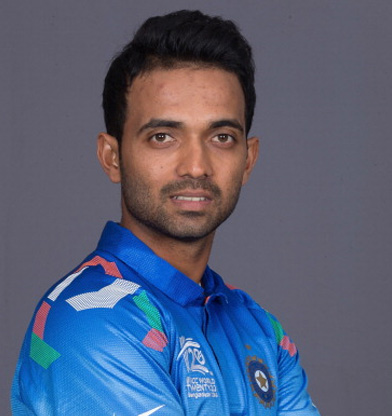
  • Indian team for Zimbabwe announced; Ajinkya Rahane named captain

    Indian team for Zimbabwe announced; Ajinkya Rahane named captain

    New Delhi: Veteran off-spinner Harbhajan Singh staged a comeback to the ODI squad after a gap of four years as a second-string team was on Monday named for next month’s tour of Zimbabwe with the selectors opting to rest most of the senior players.

    Batsman Robin Uthappa also made a return to the ODI side, while paceman Sandeep Sharma and leg-spinner Karan Sharma were included in the team to be captained by Ajinkya Rahane.

    The selection panel headed by Sandeep Patil decided to give a break to Dhoni, Kohli, Shikhar Dhawan, Suresh Raina, R Ashwin, Rohit Sharma and Umesh Yadav while recalling veteran offspinner Harbhajan Singh and others. All-rounder Ravindra Jadeja was dropped.

    Also making a comeback to the 15-member squad are Murali Vijay, Manoj Tiwary, Kedar Jadhav, Robin Uthappa, Karn Sharma. Uncapped Karnataka batsman Manish Pandey and paceman Sandeep Sharma were also included.

    There is no specialist wicketkeeper. Uthappa, Rayudu and also Jadhav have been part-time stumpers and one of them will take the big gloves in Dhoni’s absence.

    “We had picked the best possible team that played at the World Cup and keeping the future series in mind, whether it is Sri Lanka, or South Africa home series, T20 World Cup or the Australia series, we have decided to rest a few players, who need urgent rest,” he said.

    India had stunningly lost 1-2 to Bangladesh in the short series earlier this month.

    The team comprises three specialist spinners in Harbhajan, Axar Patel and Karan Sharma, while the pace department will be spearheaded by Bhuvneshwar Kumar with Mohit, Sandeep Sharma and Stuart Binny for company.

    “We cannot say on long term basis but looking at Harbhajan’s performance in the last series, we feel that he deserves a chance on this tour,” Patil said about Harbhajan, who returned to the Test side in the tour of Bangladesh.

    “The selectors’ job is to pick the best possible combination. The rest is left to the team management. Once we select the team, it is left to the captain to make up the playing XI,” he added.

    The batting will largely rest on Rahane, Vijay, Rayudu, Tiwary, Manish Pandey and Kedar Jadhav.

    “It is a good team and picking youngsters is the way forward,” BCCI Secretary Anurag Thakur said.

    Most of the senior players like regular ODI skipper Mahendra Singh Dhoni, Test captain Virat Kohli, opener Shikhar Dhawan, Rohit Sharma and off-spinner R. Ashwin, have been rested for the series.

    On Rahane being handed the captaincy Patil said, “We are happy with the way his career is shaping up. He has been the most consistent batsman for India and we want to see his other aspects. So, we have given him this opportunity and we will keep backing him.”

    India are scheduled to play three ODIs in Harare (July 10, 12 and 14) followed by a couple of Twenty20 Internationals (July 17 and 19).

    Squad:

    India: Ajinkya Rahane (c), Murali Vijay, Ambati Rayudu, Manoj Tiwary, Kedar Jadhav, Robin Uthappa, Manish Pandey, Harbhajan Singh, Axar Patel, Karan Sharma, Dhawal Kulkarni, Stuart Binny, Bhuvneshwar Kumar, Mohit Sharma, Sandeep Sharma.

  • Tendulkar voted ‘Test player of the 21st century’

    Tendulkar voted ‘Test player of the 21st century’

    MELBOURNE (TIP): In an online poll conducted on Cricket Australia’s website, Indian batting great Sachin Tendulkar was voted as the Best Test player of the 21st century. The Little Master got the highest number of votes and emerged at the top in a list of the 100 best players since 2000.

    Tendulkar earned 23 percent votes, the highest, followed by Sri Lankan Kumar Sangakkara, who got 14 percent votes, while Australia’s Adam Gilchrist came third with 13 percent votes.

    Tendulkar, who retired from Test cricket after playing his 200th game in November 2013, was the only Indian player to figure in the top-ten, which included four Australians, three South Africans and two Sri Lankans.

    “After 10 days of counting down and no end of deliberations, cricket.com.au released its final countdown of the 100 best Test players since 2000 a couple of days ago. Readers debated the top 10, just as you did players 11 through 100, but we also provided an opportunity for you to decide your No.1 Test player of the century,” CA’s website stated.

    “Tendulkar, the Little Master, who remains an iconic figure in the sport, was a runaway winner, jumping four places from where cricket.com.au had him placed, while batting giants Ricky Ponting and Jacques Kallis were separated on countback, with the Australian just edging out his Proteas counterpart,” they added.

    The Poll result:

    1. Sachin Tendulkar (Ind) 23% , 2. Kumar Sangakkara (SL) 14% , 3. Adam Gilchrist (Aus) 13% , 4. Ricky Ponting (Aus) 11% , 5. Jacques Kallis (SA) 11% , 6. AB de Villiers (SA) 10% , 7. Shane Warne (Aus) 9% , 8. Glenn McGrath (Aus) 5% , 9. Muttiah Muralitharan (SL) 3% , 10. Dale Steyn (SA) 1%

  • Business leaders urge G20 to push digital economy, e-commerce

    ISTANBUL (TIP): An influential group of business leaders have urged the G20 to improve the global trade system for the emerging digital economy as well as focus on reforms to ensure strong and sustainable growth.

    The group known as B20, met in Turkey on the sidelines of the G20 sherpas meeting and discussed the recommendations which would be finalised for the G20 leaders meeting in November. It called for eliminating data flow restrictions and softening regulations on data privacy to decrease the cost of doing business. It said customs regimes must be harmonized to ensure that bottlenecks to e-commerce are minimized and transactions are made more predictable.The G20 comprises the largest and emerging economies, which account for 85% of global GDP and 75% of world trade. It comprises the US, the UK, the European Union, India, Argentina, Australia, Brazil, Canada, China, France, Germany, Indonesia, Italy, Japan, South Korea, Mexico, Russia, Saudi Arabia, South Africa and Turkey.

    “Harmonize customer protection rules, specifically on core issues relating to purchase processes, to better facilitate e-commerce efforts and eliminate costs and administrative difficulties,” it said in its draft recommendations.

    According to estimates, the digital economy is expected to contribute $4.2 trillion or more than 5% of GDP for the G20 countries in 2016 and is growing at 10% annually. Cross border e-commerce accounts for 10-15% of total e-commerce volumes, depending on the region. By 2025, annual global cross-border e-commerce revenues could swell to between $250 billion and $350 billion-up from about $80 billion now, according to Mckinsey Global Institute and BCG analysis. The B20 has six task forces on infrastructure and investment, trade, financing and growth, anti-corruption, employment and small and medium enterprises and entrepreneurship. Each of the task forces made specific recommendations to improve business prospects within the G20, which would help lift GDP growth.

    It called for reaffirming the commitment to rollback of existing protectionist measures, particularly non-tariff barriers and said the G20 must start taking distinct actions by eliminating localization barriers to trade as a first step. Numerous reports show that G20 governments are not adhering to their standstill and roll back commitments with regards to regular tariff barriers, the B20 said.

    “Non-tariff barriers can have a much greater negative impact on GDP growth than tariffs. The benefits of reversing all barriers introduced between 2008 and 2013 is at least $460 billion increase in global exports, a $423 billion increase in global GDP and 9 million jobs supported worldwide,” it said. The B20 strongly backed the creation of an enabling environment for increased flow of private funds into more sustainable infrastructure. It said there is a need to increase the number of projects developed through public-private partnerships (PPPs) and build capabilities of governments to deliver PPPs.

  • Nestle to burn $50 million worth of noodles

    Nestle to burn $50 million worth of noodles

    New York (TIP): Nestle has issued multiple statements some contradicting their own top executive in the last few days. It is yet to be ascertained whether Nestle’s decision to burn Maggi packets recalled from the Indian Market & in its factories is a result of the Indian ban or Australia’s suspension of import from India.

    As per Nestle’s global website, Nestle India currently exports small quantities of Maggi noodles to the US, Canada, UK, Australia, Singapore and Kenya.

    Nestle has said it will burn $50 million worth of Maggi noodles in concrete incinerators after they were banned by India’s food safety regulator for containing too much lead.

    The food regulator has accused Nestle of not complying with food safety laws.

    Nestle continues to insist that the noodles are safe and that the ban is the result of issues with the interpretation of the law.

    It has however started to recall the product and burn it in incinerators at five cement factories across the country.

    According to the Indian paper AFP live, Nestle has 8 factories across India, five of which produce Maggi noodles.

    Nestle has 38 distribution centres, where products are stored before being sent to distributors

    63 Percentage of the noodle market owned by Nestle. Nestle dominates the Indian noodle market, according to Euromonitor. Nestle has been the market leader there since 2009.

    Almost 28,000 tonnes, or $32 million-worth, of Maggi noodles were in the market on June 5, when the product was decided to be recalled. Another $17 million-worth of noodles are still in factories.

    50 million dollars-worth of noodles will be burned. “These are broad estimates because it is impossible to calculate the final figure while the withdrawal is taking place,” Nestle said. It added that additional costs from bringing stock to the market and transporting it to incinerators to be destroyed had not yet been accounted for.

  • INDIAN CONSULATE IN AUSTRALIA TO ORGANISE YOGA EVENTS

    INDIAN CONSULATE IN AUSTRALIA TO ORGANISE YOGA EVENTS

    MELBOURNE (TIP): Ahead of the International Yoga Day on June 21, the Indian mission here has organised a curtain raiser for the event in front of Victoria’s Parliament house where several people gathered and performed Sun salutations.

    “Yoga is the most beautiful and inspiring gift by the Indian civilisation to the world. To live in peace with each other and themselves was the guiding words of our Prime Minister Narendra Modi when the historic resolution to celebrate this day was accepted,” the Consul General Manika Jain said.

    “A small event was organised in May to apprise people about the Yoga day at the Consulate here and it was officially launched on Monday with several people performing Suryanamaskars,” she said.

    The main event on June 21 will be held in Springers Leisure centre here as well as other parts of Australia.

    “On the main day, we are holding a day long conference and workshops in Melbourne where many leading speakers, doctors, scholars, psychiatrists and yoga experts will participate and deliberate,” Jain said.

    “We are even getting requests from many Australian universities which are keen to join the main event,” she said.

    “Yoga is no stranger to Australia. There are over 40 Yoga schools in Melbourne alone,” she said, adding the Yoga day will showcase India’s multifaceted culture and enhance its image on the world map for Australian tourists.

    “The event is surely going to create and promote awareness about India among the Australian tourists. Those keen to discover yoga techniques in order to improve spiritual and physical aspects of their life and lifestyle will make plans to travel India,” she added.

    “It will also clear up the misconception that Yoga is related to any particular religion. It can be practiced by any one from any religion or belief,” she said.

    “By participating this event, Australian tourists would see that India is a multi-faceted country and has many things to offer,” she said.

    The main event would hold several yoga and meditation sessions to be run by Rajendra Yenkannamoole, founder of the Vasudeva Kriya Yoga.

  • A way with the world

    A way with the world

    The Prime Minister, Narendra Modi, scored most in foreign policy in his first year in power. No one anticipated Modi’s natural flair for diplomacy, to which he has brought imagination and self-assurance. Modi has been more emphatic than his predecessors in giving improvement of relations with neighbors greater priority. He invited all the SAARC leaders to his swearing-in, to signal that the decisive election victory of a supposedly nationalist party did not denote a more muscular policy towards neighbors. On the contrary, India would take the lead in working for shared regional peace and prosperity.

    Bhutan, the only neighbor that has not politically resisted building ties of mutual benefit, was the first country he visited in June, 2014. He handled his August 2014 visit to Nepal with sensitivity and finesse, and followed it up with exceptional leadership in providing immediate earthquake relief to Nepal in May, 2015. In obtaining Parliament’s approval of the land boundary agreement with Bangladesh in May, 2015, Modi showed his determined leadership again.

    He did falter with Pakistan, seemingly unsure about whether he should wait for it to change its conduct before engaging it, or engage it nevertheless in the hope that its conduct will change for the better in future. He announced foreign-secretary-level talks during Nawaz Sharif’s visit to Delhi, but cancelled them precipitately. He ordered a robust response to Pakistan’s cease-fire violations, yet sent the foreign secretary to Islamabad in March, 2015, on an unproductive SAARC Yatra. Relations with Pakistan remain in flux. In Afghanistan, President Ashraf Ghani’s tilt towards Pakistan and China has challenged the viability of India’s Afghanistan policy. Ghani’s delayed visit to India in April 2015 did not materially alter the scenario for us, but India has kept its cool.

    Modi’s foreign policy premise, that countries give priority today to economics over politics, has been tested in his China policy, which received a course correction. After courting China economically, Modi had to establish a new balance between politics and economics. President Xi’s visit to India in September, 2014, was marred by the serious border incident in Ladakh. Modi showed a sterner side of his diplomacy by expressing serious concern over repeated border incidents and calling for resuming the stalled process of clarifying the Line of Actual Control. During his China visit in May, Modi was even more forthright by asking China to reconsider its policies, take a strategic and long-term view of our relations and address “the issues that lead to hesitation and doubts, even distrust, in our relationship”. He showed firmness in excluding from the joint statement any reference to China’s One Road One Belt initiative or to security in the Asia-Pacific region. The last minute decision to grant e-visas was puzzling, especially as the stapled visa issue remains unresolved. The economic results of his visit were less than expected, with no concrete progress on reducing the huge trade deficit and providing Indian products more market access in China. The 26 “agreements” signed in Shanghai were mostly non-binding MoUs involving the private sector and included the financing of private Indian companies by Chinese banks to facilitate orders for Chinese equipment.

    Modi’s visit to Seychelles, Mauritius and Sri Lanka in March, 2015, signified heightened attention to our critical interests in the Indian Ocean area. Modi was the first Indian prime minister to visit Seychelles in 33 years. His visit to countries in China’s periphery in May, 2015, was important for bilateral and geopolitical reasons. During his visit to South Korea the bilateral relationship was upgraded to a “special strategic partnership’, but Korea nevertheless did not support India’s permanent membership of the United Nations Security Council. Modi’s visit to Mongolia was the first by an Indian prime minister to a country whose position is geopolitically strategic from our point of view.

    Belying expectations, Modi moved decisively towards the United States of America on assuming office. He set an ambitious all-round agenda of boosting the relationship during his September, 2014, visit to Washington. In an imaginative move, he invited Obama to be the chief guest at our Republic Day on January 26, 2015. To boost the strategic partnership with the US, he forged a “breakthrough understanding” on the nuclear liability issue and for tracking arrangements for US-supplied nuclear material. Progress on the defense front was less than expected with four low-technology “pathfinder” projects agreed under the defense technology and trade initiative. The important US-India joint strategic vision for the Asia-Pacific and Indian Ocean region, issued as a stand-alone document, high-lighted the growing strategic convergences between the two countries, with China in view. A special feature of Modi’s September, 2014, US visit was his dramatic outreach to the Indian community, which has since then become a pattern in his visits abroad, whether in Australia, Canada or Beijing. No other prime minister has wooed the Indian communities abroad as Modi has done.

    President Putin’s visit to India in December, 2014, was used to underline politically that Russia remains India’s key strategic partner. Modi was effusive in stating that with Russia we have a “friendship of unmatched mutual confidence, trust and goodwill” and a “Strategic Partnership that is incomparable in content”. He was careful to convey the important message that even as India’s options for defense cooperation had widened today, “Russia will remain our most important defense partner”. Civilian nuclear cooperation with Russia got a boost with the agreement that Russia will build “at least” ten more reactors in India beyond the existing two at Kudankulam. All this was necessary to balance the strengthened strategic understanding with the US and its allies.

    Modi bolstered further our vital relations with Japan, which remains a partner of choice for India. Shinzo Abe announced $35 billion of public and private investment in India during Modi’s visit to Japan in September 2014, besides an agreement to upgrade defense relations.

    Modi’s visit to France and Germany in April, 2015, recognized Europe’s all-round importance to India and was timely. He rightly boosted the strategic partnership with France by ensuring concrete progress in the key areas of defense and nuclear cooperation by announcing the outright purchase of 36 Rafale jets and the MoU between AREVA and L&T for manufacturing high-technology reactor equipment in India. Modi’s bilateral visit to Canada in April, 2015, was the first by an Indian prime minister in 45 years. Bilateral relations were elevated to a strategic partnership and an important agreement signed for long-term supply of uranium to India.

    Relations with the Islamic world received less than required attention during the year, although the Qatar Emir visited India in March, 2015, and the political investment we made earlier in Saudi Arabia aided in obtaining its cooperation to extract our people from Yemen. Gadkari went to Iran in May, 2015, to sign the important agreement on Chabahar. Modi did well to avoid any entanglement in the Saudi-Iran and Shia-Sunni rivalry in West Asia. He met the prime minister of Israel, Benjamin Netanyahu, on the sidelines of the UN general assembly meeting in September, last year, to mark the strength of India-Israel ties. So, Modi’s handling of India’s foreign policy in his first year is impressive. He has put India on the map of the world with his self-confidence and his faith in the nation’s future.

  • 12 Melbourne women try to flee Australia to join ISIS

    MELBOURNE (TIP): At least five young women from Australia have successfully joined the Islamic State and are among over a dozen similar cases from Melbourne most of whom have a “romanticised” view of the dreaded militants and want to become “jihadist brides”, police said on May 27.

    The women are said to be between 18 to 20 years of age, and had lied to their families about their intentions before leaving Australia.

    Victoria Police assistance commissioner Tracy Linford said that while it was difficult to quantify the exact numbers involved, the state police knew of at least 12 such women who had tried to flee and at least five who had succeeded in joining the terror group.

    The others were either turned back or are unaccounted for and also became “jihadist brides” in some cases, police said.

    Linford said the numbers are perhaps greater than that and was concerned some of the women had been pushed into sexual servitude in Syria and Iraq, according to an ABC report.

    “We want people to understand that it’s not just a phenomenon of young men wanting to travel over to the conflict zone and join ISIS, there are women that are being lured there as well,” she said.

    Linford said most of the women had a “romanticized” view of what life was like in a conflict zone.

    “(They think) that they’ll go over there and life will be really good for them, that they’ll be put on a pedestal. The reality is the information that we’re getting back from overseas is that the lifestyle’s not so good at all.” she said.

    “We’ve had information come back that some women have actually been pushed into sexual servitude, the living conditions can be very tenuous for a young women over there, they can be on rations and living in squalid and dirty conditions,” she added.

    Linford urged family and friends to pay attention to young women, as well as young men, who might be showing changed behaviour or disengaging from their normal family and friendship circles, the report said.

    “Some of the families have contacted us, some of the families were taken by surprise when their daughters said they’re travelling for some other purpose and then they subsequently find out that they’ve gone to the conflict zone. In other cases, we’ve seen women who have succeeded in getting overseas and into those zones and have actually reached back through social media and sent messages letting their family and friends know where they are,” she said.

    It has been estimated that 30 young men had so far travelled from Victoria to join the ISIS, police said.

    A new “Taskforce Pax” set up to monitor Victorians who may pose a security risk will work with existing counterterrorism squads.

  • Defending champion Saina Nehwal bows out of Australian Open

    Defending champion Saina Nehwal bows out of Australian Open

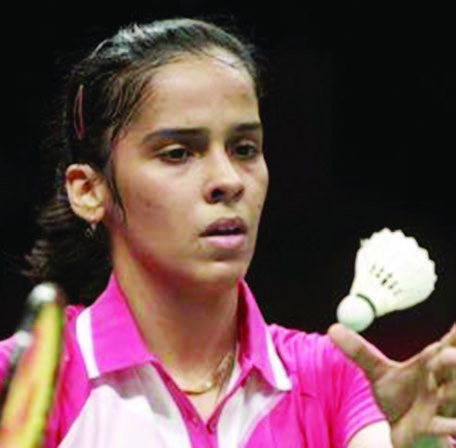
    SYDNEY (TIP): Indian challenge ended at the Australian Open Super Series after ace shuttler Saina Nehwal suffered a straight-game defeat against China’s Shixian Wang in the women’s singles quarterfinals of the badminton tournament here on May 28.

    World No.1 Saina failed to stick to her game plan and suffered a 15-21, 13-21 loss to two-time All England Champion and fifth seed Shixian in a 41-minute clash. It was Saina’s sixth defeat against the Chinese in 12 meetings.

    In the opening game, Saina had grabbed a slender lead of 4-2 but Shixian soon wrested control of the match and went into the break at 11-8.

    Slowly and steadily, Saina clawed back to 14-14 but a ruthless Shixian reeled off six straight points to grab a massive six game point at 20-14 and then pocketed the match without much ado.

    In the second game, Shixian once again opened up a three-point lead at 6-3. The Indian tried to arrest the slide and went neck and neck from 6-6 to 10-10 but after that the Chinese moved ahead with giant steps to once again leave Saina behind.

    Saina will next play in Indonesia Open Super Series Premier tournament starting on June 2.

  • ‘Generous’ BCCI gives big CLT20 relief to STAR

    MUMBAI (TIP): The BCCI has over the years acquired the reputation of a domineering big brother in dealing with its various partners, thanks to Team India’s massive popularity at home and abroad. From broadcasters, to various sponsors, franchise owners, overseas telecast rights holders, online partners and more, they have all, at some point of time, complained that dealing with the Indian cricket board hasn’t been easy .

    That was until recently when Star TV , the present right holders for all cricket played in India and sponsors of the Indian national teams, did the impossible. In a show of rare bonhomie, Star has managed to convince the BCCI to waive off $475m that they were scheduled to pay for the remaining four years of Champions League T20 event under the 10-year deal signed between BCCI and the ESPN-Star JV in 2009. In turn, Star will pay the BCCI, Cricket South Africa and Cricket Australia – the three boards which host the tournament -a collective compensatory figure of $300m to exit the tournament. ESPN-Star had bought the Champions League rights for a period of 10 years starting 2009 for a huge $975m after losing out on the Indian Premier League (IPL) rights that had been offered to MSM India in 2007-08. Six editions of the tournament have been played so far and four remain, including the 2015 season.

    Sources say the understanding between BCCI and Star to close the deal took place when N Srinivasan -the present International Cricket Council (ICC) chairman -was at the helm of affairs in BCCI. The announcement has been delayed only because financial parameters had to be worked out.

    The deal will help Star save on an estimated$90m per season that they had to shell out (four seasons remained) as part of the tripartite agreement between them and the three cricket boards for a property that clearly had few takers. Giving BCCI’s penny-pinching ways of conducting business, only the board’s bigwigs can explain why they decided to act on the misery afflicting their biggest business partner. “They’ve rarely shown such a generous side,” said a source. Star TV holds the Indian telecast rights, the national team’s sponsorship rights, the online media rights and the ground and title rights for the cricket played in India. Their partners in UK, Sky TV , hold the IPL’s international telecast rights.

  • Indians Second-Largest Migrant Group in UK

    Indians Second-Largest Migrant Group in UK

    LONDON:  Indians are the second-largest group of migrants coming to the UK after Chinese, according to latest figures.

    In 2013, 46,000 Chinese migrants entered Britain for study and work reasons followed by 33,000 Indians.

    India is tied at second place along with Spanish migrants from within the European Union, also at 33,000, according to the Office of National Statistics (ONS) International Passenger Survey (INS).

    Around 29,000 migrants came from Australia, 27,000 from Poland, 22,000 from France and 20,000 from the US.

    Three-quarters of immigrants to the UK are people migrating to work or study, ONS found as part of a research on long-term international immigration.

    On the reverse side, most British expats who had emigrated out of the country are also coming back to the UK for work-related reasons, with 46,000 doing so last year.

    “Generally, immigration of British citizens remains relatively stable, both in terms of the overall level and the main reasons for immigrating,” the ONS notes.

    The flow of immigrants into Britain is set to remain an emotive issue in the UK as Prime Minister David Cameron’s Conservative-led government struggles to control the figures.

    He had reiterated his determination to not “cave in” on tough immigration targets as part of a speech yesterday when ONS figures revealed that net migration rose by 50 per cent to 318,000 last year with a total of 641,000 people moving to the UK in 2014.

    The Conservatives had pledged before the 2010 election to reduce numbers to less than 100,000, a target they acknowledge they have failed to meet.

    “There is the approach of just give up, cave in and forget about it. But that’s not my approach,” he said as he pledged tougher rules to crack down on illegal workers in the country.

  • Two Indian cities at high risk of terror strike

    Two Indian cities at high risk of terror strike

    LONDON (TIP): Two Indian cities -Imphal (ranked 32) and Srinagar (ranked 49) have been named to be at “extreme risk” of a terrorist attack, mainly aiming to cause mass casualty and destroy public transport networks.

    According to an analysis of the terror risk to 1,300 commercial hubs and urban centres around the world, populations and businesses in 113 Indian cities have been identified to be at some risk – high, medium or low risk of facing terrorist attacks.

    The next major Indian city after these two that faces a terrorist threat is Chennai even though the risk quotient has been marked as medium risk.

    Bangalore is the fourth most prone city even though it is placed at 204th in the global threat list followed by Pune and Hyderabad at 206th and 207th respectively

    Cities like Nagpur (ranked 2010) and Kolkata (2012) have been found to face a higher risk of a mass attack by terrorists that the usually expected targets like Delhi (447) and Mumbai (298).

    Around 64 cities around the world are at “extreme” risk, with most in the Middle East and Asia – and three in Europe.

    London ranked as low as at 400 due to the lack of a terror incident since the 7/7 bombings while Paris has soared into the top 100 cities following the Charlie Hebdo shooting, according to Verisk Maplecroft’s new Global Alerts Dashboard (GAD).

    Arvind Ramakrishnan, head of Maplecroft India said “When it comes to Imphal and Srinagar, terrorist attacks aren’t on commercial targets as much as against the security forces. However n most of the other metropolitan cities, the targets are both to cause mass casualty and cripple its commercial hubs. Public transport networks in India are also prime targets”.

    Ramakrishnan added “The Mumbai attack in 2008 was the turning point for India. But lack of intelligence sharing among states is a big worry. Law and order is still a state subject in India and political rivalries across states leads to state intelligence agencies not sharing actionable data. Virtually all police forces in India lack modern equipment and adequate manpower to counter a terrorist threat. This brings down the overall morale of the force. India does not face threats from cross border terror organisations but also from home grown ones like the Indian Mujahideen”.

    Charlotte Ingham, head of security analytics at Maplecroft UK said in total, 64 cities are categorised as
    ‘extreme risk’ in an online mapping and data portal that logged analysed every reported terrorism incident since 2009.

    Based on the intensity and frequency of attacks in the 12 months following February 2014, combined with the number and severity of incidents in the previous five years, six cities in Iraq top the ranking.

    Over this period, the country’s capital, Baghdad, suffered 380 terrorist attacks resulting in 1141 deaths and 3654 wounded, making it the world’s highest risk urban centre, followed by Mosul, Al Ramadi, Ba’qubah, Kirkuk and Al Hillah. Ingham said “just because a city in India hasn’t seen a terrorist attack in a while does not mean it isn’t potentially facing one. The rankings are based on the frequency and intensity of attacks.

    Belfast has been named as the most dangerous city in Europe while Baghdad topped the list worldwide.

    Outside of Iraq, other capital cities rated ‘extreme risk’ include Kabul (13th most at risk), Mogadishu in Somalia (14th), Sana’a in Yemen (19th) and Tripoli in Libya (48th).

    However, with investment limited in conflict and post-conflict locations, it is the risk posed by terrorism in the primary cities of strategic economies, such as Egypt, Israel, Kenya, Nigeria and Pakistan that has the potential to threaten business and supply chain continuity.

    “An estimated 80% of global GDP is generated from cities,” states Ingham. “Visibility of the sub-national differences in terrorism levels should be an imperative for multinational organisations looking to understand and price the risks to assets, employees and supply chains”.

    As Africa’s largest economy, Nigeria’s role as a commercial hub is central to economic growth across the region. Because of Boko Haram 13 out of the 24 Nigerian cities experienced a significant increase in the intensity and frequency of terrorist attacks compared to the previous quarter.

    Paris (97th and ‘high risk’) has experienced one of the steepest rises in the ranking, reflecting the severity of the terrorist attack in January 2015 that left 17 people dead. The risk level in Paris is representative of a wider trend for Western countries, including Belgium, Canada and Australia, where the level of risk in key urban centres is substantially higher than elsewhere in the country”.

  • SUPPRESSING DISSENT – Why Greenpeace is first on the Indian government’s chopping block

    Source: World Resources Institute
    Source: World Resources Institute

    As Greenpeace India struggles to stay afloat, the real reason why the government wants to shut down the global environmental NGO hasn’t got much attention: Coal, the single biggest source of primary energy in India, is at the heart of the Narendra Modi government’s ambitious plans to ramp up industrial production in the country.

    Source: PwC
    Source: PwC

    A total of 1,199 new coal-based thermal power plants with a total installed capacity of more than 1.4 million MW proposed worldwide, the lion’s share – 455 plants – are in India, according to data from the World Resources Institute.

    India is overwhelmingly dependent on fossil fuels – coal, oil and gas – which meet more than three fourths of the country’s energy needs, despite Modi’s plans to promote alternative energy sources.

    Of the fossil fuels, oil and gas account for just about 30% of India’s energy needs, the bulk imported (80% in the case of crude oil). India has abundant reserves of coal, the fourth-largest in the world.

    Coal meets 54.5% of India’s energy needs, and 61.5% of the installed power generation capacity, and plays a key role in industries like steel and cement.

    India is set to more than double its coal consumption by 2035 and become the world’s largest coal importer by around 2020, according to the International Energy Agency.

    The cheapest of fossil fuels, coal is also the most polluting in terms of carbon emissions. Coal-burning power plants are the single biggest cause of climate change, way ahead of the burning of petroleum in transportation.

    Greenpeace has been at the forefront of a global campaign against coal mining and burning, and its Indian wing has mounted several high-visibility campaigns against coal-burning thermal power plants and coal mining in forest areas.

    Coal India and Adani in the spotlight

    Greenpeace graph2
    Especially irksome to the government must have been Greenpeace’s targeting of two domestic entities that are also major global players in coal – public-sector company Coal India, India’s 5th most valuable company by market capitalization at $35.9 billion (Rs 2.3 lakh crore) and the Gujarat-based Adani Group, whose promoter Gautam Adani is known to have a close relationship with Modi.

    Coal India is number one, and the Adani Group number three on the list of the top 200 coal companies globally ranked by the potential carbon emissions content of their reported reserves, according to Fossil Free Indexes, a stock market index that promotes ethical investing.

    Greenpeace has campaigned against both companies, exposing their claims on reserves and financial health, and documenting environmental and other violations. Greenpeace’s Australia chapter has opposed Adani’s plans to develop the world’s largest coal deposit, the Carmichael mine in Queensland, which it acquired for 16.5 billion dollars.

    Breakneck industrialization, Chinese style Companies like Coal India and Adani are expected to play a vital role in the Modi government’s grand plan for India to take over from China as the new ‘factory of the world’. With GDP growth dipping to 7% for the first quarter of 2015 (the lowest since 2009), China is clearly slowing down. India seems intent on capitalizing on this slowdown and the newfound limits on growth imposed by environmental and health concerns in China.

    The first signs that the Modi government is pushing for a Chinese-style industrialization project came when it announced a clutch of mega projects under the Make-In-India initiative. Work is underway on the most ambitious of these projects, the Delhi-Mumbai Industrial Corridor, across six states, to be built at an estimated cost of $100 billion.

    For the government, one of the chief obstacles in this path is land acquisition, which is being tackled through amendments to the existing legislation. The other big hurdle is energy, in which coal will continue to play the biggest part-and this is at the core of its grouse with organizations such as Greenpeace.

    Coal and Climate Change – an existential threat

    The burning of fossil fuels – coal, oil and gas, in that order – releases massive amounts of carbon into the atmosphere, and has been proven to be the biggest culprit behind climate change.green peace chart 4

    With carbon-dioxide levels at record highs – as IndiaSpend reported – only a fraction of the known extractable fossil fuel reserves, least of all, coal, can be burned without endangering the world’s future, the reason why campaigners like Greenpeace are dead set against the fuel. But for the Modi government, and India’s elites and middle classes in general, this would amount to the big prize being snatched away from sniffing distance. That’s why the shots fired against Greenpeace may be only the first in the long, bruising battle ahead.

    (This article was originally published on IndiaSpend.com, a data-driven and public-interest journalism non-profit)

  • Strategic Autonomy as an Indian Foreign Policy Option

    Strategic Autonomy as an Indian Foreign Policy Option

    [quote_right]For a large country like India, which has the potential of becoming a big power in the future, strategic autonomy is a compelling choice. By virtue of its demographic, geographic, economic and military size, India must lead, but does not have yet the comprehensive national power to do so. It cannot subordinate itself to the policies and interests of another country, however powerful, as its political tradition and the functioning of its democracy will not allow this. India may not be strong enough to lead, but it is sufficiently strong not to be led”, says the author.[/quote_right]

    In the joint statement issued during the Indian prime minister’s visit to France in April, the two sides reaffirmed “their independence and strategic autonomy” in joint efforts to tackle global challenges. In the French case, as a member of NATO it is not so clear what strategic autonomy might mean, but in our case it would essentially mean independence in making strategic foreign policy decisions, and, consequently, rejecting any alliance relationship. It would imply the freedom to choose partnerships as suits our national interest and be able to forge productive relationships with countries that may be strategic adversaries among themselves.

    In practical terms, this means that India can improve relations with the United States of America and China while maintaining close ties with Russia. It can forge stronger ties with Japan and still seek a more stable relationship with China. It can forge strong ties with Israel and maintain very productive ties with the Arab world, including backing the Palestinians in the United Nations. It means that India can have strategic partnerships with several countries, as is the case at present with the US, France, Germany, the United Kingdom, the European Union, Russia, China, Japan, Brazil, Saudi Arabia, Australia, Canada, Kazakhstan, Afghanistan, Vietnam, Iran and the like.

    It means that India can be a member of BRICS and the RIC dialogues, as well as IBSA, which exclude the West, and also forge closer political, economic and military ties with the Western countries. Our strategic autonomy is being expressed in other ways too. India is a democracy and believes that its spread favors its interests, but it is against the imposition of democracy by force on any country. If the spread of democracy is in India’s strategic interest, using force to spread it is against its strategic interest too, as is shown by the use of force to bring about democratic changes in West Asia by destroying secular authoritarian regimes and replacing them with Islamic authoritarian regimes. Likewise, India believes in respect for human rights, but is against the use of the human rights agenda to further the geo-political interests of particular countries, essentially Western, on a selective basis.

    For a large country like India, which has the potential of becoming a big power in the future, strategic autonomy is a compelling choice. By virtue of its demographic, geographic, economic and military size, India must lead, but does not have yet the comprehensive national power to do so. It cannot subordinate itself to the policies and interests of another country, however powerful, as its political tradition and the functioning of its democracy will not allow this. India may not be strong enough to lead, but it is sufficiently strong not to be led.

    India preserved its strategic autonomy even in the face of severe technology sanctions from the West on nuclear and missile issues. It preserved it by not signing the non-proliferation treaty and continuing its missile program. By going overtly nuclear in 1998, India once again exercised its strategic autonomy faced with attempts to close the doors permanently on its nuclear program by the permanent extension of the NPT and the comprehensive nuclear test ban treaty and fissile material cutoff treaty initiatives.

    In some quarters in India and abroad, the idea of strategic autonomy is contested as another manifestation of India’s non-aligned mindset, its propensity to sit on the fence, and avoid taking sides and assuming responsibility for upholding the present international order as a rising power should. These critics want India to join the US camp more firmly to realize its great power ambitions. These arguments ignore the reality that while the US has been crucial to China’s economic rise, China has been sitting on the fence for many years, even as a permanent member of the UN security council. Far from sacrificing its strategic autonomy, it has become a strategic challenger of the US.

    To be clear, the US government has officially stated its respect for India’s position on preserving its strategic autonomy, and denies any expectation that India would establish an alliance kind of relationship with it. It is looking for greater convergence in the foreign policies of the two countries, which is being realized.

    During Narendra Modi’s visit to the US in September, 2014, and Barack Obama’s visit to India in January this year, a strategic understanding on Asia Pacific and Indian Ocean issues, encapsulated in the January 2015 joint strategic vision for the Asia Pacific and the Indian Ocean has emerged. This document suggests a shift in India’s strategic thinking, with a more public position against Chinese maritime threat and a willingness to join the US in promoting partnerships in the region.

    Modi chose a striking formulation in his joint press conference with Obama in September when he said that the US was intrinsic to our Look East and Link West policies, which would suggest a growing role for the US in our foreign policy thinking. During Obama’s January visit, the joint statement noted that India’s Act East policy and the US rebalance to Asia provided opportunities for India, the US and other Asia-Pacific countries to work closely to strengthen regional ties. This was the first time that India implicitly endorsed the US rebalance towards Asia and connected our Act East policy to it.

    Rather than interpreting it as watering down our strategic autonomy, one can see it as strengthening it. So far, India has been hesitant to be seen drawing too close strategically to the US because of Chinese sensitivities. China watches closely what it sees are US efforts to rope India into its bid to contain China. At the same time, China continues its policies to strengthen its strategic posture in India’s neighborhood and in the Indian Ocean at India’s expense, besides aggressively claiming Indian territory.

    By strengthening relations with the US (which is strategically an Asian power), Japan and Vietnam, and, at the same time, seeking Chinese investments and maintaining a high-level dialogue with it, India is emulating what China does with India, which is to seek to build overall ties as much as possible on the economic front, disavow any negative anti-India element in its policies in our neighborhood, but pursue, simultaneously, strategic policies intended to contain India’s power in its neighborhood and delay its regional extension to Asia.

    In discussing the scope of our strategic autonomy, one should recognize that the strength of US-China ties, especially economic and financial, far exceeds that of India-US ties. India has to be careful, therefore, in how far it wants to go with the US with a view to improving its bargaining power with China. The other point to consider is the US-Pakistan equation. The US has just announced $1 billion of military aid to Pakistan; its position on the Taliban is against our strategic interests in Afghanistan; its stand on Pakistan’s sponsorship of terrorism against us is not robust enough.

    To conclude, strategic autonomy for India means that it would like to rely as far as possible on its own judgment on international issues, balance its relations with all major countries, forge partnerships with individual powers and take foreign-policy positions based on pragmatism and self-interest, and not any alliance or group compulsion.

    (The author is former foreign secretary of India. He can be reached at sibalkanwal@gmail.com)

  • The Mayweather-Pacquiao Fight watch online or on HBO now

    The Mayweather-Pacquiao Fight watch online or on HBO now

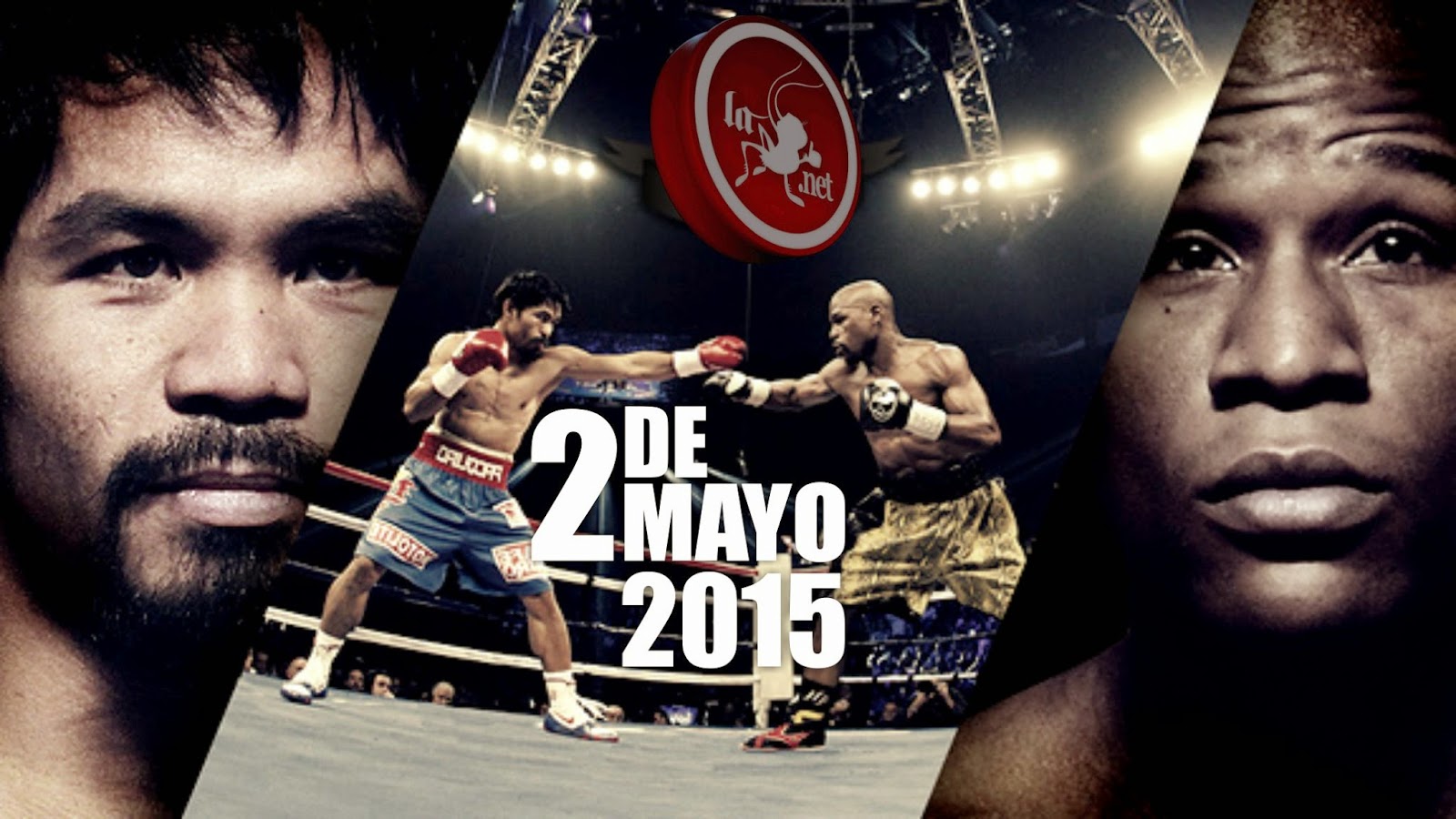
    Floyd Mayweather faces Manny Pacquiao in the “fight of the century” tonight on pay-per-view, with the main card broadcast beginning at 9 pm EST / 6 pm PST from the MGM Grand Garden Arena in Las Vegas, Nevada.

    This is the first time that premium cable giants HBO and Showtime have worked together on a fight since 2002’s Lennox Lewis vs Mike Tyson event, which generated record money for the time. Five years later, Mayweather’s fight with Oscar De La Hoya broke all the records. In 2013, Mayweather’s fight with Canelo Alvarez set new marks for PPV revenue and live gate revenue.

    Tonight, every record falls, as the biggest fight in the sport has finally come after five years of waiting.

    Here’s what you need to know:

    Fight Time: 9:00 pm EST

    Main Event Fight Time: Around 11:00 pm EST

    TV Channels: HBO/SHO PPV in the United States ($89.95-99.95); Sky Box Office in the United Kingdom (£14.95); Main Event PPV in Australia ($59.95); Sky Arena in New Zealand ($49.99); Televisa and Azteca in Mexico; Sport 1 in Hungary; Frecuencia Latina in Peru; Ma Chaine Sport in France.

  • No Indian name on ‘top 100 young university’ list

    LONDON (TIP): No Indian university has made it to the list of the world’s top 100 which are under 50 years old.

    Institutes from 28 countries are present in the list of rising global higher education universities poised to challenge the traditional Anglo-American dominance of the sector.

    Over 800 universities worldwide had submitted data for analysis of which 20 were from India.

    Phil Baty, rankings editor, Times Higher Education, told media, “A number of these Indian institutions did not meet our data providers’ strict criteria for inclusion in the rankings which includes a minimum number of research papers to be published each year and were therefore excluded. Many of the remaining institutions were also founded before 1964 which meant that they could not be considered for the 100 under 50.”

    Three factors were identified which helped the rise of these institutions. Citation Impact – how much a university’s research papers are being referenced by other academics; a measure of the influence its research has on the rest of the world. The second is ‘Income from Industry’ – how much companies are working with academics and applying their research to the real-world. Lastly, ‘International Outlook’, a measure of how many international students and staff a university attracts and how much it is collaborating on international research papers with other institutions.

    Ecole Polytechnique Federale de Lausanne moved to pole position from second place, where it has sat since the first 100 under 50 was published in 2012. It swaps places with South Korea’s Pohang University of Science and Technology. The remainder of the top five is static: the Korea Advanced Institute of Science and Technology (KAIST) holds on to third, the Hong Kong University of Science and Technology retains fourth, while Singapore’s Nanyang Technological University remains in fifth.

    The top 10 includes representatives from eight countries overall: the Netherlands’ Maastricht University holds on to sixth; the US’ University of California, Irvine is seventh with its UC stablemate Santa Cruz moving up three places to eighth; the UK’s University of Warwick rises from 12th to ninth and France’s Paris-Sud University falls two places to 10th.

    Australia has emerged as the number one nation, with 16 top 100 institutions, up from 14 last year. It also has a new number one, the University of Technology, Sydney, in 21st spot overall: it overtakes the University of Newcastle (30th in 2015).

    This contrasts favourably with the UK’s representatives, which are heavily concentrated in the 1960s. They are led by the University of Warwick in ninth, followed by the University of Dundee (joint 19th). This is Warwick’s final year in the list due to its 1965 foundation date, and Dundee has only two years left. Only four of the 15 UK universities in the list were founded after the 1960s.

  • Prosecuting those responsible for MH17 crash key priority: Dutch minister

    Prosecuting those responsible for MH17 crash key priority: Dutch minister

    HAGUE (TIP): Prosecuting those responsible for shooting down Malaysia Airlines flight MH17 over Ukraine, killing all 298 passengers and crew —193 of them Dutch — is a key priority for the Netherlands, the justice minister said April 16.

    The Boeing 777 was shot down over war-torn eastern Ukraine in July last year.

    Kiev and the West have claimed that separatists, using a BUK surface-to-air missile supplied by Russia, were responsible, a charge denied by Moscow, which has in turn pointed the finger at Kiev.

    “Now that we are at an advanced stage of the repatriation mission, the (criminal) investigation and prosecution will occupy a more central place,” Dutch Justice Minister Ard van der Steur, said in a statement.

    Van der Steur and Dutch Foreign Minister Bert Koenders met Thursday on the sidelines of a cyber security summit in The Hague with delegates from countries affected by the disaster, including Malaysia and Australia as well as Ukraine.

    The Netherlands has taken the lead in the investigation into the cause of the incident and identifying the victims of the flight from Amsterdam to Kuala Lumpur.

    A preliminary report in September, which apportioned no blame, said the plane “broke up in the air probably as the result of structural damage caused by a large number of high-energy objects that penetrated the aircraft from outside”. A final report is due in the summer.

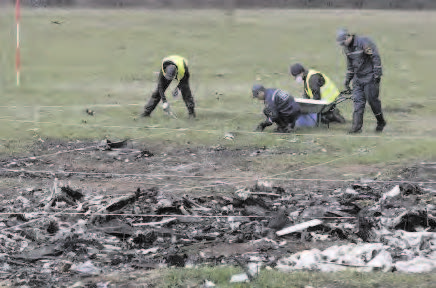
    Also on April 16 Dutch investigators recovered more body parts from the crash site after searching a location that was previously inaccessible because of clashes between pro-Russian separatists and the Ukrainian army.

    The fighting has lessened in intensity since a February ceasefire, paving the way for the investigators to continue their work, and Thursday’s operation focused on Petropavlivka, about 10 kilometres (six miles) west of Grabove where most of the debris fell.

    “The mission was again able to recover human remains and personal effects at two sites,” Jean Fransman, a spokesman for the Department of Justice, told media.

    “Personal effects were given to the members of the mission by the local population: it was jewellery,” the ministry added in a statement.

    Last year’s searches of the area had also turned up body parts, personal effects and pieces of the plane’s wreckage.

    The remains of all but two victims, both Dutch, have been identified.

  • WHY INDIA MATTERS TO CANADA

    WHY INDIA MATTERS TO CANADA

    For two countries that Prime Minister Stephen Harper calls “natural partners” in a new global economy, Canada and India might appear to share a rather meek business relationship.

    Not even one per cent of Canadian exports currently ship to India, with goods exports around $3.1 billion in 2014 – less than one-sixth what Canada exports to China.

    Promising to open India to global commerce, Indian Prime Minister Narendra Modi’s historic three-day Canadian tour this week seeks to change that.

    His trip ends a 42-year dry spell since a head of state from the world’s largest democracy visited to talk bilateral relations.

    As Harper pushes for a free-trade pact with Modi, Canadian economists and business leaders representing South Asian professionals lay out their case for why India is a social, political, cultural and economic force that matters.

    1. A hot opportunity

    “Let’s not forget there’s a race to get to India’s door,” says Jaswinder Kaur, director of the Canada-India Centre of Excellence in Ottawa.

    “We’re competing against Japan, the French, the Australians, and this is an opportunity for Canada to demonstrate how we can contribute and make a true partnership.”

    Canada’s Global Markets Action Plan identified India as a priority market, with a burgeoning economy and roughly 11 million people under 30 entering the workforce each year.

    India has for years remained the largest market for Canada’s pulses (grain legumes such as lentils and peas), and Canada also supplies lumber and potash.

    “But are Canadian companies ready to do business?” Kaur says. “That’s where the real work is going to begin.”

    The International Monetary Fund projects that by 2016, India’s GDP growth will outpace that of China’s becoming the fastest-growing major economy in the world.

    In the meantime, two-way bilateral trade has grown to $6 billion, up 47 per cent since 2010, when trade was around $4.09 billion.

    2. Energy demands

    Much has been made, Kaur notes, of Modi “shopping for uranium” as part of this Canadian tour.

    India needs the radioactive element to feed its nuclear reactors, and Canada has a vast supply.

    ‘Mr. Modi will be looking for a signed contract for Canada to be a supplier of uranium, as India desperately needs energy as it expands.’ – Elliot Tepper, Carleton University South Asian studies professor

    If Ottawa allows, Saskatchewan-based Cameco Corp. could resume uranium exports to India following a ban 40 years ago, when India was accused of testing a nuclear weapon in 1974, and then again in 1998, using Candu technology supplied by Canada.

    “Since then, our relations have slowly climbed back up to the point where we have a nuclear agreement,” said Elliot Tepper, a South Asian studies professor at Carleton University.

    “Mr. Modi will be looking for a signed contract for Canada to be a supplier of uranium, as India desperately needs energy as it expands, and wants to rely more on nuclear power.”

    Meanwhile, Canadian natural gas and oil will continue to be useful resources to India.

    3. Young population

    The under-35 demographic represents more than 65 per cent of India’s population, and many of them are migrating from rural areas to cities searching for education and employment, both of which Canada can help supply.

    Open for business. India’s Prime Minister Narendra Modi addresses the world’s largest industrial technology fair, the Hannover Messe, in Hanover, Germany, earlier this month. He has been on something of a world tour, trying to drum up industrial investment in job-hungry India.

    Modi’s “Make in India” initiative is encouraging international firms to set up manufacturing plants in India to spur job creation at home and become a low-cost alternative to China.

    Flipping the saying that China will grow old before it grows rich, Gary Comerford, president of the Canadian Indian Business Council, believes

    “India will grow wealthy before it grows old.”

    Over the last decade, he says, a large number of Indians have “pulled themselves out of poverty” and into a rising middle class.

    “And that means they’re consuming,” Comerford says of the next generation of big spenders. “They’re getting a fridge, a TV, a cellphone.

    “If you take that sheer population of 1.2 billion and convert it into a consuming group, as well as being an economic powerhouse, it will be a political powerhouse as well.”

    4. Cross-cultural understanding

    India remains a democracy with a “remarkably pluralistic society,” which Canada can appreciate as a state that welcomes diversity as a foundation of the country, says Tepper.

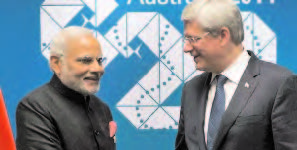
    Two business-friendly PMs, India’s Narendra Modi and Canada’s Stephen Harper chat at the G20 summit in Australia in November. (The Canadian Press)

    “That makes our two countries both natural allies and rather special in terms of the states of the world,” he says, adding that the two countries have worked together quietly for years on such things as counter-terrorism and sharing concerns about violent extremists.

    University of Toronto professor Kanta Murali, who analyzes Indian politics at the Centre for South Asian Studies, points to a 1.2 million-strong Indian diaspora in Canada as “central to the excitement surrounding Modi’s visit.”

    A shared history under British colonial rule, a broadly English-speaking population and a democratic system add to a sense of kinship, adds Comerford.

    5. A knowledge economy

    According to Dherma Jain, president of the Indo-Canada Chamber of Commerce, more than 15,000 Indian students have decided to pursue foreign studies at universities and colleges in Canada.

    Modi’s visit is expected to seal some educational co-operation agreements such as twinning programs, Tepper said.

    “Canada will be providing expertise that India invites as it wants to upscale its own capacity, from technology to agriculture, and attracting people to come to Canada instead of going elsewhere,” he said.

    India is interested in harnessing green tech as well, notes Karunakar Papala, chairman of the Indo-Canada Ottawa Business Chamber, which represents some 600 business owners in the capital.

    Modi’s plan for India to develop 100 high-tech “smart cities” that are more energy and resource efficient, could benefit from Canadian know-how. (The Indian prime minister made a similar pitch when he visited Germany recently.)

    “Solar technologies, green technologies, Canada has got a lot to offer there,” Papala said.

  • RBI GOVERNOR GETS DEATH THREAT FROM IS

    MUMBAI (TIP): Reserve Bank of India (RBI) Governor Raghuram Rajan recently received a death threat from a purported Islamic State (IS) email account that is being accessed from across the globe.

    The governor received the threat on his official email address last month from isis583847@gmail.com—an account which the police said had been opened from Australia, Canada, Italy, Germany, US, Nigeria, Poland, Belgium, Hong Kong and Ukraine in a span of a few days.

    While security measures at the RBI has been beefed up, Mumbai Police Commissioner Rakesh Maria has asked the Cyber Crime Investigation Cell to conduct thorough investigations.

    The RBI refused to comment on the issue, but inside sources confirmed that Rajan was currently in the US along with Union Finance Minister Arun Jaitley to attend the World Bank group meeting in Washington. Without elaborating on the details of the e-mail, police sources said the IS warned Rajan that he would be eliminated as a contract had been received to execute him.

  • Shell to buy BG for $70bn, take on Exxon

    Royal Dutch Shell agreed to buy smaller rival BG Group for 47 billion pounds ($70.2 billion) in the first major energy industry merger in more than a decade, closing the gap on market leader ExxonMobil after a plunge in prices.

    Anglo-Dutch Shell will pay a mix of cash and shares that values each BG share at around 1,350 pence, the companies said. This is a hefty premium of around 52% to the 90-day trading average for BG, setting the bar high for any potential counter-bid by a company like Exxon, which has said it would also use the oil markets downturn to expand. The third-biggest oil and gas deal ever by enterprise value will bring Shell assets in Brazil, East Africa, Australia, Kazakhstan and Egypt, including some of the world’s most ambitious liquefied natural gas (LNG) projects. Shell is already the world’s leading LNG company and it would get BG’s capacity in LNG logistics—complex infrastructure that includes terminals, pipelines, specialized tankers, rigs, super coolers, regasification facilities and storage points.

  • Class action lawsuit against Facebook to begin in Vienna

    Class action lawsuit against Facebook to begin in Vienna

    Max Schrems, the Austrian law graduate spearheading a class action lawsuit against Facebook for alleged privacy breaches, said ahead oft he preliminary hearing in Vienna on Thursday said he hoped to send a message to US-based online companies who think “you can do anything you want in Europe.”

    The 27-year-old accused the social networking site of taking a “Wild West” approach to data protection. Schrems and 25,000 other Facebook users are suing the website for a range of rights violations, from the “illegal” tracking of their data under EU law to Facebook’s involvement in the PRISM data collection program of the United States National Security Agency (NSA).

    “Basically we are asking Facebook to stop mass surveillance, to (have) a proper privacy policy that people can understand, but also to stop collecting data of people that are not even Facebook users,” Schrems told French news agency AFP.

    Schrems has brought the case against the company’s European headquarters in Dublin, which registers all account outside the United States and Canada – amounting to about 80 percent of Facebook’s 1.35 billion users. The case was filed in Vienna, as all EU countries are compelled to enforce court rulings from any other member state. 

    The judges will also rule on Facebook’s claim that the suit is inadmissible under Austrian law, an objection described by Schrems’ lawyer as without “any substance.”

    The plaintiffs are asking for 500 euros ($540) each in damages – a symbolic amount, as per Schrems’ explanation, the case is not about getting rich, but rather “about the principle that fundamental rights have to be applied.”

    The suit has garnered a huge amount of interest from all over the world. Within days of launching the case last August, Schrems was overwhelmed by the thousands of people from Europe, Asia, Latin American and Australia who wanted to take part. In the end, he limited the number to 25,000 participants, but a further 55,000 have already registered to join the proceedings at a later stage.

    The case landed in the European Court of Justice (ECJ) after the Irish authorities refused to open a probe into the alleged violations. The ECJ’s decision, which is expected in 2016, could have far-reaching implications for American tech companies operating in Europe.

  • US commander accuses China of creating artificial landmass in South China Sea

    BEIJING: A US navy commander has accused China of creating an “artificial landmass” in the disputed waters of the South China Sea.

    “China is building artificial land by pumping sand on to live coral reefs — some of them submerged — and paving over them with concrete. China has now created over 4 sq km (1.5 sq miles) of artificial landmass,” US Pacific Fleet Commander Admiral Harry Harris said in a speech in Australia. Harris said the move has raised “serious questions” about China’s intensions. He said China was pumping vast amounts of sand and concrete to create a “Great Wall of sand” and fake islands.

    Harris added it was endangering the environment because the sand was being poured on live corals. He described the move as part of a “pattern of provocative actions towards smaller claimant states” in the South China Sea.

    Observers said the creation of new landmass near the disputed islands would strengthen China’s claims over them. China’s foreign ministry spokeswoman Hua Chunying had earlier said the country’s operations in the disputed Spratly Islands fell “entirely within China’s sovereignty and are totally justifiable”.

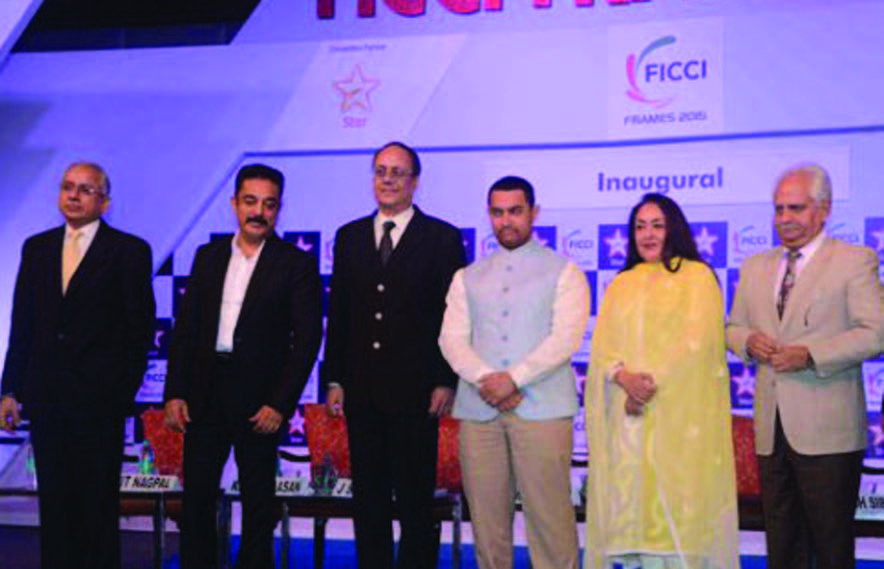
  • Aamir Khan and Kamal Hassan inaugurate FICCI FRAMES 2015 in Mumbai

    Aamir Khan and Kamal Hassan inaugurate FICCI FRAMES 2015 in Mumbai

    MUMBAI (TIP): It’s that time of the year again. The onset of a much-awaited spring in New York and a long, hot summer in Mumbai.

    The 16th Annual FICCI FRAMES conference on the Media & Entertainment (M&E) industry is back at the Rennaissance Hotel & Convention Centre situated on the picturesque Powai lake in Mumbai.

    It’s Wednesday, March 25th 2015; Day 1 of the event, and in addition to the locals, NRIs and other business visitors from USA, UK, Canada, Australia and other countries are here again in full strength; veterans from the media business, aspirants in the field of entertainment, panelists, delegates, you name it, the conference has them all.

    About FICCI FRAMES 2015

    FICCI FRAMES is Asia’s largest global conference on the business of Media and Entertainment. Spanning three days, the conference covers the entire spectrum of the M&E industry, with back-to-back presentation sessions, panel discussions & master-classes focused on micro-specializations such as film, television, radio, print, internet/digital media, animation and gaming among others. This highly-anticipated & most-respected industry event currently draws over 2,500 participants from all over the world, with India & USA together accounting for over 90% of the attendees.

    The list of known names at the conference reads like a virtual Who’s Who of the global M&E industry. Attendees get to rub shoulders and interact one-on-one with top achievers in the business; for 2015, the list of presenters & panelists boasts includes Aamir Khan, Kamal Hassan, Ayushmann Khurana, Abhishek Bachchan, Irrfan Khan, Vishal Dadlani, Abhay Deol, Kalki Koechlin, Rohan Sippy, Siddharth Roy Kapur, Arjun Kapoor, Vikas Bahl, Suhel Seth, Ramesh Sippy, Guneet Mongia, Devendra Fadnavis, Rajyavardhan Singh Rathore, Gen. V. K. Singh, Harit Nagpal, Sudhanshu Vats, Gaurav Gandhi, Mukesh Bhatt, Ashish Kulkarni, Sundeep Nagpal, Viraf Patel, Karan Bedi, Kamlesh Pandey, Anjum Rajabali, to name a few.

    Day 1 of the event saw the inauguration with Aamir Khan lighting the ceremonial lamp. This was followed by the welcome address from Jyotsna Suri, Vice President, FICCI. Harit Nagpal, CEO & MD, TataSky, delivered the theme address next.

    The FICCI-KPMG 2015 report on the Indian Media & Entertainment industry was officially released after Harit’s address; the highlight of this report is the growth registered by various disciplines within the industry.

    This was followed by opening remarks from Ramesh Sippy, Co-chair, FICCI Entertainment Committee, and Kamal Hassan. Aamir Khan was next with an interactive session with the audience.

    This inaugural session was followed by a series of presentations, panel discussions & master-classes. Detailed coverage of these sessions along with interviews of key presenters & panelists will be provided at the end of the conference.

    The list of media corporations at this year’s convention includes BBC, Discovery Networks, Disney India, Fox Star Studios, Phantom Films, NDTV, Excel Entertainment, Star India, Dharma Productions, TataSky, Viacom 8, Zee TV and Balaji Telefilms, among several others.

    The convention also features national and international government bodies such as the Consul General of USA, Consul General of Canada and the Ministry of Information and Broadcasting (India).

    Finally, there are a number of M&E-centric corporations with booths at the event, looking to showcase a wide range of industry tools & accessories such as film-making & broadcasting equipment, studio apparatus, animation tools, software solutions & related technology.

    About FICCI

    Established in 1927, FICCI (Federation of Indian Chambers of Commerce & Industry) is the largest and oldest apex business organization in India. FICCI’s history is closely interwoven with India’s struggle for independence and subsequent emergence as one of the most rapidly growing economies globally. FICCI plays a leading role in policy debates that are at the forefront of social, economic and political change.

    A non-government, not-for-profit organization, FICCI is viewed as one of the major voices of India’s business and industry. It works closely with the government on policy issues, enhancing efficiency, competitiveness and expanding business opportunities for industry through a range of specialized services and global linkages. Partnerships with countries across the world carry forward it’s initiatives in inclusive development, which encompass critical issues such as health, education, livelihood, governance & skill development.

    Through its 400 professionals, FICCI is active in 38 sectors of the economy. FICCI’s stand on policy issues is sought out by think tanks, governments and academia. Its publications are widely read for their in-depth research and policy prescriptions. FICCI has joint business councils with 79 countries around the world. Its publications are widely read for their in-depth research and policy prescriptions.

    The Media & Entertainment Division of FICCI serves a vital link between the media & entertainment industry, Information & Broadcasting Ministry and global interests in this vibrant sector.

    Media & Entertainment Division is an active division organizing the FICCI-FRAMES, conducting & releasing pioneering studies in the sectors, assisting in policy decisions and helping scale up the industry through various initiatives.

    This division is guided by the chairman Mr. Uday Shankar and co-chairman Mr. Ramesh Sippy.

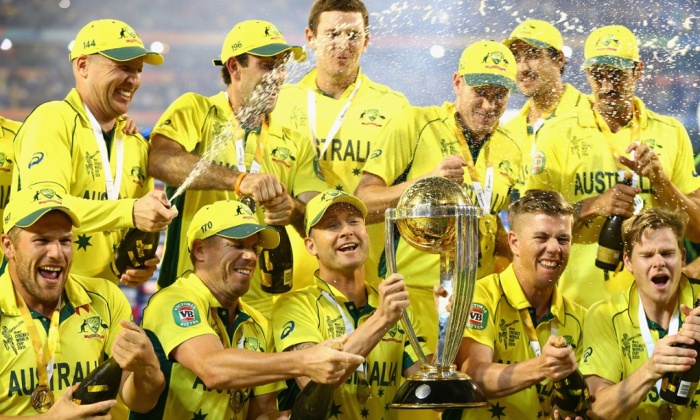
  • Australia crush New Zealand – bag 5th World Cup title

    Australia crush New Zealand – bag 5th World Cup title

    Australia 186 for 3 (Clarke 74, Smith 56*) beat New Zealand 183 (Elliott 83, Johnson 3-30, Faulkner 3-36) by 7 wickets

    Australia overwhelmed New Zealand to win the World Cup for a fifth time at an ecstatic Melbourne Cricket Ground.

    New Zealand lost influential captain Brendon McCullum to the fifth ball of the match and were bowled out for 183.

    aus_wins_smith_Reu_2356820gGrant Elliott resisted with 83, while Mitchell Starc, Mitchell Johnson and James Faulkner shared eight wickets.

    Electing to bat first, New Zealand were dismissed for 183 in 45 overs against Australia in the ICC Cricket World Cup finals at MCG on Sunday.

    The semifinal hero, Grant Elliot was the top scorer with 83. Taylor made 40. 

    The Australian bowlers were up to the task right from the word go. Mitchell Johnson (3 for 30) and James Faulkner (3 for 36) were the pick of the bowlers. Mitchell Starc took 2 for 20, whle Maxwell took 1 for 37.

    Australia rarely looked troubled, sealing a seven-wicket win in 33.1 overs, with captain Michael Clarke scoring 74 and Steve Smith 56 not out.

    Clarke, in his final one-day international, was given a standing ovation by the record 93,000 crowd and welcomed by his team-mates on the boundary when he was bowled by Matt Henry with eight required.

    He was part of the Australia team that last lifted the trophy in 2007, with this success extending their record for most World Cups won. No other team has more than two.

    Australia’s win was the second in as many tournaments by a host nation after India’s triumph four years ago.

  • SMART MOVES – Modi Government on US & China

    SMART MOVES – Modi Government on US & China

    [vc_row][vc_column][vc_column_text]

    “The Modi government will face the test of managing closer strategic relations with the US, which are in part directed against China, and forging closer ties with China that go against this strategic thrust, besides the reality that China has actually stronger ties with the US than it can ever have with India, though the underlying tensions between the two are of an altogether different order than between India and the US.”


    [/vc_column_text][/vc_column][/vc_row][vc_row][vc_column width=”1/2″][vc_column_text]

    [quote_box_center]China[/quote_box_center] 

    Prime Minister Modi has been quick to court both US and China. His first overtures were to China, prompted no doubt by his several visits there as Chief Minister of Gujarat, Chinese investments in his home state and his general admiration for China’s economic achievements. Beyond this personal element, many in the government and corporate sectors in India believe that our politically contentious issues with China, especially the unresolved border issue, should be held in abeyance and that economic cooperation with that country should be expanded, as India can gain much from China’s phenomenal rise and the expertise it has developed in specific sectors, especially in infrastructure. It is also believed that China, which is now sitting over $4 trillion of foreign exchange reserves, has huge surplus resources to invest and India should actively tap them for its own developmental needs. In this there is continuity in thinking and policy from the previous government, with Modi, as is his wont, giving it a strong personal imprint.

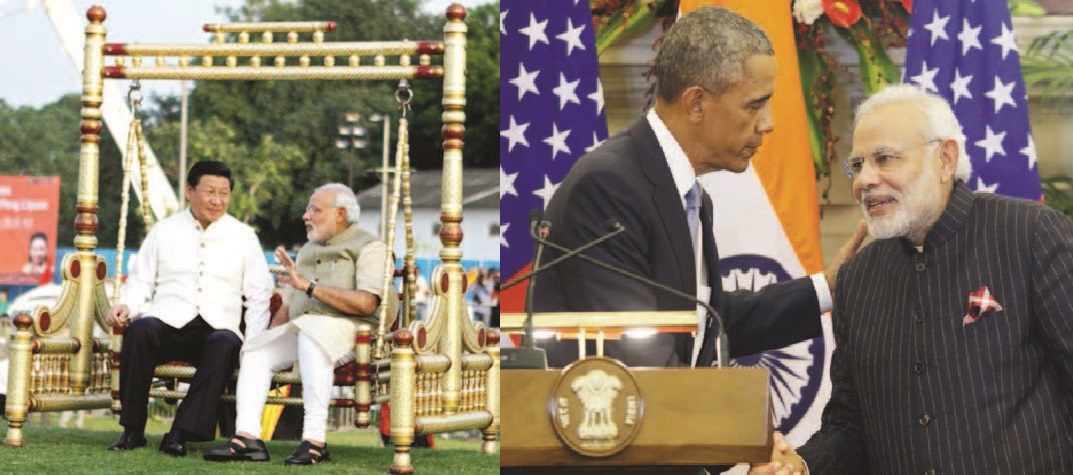
    The first foreign dignitary to be received by Modi after he became Prime Minister was the Chinese Foreign Minister, representing the Chinese President. This was followed by up by his unusually long conversation on the telephone with the Chinese Prime Minister. Our Vice-President was sent to Beijing to celebrate the 60th anniversary of the Panchsheel Agreement even though China has blatantly violated this agreement and India’s high level diplomatic endorsement of it only bolsters Chinese diplomacy, especially in the context of China-created tensions in the South China and East China Seas. Modi had occasion to meet President Xi Jinxing in July at the BRICS summit in July 2014, and this was followed up by the Chinese President’s state visit to India in September 2014, during which the Prime Minister made unprecedented personal gestures to him in an informal setting in Ahmedabad.

    The dramatics of Modi’s outreach to the Chinese aside, his objectives in strengthening economic ties with China, essentially imply a consolidation of the approach followed in the last decade or so, with some course correction here and there. In this period, China made very significant headway in our power and telecom sectors, disregarding obvious security concerns associated with China’s cyber capabilities and the links of Chinese companies to the Chinese military establishment. Many of our top companies have tapped Chinese banks and financial institutions for funds, and this has produced a pro-Chinese corporate lobby in our country. This lobby will obviously highlight the advantages of economic engagement over security concerns. The previous Prime Minister followed the approach of emphasizing shared interests with China rather than highlighting differences. The position his government took on the Depsang incident in May 2013 showed his inclination to temporize rather than confront. Externally, he took the line, which Chinese leaders repeated, that the world is big enough for India and China to grow, suggesting that he did not see potential conflict with China for access to global markets and resources. Under him, India’s participation in the triangular Russia-India-China format (RIC) and the BRICS format continued, with India-originated proposal for a BRICS Development Bank eventually materializing. Indian concerns about the imbalance in trade were voiced, but without any action by China to redress the situation. India sought more access to the Chinese domestic market for our competitive IT and pharmaceutical products, as well as agricultural commodities, without success. Concerns about cheap Chinese products flooding the India market and wiping out parts of our small-scale sector were voiced now and then, but without any notable remedial steps. The Strategic Economic Dialogue set up with China, which focused primarily on the railway sector and potential Chinese investments in India, did not produce tangible results.

    The Manmohan Singh government, despite China’s aggressive claims on Arunachal Pradesh and lack of progress in talks between the Special Representatives on the boundary issue as well as concerns about China’s strategic threats to our security flowing from its policies in our neighborhood, especially towards Pakistan and Sri Lanka, declared a strategic and cooperative partnership with that country. During Manmohan Singh’s visit to China in September 2013, we signed on to some contestable formulations, as, for example, the two sides committing themselves to taking a positive view of and supporting each other’s friendship with other countries, and even more surprisingly, to support each other enhancing friendly relations with their common neighbors for mutual benefit and win-win results. This wipes off on paper our concerns about Chinese policies in our neighborhood. We supported the BCIM (Bangladesh, China, India, Myanmar) Economic Corridor, including people to people exchanges, overlooking Chinese claims on Arunachal Pradesh and the dangers of giving the Chinese access to our northeast at people to people level. The agreement to carry out civil nuclear cooperation with China was surprising, as this makes our objections to China-Pakistan nuclear ties politically illogical. We also agreed to enhance bilateral cooperation on maritime security, which serves to legitimize China’s presence in the Indian Ocean when China’s penetration into this zone poses a strategic threat to us.

    As a mark of continuity under the Modi government, during President Xi Jinxing’s September 2014 visit to India, the two sides agreed to further consolidate their Strategic and Cooperative Partnership, recognized that their developments goals are interlinked and that their respective growth processes are mutually reinforcing. They agreed to make this developmental partnership a core component of their Strategic and Cooperative Partnership. The India-China Strategic Economic Dialogue was tasked to explore industrial investment and infrastructure development.

    To address the issue of the yawning trade imbalance, measures in the field of pharmaceuticals, IT, agro-products were identified and a Five-Year Development Program for economic and Trade Cooperation to deepen and balance bilateral trade engagement was signed. Pursuant to discussions during the tenure of the previous government, the Chinese announced the establishment of two industrial parks in India, one in Gujarat and the other in Maharashtra, and the “Endeavour to realize” an investment of US $ 20 billion in the next five years in various industrial and infrastructure development projects in India, with production and supply chain linkages also in view. In the railway sector, the two sides the two sides agreed to identify the technical inputs required to increase speed on the existing railway line from Chennai to Mysore via Bangalore, with the Chinese side agreeing to provide training in heavy haul for 100 Indian railway officials and cooperating in redevelopment of existing railway stations and establishment of a railway university in India. The Indian side agreed to actively consider cooperating with the Chinese on a High Speed Rail project. In the area of financial cooperation, the Indian side approved in principle the request of the Bank of China to open a branch in Mumbai.

    The Modi government has agreed to continue defense contacts, besides holding the first round of the maritime cooperation dialogue this year, even though by engaging India in this area it disarms our objections to its increasing presence in the Indian Ocean area, besides drawing negative attention away from its policies in the South China Sea as well as projecting itself as a country committed to maritime cooperation with reasonable partners. The joint statement issued during Xi Jinxing’s visit omitted any mention of developments in western Pacific, though it contained an anodyne formulation on Asia-Pacific. This becomes relevant in view of the statements on Asia-pacific and the Indian Ocean region issued during President Obama’s visit to India in January 2015.

    Our support, even if tepid, continues for the BCIM Economic Corridor. On our Security Council permanent membership, China continues its equivocal position, stating that it “understands and supports India’s aspiration to play a greater role in the United Nations including in the Security Council”. It is careful not to pronounce support for India’s “permanent membership”. During Foreign Minister Sushma Swaraj’s visit to China for the RIC Foreign Ministers meeting, China has maintained its equivocation, although the press has wrongly presented the formulation as an advance. China is openly opposed to Japan’s candidature in view of the sharp deterioration of their ties. In India’s case, it avoids creating a political hurdle to improved ties by openly opposing India’s candidature. “A greater role” could well mean a formula of immediately re-electable non-permanent members, of the kind being proposed by a former UN Secretary General and others.

    On counter-terrorism lip service is being paid to cooperation. On Climate Change, the two countries support the principle of “equity, common but differentiated responsibilities and respective capabilities”, although the US-China agreement on emission reduction targets has created a gap in Indian and Chinese positions, with the Modi government deciding to delink itself from China in international discussions to follow.

    In diplomacy, once concessions or mistakes are made, retrieval is very difficult unless a crisis supervenes. The Modi government, for reasons that are not too clear, repeated the intention of the two countries to carry out bilateral cooperation in civil nuclear energy in line with their respective international commitments, which has the unfortunate implication of India circumscribing its own headroom to object to the China-Pakistan nuclear nexus, besides the nuance introduced that China is observing its international commitments in engaging in such cooperation. The calculation that this might make China more amenable to support India’s NSG membership may well prove to be a mistaken one. Surprisingly, stepping back from the Manmohan government’s refusal towards the end to make one-sided statements in support of China’s sovereignty over Tibet when China continues to make claims on Indian territory, the new government yielded to the Chinese ruse in making us thank the “Tibetan Autonomous Region of the People’s Republic of China” as well as the Chinese Ministry of Foreign Affairs – as if both are independent of the Chinese government- for facilitating the Kailash Mansarovar Yatra and opening the new route through Nathu La, even though this is not the  most rational route because it involves a far longer journey, made easier of course by much better infrastructure. On receiving the flood season hydrological date the Chinese have stuck to their minimalist position.

    On the sensitive border issue, the disconnect between the joint statement which repeats the usual cliches and the serious incident in Chumar coinciding with Xi’s visit was obvious. China’s double game of reaching out to India- with greater confidence now as the gap between it and India has greatly widened and it has begun to believe that India now needs China for its growth and development goals- and staging a provocation at the time of a high level visit, continues. This is a way to remind India of its vulnerability and the likely cost of challenging China’s interests, unmindful that its conduct stokes the already high levels of India’s distrust of that country. It went to Modi’s credit that he raised the border issue frontally with XI Jinping at their joint press conference, expressing “our serious concern over repeated incidents along the border” and asking that the understanding to maintain peace and tranquility on the border “should be strictly observed”. He rightly called for resuming the stalled process of clarifying the Line of Actual Control (LAC). While this more confident approach towards China is to be lauded, we are unable to persuade China to be less obdurate on the border issue because we are signaling our willingness to embrace it nonetheless virtually in all other areas.

    That Modi mentioned “India’s concerns relating to China’s visa policy and Trans Border Rivers” while standing alongside Xi Jinping at the joint press conference indicated a refreshing change from the past in terms of a more open expression of India’s concerns. With regard to Bangladesh-China-India-Myanmar Economic Corridor that China is pushing hard, Modi rightly added a caveat by declaring that “our efforts to rebuild physical connectivity in the region would also require a peaceful, stable and cooperative environment”. He also did not back another pet proposal of Xi: the Maritime Silk Road, which is a re-packaged version of the notorious “string of pearls” strategy, as the joint statement omits any mention of it.

    Even as Modi has been making his overall interest in forging stronger ties with China clear, he has not shied away from allusions to Chinese expansionism, not only on Indian soil but also during his visit to Japan. After President Obama’s visit to India and the joint statements on South China Sea and Asia-Pacific issued on the occasion which can be construed as directed at China, Foreign Minister Sushma Swaraj’s recent visit there acquired more than normal interest in watching out for indications of China’s reaction. Her call on Xi Jinping was projected, quite wrongly, as going beyond normal protocol, when in actual fact the Chinese Foreign Minister gets access to the highest levels in India during visits. Swaraj seems to have pushed for an early resolution of the border issue, with out-of-the-box thinking between the two strong leaders that lead their respective countries today. Turning the Chinese formulation on its head, she called for leaving a resolved border issue for future generations.

    That China has no intention to look at any out-of-the-box solution- unless India is willing to make a concession under cover of “original thinking”- has been made clear by the vehemence of its reaction to Modi’s recent visit to Arunachal Pradesh to inaugurate two development projects on the anniversary of the state’s formation in 1987. It has fulminated over the Modi visit over two days, summoning the Indian Ambassador to lodge a protest, inventing Tibetan names for sub-divisions within Arunachal Pradesh to mark the point that this area has been under Tibetan administrative control historically. The Chinese Vice-Foreign Minister arrogantly told our Ambassador that Modi’s visit undermined “China’s territorial sovereignty, right and interests” and “violates the consensus to appropriately handle the border issue.” China is making clear that it considers Arunachal Pradesh not “disputed territory” but China’s sovereign territory. It is also inventing a non-existent “consensus” that Indian leaders will not visit Arunachal Pradesh to respect China’s position. There is a parallel between China’s position on the Senkakus where it accuses the Japanese government to change the status quo and inviting a Chinese reaction, and its latest broadside against India. This intemperate Chinese reaction casts a shadow on Modi’s planned visit to China in May and next round of talks between the Special Representatives (SRs) on the boundary question. If without a strong riposte these planned visits go ahead we would have allowed the Chinese to shift the ground on the outstanding border issue even more in their favor. It would be advisable for our Defense Minister to visit Tawang before Modi’s visit. A very categorical enunciation of our position that goes beyond previous formulations should be made by the Indian side. The Chinese position makes the SR talks pointless, as the terms of reference China is laying down cannot be agreed to by our side.

    [/vc_column_text][/vc_column][vc_column width=”1/2″][vc_column_text]

    [quote_box_center]UNITED STATES[/quote_box_center] 

    Prime Minister Modi, contrary to expectations, moved rapidly and decisively towards the US on assuming office. He confounded political analysts by putting aside his personal pique at having been denied a visa to visit the US for nine years for violating the US law on religious freedoms, the only individual to be sanctioned under this law. The first foreign visit by Modi to be announced was that to the US. Clearly, he believes that strong relations with the US gives India greater strategic space in foreign affairs and that its support is crucial for his developmental plans for India.

    To assess the Modi government’s policies towards the US, the results of his visit to Washington in September 2014 and that of Obama to India in January 2015 need to be analyzed, keeping in mind the approach of the previous government and the element of continuity and change that can be discerned.

    The joint statement issued during his US visit set out the future agenda of the relationship, with some goals clearly unachievable, but the ambitions of the two countries were underscored nonetheless. It was stated that both sides will facilitate actions to increase trade five-fold, implying US-China trade levels, which is not achievable in any realistic time-frame. They pledged to establish an Indo-US Investment Initiative and an Infrastructure Collaboration Platform to develop and finance infrastructure. An agreement on the Investment Initiative was signed in Washington prior to Obama’s visit to India, but bringing about capital reforms in India, which the Initiative aims at, is not something that can be realized quickly. India wants foreign investment in infrastructure and would want to tap into US capabilities in this broad sector, but the US is not in the game of developing industrial corridors like Japan or competitively building highways, ports or airports. Cooperation in the railway sector was identified, but it can only be in some specific technologies because this is the field in which Japan and China are competing for opportunities in India, whether by way of implementing high speed freight corridors or building high speed train networks in the country. India offered to the U.S. industry lead partnership in developing three smart cities, even if the concept of smart cities is not entirely clear. Some preliminary steps seem to have been taken by US companies to implement the concept. The decision to establish an annual high-level Intellectual Property (IP) Working Group with appropriate decision-making and technical-level meetings as part of this Forum was done at US insistence as IPR issues are high on the US agenda in the context of contentious issues that have arisen between the US companies and the Indian government on patent protection, compulsory licensing and local manufacturing content requirements.

    In his joint press briefing with Obama, Modi raised IT related issues, pressing Obama’s support  “for continued openness and ease of access for Indian services companies in the US market”, without obtaining a reaction from  the latter then or later when Obama visited India. On the food subsidy versus trade facilitation stand off in the WTO, Modi maintained his position firmly and compelling the US to accept a compromise. Modi’s firmness on an issue of vital political importance to India showed that he could stand up to US pressure if the country’s interest so demanded. He welcomed “the US defense companies to participate in developing the Indian defense industry”, without singling out any of the several co-development and co-production projects offered by the US as part of the Defense Technology and Trade Initiative (DTTI). Clearly, it was too early to conclude discussions on the US proposals before his September visit.

    The more broad based reference in the joint statement to India and the US intending to expand defense cooperation to bolster national, regional and global security was, on the contrary, rather bold and ambitious, the import of which became clearer during Obama’s January visit. While bolstering such cooperation for national security makes sense, regional security cannot be advanced together by both countries so long as the US continues to give military aid to Pakistan, which it is doing even now by issuing presidential waivers to overcome the provisions of the Kerry-Lugar legislation that requires Pakistan to act verifiably against terrorist groups on its soil before the aid can be released. As regards India-US defense cooperation bolstering global security, securing the sea lanes of communication in the Indian Ocean and the Asia-Pacific region is the obvious context. It was decided to renew for 10 years more the 2005 Framework for US-India Defense Relations, with defense teams of the two countries directed to “develop plans” for more ambitious programs, including enhanced technology partnerships for India’s Navy, including assessing possible areas of technology cooperation.

    The US reiterated its commitment to support India’s membership of the four technology control regimes: the Nuclear Suppliers Group (NSG), the Missile Technology Control Regime (MTCR), the Wassenaar Agreement and the Australia Group, with Obama noting that India met MTCR requirements and is ready for NSG membership, but without setting any time-tables. An actual push by the US in favor of India’s membership has been lacking because of issues of nuclear liability and administrative arrangements have remained unresolved until now and the US has wanted to use their resolution as a leverage. US support for India’s membership of these export control organizations was reiterated during Obama’s January visit, but how quickly the US will move remains unclear even after the political resolution of outstanding nuclear issues.

    The US at one time described India as a lynchpin of its pivot or rebalance towards Asia. The underlying motivation behind the pivot and US interest in drawing India into this strategy is China, though this is not stated publicly in such open terms. India has been cautious about the US pivot towards Asia as its capacity and willingness to “contain” Chinese power has been doubted because of the huge financial and commercial interdependence forged between the two countries. India seeks stable and economically productive relations with China and has wanted to avoid the risk of being used by the US to serve its China strategy that raises uncertainties in the mind of even the US allies in Asia. However, under the Modi government, India has become more affirmative in its statements about the situation in the western Pacific and the commonalities of interests between India and the US and other countries in the Indo-Pacific region. The government has decided to “Act East”, to strengthen strategic ties with Japan and Australia, as well as Vietnam, conduct more military exercises bilaterally with the US armed forces as well as naval exercises trilaterally with Japan. Modi has spoken publicly about greater India-US convergences in the Asia-Pacific region, to the point of calling the US  intrinsic to India’s Act East and Link West policies, a bold formulation in its geopolitical connotations never used before that suggested that India now viewed the US as being almost central to its foreign policy initiatives in both directions.

    On  geopolitical issues, India showed strategic boldness in the formulations that figured in the September joint statement. These laid the ground for more robust demonstration of strategic convergences between the two countries during Obama’s visit later. The reference in September to the great convergence on “peace and stability in the Asia Pacific region” was significant in terms of China’s growing assertiveness there. The joint statement spoke of a commitment to work more closely with other Asia Pacific countries, including through joint exercises, pointing implicitly to Japan and Australia, and even Vietnam. In this context, the decision to explore holding the trilateral India-US-Japan dialogue at Foreign Minister’s level- a proposition that figured also in the India-Japan joint statement during Modi’s visit there- was significant as it suggested an upgrading of the trilateral relationship at the political level, again with China in view.

    On the issue of terrorism and religious extremism, India and the US have rhetorical convergence  and some useful cooperation in specific counter-terrorism issues, but, on the whole, our concerns are  inadequately met because US regional interests are not fully aligned with those of India. The September joint statement called for the dismantling of safe havens for terrorist and criminal networks and disruption of all financial and tactical support for networks such as Al Qaeda, Lashkar-e-Taiba, Jaish-e-Mohammad, the D-company and the Haqqanis, but the Taliban were conspicuously omitted from the list. In any case, such statements against Pakistan-based terrorist groups have been made before but are ignored  by Pakistan in the absence of any real US pressure on it to curb Hafiz Saeed or credibly try Lakhvi despite repeated joint calls for bringing those responsible for the Mumbai terrorist massacre to justice.

    We had a paragraph on Iran in the joint statement in Washington, clearly at US insistence, which the Iranians would have noted with some displeasure. The Modi government is also willing to accommodate the US on Iran within acceptable limits. While the US supports India’s permanent membership of the UN Security Council, the support remains on paper as the US is not politically ready to promote the expansion of the Council.

    At Washington, India and the US agreed on an enhanced strategic partnership on climate change issues, and we committed ourselves to working with the US to make the UN Conference on Climate Change in Paris in December this year a success. This carried the risk of giving a handle to the US to ratchet up pressure to obtain some emission reduction commitments from India, encouraged  diplomatically by the US-China agreement.

    The unusually strong personal element in Modi’s diplomacy towards the US came apparent when during his Washington visit he invited Obama to be the chief guest at our Republic Day on January 26, 2015- a bold and imaginative move characteristic of his style of functioning. That this unprecedented invitation was made was surprising in itself, as was its acceptance by Obama at such short notice. Modi and Obama evidently struck a good personal equation, with the earlier alienation supplanted by empathy. Obama made the unprecedented gesture of accompanying Modi to the Martin Luther King Memorial in Washington, perhaps taking a leaf from the personal gestures made  to Modi in Japan by Prime Minister Abe.

    On the occasion of Obama’s January visit, Modi has moved decisively, if somewhat controversially, on the nuclear front, as this was the critical diplomatic moment to work for a breakthrough to underline India’s commitment to the strategic relationship with the US, which is the way that US commentators have looked at this issue. While in opposition the BJP had opposed the India-US nuclear agreement, introduced liability clauses that became a major hurdle in implementing the commitment to procure US supplied nuclear reactors for producing 10,000 MWs of power, and had even spoken of seeking a revision of the agreement whenever it came to power. During Obama’s  visit, the “breakthrough understandings” on the nuclear liability issue and that of administrative arrangements to track US supplied nuclear material or third party material passing through US supplied reactors, became the highlight of its success, with Modi himself calling nuclear cooperation issues as central to India-US ties. The supplier liability issue seems to have resolved at the level of the two governments by India’s decision to set up an insurance pool to cover supplier liability, as well as a written clarification through a Memorandum of Law on the applicability of Section 46 only to operators and not suppliers. On the national tracking issue the nature of the understanding has left some questions unanswered; it would appear that we have accepted monitoring beyond IAEA safeguards as required under the US law. However, the larger question of the commercial viability of US supplied reactors remains, a point that Modi alluded to in joint press conference. On the whole, whatever the ambiguities and shortfalls, transferring the subject away from government to company level to eliminate  the negative politics surrounding the subject is not an unwelcome development.

    For the US, defense cooperation has been another touchstone for the US to measure India’s willingness to deepen the strategic partnership. While the significant progress expected to be announced under the DTTI during Obama’s visit did not materialize, some advance was made with the announcement of four “pathfinder” projects involving minor technologies, with cooperation in the area of aircraft engines and aircraft carrier technologies to be explored later. The government has already chosen for price reasons the Israeli missile over the Javelin that was part of the several proposals made to India under the DTTI. As expected, the India-US Defense Framework Agreement of 2005 was extended for another 10 years, without disclosing the new text. It is believed  that India is now more open to discussions on the three foundational agreements that the US considers necessary for transfer of high defense technologies to India.

    The US-India Joint Strategic Vision for the Asia-Pacific and Indian Ocean Region signed during the visit is a major document which in the eyes of some reflects India’s move away from the shibboleths of the past associated with nonalignment and the obsession with strategic autonomy. Issuing a separate document was intended to highlight the growing strategic convergences between the two countries, with full awareness of how this might be interpreted by some countries, notably China. It affirms the “importance of safeguarding maritime security and ensuring freedom of navigation and overflight throughout the region , especially in the South China Sea”, while calling also on all parties to avoid the threat or use of force and pursue resolution of territorial and maritime disputes through all peaceful means in accordance with international law, including the Law of the Sea Convention. It speaks, in addition, of India and the US investing in making trilateral countries with third countries in the region, with Japan and Australia clearly in mind. This is a direct message addressed to China, reflecting less inhibition on India’s part both to pronounce on the subject and do it jointly with the US, irrespective of Chinese sensibilities. Some Chinese commentary has criticized this effort by the US to make India part of its containment strategy, without taking cognizance of how India views China’s maritime strategy in the Indian Ocean involving its strategic investments in Sri Lanka, Maldives, Pakistan and other countries. In the joint statement issued during  Obama’s visit, the two sides noted that India’s Act East Policy and the US rebalance to Asia provided opportunities to the two countries to work closely to strengthen regional ties, in what amounted to an indirect endorsement of the US pivot to Asia.

    Obama’s visit also demonstrated the consolidation of the good personal rapport established between him and Shri Modi, with embraces and first name familiarity- possibly overdone on Modi’s part- walk in the park and talk over tea, all of which boosted the prime minister’s personal stature as a man comfortable and confident in his dealings with the world’s most powerful leader on the basis of equality. This personal rapport should assist in greater White House oversight over the Administration’s policies towards India, which experience shows greatly benefits the bilateral relationship.

    Counter-terrorism is always highlighted as an expanding area of India-US cooperation because of shared threats. The joint statement in Delhi spoke dramatically of making the US-India partnership in this area a “defining” relationship for the 21st century. Does this mean that the US will share actionable intelligence on terrorist threats to us emanating from Pakistani soil? This is doubtful. The continued omission of the Afghan Taliban from the list of entities India and the US will work against is disquieting, as it indicates US determination to engage the Taliban, even when it knows that it is Pakistan’s only instrument to exert influence on developments in Afghanistan at India’s cost. The subsequent refusal of the US spokesperson to characterize the Taliban as a terrorist organization and preferring to call it an armed insurgency has only served to confirm this.

    On trade, investment and IPR issues, the two sides will continue their engagement with the impulse given to the overall relationship by the Obama-Modi exchanges. On a high standard Bilateral Investment Treaty the two sides will
    “assess the prospects for moving forward”, which indicates the hard work ahead. On the tantalization agreement the two will “hold a discussion on the elements requires in both countries to pursue” it, a language that is conspicuously non-committal. On IPRs there will be enhanced engagement in 2015 under the High Level Working Group.

    On climate change, we reiterated again the decision to work together this year to achieve a successful agreement at the UN conference in Paris, even when our respective positions are opposed on the core issue of India making specific emission reduction commitments. While stating  that neither the US nor the US-China agreement put any pressure on India, Modi spoke in his joint press conference about pressure on all countries to take steps for the sake of posterity. While  finessing the issue with high-sounding phraseology, he has left the door open for practical compromises with the US.

    As a general point, hyping-up our relations with the US is not wise as it reduces our political space to criticize its actions when we disagree. The previous government made this mistake and the Modi government is not being careful enough in this regard. Obama’s objectionable lecture to us at Siri Fort on religious freedom and his pointed reference to Article 25 of our Constitution, illustrates this. He showed unpardonable ignorance of Indian history and Hindu religious traditions in asking us to “look beyond any differences in religion” because “nowhere in the world is it going to more necessary for that foundational value to be upheld” than in India. To say that “India will succeed so long as it is not splintered around religious lines” was a wilful exaggeration of the import of some recent incidents  and amounted to playing the anti-Hindutva card by a foreign leader prompted by local Christian and “secular” lobbies. Reminding us of three national cinema and sport icons belonging only to minority religions- when their mass adulation is unconnected to their faith- was to actually encourage religiously fissured thinking in our society. On return to Washington Obama pursued his offensive line of exaggerating incidents of religious intolerance in India. On cue, a sanctimonious editorial also appeared in the New York Times. The government could not attack Obama for his insidious parting kick at Siri Fort so as not to dim the halo of a successful visit and therefore pretended that it was not directed at the Modi team. The opposition, instead of deprecating Obama’s remarks, chose to politically exploit them against Modi, as did some Obama-adoring Indians unencumbered by notions of self-respect.

    While giving gratuitous lessons on religious tolerance to the wrong country Obama announced $1 billion civil and military support to Pakistan that splintered from a united India because of religious intolerance in 1947 and has been decimating its minorities since. Obama has also invited the Chinese president to visit the US on a state visit this year, to balance his visit to India and the “strategic convergences” reached there on the Asia-Pacific region. Obama’s claim that the US can be India’s “best partner” remains to be tested as many contradictions in US policy towards India still exist.

    The Modi government will face the test of managing closer strategic relations with the US, which are in part directed against China, and forging closer ties with China that go against this strategic thrust, besides the reality that China has actually stronger ties with the US than it can ever have with India, though the underlying tensions between the two are of an altogether different order than between India and the US.

    [/vc_column_text][/vc_column][/vc_row]

  • India lose to Mighty Australia – ICC World Cup Semi-Final

    India lose to Mighty Australia – ICC World Cup Semi-Final

    SYDNEY (TIP): India were bowled out for 233 runs while chasing the mammoth total of 328 runs against Australia at the Sydney Cricket Ground. India started their tour in early December with a loss to Australia and finish their tour with a loss against the same opposition. In between, they beat all opponents, barring Australia and England. At a press conference, Indian skipper MS Dhoni defended the team: “I think they played good cricket. Over 300 is a difficult score to chase, but it was just above par. They looked like getting 350 at one stage we came back well. The fast bowlers could have done better. When you come to the knockout stages, you have to lift your game. We got off to a good start. Shikhar’s dismissal was soft. There is a pressure when you are chasing 320. I don’t think our lower-order can contribute much in these conditions. I am not sure about it. I am 33, I’m still running and maybe next year, close to the World T20 I will decide whether I want to play the next World Cup or not. Looks like these are the players who will continue forward. Thanks to both the Aussie and Indian fans. It’s a bit disappointing for the Indian fans, but in the end only one team can win.”

    INDIA LOSE TO MIGHTY AUSTRALIA in ICC WORLD CUP
    INDIA LOSE TO MIGHTY AUSTRALIA in ICC WORLD CUP

    Michael Clarke during post-match presentation said: “I feel really tired. Smithy was exceptional. Credit needs to go to all the players. Thanks to MS Dhoni and his team. They have played really well. I am pretty sure MS has got a lot of cricket left in him. The most pleasing things is the way we have trained. I still don’t think we’ve played the perfect game yet, but we know it’s going to be tough against New Zealand. I think we’ll fly to Melbourne tomorrow. We’ll recover in the afternoon. Mentally, we are there for the final, but physically we have to be ready. I am looking forward to playing against New Zealand. I hope we get a lot of support.”

    Man of the Match: Steve Smith receives the MoM award for his magnificent 93-ball 105 that undoubtedly changed the game for Australia.