Tag: Australia

  • GUTSY VIRAT KOHLI CREATES NEW RECORDS IN SYDNEY TEST

    GUTSY VIRAT KOHLI CREATES NEW RECORDS IN SYDNEY TEST

    SYDNEY (TIP): Newly-appointed captain Virat Kohli became the highest Indian run getter in a Test series in Australia after notching up an unbeaten 140 in the fourth and final cricket match of the ongoing series here on January 8.

    Kohli surpassed the earlier record of batting legend Rahul Dravid who scored 619 runs from eight innings in the 2003-04 tour of Australia.

    The 26-year-old Kohli, who came into this match with an aggregate of 499 runs, has now totaled 639 from seven innings.

    Kohli, who struck his fourth ton of the series and 10th overall in his 33rd Test, is now the only cricketer ever to have scored a century each in his first three innings as captain of a side. Australian Greg Chappell had scored a century each in his first two innings as skipper against the West Indies at Brisbane in 1975.

    He also became the first Indian batsman after Sunil Gavaskar (in 1971 and 1978-79 versus West Indies) to score four centuries in a Test series.

    The feisty batsman, who made his Test debut in 2011 against the West Indies, also became the first overseas batsman since Herbert Sutcliffe
    (1924-25) and Walter Hammond (1928-29) to score four hundreds in a Test series in Australia.

  • Nishikori leads generation next into Brisbane semis

    Nishikori leads generation next into Brisbane semis

    BRISBANE (TIP): Japanese sensation Kei Nishikori led a trio of tennis young guns into the semifinals of the Brisbane International on Friday, sending out another message that the next generation are getting ready to challenge the old guard.

    Nishikori, still on a high after reaching the final of last year’s US Open, continued his impressive build-up to this month’s Australian Open when he demolished Bernard Tomic 6-0 6-4.

    He was joined in the last four by Milos Raonic and Grigor Dimitrov, another two up-and-comers tipped to challenge at the first grand slam of the season. Raonic rode his booming serve to a 7-6(5) 3-6 7-6(2) win over Australia’s Sam Groth to set up a mouth-watering semi-final clash against Nishikori.

    Dimitrov made light work of his quarter-final with Martin Klizan, defeating the Slovakian 6-3 6-4 to set up an encounter against either Roger Federer or James Duckworth in the last four.

    Raonic and Dimitrov both made the semi-finals at Wimbledon last year and while they stumbled against their more seasoned opponents they, along with Nishikori, have been earmarked as potential grand slam winners this year.

    Nishikori took less than an hour to brush past Tomic, who was also tipped for big things after reaching the quarters at Wimbledon as a teenager in 2011.

    “There was not a lot I could do,” the Australian told reporters. “That’s why he’s gotten to (number) five in the world and potentially has a big chance of becoming a top-three player this year.” Dimitrov saved two match points in his previous match against Frenchman Jeremy Chardy but the Bulgarian was always in control against Klizan. Raonic had a tougher workout against Groth, another big server. The towering Canadian served 15 aces but more importantly, he held his composure in the tiebreakers.

  • Australian Open prize money hits record $32 million

    Australian Open prize money hits record $32 million

    MELBOURNE (TIP): Australian Open organisers said Friday they had raised the prize money for the year’s first Grand Slam to a record Aus$40 million (US$32 million), with the singles winners taking home Aus$3.1 million each.

    The increase in the cash pool was meant to compensate for the decline in the Australian dollar, officials said, which fell to a five-and-a-half year low this week.

    “Obviously this is not a decision we have taken without a lot of consideration,” Tennis Australia chief Craig Tiley said.

    “But we have an ongoing commitment to the players that we are determined to help improve the pay and conditions of life on the international tennis tour.”

    The prize money was boosted to Aus$33 million last year, from Aus$30 million in 2013, when organisers reacted to threats of a boycott from players pressing for a greater share of revenue.

    “We have done a lot of work within our business to position ourselves to make this critical investment in the players and for the long-term future of the Australian Open,” Tennis Australia president Steve Healy added.

    The latest increase, which will see a first-round loser receive Aus$34,500, means the prize pot has doubled from Aus$20 million in 2007

    The tournament will be held at Melbourne Park from January 19 to February 1 and attracts the world’s top players, including seven-time Grand Slam champion Novak Djokovic and 18th Grand Slam singles title holder Serena Williams.

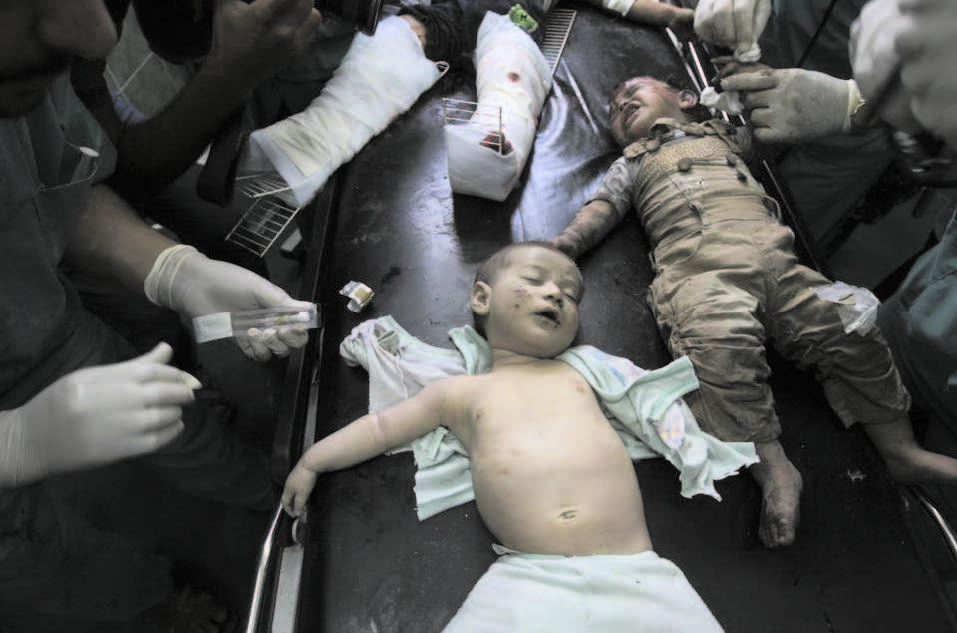
  • Eight children killed in Australia in reported mass stabbing

    Eight children killed in Australia in reported mass stabbing

    SYDNEY (TIP): Eight children have been killed and a woman injured, police said on December 18, during what several media outlets reported was a mass stabbing in Australia’s tropical northern city of Cairns.


    Australia is already in a state of heightened alert after police stormed a Sydney cafe early on Tuesday morning to end a 16-hour hostage standoff in which three people were killed, including the hostage-taker.

    Queensland state police said in a statement they were called to a house in the Cairns suburb of Manoora just before midday after reports of a woman with serious injuries on the premises.

    They found the bodies of the children, aged between 18 months and 15, when they were examining the location.

    The woman is receiving medical treatment for her injuries, police said, and is assisting them with their investigation.

    While unrelated to the mass stabbing in Cairns, the Sydney siege has triggered an outpouring of grief, with shocked Australians laying thousands of bouquets at a makeshift shrine in a central city mall near the siege cafe.

  • Political shadow boxing, threat & reality

    Political shadow boxing, threat & reality

    “The American invasion of Iraq cost the lives of millions of children. Whatever the changing definitions of terror, it is children that are so often the forgotten victims of conflict – regardless of the perpetrator”, says the author.

    Well, heaven preserve us: the most useless “peacemaker” on earth has just used an Arabic acronym for the greatest threat to civilisation since the last greatest threat. Yup, ol’ John Kerry called it “Daesh”, which is what the Arabs call it. It stands for the “Islamic State in Iraq and the Levant”. We prefer Isis or Isil or the Islamic State or Islamic Caliphate. Most journos prefer Isis because – I suspect – it’s easier to remember. It’s the name of an Egyptian goddess, after all.

    It’s the name of a university city’s river. Many an American scribe has questioned why Kerry should be using this goddam Arabic lingo – although we use Fatah for the PLO. It, too, is an acronym which, translated, means “the Party for Palestinian Liberation”. And in 2011, we called Tahrir Square in Cairo “Tahrir”, only occasionally reminding readers and viewers that it, too, meant “liberation”. None explained why the place was important: because this was the square mile of Cairo in which was based the largest British barracks and into which the Brits – during their much-loved occupation of Egypt – refused to allow any Egyptian to walk without permission. That’s why it was called Tahrir – liberation – when the Brits left.

    That’s why Hosni Mubarak’s attempt to prevent the protesters entering the square in 2011 placed him firmly in the shadow of Egypt’s former colonial masters. But why do we care what the great leaders of the West (or the East for that matter) actually say, when we all know it’s the kind of material that comes out of the rear end of a bull? Let me give you an example from Canada. Two years ago, the country’s Foreign Affairs Minister, John Baird, closed Canada’s embassy in Tehran because he feared his diplomats might be harmed. “Canada views the government of Iran as the most significant threat to global peace and security in the world today,” he quoth then – although CBC broadcasters have dug up a Foreign Ministry report which reported the biggest threat to the Tehran embassy was an geophysical earthquake.

    Since then, as the Toronto Star’s pesky columnist Thomas Walkom has pointed out, the Canadian Prime Minister Stephen Harper – whose pro-Israeli policies might earn him a seat in the Israeli Knesset -has discovered more threats. Russia under Vladimir Putin, Harper says, “represents a significant threat to the peace and security of the world”. The aforesaid Baird, taking his cue, no doubt from our own beloved Prince Charles, compared Putin’s Russia to Hitler’s Third Reich. More recently, Canada’s defence minister, Rob Nicholson, described the men of Isis (or Isil, or the Islamic State, or the Islamic Caliphate, or Daesh) as “a real and growing threat to civilisation itself”.

    The war against Isis/ Isil/ IS/ IC/ Daesh, he informed the people of Abu Dhabi, was “the greatest struggle of our generation”. Well, blow me down.Wasn’t Iran the greatest threat, ever since 1979? Wasn’t Abu Nidal, the Palestinian gun-for-hire? Wasn’t that British prime minister chappie, with the habit of saying “absolutely” and “completely” over and over again, convinced that Saddam was the greatest threat to our civilisation or generation, what with all his WMDs and links to Al-Qaida and tubes from Niger, and so on? For that matter, wasn’t Osama bin Laden’s Al-Qaida – the very bunch which morphed into Isis/ Isil/ IS/ IC/ Daesh in Iraq – the greatest threat to our civilisation/generation? Yet now, when the Iranian air force has joined the battle against Isis/ Isil/ IS/ IC/ Daesh alongside the US, Britain, Canada, Australia, old Uncle Tom Cobley and all, Kerry, in “Daesh” mode, tells us that the Iranian military action in Iraq (in any other circumstances, a ruthless assault on Iraq’s sovereignty) is “positive”. And Kerry, remember, was the fellow who told us last year that America was going to attack the regime of Bashar al-Assad, the greatest enemy of Isis/ Isil/ IS/ IC /Daesh – whom Obama reprieved in favour of bashing Isis/ Isil/ IS/ IC/ Daesh itself – with its ally Iran described by Canada’s Baird only two years ago as “the most significant threat to global peace and security in the world”.

    But what the hell … Don’t we live in a world where Save the Children (American branch only, you understand) gave an award to the same former British prime minister quoted above? Having given a prize to the man who encouraged George W Bush to embark on an Iraqi invasion which cost the lives of tens of thousands of children, surely this fine charity (again, the American branch only) must reinvent and re-name itself “Abandon the Children”. And by the way, one of the ex-PM’s supporters blandly told Channel 4 not long ago that our British “peace envoy” had travelled to the Middle East more than 160 times.Which means, doesn’t it, that our Middle East envoy had left his station in the Middle East more than 160 times! But again, what is a child’s life worth? In 2002, a Israeli missile attack on a Gaza apartment block killed a Palestinian militants but also 14 civilians, including several children.

    The Bush administration, draw in your breath here, folks, and grit your teeth, said that this “heavy-handed action” did not “contribute to peace”. Wow, now that was telling them. Killing kids is a bit heavy-handed, isn’t it? And I can see what the Bush lads and lassies meant when they said that eviscerating, crushing and tearing to bits a bunch of children didn’t really, well, “contribute” towards peace. It’s important, you see, to realise who our enemies are. Muslims, Iranians, Iraqis, Syrians, Russians, you name it. Not Israel, of course. Nor Americans. Think generational. Think civilisation. Think the most significant threat to global peace. Daesh. Isn’t that the name?

    (The author is an English writer and journalist from Maidstone, Kent. He has been Middle East correspondent of The Independent for more than twenty years, primarily based in Beirut) British English. (Source: The Independent)

  • Indian Aces edge past Singapore Slammers in IPTL

    Indian Aces edge past Singapore Slammers in IPTL

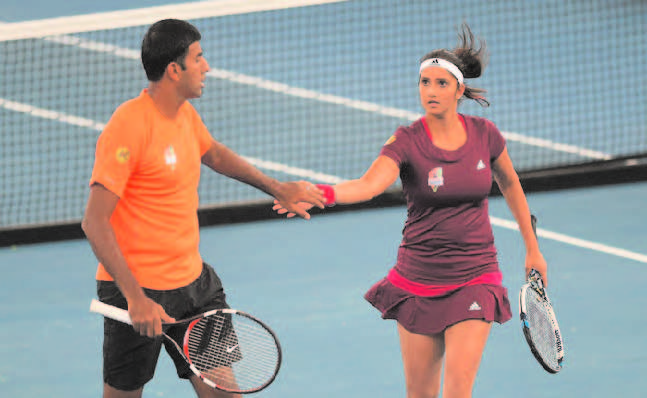
    ABU DHABI (TIP): Sania Mirza and Rohan Bopanna got past Bruno Soares and Daniela Hantuchova in the mixed-doubles match as Micromax Indian Aces edged past DBS Singapore Slammers in the UAE leg of the International Premier Tennis League on Thursday. Indian Aces were given a hard time by the Singapore team but they won four of the five games and won Match 19 of the tournament 28-24 in terms of more sets won.

    Sania and Bopanna combined well to win a closely contested battle against the Brazilian-Slovak pair of Soares and Hantuchova 6-5. In the legends face off, Fabrice Santoro from Indian Aces sailed past former World No. 1 Patrick Rafter of Australia 6-3. Serbian ace Ana Ivanovic also worked wonders for the Aces as the World No.5 beat Huntuchova 6-5 in the women’s singles match. Bopanna also paired with Gael Monfils in the men’s doubles to teach Lleyton Hewitt and Soares a lesson as the Indo-French outplayed the Australian-Brazilian pair 6-3. But Monfils tripped against Tomas Berdych 4-8 in the men’s singles encounter but Indian Aces took were the team left smiling.

  • Cong questions massive loan to Adani group

    Cong questions massive loan to Adani group

    NEW DELHI: (TIP): The Congress has questioned the decision of the Narendra Modi government to facilitate loan worth 6,200 crore through State Bank of India for Adani’s mining venture in Australia, demanding disclosure of the MoU of the loan agreement. Threatening to raise the matter in the Parliament session, Congress general secretary, communication, Ajay Maken said: “People are opening accounts under the Jan Dhan Yojana, anticipating that the government will deposit the retrieved black money in their accounts, however, the government, it seems, plans to siphon off the money deposited by people in their accounts for funding big corporate projects.” The Congress said many international banks had ruled out funding Adani’s project due to financial uncertainty of the project. The SBI has granted Adanis the loan for a coal mine project in Queensland.

    SBI defends

    SBI said it has only signed a preliminary MoU and will disburse the money only after proper due diligence

    “We clarify that this is a memorandum of understanding. This is not a loan sanction that we have given. It will go through proper due diligence both on the credit side as well as on the viability side,” SBI Chairperson Arundhati Bhattacharya said.

  • Phillip Hughes funeral: Australian cricketer gets emotional send-off

    Phillip Hughes funeral: Australian cricketer gets emotional send-off

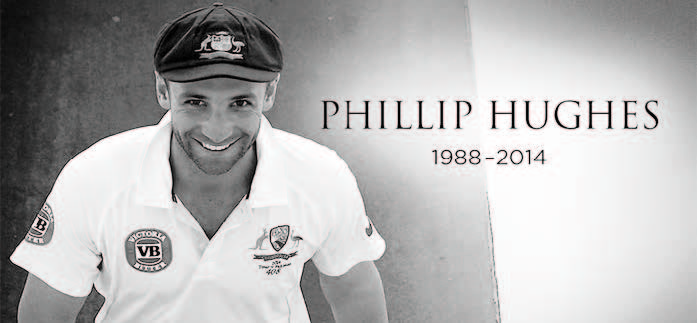
    AUSTRALIA CRICKET CAPTAIN MICHAEL CLARKE BROKE DOWN IN TEARS AS HE PAID TRIBUTE TO FRIEND AND TEAM-MATE PHILLIP HUGHES AT THE BATSMAN’S FUNERAL.

    MACKSVILLE (TIP): Hughes, 25, died last week after being hit by a ball during a match in Sydney. His death stunned Australia and the funeral was broadcast live to millions of people on national television and on big screens in major cities. Around 5,000 people attended the service in Hughes’s home town of Macksville, New South Wales.

    12

    The service was also shown at the Sydney Cricket Ground, where Hughes suffered the injury during a state match on Tuesday, 25 November. He died two days later. During the 80-minute service, Clarke said: “Phillip’s spirit, which is now part of our game forever, will act as a custodian of the sport we all love. “We must listen to it.We must cherish it.We must learn from it.We must dig in and get through to tea. And we must play on. “So rest in peace my little brother.

    13

    I will see you out in the middle.” Around 1,000 people attended the funeral at Macksville High School, which Hughes attended, as thousands more watched on screens in the baking heat outside. Joining the parents of Hughes, Greg and Virginia, and his siblings, Jason and Megan, were Clarke and Sean Abbott, the bowler whose delivery caused the fatal injury to Hughes. Former Australia internationals Shane Warne, Glenn McGrath, Ricky Ponting, Adam Gilchrist, Steve Waugh and Justin Langer were also among the mourners.

    They were joined by Australian Prime Minister Tony Abbott and cricketing legends from around the world, including former New Zealand all-rounder Sir Richard Hadlee and West Indies batsman Brian Lara. Cricket Australia chief executive James Sutherland told mourners: “I imagine Phillip has already taken guard up there and is currently flaying his trademark cut shot behind point. “Cricket’s heart has been pierced with pain, but it will never stop beating.


    19

    Phillip Hughes… forever unconquered on 63.” Jason and Megan Hughes also read letters to their brother. “I couldn’t have asked for a better little brother,” said Jason. “From a very young age, you were destined to be our rock star. “I miss you, I’m so proud of you and thank you again for all the memories. I’ll love you now and forever.” Megan added: “I want to thank you for being the most amazing brother I could ask for. You have certainly changed the way I look at and appreciate life.

    I will certainly take every opportunity that comes by.” Hughes, who would have been 26 on 30 November, was in line for a possible recall to the Australia Test side for the forthcoming series against India – which was rescheduled following his death. The left-handed batsman, who also played for English counties Hampshire, Middlesex and Worcestershire, had already played 26 Tests for his country, after making his Test debut at the age of 20 against South Africa in 2009.

    The number 63 – the runs he had scored when he was fatally injured – has become inextricably linked with Hughes, as has the social media campaign that urged people to remember the batsman by placing cricket bats outside homes, workplaces and at sports grounds. Macksville, with a population of just 2,500, lies on Australia’s east coast in the state of New South Wales.

    Father Michael Alcock told mourners: “We gather to celebrate his 26 years of life. That is what we are doing here this afternoon. “To those both near and far whom his life has touched, we pray that today we will feel some consolation as we celebrate his life.” Among those to send their condolence messages was West Indies great Sir Viv Richards, who tweeted: “My heart goes out to the family, friends & the people of Macksville honouring their favourite son Phillip today. Viv.” The service opened with the song Forever Young and closed with Elton John’s Don’t Let the Sun Go Down on Me.

    The local community also took part in a public procession that followed the hearse at the conclusion of the service. Following the ceremony, Prime Minister Abbott wrote on Twitter: “A sad, poignant, beautiful service to celebrate the life of Phillip Hughes today in Macksville,” adding the hashtag ‘RIP Phillip Hughes’. Former Australia batsman Damien Martyn tweeted: “Such a beautiful service. Forever remembered and never forgotten…”

    Phil Mercer, BBC News in Macksville

    “The feeling here was one of extreme sadness, but it was also pretty uplifting. As the priest said at the start of the service, this was an occasion also to celebrate 26 years of life. One thing everyone had in common today is that they were struck by just how much emotion was swirling around this town. It’s safe to say this little town has put on a remarkable display, as world cricket says a final goodbye to Phillip Hughes.”

  • A TRIBUTE TO PHIL HUGHES PHIL HUGHES’ PASSING AWAY A reminder of life’s uncertainty

    A TRIBUTE TO PHIL HUGHES PHIL HUGHES’ PASSING AWAY A reminder of life’s uncertainty

    You didn’t have to know Australian batsman Phil Hughes to be shaken by the news of his death after a twoday battle in hospital upon being hit by a cricket ball in a Sheffield Shield game at the Sydney Cricket Ground. The world of cricket – players, coaches and other support staff, match officials, administrators, media persons and fans alike – will be united in grief. Over the past two days, there was hope that the kiss of life that Dr Orchard gave Hughes on the hallowed cricket pitch on Tuesday would have worked in his favour.

    There was expectation that Hughes’ will to battle for life would be as strong as the determination that fetched him two hundreds in just his second Test. There was faith that the doctors would help him pull through. It took but a moment – and a text message from a friend in Australia – for those positive emotions, fuelled by an outpouring of prayers by the cricket world at large, to change to shock. Of course, the wise have told us that death is the most certain event in one’s life. But such philosophy is of little consolation when the end comes as an accident with tragic overtones.

    More so, if the victim is in the flush of youth. Surely, 25 is no age to die. Surely, a blow received on the cricket field is not a reason to be dead. There is no doubt that Hughes’ death will cloud the impending Test series between Australia and India. You can expect players from both sides to have a grave demeanour for quite some time. As we pick up the pieces and try to move on, the players will be the most challenged by paradoxical needs to be aggressive and yet sombre; combative and yet intensely serious. We have seen the spectre of death loom over cricket and the world of sport -New Zealand left Sri Lanka because of a bomb blast outside the team hotel in Colombo in 1987. England played in Mumbai in 1993 weeks after serial bomb blasts. Six years ago, England returned after a short break caused by a terrorist attack in Mumbai.

    Other grim memories come flooding back.

    A strange scorecard entry: ‘Abdul Aziz absent dead’ from the Qaid-E-Azam Trophy final in Karachi in 1959. The decline of Hyderabad batsman CL Jaikumar after what seemed to be a good start to a first-class career after he was felled by a Robin Singh bouncer in a 1990 Ranji Trophy game in which he had made 169 in the first innings and was on 42 in the second. But the worst recall is that of former India opener Raman Lamba’s death in February 1998. One can feel the shivers down the spine when thinking of a dark, cold, rainy night when Lamba’s body was brought to Delhi from Dhaka.

    Instead of walking through the arrival hall, he returned in a coffin in the cargo terminal with a few family and friends in attendance. Hughes’ death has lessons, not the least being the establishment of emergency response teams at venues. Perhaps, with greater monies coming in to cricket, the international centres should go beyond from having an ambulance on stand-by to exploring possibilities of instituting a medical centre within the premises so that no time is lost in providing the best aid to an injured player. May the world of cricket grieve together as one but long may the game remain beautiful as we have known it.

    For it is but a reflection of the lives we live, a heady mix of pain and pleasure, agony and ecstasy, joyous and grim and all that lies between. But, above all, may Phillip Joel Hughes’ soul find lasting peace

  • Hughes earned our respect: Kallis

    Hughes earned our respect: Kallis

    NEW DELHI (TIP): Phil Hughes’ tragic death on Thursday has left a huge void, according to Jacques Kallis, who believes the Australia and New South Wales batsman has left a legacy that will act as reminder to treat cricket with utmost respect. In a touching tribute published on the Cricket Australia website, the retired South African allrounder recalled his first-hand impression of watching Hughes bat. “Everything in the cricket world has been put into perspective by the death of Philip Hughes and nothing else feels very important at the moment. Like hundreds of thousands who support and follow the game, my thoughts are also with his family,” wrote Kallis. “It may be true that, as batsmen, we know and understand the risks we take in facing fast bowling but that is no consolation when someone loses their life. It is not something we are accustomed to in cricket and that makes it even harder to come to terms with. “Like millions of other people I will never forget the name ‘Phillip Hughes’, and neither will the game as a whole.

  • Hughes family wants first Test to go ahead

    Hughes family wants first Test to go ahead

    ADELAIDE (TIP): Phillip Hughes’ family would like the Test match between Australia and India starting on December 04 in Brisbane to go ahead. In a statement read out by South Australian Cricket Association CEO Keith Bradshaw, Hughes’ family was keen for the Test to be played. Hughes died on Thursday at Sydney’s St. Vincent hospital after suffering a blow on the back on the head from a Sean Abbott bouncer.

    Speaking to the media at The Adelaide Oval, Bradshaw said the SACA is fully supporting the family and they have extended help to the South Australian team players and the staff. “In regard to the Test match, (I can) only (speak) in terms of what I’ve heard, which is that the Hughes family are keen for that to go ahead,” Bradshaw said. The SACA CEO spoke about the contribution of Hughes for South Australia. “There were many stories that emerged of Phillip’s feats on the field, and those stand for themselves and have been reported.

    There are also many stories about his love for cricket, and I would like to mention his remarkable performance too, off the field; in the short time that he was with us here in South Australia, he attended hundreds of clinics where he coached many of our children. He loved doing that, he had a real passion for that, and I have to say that the children loved him too. They looked up to him, and he was their hero, and he will live on in their minds, as he will in ours, forever,” Bradshaw said. Bradshaw announced that South Australian grade cricket will not be played this weekend. “Cricket, everything else is just secondary at the moment to caring for our players, the family, and all those people that have been involved,” he said.

  • Citing trade, Beijing seeks bigger role

    Citing trade, Beijing seeks bigger role

    KATHMANDU (TIP): The shadow of China seeking a greater role in the South Asian Association for Regional Cooperation (SAARC) and its presence in the eight-member grouping could not be missed here as the 18th Summit got underway. Over the past few days, reports emerged about Beijing pushing the envelope on the issue and today leaders from Bangladesh, Maldives, Pakistan and Sri Lanka advocating a greater role for observers in the regional grouping. SAARC has Australia, China, European Union, Japan, South Korea, Mauritius, Mynamar and the USA as observers and since 2007 have been invited to attend the summit meeting.

    Today as the summit opened, Pakistan Prime Minister Nawaz Sharif emphasised the importance of SAARC observers and the benefit the grouping can draw from its interactions with them. “We should build on convergences and minimise divergences and most of all seek to augment complimentaries for the greater good of the people of the region”, he said. Similar sentiments were expressed by leaders of Bangladesh, Maldives and Sri Lanka. While none of them mentioned China, on his part Deputy Foreign Minister of China Liu Zhenmin, who participated, underscored the role Beijing was playing in the region and prepared for a larger role.

    He mentioned that while China’s trade in the countries of the region stood at $150 billion, the country has $ 30 billion investments in the pipeline, clearly underscoring the economic muscle of Beijing. While New Delhi has not made any move to counter it, India maintained that the priority among member-countries of SAARC should be to ensure cooperation among the eight countries instead of seeking to expand the grouping in a horizontal direction.

  • Modi returns home after 3-nation tour of Myanmar, Australia and Fiji

    Modi returns home after 3-nation tour of Myanmar, Australia and Fiji

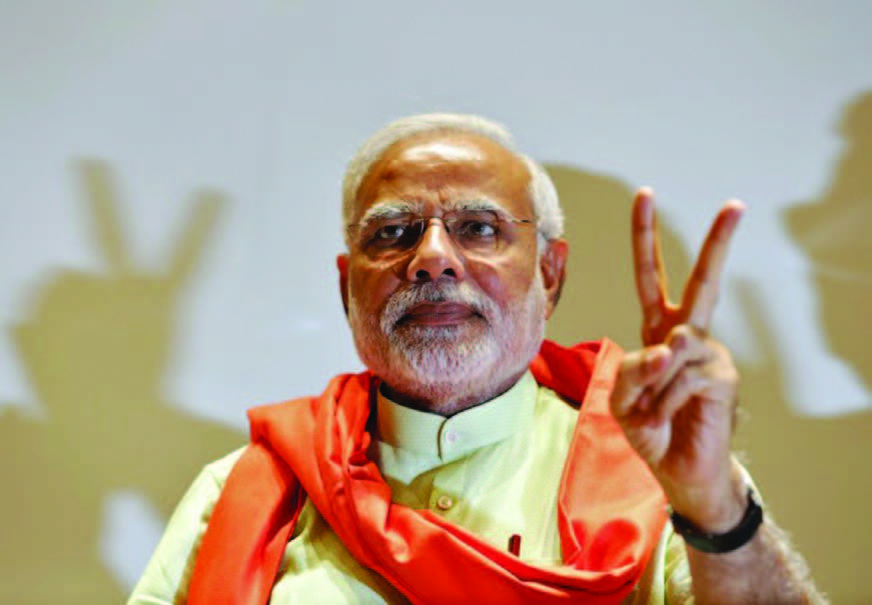
    NEW DELHI (TIP): After a threenation tour of Myanmar, Australia and Fiji that was spread over nine days, Prime Minister Narendra Modi arrived at the New Delhi aiport on November 20 morning. He was received by External Affairs Minister Sushma Swaraj and other dignitaries as he stepped out of the special Air India plane that flew the PM and his delegation from Fiji’s capital Suva. The plane landed at the airport in Delhi at 7:15 am after a 14-hour flight that included a two-hour refuelling halt at Yangon in Myanmar.

    During his three-nation tour, Modi attended the East Asia and ASEAN-India Summits in Myanmar, the G-20 Summit in Australia and held bilaterals with his Australian and Fijian counterparts. Modi, the first Indian premier to visit the Pacific country after Indira Gandhi who had come here in 1981, held talks with his Fijian counterpart Frank Bainimarama and also announced a slew of Lines of Credit and development aid totalling USD 80 million for the country.

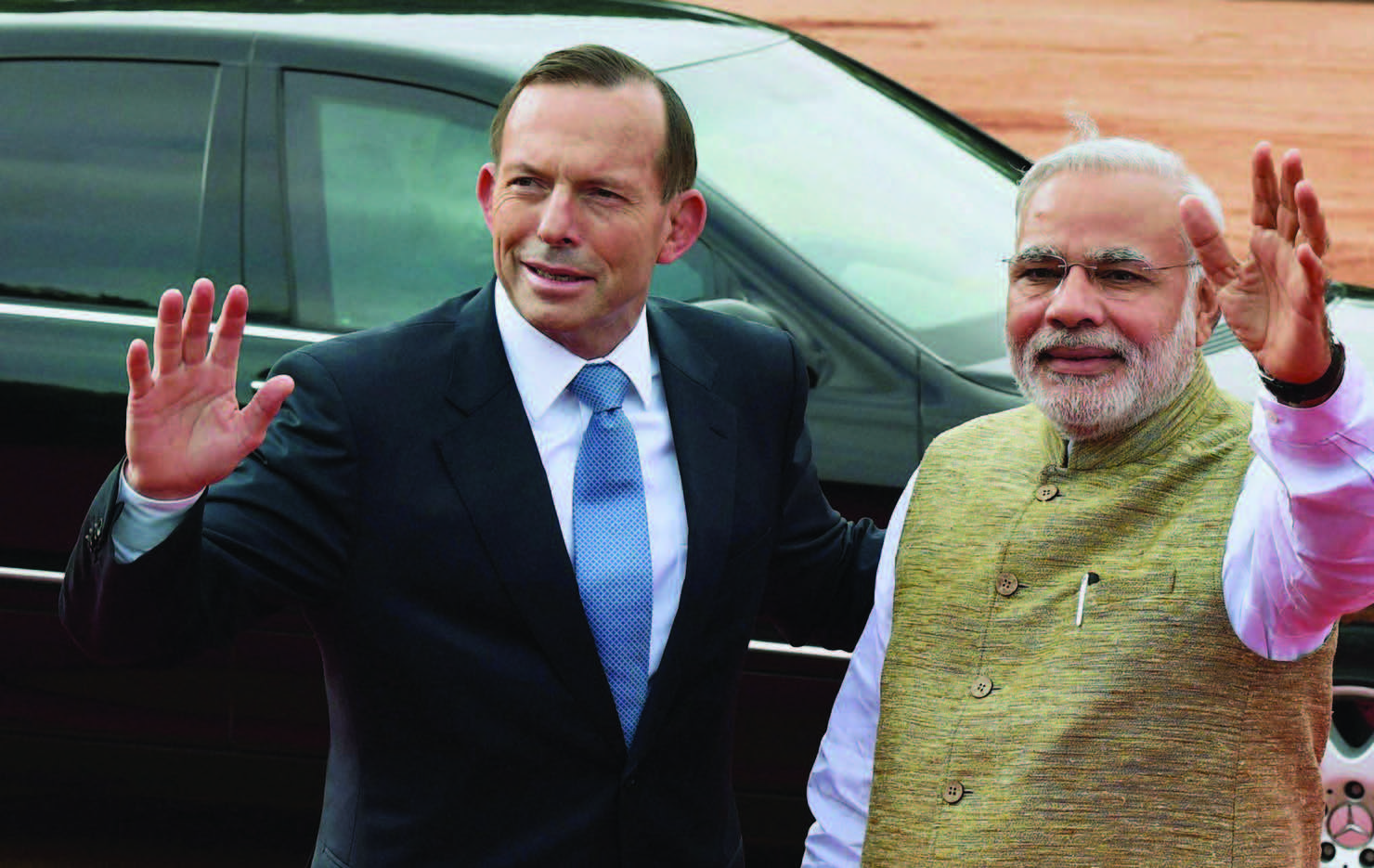
    He also addressed Fijian parliament, the first by a foreign leader, after parliamentary elections, during which he said that India was prepared to build a “Digital Fiji”. Modi announced visa on arrival facility for all the 14 Pacific Island countries and hoped it will promote better understanding between the peoples. During his four-city tour in Australia, Modi and his counterpart Tony Abbott agreed on a landmark framework for security cooperation across the spectrum in defence, cyber and maritime security and combating terrorism, including the threats posed by foreign fighters joining extremists groups. The two countries also decided to conclude a long-pending Free Trade pact by the end of next year and an “early closure” of the civilian nuclear deal that will facilitate uranium imports to India.

    Prior to arriving in Australia, Modi attended the ASEAN-India summit and the East Asia Summit in Myanmar. At the East Asia summit in Myanmar capital Nay Pyi Taw, Modi asserted that the world community must reject any linkage between religion and terrorism while formulating a “genuinely international” partnership in the fight against all forms of terror acts. On India-ASEAN relationship, Modi said there were “no irritants” in their ties and they can be “great” partners.

    He said there will be “major improvement” in India’s trade policy and environment and proposed a special facility for speedy implementation of connectivity projects with the 10-nation ASEAN bloc. On the sidelines of the summits, Modi met Chinese Premier Li Keqiang, Malaysian counterpart Najib Razak, Russian Premier Dmitry Medvedev, and Thai counterpart Gen Prayut Chan-o-cha.

  • Quran is not for Muslims alone

    Quran is not for Muslims alone

    The very first verse in Quran reads, “1:2 (Asad) All praise is due to God alone, the Sustainer of all the worlds (that exist),” and the very last chapter opens with this line, “114:1 (Ali) Say: I seek refuge with the Lord and Cherisher of Mankind,” and there is a whole lot in between. God chose to address the entire mankind, and rightfully so. Quran is for the whole humanity and not just Muslims exclusively. Hold your breath, I cannot pack the next 1200 words in one single sentence, or utter it in one single breath, but I promise you a better understanding by the end of this essay. First of all, God is not the God of Muslims and no where he claims that in Quran.

    He is creator of the universe(s), which is within and beyond our imagination. Quran is a book of guidance to preserve the cohesiveness within and what surrounds us; people and the environment. Darwin is right about survival of the fittest. Nothing in the universe will survive if it goes off balance and is not intact. Thank God everything is created in balance and harmony (55: 7-13) with billions of other elements interconnected and interdependent on each other to function cohesively. In fact, the entire creation can be broadly classified into Matter and Life.

    Planets, stars, seasons and plants are programmed to function obediently (55:5-6) with precision, whereas humans were not put on an autopilot, they were instead given a free will to manage and maintain their own balance, and of course there was the guidance for everyone. God’s says (49:13) that he has created us into many tribes, communities, nations and by extension faiths, ideas, shapes, and colors — and all of us can trace back our origins to a singular couple referred to as Adam & Eve. Given that diversity, we are bound to have conflicts and compete for the resources.

    So, he adds, the best ones among you are those who will take the time to know each other, he knows that knowledge leads to understanding and understanding to acceptance and appreciation of different points of view. God does not miss a beat in communicating with his creation, and tells us not to compel others to be like you (2:256) let it come from their hearts for common goodness, and let others be others and you be you (109:6). Indeed, when you respect the otherness of others, and accept the God given uniqueness of each one of us, then conflicts fade and solutions emerge to live in harmony.

    By the way, this is my definition of Pluralism. Had he willed, he could have made us all into a single community or created all of us precisely alike (5:48), but he chose to create each one of us to be unique with our own thumb print, eye print, DNA, taste buds, belief buds, races, nations and ethnicities. God loves us all, and n0 one is deprived of his love; he has reached out to every human through a peace maker, messenger, prophet, reformer, a wise man or simply a good friend that brings sense to living. The creator offers a variety of guidance to the mankind, no matter where you live, the guidance is there, the guidance that leads to live in peace, and without fear of the other.

    He says I have sent a peacemaker to every nation and every tribe. What does God want? Like a mother who wants her children to live well; a teacher who wants his students to do well; and the chef who wants his patrons to enjoy his food…. God wants every one of his creation to live in harmony. He emphasizes the idea repeatedly (over 18 times) — if you take care of his creation (neighbor), you need not worry; your rewards are with him. Just to make sure we understand this precisely, he says, whether you are a Jew or a Christian and by corollary other, if you take care of your neighbor, I will take care of you (2:62). Mind you, he is very clear, he has never said, “Muslim Neighbor,” but just neighbor to be inclusive of all humanity.

    The concepts of universalism are loaded in the phrases like God of the Universe, “Rabbul Aalameen” and Mercy to Mankind “Rahmatul Aalameen “as Prophet Muhammad is called. Indeed, the word Aalameen is the mother of the word inclusion, aka Pluralism. We have reduced Islam from a system to create harmony and peace in the world to an exclusive political entity, copyrighted and owned by the group. Please beware of the mistranslation and misinterpretations. Deeper study will lead any one to realize the Quran had been purposely mistranslated down through history.

    In the middle Ages, European leaders commissioned a hostile Quran translation to foster warfare against Muslim invaders (Monastery of Abbot 1143 CE). Later, Muslim leaders (Hilali Khan 1924 CE) produced another translation to inflame Muslims against Christians and Jews. It was all for politics. Thank God for the efforts of countless people, most of the mis-translations have been fixed since 2012, and I have contributed my personal share of work towards that effort and I will be happy to do a full presentation on it if needed anywhere in the world, one of them was done in Melbourne, Australia in 2009 at the Parliament of World Religions. Dr. Tariq Ramadan and I also presented the same topic again in tandem. Don’t panic, everything has checks and balances, as a seeker of the truth, you will look at least three different translations to grasp the inclusiveness of Quran.

    HERE IS THE FORMULA

    It may be worth your while to see the list of the mistranslated verses and how the fear mongers in the market have capitalized on those. The best way to understand Quran is to remember, “If it is not about justice, mercy and creating harmony”, then the translation is wrong. Go back and read it several times, three verse before the ‘wrongfully maligned’ verse and three afterwards, and read at least three to four translations. Quran in Arabic is precisely same and well preserved, but its translation and interpretations are not.

    The treatment of verses is at www.Quraantoday.com and the full story of Quran conference is at www.Quraanconference.com I recommend the translations by Muhammad Asad, Abdullah Yusuf Ali and Marmaduke Pickthall, they are not perfect but by far the best. Dr. Laleh Bakhtiar has fixed a few misogynistic translations in her work that were not handled earlier. More work needs to be done and God willing it will continue. I want to acknowledge the contributions made by Mr. Farooq Khan and Dr. Rehana Kausar of Texas, who convinced the Muslim establishments to accept and promote Muhammad Asad’s translation and have distributed many on their own.

    Once they bought the entire stock of books and freely distributed to right people. Farooq Khan adds, “Only through these translations Muslim and Non-Muslims, both, can have a true glimpse of what the Holy Quran says.” Here is a 17 minutes video about Abdullah Yusuf Ali shared by them, it is inspirational and worth watching. You may find a similar spark in you and I did. Here is the video – https://www.youtube.com/watch?v=05CDGL qrWHM Thanks to CAIR for providing me some of the copies of Asad translations which I have personally given to pastors, Rabbis, Sikh and Hindu educators and even some Imams.

    A copy was also presented to my friend Sean Hannity – a great American (unless you know about him, you may not believe until you hear from me), Pamela Geller and others with a similar but one paragraph note as above. Yes, I have copies of Bible, Torah, Bhagvad Gita, Book of Mormon, and Book of Jaina, Guru Granth sahib, Kitab Aqdas, Rev. Moon’s World Scriptures and 12 Quran translations.Thanks to friends and Muslims from around the world for the encouragement they have given me in moving forward with presenting Quran as a document of pluralism. It is a manual to create cohesive societies and it is for all, don’t let Muslims monopolize it. To be a Muslim is to be a peace maker, one who seeks to mitigate conflicts and nurtures goodwill for peaceful co-existence of humanity.

    Mike GhouseMike Ghouse : The author is a community consultant, social scientist, thinker, writer, news maker, and a speaker on Pluralism, Interfaith, Islam, politics, terrorism, human rights, India, Israel-Palestine and foreign policy.

    Mike Ghouse is a Muslim Speaker and head the think tank www.WorldMuslimCongress.com Follow Mike Ghouse on Twitter: www.twitter.com/MikeGhouse

  • Modi returns home after 3-nation tour of Myanmar, Australia and Fiji

    Modi returns home after 3-nation tour of Myanmar, Australia and Fiji

    NEW DELHI (TIP): After a threenation tour of Myanmar, Australia and Fiji that was spread over nine days, Prime Minister Narendra Modi arrived at the New Delhi aiport on November 20 morning. He was received by External Affairs Minister Sushma Swaraj and other dignitaries as he stepped out of the special Air India plane that flew the PM and his delegation from Fiji’s capital Suva. The plane landed at the airport in Delhi at 7:15 am after a 14-hour flight that included a two-hour refuelling halt at Yangon in Myanmar. During his three-nation tour, Modi attended the East Asia and ASEAN-India Summits in Myanmar, the G-20 Summit in Australia and held bilaterals with his Australian and Fijian counterparts.

    Modi, the first Indian premier to visit the Pacific country after Indira Gandhi who had come here in 1981, held talks with his Fijian counterpart Frank Bainimarama and also announced a slew of Lines of Credit and development aid totalling USD 80 million for the country. He also addressed Fijian parliament, the first by a foreign leader, after parliamentary elections, during which he said that India was prepared to build a “Digital Fiji”. Modi announced visa on arrival facility for all the 14 Pacific Island countries and hoped it will promote better understanding between the peoples.

    During his four-city tour in Australia, Modi and his counterpart Tony Abbott agreed on a landmark framework for security cooperation across the spectrum in defence, cyber and maritime security and combating terrorism, including the threats posed by foreign fighters joining extremists groups. The two countries also decided to conclude a long-pending Free Trade pact by the end of next year and an “early closure” of the civilian nuclear deal that will facilitate uranium imports to India. Prior to arriving in Australia, Modi attended the ASEAN-India summit and the East Asia Summit in Myanmar.

    At the East Asia summit in Myanmar capital Nay Pyi Taw, Modi asserted that the world community must reject any linkage between religion and terrorism while formulating a “genuinely international” partnership in the fight against all forms of terror acts. On India-ASEAN relationship, Modi said there were “no irritants” in their ties and they can be “great” partners. He said there will be “major improvement” in India’s trade policy and environment and proposed a special facility for speedy implementation of connectivity projects with the 10-nation ASEAN bloc. On the sidelines of the summits, Modi met Chinese Premier Li Keqiang, Malaysian counterpart Najib Razak, Russian Premier Dmitry Medvedev, and Thai counterpart Gen Prayut Chan-o-cha.

  • ‘CONTACTLESS’ CARDS SOON TO EASE PAYMENTS

    ‘CONTACTLESS’ CARDS SOON TO EASE PAYMENTS

    MUMBAI (TIP): NFC or ‘contactless’ payment cards, which can complete a payment transaction in one-tenth of the time traditionally taken to conduct electronic transactions, will soon be available in India. ICICI Bank has finalised launch of contactless debit and credit cards next month. NFC (Near Field Communication) cards allow payments can be made by merely waving the card in front of a scanner instead of requiring them to be swiped or dipped into a card reader.

    Rajiv Sabharwal, ED, ICICI Bank said “We expect this to be one of the biggest game changers in the payment industry. The key advantage is that, this card can ensure the transaction gets completed in one tenth the time taken by an existing credit card. Also since the card need not leave the customer’s hand, the level of security is higher.” Present regulations require that all cards need to be authenticated by punching a pin to complete the transation and as of now ICICI Bank’s NFC cards will need to be authenticated with PIN. However, RBI has said that it will review this requirement for small transactions.

    RBI governor Raghuram Rajan had said that the central bank was exploring the possibility of allowing small-value transactions on a simpler basis, provided the provider takes full responsibility of misuse beyond a certain point. ICICI Bank will introduce this cards in a Mumbai, Bangalore and Hyderabad. It has already tied up with 200 merchants in these cities and in Gurgaon. The shops include retail and restaurant chains. The bank will issue both debit and credit cards and will tie up with both Visa and MasterCard for their products payWave and s Paypass respectively.

    “In Australia, where NFC was recently introduced, in a matter of months half the market converted to NFC cards because of the convenience. There is a strong pull for this kind of a product from the merchant side as they can service many more customers in the same time. Given our distribution capabilities we expect to make a big difference,” said Sabharwal. In markets where NFC is being used signature or pin validation is waived for low-value transactions making it the fastest form of payment. “Today many believe that cards are to used only for high value payments and they use cash for low value transactions. With NFC even small value payments can be made by card and these transactions can be brought into the formal channel,” said Sabharwal.

  • GAVASKAR DENIES questioning Srinivasan’s silence on match-fixing

    GAVASKAR DENIES questioning Srinivasan’s silence on match-fixing

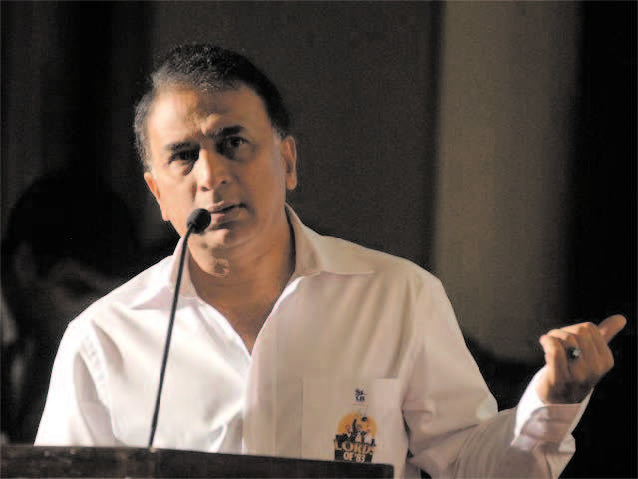
    NEW DELHI (TIP): Former India captain Sunil Gavaskar on November 20 expressed surprise at the “fabricated stories” about him questioning N Srinivasan’s silence in the match-fixing scandal while reacting to the Mudgal Committee report. Gavaskar was quoted in media reports as having said in Melbourne that Srinivasan needs to explain why he didn’t act against players if he knew their involvement in match-fixing, but the former captain stated that the report was not “based on what has actually been said”. “It was a memorable evening and the euphoria was still there next morning till I was jolted by totally erroneous headlines attributed to me about my reactions to Justice Mudgal report.

    I spoke to several channels about significance and honour of the evening and even accommodated questions on just released Justice Mudgal report, though it had nothing to do with the event at the MCG,” Gavaskar said. Gavaskar was in Australia at the invitation of Prime Minister Narendra Modi to attend a special reception at the Melbourne Cricket Ground, which was hosted by his Australian counterpart Tony Abbot. “To wake up the next day to read fabricated headlines and stories was galling indeed. I did express my views that there should be zero tolerance with those involved in matchfixing. I do understand the need for sensational headlines and stories to attract eyeballs but surely they should be based on what has actually been said. It spoilt what had been an extremely memorable three days Down Under,” he said.

  • New Balance of Power in Asia? India is challenging China’s assertiveness

    New Balance of Power in Asia? India is challenging China’s assertiveness

    “India must increase investments in education and infrastructure, achieve more equitable economic development if it is to emerge as a major driver of the global economy. Only then will it be able to make a significant contribution to Asian and international security and contribute to a new peace-promoting balance of power in Asia”, says the author.

    By Anita Inder Singh

    India’s decision to help Vietnam boost its defense modernization – against China’s wishes – raises yet again the question whether a new balance of power is emerging in Asia. India, Vietnam and Japan will try to coordinate security and economic policies. That suggests India is challenging China’s assertiveness in the Asia-Pacific region and staking a claim to explore the energy-rich resources of the South China Sea. Economic and strategic diplomacy were intertwined when Prime Minister Modi visited Japan and the US – and when Chinese President Xi Jinping visited India in mid-September.

    India needs investment to improve its rickety infrastructure and Japan, China and the US have come forward with offers to help India renew it. Companies in all three countries seek new investment destinations and potentially India is one of the biggest. Mutual economic interests are not enough for India to increase its contribution to Asian and global security. The simultaneous interest of Japan and the US in India’s development and its greater role in Asian security only highlight India’s economic weakness and the blunt fact that its ability to enhance its regional role will hinge on its economic performance improving quickly and steadily.

    India has much to gain – and learn – from closer ties with Japan, which is Asia’s oldest democracy. Neither history, nor political/territorial disputes divide India and Japan. As Asia’s post-1945 economic wunderkind Japan had surpassed India, China and many west European countries by the early 1960s. India and Japan are already collaborating on maritime security, counter-terrorism, and energy security. At their summit talks, Modi and Prime Minister Shinzo Abe decided to strengthen defense ties and forge a special strategic global partnership, emphasizing that a developed India and a prosperous Japan were important for Asia and for global peace and security.

    Economics and strategy mixed again when Modi met Japanese business leaders. The 21st century, Modi asserted, would belong to Asia – exactly how would depend on “how deep and progressive” the Indo-Japanese relationship is. This is the immediate context in which he deplored the “expansionist” tendencies among countries, caught in an 18th-century time-warp, to “engage in encroachment” and “intrude” into the seas of others. Evidently Modi was not letting trading interests blur the real political differences with such countries. These comments, made before President Xi Li Ping visited India, were widely interpreted as anti-China. The state-steered Chinese Global Times has downplayed any idea that China counted less than Japan with India.

    “China’s GDP is five times that of India’s. Mutual trust between Beijing and New Delhi, facing strategic pressure from the north, is difficult to build as there is also an unresolved border conflict between the two,” its editorial said. That appeared more of a threat than an olive branch to India. Modi carefully avoided running China down. Before leaving for the US he stated that the world should trust China to observe international law. But Xi’s visit did not enhance trust between New Delhi and Beijing. Even as Xi assured Modi of $20 billion in investment in Gujarat Chinese troops made one of their frequent forays into north-eastern Indian territory, which Beijing claims belongs to China.

    Those forays followed a pattern. China unilaterally invokes “history” (its version) when referring to territorial conflicts with India – and other neighbors. China’s attitude to India echoes that with its Asian neighbors, including Japan, Vietnam and the Philippines. By claiming a territory in the name of history it creates a dispute, dispatches its ships or aircraft – (or in India’s case, troops) – to back up that claim. That is how it unilaterally outlined last November an “air-defense identification zone” over an area of the East China Sea covering Senkaku islands that are also claimed by Japan (and Taiwan). Strong trading ties have not stopped China from using history to make claims on neighboring territories.

    In fact Japan is the largest foreign investor in China. And China is ASEAN’s largest trading partner. In New Delhi Xi’s reference to historical ties between ancient civilizations was marred by the assertion that the Sino-Indian border dispute had historical roots. Such statements imply that the border disputes will remain unsettled; more importantly, that Beijing will continue to lay claim to the Arunachal Pradesh and Ladakh regions. In that case India – like Japan and Vietnam – may find itself simultaneously taking up the politicalstrategic gauntlet and engaging in much-needed trade with China.

    China does nothing to dispel the fears of its neighbors and insists on bilateral solutions. Its claims to un-demarcated maritime waters, including the East and South China Seas (Beijing defines the latter as a ‘core’ interest) are contested by its neighbors, who want the disputes those claims give rise to be settled through international arbitration. That explains why, without naming China, the Obama-Modi communiqué, called on all parties to avoid the use, or threat of use, of force in advancing their claims. It also urged a resolution of their territorial and maritime disputes through all peaceful means, in accordance with the international law, including the UN Convention on the Law of the Sea. At another level, China has taken advantage of America’s planned withdrawal from Afghanistan and is increasing investments there. It is also securing its energy supplies in the oil and gas fields of Central Asia. Moreover, it is India’s main competitor for influence in the Indian Ocean area, which is bounded by Asia on the north, on the west by Africa, on the east by Australia, and on the south by the Southern (Antartic) Ocean.

    There is nothing improper about these activities. But they alarm China’s neighbors and the US, none of whom wants China to gain primacy in Asia. Unsurprisingly, Obama and Modi stressed the need to accelerate infrastructure connectivity and economic development corridors for regional economic integration linking South, Southeast, and Central Asia. The US and India want to promote the India- Pacific Economic Corridor, which will link India to its neighbors and the wider Asia-Pacific region, with a view to facilitating the flow of commerce and energy. That will not be lost on China. Meanwhile uncertainty hovers over the nature of America’s rebalance or pivot to Asia since it has been announced at a time when Washington is cutting defense expenditure. India must increase investments in education and infrastructure, achieve more equitable economic development if it is to emerge as a major driver of the global economy. Only then will it be able to make a significant contribution to Asian and international security and contribute to a new peace-promoting balance of power in Asia.

    (The author is a visiting professor at the Centre for Peace and Conflict Resolution, New Delhi)

  • A first for science and humanity

    A first for science and humanity

    By James Vincent

    The Philae lander has become the firstever spacecraft to land safely on a comet after traveling through space for more than 10 years and covering a distance of some 4 billion miles. “We are there and Philae is talking to us,” confirmed Philae Lander Manager Stephan Ulamec from the European Space Agency (ESA) mission control. “The landing gear has been moved inside so we are sitting on the surface – and there’s more data to come but we are there: it’s done its job, we’re on the comet!” Although details of the landing are still emerging, the ESA

    operations

    hub say that it was “a fairly gentle touch down based on amount of landing gear damping,” but that the harpoons intended to secure the craft did not fire successfully as had first been thought. This means that there’s a possible danger that the lander will not be stable as the comet moves closer to the Sun and becomes more “active” (this happens as the Sun’s rays heat up the surface), but the ESA still stress that Philae is in “great shape” for the moment and that they will re-fire the harpoons shortly. “We have no reason to think it won’t work,” said Paolo Ferri, Head of Mission Operations at the ESA, “but we have no understanding of why it is doing this.” The comet itself is about as big as a mountain: 2.5 miles wide and around 2.3 miles high. If placed on Earth it would be taller than Mount Fuji, although early images of the 67P lent themselves to more unusual comparisons: apparently fused from two separate icy bodies, the comet was most often compared to a rubber duck. Rosetta and Philae have also sent back their first images to Earth – although none from the surface of the comet. Instead, they took snaps of one another as the lander detached from its parent craft. How big is 67P? Bigger than you think. Philae’s ten onboard sensors and instruments will now begin the important work of analyzing material from the comet’s surface as well as the surrounding atmosphere of gas and dust. Rosetta will stay in orbit around the comet for the next year, peeling off sometime around December 2015. The information Philae gathers from the surface of the comet will provide new insight into the mechanisms of our solar system and could even help us answer questions about the origins of life on Earth. It’s long been theorized that life was “seeded” on Earth after hitching an interstellar ride on a comet and previous fly-bys of similar bodies have detected complex organic molecules. If Philae manages to find any water ice or amino proteins (compounds that are key to life) then it could offer some evidence for the theory.

    Markers of the mission

    Cost: The total cost of the mission is 1.4 billion Euro, of which the total Philae costs are 220 million Euro. This includes the launch, the spacecraft, the science payload (instruments and lander) and mission and science operations. Launch: Rosetta was launched on March 2, 2004 by an Ariane-5 from Europe’s Spaceport in Kourou, French Guiana. Planned mission lifetime: Rosetta’s mission will last for almost 12 years – until December 2015. Spacecraft design: Rosetta resembles a large black box.

    The scientific instruments are mounted on the top of the box (the payload support module), while the subsystems are on the “base” (bus support module). On one side of the orbiter is the steerable 2.2 m-diameter communications dish, while the lander is attached to the opposite face. Two enormous solar wings extend from the other sides. Both panels can be rotated through ±180° to catch the maximum amount of sunlight. Mass & dimensions: Approximately 3,000 kg (fully fuelled), including 1,670 kg propellant, 165 kg scientific payload for the orbiter, and the lander weighs about 100 kg. The main spacecraft is 2.8 x 2.1 x 2.0 m, on which all subsystems and payload equipment are mounted. Two 14 m-long solar panels with a total area of 64 m2 provide electrical power.

    Facts about Philae lander

    Design: The lander’s structure consists of a baseplate, an instrument platform and a polygonal sandwich construction, all made of carbon fibre. Some of the instruments and subsystems are beneath a hood covered by solar cells. An antenna transmits data from the surface to Earth via the orbiter. The lander carries nine experiments, with a total mass of about 21 kg. A drill will sample the subsurface material. Alpha Proton X-ray Spectrometer – APXS: Lowered to within 4 cm of the ground, APXS will detect alpha particles and X-rays to gather information on the elemental composition of the comet’s surface. Rosetta Lander Imaging SystemÇIVA/ ROLIS: It is a CCD camera that will obtain high-resolution images during descent and stereo panoramic images of areas sampled by other instruments. Six identical micro-cameras will take panoramic pictures of the surface. A spectrometer will study the composition, texture and albedo (reflectivity) of samples collected from the surface.

    Comet Nucleus Sounding –

    CONSERT: It will probe the internal structure of the nucleus. Radio waves from CONSERT will travel through the nucleus and will be returned by a transponder on the lander. Cometary Sampling and Composition experiment – COSAC: It is one of two ‘evolved gas analysers’. It will detect and identify complex organic molecules from their elemental and molecular composition. Evolved Gas Analyser – MODULUS PTOLEMY is another evolved gas analyser that will obtain accurate measurements of isotopic ratios of light elements. Multi-Purpose Sensor for Surface and Subsurface Science – Mupus: This will use sensors on the lander’s anchor, probe and exterior to measure the density, thermal and mechanical properties of the surface.

    Rosetta Lander Magnetometer and Plasma Monitor – Romap: This is a magnetometer and plasma monitor that will study the local magnetic field and the interaction between the comet and the solar wind. Sample and Distribution Device – SD2: This device will drill more than 20 cm into the surface, collect samples and deliver them to different ovens or for microscope inspection. Surface Electrical, Seismic and Acoustic Monitoring Experiments – SESAME’s: These three instruments will measure properties of the comet’s outer layers. The Cometary Acoustic Sounding Surface Experiment will measure the way sound travels through the surface.

    The Permittivity Probe will investigate its electrical characteristics, and the Dust Impact Monitor will measure dust falling back to the surface. Operations Mission Operations Centre: European Space Operations Centre (ESOC), Darmstadt, Germany. Prime Ground Station: ESA Deep Space Antenna in New Norcia, near Perth, Australia. Rosetta Science Operations Centre: European Space Astronomy Centre (ESAC), in Villafranca, Spain. The European Space Agency has released the following information regarding the mission, its parameters and

    objectives:

    Rosetta is the first mission designed to orbit and land on a comet. It consists of an orbiter, carrying 11 science experiments, and a lander, called “Philae”, carrying 10 additional instruments, for the most detailed study of a comet ever attempted. Rosetta’s launch was originally scheduled for January 2003 on an Ariane-5 rocket. Rosetta’s target at that time was Comet 46P/Wirtanen, with the encounter planned for 2011. However, following the failure of the first Ariane ECA rocket, in December 2002, ESA and Arianespace took the joint decision not to launch Rosetta during its January 2003 launch window.

    Objectives ESA’s comet-chaser will be the first to undertake a lengthy exploration of a comet at close quarters. After entering orbit around Comet 67P/Churyumov-Gerasimenko in 2014, Rosetta will release its Philae small lander onto the icy nucleus as it did two days ago. Rosetta will orbit the comet for about a year as they head towards the Sun. Once they have passed perihelion (closest distance to the Sun), Rosetta will keep orbiting the comet for another half year, while the comet moves back out towards the orbit of Jupiter. As the most primitive objects in the solar system, comets carry essential information about our origins. Their chemical compositions have not changed much since their formation, therefore reflecting that of the solar system when it was very young and still “unfinished”, more than 4,600 million years ago.

    Rosetta will also help to discover whether comets contributed to the beginnings of life on Earth. Comets are carriers of complex organic molecules, delivered to Earth through impacts, and perhaps played a role in the origin of life. Moreover, volatile light elements carried by comets may also have played an important role in forming Earth’s oceans and atmosphere. During its long journey, Rosetta was scheduled to have two close encounters with asteroids of the main asteroid belt that lies between the orbits of Mars and Jupiter. The first was with (2867) Steins, a rare E-type asteroid. The flyby started on August 4, 2008 with optical navigation of the asteroid itself – a technique never before used in ESA spacecraft operations.

    Rosetta orbiter

    The orbiter’s scientific payload includes 11 experiments, in addition to the lander. Scientific consortia from institutes across Europe and the United States provided these state-of-the-art instruments. The Ultraviolet Imaging Spectrometer – ALICE will analyse gases in the coma and tail and measure the comet’s production rates of water and carbon monoxide and dioxide. It will provide information on the surface composition of the nucleus. Comet Nucleus Sounding Experiment – CONSERT will probe the comet’s interior by studying radio waves reflected and scattered by the nucleus. Cometary Secondary Ion Mass Analyser – COSIMA will analyse the characteristics of dust grains emitted by the comet, such as their composition and whether they are organic or inorganic. Grain Impact Analyser and Dust Accumulator – GIADA will measure the number, mass, momentum and velocity distribution of dust grains coming from the cometary nucleus and other directions (deflected by solar radiation pressure). The Micro-Imaging Dust Analysis System, MIDAS, will study the dust around the comet.

    It will provide information on particle population, size, volume and shape. Microwave Instrument for the Rosetta Orbiter – MIRO will determine the abundances of major gases, the surface outgassing rate and the nucleus subsurface temperature. Optical, Spectrocopic and Infrared Remote Imaging System – OSIRIS has a wide-angle camera and narrow-angle camera that can obtain high-resolution images of the comet’s nucleus. Rosetta Orbiter Spectrometer for Ion and Neutral Analysis – ROSINA will determine the composition of the comet’s atmosphere and ionosphere, the velocities of electrified gas particles and reactions in which they take part.

    Radio science investigation signals

    Rosetta Plasma Consortium – RPC will measure the physical properties of the nucleus, examine the structure of the inner coma, monitor cometary activity, and study the comet’s interaction with the solar wind. Radio Science Investigation – RSI will, by using shifts in the spacecraft’s radio signals, measure the mass, density and gravity of the nucleus, define the comet’s orbit, and study the inner coma. Visible and Infrared Mapping Spectrometer – VIRTIS will map and study the nature of the solids and the temperature on the surface. It will also identify comet gases, characterise the physical conditions of the coma and help to identify the best landing sites.

  • PM Modi arrives in Australia

    PM Modi arrives in Australia

    BRISBANE (TIP): Prime Minister Narendra Modi on November 14 arrived in Australia on the second leg of his three-nation tour during which he will attend the annual G20 summit and hold bilateral talks with his Australian counterpart Tony Abbott. Modi reached Brisbane after attending the ASEAN-India summit and the East Asia Summit on November 12-13 in the Myanmarese capital Nay Pyi Taw.

    The Prime Minister is on a 10-day visit of Myanmar, Australia and Fiji to attend key multilateral summits and undertake bilateral meetings. Before his departure from India, Modi had said the importance of global cooperation against black money will be a “key issue” he will highlight at the G20 summit. “A key issue for me would be to highlight the importance of international cooperation against black money,” Modi had said in a predeparture statement.

    As India attempts to unearth black money stashed abroad, Modi is expected to renew the country’s commitment to a global response to deal with cross border tax avoidance and evasion. At the annual summit of the Group of 20 of the world’s biggest developed and emerging economies, Modi had said he intends to discuss how it can accelerate creation of next generation infrastructure, which also includes digital infrastructure, and ensure access to clean and affordable energy. The two-day summit will be held from November 15. G20 accounts for 85 per cent of the world’s economic output. During his visit, Modi will also hold talks with Prime Minister Abbott in Canberra after the G20 summit.

    Modi is the first Indian Prime Minister to visit Australia in 28 years since Rajiv Gandhi in 1986. “While we have much in common with Australia, our political, strategic and economic relations have been below potential. “A closer strategic partnership with Australia will support India’s economic goals; promote our security interests, including maritime security; and, reinforce our efforts to foster a climate of peace and stability in our extended continental and maritime neighbourhood,” he said referring to his four-city Australia visit that covers Brisbane, Melbourne and Sydney besides Canberra.

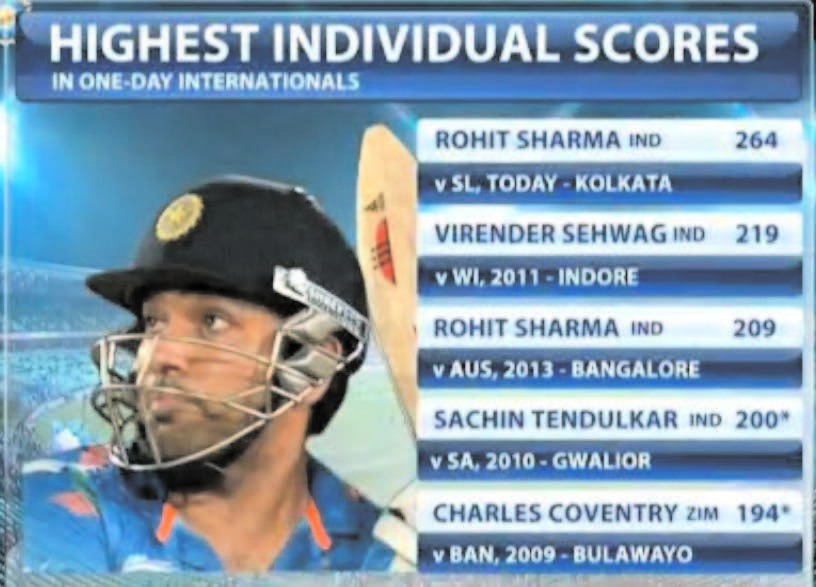
  • ROHIT’S RECORD 264 LEADS SRI LANKA THRASHING

    ROHIT’S RECORD 264 LEADS SRI LANKA THRASHING

    India have all the reasons to feel good about batting ahead of their upcoming tour of Australia after Rohit Sharma, playing his first international match since August on account of finger and shoulder injuries, scored his second double hundred (264 off 173 balls) to help India thrash Sri Lanka for the fourth time running in the five-game series at Kolkata’s Eden Gardens on Thursday.

    Rohit, after becoming the first batsman to score two double hundreds, also broke Virender Sehwag’s record of highest individual score of 219 as India posted a mammoth 404 in pursuit of which the Sri Lankans could only manage 251 all out in 43.1 overs. In the previous games of the series, Shikhar Dhawan, Ajinkya Rahane, Suresh Raina, Virat Kohli, Ambati Raidu all were among the runs but India still needed Rohit – one of their big batting hopes – to get some confidence before the gruelling Australian tour gets underway later this month.


    23


    Standin captain Kohli’s comments on Rohit on the eve of the match that “if a player like him gets going he can be the X factor in a tournament like the World Cup. When he gets going, he can bring those big runs and win the match for you” echoed at the hallowed Eden Gardens in front of thousands of Indian fans as the 27-year-old hit a record 33 boundaries to go with nine sixes. Looking at his score, one might think that he was in his zone from the first ball but that wasn’t the case. In the first half of his innings, he was sluggish struggling to meet the ball properly.

    Rohit, who took Dhawan’s place for this match, was lucky to get a reprieve on four when Thisara Perera dropped a simple catch at third man off the bowling of Angelo Mathews. His discomfort could be gauged from the fact it took him 22 balls to pick up his first boundary and then 72 balls for a fifty. However, once past fifty, Rohit upped the ante big time with his next four fifties coming off just 28, 25, 26 and 15 balls. India, for the second time in series after the Cuttack game, took the batting Powerplay a bit earlier than usual and made 57 runs from 29-34 overs. Rohit had plenty of support from Kohli (66 off 64 balls, 33rd fifty), after Ajinkya Rahane and Ambati Rayudu contributed 28 and 8 respectively, and both added 202 in 25.5 overs.

    Kohli’s run-out, resultant of a misunderstanding on the second run, was the only blemish of that partnership. Suresh Raina got out cheaply for 11 but Rohit continued his assault, adding 128 in 9.4 overs runs with Robin Uthappa (16*) before falling off the last ball of the innings. India scored 129 in the last 10 overs. The Sri Lankan bowlers had a nightmarish outing with Nuwan Kulasekera, Shaminda Eranga, Sekkuge Prasanna and Ajantha Mendis returning 2/89 ( 9 overs), 1/77 (10 overs), 0/70 (10 overs) and 0/70 (7 overs) respectively. The visitors’ hopes of a remote win were dashed in the first ten overs thanks to Umesh Yadav and Stuart Binny whose strikes left the Sri Lankans gasping for breath at 48 for 4.

    After that the match became academic as Mathews’ men only played to reduce the margin of defeat. Mathews and Lahiru Thirimanne added 118 runs and then, after Akshar Patel had Mathews stumped for 75, Thirimanne (59) put on 52 with Thisara (29) to blow away fears that it could be their worse defeat than their 183-run thrashing at Taunton in 1999 – their biggest loss in terms of runs against India. Encouraged by a big total, Indian bowlers Umesh (2/38), Binny (2/55), Patel (2/51) and Dhawal Kulkarni (4/34) plied their trade with a lot of freedom. However, it wasn’t a good day for debutant legspinner Karn Sharma who took some pounding and returned with figures of 0/64. The last game of the series will be played in Ranchi on Sunday.

    Brief scores: India 404/5 (Rohit 264, Kohli 66; Kulasekara 2/89) beat Sri Lanka (Mathews 75, Thirimanne 59; Kulkarni 4/33) by 153 runs

  • EYE ON CHINA, INDIA AND US SET TO RAMP UP JOINT NAVAL DRILLS

    EYE ON CHINA, INDIA AND US SET TO RAMP UP JOINT NAVAL DRILLS

    NEW DELHI: India and the US are set to deepen and broaden their bilateral military exercises to include more warfare components involving nuclear submarines and aircraft carriers. They would also invite more countries to join the Malabar exercises as the two nations share concerns about the growing Chinese naval presence in the Indian Ocean. Both the Indian and US navies have been warily watching the growing Chinese naval presence in the Indian Ocean, especially its submarine manoeuvres.

    In the recent weeks, India conveyed its displeasure to the Sri Lankan government at least twice over its decision to permit Chinese submarines to dock in its ports. According to dependable sources, India and US officials have had detailed discussions, including at the Defence Policy Group meeting in Washington DC, on stepping up the bilateral naval exercises. The decision involves a series of steps, starting with increasing the nuclear submarine and aircraft carrier warfare components. The two sides are also looking at adding both army and air force components to the traditionally naval exercise. Sources said the two sides are looking at inviting more countries, thus expanding them mostly into trilateral exercises.

    In July 2014, India and the US invited Japan to the exercises held in north-western Pacific. Malabar has featured Australia and Singapore, besides Japan, in 2007. Through most of the UPA tenure, especially under defence minister AK Antony, Malabar exercises off Indian coast have mostly been bilateral affairs, in an effort not to raises Chinese hackles. However, under the new regime in New Delhi there is a noticeable shift in the strategic posturing, especially vis-a-vis China. In Washington DC in October, the joint statement issued by Narendra Modi and Barack Obama had referred to the situation in South China Sea. It was the first time that the two sides had so explicitly referred to the issue in an Indo-US joint statement.

    The move to deepen and broaden the Malabar exercises flow from Modi’s declared strategic vision, especially reflected in the joint statement. The move comes even as the government is warily looking at the growing Chinese submarine activities in the region. It has for sometimes been uncomfortable about Chinese sending its submarines as part of their anti-piracy patrols.When INS Vikramaditya was sailing from Russia starting November 2013, a Chinese submarine was in Indian Ocean observing the carrier.

  • Australian government awards scholarship for 60 Indians

    Australian government awards scholarship for 60 Indians

    NEW DELHI (TIP): The Australian government on November 6 awarded 60 scholarships to Indian scholars to undertake study and research in the country. “I congratulate the successful recipients of Endeavour Scholarships and Fellowships. The fact that 60 Indians were selected for this award is a testament to the talents in this country,” said Australian High Commissioner Patrick Suckling. The number of Indians receiving scholarship have increased to 60 from 40 recipients in 2014. The recipients will undertake study or research at vocational, postgraduate, and postdoctoral level or undertake professional development at some of Australia’s most prestigious universities across a broad range of academic fields. “The Endeavour Scholarships and Fellowships facilitate knowledge sharing, strengthen mutual understanding between Indian and Australian scholars and build international networks. This serves to reinforce our strong and enduring bilateral relations with India,” said Suckling. The scholarships for the academic year 2015 have been given to 528 international students and 154 to Australians to undertake study and research overseas and three of them will be traveling to India in 2015.

  • Gurdwara vandalized in Australia’s Perth

    Gurdwara vandalized in Australia’s Perth

    MELBOURNE (TIP): A newly-built gurdwara has become target of anti-Islamic slurs after it was vandalized and painted with obscene messages in Australia’s Perth city. The multi-million dollar Sikh shrine in Bennett Springs was painted with the words like “Aussie pride” and “go home”, ABC reported. Security cameras of the gurdwara were also damaged. “We are from India, particularly from Punjab, we have got no relation with any other religion. We are Sikhs and our religion is totally different from any other religion,” said the pastor Satjit Singh. The treasurer of the gurdwara, Aman Deep Singh, said it was very hurtful. “Make the difference between Arabs and Sikhs and above all we all are here, we have left our businesses, jobs. They have done so much damage. They have not actually just done the damage to this temple, they have done the damage to the whole country,” he said. Labor MP Margaret Quirk said the racial slurs showed “complete ignorance”. “Most of the people that worship in this temple are in fact Australian citizens and this of all weeks; it’s particularly shocking,” she said. The incident has occured few days after two Perth mosques and an Islamic school were vandalised and had been painted with slogans.

  • E-VISA SYSTEM LIKELY TO BE ROLLED OUT NEXT

    E-VISA SYSTEM LIKELY TO BE ROLLED OUT NEXT

    NEW DELHI (TIP): The Government will roll out by next week the muchawaited electronic-visa system for tourists from select countries including US and Japan. Home minister Rajnath Singh along with tourism minister Sripad Naik will unveil the first phase of e-visa system for tourists from two dozens countries including US and Japan at a function here shortly, a senior Tourism Ministry official said.

    While Australia is likely to be accorded the e-visa facility during Prime Minister Narendra Modi’s visit Down Under, some countries belonging to BRICS and African region are likely to be announced in the first phase. The e-visa is expected to give a big boost to the foreign tourist arrivals in the country. While in January about 4.95 lakh foreign tourists arrived in India, there were a total of 51.79 lakh during January-September this year. All the arrangements including the software for this system is ready now and will be operational at nine international airports including Delhi, Mumbai, Chennai, Kolkata, Hyderabad, Bengaluru, Kochi, Thiruvananthapuram, and Goa.

    The official said though there are certain issues yet to be resolved for the Goa Airport, the Government has decided in principle to extend it to Goa as well. According to the official, about 25 countries including the 13 countries which are currently having the Visaon- Arrival (VoA) facility in India to be covered under e-visa regime. US, Japan, South Korea, Thailand, Vietnam, the Philippines, Singapore are among the countries which will be given e-visa facility in the first phase. Barring a few countries like Pakistan, Sudan, Afghanistan, Iran, Iraq, Nigeria, Sri Lanka and Somalia, all 180 countries will be covered under e-visa regime in phases, the official said.

    He said China is definitely on the list of countries to be provided e-visa facility, but not in the first list. China is a big-thrust market for India and Tourism Ministry has taken various steps to woo maximum Chinese tourists. While the Incredible India website is being translated into the Chinese language and an infoline will also be established in that language. Besides guides are being trained in Chinese language to help tourists from that country. In order to get e-visa, one would need to apply in the designated website along the required fees. They would be granted an electronic version of the visa within 96 hours.