Tag: Australia

  • Virgin takes full control of Tigerair Australia for Aus$1

    Virgin takes full control of Tigerair Australia for Aus$1

    SYDNEY (TIP): Virgin took full control of budget carrier Tigerair Australia, buying the remaining 40 percent it did not already own for Aus$1 (88 US cents) from its Singaporelisted parent. The deal was revealed as it was announced that Singapore Airlines (SIA) would take majority control of Tiger Airways, of which Tigerair Australia was a subsidiary, as part of a turnaround plan for the loss-making budget firm.

    Virgin Australia purchased a 60 percent stake in Tigerair in mid-2013 for Aus$35 million and said agreement had been reached to buy the rest of the carrier, which has struggled to reach profitability, for the tiny sum. Tiger will continue to license its brand to Virgin. Virgin Australia chief John Borghetti said the acquisition would allow it to fly to a number of new short-haul international destinations, providing growth opportunities for the business, while accelerating Tigerair’s drive for profitability. “Given the ongoing subdued consumer demand in the Australian domestic market, the growth of the Tigerair Australia domestic fleet is likely to be reduced,” he said.

    “Under this proposed transaction, we will benefit from the economies of scale and achieve profitability ahead of schedule by the end of 2016, by leveraging the resources of the wider Virgin Australia Group.” In Singapore, Tiger Airways said SIA would convert its “perpetual convertible capital securities holdings” in the carrier into shares, raising its stake to 55 percent from 40 percent. It said the move would effectively make Tiger Airways a subsidiary of SIA, which also operates a long-haul budget unit called Scoot. Tiger Airways also said it will separately raise Sg$234 million (US$184 million) in a rights issue that will be mostly subscribed by SIA. The rights issue will be carried out after SIA increases its stake.

    Tiger has been struggling to make money owing to tough competition in the booming Southeast Asian budget carrier market, which is dominated by Malaysia’s AirAsia and Singapore-based Jetstar Asia. Earlier this year, it sold its entire 40 percent stake in Tigerair Philippines to rival Cebu Pacific, and in July, its joint venture in Indonesia’s PT Mandala Airlines ceased operations owing to losses. The Tigerair Australia move, which is subject to Foreign Investment Review Board approval, comes after a difficult 12 months for Australian airlines as intense battle for market share saw both Virgin and Qantas suffer heavy losses. Virgin posted a full-year net loss of Aus$355 million, while Qantas suffered a record loss of Aus$2.8 billion.

  • India name 21- member hockey squad for Australia Test tour

    India name 21- member hockey squad for Australia Test tour

    NEW DELHI (TIP): Sardar Singh will lead a 21-member Indian men’s hockey squad for the four-match Test tour of Australia to be held in Perth from November 4 to 9. Post bagging the gold medal at the 17th Asian Games in Incheon, the tour of Australia is being organised as part of preparation for the upcoming FIH Champions Trophy 2014, to be held in Bhubaneswar December 6-14.

    The Indian squad is set to depart for Perth on October 29 October 2014,. Besides the four Tests, India will also play a training game against Australia A on November 1 at the Perth Hockey Stadium. The 21-member squad was selected by Hockey India selectors B P Govinda, Harbinder Singh and Arjun Halappa alongwith chief coach Terry Walsh, coach Jude Felix and physiotherapist Jince Thomas Mathew on the basis of their performance in the recently-concluded selection trials at at Major Dhyan Chand National Stadium. Goalkeeper P R Sreejesh has been named Sardar’s deputy for the tour.

    Harjot Singh has been named as the second custodian in the squad. The first Test between India and Australia will be played on November 4, followed by matches on November 5, 8 and 9. “Playing against Australia will be an exciting clash and I am sure both the teams will strive to put on their best efforts and will display an excellent show against each other,” Hockey India president Narinder Batra said in a statement. “What will go in our benefit will be the performance that the team showcased both in the Commonwealth Games as well as the Asian Games and which will be a huge motivation for the boys when they face Australia.”

  • WORLD CELEBRATES DIWALI with prayers, bright lights and fireworks

    WORLD CELEBRATES DIWALI with prayers, bright lights and fireworks

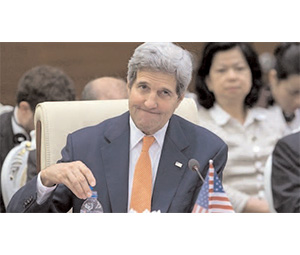
    WASHINGTON (TIP): The five-day Indian festival – Diwali – symbolic of victory of good over evil was celebrated , from October 22 , the world over with great enthusiasm Amid chanting of Vedic mantras and lighting of the traditional ‘diya’ by US Secretary of State John Kerry, Diwali was celebrated for the first time at the State Department. “As the days grow shorter, the Diwali reminds us that spring always returns – that knowledge triumphs over ignorance, hope outlasts despair, and light replaces darkness.

    Diwali is a time for the revitalization of mind and spirit,” said Kerry who was joined by India’s Ambassador S Jaishankar. “It affords a chance to reflect on how we can bring light to others. It is an opportunity for us all, regardless of our own traditions, to renew a shared commitment to human dignity, compassion, and service – and it is a commitment, I think, at the heart of all great faiths,” he said. Some 300 guests, including a large number of eminent Indian-Americans and envoys from other South Asian countries, were present to celebrate Diwali for the first time at the State Department’s historic Benjamin Franklin room, which was lit with many small diyas and candles.

    The top Indian-American US officials, including Assistant Secretary of State for South and Central Asia Nisha Desai Biswal and USAID Administrator Raj Shah, were also present. “We worked hard to prove that we were, in fact, natural partners, which I believe we are. We are two optimistic nations who believe that history doesn’t shape us, but that we have the power to shape history. And that spirit of hope and optimism is really at the center of the Diwali celebration,” Kerry said and greeted people with Saal Mubarak. The guests were served the traditional Indian dishes – including sweet dishes like Jalebi, Gulab Jamun, different varieties of burfi, kaju katli and kheer. Some of the dishes were in fact were made inside the State Department kitchen, while other dishes were procured from a popular Indian restaurant in Washington DC.

    It was also one of the rarest occasions that no alcohol was served. It was all soft drinks, juices and not to miss the traditional mango ‘lassi’. In Birmingham, UK, Bhangra music filled the air as hundreds of people flocked to Diwali celebrations in Birmingham. Food stalls and dancing also entertained families as they turned out in their droves for Soho’s Festival of Lights.

    It was the first time the event had been staged after being organized by the newly-formed Soho Road BID. The BID is home to 560 predominantly independent businesses stretching from Holyhead Road to Soho Hill – with an estimated local population of 250,000. BID manager Craig Bucky said: “We were so excited to be able to run our first community event. “It’s been a lot of hard work and determination but it was a great celebration that the community can be proud of.” BID chairman Dipak Patel said that more events were in the pipeline in a bid to improve the area.

    “The long-term strategy is to make Soho Road an exciting place to work and live,” he said. Diwali was celebrated with enthusiasm and vigor in Sri Lanka, the land where the epic happened. Distribution of misri and lighting a lamp was a traditional fix. Locals offer prayers along the beach. In Thailand, Diyas or lamps made of banana leaves with candles and incense were placed in the river to float. People greeted each other and distributed sweets. Diwali was celebrated with full aplomb in Malaysia. Even the locals indulged in the festivities wholeheartedly. Diwali is an official holiday in Malaysia. People invite each other to their homes and celebrate it with their friends and family.

    The Hindu community of Malaysia constitutes about 8% of its total population. The community celebrates it under the name of Hari Diwali. Nepal is a multi ethnic land with diversity in culture. Nepal celebrated Diwali with bright lights, gift exchanges, fireworks, and elaborate feasts to welcome Lakshmi, the goddess of light and wealth. Diwali in Nepal is known as Tihar. In Australia, Diwali was celebrated publicly amongst the people of Indian origin and the local Australians in Melbourne.

    The cultural kaleidoscope of India was depicted as Indians in Melbourne showcased Indian art, culture, style, traditions and food via various activities, seminars, festivals, fairs and events. Diwali was also celebrated in Guyana, Fiji, Mauritius, Myanmar, Singapore, Trinidad & Tobago, Indonesia, Japan, Thailand and Africa, among the Hindus across the world.

  • Venezuela, New Zealand win UN security council seats but Turkey rebuffed

    Venezuela, New Zealand win UN security council seats but Turkey rebuffed

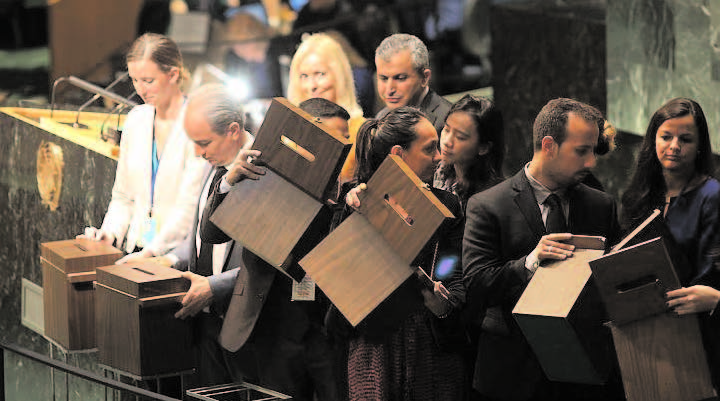
    UNITED NATIONS (TIP): Angola, Malaysia, New Zealand, Spain and Venezuela won coveted seats at the UN security council on October 16, but Turkey suffered a humbling defeat in its bid to join the world’s “top table.” The five countries garnered the required two-thirds support from the 193 countries of the UN General Assembly during three rounds of voting that ended with Turkey picking up only 60 votes.

    Turkey had been competing against New Zealand and Spain for two seats and had dispatched Foreign Minister Mevlut Cavusoglu on a high-profile mission to New York this week to lobby for votes. Angola, Malaysia and Venezuela were virtually assured to win election as their candidacies had been put forward by their region and they ran unopposed on their slates. After New Zealand’s resounding victory in the first ballot, Foreign Minister Murray McCully called the outcome a “strong vote of confidence” in his country, capping a 10-year campaign for the ultimate diplomatic prize.

    “To receive the success that we have had this morning means a lot to us and we will work very hard to make sure we give good service on the council,” McCully told reporters at UN headquarters. Venezuela won 181 votes despite criticism from rights groups and the United States over its support for Iran, Syria and other hardline regimes that are at loggerheads with the West. Venezuela’s President Nicolas Maduro called the vote “a victory, a world record of support, love and confidence. One hundred eight-one countries have said here we are, we support you.””We should feel happiness and joy in our hearts that Venezuela is beloved country in the world,” he added, speaking in Caracas. “To those birds of ill omen who say Venezuela is isolated in the world — who is isolated? The country that received 181 votes?” US Ambassador Samantha Power urged Venezuela to work cooperatively on the council.

    “Unfortunately, Venezuela’s conduct at the UN has run counter to the spirit of the UN Charter and its violations of human rights at home are at odds with the Charter’s letter,” she said. Rights groups have pointed to Venezuela’s record on the UN Human Rights Council as a cause for worry and diplomats have also expressed concern about its stance on the war in Syria. Over the three rounds of voting, Turkey saw its support dwindle from 109 votes to 73 and finally 60, surprising many who saw the regional player as a strong contender.

    Angola won 190 votes, Malaysia picked up 187, New Zealand 145 and Spain 132. The elections came at a busy time for the council, which is grappling with crises on many fronts, from the jihadist offensive in Iraq and Syria, to the Ebola outbreak in West Africa. Russia’s actions in eastern Ukraine, conflicts in Syria, South Sudan and Central African Republic and the faltering Israeli-Palestinian peace process are also at the top of the council’s agenda. A seat at the Security Council raises a country’s profile several notches, boosts influence and provides knockoff benefits in bilateral ties.

    The five elected countries to the 15- member council will join the five permanent powers — Britain, China, France, Russia and the United States — for a two-year term. Five other countries elected last year are mid-way into their term. These are Chad, Chile, Jordan, Lithuania and Nigeria. As the most powerful body of the United Nations, the security council can impose sanctions on countries and individuals, refer suspects for war crimes prosecution, endorse peace accords and authorize the use of force. It also oversees 16 peacekeeping missions in the world, with a budget of close to $8 billion. The five elected countries will replace Argentina, Australia, Luxembourg, Rwanda and South Korea, and begin their stint on January 1.

  • DEALING WITH THE US ALWAYS TESTS OUR DIPLOMACY

    DEALING WITH THE US ALWAYS TESTS OUR DIPLOMACY

    At the end of the day, India and the US have to find common ground that protects their respective interests. The US as a global power should not force India to support it in its geopolitical mistakes. India should not act irresponsibly about its own interests to prove to the US that it is a responsible power”, says the author.

    By Kanwal Sibal

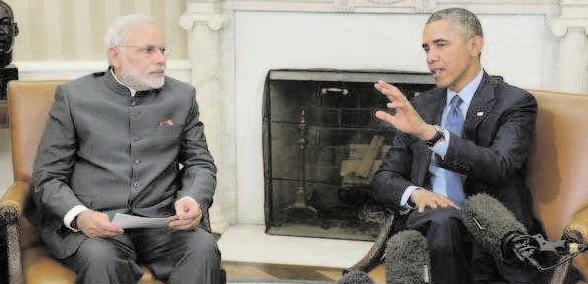
    Prime Minister Narendra Modi’s US visit presented him with a difficult challenge. At the rhetorical level, projecting the India-US relationship as between two democracies is easy. The US calls its relationship with India a defining one in the 21st century, though actual US policies belie such rhetoric. Our hype about the US being our ‘natural partner’ is not justified by the record of our relations with it since Independence. And so, the general perception continues to be that the rhetoric is disconnected from reality.

    Will the US develop industrial corridors like Japan or competitively build highways, ports and airports? India has “offered” US industry lead partnership in developing three Smart Cities…

    America’s grouse is that India has not adequately requited Washington’s decision to lift nuclear sanctions on it. American nuclear firms expect to get business in India and want the Indian nuclear liability law amended. They eye a big share of the Indian Defence procurement pie as another reward. On the economic side, US corporations have launched a campaign against India’s intellectual property, trade and investment policies, especially in the pharmaceutical sector. On WTO issues, the US government turns differences at a multilateral forum into bilateral pressure points against India. Modi and US President Barack Obama have not announced any closing of differences on these issues. In the joint press briefing, Modi simply said that he “believes” that with the change in Indian policies and processes, the India-US economic partnership will grow rapidly. On IT-related issues, Modi said he sought Obama’s support “for continued openness and ease of access for Indian services companies in the US market”, without in dicating the latter’s response. On the “candid discussion” on the WTO stand-off, he maintained that while India supports trade facilitation, he expected a solution “that takes care of our concern on food security”.

    The joint statement was not more elucidative. Both sides, it says, “will facilitate” actions to increase trade five-fold, unachievable in any realistic time-frame. They “pledged” to establish an Indo-US Investment Initiative and an Infrastructure Collaboration Platform to develop and finance infrastructure. Will the US develop industrial corridors like Japan or competitively build highways, ports and airports? India has “offered” US industry lead partnership in developing three Smart Cities, while offering similar cooperation to Japan, China in this area.

    On the WTO stand-off, the officials were “directed to consult urgently” on the next steps. The two leaders “committed to work” through the Trade Policy Forum to promote an “attractive” business environment (how and what are the metrics?) and to establish an annual high-level Intellectual Property (IP) Working Group with appropriate decision-making and technical-level meetings (will this bridge real differences, when the US is too demanding and India insists that our policies are TRIPS-compliant?). They “reaffirmed their commitment to “implement fully the US-India civil nuclear cooperation agreement” and establish a Contact Group to advance this (will we revise the liability law?). They “stated their intention” to expand Defence cooperation to bolster national, regional, and global security. It’s unrealistic when, even in the case of “regional security”, the US-Pakistan military ties and its talks with the Taliban stick in our craw. While deciding to renew for 10 more years the 2005 Framework for US-India Defence Relations, they directed their Defence teams “to develop plans” for more ambitious programmes.

    The mere mention of IS in the joint statement is being applauded by some as a decisive step by India to shed its non-aligned inhibitions and assume international responsibility. They forget that Modi did not mention IS in his speech at the UN – where, in fact, he expressed reservations about the combat against terror not being inclusive – or in his speech at the Council on Foreign Relations. The stress on the need for joint efforts to dismantle safe havens for terrorist and criminal networks, to disrupt all financial and tactical support for networks such as al-Qaeda, Lashkar-e-Toiba, Jaish-e-Mohammed, the D-Company and the Haqqanis is welcome, but one sees little US pressure on Pakistan to curb Hafiz Saeed or flush out al-Qaeda’s Ayman al Zawahiri. The omission of the Taliban from the list is striking.

    Obama notably affirmed that India meets Missile Technology Control Regime requirements and is ready for membership in the Nuclear Suppliers’ Group and supported India’s early application and eventual membership in all four regimes, without setting any time-table. He merely repeated the formulation he used in 2010 on India’s permanent membership of the UN Security Council.

    On Asia-Pacific, the joint statement shows a more substantial convergence of interests. The joint commitment to work more closely with other Asia-Pacific countries, including through joint exercises, points towards Japan and potentially Australia. The concern expressed about rising tensions over maritime territorial disputes, and affirmation of the importance of safeguarding maritime security and ensuring freedom of navigation and overflight throughout the region, especially in the South China Sea, are significant in the context of China’s disruptive policies in this area. The trilateral dialogue with Japan and the decision to consider raising it to Foreign Ministers’ level assumes significance. Also significant is the stated intent to consider enhanced technology cooperation for the Indian Navy.

    Overall, though, Modi’s visit to the US has been a huge publicity success, both for him and for India. Modi conducted himself with confidence, projecting in the process a new and confident India. He spoke to Obama as an equal and did not feel compelled to earn the latter’s goodwill by yielding on essentials. At the end of the day, India and the US have to find common ground that protects their respective interests. The US as a global power should not force India to support it in its geopolitical mistakes. India should not act irresponsibly about its own interests to prove to the US that it is a responsible power. Dealing with the US will always test our diplomacy.

    (The author is a former Foreign Secretary of India)

  • INDIA’S FARM SOPS UNDER LENS AT WTO

    INDIA’S FARM SOPS UNDER LENS AT WTO

    NEW DELHI (TIP): The United States and Pakistan have questioned several of India’s farm trade policies, including its land holding laws and the subsidy mechanism at the World Trade Organization, which is the latest assault being faced by the country after it raised the red flag over domestic support to farmers in Bali.

    Since the Bali ministerial meeting last December, WTO members have repeatedly put the lens on India’s farm sector policies, especially those related to exports and the scrutiny has only gone up since the BJP government blocked a deal on trade facilitation this July, arguing that it will not back it till concerns over domestic support for public stockholding are sorted out.

    In a document released by WTO on Wednesday, Australia and Brazil’s attempts to get some answers to their concerns over the export subsidy for sugar once again come through. In a detailed questionnaire, they not only asked about the support that is provided, but Australia has reiterated that the subsidy is not compatible with WTO rules.

    Similarly, the US and Canada have expressed concern over India exporting subsidized wheat and the Americans have even given a detailed cost analysis, which includes calculations from Comptroller & Auditor General’s report. The government has, however, parried the questions and did not disclose the data, arguing that the tender process was underway.

    In fact, several countries have blocked India’s attempts to push through the plan to allow limitless minimum support price (MSP), arguing that it will help it export subsidized grains into the world market, and distort the price. The government has been exporting excess stock of wheat to reduce the burden on overflowing silos, raising fears that subsidized grains are being sold in the international markets.

    Pakistan – which was part of the coalition that was pushing the food subsidy proposal at the WTO but walked out at the last minute – has also alleged that India is following a “double subsidization” process, which means that subsidized inputs such as power and fertilizer are given to farmers along with MSP to offer an assurance to buy the rice and wheat. While India countered it by saying that the policies were in line with the WTO agreement on agriculture, the US and Pakistan have sought detailed data, arguing that India is the largest rice exporter in the world.

    For the US, even the farm holdings and land laws in India are a big area of concern as data released by India has showed that between 2000-01 and 2010-11, there was a spurt in the proportion of land with marginal and small farmers, while the population of those with large farms went down. India has responded by saying that this is due to an increase in the holdings or population with existing hereditary laws.

  • ISLAMIC STATE PLOT IN AUSTRALIA RAISES QUESTIONS

    ISLAMIC STATE PLOT IN AUSTRALIA RAISES QUESTIONS

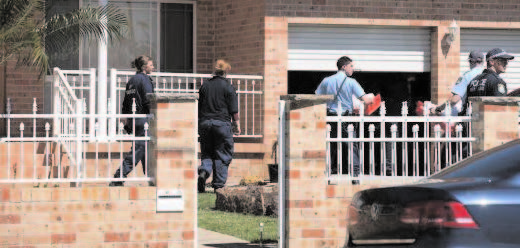
    CANBERRA, AUSTRALIA (TIP): The Islamic State plot to carry out random beheadings in Sydney alleged by police is a simple and barbaric scheme that has shaken Australians. But terrorism experts on September 19 questioned whether the ruthless movement had the capacity or inclination to sustain a terror campaign so far from the Middle East. Police said they thwarted a plot to carry out beheadings in Australia by Islamic State group supporters when they raided more than a dozen properties across Sydney on Thursday.

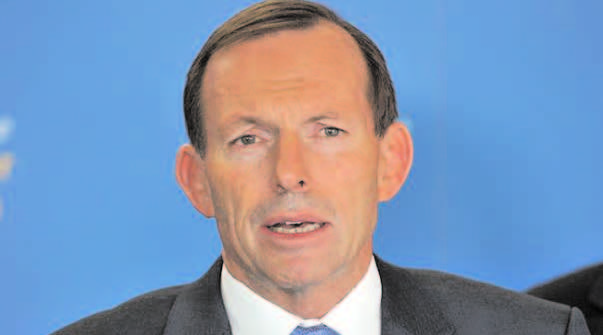
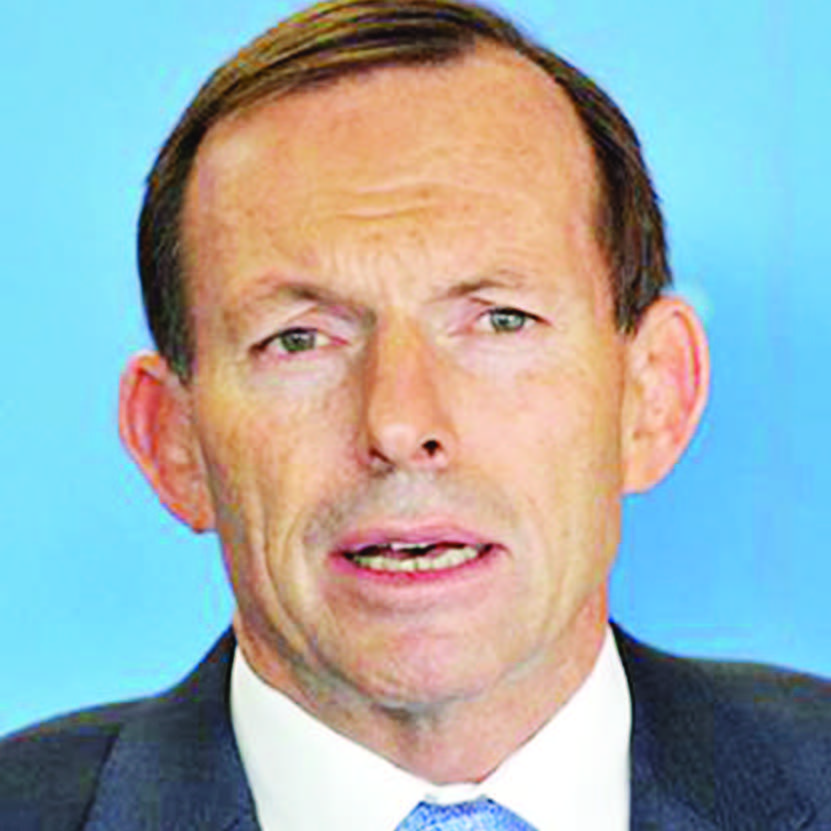
    Two of the 15 suspects detained by police were charged on Thursday, officials said. Nine others were freed before the day was over. Prime Minister Tony Abbott conceded it was difficult to safeguard the Australian population against such attacks. “The regrettable reality is that to mount the kind of attacks which ISIS in Syria and in Iraq has in mind for Australia, all you need is a determined individual who will kill without compunction, a knife, an iPhone and a victim,” Abbott told Seven Network television on Friday, using a name that Islamic State no longer goes by, Islamic State of Iraq and the Levant.

    Some terrorism experts saw the plot as a potential shift in Islamic State’s focus from creating an Islamic caliphate in the Middle East. Others said it is more likely a symptom of policy confusion within a disparate group. “If you have people coming in from different backgrounds from all these countries, when it comes to policy making, they’re going to fight each other, they’re going to kill each other,” said Samuel Makinda, professor of International Relations and Security Studies at Murdoch University.

    “On ISIS, I see no direct threat to Australia or to any other country at the moment except those in the Middle East,” he added, using the movement’s former name, Islamic State of Iraq and Syria. The raids involving 800 federal and state police officers — the largest in the country’s history — came in response to intelligence that an Islamic State group leader in Syria was calling on Australian supporters to kill, Abbott said.

    The raids sparked protests by hundreds of Muslims in the Sydney suburb of Lakemba on Thursday night, where speakers accused the government of exploiting public fear in a bid to get contentious counterterrorism laws through Parliament. Abbott said Friday that police were taking over security at Parliament House in Canberra, telling Australian Broadcasting Corporation radio that the building, “government and government people” had been identified as targets.

    With national grand finals approaching in Rugby League and Australian Rules Football — among the country’s most popular sports — police have said security will be stepped up at sports arenas and other public venues where people gather in large numbers. Greg Barton, a Monash University global terrorism expert, said that Islamic State could be starting to direct its global followers to take the fight to their home communities in a bid to usurp al-Qaida’s position as the leading global jihadist network. The movement could eventually mount attacks in Australia like the attack last year by militant group al- Shabaab gunmen on the Westgate Mall in Nairobi, Kenya, that claimed 67 lives, Barton said.

  • Australian leader warns of planned attack

    Australian leader warns of planned attack

    SYDNEY (TIP): Counterterrorism raids in Sydney on Sept 17 were sparked by security intelligence that the Islamic State movement was planning a public killing as a demonstration of its reach, the prime minister said on Sept 16. Australian police detained 15 people on Thursday in a major counterterrorism operation, saying intelligence indicated a random, violent attack was being planned on Australian soil. Prime Minister Tony Abbott said he had been briefed on Wednesday night about the operation which had been prompted by information that an Islamic State movement leader in the Middle East was calling on Australian supporters to kill. “Quite direct exhortations were coming from an Australian who is apparently quite senior in ISIS to networks of support back in Australia to conduct demonstration killings here in this country,” Abbott told reporters, referring to the al-Qaida splinter group leading Sunni militants in Iraq, Islamic State of Iraq and the Levant, which now calls itself simply Islamic State.

  • G-20 LEADERS SET TO CHECK TAX EVASION

    G-20 LEADERS SET TO CHECK TAX EVASION

    CAIRNS, AUSTRALIA (TIP): The world’s 20 largest economies are expected to signal a fresh push to check tax evasion by agreeing on deadlines for new measures and call for boosting global growth, through a quicker pace of reforms, when finance ministers and central bank governors from these countries meet here this weekend. “The base erosion (and profit sharing, or BEPS) work done by OECD will have a timetable out of Cairns.

    If not, then certainly by the leaders’ summit in November. As for the reporting standards, I hope it’s addressed this weekend. In fact, we will address it this weekend… we do want tax authorities to be able to exchange information more readily,” Australian treasurer Joe Hockey told reporters ahead of the meeting of the ministers from countries that account for 85% of the global economy.

    He, however, said India’s demand for sharing of tax- and bank-related information on a retrospective basis may not be feasible. “It is a big systemic change for banks. If Australia went hard and early, it would cost a quarter of a billion dollars ($250 million) to the banks, which ends up being passed on to customers. But, if we do it in a sensible and timely fashion, it will cost barely 20% of that. It’s very hard to have that information prepared in a format on a retrospective basis.

    It’s also hard to go back in time,” he said when asked specifically about India’s demand. Exchange of information and BEPS, which seeks to tax multinationals that avoid paying taxes anywhere, are of key importance to India as it seeks to widen its tax base. At the last meeting of the FMs and central bank governors in February, G20 members had agreed to work towards achieving both the goals. While adding 2% growth to the economies over the next five years was identified as a priority by Hockey, it is not clear how the G20 will push for it, given that every country is taking steps that suit its interests more.

    In fact, the US Federal Reserve’s decision on interest rates and further tapering of the stimulus induced to boost growth are being keenly watched. Asked about action by individual countries and its impact, Hockey acknowledged that G20 could do little.

  • TIGER, MICKELSON JUST GETTING OLDER: MCILROY

    TIGER, MICKELSON JUST GETTING OLDER: MCILROY

    ATLANTA (TIP): World number one Rory McIlroy isn’t convinced the absence of both Tiger Woods and Phil Mickelson from the US PGA Tour Championship signals a changing of the guard in golf. But the 25-year-old reigning PGA Championship and British Open champion noted Wednesday, the eve of the seasonending event, the passing years for Mickelson, 44, and Woods, who turns 39 in December.

    “They are just getting older,” McIlroy said. Phil is 43 or whatever and Tiger is nearly 40. So they are just getting into sort of the last few holes of their careers and that’s what happens. It obviously just gets harder as you get older. “I’ll be able to tell you in 20 years how it feels.” It is the first time since 1992 that the Tour Championship will be played without either Woods or Mickelson in the field, but McIlroy believes they are far from finished, citing Mickelson’s runner-up place at last month’s PGA Championship and an injurymarred season for Woods.

    “When he gets back to full fitness you will see him here,” McIlroy predicted. Northern Ireland’s McIlroy is among five playoff points leaders in the field of 29 who can win the $10 million playoff crown by capturing the tournament, the others being Americans Bubba Watson, Hunter Mahan, Chris Kirk and Billy Horschel. “Anything other than a win here would be a disappointment,” McIlroy said. “After I finished the PGA, all my focus was on trying to win this. “Obviously, if I finish second or third and end up winning the whole thing, then that’s cool as well.”

    The field is one player less than usual because American Dustin Johnson, who in July took a season-ending leave of absence, qualified despite not playing for nearly two months. McIlroy, who has played for seven of the past nine weeks, went home to Florida between last week’s event in Denver and this week’s showdown in Atlanta at East Lake. “It’s amazing what a night in your own bed can do,” McIlroy said.

    “I was standing in the shower on Monday morning in Denver and I was thinking to myself: ‘Why am I going to Atlanta today?’ So I didn’t. “It was refreshing just to spend a little bit of time at home, dump a little bit of luggage I’ve been carrying with me the past four, five weeks. It was nice.” McIlroy still has the Ryder Cup in two weeks in Scotland and stops in Bermuda, Dubai, China and Australia before ending his 2014 campaign — a global workout that already has him pondering a cutback from 26 events to between 20 and 23 in 2015.

    “Sometimes you feel like you need to play,” McIlroy said. “Sometimes you feel like you need to play the week before a major. There’s a couple of events during the year that you feel obliged just because of where you’re from or to support a different tour.

  • Bopanna to get Davis Cup Commitment Award

    Bopanna to get Davis Cup Commitment Award

    BANGALORE (TIP): Indian tennis player Rohan Bopanna will be presented the Davis Cup Commitment Award during the World Group play-off tie against Serbia which begins here tomorrow. The International Tennis Federation (ITF) will present the Awards through its national associations during the Davis Cup World Group and Zone Group matches on Saturday.

    Former Grand Slam champions Lleyton Hewitt of Australia and Gustavo Kuerten of Brazil will also be awarded after their respective games. “The Davis Cup Commitment Award reflects the dedication by players for more than a century to represent their country in this prestigious competition.

    These players have continued to rise to the unique challenge of competing in a team environment in front of their home fans, and we believe that it is fitting to recognise their efforts,” said ITF President Francesco Ricci Bitti.

    List of players to be awarded: Australia: Lleyton Hewitt, Brazil: Carlos Kirmayr, Gustavo Kuerten, Luiz Mattar, Cassio Motta, Jaime Oncins, Canada: Frank Dancevic, Chinese Taipei: Ti Chen, France: Pierre Darmon, India: Rohan Bopanna Romania: Victor Hanescu, Russia: Andrei Chesnokov, Andrei Olhovskiy, Thailand: Sanchai Ratiwatana, Sonchat Ratiwatana, Danai Udomchoke, Ukraine: Sergiy Stakhovsky.

  • INDIA AND AUSTRALIA SIGN

    INDIA AND AUSTRALIA SIGN

    Bilateral Civil Nuclear Agreement

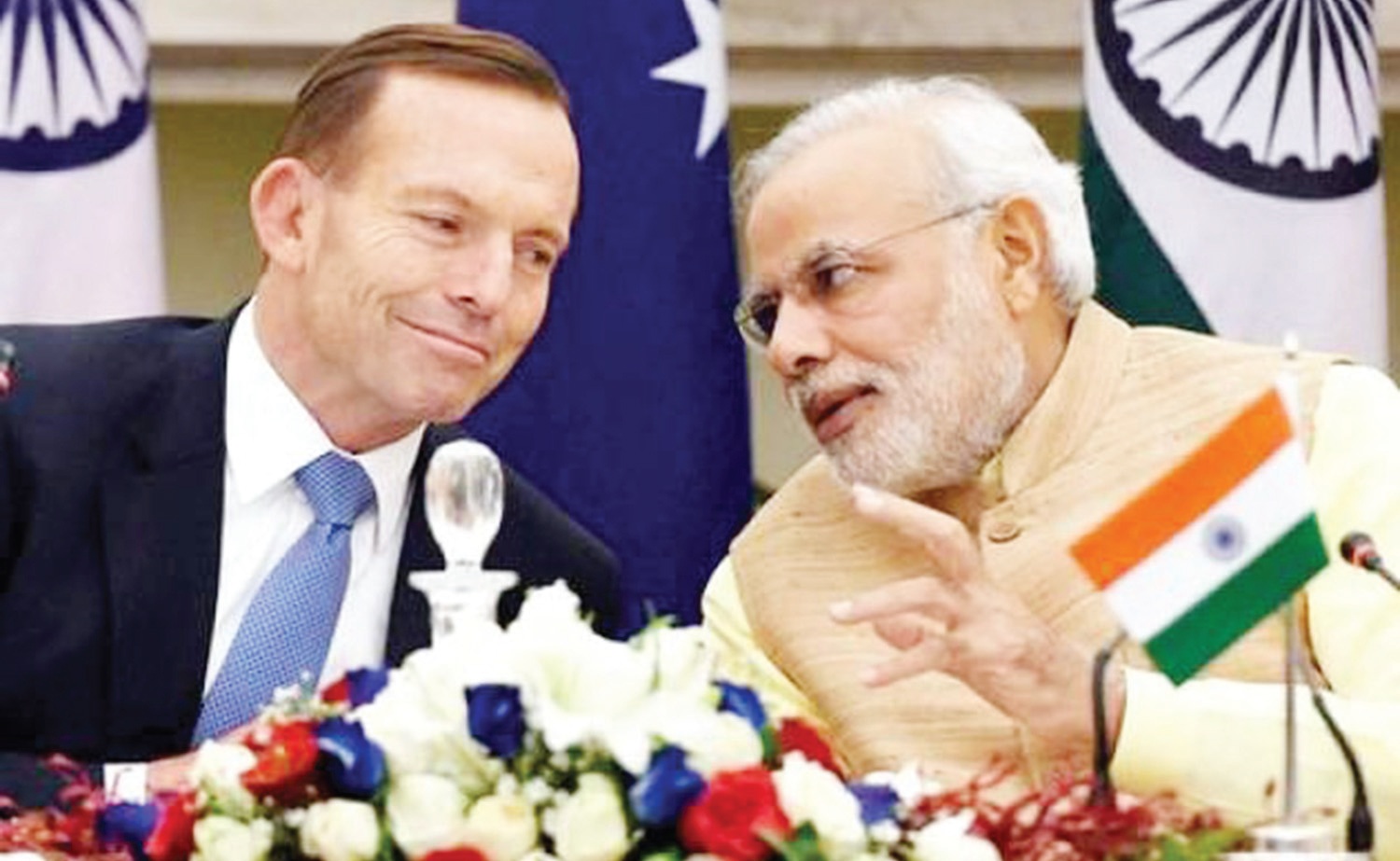
    NEW DELHI (TIP): As widely expected, India and Australia signed a bilateral civil nuclear agreement, September 5 which enables India to secure uranium from Australia to meet its energy requirements. The deal was announced by visiting Australian Prime Minister Tony Abbott, after talks with Prime Minister Narendra Modi late on Friday, September 5.

    Talks have been under way since Australia lifted a long-standing ban on selling uranium to power-starved India in 2012. The fact that India had already signed civil nuclear agreements with the US and Canada made things easier. The Australian deal took just 18 months to negotiate after former Prime Minister Julia Gillard overturned her party’s previous policy of not selling uranium to a non-signatory to the Nuclear Non-Proliferation Treaty.

    Emphasizing that India was a “fully functioning democracy with the rule of law”, Abbott had said that “if Australia was prepared to sell uranium to Russia then “surely we ought to be prepared to provide uranium to India, under suitable safeguards.” Abbott had earlier stressed that Australia would ensure adequate safeguards. After the failure to conclude a civil nuclear deal with Japan during Modi’s visit to that country, the pact with Australia will boost India’s energy sector.

    India operates 20 nuclear reactors, mostly small, at six sites, with a capacity of 4,780 MW. This accounts for a meager 2 per cent of overall capacity, according to the Nuclear Power Corporation of India. The Government hopes to increase the nuclear capacity to 63,000 MW by 2032 by adding about 30 reactors, at a cost of $85 billion. Australia, which has no nuclear power plants of its own, holds 31 per cent of the world’s uranium reserves and is one of the top exporters of the commodity.

    According to official data, it mined 7,529 tons of uranium, worth A$782 million, in 2011-12. Four Memoranda of Understanding (MoUs) were signed between the two nations. The first related to peaceful use of nuclear energy. The agreement outlines Australia’s role not just as a reliable long-term supplier of uranium to India but also the production of radio isotopes and nuclear safety. MoUs on water resources management, cooperation in technical education and training, and exchange programs in sports were also signed.

    Prime Minister Narendra Modi termed the nuclear deal as a “historic milestone that shows a new level of trust” and said he would undertake a bilateral visit to Australia, the first by an Indian PM since 1986, after the G- 20 meeting in Brisbane in November. With bilateral trade declining, Modi said both countries were committed to an early conclusion of a Comprehensive Economic Cooperation.

    “India has scrupulously dotted the Is and crossed the Ts in every international agreement,” said Abbott. He also announced that the CECA will be finalized by next year, saying, “we owe it to our people”. Modi also invited investments in the infrastructure and hi-tech sectors. There were vast possibilities to increase trade ties with Australia, he felt. Abbott stated that the country would provide speedy clearance to Indian investments in pipelines. Modi also the two countries would hold their first joint naval exercise next year.

  • Why Australia selling India uranium is a big deal

    Why Australia selling India uranium is a big deal

    During his visit to India this week, Australia’s Prime Minister Tony Abbott is expected to sign a deal to sell Australian uranium that will be the singlemost significant advance in bilateral relations with India in decades. The journey to get to this point has been tortuous and the controversy is unlikely to fade anytime soon. The main impetus for the change in Australia’s policy came from geopolitical changes and the increased importance of the bilateral relationship with India, rather than commercial calculations.

    Nuclear energy is used by about 30 countries to generate 11 per cent of the world’s electricity, with almost zero greenhouse gas emissions. Currently there are 437 operating reactors and around 70 under construction. Nuclear energy is tipped to grow between 23-100 per cent by 2030 (the long-term impact of the 2011 Fukushima disaster remains impossible to predict with certainty, hence the wide range in the estimates).

    Most of the growth in nuclear energy will be in Asia (China, India, Indonesia, Malaysia, Pakistan, Thailand and Vietnam). The world’s current total requirement for uranium is 66,000 tonnes. The biggest users are the US (18,800 tonnes) and France (9,900 tonnes). India’s uranium requirement is 900 tonnes, compared to 6,300 tonnes for China and 5,500 tonnes for Russia. In Asia, the other big uranium consumers are South Korea (5,000 tonnes) where nuclear energy accounts for 28 per cent of electricity generation, and Japan (2,100 tonnes in 2014) where nuclear energy produced 29 per cent of electricity before the Fukushima accident in March 2011 but has fallen to below 2 per cent.

    Australia holds 31 per cent of the world’s uranium reserves but its share of the global uranium market is only 12 per cent. The policy framework for the export of Australian uranium was set in the 1970s. The Non- Proliferation Treaty (NPT) obligates Australia to facilitate the peaceful uses of nuclear energy, but uranium sales would be restricted to countries that could satisfy Canberra it would not be diverted to non-civilian purposes. For this, recipients had to be in good nonproliferation standing and conclude a bilateral safeguards agreement to account for the use of Australian uranium and any nuclear material produced from it.

    Enrichment process

    Uranium processed at Australian mines must go through three more processes (conversion, enrichment, fuel fabrication) before it can be used in a nuclear reactor. The high-energy density of uranium fuel means that a 1,000 MW nuclear reactor requires 27 tonnes of fresh fuel each year, compared to a coal power station that requires more than 2.5 million tonnes of coal to produce equivalent electricity.

    There are, thus, clear environmental benefits of adding nuclear fuel to the portfolio of energy grids. Uranium enriched to between 3-4 per cent for civilian uses cannot be used in a nuclear weapon, which requires enrichment to 80-90 per cent. Thus, it is not too difficult to put in place safeguards measures against diversion for non-civilian uses. The Howard Government (1996-2007) announced in-principle willingness to sell uranium to China, Russia and India.

    The Labor Government (2007-13) insisted that ‘good nonproliferation standing’ meant being party to the NPT. Accordingly, negotiations were successfully concluded with China in 2008 and Russia in 2010 as both were NPT States Parties, but not with India, which from the start has rejected the NPT as fostering a world of “nuclear apartheid”: those that have nuclear weapons and can keep them, and others that must be stopped from getting them by any means necessary.

    Following the 2008 India-US civil nuclear cooperation deal, the Labor Government joined Washington in the India-specific waiver by the Nuclear Suppliers Group. But this left it with an illogical and untenable policy of supporting open access to global nuclear trade for India but not selling it Australian uranium. The Bush administration’s position, ultimately accepted by Australia and many other supplier countries, was that there were significant nonproliferation benefits of bringing India inside the tent of safeguarded nuclear commerce and export controls, that putting most of its nuclear reactors under international safeguards was better than having none under such controls, and that all evidence pointed to the conclusion that its nuclear weapons programme would continue regardless of international civil cooperation.

    These international advances were complemented by an Indian statement in 2008 reaffirming its “impeccable non-proliferation record” and credentials, highlighting its strengthened domestic and export controls, its posture of restraint on nuclear weapons doctrine and deployment (including no first use), the ‘voluntary, unilateral moratorium’ on nuclear testing, openness to a fissile materials cut-off treaty, and continued support for total nuclear abolition through a universal nuclear weapons convention. Australia’s uranium recalcitrance became a major hindrance to the broader bilateral relationship. The oddity of selling uranium to China and Russia was also questioned.

    As a responsible uranium exporter, Australia has to satisfy itself about the safety record and risks of reactors in the recipient countries; the security of materials and facilities against theft, leakage and raids; the adequacy of safeguards against diversion to non-civilian uses, such as making nuclear weapons; and proliferation risks. There are also not insignificant issues of safe nuclear waste disposal, as shown by the controversy over Muckaty in Australia’s Northern Territory that was touted as a possible repository but the indigenous community
    living there vigorously resisted.

    Like China and Russia, India operates nuclear reactors for both peaceful purposes and military uses. Those designated as civilian are subject to international safeguards under IAEA oversight, while those classified as military are not. In the past, the world has had greater worries about the security of nuclear materials and facilities in Russia – the problem of the so-called loose nukes – than in India. And India’s record of proliferation to third-world countries is superior to China’s past complicity in the proliferation of materials and designs to North Korea and Pakistan (remember A.Q. Khan’s global nuclear bazaar?).

    Getting it wrong

    Bilateral problems in the recent past between India and Australia have included on and offfield controversies in cricket, attacks on Indian students, and the occasional assaults on Australian tourists and missionaries in India. The noisy media in both countries can inflame popular passions and prejudices and complicate government-to-government relations.

    The most consequential mutual misperceptions arose from the failure to understand each other’s nuclear policy underpinnings and imperatives. Each side was firmly convinced of its own intellectual and moral rectitude and smugly contemptuous of the other. Australia held India to have been deceitful in conducting a nuclear test in 1974 and a stubborn recalcitrant on the Comprehensive Nuclear-Test-Ban Treaty (CTBT), in the passage of which Canberra played a key role in 1996.

    India considered countries like Australia and Canada to be grossly hypocritical in having permitted British atomic tests on their territory, sheltering under the US nuclear umbrella, hosting US military installations that are tightly integrated in the global US nuclear infrastructure and deeply implicated in global US nuclear doctrines and deployments, yet moralising self-righteously to India about the virtue of nuclear weapons abstinence. Three drivers of the shifting global order are the re-emergence of China and India as major nodes of global activity and the relative US decline from dominance.

    All three trends were reflected in the India-US nuclear deal that left Australia trapped between legacy national policy and a shifting global geopolitical-cumnormative order.When Canberra cancelled the quadrilateral security dialogue among the four great democracies of Australia, India, Japan and the US in 2008, the quixotic nature of Australian policy was confirmed for many Indians amid suspicion that Mandarinspeaking Prime Minister Kevin Rudd was merely betraying his China leanings.

    Yet, the public debate over the rise of China, its rapid military modernisation and what this means for Australia’s defence planning, reveals considerable differences of opinion. Against these larger considerations of bilateral relations with a democratic India across the Indian Ocean at a time when assertive Chinese visibility and activity is growing in the East and South China Seas, the anticipated economic gains from uranium sales are modest. Compared to the A$63bn iron ore export industry, for example, uranium exports are worth only $1bn and the most optimistic projections would see the rise restricted to under $2bn. Asia will provide most of the market growth opportunity for uranium in the foreseeable future. Australia has the advantages of proximity to this growing market.

    The bilateral agreements with China and India mean that Australia is already covering one-third of the world’s population and has been given access to the two big growth-potential markets. The world price of uranium has been depressed for some time and the finalisation of the India deal could give it a boost to incentivise uranium exploration and production. While the fear of losing market share in the long run to competitors might be a relevant commercial consideration, the changed Australian policy is more persuasively attributable to adjustments to changed geopolitical circumstances and efforts to consolidate and deepen bilateral relations with one of the key emerging powers of this century that will matter greatly to Australia both economically and geopolitically.

    Strategic interests

    In an extraordinary fact considering their reciprocal importance and cross-ocean proximity, the last Indian PM to visit was Rajiv Gandhi in 1986. Prime Minister Modi will not only attend the G-20 summit in Brisbane in November; he will add an official bilateral visit to Australia to the itinerary. India and Australia have a shared strategic interest in a stable Indo-Pacific Asia that links them also to Indonesia and South Africa around the Indian Ocean rim: Perth is closer to Chennai than Melbourne, Sydney or Brisbane are to Seoul, Tokyo and Beijing.

    They can be policy and operational partners in combating piracy, ameliorating climate change, and providing disaster relief; and fighting the scourge of international terrorism and Islamic fundamentalism. There are deepening trade, security, cultural, and educational ties. Bilateral trade could grow substantially with more policy clarity in India, deeper liberalisation, deregulation and privatisation, and less regulatory ambiguity and corruption. Indian investors in Australia are impressed by the transparency of doing business here and the absence of official and public suspicions that add hurdles to Chinese investment proposals in Australia.

    There is considerable scope for a tighter defence and strategic partnership without a formal alliance. There is equally great scope for market efficiencies in consolidation of mining exploration, extraction and processing; engineering and construction services; and skills training and educational exchanges: Australia is a global education powerhouse and the world’s third most popular international student destination after the US and UK. India is also the current largest source of immigrants. In sum, the uranium deal could potentially provide considerable ballast to the bilateral relationship.

    (The author is Director of the Centre for Nuclear Non-proliferation and Disarmament (CNND) in the Crawford School, Australian National University and Adjunct Professor in the Institute of Ethics, Governance and Law at Griffith University. He was Vice Rector and Senior Vice Rector of the United Nations University (and Assistant Secretary-General of the United Nations) from 1998-2007. He can be reached at ramesh.thakur@anu.edu.au)

    British English (Source: Tribune, Chandigarh)

  • INDIA OFFERS ABUNDANCE OF OPPORTUNITYAUSTRALIAN PM TONY ABBOT

    INDIA OFFERS ABUNDANCE OF OPPORTUNITYAUSTRALIAN PM TONY ABBOT

    MUMBAI (TIP): Australian Prime Minister Tony Abbot arrived in India on Thursday, September 4, on a two-day visit during which he is expected to sign a long-awaited deal to sell uranium to the energystarved India. “The purpose of this trip, as far as I’m concerned, is to acknowledge the importance of India in the wider world, acknowledge the importance of India to Australia’s future,” he told business leaders in Mumbai.

    “There is an abundance of opportunities here in India. I am determined to make the most of them.” The Australian PM is expected to meet Narendra Modi and senior ministers during his visit which also aims at boosting trade. Abbott is expected to sign an agreement in Delhi on Friday when he meets Modi, who swept to power in May promising to open up Asia’s ailing third-largest economy to foreign investment. India and Australia kick-started negotiations on uranium sales in 2012 after Canberra lifted a longstanding ban on exporting the valuable ore to Delhi to meet its ambitious nuclear energy program.

    Australia, the world’s third-largest producer of uranium, had previously ruled out selling the metal because nucleararmed India has not signed the Nuclear Non-Proliferation Treaty. Trade minister Andrew Robb, who is traveling with Abbott, said Canberra is now happy with India’s precautions to ensure Australian uranium exports would be used only for peaceful purposes.

    “We have satisfied ourselves that the steps (for appropriate safeguards) are in place,” Robb said this week. “We expect significant outcomes from the visit to further enhance our partnership,” said Sanjay Bhattacharya, Indian foreign ministry joint secretary, on the eve of Abbott’s arrival. Analyst and former Indian diplomat Neelam Deo said all eyes will be on the nuclear deal, which will boost future exports and heralds closer strategic ties. “The deal has been in the works for years and was mostly negotiated by the previous Labor government,” Deo, director of Mumbai-based think-tank Gateway House, told media.

    “The signing of the deal removes one of the only challenges to closer ties between the countries in the region.” India, which is heavily dependent on coal for generating power, has 20-odd small nuclear plants with plans for more. The deal with Australia would potentially ramp up those plans, as India struggles to produce enough power to meet rising demand and suffers crippling power shortages.

    Australia’s decision to overturn its ban on sales to India followed a landmark 2008 deal between Delhi and Washington for the United States to support its civilian nuclear program. Before heading to Delhi, the Australian premier will also meet Indian cricketing great Sachin Tendulkar and former Australian stars Adam Gilchrist and Brett Lee, ahead of Australia’s hosting of the World Cup next year. Abbott is due to head on to Malaysia on Saturday for talks with Prime Minister Najib Razak, before returning home.

  • US mobilizes allies to widen assault on ISIS

    US mobilizes allies to widen assault on ISIS

    WASHINGTON (TIP): The United States has begun to mobilize a broad coalition of allies behind potential American military action in Syria and is moving toward expanded airstrikes in northern Iraq, administration officials said on August 26. President Obama, the officials said, was broadening his campaign against the Sunni militants of the Islamic State in Iraq and Syria and nearing a decision to authorize airstrikes and airdrops of food and water around the northern Iraqi town of Amerli, home to members of Iraq’s Turkmen minority.

    The town of 12,000 has been under siege for more than two months by the militants. “Rooting out a cancer like ISIL won’t be easy, and it won’t be quick,” Obama said in a speech on Tuesday to the American Legion in Charlotte, NC, using an alternative name for ISIS. He said that the United States was building a coalition to “take the fight to these barbaric terrorists,” and that the militants would be “no match” for a united international community.

    Administration officials characterized the dangers facing the Turkmen, who are Shiite Muslims considered infidels by ISIS, as similar to the threat faced by thousands of Yazidis, who were driven to Mount Sinjar in Iraq after attacks by the militants.

    The United Nations special representative for Iraq, Nickolay Mladenov, said in a statement three days ago that the situation in Amerli “demands immediate action to prevent the possible massacre of its citizens.” As Obama considered new strikes, the White House began its diplomatic campaign to enlist allies and neighbors in the region to increase their support for Syria’s moderate opposition and, in some cases, to provide support for possible American military operations.

    The countries likely to be enlisted include Australia, Britain, Jordan, Qatar, Saudi Arabia, Turkey and the United Arab Emirates, officials said. The officials, who asked not to be named discussing sensitive internal deliberations, said they expected that Britain and Australia would be willing to join the United States in an air campaign. The officials said they also wanted help from Turkey, which has military bases that could be used to support an effort in Syria.

    Turkey is a transit route for foreign fighters, including those from the United States and Europe who have traveled to Syria to join ISIS. Administration officials said they are now asking officials in Ankara to help tighten the border. The administration is also seeking intelligence and surveillance help from Jordan as well as financial help from Saudi Arabia, which bankrolls groups in Syria that are fighting President Bashar al-Assad.

    On Monday the Pentagon began surveillance flights over Syria in an effort to collect information on possible ISIS targets as a precursor to airstrikes, a senior official said. The Syrian Observatory for Human Rights, an organization that monitors the humanitarian consequences of the conflict in Syria, reported that “non-Syrian spy planes” on Monday carried out surveillance of ISIS positions in the eastern province of Deir Ezzor.

    Although America’s allies in the region have plenty of reasons to support an intensified effort against ISIS, analysts said, the United States will have to navigate tensions among them. “One of the problems is that different countries have different clients among the fighting groups in Syria,” said Robert S. Ford, a former American ambassador to Syria. “To get them all to work together, the best thing would be for them to pick one client and funnel all the funds through that client. You’ve got to pick one command structure.”

  • 15 AUSTRALIAN FIGHTERS KILLED IN IRAQ, SYRIA: SPY CHIEF

    15 AUSTRALIAN FIGHTERS KILLED IN IRAQ, SYRIA: SPY CHIEF

    SYDNEY (TIP): Fifteen Australians, including two suicide bombers, are believed to have died fighting in Syria and Iraq, intelligence chief David Irvine said on August 27, while warning espionage and foreign intervention threats were increasing. Canberra has expressed alarm that Australians have joined violent jihadist groups such as Islamic State (ISIS) overseas.

    One Islamic State fighter, Australian man Khaled Sharrouf, sparked outrage when an image of his Sydney-raised son posing with the rotting head of a Syrian soldier was reportedly posted on Twitter. “The draw of foreign fighters to Syria and Iraq is significant and includes more Australians than any other previous extremist conflicts put together,” Irvine said.

    He said the Australian Security Intelligence Organisation (ASIO) believed the number of citizens posing a potential security threat had increased substantially as a result. “ASIO believes there are about 60 or so Australians fighting with the two principal extremist al-Qaida derivatives, Jahabat-al-Nusra and the Islamic State in Syria or Iraq,” Irvine said. “We believe 15 Australians have already been killed in the current conflicts, including two young Australian suicide bombers.” He said 100 more people in Australia were “actively supporting” these extremist groups by recruiting new fighters, grooming suicide bombing candidates, and providing funds and equipment.

    Australia has boosted its efforts to counter terrorism on fears that the bloody conflicts in Iraq and Syria are creating a new generation of militants, including increasing spending on security and intelligence. Irvine said intelligence agencies were concerned about the dangers posed when those who had fought overseas — potentially with a commitment to violence and training in the use of weapons or bomb-making — returned to Australia. The government also plans to overhaul laws to make it easier to arrest and prosecute terrorists and make it an offence to travel to designated hotspots overseas without a valid reason.

  • KERRY EYES US-CHINA partnership despite tensions

    KERRY EYES US-CHINA partnership despite tensions

    HONOLULU(TIP):
    Improving US cooperation with China is critical to maintaining stability and security in the Asia-Pacific as well as combating the effects climate change, US secretary of state John Kerry said. Wrapping up an eight-day, around-theworld diplomatic trip and his sixth visit to Asia as America’s top diplomat, Kerry on Wednesday outlined renewed priorities for much of the Obama administration’s much-touted “pivot to Asia” during its final 2 years, including a focus on strengthening US-Chinese partnership in areas of agreement and bridging gaps in areas of contention.

    “One thing I know will contribute to maintaining regional peace and stability is a constructive relationship between the United States and China,” Kerry said in an address to the East-West Center think tank in Honolulu. “The United States welcomes the rise of a peaceful, prosperous and stable China: one that plays a responsible role in Asia and the world and supports rules and norms on economic and security issues.”

    “We are committed to avoiding the trap of strategic rivalry and intent on forging a relationship in which we broaden our cooperation on common interests and constructively manage our differences and disagreements,” he said. Kerry arrived in Hawaii after stops in Afghanistan, Myanmar, Australia and the Solomon Islands during which tensions between China and its smaller neighbors over competing territorial claims in the South China Sea were a major subject of discussion.

    At a Southeast Asia regional security forum in Myanmar over the weekend, Kerry formally unveiled a US proposal for a voluntary freeze on provocative actions by all claimants, including the Chinese. The US says that it has no position on the competing claims but does regard stability in the South China Sea as a national security issue, given the region’s role as one of the world’s busiest maritime shipping zones. “We do care about how those questions are resolved, we care about behavior,” Kerry said.

    “We firmly oppose the use of intimidation, coercion or force to assert a territorial or maritime claim by anyone. And we firmly oppose any suggestion that freedom of navigation and overflight and other lawful uses of the sea and airspace are privileges granted by big states to small ones. All claimants must work together to solve the claims through peaceful means. These principles bind all nations equally, and all nations have a responsibility to uphold them.” While welcomed in general by the 10 members of the Association of Southeast Asian Nations, China took a dim view of Kerry’s proposal and suggested it would not agree.

    In an apparent nod to such disagreements, Kerry said that building better ties with Beijing will not be easy or inevitable. “Make no mistake: This constructive relationship, this `new model,’ is not going to happen simply by talking about it,” he said. “It’s not going to happen by engaging in slogans or pursuing spheres of influence. It will be defined by more and better cooperation on shared challenges. It will be defined by a mutual embrace of the rules, norms and institutions that have served both our nations and the region so well.”

    Kerry said he was pleased at some areas of current US-China cooperation, including multination talks on Iran’s nuclear program, a shared interest in denuclearizing North Korea and promoting calm in South Sudan. In addition, on climate change, which he regularly describes as the biggest threat facing Earth, Kerry hailed US-Chinese initiatives to reduce greenhouse gas emissions and deforestation as well as working on sustainable, clean energy options.

    At the same time, he noted that the US and China, along with other Asian nations, routinely disagree on human rights. Kerry pointed out backsliding in rights protection and democratic principles in Myanmar and Thailand and repression in North Korea but said the United States would not relent in its drive to improve conditions. “We will continue to promote human rights and democracy in Asia, without arrogance but also without apology,” he said.

  • ADANI BUYS LANCO PLANT IN RS 6,000 CRORE DEAL

    ADANI BUYS LANCO PLANT IN RS 6,000 CRORE DEAL

    NEW DELHI (TIP): Adani Power will buy Lanco Infratech’s 1,200-MW imported coal-fired power plant at Udupi in Karnataka in a deal valued at more than Rs 6,000 crore, marking the biggest acquisition in India’s thermal power industry. The acquisition, in a way, comes as redemption for the Adani group, which lost out to Anil Ambani’s Reliance Power for picking up hydel assets of the Jaypee Group.

    R-Power outbid the Adani group by offering Rs 12,000 crore for Jaypee’s hydel capacity aggregating 1,800 MW. For Lanco’s Udupi plant, Adani would pay Rs 2,000 crore in cash and take over the plant’s long-term debt of Rs 4,000 crore. The deal would bring down Lanco’s debt by Rs 4,000 crore. Lanco has a total debt of Rs 36,000 crore ($6 billion) and is reported to be examining options, including selling Griffin Coal in Australia it had bought for Australian $750 million ($665 million) in 2011, to retire outstandings.

    Lanco is seeking to sell Griffin Coal after reaching an agreement with banks to restructure debt. Coal acquisitions in Australia by foreign companies have soured as prices for the fuel fell for three straight years. The Udupi plant is the first imported coal-based unit set up by a private power producer in the country, Lanco said in a release. It comes with a captive jetty to handle import of four million tonnes of coal per year and an external coal handling system in the new Mangalore Port Trust. This capacity too can be doubled. The infrastructure would add to Adani’s coal import capacity.

    The company runs India’s largest coal handling port at its Mundra special economic zone in Gujarat. The Udupi power plant has an added advantage since its capacity can be raised by another 120 MW and the special purpose vehicle that operates the plant has an agreement with the Karnataka government. The plant supplies 90% of the power to the state and the rest goes to Punjab. Adani Power has an installed generation capacity of about 8,620 MW and is looking at the acquisition as one of the options to ramp up capacity to 20,000 MW by 2020.

    The company is in talks with several other players such as GMR, Indiabulls, Avantha Power and Athena, who want to sell their projects, with aggregate capacity estimated at 50,000 MW, in the face of coal and gas shortage and other problems. It has a presence in almost the entire value chain of the power industry and uses this strength to turn around stranded projects.

  • INDIA-AUSTRALIA NUCLEAR DEAL LIKELY NEXT MONTH

    INDIA-AUSTRALIA NUCLEAR DEAL LIKELY NEXT MONTH

    NEW DELHI (TIP): India and Australia have completed negotiations for the much awaited civil nuclear agreement, which is likely to be signed during the visit of Australian Prime Minister Tony Abbott early next month. It will pave the way for uranium imports from Australia, making it one of India’s top strategic partners. Abbott is scheduled to visit India a day after Prime Minister Narendra Modi returns from his first visit to Japan on September 3.

    Modi is scheduled to visit Australia for the G-20 summit in November. It will the first time in the history of the bilateral relationship that there would be two visits within a calendar year, said sources. Australia is heading to becoming one of India’s top energy sources. India is among Australia’s largest coal export partners. India and Australia are currently in the process of working out the administrative arrangements that will govern the actual implementation of the deal.India has been negotiating a civil nuclear agreement with Japan for the past four years.

    Japan is yet to step off the bench with Japanese diplomats calling it a “difficult” decision. Indian officials say they would wait for the Japanese to make up their mind, but if the negotiations go on for much longer, India is likely to look for alternative sources of nuclear supplies. France’s Areva, GE-Hitachi and Toshiba-Westinghouse need an India-Japan nuclear deal for progress on their plans to set up nuclear power plants in India. With the Australian agreement done, Japan is certain to come under pressure to assure this deliverable when Modi visits Tokyo on August 31.

    Last week, Australia cleared Gautam Adani’s Carmichael coal project in the Galilee basin in Queensland, which holds some of the largest untapped coal reserves. Indian company, Petronet, in August 2009 signed a 20-year deal to buy 1.44 million tonnes per annum of liquefied natural gas (LNG) from Australia’s Gorgon terminal. India has signed nuclear supply agreements with countries like Canada, Kazakhstan and Argentina, but Australia is a much sought after source because of the quality of uranium there.

    The negotiations started when Australian PM Julia Gillard visited India in October 2012 and has been one of the shortest on record, comparing favourably with the India’s negotiations with Canada.

  • Pakistan’s shrinking minority space

    Pakistan’s shrinking minority space

    By Farahnaz Ispahani

    The desire of Islamist extremists to ‘purify’ Pakistan has resulted in a major catastrophe for the minorities. The country cannot emerge as a modern pluralist state until the reversal of this culture of intolerance.

    “Pakistani laws, especially the one that deals with blasphemy, deny or interfere with the practice of minority faiths. Religious minorities are targets of legal as well as social discrimination”, says the author. .

    The murder in Gujranwala of an elderly woman, a seven-year-old girl and an infant in a mob attack on members of the Ahmadi community highlights the continuing deterioration of Pakistan’s treatment of its religious minorities. The mob was incited by an Ahmadi youth allegedly sharing blasphemous material on his Facebook page. But the cause of incitement is hardly relevant. Pakistan has been described by several human rights organizations as one of the nations with the least tolerance in religious matters.

    The latest incident should be viewed as part of a tragic pattern that has evolved over decades. Ironically, the intolerance that is now widely associated with Pakistan had little to do with its founder’s vision of a country where “in course of time Hindus would cease to be Hindus and Muslims would cease to be Muslims, not in the religious sense, because that is the personal faith of each individual, but in the political sense as citizens of the State.” The Ahmadis consider themselves Muslim but their beliefs are deemed by the orthodox as falling outside the tenets of Islam.

    The community recognizes Mirza Ghulam Ahmed of Qadian as messiah and an emissary from god, a concept that runs contrary to the Orthodox Muslim notion of Khatm-e- Nabuwwat or Finality of the Prophethood. Anti-Ahmadi agitations have often been used by religious-political groups, particularly in the Punjab, as an instrument of polarization. Violent attacks on Ahmadis in 1953 resulted in Pakistan’s first instance of limited martial law being imposed in the city of Lahore.

    Growing discrimination
    In 1974, another wave of violence led to Pakistan’s Parliament amending the Constitution to declare Ahmadis as non- Muslims for legal purposes. It was argued at the time that once the Ahmadis’ apostasy is legally recognized and they are classified legally as non-Muslims, their orthodox Muslim critics would be satisfied and anti- Ahmadi violence would decline. But that has not happened. Instead, attacks on Ahmadis have continued unabated and along with other minority religious communities, there is an effort to marginalize the community, convert them or push them out of Pakistan.

    Currently, the Ahmadis are barred by law from calling themselves Muslim or using Islamic terminology like “masjid” to describe their places of worship. Violation of that law entails criminal proceedings and imprisonment. But the community is not afforded any legal protection even as a non- Muslim minority. Over a one-and-a-half year period in 2012-2013, there were 54 recorded mob attacks against Ahmadis.

    The latest incident stands out because of the frivolousness of its ostensible cause and the innocence and helplessness of its victims. A grandmother and her seven-year-old granddaughter or an infant could hardly pose a threat to Islam in Gujranwala, a large city with millions of inhabitants and hundreds of mosques and madrasas. The desire of Islamist extremists to “purify” Pakistan has resulted in a major catastrophe for the country’s minorities.

    The violence of Partition denuded Pakistan of the majority of its Hindus and Sikhs, who would have otherwise constituted almost 20 per cent of the new country’s population based on the 1941 census. Now that a sizeable swathe of Pakistan’s Muslim population has been turned into zealots, communities such as the Ahmadis, who were considered Muslim at independence, have joined the ranks of endangered minorities. Even the Shia, almost 20 per cent of the populace, are being attacked by extremists who do not acknowledge them as being a part of Muslim society.

    The attempts to describe Shias as non-Muslims are particularly ironic in view of the fact that Pakistan’s founder, Quaid-e- Azam (the great leader) Muhammad Ali Jinnah was himself a Shia Muslim. Jihadist groups created and trained to fight “infidel” communists in Afghanistan and “Hindu” India have become a threat at home and no one in a position of power seems to have the will or the courage to shut them down.

    Such is the sway of extremist ideology that the murder in cold blood of Ahmadis, Shias, Christians, Hindus and now increasingly Barelvi or “soft Sunni” Muslims and other religious groups who do not belong to the majority Sunni Muslim interpretation of Islam no longer seems to have any shock value left. According to reports, crowds celebrated all night on July 27 after the bloodshed in Gujranwala.

    Erosion of diversity
    That this occurred in the month of Ramzan, a month meant to be spend praying and asking for forgiveness of one’s earthly sins, indicates the absence of any connection between violence against minorities and any notion of religious piety among the orthodox Sunnis who victimize them. More than three days have passed since the Gujranwala attack and most Pakistanis have seen the television images of the crowd who perpetrated this calumny, dancing in the streets all night in celebration.

    However, there was no condemnation heard from the Prime Minister of Pakistan, Nawaz Sharif or his brother, the Chief Minister of Pakistani Punjab. The utter irrationality of the rejection of the Ahmadiyya community in Pakistan is encapsulated in the manner in which one of its most famous sons, Dr. Mohammad Abdus Salam was spurned by his country. The physicist was the first and the only Pakistani as well as the first Muslim to win a Nobel Prize in science.

    After his death in 1996, Salam’s remains were returned to Pakistan and buried in an Ahmadi cemetery, with his tombstone describing him as the “First Muslim Nobel Laureate.” A magistrate subsequently ruled that the word “Muslim” on an Ahmadi grave was blasphemous and ordered it to be sanded off. It seems that nobody in Pakistan remembers Jinnah’s comments when confronted with the demand to exclude Ahmadis from the fold of Islam. Jinnah had said, “If someone describes himself as a Muslim, how can I judge him otherwise.

    Let God decide that matter.” When Pakistan was born on August 14, 1947, the new country’s capital, Karachi, was home to a religiously diverse community. The city’s architecture, too, reflected the traditions of several religions. In addition to mosques of various Muslim denominations, there were Catholic and Protestant churches, a Jewish synagogue, Parsi (Zoroastrian) fire temples, as well as Jain and Hindu temples devoted to various deities. The Muslim call to prayer (Azan) was called on loudspeakers by Shias, Sunnis and Ahmadis five times a day.

    Various religious holidays were observed openly and often across communities. Sixty seven years later, Karachi is no longer Pakistan’s capital. The country’s federal government now conducts its business from a purpose built capital, Islamabad, whose very name suggests a close relationship between Pakistan and Islam. Karachi’s synagogue has shut down as have several of its churches.

    The few remaining churches have a dwindling number of worshippers. Many Pakistani Christians have emigrated to North America or Australia. Most Jain and Hindu temples have either been destroyed or taken over by squatters or land-grabbers and property developers. The Parsi populations have also declined though their temples exist. The Muslim call to prayer no longer sounds from Ahmadi places of worship.

    Incremental intolerance
    Pakistan’s incremental intolerance in matters of religion is exemplified by the brutal assassination of former Punjab Governor Salmaan Taseer and its aftermath. Taseer had attempted to help a poor unlettered Christian woman, Asia Bibi who was facing false blasphemy accusations. He was accused of being a blasphemer himself and killed by his own bodyguard.

    His murderer, Mumtaz Qadri, was garlanded and showered with rose petals by educated middle class lawyers outside a courthouse at his arraignment. According to the independent Human Rights Commission of Pakistan (HRCP), the country’s problem is the tolerance of “pervasive intolerance” in the country. The commission’s director, I.A. Rehman, asserts that “Pakistan continues to offer evidence of its lack of respect for the rights of religious minorities.”

    He attributes it to “the virus of intolerance” that he maintains “has infested the Pakistani people’s minds.” Human rights advocates like Mr. Rehman demand “visible action to end abuse of minorities’ rights” instead of “half-truths and subterfuge in defending the state,” which they feel have been consistently employed by Pakistan officials over the years. Pakistani laws, especially the one that deals with blasphemy, deny or interfere with the practice of minority faiths.

    Religious minorities are targets of legal as well as social discrimination. Most significantly, in recent years, Pakistan has witnessed some of the worst organized violence targeting religious minorities. Over an 18-month period covering 2012 and part of 2013, at least 200 incidents of sectarian violence were reported, that led to 1,800 casualties, including more than 700 deaths.

    Those of us who have been born in Pakistan have seen and experienced the effects of the hatred fed to us through our textbooks, television sets, newspapers, religious clergy and military dictators about the purity of only one religion and one version of Islam.

    Their need to destroy any threat to its purity, and therefore the purity of the state, has ensured that the well of tolerance has by now been well and truly poisoned. Pakistan cannot emerge as a modern pluralist state until the reversal of this culture of intolerance.

  • India holds its ground, WTO fails to reach $1 trillion deal on customs rules

    India holds its ground, WTO fails to reach $1 trillion deal on customs rules

    GENEVA (TIP): The World Trade Organization failed on July 31 to reach a deal to standardise customs rules, which would have been the first failed global trade reform in two decades but was blocked by India’s demands for concessions on agricultural stockpiling. “We have not been able to find a solution that would allow us to bridge that gap,” WTO director-general Roberto Azevedo told trade diplomats in Geneva just two hours before the final deadline for a deal. “Of course it is true that everything remains in play until midnight, but at present there is no workable solution on the table, and I have no indication that one will be forthcoming.”

    The deadline passed without a breakthrough. WTO ministers had already agreed the global reform of customs procedures known as “trade facilitation” last December, but it needed to be put into the WTO rule book by July 31. Most diplomats saw that as rubberstamping a unique success in the WTO’s 19 year history, which according to some estimates would add $1 trillion and 21 million jobs to the world economy, so they were shocked when India unveiled its veto.

    Trade experts say on Thursday’s failure is likely to end the era of trying to cobble together global trade agreements and to accelerate efforts by smaller groups of likeminded nations to liberalise trade among themselves. India has been vocal in opposing such moves, making its veto even more surprising. “Today’s developments suggest that there is little hope for truly global trade talks to take place,” said Jake Colvin at the National Foreign Trade Council, a leading US business group.

    “The vast majority of countries who understand the importance of modernizing trade rules and keeping their promises will have to pick up the pieces and figure out how to move forward.” Some nations have already discussed a plan to exclude India from the agreement and push ahead regardless, and the International Chamber of Commerce urged officials to “make it happen.” “Our message is clear. Get back to the table, save this deal and get the multilateral trade agenda back on the road to completion sooner rather than later,” ICC secretary general John Danilovich said.

    US secretary of state John Kerry, on a visit to New Delhi, had earlier said he was hopeful that differences between India and much of the rest of the world could be resolved. But after Azevedo’s speech, US ambassador to the WTO Michael Punke was downbeat. “We’re obviously sad and disappointed that a very small handful of countries were unwilling to keep their commitments from the December conference in Bali, and we agree with the Director- General that that action has put this institution on very uncertain new ground,” Punke told reporters.

    India had insisted that, in exchange for signing the trade facilitation agreement, it must see more progress on a parallel pact giving it more freedom to subsidise and stockpile food grains than is allowed by WTO rules. It got support from Cuba, Venezuela and Bolivia. India’s new nationalist government has insisted that a permanent agreement on its subsidised food stockpiling must be in place at the same time as the trade facilitation deal, well ahead of a 2017 target set last December in Bali. Kerry, whose visit to India was aimed at revitalising bilateral ties but was overshadowed by the standoff, said the United States understood India’s position that it needs to provide food security for its poor but India would lose out if it refused to maintained its veto.

    Deal without India?
    Diplomats say India could technically attract a trade dispute if it caused the deal to collapse, although nobody wanted to threaten legal action at this stage. The summer break will give diplomats time to mull options, including moving ahead without India. Technical details would still have to be ironed out, but there was a “credible core group” that would be ready to start talking about a such a deal in September, a source involved in the discussions said.

    “What began as a murmur has become a much more active discussion in Geneva and I think that there are a lot of members in town right now that have reached the reluctant conclusion that that may be the only way to go,” he said. An Australian trade official with knowledge of the talks said a group of countries including the United States, European Union, Australia, Japan, Canada and Norway began discussing the possibility in Geneva on Wednesday afternoon. New Delhi cannot be deliberately excluded, since that would mean other countries slowing down containers destined for India, but if it becomes a “free-rider” it will add another nail in the coffin of attempts to hammer out global trade reform.

    Trade diplomats had previously said they were reluctant to consider the idea of the allbut- India option, but momentum behind the trade facilitation pace means it may be hard to stop. Many countries, including China and Brazil, have already notified the WTO of steps they plan to take to implement the customs accord immediately. Other nations have begun bringing the rules into domestic law, and the WTO has set up a funding mechanism to assist.

    But WTO head Azevedo said he feared that while major economies had options open to them, the poorest would be left behind. “If the system fails to function properly then the smallest nations will be the biggest losers,” he said. “It would be a tragic outcome for those economies — and therefore a tragic outcome for us all.”

  • UN decries reports Australia handing back Sri Lanka Tamil asylum seekers

    UN decries reports Australia handing back Sri Lanka Tamil asylum seekers

    SYDNEY/COLOMBO (TIP): The United Nations has expressed “profound concern” about Australia’s handling of asylum seekers amid reports that scores of Sri Lankans will be handed over to their country’s navy after only a brief assessment by Australian authorities. Two boats carrying more than 200 Tamil asylum seekers from Sri Lanka were intercepted by Australian border security forces in the Indian Ocean in recent days and either have been or will be transferred to the Sri Lankan navy, Australian media said. An Australian source with knowledge of the operation said the intention was to carry out the transfer on Friday, but the situation was fluid.

    The prospect of a risky mid-ocean transfer of Tamil asylum seekers and their return to Sri Lanka has sparked criticism of Australia’s tough immigration policy. Sri Lanka is facing heavy pressure from rights groups and the West for alleged human rights violations during the final phase of the war against Tamil separatists which ended in 2009. It says many asylum seekers are economic migrants, but rights groups say Tamils seek asylum to prevent torture, rape, and other violence at the hands of the military.

    Australia’s government has not confirmed any details of the incident and refuses to comment on what it calls operational matters regarding its “Operation Sovereign Borders” programme. The UNHCR said it did not have official confirmation of the incidents but said it had followed “with profound concern recent reports in the media and from the community” about interceptions and assessment of claims for asylum. “International law prescribes that no individual can be returned involuntarily to a country in which he or she has a wellfounded fear of persecution,” UNHCR said in a statement late on Thursday.

    Sri Lankan officials have given conflicting accounts about whether their navy has been involved. Government spokesman Keheliya Rambukwella said on Thursday that the navy had agreed to accept the asylum seekers but changed his response after questioning from reporters. “I really don’t know where we stand,” he said.Two other government officials said the navy would receive the boat people from its Australian counterpart. Forcing people seeking refugee protection back to their country of origin without properly investigating their claims is a flagrant breach of the Refugee Convention and international law, the Refugee Council of Australia said.

  • Saina Nehwal pulls out of Glasgow CWG

    Saina Nehwal pulls out of Glasgow CWG

    HYDERABAD (TIP): In a major setback to Indian badminton hopes at the Glasgow Commonwealth Games, ace shuttler Saina Nehwal is learnt to have pulled out of the event. Saina, who shot to fame by winning the gold medal for India at the Delhi Games in 2010, has reportedly expressed her inability to join the team set to leave for Glasgow on Friday.

    Though Saina’s ticket has reached the city, it is reliably learnt that the shuttler will not fly to Europe. After her unexpected triumph at the Australian Open Super Series last month, Saina was a favourite to win gold in Glasgow. But the shuttler, who sustained blister injuries on both her feet, took some time to recover and was not able to practise properly.

    In fact, she did not hit the court for about a week after her return from Australia. It is also learnt that she is suffering from a knee problem. Neither Saina nor her coach Pullela Gopichand were available for comment. A source in the Badminton Association of India (BAI) told TOI that president Akhilesh Das Gupta and some members of the coaching staff are persuading her to go to Glasgow.

    However, till Thursday, their efforts had not borne fruit. “For the last three days we have been trying to convince her. If she goes even with 50% of fitness she can win a gold for us. Apart from Saina there are no big players among the Commonwealth countries. So far she has not agreed to be part of the squad.

    I don’t think she will change her mind,” the BAI official said. In 2010, Saina defeated Malaysia’s Wong Mew Choo in a nailbiting final to win the women’s singles gold. India won four medals then. Jwala Gutta and Ashwini Ponnappa clinched gold in the women’s doubles while Kashyap secured bronze in men’s singles. India had also won silver in the team event. With Saina’s likely to stay home, Indian hopes will hinge of PV Sindu and the pair of Jwala and Ashwini in the women’s section.

  • UN decries reports Australia handing back Sri Lanka Tamil asylum seekers

    UN decries reports Australia handing back Sri Lanka Tamil asylum seekers

    SYDNEY/COLOMBO: The United Nations has expressed “profound concern” about Australia’s handling of asylum seekers amid reports that scores of Sri Lankans will be handed over to their country’s navy after only a brief assessment by Australian authorities.

    Two boats carrying more than 200 Tamil asylum seekers from Sri Lanka were intercepted by Australian border security forces in the Indian Ocean in recent days and either have been or will be transferred to the Sri Lankan navy, Australian media said. An Australian source with knowledge of the operation said the intention was to carry out the transfer on Friday, but the situation was fluid.

    The prospect of a risky mid-ocean transfer of Tamil asylum seekers and their return to Sri Lanka has sparked criticism of Australia’s tough immigration policy. Sri Lanka is facing heavy pressure from rights groups and the West for alleged human rights violations during the final phase of the war against Tamil separatists which ended in 2009.

    It says many asylum seekers are economic migrants, but rights groups say Tamils seek asylum to prevent torture, rape, and other violence at the hands of the military. Australia’s government has not confirmed any details of the incident and refuses to comment on what it calls operational matters regarding its “Operation Sovereign Borders” programme.

    The UNHCR said it did not have official confirmation of the incidents but said it had followed “with profound concern recent reports in the media and from the community” about interceptions and assessment of claims for asylum. “International law prescribes that no individual can be returned involuntarily to a country in which he or she has a well-founded fear of persecution,” UNHCR said in a statement late on Thursday.

    Sri Lankan officials have given conflicting accounts about whether their navy has been involved. Government spokesman Keheliya Rambukwella said on Thursday that the navy had agreed to accept the asylum seekers but changed his response after questioning from reporters. “I really don’t know where we stand,” he said.

    Two other government officials said the navy would receive the boat people from its Australian counterpart. Forcing people seeking refugee protection back to their country of origin without properly investigating their claims is a flagrant breach of the Refugee Convention and international law, the Refugee Council of Australia said.

    “For asylum seekers, this is a matter of life and death, particularly in Sri Lanka which has a long history of political violence on a scale unimaginable to Australians,” Refugee Council of Australia chief executive officer Paul Power said. Australian Prime Minister Tony Abbott, who came to power last September partly because of his tough stance on asylum seekers, declined to comment, saying only that it was no secret that boats had been turned back under the policy.

    “I want to make this observation,” he said. “Sri Lanka is not everyone’s idea of an ideal society, but it is at peace.” Australia has offshore detention centres in the impoverished South Pacific nations of Papua New Guinea and Nauru capable of holding thousands. About 16,000 asylum seekers came on 220 boats to Australia in the first seven months of last year but the government says there have been no illegal boat arrivals since December 2013.

  • From Slavery to Freedom The Journey of American Nation

    From Slavery to Freedom The Journey of American Nation

    Story of American Journey from British Occupation to slaving and racially discriminating its own citizens to vibrant Democracy to Crony Capitalism

    The journey of America from a little known land mass inhabited by primitives to what it is today is an interesting piece of history of man and evolution of a nation. Today, America is known to the world as a country built by immigrants and governed by immigrants. Whether some one’s ancestors arrived last year or last century, every American with the exception of Native Americans the Red Indians; has a family tree with roots somewhere else. People have come in to America from all continents- Europe, Africa, Latin America, Asia, and Australia. What a wonderful mosaic of nationalities here! America is currently the most religiously diverse nation in the world. It is the quintessential melting pot for world’s major religions, Americans honor the divine in mosques, churches, synagogues, temples, Monasteries, Gurudwaras and they are a multi-cultural, multi-religious nation. At the same time America belongs to the nonbelievers, too.

    The many nationalities and religions brought with them their culture, their value systems which we find have beautified and enriched the composite culture, yes, the composite culture, of America. But the making of America of today is a long story of a protracted and grim struggle, trials and travails. The Story of American Journey from British Occupation to slaving and racially discriminating its own citizens to evolving in to a vibrant and functional Democracy is worth studying. It is a long history, from the initial battles in the Revolutionary War which broke out in April 1775 for complete independence from Great Britain to the first commemoration by Philadelphia of independence on July 4, 1777.

    I will not go in to details of the history of the freedom struggle. I believe most of us have read about it either at school or at some other point. Nor will I dwell on the Flag of America, the national song of America, the manner of celebration of July 4th. These are commonplace knowledge. But I will certainly touch upon the human aspect of America’s evolution in to a great functional democracy. 1777 brought freedom from colonial rule. But it did not bring freedom to all human beings in America. Unfortunately some Americans especially the African Americans were excluded from the Independence and freedom.

    Enslaved men women and children labored to make millions for their masters. The seeds of this slavery were planted with the birth of a nation built upon the labor derived from slave-wages and the contradiction-in-terms produced by claiming freedom and democracy while owning and profiting from slavery at the same time. Millions of enslaved people were bought and sold; practically one third of all Southerners lived in bondage. Even in Washington D C, slave auctions were a daily occurrence with chained human beings marched routinely in front of the Capital of the nation dedicated to the proposition of human freedom.

    The de-humanization of black-people being treated as animals, traded as commodity, tortured beyond human tolerance, murdered and lynched in cold blood and their separation from the common run of humanity gave birth to confrontation between North and South on the issue of slavery that tormented the nation for almost a century. I hope, you have seen the wonderful movie “12 Years a Slave” which deals precisely with this subject It took America more than a century to end discrimination. We remember that on August 28, 1963, 186 years after independence, a March to Washington was held with the active support of President Kennedy, in a collaborative effort of all of the major civil rights organizations.

    The march had six official goals:
    (1) meaningful civil rights laws
    (2) a massive federal works program
    (3) full and fair employment
    (4) decent housing
    (5) the right to vote
    (6) adequate integrated education. The major focus was on passage of the civil rights law that the Kennedy administration had proposed after the upheavals in 100 cities including Birmingham earlier in the summer. The march was a success, an estimated 200,000 to 300,000 demonstrators gathered in front of the Lincoln Memorial, where Dr King delivered his famous “I Have a Dream” speech. Dr King said even after one hundred years after signing of Emancipation Proclamation, (which Lincoln had signed on January 1, 1863) the Negro is still not free, the life of the Negro is still sadly crippled by the manacles of segregation and the chains of discrimination.

    One hundred years later, the Negro lives on a lonely island of poverty in the midst of a vast ocean of material prosperity and is still languished in the corners of American society and finds himself an exile in his own land. And so we’ve come here today to dramatize a shameful condition. He said, “And so let freedom ring from the prodigious hilltops of New Hampshire. Let freedom ring from the mighty mountains of New York. Let freedom ring from the heightening Alleghenies of Pennsylvania. Let freedom ring from the snow-capped Rockies of Colorado. Let freedom ring from the curvaceous slopes of California.

    But not only that: Let freedom ring from Stone Mountain of Georgia. Let freedom ring from Lookout Mountain of Tennessee. Let freedom ring from every hill and molehill of Mississippi. From every mountainside, let freedom ring. And when this happens, when we allow freedom ring, when we let it ring from every village and every hamlet, from every state and every city, we will be able to speed up that day when all of God’s children, black men and white me, Jews and Gentiles, Protestants and Catholics, will be able to join hands and sing in the words of the old Negro spiritual: Free at last! Free at last! Thank God Almighty, we are free at last!” July 2, 1964, Johnson signed the Civil Rights Act of 1964, that banned discrimination based on “race, color, religion, sex or national origin” in employment practices and public accommodations.

    The bill authorized the Attorney General to file lawsuits to enforce the new law. The law also nullified state and local laws that required such discrimination. President Lyndon Johnson’s call for “Great Society” further expanded and guaranteed access to opportunity by minorities in America while Congress helped support new federal spending in the form of programs such as Medicare and Food Stamps. A year later, on August 6, 1965 Johnson signed the Voting Rights Act suspending poll taxes, literacy tests, and other subjective voter registration tests. It authorized Federal.