Author: Kanwal Sibal

  • How China won the NSG membership power play

    How China won the NSG membership power play

    A disquieting feature of the Seoul setback was the diplomatic victory China scored over the US, in a forum established by the US and dominated by it for decades.

    If China could block the US here, it does raise questions about US willingness and capacity to checkmate China elsewhere – not only in the South China Sea, but also in our region.

    Washington is seeking expanded commitment from India against the rising Chinese threat in the Asia-Pacific region.

    It should normally have reasoned that if its resolve to counter China on an issue such as India’s NSG membership – which China was opposing for purely political reasons and its unflinching support for Pakistan – was seen as weak, India would have less confidence in the tenacity of America’s rebalance towards Asia.

    Business

    Washington’s public support for India’s application and China’s equally public opposition to it made the issue of India’s NSG membership an open diplomatic tussle between the US and China.

    Countries such as Austria, New Zealand, Ireland, Mexico, and Switzerland are amenable to firm US diplomacy, but were allowed to play into China’s hands and buttress its opposition by raising procedural issues.

    China was allowed to inflict a diplomatic defeat on India and on the US itself.

    China was a late entrant not only to the NPT, which it rejected as discriminatory for years, but also to the NSG, which it joined in 2004.

    For such a country to swear by the NPT and project itself as a conscientious upholder of the NSG guidelines compared to the unprincipled approach of the US is quite ironic.

    China’s nuclear relationship with Pakistan in the past – and even now -cannot withstand strict NSG scrutiny.

    The US has chosen not to confront China on this issue as other differences have higher priority in its eyes.

    Other factors have given China room for its NSG power play.

    China is expanding its nuclear sector massively. US, French, and Russian companies are constructing several nuclear power plants in the country, which makes business considerations very relevant.

    Kingpin

    PM Modi with Chinese President Xi Jinping. A handshake which did not work for India. (file photo)
    PM Modi with Chinese President Xi Jinping. A handshake which did not work for India. (file photo)

    China has been offered a stake in the UK’s Hinkley nuclear power project, which requires huge investment.

    France’s Areva has signed a number of strategic agreements with China in the nuclear sector and is now offering equity in the company to China.

    This would explain the reluctance to corner China on its nuclear cooperation with Pakistan and on India’s NSG membership.

    China has behaved as a kingpin in the NSG, and has got away with it for the moment.

    Ever since the India-US nuclear deal China has been challenging Washington’s global supremacy on non-proliferation matters.

    To balance the India-US deal, China decided to enhance its nuclear cooperation with Pakistan by contracting to build two additional reactors without going through the process of seeking an NSG exemption for its protege.

    It has deliberately tagged Pakistan’s NSG membership to that of India to show the US that it can exercise patronage on nuclear matters too – and without doing any preparatory legal work as the US did in India’s case.

    Fragile

    China deliberately fast-tracked Pakistan’s NSG membership application to derail a decision on India’s case, because it ensured that the procedural and criteria argument regarding membership of non-NPT countries became more germane.

    Through such maneuvering China wanted to expose the fragility of the US commitment on our membership, and demonstrate that the latter could not steam-roll India’s membership against China’s wishes.

    (The author is a former Foreign Secretary of India. He can be reached at sibalk@gmail.com) 

  • Why it’s silly to link FDI and Intolerance

    Why it’s silly to link FDI and Intolerance

    “Those making a connection between an intolerant India and FDI are widely off the mark. Democracies by definition are tolerant and nobody is claiming that we are abandoning our democratic system……….At the heart of the controversy is Prime Minister Narendra Modi’s silence – specifically on the beef-linked murder of a Muslim – and his inaction in not reining in fringe elements of his party voicing communal views. His general statements against such acts and discourse which detracts from his development agenda are not considered sufficient to clear the air”, says the author.

    Many believe that rising intolerance in India is becoming an issue in our foreign relations, to the point that foreign investment flows into the country may be affected.

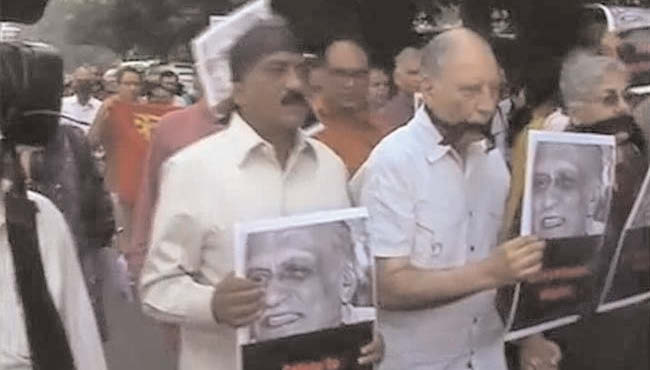
    The murder of a Muslim for allegedly stocking beef in one state, those of a couple of Dalits in another, the killing of a ‘rationalist’ in still another state, and some statements by BJP members inconsistent with our secular ethos are seen as instances of a dramatic surge in intolerance in India.

    This has been enough for writers, artists, historians and scientists to return awards, and others of public standing to express concern.

    The media has, of course, amplified the controversy, with denunciatory columns in some newspapers and unbridled TV debates.

    At the heart of the controversy is Prime Minister Narendra Modi’s silence -specifically on the beef-linked murder of a Muslim – and his inaction in not reining in fringe elements of his party voicing communal views.

    His general statements against such acts and discourse which detracts from his development agenda are not considered sufficient to clear the air.

    Debate

    Naturally, such an intensive debate in the country will be followed by local diplomatic missions – western in particular – and their assessment reports will reach their capitals.

    Foreign correspondents will inevitably follow the domestic sparring over the issue and publish articles without being too rigorous in their analysis, as their target is newspaper readership and not policy-makers.

    Indian or Indian-origin correspondents writing for foreign media are often inclined to write negative stories to make themselves more credible with head offices, besides catering to the biases of a few established US/UK newspapers who traditionally put the spotlight on some darker aspects of India’s social reality.

    The NGOs, domestic and foreign-funded, focused on community issues will be drawn into the debate on rising intolerance as part of civil society’s increasing political activism.

    Indian scholars and Western ones involved in India studies are networked and influence each other on the choice of issues to study and analyse and shaping perspectives on them.

    Some foreign scholars get unusually large space in our papers for airing views on sensitive subjects, which reinforce the impression of foreign concern about unwholesome developments at home.

    In addition, sections of India-origin populations, principally in some Western countries, have grievances against India which find sympathetic echoes in political, academic, media and religious circles there for a variety of reasons, including electoral.

    Incidents relating to minorities in India especially draw negative attention.

    The debate on rising intolerance in the country is closely linked to Modi’s rise to power, the political legitimacy that the Hindutva ideology is seen to have acquired as a result, and – what is anathema to devout secularists – the expanding influence of the RSS.

    Intolerance

    Those mounting a campaign against rising intolerance have been in their large majority always politically opposed to Modi and the Hindutva ideology.

    Despite the judicial process through which Modi has been wrung for years, this group has not forgiven him for the 2002 Gujarat riots – and it is this entrenched prejudice that found echo in the questions posed to him by the BBC and The Guardian journalists at his joint press conference with UK PM David Cameron during his London visit.

    Modi’s opponents at home and India-baiters in the US/UK establishment in particular are complicit in denigrating the Indian PM, and both feed on each other’s prejudices.

    +1

    The leadership of the Congress has begun to target Modi personally for the reprehensible crimes that have been lately in the news, holding him responsible for allowing an atmosphere to be created which has encouraged such acts.

    Such accusations, made recklessly in the context of domestic politics, do not serve India’s interests abroad as they give a handle to India’s opponents there to project a picture of India that is actually far from reality.

    Freedom 

    To say that dissent or freedom of expression in India is being suppressed overlooks the rampant criticism of the government in the media and the constraints that the judiciary has put on the power of the government and Parliament too.

    Attempts to impose some constraints on the social media as part of counter-terrorism efforts have failed because of public opposition.

    The government cannot even implement crucial parts of its economic reforms agenda because of political opposition.

    Those making a connection between an intolerant India and FDI are widely off the mark.

    Democracies by definition are tolerant and nobody is claiming that we are abandoning our democratic system.

    Most countries in the world are not democratic, and so by definition they should not be attractive for foreign investment.

    China has received vastly greater amounts of FDI than India and continues to do so, despite its open rejection of democracy and Western values and active suppression of dissent at home.

    The Gulf countries are not paragons of tolerance, but corporate heads and governments too do not seem to hold back investments there for this reason.

    Western businessmen are now thronging in Iran for economic opportunities.

    Singapore’s authoritarianism is actually an explanation for its economic success. Our own investments abroad, especially in the oil sector, are not contingent on tolerance or lack of it in the countries concerned.

    We can be our worst enemies.

    As an extension of domestic politics we want to leverage external forces to make a democratically elected government of a country of 1.25 billion inhabitants accountable for few sporadic crimes.

  • The Pakistani Shadow on Indo-US Relations

    The Pakistani Shadow on Indo-US Relations

    We should be treating the visits of Pakistani leaders abroad as part of normal diplomacy that all countries engage in. By paying too much attention to them we boost Pakistan’s political importance and diminish our own stature. Unfortunately, we cannot easily ignore the visits of top Pakistani leaders to the US, not because of concerns about what Pakistan may seek but what the US may dispense.

    US policies towards Pakistan have always been a source of serious strategic concern to us. Even with the visible improvement of India-US ties, now elevated to a strategic partnership, we have to be watchful of US dealings with Pakistan and their impact on our security interests. Pakistan has always been, and remains, a US blindspot in its relationship with India.

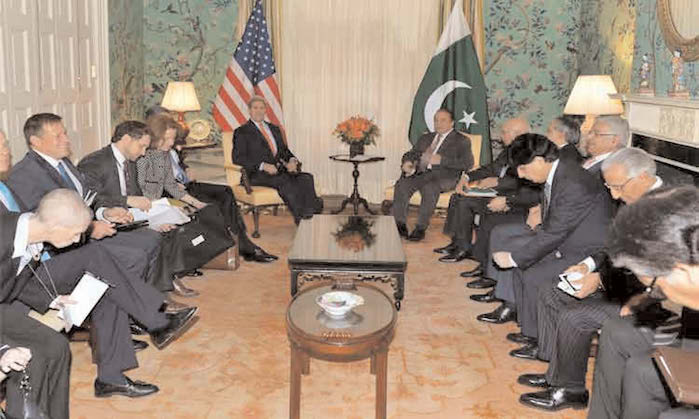
    This has been proved again with Nawaz Sharif’s just concluded visit to the US. Prior to the visit, US sources leaked to the media that Washington was contemplating some sort of a nuclear deal with Pakistan that would legitimise its nuclear status despite its known proliferation activities, the rapid expansion of its nuclear arsenal, its development of tactical nuclear weapons and open threats to use them against India. While Sharif’s visit did not produce such a deal, the US ignored all these Pakistani nuclear provocations and transgressions and preferred to focus self-servingly on the success of the Nuclear Security Summit to be hosted by Obama next year and “welcomed Pakistan’s constructive engagement with the Nuclear Security Summit process and its cooperation with the International Atomic Energy Agency and other international forums”. Obama also noted “Pakistan’s efforts to improve its strategic trade controls and enhance its engagement with multilateral export control regimes”. All these were approving chits of Pakistan’s nuclear policies, unfortunately at the cost of India’s security, given that a day prior to Nawaz Sharif’s Washington visit, the Pakistani Foreign Secretary publicly brandished the tactical nuclear threat to India, spoke of full spectrum deterrence and dismissed any talk of Pakistan accepting any restraint on its nuclear arsenal. The un-named US official’s categorical declaration that the US was not contemplating any 123 type agreement with Pakistan or an NSG exemption has come after Sharif’s visit and in the wake of Pakistani defiance.

    The recognition by Obama and Sharif in their joint statement of their “shared interest in strategic stability in South Asia” is seriously objectionable from our point of view, even if similar language figured in the Obama-Sharif joint statement in 2013. Such a stance is inconsistent with the import of the India-US nuclear deal which was intended to free India from some strategic constraints while also bringing large parts of its nuclear program, present and future, under IAEA safeguards in a bid to restrict its scope. There are no such constraints on China’s nuclear program, or on China’s nuclear cooperation with Pakistan in both civilian and military areas. There can therefore be no strategic stability in South Asia unless China and its cooperation with Pakistan is brought into the equation and India’s strategic needs vis a vis China are recognised. Until the India-US nuclear deal, the US has viewed the nuclear equation in the sub-continent as a purely India-Pakistan affair. Even before India and Pakistan became overtly nuclear the US pressed for “strategic stability” with a view to curbing India’s nuclear program, in the belief that this would deprive Pakistan of the argument that it must match India’s nuclear capabilities to ensure its security.

    The tenacity of such US thinking surfaced during discussions on the “Next Steps in the Strategic Partnership” when the US tried to introduce the concept of strategic stability to offset Pakistani concerns about US tilting in favor of India on strategic matters. Why after the nuclear compromise inherent in the India-US nuclear deal the US continues to stress strategic stability in South Asia and wants all sides to “continuously act with maximum restraint and work jointly toward strengthening strategic stability in South Asia”, is difficult to understand. So is the reference to “the importance of regional balance and stability in South Asia” which unreasonably equates India with Pakistan, including in the sphere of their security interests.

    Even if we ignored the reference to strategic stability in 2013, we have less reason to ignore it today. India and the US have in 2015 greatly widened the scope of their geopolitical engagement by releasing a US-India Joint Strategic Vision for the Asia-Pacific and Indian Ocean Region and upgrading the trilateral India-US-Japan relationship relationship in a certain strategic perspective. In this context it makes little sense for the US to still talk of strategic balancing India and Pakistan. This merely sends confusing signals about the depth of India’s strategic commitment to India.

    Likewise, in January 2015, on the occasion of Obama’s January 2015 visit, the US-India Delhi Declaration of Friendship was issued, which proclaimed a higher level of trust and coordination between the two countries. Furthermore, in the joint statement issued then, Obama and Modi “committed to undertake efforts to make the U.S.-India partnership a defining counterterrorism relationship for the 21st Century by deepening collaboration to combat the full spectrum of terrorist threats”. It “called for eliminating terrorist safe havens and infrastructure, disrupting terrorist networks and their financing, and stopping cross-border movement of terrorists”, besides asking “Pakistan to bring the perpetrators of the November 2008 terrorist attack in Mumbai to justice”. In September 2015, as part of the inaugural India-US Strategic and Economic Dialogue, a U.S.-India Joint Declaration on Combating Terrorism was issued with expansive provisions.

    read-more

  • Putting India Emphatically on Global Map – Part 2

    Putting India Emphatically on Global Map – Part 2

    Continued from Putting India Emphatically on Global Map – Part 1

    It defies logic that a country that is considered as our most serious adversary and whose policies in our region has done us incalculable strategic harm should have been accepted as India’s strategic partner during Manmohan Singh’s time. Such a concession that clouds realities serves China’s purpose and once given cannot be reversed. Pursuant to discussions already held during the tenure of the previous government, the Chinese announced during Xi’s visit the establishment of two industrial parks in India, one in Gujarat and the other in Maharashtra, and the “endeavour to realise” an investment of US $ 20 billion in the next five years in various industrial and infrastructure development projects in India, including in the railways sector. The Chinese Prime Minister’s statement just before Modi goes to China on May 14 that China is looking for preferential policies and investment facilitation for its businesses to make this investment suggests that the promised investment may not materialise in a hurry. While the decision during Xi’s visit to continue defence contacts is useful in order to obtain an insight into PLA’s thinking and capacities at first hand, the agreement, carried forward from Manmohan Singh’s time, to explore possibilities of civilian nuclear cooperation puzzles because this helps to legitimise China’s nuclear cooperation with Pakistan.

    Even as Modi has been making his overall interest in forging stronger ties with China clear, he has not shied away from allusions to Chinese expansionism, not only on Indian soil but also during his visit to Japan. During his own visit to US in September 2014 and President Obama’s visit to India in January 2015, the joint statements issued have language on South China Sea and Asia-Pacific which is China-directed. A stand alone US-India Joint Vision for Asia Pacific and the Indian Ocean Region issued during Obama’s Delhi visit was a departure from previous Indian reticence to show convergence with the US on China-related issues. India has now indirectly accepted a link between its Act East policy and US rebalance towards Asia. The Chinese have officially chosen to overlook these statements as they would want to wean away India from too strong a US embrace. During Sushma Swaraj’s call on Xi during her visit to China in February 2015 she seems to have pushed for an early resolution of the border issue, with out-of-the-box thinking between the two strong leaders that lead their respective countries today. Turning the Chinese formulation on its head, she called for leaving a resolved border issue for future generations.

    It is not clear what the External Affairs Minister had in mind when she advocated
    “out-of-the-box” thinking, as such an approach can recoil on us. That China has no intention to look at any out-of-the-box solution has been made clear by the unusual vehemence of its reaction to Modi’s visit to Arunachal Pradesh in February 2015 to inaugurate two development projects on the anniversary of the state’s formation in 1987. The pressure will be on us to do out-of-the-box thinking as it is we who suggested this approach. China is making clear that it considers Arunachal Pradesh not “disputed territory” but China’s sovereign territory. This intemperate Chinese reaction came despite Modi’s visit to China in May. The 18th round of talks between the Special Representatives (SRs) on the boundary question has taken place without any significant result, which is not surprising in view of China’s position on the border. The Chinese PM has recited the mantra a few days ago of settling the boundary issue “as early as possible” and has referred to “the historical responsibility that falls on both governments” to resolve the issue, which means nothing in practical terms. As against this, India has chosen to remain silent on the China-Pakistan Economic Corridor (CPEC) which will traverse territory that is legally Indian, and which even the 1963 China-Pakistan border agreement recognises as territory whose legal status has not been finally settled. The CPEC cannot be built if China were to respect its own position with regard to “disputed” territories which it applies aggressively to Arunachal Pradesh. Why we are hesitant to put China under pressure on this subject is another puzzle.

    Modi’s visit to Seychelles, Mauritius and Sri Lanka in March 2015 signified heightened attention to our critical interests in the Indian Ocean area. The bulk of our trade- 77% by value and 90% by volume- is seaborne. Modi was the first Indian Prime Minister to visit Seychelles in 34 years, which demonstrates our neglect of the Indian Ocean area at high political level and Modi’s strategic sense in making political amends. During his visit Modi focused on maritime security with agreement on a Coastal Surveillance Radar Project and the supply of another Dornier aircraft. In Mauritius, Modi signed an agreement on the development of Agalega Island and also attended the commissioning of the Barracuda, a 1300 tonne Indian-built patrol vessel ship for the country’s National Coast Guard, with more such vessels to follow. According to Sushma Swaraj, Modi’s visit to Seychelles and Mauritius was intended to integrate these two countries in our trilateral maritime cooperation with Sri Lanka and Maldives.

    In Pakistan’s case, Modi too seems unsure of the policy he should follow- whether he should wait for Pakistan to change its conduct before engaging it or engage it nevertheless in the hope that its conduct will change for the better in the future. Modi announced FS level talks with Pakistan when Nawaz Sharif visited Delhi for the swearing-in ceremony, even though Pakistan had made no moves to control the activities of Hafiz Saeed and the jihadi groups in Pakistan.

    The Pakistani argument that Nawaz Sharif was bold in visiting India for the occasion and that he has not been politically rewarded for it is a bogus one. He had a choice to attend or not attend, and it was no favour to India that he did. Indeed he did a favour to himself as Pakistan would have voluntarily isolated itself. The FS level talks were cancelled when just before they were to be held when the Pakistan High Commissioner met the Hurriyet leaders in Delhi. Pakistan’s argument that we over-reacted is again dishonest because it wanted to retrieve the ground it thought it had lost when Nawaz Sharif did not meet the Hurriyet leaders in March 2014.

    Modi ordered a robust response to Pakistani cease-fire violations across the LOC and the international border during the year, which suggested less tolerance of Pakistan’s provocative conduct. We have also been stating that talks and terrorism cannot go together. Yet, in a repetition of a wavering approach, the government sent the FS to Islamabad in March 2015 on a so-called “SAARC Yatra”. Pakistan responded by releasing the mastermind of the Mumbai attack, Lakhvi, on bail and followed it up by several provocative statements on recent demonstrations by pro-Pakistani separatists in Srinagar, without any real response from our side. Surprisingly, in an internal political document involving the BJP and the PDP in J&K, we agreed to include a reference to engaging Pakistan in a dialogue as part of a common minimum programme, undermining our diplomacy with Pakistan in the process.

    Pakistan believes that it is US intervention that spurred India to take the initiative to send the FS to Pakistan, which is why it feels it can remain intransigent. Pakistan chose to make the bilateral agenda even more contentious after the visit by the FS by raising not only the Kashmir cause, but also Indian involvement in Balochistan and FATA. On our side, we raised the issue of cross border terrorism, the Mumbai terror trial and LOC violations, with only negative statements on these issues by Pakistan. Since then the Pakistani army chief has accused India of abetting terrorism in Pakistan. The huge gulf in our respective positions will not enable us to “find common ground and narrow differences” in further rounds of dialogue, about which the Pakistani High Commissioner in Delhi is now publicly sceptical.

    Even though one is used to Pakistan’s pathological hostility towards India, the tantrums that Nawaz Sharif’s Foreign Policy Adviser, Sartaj Aziz, threw after President Obama’s successful visit to India were unconscionable. He objected to US support for India’s permanent seat in the UNSC and to its membership of the Nuclear Suppliers Group (NSG). He castigated the Indo-US nuclear deal, projecting it as directed against Pakistan and threatened to take all necessary steps to safeguard Pakistan’s security- in other words, to continue to expand its nuclear arsenal.

    Chinese President Xi’s April 2015 visit to Pakistan risks to entrench Pakistan in all its negative attitudes towards India. The huge investments China intends making through POK constitutes a major security threat to India. China is boosting a militarily dominated, terrorist infested, jihadi riven country marked by sectarian conflict and one that is fast expanding its nuclear arsenal, including the development of tactical nuclear weapons, without much reaction from the West. President Ashraf Ghani’s assumption of power in Afghanistan and his tilt towards Pakistan and China, as well as the West’s support for accommodating the Taliban in Afghanistan with Pakistan’s help will further bolster Pakistan’s negative strategic policies directed at India. Ghani’s delayed visit to India in April 2015 has not helped to clarify the scenario in Afghanistan for us, as no change of course in Ghani’s policies can be expected unless Pakistan compels him to do by overplaying its hand in his country. Modi is right in biding his time in Afghanistan and not expressing any undue anxiety about developments there while continuing our policies of assistance so that the goodwill we have earned there is nurtured.

    Prime Minister Modi, belying expectations, moved rapidly and decisively towards the US on assuming office. He blindsided political analysts by putting aside his personal feelings at having been denied a visa to visit the US for nine years for violating the US law on religious freedoms.