
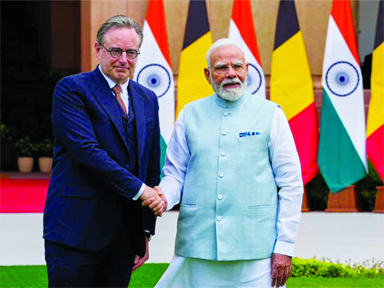

New Delhi (TIP): Prime Minister Narendra Modi and his Belgian counterpart Bart De Wever on Thursday, September 3, agreed to bolster cooperation in defence, advanced technology and law enforcement and set a target for doubling trade in five years, as defense firms of the two countries concluded co-production agreements for a wide range of military equipment.
Modi and De Wever, the first Belgian PM to visit India in two decades, reviewed bilateral ties and held focused discussions on collaboration in semiconductors, chemicals, pharmaceuticals, fintech, advanced manufacturing, ports and logistics, and clean energy.
The creation of resilient supply chains to reduce dependency on China and more predictable trade arrangements, including leveraging the proposed India-European Union (EU) free trade agreement, against the backdrop of geo-economic turmoil unleashed by US trade policies and tariffs also figured in the discussions between the two leaders.
Modi noted at a joint media interaction that food, fuel and supply chains have been impacted by uncertainty because of conflicts in different parts of the world, and said democratic values and the market economy make India and Belgium natural partners. He also highlighted new opportunities presented by India’s economy in this challenging environment.
“Defence and security cooperation is a key pillar of our relationship. Today, we agreed to enhance military exchanges and training cooperation between the two countries,” Modi said. “The agreements between our governments and defense industries will open up new opportunities for defense co-development and co-production. We will also strengthen intelligence-sharing and cooperation between our agencies in combating crime.”
Besides establishing an Investment Fast-Track Mechanism for Belgian companies, making the India-Belgium Business Forum a regular mechanism and strengthening coordination among the financial, fintech and regulatory institutions of both countries, India and Belgium have set a target of doubling bilateral trade over the next five years, Modi said.
Two-way trade is currently worth about $13 billion, with diamonds accounting for almost 30% of the total figure.
“Belgium’s expertise in semiconductors and India’s scale are complementary to each other. In this direction, we will work together to connect Belgium’s IMEC Institute with India’s semiconductor ecosystem,” Modi said. The two sides will soon conclude a migration and mobility partnership agreement, he said. De Wever described India as an increasingly important partner in a turbulent world and said Belgium, one of the most internationally connected economies, can serve as India’s gateway to European markets. “We live in a more fragmented and uncertain world, prosperity and security increasingly go hand-in-hand,” he said.
The Letter of Intent on Defense Cooperation finalised by the two sides provides a new framework for everything ranging from military exchanges to research, co-development and co-production of defense hardware, De Wever said. India and Belgium can be partners for the security of economies and supply chains, energy security, cyber security and maritime security, even as they address the disruption and weaponization of supply chains and excessive dependencies, he said.
De Wever spoke more at length on dependencies created by China and the turmoil unleashed by the trade policies of the US administration at a subsequent business event organized by the Confederation of Indian Industry (CII).
“These are turbulent times, our world seems ever more divided into great blocs, raising barriers between one another. For them, geopolitics seems like a zero sum game, tariffs can be imposed from one day to the next by anyone on anyone and anything, for reasons that have nothing to do with economics at all,” he said, in an apparent reference to the US.
De Wever also noted that India had warned about dependencies long before Europe experienced a “rude awakening”, its industrial base undermined and over-capacity dumped as low cost goods.


Be the first to comment