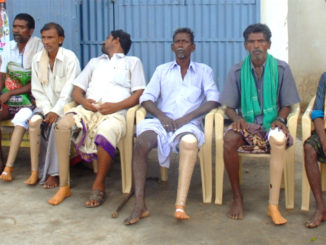
NEW YORK (TIP): Amid the ongoing Ukraine war, Jaipur Foot USA is looking at possibilities to hold limb fitment camps for needy soldiers and civilians injured in the conflict, a PTI report says.
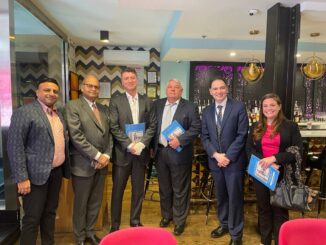
Jaipur Foot USA Chairman Prem Bhandari along with Joint Secretary, Jaipur Foot USA Nishant Garg met the Consul General of Ukraine in New York Oleksii Holubov on Tuesday, May 4.
They also met New York City’s Commissioner for International Affairs Edward Mermelstein, Deputy Commissioner- Trade, Investment and Innovation for New York City Mayor’s Office for International Affairs Dilip Chauhan and General Counsel for the Mayor’s Office for International Affairs Sarah Friedman.
During the initial meeting, Bhandari raised the issue of the possibility of organizing Jaipur Foot camps to help soldiers and civilians injured in Ukraine war.
Bhandari said that given the current circumstances that may make holding camps in Ukraine difficult, the organization will explore options to hold a pilot project for such camps in countries neighboring Ukraine such as Poland.
To a question from The Indian Panorama, if the Jaipur Foot USA will provide their services to Russian soldiers and civilians, too, Mr. Bhandari said their organization believes in serving all people in need of their services.
To another question on whether or not the limbs will be provided at a cost or free, Mr. Bhandari said the limbs are provided absolutely free. “Since 1975, we have not charged even 10 cents”, Mr. Bhandari said.
The organization has been providing artificial limbs at zero cost to those in need, including children affected by armed conflicts.
He said he discussed the proposal with Padma Bhushan awardee D R Mehta, the founder and chief patron of Bhagwan Mahaveer Viklang Sahayata Samiti (BMVSS), the parent body of Jaipur Foot USA.
So far, over 1.90 million beneficiaries of BMVSS have been fitted/provided with Jaipur Foot limb, calipers, and aids and appliances in India as well as in 33 countries of Asia, Africa and Latin America, including through 85 international camps.
Bhandari said that in line with the Indian philosophy of Vasudhaiva Kutumbakam – the World is One Family – Jaipur Foot believes in this philosophy and inculcates it in its mission of helping those in need.
Jaipur Foot has zero per cent administrative cost, he said, adding that “BMVSS is a secular, non-religious, non-governmental, non-political, non-sectarian, non-regional and not for profit charitable organization set up to help the physically challenged, particularly the financially weak and underprivileged.”
The current purge against civil society organizations seems to be indiscriminate and alarming
By M.S. Sriram
“Why foreign funding? As we know, “causes” have no boundaries and funding for such socially desirable belief systems could come from beyond borders. Some causes carried out by organizations such as Doctors Without Borders, or Reporters Without Borders are by definition international in nature. Similar is the case with the Jaipur foot provided by the Bhagwan Mahaveer Viklang Sahayata Samiti. The humanitarian work by the Missionaries of Charity is beyond the capability of a state. Such causes do not have a rational basis to be explained in terms of a financial model; how do you put a price tag to press freedom? The niche funding will happen from agencies that may be beyond the borders. They need to be encouraged.”
On December 31, 2021, the Ministry of Home Affairs issued another public notice extending the validity of registration certificates that were expiring from September 29, 2020, to March 31, 2022, till the latter date, provided that the request for renewal had not been rejected. What should have been a routine activity of the Ministry has turned out to be a fairly detailed exercise of scrutiny, resulting in a paralysis in granting permissions. The levels of due diligence and the information sought on the one hand and the annual declarations to be given by the board members of civil society organizations on the other have increased significantly. The mandatory opening of bank accounts for foreign contributions has been centralized in one branch of the State Bank of India. The linking of Permanent Account Number (PAN), Aadhaar number and mapping it with the bank account/s of the individual board members are happening with gusto. All this has resulted in a chill settling over the people who are and have been associated with civil society organizations serving a social or cultural cause. The registrations under Foreign Contribution (Regulation) Act (FCRA) have been long necessitated in order to undertake due diligence of the causes for which the organization is working for and also to have a handle on the traceability of funds.
Data on cancellations
Recently, the Missionaries of Charity established by Nobel Laureate Mother Teresa, was in the news for the cancellation of its permission under the FCRA. A perusal of the statistics available on the website of the Ministry of Home Affairs (https://bit.ly/32Kij6E) reveals an interesting pattern. Of the 20,675 permissions under the FCRA that were cancelled from 2011 onwards, only 89 have been cancelled on request; the rest have been cancelled on violation. Of these 20,675 cancellations, 80% of the cancellations are after 2014, with a massive purge of around 10,003 permissions in the year 2015. The dashboard (https://bit.ly/3sXfOsu) shows a little under 17,000 active organizations — which have either got permission or will know their fate by March 2022, while around 33,000 organizations have either lost their permission or it has expired. These cancellation numbers do not include the rejection of around 600 applications that have been in the news in the recent past, as the website shows only three cancellations in the year 2021 and none in 2020.
There has been a pattern to the organized attack on civil society organizations and this looks like the final shot. In the past, the amendments in the FCRA that restricted the ability to sub-grant, killed many of the niche organizations working in very remote areas which had no direct access to international funding but were doing it through larger non-governmental organizations. The other amendment restricting the proportion of expenses on administration almost choked organizations that worked for the rights of the disposed. The increasing level of surveillance type of data sought has resulted in many organizations losing people on their governance structure and resulting in problems in funding. The level of the purge is alarming on two fronts. If this purge is because of violations that seem to threaten sovereignty because of evidence of money laundering, subversive activities and violation of the laws, then it is worrying that these organizations survived for all these years. This says a bit about the system of scrutiny that we have had in the past.
Alternately, if these are organizations that have been purged on xenophobic considerations — because they are activists usually questioning the Government and speaking for the marginalized — organizations working on issues such as human rights, and organizations serving the people whom the state is unable to reach, then it is even more alarming. That is because it is suppressing the concept of antyodaya — reaching the last person with rights, services and entitlements.
Organizations that are needed
Why we need civil society organizations is a moot question. We need them because they usually work on what can be called an unreasonable agenda. This unreasonableness falls in three large verticals. The first is that they ask for greater efficiency, delivery and accountability from the state. Whether is it about rehabilitation and compensation in the case of land acquisition or setting up a great accountability framework as was done through the movement led by the Mazdoor Kisan Shakti Sangathan for the Right to Information. The second vertical is in correcting the extractive nature of markets. The groups asking for environmental accountability are looking at inter-generational justice on a matter that is not very precisely measurable but is palpable. The third is basically picking up causes that are so niche that it is beyond the capability of the state to come up with such initiatives such as a school of drama set up by NINASAM (Nilakanteshwara Natyaseva Samgha) in a village called Heggodu, Karnataka, or an idea of distributing clothing for work as done by Goonj. These initiatives cannot be put into specific business plans, spreadsheets or government schemes. They, therefore, need a grant-based, cause-based revenue stream model.
Issue of funding
Why foreign funding? As we know, “causes” have no boundaries and funding for such socially desirable belief systems could come from beyond borders. Some causes carried out by organizations such as Doctors Without Borders, or Reporters Without Borders are by definition international in nature. Similar is the case with the Jaipur foot provided by the Bhagwan Mahaveer Viklang Sahayata Samiti. The humanitarian work by the Missionaries of Charity is beyond the capability of a state. Such causes do not have a rational basis to be explained in terms of a financial model; how do you put a price tag to press freedom? The niche funding will happen from agencies that may be beyond the borders. They need to be encouraged.
In general, past regimes have been tolerant of all developmental and cultural causes; somewhat wary and tolerant of rights-based causes; and largely suspicious of civil society organizations working for human rights and environmental causes. Both human rights and environmental causes put these civil society organizations directly in confrontation with the job of policing/internal security and “development” or economic growth. That is a fight that the civil society organizations were used to.
Deeper study needed
However, the current purge seems to be indiscriminate. The depth and the variety of the work of a civil society organization cannot be captured in the annual returns filed on the FCRA portal, where there is no scope for explaining something beyond the binary. There needs to be a study on how many civil society organizations lost their permissions on “expiry” only because the pre-populated dropdowns given by the FCRA portal were unable to capture the work of the organizations.
The duality of welcoming foreign investments (which takes away capital gains and dividends) while actively discouraging foreign aid to charities is staring us in the face. The definition of what is foreign in the case of electoral bonds and donations to political parties is dodgy at best. This duality is the signature of the current dispensation. Its appetite to collect data is matched only by its reluctance to share data. If the hope, therefore, for civil society organizations is corporate social responsibility funding and funding from Indian philanthropists, watch this space. As cartoonist P. Mahamud indicated in a cartoon, we are moving towards a ‘One Nation One NGO’ regime.
(Author is Faculty member, Centre for Public Policy, Indian Institute of Management Bangalore. He is on the boards of non-governmental organizations, or NGOs that have applied for FCRA permission. None of those NGOs is mentioned in the article.)
Signup to our Newsletter!
Don’t miss out on all the happenings around the world