Tag: Bhagwant Mann

  • Punjab CM Mann orders transfer of 10,000 cops over nexus with drug peddlers

    Punjab CM Mann orders transfer of 10,000 cops over nexus with drug peddlers

    Chandigarh (TIP)- Punjab Chief Minister Bhagwant Mann has ordered the transfer of at least 10,000 police personnel in an unprecedented move to crack down on the drug menace in the state. Chief Minister Mann said that the transfers were made because several police personnel were part of the drug pedlar nexus.
    He said that because of the nexus, many of the accused have been let off the hook, and the complaints against them had been ignored for many years. “Many of the Moharrir head constables (MHC), station house officers (SHO), and constables have been stationed at the same police station for many years and have formed a nexus with the drug smugglers there. They manipulate the procedures to save the accused. I have asked the Director General of Police (DGP) to immediately order mass transfers,” Bhagwant Mann said.
    A major rejig within the police department left the cops fuming. Speaking with India Today, former Punjab DGP (Prisons) Shashi Kant said that the state government’s decision can backfire as merely transferring the cops will not solve the reigning drug menace in the state.
    “While there is no denying the fact that there are black sheep within the police force, all cops are not corrupt. Similar action was required in the jails, which have become dens of drugs. The government should have first identified the tainted cops before ordering the transfers,” Shashi Kant said.
    While confirming the transfer orders, Deputy Inspector General (DIG) Border Range Rakesh Kaushal said that linking the transfers with the drug problem is wrong.
    “The decision to order transfers was made in 2020 but was delayed and is now being implemented. These transfers are administrative and not related to the alleged involvement of cops in drug smuggling,” said Rakesh Kaushal.
    Meanwhile, Punjab DGP Gaurav Yadav has said that the police seized the properties owned by drug smugglers worth Rs 200 crore in the last two years.
    Apart from identifying the 750 hotspots, DGP Gaurav said that the State Task Force (STF) and the intelligence wing have prepared a list of 9,000 street-level pedlars.
    Despite the Punjab Police’s claims of taking strict action against drug smuggling, criminals have expanded their networks. Using drones and sea routes, smugglers are increasing drug supplies within the state. Addressing the media, Bhagwant Mann stated that drugs were coming from Gujarat, which is under investigation.
    In 2023, the BSF and Punjab Police downed or recovered 107 drones used for drug transport. Drug seizures in Punjab have increased fivefold over the past seven years, from 179 kg in 2017 to 1,346 kg in 2023. Source: India Today

  • Punjab Chief Minister Bhagwant Mann Assailed for Arm- twisting Major Punjabi Newspaper

    Punjab Chief Minister Bhagwant Mann Assailed for Arm- twisting Major Punjabi Newspaper

    Punjab Chief Minister Bhagwant Mann

    NEW YORK (TIP): A meeting of representatives of the Punjabis in New York was held on Sunday, June 18 in which the Punjab Chief Minister’s action against the Daily Ajit was strongly condemned. President of Indian Overseas Congress USA Mohinder Singh Gilzian said that the AAP government of Punjab in taking action against Ajit is trying to silence the voice of the people of Punjab. He further said that Punjabis abroad will not tolerate this. We will support and defend the publication wholeheartedly . He said a larger meeting would be convened and appropriate action against the dictatorial Punjab government initiated.
    Baldev Singh Grewal, who served Ajit for a long time, said that Ajit Jalandhar is the only voice of Punjabis, especially the Sikhs. When Ajit was established and earned a readership of hundreds of thousands through hard work, Hind Samachar and Tribune Group started Punjabi editions, seeing commercial possibilities. Before that, these people were campaigning against Punjabi. The action of the present government of Punjab against Ajit should be considered as an action against Punjab, Punjabis and Punjabiat. The Chief Minister of the Punjabi state based on the Punjabi dialect, who himself has been making a living by making Punjabi comedy till today, should desist from taking the heinous action against the Punjabi newspaper.

    Prof. Indrajit Singh Saluja, president of the international organization “Journalists Beyond Borders”, said that newspapers are the voice of the people. Media is the fourth pillar of democracy. The action of forcing any newspaper with the intention of closing it cannot be tolerated. Voice will be raised against this dictatorial action of Bhagwant Mann at the international level. As a first, the media will boycott AAP politicians coming from India to US.

    Gurmeet Singh Butar and Bhinda Begowalia said that Bhagwant Mann should stop the daily excesses against Ajit. This is a newspaper of the people of Punjab, not owned by any particular caste. An attack on its editor Barjinder Singh is an attack on Ajit newspaper and an attack on the voice of Punjabiat. The meeting passed a resolution unanimously and strongly condemning the action of Punjab Chief Minister against Ajit and Ajit’s editor Barjinder Singh Hamdard.

  • Lurking menace in Punjab

    Lurking menace in Punjab

    AAP government yet to find its feet on the security front

    It is the police capitulation to the radical preacher that will come back to haunt the administration. I see the hand of the political leadership in this surrender to unlawful demands. There is no way the CM was kept out of the loop. It is evident that the AAP government led by Bhagwant Mann is still to find its feet on the security front. It could be its Achilles’ heel.

    “The opportunity to nip the trouble in the bud having been lost, the task of the leadership, both political and police, will now be made difficult. The AAP government should seek Doval’s help. He can do so behind the proverbial curtain without announcing his role of adviser. A double-pronged approach would be required. The bulk of the population, the Jat Sikh farmers in the villages, had suffered the ravages of terrorism in the 1980s and early 1990s. They can be won over by well-reasoned arguments on multiple fora.”

    By Julio Ribeiro

    Described as a ‘radical preacher’, Amritpal Singh aspires to be the next Bhindranwale. That aim will not be easy to achieve. Bhindranwale was the product of political machinations gone awry. Amritpal obviously wants to exploit the current gloomy mood of Punjabi youth, caused by unemployment and the rising prices of essential commodities, and aggravated by the Russia-Ukraine conflict with its implications for global economy.

    Amritpal can’t be allowed to become larger than life. He has to be contained before he assumes an aura of invincibility.

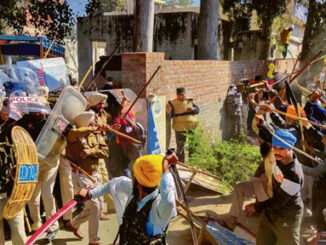
    According to media reports, the police had arrested one of his associates, Lovepreet Singh ‘Toofan’, for allegedly kidnapping and assaulting Varinder Singh of Chamkaur Sahib. Amritpal had also been named in the FIR lodged at the Ajnala police station. Amritpal announced a march to the police station to demand Lovepreet’s release. Anticipating trouble, police personnel were drawn from neighboring police stations and deployed at Ajnala.

    Barricades had been set up, yet a massive crowd of supporters of Amritpal and his Waris Punjab De outfit, armed with swords and a few with guns, stormed the barricades, entered the police station and caused extensive damage to government property. A hundred trained policemen, given implicit instructions on what they should do if attacked by a mob, should normally have been able to deal with the mob and disperse it. But if they had not been told clearly of the type and extent of force they could use to counter violence by the mob, the situation was destined to get out of control, and it did! I would squarely categorize the response as a failure of the police leadership and the state’s political leadership for not making its intention clear.

    I would frown at armchair criticism of the police when dealing with piquant situations. On the ground, it is never easy to take quick decisions as events unravel in front of the police officer in charge on the spot. If he is a confident individual with his wits about him, the public should accept the decision, even if the results turn sour. It is the intent of the decision-maker that should matter.

    Senior IPS officers turned up later, according to the reports, and held talks with Amritpal. He seemed to have convinced the Police Commissioner of Amritsar and the Ajnala SSP that Lovepreet was not the man involved in kidnapping Varinder! The senior officers agreed to release Lovepreet. This capitulation is what will trouble the police and the political leadership henceforth.

    Lovepreet had been named by Varinder in his initial complaint. What the police needed to do was to check whether there actually had been a kidnapping. Who thrashed Varinder? It was reported that he had objected to Amritpal’s utterances, and, if that is true, a motive for the assault was available.

    The Ajnala police would have kept their supervising officers in the loop on such an important political happening. Deputing extra forces from neighboring police stations could have been ordered only by an officer with authority over all five police stations. If reserves were deputed from the armed battalion, the order could only have been issued from the state DGP’s office. There is no way the seniors can claim that they were not in the know of the decision to arrest the men named in the FIR. It is the police capitulation to the radical preacher that will come back to haunt the administration. I see the hand of the political leadership in this surrender to unlawful demands. There is no way the CM was kept out of the loop. It is evident that the AAP government led by Bhagwant Mann is still to find its feet on the security front. It could be its Achilles’ heel.

    An even worse scenario now is the possible recrudescence of terror in this sensitive border state. Our neighbor, mired in an economic morass, will try to fish in troubled waters across the border. In the 1980s, it had provided training and given shelter to Khalistani terrorists. It had also facilitated the movement of arms across the border. The neighbor will touch base with Amritpal, if it has not done so already. NSA Ajit Doval is best placed to intervene. He knows what to do, how it has got to be done and who should be entrusted with the task. Amritpal cannot be permitted to become larger than life. He has to be contained before he assumes an aura of invincibility. He has tasted victory in Ajnala. Consequently, support to him in Punjab will increase.

    The Union Government may try to leverage the state government’s failure in Ajnala to gain political advantage in a state that has not welcomed the BJP. It will be a mistake to do so. The AAP was voted to power with a massive majority. Mann was propelled to the CM’s chair as the Sikh face of the AAP. The BJP has its own Sikh face in Capt Amarinder Singh, but he is a spent force. The wiser option for the Modi government is to leave this state alone lest it should burn its fingers.

    An even worse option would be to play politics because Mann and his party have been pushed into a corner by a tyro who till last year was a clean-shaven Sikh living a nondescript life in Dubai. Sensing an opportunity for his latent talents, he grew a beard, started wearing clothes that imitated those of Bhindranwale and made his supporters carry Guru Granth Sahib to deter the police from acting.

    The opportunity to nip the trouble in the bud having been lost, the task of the leadership, both political and police, will now be made difficult. The AAP government should seek Doval’s help. He can do so behind the proverbial curtain without announcing his role of adviser. A double-pronged approach would be required. The bulk of the population, the Jat Sikh farmers in the villages, had suffered the ravages of terrorism in the 1980s and early 1990s. They can be won over by well-reasoned arguments on multiple fora.

    At the same time, as the communication lines with the masses are developed, a quick rounding up of Amritpal and his cronies should be effected. All laws the BJP governments use against their political opponents and critics should be used against this looming menace before it bites both the state government and the Centre.

    (The author is a former governor and a retired IPS officer)

  • INVESTORS’ SUMMIT

    INVESTORS’ SUMMIT

    Will ensure ease of doing business: Punjab CM

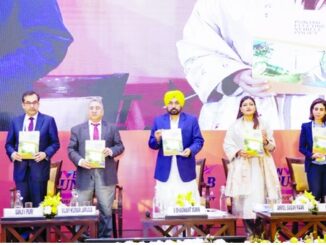
    Mohali (TIP)- Underlining the government initiatives towards facilitating the ease of doing business for the new industrial units in Punjab, Chief Minister Bhagwant Mann On February 23 unveiled the roadmap for industrial growth with minimal government interference. He was addressing the inaugural session of the fifth Progressive Punjab Investors’ Summit at the Indian School of Business (ISB) here. The CM said, “We will abolish the necessity of obtaining the change of land use (CLU) and no objection certificates.” He said, “This summit is not about signing MoUs. This is a platform for learning and sharing ideas. We don’t want to repeat the habit of making big announcements about MoUs, as done in the past. Majority of those showed no result on the ground.”

    He unveiled the new Industrial and Business Development Policy with incentives for investors undertaking expansion projects, setting up new MSMEs or large units, start-ups in service and manufacturing sectors. Punjab is developing 20 rural industrial clusters and 15 industrial parks. The state has received investment worth over Rs 40,000 crore since March 2022 and generated around 2.5 lakh employment opportunities. He also made a special mention of the investments received from Japan, UK, UAE, USA, Germany, South Korea, Singapore, Spain, France, Italy and other countries.

    Investment Promotion Minister Anmol Gagan Mann said, “We are investing heavily in developing infrastructure to attract tourists with special emphasis on adventure and water tourism.” Medanta Group chairman Dr Naresh Trehan said, “We are coming to Punjab. We are working on establishing ourselves in Punjab as soon as possible.”

    Mahindra and Mahindra executive director Rajesh Jejurikar said, “We have invested in Punjab for decades. We have grown five times since 2007. We have four manufacturing units in Punjab and are investing in the fifth one, which at present, is under construction.” Cargill (India) president Simon George said, “We have 13 manufacturing locations in the country. We made the first investment in Punjab in 2016. We are in the process of doubling our investment here over the next two years.”

    RJ Corp chairman Ravi Kant Jaipuria said, “We have two large plants in Punjab at Phillaur and Pathankot. We are in the process of doubling our production at the Pathankot unit.”          Source: TNS

  • Raj Bhawan-Govt row escalates

    Raj Bhawan-Govt row escalates

    ‘Legal advice first’: Guv refuses to give nod to summon Punjab assembly budget session

    Chandigarh (TIP)- The ongoing row between Governor Banwarilal Purohit and Chief Minister Bhagwant Mann in Punjab further deepened on Thursday, February 23,  with the former refusing to summon the Assembly’s Budget session while stating that he would take a decision only after getting legal advice on the “derogatory and unconstitutional” letter and tweet made by the AAP leader in response to a letter from Raj Bhavan on February 13. The governor sent a letter to  Mann to convey his position on the state cabinet’s decision two days ago regarding the summoning of the house of the legislature of the state. The state cabinet on Tuesday decided to convene the budget session of the Punjab assembly on March 3, following which the governor was requested to summon the house.

    “Since your tweet and letter both are not only patently unconstitutional but extremely derogatory also, therefore, I am compelled to take legal advice on this issue. Only after getting legal advice, I will take a decision on your request,” Purohit wrote. The letter is likely to further flare up the long-running tussle between Mann and Purohit which has strained their relations.

    The governor had, in a letter to Mann on February 13, raised questions about the selection of school principals for a training trip to Singapore, saying he received complaints of “malpractices and illegalities” in this regard.

    The AAP government sent 36 government school principals to a professional teacher training seminar in Singapore from February 6 to 10. The governor also questioned the appointment of Guninderjit Singh Jawandha as the Punjab Information and Communication Technology (Punjab Infotech) chairman while pointing out that his name figured in a kidnapping and property grabbing case.

    He had also raised questions about the promotion and posting of IPS officer Kuldeep Singh Chahal as the Jalandhar police commissioner; the presence of a non-official Naval Aggarwal in meetings of senior officers where sensitive and confidential matters of security of the country were discussed, and non-disbursal of scholarships to 2 lakh SC students. Claiming that Mann “never cared to reply” to his letters in the past and treated “all my queries with contempt”, Purohit told the CM that people elected him (Mann) for running the administration as per the Constitution and not according to his “whims and fancies” and that he is bound to furnish any information sought by Raj Bhavan. He also asked Mann to reply to his letter within a fortnight, failing which he would be compelled to take legal advice for further action.Mann promptly took to the microblogging site Twitter to tell the governor that he and his government are accountable to 3-crore Punjabis according to the Constitution and not to any governor appointed by the central government.

  • Looking Ahead : Punjab needs a big push

    Looking Ahead : Punjab needs a big push

           By Prabhjot Singh

    Challenges, if taken seriously, are often productive as they determine the path of progress. The turn of the year is the time not only to look back but also to set new challenges and targets ahead.

    Punjab, once the sword and sports arm of the country, is at a crossroads. Its economy is tottering at the brink. Problems of drug addiction, suicides, unemployment, continuous exodus of youth,  gangsterism, pollution, diversification of agriculture and poor delivery of civic services  are aggravating day by day. Though AAP, the new ruling party in the State, has been in the saddle for more than nine months,  long standing problems continue to elude solutions. The State needs a perestroika to be back on its footing as a dynamic and prosperous leader.

    The Bhagwant Mann Government in the State has been patting its back for a number of revolutionary decisions it has taken in the first nine months of its governance. These  include “zeero electricity bills”,  start of 100 Mohalla clinics besides starting bus service to Indira Gandhi International Airport in New Delhi from various district headquarters, it has taken in the first nine months. It is also claiming credit for introducing “single pension for MLAs”, regulate supply of sand and gravel at affordable rates, control corruption in public offices and improving school education. The less said the better.

    Intriguingly The State government was concerned more for wowing voters in Gujarat and Himachal Pradesh in its party fold than redress the chronic problems facing the State. Inserting full page advertisements in newspapers not read in the State and on TV channels that have larger viewership outside the geographical terrains of the State have evoked severe criticisms, both from the political opponents as well as eminent social scientists. These extra ventures  in far off “greener” pastures even failed to get the ruling party mileage it was expecting to get. The only gain, as it claims, has been in its status of becoming a national party with its nominees sitting in four Assemblies. The progress on the national political horizon may be commendable for a party that made its debut less than a decade ago. Still, it falls far short of expectations of the people  who have been posing their electoral trust in hoping it to be a harbinger of change in a country that has primarily been ruled by two parties – Congress and Bharatiya Janata Party – with brief spells of rule by alliances.

    AAP may be working for a larger agenda as  it has set its eyes to be a major political opponent to Narendra Modi’s BJP. It has been preparing itself for its bigger political challenge, the 2024 general elections. To succeed, it has to keep its already acquired flock together. Punjab and Delhi will be its biggest testing grounds. It has additional challenges and issues confronting the State. Farmers are still up in arms. Industry is facing a plethora of problems. Health care and basic civic infrastructure, including provision of safe potable water and disposal of solid garbage have been engaging the attention of the State but without much reprieve.

    One of the major challenges facing the State is shortage of funds. It keeps looking towards the Centre for special packages rather than cutting down its wasteful expenditure, including  its publicity budget besides rationalizing its security expenditure. Growing budget of subsidies and diminishing channels generating revenue coupled with rapidly increasing expenditure on maintenance of establishment, including the security of Chief Minister and other VIPs, are all contributing factors  for the deteriorating fiscal health of the State.

    Strong statesmanship and all-out effort to redress some of the chronic problems of the State are the minimum the people of the State expect from the incumbent government in the New Year. Looking for help from outside, including investments, is  laudable but the State cannot be dependent upon others and the doles from the Centre. Punjab needs a hard and strong push as it will have to fight its own battle. Think more of Punjab than  Delhi or Gujarat should be the motto of Bhagwant Mann government.

    (Prabhjot Singh is a senior journalist. He can be reached at prabhjot416@gmail.com

    Phone: +1 647 241 3806/+91 98140 02189

    visit probingeye.com  or follow him on Twitter.com/probingeye)

  • Punjab Then and Now

    Punjab Then and Now

    By Prabhjot Singh

    Change is the only thing that is permanent. This has been my philosophy throughout. The other day Punjab Chief Minister Bhagwant Mann launched with great fanfare the Aam Aadmi Clinic. It leaves me wondering if it is all we have achieved in 75 years of Independence. Vivid are memories when as a child, 60 years ago,  I occasionally visited the local dispensary  primarily for  medical attention. I am not sure whether it was a Municipal Dispensary or a Primary Health Centre run by the State Health department. It had all the facilities that the Aam Aadmi Party Clinics are promising to have. Besides a Doctor, the Dispensary had a nurse, a midwife, a pharmacist and an attendant besides a safai karamchari.

    All basic needs of people of our locality – Model Town – were met by the Dispensary.

    As I grew older, the Dispensary started losing its usefulness. Sometimes it was either without a doctor or a nurse or both. Drugs were either scarce or there were no replenishments.  Routine tests, including the Malaria test,  too were discontinued. As the country started enjoying fruits of independence, services became the first casualty. For people belonging to my generation, “services”, including health care, education, streetlights, garbage collection and disposal, local transportation and maintenance of parks and open spaces were all “Sarkari”.

    It sounds amazing to hear the State Chief Minister talking of making primary health centers and government schools  as prime institutions to meet growing needs of the people.

    I went to a Government Model School in my area. Teaching of English with Punjabi or Hindi started from Lower Kindergarten (LKG) class. In 1968 when I sat in the Middle Standard Examination conducted by the District Education Office, my school had the district topper while I also figured among top 50 students of the district.

    Even after securing high first division  – 484 marks out of 700 – it was a tough competition to get into another “Sarkari” school, Government Model High School, Cemetery Road.

    Two years later when the Matriculation Examination was conducted by the Punjab School Education Board for the first time, my school  had the State topper. Incidentally, he was the same boy who had topped the Middle standard exam. I was once again among the top 100 students of the State. Those were the days when Government schools produced the toppers. The “sarkari” dispensaries sans  picture of the Chief Minister provided free basic treatment. Now after 60 years, the Chief Minister’s  assertion that the government was committed to rejuvenate the health care and  education system in the state left me wondering whether we were moving forward or going back.

    Who has  been at fault for the present plight of basic services that the State was mandated to provide?

    Of course, people have been electing their governments!

    (Prabhjot Singh is a veteran journalist with over three decades of experience covering a wide spectrum of subjects and stories. He has covered  Punjab and Sikh affairs for more than three decades besides covering seven Olympics and several major sporting events and hosting TV shows. For more in-depth analysis please visit probingeye.com  or follow him on Twitter.com/probingeye)

  • Punjab Politics: Litmus Test for AAP in Sangrur Lok Sabha Bye-Election

    Punjab Politics: Litmus Test for AAP in Sangrur Lok Sabha Bye-Election

    By Prabhjot Singh

    Rocked by the gruesome assassination of folk singer-turned politician Sidhu Moose Wala on May 29, the ruling Aam Aadmi faces a litmus test in the Sangrur Lok Sabha seat bye-election scheduled for June 23.

    The seat had fallen vacant after the incumbent Punjab Chief Minister Bhagwant Mann quit his Lok Sabha seat on his election to Punjab Vidhan Sabha from Dhuri. In the last two elections – in 2014 and 2019 – Bhagwant Mann had successfully contested from this seat.

    Of the five contestants in the fray this time include Simranjit Singh Mann, President of Shiromani Akali Dal (Mann), who represented Sangrur in Lok Sabha from 1999 to 2004. There were speculations that all Sikh organizations and political parties would put up a joint Panthic candidate in their endeavor to get early release of Sikh prisoners languishing in various jails of the country.

    The proposal was first taken at a meeting of the Panthic organizations. It was followed by a visit of Shiromani Akali Dal chief Sukhbir Singh Badal to the residence of Simranjit Singh Mann, President of Shiromani Akali Dal (Mann).

    At the closed door meeting the two leaders and other senior leaders reportedly failed to reach unanimity.

    While Simranjit Singh Mann went ahead to file his nomination papers day after the meeting, Shiromani Akali Dal chief Sukhbir Singh Badal announced the candidature of Kamaldeep Kaur Rajoana, sister of jailed Balwant Singh Rajoana. Various Panthic organizations have been making concerted efforts to seek release of Balwant Singh Rajoana undergoing life imprisonment in the Beant Singh assassination case. Other candidates in the fray include Gurmail Singh of ruling Aam Aadmi Party. An environmentalist, Gurmail Singh has been active in AAP politics as a youth leader and heads the Sangrur unit of the party.

    Other than Simranjit Singh Mann, who contested the last Lok Sabha election from this seat unsuccessfully, Kewal Singh Dhillon is also in the running this time. Though last time, he was a Congress candidate, now he is representing Bharatiya Janata Party. Interestingly, Kewal Dhillon, who twice represented Barnala in Punjab Vidhan Sabha as a Congressman, joined BJP only a day before his nomination as the party candidate for the ensuing bye-election. Though the BJP contested the State assembly elections in February in alliance with Punjab Lok Congress, a new outfit floated by former Chief Minister Capt Amarinder Singh after leaving Congress, and Sanyukat Shiromani Akali Dal led by former MP Sukhdev Singh Dhindsa, announcement of Kewal Dhillon’s candidature, indicates that the alliance is no more in existence.

    At one stage, the Sanyukat Shiromani Akali Dal had raised objections on the way the BJP was going alone on both scouting for the candidate and contesting the election on its own.

    In the 2019 elections, Parminder Singh Dhindsa, who unsuccessfully contested from Dirba in the last Assembly elections, was the Shiromani Akali Dal candidate. He finished third behind Bhagwant Singh Mann and Kewal Singh Dhillon by polling 2,63,498 votes.

    Parminder Dhindsa had represented Dirba in Punjab Vidhan Sabha for the 2017-2022 term.

    Congress has named former Dhuri MLA, Dalvir Singh Goldy, as its candidate.

    In the Punjab Assembly elections held early this year, all nine assembly segments – Lehra, Dirba, Sunam, Bhadaur, Barnala, Mehal Kalan, Malerkotla, Dhuri and Sangrur – that constitute this Lok Sabha, AAP candidates made a clean sweep.

    Sangrur has a unique record as it has been sending representatives of different political parties, including Communists, Congress, and various factions of Shiromani Akali Dal, to Lok Sabha.
    Ranjit Singh was the first Lok Sabha winner from Sangrur. He won in the 1952 elections as a representative of Congress.

    Nirlep Kaur, owing allegiance to the then Shiromani Akali Dal (Sant Fateh Singh), won from Sangrur in 1967, the first general election after the reorganization of Punjab. Subsequently, Teja Singh Swatantar, wrested back the seat for Communist Party of India. In 1962, Ranjit Singh was the first CPI nominee to win from Sangrur.

    Two of SAD MPs from Sangrur – Surjit Singh Barnala and Sukhdev Singh Dhindsa – remained part of the Union Cabinet in the NDA governments of their time.

    SAD (Mann) was successful twice in representing this constituency in Lok Sabha. In 1989, Rajdev Singh was elected from here and 10 years later, the SAD(Mann) chief, Simranjit Singh Mann, won from Sangrur.

    Before Bhagwant Mann was elected for the first time in 2014, the seat was held by Vijay Inder Singla for a term – 2009-2014.

    Sukhdev Singh Dhindsa succeeded Simranjit Singh in 2004.

    For Congress, Gurcharan Singh Nihalsinghwala (1980) and Gurcharan Singh Dadhahoor (1991) represented Sangrur in Lok Sabha.

    Political analysts hold that things have changed significantly primarily because of the assassination of Sidhu Moose Wala. Days before his killing, he had reportedly held a meeting with Simranjit Singh Mann pledging support to him in the Lok Sabha bye-election.

    (Prabhjot Singh is a veteran journalist with over three decades of experience covering a wide spectrum of subjects and stories. He has covered Punjab and Sikh affairs for more than three decades besides covering seven Olympics and several major sporting events, including eight World Cups in Hockey. He has been hosting TV shows. For more in-depth analysis and stories by him please visit probingeye.com or follow him on Twitter.com/probingeye and on Facebook @PrabhjotSingh.Journalist. He can be reached at prabhjot416@gmail.com)

  • Sidhu Moosewala assassination case: AAP govt lands deep in hot waters

    Sidhu Moosewala assassination case: AAP govt lands deep in hot waters

    By Prabhjot Singh

    “Neither the Chief Minister Bhagwant Mann nor any of the senior members of the High Command of AAP, including its Convener, Arvind Kejriwal, could visualize the serious consequences they would counter for their action of cutting down security cover of eminent personalities, including politicians, religious leaders, artists, and policemen.

    “The broad daylight assassination of folk singer-turned budding politician Sidhu Moosewala not only evoked worldwide condemnation but also painted the action of the first-time ruling party in the State as a cheap and unlawful gimmick.” In less than 10 weeks of its landslide triumph in the Assembly elections of this trouble-torn revenue deficit border State, the ruling Aam Aadmi Party (AAP) is finding itself knee deep in hot waters. The reason: a highly publicized action that boomeranged on its face.

    Neither the Chief Minister Bhagwant Mann nor any of the senior members of the High Command of AAP, including its Convener, Arvind Kejriwal, could visualize the serious consequences they would counter for their action of cutting down security cover of eminent personalities, including politicians, religious leaders, artists, and policemen.

    The broad daylight assassination of folk singer-turned budding politician Sidhu Moosewala not only evoked worldwide condemnation but also painted the action of the first-time ruling party in the State as a cheap and unlawful gimmick. Needless to reiterate that security is a sensitive issue that is seldom revealed in public domain.

    In less than 24 hours of issuance of orders of withdrawal or reduction of security cover to over 400 eminent personalities, the State plunged into one of its worst glooms in recent years with the killing of Sidhu Moosewala who had unsuccessfully contested the Punjab Assembly elections early this year.

    Intriguingly, copies of the order, though confidential and marked “secret” , were made available to the entire media for “wide publicity” as “another daring step by the “Government that works for people.”

    Without getting into the merits of the action or the order, the way it was publicized not only defeated its purpose but also made all those who felt aggrieved by it more “vulnerable”.

    The subsequent explanation by the State police chief that the order was part of an annual exercise of making available additional security personnel for deployment for “ghallughara week” duties.

    The present strength of Punjab police is more than 70,000. In addition, it has some Punjab Armed Police (PAP) battalions as well as India reserve battalions. Punjab also has a couple of trained Commando battalions. Of these men in uniform, nearly 30,000 to 35,000 are deployed in 300-odd police stations and police posts in the State.

    Providing security cover to individuals or institutions is a highly sensitive subject that need not be discussed in any public domain. In the past a little more than 10 weeks of assuming power in the State, the AAP government has been issuing orders from time to time in reviewing security cover of political bigwigs and others. Such reviews were also widely publicized as was the last order of May 28.

    In India, there are various agencies that provide security cover to individuals and vulnerable institutions, including installations. They include those that are under direct control of the Central Government like the Ministry of Home Affairs or the Ministry of Defense. They assess the threat perception and accordingly provide the security cover that at times work in close coordination with the State Security Agencies depending upon the movement of the protected personalities.

    In addition to the Centre, the State Governments have their own Security wings that function under a senior police officer. Though broadly, the State Security agencies follow the same pattern of assessing the threat perception before deciding the quantum of security cover in each individual case. Normally, there is a regular review of security cover with changing threat perceptions, but this practice is not followed religiously. It is in rarest of rarest cases that the State police extends its security cover to individuals who are neither Bonafede residents of the State nor have any threats emanating from within the State. There are numerous when security audits are not conducted, and even if they are done, they are only to complete the formalities.

    There is no denying the fact for many, security cover is more of a “status symbol” than a necessity. The bigger or larger the security cover is used to gauge one’s political or social height.

    Security experts say that there is nothing like “absolute” or” foolproof” security. Their observation is corroborated by high profile assassinations taking place world over from time to time.

    During my nearly 40 years stint in journalism, I reported several cases in which well protected political bigwigs, policemen or others were attacked. Many of these turned out to be gruesome assassinations, while few others left their victims shattered or crippled.

    Security is a highly debatable subject as the State is mandated to protect life and property of its populace. However, deviating from this Constitutional mandate, the State or the people given the mandate to run the State start their own isolation on the pretext of security. Safety and security of a common man is getting greatly ignored.

    Intriguingly, nearly 80 per cent of the police force in Punjab is undertrained. Studies from time to time reveal that nearly 80 per cent of the training budget of the police force is consumed by the top 5 to 10 percent of the force that generally covers up the gazetted officer’s level. Eight to 10 percent of the training budget is spent on the NGOs, who comprise about 10-15 per cent of the total strength and for the remaining 70-75 per cent, the constabulary, gets only five to eight per cent of the training Budget. Majority of the policemen undergo mandatory training only at the time of their induction in the force and seldom afterwards. They are the “lathi” or cane wielding policemen chosen to do route marking or simple beat duties with little or no power of investigation. They are the mainstay of the “visible” security for VIP visits or mass political events. Invisible security is an area that has generally remained ignored.

    There may not be a single policeman to ensure the safety of hundreds of people at a busy marketplace, bus stand or railway station but a political bigwig or a senior police official comes surrounded by a horde of armed guards. The strength of the horde indicates the political or official rank of the protected politician or civil servant.

    ( Prabhjot Singh is a veteran journalist with over three decades of experience covering a wide spectrum of subjects and stories. He has covered Punjab and Sikh affairs for more than three decades besides covering seven Olympics and several major sporting events, including eight World Cups in Hockey. He has been hosting TV shows. For more in-depth analysis and stories by him please visit probingeye.com or follow him on Twitter.com/probingeye and on Facebook @PrabhjotSingh.Journalist. He can be reached at prabhjot416@gmail.com)

  • Massive fire at medical college in Amritsar;  three floors of the building have been damaged

    Massive fire at medical college in Amritsar; three floors of the building have been damaged

    AMRITSAR (TIP): A major mishap was averted at Government Medical College, Amritsar, after fire engulfed a hospital building near the X-Ray department. The hospital employees claimed the fire started from an electricity transformer in the parking area behind the building. The patients admitted in different wards of the building were timely evacuated by the hospital employees and their attendants. The fire could be controlled only after 40 minutes when the fire tenders reached the place. The three floors of the building have been damaged. The hospital authorities stated that no one has received any injuries. Meanwhile, Punjab Chief Minister Bhagwant Mann has expressed anguish over the incident. He wrote on Twitter that he was monitoring the relief work and Minister Harbhajan Singh had reached the spot. The loss to the medical equipment and building is yet to be assessed.

    (Source: TNS)

  • Punjab cabinet: Bhagwant Mann keeps home, Cheema gets finance

    Punjab cabinet: Bhagwant Mann keeps home, Cheema gets finance

    Punjab chief minister Bhagwant Mann on Monday, March 21, allocated portfolios to his 10 ministers, retaining home and justice, and giving the charge of finance and taxation to his seniormost cabinet colleague Harpal Singh Cheema. The portfolios were announced by the new chief minister two days after the 10 cabinet ministers took the oath of office and secrecy here. All the ministers, except Cheema and Gurmeet Singh Meet Hayer, are first-time legislators.

    Besides home, Mann, who was elected from Dhuri assembly segment, has kept 26 departments in his portfolio, including local government, industries and commerce, agriculture and farmers’ welfare, according to an official release. Cheema, who represents Dirba (reserved) seat, has got the portfolios of finance, excise and taxation, planning, programme implementation and cooperation. He was the leader of the opposition in the previous assembly.

    Dr Baljit Kaur, MLA from Malout (reserved) who is the lone woman in the cabinet, has been made the in-charge of social justice, empowerment and minorities, and social security, women and child development. Harbhajan Singh, who represents Jandiala (reserved), has been given the charge of public works and power.

    Mansa MLA Dr Vijay Singla has got the portfolios of health and family welfare, and medical education and research. A dentist, he is among 13 doctors who have made it to the state assembly this time. Lal Chand Kataruchak, who got elected from Bhoa (reserved), is the minister for food, civil supplies and consumer affairs, forests and wildlife.

    Gurmeet Singh Meet Hayer, MLA from Barnala, has been allotted the departments of school education, sports and youth services, and higher education. The 32-year-old minister has a BTech degree.

    Kuldeep Singh Dhaliwal, MLA from Ajnala, has been allotted the portfolios of rural development and panchayats among others. Laljit Singh Bhullar, MLA from Patti, is the new transport and hospitality minister. Bram Shanker, who got elected from Hoshiarpur, has got the charge of revenue, rehabilitation and disaster management besides water and sanitation.

    Harjot Singh Bains, who got elected from Anandpur Sahib, has been allocated legal and legislative affairs, and jails among other departments. An advocate by profession, the 31-year-old first-time MLA is the youngest member of the state cabinet. The portfolio, if any, not allotted to any of the ministers will vest with the chief minister, said the official spokesperson.

  • Opposition, Agitation, Rebellion and Change

    Opposition, Agitation, Rebellion and Change

    AAP would have to, and must remember the People’s temperament pertaining to ‘Opposition, Agitation, Rebellion and Change’.

    By Gurmit Singh Palahi
    English translation by Amarjit Singh Anand

    There has come about an upheaval in the echelons of power, in the strategically significant border-State of Punjab, which has been relegated to a dilapidated condition. In this context, it is noteworthy that many a stalwart veteran political bigwigs have been reduced to a shambles, having tasted crushing defeat in the recent elections. Amongst those who tasted bitter fruit are Prakash Singh Badal (five-time CM) Sukhbir Singh Badal (Supremo o Akali Dal) ‘Raja’ Amarinder Singh (former CM) Charanjit Singh Channi (CM for a couple of months) Navjot Singh Sidhu (State-Congress Chief) and Jasvir Singh Garhi (BSP State-President) while Ashwani Sharma (BJP State-boss) has emerged victorious. Aam Aadmi Party (AAP) has been given a resounding mandate by the populace. Leaders have lost the contest and Punjab has won the battle. Has Punjab actually won, in reality?

                Polling results for 117 seats in Punjab Assembly were declared on March 10. The State has 2.14 crore voters. In 2017, 70% voters had exercised their right to political franchise. This year, 71.95% people voted. Punjab was, apparently, dejected this time, as compared to 2017. A staggering number of 1,10,308 voters opted to accept ‘notes’, in exchange for votes.

                AAP won a thumping 92 seats, BSP got 1, BJP 2, 1 Independent candidate won, Congress 18 and SAD was saddened at having bagged just 3 seats. Others including Leftist-parties, Kisaan Morcha and sundry outfits failed miserably while not evening opening their accounts. Could it be presumed that the overwhelming success of one party is a victory for AAP and the demolition of all other parties is a vote of disappointment against Congress and SAD ? There was noticeable widespread public protestation, anger and a rebellious wave to effect massive change, by bringing about the downfall of ‘the establishment’.  All of these sentiments assumed the form of a volcanic eruption, which outpoured rivers of lava. Delhi CM Arvind Kejriwal and his Dy. CM Manish Sisodia visit Hanuman Mandir and then tell their party-cadre that “this is the biggest Inquilaab” (revolution). Is it, truly, a “revolution”?

                  The percentage of votes was as follows : AAP 42, SAD 18.38, BJP 1.77, CPI 0.05, CPM 0.06, CPML 0.03, Congress 22.98, NOTA votes (none of the above) totaled 0.71, RSP 0.01. The maximum % of 42.01 was claimed by AAP which had received only 23.7% in 2017. Congress got 22.98 as against 38.5 in 2017. SAD recorded a fall from 25.2 to 18.38. BJP registered 1.77 compared to 1.5 last time. Out of 69 seats in Malwa-belt, AAP captured 66. In this region, there was a strong presence of Kisaan protestors and a huge dejection against the previous governance by various parties or alliances. The farming community became a catalyst for Punjab’s empowerment and for giving power to AAP. Whether ‘Dera-following’ or caste-politicking or religious machinations, nothing at all could succeed obstruct the wave of massive awareness amongst the people. AAP reaped a rich harvest, on account of strong public resentment against the traditional parties, everywhere including the latter’s bastions. AAP’s slogan of “One Chance” resonated extremely well with the masses and their hearts were touched. Then, there were additional enticements like the National Coordinator’s poll-promises, which included Rupees 1000/-, 300 free units and 24-hour uninterrupted supply of electricity. It was an emotionally charged election.

    After the victory-laps are over, AAP shall have no ordinary, common promises to keep but would have a very special agenda to adhere to, in order to retain the faith and trust of voters who installed AAP at the pinnacle of power. AAP would not benefit from breaching this faith and betraying such trust especially when the Party has promised revolutionary measures for the good of Punjab. Special emphasis would have to be given to the extinction of the era of traditional fashion or trend of lineage-nepotism, as promised by AAP. The general message is that the public wants change in various spheres and desire public-welfare schemes to be implemented. People want to visualize government as public servants and not as monarchs or dictators.

                The political texture had been entangled since long, whereby one privileged and affluent and powerful segment was ruling the roost. ‘Once upon a time’ there used to be governance which was respected by the nomenclature of ‘Divine Kingship’, which was rejected by the people. Then came the era of Principalities, which also vanished. Finally, the era of democratic rule by majority votes came into effect but which was hijacked and misused by aristocrats, affluent ones and the ‘high and the mighty’. The devastatingly excruciating results of such selfish machinations, by vested interests, are verily visible. In 4 States of India, where polls were conducted, continuity and status-quo was maintained in Goa, Manipur, Uttarakhand and Uttar Pradesh. The winds of change were experienced in Punjab, where people were exasperated on account of rising rate of unemployment, rampant menace of drugs-influx, unresolved cases of repeated incidents of desecration of Guru Granth Sahib Ji, prevalent massive corruption, mal-administration and mafia-rule.

                   People in Punjab are becoming poorer. Farmers are giving up the non-profitable occupation of agriculture and are opting for labor-oriented vocations or they are migrating to other States. The farmers are pained to see their children flying abroad, in search of earning a livelihood. They are unable to envision the fulfillment of their aspirations, in Punjab, whose total annihilation they are pained to see. They are awaiting the manifestation of a miracle-of-sorts, to uplift Punjab out of the doldrums. Their foremost hopes rest on the politicians. For this sole reason, the people used their voting-prowess to ignite the ‘vacuum-cleaner’, instead of merely wielding the ‘broom’. This gave a clean-sweep to AAP, thereby awarding Kejriwal-Mann-combine an unimaginable mandate. Similar power had been given, earlier, to SAD-BJP-alliance, which miserably failed to deliver, despite having 93 seats, that’s 1 more than the seats gained by AAP, on its own. SAD-BJP bigwigs lost their reputation and image. People’s Power of Peaceful Protest was well demonstrated in the electoral arena and the betrayers were uprooted.

    The public rewarded those who were part of the successful year-long strenuous Kisaan-Morcha, on the borders of Delhi, which had forced the Central government to revoke the ‘Three Black-Laws’. Those who appeared to be corrupt and double gamers were rejected outright, by the people. Punjabis have always adored those who lead from the front, those who fight for the people’s rights, those fearless ones who are valiant to face the onslaught of the might of oppressors. Martyr Bhagat Singh and Martyr Kartar Singh Sarabha have always been their role-models. Whenever the Punjabis see someone brave as the Martyrs, they decide to follow and support such leaders. So, AAP is everywhere, and all others have been wiped out, without a trace. However, it remains to be seen whether this trust is respected and if such faith fructifies. Only time shall tell if the victorious leaders, most of whom have been selected from amongst traditional outfits, prove to be loyal to Common-Cause of Public-Good.

               Amongst the people of Punjab, there’s a general air of mistrust in the politicians. Unemployment is eating at their roots. There is intense frustration, irritation and bitterness in their mind, against mal-administration and there is immense resentment against those governing the State. The farmers are increasingly concerned about the fact that agriculture and agro-businesses are running into losses and their landholdings are receding, on account of the rampant influence of corporate-culture, which controls all political parties. Generally, the image of political leaders has been linked with nepotism, corruption, bribery, police-reports, violence, litigation et al. The politicians get votes by giving wind to communalism, fanning sentiments pertaining to religious bias. Would such intentions and policies of politicians change in Punjab?  The people have given their verdict by bringing forward candidates with a clean image, who are expected to work on an agenda of growth, development, progress, to uplift the masses. People have favored the Delhi-model and would like to see it replicated in Punjab.

    Aam Aadmi Partyhas members drawn from various spheres and there are many who give precedence to power, over and above working for public-good. They speak their own language and have their own opinions. Although the people of Punjab are not in any kind of a hurry, but they are, certainly, emotional and have the capability of analyzing those whom they have selected and elected. People shall judge the new government on the parameters of concrete policies, programs, performance, deliverance of results and they would not be content with living on mere minor concessions. The Central government is constantly maneuvering to destabilize the structure of ‘State-autonomous sphere of functioning’. What would be the stance of AAP, on this point? What would be the policy of AAP, on the issue of Punjab’s river-waters? What would be the approach and attitude of AAP, towards mitigating the sufferings of the unemployed youth, thereby ameliorating their condition? What would be the views and measures of AAP, regarding the farming community?

                  For AAP and for CM Bhagwant Mann, the major thrust areas are : presenting a budget whereby public-welfare schemes are offered; decision-making, implementation and functioning, free from the shackles of Central domination; providing an honest and transparent governance; taking effective action on sentimental-issues; giving priority to growth and development projects; working towards having a clean Punjab. These would be some of the major and primary tasks and challenges, for CM and his cabinet and for his party-cadre. Punjab is under severely exorbitant fiscal debts. Would there be effective control exercised over the mafia, ruling the land and construction sector? Would the CM be able to break free from the ‘High-Command-culture’, and work independently, as per the localized needs and requirements? Would the CM bid adieu to the party or be chucked out, just as Sukhpal Khaira, Kanwar Sandhu or Dharamveer met their fate?

              AAP claims that it shall uplift Punjab economy from the throes of financial debt and red tape. Would the CM face a challenge while dealing with leaders drawn from ‘traditional-culture’ parties?

             AAP would have to bravely face the greatest challenge of tackling major emotional issues, including farming, migration and booking the culprits who are guilty of desecration of Guru Granth Sahib Ji, with sheer grit and determination. No doubt, AAP has been victorious in Punjab. Arvind Kejriwal and Bhagwant Mann have risen in stature, nationally. Kejriwal has harbored ambitions of entering Punjab politics and his aspirations have seen fruition. Punjab is a challenge for him, now. Then, the question also arises whether the Delhi-model, especially on health and education, could possibly be replicated successfully, in Punjab. The culture, heritage and lifestyle conditions in Punjab are at variance with Delhi. Punjabis differ in their thought-process, from the folks in Delhi. People in Punjab have, now, started confabulating amongst themselves and have started questioning the politicians, openly and increasingly.  The success of Kisaan-Morcha has effectively impacted the awareness-levels of the common folks in Punjab. People have rejected the ‘Supremo-culture’ of high-handedness, practiced by politicians. People of Punjab are no longer ignorant, indifferent and unaware; they do not refrain from expressing dissent and disagreement, in crystal-clear terms.AAP would have to, and  must remember the People’s temperament pertaining to ‘Opposition, Agitation, Rebellion and Change’.

    (The author is an India based  retired Principal and a well-known columnist. He is President of Punjabi Columnists Patrakar Manch. He can be reached at gurmitpalahi@yahoo.com)

    (New York based Amarjit Anand is a writer, thinker and an Ambassador for Peace. He can be reached at amar1ujagar1pritam@gmail.com)

  • “My Personal Number”: Bhagwant Mann Announces Anti-Corruption Helpline

    “My Personal Number”: Bhagwant Mann Announces Anti-Corruption Helpline

    Punjab’s new Chief Minister, Aam Aadmi Party’s Bhagwant Mann, announced the launch of an anti-corruption helpline on March 17. Mann, who took oath on March 16, promising that he would not “waste a day”, said the helpline number will be launched on March 23, the death anniversary of freedom fighter Bhagat Singh.. “The anti-corruption helpline number will be my personal number… If anybody asks for bribe, send audio and video on that number,” he said.

    “I am not threatening any govt employee as 99 per cent of govt employees are honest but 1 percent of such employees are corrupt which has rotted the system. Only AAP can clean this corrupt system,” he added in the tweet.

    The number will be exclusively for people to upload videos of corrupt officials demanding bribe for their day to day work or indulging in other malpractices. Such officials, he later said, will be given exemplary punishment.

    Eradication of corruption from Punjab was one of the key promises of AAP, which traces its birth to the anti-corruption movement of freedom fighter and Gandhian Anna Hazare. On February 5, party chief and Delhi Chief Minister Arvind Kejriwal had promised to “end corruption in government jobs if AAP government is formed”.

    In his first meeting with police and administration officials today, Mr Mann stressed on the need for a corruption-free government.

    “Corrupt officers have no place in my government and if any such complaint comes to my notice, then don’t expect any sort of sympathy for such officers,” he told the officials who had assembled at the Chief Minister’s Office.

    In a first, the Chief Minister also announced reward for both civil and police officers. The “Best Performance Award” will be given quarterly for making a difference in the lives of common man at the grassroots level, besides ensuring free and fair justice.

  • Bhagwant Mann: Stand-up comedian to Punjab’s CM

    Bhagwant Mann: Stand-up comedian to Punjab’s CM

    From a comedian to Punjab chief minister, Bhagwant Mann has seen a phenomenal rise in a political career of just over a decade. Mann on Wednesday, March 16,  was sworn in as chief minister at Khatkar Kalan, the ancestral village of freedom fighter Bhagat Singh in Punjab’s Shaheed Bhagat Singh (SBS) Nagar district.

    Mann, 48, is a sitting Member of Parliament from Punjab. He won from the Sangrur Lok Sabha constituency in 2014 and 2019. He was chosen as the AAP’s chief ministerial candidate earlier on January 18 this year and won the Punjab polls from Dhuri seat.

    He now becomes the first non-Congress and non-Akali leader to become the CM after the reorganisation of Punjab in 1966. Inviting people of Punjab to his oath-taking ceremony, Mann told them it will be their government. Weeks before election day, Arvind Kejriwal’s AAP declared him its CM face after a phone-in poll, called ‘Janta Chunegi Apna CM’ (people will pick their own CM).

    The AAP state unit president was the first choice of over 90 per cent of the 21 lakh callers. He fought the polls from Dhuri, an assembly segment in his Sangrur parliamentary constituency, winning by a margin of over 58,000.

    Mann’s career in comedy was at its peak when he quit and took the political plunge. In 2011, he joined Manpreet Badal’s People’s Party of Punjab. The People’s Party of Punjab was an experiment in clean politics in 2011 by Manpreet Badal, a nephew of Akali patriarch and five-time Punjab chief minister Parkash Singh Badal.

    In 2012, Mann fought his first election from Lehragagga assembly seat against former chief minister Rajinder Kaur Bhattal but lost.

    Manpreet Badal merged his party with the Congress before the 2014 Lok Sabha polls, but Mann refused to go along.

    In 2014, Mann fought on the AAP ticket from the Sangrur Lok Sabha sear and won by a record margin of over two lakh votes defeating veteran Akali leader S.S. Dhindsa.

    Early Life And Childhood

    Mann was born into the family of a school teacher at Satoj village in Sangrur on October 17, 1973. He released his maiden audio cassette while in B.Com 1st year at Shaheed Udham Singh Government College, Sunam (Sangrur), at the age of 18. Mann, a master of social and political satire, was soon the undisputed king of comedy in Punjab with long-running television shows such as ‘Jugnu Mast Mast’.

    Some of the notable comic characters played by Maan include  Jugnoo, Jhandaa Singh, Bibo Buhaa and Pappu Paas. His comedy TV shows include ‘Jugnu Mast-Mast’ and ‘No Life With Wife’. In 2008, Mann competed in the Great Indian Laughter Challenge on Star Plus which increased his audience. He also acted in National Award winning film “Main Maa Punjab Dee” directed by Balwant Dullat.

  • Punjab Chief Minister Bhagwant Mann will do well to seek the cooperation of the Punjabi Diaspora for regaining the State’s Glory

    “Those who fail to learn the lessons of history are doomed to repeat it”. Conversely, those who learn from history are most likely to succeed.

    In politics, as in every other sphere, one looks for success. Narendra Modi who was not welcome in the United States of America for more than a decade got his opportunity to visit the greatest democracy of the world after he became the Prime Minister of India. And one of the first initiatives he took was to connect with the Indian Diaspora. He came to America and established a rapport with the Indian Diaspora, and in particular with the Gujarati Diaspora. His outreach to the Indian Diaspora helped him create his  positive image  here in America which resulted in his influence with the US administration and with the corporate sector which, of course, in due course resulted in significant investments and partnerships, giving fillip  to Indian businesses and the nation’s economy. It is always a chain reaction. One step leads to another And Prime Minister Modi soon learnt how useful it is to connect with the Diaspora , and he traveled to many more countries to replicate his US experience. Today, the Indian Diaspora is one of his major strengths. The Indian Diaspora is his mouthpiece abroad. Taking cue from him, a number of chief ministers reached out to the Indian Diaspora and got many involved in contributing to the growth of their respective states. Maharashtra, Madhya Pradesh, Chhattisgarh, Haryana and Uttar Pradesh benefitted immensely.

    Punjabi Diaspora has for too long been neglected. No government in  Punjab seriously considered connecting with the Punjabi Diaspora to involve them in the development of Punjab. There have been a few chief ministers during the past few decades who visited the US, Canada and the UK, but the seriousness of purpose was missing. Their visits were  more in the nature of tourism than in the serious business of a meaningful dialogue with the Punjabi Diaspora to secure their cooperation   in the growth of  the State.

    Punjabis love their motherland as no other people may. The love of Punjabis for their lands and the people is unique. That is why even though the successive governments have not bothered to reach out to them many have on their own undertaken projects to help out their brethren in many ways. There are schools being funded by the NRI Punjabis. There are dispensaries and health centers being funded by the NRI Punjabis. There are many organizations that support widows and orphans, and organize mass weddings. They provide these services out of  love for Punjab and its people.

    It will be in the interest of the new government in Punjab to learn from Mr. Modi’s experience, even though they may not like the man himself, and connect with the Punjabi Diaspora on a priority basis. It is a strong Diaspora in terms of numerical strength, financial prowess, influence in the countries that they live in,  and the willingness to give,  which the Sikh Gurus have taught the people of Punjab.

    The Punjabi Diaspora is ready to contribute to the development of the State of Punjab. Is the new chief minister of Punjab equally ready to seek their cooperation? Time, of course, is always of essence.

  • Challenges before Bhagwant Mann and his Government

    Challenges before Bhagwant Mann and his Government

    By Prabhjot Singh

    “Expectations of people of Punjab who voted out the two earlier ruling parties – Congress and Shiromani Akali Dal –  are high as they expect that instead of subsidies, the delivery systems in education and health care should be reliable and affordable. Similarly, civic issues, which the people have been fighting since Independence, need to be tackled in a more professional and competent manner. Corruption in public offices is another irritant that people want the new Government to handle with a firm hand.”

    After a landslide triumph in the just concluded Punjab Assembly elections, the Aam Aadmi Party (AAP) has set upon itself the onerous task of reviving not only the tottering economy but also in establishing the Rule of Law in this border State. After an impressive oath ceremony, attended by hundreds of thousands of the party workers and well-wishers at the historic Khatkar Kalan, the birthplace of Shaheed-e-Azam Bhagat Singh, the Chief Minister, Bhagwant Singh Mann, is faced among other things , a difficult challenge of not only naming members of his Council of Ministers but also in deciding who seven will sit in the Upper House of Parliament, Rajya Sabha, as representatives of AAP. These are ticklish issues as some loyalists workers and leaders tend to feel offended if their loyalty and sincerity to the party is not recognized. While some of the second time MLAs, including Harpal Cheema, Aman Arora and Baljinder Kaur look certain choices for inclusion in the Council of Ministers, there may be pressures on the Chief Minister from other quarters and groups also. There will be similar pressures for nomination to Rajya Sabha.

    Though these party level decisions will be taken in consultation with the national convener Arvind Kejriwal, Bhagwant Mann will have to put his head down to go about the task of restructuring the State Administration while following the legislative requirements in a time bound manner. He has to tone up the civil administration by making it  responsive to public needs.

    Convening of the session of the newly constituted Punjab Vidhan Sabha with a Pro-Tam Speaker administering oath of secrecy to all members, election of Speaker will follow. A date has also to be fixed for passing a vote on account as the new ruling party may need time to finalize its budget for the current financial year. The new excise policy that must become effective from April 1, too, needs to be drafted and approved by the Council of Ministers. While Vote on account must be done before March 31, the new Budget may take a couple of months and a special session of Vidhan Sabha. In between, the AAP government must take policy decisions on several issues of public interest, including implementation of promised 300 units of free power in the power tariff from April 1.

    The AAP national convener Arvind Kejriwal had been talking about replicating the Delhi model in Punjab with certain promises, including free 300 electricity units to all. Punjab has almost 1 crore electricity consumers, including 73 lakh domestic consumers, 14 lakh agriculture consumers, 11.50 lakh commercial consumers and 1.5 lakh industrial consumers. The State spends Rs 10,000 crores as electricity subsidy of which a major chunk – Rs 7180 crores – goes to the farm sector alone.

    The AAP government will also become cynosure of all eyes as it takes on the battle to fight mafias. The first step of the battle will get initiated with the announcement of the new Excise policy. How the State reins in those controlling the liquor trade, both in retail and wholesale, besides tightening control over the running of distilleries and breweries – major sources of evasion of excise duty – will be watched with bated interest. Simultaneously, it will face an uphill task of controlling  deeply entrenched sand and gravel mafia not only to bring down these essential building raw materials but also to check the massive drain of State resources. Illicit mining has also been posing a serious threat to the ecology and environment of the State.

    Expectations of people of Punjab who voted out the two earlier ruling parties – Congress and Shiromani Akali Dal –  are high as they expect that instead of subsidies, the delivery systems in education and health care should be reliable and affordable. Similarly, civic issues, which the people have been fighting since Independence, need to be tackled in a more professional and competent manner. Corruption in public offices is another irritant that people want the new Government to handle with a firm hand.

    Equally challenging will be handling the problem of unemployment and drain of youth to developed nations. Not only the able-bodied young men and women, especially those belonging to the 18-15 age group are heading for green pastures overseas, they are also adding to the debt of their aging and helpless parents and guardians by taking huge sums of money with them. The faith of the people in governance needs to be restored. It can be done only when the new Government with an unprecedented mandate starts delivering by keeping its pre-election promises. Fortunately, the coffers of the State are neither empty nor do they have any pending bills needing clearance. All the State needs is an honest government with a vision. Will Bhagwant Mann and his team deliver? Time will tell.

    (The author  is a veteran journalist with over three decades of experience covering a wide spectrum of subjects and stories. He has covered  Punjab and Sikh affairs for more than three decades besides covering seven Olympics and several major sporting events and hosting TV shows. For more in-depth analysis please visit probingeye.com  or follow him on Twitter.com/probingeye)

    For Jatin

    Categories: Breaking News, Front page,  Politics, India, Punjab,

    Tags:Facebook, WhatsApp, Twitter  LinkedIn,  snap chat, Bhagwant Mann, Kejriwal, Punjab, India, NRIs

  • Bhagwant Mann to take oath as Punjab CM on March 16

    Bhagwant Mann to take oath as Punjab CM on March 16

    Chandigarh (TIP)- The Aam Aadmi Party government in Punjab will take oath on March 16. It was said on Thursday, March 10, that they would take oath at Khatkar Kalan, the native place of martyr Bhagat Singh.

    It is learnt that Bhagwant Mann and Punjab affairs in charge Raghav Chadha have already left for Delhi to meet party national convenor Arvind Kejriwal. Among other things to be decided on Friday are the candidates who will be inducted into the Cabinet.

    Sources in the party say all 17 ministers may not be inducted immediately; only five to six candidates may be inducted now. The names of the probable candidates who could be inducted are Aman Arora, Harpal Cheema, Kultar Singh Sandhwan, Harjot Bains and Baljinder Kaur.

  • Kejriwal as contender

    Kejriwal as contender

    Punjab’s tidal wave of anti-incumbency is against the entire privileged political class

    By Rajesh Ramachandran

    “The most shocking aspect of these results is how the mighty bit the dust, a lesson taught by angry voters to the feudal, tainted and rent-seeking leadership of Punjab. Among the banyan trees of political privilege that fell are four-time former CM and Punjab’s political patriarch Parkash Singh Badal, the “Maharaja” of Patiala, former CM Capt Amarinder Singh, ex-CM Rajinder Kaur Bhattal, sitting CM Charanjit Singh Channi, celebrity Punjab Congress president Navjot Singh Sidhu, Shiromani Akali Dal president and former deputy CM Sukhbir Badal, his controversial brother-in-law fighting drug cases, Bikram Singh Majithia, and his cousin and Congress’ finance minister Manpreet Badal. Most importantly, these weighty “lords” have been knocked out of the ring with a huge thud by first-timers — mobile phone repairmen, volunteers and other nobodies.”

    It is always heartening to talk of hope. The angry, resilient, yet ebullient people of Punjab believe that things can and will change; this, in short, explains the political deluge that has drowned a sitting Chief Minister, three former Chief Ministers, the heads of two parties and the state’s most controversial politician. This tsunami of change has to be credited entirely to Delhi Chief Minister Arvind Kejriwal’s meticulous planning, patience and people-connect. Bhagwant Mann was declared the CM candidate only a few weeks ahead of the polls — till then, there was just Kejriwal representing the Delhi model of governance, seeking a vote for change. The first sign of this campaign’s effectiveness was Union Territory of Chandigarh’s local body polls in December, which resulted in the AAP emerging as the single largest party, dislodging the BJP. Kejriwal offers a national alternative as voters can break away from identity silos to get their lives improved.

    The most shocking aspect of these results is how the mighty bit the dust, a lesson taught by angry voters to the feudal, tainted and rent-seeking leadership of Punjab. Among the banyan trees of political privilege that fell are four-time former CM and Punjab’s political patriarch Parkash Singh Badal, the “Maharaja” of Patiala, former CM Capt Amarinder Singh, ex-CM Rajinder Kaur Bhattal, sitting CM Charanjit Singh Channi, celebrity Punjab Congress president Navjot Singh Sidhu, Shiromani Akali Dal president and former deputy CM Sukhbir Badal, his controversial brother-in-law fighting drug cases, Bikram Singh Majithia, and his cousin and Congress’ finance minister Manpreet Badal. Most importantly, these weighty “lords” have been knocked out of the ring with a huge thud by first-timers — mobile phone repairmen, volunteers and other nobodies.

    But mere free-floating anger would not have consolidated in favor of one party to cause this landslide of an election result. And this anger was not confined or focused against just the incumbent government. It was a sort of a tidal wave of anti-incumbency against the entire privileged political class. The rushing river of anger that was dammed in 2017 appears to have burst forth in 2022 to submerge the political landscape. Another factor that worked in favor of the AAP was that it became the sole beneficiary of the collective angst against the new farm laws. So, while Bharatiya Kisan Union leader Balbir Singh Rajewal lost his credibility and the polls, the anti-establishment vote that coalesced as a result of farm unions’ mobilization went into the AAP’s kitty.

    The results prove that rural Sikh farmers voted for the AAP in huge numbers, a fact further established by the decimation of the Akalis. From 15, the party’s strength has been reduced to three. Similar is the BJP’s drubbing. Despite all its dirty tricks — including Kumar Vishwas’ last-minute stab in the back — the Hindus of Punjab voted overwhelmingly for the AAP, helping the party sweep the urban seats. So, if in 2017 it was a backlash of the Hindus over unfounded fears of a Khalistani connection that defeated the AAP and made the Congress victorious on 77 seats, Kejriwal worked hard early in the campaign to allay those old apprehensions by launching the Tiranga Yatra to burnish his nationalist credentials. And it worked: the committed Hindu voter turned against the Congress and the BJP to emphatically support the AAP. Or rather, Hindus rose above sectarian interests and minority insecurities and voted along with other communities for hope and change.

    That leaves the famed Dalit voters of Punjab — 32 per cent of the population. The replacement of a lazy Maharaja with an enthusiastic Dalit as CM was thought to be a masterstroke by the Congress leadership. But angry Dalit voters treated the high command’s trump card as if it was the joker in the pack. And like Sikhs and Hindus, Dalits voted against the political establishment, proving yet again that anger overrides identity in Indian politics — for there was an attempt to split the Dalit votes in favor of the BJP and the Akalis through the discredited Dera Sacha Sauda. Neither Channi’s candidature nor Ram Rahim’s furlough seemed to have made any difference to the determined Dalit voter seeking revenge against corrupt tokens taken out of the cupboard at the last minute. The Enforcement Department raid seizing crores in cash from Channi’s nephew robbed him of all his “poor Dalit” sheen and Sidhu’s daily barbs against the government left Congress with nothing worth defending.

    If these elections have thrown up Kejriwal as a national contender for the top post, offering a credible alternative beyond Delhi, it is because voters are breaking away from their identity silos and coalescing to get their lives improved. The same logic applies to Yogi Adityanath’s victory, however unseemly his saffron robes may appear to the liberals. The Muslim-Yadav formula, with some non-Yadav OBCs thrown in, did read like a winning combination, but popular sentiment had forgiven Yogi and the BJP for the Delta deaths, floating graves on the Ganga, the farm laws and even the Lakhimpur Kheri killings. The law-and-order situation, free ration, direct benefit transfers and various targeted schemes improving the people’s lot seem to have caught the voter’s imagination. Yet, the Samajwadi Party’s performance only shows that there is simmering anger against the incumbent, which has not yet reached the boiling point. Its leader Akhilesh Yadav may also have to get out of the caste costume to look at the new realities of a changing India, in which the political capital of identity politics may just not be enough to win elections.

    The Congress’s failure as an alternative to the BJP is writ large over the results in Uttarakhand, Goa and Manipur. The party is steadily sliding into inconsequence, with its leadership refusing to re-engineer itself. In this context of a crisis of Opposition leadership steps in Kejriwal, with the amalgamation of two contemporaneously disparate political slogans of ‘Bharat Mata Ki Jai’ and ‘Inquilab Zindabad’. The 2024 contest just got hotter with Kejriwal’s promise of ‘inquilab’.