Tag: Bharatiya Janata Party

  • Nitish inches closer to alliance exit; BJP ready

    Nitish inches closer to alliance exit; BJP ready

    New Delhi/Patna (TIP)- Bihar’s ruling coalition appeared at breaking point on Friday, January 26, with the Janata Dal (United), its ally Rashtriya Janata Dal, and the opposition Bharatiya Janata Party all corralling their lawmakers and calling meetings over the weekend as speculation about chief minister Nitish Kumar’s joining the National Democratic Alliance (NDA) reached fever pitch. If Kumar makes the switch, as rumoured, it will be the fourth such move in the past decade and the second this term.
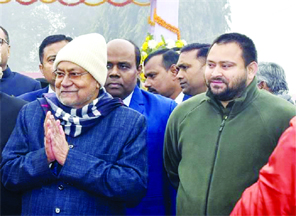
    Signs of plummeting ties in the ruling alliance were apparent after deputy CM Tejashwi Yadav skipped the Republic Day celebrations at Raj Bhavan, where Kumar was present. The two didn’t exchange a word in the parade held in Patna soon after. “Ask those who were not present why they skipped the function,” said Kumar to reporters. At Raj Bhavan, the CM was seen chatting with the leader of the Opposition Vijay Kumar Sinha, and JD(U) minister Ashok Choudhary was sitting on the chair allotted for the deputy CM. The RJD has called a meeting of its legislators on Saturday, while the JD(U) scheduled its meeting on Sunday even as the BJP indicated it was open to joining hands with its friend-turned-foe-turned-friend-turned-foe.
    “We are keeping an eye on all the developments and if needed an appropriate decision will be taken. No door is permanently closed in politics and the door can be opened if needed,” said BJP’s Rajya Sabha MP and former deputy CM Sushil Modi.
    If Kumar goes with the BJP, he is likely to remain CM till at least the Lok Sabha polls later this year, people aware of developments said. But disagreement is rife over who’d become his deputy — Kumar favours Sushil Modi, with whom he worked for a decade in the past, but the BJP might want to go with another face. “They may prefer someone from an extremely backward caste, or dominant OBC group such as Yadav or Kushwaha,” said a person aware of the negotiations.
    Hectic parleys were on in Delhi and Patna throughout the day as the BJP rushed key leaders to the state after a late-night meeting chaired by Union home minister Amit Shah. Sushil Modi flew to Patna on Friday and the state’s central in-charge Vinod Tawde is scheduled to hold a key meeting in Patna on Saturday. “The home minister’s direction to us is very clear,” said a BJP leader in Patna, on condition of anonymity. “We have to speak to everyone so that we are ready for all eventuality. We are waiting for Nitish Kumar to take the final call and resign. Everything will become clearer tomorrow.”
    In Patna, the leading constituents of the six-party ruling coalition exchanged barbs.
    “There is a lot of confusion which is not in the interest of the people of the state. Only the CM can put an end to the confusion,” said RJD MP Manoj Jha. JD(U) chief spokesperson Neeraj Kumar shot back. “Kumar plays politics from the front. He has no confusion.”
    The timing of these moves is crucial. On Monday, Jan 29, Rahul Gandhi’s Bharat Jodo Nyay Yatra enters Bihar and the Congress had planned a show of strength with all members of the ruling alliance. Source: HT

  • Beta, beti, bhai and biwi… the ‘nepo’ netas in the fray

    Beta, beti, bhai and biwi… the ‘nepo’ netas in the fray

    Parivarvaad and Indian politics go hand in hand. The upcoming Karnataka Assembly elections are no exception. The Congress, often targeted for dynastic politics, is not the one to change. Its list of candidates is rife with nominees from political families. The Bharatiya Janata Party (BJP) and Janata Dal (Secular) also have names in the fray from influential backgrounds.
    There are daughters, sons, wives and brothers in the running. It’s all in the family.
    Let’s take a look at the big candidates fighting the Karnataka Assembly elections 2023 with ties to powerful political families.
    Congress’ ‘dynasty’ politics?
    Former chief minister and Congress veteran Siddaramaiah has replaced his son Yathindra from the Varuna seat. In the 2018 assembly election, the current chief minister hopeful had given this seat to his son.
    Congress president Mallikarjun Kharge’s son Priyank Kharge has been nominated from Chittapur SC seat.
    Karnataka Congress chief DK Shivakumar’s nomination has been accepted by the election commission from the Kanakapura assembly constituency, reported NDTV. In a surprise move, his brother – Bengaluru Rural MP DK Suresh – had filed nomination papers from the Kanakapura constituency on Thursday (20 April). As per Hindustan Times (HT), it was a precautionary step by Congress in case Shivakumar’s nomination was disqualified.
    Lingayat heavyweight Shamanur Shivashankrappa has been given a ticket from Davanagere South, while his son SS Mallikarjun is a candidate from the Davanagere North constituency.
    KH Muniyappa is a candidate from Devanahalli (SC) seat, while his daughter Roopakala M has been nominated from Kolar Gold Field- SC seat.
    Karnataka Congress working president and former minister Ramalinga Reddy is contesting from BTM Layout and his daughter – MLA Sowmya Reddy – has again been fielded from the Jayanagar seat.
    M Krishnappa and his son Priyakrishna will contest from Vijaynagar and Govindraj Nagar, respectively.
    Nivedith Alva, son of Congress veteran Margaret Alva, has been fielded from Kumta.
    JD(S) – All in the family?
    Most family members of former prime minister HD Deve Gowda are in politics and this is more highlighted by JD(S)’s ticket distribution. Father-son duos have also been nominated by the JD(S).
    Deve Gowda’s son HD Kumaraswamy has been Karnataka’s chief minister twice. Kumaraswamy will contest from the Channapatna seat, while his son Nikhil has been fielded from Ramanagara – the constituency currently held by his mother Anitha.
    Holenrasipura MLA HD Revanna, Deve Gowda’s other son and Kumaraswamy’s older brother, is again contesting from the seat.
    Revanna’s wife Bhavani wanted a ticket from the Hassan Assembly seat, however, Kumaraswamy resisted the idea, reported NDTV. Swaroop Prakash has been given a ticket by the party from the constituency.
    GT Devegowda is JD(S)’s candidate from Chamundeshwari, while his son Harish Gowda has been nominated from Hunsur.
    ‘Parivarvaad’ in BJP?
    Karnataka chief minister, Basavaraj Bommai, is the son of former chief minister the late Somappa Rayappa Bommai. The incumbent chief minister is the BJP’s candidate from Shiggaon in the Haveri district, where he will face Congress’ Yasir Ahmed Khan Pathan.
    Former Karnataka chief minister and party strongman BS Yediyurappa is not contesting the elections.
    As per a PTI report, Yediyurappa followed in his “lucky” Ambassador car when Vijayendra went to file his nomination for the May 10 Assembly election.
    MLA Ravi Subramanya, who is seeking re-election from Basavanagudi, is the uncle of Bengaluru South MP Tejasvi Surya.
    Mining baron Gali Janardhana Reddy’s brothers – Somashekhar Reddy and Karunakar Reddy – will be contesting from Bellary City and Harapanahalli, respectively.
    Ramesh Jarkiholi and Balachandra Jarkiholi are brothers, with the former allotted a ticket from the Gokak seat and the latter from Arabhavi.
    The family of late minister Umesh Katti, a Lingayat leader from the Belagavi district, has received two tickets. His son Nikhil Katti is the candidate from the Hukkeri Assembly seat and the late minister’s brother Ramesh Katti is fighting from Chikkodi -Sadalaga seat, as per The Hindu.
    BJP MP Karadi Sanganna’s daughter-in-law, Manjula Amaresh, has been given the ticket from Koppal. According to an Economic Times report, he sought the ticket for himself but the party was not in favour of fielding him or any of his family members. After he allegedly threatened to quit the party, the BJP took the move to nominate Amaresh so as not to lose another Lingayat leader.
    Snubbing sitting MLA Aravind Limbavali from Mahadevapura (SC) constituency, the BJP has nominated his wife Manjula Aravind Limbavali from the seat.
    Minister Shashikala Jolle is the nominee from the Nippani seat. Her husband Anna Saheb Jolle is a member of parliament from Chikkodi.
    Chincholi candidate Avinash Jadhav is the son of Gulbarga MP Umesh Jadhav.
    Chandrakant Patil, a candidate from Gulbarga North, is the son of BG Patil who was an MLC.
    Both Karnataka transport minister B Sriramulu (Ballari) and his nephew TH Suresh Babu (Kampli) have been given tickets.
    Tourism minister Anand Singh has been replaced by his son Siddharth Singh as the Vijayanagar candidate.
    Source: Firstpost

  • United Opposition supports Rahul, BJP points at ‘feudal mindset’

    United Opposition supports Rahul, BJP points at ‘feudal mindset’

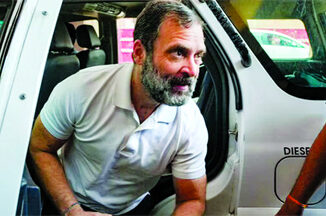
    New Delhi (TIP)- The disqualification of Congress leader Rahul Gandhi from the Lok Sabha sparked strong political reactions across the board on Friday, March 24, with the party vowing to launch mass protests and calling it an assault on freedom of speech, and the Bharatiya Janata Party (BJP) calling his behaviour feudal and accusing him of insulting a community. A number of other Opposition parties – including some opposed to the Congress – also closed ranks and backed Gandhi, criticising the government.
    During a meeting of Congress leaders on March 24, one Member of Parliament (MP) said all party MPs should tender mass resignation but no final decision was taken, said people aware of the developments. Congress leader Priyanka Gandhi Vadra said that a reply should be given to the disqualification through the party’s victory in the upcoming Karnataka elections and a committee will be formed to take further decisions.
    “They (BJP) tried all ways to disqualify him. They don’t want to keep those who are speaking the truth but we will continue to speak the truth. We’ll continue to demand JPC (joint parliamentary committee) probe (into Adani issue). If needed we’ll go to jail to save democracy,” Congress chief Mallikarjun Kharge said.
    The BJP accused Gandhi of being a “habitual loose cannon” with a “feudal mindset” and having little respect for marginalised communities . “I want to ask Mallikarjun Kharge, is abusing other backward classes (OBCs) considered speaking the truth? Do you consider the feudal mindset as truth… this is not the truth, its arrogance,” said Union minister Dharmendra Pradhan.
    A string of other opposition parties also attacked the government. “In PM Modi’s New India, Opposition leaders have become the prime target of BJP…Today, we have witnessed a new low for our constitutional democracy,” tweeted West Bengal chief minister Mamata Banerjee.
    Kerala chief minister Pinarai Vijayan called the disqualification decision hasty and proof of authoritarianism. “This brazen assault is an insult to our democratic values and can’t be overlooked. It must be unequivocally denounced,” he said.
    “The expulsion of Rahul Gandhi from the Lok Sabha is shocking. The country is passing through very difficult times,” Delhi chief minister Arvind Kejriwal said. Congress leader Abhishek Singhvi indicated the party will challenge Gandhi’s conviction on various grounds, including the process of his disqualification.
    Union information and broadcasting minister Anurag Thakur criticised Gandhi for his performance as a lawmaker and said, “In 13 years, Rahul participated in only 21 discussions and did not introduce a single Private Member’s Bill. He is the epitome of unparliamentary behaviour.”
    Thakur said it seems like a “well-planned conspiracy” within the Congress to “get rid of” him by not challenging the Surat court’s verdict on time despite having a battery of lawyers. Thakur said the Speaker had nothing to do with his disqualification. “It was done in full conformity of Section 8 of Representation of People’s Act, Section 102(1) E of the constitution,” he added.
    Source: HT

  • Honor of office: On new Governors of States appointed by the Center

    Those required to stay away from partisan politics in current role must not be made Governors

    A former judge of the Supreme Court of India and a former Indian Army commander are among the new Governors of States appointed by the Centre on Sunday. The Governors of several States and the Lieutenant-Governor of a Union Territory were also shuffled. In recent years, Governors have sought to play a political role in States such as Jharkhand, Kerala, Tamil Nadu and West Bengal, creating a train of controversies. Judiciary reasons, the roles of the military and the judiciary too are topics of interest, particularly with regard to their relationship with the political executive. The executive government’s eagerness to control judicial appointments, besides the debate on the collegium system of judges appointing judges, is evident. It has selectively delayed and accelerated appointments recommended by the collegium, effectively exercising powers that it does not have in appointing judges. The Bharatiya Janata Party (BJP) has also faced charges of using the armed forces to further its political narratives. Earlier too, retired police and intelligence officers went on to occupy Raj Bhavans, but it was the appointment of a retired Chief Justice of India (CJI) as a Governor in 2014 that created a new precedent. Another retired CJI was nominated to the Rajya Sabha, in 2020, raising eyebrows.

    The institution of the Governor is a legacy of the British imperial governance structure. The legitimacy of a nominated Governor in a democracy was the topic of a heated debate in the Constituent Assembly, but it was carried on into the new republic nevertheless. The Governor was to act as a dynamic link between the Centre and the State, but the makers of the Constitution were clear that the posts must remain ornamental, except in very narrowly defined situations in which they were allowed discretion in decision-making. Over the decades, the overreach of Governors has become a serious question in Centre-State relations and democracy in general. The dominance of the BJP at the Centre since 2014 has added fresh tensions with the States. The BJP has a vision of national unity that causes anxiety among regional interest groups. The office of the Governor was to be embellished by the personalities of those who would occupy it. Opening it as a post-retirement possibility for those who are required to stay aloof from partisan politics in their current roles, lowers the dignity of the offices that they leave behind and what they go on to occupy.

    (The Hindu)

  • Post-retirement appointments: a danger to judicial independence

    Justice S. Abdul Nazeer. (Photo Credit/ The Hindu)

    Post retirement, the judicial community should take a concerted decision not to accept any job stemming from political patronage

    Justice Y.V. Chandrachud had said that the greatest danger to the judiciary lies within. Members of the judiciary cannot compromise judicial independence by trading it for a plum post-retirement sinecure. When one becomes a judge, one signs up to fulfil a promise of ensuring a fair and independent judiciary; this promise cannot be compromised at any cost. Our judges need to be gently reminded of this unwritten contract they have with the Indian people.

    By A.P. SHAH

    Within a month of retiring from the Supreme Court of India, Justice S. Abdul Nazeer has been appointed Governor of Andhra Pradesh. Like many others, I believe it is no coincidence that he was a part of the Constitution Bench that decided the Ayodhya Ram Mandir land issue. In the tenure of the Narendra Modi-led government since 2014, he is the third Supreme Court judge who has received a high-profile political appointment soon after retirement, the other two being Justice P. Sathasivam (who was appointed Governor of Kerala), and Justice Ranjan P. Gogoi (who was appointed member of the Rajya Sabha).

     These appointments are all signalling on the part of the government, letting the members of the higher judiciary know that they will be suitably rewarded if they issue favorable decisions. Dangling such a proverbial carrot is akin to corrupting the judges, and encouraging a culture of sycophancy even, as we are increasingly seeing among some judges in the apex court. Worse, this also makes the public have less faith in the judiciary itself. In 1980, Justice V. D. Tulzapurkar had said that “if judges start sending bouquets or congratulatory letters to a political leader on his political victory, eulogizing him on assumption of high office in adulatory terms, the people’s confidence in the judiciary will be shaken.”

    Chipping away at judiciary

    While a Governor’s position may seem largely ceremonial, it is in fact a squarely political appointment. In any event, this appears to be a part of the ruling party’s strategic mission — a long game, if you will — to destabilize the judiciary, chipping away in small and big ways at various aspects of its functioning. If you step back and observe, the judiciary is slowly but surely being subtly weakened.

    To be fair, this is not the first government that has ventured so far as to corrupt the judges in this fashion. Congress-led governments, notably under Indira Gandhi and Rajiv Gandhi, have done it too. But it is a cowardly defense that the Opposition party was equally guilty, and past precedent does not justify present transgressions. The larger objective, for any reasonable executive, should be to ensure the independence of the other arms of the governing mechanism, and that democratic values are preserved in all circumstances. However, a conclusively majoritarian mandate can make one heady with power, and compel the exploration of creative ways in which that power can be maintained and consolidated further. This is entirely the case with the Indian government today.

    Hypocritical behavior

    The government’s behavior is also hypocritical for it is deliberately paying no heed to its own manifesto articulated by its late leader, Arun Jaitley, that such post-retirement judicial appointments should be avoided. In fact, ‘inducing the judges’ by such appointments was a specific allegation directed by the Bharatiya Janata Party (BJP) against the Congress-led coalition.

     The judiciary is no less culpable in this situation. Ideally, I would like to believe that Indian judges are made of stronger stuff, and not ones to be seduced thus. Judges should show moral responsibility and character, as Justice Akil Kureishi most recently did. After being unceremoniously disregarded for elevation, and shoved across the country to various High Courts, upon retirement, he said that the government’s stated ‘negative perceptions’ about him were a ‘certificate of independence’, and he was leaving the judiciary with ‘his pride intact’.

    Judges must recognize that handouts from the government, in the form of such political appointments, are not one-way: there is a giver and there is a receiver. The Indian judiciary must distinguish between political favors and other post-retirement employment opportunities.

    Demarcation of roles

    There needs to be a demarcation between roles where the presence of a judicial authority is clearly valuable and even necessary, such as in a tribunal or a commission, and where it is not. Justice Gogoi, upon his appointment to the Rajya Sabha, had famously proclaimed that he intended to bridge the gap between the judiciary and the legislature, but his attendance record and public participation in parliamentary affairs suggest nothing of the sort. Similarly, Justice Sathasivam had said he had wanted to serve the people in his role as Governor, but surely, he could have achieved the same objective through other appointments, that would be more befitting of someone who had held the office of the Chief Justice of India.

     Ideally, the judicial community should take a concerted decision on this, say, in the Chief Justices’ conference. The plenary should agree that judges should not take up any appointments upon retirement stemming from political patronage (with the nature of such appointments being clearly defined). Additionally, a cooling period of about two years should be considered a mandatory minimum before a judge agrees to take on any post-retirement adjudicatory role, in any case.

    Justice Y.V. Chandrachud had said that the greatest danger to the judiciary lies within. Members of the judiciary cannot compromise judicial independence by trading it for a plum post-retirement sinecure. When one becomes a judge, one signs up to fulfil a promise of ensuring a fair and independent judiciary; this promise cannot be compromised at any cost. Our judges need to be gently reminded of this unwritten contract they have with the Indian people.

     (A.P. Shah is former Chief Justice, Delhi High Court and Former Chairperson, Law Commission of India)

  • In Dropping Gadkari from BJP’s Parliamentary Board Modi  Sends  a Message to  RSS Chief

    In a major organizational reshuffle, the Bharatiya Janata Party  dropped Union Minister Nitin Gadkari and Madhya Pradesh Chief Minister Shivraj Singh Chouhan from its parliamentary board, the party’s highest decision-making body. Nitin Gadkari has not exactly been comfortable in the company of  Modi-Shah duo. A once vocal president of Bharatiya Janata Party, Gadkari has comparatively been, if not silent, quiet for some time.  In the last three years one could see a different Gadkari than the nation had known as pushing forward vigorously the party agenda.

    Gadkari’s performance as minister speaks for itself. I remember his keenness to learn from New York traffic control authorities how best traffic could be managed in Indian metropolitan cities. He spent a couple of hours to study the system at the Traffic control in New York. His passion to speed up work of construction of roads and bridges, the department he holds (Gadkari is Minister for Road Transport and Highways), is  evident from the fact that he not only met the targets but met them in advance of the deadlines. A man who believes in action rather than in making tall claims, he is probably the best man in Modi’s cabinet.  Why should Gadkari, a former President of the BJP and a performing senior minister in Modi cabinet be dropped from the Party’s highest policy making body- the BJP Parliamentary Board?

    Well, it is a clear signal to RSS Chief Mohan Bhagwat that he does not control power; the power lies with Modi-Shah duo. The first clear indication came when, in a dramatic move, a Bhagwat favorite  Devendra Fadnavis, was restrained from becoming the chief minister of Maharashtra  when even the announcement about his oath taking was almost made.

    And now comes the exclusion of Gadkari. One should not be surprised if a performing chief minister of UP whose model of governance came in for much appreciation and which is being sought to be replicated by many BJP chief ministers in their states,   has failed to find  favor with the BJP leadership of Modi-Shah duo because of his being a protégé of RSS Chief Mohan Bhagwat.

    Clearly, Modi who is  known to be ruthless with his perceived rivals, has conveyed to RSS chief who really controls the knobs of power Surely, all is not well in Modiland.

  • Trumping majoritarianism in the Hindi heartland

    Trumping majoritarianism in the Hindi heartland

    By Zoya Hasan
    While regional parties will continue to be significant in various States of the Union, the principal challenge of overcoming majoritarianism lies in the Hindi heartland, especially in U.P. Oppositional electoral alliances, notably the formation of a federal front, are important strategies in this battle but it is no less important to challenge the ideological foundations of the majoritarian project through progressive and inclusive politics.

    The landslide victory of the All India Trinamool Congress in the West Bengal Assembly elections and the pushback of the Bharatiya Janata Party (BJP) in West Bengal, Tamil Nadu and Kerala have given rise to a pervasive belief that right-wing politics can be defeated by regional assertions. Undoubtedly, regional and cultural assertion in these States acted as an effective bulwark against the BJP’s expansionary plans in southern and eastern India. The regional-cultural tropes deployed by Mamata Banerjee, for example, worked so well that at one point, Home Minister and BJP leader Amit Shah was even forced to clarify that if the BJP is elected, someone from Bengal would be the Chief Minister. This underlines the effectiveness of regional culture and politics in trumping communal politics. However, this claim needs to be tempered by the realism that it cannot work in the Hindi heartland, which is dominated by caste and communal politics, and has so far not seen any serious ideological and political challenge to politics based on these identities.

    Encompassing nine States whose official language is Hindi, namely Bihar, Chhattisgarh, Haryana, Himachal Pradesh, Jharkhand, Madhya Pradesh, Rajasthan, Uttar Pradesh (U.P.) and Uttarakhand, this region retains a central position in the electoral strategies of the BJP and its larger political imagination. The party’s stunning show in these States propelled it to power in the 2014 and 2019 parliamentary elections. Its continued political dominance in the heartland will neutralize its losses now as well as in future in States where it has been bested by regional players. I will focus here on U.P. to illustrate the limits of the regional assertion.

    Dimensions in the heartland

    The Hindi heartland is clearly different. There are at least four important dimensions of this difference. First is the absence of regional identity in States such as U.P. This is evident from the debate on States reorganization and the reorganization of Uttar Pradesh in the 1950s. The compulsions of nation-oriented identity emerged very clearly from the discussions in the States Reorganization Commission on suggestions for the division of U.P. for administrative convenience. U.P. leaders argued for a large and powerful State in the Gangetic valley as a guarantee of India’s unity.

    In this sense, U.P. was considered the backbone of India and the centerpiece of political identity in modern India. Importantly, it was supposed to provide the chief bulwark against growing regionalization and fragmentation elsewhere. Instilling a sense of regional pride, an essential part of Congress strategy in southern and coastal India, was not followed in U.P. U.P. was seen as the political heartland in contrast to Punjab and Bengal for instance, which were splintered and incorporated into two different nation states. As is well known, the bases of this post-colonial identity varied from its location in the freedom struggle to staking claim as the cultural homeland of Hindi and Hinduism. In both cases, it was centered in the idiom of the nation-state and strong central authority.

    Second, although U.P.’s cultural homogeneity remains a matter of disagreement, the idea of the heartland had great resonance among the political elite who opposed the demand for U.P.’s reorganization. The long-standing traditions of composite cultural identity and shared plural cultures began to yield place to a singular homogenized identity. The Hindi-Urdu divide, which mirrored the communal cleavage of U.P. society, played a crucial role in this process. Urdu was excluded as it was seen to symbolize Muslim cultural identity in independent India, while Hindi was boosted to promote the development of a Hindi-Hindu heritage for this region. The project of homogenization of Indian/U.P. culture as Hindu culture was quickened in later decades. Even though it would be hard to assume a direct link between Hindi dominance and communal politics of subsequent decades, it is nevertheless a fact that all political parties in the State used it as an ingredient of social and cultural differentiation and a means to consolidate political dominance.

    Role of communal politics

    Third, it is clear that communal politics and communal movements have played a key role in U.P.’s modern history which in turn have diluted other identities.

    In some respects, this process gained momentum in the wake of Partition which cast its long shadow upon political institutions and culture in U.P. and to a great extent affected the perspectives of Hindus and Muslims alike. Hindu nationalism was marginalized within the Congress party but many of its ideas were accepted in framing party policies. The State leadership was instrumental in forging a conservative consensus in the State under Chief Minister G.B. Pant who steered the affairs of the state for eight years after Independence.

    The intensification of communal politics took a new turn with the mass mobilization for the construction of a Ram temple at Ayodhya which was deftly used by the Hindu right to establish a major presence in U.P. and to facilitate the political reconstruction of U.P. through the promotion of a collective Hindu identity. The crusade for the appropriation of disputed shrines is central to the communalization of politics and short circuiting the more complex process of political expansion for the BJP.

    Importantly, this has laid the groundwork for building permanent electoral majorities through the deployment of ascriptive symbols in U.P. which, given its huge size, helps it to establish a strong base in the Hindi heartland to offset the appeal of countervailing identities elsewhere in India.

    Caste politics too

    Finally, caste politics which was expected to counter Hindutva expansion has failed to do so; in fact, caste politics has become a building block for the BJP’s expansion. The party has reached out to Dalits, actively mobilizing them and other backward castes to assimilate them into the Hindutva meta-narrative. Instead of erasing caste from electoral politics, the BJP-Rastriya Swayamsevak Sangh has sought to court fragments of castes as a way of undermining broad-based political movements and opposition to it. It has used the wider appeal of Hindu nationalism to co-opt backward castes and Dalits who are keen to align themselves to the larger narrative of Hindu nationalism.

    A reset is needed

    While regional parties will continue to be significant in various States of the Union, the principal challenge of overcoming majoritarianism lies in the Hindi heartland, especially in U.P. Oppositional electoral alliances, notably the formation of a federal front, are important strategies in this battle but it is no less important to challenge the ideological foundations of the majoritarian project through progressive and inclusive politics. This requires a reset of the basic political mindset in U.P. which can only be done by reviving the splendid heritage of the national movement in which this region played a central role and in which Gandhiji and Nehru played a heroic part. Invoking the spirit of the Bhakti movement which was the first major challenge to the religious orthodoxy of Hinduism would also help in resetting the cultural clock. This must, however, combine with much greater concern for the fundamental social and economic issues of the State, and making the struggle between communal and secular forces the central issue through public campaigns that address the problems of religious traditionalism and the cultural underpinning that this provides to the push to make India a Hindu state.

    (Zoya Hasan is Professor Emerita, Jawaharlal Nehru University)

  • Political row escalates after  Mamata suffers bone injuries in Nandigram ‘attack’

    Political row escalates after  Mamata suffers bone injuries in Nandigram ‘attack’

    Kolkata (TIP): West Bengal Chief Minister Mamata Banerjee, who was allegedly pushed by unknown miscreants while campaigning for West Bengal assembly elections in Nandigram, has suffered severe bone injuries in her left ankle and foot, right shoulder, forearm and neck, a senior doctor of the state-run SSKM hospital said in a medical bulletin issued late on Wednesday, March 10,  night. A day later, a political row escalated on  as the Trinamool Congress (TMC) and the Bharatiya Janata Party (BJP) traded charges, and large-scale protests rocked the poll-bound state.

    Doctors in Kolkata said Banerjee, 66, suffered severe “bony injuries” in her left ankle and foot, besides injuries in right shoulder, forearm and neck. Her supporters blocked roads, burnt tyres and performed prayers in temples and mosques across the state. In several districts, clashes were reported between BJP and TMC workers.

    Banerjee went to the high-profile seat of Nandigram on Wednesday to file her nomination but, in the evening, alleged that some people deliberately attacked and injured her. A preliminary investigation by the police and a section of the eyewitnesses hinted that the injuries may be the result of an accident, and not a deliberate conspiracy.

    The issue quickly snowballed into a political slugfest with the state’s ruling party blaming the BJP for the injuries and the latter accusing Banerjee of orchestrating the incident for sympathy.

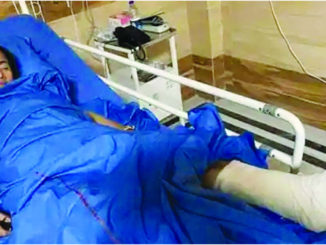
    Images of Banerjee being carried by her security personnel and later, lying on a hospital bed with her leg in a plaster, dominated the airwaves and popular discussion, roughly three weeks before elections kick off for the 294-member assembly. “I appeal to my party cadres, supporters, activists and common people to maintain peace and calm. It is true that I was badly hurt last night and felt severe pain in the chest and head… I hope to be back on the field in the next few days,” Banerjee said in a video message filmed from her hospital bed in a government-run facility in Kolkata. Banerjee, who is seeking a third consecutive term as chief minister, said she would not cancel any scheduled meetings and use a wheelchair if needed. She didn’t repeat her allegation that four-five men had deliberately attacked her.

    The TMC said it will hold silent protest across the state and wear black bands to condemn the incident. “The only woman chief minister in the country was injured and attacked. The Prime Minister and the Union home minister, however, didn’t show the courtesy to call up. We condemn this,” said Saugata Roy, TMC parliamentarian.

    Other TMC leaders invoked previous attacks on Banerjee – the politician popularly known as didi was hit on the head during a rally in 1990 and images of her bloodied body made her a national figure – and it will be a major campaign issue.

    The BJP condemned the TMC’s stance and sought a Central Bureau of Investigation (CBI) probe. The party, which is looking to dislodge the TMC and come to power for the first time in the state, demanded that pictures of the incident be made public.