Tag: Bhima Koregaon

  • The Bhima Koregaon case and what it tells us about democracy

    The Bhima Koregaon case and what it tells us about democracy

    Dissent has a huge price in India, say writers, who piece together the story of the imprisonment of human rights defenders including professors, lawyers, journalists and poets, without credible evidence and without trial, after being labelled as Maoist terrorists or ‘urban Naxals’

    By Ziya Us Salam

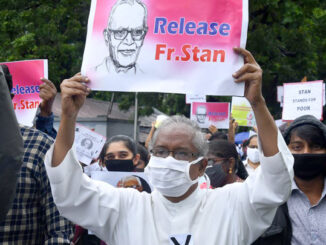
    At a raid on Bagaicha, the training center and home of Jesuit priest and activist Father Stan Swamy in Ranchi, in August, 2018, the Pune police told him that he was a suspect in the Bhima Koregaon case. This shocked him, recalls Prakash Louis who has put together details of Swamy’s subsequent arrest and death in custody in a book, Fr Stan Swamy: A Maoist or A Martyr?. Swamy had never been to Bhima Koregaon nor did he have anything to do with the violence that happened on January 1, 2018, when Dalits had gathered to commemorate the 200th anniversary of the Battle of Bhima Koregaon.

    “They seized my laptop, mobile and sim card, some CDs and some documents lying on my table,” he recalled. The raid was to change the octogenarian’s life. Arrested in October 2020, he was to die in judicial custody on July 5, 2021. He faced multiple accusations of involvement in the Bhima Koregaon incident besides alleged Maoist links. There were reports that Swamy was being denied basic human rights in jail, including the use of a sipper — he was suffering from Parkinson’s disease.

    Fr Stan Swamy: A Maoist or A Martyr

    Louis’s book, which is being translated into many Indian languages, asks questions not just about the Bhima Koregaon arrests but the larger issue of how and why a man, whose death in judicial custody is considered by many to be an institutional murder, came to be called a Maoist in some government circles. In 2021, after his passing, The Indian Social Institute, Bengaluru, where Swamy had worked for years, published I am not a Silent Spectator, an autobiographical fragment by Stan Swamy, where he reflects on his life and work, and also his time in prison.

    Arrests, and after
    In her new book, Alpa Shah, professor of anthropology at the London School of Economics, provides details of arrests of activists, from Rony Wilson, Sudhir Dhawale and Surendra Gadling to Shoma Sen — who has just got bail after six years in jail without trial — and Mahesh Raut. Then came the arrests of Sudha Bharadwaj, Arun Ferreira and Vernon Gonsalves followed by those of Gautam Navlakha, Anand Teltumbde, Hany Babu and Swamy etc. In The Incarcerations: Bhima Koregaon and the Search for Democracy in India, Shah outlines how 16 human rights defenders, whom she calls the BK 16, including academics, activists, lawyers and poets, were imprisoned for years without credible evidence, and dubbed Maoist terrorists/’urban Naxals’. She goes on to write about the role of the police in hacking into the computers of at least three of the accused — Swamy, Wilson and Gadling.

    Patiently, Shah unravels how these alleged terrorists were charged with inciting violence at a commemoration in January 2018, accused of waging a war against the Indian state and plotting to kill the Prime Minister. “The BK case is a bellwether for the collapse of democracy because, for the first time in Indian history, there is a multi-pronged coordinated nationwide persecution of these custodians of democracy. This goes well beyond the routine forms of anti-journalistic, anti-activist action taken by the state in the past. The BK case shows that the ritual of elections hides the rise of authoritarianism. It exposes the brutal state-sponsored abuse of democratic rights taking place across India with complete impunity.”

    Indeed, when the arrests of noted human rights defenders took place, civil society was alarmed, and some took recourse to the judiciary. The Booker Prize-winning novelist Arundhati Roy drew attention to the Emergency-like condition, stating, “In the India of today, to belong to a minority is a crime. To be murdered is a crime. To be lynched is a crime. To be poor is a crime. To defend the poor is to plot to overthrow the government.” Historian Romila Thapar went to court, stating, “Our intention was to draw the attention of the judiciary to what we see is a case of a gross misuse of the state’s power under the draconian law of the UAPA (Unlawful Activities Prevention Act).”

    Two of the three Supreme Court judges rejected Prof Thapar’s petition, with a dissenting note by Justice D.Y. Chandrachud. He wrote in his judgment, “Circumstances have been drawn to our notice to cast a cloud on whether the Maharashtra Police has in the present case acted as a fair and impartial investigating agency….Liberty cannot be sacrificed at the altar of conjectures…Voices of opposition cannot be muzzled because it’s a dissent. Dissent is the safety valve of democracy. If dissent is not allowed, then the pressure cooker may burst.”

    Prison diaries
    The BK 16 case is bleak, but there are some moments of light in the darkness. The arrests of accomplished academics and lawyers give us an insight into the conditions of prisons besides the heart-warming ground reality of common people building bonds beyond social barriers. Recalling her days in prison, Sudha Bharadwaj penned From Phansi Yard, which brings many human stories together. The book has sketches and notes about 76 prisoners or groups of prisoners with whom Bharadwaj interacted during her time at Yerwada and Byculla jails. Through the stories of prisoners unconnected with the BK case, Bharadwaj threw light on how women helped women in prisons, that even in times of acute distress, they looked out for those in more dire circumstances.

    The BK 16 case is a warning to the dangers facing Indian democracy. As Christophe Jaffrelot writes in his endorsement for Shah’s book, “A poignant biography of the Bhima Koregaon accused, Shah’s book uses this entry point to make us understand what post-democracy India is fast becoming, and how those who resist suffer — be they in jail or out.”

    (Ziya Us Salam is an Indian Author, critic, journalist, social commentator)

  • Draupadi Murmu: will she be the guardian of Adivasi interests?

    Draupadi Murmu: will she be the guardian of Adivasi interests?

    “Apart from all the political maneuvering, one needs to look at the story of the Adivasis and make one’s own conclusions whether this nomination by BJP is part of a genuine effort to recognize the aspirations of a backward community or simply a charade slyly weaponizing its diversity, equity, and inclusion program. The upper caste politics have long realized that they can no longer control the people under ‘Chaturvarnya,’ the caste system. Today’s Hindutva agenda includes carefully crafted strategies to attract Scheduled Castes and Scheduled Tribes into their fold.”

    By George Abraham
    By  George Abraham

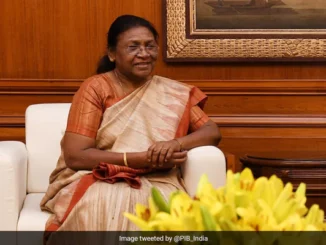
    It is almost a foregone conclusion that Draupadi Murmu will be the next President of India. She belongs to the Scheduled Tribes and hails from the Santhal community in the district of Mayurbhanj in Odisha. When elected, she will be the first tribal woman to be the President of India. It is indeed a triumph for the community, and she deserves all the accolades that come her way. However, one cannot help but be dismayed by the blatant politics the BJP has employed to elect their favored candidate. BJP clearly lacked the necessary votes to elect someone outright. It is believed that they might be short of 2% votes to get their candidate over the hump. In the meantime, the divided opposition parties tried to line up behind a single candidate. A united opposition might have thwarted the BJP’s desire not to have a consensus candidate. However, with the selection of Murmu, the BJP appeared to have outplayed the opposition.

    The selection of a Tribal candidate has just disarmed the opposition and has placed them in a precarious position, where any criticism could be construed as anti-tribal, anti-woman, or even anti-poor. Biju Janata Dal (BJD)  has declared their early support stating that Murmu belongs to Odisha while expressing their pride and joy on the nomination. The selection has forced the Jharkhand Mukti Morcha (JMM) Hemant Soren to announce support for Draupadi Murmu, calling it a proud moment for tribals. Even Mamata Banerjee’s commitment to the opposition unity in this regard may be in doubt. As the opposition is in disarray and the support for Yashwant Sinha is fast vanishing,  the die is cast that she will emerge victorious on the voting day. Apart from all the political maneuvering, one needs to look at the story of the Adivasis and make one’s own conclusions whether this nomination by BJP is part of a genuine effort to recognize the aspirations of a backward community or simply a charade slyly weaponizing its diversity, equity, and inclusion program. The upper caste politics have long realized that they can no longer control the people under ‘Chaturvarnya,’ the caste system. Today’s Hindutva agenda includes carefully crafted strategies to attract Scheduled Castes and Scheduled Tribes into their fold.

    Sri Aurobindo’s lights on the system of Indian culture compiled the following, “There are, first and highest, the man of learning and thought and knowledge; next, the man of power and action, ruler, warrior, leader, administrator; third in the scale, the economic man, producer and wealth-getter, the merchant, artisan, cultivator: these were the twice-born, who received the initiation, Brahmin, Kshatriya, Vaishya. Last came the more undeveloped human type, not yet fit for these steps of the scale, unintellectual, without force, incapable of creation or intelligent production, the man fit only for unskilled labor and menial service, the Shudra.” The BJP certainly realizes that they need the votes of the last category to attain and keep them in power. That begs the question of whether the RSS-BJP’s effort is simply vote-bank politics or points to a genuine transformation from their original feudalistic-caste designs. Their record speaks an entirely different story. BJP’s idea of “sabka Saath, sabka vikas” runs entirely contrary to the tribal interests and their wellbeing as they are repeatedly told they must sacrifice their lands and resources for other people’s vikas. Media reports state that under the BJP rule in Chhattisgarh, 2003-18, villages were burnt, and thousands were killed in Salwa Judum and subsequent operations. The forest act of 2006 has been further diluted by the Modi regime, making the Scheduled tribe consent the last requirement for forest diversion to industry rather than the first.

    For  long the Modi Government has wanted to diminish these rights in favor of corporates or other vested interests. In May 2016, the BJP Government passed two legislations that enabled the transfer of tribal land to commercial interests. That legislation set in motion a struggle (Pathalgadi movement) between the tribal people and the government, resulting in a brutal crackdown by the authorities. Moreover, the movement was branded as anti-national, and hundreds of people were arrested and charged under the sedition laws. The government went a step further and linked the movement to ‘Maoists,’ which is labeled as anti-national and dedicated to the overthrow of the elected governments.

    At this point, it is worth remembering the late Fr. Stan Swamy, who has been a vocal critic of the government policies and defender of the tribal rights over these lands. Sadly, he died in prison awaiting trial, being charged with plotting the government’s violent overthrow. To bolster their case, NIA, in their charge sheet, accused Fr. Stan as responsible for the violence in Bhima Koregaon in Maharashtra in 2017. He was not present at the rally celebrating British and Dalit forces’ victory over Brahmin Peshwas. Bhima Koregaon was an incident where Dalits were taught another lesson for daring such a celebration.

    Historically, the BJP/RSS strategy resisted real enlightenment for the oppressed people. The feudalistic and casteist mindset under which they operate detests any individual or group that educates and inspires people from those impoverished conditions of their rights and privileges. Their anti-conversion campaign is often seen as camouflage to prevent the Tribal population from ever learning of their true worth as human beings but condemning them forever in a subservient role to the upper echelons of society. What Fr. Stan has done was to help this vulnerable population demand equal justice and freedom from servitude.

    The RSS also refuses to recognize the Adivasi religion as distinct and deserving of the nation’s respect. Those who have been converted to Christianity often suffer attacks on their worship places. What happened to Fr. Stan Swamy is a harsh reality in today’s India and a lesson to anyone who dares to defend the rights of the Adivasis. Some would argue that RSS fronts like Vanavasi Kalyan and Vidya Bharati run schools filling a critical need. But in the process, the Adivasi children are converted into Hindutva followers and foot soldiers against Muslims and Christians, as in Gujarat in 2002 and Kandhamal, Odisha, in 2008, respectively. It has also been said that Adivasis in prisons are much higher than their percentage of the population.

    To her credit, as Governor of Jharkhand, Murmu returned bills proposed by the BJP government that aimed at changing the land tenure legislation – CNTA (Chhota Nagpur  Tenancy Act) and SPTA (Santhal Pargana Tenancy Act), which were intended to make it easier to take over the Adivasi land. However, under apparent pressure, she passed the anti-Adivasi changes in the Land Acquisition Act and the Freedom of Religion bill 2017, which criminalizes conversion. She appeared to be only a pawn in the BJP’s political game than a conscientious defender of the rights of her own people. Fr. Stan Swamy may not belong to the Adivasis; however, his legacy in defense of those impoverished and defenseless people will outshine forever any tokenism employed by the current regime.

    (The author is a former Chief Technology Officer, the  United Nations, and is Vice Chairman of the Indian Overseas Congress USA. He can be reached at gta777@gmail.com)