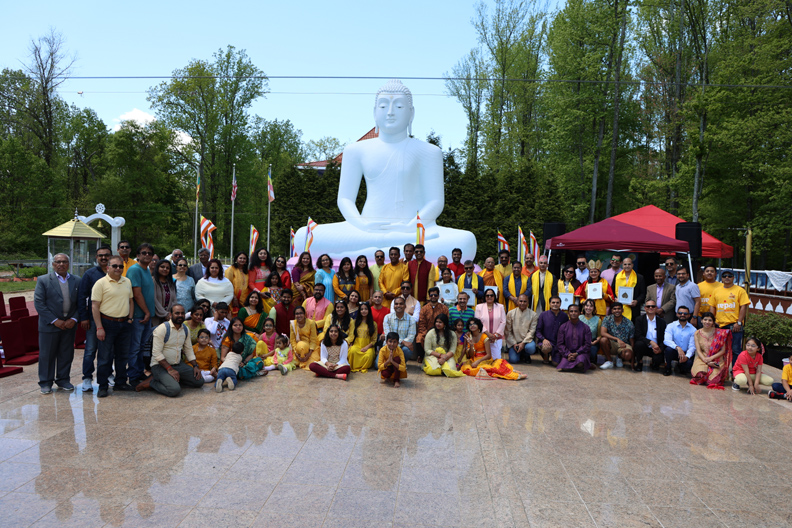
NEW JERSEY (TIP): Bihar Jharkhand Association of North America (BJANA), a 47-year-old organization in NJ, USA in partnership with the Indian consulate in New York, the east coast chapter of Bihar Foundation conducted successful celebrations of Buddha Jayanti on May 6th at the Buddha Vihar, Princeton, NJ.
Buddha Jayanti, one of the most important Buddhist holidays, commemorates the birth, enlightenment, and passing of Gautam Buddha. The event was attended by dignitaries from the consulates of India, Nepal, Vietnam, and Sri Lanka, as well as members of the Indian Diaspora from various Indian Community Organizations.
On this occasion, Bihar Chief Minister Sri Nitish Kumar mentioned in his message to BJANA communities in the USA, about the teachings and ideals of the Buddha, which will enlighten us and guide us on the right path.
Nitish Kumar has appreciated the efforts we are taking in preserving the glorious history, rich cultural heritage, language, and traditions of our region in the USA. He is also confident that this celebration will help us rise above all man-made divides and spread peace, happiness, and prosperity in both the country.
The event was attended by Indian Consul General Randhir Jaiswal, he extended his warmest greetings and best wishes to all the Buddhism followers who celebrate Buddha Purnima. He congratulated BJANA and Bihar Foundation for leading the Indian community and people from Nepal, Srilanka, and Vietnam to celebrate the Buddha Jayanti together. He emphasized that the teachings of Buddha continue to inspire and guide us toward a path of peace and harmony.
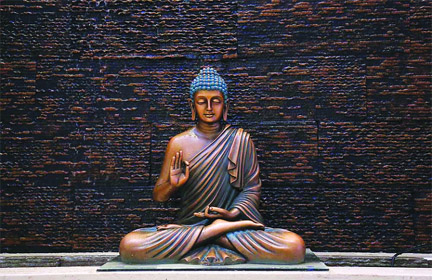
The event was attended by the Consul General of Nepal Bishnu Prasad Gautam and the Consul General of Vietnam Dinh Phuong Mai, they addressed the attendees about Buddha’s enlightenment and the teachings that can bring happiness and peace in life. BJANA president Anurag Kumar welcomed the attendees and thanked everyone for being part of this celebration. The event started with the parikrama of the Lord Buddha statue and a performance by kids in the form of dance and Buddha’s teachings.
On behalf of FIA, Executive Vice President of FIA Dr. Avinash Gupta and FIA Trustee Srujal Parikh congratulated and thanked BJANA, Indian Consulate & Bihar Foundation for organizing Buddha Divas at the grand location of Buddha Vihar and getting all communities together. Alok Kumar, chairman of the Bihar Foundation East Coast Chapter in his message emphasized the importance of teachings from the life of Buddha and focused on inner peace, kindness, and compassion.
Sanjeev Singh, vice president of BJANA, expressed his sincere gratitude to the executive team, volunteers, and members of the community who helped make this event a success. Additionally, Mr. Singh thanked Dr. S. Siddharth, the principal secretary to the chief minister of Bihar, and Kumar Ravi, the commissioner of Patna, for their invaluable assistance in making this event a success.
(Press release)
Also known as Buddha Jayanti or Vaisakhi Buddha Purnima or Vesak, the festival of Buddha Purnima is based on the Asian lunisolar calendar and marks the birth of Gautama Buddha. It is celebrated with great fervour in India, Sri Lanka, Nepal, Bhutan, Tibet and numerous other South East Asian countries including Thailand, Tibet, China, Korea, Laos, Vietnam, Mongolia, Cambodia and Indonesia.
he birthday of Gautam Buddha, the founder of Buddhism, is celebrated as Buddha Purnima across the world since he was born as Prince Siddhartha Gautama on the Purnima Tithi (full moon day) in 563 BC in Lumbini (modern day Nepal). In Hinduism, Buddha is considered as the ninth avatar of Lord Vishnu hence, this day is commemorated by Buddhists and Hindus all over the world.
In Theravada Buddhism, it is also observed as the day when Buddha, born as Prince Siddhartha Gautama (c. 563-483 BCE) attained Nirvana (salvation) under the Mahabodhi tree at Bodh Gaya, Bihar, as well as his death anniversary. Gautama Buddha preached Dharma (duty), non violence, harmony and kindness. He left his worldly possessions and princedom at the age of 30 to lead a life searching for the truth, seeking penance in the hopes of liberating himself from suffering (duhkha).
Devotees of Buddha visit temples, light candles and incense sticks, pray and offer sweets and fruits before the statue of Lord Buddha. Sermons on the life and teachings of Buddha are held and attended by followers all over. People usually dress in white, do not consume non-vegetarian food and distribute kheer, as according to Buddhist lore, on this day a woman named Sujata had offered Buddha a bowl of milk porridge.
Many followers also free caged birds on this day as a symbol of empathy and compassion for all living beings, one of the most important teachings of Lord Buddha. In India, a large fair takes place in Sarnath, Uttar Pradesh, a major Buddhist pilgrimage site where Buddha is said to have delivered his first sermon after attaining enlightenment.
Celebrations around the world
Japan
The festival in Japan is based on a different legend that says, a dragon appeared in the sky on Buddha’s birthday and poured soma over him, which is a Vedic ritual drink. In the modern arena, Japan celebrates Vesak by pouring amacha, a sweet tea on statues.
Nepal
Nepal is home to Lumbini-birthplace of Buddha, and Swayambhu-the holy temple for Buddhists also known as the Monkey Temple. The main door of Swayambhu is opened only on this day; hence, people from all over Kathmandu valley are stimulated by the event. Pilgrims across the world gather in thousands to celebrate Buddha’s birthday at his birthplace.
Sri Lanka
Sri Lanka celebrates Vesak for about one week! During this time, the selling of alcohol and fresh meat is prohibited with abattoirs also being closed. The celebrations here include giving of alms and erection of pandals wherein each pandal illustrates a story from the Jataka Tales. Food stalls are set up by Buddhist devotees that provide eatables and drinks to passersby. Also birds, insects and animals are released by the thousands in what is known as a ‘symbolic act of liberation’; of giving freedom to those who are in captivity, imprisoned, or tortured against their will.
Apart from these, other Asian countries like Korea, Vietnam, Malaysia, Indonesia, and Singapore also participate in processions and prayers by monks and make this day a true symbol of spirituality.
What Do People Do?
Many Buddhists visit temples on Vesak to listen to monks give talks and recite ancient verses. Devout Buddhists may spend all day in one or more temples. Some temples display a small statue of Buddha as a baby. The statue is placed in a basin filled with water and decorated with flowers. Visitors to the temple pour water over the statue. This symbolizes a pure and new beginning.
Many Buddhists pay special attention to Buddha’s teachings during Vesak. They may wear white robes and only eat vegetarian food on and around Vesak. Many people also give money, food or goods to organizations that help the poor, the elderly and those who are sick. Caged animals are bought and set free to display care for all living creatures, as preached by Buddha.
Government offices, post offices and banks are closed in India on Vesak. Stores and other businesses and organizations may be closed or have reduced opening hours. Transport is usually unaffected as many locals travel for religious celebrations.
Background
Gautama Buddha was a spiritual teacher in India. Many scholars are uncertain when he lived. It is believed that Buddha was born at some time between sixth and fourth centuries BCE. Opinions among scholars are generally divided between those who place Buddha’s death about 480 BCE and those who place it as much as a century later.
Buddha was an influential spiritual teacher during and after his lifetime. Many Buddhists see him as the Supreme Buddha. Festivals to honor Buddha were held for many centuries. The decision to celebrate Vesak as the Buddha’s birthday was formalized at the first conference of the World Fellowship of Buddhists. This conference was held in Colombo, Sri Lanka, in May, 1950. The date was fixed as the day of the full moon in May. Different Buddhist communities may celebrate Vesak on different dates in years when there are two full moons in May. This is because the Buddhist lunar calendar can be interpreted in different ways.
Symbols
The dharmacakra or dharma wheel is a symbol often seen during Vesak. It is a wooden wheel with eight spokes. The wheel represents Buddha’s teaching on the path to enlightenment. The eight spokes symbolize the noble eightfold path of Buddhism.
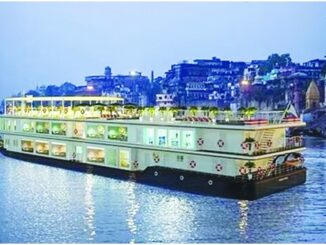
New Delhi (TIP)- Prime Minister Narendra Modi on Friday flagged off MV Ganga Vilas, the world’s longest river Cruise, and inaugurated Tent City in Varanasi via video conferencing. During the event, the prime minister also laid the foundation stones for several other inland waterways projects worth over ?1000 crores. Minister for Ports, Shipping and Waterways Sarbananda Sonowal, Uttar Pradesh chief minister Yogi Adityanath, Assam chief minister Himanta Biswa Sarma, Bihar deputy chief minister Tejashwi Yadav, besides other ministers and senior officials from various ministries and departments were present at the event. Speaking at the event, Prime Minister Narendra Modi said that the beginning of the world’s longest river cruise service on river Ganga is a landmark moment, asserting that the project will herald a new age of tourism in India.
All you need to know about Ganga Vilas cruise:
Operated by Antara Cruises, MV Ganga Vilas will traverse 3,200km through five states in India and parts of Bangladesh over 51 days. It will begin its journey from Varanasi in Uttar Pradesh and reach Dibrugarh in Assam via Bangladesh. The vessel with three decks is 62 metres wide and 12 metres in breadth.
Besides connecting National Waterway 1 (NW1) which includes Ganga and National Waterway 2 (NW2) on Brahmaputra, the cruise will cross 27 river systems.
It has 18 suites on board with a capacity of 36 tourists, with all the luxury amenities. The suites have soothing interiors, furnished with numerous amenities such as French balconies, LED TVs, safes, smoke detectors, and convertible beds, according to a UP tourism department official.
The cruise ship also has a 40-seater restaurant on the main deck, a spa, and a sun deck. The upper deck features a bar. The 51 days cruise is planned with visits to 50 tourist spots including World Heritage Sites, National Parks, River Ghats, and major cities like Patna in Bihar, Sahibganj in Jharkhand, Kolkata in West Bengal, Dhaka in Bangladesh and Guwahati in Assam.
Sonowal said the journey will give foreign tourists an opportunity to embark upon an experiential voyage and indulge in the art, culture, history, and spirituality of India and Bangladesh.
The maiden voyage has 32 tourists from Switzerland signing up for the entire length of the journey.
The cruise was to reach Varanasi on January 6 but weather conditions and poor visibility meant that it reached Ghazipur, 65km from Varanasi, on January 8.
The tourists were taken to the tomb of Lord Cornwallis in Ghazipur, the Ganga Aarti at the Dashashwamedh Ghat, and the newly renovated Kashi Vishwanath corridor. Source: HT
India is on course to become the world’s most populous country. The ‘World Population Prospects 2022’ report says that India’s population is projected to be 1.429 billion next year, when China would have 1.426 billion people. By 2050, it is estimated that India will have 1.668 billion people, far ahead of China’s population, which will drop to 1.317 billion. The UN has credited India with bringing down the fertility rate slowly and smoothly, in stark contrast to China’s strict policies that have produced rapid results.
The report of the fifth round of the National Family Health Survey (NFHS-5), released in May this year, stated that India’s total fertility rate — the average number of children per woman — had ‘further declined from 2.2 to 2 at the national level’. One of the survey’s key findings was that there were only five states whose fertility rate was above the replacement level of 2.1 (the rate at which a population exactly replaces itself from one generation to the next) — Bihar, Meghalaya, Uttar Pradesh, Jharkhand and Manipur. Notably, these states are among the laggards in terms of per capita income. This makes it obvious that population growth adversely impacts economic prosperity. The fact that Jains, Sikhs and Buddhists have fertility rates well below the national average can be largely attributed to economic security among members of these communities. Overtaking China as the most populous nation will pose a new set of challenges for policymakers. The government’s welfare schemes will have to factor in the rising numbers and the availability of resources to ensure that all eligible beneficiaries are covered. Healthcare, housing and education sectors, in particular, will come under greater strain. India might have made significant strides in population control in recent years, but there is no room for complacency. The overall contraceptive prevalence rate has risen from 54 per cent to 67 per cent; the aim should be to improve it substantially through an intensive and extensive awareness programme about the use of modern methods of contraception. Once population growth reaches an unmanageable level, socio-economic development will be derailed. India can’t afford to let that happen.
While regional parties will continue to be significant in various States of the Union, the principal challenge of overcoming majoritarianism lies in the Hindi heartland, especially in U.P. Oppositional electoral alliances, notably the formation of a federal front, are important strategies in this battle but it is no less important to challenge the ideological foundations of the majoritarian project through progressive and inclusive politics.
The landslide victory of the All India Trinamool Congress in the West Bengal Assembly elections and the pushback of the Bharatiya Janata Party (BJP) in West Bengal, Tamil Nadu and Kerala have given rise to a pervasive belief that right-wing politics can be defeated by regional assertions. Undoubtedly, regional and cultural assertion in these States acted as an effective bulwark against the BJP’s expansionary plans in southern and eastern India. The regional-cultural tropes deployed by Mamata Banerjee, for example, worked so well that at one point, Home Minister and BJP leader Amit Shah was even forced to clarify that if the BJP is elected, someone from Bengal would be the Chief Minister. This underlines the effectiveness of regional culture and politics in trumping communal politics. However, this claim needs to be tempered by the realism that it cannot work in the Hindi heartland, which is dominated by caste and communal politics, and has so far not seen any serious ideological and political challenge to politics based on these identities.
Encompassing nine States whose official language is Hindi, namely Bihar, Chhattisgarh, Haryana, Himachal Pradesh, Jharkhand, Madhya Pradesh, Rajasthan, Uttar Pradesh (U.P.) and Uttarakhand, this region retains a central position in the electoral strategies of the BJP and its larger political imagination. The party’s stunning show in these States propelled it to power in the 2014 and 2019 parliamentary elections. Its continued political dominance in the heartland will neutralize its losses now as well as in future in States where it has been bested by regional players. I will focus here on U.P. to illustrate the limits of the regional assertion.
Dimensions in the heartland
The Hindi heartland is clearly different. There are at least four important dimensions of this difference. First is the absence of regional identity in States such as U.P. This is evident from the debate on States reorganization and the reorganization of Uttar Pradesh in the 1950s. The compulsions of nation-oriented identity emerged very clearly from the discussions in the States Reorganization Commission on suggestions for the division of U.P. for administrative convenience. U.P. leaders argued for a large and powerful State in the Gangetic valley as a guarantee of India’s unity.
In this sense, U.P. was considered the backbone of India and the centerpiece of political identity in modern India. Importantly, it was supposed to provide the chief bulwark against growing regionalization and fragmentation elsewhere. Instilling a sense of regional pride, an essential part of Congress strategy in southern and coastal India, was not followed in U.P. U.P. was seen as the political heartland in contrast to Punjab and Bengal for instance, which were splintered and incorporated into two different nation states. As is well known, the bases of this post-colonial identity varied from its location in the freedom struggle to staking claim as the cultural homeland of Hindi and Hinduism. In both cases, it was centered in the idiom of the nation-state and strong central authority.
Second, although U.P.’s cultural homogeneity remains a matter of disagreement, the idea of the heartland had great resonance among the political elite who opposed the demand for U.P.’s reorganization. The long-standing traditions of composite cultural identity and shared plural cultures began to yield place to a singular homogenized identity. The Hindi-Urdu divide, which mirrored the communal cleavage of U.P. society, played a crucial role in this process. Urdu was excluded as it was seen to symbolize Muslim cultural identity in independent India, while Hindi was boosted to promote the development of a Hindi-Hindu heritage for this region. The project of homogenization of Indian/U.P. culture as Hindu culture was quickened in later decades. Even though it would be hard to assume a direct link between Hindi dominance and communal politics of subsequent decades, it is nevertheless a fact that all political parties in the State used it as an ingredient of social and cultural differentiation and a means to consolidate political dominance.
Role of communal politics
Third, it is clear that communal politics and communal movements have played a key role in U.P.’s modern history which in turn have diluted other identities.
In some respects, this process gained momentum in the wake of Partition which cast its long shadow upon political institutions and culture in U.P. and to a great extent affected the perspectives of Hindus and Muslims alike. Hindu nationalism was marginalized within the Congress party but many of its ideas were accepted in framing party policies. The State leadership was instrumental in forging a conservative consensus in the State under Chief Minister G.B. Pant who steered the affairs of the state for eight years after Independence.
The intensification of communal politics took a new turn with the mass mobilization for the construction of a Ram temple at Ayodhya which was deftly used by the Hindu right to establish a major presence in U.P. and to facilitate the political reconstruction of U.P. through the promotion of a collective Hindu identity. The crusade for the appropriation of disputed shrines is central to the communalization of politics and short circuiting the more complex process of political expansion for the BJP.
Importantly, this has laid the groundwork for building permanent electoral majorities through the deployment of ascriptive symbols in U.P. which, given its huge size, helps it to establish a strong base in the Hindi heartland to offset the appeal of countervailing identities elsewhere in India.
Caste politics too
Finally, caste politics which was expected to counter Hindutva expansion has failed to do so; in fact, caste politics has become a building block for the BJP’s expansion. The party has reached out to Dalits, actively mobilizing them and other backward castes to assimilate them into the Hindutva meta-narrative. Instead of erasing caste from electoral politics, the BJP-Rastriya Swayamsevak Sangh has sought to court fragments of castes as a way of undermining broad-based political movements and opposition to it. It has used the wider appeal of Hindu nationalism to co-opt backward castes and Dalits who are keen to align themselves to the larger narrative of Hindu nationalism.
A reset is needed
While regional parties will continue to be significant in various States of the Union, the principal challenge of overcoming majoritarianism lies in the Hindi heartland, especially in U.P. Oppositional electoral alliances, notably the formation of a federal front, are important strategies in this battle but it is no less important to challenge the ideological foundations of the majoritarian project through progressive and inclusive politics. This requires a reset of the basic political mindset in U.P. which can only be done by reviving the splendid heritage of the national movement in which this region played a central role and in which Gandhiji and Nehru played a heroic part. Invoking the spirit of the Bhakti movement which was the first major challenge to the religious orthodoxy of Hinduism would also help in resetting the cultural clock. This must, however, combine with much greater concern for the fundamental social and economic issues of the State, and making the struggle between communal and secular forces the central issue through public campaigns that address the problems of religious traditionalism and the cultural underpinning that this provides to the push to make India a Hindu state.
(Zoya Hasan is Professor Emerita, Jawaharlal Nehru University)
“The new legislation has been deliberately brought up to further communalize the situation and also financially ruin the poor Muslims. And the government is not even attempting a sham of making suggestions to counter the perception that its actions are weakening the morale of minorities”, says the author.
Union Home Minister Rajnath Singh, speaking of the achievements of the three years of the Modi government, proudly proclaimed: “We have by and large provided security to the country. India is the second largest country in the world as far as the Muslim population is concerned, and I can say with full responsibility that despite such a large population (of Muslims), the IS has not been able to set foot.”
Frankly, it is not clear whether he meant it to be a compliment for the patriotism and nationalism of Indian Muslims or he was only praising his security agencies – that notwithstanding such a large population of Muslims, his intelligence agencies have been able to control it. I hope it was not the latter, because it would be uncalled for and unjustly maligning the Muslim community.
Rajnath Singh should openly say that the patriotism and nationalism of Indian Muslims is no less than any other community, including Hindus. And that anyone even remotely suggesting otherwise is talking treason, as some of the sickening communal Hindu bodies are doing.
Muslims do not have to carry their patriotism on the sleeve; to suggest that would be calumny. In fact, notwithstanding the provocation from RSS fanatics, the equanimity shown by Muslims is praiseworthy. If the Home Minister is really keen to keep peace in the country, he needs to persuade Modi to immediately withdraw the deliberately provocative animal slaughter legislation, which is being opposed by many states apart from being challenged in high courts.
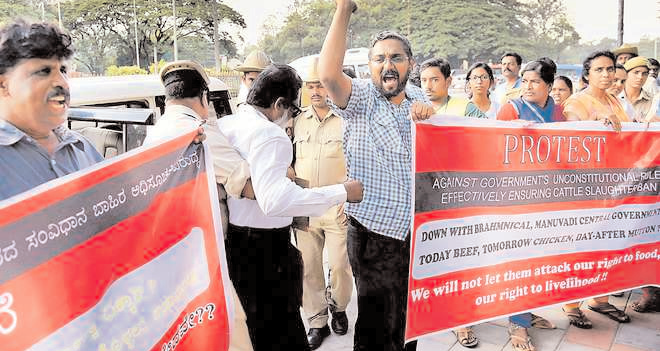
The legislation purporting to be for the prevention of cruelty to animals is a ploy to snatch jurisdiction by the Centre on the subject of cattle trade, which is squarely the purview of the states. Even the BJP accepts this, as is clear from the Arunachal Pradesh state party president openly announcing that the Centre’s ban on the sale of cattle for slaughter could not be binding on the states. The entire North-East is on the boil on this matter. Minister of Environment Harsh Vardhan says diplomatically that the government is open to suggestions. This sounds hollow given that half the states are opposed to this legislation, which in reality is an attempt at pleasing the “gau rakshak” gang and to allow them to spread terror. This legislation has been deliberately brought up by the BJP to further communalize the situation and also financially ruin the poor Muslims who earn their livelihood through cattle sales.
The atmosphere was earlier vitiated by RSS Nagpur bosses installing Yogi Adityanath as Chief Minister of UP, who has already spread fear among Muslims in the state by praying at the makeshift Ram Temple near the Babri Masjid demolition site. This is blatant communalization of the situation in India, which is the strategy of the BJP for 2019 elections.
Prime Minister Narendra Modi needs to be reminded of how he addressed cow vigilantes in August 2016 saying: “It makes me angry that people are running shops in the name of cow protection…. Some people indulge in antisocial activities at night and in the day masquerade as cow protectors.”
The Modi government is not even attempting a sham of making suggestions to counter the perception that its actions are weakening the morale of minorities. In that regard, the way Modi has handled the naming of National Commission for Minorities members shows he only wants to retain the shell of it. The present members were appointed after the positions remained vacant for months. Of the five persons appointed, only one is a Muslim (Chairperson) and the remaining are one each from other minorities.
This too was done after a high court asked the government for a response to a writ petition. According to the 2011 Census, the Hindu population is 79.8 per cent and Muslim 14.2 per cent. The rest 6 per cent is constituted of Christians (2.3%), Sikhs (1.7%), Buddhists (0.7%), Jains (0.4%), and Parsis. It can’t be denied that the object of the minorities panel is to create a mechanism that would give them confidence. To make the minorities feel that they have an equal stake in the running of the State and are equal beneficiaries of its programs. It is hoped that the two more members yet to be appointed would be Muslims, either well-recognized academicians or public figures from the community, to give some reassurance to the community.
The report of the UN Human Rights Council Forum on Minority Issues, 2010, had made some significant recommendations on minorities and their effective participation in economic life, which each country is mandated to follow: “…the right of minorities to participate effectively in economic life must be fully taken into account by governments seeking to promote equality at every level. From implementing non-discrimination in employment and enforcing protection laws in the private sector to developing national economic development and international development assistance schemes.”
It is unfortunate that the Opposition has not come up with a concrete/specific program on which it intends to fight the 2019 election. In fact, the Opposition has been reduced to a debating/TV phenomenon. It has no specific program for action. The way the Congress and other political parties are letting wither away the opportunity that arose from the Dalit assertion in Saharanpur speaks ill of their commitment.
There is already a competition between the Chief Minister of UP and Prime Minister Modi as to who would be a greater favorite of the Sangh Parivar after the 2019 parliamentary elections, assuming the BJP wins the majority.
Yogi Adityanath has given encouragement to the cow vigilante brigade, as indicated in the UP Director-General of Police issuing instructions to all police officers that those involved in cow slaughter or smuggling should be booked under the National Security Act – a legislation designed to handle terrorists. Has the BJP lost all sense of balance and proportion?
(The author is a retired Chief Justice of the Delhi High Court)
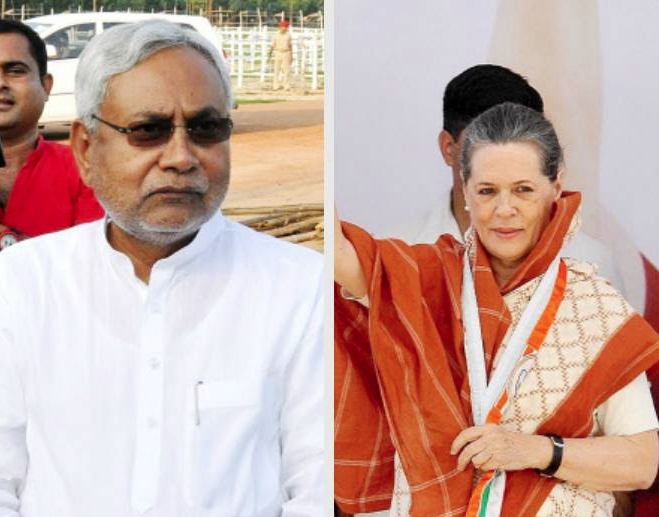
NEW DELHI (TIP): Bihar Chief Minister and Janata Dal (United) president Nitish Kumar met Congress president Sonia Gandhi, setting off speculation on the possibility of a united Opposition fielding a joint candidate for the upcoming Presidential election.
Nitish spent about half an hour with Sonia. It was after a long time that the AICC president met a senior leader after she took ill in August last year. The CPM has already indicated its willingness to back a common nominee against a BJP candidate. Indications are that the Opposition parties may agree on fielding former JD (U) chief Sharad Yadav, a Rajya Sabha MP.
Within the Congress there is an understanding that non-NDA outfits must come together to throw a challenge to the BJP. If the Trinamool Congress (TMC) and Left parties are to come together, the nominee has to be acceptable to both, and Yadav fits the bill, claim sources. “It’s still early. Let us see what happens,” said a Congress source, sounding cautious.
Signup to our Newsletter!
Don’t miss out on all the happenings around the world