Tag: Bilkis Bano

  • Bilkis Bano case : Supreme Court rightly cancels remission of convicts

    Righting a horrible wrong, the Supreme Court has quashed the Gujarat government’s decision to grant remission to 11 convicts in the Bilkis Bano case. A pregnant Bilkis was gangraped and seven of her family members were murdered during the 2002 riots in the state. Sentenced to life imprisonment for committing these heinous crimes, the convicts had been released, ironically, on Independence Day in 2022. The state government had gone by the 1992 remission policy, which was in force when the conviction took place in 2008, and not the 2014 policy, which forbids the release of rape-murder convicts.

    According to the court, the rule of law was breached as the state government usurped power not vested in it. Calling this an instance of abuse of power, the SC said it was the government of Maharashtra, where the trial and sentencing took place, that was competent to take a decision on the remission plea of the convicts. The ruling is a major embarrassment not only for the Gujarat government but also the Centre. In October 2022, the state government had told the apex court that it had decided to release the convicts primarily due to three reasons: they had completed 14 years or more in prison; their conduct was found to be good; and the Centre had conveyed its ‘concurrence/approval’ regarding their premature release. They had been freed despite the CBI’s contention that the offences committed were ‘heinous, grave and serious’ and hence ‘no leniency may be given’ to them.

    Adding insult to injury, the convicts had been greeted with garlands after they walked out of the Godhra sub-jail. The court verdict is a stern reminder to the state and Central governments that they can’t make a mockery of law and justice and get away with it.

    (Tribune, India)

  • Opposition unity remains a bridge too far

    Opposition unity remains a bridge too far

    Sisodia’s arrest has profound national implications for the direction the Opposition will eventually pursue. After tarring the TMC and AAP with the corruption taint, it is inconceivable that the Congress could include the Opposition in its anti-corruption blitzkrieg. That’s expecting too much. The core of its 2024 blueprint has only one strategy, and that is to position Rahul as Modi’s sole adversary.

    “Refusing to reconcile with the reality that its pre-eminence as the Grand Old Party might be dated by now, Congress president Mallikarjun Kharge qualified his imploration to the Opposition with the caveat that the exercise would follow the UPA template with the Congress heading the coalition because it was the only party that had never done business with the BJP. It’s a fact few would dispute, but should the Congress grandstand at every opportunity on its ‘unsullied’ ideological ‘credentials’? Can parties such as the SP be labelled as BJP’s accomplices even as the subject of whether their campaigns against Hindutva were sufficiently robust should be debated? Has the Congress scored over other non-BJP entities on this marker? If the Congress’s pro-secular, pro-minority credentials were impeccable, why did Thiruvananthapuram MP Shashi Tharoor intervene at the AICC plenary to emphasize that his party could have been ‘more vocal’ on the release of Bilkis Bano’s rapists in Gujarat, the attacks on churches, lynchings in the name of cow vigilantism and the bulldozing of Muslim homes.”

    By Radhika Ramaseshan

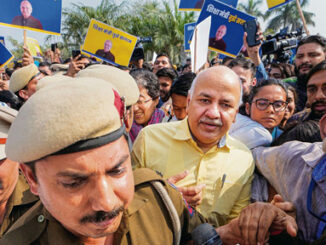
    The ruling BJP could be sanguine in the belief that the country’s attention has been deflected from the Hindenburg-Adani row by the arrest of Delhi minister and Aam Aadmi Party’s backbone Manish Sisodia.

    The development has profound national implications for the direction the Opposition will eventually pursue. The early indications augur well for the BJP because the arrest has reopened the fault lines running through the Congress and the regional parties, some of which it is counting on as its allies in the prelude to the 2024 General Election.

    Delhi offers only seven parliamentary states. It is a quasi-state that is partially governed by the Centre, which has increasingly shrunk the space for the exercise of powers by the Arvind Kejriwal government after the BJP lost the 2015 and 2020 Assembly polls to the AAP.

    Delhi is significant for the BJP because the seeds of the downfall of the Congress-helmed United Progressive Alliance (UPA) government were sown in the national capital in a long-drawn-out protest against the UPA’s ‘corruption’ and ‘misrule’; Kejriwal was then closely associated with the anti-corruption movement piloted by Anna Hazare. The India Against Corruption stir became a launch pad for Kejriwal’s political career, which was carefully camouflaged by his ‘activism’ with a moral underpinning. The Congress was the principal casualty of the protests and the BJP the eventual gainer.

    The arrest of Sisodia, a founding member of the AAP, provoked strong reactions from regional forces, but invited the Congress’s endorsement. KT Rama Rao, working president of the Bharat Rashtra Samithi (BRS), accused the BJP of “resorting to stealth politics by inciting Central agencies against Opposition parties in states where it can’t come to power (on its own).” For the BJP, BRS-ruled Telangana is analogous to Delhi. The party’s exertions have not fructified into tangible political gains. At best, the BJP can hope to unseat the Congress as the main Opposition party in Telangana, unless the ground situation dramatically changes. Samajwadi Party (SP) chief Akhilesh Yadav lauded Sisodia’s record in making quality education accessible to Delhi’s underprivileged children and remarked, “The BJP proved that it is not only against education, but also against the future of Delhi’s children.”

    The approval by the Congress’s Delhi unit stood out all the more against the backdrop of the party’s call for forging ‘Opposition unity’ before the next Lok Sabha battle at its just-concluded plenary in Raipur. Refusing to reconcile with the reality that its pre-eminence as the Grand Old Party might be dated by now, Congress president Mallikarjun Kharge qualified his imploration to the Opposition with the caveat that the exercise would follow the UPA template with the Congress heading the coalition because it was the only party that had never done business with the BJP. It’s a fact few would dispute, but should the Congress grandstand at every opportunity on its ‘unsullied’ ideological ‘credentials’? Can parties such as the SP be labelled as BJP’s accomplices even as the subject of whether their campaigns against Hindutva were sufficiently robust should be debated? Has the Congress scored over other non-BJP entities on this marker? If the Congress’s pro-secular, pro-minority credentials were impeccable, why did Thiruvananthapuram MP Shashi Tharoor intervene at the AICC plenary to emphasize that his party could have been ‘more vocal’ on the release of Bilkis Bano’s rapists in Gujarat, the attacks on churches, lynchings in the name of cow vigilantism and the bulldozing of Muslim homes? “If we don’t speak out in such cases, we are only surrendering our core responsibility of standing up for India’s diversity and pluralism, which should be central to the Congress’s core message,” Tharoor had stated.

    More evidence followed to demonstrate that the Congress was unwilling to cede the leadership position to a leader from a prospective ally. Addressing a meeting in Shillong, Rahul Gandhi aggressively engaged with the Trinamool Congress (which fought the Meghalaya elections solo) and listed the violence in West Bengal, the Saradha scam and the alleged profligacy exhibited by the TMC in the Goa elections as proof of its ‘tradition’ and its propensity to ‘help’ the BJP and defeat the Congress. Meghalaya’s last Congress Chief Minister Mukul Sangma had crossed over to the TMC with a dozen legislators. At the same time, at a rally in Nagaland, Kharge made it amply clear that the Congress would lead the Opposition alliance that will come to power at the Centre in 2024. “The Congress will lead. We are talking with other parties. Because otherwise, democracy and the Constitution will go,” claimed the Congress president.

    Secularism apart, it is apparent that the Congress has acquired a sense of proprietorship over the public articulation and projection of corruption, exemplified in the Centre’s alleged patronage to Adani and its silence on the questions raised by Rahul in Parliament. In his speech at the Raipur session, Rahul compared the Adani conglomerate with the East India Company and said, “History is being repeated.” “The Independence struggle was against the East India Company. That was also a company, the company that took away India’s wealth, infrastructure, ports….” he stressed.

    After tarring the TMC and AAP with the corruption taint, it is inconceivable that the Congress could include the Opposition in its anti-corruption blitzkrieg. That’s expecting too much. The core of its 2024 blueprint has only one strategy, and that is to position Rahul as Narendra Modi’s sole adversary.

    (The author is a senior journalist)


  • Remission to the convicts in the Bilkis Bano Gangrape case must be reviewed

    The political battle over the decision of the state government in poll-bound Gujarat to prematurely release the 11 convicts in the 2002 Bilkis Bano gangrape case has intensified, with the Congress questioning the kind of message that was being sought to be conveyed to the women of the country in disregard of the Prime Minister’s own commitment to the cause. Other parties like the TRS have asked for amendments to the IPC and CrPC to prevent those charged with rape from getting remission. Though the power of remission is subject to judicial review and the victim can approach the High Court or the Supreme Court, the process is fraught with concerns for the victim’s safety because of fear of reprisal.

    The Gujarat Government has held that a jail advisory committee was formed to look into the early release of the convicts following an appeal in the Supreme Court by one of the accused under the state’s remission policy, which was in effect when they were pronounced guilty in the case. The 11 convicts who were welcomed with garlands and sweets after they walked free, were sentenced to life not just for the gangrape of Bilkis Bano but also for the murder of 14 members of her family, including her three-year-old child. This case exemplified the rapes and murders that terrorized and brutalized the Muslims of Gujarat in 2002. And the conviction provided closure to the community and restoration of faith in the justice system. The remission has dealt a severe blow to all that.

    The legal system has to assure justice to the victims and ensure faith in the due process of law. The overall aim should be to make sure that the punishment is just and proves to be a deterrent against repetition of crime. Gujarat witnessed some of the worst communal trouble that scarred not only the state, but also the psyche of the nation. It is the responsibility of the state to ensure that harmony prevails. Remission to the convicts in the Bilkis Bano case must be reviewed.

    (Tribune, India )

  • Outrage over Remission for accused in Bilkis Bano gangrape case

    Outrage over Remission for accused in Bilkis Bano gangrape case

    NEW DELHI (TIP): It was as recently as in April that the court had said that the State cannot exercise its remission powers arbitrarily. The Supreme Court has enough ammunition in the form of past judgments to examine the Gujarat Government’s premature release of 11 convicts who were sentenced to life imprisonment for the 2002 Bilkis Bano gangrape case. For one, on April 23, 2019, the court, while awarding her ₹50 lakh in compensation, described how the “brutal, diabolic, gruesome, horrific acts of violence” committed on her has left an “indelible imprint on her mind which will continue to torment and cripple her”.

    The apex court had noted that the then 21-year-old and pregnant Ms. Bilkis was “repeatedly gangraped”. She was a “mute and helpless witness to her three-and-a-half-year-old daughter butchered to death”. She had lost all the members of her family while fleeing the mayhem and violence of the 2002 riots. The court said she had lived the life of a nomad, an orphan.

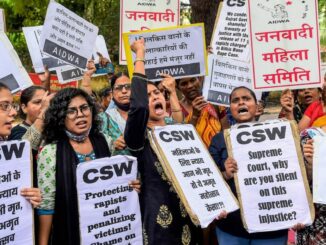
    The State government’s decision to remit the sentence of the 11 convicts has raised a furious public outcry. Civil rights groups have urged the Supreme Court to revoke the remission. Ms. Bilkis’s family has told the media that they are scared of what may happen to them in the future. The fact that the crimes were committed on Ms. Bilkis in the background of violence which affected the entire State; the apprehensions voiced by her family following the release of the convicts, and the warm welcome reported to have been accorded to the 11 men when they came out of jail, make the Laxman Naskar judgment relevant in this case.

    The Supreme Court, if it takes up the issue of remission in the Bilkis case, should also examine whether the State had been guided by the opinion of the presiding officer of the sentencing court on the remission applications.

    In Union of India Vs. Sriharan @ Murugan , the apex court said the presiding judge’s opinion would shed light on factors like the nature of the crime that was committed, the record of the convicts, their backgrounds and other relevant factors, which would enable the government to take the “right” decision as to whether or not the sentence should be remitted. After all, as the Supreme Court observed in Nandini Sundar Vs. Chhattisgarh, it is the “responsibility of the States to prevent untoward incidents and to prevent crime”. In its 2018 decision in the Tehseen Poonawalla case on mob violence and lynching, the court considered the “targeted violence and commission of offences affecting the human body and against private and public property by mobs under the garb of self-assumed and self-appointed protectors of law”. Here, the court noted that “horrendous acts of mobocracy” should not become the “new normal”. The apex court had warned the State against turning “a deaf ear to the growing rumblings of its people”.