Tag: Bill Gates

  • India Day celebrated at Gates Foundation on the occasion of Gandhi Jayanti

    India Day celebrated at Gates Foundation on the occasion of Gandhi Jayanti

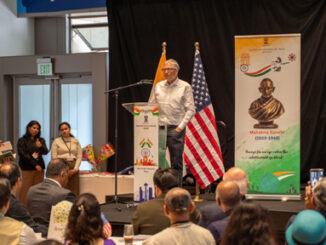
    SEATTLE, WA (TIP): In partnership with Gates Foundation, Consulate General of India in Seattle hosted a special celebration showcasing Indian culture, arts and cuisine at the Gates Foundation today (October 2). The event was graced by Mr. Bill Gates, Chair and Board Member of Gates Foundation, along with senior leadership of Washington State and Seattle City government.

    Mr. Bill Gates, Chair and Board Member of Gates Foundation, being presented a special publication on Gandhi ji by Mr. Prakash Gupta, Consul General of India in Seattle, at Gandhi Jayanti celebrations , October 2, 2025.

    Addressing the gathering, Mr. Bill Gates said “It’s fitting that we’re coming together on the birthday of Mahatma Gandhi. The ideals he championed, the equality and dignity of every person, are foundational to the work we do. Today, India stands as a global leader in innovation and is pioneering solutions with the potential to save and improve millions of lives across the Global South. We look forward to continuing to partner with India on its journey toward Viksit Bharat 2047.”

    “Natyam – A Dance Mosaic of Bharat” – a specially curated dance performance on various states of India being performed at Gandhi Jayanti celebrations

    The event also coincided with the Gandhi Jayanti and International Day of Non-Violence celebrations in the Greater Seattle area and also featured a special address on the ‘Relevance of Gandhian Values in Contemporary World Order’ by Mr. Jonathan Granoff, President of the Global Security Institute.

    Dignitaries at Gandhi Jayanti celebrations

    Earlier in the day, a commemorative event was also held at the Statue of Mahatma Gandhi near the Bellevue Public Library, where Bellevue City Council leadership joined in honoring the legacy of the Mahatma. In addition, another commemorative function was hosted in the afternoon at the Seattle Center (near the base of Space Needle) and floral tributes were offered at the bust of Mahatma Gandhi by Washington State Senator Vandana Slatter in the presence of Eddie Rye, Chairman and Founder of the Martin Luther King (MLK) – Gandhi Foundation. A large cross-section of Indian-American leadership attended these events in Seattle and Bellevue respectively, which also featured a special rendition of Gandhi Ji’s favorite hymns by young school children.

    Commemoration of Gandhi Jayanti at Seattle Center next to Space Needle on October 2,2025.
  • Seattle witnesses an impressive India Day Parade with the enthusiastic participation of a large Indian American community

    Seattle witnesses an impressive India Day Parade with the enthusiastic participation of a large Indian American community

    Mr. Bill Gates addresses the gathering

    SEATTLE, WA (TIP): Mr. Bill Gates, Chairman, Gates Foundation flagged off the FIRST India Day celebrations in the Greater Seattle area as Consulate General of India in Seattle’s Guest of Honor, on the 78th Independence Day of India.

    Addressing the nearly 2000 plus members of the Indian American community, he referred to India “as a global leader with breakthrough innovations in areas like technology, agriculture and healthcare”. He further added that “from manufacturing safe low-cost vaccines to the remarkable leadership shown by the Indian diaspora to India’s Digital Public Infrastructure – India’s ingenuity is helping not just Indians, but the whole world. Countries across the Global South are leveraging India’s experience to build their DPI systems.”

    Consul General of India in Seattle Mr. Prakash Gupta hoists the Indian Flag on the occasion of the 78th Independence Day of India.

    Other distinguished participants at the Inday Day celebrations included Congresswoman Suzan DelBene, Congresswoman Kim Schrier, Congressman Adam Smith, Lt. General Xavier Brunson, Commander of the America’s First Corps in Pacific Northwest, Rear Admiral Mark Sucato, Commander of the Navy Region of Northwest, Washington Lieutenant Governor Denny Heck and Washington Secretary of State Steve Hobbs and Chief Justice from Washington Supreme Court Steve Gonzalez. From city leadership, Mayors of cities of Bellevue, Tacoma, Kent, Auburn, Renton, SeaTac, Snoqualmie and Mercer Island also joined in the India Day celebrations.

    Mr. Bill Gates and other guests with the CG Mr. Gupta.

    The event showcased for the first time in Greater Seattle area ALL states and regions of India through floats and cultural performances celebrating the theme of Unity in Diversity.

    A float depicting Kashmir.

    Each of the floats were put together by prominent leaders of the Indian American community and reflected some of the important aspects of India’s rich cultural heritage.

    In another special gesture, five separate official proclamations were issued by governments/city councils of King County, Bellevue City (Washington), Portland (Oregon), Hillsboro (Oregon), Tigard (Oregon) to honor the India Day celebrations. H.E Mark Gordon, Governor of Wyoming also sent a separate congratulatory message on India’s 78th Independence Day. Some iconic buildings in Seattle and Bellevue also lit up in tricolors to mark the India Day celebrations.

    A marching group in the parade.

    Performances.

    Viewers (All photos: Jay Mandal- on assignment)
  • In chat with Bill Gates, PM Modi’s ‘dos and don’ts’ on AI-generated deepfake content

    In chat with Bill Gates, PM Modi’s ‘dos and don’ts’ on AI-generated deepfake content

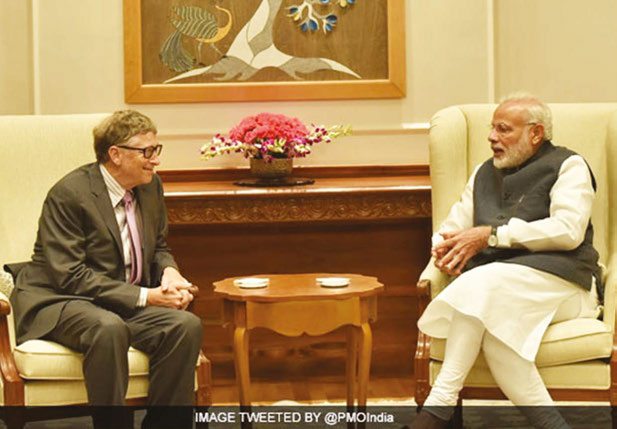
    New Delhi (TIP)- Prime Minister Narendra Modi has underscored India’s cautious approach towards embracing Artificial Intelligence while acknowledging the pressing need for regulations to mitigate potential misuse. In a conversation with Microsoft founder Bill Gates, PM Modi stressed the importance of providing proper training before granting access to AI technologies.
    “If such a good thing (AI) is given to someone without proper training, it is likely to be misused. I suggested that we should start with clear watermarks on AI-generated content. So that nobody is misguided,” Modi said. “In a democratic country like India, anybody can use deepfake. It’s crucial to acknowledge that deepfake content is AI-generated. We need to think about some dos and don’ts,” he added.
    PM Modi also called for establishing clear guidelines and distinguishing authentic content from deepfake creations. “For example, they may misuse my voice. It can initially deceive people, leading to widespread chaos. It’s crucial to acknowledge that deepfake content is AI-generated and mention its source,” PM Modi said while addressing the issue of deepfake.
    Deepfake is a video of a person in which their face or body has been digitally altered so that they appear to be someone else, typically used maliciously or to spread false information.
    The prime minister issued a poignant warning against the reckless deployment of AI, cautioning against viewing it merely as a “magic tool” that could lead to grave injustices if wielded without due diligence.
    “If we use AI as a magic tool, it will perhaps lead to a grave injustice. If AI is relied on out of laziness…then it is the wrong path,” Modi said as he argued for competition between humans and AI chatbots like ChatGPT.
    Echoing Modi’s sentiments, Bill Gates provided insights into the dynamic nature of AI development, characterising the current stage as “early days” fraught with challenges and opportunities. Source: HT

  • From Ambani to Birla, meet top 10 richest billionaires of India

    From Ambani to Birla, meet top 10 richest billionaires of India

    We all know that wealth does not remain static and specially during the fluctuating industry scenario that we are facing due to the ongoing covid pandemic. But even in this tough situation where market continue to go up and down, India has produced several billionaires who occupy a significant number of slots on the list of wealthiest persons in the world today. And with just a few days left for the year 2021 to end, here is the list of the top 10 richest persons in India as per the Forbes.

    Mukesh Ambani

    With a net worth of $92.7 billion, according to Forbes, the Chairman of Reliance Industries tops the list, yet again. During the lockdown period, Ambani raised $20 billion, by selling one-third of the stake of Jio to investors like Google and Facebook. He has remained at the top place for more than 10 years now.

     Gautam Adani

    The infrastructure tycoon has a net worth of $74.8 billion. Apart from infra, he has business interests in power generation and transmission, edible oil and real estate as well. Interestingly, Adani owns a 74 per cent stake in Mumbai International Airport.

    Shiv Nadar

    With a net worth of $31 billion, the co-founder of HCL ranks third this year. He is a leading philanthropist and has donated more than $662 million to his Shiv Nadar Foundation. His daughter, Roshni Nadar Malhotra, is the current Chairman of HCL Technologies.

    Radhakishan Damani

    Damani has a net worth of $29.4 billion. He owns 214 DMart stores across the country. In 2017, he became India’s retail king after a successful IPO of his supermarket chain Avenue Supermart.

    Cyrus Poonawalla

    The founder of Serum Institute of India, Poonawalla has a net worth of $19 billion. SII is the world’s largest vaccine maker. During and after Covid-19’s second wave, the majority of Indians got vaccinated with Covishield, a product of SII.

    Lakshmi Mittal

    The Chairman of ArcelorMittal, the world’s largest steel and mining company, Mittal has a net worth of $18.8 billion. He has been frequently featured on the list of richest Indians. In January 2021, Mittal gave the CEO’s position to his son Aditya Mittal.

    Savitri Jindal

    The Richest Indian woman, Jindal has a net worth of $18 billion. She is the Chairperson of Jindal Group, founded by her late husband, Om Prakash Jindal. In 2005, after Jindal’s sudden death, the group got divided among their four sons.

    Uday Kotak

    Founder of Kotak Mahindra Bank, Uday Kotak has a net worth of $16.5 billion. The bank, which is now among the top four private banks in the country, was converted to a bank from a finance firm that Kotak founded in 1985. He was, initially, backed by Anand Mahindra for the bank.

    Pallonji Mistry

    Famous construction and engineering giant Shapoorji Pallonji Group is virtually controlled by Mistry. He has a net worth of $16.4 billion. Interestingly, SP Group also owns the water purifier brand, Eureka Forbes.

    Kumar Birla

    Head of Aditya Birla Group, Birla has a net worth of $15.8 billion. In India, he is also called the ‘Commodity King’. He inherited the empire after the death of his father, Aditya Birla, in 1995.

    Richest people on earth in 2021 : With a net worth of more than $296 billion as of November 27, 2021, Tesla CEO Elon Musk is the richest person in the world, followed by Amazon’s founder and former CEO Jeff Bezos. The businessman has a total net worth of approximately $201 billion.

    LVMH’s Chairman and CEO, Bernard Arnault, is the 3rd-richest person in the world, with approximately $164 billion in current real-time total net worth. Microsoft mogul Bill Gates ranked 4th with a personal wealth of $136 billion, followed by Larry Page with $127 billion.

    RANK    NAME   TOTAL NET WORTH         COUNTRY            INDUSTRY

    1              Elon Musk           $296 billion                          United States    Technology

    2              Jeff Bezos           $201 billion                          United States    Technology

    3              Bernard                $164 billion                          France                  Consumer

                    Arnault

    4              Bill Gates             $136 billion                          United States    Technology

    5              Larry Page           $127 billion                          United States    Technology

    6              Mark                     $124 billion                          United States    Technology

                    Zuckerberg

    7              Sergey Brin         $122 billion                          United States    Technology

    8              Steve Ballmer    $117 billion                          United States    Technology

    9              Larry Ellison        $112 billion                          United States    Technology

    10           Warren Buffett $103 billion                          United States    Diversified

    11           Mukesh               $91.1 billion                        India                      Energy

                    Ambani

    12           Francoise             $90.1 billion                        France                  Consumer

                    Meyers

    13           Gautam Adani   $78.1 billion                        India                      Industrial

    14           Zhong                   $75.1 billion                        China                     Diversified

                    Shanshan

    15           Amancio              $70.5 billion                        Spain                     Retail

                    Ortega

    16           Michael                $70 billion                            United States    Media & Telecom

                    Bloomberg

    17           Jim Walton          $65.0 billion                        United States    Retail

    18           Rob Walton        $64.5 billion                        United States    Retail

    19           Alice Walton       $63.1 billion                        United States    Retail

    20           Phil Knight           $62.9 billion                        United States    Consumer

  • Unprecedented congratulatory messages pour in for Modi from over 50 US leaders

    Unprecedented congratulatory messages pour in for Modi from over 50 US leaders

    WASHINGTON (TIP): In a testimony to the strength of India-US relations, unprecedented congratulatory messages have been received from over 50 US leaders in every domain, including the Administration, Congress, business, academia/think tanks on the historic electoral victory of India’s Prime Minister Narendra Modi.

    ADMINISTRATION

    President Donald Trump

    • Just spoke to Prime Minister @NarendraModiwhere I congratulated him on his big political victory. He is a great man and leader for the people of India -they are lucky to have him!

    Vice President Mike Pence

    • Congrats to an American ally & friend PM @narendramodi, on his party’s win in India’s parliamentary election. This was a strong display of the Indian people’s commitment to democracy! We look forward to continuing to work with India for a freer, safer, & more prosperous region.

    Secretary Mike Pompeo

    • Congratulations to @narendramodi and the NDA for their victory in India’s election, and to the Indian people for casting their votes in such historic numbers. As the world’s largest exercise in democracy, #India’s election is an inspiration around the world.

    Ivanka Trump, Advisor to the President

    • Congratulations @narendramodi on a great victory! Exciting times ahead for the wonderful people of India!

    Governor Phil Murphy (New Jersey)

    • Congrats to Prime Minister @narendramodi and the NDA on your historic election! New Jersey has a vibrant Indian American population and deep ties to the world’s largest democracy –we look forward to strengthening our relationship in the years ahead.

    Governor Greg Abbott (Texas)

    • Prime MinisterModi, Congratulations on your election win. I view it as a very important to the future of India. Texas looks forward to continuing to work with you as we advance the economies of India and Texas

    CONGRESS

    Senator Chris Coons (D-DE)

    • Congratulations to the new government and the people of India for concluding the world’s largest democratic election in which 600 million votes were cast for the country’s leadership.·I look forward to continuing my work to strengthen and deepen ties between the United States and India, two of the world’s great democracies, in the years ahead.

    Senator Mark Warner (D-VA)

    • As co-chair of the Senate India Caucus, I want to congratulate the Indian people on today’s historic election —the largest democratic election in history. I look forward to continuing our work with PM Modi’s administration to strengthen our important alliance with India.

    Senator Kevin Thomas

    • Congratulations to @narendramodi on his win in the Indian elections today. India and the U.S. share a great relationship and looking forward to continuing cooperation going forward.

    Senator John Cornyn

    • Congratulations @narendramodi on your historic victory. Looking forward to seeing you soon

    enator Dan Sullivan

    • I want to congratulate @PMOIndia@narendramodion achieving a commanding victory in his reelection bid today. Modi, a steadfast friend of America and free people everywhere, has clearly earned a strong and lasting confidence among the people of India.

    Congressman Ted Yoho (R-FL)

    • The world’s largest democracy and one of our strongest partners in the Indo-Pacific has chosen their leadership in free and fair elections. Congratulations to @BJP4India and @narenbramodi on your historic re-election.

    Congressman Jim Banks (R-IN)

    • Congratulations to @narendramodi and his party for their landslide victory in India’s election. The relationship between India and the United States has never been stronger!

    Congressman Tom Suozzi (D-NY)

    • Congratulations to @narendramodi on his re-election! The India-U.S. relationship is based upon shared values. This alliance will be very important overthe next 50 years & I am looking forward to continuing our work with PM Modi & Indian government to strengthen our alliance.

    Congressman Raja Krishnamoorthi

    • Congratulations to Prime Minister @narendramodi on his re-election —it was truly an inspiration to see so many Indians exercise their democratic rights, and I look forward to working with PM Modi and the Indian government to strengthen the US-India partnership.

    Congressman Steny Hoyer

    • Congratulations @NarendraModi on winning re-election this week. I look forward to strengthening the important U.S.-India partnership.

    Congressman Ami Bera

    • Great job to the people of #India on their historic election. Never before have so many voted in a single democratic election. Congratulations to PM Modi for his win and I look forward to working with his government to strengthen the ties between our two great nations.

    Congressman Ro Khanna

    • One lesson from Modi’s win is that dynastic, establishment candidates are weak. Democrats need to make sure that our candidate against Trump can connect with people’s frustration and offer a positive vision for change.

    Asm. Raj Mukherjee, Assembly Majority Whip, NJ Legislature

    • Congrats to @narendramodi on a decisive reelection and to the Indian people on the largest display of participation in democracy in the history of the world. Looking forward to furthering the strong bilateral ties between our two great democracies. @IndiainNewYork

    THINK TANKS/ ACADEMICS

    Ambassador Nikki Haley , Stand for America

    • India continues to have amazing potential and is a strong US partner. Congratulations to @narendramodi on your success with the elections and the direction you are taking India. We look forward to seeing our partnership continue to strengthen

    Ambassador Nicholas Burns, Professor, Harvard Kennedy School

    • A major victory for PM Modi and the BJP in #India. The Trump Administration now has an opportunity to expand our military and economic partnership with Delhi, particularly to limit China’s ambitions in the Indo-Pacific.

    Renu Khator, President of University of Houston ·Congratulations to Prime Minister Modi on his decisive victory in election…1.3 billion people have chosen their leader to continue to shape India’s future at home and abroad!

    BUSINESS

    Bill Gates, Microsoft

    • Congratulations @NarendraModi on a remarkable win in #IndianElections2019. Your continued commitment to improve health, nutrition, and development will significantly improve lives of many.

    IBM CEO Ginni Rometty

    • IBM congratulates Prime Minister Modi on his reelection, and I look forward to continuing to work with him on issues that are critical to India and its people -from skills to emerging technologies like AI.

    Ajay Banga, President & CEO, Mastercard

    • Congratulations to Prime Minister Narendra Modi on this historic win with this decisive mandate from the world’s largest democracy, he will propel the country further on all fronts. We are proud of our long-standing commitment to India and its citizens. And, we are excited to expand our investments and local partnerships in the country to deliver on the Digital India vision and help power it’s continued economic growth.
  • Bill & Melinda Gates Foundation announces $170 Million for women’s empowerment

    Bill & Melinda Gates Foundation announces $170 Million for women’s empowerment

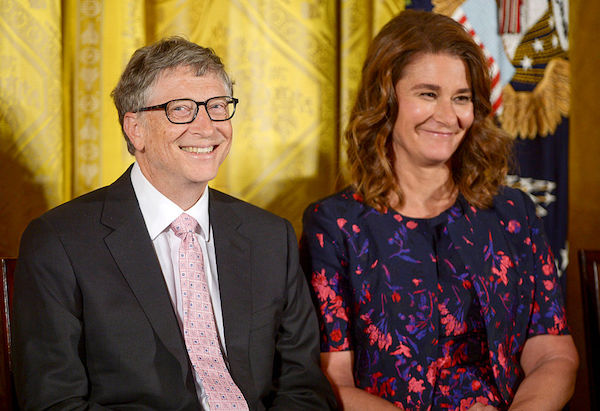
    WASHINGTON (TIP): On the eve of International Women’s Day, the Bill and Melinda Gates Foundation has announced a USD 170 million project aimed at advancing women’s economic empowerment in four countries, including in India.

    Announced on Tuesday, March 6, the investments focused in India, Kenya, Tanzania and Uganda will target four key priorities — advancing gender equality, spreading digital financial inclusion, increasing job opportunities, and supporting the agricultural sector and women’s support groups.

    “One of the most profound ways a woman can make life better for herself and her family is to take control of her economic future,” said Melinda Gates, co-chair of the Bill & Melinda Gates Foundation.

    “When women have money in their hands and the authority to choose how to spend it, they grow in confidence and power. They change the unwritten rules that say women are lesser than men,” she said in a statement.

    The investments will build on the foundation’s previous financial commitments to advance progress on gender equality, including USD 80 million for gender data, advocacy and accountability, of which USD 20 million was dedicated to supporting women’s movements, a statement said.

    According to the foundation, the data show that when a woman has the option of working outside the home and access to financial services to participate in the formal economy, families break the cycle of poverty and national GDPs rise.

    When women have access to financial resources such as cash or mobile money, the ability to control those resources and the ability to make decisions that affect her, and her family’s future, women are empowered in ways beyond economics, it said.

    The investments will not only help better understand what works to ensure women are able to fully participate in economies, but also dismantle the barriers that have held women back for far too long, said Sarah Hendriks, director, gender equality at the Bill & Melinda Gates Foundation.

    “Our strategy is aimed at giving more women and girls the economic opportunities they need to engage as equals in society,” Hendriks said.

    International Women’s Day is celebrated on March 8 every year. It commemorates the movement for women’s rights.

    (Source: PTI)

  • Amazon’s Jeff Bezos bumps Bill Gates from world’s richest position

    Amazon’s Jeff Bezos bumps Bill Gates from world’s richest position

    WASHINGTON (TIP): Amazon’s founder CEO Jeff Bezos may have ended Microsoft badshah Bill Gates’ long reign since 1995 as the world’s richest individual – a position interrupted only briefly by the likes of Berkshire Hathaway’s Warren Buffett and Mexican billionaire Carlos Slim.

    A one per cent bump in the shares of Amazon on Thursday morning pushed the personal wealth of Bezos, who owns about 17% of the company, to over $91 billion, overtaking Gates’ approximately $90 billion, give or take a few million. Gates has generally been regarded as the wealthiest individual on the planet except when Slim bumped him from the top spot in 2012 and his friend and bridge partner Buffett topped him a few years earlier in 2008. Gates regained the top position on both occasions within a year. Because their wealth is largely a result of the shares they own their company and its fluctuating price, it is possible that the wealthiest title may go back and forth between Gates and Bezos – both from Seattle — for a while.

    But Bezos is considered a good bet to hold the title in the long run given Amazon’s phenomenal run and seemingly endless business interests and revenue stream. In the past week alone, Bezos’ net worth has increased by almost $3 billion due to a 3% increase in Amazon’s stock price; it has increased $16.5 billion since Forbes’ 2017 Billionaires List was published in March, when he was ranked third behind Gates and Buffett. Amazon’s market cap+ is now over $500 billion, just $72 billion shy of Microsoft’s $575 billion, and the internet giant’s bull run not only positions it to overtake the software giant, but also – according to some market experts — put it on track to become the world’s first trillion dollar company.

    Bezos is also an early investor in Google, and holds interest in AirBnB, Uber, and Twitter among other unicorn companies. Ironically, Amazon’s hot streak has coincided with the election as President of Donald Trump, who is not favorably disposed towards Bezos or Amazon despite his pro-business credentials.

    The company has seen a 40% increase in revenue this year alone, adding billions to the wealth of Bezos, who also happens to own The Washington Post, which has been sharply critical of the President. (PTI)

  • Demonetization a ‘Bold Move’ To Curb Shadow Economy: Bill Gates

    Demonetization a ‘Bold Move’ To Curb Shadow Economy: Bill Gates

    NEW DELHI (TIP): Praising Prime Minister Narendra Modi’s demonetization decision, Microsoft founder Bill Gates has said it is a “bold move” and will deflate India’s shadow economy.

    Delivering the Second Transforming India Lecture organized NITI Aayog on Wednesday, November 16, Gates said that shift to digital transactions will enhance transparency and reduce leakages. PM Modi, in surprise decision on November 8, demonetized currency notes of Rs. 500 and Rs. 1,000 denomination, replacing them with new Rs. 500 and Rs. 2,000 bills.

    “The Prime Minister’s bold move to demonetize high-value denominations and replace with new notes with high security features is an important step to deflate India’s shadow economy,” Gates said.

    India, he added, “has all the pieces in place for a compelling vision for digital financial inclusion. Aadhaar will convert a cumbersome, paper-based account opening process into a 30-second, all-digital system.”

    He was of the view that Aadhaar will also create a centralized data repository. The impending rollout of payment banks and the ubiquity of mobile phones can enable access for all Indians to digital accounts connected to a fraud-resistant interoperable payment system, he said.

    Referring to health issues in India, the Co-Chairman of the Bill and Melinda Gates Foundation said, “If I had a wand and could fix one health issue in India, it would be the malnutrition crisis. There are states that have made great progress, but there also are regions where malnutrition is the norm, not the exception.”

  • 10-year-old Indian girl proves age is just a number at ‘brainiacs’ meet in NY

    10-year-old Indian girl proves age is just a number at ‘brainiacs’ meet in NY

    Growing up is a wonderful experience, but when we grow up, one particular question from elders makes us confused: “ What do you want to become when you grow up?” Well, “Why not talk about their present? What they want to do or want to be at present?” says Ishita Katyal from Pune who was invited to speak at TED Youth Conference in New York.

    10-year-old Pune writer and middle-schooler who, quite extraordinarily, debuted as the opening speaker at the TED2016 (Technology, Entertainment, Design), a nerdy conference of some of the world’s smartest people.

    Alpha-geeks from Google and Tesla, Apple and Uber, not to speak of marquee names such as Al Gore and Bill Gates are attending the annual brainiacs gig, but it was the singsong voice of this pre-teen, with her pink-frame spectacles and burgundy velvet gown, that held centerstage on when the conference opened.

    “We can do a lot in this moment, in the present. The problem is our world has many forces working against the dreams of children.” Adults, she said, chronically underestimate kids, and in the process they pass on fear to children who are born without fear.

    The nerdy audience, with an average age perhaps in the forties, absorbed the mild admonition, responding with frequent applause as she pressed on to issues such as hunger, education, and war.

    “My dream for the future is that people think 10 times before raising school fees, a hundred times before going to war with another country, a thousand times before wasting food and water, and ten thousand times before letting their child’s childhood go away,” she said. “I hope you adults can look after the world long enough to give us our chance.”

    After she concluded to rousing cheers (AR Rahman, who performed a little later in the opening session, was in the anteroom), scientists and savants, poets and philosophers, mandarins and musicians ambushed her in the lobby, wanting selfies with her.

    Her mother, Nancy Katyal, an image consultant in Pune, beamed with pride, recalling how Ishita, who wrote her first book “Simran’s Diary”, came into limelight after she organized a TEDx talk at her school Vibgyor High, Balewadi, last February.

    But this was the big stage, a world event that was for the first time, simulcast in movie theaters across the world as TED grows bigger and better. A large TEDx initiative involving Infosys in India is to be unveiled later in the day, but for now all eyes are on Ishita, even as she’s yawning and swaying lightly on her feet from jetlag, held up by adulation.

  • Harvard and hedge fund tycoon hammered for $400 million donation

    Harvard and hedge fund tycoon hammered for $400 million donation

    WASHINGTON (TIP): The world’s wealthiest university just added $400 million to it kitty by way of the largest donation in its history, but the gift from a hedge fund tycoon is being shredded by critics who see it as a rich man’s selfish gesture to a spoilt school.

    “If billionaires don’t step up, Harvard will soon be down to its last $30 billion,” was one of the many snarky tweets by Malcolm Gladwell, the outlier writer, as news broke on Wednesday that hoary Harvard, already the richest school in the world with a $36 billion endowment (greater than the GDP of 100 countries), was the recipient of the massive contribution, the biggest in its 379-year history.

    The donor was hedge-fund honcho John Paulson who made his fortune betting on the housing market collapse, and who was an alumnus of Harvard Business School in 1980.

    “Next up for John Paulson: volunteering at the Hermes store on Madison Avenue. Let’s make this a truly world class retail outlet!” Gladwell sneered, as the philanthropic world weighed the gesture and rival schools and those less fortunately looked on enviously. “It came down to helping the poor or giving the world’s richest university $400 mil it doesn’t need. Wise choice, John!” Gladwell added.

    Other critics piled on to Harvard and other elite universities (such as Yale and Cornell) that have in recent years been the beneficiaries of large donations from billionaires (including some from India). even as lesser-known schools catering to poorer students have languished. According to a survey by Moody’s Investor Services, the 10 richest institutions in the US held nearly a third of total cash and investments in fiscal 2014, while the top 40 accounted for nearly 60 per cent.

    Indian billionaires such as Anand Mahindra and Ratan Tata are among those who have contributed in recent years to their Ivy League alma mater. Mahindra, a HBS 1981MBA, gave Harvard $10 million to support a Humanities Center that was renamed the Mahindra Humanities Center in honor of his mother, Indira Mahindra.

    But critics charge that many philanthropic gestures to Ivy League schools have as much to do with the giver’s ego as their sense of altruism. “If you slap your name on a college campus in return for a pile of cash, your act of charity is, by definition, not very modest,” argued a Slate columnist in a commentary headlined “Billionaire’s Ego Donates $400 Million to Harvard.”

    “Harvard is already America’s richest university, with an endowment of $36 billion … by any reasonable measure, the school does not strictly need more money, especially compared to the financially strapped colleges that typically educate lower-income students,” the writer maintained.

    But Paulson shot back, reminding FT in an interview that far from an elite background, he went to public schools in New York City and then to Harvard on a scholarship. “I am very grateful for the financial support that I got. The money is going to be used largely for financial aid and scholarships; I know how expensive it is to go to university. It will also go to research that is going to be beneficial and impactful to all humanity,” he said.

    Paulson’s $400 million will go primarily to Harvard’s lesser-known engineering school, whose Dean at one time was the Indian academic Venky Narayanmurthi. Among the school’s alumni are former Microsoft chief executive Steve Ballmer and Bill Gates (before he dropped out).

  • Why Bill Gates doesn’t want students to be like him

    WASHINGTON (TIP): Bill Gates is something of a model for education skeptics. Gates — like Steve Jobs, Mark Zuckerberg and Oprah Winfrey — dropped out of college. If they didn’t need a college degree, the skeptics suggest, maybe you don’t need one, either.

    Gates has just published a blog post with something of a reply: Yes, you do need one.

    “Although I dropped out of college and got lucky pursuing a career in software, getting a degree is a much surer path to success,” he writes.

    “College graduates are more likely to find a rewarding job, earn higher income, and even, evidence shows, live healthier lives than if they didn’t have degrees. They also bring training and skills into America’s workforce, helping our economy grow and stay competitive.”

    He adds, “It’s just too bad that we’re not producing more of them.”

    The post is tied to an interview Gates has done with Cheryl Hyman, the chancellor of the City Colleges of Chicago, the city’s network of community colleges. During her five-year tenure, the system has started to raise its abysmally low graduation rate. One of her main pushes has been simplifying the course-selection process, so students know what courses they need to take and can enroll in them. The complexity of that process at many colleges is a bigger problem than many people realize.

    “The problem isn’t that not enough people are going to college,” Gates writes. “The problem is that not enough people are finishing.” About one-fifth of the working-age population, he notes, have attended some college without earning a degree.

    The attention that Gates and his foundation are putting on college completion is part of a broader push on the subject. The Obama administration has also started emphasizing college completion, as have some governors and mayors, both Republican and Democratic.

    It’s still not clear exactly what works best in reducing dropout rates, but it is clear that doing so matters. As I wrote recently, two large recent studies suggest that college graduation itself matters. (And other studies have come to similar conclusions.) Not only do students learn from the courses they take, but they also learn the valuable skill of seeing something through to the end —of figuring out how to finish what they started and of gaining the confidence that comes with that success.

    The broader economic weakness over the past 15 years— which has affected college graduates, too — has created a fair amount of cynicism about college. People worry, somewhat understandably, that the economy is a zero-sum game in which producing more college graduates will simply force those graduates to fight over a fixed number of good jobs. But the evidence points strongly in the other direction.

    Education, as David Autor, the MIT economist, notes, is not a game of musical chairs. More educated societies generally become richer, healthier and better functioning over time. Take the United States, which led the way in making high school universal in the early 20th century. Or South Korea, which has rapidly expanded its number of college graduates in recent decades.

    “It’s hard to find examples of countries that have not ultimately benefited from sustained investments in modern education,” Autor said. “The evidence favors the idea that human capital investments pay off over the medium and long term.”

    I’ve pointed out before that even education skeptics aren’t skeptical about the value of education — and college — for their own children. One of the world’s most famous college dropouts isn’t skeptical about it, either.

  • 3 Indian-Americans Among Biggest Philanthropists of 2015: Town and Country Magazine

    3 Indian-Americans Among Biggest Philanthropists of 2015: Town and Country Magazine

    WASHINGTON:  Three Indian-Americans are among 50 biggest philanthropists of 2015, that includes top business honchos like Microsoft co-founder Bill Gates, Apple CEO Tim Cook and Facebook CEO Mark Zuckerberg.

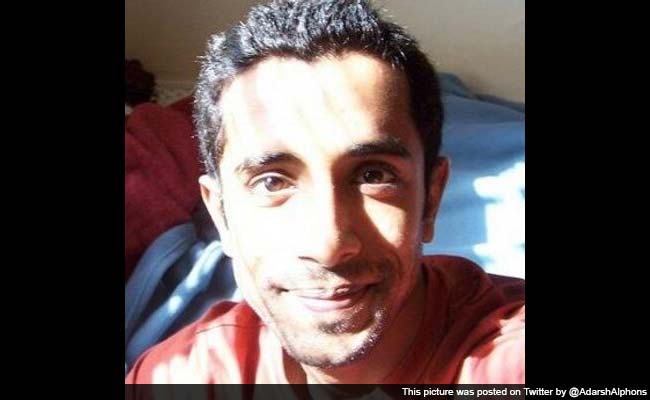
    The list compiled by American lifestyle ‘Town and Country Magazine’ figures New York-based Adarsh Alphons, Reshma Saujani and Shaila Ittycheria, all under 40 years of age.

    “These are the men and women whose serious dollars, bold ideas, and old-fashioned hard work have made them the year’s most noteworthy and inspiring givers,” says the magazine of people on its ‘T&C 50: The Biggest Philanthropists of 2015’ list.

    Ms Saujani, 39, is the founder of ‘Girls Who Code’, a three-year-old nonprofit that teaches computer skills to girls from low-income communities to close technology’s gender-gap.

    “This is more than just a programme. It’s a movement”, said Ms Saujani, who was also among four Indian-American entrepreneurs on a recent list of the 40 most talented and dynamic professionals under the age of 40 in New York City.

    Meanwhile, 30-year-old Mr Alphons founded ‘ProjectArt’ to unleash the creative power in each child and change the way the world views arts education, because for him, art saves lives.

    His ‘Grand Plan’ is to help troubled New York City students via ProjectArt, which provides free art classes at public libraries in all five boroughs.

    It does this by public awareness and programmes. Using its unique library-partnerships model, it helps youth express their artistic visions, set goals and display their art in celebrated art galleries in New York City, all at no cost to the students.

    Expelled from school when he was just seven-years-old for drawing in every class, Alphons – son of former Indian bureaucrat KJ Alphons – has been painting portraits for Mother Teresa, Nelson Mandela and the Pope by the time he was 15 – all because one art teacher perceived his passion for art and believed in him, according to information on his website.

    Ms Ittycheria, 31, co-founded ‘Enstitute’ that bypasses college by placing its students in paid tech apprenticeships.

    Her ‘Grand Plan’ is to educate the digitally inclined and debt-averse.

    The list also includes Zuckerberg’s wife Priscilla Chan, former New York mayor Michael Bloomberg, and actors Leonardo DiCaprio and Emma Watson.


  • FOUR INDIANS FIGURE IN THE TOP 100 GLOBAL RICH LIST

    FOUR INDIANS FIGURE IN THE TOP 100 GLOBAL RICH LIST

    LONDON (TIP): Four Indians have made it to the top 100 global rich list, as the country records for the first time more billionaires than Britain and Russia.


    The world now has a record 2,089 billionaires with Mukesh Ambani being the richest Indian in the list.


    The Reliance chief however ranks 41 in the top 100 global rich list.


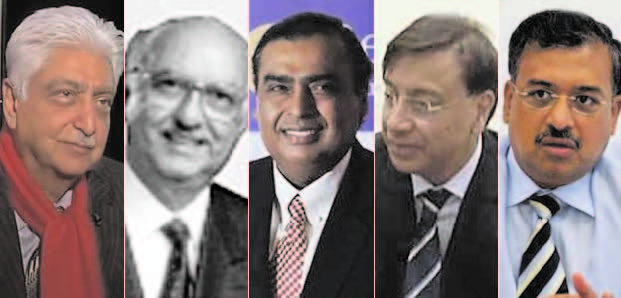
    The other Indians to figure in the top 100 are Dilip Sanghvi of Sun Pharma who is ranked 53, Pallonji Mistry & family who own Tata Sons ranked 60 and Wipro’s Azim Premzi who is ranked 74.


    India has leapfrogged Russia and the UK to third place with 97 billionaires, 27 more than 2014. Manufacturing and Pharma are the preferred sectors with 23 and 14 billionaires respectively. Combined wealth of the Indian billionaires comes to $266 billion. Mumbai is headquarters to most of the Indian billionaires.


    The latest Harun Global Rich List 2015 shows an additional 222 billionaires were created last year, almost a third of whom were in China. Bill Gates remains the world’s wealthiest individual increasing his wealth to $85 billion. Mexican tycoon Carlos Slim is second with $83bn, while Facebook founder Mark Zuckerburg breaks into the global top 10 for the first time.


    The US still holds the crown for most mega-wealthy residents, at 537. But China is not far behind with 430, having acquired 72 new billionaires in 2014.


    Russia has 93 billionaires and UK has 80.


    New York remains the favourite city of the super-rich, with 91 billionaires while London is still fifth with 49.


    But six cities in Asia now make the top 10: Mumbai, Hong Kong, Beijing, Shenzhen, Taipei and Shanghai.


    The List ranked 2089 billionaires from 68 countries, up 222 from last year.


    Mark Zuckerberg at 30 is the youngest member of the Top 10. His wealth soared 42%, moving him up 11 places to number 7.


    The ‘Big Two’ in the list are the USA and China with 537 and 430 billionaires respectively, amounting to almost half of the billionaires on the planet. Russia had a bad year, losing 10 billionaires.

  • ADVANI, AMITABH, DILIP KUMAR, BADAL GET PADMA VIBHUSHAN

    ADVANI, AMITABH, DILIP KUMAR, BADAL GET PADMA VIBHUSHAN

    NEW DELHI (TIP): Like every year, the Indian government has announced the highly prestigious Padma Awards for the year 2015 on the occasion of Republic (26th January).


    Padma Awards, which are one of the highest civilian Awards of the country, are conferred in three categories – “Padma Vibhushan”, “Padma Bhushan” and “Padma Shri”.


    “Padma Vibhushan” is the second highest civilian award after “Bharat ratna” given for exceptional and distinguished service to the nation in any field; “Padma Bhushan” is the third highest civilian honor conferred to recognize distinguished service of high order in any field and “Padma Shri” is the fourth highest civilian award given to Indian citizens to acknowledge their distinguished service in various spheres of activity.


    The Padma Awards are awarded to distinguished individuals for their exceptional contribution in various disciplines including art, social work, public affairs, science, trade, medicine, literature and education, sports, civil service, etc.


    The President of India Pranab Mukherjee approved conferment of Padma Awards on 104 individuals. On 26th January 2015, the 2015 list of Padma Awardees was announce which comprises of 9 Padma Vibhushan awardees, 20 Padma Bhushan and 75 Padma Shri awardees. Out of these 104 awardees, 17 are women and 4 are Posthumous awardees. Also, 17 of the Padma Awardees are from the category of foreigners, NRIs, PIOs.


    Following is the list of 104 persons with their Discipline/State/Domicile who are receiving Padma Awards this year:


    Padma Vibhushan
    1 LK Advani- Public Affairs- Gujarat
    2 Amitabh Bachchan- Art- Maharashtra
    3 Prakash Singh Badal- Public Affairs- Punjab
    4 Dr D Veerendra Heggade- Social Work- Karnataka
    5 Mohammad Yusuf Khan alias Dilip Kumar- Art- Maharashtra
    6 Jagadguru Ramanandacharya Swami Rambhadracharya- Others- Uttar Pradesh
    7 Prof Malur Ramaswamy Srinivasan- Science and Engineering- Tamil Nadu
    8 Kottayan K. Venugopal- Public Affairs- Delhi
    9 Karim Al Hussaini Aga Khan (Foreigner)- Trade and Industry-France/UK


    Padma Bhushan
    1 Jahnu Barua- Art- Assam
    2 Dr Vijay Bhatkar- Science and Engineering- Maharashtra
    3 Shri Swapan Dasgupta- Literature and Education- Delhi
    4 Swami Satyamitranand Giri- Others- Uttar Pradesh
    5 N Gopalaswami- Civil Service- Tamil Nadu
    6 Dr Subhash C Kashyap- Public Affairs- Delhi
    7 Dr (Pandit) Gokulotsavji Maharaj- Art- Madhya Pradesh
    8 Dr Ambrish Mithal- Medicine – Delhi
    9 Sudha Ragunathan- Art- Tamil Nadu
    10 Shri Harish Salve- Public Affairs- Delhi
    11 Dr Ashok Seth- Medicine- Delhi
    12 Rajat Sharma- Literature and Education- Delhi
    13 Satpal- Sports- Delhi
    14 Shivakumara Swami- Others- Karnataka
    15 Dr Kharag Singh Valdiya- Science and Engineering- Karnataka
    16 Prof Manjul Bhargava (NRI/PIO)- Science and Engineering- USA
    17 David Frawley (Vamadeva) (Foreigner)- Others- USA
    18 Bill Gates (Foreigner)- Social Work- USA
    19 Melinda Gates (Foreigner)- Social Work- USA
    20 Saichiro Misumi (Foreigner)- Others- Japan


    Padma Shri

    1 Dr Manjula Anagani- Medicine- Telangana
    2 S Arunan- Science and Engineering- Karnataka
    3 Kanyakumari Avasarala- Art- Tamil Nadu
    4 Dr Bettina Sharada Baumer- Literature and Education- Jammu and Kashmir
    5 Naresh Bedi- Art- Delhi
    6 Ashok Bhagat- Social Work- Jharkhand
    7 Sanjay Leela Bhansali- Art- Maharashtra
    8 Dr Lakshmi Nandan Bora- Literature and Education- Assam
    9 Dr Gyan Chaturvedi- Literature and Education- Madhya Pradesh
    10 Prof (Dr) Yogesh Kumar Chawla- Medicine- Chandigarh
    11 Jayakumari Chikkala- Medicine- Delhi
    12 Bibek Debroy- Literature and Education- Delhi
    13 Dr Sarungbam Bimola Kumari Devi- Medicine- Manipur
    14 Dr Ashok Gulati- Public Affairs- Delhi
    15 Dr Randeep Guleria- Medicine- Delhi
    16 Dr KP Haridas- Medicine- Kerala
    17 Rahul Jain- Art- Delhi
    18 Ravindra Jain- Art- Maharashtra
    19 Dr Sunil Jogi- Literature and Education- Delhi
    20 Prasoon Joshi- Art- Maharashtra
    21 Dr Prafulla Kar- Art- Odisha
    22 Saba Anjum- Sports- Chhattisgarh
    23 Ushakiran Khan- Literature and Education- Bihar
    24 Dr Rajesh Kotecha- Medicine- Rajasthan
    25 Prof Alka Kriplani- Medicine Delhi
    26 Dr Harsh Kumar- Medicine- Delhi
    27 Narayana Purushothama Mallaya- Literature & Education- Kerala
    28 Lambert Mascarenhas- Literature and Education- Goa
    29 Dr Janak Palta McGilligan- Social Work- Madhya Pradesh
    30 Veerendra Raj Mehta- Social Work- Delhi
    31 Tarak Mehta- Art- Gujarat
    32 Neil Herbert Nongkynrih (Art), Meghalaya
    33 Chewang Norphel- Others- Jammu and Kashmir
    34 TV Mohandas Pai- Trade and Industry- Karnataka
    35 Dr Tejas Patel- Medicine- Gujarat
    36 Jadav Molai Peyang- Others- Assam
    37 Bimla Poddar- Others- Uttar Pradesh
    38 Dr N Prabhakar- Science and Engg- Delhi
    39 Dr Prahalada- Science and Engg- Maharashtra
    40 Dr Narendra Prasad- Medicine- Bihar
    41 Ram Bahadur Rai- Literature and Education- Delhi
    42 Mithali Raj- Sports- Telangana
    43 PV Rajaraman- Civil Service- Tamil Nadu
    44 Prof JS Rajput- Literature and Education- Uttar Pradesh
    45 Kota Srinivasa Rao- Art- Andhra Pradesh
    46 Prof Bimal Roy- Literature and Education- West Bengal
    47 Shekhar Sen- Art- Maharashtra
    48- Gunvant Shah- Literature and Education- Gujarat
    49 Brahmdev Sharma- Literature and Education- Delhi
    50 Manu Sharma- Literature and Education- Uttar Pradesh
    51 Prof Yog Raj Sharma- Medicine- Delhi
    52 Vasant Shastri- Science and Engg- Karnataka
    53 SK Shivkumar- Science and Engg- Karnataka
    54 PV Sindhu- Sports- Telangana
    55 Sardara Singh- Sports- Haryana
    56 Arunima Sinha-Sports- Uttar Pradesh
    57 Mahesh Raj Soni- Art- Rajasthan
    58 Dr Nikhil Tandon- Medicine- Delhi
    59 H Thegtse Rinpoche- Social Work- Arunachal Pradesh
    60 Dr Hargovind Laxmishanker Trivedi- Medicine- Gujarat
    61 Huang Baosheng- Others- China
    62 Prof Jacques Blamont- Science and Engg- France
    63 Late Syedna Mohammad Burhanuddin- Others- Maharashtra (Posthumous)
    64 Jean-Claude Carriere- Literature and Education – France
    65 Dr Nandrajan ‘Raj’ Chetty- Literature and Education- France
    66 George L Hart- Others- USA
    67 Jagat Guru Amrta Suryananda Maha Raja- Others- Portugal
    68 Late Meetha Lal Mehta- Social Work- Rajasthan (Posthumous)
    69 Tripti Mukherjee- Art- USA
    70 Dr Dattatreyudu Nori- Medicine- USA
    71 Dr Raghu Rama Pillarisetti (Medicine), USA
    72 Dr Saumitra Rawat- Medicine- UK
    73 Prof Annette Schmiedchen (Literature and Education), Germany
    74 Late Pran Kumar Sharma alias Pran- Art- Delhi (Posthumous)
    75 Late R Vasudevan- Civil Service- Tamil Nadu (Posthumous)


    The Padma Awards 2015 will be handed over to the award winners by Indian President Pranab Mukherjee at a ceremonial function due to be held in March/April 2015 at Rashtrapati Bhavan in New Delhi.

  • BILL GATES FOUNDATION TO TURN HUMAN FAECES INTO POTABLE WATER

    BILL GATES FOUNDATION TO TURN HUMAN FAECES INTO POTABLE WATER

    HOUSTON (TIP): With an aim to prevent diseases caused by contaminated water supply, Microsoft co-founder Bill Gates has joined hands with a US firm to develop a plant which can turn human faeces into potable water, saying the new technology could be a “great fit” in India.

    The plant known the Omniprocessor was designed and built by Seattle-based Janicki Bioenergy and backed by the Bill and Melinda Gates Foundation. The facility would try to prevent diseases caused by contaminated water supplies.

    According to a blog post of Bill Gates, at least 2 billion people worldwide don’t have access to adequate sanitation, with human waste often polluting the water supply and remaining untreated.

    Gates said the Omniprocessor could also be a “great fit” in India working with local entrepreneurs to make the machine a reality.

    “There’s no indication of price (it could be “several years” until it’s ready), but at the same size as two double-decker buses, it’s definitely not a consumer technology. Instead, it’s hoped that local governments and entrepreneurs will be interested,” he said in the blog.

    “Diseases caused by poor sanitation kill some 7,00,000 children every year,” Gates wrote, “and they prevent many more from fully developing mentally and physically,” he added.

    “Western toilets aren’t the answer, because they require a massive infrastructure of sewer lines and treatment plants that just isn’t feasible in many poor countries. So a few years ago our foundation put out a call for a new solution,” Gates said.

    “The “Omniprocessor” aims to help with this problem. Its development is led by Seattle-based engineering firm Janicki Bioenergy,” he added.The machine extracts water from sewage that’s piped in or delivered to the facility. The dry sewage is then incinerated to generate steam, which powers the entire machine.Gates publicly demonstrated his commitment to the new technology by drinking a glass of water on camera that entered the machine as feces just minutes before.

    He said that it’s as “good as any he’s had out a bottle” and would “happily drink it every day.A test plant is up and working at Janicki’s headquarters, according to the blog post. The first operational plant is planned for Senegal.”The next-generation processor, more advanced than the one I saw, will handle waste from 1,00,000 people, producing up to 86,000 litres of potable water a day and a net 250 kw of electricity,” he wrote. “If we get it right, it will be a good example of how philanthropy can provide seed money that draws bright people to work on big problems, eventually creating a self-supporting industry.” the blog post added.

  • ‘ALIBABA FOUNDER JACK MA BIGGEST BILLIONAIRE GAINER OF 2014’

    ‘ALIBABA FOUNDER JACK MA BIGGEST BILLIONAIRE GAINER OF 2014’

    NEW DELHI (TIP): Alibaba founder and executive chairman Jack Ma is this year’s biggest financial gainer as the billionaire entrepreneur’s fortune has swelled by a whopping USD 18.5 billion this year to USD 29.2 billion, a report says.

    According to private wealth consultancy, Wealth-X, the former English teacher-turned billionaire entrepreneur is the biggest gainer of this year as his fortune increased 173 per cent, largely due to Alibaba’s blockbuster IPO in September and the subsequent strong performance of the company’s
    stock.Legendary investor Warren Buffett stood at second place on the Wealth-X list of this year’s top gainers.

    The Berkshire Hathaway chairman raked in USD 13.5 billion in 2014, a 23 per cent increase from last year, to push his fortune to USD 72.6 billion.

    Meanwhile, the world’s richest man, Bill Gates, saw his net worth grow by USD 10.5 billion in 2014 to reach USD 83.1 billion, earning him third place on the Wealth-X ranking of this year’s biggest gainers.

    The top five biggest gainers of this year also include, Mark Zuckerberg, ranked fourth on the list as his fortune rose by USD 8.4 billion to USD 33.1 billion, followed by telecommunications company Altice’s founder Patrick Drahi whose fortune increased by USD 5.1 billion to USD 12.9 billion.The individual who lost the most money this year is Russian energy tycoon Leonid Mikhelson. Mikhelson’s fortune now stands at USD 10 billion, Wealth-X said. The biggest shareholder of natural gas producer Novatek lost USD 7 billion, or 41 per cent of his wealth, in 2014, due to the plummeting Russian currency, weak oil prices and economic sanctions imposed by the West over the Russia-Ukraine conflict.

    The top five losers of 2014 include Masayoshi Son (CEO, Softbank) whose net worth eroded by USD 5.9 billion to USD 13.2 billion this year, followed by Lui Chee Woo who suffered a loss of USD 5.5 billion in his fortune which stood at USD 14.1 billion in 2014. Amazon’s Jeff Bezos’ fortune eroded by USD 5.5 billion to USD 28.9 billion in 2014, while Sheldon Adelson lost USD 5.2 billion of his wealth which now stands at USD 30.1 billion, Wealth-X said. Wealth-X is the world’s leading ultra high net worth (UHNW) intelligence and prospecting firm with the largest collection of curated research on UHNW individuals, defined as those with net assets of USD 30 million and above.

  • The end of poverty? There will be ‘almost no poor countries by 2035,’ Bill Gates says

    The end of poverty? There will be ‘almost no poor countries by 2035,’ Bill Gates says

    LONDON (TIP): Bill Gates has said there will be “almost no poor countries by 2035”, and that child mortality rates in the poorest nations will plummet to the same levels as in the US and UK in 1980.

    The world’s richest man made the prediction in the Gates Foundation’s annual letter, in which he and his wife Melinda Gates sought to dispel three common “myths” surrounding the issues of world poverty. The foundation, which is expected to have given away the entire Gates fortune of around $67 billion (£40 billion) by the time the couple have been dead for 20 years, has published a letter for each of the last five years detailing global philanthropic progress.

    Speaking to Forbes Magazine’s editor Randall Lane, Gates said there will soon come a point where “you’ll have to give a reason why a country is poor.” He said that while it is difficult to make predictions for nations where politics hinders progress (naming North Korea as an example), for almost everyone else there are “good examples to learn from”.

  • Rajat Gupta Sentenced to Two Years in Prison for Leaking Boardroom Secrets

    Rajat Gupta Sentenced to Two Years in Prison for Leaking Boardroom Secrets

    NEW YORK (TIP): Rajat Gupta, former Goldman Sachs Director, one of the highest ranking Indian Americans, was sentenced to two years in prison on Wednesday, October 24 for leaking Goldman Sachs boardroom secrets to the hedge fund manager Raj Rajaratnam.

    Mr. Gupta, 63, who ran the consulting firm McKinsey & Company and served as a major adviser to the philanthropic efforts of Bill Gates and Bill Clinton, is the most prominent figure to face prison in the government’s sweeping crackdown on insider trading. The court also ordered Mr. Gupta to pay a $5 million. He will start his serving the jail term in January, 2013.

    The sentence was imposed by U.S. District Judge Jed Rakoff, who wrestled over the course of a two-hour hearing with the question of why Gupta, a once-respected businessman, had turned his back on an “extraordinary” and “selfless” life to commit a crime he did not profit from directly.

    “I have never encountered a defendant whose past history suggests such an extraordinary devotion … to people in need,” Rakoff said. Yet Gupta’s past good deeds “starkly contrast with the nature and circumstances of his crimes.”

    A Manhattan federal jury found him guilty in June of feeding tips about Goldman Sachs at the height of the 2008 financial crisis to hedge fund tycoon Raj Rajaratnam, his friend and business associate. Rajaratnam is now serving an 11- year prison term for insider trading.

    Gupta’s sentence was less than the eight to ten years sought by prosecutors, but more than the punishment of probation and community service that Gupta’s lawyers had requested.

    “The fall from grace that Mr. Gupta has suffered or experienced as a result of this matter is as steep as … I have ever seen,” Gupta’s lawyer, Gary Naftalis, told the court. “This was an iconic figure who had been a role model for countless people around the globe. He is no more….. This is a fall from grace of Greek tragedy proportions,” Mr. Naftalis said.

    As one alternative to prison, the defense had proposed “a less orthodox” plan in which Gupta would go to Rwanda to help fight HIV/AIDS and malaria in rural districts as well as work with a New York group focused on at-risk youth.

    Bill Gates, Microsoft Corp’s co-founder, and former United Nations Secretary- General Kofi Annan were among 400 friends and luminaries who had written letters to the judge urging leniency

    Federal judges have wide leeway in sentencing, and Rakoff has a reputation for veering from guidelines designed for courts in handing down punishment. Gupta had faced a maximum sentence of 20 years for securities fraud and five years for conspiracy.

    A native of Kolkata, India, Mr. Gupta came to the United States to earn a graduate degree at Harvard Business School. He rose swiftly through the ranks of McKinsey and headed the firm for a decade. Mr. Gupta was a trusted adviser to the captains of industry, including Henry R. Kravis of the private equity firm Kohlberg Kravis Roberts & Company and Peter R. Dolan, the former chairman and chief executive of Bristol- Myers Squibb. A noted humanitarian, he has also played a leading role in organizations fighting diseases like AIDS, malaria and tuberculosis in povertystricken nations.

  • US Prosecutors seek 10 years for Rajat Gupta

    US Prosecutors seek 10 years for Rajat Gupta

    NEW YORK (TIP): US prosecutors want Rajat Gupta, a former Indian- American director of Goldman Sachs Group, jailed for up to 10 years, but his lawyers suggest he could repay for his “shocking” crimes with community work in rural Rwanda. Prosecutors have urged a sentence of 97 to 121 months for Gupta, 63,who is scheduled to be sentenced Oct 24 for his June conviction for insider trading on three counts of securities fraud and one count of conspiracy.

    “Gupta held positions of extraordinary privilege and prestige,” said Assistant US Attorney Richard Tarlowe in a court filing Wednesday, October 17, according to the Wall Street Journal. “He understood as well as anyone the special responsibility that came with being in such an extraordinary position of trust …..Yet, time and time again, over the span of nearly two years, Gupta flouted the law and abused his position of trust.”

    Gupta, who allegedly passed corporate secrets he learned in the boardroom about Goldman to convicted hedge fund manager Raj Rajaratnam, should also forfeit more than $1.1 million, an estimate of the hedge fund titan’s personal gain from his tips, prosecutors argued. They also wanted Gupta to pay restitution of nearly $6.8 million to Goldman for legal fees, compensation and investigative costs. However, lawyers for Gupta said he should receive probation and community service because he never profited from the alleged illegal trading, lived an “exemplary” life and had already suffered serious consequences.

    As one option, they suggested Gupta work on health care and agriculture in rural Rwanda. “It would be punishment reflecting the seriousness of the offense of which he was convicted,” Gary Naftalis, a lawyer for Gupta, said, while “enabling him to give back to society and employ his talents in a country, and in a manner, consistent with US interests.” In handing down a sentence to Gupta, US District Judge Jed Rakoff, is likely to consider the defense’s arguments about Gupta’s “exemplary life of uncommon accomplishment” and dedication as a family man despite a demanding career, the Journal said.

    That has been reflected in more than 400 letters from Gupta’s relatives and supporters, including former UN Secretary General Kofi Annan and Microsoft chairman Bill Gates that Rakoff has received through his lawyers.

  • As i see it: Dollar Billionaires in Poor Countries India’s Philanthrocapitalism

    As i see it: Dollar Billionaires in Poor Countries India’s Philanthrocapitalism

    In this time of global financial crisis, when so many are suffering financial hardship, most countries have witnessed increases in their number of dollar millionaires. These ‘High Net-Worth Individuals’ (HNWI), according to a report by Capgemini and Merrill Lynch Wealth Management, have in recent years more than doubled in India. In 2008-09, India had 84,000 HNWIs. By 2010, it had risen by 50 per cent (126,700), the biggest increase of all countries.

    In the worldwide list of dollar billionaires for 2010, India ranked third with 69, behind China (128) and the US (403). Forbes states, however, that the wealthiest 100 Indians are collectively worth $276 billion, while their top 100 Chinese counterparts are worth $170 billion. The three richest Indians together had more wealth than the top 24 Chinese billionaires combined.

    You don’t have to look very far for evidence of their wealth, with more than 30 luxury skyscrapers springing up in Mumbai. For the rich occupants, the taller, the better, to escape from the reality of India below – the railway tracks, low-rise tenements, choking traffic and the 55 per cent of the city’s population who live in slums. People are paying nearly two million dollars for a designer apartment, built in complexes with private cinemas, swimming pools, floodlit tennis courts and high-level security. Developers believe each year Mumbai can absorb between 30,000 and 40,000 more homes in the one million dollar-plus category. (Another housing bubble in the making?)

    Such extreme wealth doesn’t go unnoticed. In the UK, people are questioning the decision to keep giving India some $460 million of aid annually, which makes India the largest single recipient of British aid. Many ordinary Brits are asking if it can be right that the downtrodden British taxpayer gives such sums to a nation that boasts such wealth (albeit highly concentrated).

    Siphoning off the country’s wealth

    Some of the most damning comments about India come from French author Dominique Lapierre, whose book royalties from ‘City of Joy’ fund projects for the underprivileged in India. He is frustrated by the greed and corruption that he encounters.

    Lapierre’s nonprofit organization, City of Joy Aid, runs a network of clinics, schools, rehabilitation centers and hospital boats. It operates 14 projects in India, most in the Sunderbans area. However, 90 per cent of free medicines get stolen in the journey from Delhi to Kolkata, and the project is thus forced to buy them at high prices from the market.

    A few years ago, Lapierre set up in Delhi a trust which offers a tax-deductible certificate for all donations. With more than a hint of disappointment, he notes the foundation still does not have any funds from affluent Indians who seem reluctant to help their fellow country-folk.

    Quite the opposite, it seems. Much of India’s wealth has been creamed off into Swiss banks, robbing ordinary folk of a quality of life they can now only but dream of. According to some estimates, it could be over Rs 7,280,000 crore (around $1.6 trillion). Data from the Swiss Banking Association in 2006 indicated that India had more black money than the rest of the world combined, or 13 times India’s total national debt. Global Finance Integrity notes this siphoning of wealth has served to widen the gap between rich and poor and asserts the main guilty parties have been private organizations and High Net Worth Individuals.

    By contrast, Global management and consulting firm Bain notes philanthropic donations amount to just 0.6 per cent of India’s GDP. This is not too good when compared to giving in the US and UK, for example, but is better than rates in other developing countries like Brazil and China. In the US, individuals and corporations are responsible for 75 per cent of charitable gifts, whereas in India individual and corporate donations make up only 10 per cent of charitable giving. Some 65 per cent comes from India’s central and state government, and the remaining gifts are provided by foreign organizations.

    In India, giving does not rise with income and education. As a percentage of household income, donations by the wealthy actually decrease. From an analysis of 30 HNWIs in India, Bain noted that they contribute, on average, just around one-fourth of one per cent of their net worth to social and charitable causes.

    All of this is not meant to imply that philanthropy is absent in India. Far from it. Vineet Nayyar’s Rs 30 crore gift (just under $7 million) to the Essel Social Welfare Foundation is a high-profile example of philanthropic giving. Over the years, Rohini Nilekani has donated $40 million to numerous causes that try to tackle the root causes of social problems and not merely the symptoms. Her biggest contribution has been to Arghyam, a Bangalore foundation that promotes clean water and hygiene, which now has projects in 800 villages. Philanthropy can and does positively impact people’s daily lives.

    Philanthrocapitalism: a plaster on a gaping wound

    What is really required, though, is a proper redistributive system of taxation, effective welfare provision and genuine economic democracy through forms of common ownership to help address inequality and poverty. In the absence of such things, wealthy philanthrocapitalists will have a major say in deciding which problems are addressed and how, and some will be highly selective.

    For instance, critics of Bill Gates say his foundation often ends up favoring his commercial investments. Instead of paying taxes to the state coffers, he donates his profits where it is favorable to him economically, such as supporting GM crops in Africa or high tech patented medicines. ‘Giving’ often acts as a smokescreen for channeling funds into pet projects and ‘business as usual’, with rich corporations receiving money to shape the world in their own image and ultimately for their own benefit. Apparent benevolence can have sinister motives, just like certain governments which provide money in the form of ‘development aid’ that is intentionally used to fund actions that serve geo-political self interest and ultimately undermine the recipient state.

    Philanthropy isn’t necessarily opposed to capitalism; it’s very much part of it. Capitalism is designed to ensure that the flow of wealth goes upwards and remains there via, among other things, the privatization of public assets, deregulation of the financial sector, the use of subsidies and tax policies that favor the rich, the legal obligation to maximize shareholder profits and the consistent downward pressures on labor costs.

    Professor Ha Joon Chang of Cambridge University says that economics isn’t a social science anymore, but adopts the role the Catholic Church played in medieval Europe. Essentially, economic neo liberalism is secular theology used to justify the prevailing system, with the hope that some drops of wealth will trickle down an extremely thin funnel to placate the mass of the population. Widening the funnel slightly by making benevolent donations will not address the underlying issues of a failed system.

    For example, consider that one in four people in India, is hungry and every second child is underweight and stunted. Environmentalist Vandana Shiva argues that hunger is a structural part of the design of the industrialized, globalize food system and of the design of capital-intensive, chemical-intensive monocultures of industrial agriculture. The long-term solution for hunger lies in moving away from and challenging the centralized, globalised food supply controlled by a handful of profiteering corporations.

    This type of built-in structural inequality, whether it concerns hunger, poverty, housing, income or health, is part and parcel of a development process that is skewed by elite interests in India and at the World Bank and by the corporations that pull the strings at the World Trade Organization, who have all succeeded in getting their ‘globalization’ agenda accepted. No amount of philanthropy, regardless of how well meaning it may be, will remedy the overall destructive effects of the type of capitalism (and massive corruption) being embraced by India’s economic and political leaders.

    (Originally from the northwest of England, Colin Todhunter has spent many years in India. He has written extensively for the Bangalore-based Deccan Herald, New Indian Express and Morning Star (Britain). His articles have also appeared in many other newspapers, journals and books. His East by Northwest site is at: http://colintodhunter.blogspot.com)