Tag: Bill Nelson

  • Indian American space expert AC Charania named NASA’s new chief technologist

    Indian American space expert AC Charania named NASA’s new chief technologist

    WASHINGTON, D.C. (TIP): An Indian American aerospace industry expert has been appointed as NASA’s new chief technologist to serve as principal advisor to Administrator Bill Nelson on technology policy and programs at the space agency’s headquarters here.

    In his position, AC Charania will align NASA’s agencywide technology investments with mission needs across six mission directorates and oversee technology collaboration with other federal agencies, the private sector, and external stakeholders, NASA said in a statement on Monday.

    The position works within NASA’s Office for Technology, Policy, and Strategy.

    “Technology plays a vital role in every NASA mission. Making sure that we’re pursuing the best policy objectives allows this agency to continue to serve as a global leader in innovation,” Bhavya Lal, NASA associate administrator for technology, policy, and strategy, was quoted as saying in the statement.

    “Charania is an experienced leader in managing large, rapidly shifting technology portfolios. I am eager for him to apply his knowledge and enthusiasm at NASA,” Lal said. Lal served as acting chief technologist prior to the appointment of Charania, whose first day working at NASA Headquarters was January 3.

    “The rate of advancement we seek in the 21st century is dependent upon selecting and maturing a portfolio of technologies into systems to execute our missions,” Charania said in the statement.

    “With this in mind, there are incredible opportunities in partnerships within and outside of NASA. I now look forward to the opportunity to work with the entire community to increase the rate of space and aviation progress,” he added. Prior to joining NASA, he served as vice president of product strategy at Reliable Robotics, a firm that works to bring certified autonomous vehicles to commercial aviation.

    His previous experience also includes working at Blue Origin to mature its lunar permanence strategy, Blue Moon lunar lander program, and multiple technology initiatives with NASA.

    Charania has also worked in strategy and business development for the Virgin Galactic (now Virgin Orbit) LauncherOne small satellite launch vehicle program. Charania led the formation of the Fast Forward industry group focused on high-speed point-to-point transportation, was a NASA Innovative Advanced Concepts fellow, and served on the Lunar Exploration Analysis Group Commercial Advisory Board, according to the release. He received a bachelor’s and a master’s degree in aerospace engineering from the Georgia Institute of Technology, and a bachelor’s in economics from Emory University.

  • NASA nails trickiest job on newly launched James Webb Space Telescope

    NASA nails trickiest job on newly launched James Webb Space Telescope

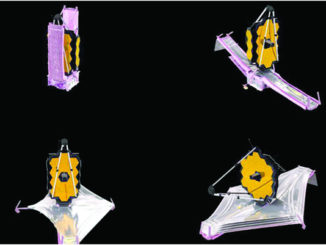
    NASA aced the most complicated, critical job on its newly launched space telescope Tuesday: unrolling and stretching a sunshade the size of a tennis court. Ground controllers cheered and bumped fists once the fifth and final layer of the sunshield was tightly secured. It took just 1 1/2 days to tighten the ultra-thin layers using motor-driven cables, half the expected time.

    The 7-ton James Webb Space Telescope is so big that the sunshield and the primary gold-plated mirror had to be folded for launch. The sunshield is especially unwieldly — it spans 70 feet by 46 feet (21 metres by 14 metres) to keep all the infrared, heat-sensing science instruments in constant subzero shadow.

    The $10 billion telescope is more than halfway toward its destination 1 million miles (1.6 million kilometers) away, following its Christmas Day send-off. It is the biggest and most powerful observatory ever launched — 100 times more powerful than the Hubble Space Telescope — enabling it to peer back to almost the beginning of time.

    Considered Hubble’s successor, Webb will attempt to hunt down light from the universe’s first stars and galaxies, created 3.7 billion years ago. “This is a really big moment,” project manager Bill Ochs told the control team in Baltimore. “We’ve still got a lot of work to do, but getting the sunshield out and deployed is really, really big.”

    Engineers spent years redoing and tweaking the shade. At one point, dozens of fasteners fell off during a vibration test. That made Tuesday’s success all the sweeter, since nothing like this had ever been attempted before in space.