Dhemaji (TIP-Cl aiming that the demography of Assam changed during Congress rule, Union Home Minister Amit Shah on Friday said the BJP-led government under Prime Minister Narendra Modi is working to reverse the trend.
Addressing the closing ceremony of the 10th Mising Youth Festival organised by Takam Mising Porin Kebang (All Mising Students’ Union) at Kareng Chapori here as the chief guest, Shah appealed to people to vote for the BJP in the upcoming Assembly elections to free the state from infiltration.
“Assam’s demography totally changed during the Congress rule. The population of infiltrators rose to 64 lakh from nil, and infiltrators became a majority in seven districts,” he alleged.
Shah asserted that the Modi government was working through various means to reverse the demographic trend in the state.
“If you want to stop infiltration in Assam, then elect the BJP government for a third term and strengthen the hands of Chief Minister Himanta Biswa Sarma in the fight against illegal immigrants. Two BJP state governments in Assam have freed 1.26 lakh acres of land from encroachment by infiltrators,” he added.
The Union home minister also stressed the role played by the Mising community in stopping infiltrators from settling in Upper Assam through their lifestyle of hard work.
“It’s the responsibility of the Mising community to stop infiltration. You do not need to take up guns. Through your culture of hard work, infiltrators have not been able to come to this side,” he said.
Talking about the Bogibeel bridge over Brahmaputra river connecting Dibrugarh and Dhemaji, Shah said it stands as a symbol of India’s progress before the entire world.
“However, very few people in India know that the Bogibeel Bridge was built through the hard work and sweat of my brothers and sisters from the Mising community. Today, this bridge has become a powerful representation of the vision of a New India, both across the nation and globally,” he added.
The Union home minister further said that Rajya Sabha MP from Assam, Manmohan Singh had served as Prime Minister for 10 years but this bridge remained incomplete.
“The people of Assam placed their trust in Modi Ji, and it was under his leadership that this bridge was completed in just four years,” he added.
Shah also alleged that several tribal communities struggled to protect their identity during the Congress regime, while asserting that the BJP was committed to addressing the issues of the Mising society through an interlocutor appointed by the Centre. He lauded the unique ‘chang ghar’ or stilt house of the community, saying its architectural design in a way gives way to river during the flood, thereby silently fighting the global warming.
The Union home minister announced that a special requirement drive will be conducted for Mising youths for the central paramilitary forces.
“If I had not attended the Mising Youth Festival, my life would have felt incomplete without witnessing this truly magnificent spectacle. Today, I bow with deep respect to the sacred ‘Donyi-Polo’ tradition, which embodies nature worship and the faith of our Mising community,” he added.
Tag: (BJP)
-

64 lakh infiltrators entered Assam in Congress rule: Amit Shah
-

Indian Parliamentary Delegation Engages with Indian Diaspora at the Consulate
NEW YORK CITY (TIP): A visiting Indian Parliamentary Delegation, led by BJP MP Daggubati Purandeswari, held an engaging interaction with members of the Indian-American community at the Consulate General of India in New York on Thursday, October 30.
The event, hosted by Consul General Binaya Srikanta Pradhan, brought together members of the Indian diaspora and lawmakers representing a broad political spectrum from India. New York State Assemblyman Anil Beephan, the first Indian-American Republican elected to the New York Assembly, also addressed the gathering, lauding the strong and ever-growing ties between the two largest democracies.
A Cross-Party Representation from India
The delegation accompanying Purandeswari included Rekha Sharma, Dilip Saikia, Bhola Singh, and Saumitra Khan from the BJP; Sandeep Pathak from the Aam Aadmi Party; P. Wilson and Thamizhachi Thangapandian from the DMK; G.K. Vasan from the Tamil Maanila Congress; Sajda Ahmed from the Trinamool Congress; Indra Hang Subba from the Sikkim K

Consul General Binaya Srikanta Pradhan in his welcome address apprised the delegation members of the tremendous contribution the Indian Diaspora is making in the US. rantikari Morcha; and Joyanta Basumatary from the United People’s Party Liberal (UPPL).
The multi-party delegation is currently in New York to participate in the ongoing United Nations General Assembly session, where they are articulating India’s positions in various committees and engaging with UN officials and diplomats. This is the second such group of Indian MPs to attend this year’s UNGA session.
Diaspora’s Growing Global Footprint
In his welcome remarks, Consul General Pradhan highlighted the strength and influence of the Indian-American community, which now numbers 2.4 million in the U.S. — the largest Indian diaspora anywhere in the world.

Parliamentary delegation leader Daggubati Purandeswari spoke highly of the Indian Diaspora He shared that Indian-Americans contribute 6% of total U.S. taxes, lead several Fortune 500 companies, and hold 10% of all U.S. patents. The community includes over 22,000 faculty members teaching in top universities across the country.
On the cultural front, Pradhan noted that Indian-Americans have inspired 10% of Americans to practice yoga, with 36,000 yoga studios and 2,200 Ayurveda clinics now operating nationwide. In 2024, the diaspora’s philanthropic contributions topped $1.5 billion, underscoring their growing social impact.

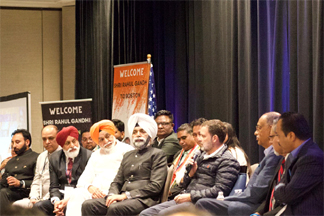
A view of the gathering at the Consulate to interact with the delegation. “The U.S. remains India’s largest trade partner and investor,” Pradhan added, citing the $212 billion bilateral trade recorded last year as evidence of deepening economic ties.
Building Bridges for India’s Future
During the session, MPs acknowledged the diaspora’s multifaceted contributions in education, technology, healthcare, and entrepreneurship. They urged Indian-Americans to continue acting as cultural ambassadors and economic partners in India’s growth story.
Daggubati Purandeswari emphasized that India is moving steadily toward its goal of becoming the third-largest economy by 2047, the centenary of independence, and that the diaspora’s engagement will play a critical role in achieving that vision.
Lawmakers also touched upon domestic challenges such as drug addiction in Punjab, assuring the audience that the government is implementing targeted measures and collaborating with state authorities to address the issue comprehensively.
A Shared Vision
Several participants described the evening as both inspiring and thought-provoking. The MPs and diaspora members exchanged views on how to strengthen educational linkages, attract investment in India’s innovation sectors, and promote youth exchanges to deepen mutual understanding between the two nations.
The meeting concluded with a shared call for unity — encouraging the Indian diaspora to remain deeply rooted in their culture and traditions while continuing to contribute to India’s development and to the prosperity of their adopted homeland.
As Consul General Pradhan aptly summed up, “The Indian diaspora is not just India’s pride abroad — it is India’s bridge to the world.”

The Delegation members with the Diaspora members for a photo session at the Consulate on October 30, 2025 (Photos : Ashish Chandratreya) -

Rahul’s vote theft charge: Election Commission seeks signed declaration or apology to the nation
NEW DELHI (TIP): A day after Congress leader Rahul Gandhi levelled allegations of over one lakh “stolen” votes in the Mahadevapura Assembly segment of Bangalore Central Lok Sabha seat — which the opposition narrowly lost to the ruling BJP in 2024 — the Election Commission of India (ECI) hit back on Friday.
In a direct attack on the Leader of Opposition, the poll body asked him to either submit a signed declaration of his charges under oath or apologize to the nation.
ECI sources said that if Gandhi believes his analysis and allegations are true, then he should have no problem in signing a declaration to that effect.
However, if he does not do so, then it will mean that his allegations are absurd and then he should apologize to the nation, they said.
On Thursday, soon after the Congress MP had given a detailed presentation to the media on how “vote theft” was effected at various levels in the assembly segment of Bangalore Central Lok Sabha constituency, the ECI had retaliated by asking him to send a signed declaration under oath to that effect, through the Chief Election Officer (CEO) of Karnataka.
Congress leader Rahul Gandhi alleged that in the 2024 Lok Sabha polls, PM Narendra Modi and BJP leaders made an assault on the Constitution. Gandhi alleged that the Election Commission and the BJP colluded to steal the Lok Sabha election from people.
He said, “In Lok Sabha election our alliance won in Maharashtra; surprisingly after four months the BJP won the assembly polls. In the Maharashtra Assembly polls, one crore (10 million) new voters, who did not vote in the Lok Sabha election, cast their votes. The INDIA bloc votes did not reduce in the Maharashtra Assembly polls; we got the same number of votes as in the Lok Sabha polls.”
Fake voters in bulk are shown as residing in one-bedroom houses owned by BJP leaders, he alleged.
CEOs of Haryana and Maharashtra also later in the day had sought written declarations from him detailing his allegations against the poll body.
Leader of Opposition(LOP) Rahul Gandhi on Friday reacted to Election Commission’s demand for an affidavit about his explosive claims of a “huge criminal fraud” in elections through collusion between the BJP and the poll body, saying he has “already taken the oath of the Constitution in Parliament”.
“The Election Commission demands an affidavit from me. It says that I must take an oath. I have already taken the oath of the Constitution in Parliament,” the Congress leader Rahul Gandhi said in Karnataka’s Bengaluru.
The Lok Sabha LoP’s reaction comes a day after his scathing attack on EC of a “vote theft”.
Following the Congress leader’s claims of electoral fraud, EC officials had demanded a proof, while requesting for a signed declaration detailing specific instances of voter-list manipulation.
Meanwhile, taking a further jibe at Gandhi, ECI sources said that as usual, he might present his claims and objections against special intensive revision (SIR) of electrical rolls in Bihar only after the assembly elections in the state are over.
They went on to add that ever since the draft electoral roll for Bihar was published on August 1, not a single political party has come forward to present its objections on addition or deletion of voters in the rolls.
The Congress-led INDIA bloc has alleged that 65 lakh voters faced the risk of being deleted from the state’s electoral roll following the SIR exercise.
The Supreme Court has sought a detailed response from the ECI to an application seeking the particulars and reason for each of the 65 lakh voters deleted from the Bihar draft electoral roll.
On August 6, a Bench headed by Justice Surya Kant told the poll body to file the particulars by August 9. A hearing has already been scheduled for August 12 on the matter. -

Only Dalai Lama can decide his successor, says India
New Delhi (TIP)- In a terse message to China, India asserted on Thursday, July 3, that the right to pick the 14th Dalai Lama’s successor rests with the incumbent and the institution, a day after Beijing said that his reincarnation must have its approval.
India added that Union ministers Kiren Rijiju (BJP) and Rajiv Ranjan Singh (JDU), Arunachal Pradesh chief minister Pema Khandu and Sikkim CM Prem Singh Tamang will attend the Dalai Lama’s 90th birthday celebrations in Dharamshala on July 6.
On Thursday, Rijiju said that the institution of the Dalai Lama is the most important and defining institution for Tibetans not just in Tibet but across the world. “And all those who follow the Dalai Lama feel that the Incarnation is to be decided by the established convention and as per the wish of the Dalai Lama himself… Nobody else has the right to decide it except him and the conventions in place,” Rijiju said. The minister said the Indian government’s decision to depute two senior ministers to attend the celebrations is not a political issue.
India has for long stated that the process of naming the successor is a long standing tradition that the Dalai Lama undertakes and no third party has a role to play here.
The Dalai Lama said on Wednesday that the 600-year-old institution of spiritual head of Tibetan Buddhists will continue after his death and a trust created by him will be the sole authority to recognise his reincarnation, effectively shutting out any role for China in choosing his successor.
Speculation has swirled about the future of the institution since the Nobel laureate head of Tibetan Buddhism said in 2011 that he would decide on his 90th birthday – which falls on July 6 this year – whether the position should continue. His Wednesday announcement, which clarifies matters, came at a Tibetan religious conference in McLeodganj, near Dharamshala, that is part of a week of celebrations to mark his birthday.
Hours later, an irate Beijing, which describes the Dalai Lama as a “separatist”, countered that the spiritual leader’s reincarnation “must be approved by the central (Chinese) government”.
Chinese foreign ministry spokeswoman Mao Ning told a regular news briefing, “The reincarnation of the Dalai Lama, the Panchen Lama and other great Buddhist figures must be chosen by drawing lots from a golden urn, and approved by the central government.”
“The Chinese government implements a policy of freedom of religious belief, but there are regulations on religious affairs and methods for managing the reincarnation of Tibetan living Buddhas,” she added. Source: HT
-

Lotus blooms in Delhi after 27 years
- Delhites Reject AAP, shun Congress
- Kejriwal accepts his party’s defeat, congratulates the BJP
I.S. Saluja
NEW DELHI (TIP): The Bharatiya Janata Party (BJP) is all set to form the government in Indian capital Delhi after 27 years as it scripted an impressive election victory over the Aam Aadmi Party (AAP) which commanded a formidable majority in two 5-year terms.The Bharatiya Janata Party (BJP) has won or is leading in 48 seats in the 70-member legislative assembly, while the incumbent Aam Aadmi Party (AAP) has won or is ahead in 22 seats, according to data from the Election Commission of India (EC).
A party that wins 36 seats can form the government. “Development wins, good governance triumphs,” Modi wrote on X, adding that his party would leave “no stone unturned” in developing Delhi. The Aam Aadmi Party (AAP) national convenor Arvind Kejriwal on Saturday, February 8, 2025, conceded his party’s defeat in the high-stakes Delhi Assembly elections.
The AAP is heading towards a big defeat in the 70-member Assembly with the Bharatiya Janata Party (BJP) leading on 47 seats, leaving the AAP to just 23 seats. AAP supremo Arvind Kejriwal and his number two Manish Sisodia have already lost to BJP’s Parvesh Verma and Tarvinder Singh Marwah, respectively. In a video message, AAP supremo said, “We accept people’s mandate with humility, and I congratulate the BJP for its victory and also hope that it will fulfil the expectations of the people of Delhi.”
Mr. Kejriwal said the AAP will play the role of a constructive Opposition, saying, “In the next five years, the AAP will not only play the role of a constructive Opposition, but will also be available to the people of Delhi. We are not in politics for power, instead we consider it as a medium to serve people,” Mr. Kejriwal claimed in the video message. In the end, the AAP chief thanked all his party workers. “I thank all the AAP workers for their hard work during the elections and we fought a good election.” While the AAP has dominated the political landscape in Delhi for the past 10 years, the BJP has been out of power in the city since 1998.
The Congress, which governed Delhi from 1998 to 2013 and was hoping for a resurgence, seemed headed for its third straight washout.
(With inputs from agencies) -
Parties woo women voters with cash promises ahead of Delhi polls
Ahead of the Delhi Assembly polls, all major parties seem to be wooing women voters with direct cash transfers.
Major political contenders, the Bharatiya Janata Party , the Aam Aadmi Party and the Indian National Congress, have each promised financial assistance schemes for women, a demographic that constitutes 46.2 per cent of Delhi’s electorate.
According to the final electoral roll published by the Office of the Delhi Chief Electoral Officer on January 6, the national capital has a total of 1,55,24,858 registered voters, comprising 83,49,645 male voters and 71,73,952 female voters.
In a bid to woo the female voters and as a countermeasure to A’s welfare-centric campaign, BJP has proposed a monthly aid of Rs 2,500 for women. A, under the Mahila Samman Yojana, has pledged Rs 2,100 per month to women, continuing its strategy of offering direct benefits to secure electoral support.
Not to be left behind, the Congress has introduced the ‘Pyari Didi Yojana,’ promising Rs2,500 monthly to women if elected, mirroring similar initiatives it has implemented in other states. -

Modi returns, Rahul finds foothold: Revisiting the grand political tamasha India witnessed this year
The year 2024 was significant for Indian politics as the Election Commission carried out the world’s largest electoral exercise with 642 million people voting to decide who would rule the nation for the next five years.
The elections were carried out in seven phases between April and June with thousands of government functionaries — who were manned by an even greater number of security forces — managing a whopping 10.5 lakh polling booths across the country.
The year also witnessed several states electing their new governments, with all but two retaining those in power. The opposition also got a new lease of life this year despite being on the losing side in the general elections.
Congress leader Rahul Gandhi became the Leader of Opposition in Lok Sabha as his party won 99 seats, nearly double the number it had scrambled to in 2019. The grand old party celebrated the performance like a win against the larger-than-life figure of Narendra Modi, who became the Prime Minister for the third consecutive time, though with figures far below the BJP’s expectations.
In the national capital, the tug of war between the Centre and the elected Aam Aadmi Party government witnessed strong pulls and drags this year. The tension peaked when AAP chief Arvind Kejriwal was jailed in March for his alleged role in the Excise Policy Scam. He functioned as Delhi Chief Minister behind bars for the next seven months until the Supreme Court granted him bail with conditions, following which he quit, paving the way for his party leader Atishi to take over as Delhi CM.
The resignation, arrest, and return of Hemant Soren in Jharkhand, the fall of the Biju Janata Dal government in Odisha after 24 years, the return of Chandrababu Naidu as Andhra Pradesh Chief Minister, the maiden Assembly Elections in the Union Territory of Jammu and Kashmir, and the NDA’s landslide victory in Maharashtra Elections were some of the other major political developments the country witnessed in 2024.
Here is a sneak peek into these and other landmark events in Indian politics this year.
Hemant Soren’s Fall And Rise
Four-time Jharkhand Chief Minister, Hemant Soren dogged it out against the central government in the very first month of 2024 but managed to retain power amid a high-decibel political drama at the fag end of the year.
The gripping political potboiler saw Soren quitting as chief minister hours before he was arrested by the Enforcement Directorate in a land scam case on January 31. Ahead of his arrest, the agency could not confirm his whereabouts for around 24 hours before he showed up in Ranchi. Soren claimed the charges against him were nothing but a vindictive action on the part of the BJP-led central government.
His chosen replacement Champai Soren functioned as Jharkhand CM for barely five months till Hemant was released on bail on June 28. Less than a week later, Champai Soren resigned as CM, making way for Hemant who took oath as CM on July 4. The move did not go down well with Champai Soren who quit JMM and joined the BJP on August 30.
In the November Assembly Elections, Hemant Soren signed off the year with flying colours as the JMM-led alliance won 56 seats, the party’s best performance since inception. Soren was unanimously elected as leader of the legislature party and again took oath as Chief Minister on 28 November.
Delhi CM Arvind Kejriwal Is Jailed
Embroiled in controversies that saw him running the Delhi government from behind bars for several months, Aam Aadmi Party National Convener Arvind Kejriwal was on a political roller-coaster in 2024.
With several of his key party members and ministers in the Delhi government already arrested in the alleged excise policy scam, Kejriwal also was on the Enforcement Directorate’s radar.
He managed to dodge multiple summons by the central agency before he was arrested on March 21 after the Delhi High Court rejected his plea for anticipatory bail. Kejriwal knew his arrest was around the corner and had time and again mentioned it in his prior public speeches.
The BJP were all but sure of him resigning from his post but Kejriwal stayed put and ran the Delhi government from jail for several months. He attempted to get bail from the Delhi High Court however the same was rejected multiple times.
During his jail time, Kejriwal’s legal battles took several twists and turns. He was granted interim bail by the Supreme Court from May 10 to June 1, 2024, to allow him to campaign for the Lok Sabha elections. After his interim bail expired, Kejriwal surrendered at Tihar Jail on June 2.
Delhi Rouse Avenue Court granted him bail on June 20. However, the Enforcement Directorate challenged the trial court order before the Delhi High Court which stayed the bail order on June 21. Five days later, the CBI arrested Kejriwal in a different case linked to the alleged excise policy scam.
The Supreme Court granted Kejriwal interim bail on July 12, but he remained in jail due to the CBI arrest. He was finally granted bail by the Supreme Court on September 13, 2024, after spending over five months in prison.
The bail, however, came with certain conditions including prohibiting him from making public statements about his arrest by the CBI. He was also ordered not to enter the office of the Delhi Chief Minister and sign any official files in his capacity as the Chief Minister.
Just four days later, on September 17, Kejriwal resigned as the Chief Minister of Delhi. He made it clear that he would only consider taking up the role again if he received a public mandate. On September 21, Atishi, the Delhi education minister till then, replaced Kejriwal as the youngest woman CM of Delhi.
2024 General Elections:
A Mammoth Exercise
India witnessed its 18th general elections this year as the entire country voted to choose the next central government. Of the 96.8 crore (968 million) people who were eligible to vote, 64.2 crore exercised the right including 312 million women, the highest-ever participation by female voters.
The 44-day electoral exercise was the second longest in country after the first parliamentary elections of 1951-52, which lasted for more than four months. The polls were conducted in seven phases beginning April 19 and ending June 1. The results were declared on June 4.
The BJP-led NDA alliance won the elections with Narendra Modi returning as Prime Minister for the third consecutive time. The BJP’s performance, however, was below expectations and it had to heavily rely on two main allies—the Telugu Desam Party of Andhra Pradesh and Janata Dal (United) of Bihar—to form a coalition government.
Eyeing 400 of the 543-seat Lok Sabha, BJP managed to win only 240 while its main partners TDP and JD(U) won 16 and 12 seats respectively. Overall, the NDA won 293 seats.
In 2019, the BJP won 303 seats with the NDA’s final tally at 353. In contrast, Congress recorded a turnaround winning 99 seats, nearly double its 2019 tally of 52, thereby coming back as a potent opposition.
Narendra Modi Takes Oath As PM For Third Consecutive Time
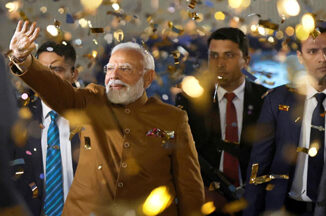
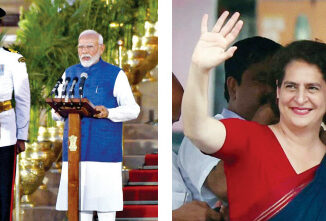
On June 9, Narendra Modi took oath as the Prime Minister of India for the third consecutive time after his BJP-led NDA alliance registered a victory in the 2024 Lok Sabha elections.
The ruling party’s rallies ahead of the elections were powered by the ‘Modi ki Guarantee’ campaign, which managed to help it win 240 seats, a lacklustre performance but strong enough to form a coalition government with the BJP as its most powerful constituent.
Three days after the results were declared on June 4, Modi confirmed the support of 293 MPs to President Droupadi Murmu after which he was sworn-in as the Prime Minister for the third time on June 9.
As for his individual performance from the Varanasi Lok Sabha seat, PM Modi had a shocking start on the result day as Congress’ Ajay Rai was seen leading in the first hour of vote counting.
PM Modi raced past in the second half defeating Rai by a margin of 1,52,513 votes. It was the second-lowest-ever victory margin (in percentage points) for a sitting prime minister and a steep fall for Modi compared to his 2019 margin of 4.5 lakh votes.
In his victory speech, Prime Minister Modi pledged to work with all states, regardless of the party in power, to build a developed India. He also laid out his vision for the third term saying it would be a tenure of big decisions and a key emphasis would be on uprooting corruption. He thanked TDP supremo Chandrababu Naidu and Bihar Chief Minister Nitish Kumar, his NDA allies for the electoral successes in Andhra Pradesh and Bihar.
Rahul Gandhi’s Resurgence As LoP, Priyanka’s Debut in Parliament
Ridiculed as ‘Shehzada’ and dismissed as ‘Pappu’, Congress leader Rahul Gandhi had the last laugh in the 2024 Lok Sabha election as he managed to gain big even though his party lost the elections.
Gandhi contested from Kerala’s Wayanad and Uttar Pradesh’s Rae Bareli, winning the southern seat by 3.64 lakh votes against his nearest rival Annie Raja of CPI and the northern one by 3.9 lakh votes against BJP’s Dinesh Pratap Singh. Rahul retained Rae Bareli and his sister Priyanka fought and won from Wayanad by an even greater margin in the by-elections later in the year, making her Parliament debut as she took oath as Lok Sabha MP on November 28.
Congress credited its spirited performance in the general elections to Rahul Gandhi for a campaign that focussed on people’s issues and welfare measures. The party lauded Gandhi for creating a new narrative through his Bharat Jodo Yatras, the on-foot marches he undertook from one end of the nation to another during which he was seen meeting people on the ground and getting to know about the real issues facing mainland India.
Even the harshest of his critics would concede that Gandhi’s 2024 campaign was by far his best one as he focussed on bread-and-butter issues and the party’s welfare guarantees which struck a chord with a section of the voters.
With Congress winning 99 seats in the elections (more than the requisite 55 or 10 per cent of the 543 seats), it meant that for the first time since 2014, it had the opportunity to pick a Leader of Opposition (LoP) in Lok Sabha. As an obvious choice, the party nominated Gandhi who was appointed the LoP on June 24, his maiden constitutional position since his entry into politics in 2004.
As LoP Gandhi was accorded a Cabinet Minister’s rank, enhancing his position in the protocol list. The work of the Leader of the Opposition in the Lok Sabha is opposite to that of the Leader of the House.
TDP Wins Andhra Elections,
Naidu Returns As CM
Andhra Pradesh saw a power transfer in 2024 as the ruling YSR Congress party lost the Assembly Elections to Telugu Desam party-led NDA. The elections were held in a single phase on May 13 with counting of votes on June 4. The polls were held simultaneously with the Lok Sabha elections.
The incumbent Jagan Mohan Reddy’s YSRCP faced a crushing defeat as it won just 11 seats against 151 in 2019. In contrast, the TDP won 135 seats in the 2024 elections against just 23 in 2019.
TDP Chief N Chandrababu Naidu returned as Chief Minister, taking oath on June 12. His last term as CM was from 2014 to 2019. Before the state bifurcation, he served as the CM of United Andhra Pradesh twice – 1995-99 and 1999-2004.
The other highlights of the 2024 Andhra Elections were Naidu’s son Nara Lokesh and Janasena leader Pawan Kalyan entering the Assembly for the first time. The BJP got a much-needed boost with the NDA alliance winning 21 out of the total 25 Lok Sabha seats in the state. YSRCP got just four MP seats.
Analysts said strong anti-incumbency coupled with a united fight by the opposition parties routed the ruling YSRCP. Though the Reddy-led government shelled out Rs 2.60 lakh crore towards doles over the last five years, there was no perceivable development in the state.
BJP Wins Odisha, Naveen
Patnaik’s 24-Year Rule Ends
Odisha crossed a political milestone in the 2024 Assembly Elections as the electors voted for the BJP, ending the 24-year Biju Janata Rule (BJD) rule. Naveen Patnaik’s party could manage only 54 seats in the elections, a huge dip from 113 in the previous elections.
BJP, on the other hand, secured a simple majority, winning 78 seats in the 147-seat Legislative Assembly. Held simultaneously with Lok Sabha elections, the elections were carried out in four phases with the first on May 13 and the last on June 1. The BJP also made significant gains, winning 20 out of 21 Lok Sabha seats in Odisha marking one of the strongest wins for the saffron party in the general elections.
As for Naveen Patnaik, the BJD leader contested from two seats – Hinjili and Kantabanji. He won from Hinjili with 66,459 votes, defeating BJP candidate Sisir Kumar Mishra by a narrow margin of 4,636 votes.
The election campaign by the BJP was intense, with Prime Minister Narendra Modi addressing several rallies and holding two road shows in Bhubaneswar and Puri. The BJP’s high-profile electioneering seemed to overshadow the BJD’s campaign, which was largely led by Patnaik and his aide VK Pandian.
2024 Tripura Peace Accord
On September 4, India’s northeast region witnessed a historic moment when the 35-year-long insurgency in Tripura came to an end following the signing of an agreement between the Centre, the Tripura government and two insurgent outfits of the state–the National Liberation Front of Tripura (NLFT) and All Tripura Tiger Force (ATTF).
The agreement was signed at North Block in the presence of Union Home Minister Amit Shah, Tripura Chief Minister Dr Manik Saha, and top leaders of both NLFT and ATTF. As per the agreement, the Centre sanctioned a special economic development package amounting to Rs 250 crore for a period of four years to be implemented by the state government for the overall development of tribals of Tripura.
“The Government of India and the Government of Tripura have been making concerted efforts to engage the tribal armed groups of Tripura in order to bring peace and harmony in the state, and rehabilitate the cadres so as to enable them to lead a normal life in the society,” the agreement stated.
The agreement stated that NLFT and ATTF would not extend any support to any other militant or armed groups by way of training, supply of arms, providing protection or in other manner.
Jammu And Kashmir UT Gets Maiden Elected Government
The Union Territory of Jammu and Kashmir flipped a page in its political history in 2024 as it witnessed its first assembly elections after the abrogation of Article 370 and downgrading of the state into two federally controlled territories in 2019.
The long-pending elections were finally carried out in three phases from September 18 to October 1 with counting of votes on October 8. They were held in the backdrop of the Supreme Court direction in December 2023 in which it had asked the Election Commission to “restore the democratic process” in the union territory by September 2024.
The opposition bloc led by the National Conference in the Union Territory won the elections bagging 49 of the 90 Assembly seats. NC emerged as the single largest party winning 41 seats followed by BJP (29) and Congress (6). Mehbooba Mufti-led PDP was able to win only three seats, the worst performance by the party since it was founded by Late Mufti Sayeed 25 years ago.
Former CM and National Conference leader Omar Abdullah was sworn in as the first Chief Minister of the J&K UT on October 16. Interestingly, a few months before the election dates were announced, the Ministry of Home Affairs increased the powers of the L-G Manoj Sinha-led administration by amending the Jammu and Kashmir Reorganisation Act, 2019.
The amendment entrusted more powers to the L-G for making decisions on police, all-India services officers and appointment of advocates and other law officers. He was also given powers for sanctioning prosecution in certain cases and taking decisions on anti-corruption bureau-related matters.
BJP’s Hat-Trick In Haryana
Buoyed by its success in Odisha, BJP recorded a hat-trick win in Haryana leaving the opposition stunned while managing to overcome anti-incumbency with ease.
The single-phase elections were held on October 5 and the votes were counted on October 8. The victory in Haryana was a significant milestone for the BJP as, despite predictions of a Congress-led alliance win, the saffron secured a majority with 48 seats in the 90-member Assembly, marking its third consecutive win in the state.
The election saw a high voter turnout of 67.90 per cent, with the BJP winning 39.94 per cent of the popular vote. The Congress, led by Bhupinder Singh Hooda, won 37 seats with 39.09 per cent of the popular vote.
Nayab Singh Saini, the 54-year-old OBC leader who was made CM in March to replace Manohar Lal Khattar in an unexpected appointment, took oath as the new Haryana Chief Minister for the second term on October 17.
The BJP’s victory was attributed to its strong campaign and the popularity of its leaders. The party’s decision to contest the election without a chief ministerial face also seemed to have worked in its favour.
The Congress, on the other hand, faced internal conflicts and was unable to capitalize on the anti-incumbency factor. The party’s alliance with the Communist Party of India (Marxist) also failed to yield the desired results.
The Jannayak Janta Party (JJP), which had allied with the BJP in the previous election, contested the election alone but failed to win any seats. The Indian National Lok Dal (INLD) also failed to make a significant impact, winning only two seats.
Mahayuti’s Landslide Victory In Maharashtra, Fadnavis Returns As CM
The BJP-led Mahayuti alliance registered a landslide victory in Maharashtra as the key western state went to polls on November 20. In the 288-seat Legislative Assembly, the BJP won 132 and its allies Shiv Sena and NCP bagged 57 and 41 seats respectively. The opposition Maha Vikas Aghadi (MVA) was handed one of the worst defeats in recent history as the three main constituents of the alliance could manage wins in just 50 seats–Congress 16, Shiv Sena (UBT) 20, and NCP (SP) 10.
The BJP was at the forefront of this spectacular performance, comprehensively managing to buck the anti-incumbency and emerge as the largest party in the state pocketing 132 of the 149 seats it contested in the politically significant western state. BJP’s success was led by its senior leader and state deputy CM Devendra Fadnavis, who eventually became the Chief Minister for the third time after some hiatus on the part of the Eknath Shinde-led Shiv Sena.
Fadnavis’ name was finalised for the Maharashtra Chief Minister post at a key meeting on December 4. A day later, he took an oath as the Chief Minister for the third time. The swearing-in ceremony was attended by Prime Minister Narendra Modi and other top political figures of the country. The results came as a fillip for the BJP after the unprecedented hat-trick in Haryana and helped the party overcome some of its setbacks in the general elections where it bagged just 240 seats.
Voters in the politically significant western state of Maharashtra, which sends 48 MPs to the Lok Sabha and gave the MVA a decisive 30 seats, clearly decided to go against the trend of that parliamentary victory just five months ago. -

Landmark events that made headlines in 2024
From national politics and international affairs to environmental concerns and advances in science and technology, here are the top issues that captured everyone’s attention this year
The year 2024 has been a whirlwind of significant events across the globe, spanning politics, science, technology, culture, and natural phenomena. From breakthroughs in artificial intelligence to groundbreaking diplomatic agreements, here’s an in-depth look at the events that shaped the world in 2024.
Iran-Israel Conflict
On April 14, Iran launched hundreds of drones and missiles towards Israel in retaliation for an Israeli attack on its consulate that occurred in Damascus, Syria, on April 2. This attack became the immediate cause of the escalating conflict between Iran and Israel.
Although Iran and Israel have a long history of bitter conflict and covert military actions against each other, this was the first time Iran has launched a direct attack of this scale aimed at targets within Israel.
Heatwaves
Higher daily peak temperatures and longer, more intense heatwaves are becoming increasingly common worldwide. This summer, India also experienced the impact of more frequent heatwaves, which have had devastating effects on human health and the environment.
According to the India Meteorological Department (IMD)- A heatwave is a period of abnormally high temperatures, more than the normal maximum temperature that occurs during the summer season in the North-Western parts of India. Heatwaves typically occur between March and June, and in some rare cases even extend till July. The extreme temperatures and resultant atmospheric conditions adversely affect people living in these regions as they cause physiological stress, sometimes resulting in death.
Misuse of Deepfakes
In the General Elections of 2024, the widespread misuse of deepfakes significantly complicated the battle against misinformation. A deepfake video featuring actors Ranveer Singh and Aamir Khan purportedly endorsing a particular political party went viral during the elections. Earlier, a video that supposedly shows actress Rashmika Mandanna entering an elevator sparked a major controversy online. What initially appeared to be genuine was, in fact, a deepfake of the actress. The original video featured a British Indian girl, whose face was morphed to replace Mandanna’s.
Deepfakes constitute fake content — often in the form of videos but also other media formats such as pictures or audio — created using powerful artificial intelligence (AI) tools. It is an amalgamation of the words “deep learning” and “fake” and it means fabricated videos generated from existing face-swapping techniques and technology.
They are called deepfakes because they use deep learning technology, a branch of machine learning that applies neural net simulation to massive data sets, to create fake content. It employs a branch of artificial intelligence where if a computer is fed enough data, it can generate fakes that behave much like a real person.
Bangladesh Political Upheaval
The political upheaval in Bangladesh in August 2024 resulted in the ouster of former Prime Minister Sheikh Hasina and the establishment of an interim government led by Nobel laureate Muhammad Yunus. This event is considered a significant turning point in Bangladesh’s history and has introduced new dynamics in regional politics.
India and Bangladesh share a unique relationship rooted in a common cultural heritage, shared principles, and values. However, recent regime changes in Bangladesh are affecting this relationship, particularly with the rising concern over atrocities against Hindus in Bangladesh, which has become a significant challenge in their bilateral relations.
India-Canada Diplomatic Row
In mid-October 2024, the sharp escalation of the diplomatic row between India and Canada, a first-of-its-kind situation in India’s diplomatic relations with the West, raised concerns about potential ripple effects in a range of areas, including trade and people-to-people ties.
Notably, the diplomatic tension between India and Canada escalated on October 14, when India ordered the expulsion of six Canadian diplomats while also announcing its decision to withdraw the Indian High Commissioner to Canada and “other targeted diplomats,” citing security concerns after Ottawa identified them as “persons of interest” in its investigation into the killing of Khalistan separatist Hardeep Singh Nijjar.
The bilateral ties between India and Canada are long-standing and significant. Canada is home to a high percentage of Sikhs. However, the two countries’ bilateral relations have been affected by various issues, such as Khalistani separatism and Canada’s position on human rights in India. These issues have led to increased tensions and have impacted diplomatic interactions.
Political Upheaval in Syria
The Syrian civil war saw major developments in December this year. The government of President Bashar al-Assad, who has ruled the Middle Eastern country since 2000, faced sudden and intense attacks from the rebel group Hayat Tahrir al-Sham. On December 8, the group reached the capital, Damascus, and celebrated the fall of Assad’s regime.
Notably, New Delhi was preparing to revive its political and economic ties with Damascus late last month. On November 29, India and Syria held Foreign Office Consultations in New Delhi. India has been a keen developmental partner for Syria and is also actively involved in the capacity-building of the Syrian youth
The Syrian civil war began around the “Arab Spring” of 2010, dubbed so as many countries in the Middle East and North Africa saw uprisings against authoritarian governments that had been in power for decades. Foreign governments, such as the United States and Russia, also engaged with the conflict based on their respective strategic interests.
The Arab Spring also echoed in street protests in Syria. But Assad put it down with force unleashing a harsh crackdown on those opposing the regime. This set off a civil war, with the US backing the rebels while Russia, Iran and Hezbollah backing Assad.
One Nation, One Election Debate
The discussion on simultaneous elections has been a prominent topic throughout the year. Recently, the Union Cabinet approved the Constitution (One Hundred and Twenty-Ninth Amendment) Bill, 2024, along with the Union Territories Laws (Amendment Bill), 2024. This has reignited the debate over “One Nation One Election” (ONOE). Some believe that simultaneous elections would benefit the citizens, while others argue that it would undermine the basic structure of the Constitution of India.
Notably, the high-level committee headed by former President Ram Nath Kovind has recommended that the government take a “one-time transitory measure”, which would require the Union government to identify an “appointed date” immediately after a Lok Sabha election and all state assemblies that go to poll after the said date would have their terms expire with the Parliament.
Simultaneous elections, popularly referred to as “One Nation, One Election”, means holding elections to Lok Sabha, all state Legislative Assemblies, and urban and rural local bodies (municipalities and panchayats) at the same time. Currently, all these elections are held independently of one another, following timelines dictated by the terms of every individual elected body.
Trump comes back to power
Donald Trump won the election in the US to become the 47th President of the United States of America. Trump got 312 electoral college votes, while his rival, Kamala Harris from the Democratic Party could manage only 226. Trump’s victory in the US is likely to ensure the revival of ‘America First’ as well as America pulling back from several international organisations, which Trump thinks drain American taxpayers’ money.
PM Modi gets third consecutive term
In India, Narendra Modi’s Bharatiya Janata Party (BJP) won the general elections for the third consecutive term, defeating the alliance, dubbed INDIA. The election victory of PM Modi is slated to propel India towards strategic autonomy, meaning India will be able to make decisions that are best suited to its national interests, regardless of what major powers in the world want India to do.
South Korean President imposes emergency, impeached
South Korean President Yoon Suk Yeol declared an “emergency martial law” on December 3, accusing the opposition of controlling the parliament; however, within some hours, it was lifted. Following this, the South Korean leader was impeached by the parliament. Notably, the president had survived the first vote after members of his ruling People Power Party boycotted the vote.
German chancellor loses confidence vote
German Chancellor Olaf Scholz lost a confidence vote in the Bundestag, the German federal parliament. Scholz got only 207 in the 733-seat lower house against 394 voting against him while 116 abstained. The no confidence vote followed after the chancellor fired his finance minister in a long-running dispute over how to revitalise Germany’s stagnant economy. This saw Scholz’s three-party government collapsing in Germany.
Labour Party wins in the UK
UK’s Labour Party won the election in the UK on July 5TH, which dramatically reshaped the political landscape in the country. Keir Starmer became the Prime Minister defeating the Conservative Party’s Rishi Sunak, ending the Tories’ 14-year continued control of the British parliament.
India-China reach border consensus
In October, both India and China confirmed that they reached an agreement to end the standoff between both the Asian giants. After the Galwan clash in 2020, the agreement melted the ice as relations between both countries stooped to very low. In December, China and India reached a six-point consensus to address border issues during crucial talks between National Security Advisor (NSA) Ajit Doval and Foreign Minister Wang Yi.
Vladimir Putin gets presidency again
In Russia, Vladimir Putin cemented his position by winning the election. Putin will leave Josef Stalin behind if he completes his current six-year term. Putin got 87 per cent of the total votes polled.
Five nations join BRICS
Egypt, Ethiopia, Iran, Saudi Arabia, and the United Arab Emirates joined BRICS in 2024. This will see a major portion of the world get represented in one of the most prominent non-western groups.
Bitcoin’s meteoric rise
Bitcoin’s meteoric rise to over $100,000 is reminiscent of previous post-election surges. Notably, the cryptocurrency had already hit $81,000 shortly after Donald Trump’s victory in the US presidential elections earlier this year. Historically, Bitcoin’s price has shown a pattern of significant gains following the US presidential elections, which often coincide with its halving cycles – events that reduce its supply and drive up prices.
Pakistan general election
Pakistan also went to the polling booths in 2024, in February, to elect members of the 16th National Assembly. But the election was anything but fair. Pakistan Tehreek-e-Insaf (PTI), led by Imran Khan, was not allowed to contest the elections, due to which its leaders appeared as independent candidates on the ballot.
Despite this and alleged rigging by the military, PTI-backed independents defied the odds and emerged as the largest bloc. However, they were not allowed to form the government, and a last-minute coalition of PML-N, PPP, MQM and others was given the green light.
Vinesh Phogat’s Olympic Disqualification
Indian wrestler Vinesh Phogat was disqualified from the Paris 2024 Olympics after being found 100 grams overweight for the women’s 50kg category just before her gold medal bout. After defeating top contenders, including defending Olympic champion Yui Susaki, Phogat was on the cusp of gold, only to see her dreams shattered at the mandatory weigh-in.
This disqualification ended her bid to become the first Indian woman to win an Olympic gold in wrestling. Despite an appeal to the Court of Arbitration for Sport, the decision stood, leaving India reeling from a missed Olympic medal. A dejected Phogat soon announced her retirement, marking a tragic conclusion to her career.
India’s Triumph in the T20 World Cup
India clinched their second T20 World Cup title after a 17-year hiatus, defeating South Africa by seven runs in a thrilling final. Captain Rohit Sharma made history by becoming the first-ever captain to win 50 T20Is, further solidifying his legacy in the sport.
Expansion of Cricket in the United States
The 2024 T20 World Cup featured matches in the United States, including a high-profile India vs. Pakistan game held at a pop-up stadium in Long Island. This initiative was part of the ICC’s broader strategy to globalize cricket and tap into new markets, marking a pivotal moment in the sport’s history.
Typhoon Yagi (Enteng)
In early September, Typhoon Yagi struck parts of East Asia, leading to approximately 844 deaths. The typhoon brought torrential rains and strong winds, causing severe flooding and landslides.
Enga Landslide in Papua New Guinea
On May 24, a catastrophic landslide in the Enga Province of Papua New Guinea resulted in a tragic loss of life, with estimates ranging from 670 to over 2,000 fatalities. The disaster buried entire villages, making rescue operations challenging. -

Odisha: A journey through history, culture, tradition and architecture
Odisha’s history, culture, tradition, and architecture are intertwined in a rich tapestry that reflects its ancient glory and resilience. From the grandeur of the Kalinga Empire to the magnificence of the Jagannath Temple and the artistic finesse of Odissi dance, the state stands as a testament to India’s diverse heritage. Odisha’s political history, marked by conquests, colonial rule, and modern progress, adds depth to its narrative. As a land of spirituality, art, and history, Odisha continues to inspire and captivate people from all over the world, earning its rightful place as the cultural soul of India.
Odisha, located on the eastern coast of India, is a land of timeless heritage, magnificent architecture, rich cultural traditions, and a fascinating political history. Known as the “soul of India,” Odisha has been a cradle of civilization, art, and spirituality. With its ancient temples, vibrant festivals, and storied past, the state beckons travelers, historians, and cultural enthusiasts alike. This article explores Odisha’s glorious history, cultural riches, architectural marvels, and political evolution over the centuries.
Ancient History of Odisha
Early Human Settlements
The history of Odisha dates back to prehistoric times, with evidence of human settlements as early as the Stone Age. Excavations at sites like Kuliana and Mayurbhanj indicate that the region was inhabited by early human societies practicing rudimentary agriculture and crafting tools.
Kalinga: The Ancient Name of Odisha
In ancient history, Odisha was known as Kalinga. It gained prominence as a powerful kingdom that played a significant role in Indian politics, trade, and culture.
The Kalinga region stretched across modern Odisha and parts of Andhra Pradesh. The first recorded mention of Kalinga appears in Mahabharata and Jain texts.
The Kalinga War (261 BCE)
One of the most defining moments in Odisha’s history was the Kalinga War fought between the Mauryan emperor Ashoka and the Kalinga kingdom in 261 BCE. The war was brutal, with massive casualties. However, its aftermath marked a turning point in Indian history. The devastation of the war led Ashoka to embrace Buddhism, promoting peace, compassion, and non-violence. The war’s significance is captured in Ashoka’s inscriptions at Dhauli and Jaugada.
Maritime Trade and Cultural Exchange
During ancient times, Odisha’s coastline facilitated extensive maritime trade with Southeast Asian countries like Java, Sumatra, Bali, and Sri Lanka. Traders and sailors from Kalinga established cultural and commercial ties, leading to the spread of Indian art, architecture, and religion, especially Buddhism and Hinduism.
Rich Cultural Heritage
Odisha’s culture is a harmonious blend of tradition, spirituality, art, and festivals, which have been preserved for thousands of years.
Performing Arts
Odissi Dance
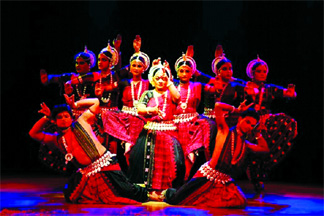
Odisha is the birthplace of Odissi, one of the eight classical dance forms of India. With its roots in ancient temple rituals, Odissi is characterized by graceful movements, expressive gestures, and intricate footwork. Dancers use mudras (hand gestures) to convey stories from Hindu mythology.
Folk Dances
Odisha boasts a variety of folk dances like Chhau, Sambalpuri, and Ghumura, each reflecting local traditions and cultural vibrancy. The Chhau dance, particularly from Mayurbhanj, combines martial arts and folk elements.
Music
Odisha has a rich musical tradition rooted in Odissi Sangeet, which is a form of classical music. The music, often accompanied by instruments like the veena, mardala, and bansuri, complements Odissi dance performances and devotional songs.
Festivals
Odisha’s festivals are colorful and deeply rooted in spirituality:
Rath Yatra
The annual chariot festival at the Jagannath Temple in Puri is one of the largest religious gatherings in the world.
Durga Puja
Celebrated with grandeur across the state, Durga Puja marks the victory of good over evil.
Bali Yatra
This festival commemorates Odisha’s ancient maritime connections and is celebrated on the banks of the Mahanadi River.
Makar Sankranti and Nuakhai
These harvest festivals celebrate agrarian traditions and community bonding.
Handicrafts and Textiles
Odisha’s artisans are renowned for their craftsmanship:
Pattachitra
Traditional scroll paintings depicting mythological themes and intricate designs.
Applique Work
Pipili appliqué craft, often seen during temple festivals, involves colorful fabric cutouts stitched onto cloth.
Ikat Weaving
Odisha’s handwoven Ikat sarees from Sambalpur and Sonepur are globally acclaimed.
Stone Carving
The art of stone carving, seen in Odisha’s temples, continues to thrive.
Architectural Marvels
Odisha is home to some of India’s most impressive architectural treasures. The state’s architecture reflects its religious and cultural history, particularly influenced by Hindu, Jain, and Buddhist traditions.
Temples of Odisha
The temples of Odisha are a testament to the state’s rich architectural heritage. Built primarily during the Kalinga period, these temples follow the Kalinga style of architecture, characterized by curvilinear spires, intricate carvings, and spacious courtyards.
Lingaraj Temple (Bhubaneswar)
Built in the 11th century, this temple is dedicated to Lord Shiva and represents the zenith of Kalinga architecture. The sanctum, tower, and carvings display exceptional craftsmanship.
Jagannath Temple (Puri)
One of the Char Dhams of Hindu pilgrimage, the Jagannath Temple is dedicated to Lord Jagannath (a form of Vishnu). Its massive structure and annual Rath Yatra attract millions of devotees.
Konark Sun Temple
A UNESCO World Heritage Site, the Konark Sun Temple is shaped like a colossal chariot with intricately carved stone wheels, pillars, and sculptures. Built in the 13th century by King Narasimhadeva I, it remains a masterpiece of Kalinga architecture.
Mukteshwar Temple
Known as the “Gem of Odisha Architecture,” this 10th-century temple is renowned for its exquisite carvings and arched gateway.
Buddhist Monasteries and Stupas
Odisha has a rich Buddhist heritage reflected in its ancient stupas and monasteries:
Ratnagiri, Udayagiri, and Lalitgiri
Known as the Diamond Triangle of Odisha, these sites contain remains of stupas, monasteries, and sculptures from the Buddhist era (7th-12th centuries CE).
Dhauli
The site where Ashoka embraced Buddhism after the Kalinga War, Dhauli houses the Shanti Stupa (Peace Pagoda).
Forts and Palaces
Barabati Fort
Located in Cuttack, this 14th-century fort was a prominent military stronghold during the medieval period.
Chilika Lake and Kalijai Temple
Though not an architectural site, the Kalijai Temple on Chilika Lake is a significant cultural landmark.
Political History of Odisha
Odisha’s political history is marked by the rise and fall of powerful dynasties, colonial domination, and post-independence development.
Ancient Dynasties
Mauryas and Ashoka
The Mauryan conquest of Kalinga marked a significant chapter in Odisha’s history.
Mahameghavahana Dynasty
Under King Kharavela (1st century BCE), Odisha witnessed a resurgence of Jainism and territorial expansion. Kharavela’s Hathigumpha inscription at Udayagiri provides insights into his reign.
Medieval Period
Somavamshi Dynasty
Between the 9th and 12th centuries, the Somavamshis established their rule in Odisha, contributing to temple construction.
Ganga Dynasty
The Ganga rulers, particularly King Anantavarman Chodaganga Deva, ushered in a golden era of Odisha’s art and architecture. The Jagannath Temple was built during this period.
Eastern Ganga Dynasty
The Ganga rulers continued their legacy, with the construction of the Konark Sun Temple marking the pinnacle of their achievements.
Surya Vamsi Gajapati Dynasty
In the 15th century, the Gajapati kings ruled Odisha with great prowess, expanding their influence to neighboring regions.
Colonial Rule
In the 16th century, Odisha came under Mughal rule and later the Marathas in the 18th century. In 1803, the British East India Company annexed Odisha, marking the beginning of colonial exploitation. The region became part of the Bengal Presidency until it gained separate identity as Odisha Province in 1936.
Modern Odisha
Post-independence, Odisha became a state of the Indian Union on April 1, 1936, celebrated as Utkal Divas. Since then, Odisha has made significant strides in socio-economic development while preserving its cultural heritage.
BJP term in Odisha
The Bharatiya Janata Party (BJP) assumed power in Odisha on June 12, 2024, marking a significant shift after five consecutive terms under the Biju Janata Dal (BJD).
Since 1946, Odisha has had 14 chief ministers. Serving from 2000 till 2024, Naveen Patnaik of the Biju Janata Dal was the longest-serving chief minister in Odisha’s history. The current Chief Minister of Odisha since 12 June 2024 is Mohan Charan Majhi of the Bharatiya Janata Party.
In collaboration with the state government, the 18th Pravasi Bharatiya Divas (PBD) Convention is scheduled to take place in Bhubaneswar from January 8 to 10, 2025. Prime Minister Narendra Modi is set to inaugurate the event, which will focus on the theme “Diaspora’s contribution to a Viksit Bharat.” The convention aims to engage the Indian diaspora in India’s development journey.
The BJP government in Odisha has been proactive in implementing policies to enhance the state’s growth trajectory. Prime Minister Modi has acknowledged these efforts, emphasizing the government’s commitment to development.
Additionally, the new administration has initiated investigations into alleged corruption during the previous BJD regime. Chief Minister Mohan Charan Majhi has pledged to probe all corruption cases from the BJD’s tenure, aiming to ensure transparency and accountability in governance.
The BJP’s rise to power in Odisha signifies a transformative period, with the government focusing on development, anti-corruption measures, and strengthening ties with the Indian diaspora through events like the upcoming PBD Convention. -

Rashtrapati Bhavan sheds 2 more colonial tags, renames halls
Durbar Hall now Ganatantra Mandap, (R) Ashok Hall rechristened Ashok Mandap.
New Delhi (TIP)- Rashtrapati Bhavan’s iconic Durbar Hall and Ashok Hall will now be called Ganatantra Mandap and Ashok Mandap, respectively. President Droupadi Murmu renamed the halls on Thursday, July 25, as she marked the completion of her two years in office. A statement from the President house said the Rashtrapati Bhavan, the office and the residence of the President of India, is a symbol of the nation, and an invaluable heritage of the people and continuous efforts are being made to make it more accessible to people. “There has been a consistent endeavour to make the ambience of the Rashtrapati Bhavan reflective of the Indian cultural values and ethos,” the communique said.
It said the Durbar Hall is the venue of important ceremonies and celebrations such as the presentation of National Awards. “The term ‘Durbar’ refers to courts and assemblies of Indian rulers and the British. It lost relevance after India became a Republic, that is, ‘Ganatantra’. The concept of ‘Ganatantra’ is deeply rooted in Indian society since the ancient times, making ‘Ganatantra Mandap’ an apt name for the venue,” the Rashtrapati Bhavan said as a reason behind rechristening an important feature of the complex.Ashok Hall, the President house said, was originally a ballroom. “The word ‘Ashok’ connotes someone who is ‘free from all sufferings’ or is ‘bereft of any sorrow’. Also, ‘Ashoka’ refers to Emperor Ashok, a symbol of unity and peaceful co-existence. The National Emblem of the Republic of India is the lion capital of Ashok from Sarnath. The word also refers to the Ashok tree, which has a deep significance in Indian religious traditions as well as arts and culture. Renaming ‘Ashok Hall’ as ‘Ashok Mandap’ brings uniformity in language and removes the traces of anglicisation while upholding the key values associated with the word ‘Ashok’,” the President house said.
Last year, the famous Mughal Gardens on the Rashtrapati Bhavan premises was rechristened ‘Amrit Udyan’.
Taking a swipe at the Modi government, Congress general secretary Priyanka Gandhi Vadra said: “There is no concept of ‘durbar’ but a concept of ‘shehanshah’… Interesting.” Party MP Karti Chidambaram termed it BJP government’s “fetish” for changing names, saying by doing so, they thought they were bringing back some past glory. Source: TNS -

Guiding spirits of the judiciary
It’s important to publicize decisions of judges who cannot be swayed by dangling carrots
The judiciary and the armed forces of Bharat are our last refuge for justice and security. They have not succumbed yet, unlike the police, the civil services and the media. But the onslaught is severe and relentless. We must salute those judges who are true to their conscience.
“If disturbed citizens don’t bemoan this disregard for judicial integrity due to a fear of reprisal in the form of contempt of court proceedings, our country will never be the same. It is the ‘suicide’ of justice that the citizens of Bharat should dilate upon. It is of utmost urgency that concerned citizens shed the fear they now harbor of raising their voices lest they are sent to jail for doing their duty to their motherland. Citizens are constantly told to excise dynasties from the political system. It is much more urgent to excise questionable means that serve political ends and breed dishonesty and corruption. Dynasties will die their natural deaths when more non-dynasts like Modi enter the political arena.”

By Julio Ribeiro The Madras High Court should be proud of Justice Anand Venkatesh, who suo motu ordered the reopening of a corruption case against Tamil Nadu Higher Education Minister K Ponmudy last month. Justice Venkatesh also ordered the reopening of another case of corruption, involving possession of assets disproportionate to known sources of income, against TN Revenue Minister KKSSR Ramachandran and Finance Minister Thangam Thennarasu. All is not lost. The judiciary and the armed forces are our last refuge for justice and security.
The case against Ponmudy was to be heard in a court in Villupuram. It was transferred by the administrative side of the Madras High Court to the court of the principal judge of Vellore for reasons not known to the public. Justice Venkatesh felt that the court in Vellore was “too hurried to be natural” and did not give any cogent reason for the minister’s acquittal.
The cases against Ramachandran and Thennarasu ended in their discharge by the Special Court at Villiputhur in Virudhunagar district. The cases had been adjourned for months and years, during which the two accused ministers were reinstated in the DMK Cabinet. The investigating police officer who had filed the chargesheets was replaced by another, who whitewashed the original findings, established when the AIADMK was in power.
It was apparent that the truth changed according to who was in power. If this is how the rule of law is going to be enforced in Bharat that was India, we, the citizens, will be forced to “cry for our beloved country”. The trend is truly frightening.
Take the case against Congress leader Rahul Gandhi in the Surat district court over a cheap joke he cracked without giving it a thought. The case came up before the Chief Judicial Magistrate. The prosecution obviously found the magistrate uncooperative. It approached the High Court in Ahmedabad and sought a stay on the proceedings, which was granted. When the Chief Judicial Magistrate was transferred, the prosecution got the High Court’s permission to resume the original proceedings.
We all know that for that poor joke, Rahul Gandhi was sentenced to two years in prison. He had to approach the Supreme Court for redress after failing to get it in the Gujarat High Court. The Supreme Court remarked caustically that there was something wrong with the High Court in Gujarat. Rahul, it is hoped, must have learnt a lesson from that episode.
But what are we to conclude about our judicial system from these two cases? A common thread that runs through both cases, one from Tamil Nadu where a government aligned to the Opposition’s INDIA bloc rules, and the other from Gujarat, where a ‘double-engine’ government is in power, is that the ruling party in a state can influence certain decisions. It is disturbing to find that criminal trials can be “derailed by the active design of those at the helm of political power,” as Justice Venkatesh observed in his order.
If disturbed citizens don’t bemoan this disregard for judicial integrity due to a fear of reprisal in the form of contempt of court proceedings, our country will never be the same. It is the ‘suicide’ of justice that the citizens of Bharat should dilate upon. It is of utmost urgency that concerned citizens shed the fear they now harbor of raising their voices lest they are sent to jail for doing their duty to their motherland. Citizens are constantly told to excise dynasties from the political system. It is much more urgent to excise questionable means that serve political ends and breed dishonesty and corruption. Dynasties will die their natural deaths when more non-dynasts like Modi enter the political arena.
All is not lost as yet. There are many upright, honest and conscientious judges like Justice Venkatesh in most states of the Union. We must celebrate them, like we celebrate upright, honest and conscientious civil servants and police officials who are true to their oath of serving the people. It is important that we publicize the decisions of such judges who cannot be swayed by dangling carrots.
When a calculated false propaganda was unleashed on maulvis, many from foreign countries, accusing them of spreading the Covid virus in India after attending a markaz in Delhi, Justices TV Nalawade and MG Sewlikar of the High Court of Bombay, sitting on a Division Bench in Aurangabad, discharged the accused and passed severe strictures against the government agency that brought them to trial unjustly. It required extraordinary courage to go against the ruling party’s propaganda machine. The judgment restored the citizens’ faith in the administration of justice.
Justice S Muralidhar of the Delhi High Court ordered the Delhi Police to register FIRs against a minister in Modi’s government and two other BJP leaders for spewing hate against those who were opposing the CAA and the NRC in Delhi. However, Justice Muralidhar was hurriedly transferred to the Punjab and Haryana High Court. He retired as the Chief Justice of the Orissa High Court. The government did not agree to give him the more important charge of the Madras High Court, which the Supreme Court Collegium had recommended. In 2018, the same judge had sentenced Congress leader Sajjan Kumar to life imprisonment in a 1984 Delhi riots case.
The judiciary and the armed forces of Bharat are our last refuge for justice and security. They have not succumbed yet, unlike the police, the civil services and the media. But the onslaught is severe and relentless. We must salute those judges who are true to their conscience.
(The author is a former ambassador and a highly decorated retired Indian Police Service (IPS) officer) -

One Nation, One Election: An idea fated to fail
“The idea of ‘one nation, one election’ is based on the premise that there should be countrywide elections to the state Assemblies and the Lok Sabha once in five years. It does not allow for the fact that party positions at the Centre and in the states would fluctuate, and there could be mid-term elections anytime. There was a mid-term election in Kerala in 1960 after the Communist Party government, which came into power in 1957, was brought down by the Congress. And there was a mid-term election in Bihar in 1969, and again in 1972. Similarly, West Bengal had gone through three elections in quick succession — 1967, 1969 and 1971. The instability came about because no party could get a majority and the elections had to be held till the decisive vote came. That is the way democracy functions.”
The Prime Minister’s tendency to simplify complex issues is at the root of the problem. He wants to eliminate complexity and uncertainty. That is indeed the way of authoritarianism and it comes in the garb of utopianism — an orderly republic with once-in-five-years elections across the country, and no hiccups in the process. If there are hurdles, they will be removed in the favor of those who are in power. So, the dance of democracy or the play of democracy, which we have been celebrating for the past several decades, is under threat.

By Parsa Venkateshwar Rao Jr. A countrywide election to the state Assemblies and the Lok Sabha was held every five years from 1951-52 to 1967. The cycle was disrupted when Indira Gandhi called an election in 1971, a year earlier than it was due, even as most of the states had their elections in 1972. The Lok Sabha election, which was due in 1976, took place in 1977 because of the Emergency. There were elections to the Lok Sabha in 1980 because the Morarji Desai-led Janata Party government fell in 1979, and Chaudhary Charan Singh, who had subsequently assumed charge as PM, could not prove his government’s majority.
The idea of ‘one nation, one election’ does not allow for the fact that party positions at the Centre and in the states would fluctuate, and there could be mid-term elections anytime.
In 1989, the VP Singh-led National Front formed the government, but it fell in 1990; Chandra Shekhar, too, had a short-lived tenure as Prime Minister. There were elections in the summer of 1991. Later, there were back-to-back elections in 1998 and 1999. The United Front government of IK Gujral was brought down by the Congress in 1998, and Atal Bihari Vajpayee-led National Democratic Alliance (NDA) formed the government, which lasted just a year as Jayalalithaa’s AIADMK withdrew support. In October 1999, the NDA came back to power under Vajpayee. It was at this time that election fatigue set in and there was talk that Parliament must have a fixed tenure. It was an idea mooted by the BJP.
The idea of ‘one nation, one election’ is based on the premise that there should be countrywide elections to the state Assemblies and the Lok Sabha once in five years. It does not allow for the fact that party positions at the Centre and in the states would fluctuate, and there could be mid-term elections anytime. There was a mid-term election in Kerala in 1960 after the Communist Party government, which came into power in 1957, was brought down by the Congress. And there was a mid-term election in Bihar in 1969, and again in 1972. Similarly, West Bengal had gone through three elections in quick succession — 1967, 1969 and 1971. The instability came about because no party could get a majority and the elections had to be held till the decisive vote came. That is the way democracy functions.
The idea of a fixed tenure — and ‘one nation, one election’ does not work if this is not the case — needs a lot of changes in the party system. In France, several governments rise and fall as coalitions change and the majority fluctuates. That is one way, a messy way. But the French are making it work. They do not go for an election once the government loses majority or is defeated on a legislative measure.
Then there is the example of the United States. The House of Representatives, with its two-year term, works because in the two-party system a few members cross over from the minority side to vote for the passage of laws. There is no anti-defection law and members of the Opposition who vote for the ruling party are not expelled.
And the same principle of compromise and cross-voting across the aisle works in the Senate with its six-year term. So, in these two systems, the fixed tenure is the rule, but conventions and traditions have been evolved to deal with the legislative business. The British system, like the Indian one, works on the majority principle. Once the party loses majority, elections are called.
Prime Minister Narendra Modi has been working on the BJP idea of a fixed tenure for Parliament so that a change in the party positions in Parliament does not necessitate an election before five years are over.
So, the BJP has not really worked out the idea of ‘one nation, one election’. And the ideologues who support the idea have no clue as to how to deal with the nitty-gritty to make it doable. The Prime Minister and his supporters believe that there is a need to eliminate political confusion. They fail to realize that it is the people of the country who are holding back from giving any one party an absolute majority.
The new system would require that one of the parties will have to have an assured majority, and one of the ways of doing it is to have a run-off, where a candidate has to get a minimum of 50 per cent of the vote. So, there would be run-offs for all Assembly and Lok Sabha seats. People will be forced to cast their vote for a person whom they do not approve of because they have to choose between two candidates and not more. In France, the run-off is only for the President’s post. It is indeed a debatable issue. There has to be a widespread debate and the people must have a say in the matter — perhaps through a referendum. Or the Modi government should fight the 2024 General Election on the plank of ‘one nation, one election’. But the government has to present before the people a detailed plan for implementing the idea.
The Prime Minister’s tendency to simplify complex issues is at the root of the problem. He wants to eliminate complexity and uncertainty. That is indeed the way of authoritarianism and it comes in the garb of utopianism — an orderly republic with once-in-five-years elections across the country, and no hiccups in the process. If there are hurdles, they will be removed in the favor of those who are in power. So, the dance of democracy or the play of democracy, which we have been celebrating for the past several decades, is under threat.
PM Modi wants an ordered and orderly democracy. And that is what the middle class wants, too. However, the people at large are likely to throw out the idea — if not now, then most probably in the future.
(The author is a senior journalist) -
Rahul Gandhi speaks his mind on his visit to the US
Rahul Gandhi in US

Rahul Gandhi gets a warm reception on arrival at the San Francisco airport on May 30, 2023. Seen among others is IOC USA President Mohinder Gilzian in white turban (Photo / PTI I.S. Saluja
NEW YORK (TIP): On his first visit abroad after being disqualified from the Lok Sabha, Rahul Gandhi spoke candidly on a number of national and international issues at a number of events which included a National Press Club appearance in Washington, D.C. , meetings with students at universities, and with the public in California and Washington D.C.
On a six-day visit to the US, Rahul Gandhi was in California on May 30 and 31 on the first leg of his tour where he spoke at the ‘Mohabbat Ki Dukaan’ event organized by Indian Overseas Congress USA in Santa Clara on Tuesday, May 30.
On May 31, he held interactions with Silicon Valley AI experts and startup entrepreneurs.
Rahul Gandhi was in Washington, D.C. on June 1 and 2 where he appeared at a number of events including the National Press Club appearance , held meetings with students, business and trade representatives, the Indian Diaspora organizations and with US lawmakers.
He would arrive in New York on June 3 on the last leg of his tour where the Indian Overseas Congress USA has planned a huge public meeting at the Javits Center in Manhattan on Sunday, June 4, and before that, on June 3, a dinner has been organized where Rahul Gandhi will meet people in an informal setting.
During his stay in New York, he will be meeting with representatives of various organizations and have interactions with a number of delegations . He will also speak to students.Indian Overseas Congress chairperson Sam Pitroda said Gandhi’s visit is aimed at promoting shared values and a vision of “real democracy”.
“The purpose of his (Gandhi’s) trip is to connect, interact and begin a new conversation with various individuals, institutions and media, including the Indian diaspora that is growing in numbers in the United States and abroad to promote the shared values and vision of the real democracy with a focus on freedom, inclusion, sustainability, justice, peace and opportunities world over,” Pitroda said in a statement on Sunday, May 28. The Indian Panorama brings you below the media coverage of Rahul Gandhi’s visit to the US from May 30 to June 2, 2023.
BJP can be defeated if Opposition is ‘aligned properly’: Rahul Gandhi

@RahulGandhi Interacts with activists, academics and civil society at University of California, Santa Cruz (Twitter photo) SANTA CLARA, CA (TIP): The ruling BJP can be defeated if the Opposition is “aligned properly” and the Congress party is working towards it and it is “coming along very nicely”, Rahul Gandhi has told Indian Americans here, citing his party’s emphatic victory in the recent assembly elections in Karnataka.
Responding to questions from the moderator and the audiences at an event at the Silicon Valley Campus of the University of California in Santa Cruz on Tuesday, Gandhi said he can clearly see “vulnerabilities” in the BJP.
“As a political entrepreneur, I can clearly see vulnerabilities in the BJP… The BJP can be defeated if the Opposition is aligned properly,” he said.
“If you look at the Karnataka elections, the general sense is that the Congress Party fought the BJP and defeated the BJP. But what is not well understood is the mechanics that we used,” he said.
The Congress party used a completely different approach to fighting an election and building a narrative, Gandhi said, adding that elements of what happened in Karnataka came out of the ‘Bharat Jodo Yatra’.
In the May 10 elections to the 224-member Karnataka Assembly, the Congress won 135 seats, while incumbent BJP and the former prime minister H D Deve Gowda-led Janata Dal (Secular) got 66 and 19, respectively.
Gandhi said in the Karnataka elections, the BJP spent 10 times more money than the Congress party.
He said the country needed an alternative vision to defeat the ruling Bharatiya Janata Party (BJP), in addition to having a united Opposition in the 2024 general elections.
“On the matter of opposition unity, we are working towards it and it is coming along very nicely. But I think in order to defeat the BJP, you need more than just opposition unity. Just opposition unity, in my opinion, is not going to be enough to do the job. I think you need an alternative vision to the BJP,” he said.
“Part of Bharat Jodo Yatra was the first step in proposing such a vision. It’s the vision that all opposition parties are aligned with. No opposition party would disagree with the idea of the Bharat Jodo Yatra,” he said.
Bharat Jodo Yatra (Unite India March) was a Gandhi-led mass movement aimed at uniting India. The yatra began on September 7 from Kanyakumari, passed through 12 states and culminated in Jammu and Kashmir on January 31. During the course of the yatra, Gandhi, 52, addressed 12 public meetings, over 100 corner meetings and 13 press conferences. He had over 275 planned walking interactions and more than 100 sitting interactions.
“So, I think bringing the opposition together is important, but also aligning the opposition and making the people of India understand that there is not just a group of opposition parties that have combined but a proposed way forward for the country. And we’re working on those things,” Gandhi said.
The ex-Wayanad MP said it is the president of the Congress party who will decide the prime ministerial candidate.
“We believe that everybody in India, regardless of who they are, whichever part of the society they come from, they should have a voice that voice should be respected, to be listened to be appreciated. And I think that voice is an asset,” he said.
In his address, Gandhi also took a dig at the ruling BJP government, saying it is “threatening” the people and “misusing” the country’s agencies.
“The BJP is threatening people and misusing government agencies. The Bharat Jodo Yatra started because all the instruments that we needed to connect with the people were controlled by the BJP-RSS,” he said.
“We were also finding that in some way, it had become quite difficult to act politically. And that’s why we decided to walk from the southernmost tip of India to Srinagar,” he said.
Gandhi said the yatra carried the spirit of affection, respect and humility.
“If one studies history, it can be seen that all spiritual leaders — including Guru Nanak Dev ji, Guru Basavanna ji, Narayana Guru ji — united the nation in a similar way,” he said.
Gandhi said India is not what is being shown in the media which likes to promote a political narrative that is far from reality, asserting that there is a “huge distortion”.
“It was very clear to me in the Yatra that it’s in the media’s interest to project these things, it helps the BJP. So, don’t think that everything you see in the media is the truth,” he said.
“India is not what the media shows. The media likes to show a particular narrative. It likes to promote a political narrative that is actually not what is going on in India,” he said.
The Congress leader arrived here on Tuesday, May 30 on a three-city US tour during which he will interact with the Indian diaspora and meet American lawmakers.
He had a first-hand experience of the American immigration system as he had to wait for about two hours along with his other co-passengers on the Air India flight because of the common shortage of staff at the US airports.
People were seen taking selfies with him and asking him questions. He was seen interacting and mingling with other traveler’s at the San Francisco airport.
(Source: PTI)Rahul Gandhi says PM Modi thinks he knows more than God, calls him ‘specimen’
SANTA CLARA, CA (TIP): There are people in India who think they know more than God and Prime Minister Narendra Modi is “one such specimen”, Congress leader Rahul Gandhi has said.
Speaking at the ‘Mohabbat Ki Dukaan’ event organized by Indian Overseas Congress USA in Santa Clara in the US state of California on Tuesday, May 30, Gandhi said these people are “absolutely convinced” that they know everything and can explain history to historians, science to scientists and warfare to the army.
“The world is too big and complicated for any person to know everything. That is the disease…There is a group of people in India who are absolutely convinced they know everything. They think they know even more than God.
“They can sit with God and explain to him what’s going on. And of course, our prime minister is one such specimen. If you sat Modiji with God, he would explain to God how the universe works and God will get confused about what have I created,” he said, evoking peals of laughter from hundreds of his Indian American supporters.
“They think they can explain history to historians, science to scientists and warfare to the army. But at the core of it is mediocrity. They’re not ready to listen!” he said.
Gandhi’s event was attended by community members not only in Silicon Valley but also from Los Angeles and Canada. Gandhi told the Indian Americans that the idea of India was under attack and is being challenged.
He applauded the Indian Americans for holding up the Indian flag in America, showing the American people what it means to be an Indian by respecting their culture and learning from them while also allowing the Americans to learn from them.
“You make us all proud. When we think of our country, you are all our ambassadors. When America says Indian people are extremely intelligent. Indian people are masters of IT, Indian people are respectful. All these ideas that have come, they’ve come because of you and because of your actions and your behaviors,” he said.
(Source: PTI)Rahul Gandhi says his disqualification from Lok Sabha has given him huge opportunity

Congress @INCIndia
Scenes from @RahulGandhi ji’s interaction with the Indian diaspora in San Francisco, California, in the United States.
Twitter photoSAN FRANCISCO (TIP): Congress leader Rahul Gandhi has said that he did not imagine his disqualification from Lok Sabha was possible when he joined politics but asserted that it has given him a “huge opportunity” to serve the people.
Gandhi, who is in the US for a three-city US tour, made the remarks on Wednesday, June 31 night in response to a series of questions from Indian students at the prestigious Stanford University Campus in California.
The Wayanad (Kerala) Member of Parliament was disqualified from Lok Sabha earlier this year after he was convicted by a Surat court in a 2019 criminal defamation case over his “Modi surname” remark.
In his remarks, Gandhi said that when he joined politics in 2000, he never imagined this is what he would go through. What he sees is going on now is way outside anything that he had thought when he joined politics.
Referring to his disqualification from Lok Sabha as a Member of Parliament, Gandhi, 52, said he didn’t imagine that something like this was possible.
“But then I think it’s actually given me a huge opportunity. Probably much bigger than the opportunity I would have. That’s just the way politics works,” he said.
“I think the drama started really, about six months ago. We were struggling. The entire opposition is struggling in India. Huge financial dominance. Institutional capture. We’re struggling to fight the democratic fight in our country,” he said, adding that at this point in time, he decided to go for the ‘Bharat Jodo Yatra’.
“I am very clear, our fight is ours fight,” he said. “But there is a group of young students from India here. I want to have a relationship with them and want to talk to them. It’s my right to do it,” he said during his interaction with Indian students and academicians of Indian origin at the University here.
He also emphasized in his frequent foreign trips like this, he is not seeking support from anybody.
“I don’t understand why the prime minister doesn’t come here and do it,” Gandhi asked amidst applause from the audience who had packed the entire auditorium at Stanford.
The moderator said that the Prime Minister is welcome to come to Stanford anytime and interact with the students and academicians.
Some of the students were denied entry as the auditorium was packed. Students started queuing up two hours before the event started. In the last one and a half years, several Indian ministers have interacted with Indian students.
(Source: PTI)Rahul Gandhi holds interactions with Silicon Valley AI experts, startup entrepreneurs
SUNNYWALE, CA (TIP): Congress leader Rahul Gandhi Wednesday, May 31 spent the first half of his day with Silicon Valley-based startup entrepreneurs, known for doing path-breaking work in the field of Artificial Intelligence and cutting-edge technologies.Sitting in the front row of the Plug and Play auditorium along with Indian Overseas Congress chairperson Sam Pitroda and some other key aides who have been travelling with him from India, Gandhi was seen engrossed in the panel discussion of experts on various aspects of artificial intelligence, big data, machine learning and their implications on mankind in general and on issues like governance, social welfare measures and also disinformation and misinformation.
Based out of Sunnyvale in California, the Plug and Play Tech Centre is one of the largest incubators of startups. According to its CEO and Founder Saeed Amidi, more than 50 per cent of the startups founder at Plug and Play have been Indians or Indian Americans. Amidi told PTI after the event that Gandhi has shown a deep understanding of the IT sector and his knowledge of the latest and cutting edge technologies are quite impressive.
Participating in a fireside chat with Amidi and Shaun Shankaran, founder of FixNix Startup, Gandhi tried to link all the technologies with the impact this would have on the common man in the remote villages of India.
“If you want to spread any technology in India, you have to have a system where power is relatively decentralized,” he said in response to a question and then went on to share with the select group of invited entrepreneurs about his personal experience of drone technology and its regulation, which, according to him, “faced massive bureaucratic hurdles”.
Data, Gandhi said, is the new gold and countries like India have realized the real potential of it. “There is need to have appropriate regulations on data safety and security”. However, on the issue of Pegasus spyware and similar technologies, Gandhi told the audience he is not worried about it. At one point of time he said he knows his phone is being tapped. And jokingly said, “Hello! Mr Modi” on his iPhone.
“I presume my iPhone is being tapped. You need establish rules with regard to privacy of data information as a nation and also as an individual,” he said.
“If a nation state decides that they want to tap your phone, no one can stop you. This is my sense,” he said. “If the nation is interested in tapping phone, then this is not a battle worth fighting. I think whatever I do and work, is available to the government,” he claimed.
Shankaran, who hosted Gandhi for the AI event at Plug and Play, said he is very much impressed about the knowledge he has shown about the latest developments in technology.
(Source: PTI)India, China relationship is going to be ‘tough’, says Rahul Gandhi

Rahul Gandhi speaks at a gathering during his US visit (Photo / ANI) SAN FRANCISCO (TIP): Congress leader Rahul Gandhi has asserted that India cannot be pushed around by China as he underlined that the relationship between the two neighbors is going to be “tough” and not an easy one.
Gandhi, who is in the US for a three-city US tour, made the remarks on Wednesday, May 31 night in response to a question from Indian students at the Stanford University Campus in California.
“How do you see the India-China relationship evolving in the next 5-10 years?” he was asked.
Gandhi replied, “It’s tough right now. I mean, they’ve occupied some of our territory. It’s rough. It’s not too easy (a relationship).” “India cannot be pushed around. That something is not going to happen,” Gandhi said.
India and China are also locked in a lingering border standoff in eastern Ladakh for three years.
The bilateral relationship came under severe strain following the deadly clash in Galwan Valley in eastern Ladakh in June 2020.
India has maintained that the bilateral relationship cannot be normal unless there is peace in the border area.
During his interaction at Stanford University, Gandhi supported New Delhi’s policy of having its relationship with Russia in the context of the Ukrainian war, despite the pressure it feels from the West.
“We have a relationship with Russia, we have certain dependencies on Russia. So, I would have a similar stance as the Government of India,” Gandhi said in response to a question when asked does he supports India’s neutral stance on Russia. At the end of the day, India has to look for its own interest. India, he said, is a big enough country whereby it generally will have relationships with other countries.
It’s not so small and dependent that it will have a relationship with one and nobody else, he added.
“We will always have these types of relationships. We will have better relationships with some people, evolving relationships with other people. So that balance is there,” the former Congress president said.
Supporting a strong relationship between India and the United States, Gandhi underscored the importance of manufacturing and both countries collaborating in emerging fields like data and artificial intelligence. Simply focusing on the security and defense aspect of this bilateral relationship is not enough he said.
(Source: PTI)BJP will be ‘decimated’ in the next three-four assembly elections: Rahul Gandhi
WASHINGTON, D.C. (TIP): Rahul Gandhi has said that the BJP will be “decimated” in the next three-four assembly elections by the Congress, emphasizing that they have the basic requirements that are needed to defeat the ruling party which do not have the support of the vast majority of the Indian population.
These remarks were made by Gandhi, who is in the US for a three-city US tour, on Thursday, June 1, at a reception hosted for him by eminent Indian American Frank Islam.
“There is a tendency of people to believe that this sort of juggernaut of the RSS and the BJP is unstoppable. This is not the case. I’ll make a little prediction here. You will see that the next three or four elections that we fight directly with the BJP will be decimated,” Gandhi said in response to a question at the reception.
“I can give it to you right now, that they’re gonna have a really tough time in these assembly elections. We’ll do to them the very similar stuff that we’ve done in Karnataka. But if you ask the Indian media that’s not going to happen,” he said.
The Congress secured a comfortable majority and ousted the BJP from power in Karnataka in the May 10 assembly elections. The visiting leader told the invited group of Indian Americans, members of the think-tank community and lawmakers that the Indian press is currently giving a highly favorable version of the BJP.
“Please realize that 60 per cent of India does not vote for the BJP, does not vote for Narendra Modi. That’s something you have to remember. The BJP has the instruments of noise in their hand, so they can shout, they can scream, they can distort, they can yell, and they are much better at doing that. But they do not have the vast majority of the Indian population (supporting them),” he said.
Responding to another question, Gandhi said that he is convinced that the Congress will be able to defeat the BJP.
Assembly elections will be held in five states — Madhya Pradesh, Chhattisgarh, Rajasthan, Telangana and Mizoram — later this year, setting the stage for the crucial general elections in 2024.
“Rebuilding the democratic architecture is not gonna be easy. It’s gonna be difficult. It’s gonna take time. But we are absolutely convinced that we have the basic requirements that are needed to defeat the BJP,” the 52-year-old former Congress party President said.
“You will hear from the media that Modi is impossible to defeat. A lot of it is exaggerated. Modi is actually quite vulnerable. There’s huge unemployment in the country, a massive increase in prices in the country, and these things in India, pinch people, very, very quickly and very hard,” he said.
“But it’s been a very interesting time for me to see how this process plays out. I would’ve never imagined that this is how democracy is attacked. This is the method of attacking a democracy. It has been very good for me,” he said responding to a question on his disqualification as an MP.
The Wayanad (Kerala) Member of Parliament was disqualified from Lok Sabha earlier this year after he was convicted by a Surat court in a 2019 criminal defamation case over his “Modi surname” remark.
“These are good things for me because they teach me and they crystallize exactly what I’m supposed to do and how I’m supposed to do it. I thank all of you for your support, your love and affection. It means a lot to me, especially coming to the United States and seeing that there are many, many people who are ready to fight for Indian democracy and protection,” he said.
(Source: PTI )Indian democracy is a ‘global public good’; its ‘collapse’ will have an impact on world says Rahul Gandhi

Rahul Gandhi at the National Press Club in Washington D.C. Photo / PTI WASHINGTON, D.C. (TIP): Asserting that Indian democracy is a “global public good”, Congress leader Rahul Gandhi has said that its “collapse” will have an impact on the world and is not in America’s national interest.
At the same time, Gandhi, who is currently on a six-day tour of the United States, said in multiple settings that the issue of democracy is an internal matter of the country, and he is committed to fighting against it.
“It’s our job, it’s our business, and it’s our work to fight the battle for democracy in India. “And it’s something that we understand, we accept, and we do,” he told reporters at a news conference here at the National Press Club on Thursday, June 1.
“But the thing to remember is that Indian democracy is a global public good. Because India is large enough that a collapse in democracy in India will affect…will have an impact on the world. So that is for you to think about how much you have to value Indian democracy. But for us, it’s an internal matter, and it’s a fight that we are committed to, and we are going to, we are going to win,” Gandhi said. He gave a similar answer to questions on democracy at a reception hosted for him by eminent Indian American Frank Islam.
Responding to a question, Gandhi said that there is a need to broaden the India-US relationship and it should not be restricted to just defense relationships alone. “India has to do what’s in its interest. And that’s what will guide us… So, I am not entirely convinced about the sort of autocratic vision that is being promoted. I think that it’s very important that democracy is protected on the planet. So, India has a role there. India, of course, has its view on things, and I think that that view should be put on the table, but I don’t think one should think about these things as the center of things. I think that’s, that would be arrogant,” he said.
“We understand the strengths that we bring to the table: democratic values, data, these are some of the things that technology, a highly educated, technically educated population. These are our strengths. I think we have to chart our course based on these strengths,” he said in response to a question on the India-US relationship.
During an interaction with the media at the National Press Club, Gandhi said that “the US and India have synergies, that if they come together can be very powerful. What we are facing is a particular vision of the world, the Chinese vision of the world that offers productivity, and prosperity, but under a non-Democratic field.”
“That’s not acceptable to us, because we simply cannot thrive under non-democratic. So, we have to think about productive production and prosperity in a Democratic field. And I think that’s where the bridge between India and the United States can play a very important role for us and for you,” he said.
Responding to a question on China, at a dinner reception, Gandhi said the Chinese system offers prosperity, but under a non-democratic system. “I feel that an alternative vision needs to be put on the table. I think that’s the real challenge facing the United States and India and other democracies. What exactly does a countervailing vision look like and what are the core elements of that vision?” he said.
“I think we are in the midst of a number of transitions. We are in the midst of a transition in mobility, a transition in energy, a transition in communication. How do we, how do we think about those transitions? I think those are really the big questions. Of course, uh, with regards to the United States, we have cooperation on defense, and that’s very important, but I think it’s equally important to widen the relationship and make it broader so it’s more secure,” Gandhi said.
China is occupying Indian territory, the former Congress party chief claimed.“It’s an accepted fact. I think 1,500 square kilometers of land the size of Delhi is occupied by them. It’s absolutely unacceptable. The Prime Minister seems to believe otherwise. Maybe he knows something that we don’t know,” he said at the National Press Club.
(Source: PTI) -

Beta, beti, bhai and biwi… the ‘nepo’ netas in the fray
Parivarvaad and Indian politics go hand in hand. The upcoming Karnataka Assembly elections are no exception. The Congress, often targeted for dynastic politics, is not the one to change. Its list of candidates is rife with nominees from political families. The Bharatiya Janata Party (BJP) and Janata Dal (Secular) also have names in the fray from influential backgrounds.
There are daughters, sons, wives and brothers in the running. It’s all in the family.
Let’s take a look at the big candidates fighting the Karnataka Assembly elections 2023 with ties to powerful political families.
Congress’ ‘dynasty’ politics?
Former chief minister and Congress veteran Siddaramaiah has replaced his son Yathindra from the Varuna seat. In the 2018 assembly election, the current chief minister hopeful had given this seat to his son.
Congress president Mallikarjun Kharge’s son Priyank Kharge has been nominated from Chittapur SC seat.
Karnataka Congress chief DK Shivakumar’s nomination has been accepted by the election commission from the Kanakapura assembly constituency, reported NDTV. In a surprise move, his brother – Bengaluru Rural MP DK Suresh – had filed nomination papers from the Kanakapura constituency on Thursday (20 April). As per Hindustan Times (HT), it was a precautionary step by Congress in case Shivakumar’s nomination was disqualified.
Lingayat heavyweight Shamanur Shivashankrappa has been given a ticket from Davanagere South, while his son SS Mallikarjun is a candidate from the Davanagere North constituency.
KH Muniyappa is a candidate from Devanahalli (SC) seat, while his daughter Roopakala M has been nominated from Kolar Gold Field- SC seat.
Karnataka Congress working president and former minister Ramalinga Reddy is contesting from BTM Layout and his daughter – MLA Sowmya Reddy – has again been fielded from the Jayanagar seat.
M Krishnappa and his son Priyakrishna will contest from Vijaynagar and Govindraj Nagar, respectively.
Nivedith Alva, son of Congress veteran Margaret Alva, has been fielded from Kumta.
JD(S) – All in the family?
Most family members of former prime minister HD Deve Gowda are in politics and this is more highlighted by JD(S)’s ticket distribution. Father-son duos have also been nominated by the JD(S).
Deve Gowda’s son HD Kumaraswamy has been Karnataka’s chief minister twice. Kumaraswamy will contest from the Channapatna seat, while his son Nikhil has been fielded from Ramanagara – the constituency currently held by his mother Anitha.
Holenrasipura MLA HD Revanna, Deve Gowda’s other son and Kumaraswamy’s older brother, is again contesting from the seat.
Revanna’s wife Bhavani wanted a ticket from the Hassan Assembly seat, however, Kumaraswamy resisted the idea, reported NDTV. Swaroop Prakash has been given a ticket by the party from the constituency.
GT Devegowda is JD(S)’s candidate from Chamundeshwari, while his son Harish Gowda has been nominated from Hunsur.
‘Parivarvaad’ in BJP?
Karnataka chief minister, Basavaraj Bommai, is the son of former chief minister the late Somappa Rayappa Bommai. The incumbent chief minister is the BJP’s candidate from Shiggaon in the Haveri district, where he will face Congress’ Yasir Ahmed Khan Pathan.
Former Karnataka chief minister and party strongman BS Yediyurappa is not contesting the elections.
As per a PTI report, Yediyurappa followed in his “lucky” Ambassador car when Vijayendra went to file his nomination for the May 10 Assembly election.
MLA Ravi Subramanya, who is seeking re-election from Basavanagudi, is the uncle of Bengaluru South MP Tejasvi Surya.
Mining baron Gali Janardhana Reddy’s brothers – Somashekhar Reddy and Karunakar Reddy – will be contesting from Bellary City and Harapanahalli, respectively.
Ramesh Jarkiholi and Balachandra Jarkiholi are brothers, with the former allotted a ticket from the Gokak seat and the latter from Arabhavi.
The family of late minister Umesh Katti, a Lingayat leader from the Belagavi district, has received two tickets. His son Nikhil Katti is the candidate from the Hukkeri Assembly seat and the late minister’s brother Ramesh Katti is fighting from Chikkodi -Sadalaga seat, as per The Hindu.
BJP MP Karadi Sanganna’s daughter-in-law, Manjula Amaresh, has been given the ticket from Koppal. According to an Economic Times report, he sought the ticket for himself but the party was not in favour of fielding him or any of his family members. After he allegedly threatened to quit the party, the BJP took the move to nominate Amaresh so as not to lose another Lingayat leader.
Snubbing sitting MLA Aravind Limbavali from Mahadevapura (SC) constituency, the BJP has nominated his wife Manjula Aravind Limbavali from the seat.
Minister Shashikala Jolle is the nominee from the Nippani seat. Her husband Anna Saheb Jolle is a member of parliament from Chikkodi.
Chincholi candidate Avinash Jadhav is the son of Gulbarga MP Umesh Jadhav.
Chandrakant Patil, a candidate from Gulbarga North, is the son of BG Patil who was an MLC.
Both Karnataka transport minister B Sriramulu (Ballari) and his nephew TH Suresh Babu (Kampli) have been given tickets.
Tourism minister Anand Singh has been replaced by his son Siddharth Singh as the Vijayanagar candidate.
Source: Firstpost -

KARNATAKA ELECTIONS
After Lord Rama & Bajrangbali, Arjuna part of election rhetoric
New Delhi (TIP)- Lord Rama, Bajrangbali, ace warrior Arjuna — heroes of the Ramayana and the Mahabharata — continue to dominate the Karnataka election rhetoric even as the Vishwa Hindu Parishad (VHP) held protests across the state against Congress’ poll promise to ban the Bajrang Dal. The Bajrang Dal is the youth wing of the RSS affiliate, the VHP. On campaign trail on Thursday, May 4,Congress general secretary Priyanka Gandhi Vadra while addressing a rally at Kanakgiri in Koppal urged voters to become “Arjuna”.
“You should all become Arjunas of the Mahabharata. Like him, set your eyes on the goal of voting for your developed and prosperous future. No matter how big a leader comes and says something, do not stray from your goal. Stay focused on issues that concern you and your lives,” Vadra said. She also accused the ruling BJP dispensation in the state of being a “40 per cent commission” government.
This even as BJP’s star campaigners led by Prime Minister Narendra Modi continued to start and end their rallies with “Jai Shri Ram” and “Jai Bajrangbali” chants.
In a new twist to the Bajrang Dal controversy, Congress general secretary (communications) Jairam Ramesh today reminded the BJP whether it was an insult to Lord Rama when saffron governments banned the Sri Ram Sene.
“The PM’s hypocrisy, especially when in despair and desperation, has no limits. On August 20, 2014, (then) Goa CM Manohar Parrikar banned the Sri Ram Sene. In 2020, the BJP government in Goa again banned the Sri Ram Sene for 60 days. Did the PM consider this an insult to Lord Rama?” asked Ramesh as the BJP spun the Congress promise of banning the Bajrang Dal into an “anti-Lord Hanuman” narrative. Source: TNS -

United Opposition supports Rahul, BJP points at ‘feudal mindset’
New Delhi (TIP)- The disqualification of Congress leader Rahul Gandhi from the Lok Sabha sparked strong political reactions across the board on Friday, March 24, with the party vowing to launch mass protests and calling it an assault on freedom of speech, and the Bharatiya Janata Party (BJP) calling his behaviour feudal and accusing him of insulting a community. A number of other Opposition parties – including some opposed to the Congress – also closed ranks and backed Gandhi, criticising the government.
During a meeting of Congress leaders on March 24, one Member of Parliament (MP) said all party MPs should tender mass resignation but no final decision was taken, said people aware of the developments. Congress leader Priyanka Gandhi Vadra said that a reply should be given to the disqualification through the party’s victory in the upcoming Karnataka elections and a committee will be formed to take further decisions.
“They (BJP) tried all ways to disqualify him. They don’t want to keep those who are speaking the truth but we will continue to speak the truth. We’ll continue to demand JPC (joint parliamentary committee) probe (into Adani issue). If needed we’ll go to jail to save democracy,” Congress chief Mallikarjun Kharge said.
The BJP accused Gandhi of being a “habitual loose cannon” with a “feudal mindset” and having little respect for marginalised communities . “I want to ask Mallikarjun Kharge, is abusing other backward classes (OBCs) considered speaking the truth? Do you consider the feudal mindset as truth… this is not the truth, its arrogance,” said Union minister Dharmendra Pradhan.
A string of other opposition parties also attacked the government. “In PM Modi’s New India, Opposition leaders have become the prime target of BJP…Today, we have witnessed a new low for our constitutional democracy,” tweeted West Bengal chief minister Mamata Banerjee.
Kerala chief minister Pinarai Vijayan called the disqualification decision hasty and proof of authoritarianism. “This brazen assault is an insult to our democratic values and can’t be overlooked. It must be unequivocally denounced,” he said.
“The expulsion of Rahul Gandhi from the Lok Sabha is shocking. The country is passing through very difficult times,” Delhi chief minister Arvind Kejriwal said. Congress leader Abhishek Singhvi indicated the party will challenge Gandhi’s conviction on various grounds, including the process of his disqualification.
Union information and broadcasting minister Anurag Thakur criticised Gandhi for his performance as a lawmaker and said, “In 13 years, Rahul participated in only 21 discussions and did not introduce a single Private Member’s Bill. He is the epitome of unparliamentary behaviour.”
Thakur said it seems like a “well-planned conspiracy” within the Congress to “get rid of” him by not challenging the Surat court’s verdict on time despite having a battery of lawyers. Thakur said the Speaker had nothing to do with his disqualification. “It was done in full conformity of Section 8 of Representation of People’s Act, Section 102(1) E of the constitution,” he added.
Source: HT -
Honor of office: On new Governors of States appointed by the Center
Those required to stay away from partisan politics in current role must not be made Governors
A former judge of the Supreme Court of India and a former Indian Army commander are among the new Governors of States appointed by the Centre on Sunday. The Governors of several States and the Lieutenant-Governor of a Union Territory were also shuffled. In recent years, Governors have sought to play a political role in States such as Jharkhand, Kerala, Tamil Nadu and West Bengal, creating a train of controversies. Judiciary reasons, the roles of the military and the judiciary too are topics of interest, particularly with regard to their relationship with the political executive. The executive government’s eagerness to control judicial appointments, besides the debate on the collegium system of judges appointing judges, is evident. It has selectively delayed and accelerated appointments recommended by the collegium, effectively exercising powers that it does not have in appointing judges. The Bharatiya Janata Party (BJP) has also faced charges of using the armed forces to further its political narratives. Earlier too, retired police and intelligence officers went on to occupy Raj Bhavans, but it was the appointment of a retired Chief Justice of India (CJI) as a Governor in 2014 that created a new precedent. Another retired CJI was nominated to the Rajya Sabha, in 2020, raising eyebrows.
The institution of the Governor is a legacy of the British imperial governance structure. The legitimacy of a nominated Governor in a democracy was the topic of a heated debate in the Constituent Assembly, but it was carried on into the new republic nevertheless. The Governor was to act as a dynamic link between the Centre and the State, but the makers of the Constitution were clear that the posts must remain ornamental, except in very narrowly defined situations in which they were allowed discretion in decision-making. Over the decades, the overreach of Governors has become a serious question in Centre-State relations and democracy in general. The dominance of the BJP at the Centre since 2014 has added fresh tensions with the States. The BJP has a vision of national unity that causes anxiety among regional interest groups. The office of the Governor was to be embellished by the personalities of those who would occupy it. Opening it as a post-retirement possibility for those who are required to stay aloof from partisan politics in their current roles, lowers the dignity of the offices that they leave behind and what they go on to occupy.
(The Hindu)
-
Post-retirement appointments: a danger to judicial independence

Justice S. Abdul Nazeer. (Photo Credit/ The Hindu) Post retirement, the judicial community should take a concerted decision not to accept any job stemming from political patronage
Justice Y.V. Chandrachud had said that the greatest danger to the judiciary lies within. Members of the judiciary cannot compromise judicial independence by trading it for a plum post-retirement sinecure. When one becomes a judge, one signs up to fulfil a promise of ensuring a fair and independent judiciary; this promise cannot be compromised at any cost. Our judges need to be gently reminded of this unwritten contract they have with the Indian people.

By A.P. SHAH Within a month of retiring from the Supreme Court of India, Justice S. Abdul Nazeer has been appointed Governor of Andhra Pradesh. Like many others, I believe it is no coincidence that he was a part of the Constitution Bench that decided the Ayodhya Ram Mandir land issue. In the tenure of the Narendra Modi-led government since 2014, he is the third Supreme Court judge who has received a high-profile political appointment soon after retirement, the other two being Justice P. Sathasivam (who was appointed Governor of Kerala), and Justice Ranjan P. Gogoi (who was appointed member of the Rajya Sabha).
These appointments are all signalling on the part of the government, letting the members of the higher judiciary know that they will be suitably rewarded if they issue favorable decisions. Dangling such a proverbial carrot is akin to corrupting the judges, and encouraging a culture of sycophancy even, as we are increasingly seeing among some judges in the apex court. Worse, this also makes the public have less faith in the judiciary itself. In 1980, Justice V. D. Tulzapurkar had said that “if judges start sending bouquets or congratulatory letters to a political leader on his political victory, eulogizing him on assumption of high office in adulatory terms, the people’s confidence in the judiciary will be shaken.”
Chipping away at judiciary
While a Governor’s position may seem largely ceremonial, it is in fact a squarely political appointment. In any event, this appears to be a part of the ruling party’s strategic mission — a long game, if you will — to destabilize the judiciary, chipping away in small and big ways at various aspects of its functioning. If you step back and observe, the judiciary is slowly but surely being subtly weakened.
To be fair, this is not the first government that has ventured so far as to corrupt the judges in this fashion. Congress-led governments, notably under Indira Gandhi and Rajiv Gandhi, have done it too. But it is a cowardly defense that the Opposition party was equally guilty, and past precedent does not justify present transgressions. The larger objective, for any reasonable executive, should be to ensure the independence of the other arms of the governing mechanism, and that democratic values are preserved in all circumstances. However, a conclusively majoritarian mandate can make one heady with power, and compel the exploration of creative ways in which that power can be maintained and consolidated further. This is entirely the case with the Indian government today.
Hypocritical behavior
The government’s behavior is also hypocritical for it is deliberately paying no heed to its own manifesto articulated by its late leader, Arun Jaitley, that such post-retirement judicial appointments should be avoided. In fact, ‘inducing the judges’ by such appointments was a specific allegation directed by the Bharatiya Janata Party (BJP) against the Congress-led coalition.
The judiciary is no less culpable in this situation. Ideally, I would like to believe that Indian judges are made of stronger stuff, and not ones to be seduced thus. Judges should show moral responsibility and character, as Justice Akil Kureishi most recently did. After being unceremoniously disregarded for elevation, and shoved across the country to various High Courts, upon retirement, he said that the government’s stated ‘negative perceptions’ about him were a ‘certificate of independence’, and he was leaving the judiciary with ‘his pride intact’.
Judges must recognize that handouts from the government, in the form of such political appointments, are not one-way: there is a giver and there is a receiver. The Indian judiciary must distinguish between political favors and other post-retirement employment opportunities.
Demarcation of roles
There needs to be a demarcation between roles where the presence of a judicial authority is clearly valuable and even necessary, such as in a tribunal or a commission, and where it is not. Justice Gogoi, upon his appointment to the Rajya Sabha, had famously proclaimed that he intended to bridge the gap between the judiciary and the legislature, but his attendance record and public participation in parliamentary affairs suggest nothing of the sort. Similarly, Justice Sathasivam had said he had wanted to serve the people in his role as Governor, but surely, he could have achieved the same objective through other appointments, that would be more befitting of someone who had held the office of the Chief Justice of India.
Ideally, the judicial community should take a concerted decision on this, say, in the Chief Justices’ conference. The plenary should agree that judges should not take up any appointments upon retirement stemming from political patronage (with the nature of such appointments being clearly defined). Additionally, a cooling period of about two years should be considered a mandatory minimum before a judge agrees to take on any post-retirement adjudicatory role, in any case.
Justice Y.V. Chandrachud had said that the greatest danger to the judiciary lies within. Members of the judiciary cannot compromise judicial independence by trading it for a plum post-retirement sinecure. When one becomes a judge, one signs up to fulfil a promise of ensuring a fair and independent judiciary; this promise cannot be compromised at any cost. Our judges need to be gently reminded of this unwritten contract they have with the Indian people.
(A.P. Shah is former Chief Justice, Delhi High Court and Former Chairperson, Law Commission of India)
-
President’s rule in Punjab is not a good idea
One has been hearing a demand by certain sections of politicians, both in Delhi and in Punjab for imposition of president’s rule in the state of Punjab, following the lapse in the security of Prime Minister Narendra Modi on his visit to the state.Prime Minister was to announce developmental schemes and address a party rally in Ferozepur in Punjab. He was to travel from Bathinda to Hussainiwala by a helicopter where he was to pay tribute to the three martyrs -Bhagat Singh, Rajguru and Sukhdev. But a bad weather forced him to make changes to his travel plan.
It was decided that he would travel by road from Bathinda to Hussainiwala- a good two hours’ drive. Somewhere on the road some 20 miles shy of Hussainiwala his convoy had to stop because there were, as alleged, protesting farmers who had blocked the road.Prime Minister’s convey was held up there for about 20 minutes. And then the PM returned to Bathinda where he told a Punjab government official to convey his thanks to Punjab chief minister that he had come back alive to Bathinda.
The Prime Minister’s remark generated all kinds of conspiracy theories. The central government blamed the Punjab government for the lapses and Punjab government defended its police officers, administration and itself by saying that the security of the Prime Minister is the responsibility of the SPG which cleared all plans of movement of the Prime Minister. However, since Punjab is going to elections in the next couple of months, the state is politically surcharged.
The BJP which has lost ground in Punjab, after its break with SAD knows very well that it doesn’t have the kind of strength to win elections and therefore, it decided to go with Capt Amarinder Singh only to realize soon that Capt did not have enough sway in the State and that an alliance with his party was not going to get them the number of assembly seats they wanted.
The Indian Panorama had pointed out a couple of months ago when the center had given BSF special powers and control over 50 kilometers of area of the state of Punjab along the Pakistan border that it was the beginning of an exercise to prevent elections in Punjab. Today, we hear a clamor for imposition of president’s rule. Unconfirmed reports say that when Prime Minister Modi and Home Minister Shah went to President Kovind and requested him for imposing President’s rule, President did not oblige them. BJP leaders demanding President’s rule in Punjab say that because Punjab government is not able to secure law and order which is evident from the lapse in the security of the Prime Minister, the government has no right to remain in power.
The fact is that BJP government is looking for a pretext to not hold elections in Punjab knowing full well that it has no chance of winning enough seats to be able to in any way form a government. Therefore, it is better that elections are not held. What the BJP wants is a number of Rajya Sabha members from any state because that is where they need people. They need people to be able to amend the Constitution to make India a theocratic state, a Hindu Rashtra. If opposition parties have their Raja Sabha members, that will weaken the strength of the BJP in the parliament.We are concerned over this scenario. It’s not going to help democracy in the country. It is not going to serve the interests of the people of India. It is not going to serve the interests of the people of Punjab, and it certainly will be a bad precedent if the BJP government at the center made the issue of lapse in the security of the Prime Minister a reason for imposition of President’s rule in Punjab.