Tag: BJP

  • Goa for BJP: Alchemy of making minority into a majority

    Goa for BJP: Alchemy of making minority into a majority

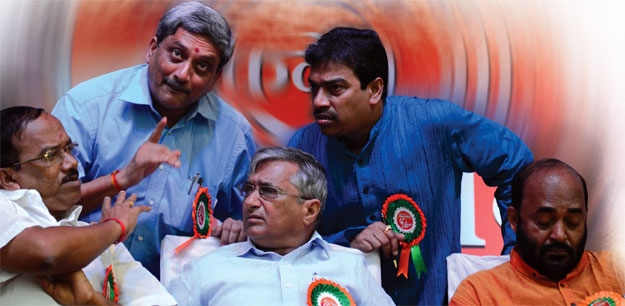
    As expected the Manohar Parrikar government in Goa was able to prove its majority on Thursday, March 16, following a Supreme Court directive. Once the Governor had decided to invite the former Defence Minister, Parrikar to form the government, even though the Congress had emerged as the largest party, the dice got loaded in favor of the BJP.

    In the end, the BJP with just 13 MLAs in a house of 40 managed to conjure up a slate of 22 legislators for voting in favor of chief minister Parrikar. The vote and the outcome are in perfect harmony with the Goan political culture of smaller parties and independents making themselves available for the highest bidder.

    As the BJP is politically ascendant nationally and is flush with resources and imbued with resourcefulness, there was little doubt about its ability to win this round in Goa. Even before the final vote on Thursday, the Congress was making allegations of money changing hands.

    It is the irony of our times that the winner not only gets to write the history but also re-writes the norms; it would be seen as cussedness to point out the ethical dimension of the denouement:  the BJP was in power and it lost the majority in the election, ending up with only 13 MLAs yet storming its way back into power.  Most curious and inexplicable is the case of all the three MLAs, belonging to the Goa Forward Party, siding with the BJP; in disgust, the GFP president, Professor Prabhakar Timble resigned from the party, accusing the BJP of inflicting a ‘political mafia raj’.  So be it. The BJP’s cocky leadership would have the satisfaction of having one more state government under its belt.  

    Within days all the righteous anger about a ‘stolen government’ would subside.  No one should be surprised if some of the Congress MLAs end up crossing over to the winning side.  Goa would return to its happy and carefree habits and preferences. Above all, Manohar Parrikar’s exile in Delhi ends. Goa gets a chief minister it deserves and the country will, hopefully, get a defence minister it badly deserves.


  • NOOYI MEETS MODI, OFFERS HELP TO MEET ‘DEVELOPMENT GOALS’

    NOOYI MEETS MODI, OFFERS HELP TO MEET ‘DEVELOPMENT GOALS’

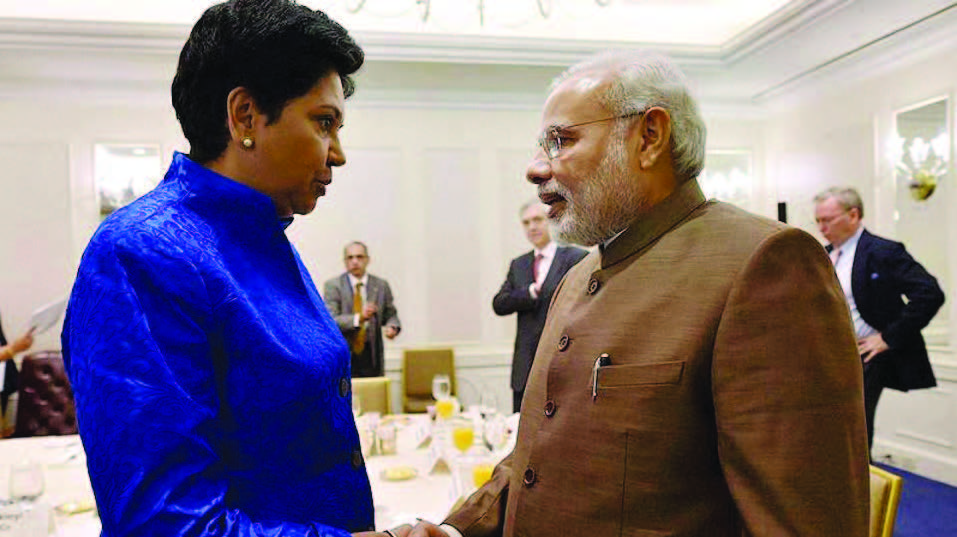
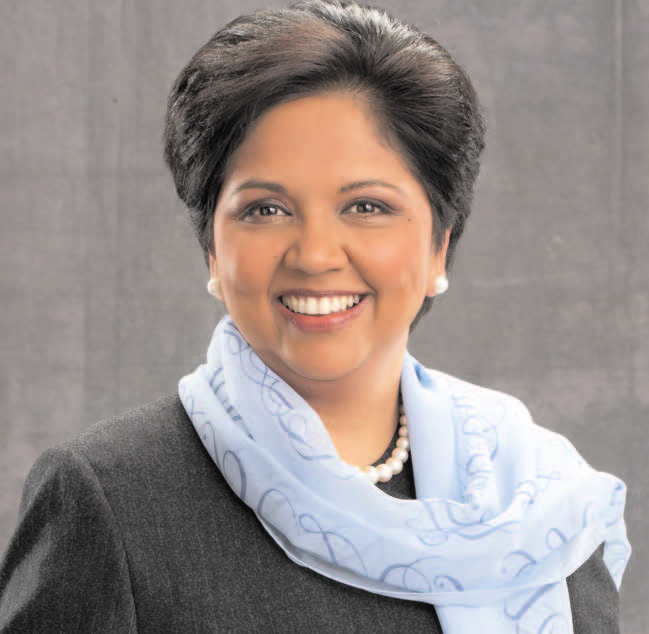
    NEW DELHI (TIP): #PepsiCo Chairperson #IndraNooyi today met Prime Minister @NarendraModi and offered the company’s participation in the government’s efforts to deliver on national development goals, especially in supporting farmers.

    She also apprised the Prime Minister on how PepsiCo’s new Quaker Oats products that take traditional recipes can contribute to improving health of Indian consumers.

    “As I shared with Prime Minister Modi, PepsiCo is well positioned to help the government deliver on the national development goals he has outlined for farmers and supporting their livelihoods,” she said in a statement. Nooyi further said: “The Prime Minister and I had an engaging dialogue on how PepsiCo is making investments to grow, process and use more Indian-grown fruit juice in our sparkling beverages.”

    She also said they discussed on how PepsiCo is focusing on new health-oriented products with local recipes. “We also discussed our launch of new Quaker Oats products that take traditional recipes and add in whole grain Quaker Oats to help Indians start their day in a healthy way,” Nooyi added.

  • Time for a frank debate on freedom of speech and nationalism

    Time for a frank debate on freedom of speech and nationalism

    Bundle of nerves: Are we getting paranoid about freedom of speech?

    KC Singh

    The rise of Modi and the continued Cabinet slots for those preaching sectarian hatred is not much different from President Trump listening to the whisperings of Rasputin-like Stephen Bannon, erstwhile publisher of Breitbart News – the mouthpiece of ‘alt-right’, who is White House chief strategist”, observes the author – KC Singh


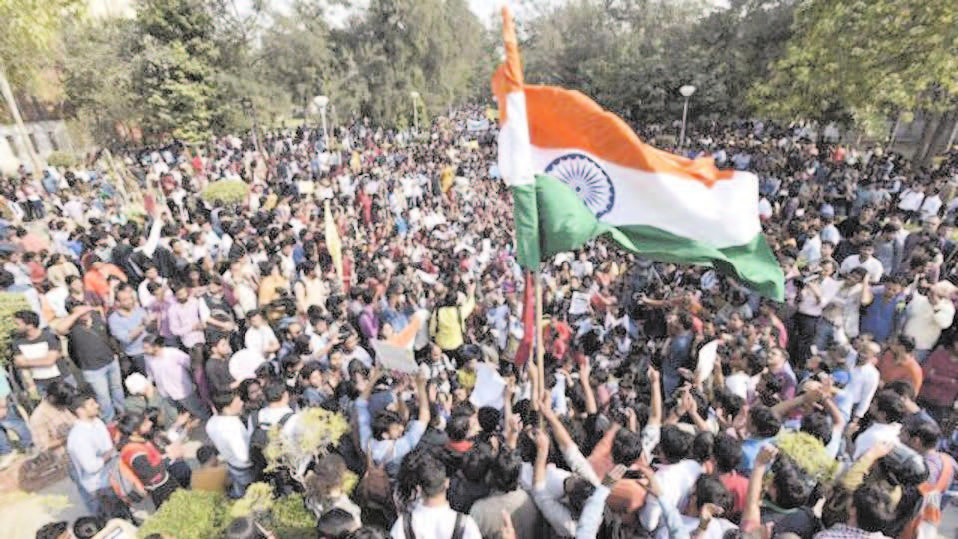
    Two events over the last few days, on opposite continents of the world, raise questions about the future of democracy in the US, the world’s most powerful, and India, the world’s most populous. On February 22, Srinivas Kunchibhotla was gunned down in Kansas, sharing a drink with a friend after work, by a white US navy veteran, in patently a hate crime. In India, at Ramjas College, New Delhi, a fracas broke out when BJP-aligned students’ union, ABVP, disrupted a function organized by campus students not aligned to them and invitees from JNU. The passively observant police intervened, more to rough-up the organizers than restrain ABVP disruptors. The allegation is that anti-national slogans were in the air.

    The attention got diverted from the melee when a young student, Gurmehar Kaur posted on social media placards denouncing the ABVP high-handedness, arguing that like her father – martyred fighting militants in Kashmir when she was little – she was unafraid to confront intolerance. The battle lines got promptly drawn, with intemperate remarks or tweets by an actor, a cricketer, a Union minister of state, and so on. In Gurmehar’s defense rose up senior journalists, retired soldiers, television anchors, etc. By nightfall, BJP spokesmen began distancing themselves from Gurmehar’s tormentors as their standard dubbing of any critic as anti-national did not work against a martyr’s daughter. The elections in UP also made it unwise to offend serving and retired servicemen.

    The distraction aside, the issues in the US and India are not that apart. The rise of Modi and the continued Cabinet slots for those preaching sectarian hatred is not much different from President Trump listening to the whisperings of Rasputin-like Stephen Bannon, erstwhile publisher of Breitbart News -the mouthpiece of ‘alt-right’, who is White House chief strategist. Both leaders prefer political rallies and one-way communication with chosen media outlets than transparent and frank interaction with the media. If Modi has never contradicted ministerial colleagues tarring the media with the abusive phrase ‘presstitutes’, Trump does one better by directly and almost daily referring to ‘The Fake News’. At a Florida rally, he confidently advocated -uncaring that independent media strengthens democracy – that media ‘is not my enemy, it is the enemy of the American people’. A former President, George Bush, has been constrained to contradict Trump’s condemnation of the media, despite both being Republicans.

    Both the racist killing of an Indian techie in Kansas and the ABVP use of violence to drown alternative views spring from identical philosophies and narrow visions. In case of India, it brings up the freedom of speech, while in the US it raises the spectra of nativism fed by a mix of xenophobia and fear of Islam. It is thus supremely ironical that while the Indian Government sends Foreign Secretary S Jaishankar to intervene with the US on the rising danger to Indian diaspora from white vigilantism, when under their noses similar intolerance is being happily marketed daily from election platforms in UP.

    Illustratively, RL Stevenson related the story about George Meredith, author of the 19th century novel, The Egoist, written to purge Victorian England of this evil, that when a young friend of the writer complained that the protagonist ‘Willoughby is me’, the writer replied: ‘No, my dear fellow, he is all of us.’

    The issues arising need a closer analysis. At stake in India is the definition of freedom of speech. Having inherited the common law-based criminal justice system from the British, India clings to antiquated laws on sedition. In the US too, immediately after their independence they enacted a sedition Act, which was allowed to lapse in 1801 as the nation matured and gained self-confidence. Following the Bolshevik Revolution in Russia, the fear of Communism made the US pass the Federal Espionage Act in 1917. Thus, while the British Common Law treats freedom of speech as ‘residual freedom’, circumscribed by societal needs of morality and public order, the US Supreme Court started treating it as a ‘fundamental right’ flowing from the First Amendment from 1925. In 1969, it upheld the right of students to wear black bands to protest Vietnam War. Justice OW Holmes ruled that while a nation is at war, many things that can be said in time of peace are taboo, but the test has to be whether there is ‘clear and present danger’ of sedition, not merely the expression of an opinion or a thought. What a person, in the exercise of his freedom of expression, is doing must be more than public inconvenience or annoyance, or even unrest.

    India, with a concept of ‘Fundamental Rights’ borrowed from the US practice has to assess if what happened at JNU earlier, or now at Ramjas College, passes the Holmes test. The definition of nationalism cannot be crafted in Nagpur and implemented by an evangelical lynch mob. Is that not the same question that the US is today required to answer, whether ordinary whites carrying guns can ask any non-white to prove their immigration status, or why they are in the US at all. So, the diaspora that came to Madison Square Garden to chant ‘Bharat Mata ki Jai’, in response to Modi’s incantations, are being put to the kind of test of loyalty that misguided flag-carriers of the BJP, or fringe organizations of the Sangh Parivar, have been putting to their own countrymen. How does India ask Trump to be more considerate when President Obama reminded the Modi government before emplaning for the US in 2015, in his speech at Siri Fort, that Article 25 ensured freedom of conscience and it was the government’s responsibility to uphold it.

    While it is true that the Indian geo-political environment does compel the government to be ever-alert to forces endangering Indian territorial integrity or sovereignty, but surely campus students holding placards, or sloganeering do not compose such a threat. As Voltaire, some say wrongly quoted, said: ‘I disapprove of what you say, but I will defend to the death your right to say it.’ Perhaps like the US Supreme Court, India’s highest court needs to re-balance the fundamental rights and the State’s obligations, and in the process, re-educate the lawyer-ministers of the BJP.

    (The author, KC Singh, is a former Secretary, Ministry of External Affairs, Government of India)

  • Varun removed as BJP’s star campaigner in UP polls

    Varun removed as BJP’s star campaigner in UP polls

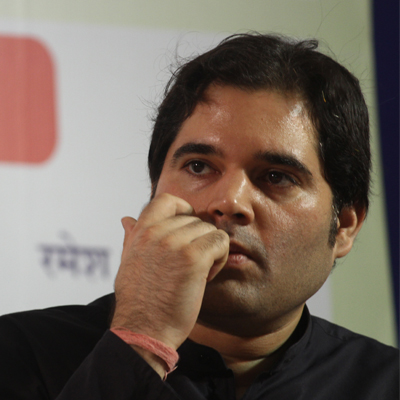
    NEW DELHI (TIP): BJP MP Varun Gandhi is conspicuous by his absence in the Uttar Pradesh polls. His cold war with party chief Amit Shah has left him out of the list of star campaigners yet again.

    Varun has not visited his own Lok Sabha constituency of Sultanpur after the announcement of the Assembly poll schedule, despite figuring in the party’s second list of campaigners for the third and fourth phase of polling; his constituency goes to polls on Monday.

    In a move that has caused great embarrassment to the party, Varun delivered a lecture in Indore on Tuesday, where he questioned the Modi government’s outreach to farmers. He said the farmers continue to commit suicide.

    He also criticised the government’s inability to do something substantial about absconding loan defaulter Vijay Mallya.

  • Kejriwal sets eyes on three BJP-ruled states

    Kejriwal sets eyes on three BJP-ruled states

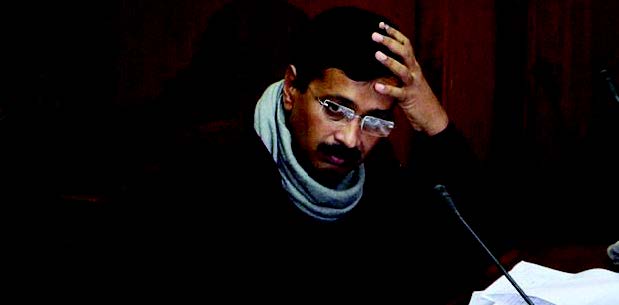
    NEW DELHI (TIP): Aam Aadmi Party’s (AAP) national convener and Delhi chief minister Arvind Kejriwal has called a meeting of state in charges on Saturday to discuss the party’s national plan post-Punjab and Goa elections.

    AAP will focus on the assembly elections in Gujarat later this year and Madhya Pradesh and Chhattisgarh next year, party sources said.The Aam Aadmi Party launched a multi-pronged attack against the BJP accusing it of engineering violence at Delhi’s Ramjas college to communally charge the Uttar Pradesh election and its governments in Gujarat and Chhattisgarh for unleashing police brutalities on farmers and tribals.

    On a day the party’s highest decision making body — the political affairs committee —met to firm up the plan, AAP leaders in Delhi also raked up the issue of an alleged spy racket in MP in which a local BJP leader was arrested.

    Party leader Kumar Vishwas accused the BJP along with its affiliate, the Akhil Bharatiya Vidyarthi Parishad — Rashtriya Swayamsewak Sangh’s student wing, of fomenting violence at Delhi University in the last two days.

    “ABVP’s actions in Delhi University are triggered by the BJP’s impending defeat in UP,” Vishwas said. “They are trying to communalise the election,” he added. Party leader Gopal Rai, who is in charge of Gujarat, MP and Chhattisgarh led a delegation of farmers from Gandhinagar and tribals in Bastar to the National Human Rights Commission against alleged police atrocities.

  • With 82 seats, BJP makes gains in BMC polls, finishes 2 short of Shiv Sena’s tally

    With 82 seats, BJP makes gains in BMC polls, finishes 2 short of Shiv Sena’s tally

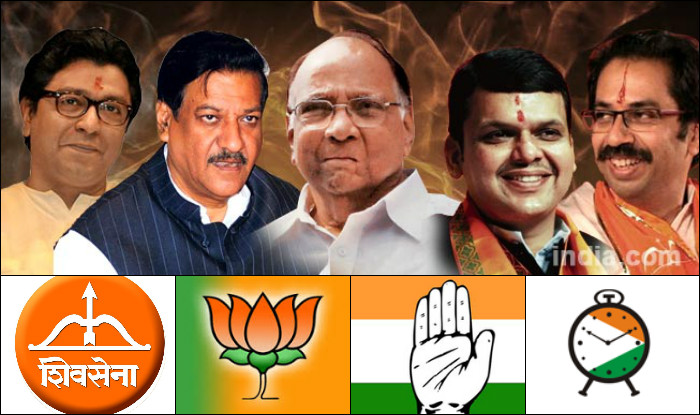
    MUMBAI (TIP): The Shiv Sena on Thursday (February 23) emerged as the largest party in the Brihanmumbai Municipal Corporation (BMC) elections with 84 seats, but the BJP, which made massive gains, said it could take control of the civic body with the backing of independents.

    Shiv Sena activists celebrated earlier in the day as it appeared it was set to take control of the BMC, but at the end it finished with just 84 of the 227 seats. The BJP came close with 82 seats.

    Any party or combine will need 114 corporators for a simple majority.

    Across Maharashtra, however, the Bharatiya Janata Party made major gains in elections held for municipal bodies. The Shiv Sena victory came in Thane.

    BJP Mumbai president Ashish Shelar said the party had bagged 82 seats in Mumbai and had the support of four independents and that it was in a position to claim the crucial post of mayor.

    “This is a historic victory for the BJP … We are only three seats less than the Shiv Sena … The credit goes to the development agenda of Prime Minister Narendra Modi and Chief Minister Devendra Fadnavis,” he said.

    An aggressive Shiv Sena had snapped ties with the BJP+ ahead of the municipal elections and its leader Uddhav Thackeray had expected the Sena to win at least 100 seats, if not an outright majority.

    The BMC, which is also the country’s largest municipal body, has an annual budget of Rs 37,000 crore in 2016-17.

    The Congress trailed at a distant third in Mumbai, forcing its city unit chief Sanjay Nirupam to accept moral responsibility. He has offered to resign from the post.

    The Maharashtra Navnirman Sena (MNS) of Raj Thackeray, Uddhav’s estranged cousin, finished with seven seats. The Nationalist Congress Party (NCP) bagged nine seats and the Hyderabad-based Majlis-e-Ittehadul Muslimeen three. The BJP’s solid gains came in other major cities of Maharashtra. The BJP raced towards victory in the Pune Municipal Corporation, pushing the ruling NCP to a poor second spot. The Shiv Sena, the MNS and the Congress fared poorly in the state’s cultural and IT capital.

    The contest was close in Pimpri-Chinchwad Municipal Corporation near Pune, with the ruling NCP leading in 27 seats and the BJP at the second place with 21 seats.

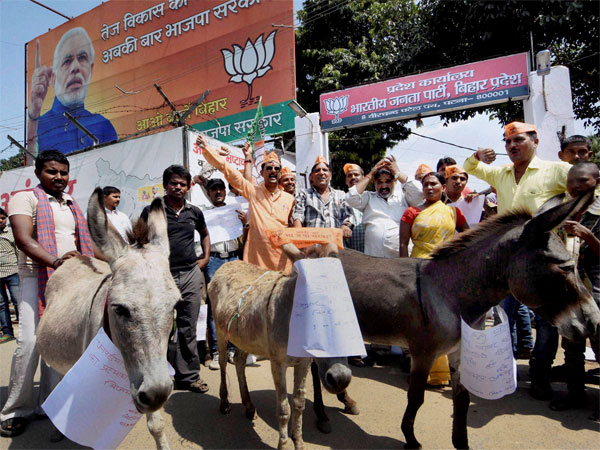
  • I DRAW INSPIRATION FROM DONKEYS, MODI COUNTERS ‘CASTEIST’ AKHILESH

    I DRAW INSPIRATION FROM DONKEYS, MODI COUNTERS ‘CASTEIST’ AKHILESH

    LUCKNOW (TIP): Countering Chief Minister Akhilesh Yadav’s ‘donkeys from Gujarat’ jibe, Prime Minister Narendra Modi on Feb 23 (Thursday) said he drew inspiration from the animal.

    Modi also said the remark reflected Akhilesh’s “casteist” mentality. “You can attack me or the BJP, but why attack the donkeys? Why are you scared of them… they are hundreds of miles away,” Modi said, addressing an election rally at Bahraich.

    Spare the animal, says PM

    “It shows your (Akhilesh’s) casteist mentality… it is discriminating among animals,” the prime minister said, adding that the SP regime was known for employing the entire government machinery in tracing a lost buffalo.

    “The donkey also inspires me… it remains loyal to its master and keeps on working even if tired, hungry or sick. I perform tasks that the people of the country ask me to do. I work on an empty stomach, without taking leave,” he said.

    Modi reminded Akhilesh that the previous Congress-led UPA government had released a postal stamp on donkeys. “It (Congress) is your (SP’s) alliance partner now,” he said.

    Akhilesh had on Monday launched a veiled attack on Modi for promoting the donkeys of Gujarat and asked actor Amitabh Bachchan not to endorse them. “Gujarat ke log ab wahan ke gadhon ka bhi prachar karwa rahen hain…kahin gadhon ka prachar hote dekha hai?”

    (even the donkeys of Gujarat are being promoted… have you ever seen the promotion of donkeys?),” Akhilesh said at an election rally in Raebareli.

    “I urge Amitabh Bachchan to stop promoting the donkeys of Gujarat,” he said, referring to the ad campaign on the Wild Ass Sanctuary in Gujarat.

  • ‘Huge blessing in small virtues’

    ‘Huge blessing in small virtues’

    Sheila Chaman, the one time most admired newsreader on Doordarshan and now a Delhi based freelance journalist sent me, the other day, a piece ‘Huge blessing in small virtues’ by Maj Gen SPS Narang (Retd). She came across the article in The Tribune, liked it and forwarded it to me. Thank you, Sheila. The author’s forceful narrative of a moving incident carries an extremely tender, human message which I am sharing with the readers of The Indian Panorama.

    Like a large percentage of secular Indians, I have an incident to share which may awaken the conscience of some of my fellow men. The incident goes back to nearly a year, and even now evokes poignancy in my heart.

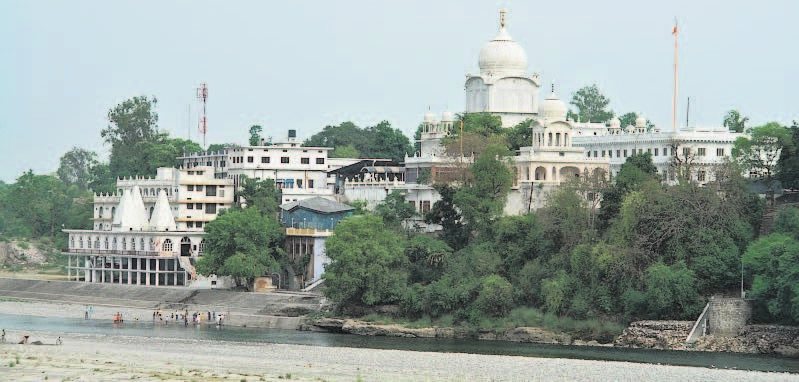
    Last November, I was driving back to Dehradun from Chandigarh – a fascinating four-hour journey, with the added attraction of visiting Paonta Sahib Gurdwara. I had to break on the way to give myself and my car some rest. And what better than entering the abode of the Guru. Besides the soothing kirtan, it is the langar that one savors, seated on the floor among a multitude of people from all walks of life. Some partake of all meals as they have no means to satiate their hunger.

    Breaking bread with them gives an indescribable spiritual high, and to experience this, one doesn’t have to belong to any one religion. I, too, enjoyed the langar and came out to get on with my journey.

    I stopped to buy some knick-knacks from a kiosk outside the gurdwara. Just then, I spotted a family of Gujjars (Muslims nomads who rear cattle in semi mountains and sell milk), in an intent discussion in front of a tea vendor. The family comprised an elderly couple, two middle-aged couples and four children. Three women were partially veiled. They seemed poor as the eldest gentleman (probably the father) counted coins and some crumpled notes.

    Undoubtedly, the issue was how much they could afford to buy. They asked for three cups of tea and four samosas (popular Indian snack).

    Gathering courage, I asked him, “Kya aap sab khana khayenge?” (would you all like to have food!!) They looked at one another with a mix of surprise, apprehension and a hurt self-respect.

    There was silence. Sometimes, silence can be loud. The innocent eyes of the kids were filled with hope. “Hum kha ke aaaye hain,” (we have eaten already) he responded.

    There was an instant retort, “Kahan khayaa hai subeh se kuch bhi, Abba?” (we have not eaten anything since morning, Papa!!)

    Hearing that, a dull ache in my chest caught me by surprise. The stern look in the eyes of the three men and the pleading moist eyes of the women said it all

    I insisted that they come with me. They agreed, reluctantly. We entered the gurdwara (Sikh Temple of God)

    A good feeling descended over me as I deposited their shoes at the jora ghar (Shoe deposit room in all Gurdwaras). The elders were awed by the architectural marvel.

    However, there was fear in their eyes, which was understandable. They were entering a non-Islamic place of worship for the first time.

    But the children couldn’t care less, their innocent faces single-mindedly focused on food. Some onlookers flashed strange looks from the corner of their eyes. But then I followed the children, adopting their easy attitude as they excitedly chose head wraps of different colors. (everyone is supposed to cover their heads inside a Gurdwara).

    Except for the eldest member, all accompanied me inside, and emulating me, bowed their heads and touched their forehead to the floor. Many others must have noticed, as I did, that these children went through this ritual with utmost reverence. They took Parshad (offering) from the Bhaiji (The Priest)) who asked them if they needed more. The children gladly nodded.

    We entered the Langar Hall and I took the kids along to collect thaalis (plates).

    They did it with joy, like only kids would. Seated opposite us was a newly-married couple. The bride, with red bangles accentuating her charm, asked the children to sit beside her, and two of them sat between them. The way she was looking after them, I could tell she would make a loving mother.

    Langar was served, and though I had already eaten, I ate a little to make my guests comfortable. One had to see to believe how they relished it. The initial apprehension had vanished and they ate to their fill. I have no words to describe the joy I experienced.

    We had nearly finished when an elderly Sikh and a youth with flowing beard (perhaps the head granthi and sewadar- helper) sought me out.

    I was overcome by fear, and more than me, my guests were scared. I walked up to them with folded hands.

    He enquired, “Inhaan nu tusi le ke aaye ho? (Have you brought them in?).” I nodded.

    The next question had me baffled, “Tusi har din path karde ho? (Do you say prayers every day?).” I almost blurted “yes”, but it would have been a lie. So, with utmost humility I said “no”.

    Expecting an admonishment, he surprised me, “Tuhaanu tha koi lorh hi nahin. Aj tuhaanu sab kuch mil gaya hai ji (You don’t need to. Today you have got everything).” I was flabbergasted. Was it advice or sarcasm? He added, “Inha nu Babbe de ghar lya ke te langar shaka ke tusi sab kuch paa laya. Tuhaada dhanwad. Assi dhan ho gaye (By bringing them to the Guru’s abode for langar, you’ve got everything from God. Thank you. We are blessed).”

    Then, with folded hands, he walked up to the elderly couple and requested them, “Aap jad bhi idhar aao to langar kha ke jaaiye. Yeh to uparwale da diya hai ji (Whenever you happen to pass through here, please come and have food. It is God’s gift).”

    I escorted my guests out of the Langar Hall. Just as we were about to pick our footwear, one of the children said, “Humme aur halwa do naa.” (Get us some more sweet offering). We five went in to get more parshad.

    Finally, as they were about to depart, the elderly lady whispered to her husband.

    I enquired, “Koi baat, Miyaji?” (is there any problem, Mian Ji!!

    Almost pleadingly, he said, “Yeh keh rahin ki, kya aap ke sar par haath rakh sakti hain? (She is saying, can she keep her hand on your head)!! I bowed as she blessed me with tears in her eyes.

    A wave of emotions swept over me.

    Is it my imagination, or for real, that I often feel the beautiful hand of a Muslim lady, wrapped in purity and love, on my head?

    This is the reason, we are secular.

  • Demonetisation had a significant impact on India business in Q4: Indra Nooyi

    Demonetisation had a significant impact on India business in Q4: Indra Nooyi

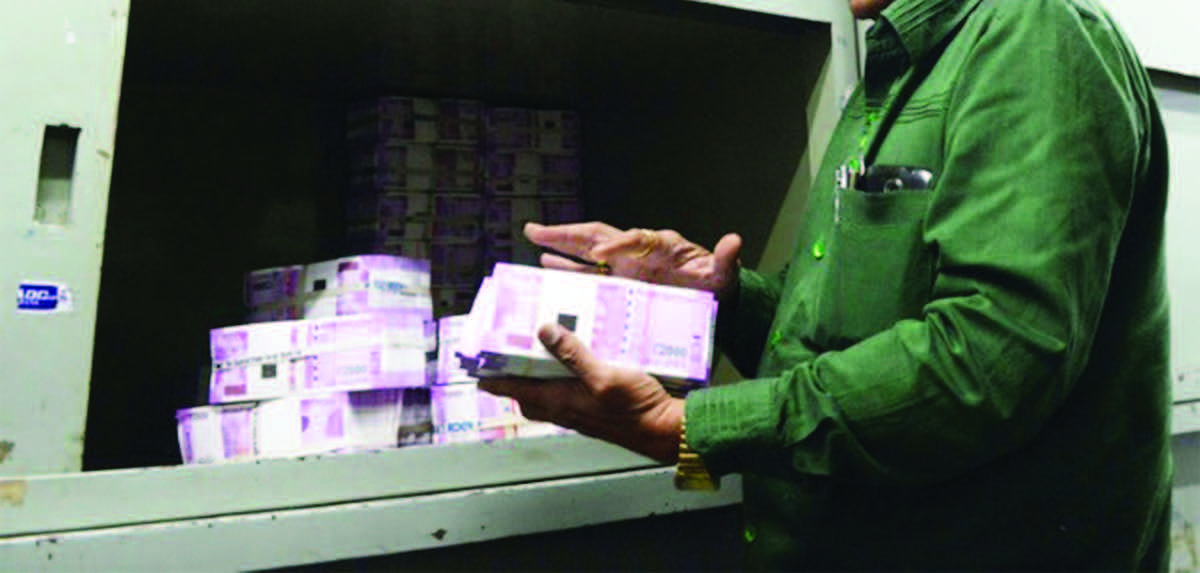
    NEW DELHI (TIP): PepsiCo India may emerge from the setback caused by demonetisation only by the April-June quarter, global chief executive officer Indra Nooyi said, the seventh leader among consumer companies to voice concerns over the note ban’s significant impact on sales.

    “Our hope is that by the time Q2 rolls by, we would be through the bulk of the demonetisation challenges,” Nooyi told investors on a call after the US beverage and snacks maker announced its fourth-quarter results on Wednesday. “The new currency and the digital currency will be back in circulation and we’ll be back to retail activity coming back to normal. I’m not sure we are totally out of the woods.”

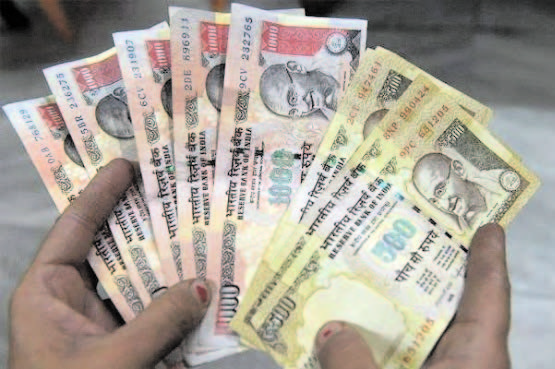
    Nooyi said scrapping of the high-denomination rupee notes in November was a massive change because 80% of the currency was taken out of circulation and the implementation of the measure had its share of challenges.

    “Demonetisation had a significant impact on our India business in Q4. It hit individual retailers significantly. And there’s still some lingering effects. India is a big country,” she said.

    While New York-based Pepsi-Co did not specify India numbers, it said the Asia, Middle East and North Africa (AMENA) region was negatively affected by issues such as operating cost inflation and higher raw material costs. Net income fell 18% to $1.4 billion in the fourth quarter, while net revenue increased 5% to $19.5 billion from a year earlier.

    On the outlook for the first quarter of 2017, Nooyi said: “At this stage of the quarter, we expect organic sales to decline at our AMENA division, driven by increased levels of volatility throughout the region.”

    PepsiCo’s global beverage sales rose 1% in the fourth quarter and sales of food and snacks went up 3%.

    India’s carbonated drinks sales are estimated at over Rs 14,000 crore. Volume growth has been in the low single digits for at least four quarters as consumers in urban markets increasingly prefer healthier drinks, while in the rural areas, they’ve been scaling down on discretionary spending.

    Nooyi told analysts the company was making “significant progress in transforming its portfolio.”

    The maker of Pepsi and Mountain Dew fizzy drinks and Lay’s chips said last year it would reduce the sugar content in juices and carbonated drinks across markets including India by 2025. Nooyi said the company had a ‘pipeline of innovations’ such as Tropicana Essentials functional juices and Quaker foods, which she said were helping to fuel sales in developed markets such as the US.

    Globally, the Pepsi cola trademark contributes 12% of net revenue, while 25% comes from everyday nutrition products such as bottled water and foods and drinks packed with grains, fruits and vegetables.

    Food and beverage makers are facing pressure from consumers, health activists and governments to make their products healthier in order to rein in obesity and diseases such as diabetes.

    Measures to reduce sugar include replacing it with natural and artificial sweeteners and making smaller packs of beverages and snacks. In India, while PepsiCo is using plantbased sweetener stevia in 7UP, leading to a cut of 30% in sugar content, it is selling colas in smaller 150 ml cans.

    Demonetisation announced on November 8 by Prime Minister Narendra Modi led to slowing down of sales across consumer goods, with global heads of companies ranging from Coca-Cola to Unilever and Colgate-Palmolive stating that the currency curbs had significantly impacted their India numbers.

    Food and beverage makers are facing pressure from consumers, health activists and governments to make their products healthier in order to rein in obesity and diseases such as diabetes. Measures to reduce sugar include replacing it with natural and artificial sweeteners and making smaller packs of beverages and snacks. In India, while PepsiCo is using plantbased sweetener stevia in 7UP, leading to a cut of 30% in sugar content, it is selling colas in smaller 150 ml cans. Demonetisation announced on November 8 by Prime Minister Narendra Modi led to slowing down of sales across consumer goods, with global heads of companies ranging from Coca-Cola to Unilever and Colgate-Palmolive stating that the currency curbs had significantly impacted their India numbers.

  • USCIRF Report on India’s Deteriorating Religious Freedom

    USCIRF Report on India’s Deteriorating Religious Freedom

    INOC USA expresses concern, HAF questions Credibility

    NEW YORK (TIP): Indian National Overseas Congress, USA expressed serious concern over the recently issued annual report by the United States Commission on International Religious Freedom (USCIRF), a powerful freedom body that exercises considerable influence on the US Senate and Administration, which cited that religious tolerance has deteriorated and religious freedom violations have increased in India under Prime Minister Narendra Modi’s regime.

    On the other hand, The Hindu American Foundation (HAF) slammed the report saying that “US Religious Freedom Commission Outsourced Its Credibility with Attack on Hinduism and India.”

    “It is unfortunate that the last two years have witnessed a steady deterioration of religious freedom and human rights in India especially that of the minorities and the current administration cannot shirk their responsibility in that regard,” said George Abraham, Chairman of the Indian National Overseas Congress, USA.

    According to the recently released report, India faces serious challenges to both its pluralistic traditions and its religious minorities. Christians, Sikhs, and Jains generally are fearful of what the future portends. Dalits also are increasingly being attacked and harassed.

    But HAF feels the report by Iqtidar Cheema, a Pakistan-origin author known for his anti-India stand and director for Institute for Leadership and Community Development, in Birmingham, England, is completely biased. In a blog post, HAF executive director Suhag Shukla wrote, “Cheema’s work provides cover to Pakistan’s long-standing support of a bloody proxy war to separate the Indian state of Jammu and Kashmir from India. Not surprisingly then, this report fails to mention the plight of over 300,000 Kashmiri Hindu Pandits cleansed from their ancestral homeland in the Valley at the hands of Islamist radicals. Previous commission reports have ignored the same.”

    She also feels that USCIRF has lost its credibility. “How could USCIRF outsource a report harshly critical of India, one of the most important democratic allies of the United States, to an activist with a history of supporting separatist causes against India that too often employ terrorism against innocent civilians? How can USCIRF give its imprimatur to a report citing debunked sources and smearing the Hindu religion?”

    In the report, USCIRF urged the Indian government to immediately lift its sanctions against non-governmental organizations (NGOs) that are working for the welfare of the minorities in India. It also pointed out that FCRA (Foreign Contribution Regulation Act) is increasingly being used as a tool to shut down foreign-funded minority NGOs.

    In an unusually sharp criticism of the Modi Administration, the USCIRF wants the US administration to identify and act against “Hindutva groups that raise funds from US citizens and support hate campaigns in India”, adding “such groups should be banned from operating in the US if they are found to spread hatred against religious minorities in India.”

    INOC, USA urged the growing Indian community in the United States to refrain from funding these organizations that promote hatred and bigotry against the minorities in India.


  • Modi’s war on civil society; Minority NGOs are specially targeted

    Modi’s war on civil society; Minority NGOs are specially targeted

    Indian law stipulates that non-governmental groups register under the Foreign Contributions Regulation Act (FCRA) to operate while receiving foreign donations. Increasingly this provision is being used by this government as a political tool to stifle dissenting opinions and to undermine the constitutional rights of its citizens”, says the author – George Abrahim.


    During the recent confirmation hearing for the job as the U.S. Secretary of State, Rex Tillerson was urged by Cory Gardner, the Senator from Colorado to take up the issue of ‘Compassion International,’ a Christian Charity that operates 580 centers in India for destitute children, with authorities in India.

    ‘Since 2014, Compassion (International) has been the target of multiple coordinated governmental attacks because of its unapologetically Christian belief, but it has been delivering humanitarian services to hundreds of thousands of Indian Children. But due to restrictions by the Indian Government, they have been unable to fund its India operations since February 2016, despite having broken no laws. I believe the State Department should take notice that this ill treatment of Compassion International should stop, and it is a broader pattern by the Government of India, where other NGOs have seen similar problems’, Senator Gardner said at the hearing.

    Mr. Tillerson responded by saying that he appreciated the Senator bringing this issue during the hearing and assured that he would work with the Senator on the matter once he is confirmed. The Chairman of the Foreign Relations Committee Mr. Bob Corker who was said to be actively engaged with the Indian Government over this issue for a year now followed up the exchange with a comment of his own saying that he was grateful for Senator Gardner for raising this issue and further stating that the Chairman Ed Royce of the House International Committee also cares deeply about this matter.

    The broad pattern that was referenced by the Senator on Non-Governmental Organizations in India appears to be real and disconcerting to freedom loving people everywhere. What is unraveling in Modi’s India today is the systematic banishment of those organizations that do not share his sectarian or environmental vision.

    Indian law stipulates that non-governmental groups register under the Foreign Contributions Regulation Act (FCRA) to operate while receiving foreign donations. Increasingly this provision is being used by this government as a political tool to stifle dissenting opinions and to undermine the constitutional rights of its citizens.

    Civil rights activist Teesta Setalvad, who has fought hard for justice for the 2002 riot victims of Gujarat and accused the Modi Government of allegedly overseeing the violence now stands accused of defrauding funds from ‘Unity for Peace & Justice and Sabrang International,’ an organization she headed and subsequently lost the FCRA license. Green Peace India’s Priya Pillai was removed from a flight en route to London to attend a conference on the charges that she would have damaged India’s ‘national interest’ and further yanking out its FCRA privilege. Even NGOs who were engaged in Rights-based advocacy work such as Amnesty International were not spared.

    Cancellation of these FCRA licenses would mean that henceforth these organizations are forbidden to receive foreign donations, thereby essentially killing their operations. Many of these NGOs solely depends on the foreign funding as Corporations or other entities in India are reluctant to fund them often characterizing them as either politically charged or a risk due to fear of reprisals from the power centers. It should also be noted that with all the wealth creation that occurred in the last three decades or so, the Indian attitude towards charitable giving is still much to be desired!

    It is estimated that FCRA licenses of 20,000 NGOs have been canceled. Some of these organizations have come together and issued a joint statement accusing Modi government of using FCRA as a tool of repression. ‘Prima-facie it appears FCRA license non-renewal is neither legal nor objective and thereby impinging on the rights of the human rights defenders in access to funding, including foreign funding,” the apex human rights watchdog in the country said in a notice.

    Apart from the sound and fury created by these exchanges between some of the world renowned NGOs such as Green Peace and Amnesty International and the government, there is also a secret war being waged against Christian NGOs that are engaged in welfare work for the very poor in rural India. Caritas International that works with 350 NGOs across India that boasts a force of 25000 volunteers is another victim to Government’s authoritarian agenda and being accused of indulging in anti-India activity.

    Undoubtedly, there appears to be an unprecedented, deliberate and systematic effort to dislodge various Christian NGOs from India that may have nothing to do with their performance or violations of any rules. A joint statement from Amnesty International and Human Rights Watch said the government was using the FCRA to muzzle NGOs. “The law’s use of broad and vague terms such as ‘public interest’ and ‘national interest’ have left it open to abuse”, read the statement. The ‘national interest’ government invokes in these cases seems to be an excuse for strengthening the Hindu identity of the country and is egged on by the Hindutva activists led by RSS.

    Almost eighty percent of the Charity work among the poorest of the poor is delivered by Christian NGOs in India often on difficult terrains and under trying conditions. ‘Compassion’ began operating in 1968 in India, where today its Indian-staffed development centers care for more than 145,000 children. ‘Compassion sends about $50 million per year in humanitarian aid to India. That makes it the single largest contributor of aid for children living in extreme poverty’ said Tim Glen, the US communication director for the organization.

    Why Modi government is shutting down ‘Compassion’ and denying vital services to this vulnerable part of the society may be debatable considering that this particular organization or similar entities rarely get involved in policy debates to the discomfiture of the establishment! However, one thing is certain, the politicians and bureaucrats who are formulating these disastrous policies are unaffected in their own bubble and do not seem to give a hoot about the well-being or the future of these children. “In Compassion’s case, Prime Minister Modi’s Government has since April blocked $3.5 million in aid to India’s most vulnerable children, as far as we can tell, no other reason than that Compassion is founded on and demonstrates Christian values” wrote Compassion president and CEO Santiago Mellado in an article for the ‘Hill’.’The Ministry of Home Affairs views Christian values as a threat to the ‘national interest’, particularly if those values are taught to the poor’ said Charity’s lead Attorney Stephen Oakley.

    In December 2016, House Foreign Affairs Committee Chairman Ed Royce convened a hearing to discuss Compassion International’s work in India. The hearing was entitled “American Compassion in India: Government Obstacles”. As the Chairman of the India Caucus and champion of the US-India civil nuclear agreement on the House floor, Mr. Royce was well placed in mediating a resolution to the standoff but to no avail. The belligerence from the administration was finally on full display when a Compassion official was subjected to a ‘dressing down’ at the Ministry of External Affairs thereby dashing any hope for a positive outcome.

    These moves appear to be consistent with the Hindutva philosophy that the Modi government has embraced to advance the saffron agenda that challenges the very idea of India as a multi-cultural and pluralistic society. Modi appears to pay lip service to Gandhiji’s idea of India upon his visits abroad but remains silent when Institutions that are supposed to promote those principles come under attack back at home.

    While the BJP government is hard at work restricting Christian NGOs from receiving funds from abroad, no such limitations are placed on the Sangh Parivar organizations that collect millions of dollars from Western Democracies. A recently released report from the United States Commission for International Religious Freedom (USCIRF) states that “While the Indian government continues to use the FCRA to limit foreign funding for some NGOs, Hindutva supported organizations have never come under the scrutiny of the FCRA. With the new amendment to the FCRA, these foreign-based radical Hindu organizations will be able send funds to India, without restriction, to support hate campaigns. Under the new definition of FCRA, so long as the foreign company’s ownership of an Indian entity is within the foreign investment limits prescribed by the government for that sector, the company will be treated as “Indian” for the purposes of FCRA.” The latest report on the constitutional and legal challenges faced by religious minorities in India comes after the controversy last March when Indian government denied USCIRF the visas to visit the country. The powerful US religious freedom body that exercises considerable influence on the US Senate and Administration had at that point described the situation in India as “worrisome”.

    It is also common knowledge that Christian church leaders from the United States have a harder time obtaining a visa to visit their fellow faithful in India or attend a conference while no such restrictions are placed on Indians based on religious affiliations. It is indeed hypocritical to deny a religious conference visa to an American citizen while crying foul about H1B visa program that could take jobs away from American workers!

    More than 100 million children in India live without access to proper nutrition or other basic needs. The government does not have well established anti-poverty programs to address this critical issue and relies primarily on foreign aid groups for humanitarian relief. It would not only be irresponsible on the part of the government but immoral to let these children fall through the cracks for the sake of political expediency orin the name of religious bigotry.


  • PM Modi’s Raincoat barb leads to disruption of Parliament

    PM Modi’s Raincoat barb leads to disruption of Parliament

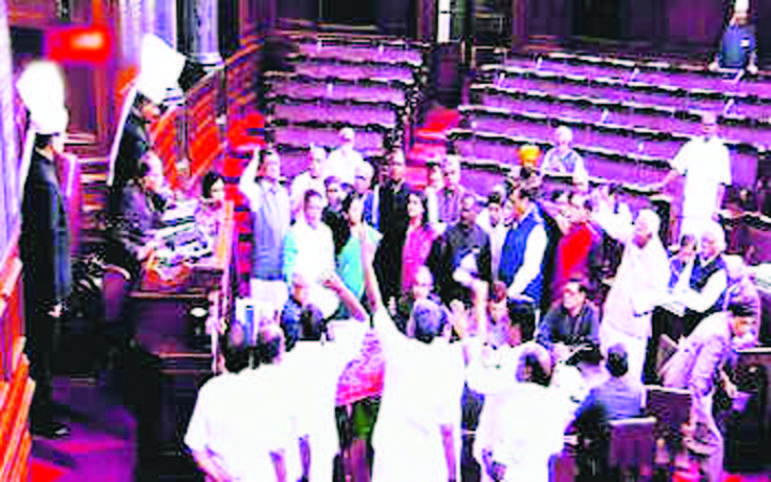
    NEW DELHI (TIP): The Rajya Sabha witnessed, February 9, repeated adjournments and was unable to function as the Opposition raised objections to Prime Minister Narendra Modi’s remarks made against Dr. Manmohan Singh a day earlier. In the Lok Sabha too, the Congress staged a walkout during Zero Hour in protest against the chair’s ruling of not allowing its floor leader Mallikarjun Kharge from raising the party’s objection to Modi’s “raincoat” remark against his predecessor Manmohan Singh.

    In the Rajya Sabha, the Opposition parties were particularly agitated over the remarks the PM made with reference to former Prime Ministers Manmohan Singh and Indira Gandhi, alleging Modi used “abusive” and “insulting” language. The members demanded an apology from the PM over his remarks. The House was first adjourned till noon and then till 2 pm.

    Congress’ Anand Sharma said Rule 238 disallowed use of offensive expression during a debate. “Prime Minister yesterday insulted the memory of Indira Gandhi. He has dragged political debate to a new low… he was abusive… we will oppose him,” he said.

    CPM leader Sitaram Yechury gave a notice under Rule 267 over the Prime Minister’s reference to late Communist leader Jyotirmoy Basu during his speech of Wednesday but the Chair rejected it.

    The Congress was joined in by the CPM and JD(U) saying they were not given an opportunity to seek clarifications during the debate yesterday despite Chairman Hamid Ansari citing precedence and tradition of the House that gave members the right to seek such response after Prime Minister or a minister’s statement.

    But it was not just the Congress members who were agitated but AIADMK counterparts also entered the well of the House demanding that Tamil Nadu Governor Vidyasagar Rao should discharge his Constitutional duty by swearing in VK Sasikala as Chief Minister without wasting any further time.

    In the Lok Sabha, Speaker Sumitra Mahajan ruled that the matter relating to the other House could not be raised amid noisy scene created by members of the treasury benches. Congress members first trooped into the Well raising slogans “Prime Minister mafi mango (PM should apologise)” and “Prime Minister shame, shame…” and then walked out of the House.

    Parliamentary Affairs Minister Ananth Kumar was also heard saying the issue could not be raised in the Lok Sabha.

    However, Kharge, before being cut by the Speaker, said, whatever Mr Modi has said about Dr Singh is not good for parliamentary democracy. He also noted that what the Prime Minister had said was an insult to the country.

    Taking a dig at Manmohan, Modi had said he knew the art of taking bath wearing a raincoat as there were many scams during his government, but he remained untainted. Earlier, the ongoing power struggle in Tamil Nadu was also played out in the Lok Sabha with AIADMK members disrupting proceedings by raising slogans apparently supporting VK Sasikala as the next Chief Minister.

    The Speaker asked them to raise the issue during Zero Hour and later adjourned the proceedings for nearly 20 minutes till 11.30 am.

    BJP hits back, says pun, fun part of democracy: Even as the Congress clamored for an apology from Prime Minister Narendra Modi for, what it called “ugly” and “unacceptable”, “raincoat” dig at his predecessor Manmohan Singh, the BJP escalated attack, asking the Opposition party to express regret for conduct in the Rajya Sabha yesterday and “absurd” and “cheap” language used by its leaders against the PM in the past.

    The Congress, they said, was angry and upset because the Prime Minister had “shown it the mirror”. Also, as per BJP leaders, the Opposition had no moral right to preach about Parliamentary etiquette given the “absurd” and “cheap” words used by its top leaders – inside and outside the Parliament -against the Prime Minister.

    “In the same Parliament they (Opposition) called him (the Prime Minister) ‘Hitler’, ‘Mussolini’, ‘Gaddafi’. The references were removed at our insistence. They have used meaningless phrases like ‘khoon ki dalali’ and ‘maut ka saudagar’ to describe him. It is a shame, they are giving ‘pravachan’ (sermons) to others now.

    “They are not able to understand the reality and are thus creating problems. Why should the Prime Minister apologize,” questioned Union Ministers M Venkaiah Naidu, Ravi Shankar Prasad and Ananth Kumar.

    On the contrary, as per BJP leaders, they should not just apologize to them but the entire country. “We have shown them the mirror, unmasked the Congress and they are now upset. The Prime Minister of India is an institution, respected not only in India, but worldwide,” they said.

    Moreover, as per Prasad “pun, fun and repartee was very much a part of the Parliamentary democracy”. “Mild exchange of words is all part of healthy democracy. So why is the Congress worried,” he wondered while responding to the Congress’ anger.

    Reminding Singh that he was the Prime Minister when “scams worth 12 lakh crore had taken place”, Prasad said he did not believe that words used by Singh to describe the demonetization scheme – “organized loot” and “legalized plunder” actually belonged to him. “We have observed him in Parliament in past 10 years. These are not his words. Rather, I feel sorry for him. He could not do anything to save the honor of his mentor (former PM Narsimha Rao), whose body was not even allowed to enter the AICC’ precincts,” Prasad said.

    Cong to boycott PM over ‘insult’: Meanwhile, The Congress said, Feb 9, it will boycott Prime Minister Narendra Modi for his jibe at predecessor Manmohan Singh and the “insult” he heaped on late Indira Gandhi, and that it would bring other Opposition parties too on board on the issue.

    Addressing a press conference today, Deputy Leader of Congress in Rajya Sabha Anand Sharma said the boycott will continue until the remaining half of the Budget Session starting March 9.

    “The PM has written the first chapter of this story. We will write the last,” Sharma said in a threatening tone a day after PM Modi questioned Manmohan Singh’s Prime Minister ship under the UPA government wondering how he could remain untainted in a government full of scams.

    Earlier, Congress Vice President Rahul Gandhi commented: “The PM has mastered the art of bathing with the rain coat on,” PM Modi had said triggering a walkout by Congress. Sharma today said Congress will boycott the PM, not listen to him but won’t assault the dignity of the Stepping up his attack on Prime Minister Narendra Modi, Congress vice president Rahul Gandhi on Thursday said he had lowered the dignity of his office by his “raincoat” jibe against Manmohan Singh in Parliament.

    “The Prime Minister’s office is not an ordinary one. Great honor is associated with it. So, by targeting his predecessor in that manner the Prime minister has lowered the dignity of his office,” Rahul said, addressing an election rally here.

    Member of Parliament Shashi Tharoor commented: "We are very-very disappointed by what the PM said on Wednesday".
    Member of Parliament Shashi Tharoor commented: “We are very-very disappointed by what the PM said on Wednesday”.

    And the gentleman politician Shashi Tharoor, Member Parliament said, outside Parliament: “We are very-very disappointed by what the PM said on Wednesday. I do not think in the history of Indian parliamentary democracy, we have ever heard the PM insulting his predecessor in such a manner using bathroom analogy. This is simply not heard of”.


  • India Assembly elections: Change of guard on cards in Punjab, Goa

    India Assembly elections: Change of guard on cards in Punjab, Goa

    NEW DELHI (TIP): Punjab and Goa, which reported high voter turnout for assembly elections on February 4, could be looking at a change, an analysis of past poll data reveals. In around 80% of the state assembly polls whenever voting percentage has been higher than the previous election, there has been a change in the government, election commission data for the last 20 years reveal. The probability of change is even higher when women voters outnumber men.

    Also Read Related Story: PUNJAB RECORDS 77.37% VOTER TURNOUT & Goa notches record 83% turnout

    Punjab reported 77.37% polling, a shade lower than 78.57% in the 2012 election. Goa turnout was 82.23% against 81.73% the last time. In both the states, more women turned up at polling booths than men.

    High voting, a recent phenomenon, has led to change in governments in most states though there are exceptions. Voters in Punjab took everyone by surprise in 2012 when they returned SAD-BJP to power, a first for the state where Akalis and Congress took turns to rule the state.

    Last year, Mamata Banerjee was given a second successive term by voters in West Bengal. When she ended the Left’s three decades of rule in 2011, it was a new voting record for the state. Sheila Dikshit returned as the chief minister of Delhi with a higher majority in 2003.

    “Invariably the enthusiasm at polling booths is for a change,” said Sanjay Kumar of the Centre for the Study of Developing Societies, which has been monitoring voting patterns of assembly elections for the last 20 years.

    Kumar said understanding voting pattern was a complex issue and could vary from state to state in a big country like India, as elections also have caste and community dimensions. “But what we observe from analyzing long-term data is that if people are satisfied with the incumbent government, they normally may not come out in large numbers,” he said.

    In the last 20 years, India has seen voters’ enthusiasm rise. Higher turnouts can primarily be attributed to three factors -weeding out of bogus names from poll rolls, the election commission’s efforts to encourage voting and bring polling stations closer to voters’ homes and adequate security. The number of polling stations has more than doubled in the last two decades. All polling booths now have a central election observer to ensure free and fair polling.

    At least 10% of the names on polls rolls were found to be bogus or duplicate and were struck off, EC has said. “The ECI has worked a lot on this and it is showing results,” former chief election commissioner SY Quraishi said. These factors have helped build voter’s confidence. In around 160 assembly polls, including those for union territories, held since 1990, higher voter turnout was reported in about 122 elections, leading to change in the government in about 79.4% cases. Moreover, data also show that it is getting increasingly difficult for the ruling parties to retain power when compared to early years of Independence.


  • US Industry commends India’s Union Budget 2017: Says It Seeks to Simplify Ease of Doing Business for Foreign Investors

    US Industry commends India’s Union Budget 2017: Says It Seeks to Simplify Ease of Doing Business for Foreign Investors

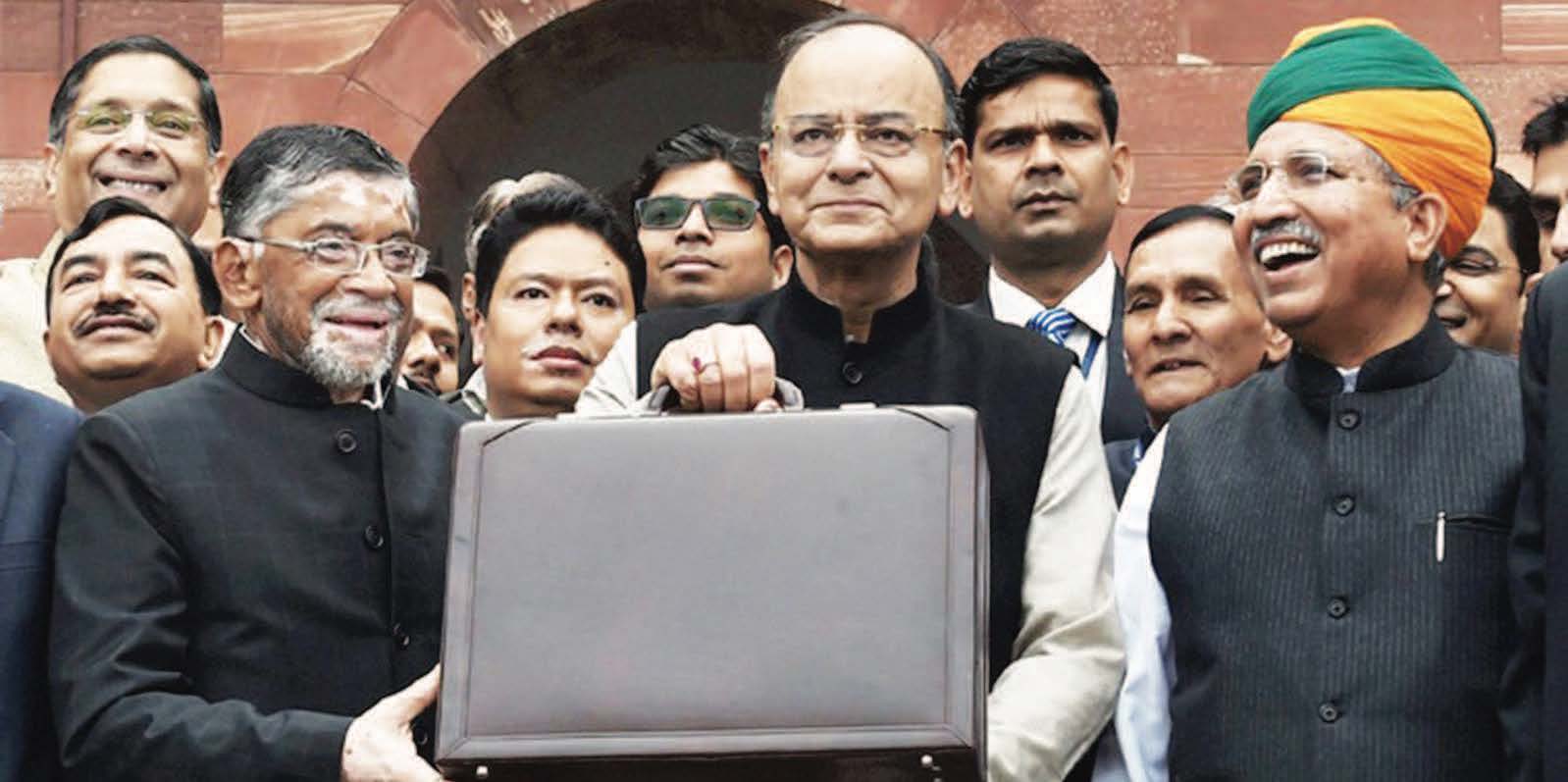
    The U.S.-India Business Council (USIBC) commended the 2017 Union Budget presented by Finance Minister Arun Jaitley, saying the budget has a forward-looking outlook and builds off the economic reforms enacted over the last three years of Prime Minister Modi’s government. USIBC feels that the budget deepens the Government’s move towards a digital economy, while remaining committed to attracting foreign investment, increasing infrastructure spending in roads and civil aviation, rationalizing the tax structure, spurring domestic growth while also bringing in rural India into the fold of the digital economy.

    USIBC has commended the noteworthy reform measures that have been implemented in the last year including the passage of the Goods and Services Tax (GST), the bankruptcy code, FDIs in several sectors of the economy, and measures for financial inclusion. In light of these reforms, the Council was pleased to note that the budget is a fiscally sound agenda that doubles down on Prime Minister Modi’s stated goals of improving the ease of doing business by reducing red tape, investing in “Skill India”, and attempts to mitigate the negative impact of demonetization.

    USIBC President, Dr. Mukesh Aghi said, “At a time of global uncertainty, budgets can be challenging to implement but the Finance Minister has done an admirable job in creating a vision that will propel the domestic economy while remaining cognizant about foreign investors. The industry welcomes positive steps in the affordable housing segment, bringing the ‘Housing for All’ scheme a step closer to reality. Relaxation on long term capital gains and infrastructure status to the segment will boost supply in the market. The Council looks forward to more announcements on liberalization in certain sectors in the near-term.”

    Rajiv Khanna, President of India-America Chamber of Commerce described it as a well-balanced budget. “It is a well thought out and a well balanced budget. The fact that the Indian stock market has reacted so positively to the budget speaks for itself”, said Mr. Khanna.

    Ron Somers, founder and CEO of India First Group also commended the budget. “I am in complete agreement with Finance Minister Arun Jaitley: when you look around the world today and witness all the retrenchment and chaos underway from Russia to China to Brazil, India stands out as a beacon of stability and predictability,” said Somers.

    Karun Rishi, President of USA-India Chamber of Commerce (USAIC) described it as a well-balanced, fiscally cautious budget in the right direction.

    The Indian Panorama invited readers to comment on the Indian Union Budget. Most felt it was a soft budget which did not hurt common people much, may be because of the impeding elections in a couple of important state assemblies. Whatever, the consensus was that it was an unexciting, lackluster budget. Here are their comments.

    Dr. VK Raju, an eminent eye surgeon based in Morgantown, WV says: “India has had 25 finance ministers since independence in 1947 that have presented and passed in Parliament 83 budgets- both interim and annual so far. Mrs. Indira Gandhi from Indian National Congress, as the Prime Minister of India was the only woman to hold the Finance Portfolio (1970-71). Her critics used to call her “the only man in Indian Cabinet.”

    Since our Independence in 1967, we have few islands of excellence in many fields, yet the India we all dream about is far from reality.

    The budget can undoubtedly give a shot in the arm to our economy, but consider these:

    1. The human resource is the ultimate resource of a nation.
    2. Water and sanitation are still major problems.
    3. Investment in human development is more productive than investment in physical assets and moreover, it leads to a faster rate of national growth.
    4. Malnutrition in children and 23% of middle school girls dropping out of school because of feminine hygiene issues.

    India is a highly developed country with developing country problems. In the west, poverty is relative and in India it is absolute poverty.

    Finally see what the great statesman, Nani Palkhivala said, “To my countrymen, who gave unto themselves the constitution but not the ability to keep it. Who inherited a resplendent heritage but not the wisdom to cherish it, who suffer and endure in patience without the perception of their potential. I say, Change the mindset, sky is the limit for India.”

    George Abraham, a former Chief Technology Officer at the United Nations and Chairman of INOC (USA) made the following comment.

    “I could not bring myself commenting on this budget without mentioning the way Modi Government’s unprecedented rush for submission on the day when one of its longest serving members of Lok Sabha and former Union minister Shri. E. George Abraham Ahamed has passed away. I am saddened by the fact that his memory has been dishonored!

    At the outset, I would like to agree with many observers that the budget has some positive elements such as tax deduction for lower-income earners. However, the budget has done very little for the middle class, farmers, daily laborers, self-employed or small and medium businesses who are hit hard by the reckless demonetization policy of this Government. The budget is also appeared to be rushed through for narrow political benefits with an eye on the upcoming state elections.

    At this point in time, the economic fundamentals are on a downward trend with fall in demand and fall in consumption with job losses in millions. While the GDP forecast is downgraded to be a percent or lower, there are no new bold initiatives for job creation or very few incentives to promote investment.

    Obviously, there is so much emphasis on digitization while not referencing the fact that there are 18,000 villages in India are still without electricity and 47 percent of the population lack any access to a bank account and the Internet is unavailable in the remote areas of the country.

    Although the Union budget has made an attempt to deal with political contributions, there would be little accountability without laying a solid groundwork for transparency, disclosures, and penalty.

    Finally, though the Prime Minister has characterized MGNREGA  as a ‘living monument,’ of Congress failure, the Finance Minister gave it a nudge by allocating 699 crores more than the previous year. It is a clear admission that the MGNREGA is so vital to the rural households across the land, and it would be suicidal for the Modi Government to scuttle it.

    In summary, the budget failed either to address the current hardships the lower echelon of the society is facing due to demonetization or putting up bold reforms for incentivizing investment or job creation.”

    Anu Jain, a Finance analyst had this to say. “Indian Finance Minister Arun Jaitley has presented the Union Budget for the year 2017-18. It was the first budget in the history of independent India to be presented on February 1

    This is his fourth annual budget and the first budget after demonetization. The Union Budget 2017 was broadly focused on 10 broad themes.

    They are – Farmers, Rural Population, Youth, Poor and Health Care for the Underprivileged; Infrastructure; Financial Sector for Stronger Institutions; Speedy Accountability; Public Services; Prudent Fiscal Management; Tax Administration for the honest.

    “The impact on growth from the governments cash crackdown would wear off soon and called 2017 budget is for the poor”, said Mr. Jaitley. Yet, while vowing prudent fiscal management, Arun Jaitley also raised his 2017-18 federal deficit targets to 3.2 percent of gross domestic product to cover his spending promises. Jaitley said, “As we all see that India as “an engine of global growth” but we should remember risks to its outlook from likely U.S. interest rate hikes rising oil prices and signs that globalization is in retreat”. PM Narendra Modi’s surprise decision last November to scrap high-value banknotes worth 86 percent of India’s cash in circulation has hit consumer demand, disrupted supply chains and hurt capital investments. The worst of the cash crunch is now over. Manufacturing survey showed that business was slowly returning to normal. Still, the finance ministry forecasts that growth could dip to as low as 6.5 percent in the current fiscal year till March, before picking up slightly in the coming fiscal year to between 6.75 and 7.5 percent.

    The Income Tax rates have been slashed and that’s certainly a reason for everyone to cheer. Those earning up to Rs 3 lakhs per annum will now be completely exempted from paying tax. Individuals earning between Rs 3 lakhs and Rs 5 lakhs per annum will get a 5% benefit as the tax rate has been slashed from 10% to 5%. Also, people earning higher than Rs 5 lakhs per annum are also eligible for the 5% reduction in income tax and businesses with turnovers of no more than Rs 50 crore get a tax break. This all is healthy to trigger the economy and help everyone especially the middle class and small business.

    Government targets to bring almost one crore households out of poverty by 2019. The budget proposes to complete 1 crore houses for those without homes.

    Budget has raised the allocation for the “Mahatma Gandhi National Rural Employment Guarantee Act” (MGNREGA) to an all-time high from Rs 37,000 crore to Rs 48,000 crore. This is big hike, and was the highest ever allocation to rural India.

    Budget also highlighted that the participation of women in MGNREGA is increased to 55 per cent. In the budget, there is allocation for linking Aadhar to various bank accounts and to health cards for senior citizens. After announcing demonetization, Modi government has been promoting linking of Aadhar numbers to bank accounts and also claims credit for systematization as Aadhar registrations grow.

    Railway e-tickets: In a move to encourage the use of services, service tax on railway tickets booked electronically have been pulled back. Currently, a service charge of Rs 20 is levied for sleeper class and Rs 40 for all air conditioned classes per ticket while booking tickets on the IRCTC website.

    The continuing theme of attacking black money was evident in the move to ban all cash transactions of over Rs 3 lakh and the attempt to clean up political funding. Parties will now have to disclose the identities of those donating over Rs 2,000, though electoral bonds will be introduced to allow anonymity for clean donors. The government has lined up more incentives for startups. Profit linked deduction will be allowed for three years out of seven instead of three years out of five.

    But there is negative impact of budget on LED Lights, Tobacco, Mobile phones etc.

    The 2017 India budget looks all round development budget, aimed to take India to growth path, while focusing on helping low and middle income group people including farmers and village folk, the poor and youth – while not unusual, became even more necessary because of the criticism that demonetization had hurt the informal sector and the rural economy. It is first budget which include railway budget too projecting an overall growth of more than 7%.”

    Indu Jaiswal, a senior community leaders said: “I think the new budget proposed for 2017 by Mr. Jaitley will definitely benefit the country. Specially encouraging digital payment, transactions at fuel pumps, hospitals and railway stations will help in eliminating cash handling. As we are progressing in the right direction these proposals for upgrading the financial transactions system will help.

    We must include all areas of business specially healthcare. Together we will continue to make a difference.

    Ashok Ojha, a senior journalist and a promoter of Hindi language in the US opined that the budget might determine the course of movement of Indian economy but doesn’t necessarily reflect the condition of its entire people.

    “The presentation of annual budget in the Indian Parliament is a democratic ritual that is supposed to accelerate the growth of Indian economy, which is on upward path since the past decade. The Modi Government has made a wide range of tax concessions aimed at directly assisting the middle class working man save some money every year. In addition to helping the middle class city dweller the annual budget of India also targeted farmers who produce the food for the nation. Helping farmers with varieties of crop loans and insurance policies may go a long way making the farming community prosperous and the country self-sufficient in agriculture.

    My sister called me from her village in Buxar district of Bihar. Two decades ago her village lacked even the basic electricity to light her home. She boldly invited me to visit her home where all rooms were fitted with heater and air-conditioning. She said her family agriculture business helped her save enough money to install comfortable living and now we feel that ‘Our living is no less comfortable than that of city dwellers’.

    The farming community in India is no doubt prospering, however, the budget failed to take stock of the debt that the rural economy is carrying on its soldiers. We don’t know if the budget is able to protect a debt struck farmer from taking the extreme step of committing suicide.

    The budget allocates two months interest free credit for farmers and many other insurance plans. It is hoped that rural India will receive funding to improve crop yield and provide employment to rural population.

    The budget might determine the course of movement of Indian economy but doesn’t necessarily reflect the condition of its entire people. Indian boasts of its huge workforce of young people within the age range of 20 to 35, who continue to look for job and with every passing year ejected from various jobs that subscribe age limit for employment. During the past few years the job growth remained very dismal. The education system failed to improve and address the demands of the 21st century. In its new budget proposals the Modi Government promised to set up one hundred skill development centers while institutions of higher education, especially in states like Bihar, continue to be out of tune with the new demands and challenges of 21st century.

    The government plans to improve employment opportunities by teaching foreign languages for young people, however, improving the quality of education for Indian languages are on back burners. Of course, the prime minister promised to pay $6,000 for every pregnant woman in rural India, however, hospitals continue to charge hefty amount from patients with serious illnesses. In USA a patient death is the failure of the hospital, in India, it is a normal situation that enables hospital authorities collect their dues before the dead is released for last rites. India seems to become insensitive to rail accidents. One hears stories of rail accidents almost every month. There is no way to know if the provision of Rs. 1,31,000 crores in the national budget will be wisely used to upgrade the system.

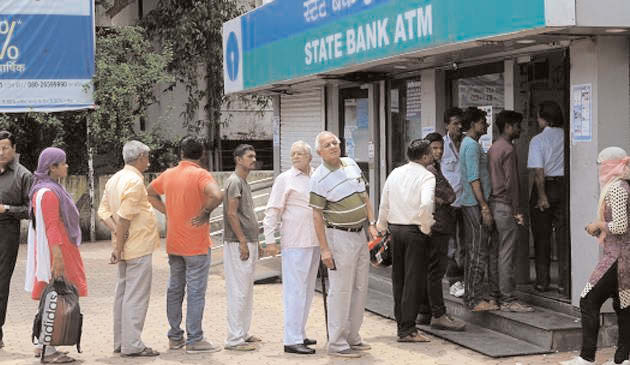
    I returned to USA after a month-long trip to India, where ATM machines fail to eschew cash, two months after the much hated demonetization of high value Indian currencies. A story goes like this: A Western tourist exchanged his dollar bills into Indian rupees in 500 and 1000 denominations. The same day government of India ordered these currencies invalid. The tourist was visiting India for 40 days. He spent rest of his time in India returning his rupees bills of 500 and 1000 by queuing outside of banks. There are many stories that tell the story of negative impact of demonetization but the government ignored to talk about it in its budget.

    The government push to make the country cash less is a dangerous one. The whole world deals in cash, especially for small transactions. If you are forced to get a credit card and use for purchases, you are destined to be drowned in heavy debt very soon. This is the true saga of middle class in developed economies including USA. Indian government promotes the cash less economy that would bring misery over its middle class, the same people who are responsible for improving the Indian economy to more than seven percent growth rate. There is no sign Modi government is capable to force the big industrialist mend their ways of working. Barring a few, no major case of corruption has been unearthed, except the arrests of individuals, who were caught carrying a few lakhs of currencies.

    Travelling from Delhi airport to my home in Dwarka I met a number of young people who had left their villages in far flung areas of Bihar and Odisha to drive taxis for living. These young people work for companies like Uber and Ola. Some of them plan to go back to their native village where they would appear for collage examinations. I bet these young people, who are without a pull in Delhi, are destined to continue driving taxis even after they would graduate from colleges.

    I travelled to Jaipur to attend the annual literature festival. The festival didn’t charge entry fee for young people who came to listen to authors from all over the world. I could see hundreds of young people, who thronged the venue every afternoon to mingle with friends. I am sure these young people were trying to make a sense of their lives and figure out if there is a future for themselves should they decide to become writers.

    During my month long trip to India I found that government offices including banks reverting to old days, when files used to move slowly. Officials talk about government guidelines that must be observed in order to ensure compliances. I visited a number of government offices and banks all of who were not busy working on their laptops. Wi-Fi was not functioning most of the time and many people continued to wait days and weeks for clearance of their files.

    All government steps are geared towards winning elections. The ruling Bharatiya Janata Party is facing daunting challenges in five states immediately after the release of the budget. It is quite natural that the concessions declared in the national budget reflect its concern for the common man. How much gain the common man gets due to the new initiatives is something to see in coming months.”

    The Indian Panorama will welcome comments on the subject from our wide awake readers.

  • Key Figures From Budget 2017 : Snapshot

    Key Figures From Budget 2017 : Snapshot

    Snapshot

    • Total expenditure of budget 2017-18 is 21.47 lakh crore
    • Fiscal deficit at 3.2 per cent of GDP for year starting April 1. Remain committed to achieve 3% in following year
    • Defence Expenditure excluding pensions set at 2.74 lakh crore
    • 10,000 crores for recapitalization of banks
    • Rural employment scheme of MNREGA gets “highest allocation ever” of 48,000 crores
    • One page I-T return form for individuals with less than Rs. 5 lakh income
    • Maximum cash donation from unknown sources to political parties cut to Rs. 2,000 from Rs. 20,000
    • Tax rate on small firms cut to 25 per cent

    FARMERS:

    • Farmer credit fixed at record level of Rs10 trillion; will ensure adequate flow to underserved areas
    •  Soil health cards: Govt to set up mini-labs in Krishi Vigyan Kendras
    • Long-term irrigation fund in Nabard-corpus at Rs40,000 crore
    • Model law on contract farming to be circulated
    • Dairy processing infra fund with corpus of Rs8,000 crore
    • Dedicated micro-irrigation fund with Rs5,000 crore corpus

    RURAL POPULATION

    • Mission Antyodaya to bring 1 crore households of poverty
    • MGNREGA: Rs48,000 crore has been allocated; participation of women now at 55%; using space technology in a big way
    • Prime Minister Gram Sadak Yojana: Rs19,000 crore allocated; along with states, Rs27,000 crore will be spent in FY18
    • Pradhan Mantri Awas Yojana: Rs23,000 crore allocated
    • 100% village electrification by May 2018
    • Rural livelihood mission: Rs4,500 crore allocated
    • Mason training to be provided for 5 lakh people
    • Panchayat Raj: Human resource reform programme to be launched
    • Rs1,87,223 crore allocated for rural programmes

    YOUTH

    • ? Education: System of measuring annual learning outcomes, emphasis on science
    • ? Innovation fund for secondary education
    • ? Reforms in UGC: Colleges to be identified based on ranking and given more autonomy
    • ? Propose to leverage information technology with launch of SWAYAM platform for virtual learning
    • ? National testing agency to be established for all entrance exams, freeing up CBSE, AICTE and other bodies
    • ? 100 Indian international skill centres to be established with courses in foreign languages
    • ? Rs4,000 crore allocated to launch skill acquisition and knowledge awareness
    • ? Special scheme for creating employment in leather/footwear sector

    POOR AND UNPRIVILEGED

    • ? Women: Mahila Shakti Kendras with Rs500 crore corpus
    • ? Stepped up allocation to Rs1.84 trillion for various schemes for women and children
    • ? Affordable housing to be given infrastructure status
    • ? Action plan to eliminate leprosy by 2018, TB by 2025, reduce IMR to 29 in 2019
    • ? To create additional PG medical seats per annum
    • ? Two new AIIMS in Jharkhand and Gujarat
    • ? New rules to be introduced for medical devices
    • ? Labour rights: Legislative reforms to simplify and amalgamate existing labour laws
    • ? Allocation to SCs increased to Rs52,393 crore; STs given Rs31,920 crore, minority affairs allocated Rs4,195 crore
    • ? Senior citizens: Aadhaar-based smart cards with health details to be provided

    INFRASTRUCTURE

    • ? Total capex and development expenditure of railways pegged at Rs1.31 trillion
    • ? Railways: Passenger safety fund corpus set up; unmanned level crossings to go by 2020
    • ? Railway lines of 3,500km to be commissioned
    • ? To launch dedicated tourism/pilgrimage trains
    • ? 500 stations to be made differently-abled friendly
    • ? Cleanliness in railways: To introduce Coach Mitra facility; By 2019, biotoilets for all coaches
    • ? Railways to offer competitive ticket-booking facility; service charge withdrawn for tickets
    • booked on IRCTC
    • ? New metro rail policy to be announced
    • ? Roads sector: Allocation for national highways at Rs64,000 crore


  • Education outlay increases 9.9% to Rs 79,685.95 crore

    Education outlay increases 9.9% to Rs 79,685.95 crore

    NEW DELHI (TIP): Finance minister Arun Jaitley indicated in his Budget speech on February 1 that India’s education sector would take a reform path in 2017-18.

    From focusing on learning assessment in schools and revamping higher education regulator University Grants Commission (UGC) to allow more autonomy to setting up of a national testing agency to conduct higher education entrance exams and freeing nodal education bodies from tedious administrative work, Jaitley touched the pain points in the country’s ever expanding education sector.

    Overall, the Union Budget 2017-18 has pegged an outlay of Rs79,685.95 crore for the education sector for financial year 2017-18, up from Rs72,394 crore in 2016-17-a 9.9% rise. Of the total outlay, Rs46,356.25 is for the school sector and the rest for higher education.

    “We have proposed to introduce a system of measuring annual learning outcomes in our schools. Emphasis will be given on science education and flexibility in curriculum to promote creativity through local innovative content,” the finance minister said.

    He also spoke about an “innovation fund” for the secondary education segment and leveraging technology to take quality courses to the mass students base in 3,479 educationally-backward blocks. In the higher education space, the finance minister said the government will undertake reforms in the University Grants Commission of India.

    “Good quality institutions would be enabled to have greater administrative and academic autonomy. Colleges will be identified based on accreditation and ranking, and given autonomous status,” said Jaitley, taking a leaf from the much talked about Indian Institutes of Management (IIM) Bill that promises to grant “complete autonomy” to the elite B-Schools.

    However, there seems to be a gap between the intent and actual allocations under some of the education reform heads. For example, the school assessment program has been allocated a sum of Rs67 lakh in the 2017-18 budget as against Rs5 crore in the previous one.

    Conducting learning assessment in a mammoth school system with nearly 250 million students across over 1.4 million schools with the amount allocated looks difficult. In contrast, the budget pegs Rs125 crore for appointing language teachers in 2017-18 as against Rs25 crore in the previous budget.

    Similarly, the e-learning portfolio of higher education has been allocated a total of Rs497 crore in 2017-18, as against Rs552 crore in 2016-17. Though the e-learning revised budget talks of a Rs516.89 crore allotment for the fiscal ending 31 March, the new allocation is below the revised estimates.

    The massive open online courses (MOOCs), part of the overall e-learning segment has been allocated Rs75 crore, the same as last year. The budget is also silent on any allocation for the proposed national testing agency or the innovation fund.

    “If you look at some of the reforms that the budget speech mentioned and the allocations made, then it is disappointing. Too little too late,” said Narayanan Ramaswamy, partner and head education practice at consulting and auditing firm KPMG.

    However, the budget allocates Rs250 crore for capital expenditure for setting up of higher education financing agency up from a token Rs1 crore last year. The world class institutions plan has been allocated Rs50 crore and the prime minister’s research fellowship, a new entrant in the budget has got Rs75 crore.

    Similarly, the IIMs will get Rs1,030 crore in 2017-18 including Rs190 crore for setting up of new IIMs. In 2016-17, the government had allocated Rs730 crore to IIMs, which was raised to Rs857.78 crore in the revised estimate.

    The Indian Institutes of Technologies have been allocated Rs7,856 crore in this budget, up from around Rs5,000 crore in the last budget. Sarva Shiksha Abhiyan, the flagship central scheme for universalization of school education has been given Rs23,500 crore, up from Rs22,500 crore in last budget. The mid-day-meal programme has been allocated Rs10,000 crore, up by Rs300 crore from the last budget.

  • UNION BUDGET 2017 – CIGARETTES, TOBACCO, MOBILES ASSEMBLED IN INDIA TO TURN DEARER

    UNION BUDGET 2017 – CIGARETTES, TOBACCO, MOBILES ASSEMBLED IN INDIA TO TURN DEARER

    PARTS USED FOR MANUFACTURING OF LED LIGHTS WILL ATTRACT BASIC CUSTOMS DUTY 5 PER CENT AND CVD OF 6 PER CENT FROM NIL EARLIER

    NEW DELHI (TIP): Smokers and tobacco consumers will have to pay more for their indulgence as Finance Minister Arun Jaitley continued with the crackdown on cigarettes, bidis and tobacco products by increasing taxes in the Budget 2017-18. Besides, mobile phones and LED lights assembled in India will also become dearer with the finance minister increasing duties on imported printed circuit boards and components respectively.

    UNION BUDGET 2017: WHO SAID WHAT
    PRIME MINISTER NARENDRA MODI: “This is a Budget for the future – for farmers, underprivileged, transparency, urban rejuvenation, rural development, enterprise. This Budget is yet again devoted to the well-being of the villages, farmers and the poor. From railway modernization to economic reforms, from education to health, from entrepreneurship to industry, the aim at fulfilling the dreams of all is clearly visible in the Budget.”

    RAILWAY MINISTER SURESH PRABHU: “It’s a pro- growth Budget. The growth will happen because of huge investments that is happening. For example in railways, the provision for Rs 1.31 lakh cr for capital expenditure is unprecedented in railway history.”

    UNION MINISTER VENKAIAH NAIDU: “It’s a fine exercise taken up by the Finance Minister. It’s very inspiring, bold steps has been announced. Particularly the political funding has been made transparent. People will be happy. Some political parties will become poor. That is why our opponents are saying the budget is anti-poor.”

    UNION MINISTER KIRAN RIJIU: “It will transform rural India and urban as well in terms enhancing the capacity of building infrastructure. It is a great relief to the common masses and it will transform the economy of the nation. At the same time, the reform in taxation is great.”

    BJP PRESIDENT AMIT SHAH: “The Union B8udget is aimed at all-round development with sops for the youth, women, farmers, the poor and middle class and that it will usher in a new era of progress.”

    CONGRESS VICE-PRESIDENT RAHUL GANDHI: “We were expecting fireworks, instead it was a damp squib. It is just ‘sher-o-shayari’ in the Budget. There is nothing for farmers and youth and nothing for job creation. There is no clear vision, no idea.”

    CONGRESS MP MALLIKARJUN KHARGE: “They have promised all these things (proposals to cleanse political system) keeping polls in five states in mind. They have not said anything for farmers, youth, women. They have accepted that GDP growth has gone down.”

    WEST BENGAL CM MAMATA BANERJEE: “A controversial Budget which is clueless, useless, baseless, missionless and actionless. No roadmap for the country or the future from a government that has lost all its credibility.”

    MADHYA PRADESH CHIEF MINISTER SHIVRAJ SINGH CHOUHAN: ” union budget is a revolutionary step for a progressive India. The budget will increase the pace of development and growth to help poor and marginalized people.”

    CPM GENERAL SECRETARY SITARAM YECHURY: “It an example of Finance Minister joining the Prime Minister and the BJP President to create ‘jumlas’. The budget is a classic example of that. It won’t boost employment or generate demand. The idea of infrastructure development is a farce because the data given by the FM is not related to reality, does not match to what he said in his speech.”

    MAHARASHTRA CM DEVENDRA FADNAVIS: “Pathbreaking budget! It has the same disruptive effect as demonetization had. Country will leapfrog to next level. This is indeed Budget for Better India. Positive effect of demonetization, the increase in capital expenditure by 25%will generate more jobs.”

    HARSH KUMAR BHANWALA, CHAIRMAN NABARD: “The Budget focuses a lot on the rural and agriculture sector. Though the thrust on digital continues, reforms announced in the Budget will generate employment and help in doubling farmers income.”

    Jaitley, however, made an attempt to make it more affordable for clean energy sources by cutting duties on solar tempered glass, fuel cell based power generating systems and wind operated energy generator. With the expected implementation of GST, large scale tinkering of tax structure has been avoided in the Budget thereby sparing most of the commonly used daily items from price changes.

    “Implementation of GST is likely to bring more taxes to both central and state governments because of widening of tax net. I have preferred not to make many changes in current regime of Excise and Service Tax because the same are to be replaced by GST soon,” Jaitley said while presenting the Budget.

    Yet, tobacco and cigarettes have not been spared.

    Excise duty on unmanufactured tobacco has been almost doubled to 8.3 per cent from 4.2 per cent earlier, while that on pan masala has been hiked to 9 per cent from 6 per cent.

    Likewise, excise duty on cigar, cheroots has been changed to 12.5 per cent or Rs 4,006 per thousand, whichever is higher from 12.5 per cent or Rs 3,755 per thousand, whichever is higher. Excise duty on chewing tobacco, including filter khaini and jarda scented tobacco has also been doubled to 12 per cent from 6 per cent earlier.

    Excise on paper-rolled handmade bidis has been increased to Rs 28 per thousand from from Rs 21 per thousand and the same for paper rolled biris has gone up from Rs 21 per thousand to Rs 78 per thousand.

    Populated Printed Circuit Boards (PCBs) for use in the manufacturing of mobile phones, subject to actual user condition will also attract SAD of 2 per cent from nil earlier.

    Similarly, parts used for manufacturing of LED lights will attract basic customs duty 5 per cent and CVD of 6 per cent from nil earlier.

    As per the Budget announcement, imported cashew nut (roasted, salted or roasted and salted) will also become dearer as basic customs duty on the item has been hiked to 45 per cent from 30 per cent earlier.

    Imported silver medallion, silver coins, having silver content not below 99.9 per cent, semi-manufactured form of silver and articles of silver will also be dearer as there items will now attract CVD of 12.5 per cent from nil earlier.

    Jaitley has made a few announcements in the Budget that will help consumers.

    Railway travel with e-tickets booked through IRCTC will become cheaper as service charge on it has been withdrawn. RO water purifiers are likely to be slightly cheaper with basic customs duty on imported membrane sheet and tricot/spacer for use in the manufacture of RO membrane element for household filters has been reduced from 12.5 per cent to 6 per cent.

    However, with a view to encourage domestic production of RO membrane element, the government has hiked basic customs duty on it to 10 per cent from 7.5 per cent earlier.

    Customs duty of LNG has been halved to 2.5 per cent which can lead to lower power and fertiliser costs.

    With an eye on promoting clean energy source, the government has reduced basic customs duty on solar tempered glass used in solar panels from 5 per cent to nil.

    Likewise, the basic customs duty and CVD on all items of machinery required for fuel cell based power generating systems to be set up in the country lowered to 5 and 6 per cent from 10/7 and 12.5 per cent earlier.

    Also, the basic customs duty, on resins and catalyst for manufacture of cast components for wind operated energy generator has been lowered to 5 per cent from 7.5 per cent earlier, while CVD and SAD on these items have been slashed to nil from 12.5 per cent and 4 per cent, respectively earlier.

    Continuing the focus on promoting leather industry, Jaitley announced that basic customs duty on vegetable tanning extracts used in making leather products such as bags and shoes has been slashed to 2.5 per cent from 7.5 per cent earlier.

    Miniaturised POS card reader for m-POS, micro ATM as per standard version, finger print reader/scanner and iris scanner will also be cheaper as duty on these item have been reduced to nil.

    For the defence forces, services provided or agreed to be provided by the Army, Naval and Air Force Group Insurance Funds by way of life insurance to their members under the Group Insurance Schemes of the Central Government is being exempted from service tax as against 14 per cent charged earlier.


  • Funding a clean polity: Crony capitalism needs a dirty political arena

    Funding a clean polity: Crony capitalism needs a dirty political arena

    Harish Khare

    “Today, our politics has become so divisive and toxic that any ‘reform’ becomes suspect. There is no ‘JRD’ today who would be able to tell the Prime Minister that he would be funding his political rivals.  There is no business house that does not seek a favour from the government of the day. This vulnerability induces moral timidity and financial chicanery. The unvarnished fact is that no corporate house can sanguinely acknowledge writing cheques for a political party’s treasurer. No businessman can afford to earn the wrath of the ruling party and incite a visit from that ubiquitous ‘ED’ or the CBI who invariably end up seizing ‘incriminating documents’. Even the most honest trader or contractor or entrepreneur remains vulnerable to the State’s minatory inspector”, says the authorHarish Khare.

    Sometime in early 1959, JRD Tata, India’s most respected and iconic entrepreneur, wrote to Jawaharlal Nehru that though his group, the Tatas, would continue to keep funding the Congress Party, he wanted to inform the Prime Minister that it would also be financing the newly established Swatantra Party. The Tata doyen told the Prime Minister that he found the Swatantra Party to be having a much closer appreciation of the needs of the business community; hence, he felt his group was obliged to extend whatever support it could to the Swatantra Party. Unperturbed, Nehru replied to JRD that he and his group were fully entitled to fund and finance whichever political activity they deemed worth their penny. As far as he was concerned, he had no doubt in his mind that the Swatantra Party had no future in Indian politics. Nehru was proved right: the Swatantra Party folded its tent within 15 years, though not without some spectacular successes in the 1962 and 1967 Lok Sabha elections.

    What neither Nehru argued nor JRD understood was that the Indian business community did not need a party like the Swatantra Party, a political outfit that believed in plain, simple, clean capitalism, whereas the Indian businessmen had thrived only under State patronage and its louche cousin, crony capitalism. Both before and after the 1991 reforms, the so-called entrepreneurs relied on political connections for their financial prosperity. Even now, the Indian State retains a very capricious capacity to mug any business house of its happiness. That is why the totally strange and inexplicable sight of a Ratan Tata making a pilgrimage to Nagpur to pay a ‘courtesy call’ on Mohan Bhagwat, the RSS boss man.

    All this needs to be recalled in order to contextualise Finance Minister Arun Jaitley’s attempt to cleanse the political party’s dirty financial stables. Over the years, all political parties have had access to huge and, that means, really huge -funds to finance elections and political activity. And, this means a less-than-honourable juggalbandi with the dishonest businessman. This juggalbandi has been at the core of all the ills and imperfections of Indian democracy. On the one hand, there rose- and, rose mightily -the houses of the Adanis and the Ambanis; the rise has been attributed to their ability to cosy up to political leaders. On the other hand, we have had the politicians with business links -the SK Patils, the LN Mishras, the Pramod Mahajans – having acquired prominence and clout within their own parties. Narendra Modi’s own ascendency in Gujarat can easily be traced to the ecology of institutionalised crony capitalism. And, by all accounts, the BJP had outspent many times over all its rivals in the 2014 Lok Sabha elections.

    No political party can pretend to have its hands clean, or even cleaner than the other. A handful of individual leaders may be able to claim a kind of personal honesty but none is entitled to a claim of ignorance about his/her party’s ability to access dirty money. No political party can claim to be morally superior when it comes to receiving – or extorting -funds from businessmen, big or small. In recent years, AAP has sought to put in place a somewhat transparent system but, of late, it too has found itself being accused of unclean transactions.

    At first glance, Mr. Jaitley has taken the first step towards forcing the political parties to clean up their account books. It is a political reform whose day has come. Not a day too soon. The middle classes, who have peremptorily colonised the sites of political argumentation, can be tempted to cheer this as a transformative moment. Yet, the temptation must be resisted-for three reasons.

    First, politics is an expensive business. A political party and its activities -mobilisation of support and dissent, sustenance of a large number of party activists, and, increasingly, the need for access to expensive technology of social media – cost quite a bundle. The bigger the party, the larger its establishment and larger the size of its baggage-and, the heftier its monthly bill. Second, the government – at the Centre and in the states – has not vacated its rent-seeking sites. There will always be temptation for a chief minister to use his coercive powers to generate easy money, for personal or political use. Political parties attract mostly the parasitic elements that come to the arena only to live off the taxpayer. And, third, there is no dismantling of crony capitalism. Consequently, the unclean and unethical businessman would continue to seek out the unclean and unethical politician. The businessman’s greed and the politician’s rapacity work in tandem.

    Nonetheless, a beginning has been made. Still, it would be reassuring to know that the Finance Minister’s initiative was not simply motivated by political cleverness, aimed at grounding the BJP’s rivals – just as some suspect that demonetisation was primarily driven by a desire to ‘pauperise’ the other political parties. That calculation seems to be coming unstuck in Uttar Pradesh. The Modi government has incurred a serious trust deficit.

    Political parties in India will continue to have a legitimate need for funds, both for and beyond electioneering activities. And, it is perfectly legitimate for a business house or a rich businessman to ‘reward’ a political party or leader on account of a platform or ideology. In fact, even before Independence, most Indian business leaders willingly and cheerfully funded Mahatma Gandhi’s establishment. After 1947, many regional businessmen were inclined to fund, finance and support regional political outfits.

    Today, our politics has become so divisive and toxic that any ‘reform’ becomes suspect. There is no ‘JRD’ today who would be able to tell the Prime Minister that he would be funding his political rivals. No businessman can afford to earn the wrath of the ruling party and incite a visit from that ubiquitous ‘ED’ or the CBI who invariably end up seizing ‘incriminating documents’. Even the most honest trader or contractor or entrepreneur remains vulnerable to the State’s minatory inspector.

    Mr. Jaitley’s budget has so ordained that the political parties – including the BJP – would have to rejig their financial connections. Transparency in public life is a much-desired goal, but it should not be used to frogmarch the rivals out of the political arena. New norms of a level-playing field will need to be institutionalised. Otherwise the Jaitley remedy may be worse than the disease.

    (The author is editor in chief of Tribune group of newspapers)

    British English

  • Indian Union Budget 2017 Presented – Finance Minister unveils series of post-demonetization digital reforms

    Indian Union Budget 2017 Presented – Finance Minister unveils series of post-demonetization digital reforms

    NEW DELHI (TIP): In a pre-election Budget aimed at softening the demonetization blow, Finance Minister Arun Jaitley on February 1 halved the basic income tax rate to 5 per cent and lowered the rate for small companies, while boosting spending on rural employment, agriculture and infrastructure.

     
    HIGHLIGHTS
    I-T halved to 5% for assessees in Rs 2.5-Rs 5 lakh slab

    ● Rs 12,500 relief for taxpayers in other categories

    ● 10% surcharge on income between Rs 50 lakh-1 cr

    ● Rs 1 lakh cr Rail Safety Fund for network upgrade

    ● Highest-ever Rs 48,000-cr grant for MGNREGA

    ● FIPB shut; FDI norms to be further eased

    ● 5% corporate tax cut for small firms

    ● No cash deals above Rs 3 lakh

    Jaitley presented a merged railway and general Budget after advancing the dates by a month that provides a record outlay of Rs 3,96,135 crore for infrastructure schemes, besides a capital expenditure of Rs 1.3 lakh crore on railways and Rs 64,000 crore on highways.

    The FM perhaps was asked to build on the political gains of demonetization, and that is why sections hurt by it were targeted for incentives. Small and medium enterprises got a tax cut and taxpayers were rewarded – though not to the extent expected. And much against expectation again, the Budget lacked the surprise factor.

    The Budget seeks to provide a record Rs 10 lakh crore in loans to farmers, boost funds for rural employment guarantee program, bring one crore households out of poverty and promised to build one crore houses by 2019 for the homeless ahead of the crucial elections in five states.

    In view of the fact that the proposed GST is expected to be rolled out soon, he left indirect taxes largely untouched.

    While the tax rate for income between Rs 2.5 lakh and Rs 5 lakh has been lowered to 5 per cent, a 10 per cent surcharge has been slapped on income between Rs 50 lakh and Rs 1 crore. The 15 per cent surcharge on income above Rs 1 crore will continue.

    The tax liability of all persons below Rs 5 lakh would be reduced to either zero (with rebate) or 50 per cent of the existing liability. In order not to have duplication of benefit, the existing benefit of rebate available to them is being reduced to Rs 2,500 available only to assessees up to income of Rs 3.5 lakh.

    While the taxation liability of people with income up to Rs 5 lakh is being reduced to half, all other categories of taxpayers in the subsequent slabs will also get a uniform benefit of Rs 12,500 per person.

    In the case of senior citizens above 60 years, there will be no tax up to Rs 3 lakh, while the exemption will be up to Rs 5 lakh in case of citizens above 80. Both the categories will attract a tax of 20 per cent on income between Rs 5-10 lakh and 30 per cent for income above Rs 10 lakh.

    FISCAL DEFICIT DOWN TO 3.2% FROM 3.5%

    Moving ahead with the fiscal consolidation path, Finance Minister Arun Jaitley has pegged the fiscal deficit for 2017-18 at 3.2 per cent, down from 3.5 per cent expected in the current financial year. Addressing the media, he said the Budget estimate for fiscal deficit was 3.5 per cent for 2016-17 and revised estimate is also 3.5 per and it will be achieved. Fiscal deficit is the difference between revenue receipts plus non-debt capital receipts (NDCR) and total expenditure. This indicates the total borrowing requirements of the government from all sources. Fiscal deficit of 3.2 per cent in absolute terms for the next fiscal comes out to be Rs 5,46,532 crore.

    AFFORDABLE HOUSING GETS INFRA STATUS

    Aiming to boost real estate sector, the government announced infrastructure status to affordable housing for encouraging investment and offered tax sops to developers sitting on completed but unsold homes. The allocation for Pradhan Mantri Awaas Yojana- Gramin has also been raised.

    INCENTIVES TO BOOST INVESTMENT IN NPS

    In a bid to boost NPS, Finance Minister Arun Jaitley has proposed higher tax rebate for investment in flagship social security programs and allowed tax relief on partial withdrawal of up to 25 per cent of the contribution.

    NOW, TAX EXEMPTION TO CM, LG RELIEF FUNDS

    The government announced extension of tax exemption on contributions to Chief Minister’s Relief Fund and Lieutenant Governor’s Relief Fund. At present, there is tax exemption on funds given to Prime Minister’s National Relief Fund. Jaitley said Chief Minister’s Relief Fund (CMRF) and Lieutenant Governor’s Relief Fund (LGRF) are of the same nature as the Prime Minister’s National Relief Fund at the level of state or the union territory. “Therefore, it is proposed to amend the said clause to provide the benefit of exemption to the Chief Minister’s Relief Fund or the Lieutenant Governor’s Relief Fund,” he said. This amendment to I-T Act will take effect retrospectively from April 1, 1998.

    “The Union Budget for 2017-18 is in line with the BJP’s changed political stance of wooing the poor and shedding its “suit-boot-ki-sarkar” image. The Modi government has changed track and turned to the side where the numbers are -the poor, farmers and the middle class – which makes sense electorally. This is what every party tries to do – look credible on welfare and capture the constituency of the deprived. Congress and BJP budgets frequently look similar. How to deliver the dole is the real challenge and the switchover to a technology-based foolproof system is being unnecessarily delayed”, commented a newspaper.

  • Notebandi not enough to end corruption

    Notebandi not enough to end corruption

    By Beena Kothari - President, India Association of Long Island Email: beena.kothari@gmail.com
    By Beena Kothari – President, India Association of Long Island Email: beena.kothari@gmail.com

    The historic decision of Nov 9, 2016 to demonetize currency notes of Rs. 500/1000, which represents 86 %of the total currency in circulation, was ‘overdue’ since the last time in 1978.

    Many reports suggest that it has resulted in shrinking the size of the parallel economy and black money tremendously, at the least by 20%. and likely to be more in the coming year as follow up measures indicate .The business of counterfeit currency  is almost 80,000 crores which has been pumped by ISI and our enemies  has been badly hit  and almost stopped for now. The terror funding by the enemies across the border and the illegal mafia activities, communal riots, human trafficking, including Naxalites activities have been extremely reduced for the time being. The huge inflow of the cash money into the banks thus into the economy, has resulted into loan interest rates going down and lowering the cost of doing business and making more affordable the products.

    It is well known that many political parties are the biggest hoarders of the black money. Now, we may see a better election process and the fair practices in the upcoming assembly elections in a more democratic ways. The cash deposits of over 14 lakhs crores after this move which will very positively impact Indian economy and improve the GDP by at least 1.5%. People are becoming hopeful that there is likely increase in public expenditure due to more tax collections which govt. will be spending on infrastructure, health, education, social welfare schemes and creating job opportunities.

    The demonetization move has been seen as a “Masterstroke” by many among us. Is it a Masterful enough?

    This mammoth tasks lacked in the great detailed planning as seen by the long queues at the banks for many weeks and the empty ATMs. It caused public inconvenience in many medical emergencies and health issues, the wedding seasons was also around the corner. In rural area, the banking structure was not sound enough to support this transition. As 90 % of the Indian economy is on cash, this cash crunch has the worst impact in the service sector and would continue for more months .Ongoing period is high activity for agriculture is a major concern and have felt the big pinch. There is a fear of return of “inflation” contrary to the fundamentals that it should go down after demonetization. So we could see short-term pain for India’s economic trajectory but eventual long-term gains for Indian economy.

    “Black money is not synonymous with corruption; it is rather one of several symptoms of corruption”. This intervention is a one-time draining of this current stock of black money but unless the root causes of corruption are removed, corruption will continue. It is sort of like a dialysis, more of a short term cleaning up than a solution of the problem. It needs to be repeated periodically. More enforcements   and tightening of the laws and regulations is required on ongoing basis to get rid of the menace of the corruption.

    Digitization provides equal access to education and communication. Digitization also ensures that the public goods and services are reaching people cost effectively and timely in an efficient manner. Whether it is banking, railways or even Public distribution system or any public utility service, it makes their delivery faster and easier to keep track with. People can now do almost everything online, to apply for a PAN card, passport and to book a railway ticket or pay bills they no longer need to stand in long queues. There is also an online grievance system for almost every service and therefore people’s problems are now better attended because everything is now recorded, monitored and tracked. We have even seen People directly tweet the grievance to the concerned minister, the role of Smt. Sushma Swaraj, MEA Minister is exemplary outstanding and extra ordinary and getting it resolved promptly. So with this another value of democracy, service for the people is effectively implemented. Digitization is truly strengthening and enhancing the Indian democracy and widening its scope for betterment of common man. Digitization is the way to advance.

  • Demonetization was a dishonest promise

    Demonetization was a dishonest promise

    A cost-benefit analysis of demonetization needs to take into account the inconvenience caused and the millions of man days lost in queues and lay-offs.

    The honorable Prime Minister promised the people an India of their dreams after 50 days in lieu of their cooperation. And people gave full cooperation by standing in long queues outside banks from dawn to dusk, just to withdraw their own money, and that too in rationed amounts. Despite the chaos continuing even after the completion of the 50-day ‘grace period’, for God’s sake let us not doubt the ‘good’ and ‘honest’ intentions of our worthy Prime Minister. At the same time, we must appreciate the unprecedented and remarkable patience and cooperation people have extended. This has been publicly acknowledged by the Prime Minister. Now it is the turn of Narendra Modi, the all-powerful Prime Minister, to deliver as promised.

    Did Modi really know what people desired, or did he simply wrap his political motives as the desire of the people? Or was it a move to cover up for the failure of the much touted promise of bringing back the black money stashed in foreign banks. Diverting peoples’ attention from the unfulfilled promise and almost negligible achievement on black money might be another reason behind demonetization. Let us leave it to the judgement of the people and history. It is often said that everyone is good until he proves otherwise, and the PM, too, must be given the opportunity.

    Nonetheless, even as black money and corruption are very important issues, poverty, unemployment/underemployment and social security are the more important concerns of people. Often, politics in India is being done in the name of the poor, as seen in the “garibi hatao” slogan of the then all-powerful PM, Indira Gandhi, in the late 1960s. “Garib” and “garibi” are still there, but Indira Gandhi won the Parliament elections with a thumping majority. Let us hope that demonetization is above such politics.

    One immediate outcome of demonetization has been the non-functioning of Parliament, a heavy cost for a poor nation and loss of precious time of our elected representatives. Both the ruling alliance and the Opposition blamed each other. It was politics versus politics, while each side accused the other of playing politics. The NDA has labelled the political opposition as well as all others critical of demonetization as supporters of corruption and black money, as if everybody in the ruling alliance was honest and others dishonest. This is being used as a powerful weapon to disarm the Opposition and critics and to change the entire narrative. The fact, however, is that all political parties resort to corrupt practices to finance and win elections. Once in power, they shower benefits on their financers and supporters, and thereby promote the culture of crony capitalism.

    The poor and common people get swayed by the illusion that perhaps they will be benefited, but in the process only enter a still greater illusion of ‘achhe din’ and the India of their dreams. Every time clever politicians conjure up new dreams and mange to remain in power themselves. Competitive political populism and blame games are an integral part of the grand design to fool the people. Something similar seems to be at work behind the demonetization exercise.

    The common man is in the illusionary wait to see some ‘big’ amount deposited in his bank account as a result of demonetization. The Prime Minister himself has advised the Jandhan account holders not to give back the black money deposited in their accounts. Sadistic pleasure may be another source of the common man’s satisfaction, in the sense that he is happy that rich peoples’ money would be confiscated. The real issues and concerns of the common people, meanwhile, continue to remain unattended and their sufferings seem to be unending.

    While making the ‘bold’ and ‘historic’ announcement (no less than a ‘surgical strike’) to the nation on the night of November 8, the Prime Minister stated three overt objectives of the demonetization decision: eliminating black economy; eradicating corruption; and curbing counterfeit money and thereby eliminating terrorism. But the million-dollar question remains: Can demonetization really achieve these objectives?It is impossible to obtain an affirmative answer through any logic or imagination.

    The simple reason is that there is no correlation between demonetization and the generation of black money; demonetization and corruption; and demonetization and counterfeit currency/terrorism. In the absence of any correlation, how can demonetization achieve the stated objectives? As a matter of fact, demonetization is neither a necessary nor a sufficient condition to achieve the above mentioned objectives. Nonetheless, demonetization may create some temporary deterrent in the minds of the people who are indulging in corruption and generation of black money.

    A cost-benefit analysis of demonetization needs to take into account the inconvenience and the millions of man days lost in queues and lay-offs (particularly in the unorganized / informal sectors) caused so far and in the months to come. In a consumption-led growth model, whenever consumption falls, production is adversely affected, which in turn leads to lay-offs and unemployment. It eventually results in a reverse investment multiplier (one unit decline in investment leading to a multiple decline in income), leading to lower income generation and often to a recessionary phase. In that case the economy shall have to struggle hard to stage a comeback.

    If Modi is really interested in curbing the black economy and corruption, then a systemic and social solution is needed. Corruption and the amassing of unaccounted-for wealth are ingrained in the psyche of the people; it is this greed that needs to be addressed. Everybody, especially in the tax collection machinery and the government, knows the sources of black money/economy, and laws are in place to curb it. Confiscation of ill-gotten money and wealth and effective implementation is sine qua non.

    A digital and cashless economy may provide a solution in the long run, but first we must have the enabling infrastructure in place, and then people need to be prepared, especially the poor and illiterate in the remote and rural areas, to get accustomed to that. The kind of ‘surgical operation’ and shock therapy being undertaken currently may cause more harm than good. It is difficult to believe that Modi is not aware of all this.


  • GST: JAITLEY PUSHES  FOR CONSENSUS

    GST: JAITLEY PUSHES FOR CONSENSUS

    NEW DELHI (TIP): The Centre on Wednesday said that it will wait for consensus to emerge on GST laws and will not push for a decision by vote despite the threat of a delay in rolling out the new tax regime from April.

    “I have consciously avoided voting and we have decided on issues based on consensus, often after a long discussion. The GST Council is a federal institution and a delicate one,” finance minister Arun Jaitley said after the body comprising states and the Centre failed to finalise the draft laws once again. Jaitley said that given that the precedent from earlier meetings would be cited in future decision-making, GST Council was trying to decide on all issues by consensus.

    Two major issues -the proposed levy of tax on sale in the high-seas and dual control over entities with annual turnover of less than Rs 1.5 crore -have held up the finalisation of the draft laws. The laws need to be cleared by the state legislatures and Parliament before GST can be rolled out and industry is demanding time to prepare itself for the new tax regime.

    As a result, the possibility of rolling out GST from April seems remote and state FMs are talking about a delay with Kerala finance minister Thomas Issac suggesting that implementation may not take place before September, which is the Constitutional deadline. “I am not very optimistic about GST rolling out in June or July.It is better to move to GST after all the preparations are done. To my understanding, it will be implemented September on wards,” he told reporters.

    While West Bengal finance minister Amit Mitra did not indicate a date, he said that a number of steps had to be taken, including software upgradation by companies. Jaitley too acknowledged that it was a race against

    time.”We know the difficulties, we are moving against time,” he said, adding that the GST Council would try to clinch a deal at its next meeting on January 16.

    Source: TOI

  • Poll schedule for 5 states announced, UP to vote in 7 phases; counting on March 11

    Poll schedule for 5 states announced, UP to vote in 7 phases; counting on March 11

    NEW DELHI (TIP): The Election Commission on January 4 (Wednesday) announced the poll dates for Uttar Pradesh, Uttarakhand, Punjab, Manipur and Goa. Chief Election Commissioner Nasim Zaidi said that the state of Manipur will have a two-phase election and Uttar Pradesh will have a seven-phase election. Counting for all states will be held on 11 March.

    A total of 690 assembly constituencies will go to polls in these elections. Twenty three of these have been reserved from Scheduled Tribes candidates. Over 160 million voters – that’s the size of the electorate in these assembly elections. There will be 1,85,000 polling stations across five states.

    Seven-phase elections in Uttar Pradesh from February 11 to March 8; Punjab and Goa will vote on February 4 while Uttarakhand on Feb 15; results on March 11

    NEW DELHI (TIP): Assembly elections in UP, Punjab, Uttarakhand, Goa and Manipur will be held between February 4 and March 8, the results of which — to be announced on March 11 — are likely to be seen as a referendum on the demonetisation move by PM Narendra Modi.

    The terms of the legislative assembly of Goa, Manipur and Punjab are due to expire on March 18 while that of Uttarakhand expires on March 26. The legislative term of Uttar Pradesh ends on May 27. Goa has 40 assembly seats, Manipur has 60, Punjab has 117, Uttarakhand has 70 while Uttar Pradesh has 403.

    Election Commission made the much-anticipated announcement of dates on January 4 (Wednesday), setting in motion a process that will impact Indian polity in the coming months. The UP polls are already being dubbed as a “semi-final” to the 2019 general elections. These polls are significant for BJP as a good electoral harvest will boost its strength in the Rajya Sabha in the near future. The outcome will also have a bearing on the Presidential elections later this year.

    UP will have a seven phase election, with polling on February 11, 15, 19, 23, 27, March 4 and 8.

    Manipur, which continues to be under a blockade and is facing law and order problems, will have a twophase election with polling on March 4 and 8.

    Seven-phase elections in Uttar Pradesh from February 11 to March 8; Punjab and Goa will vote on February 4 while Uttarakhand on Feb 15; results on March 11Punjab and Goa will vote on February 4 while Uttarakhand on Feb 15. While the Code of Conduct has come into force with the announcement, the state-wise notification process will begin with Punjab and Goa on January 11.

    Demonetisation is likely to be a big issue in these elections, though the polling pattern will be guided by local factors, caste equations and identity politics. With the Centre propagating a less-cash economy, the extent to which money power is at play in these polls will be keenly watched. One of the new rules of these elections allows parties to use cash for campaign payments only up to Rs 20,000.

    Candidates will also have to take oath this time that they have no pending public utility bills. The SC order last week barring political parties and candidates from seeking votes in the name of religion or caste has also added to the worries of the contestants. While SP is seeking to retain power in UP and is facing a challenge from BJP and BSP, Congress is trying to beat anti-incumbency in Uttarakhand and Manipur. BJP is a part of the ruling coalition in Punjab and rules Goa. The caste-ridden politics of UP now has an added dimension with the feud in the first family of SP. CM Akhilesh Yadav is fighting over the symbol, bicycle, with his father and party patriarch Mulayam.

    SAD-BJP combine, which has ruled Punjab for two consecutive terms, has not lost hope, especially if AAP makes it a triangular contest at the expense of Congress. AAP is also making things difficult for BJP and Congress in Goa.

    BJP is still confident of retaining power. BJP is hopeful of defeating Congress in Uttarakhand while CM Harish Rawat is playing the victim card, citing the saffron party’s attempt to topple his government a few months ago. BJP is hopeful of defeating Congress in Manipur currently under Congress rule. Manipur has been facing an economic blockade on its two highways since November 1 over creation of seven new districts.

  • HOW INDIA LOBBIED MOODY’S FOR RATINGS UPGRADE, BUT FAILED

    HOW INDIA LOBBIED MOODY’S FOR RATINGS UPGRADE, BUT FAILED

    NEW DELHI (TIP): India criticised Moody’s ratings methods and pushed aggressively for an upgrade, documents reviewed by Reuters show, but the US-based agency declined to budge citing concerns over the country’s debt levels and fragile banks.

    Winning a better credit rating on India’s sovereign debt would have been a much-needed endorsement of Prime Minister Narendra Modi’s economic stewardship, helping to attract foreign investment and accelerate growth.

    Since storming to power in 2014, Modi has unveiled measures to boost investment, cool inflation and narrow the fiscal and current account deficits, but his policies have not been rewarded with a ratings upgrade from any of the “big three” global ratings agencies, who say more is needed.

    Previously unpublished correspondence between India’s finance ministry and Moody’s shows New Delhi failed to assuage the ratings agency’s concerns about the cost of its debt burden and a banking sector weighed down by $136 billion in bad loans.

    In letters and emails written in October, the finance ministry questioned Moody’s methodology, saying it was not accounting for a steady decline in the India’s debt burden in recent years. It said the agency ignored countries’ levels of development when assessing their fiscal strength.

    Rejecting those arguments, Moody’s said India’s debt situation was not as rosy as the government maintained and its banks were a cause for concern, the correspondence seen by Reuters showed.

    Moody’s and one of its lead sovereign analysts, Marie Diron, declined to comment on the correspondence, saying ratings deliberations were confidential. India’s finance ministry did not respond to requests for comment.

    Arvind Mayaram, a former chief finance ministry official, called the government’s approach “completely unusual”.

    “There was no way pressure could be put on rating agencies,” Mayaram told Reuters. “It’s not done.”

    Debt burden, bad loans

    India has been the world’s fastest growing major economy over the past two years, but that rapid expansion has done little to broaden the government’s revenue base.

    At nearly 21 percent of gross domestic product (GDP), India’s revenues are lower than the 27.1 percent median for Baa-rated countries. India is rated at Baa3 by Moody’s, the agency’s lowest notch for debt considered investment grade.

    A higher rating would signify to bond investors that India was more creditworthy and help to lower its borrowing costs.

    While India’s debt-to-GDP ratio has dropped to 66.7 percent from 79.5 percent in 2004-05, interest payments absorb more than a fifth of government revenues.

    Moody’s representatives, including Diron, visited North Block, the colonial sandstone building in the Indian capital that houses the finance ministry, on September 21 for a discussion on a ratings review.

    The atmosphere at the meeting with economic affairs secretary Shaktikanta Das, one of the ministry’s most senior officials, and his team was tense, according to an Indian official present, after Diron had told local media the previous day that a ratings upgrade for India was some years away.

    On September 30, Moody’s explained its methodology to Indian officials in a teleconference.

    Lobbying for an upgrade

    Four days later, the finance ministry sent an email to Diron questioning Moody’s metrics on fiscal strength. The government cited the examples of Japan and Portugal, which enjoy better ratings despite debts around twice the size of their economies.

    “Given that countries are on different stages of economic and social development, should countries be benchmarked against a median or mean number (as is done by Moody’s)” the email asked.

    In India’s case, “while the debt burden lowered significantly post 2004, this did not get reflected in the ratings”, the ministry argued.

    New Delhi urged Diron to look at improvements in the factors – better forex reserves and economic growth -that Moody’s had considered when handing India its last ratings upgrade in 2004.

    In a reply the next day, Diron said that, not only was India’s debt burden high relative to other countries with the same credit rating, but its debt affordability was also low.

    She added that a resolution to the banking sector’s bad loan problems was “unlikely” in the near-term.

    In a last-ditch effort on Oct. 27, Economic Affairs Secretary Das sent a six-page letter to Singapore-based Diron, addressed to Moody’s New York headquarters. Source: Reuters

  • Pravasi Bharatiya Divas 2017: Redefining Engagement with Indian Diaspora

    Pravasi Bharatiya Divas 2017: Redefining Engagement with Indian Diaspora

    “I personally extend my warm greetings to you. Please do come. This day is being celebrated in your honor. This day is dedicated to overseas Indians who, through heroic achievements, have made a mark in the world. We also dedicate this day to all overseas Indians who through their hard work have kept India’s flag flying high”. Sushma Swaraj, External Affairs Minister.

    • Register online for participating in the 14th Pravasi Bharatiya Divas Convention
    • Last Date for Registration: 22 December, 2016.
    • Special Discounts in Registration Fees for Young Delegates and Group Registrations

    Pravasi Bharatiya Divas (PBD) is celebrated on 9 January every year to mark the contribution of Overseas Indian community in the development of India. January 9 was chosen as the day to celebrate this occasion since it was on this day in 1915 that Mahatma Gandhi, the greatest Pravasi, returned to India from South Africa, led India’s freedom struggle and changed the lives of Indians forever.

    PBD conventions are being held every year since 2003. These conventions provide a platform to the overseas Indian community to engage with the government and people of the land of their ancestors for mutually beneficial activities. These conventions are also very useful in networking among the overseas Indian community residing in various parts of the world and enable them to share their experiences in various fields.

    During the event, individuals of exceptional merit are honored with the prestigious Pravasi Bharatiya Samman Award to appreciate their role in India’s growth. The event also provides a forum for discussing key issues concerning the Indian Diaspora.

    The 14th Pravasi Bharatiya Divas Convention will be held from 7 to 9 January, 2017 at Bengaluru in Karnataka.The theme of 2017 PBD is “Redefining Engagement with Indian Diaspora”. It will see close to 3000 Non-Residential Indians (NRI) and PIO delegates from across the world.

    The PBD Convention features Plenary Sessions; an Exhibition; Cultural programs and provides an opportunity to interact with other Overseas Indians, Policy makers, Political leadership and others. The highlight of the PBD convention is the inaugural address by the Prime Minister. Chief Ministers of several states also participate and address the delegates on opportunities available in their respective states. The last day of PBD features the valedictory address by the President of India, who will also confer the Pravasi Bharatiya Samman Awards on Overseas Indian for their achievements and contribution both in India and abroad. 

    Objectives of PBD 2017:

    • PBD 2017 will focus on the theme “Redefining the engagement with the Indian Diaspora”.
    • To strengthen Diaspora engagement and provide a platform for networking with the Diaspora.
    • To recognize the Diaspora’s contribution to India and know their expectations and concerns.
    • To deepen engagement with young Diasporas, to help them know more about their roots.

    Dr. António Costa, Prime Minister of the Republic of Portugal has accepted an invitation from Prime Minister Shri Narendra Modi, to be the Chief Guest at the 14th Pravasi Bharatiya Divas Convention. He will participate in the inaugural session of the PBD Convention on 8 January and address the delegates.

    Mr. Michael Ashwin Satyandre Adhin (36 years), Vice President of the Republic of Suriname will be the Special Guest at the Youth Pravasi Bharatiya Divas (PBD) to be held on 7 January. He will address the young overseas Indian delegates at the inaugural session of the Youth PBD, along with Minister of External Affairs Smt Sushma Swaraj and Minister of State for Youth Affairs and Sports Shri Vijay Goel. Youth Pravasi Bharatiya Divas is a platform to connect with the youth, the new generation of Pravasis growing up all over the world, confident, aspirational and transcending the old boundaries of caste and class. The government is keen to enable young Diaspora to know more about their roots and the place from where their fathers or forefathers originated. They can discover many features of India, its tradition, rich art and culture and also many facets of contemporary India.

    The Government has put in place many schemes and programs to connect with the young Diaspora.

    The ‘Know India Program’, conducted every year, familiarizes Indian Diaspora youth with India and KIP provides an exclusive forum for students and young professionals of Indian origin to visit India, share their views, expectations and experiences and to bound closely with contemporary India. 35 editions of KIP have been held so far.

    In 2015 “Bharat Ko Jaano” quiz online was launched for young overseas Indians in which we saw enthusiastic participation of young NRIs and PIOs. The final round of quiz will be held in Delhi on 2nd October 2016.

    The Youth PBD is the flagship initiative for our engagement with young Diaspora and provides forum to discuss issues and concern to Young Diaspora. The delegates of the Youth PBD will have the opportunity to interact with young Indian students pursuing programs in Bengaluru, and network with them. They will visit the Exhibition at the PBD conventions which showcases the government achievements in various sector, flagship programs, state governments’ initiative and policies; Indian corporate sectors and craft and cultural bazaar. In the evening of 7th January, the young delegates will enjoy an enthralling cultural performances organized by the state government of Karnataka. Youth PBDs overseas Indian delegates can also participate in the PBD convention on 8th January.

    The Youth PBD 2017 will focus on “Redefining engagement with the Indian Diaspora”. Nearly 300-400 overseas Indian youth are expected to participate in the Youth PBD, including nearly 150 PIOs who will be visiting India for the Know India program. The Youth PBD in 2017 will include plenary sessions on:

    1. Problems faced by Indian students abroad.
    2. Problems faced by NRI students in India.
    3. Startups and Innovation which have a social impact in India.

    In a message addressing the NRIs, Minister of External affairs, MsSushmaSwaraj said, “I personally extend my warm greetings to you. Please do come. This day is being celebrated in your honor. This day is dedicated to overseas Indians who, through heroic achievements, have made a mark in the world. We also dedicate this day to all overseas Indians who through their hard work have kept India’s flag flying high.”

    Chief Minister of Karnataka Shri Siddaramaia said in a message, “Pravasi Bharatiya Divas is the largest gathering of overseas Indian Community in India. It is an important platform for the government of India to hear the views of the diaspora, have a direct dialogue with them and inform them about opportunities to contribute to their country of origin.”

    Register online for participating in the 14th Pravasi Bharatiya Divas Convention

    Last Date for Registration: 22 December, 2016.

    Special Discounts in Registration Fees for Young Delegates and Group Registrations

    For further information, please visit www.theindianpanorama.news  and www.pbdindia.gov.in