Tag: BJP

  • Modi’s claim of 400 plus seats entails 100% EVM-VVPAT

    Modi’s claim of 400 plus seats entails 100% EVM-VVPAT

    “Free and fair elections are fundamental to a thriving democracy. One of the foremost indications of that effect is citizenship participation in the democratic process. It is every citizen’s right and duty to vote in the electoral process. Through that participation, they help to build a better democratic system that could effectively serve the public. However, intimidation, corruption, and threats to citizens during or before an election are against the principles of democracy, and the same also holds true for manipulating the voter lists or the voting mechanisms. There ought to be transparency in the public square where those in power are genuinely accountable to the people, and the voters should be fully appraised of what decisions are made, by whom, and why.”

    By George Abraham

    Prime Minister Modi claims that their NDA coalition will win 400 plus seats in the upcoming Parliamentary elections that will take place in India starting April 19 of this year. Is it a panacea or a realistic assessment considering nationwide political dynamics? What is the purpose of making such exaggerated claims if they are not based on accurate data? Their history is replete with fraudulent claims and unscrupulous behavior. Why then should the public believe it now? Anyway, this whole public relations campaign may also be aimed at enthusing the cadres.

    Responding to their claim, Mr. Sam Pitroda, who is also known as the father of the Telecommunication revolution in India, retorted, “BJP can win more than 400 seats in the 2024 elections if issues associated with EVMs are not fixed “. In further expressing his concerns, Mr. Pitroda cited a report by “The Citizens’ Commission on Elections,” chaired by former Supreme Court judge Madan B Lokur and said that the main recommendations of the report were to modify the current design of the VVPAT System to make it truly “voter-verified.”

    It appears that the BJP leaders are engaged in a psychological warfare where people are being conditioned to believe that Modi’s victory is inevitable. It has dual purposes: one is to demoralize the opposition and dispirit their grassroots, and the other is to set up the stage for any illicit operations that would benefit the party before a desensitized electorate. Their strategy is apparently working.

    The public generally assumes that Modi’s third term is inevitable, and to them, it is just a numbers game as far as how big a majority his party could achieve. Is the Indian electorate so naïve as to believe a narrative created by the BJP without supporting facts? However, the BJP is confident that a public that believes in the ‘Gujarat Model’ can be swayed time after time and will fall prey to their deception once again.

    An entirely different picture might emerge if one looks at the electoral map. Their carefully crafted plans may have little impact in South India. With Karnataka going back to the Congress fold, BJP’s expectations of a repeat performance are quite unlikely. The victory in Telangana by the Congress and the BJP’s lack of an alliance with TRS may also spell trouble for the BJP there. In short, the BJP’s plan of building on the 2019 election results is indeed further complicated by the setbacks in these two southern states. With 130 seats distributed among the five states and the union territory in the south, the BJP’s chances of making any substantial gains in South India will remain as elusive as ever before.

    If we look at the poll results in the Northern States, the BJP almost swept them out, creating the current brute majority in the Loka Sabha. They have won all the seats in states like Gujarat, Rajasthan, Haryana, Himachal Pradesh, Uttarakhand, Delhi, and Tripura. In addition, Madhya Pradesh, Bihar, Maharashtra, U.P., Odisha, and Chhattisgarh combined for a whopping 92% of all seats gained by the NDA coalition. It was an incredible win that even the Political pundits have had a hard time explaining since that came at the heel of a disastrous mismanagement of the COVID-19 pandemic that killed more people in India than anywhere else.

    For any sane mind, that history will be hard to replicate. At present, the Modi regime is in the throes of a mushrooming corruption scandal involving Electoral bonds. If the current allegations of pay-to-play are proven, this BJP government may be one of the most corrupt administrations in the history of an Independent India. This is the party that came to power, putting the Manmohan Singh government on the defensive as regards a number of alleged scams. Yet, they have far exceeded in excelling in corrupt ways while covering up their misdeeds from the public’s view. Thanks to the Supreme Court, the public is learning much more about the crimes and the exploitation the country has been subjected to.

    For the BJP leaders, it is imperative that they stay in power not only to perpetuate their ideology and remake India in its medieval ways but also to be in the unenviable position of power where they will never be held accountable for their misdeeds and misgovernance. It is common knowledge that the economy for the man on the main street is not working that well. Rampant inflation, increasing unemployment among the youth, and persistent poverty at the lower end of the strata have all clouded the high GDP numbers India boasts about. The economy is working for the elites and the super-rich, who already own 40% of India’s wealth. It is crony capitalism at its best, joined at the hip by the governing establishment.

    There is a limit to one who can exploit religious sentiment to win votes. The euphoria over the Ram Janmabhoomi Kshetra may be just about dissipated. Patriot games using CAA and NRC may also have found their boundaries. Therefore, despite all the bravado about winning 400 or more seats, the BJP team must be worried, and their internal polls must have indicated the same. Therefore, they dwell on propagating this narrative about the upcoming massive victory, intending to inject inertia into the minds of the opposition while adding fuel to energize their cadre.

    Considering these circumstances, one should be overly concerned about whether the country will have free and fair elections. It doesn’t matter whether the electorate is dissatisfied or opposition parties run a well-rounded campaign if the will of the people is not truly reflected in the outcome. Some countries in the world would conduct pre-determined elections, whereas India stood as a champion of democracy, transferring power when people finally spoke through the ballot boxes. The question being raised by Sam Pitroda and others touches on this susceptible issue.

    Free and fair elections are fundamental to a thriving democracy. One of the foremost indications of that effect is citizenship participation in the democratic process. It is every citizen’s right and duty to vote in the electoral process. Through that participation, they help to build a better democratic system that could effectively serve the public. However, intimidation, corruption, and threats to citizens during or before an election are against the principles of democracy, and the same also holds true for manipulating the voter lists or the voting mechanisms. There ought to be transparency in the public square where those in power are genuinely accountable to the people, and the voters should be fully appraised of what decisions are made, by whom, and why.

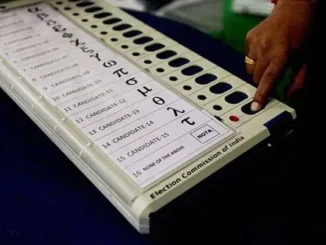
    Therefore, the Supreme Court’s query to the Election Commission on adding VVPAT to every EVM is sensible. Voter Verified Paper Audit Trail is a machine that prints a paper slip of a candidate’s name, serial number, and party’s symbol after a voter has cast their vote. It displays a paper slip for seven seconds for the voters to check if their vote is cast for the chosen candidate. The paper slip then drops down to a locked compartment, and it can be used to audit voting data in the EVMs. Whether the handpicked election commissioners by Modi Sarkar would comply with the public sentiment on this issue will be critical in saving democracy for India and its future generations.

    (The author is a former Chief Technology Officer at the United Nations. He is Vice Chair of Indian Overseas Congress. He can be reached at gta777@gmail.com)

  • Saving India from the Grip of Authoritarianism: Last Opportunity for the Opposition Parties

    In the labyrinth of Indian politics, power has become the ultimate pursuit for the Bharatiya Janata Party (BJP) and its leaders. Their ambition knows no bounds, their appetite for control is insatiable. The Modi government’s relentless drive for absolute dominance over India’s political landscape reeks of authoritarianism, leaving opposition parties teetering on the brink of extinction.

    For the BJP, the vision of an India devoid of opposition is tantalizingly within reach. Their modus operandi is clear: by hook or by crook, they will obliterate any semblance of dissent, any challenge to their hegemony. The systematic dismantling of opposition parties is not merely a political strategy but a march towards dictatorship, where dissent is silenced, and democracy is reduced to a charade.

    But amidst the looming shadow of totalitarianism, there remains a glimmer of hope for opposition parties. They must awaken from their slumber, cast aside petty rivalries and narrow ambitions, and recognize the existential threat they face. The time for complacency is over; the time for action is now.

    Opposition parties must shed their myopic focus on individual gains and unite in a formidable alliance against the BJP juggernaut. The concept is simple yet potent: one candidate against the BJP’s candidate. By pooling their resources and consolidating their support base, opposition parties can mount a credible challenge to the BJP’s hegemonic aspirations.

    The urgency of this alliance cannot be overstated. The BJP’s Machiavellian tactics have already sown seeds of discord within opposition ranks, enticing defections and weakening their resolve. Unless opposition parties stand united, they risk being devoured by the voracious appetite of the BJP, consigned to the annals of history as relics of a bygone era.

    Leaders like Mayawati must cast aside their fears of reprisal and embrace the mantle of resistance. The specter of arrest should not deter them from standing up for the principles of democracy and freedom. Likewise, other opposition leaders must find the courage to defy the BJP’s authoritarian grip and reclaim the spirit of India’s freedom fighters.

    As the nation commemorates Martyrs Day on March 23, opposition leaders must heed the call of history and honor the sacrifices of those who laid down their lives for India’s independence. They must remember Gandhi’s dream of a free and equitable India, where every citizen’s rights are respected, and every tear is wiped away.

    Billions of eyes are filled with tears today, not just from the hardships wrought by the pandemic but also from the erosion of democratic values and freedoms. Opposition leaders must rise to the occasion, armed with common sense and wisdom, to safeguard the soul of India from the clutches of authoritarianism.

    The task ahead is daunting, but the stakes could not be higher. It is not just the survival of opposition parties that hangs in the balance but the very essence of India’s democratic fabric. Failure to act now could consign India to a future devoid of liberty, where the voices of dissent are silenced, and the ideals of justice and equality are trampled underfoot.

    Let the opposition leaders heed the call of duty; let them rally behind the banner of democracy; and let them forge a united front against tyranny. The time to save India is now, for if they falter, there may be no India left to save.

  • CAA rollout: Challenge for Centre to dispel fears

    Weeks after the consecration of the Ram Temple in Ayodhya and the rollout of the Uniform Civil Code in Uttarakhand, the BJP has ticked another important box in the run-up to the Lok Sabha polls by announcing the implementation of the Citizenship Amendment Act (CAA). Over four years after the law was passed, the Centre has notified the rules to fast-track citizenship for undocumented non-Muslim migrants — Hindus, Sikhs, Jains, Buddhists, Parsis and Christians — who came to India from Pakistan, Bangladesh and Afghanistan before December 31, 2014, fleeing persecution on religious grounds.

    Union Home Minister Amit Shah has asserted that the CAA will not take away anyone’s citizenship, even as the Opposition and some religious groups are apprehensive that the enforcement of the law will intensify communal polarization. West Bengal Chief Minister Mamata Banerjee has declared that she would fiercely oppose the CAA if it turns out to be discriminatory against people living in India or curtails their existing citizenship rights. The Indian Union Muslim League (IUML) has approached the Supreme Court, seeking a stay on the implementation of the rules that are ‘manifestly arbitrary and create an unfair advantage in favor of a class of persons on the grounds of religious identity’.

    The passage of the Citizenship Amendment Bill by Parliament in December 2019 and the subsequent presidential assent had triggered protests in parts of the country. The law has been under fire for excluding Muslims from its ambit despite the fact that Muslim minority communities have faced persecution in India’s neighborhood. There are also fears that Muslim refugees will be singled out as ‘illegal migrants’ in India. The onus is on the Centre to convince various stakeholders, primarily in states such as West Bengal and Assam which share their borders with Bangladesh, that the law is not politically or electorally motivated but is aimed at weeding out infiltrators and streamlining the grant of citizenship.
    (Tribune, India)

  • BJP’s 370-seat target overly optimistic

    BJP’s 370-seat target overly optimistic

    With the INDIA bloc coming to its senses, the ruling party may not find the going easy

    “The north, except Punjab and Himachal, is solidly with the BJP. But with the INDIA bloc coming to its senses, it is possible that the BJP will not reach the figure of even 303, its tally in the 2019 Lok Sabha elections. The figure of 370, quoted by Modi, is far too optimistic.”

    By Julio Ribeiro

    I am convinced that Narendra Modi is going to be the Prime Minister for another five-year term. What I seriously doubt is whether his prediction that the BJP will win 370 seats (and the NDA will get 400) in the Lok Sabha elections will come true.

    It is incumbent on the party firmly backed by the majority community to suppress its tendency of misusing its powers to humble the Opposition.

    In Maharashtra, which sends 48 MPs to the Lower House, it seems that the Congress, the Sharad Pawar-led NCP and the Uddhav Thackeray-led Shiv Sena faction will each win a few seats in their respective spheres of influence. The BJP has made major inroads into rural constituencies. Along with its new-found friends, the Shinde faction of the Sena and the Ajit Pawar-led NCP, it will win a few more than the Opposition, but certainly not the figure it quotes.

    The Hindi-speaking belt is firmly on its side, but here, too, the going is not going to be so smooth that it can afford to let its guard down. The farmers’ renewed agitation is confined mainly to Punjab, a state where the BJP has little influence. Jat farmers of Haryana and Uttar Pradesh have been weaned away by the bestowal of the Bharat Ratna on the tallest Jat leader, former PM Chaudhary Charan Singh. The award ahead of the Lok Sabha elections was one very clever move.

    What was far from clever, though, was the attempt to tamper with the result of the Chandigarh mayoral poll. It resulted in prosecution being ordered against the presiding officer by the Supreme Court, whose judgments in the electoral bond case and the Chandigarh episode have alerted the party in power to refrain from venturing into such escapades.

    The fate of the presiding officer should serve as a warning to officials wanting to prove their loyalty to the powers that be. The apex court’s decision on the electoral bond scheme has cast a shadow over the willingness of corporates to blindly help the party in power. They should revert to the system followed by the Tata Group and the Aditya Birla Group to donate to all political parties by crossed cheques, properly accounted for. That system was working seamlessly till the electoral bonds were invented.

    It is natural for the party in power, particularly one riding a wave as the BJP is at present, to get the bulk of the donations made by corporates. But it is not normal for a ruling party to ensure through government agencies controlled by it to choke the funding of Opposition parties. The ‘freezing’ of bank accounts of the Congress by the income tax (I-T) authorities in the run-up to the General Election was a very ham-handed and mean method of ruffling feathers and it was not appreciated by even BJP supporters. Mercifully, the Income Tax Appellate Tribunal intervened and restored sanity.

    Modi was on a roll after he took over the role of the high priest and inaugurated the Ram Janmabhoomi Temple in Ayodhya. Even normally tepid followers of religion, in this case of the religion of India’s majority Hindus, were positively affected by the pomp and splendor associated with the January 22 function. Modi’s popularity went up by a few notches.

    This glorious moment was repeated a few days later when he persuaded Qatar to free eight former Navy personnel, who had initially been sentenced to death (later commuted to imprisonment) for suspected spying. Our Prime Minister succeeded in his mission, thus displaying the strength of the country’s soft power in the Muslim world of West Asia.

    Unfortunately, the comparatively petty-minded acts of trying to change the mandate in the Chandigarh mayoral poll and the I-T Department’s action against the Congress have neutralized the gains that Modi had generated.

    It is incumbent on the party, now firmly backed by the majority community in its stronghold of Hindi-speaking states, to suppress its tendency of misusing its powers to humble the Opposition. Educated voters have realized that their favored party is needlessly needling its political opponents and making obvious attempts to lure Opposition bigwigs with threats of investigations by Central agencies like the ED, the CBI and the income tax authorities. Once they cross over, their sins are forgiven. Some of them are even made ministers or Rajya Sabha MPs!

    One cannot be sure if the use of such tactics will be halted once electioneering begins in earnest. The Congress and its allies in the INDIA bloc have woken up to the realization of the likely fate of their leaders if the BJP gets the 370 seats that Modi has quoted. In Delhi, Haryana and Gujarat, AAP and the Congress have reached an understanding. Though late in the day, it may help them salvage a few seats.

    The south, which includes Tamil Nadu, Kerala, Andhra Pradesh, Telangana and Karnataka, is not going to go the BJP way. In Kerala and Tamil Nadu, the BJP is likely to draw a blank. Karnataka will contribute the biggest number to the BJP’s kitty, but even that will not make a difference.

    In the east, West Bengal is still Mamata Banerjee territory. It has 42 seats to offer. The BJP has made sizeable gains in Bengal, but not enough to dislodge Mamata.

    In the North-East, the regional players go along with the ruling party for their own survival. But after the Sangh Parivar’s activities in Manipur, the Baptist Christians of Nagaland, Mizoram, Meghalaya and the hill districts of Manipur have been having second thoughts on this score. Only Odisha and Tripura can be counted upon to partner the BJP. In any case, the number of Lok Sabha seats in the North-East is extremely small.

    The north, except Punjab and Himachal, is solidly with the BJP. But with the INDIA bloc coming to its senses, it is possible that the BJP will not reach the figure of even 303, its tally in the 2019 Lok Sabha elections. The figure of 370, quoted by Modi, is far too optimistic.
    (The author is former governor and a highly decorated retired Indian Police Service Officer)

  • Probe agencies being misused to ‘extort’ donations for BJP: Cong

    Probe agencies being misused to ‘extort’ donations for BJP: Cong

    New Delhi (TIP)- The Congress on Friday, Feb 23, alleged that probe agencies were being misused to “extort” donations for the BJP from private companies and demanded a Supreme Court-monitored probe into what it called “hafta-vasooli” by the government.
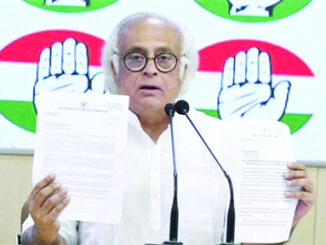
    Addressing a press conference, Congress general secretary in-charge communications Jairam Ramesh alleged that at least 30 companies, which donated a total of nearly Rs 335 crore to the BJP between financial years 2018-19 and 2022-23, faced investigation by central agencies during that period. Ramesh said Congress general secretary in-charge organisation K C Venugopal on Friday wrote to Finance Minister Nirmala Sitharaman over the issue and asked why the government should not be open to a Supreme Court-monitored probe into the donations received by the BJP.
    Congress leader Rahul Gandhi in a post on X said, “Do you know about the Prime Minister’s ‘Donate, take bail and business’ scheme? In the country, the Prime Minister is doing business like ‘vasooli bhai’ by misusing ED, IT and CBI.” He said reports have revealed that 30 companies that faced investigation by various agencies, which have become “recovery agents” now, donated Rs 335 crore to the BJP during the investigation.
    “The donation business is going on so shamelessly that the owners of a distillery in MP donated to the BJP as soon as they got the bail. Benefitting the company of a friend by dishonesty and adopting different rules for others? ‘Illegal donations’ and ‘Electoral Bonds’ given to BJP under Modi rule are the guarantee of ‘Ease of Doing Business’,” Gandhi said in his post in Hindi, using the hashtag “#HaftaVasooliSarkar”.
    Ramesh asked if the government would come up with a “white paper” on the BJP’s finances, not just the sources but how corporate firms were “coerced” to donate by misusing investigative agencies against them.
    “If you have nothing to hide, then are you willing to present a point-by-point rebuttal on the ‘chronology’ of events which led to the filling of BJP’s treasury?” he asked. Source: PTI

  • Victory for democracy: Supreme Court of India overturns Chandigarh mayoral poll result

    Exercising its power under Article 142 of the Constitution to do ‘complete justice’, the Supreme Court on Tuesday, February 20, overturned the result of the January 30 Chandigarh mayoral poll — which had witnessed BJP nominee Manoj Sonkar being declared the winner under controversial circumstances — and named AAP-Congress candidate Kuldeep Kumar as the mayor. Ruling that the result declared by returning officer (RO) Anil Masih, a nominated councillor of the BJP, was contrary to law, the court ordered his prosecution for making the ‘false’ statement before the Bench that he had invalidated eight ballot papers because they had been ‘defaced’. With these eight AAP-Congress votes not being counted at that time, the poll outcome had gone the BJP’s way, prompting the alliance to accuse the RO of ballot-tampering.

    The Bench headed by Chief Justice DY Chandrachud asserted that in such a case, the top court was duty-bound to ensure that the process of electoral democracy was not allowed to be thwarted by subterfuge. The court’s commendable intervention has undone a grave wrong. The development is a major embarrassment for the BJP, whose attempt to engineer a victory has been scuttled. The INDIA bloc, beset by differences among its constituents, finally has something to cheer about. The AAP-Congress candidate’s victory has underscored the dire need for the Opposition to get its act together in the run-up to the Lok Sabha elections.

    The verdict is a stark reminder to all stakeholders — political parties, the electorate and the poll authorities at all levels — that the sanctity and fairness of the electoral exercise must always be ensured. Efforts to subvert the mandate are a blot on our democracy and should not be tolerated. Hopefully, the Chandigarh case will serve as a deterrent against the use of unfair means in elections.
    (Tribune, India)

  • Electoral bonds: Apex court rightly annuls contentious scheme

    Mired  in controversy since its inception, the electoral bond scheme for political funding has been annulled by the Supreme Court. A five-judge Constitution Bench headed by Chief Justice DY Chandrachud said the scheme was violative of the right to freedom of speech and expression under Article 19(1)(a) of Constitution, adding that the fundamental right to privacy also included the citizens’ right to ‘political privacy and affiliation’. The court has directed the State Bank of India (SBI) to disclose the details of each electoral bond encashed by various parties over the years.

    The verdict is a big blow to the BJP-led NDA in the run-up to the Lok Sabha elections. Notifying the scheme in January 2018, the Modi government had touted it as a ‘transparent’ alternative to cash donations made to political outfits. Then Finance Minister Arun Jaitley had exuded confidence that the electoral bond scheme would considerably cleanse the political funding system. However, the initiative ran into rough weather over allegations of ‘selective confidentiality’ and denial of a level playing field.

    The government’s insistence on ensuring the anonymity of the donors and keeping the citizens in the dark struck at the heart of the scheme, whose avowed main objective was transparency. Paradoxically, the government itself was in a position to access the donors’ details by demanding their data from the SBI. The Opposition had every reason to tear into the scheme as the BJP grabbed the lion’s share of the bonds, even as the Election Commission of India (ECI) adopted an evasive approach. Last year, the apex court had rapped the ECI for not maintaining data on funding received through electoral bonds despite the interim order it had passed in April 2019. It is hoped that the poll panel and the SBI will finally lift the dubious veil of secrecy and make the details public.

    (Tribune, India)

  • ‘Overseas Friends of BJP’ in US to make 25 lakh calls to India during elections; send 3,000 Indian-Americans to campaign

    ‘Overseas Friends of BJP’ in US to make 25 lakh calls to India during elections; send 3,000 Indian-Americans to campaign

    WASHINGTON, D.C. (TIP): The ‘Overseas Friends of BJP’ in the US has made an elaborate plan to make more than 2,50,000 calls to people across India urging them to vote and re-elect Prime Minister Narendra Modi for a third term with a record 400 plus seats in the 2024 Lok Sabha polls, according to community leaders. ‘Overseas Friends of BJP’ in the USA has also made plans to send a strong delegation of more than 3,000 Indian Americans who will campaign for the party and its candidates in various capacities across India.

    The BJP has also created more than two dozen teams across the US to make specific calls and help in developing strategies according to different states and languages.

    “We started preparations from December itself and we are picking up speed this month. In February, we are starting a kickoff event all over the United States — probably around 20-22 cities cutting across 18 States. We are trying to gather not only the sympathizers and volunteers of ‘Overseas Friends of BJP’, but also the general community, the community leaders, and the community who want to see Modi 3.0. So they will be participating in that,” OFBJP USA President Adapa Prasad told PTI in a recent interview.

    OFBJP USA, he said, will be presenting the achievements of the Modi government in the last five years and also the 10 years cumulatively and how India’s position in the global community of the nations in the current situation, and also US India relations and the domestic side, how overall growth has happened.

    “We have already prepared the PowerPoint slides. We have PDF documents to distribute,” he said.

    OFBJP is also working to organize “Chai Pe Charcha” in towns and cities across the US, he said.

    “We will gather local people. We will discuss these things about the overall development agenda of BJP and Modi. We will urge all our NRI brothers and Indian diaspora brothers to call their friends and families to vote for the BJP. It’s not for asking why just vote for BJP. They will be telling them why they should be voting for BJP and they will list out all the achievements of the BJP government led by Prime Minister Narendra Modi,” he said.

    The goal, this time, he said, is to get 400 seats for the BJP and its allies.

    “For general elections, there is already a lot of enthusiasm. Just like in India, it is for Modi and BJP. We will be having call centers almost at the county (district) level. We will be calling and we will be dividing this by state. There are Hindi-speaking states and there are regional-speaking states. So for example, if it is Karnataka, we have a Karnataka speaking people who will be calling there, if it is Telangana, we will be having Telugu speaking and so on. Marathi, Tamil we have everybody. We have NRIs covering, volunteering already from hailing, from Jammu and Kashmir to Kerala,” Prasad said.

    “I’m expecting almost 2.5 million calls,” Prasad said, adding that this year OFBJP is expecting to send a delegation of 3,000 Indian Americans to campaign for the party in the general elections.

    There is coordination on this between OFBJP USA and the BJP in India.

    The OFBJP USA is also planning to hold car rallies in different cities during the elections to create awareness about the developments and achievements in India in the last 10 years, he said.

  • ‘Won my heart’: RLD chief hints at poll alliance with BJP

    Rashtriya Lok Dal chief Jayant Chaudhary on Friday, Feb 9, signalled positive outcomes for the ongoing Lok Sabha pre-poll alliance talks with the ruling BJP saying the government had won his heart by honouring his grandfather and late Prime Minister Chaudhary Charan Singh with the Bharat Ratna.
    “Dil jeet liya,” Jayant, currently part of the anti-BJP INDIA bloc, said on X today after the news broke. Describing the feeling as one of absolute elation, Jayant said today was a big day. “It is an emotional moment for me, a memorable occasion. I thank President Droupadi Murmu, the Government of India and especially Prime Minister Narendra Modi for the decision to honour Chaudhary Charan Singh ji with the Bharat Ratna,” Jayant said.
    Asked if he would ally with the BJP, Jayant said, “Koi kasar rehti hai? (is anything left to be said?”. He, however, added that he was yet to announce any alliance. Importantly, Bihar Chief Minister Nitish Kumar, chief architect of the INDIA bloc, also returned to the BJP-led NDA days after the announcement of the Bharat Ratna for late OBC icon from the state Karpoori Thakur.
    Parallel to the BJP-RLD talks, YSRCP chief YS Jagan Mohan Reddy also met Prime Minister Narendra Modi in Parliament today just two days after TDP president N Chandrababu Naidu held parleys with BJP president JP Nadda and Union Home Minister Amit Shah. Source: TNS

  • Indian community has been anchor of Indo-US relationship: Ambassador Sandhu

    Indian community has been anchor of Indo-US relationship: Ambassador Sandhu

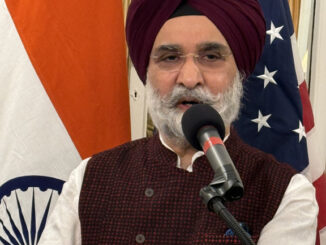
    WASHINGTON, D.C. (TIP): The Indian-American community has been an anchor of the Indo-US relationship, India’s Ambassador to the US Taranjit Singh Sandhu has said, emphasizing that the diaspora has a great role to play in the development of India.

    Sandhu was speaking at his farewell reception on Thursday, January 25, in a Maryland Suburb of Washington DC that was hosted by Indian-American organizations, including Sikhs of America, Overseas Friends of BJP USA, US India SME Council. “Indian community here has been an anchor of the fantastic relationship that has emerged,” Sandhu said. During the farewell reception, several members of the Indian-American community, particularly those from the Sikh Diaspora, urged him to do something for his hometown Amritsar and his home State of Punjab after his retirement.

    In response, Sandhu speaking in Punjabi said that the Diaspora can do more for Amritsar.

    He said that every time members of the diaspora go to Amritsar, they should spend an additional two days in the city and play a role in the development of the city and the state.

    “The tourism of Amritsar is like that of Agra, no less,” Sandhu said.

    Addressing the gathering, Jasdip Singh Jesse from Sikhs of America, said that Sandhu has made the community proud and has played a very important role in strengthening the India-US relationship.

    Under his leadership, the embassy resolved several issues impacting the community.

    Adapa Prasad, president of Overseas Friends of BJP USA, said that Sandhu has been the top Indian diplomat during whose tenure the bilateral relationship reached a new height.

    He hoped that the country would continue to benefit from his services in one capacity or the other post-retirement. Elisha Pulivarti, president of the US-India SME Council, presented Sandhu with the “Modern Day Chanakya and Master Strategist” award on the occasion.

    Sandhu, 61, retires from the foreign service after 35 years of diplomatic career this month.
    (Source: PTI)

  • Nitish inches closer to alliance exit; BJP ready

    Nitish inches closer to alliance exit; BJP ready

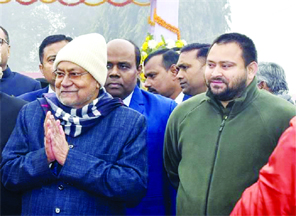
    New Delhi/Patna (TIP)- Bihar’s ruling coalition appeared at breaking point on Friday, January 26, with the Janata Dal (United), its ally Rashtriya Janata Dal, and the opposition Bharatiya Janata Party all corralling their lawmakers and calling meetings over the weekend as speculation about chief minister Nitish Kumar’s joining the National Democratic Alliance (NDA) reached fever pitch. If Kumar makes the switch, as rumoured, it will be the fourth such move in the past decade and the second this term.
    Signs of plummeting ties in the ruling alliance were apparent after deputy CM Tejashwi Yadav skipped the Republic Day celebrations at Raj Bhavan, where Kumar was present. The two didn’t exchange a word in the parade held in Patna soon after. “Ask those who were not present why they skipped the function,” said Kumar to reporters. At Raj Bhavan, the CM was seen chatting with the leader of the Opposition Vijay Kumar Sinha, and JD(U) minister Ashok Choudhary was sitting on the chair allotted for the deputy CM. The RJD has called a meeting of its legislators on Saturday, while the JD(U) scheduled its meeting on Sunday even as the BJP indicated it was open to joining hands with its friend-turned-foe-turned-friend-turned-foe.
    “We are keeping an eye on all the developments and if needed an appropriate decision will be taken. No door is permanently closed in politics and the door can be opened if needed,” said BJP’s Rajya Sabha MP and former deputy CM Sushil Modi.
    If Kumar goes with the BJP, he is likely to remain CM till at least the Lok Sabha polls later this year, people aware of developments said. But disagreement is rife over who’d become his deputy — Kumar favours Sushil Modi, with whom he worked for a decade in the past, but the BJP might want to go with another face. “They may prefer someone from an extremely backward caste, or dominant OBC group such as Yadav or Kushwaha,” said a person aware of the negotiations.
    Hectic parleys were on in Delhi and Patna throughout the day as the BJP rushed key leaders to the state after a late-night meeting chaired by Union home minister Amit Shah. Sushil Modi flew to Patna on Friday and the state’s central in-charge Vinod Tawde is scheduled to hold a key meeting in Patna on Saturday. “The home minister’s direction to us is very clear,” said a BJP leader in Patna, on condition of anonymity. “We have to speak to everyone so that we are ready for all eventuality. We are waiting for Nitish Kumar to take the final call and resign. Everything will become clearer tomorrow.”
    In Patna, the leading constituents of the six-party ruling coalition exchanged barbs.
    “There is a lot of confusion which is not in the interest of the people of the state. Only the CM can put an end to the confusion,” said RJD MP Manoj Jha. JD(U) chief spokesperson Neeraj Kumar shot back. “Kumar plays politics from the front. He has no confusion.”
    The timing of these moves is crucial. On Monday, Jan 29, Rahul Gandhi’s Bharat Jodo Nyay Yatra enters Bihar and the Congress had planned a show of strength with all members of the ruling alliance. Source: HT

  • Delhi CM Arvind Kejriwal refuses to appear before ED, says BJP targeting him ahead of polls

    Delhi CM Arvind Kejriwal refuses to appear before ED, says BJP targeting him ahead of polls

    New Delhi (TIP)- Delhi chief minister Arvind Kejriwal on Thursday, January 18, skipped summons from the Enforcement Directorate, calling them illegal, and alleging they were part of a conspiracy to stop him from campaigning for the upcoming Lok Sabha elections.
    Later in the afternoon, he left for Goa, where he is assessing the Aam Aadmi Party’s (AAP’s) preparedness in the state for the general elections. ED had asked Kejriwal, who is also the AAP national convenor, to appear before it in connection with its money laundering probe into alleged irregularities in Delhi’s 2021-22 excise policy. This was the fourth time Kejriwal skipped summons by ED — he previously failed to appear before the agency on November 2, on December 22, and on January 3. Kejriwal and his party have repeatedly objected to the summons saying it is not clear whether he was asked to appear as a witness or suspect; as chief minister or as AAP chief; and that the agency has not made available any details of its line of questioning. The Bharatiya Janata Party (BJP), meanwhile, accused Kejriwal of “evasive behaviour”. In response to a question about the summons, he said, “ED sent me fourth notice asking me to appear on January 18 or 19. All the four summonses are illegal and invalid. Different courts have termed such general, non-specific ED summons illegal and have quashed them. I have written to ED multiple times on why the ED notices are illegal, but ED has not responded.” Alleging that the notices are part of a political conspiracy, Kejriwal added, “The probe (in the excise case) is going on for two years, but they have found nothing. The courts have asked them how much money was recovered and what other things such as cash, gold were recovered… Two months before Lok Sabha polls, I have been summoned. BJP leaders are saying that I will be arrested. How the BJP knows that I will be arrested? It is because the BJP is running ED… The purpose of the summons is to arrest me before polls and stop me from campaigning.” People aware of the matter said Kejriwal was also upset by the language used by ED in a communication dated January 12, that was addressed to the chief minister. According to the people, Kejriwal objected to the use of the phrases “excuse”, “extraneous reasons”, “camouflage your real motive”, and “intentionally disobeying your summons” in the ED communication, and in response, wrote to the central agency, stating that its “bias and prejudice against me are apparent from various innuendos hurled at me”.
    AAP has accused ED of dropping or stalling investigations of leaders the moment they become associated with BJP. Claiming that the agency was acting in a “blatantly biased” manner, a senior party official, on condition of anonymity, said, “Narayan Rane was being investigated by ED in a ?300 crore money laundering case. After joining BJP in 2019, no raids or further investigation has taken place.”
    Meanwhile, the BJP accused Kejriwal of making excuses to skip the ED summons.
    “Kejriwal may make excuses, but he will have to honour the ED summons and the law will take its course. Kejriwal has to answer a lot of questions related to the excise policy,” said Delhi BJP secretary Harish Khurana.
    ED likely to issue 5th summons to Kejriwal
    With Delhi chief minister Arvind Kejriwal skipping his fourth summons in connection with a money laundering probe stemming from the investigation into alleged irregularities in the Delhi excise police 2021-22, Enforcement Directorate (ED) officials said their case is now left in limbo, even as they are deliberating on their next steps. People familiar with the developments said a fresh, fifth summon is likely to be issued to Kejriwal, but a call on the same is yet to be taken. “A call is yet to be taken on the next steps. But the Delhi CM has once again disregarded our summons to join investigations,” said an officer, who didn’t want to be named.
    Source: HT

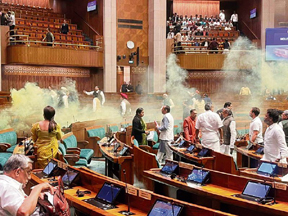
  • Questions aplenty over security breach

    Questions aplenty over security breach

    Need to thoroughly probe what prompted the intruders to cause a ruckus in the House
    “Is unemployment now a major factor in India and did the youth involved feel that they had to highlight the plight of the unemployed before those empowered by the voters to make laws? Was this the sole motive for the doomed escapade? Or was it something sinister? Could an Opposition party or the entire INDIA bloc be behind this parody? Remember also that the pro-Khalistan founder of Sikhs for Justice, Gurpatwant Singh Pannun, had threatened to strike back when he learnt from the disclosures made public by the US authorities that the Indian government or one of its accredited operatives was involved in a conspiracy to murder him. Pannun had threatened that December 13, the anniversary of the 2001 Parliament attack, would be the ‘day of reckoning’.”

    By Julio Ribeiro

    What motivated Sagar Sharma and Manoranjan D to descend from the visitors’ gallery to the floor of the House and release smoke from canisters to cause a commotion? Both young men and their co-conspirators who protested outside the Parliament building had one thing in common — they were educated but unemployed. It is gracious of the Speaker to assume responsibility for what went wrong. The people, of course, may not appreciate these niceties.

    One of them had repeatedly appeared before Army and police recruitment boards, but failed to make the cut. A woman among them is well into her 30s. Though armed with academic degrees and certificates, she could not land a job as a primary or secondary school teacher. So, she took part in the farmers’ protest outside Delhi in 2020-21 and, later, in the sit-in organized by medal-winning women wrestlers protesting against a BJP MP, who was then the president of the Wrestling Federation of India.

    Is unemployment now a major factor in India and did the youth involved feel that they had to highlight the plight of the unemployed before those empowered by the voters to make laws? Was this the sole motive for the doomed escapade? Or was it something sinister? Could an Opposition party or the entire INDIA bloc be behind this parody? Remember also that the pro-Khalistan founder of Sikhs for Justice, Gurpatwant Singh Pannun, had threatened to strike back when he learnt from the disclosures made public by the US authorities that the Indian government or one of its accredited operatives was involved in a conspiracy to murder him. Pannun had threatened that December 13, the anniversary of the 2001 Parliament attack, would be the ‘day of reckoning’.

    There could be many reasons why these four desperate young people from different parts of the country, ranging from Haryana to Maharashtra, were brought together by Lalit Jha, who is also unemployed. All five youths had come to know each other through a Facebook group called ‘Bhagat Singh Fan Page’. Jha was arrested in Kolkata and is being questioned.

    Home Minister Amit Shah has not made a statement in the House about the obvious breach of security. The Opposition had demanded such a statement from him. It was to be followed by a discussion in the House. It could be that Shah is waiting for the outcome of Jha’s interrogation, but he has not specified that reason. Shah is reported to be sheltering under the Lok Sabha Speaker’s stand that he (Speaker) is the final arbiter on whatever occurs in the precincts of Parliament and the authorities have to act on his orders.

    Is the security of the Parliament House and its occupants, the MPs and officials, not the responsibility of the government of the day? Did then Home Minister not give a statement after the 2001 attack and the BJP, then in the Opposition, not condemn the shoddy security arrangements? It is the first time that citizens have been informed that even security in Parliament is the responsibility of the Speaker! The officials and the police were unaware of this new interpretation. It is gracious of the Speaker to assume responsibility for what went wrong and deflect it away from the Home Minister. The people, of course, may not appreciate these niceties.

    A question needs to be asked: How did Sharma and Manoranjan, who procured visitors’ passes from the BJP MP from Mysuru, manage to enter with smoke canisters hidden in their shoes? It is learnt that the young men ‘modified’ their shoes to accommodate a canister each! That would surely make it awkward for them to walk even a few steps! The bulging shoes should have immediately attracted the attention of the security personnel on duty.

    A media report states that leaflets carried by the intruders and thrown in the well of the House were also hidden in the shoes. How many leaflets can be carried in this fashion? The ‘modified’ shoes would have been spotted by other visitors to the Lok Sabha gallery, even if the security men were inattentive. There is a lot of explanation to do.

    The other sensational news in the past week was that the family of Nikhil Gupta, the man arrested in the Czech Republic at the behest of the US government for being involved in a conspiracy with an Indian government official to assassinate a US citizen (Pannun), has moved India’s Supreme Court. The family has pleaded that he should not be extradited to the US as he has not committed the crime in question. The Czechs are more likely to pay heed to the US government’s demand than submit themselves to the jurisdiction of an Indian court. I mentioned this ticklish matter in my column last week. I had wondered how our powerful and astute Prime Minister would pull India out of this mess. After the G20 summit, he is a global figure with clout on the world stage, but it is not enough to defy edicts or demands of a powerful country like the US. That country’s judicial system rotates on a different plane from ours. The judges there are presumably independent of the political executive. Gupta may run out of options if the facts disclosed by the Americans have a leg to stand on.

    Pannun has a following among some expatriate Sikhs. His views have cut no ice with Sikhs in India, particularly Punjab. But with this narrative of being targeted, he may gain some adherents among unemployed Sikhs.

    Prime Minister Modi’s economic policies have greatly benefited the ‘haves’ in our land. Since his party’s well-oiled propaganda machine and the absence of a credible Opposition leader have made a third term for him a near certainty, he can afford to reduce his own role in electioneering to concentrate on the economic needs of those at the bottom of the ladder. There are many states in the country over which unemployment looms large.

    (The author is a highly decorated retired Indian Police Services (IPS) Officer, and a former governor)

  • Chhattisgarh: From village head to CM, the incredible journey of Vishnu Deo Sai

    Chhattisgarh: From village head to CM, the incredible journey of Vishnu Deo Sai

    Hailing from the tribal (Janjati/Vanvasi) dominated Jashpur region of Chhattisgarh, Vishnu Deo Sai has taken oath as the first Vanvasi Chief Minister of the Chhattisgarh state, where the Vanvasi community constitutes a significant majority. The swearing-in ceremony held in Raipur’s science college ground on Wednesday afternoon was attended by a number of senior leaders of the Bharatiya Janta Party (BJP) including the Prime Minister, Narendra Modi, Party’s President, JP Nadda, Union Home Minister Amit Shah, and other BJP CMs.
    Sai commenced his political journey after getting elected as a Panch (ward) from Bagia Gramme Panchayat, a remote region located in Jashpur, in the year 1989 and never looked back. Next year, Sai participated in the Panchyat elections again and emerged victorious as Sarpanch of the Bagia Panchayat.
    In 1990, Sai contested from the then state assembly seat of Tapkara and had been elected as a member of the legislative assembly of undivided Madhya Pradesh for a term of three years. He was re-elected for the state assembly in the election held in the year 1993. In the year 1999, Sai contested its first Lok Sabha election from the Vanvasi-dominated Raigarh Lok Sabha seat and was elected as a Member of Parliament of the 13th Loksabha. The popularity of Sai can be better understood by the fact that after being elected as an MP in 1999 Sai was re-elected from the same seat in the 2004, 2009 and 2014 Lok Sabha elections. In between his years as an MP, Sai has been nominated in many committees formed by the respective governments of Bharat.
    As BJP’s president in Chhattisgarh
    During his years as an MP, Sai has also been bestowed with the responsibility of leading the BJP in the state thrice. He was first named as the president of the party in Chhattisgarh in October 2006. Sai first tenure as a party’s president lasted for around three and a half years, during which the party registered a resounding victory in the 2008 state assembly election, securing a total of 50 seats in the 90-seat state assembly election.
    Sai was re-appointed as the party’s president for a short term of around six months in the year 2014, though he left the post after he was made the union minister for state for steel, labour, and employment in the NDA government in the subsequent year. He was again appointed as the party’s president in the year 2020 for a period of two years, during which the party managed to perform well in Chhattisgarh in the 2019 Lok sabha election. In December last year, Sai was also nominated as a special invitee in the BJP’s national working committee.
    Sai was asked to contest the recently held state assembly election from the much-hyped Kunkuri assembly seat, where he emerged victorious after defeating the Indian National Congress UD Minj by a margin of 25000 votes. Later on, Sai was chosen as the leader of the BJP’s legislative group in a meeting held in state assembly in Raipur on December 10, paving the way for Sai to become the first Vanvasi Chief Minister of the Vanvasi heartland.
    It is to be noted that the saffron party’s move to choose Sai as the CM of the state is expected to further solidify the trust of the Vanvasi community in the Narendra Modi-led party, which earlier threw its weight behind Draupdi Murmu, another BJP leader of the Vanvasi community, for the presidential post.

  • BJP appoints central observers as suspense over new CMs in 3 states continues

    BJP appoints central observers as suspense over new CMs in 3 states continues

    New Delhi (TIP) – Five days after the assembly election results for Madhya Pradesh, Chhattisgarh and Rajasthan were declared, the Bharatiya Janata Party (BJP) on Friday, December 8, named central observers for electing the leaders of its legislature parties in the state amid indications that new chief ministers may be named over the weekend, ANI reported. The party has named Union defence minister Rajnath Singh, Vinod Tawade and Saroj Pandey as observers of Rajasthan.
    For Madhya Pradesh, the party has appointed Haryana Chief Minister Manohar Lal Khattar, K Laxman and Asha Lakra. In Chhattisgarh, Union Ministers Arjun Munda, Sarbananda Sonowal and Dushyant Gautam have been appointed as observers.
    An unidentified BJP leader told PTI that the observers are likely to travel to the respective state to oversee the meetings of newly elected MLAs where the future chief ministers will be named. He added that no decision has been taken yet on the choices of the chief minister and the party will keep in mind social, regional, governance and organisational interests in picking the new chief ministers, according to PTI. The BJP ousted incumbent Congress from Rajasthan and Chhattisgarh and retained Madhya Pradesh with a landslide victory. This led to the saffron party tightening its hold in the Hindi heartland and gave a big boost to Prime Minister Narendra Modi for the 2024 Lok Sabha elections.
    With an absolute majority in the 90-member Chhattisgarh assembly, the BJP won 54 seats while the Congress trailed at 35 seats. In Rajasthan, the saffron party won a total of 115 out of 199 seats. In Madhya Pradesh, BJP managed to stave off anti-incumbency after winning 163 seats in the 230-member assembly. However, the BJP bagged only eight seats in the 119-member Telangana assembly as Congress won the southern state by ousting K Chandrasekhar Rao-led Bharat Rashtra Samithi (BRS). Revanth Reddy of the Congress took oath as the new chief minister of Telangana on Thursday, December 7.
    Since the poll results on Sunday, leaders from the three states have been meeting the top party brass, including Home Minister Amit Shah and party president J P Nadda. However, sources within the party have played down their significance, saying such meetings are routine, according to PTI.
    On Thursday, December 7, morning, former Rajasthan chief minister and one of the frontrunners for the CM post Vasundhara Raje reached Delhi on Wednesday night but dodged any question on the meeting or the CM pick. “I have come to Delhi to see my daughter-in-law,” she told reporters outside the airport.
    Narendra Singh Tomar, a seasoned BJP leader from Madhya Pradesh whose resignation as Union minister was accepted on Thursday, and Baba Balaknath, who is from Rajasthan, also met Shah on Thursday. Both quit Lok Sabha after becoming members of assemblies of their states. Tomar and Union minister Prahlad Singh Patel, who comes from politically significant Other Backward Classes, are seen as possible chief ministerial choices in Madhya Pradesh along with the incumbent Shivraj Singh Chouhan. In Chhattisgarh, BJP president Arun Sao, an OBC leader, Union minister Gomati Sai and Lata Usendi, both of whom come from Scheduled Tribes, are seen as serious contenders for the top seat.

  • Cong calls meet to brainstorm over losses in three states

    Cong calls meet to brainstorm over losses in three states

    New Delhi (TIP) – The Congress brass will brainstorm over the party’s losses in Rajasthan, Madhya Pradesh and Chhattisgarh, in what is seen as the first structural review of its dismal performance in the recent round of assembly elections. The Congress won only one state – Telangana – of the five states that went to the polls. The grand old party lost its governments in Rajasthan and Chhattisgarh, and failed to dislodge the Bharatiya Janata Party (BJP) in Madhya Pradesh. It also failed to win the polls in Mizoram.
    This round of assembly elections was seen as a virtual semi-final to the 2024 Lok Sabha polls, given that it was the last major electoral exercise before next year.
    According to two Congress leaders aware of the details, the restructuring in the states where the party lost will be done after the review.
    The Congress high command has summoned outgoing chief ministers Ashok Gehlot (Rajasthan) and Bhupesh Baghel (Chhattisgarh), former Madhya Pradesh chief minister Kamal Nath, state unit chiefs, in-charges and co-incharges of the three states for the meetings in Delhi.
    While the defeat in Chhattisgarh and Madhya Pradesh will be analysed during a meeting on Friday, the poll loss in Rajasthan will be reviewed on Saturday, the leaders cited above said.
    In Madhya Pradesh, state Congress chief Kamal Nath is likely to quit the post following the party’s worst performance in a decade. A senior Congress leader earlier said that during a meeting on Tuesday, party chief Mallikarjun Kharge conveyed to Nath that there is a growing consensus in the party that the 77-year-old should no longer helm the MP unit.
    “Nath is willing to submit his resignation and will demand a new leader as state head and leader of opposition in the state assembly,” a senior party leader said, seeking anonymity.
    Nath, who has sought a report from candidates on the poll loss by December 15, will attend the AICC meeting with leaders Govind Singh, Suresh Pachori and Rajya Sabha MP Digvijaya Singh on Friday, party functionaries said.
    Baghel and Congress’s Chhattisgarh chief Deepak Baij left for Delhi on Thursday evening. “As I am informed, there will be a review meeting on the poll outcomes,” Sushil Anand Shukla, head of Chhattisgarh Congress communication wing.
    A second senior Congress leader said the issue of the leader of opposition is likely to be discussed in the meeting. “Hopefully, the appointment of the leader of the opposition in the state assembly will also be discussed in this meeting,” the leader said.
    Speaking to reporters, Baij said the elections were fought under collective leadership in Chhattisgarh. “The election was fought under a joint leadership, maintaining a balance among numerous senior leaders. As party chief for a brief period of four to five months, I tried my best to strike a balance. Despite the unexpected election results, we acknowledge the public’s mandate,” Baij said.
    Source: HT

  • Bharatiya American Community Celebrates BJP’s Grand Victory  in New York

    Bharatiya American Community Celebrates BJP’s Grand Victory in New York

    Ladies at the celebration

    NEW HYDE PARK, NY (TIP): “This is Modi Era. Modi means performance”, said Mr Jagdish Sewhani, President of The American India Public Affairs Committee in New York. People have voted for good governance and performance . The credit for this victory goes to our “yashasvi” Prime Minister Narendra Modiji. The Strategy developed by his team Home Minister Amit Shahji and Party President J P Naddaji decimated the opposition.
    The results are a reflection of mood of the country.
    Mr Sewhani further said that people of three states have shown full confidence in BJP, its governance and its leadership, under the guidance of visionary Prime Minister Modi ji.
    People Voted for Modi Guarantee. It Shows they Trust Prime Minister Modi under whose Leadership Bharat is Growing Economically, Culturally, Socially and Strategically. Today, Bharat is among Top five Economies of the world with GDP of 4 trillion., and thanks to the leadership of prime minister Modi ji, I have no doubt that in next 25 years Bharat will be a 40 Trillion economy.
    Mr Sewhani further said that people have outrightly rejected caste politics and voted for” Development ,Development, Development.” This is Semi Final . Final will be next year and I’m confident that BJP will again be blessed by people of Bharat. We Bharatiya Americans need to play important role by aggressively campaigning for the BJP and its Candidates in 2024 Elections. Dr Narinder Kukar, Chintu Patel , Dr Dipak Nandi , Sunil Hali, Amba Sharma, ,Dr Urmilesh Arya , Satvinder Satta , Kulbir Singh, Indu Jaiswal , Anju Sharma, Pinki Jaggi, Dr Pushp Bhansali , and Dr Sanil Sarkar also spoke at the celebrations.

    Gentlemen at the celebration
  • It’s back to the drawing board for the Congress

    It’s back to the drawing board for the Congress

    The Congress needs to go beyond the current focus on the negative aspects of the ruling dispensation or its perceived faultlines

    “The Congress can build on this base, but to take this process forward, it needs to project a clear ideological narrative and articulate its own politics. For a start, it shouldn’t try to outdo the BJP as a ‘more Hindu’ party, particularly when voters have the option to go for the real thing. The ideological counter must reflect a different model of development with an emphasis on rights-based welfare, especially employment guarantees interlaced with social harmony. In sum, the Congress has to reboot its political discourse by foregrounding something substantive, which is best done by advocating a positive agenda that can galvanize the electorate and goes beyond the current focus on the negative aspects of the ruling dispensation or the perceived faultlines within it and the politics it has promoted.”

    By Zoya Hasan

    The Congress’ remarkable victory in Telangana was overshadowed by its devastating defeat in the Hindi heartland in the just-concluded Assembly elections. The Congress has suffered a big blow as it lost all three states — Madhya Pradesh, Rajasthan and Chhattisgarh — it had won in 2018. The Bharatiya Janata Party’s (BJP) comprehensive victory was backed by support across most regions in these states and a strong showing in urban areas. But the Congress, despite its defeat, has managed to retain its vote share — Madhya Pradesh (40.4 per cent), Rajasthan (39.5 per cent) and Chhattisgarh (42.23 per cent). The BJP has gained mostly at the expense of others in the fray. With these triumphs, the BJP has expanded its dominance of a key region ahead of the 2024 General Election. However, the Congress vote share holds considerable significance in the run-up to the Lok Sabha elections.

    The Congress tried to highlight issues such as joblessness and caste discrimination in the hope that it would appeal locally in the state elections and nationally in the General Election. But its two-pronged plank of welfare schemes and social justice was upstaged by the subtext of Hindu nationalism and communal politics. The BJP’s victories highlight the consolidation of Hindu nationalism and the great resonance it enjoys in the heartland states. The use of state machinery, ample financial resources and the party’s organizational framework, buttressed by RSS cadres, have helped it promote itself as a champion of a strong nation, development and welfarism as well as of Hindu interests and the Hindu religion.

    From the outset, the BJP’s campaign pivoted on Prime Minister Narendra Modi, relegating established state leaders to the sidelines. The party decided not to nominate a chief ministerial candidate for any of the states going to the polls. This meant that even popular state leaders of the Congress like Ashok Gehlot and Bhupesh Baghel were not pitted against their local BJP rivals, but against Modi himself. The PM’s huge popularity in north and central India neutralized the public acceptance of these leaders.

    Taking a cue from its experience in Karnataka, where the visibility and prominence of local leaders paid off, the Congress projected state leaders, who were given a free hand. However, the infighting and overweening ambitions of its leaders in Rajasthan and Chhattisgarh put paid to this strategy. Factionalism and divided state leadership, which have been the undoing of the Congress in many states, was on full display throughout its term in office in these two states. Leaders were attacking each other until a few months before the elections, which sent a message to voters that this was a party that couldn’t keep its house in order. A settlement was forged between the warring leaders in both states, but it was a case of too little, too late.

    Apart from factionalism, there was no accord or concord between the state leadership and the high command. The Congress campaign lacked coherence; it appeared disjointed, with powerful state satraps unwilling to countenance any interference on their turf. In contrast, the BJP’s campaign was intensive and focused and the party spoke in one voice. This is not surprising, as the contemporary BJP is a highly centralized party, while the Congress, in a departure from the past, is relatively decentralized.

    To make matters worse, there was no agreement between the Congress and its allies in the state elections. The 28-party INDIA grouping led by the Congress, which came together to fight the BJP, did not feature in the state polls due to inter-party rivalries. Opposition parties should have negotiated state-specific alliances and seat adjustment in a spirit of give-and-take. This is easier said than done. Seat-sharing didn’t happen, which hurt the Congress as well as the INDIA bloc, which the voters saw as a divided house. The fate of the Congress and other parties in this election makes it clear that they can tackle the BJP only when they are united against it.

    A caste-based census was the big battlecry of the Congress to undercut the BJP’s support among the OBCs, but it turned out to be a ‘no-ball’. This call had little traction on the ground, with the issue not paying dividends — the BJP’s share of OBC votes has increased. In any case, it is doubtful that the demand for a caste census is an inspiring or effective counter to Hindu identity politics, which holds much greater appeal for subaltern groups in the current conjuncture. Caste politics and ideas of social justice were not enough without a clear political plank to serve as a counterpoint to the BJP’s politics in these states or effective campaigning, ideological clarity and organizational cohesion to communicate its message.

    There is limited evidence of a correlation between state and national elections. Yet, there’s little doubt that the Congress’ decisive defeat at the hands of the BJP in straight contests has undermined its credibility and is bound to demoralize it at a crucial time when the Lok Sabha elections are just five months away. However, all is not lost as the majority of the voters have opted for non-BJP parties in these critical states.

    The Congress can build on this base, but to take this process forward, it needs to project a clear ideological narrative and articulate its own politics. For a start, it shouldn’t try to outdo the BJP as a ‘more Hindu’ party, particularly when voters have the option to go for the real thing. The ideological counter must reflect a different model of development with an emphasis on rights-based welfare, especially employment guarantees interlaced with social harmony. In sum, the Congress has to reboot its political discourse by foregrounding something substantive, which is best done by advocating a positive agenda that can galvanize the electorate and goes beyond the current focus on the negative aspects of the ruling dispensation or the perceived faultlines within it and the politics it has promoted.
    (The author is Professor Emerita, Centre for Political Studies, JNU)

  • BJP on a roll, Opposition needs to regroup

    BJP on a roll, Opposition needs to regroup

    • The least resilient among the INDIA members are in danger of disappearing from the political scene

    “PM Modi’s most urgent task is to lift millions of his countrymen from the poverty in which they are mired. The affluent are certainly much better off since 2014. The stock market is booming. Those who have invested in stocks will become even richer if he is re-elected in 2024. The freebies now given away to the rural poor will eventually have to be stopped. The youth of those poor households, belonging mainly to the lower castes, must be equipped with skills to enable them to fend for themselves. Industrialists and entrepreneurs, who have prospered in the last 10 years, should be motivated to enter less-profitable segments of the economy so that jobs are created for our unemployed youth.”

    By Julio Ribeiro

    I write this piece as a member of a minority community — just 2 per cent of the country’s population. In a ‘first past the post’ system of electing people’s representatives, the BJP has swept the Assembly polls in the Hindi heartland. The Congress lost the tribal and women’s votes. The shift in votes from the Congress to the BJP catapulted the latter to power in Madhya Pradesh, Rajasthan and Chhattisgarh.

    ‘Sabka Saath, Sabka Vikas, Sabka Vishwas’ needs to be put into practice instead of being merely parroted every now and then.

    The difference in the overall vote share of the BJP and the Congress was roughly 2 percentage points in Rajasthan and 4 in Chhattisgarh. It was 8 percentage points in Madhya Pradesh, where the winner garnered 48 per cent of the votes as against 40 per cent by the Congress.

    It was a resounding victory for the BJP and Modi in particular. Not even his bitterest critic can say that he is not the most popular and charismatic of all political leaders in the country. It looks certain that he will be elected for a third term. The Hindi heartland is with him and that should tilt the scales in his favor. The South is not with him, but the West is his for the taking. What is in store for the country after the 2024 Lok Sabha elections? In the past decade, India has been divided on communal lines. The consolidation of the Hindu vote was what the Hindutva forces strived for. It succeeded to the extent of ensuring the BJP’s poll victories. Muslims and Christians together make up just 16 per cent of the population. The Sikhs account for less than 2 per cent.

    After the 2024 polls, the forward castes in the Hindu fold will be the chosen ones, like the Christian Brahmins and Kshatriyas were in Goa during the Portuguese rule. The BJP under Modi, influenced by the RSS, will placate the OBCs and the Scheduled Castes/Scheduled Tribes, counting them within the 80 per cent whose pride in being Hindu has to be ‘created’.

    The Muslims were in the doghouse in Modi’s first two terms. Beef-related lynchings, ‘love jihad’ accusations and the fear generated by the CAA-related NRC had stifled their quest for equality as citizens of India. Now, I envisage that they and the Christians, who are next in line on the extremists’ hit list, will have to adjust to second-class citizenship like Hindus and Christians in Pakistan have done in that religion-influenced country.

    Delivering his victory speech at the BJP’s headquarters in Delhi, PM Modi mentioned ‘appeasement’, besides corruption and dynastic politics, as the evils that he has been fighting. I do not know what he means by ‘appeasement’. If he is referring to the Muslims, it is only the mullahs who were appeased by the Congress, and that too in religious matters. That is not the mandate of a democratically elected government. Muslims should be ‘appeased’ like all poor communities, such as the Scheduled Castes and the Scheduled Tribes, in terms of education and healthcare. Religious issues should be sorted out by the community itself or by the courts.

    Extremist elements in the Hindutva camp have consistently railed against the Muslim minority. There have even been calls to exterminate Muslims and boycott their traders selling vegetables and fruits in Hindu localities. Modi should rein in these extremists by ordering penal action against them as ordained by law. He hesitates to do that for fear of losing their support. They, in turn, misinterpret this silence as tacit approval.

    PM Modi’s most urgent task is to lift millions of his countrymen from the poverty in which they are mired. The affluent are certainly much better off since 2014. The stock market is booming. Those who have invested in stocks will become even richer if he is re-elected in 2024. The freebies now given away to the rural poor will eventually have to be stopped. The youth of those poor households, belonging mainly to the lower castes, must be equipped with skills to enable them to fend for themselves. Industrialists and entrepreneurs, who have prospered in the last 10 years, should be motivated to enter less-profitable segments of the economy so that jobs are created for our unemployed youth.

    The possible re-election of Modi and the BJP in 2024 will consolidate the right-wing economic trend in the country. All left-of-center parties, like the Congress, TMC and the AAP, should come together to form an effective Opposition. If they fail to do so, the least resilient among the INDIA members are in danger of disappearing from the political scene. Many leaders of those parties, such as Arvind Kejriwal, will find themselves targeted by the ED, the CBI and other Central agencies with ruthless precision just before the elections.

    Nearly a century ago, writer-philosopher Aldous Huxley, in his futuristic work Brave New World (1932), prophesied: “By means of ever more effective methods of mind manipulation, the democracies will change their nature; the quaint old forms — elections, parliaments, Supreme Courts and all the rest — will remain. The underlying substance will be a new kind of non-violent totalitarianism. Democracy and freedom will be the theme of every broadcast and editorial… Meanwhile, the ruling oligarchy and its highly trained elite of soldiers, policemen, thought-manufacturers and mind-manipulators will quietly run the show as they see fit.” Does that ring a bell? An Opposition-mukt democracy is no democracy.

    PM Modi has often stated: “India is the mother of democracy.” If he really believes what he says, we, members of the minority in our own land, will be reassured if ‘Sabka Saath, Sabka Vikas, Sabka Vishwas’ is put into actual operation instead of being merely parroted every now and then.
    (The author is a highly decorated Indian Police Service (IPS) Officer and a former governor)

  • Time for the Congress party to reach out and work together for a united front to save democracy and the nation

    George Abraham, Vice-Chair of IOCUSA

    I salute the victory in Telangana while blaming overconfidence and infighting for the losses in the other three states!
    Telangana stands out as the shining light for the Congress party in the unfortunate defeats elsewhere in the just concluded state elections. Yet, the Congress Party should not give up the fight but rather garner all the energy and strengthen the INDIA alliance for the ultimate prize fight in 2024,” said George Abraham, Vice-Chairman of the IOCUSA and Global coordinator of the IT & Social media for IOC.
    Instead of engaging in the so-called introspection exercise, the leadership should quickly move to clean up the INC Secretariat and engage people who might bring contrasting perspectives that would enrich the debate and arrive at well-thought-out solutions to resolve various issues confronting the party. Keeping Shashi Tharoor at arms-length or removing him as the chairman of the Professional Congress right in the middle of an election is not an intelligent strategy. It is not only a united leadership that may win an election but also using modern strategy and employing the latest technologies that make a difference.
    There must be zero tolerance for groupism all across the party if it wishes to come back to power at the center again. The recent victory in Karnataka may have made some in the leadership a little cocky to the point where the ongoing talk on the INDIA alliance almost appeared to have come to a halt. Congress needs to be cognizant of the fact that fighting the Modi behemoth machine alone would not suffice; Congress may have to take a step back and reach a consensus. The ultimate aim for the next election must be the defeat of Modi but not the debate of who would be the Prime Minister.
    A change of leadership in many state units with young and dynamic individuals with a new vision would go a long way for the party. The victory led by Mr. Revanth Reddy in Telangana is a case in point. The appetite for corruption is still quite rampant in some party circles, and it ought to be seriously checked. In Rajasthan, the simmering leadership dispute should have been brought to an end a long time ago. In Chhattisgarh, a tribal community was driven out of their own homes on allegations of conversions, and the state government closed its eyes for political expediency; in Madhya Pradesh, the leadership appeared to have been practicing soft-Hindutva rather than championing the Nehruvian vision and Ambedkar’s constitution. Why would anybody opt for duplicates when the original BJP, which practices Hindutva ideology, is readily available? It is also time to check the EVMs and make sure the systems are performing well and fulfilling its constitutionally assigned responsibilities.
    It is time for the Congress party to reach out and work together for a united front to save democracy and the nation.
    (The opinion expressed above is strictly personal)

  • Hitting below the belt in poll season

    Hitting below the belt in poll season

    Central investigation agencies and Governors being used to weaken the Opposition’s will to fight

    “The BJP was touted as the ‘party with a difference’. We thought it signified better governance, but instead we got the electoral bonds to finance political parties in place of the crossed cheques that electoral trusts established by corporates would issue transparently to various parties operating in the vicinity of their factories.

    By Julio Ribeiro

    Another step the BJP took to ensure an ‘Opposition-mukt’ polity was to literally release ‘tigers’ in the form of Governors and Lt Governors on hapless Opposition parties. The most recent example is of one of my own tribe (the Indian Police Service), who sits in the gubernatorial chair in Chennai, the capital of Tamil Nadu. Governor RN Ravi has forced even a dyed-in-the-wool politician like DMK’s MK Stalin to approach the Supreme Court, pleading to be allowed to function like BJP governments in the Hindi heartland.”

    Can you blame the Prime Minister if voters give him credit for the superb performance of the Indian cricket team in the ongoing World Cup? I would not. But if the Enforcement Directorate (ED) shows its true colors and leaks unverified information against a popular Chief Minister like Chhattisgarh’s Bhupesh Baghel just before the voters in that state wend their way to the polling booths, that would be called ‘hitting below the belt’. Boxers get disqualified if their blows land below the belt of the opponent. Why then is it permitted during elections, which have almost entered the category of a blood sport?

    The double-engine governments, of course, do not require class monitors. They know what they have to do.

    The Congress has sought the intervention of the Election Commission of India. That august body is making efforts to rebuild its good name, which was in danger of being obliterated. Recently, it has acquired the spine to question Narendra Modi and Amit Shah. But I doubt if it will find the law on its side in this distasteful matter.

    The ‘caged parrot’, the CBI, has been replaced by a puppet on strings. The power of appointment has served the party in power well. The Delhi Chief Minister has been served with a notice in the liquor policy case, which has succeeded in keeping some important AAP leaders in limbo. It is a novel method of dispersing political opponents and it has certainly marred AAP’s ability to give the poorer sections of Delhi’s population quality education at the school level and quicker access to medical help at the mohalla level.

    The BJP was touted as the ‘party with a difference’. We thought it signified better governance, but instead we got the electoral bonds to finance political parties in place of the crossed cheques that electoral trusts established by corporates would issue transparently to various parties operating in the vicinity of their factories.

    Another step the BJP took to ensure an ‘Opposition-mukt’ polity was to literally release ‘tigers’ in the form of Governors and Lt Governors on hapless Opposition parties. The most recent example is of one of my own tribe (the Indian Police Service), who sits in the gubernatorial chair in Chennai, the capital of Tamil Nadu. Governor RN Ravi has forced even a dyed-in-the-wool politician like DMK’s MK Stalin to approach the Supreme Court, pleading to be allowed to function like BJP governments in the Hindi heartland.

    Non-cooperation of Governors with Opposition-ruled parties was not so common before 2014. Reports of such adversarial contests have been recorded in an alarming degree from Punjab, West Bengal, Kerala and Telangana. The double-engine governments, of course, do not require class monitors. They know what they have to do.

    The Supreme Court has never been assailed by so many complaints against Governors. When it was asked to adjudicate the Tamil Nadu imbroglio, I sensed a sense of fatigue in the Chief Justice’s remarks in the court. He asked the parties why they could not sort out their differences keeping the Constitution in mind. But the contestants are not bothered about the Constitution. One wants to install a ‘double engine’, while the other thinks that a ‘single engine’ is more appropriate for the people. There is, subsequently, no meeting point and rapprochement is not likely to happen. Incidentally, a ‘single-engine’ government is permitted by our Constitution.

    Delhi has a governance system under which babus take policy decisions. The government elected by the people has no real role to play. In the union territory of Puducherry, the Centre installed an old colleague of mine from the police service as Lt Governor. She gave the Chief Minister a rough time till he was voted out of office.

    The use of Central investigation agencies and Governors to weaken the Opposition’s will to fight and thereby get re-elected to high office is accompanied by the targeting of the hearts and minds of Opposition legislators en masse to form double-engine governments. Had that resulted in improved governance, all sins would have been forgiven. But that does not happen. On the contrary, the temptation to indulge in corruption is reinforced!

    It is clear that the route to power has been mapped out. First ensure emasculation of Opposition parties by setting the ED, the CBI, the NIA, et al, on their tails. If they win the elections even after the investigating agencies have dug their teeth into them, go for mass defection of elected legislators of Opposition parties by the lure of office so that double-engine governments are installed in the states. If the difference in numbers is not conducive to a takeover, release Governors or Lt Governors to make the government in question impotent.

    This plan will backfire when the voters see through the game. That is what the ruling party, which is working according to those plans, should worry about. Even the poorer sections of the populace have cottoned on to what is being perpetrated. They are beginning to realize that jobs will not be forthcoming through such machinations and that their present lot of poverty and deprivation will end only if those who have benefited greatly from the right-wing policies invest their money in creating jobs. But that is not happening.

    In the meantime, the government is changing laws to give itself the last word on appointments in the Indian Institutes of Management (IIMs) and other centers of higher learning. If the autonomy enjoyed by these institutions is taken away, the standing of these IIMs and others in the job market will diminish. This will force bright students to seek avenues in foreign universities. But then the students, besides being bright, will also have to be well-heeled, which puts the poorer sections at a disadvantage.
    (The author is a highly decorated Indian Police Service Officer and a former governor)

  • Promises, populism and welfare politics at play

    Promises, populism and welfare politics at play

    Kickerline: South India has a history of populism in which the prelude to polls is signified by unrolling expensive freebies such as white goods

    “Doubtless, the crowning stroke was Prime Minister Narendra Modi’s announcement while campaigning in Madhya Pradesh and Chhattisgarh that the Centre would continue handing out free foodgrains to the targeted beneficiaries under the National Food Security Act, 2013, for the next five years. The declaration was intended to counter the munificence held out by the Congress in its manifestos. The PM’s proclamation was expectedly denounced by the Opposition. While the Congress alleged that the scheme mirrored “the continuing high level of economic distress and growing inequalities”, the Trinamool Congress maintained that the timing and the occasion were meant to “influence the electorate ahead of the elections and defeat the idea of a level playing field”. Ironically, had a Congress dispensation introduced such a scheme, it’s doubtful that it would have called it off midway citing improved economic standards.”

    By Radhika Ramaseshan

    It’s that time of the year when Santa Claus descends from his north Finland abode on a reindeer-powered sleigh, bearing a sackful of gifts for the hopefuls after prudently assessing who gets what and how much so that no soul is left disgruntled on Christmas Eve. The mythical correlative comes close to explaining the milieu prevailing in the five states voting this month. The ‘horn of plenty’ is overflowing with plentiful populist promises, even as the governments voted to power five years ago on copious pledges are being held accountable for the unfulfilled or partially realized ones, showing the hollowness of a ritualistic enactment in the election season.

    Doubtless, the crowning stroke was Prime Minister Narendra Modi’s announcement while campaigning in Madhya Pradesh and Chhattisgarh that the Centre would continue handing out free foodgrains to the targeted beneficiaries under the National Food Security Act, 2013, for the next five years. The declaration was intended to counter the munificence held out by the Congress in its manifestos. The PM’s proclamation was expectedly denounced by the Opposition. While the Congress alleged that the scheme mirrored “the continuing high level of economic distress and growing inequalities”, the Trinamool Congress maintained that the timing and the occasion were meant to “influence the electorate ahead of the elections and defeat the idea of a level playing field”. Ironically, had a Congress dispensation introduced such a scheme, it’s doubtful that it would have called it off midway citing improved economic standards.

    However, the Opposition justifiably questioned Modi’s frequent use of the term revdi politics to run down the non-BJP parties when pre-poll promises were unrolled. As long as he was the Gujarat CM, doling out freebies was ruled out. In the 2012 Uttar Pradesh Assembly elections, when the Samajwadi Party was voted in on the back of a slew of avowals that included an unemployment dole and free laptops to students, those close to Modi asked if such sops would not undermine the confidence of young people by creating a ‘parasitic’ order. Now, the parasites are acceptable to the BJP.

    Ostensibly inspired by the success of its five mantras in Karnataka, the Congress reprised the incantation in its campaign, notably in Telangana, where it is playing for high stakes as part of a larger game plan to retrieve its southern base. The Congress is up against the ruling Bharat Rashtra Samithi (BRS), which honed populism to a fine political skill to overcome anti-incumbency in 2018. The south has a history of populism in which the prelude to the polls is signified by unrolling expensive freebies such as white goods that are later gifted away.

    Other factors such as the creation of Telangana out of Andhra Pradesh, caste equations and personalities will count in the elections, but populism has been a hallmark of the south. Sonia Gandhi took it upon herself to unspool six guarantees at a rally in Telangana’s Tukkuguda, covering the entire social gamut from women, peasantry, the homeless, households, freedom fighters to students and pensioners. There was something substantial, at least notionally, for everyone. The BRS, riddled with corruption insinuations against its first family and patchy governance, must rely on its foundation of welfare politics to win a third term. Hence, its slew of sops and doles, included 5 kg of fortified (not normal) rice through the public distribution system, a life insurance cover for those below the poverty line with the government paying the premium, enhanced amounts for virtually every section and a raise in the flagship Aarogyasri health insurance scheme. Enough for a measure-for-measure play against the Congress? It’s a tough call.

    Populism panned out differently in the states, because objective circumstances shaped its play. In Madhya Pradesh, a traditional BJP stronghold since the Bharatiya Jana Sangh era, Hindutva has always cast a long shadow over electioneering. The BJP trumpeted the completion of the Ram temple in Ayodhya, the Congress’s predicament over its ally DMK’s in-your-face remarks on Sanatan Dharma and the development of religious corridors in MP’s pilgrim centres, while the Congress exhibited its own form of Hindutva, manifest in its CM candidate Kamal Nath’s recall of then PM Rajiv Gandhi’s decision to unlock the gates of the Babri mosque and allow Hindus to worship the Rama idol ensconced in the ‘sanctum sanctorum’.

    The spotlight on Hindutva did not preclude the significance of populism in the MP polls. The welfare agendas of the BJP and the Congress are undergirded on gender justice, targeting women. The BJP’s CM, Shivraj Singh Chouhan, unveiled several measures for women, including 35 per cent reservation in government jobs and 50 per cent of teaching positions, not to forget the string of Ladli schemes, encompassing women of all age groups. As a counter, the Congress listed a slew of promises for women in its manifesto, which includes Rs 1,500 monthly assistance, LPG cylinders at Rs 500, loans, housing for rural women and free travel on city buses, following the Karnataka template.

    The Congress did not lose sight of the changing demography reflected in the aspirations of the young. Its manifesto promised an MP IPL team, an artificial intelligence center and a dole for the jobless.

    Like Telangana, the Congress governments in Rajasthan and Chhattisgarh, led by Ashok Gehlot and Bhupesh Baghel, respectively, have had to battle perceptions of anti-incumbency, not necessarily against the CMs but their legislators, corruption and an uneven spread of their welfare programs. The answer to welfare is a heavier dose of welfare and Rajasthan and Chhattisgarh have not fallen short of promising the moon to the voters. The joust on welfare boils down to finessing the details. In Chhattisgarh, if the Congress vowed to waive farm loans, offer a higher paddy price and free higher education, the BJP wrapped its manifesto under the title of ‘Modi ki guarantee 2023’ and resolved to offer annual financial help to married women and LPG cylinders at Rs 500 each.

    The question remains: can manifestos help parties reach the finish line first?
    (The author is a senior journalist)

  • INDIA bloc ‘very strong’, BJP in panic after bypoll results: Kejriwal

    INDIA bloc ‘very strong’, BJP in panic after bypoll results: Kejriwal

    NEW DELHI (TIP): A day after the INDIA bloc parties won four seats out of seven in the Assembly bypolls, AAP national convener Arvind Kejriwal on Saturday, September 9, said the BJP is in panic as the opposition alliance is “very strong”. In a post on X, the Delhi chief minister shared a media report of the results of the bypolls and said, “INDIA alliance is very strong. This is the reason for the BJP’s panic. This is the reason that the BJP wants to change the name of the country.” The by-election results for seven assembly seats in six states were declared on Friday with the BJP winning three seats and one each going to its rivals Congress, the JMM, the Trinamool Congress (TMC) and Samajwadi Party (SP).

    The opposition alliance tasted victory in the Ghosi Assembly seat in Uttar Pradesh, where it backed the Samajwadi Party, and in Jharkhand, where the JMM retained the Dumri assembly seat.

    The BJP maintained its hold on the Bageshwar Assembly seat in Uttarakhand and Dhanpur in Tripura and wrested the Boxanagar assembly seat from the CPI(M) in the northeastern state, where the INDIA alliance parties had joined hands. The BJP lost the Dhupguri Assembly seat in West Bengal to the TMC.

    The AAP is a member of the INDIA bloc that has yet to discuss and finalize a seat-sharing formula in different states to counter the BJP in the Lok Sabha polls next year.
    (Source: PTI)

  • BJP weaponizing parliamentary privilege: Opposition

    BJP weaponizing parliamentary privilege: Opposition

    In this session, investigations were opened against five MPs – two from Lok Sabha and three from Rajya Sabha

    NEW DELHI (TIP): The Opposition held a protest in Parliament accusing the government of weaponizing parliamentary privilege. In this session, investigations were opened against five MPs — two from the Lok Sabha and three from the Rajya Sabha. Leading the protest, Congress President Mallikarjun Kharge alleged that the Constitution was being shredded to pieces as the BJP government, Prime Minister Narendra Modi in particular, did not want to run the Parliament according to the Constitution.

    Talking to reporters in front of the statue of Dr. Bhimrao Ambedkar, surrounded by other INDIA bloc members, Mr. Kharge said, “All rules and regulations were being set aside and the government was trying to threaten and intimidate every Opposition MP and even suspend them.” Referring to Congress’s Lok Sabha floor leader Adhir Ranjan Chowdhury’s suspension, Mr. Kharge said it was perhaps for the first time that a member was suspended and the matter was referred to the Privileges Committee afterwards. Mr. Chowdhury’s suspension, he said, was aimed at disabling him from participating in various parliamentary committees he is part of, including the Public Accounts Committee that he heads.

    Not Codified
    Indian parliamentary privileges are not codified. The Constitution makers left it to the Parliament to decide it on a case-to-case basis. Article 105, that deals with the subject, says, “the powers, privileges and immunities of each House of Parliament and of the members and the committees of each House shall be such as may from time to time be defined by Parliament by law.”

    Trinamool Congress MP Derek O’ Brien, in a video message posted on social media, said, “Suspending members of Parliament, weaponizing privilege motions to throttle every voice of dissent, Prime Minister Modi, listen to this carefully this assault on democracy will not deter INDIA, it will only strengthen.”

  • Congress government in Chhattisgarh survives no-trust motion moved by BJP

    The Bhupesh Baghel-led Congress government in Chhattisgarh on Saturday, July 22, survived a no-trust motion moved by the BJP on the last day of the Monsoon Session of the state assembly.
    The no-confidence motion was defeated by voice vote in the state assembly shortly after 1 am after a 13-hour debate. While the Congress has 71 members in the 90-member assembly, the BJP has 13 MLAs in the House.
    The debate, which began shortly after noon on Friday, July 21, saw the BJP presenting a 109-point “chargesheet” against the Baghel government and accusing it of corruption and failure to keep poll promises.
    During the stormy debate, the opposition members targeted the Congress government over alleged scams, non-fulfilment of its poll promises and “deteriorating” law and order situation.
    The treasury bench rejected the charges claiming that the opposition failed to come up with any concrete issues and its chargesheet lacks facts. Replying to the debate, Chief Minister Bhupesh Baghel said the opposition chargesheet lacks facts and by bringing it, the BJP gave a chance to the government to highlight its achievements in the assembly.