Tag: BJP

  • EC probes Azam Khan’s ‘hate speech’

    EC probes Azam Khan’s ‘hate speech’

    LUCKNOW (TIP): It looks like UP cabinet minister Azam Khan’s problems are not over yet. On Thursday, Election Commission (EC) officials said the commission was probing numerous parts of a speech the Samajwadi party (SP) leader had delivered on April 8. The reference to only Muslim soldiers having fought in Kargil, calling Bharatiya Janata Party’s (BJP) leader Amit Shah a “gunda No. 1” and a rapist, and comments on the late Sanjay Gandhi are the segments being scrutinized.

    EC official R P Singh said a team was examining the video in which Khan allegedly delivered a 30- minute ‘hate speech’ against BJP’s prime ministerial candidate Narendra Modi – who he referred to as the elder brother of a puppy – and the party’s UP chief Amit Shah. Congress was purportedly maligned as well.

  • BJP expels Jaswant’s son from national executive

    BJP expels Jaswant’s son from national executive

    NEW DELHI (TIP): The BJP on April 10 expelled party leader Jaswant Singh’s son Manvendra Singh from its national executive in the wake of reports that he was campaigning against the party’s candidate Sonaram Chaoudhary in Barmer. Manvendra, an MLA in Rajasthan, has been campaigning for his father and former Union Minister, contesting as an Independent, and refraining from attending party meetings in favour of its official candidate.

    The party had expelled Jaswant Singh for entering the electoral fray in Barmer as an Independent candidate against the party’s official nominee after he was refused the party ticket. BJP fielded Choudhary, a Congress defector, for Barmer LS seat. The party’s Rajasthan unit had resented Manvendra’s actions of supporting a dissident leader and BJP state unit president Ashok Parnami had written to the party’s central unit seeking action against him.

    As per the party’s constitution, the state unit of the party cannot initiate disciplinary action against a leader who is a member of the national executive. Taking into consideration the recommendation of BJP’s Rajasthan party chief, BJP President Rajnath Singh decided to remove Manvendra Singh from the national executive, paving the way for further action against him.

  • How candidates cook books to spend crores over Election Commission limit

    How candidates cook books to spend crores over Election Commission limit

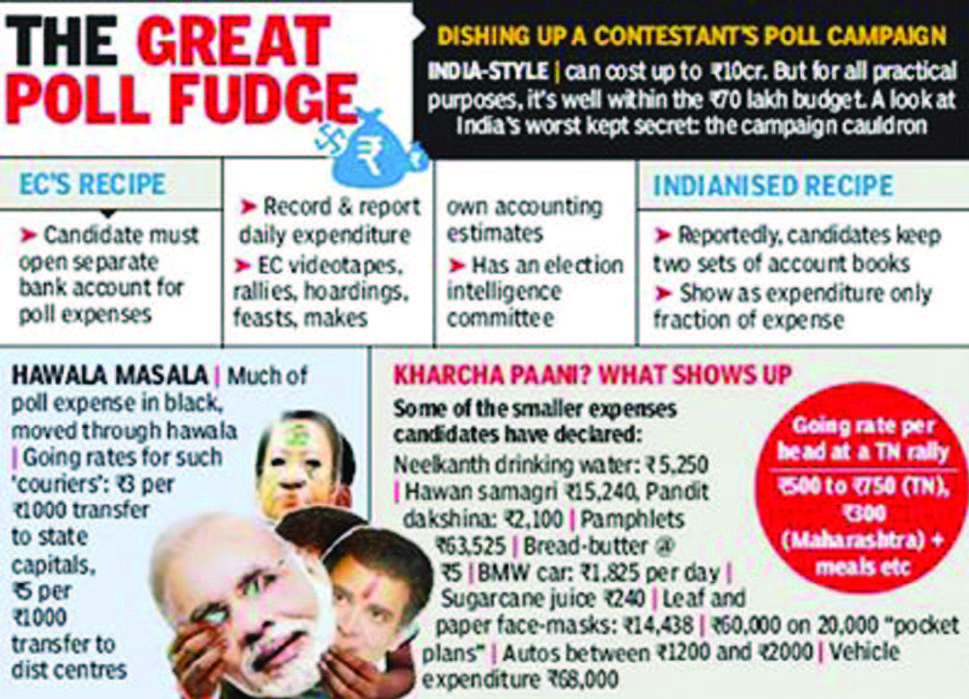
    NEW DELHI (TIP): Elections, it is said, are about spending big. This despite repeated poll panel efforts to curb candidate expenses. The EC rule book is clear: Each candidate is entitled to spend a maximum of Rs 70 lakh and it is mandatory for the nominee to file daily expenses. On the ground, a different story plays out and contestants find ways to beat the book. Politicians begin spending the day their names surface as a potential candidate.

    Many engage image consultants to get their projection right and build a “winnability” perception. After the contestant bags a ticket his election expenses start the day he files nomination. The EC requires candidates to open separate accounts only for their poll expense, and if that weren’t bother enough, to account for day-to-day expenses. For LS polls, a general category nominee must pay a Rs 25,000-security deposit.

    The meter starts ticking. “We fix heads under which we need to spend,” Vishwas Sarang, campaign manager for a BJP LS candidate in MP says. Typically these include daily campaign expenditure, spend on banners, and publicity material and, crucially, booth management on polling day. “Bhopal alone has 1,600 polling booths. To staff them adequately, we need manpower and resources,” Sarang says. But even the best of plans spin out of control as campaigning picks up. “It’s like budgeting for a wedding, things usually go wrong.

    There are so many imponderables,” campaign manager for a senior politician says. MP BJP leader Mahendra Singh Chouhan concedes: “It’s very difficult to earmark a particular percentage of Rs 70 lakh under a specific category. Expenses fluctuate.” A rival’s ability to spend and his/her visibility quotient dictate expenses. “Truth is if the rival is running a low-steam campaign, you also cut back on expense. But if the opponent is extravagant, you’re left with no option,” Chouhan says.

    Former MP from Chhattisgarh Chandrashekhar Sahu says travel and promotional material are major components of total expenses. But in practice, much is not accounted for. “Party workers need cars, fuel and food. These account for a lot of money, most of the spending under these heads don’t go into the books,” a Congressman says. So, how much does the candidate really disclose? Here are some startling figures to show how they dodge the watchdog body.

    In the 2011 Bengal assembly polls, candidate expense statements filed to EC showed three elected nominees held no public meetings, 163 of the 217 MLAs chose to simply ignore print and electronic media advertisement costs, 53 said they never paid a paisa to their campaign workers, even for food. Forget the Rs 70 lakh limit, truth is most contestants spend upwards of Rs 10 crore each.

    9

    A Tamil Nadu politician concedes: “By conservative estimates, a minimum of Rs 2.5 crore is a must to contest. On average there are 1,300 booths per constituency. I pay at least Rs 15,000 per booth (each booth as four agents) to ensure it’s well covered and my men are everywhere ensuring there’s no rigging — that alone works out to about Rs 2 crore. Over and above that, printing of pamphlets, flex boards cost roughly Rs 20 lakh. Fuel expenses and vehicle rentals notch up another Rs 20 lakh, ad campaigns an additional Rs 15 lakh to Rs 20 lakh.” Booth management is one of the biggest headaches and a big cost centre, politicians in Chhattisgarh agree.

    This expense can’t be shown in the accounts that are forwarded to EC else the prescribed spending limits would be breached by miles. So, it has to be adjusted or dressed up. “While filing returns, we hardly ever show the money spent on polling booth agents. While we disclose an expenditure of Rs 4 lakh to Rs 5 lakh per public meeting addressed by a senior leader, the actual expense could be well over Rs 2 crore to Rs 3 crore,” an election manager in MP says.

    Political observers in Karnataka claim each Narendra Modi rally in that state could have cost close to Rs 1.5 crore, all expenses are put together. You need sacks of liquid cash to bring crowds to rallies. “The current practice in TN is to pay those attending Rs 500 to Rs 750 per head,” a campaign manager informs. In Maharashtra, the rent-a-crowd rate in 2009 was Rs 100 per person. The going rate in the state now has shot up to Rs 300 and more.

    The person coming for the meeting expects to be fed a decent meal. These expenses are hidden and none of it goes into the accounts. All major parties concede that planning a senior leader’s logistics for a big election rally can send expenses through the roof. The national leader is a star campaigner. His hotel arrangements have to be made, transportation taken care of and security arranged.

    These are huge costs. The heat adds to the problem. Parties spend big on pandals and safe drinking water. Nobody will come if they’re made to sit in the open under the scorching sun.

  • BJP and the great communal divide

    BJP and the great communal divide

    Unless the leaders of India, especially from the secular parties show some courage to stand up to fundamentalism that may emanate from any quarters whether it is Hindu, Muslim, Sikh or Christian and stop exploiting religion and caste for vote bank politics, India’s democracy is headed for serious trouble”, says the author who visited Muzaffarnagar, last month, and got reactions of people there.

    On my recent visit to Muzaffarnagar in Uttar Pradesh, at the refugee camp of the September 2013 riot victims, the name of Amit Shah often came up during discussions. Mr. Shah is the newly appointed Campaign manager for Narendra Modi in Western U.P. For those who are keeping a close tab on the human rights situation in India, Amit Shah’s name rings an alarm bell. The appointment of Amit Shah appears to have a lot of political underpinnings.

    How this man who is charged with murder in Gujarat end up being the campaign manger in U.P? Sajjad, an aid worker to the riot victims wondered aloud in disbelief ! Uttar Pradesh has become a pivotal ground for BJP’s election strategy and Mr. Shah, who has a winning track record in Gujarat has the full confidence of Modi and the BJP. In order for Modi to become the Prime Minister, UP’s share of BJP seats has to be substantially increased from nine seats at present. Amit Shah, who has been charged with murder, extortion, kidnapping and five other sections under IPC for the killing of Sohrabuddin and his wife Kausar Bi in 2005.

    He was minister of state for Home in the Gujarat government under Chief Minister Narendra Modi, but had to resign in 2010 after he was arrested on charges of having ordered a series of “encounter” killings by the State Police. Currently on judicial bail, the Supreme Court has directed that he may not enter his home state of Gujarat where he may influence the investigations of the encounter killings. In Muzaffarnagar, they would all agree that it is the first time in history of the region that Jats and Muslims have killed each other. They are culturally the same people and the Muley Jats are converts from the Hindu Jat community. For instance, both communities observe the custom of pagri rasam ritual which consecrates a new head of a family, lineage or clan. The worship of Goga Pir, a local saint is common among both communities, remembering of ancestors.

    In a recent incident when an Imam issued a Fatwa against the use of cell phones by Muslim women, the entire community got together and filed an FIR and thereby forcing the withdrawal of such a dictate. The community is primarily known as owner cultivators who also tend cattle and raise chicken farms. The Jat-Muslim combine was first formed by Charan Singh and was efficiently used fielding Jat and Muslim candidates for a great win that catapulted him to become the Prime Minister of the country in 1979. The BSP in 2009 followed the same strategy and got encouraging results. For BJP and Samajawadi party, the Jat-Muslim combine has become an obstacle for 2014 election strategy and had to be broken and thereby breaking the hold of BSP.

    Two Jat youths named Sachin and Gaurav Singh had first killed Mohammed Shahnawaz, a Muslim youth of the village of Kawal after a traffic incident. Later a Muslim mob lynched to death the killers. It looks like it was a perfect situation handed down on a silver platter to these political operatives to put together a game plan and score for their party. The rest of the events are there for the record. For BJP, it presented an opportunity to consolidate the Hindu vote overriding caste divisions in U.P. They went on an overdrive even directly involving Members of the Legislative Assemblies to aggravate the situation by inciting the rioters. FIRs are filed against 19 MLAs though only 4 were arrested and all of them were shortly released.

    For Samajawadi party, the slow response to the worsening situation in Muzaffarnagar was alleged to be a calculated move as well. They were determined to break the supremacy of BSP in the region in order to add additional seats as SP President Mulayam Singh Yadav who is eyeing the post of Prime Minister in the upcoming election. Seema Mustafa, Director of Center for Policy Analysis doesn’t mince words when naming the perpetrators behind the violence. ‘The BJP, RSS and VHP, supported by the Bharatiya Kisan Union (BKU), were behind the violence. Moreover, the Samajwadi Party government did not do anything to prevent or control the violence, nor did it rehabilitate the displaced’.

    BJP seems to have accomplished its goal by fracturing the Jat-Muslim combine and their support for the Lok Dal and BSP. Samajawadi may be biggest loser in this whole affair as they have alienated Muslims who voted with them (40%) in the past. Jats who live not only in U.P. but also in Haryana and Rajasthan are indeed tilting towards BJP as the strategy of divisive politics beginning to pay dividends. To add insult to injury, those BJP MLAs who incited the community into violence are now rewarded with tickets to run for the Parliament. That includes Mr. Sangeet Som who created a fake video which is blamed for much of the anger and frustrations by the Hindu mob that participated in the melee.

    Sadhvi Prachi, a BJP leader was also arrested for violation of prohibitory orders and inciting communal violence by speeches in meetings at Nagala Madore area of Muzaffarnagar is heralded as a great champion for the promoting the Hindutva agenda. If one looks back at the history, Babri Masjid demolition and subsequent riots were results of careful and intensive strategizing by the Hindutva leadership. The demolition of the ancient Mosque in 1992 is the one incident in India’s social and political history that marks the climax of the politics of religious identity, and is the source from which caste identity politics originated and became powerful .

    There were 24 riots that happened last year alone and the public might even have missed noticing those reports. Soon after assuming responsibility for UP campaign, Amit Shah reportedly visited the Babri Masjid site and said the temple should be built there. Although he said it was not an election campaign issue, many observers made the connection as soon as the riots broke out, with minority affairs minister Rahman Khan telling India Today magazine that Shah had been sent expressly to stir up communal tension. ‘Any polarization along the religious lines would naturally help BJP’ another observer pointed out.

    Riots seem to be engineered for political purposes and BJP is mastering the art of creating communal tension for the sole purpose of political leverage or electoral gains. By driving own citizens from their homes to refugee camps, these parties are in gross violation of their oath to safeguard the life and property of all its citizens guaranteed by the constitution. Unless the leaders of India, especially from the secular parties show some courage to stand up to fundamentalism that may emanate from any quarters whether it is Hindu, Muslim, Sikh or Christian and stop exploiting religion and caste for vote bank politics, India’s democracy is headed for serious trouble.

  • The future of Indo-US ties now lies squarely on America’s shoulders

    The future of Indo-US ties now lies squarely on America’s shoulders

    After entering a green light mode, India-US relations have slipped into an amber mode. How soon we can get back into smooth circulation will depend largely on the US, as the responsibility for the malaise affecting our ties rests mainly on its shoulders.

    Misjudgment
    It is irrelevant whether the current US ambassador to India has resigned or has chosen retirement. The ambassador would have done two years by the time she leaves, not an abnormal tenure by any means. With a new government in New Delhi in the offing, a change in ambassadors would not be inopportune even in the normal course of things. That the present ambassador has contributed to driving the relationship into a corner despite a pro-US government in New Delhi makes the change even more advisable.

    From our perspective, the present ambassador has outlived her utility.With regard to the State Department role in Khobragade’s arrest and the evacuation of the maid’s family, either the ambassador misjudged our reaction and therefore gave faulty advice, or she gave the right counsel but it was disregarded, which would suggest that her clout in Washington is limited. In either case her usefulness, in any serious attempt to put the relationship back on track, is questionable.

    A more serious political misjudgment by the US, for which the ambassador cannot escape blame, is the failure to mend political fences with Narendra Modi in a timely manner following the European example. Worse for her credibility, the day she met Modi, the State Department declared that the visa policy towards him remained unchanged. The ambassador would have undoubtedly been consulted beforehand about how her overture to Modi would be “balanced” at the Washington end, which further underscores the inept political handling of the US relationship with the BJP’s prime ministerial candidate.

    To lift the morose mood in India-US ties, the US has to decide whether its strategic interest in India has wider geopolitical objectives, or depends on the redressal of shortcomings in our current trade, investment and IPR polices that affect the interests of US corporations in select sectors. If US interest has flagged because the promised opening of the Indian market has not occurred and our growth rate has fallen, can one conclude that the US-India “strategic partnership” is largely a function of board room strategies of US corporations? If so, is the US hyping up its strategic partnership with India to essentially gain wider access to our expanding market?

    Security
    Even if this strategic partnership is taken at face value, the US “system” makes it very difficult to deal with this kind of a relationship with America. Separate constituents of the Administration, the Congress, the intelligence agencies, NGOs, think-tanks, foundations, a variety of lobbies, can all play a constructive or a destructive role in conducting relations between the US and other countries.

    Changing of the guards: The tensions over the arrest of diplomat Devyani Khobragade demonstrate the need for a change of staff. For the Pentagon, India seems to have geopolitical value, especially in the context of a rising China. Protecting the sea lanes of communication in the Indian Ocean, through which global trade and energy flows, makes India a valuable strategic partner of the US, given the expanding power of the Indian Navy. With the Indo-Pacific concept gaining acceptance, maritime security has become a top drawer issue.

    The State Department’s ambivalence towards India remains despite the forging of a strategic partnership. Secretary Kerry is supposedly less drawn towards India than his predecessor, which would make the political hand at the top of the State Department looser in directing Indiarelated policies. While the non-proliferation lobby in the State Department has been subdued by the India-US nuclear deal, the human rights, human trafficking, minority protection units seem to be propelled by their own logic vis-a-vis India independently of the logic of the overall relationship in which the stakeholders on the US side have interests that obviously transcend dedicated moral pursuits by human rights activists in the US foreign office.

    Turnabout
    The responsiveness of the US system to pressure by corporate lobbies can cause unexpected turbulence in pursuing an overall “strategic partnership” with the US, as demonstrated by the US Trade Representative’s threat to impose sanctions on India under US laws for alleged IPR violations, instead of getting the matter adjudicated through the WTO’s dispute settlement mechanism.

    Hesitant: The US state department under John Kerry appears ambivalent on strengthening ties with India Select US corporations in the pharmaceutical, telecom and solar energy are today leading the charge against India in the US Congress, even as the US corporate sector has been in the past, a potent ally of India in promoting bilateral economic ties. Now we hear that President Obama, focused primarily on domestic issues, is paying inadequate attention to India, even though in 2010 the US relationship with India was, in his eyes, a defining partnership of the 21st century.

    Such a quick turnabout calls into question the depth of the India-US strategic partnership. Presumably this partnership was based on a wider US geopolitical objective of consolidating the global system established by the West post-1945 by co-opting a huge and rising Asian country like India through intensified engagement, so that the inevitable re-ordering of the balance of power within the system is done under the aegis of the US rather than in opposition to it.

    This objective will be increasingly difficult to achieve if the US continues with its regime change policies, refuses to see the terrible societal costs of its democracy and human rights promotion policies, or curbs its tendency to unilaterally sanction countries whose policies it disagrees with, as we see even in the case of a nuclear-armed permanent UN Security Council member like Russia. What strategic lesson should weaker and more vulnerable countries draw from this?

  • BABA RAMDEV BATS FOR BJP, VOWS TO BRING BACK BLACK MONEY STASHED ABROAD

    BABA RAMDEV BATS FOR BJP, VOWS TO BRING BACK BLACK MONEY STASHED ABROAD

    BHUBANESWAR (TIP):
    Beating the drums for Bharatiya Janata Party (BJP) prime ministerial candidate Narendra Modi, yoga guru Baba Ramdev has again promised to bring back Indian currency stashed away in foreign banks within 100 days of the formation of the latter’s government in New Delhi. Baba Ramdev, who was in the temple city of Bhubaneswar, said: “I would commence the work for getting back the 100000 crores of Indian money within 100 days of Modi government.” Continuing his tirade against the ruling Congress, Baba Ramdev blamed the UPA Government for the lack of development in Odisha.

    “In the last sixty years, Congress has done an injustice with Odisha. Despite having sufficient financial resources at its disposal, the Centre has dealt with the state of Odisha poorly. This deprivation has made the state even poorer,” he claimed. Baba Ramdev is an avid supporter of Modi, and has been touring India to garner votes for the BJP after the party accepted his proposal to bring back black money stashed in foreign banks.

    Indian media often presents the parliamentary elections as a face-off between Congress vice president Rahul Gandhi and Narendra Modi. Polls have repeatedly indicated that although the BJP will emerge as the largest single party in parliament, it is unlikely to win an outright majority. Congress and its allies are battling to weaken Modi’s chances of building a coalition. Elections began on April 7. Polling will end on May 12. Already, 814 million people have registered to vote – a number exceeding the population of Europe and a world record. Results are due on May 16.

  • BJP stands by Uddhav, dumps Raj

    BJP stands by Uddhav, dumps Raj

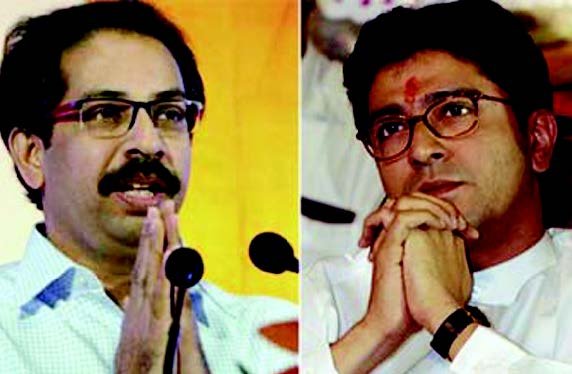
    PUNE (TIP): Unimpressed by Raj Thackeray’s support for its prime ministerial candidate Narendra Modi, the state BJP unit has decided to take on the Maharashtra Navnirman Sena (MNS) in the Lok Sabha elections. State BJP president Devendra Fadnavis said that the BJP leaders will campaign for Shiv Sena’s candidates to ensure the MNS’s defeat.

    “We stand by our alliance partner Shiv Sena. We are doing all to win every seat in the state. The MNS has opened a front against our alliance partner and we are going to resist every attack on the Sena. Our leaders will campaign for the Sena candidates and appeal to voters to defeat the MNS,” Fadnavis added. He said there was no confusion and though Raj has announced that his MPs will support Modi, they would are going to campaign against MNS candidates. Allegations about colluding with the MNS have been in the air. Fadnavis said there is no covert or overt understanding with the MNS.

    “The BJP values its old alliance partner Shiv Sena and there is no question of any understanding with the MNS. We are contesting the election as an alliance and it is our duty to abide by it,” he added. Senior BJP leader Gopinath Munde, speaking to local media persons in his hometown of Beed, said, “I had met Raj Thackeray and wanted him in our alliance. But things did not work out and the chapter was closed. There is no point in raking up the issue again.

    We are confident that the alliance will win the maximum seats in the state.” Munde said he would address a series of rallies with Uddhav across the state. The BJP’s support for Uddhav comes against Raj’s appeal to his party workers to “target Shiv Sena”. During his public rally in Pune on Monday, Raj announced a dozen public rallies to explain his stand on Shiv Sena and Uddhav. “I need to clarify that I was not against joining the BJP-Sena alliance. But Uddhav never wanted me in. I plan to reveal more such facts in the next few days,” Raj had said.

    City unit told to get its act together
    The BJP’s state president Devendra Fadnavis said he had asked the city unit leaders to set aside their differences and campaign for the party candidate Anil Shirole. “We don’t want to lose any seat because of infighting. We cannot afford any bickering at this moment. All party workers will work for Anil Shirole and we are confident of winning the Pune seat,” said Fadnavis. He added that MLA Girish Bapat and his supporters were actively campaigning for Shirole and senior state leaders would address public rallies in the city. Nitin Gadkari supporter Bapat had sought party nomination, but finally Munde supporter Shirole succeeded to fetch the ticket. Unhappy with the decision, Bapat and supporters had publically expressed unhappiness over the party’s decision.

    Mistry, Modi’s opponent in Vadodara, arrested
    VADODARA (TIP): Congress’s Vadodara candidate Madhusudan Mistry, who removed posters of the BJP prime ministerial candidate Narendra Modi, was on April 3 arrested by cops on charges of vandalism.Mistry, the Congress candidate was earlier detained for vandalism. Mistry, along with 100-odd Congress workers tried to remove posters of his rival and BJP’s prime ministerial candidate, Narendra Modi, in Vadodara.After detention, an unrepentant Mistry said he had no regrets for his action and said that he would continue to protest against Modi.

    Will your jijaji be India’s chowkidaar? Modi asks Rahul Gandhi
    KURUKSHETRA (TIP): Bharatiya Janata Party prime ministerial candidate Narendra Modi took on Congress vice president Rahul Gandhi in a rally in Kurukshetra in Haryana. Referring to Rahul’s brother-in-law Robert Vadra’s controversial land deals in Haryana, Modi attacked the Gandhi scion, calling him shehzada. He was quoted by NDTV as saying, “I had said the country needs a chowkidaar and I will serve you like a chowkidaar.

    Shehzada said the country needs 125 crore countrymen as chowkidaars. I ask him, will his jijaji (brotherin- law) be a chowkidaar too? Will he guard land?” In 2012, Vadra was accused by Arvind Kejriwal, an anticorruption crusader, of taking an interest-free loan of Rs 65 crores and heavy bargains on land from DLF Limited in exchange for political favours.Congress’ principal opponents, the Bharatiya Janata Party raked up the issue in the parliament and demanded a probe into the matter. In response to the controversies surrounding the deals, the Congress came in strong defence of Vadra, criticising the BJPfor targeting its president Sonia Gandhi’s family.

  • Lalu’s daughter hires IITians, doctors to manage her campaign

    Lalu’s daughter hires IITians, doctors to manage her campaign

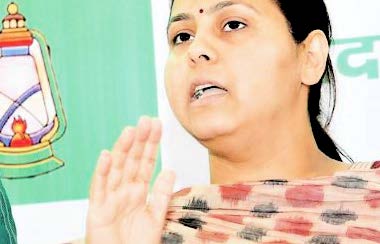
    PATNA (TIP): Misa Bharti, daughter of RJD chief Lalu Prasad, is taking all the help she needs and has hired two IITians and doctors to manage her campaign for the Lok Sabha polls in Bihar. Her husband Shailesh Kumar, an IT professional, is also working as her shadow during the campaign.

    Misa, a doctor, is contesting from the Patliputra constituency in Patna. She has hired two IITians — Pankaj Sudan and Perween Tyagi — to manage her campaign and help her in reaching out to voters through social media. “Both of them are also giving her important tips and providing suggestions on how to meet people from different classes,” a leader close to her said.

    Sudan works with a Gurgaon-based MNC, while Tyagi runs his own company in Delhi. Thanks to them, Misa’s Facebook page is getting support of youths in Patna. She has also hired two doctor colleagues — one of them an NRI and the other based in Gujarat — to finalize strategy and to understand pulse of the people, particularly those in rural areas.

    Jamil Akhtar, a New York-based doctor, is helping her in finalizing her poll speeches and Azad Kumar is helping her understand the rural voters. She is pitted against JD(U) candidate and sitting MP Ranjan Prasad Yadav and BJP’s Ram Kripal Yadav in the contest for the seat. Ram Kripal Yadav was a close associate of her father, Lalu Prasad, and left the RJD after Lalu decided to field Misa from Patliputra constituency.

  • REFORMS TO GIVE 110 MILLION JOBS BOOST TO ECONOMY IN 10 YEARS

    REFORMS TO GIVE 110 MILLION JOBS BOOST TO ECONOMY IN 10 YEARS

    NEW YORK (TIP): As general elections draw closer in India, global financial major Goldman Sachs has said 40 million new manufacturing jobs can be created in a decade if states follow flexible labor laws like in Gujarat.

    Besides labor laws, implementation of proper reforms in other areas such as subsidies can lead to overall job gains rising to 110 million over the next 10 years – the largest for any major economy, Goldman Sachs said. The observations assume significance as they come at a time when a political debate is underway on the comparison between growth model of Narendra Modi-led Gujarat and that of other states ruled by Congress and other parties.

    Modi is the prime ministerial candidate of BJP, which is trying to wrestle power from Congress at the Centre. The report said the Gujarat government amended the Industrial Disputes Act in 2004 to allow for greater flexibility in the labor market for Special Economic Zones (SEZ). It allowed for companies within SEZs to lay off workers, without seeking the permission of the government, by simply giving a 1-month notice to the worker.

    In contrast, the West Bengal government, made several pro-worker changes. It changed the laws to make it virtually impossible to shut down a loss-making factory.Accordingly, Gujarat has witnessed a 60 per cent growth in manufacturing employment between 2000 and 2012 while West Bengal has seen only a 22 per cent increase.Goldman Sachs said as a new government takes charge from mid- 2014, it sees labor market reforms as a critical ingredient to accelerate India’s economic growth rate.

    “If India were to undertake significant reforms in the labor market, the benefits could be quite large,” Goldman Sachs said. In a bull scenario, it projected that India could add some 110 million workers over the next decade. At this level, the number of jobs that India could create would be larger than that of the US, China, Russia, and Brazil combined, Goldman Sachs said.

    According to the financial services firm, India’s stringent labor laws are a key factor constraining employment growth and the reforms like simpler labor laws, more flexibility to hire and fire, self-certification by the employers, amendment in the Trade Union Act and faster dispute settlement, are likely to increase flexibility and boost employment.India’s employment growth in recent years has been anemic. The economy added only about 2 million jobs each year between FY05 to FY12, compared to 12 million a year in the 5 years before this period, it said.

    “As a labor abundant country, India should be generating jobs in laborintensive manufacturing,” the report said.India has some 44 labor laws which are enacted by the central government and enforced by both the central as well as state governments. In addition, there are also labor laws enacted and enforced by the various state governments. Some laws date back to the colonial era. The Trade Unions Act is from 1926, the Workmen’s Compensation Act is from 1923, and the Factories Act from 1948.

  • Another round of “Chai Pe Charcha” on community leader Atma Singh’s birthday

    Another round of “Chai Pe Charcha” on community leader Atma Singh’s birthday

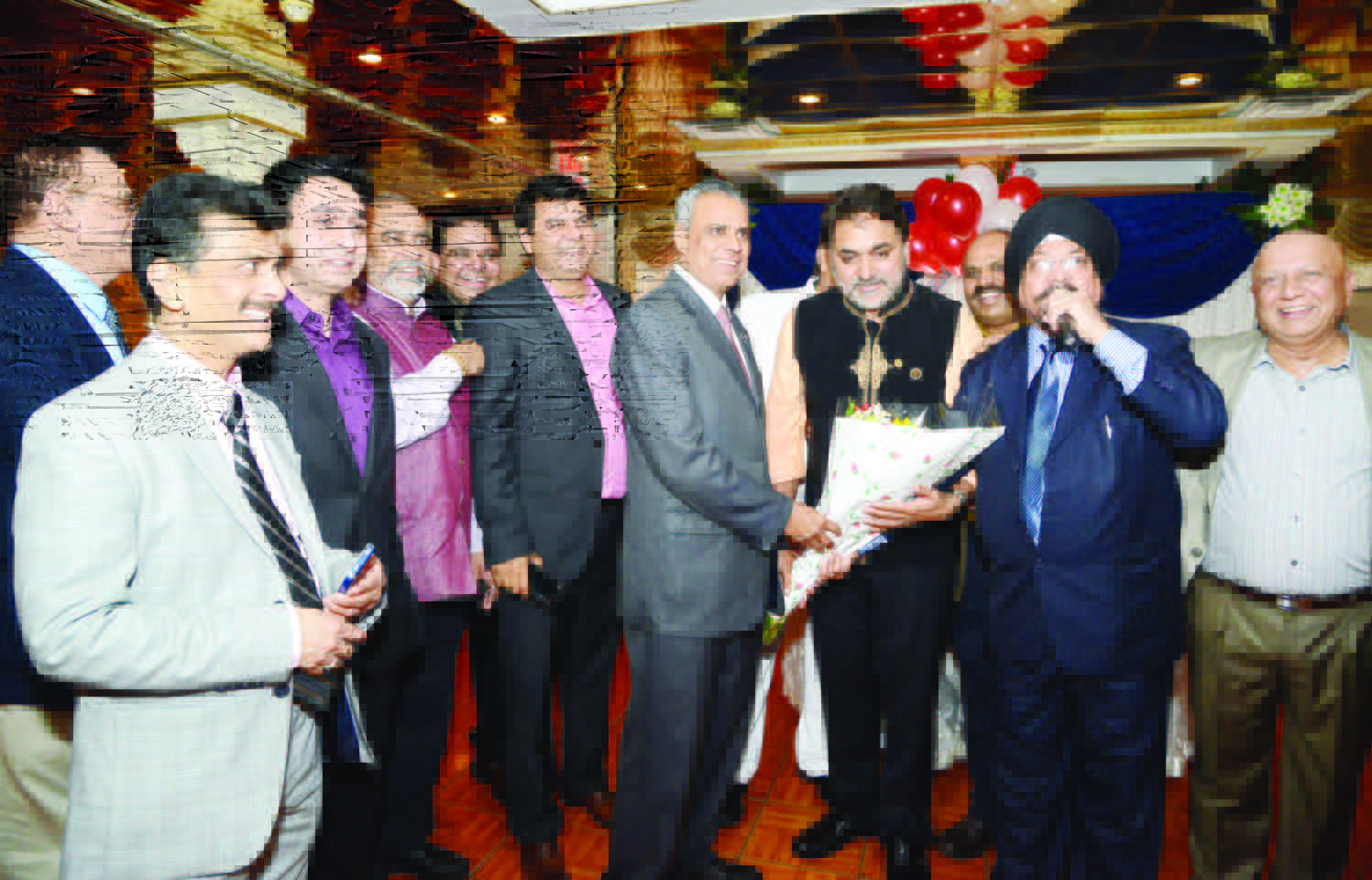
    EDISON, NJ (TIP): ” Chai pe Charcha” organized by the BJP worker and community leader Atma Singh on the occasion of his 52nd birthday, attracted a large number of Modi supporters.

    The event held at Akbar Restaurant in the Indian hub town of Edison on March 29th witnessed huge support for Narendra Modi. The gathering was called upon to reach out to their friends and family to convince them to vote for BJP in the upcoming elections.


    11
    The gathering sings praises of Bharat Mata with Vande Mataram

    “We need a government that provides voting rights for NRIs, improves consular services, promotes better investment opportunities and provides a secure feeling that every NRI looks forward to. They feel this is possible only with a BJP government”, Atma Singh said.


    12
    The birthday boy gets a taste and a feel of cake. Seen to his left is Mrs. Atma Singh

    The event attended by various Indian community leaders, business owners, politicians and media personalities included, among others, HR Shah (CEO of TV Asia), Assemblyman Upendra Chivukula, Prof. Indrajit Saluja (Chief Editor, The Indian Panorama), Surat Singh Padda, Editor, Awaz Punjab Dee, Jaya Sharma, Director Marketing, PTC TV, Councilman Khemraj Ramchal, Rakshpal Sood (OFBJP), Hardeep Goldie( Amantel), Swami Gauravanand ( Divyajyoti Sansthan), Col. Virendra Tavathia( Farmers Insurance) Mukul Bishnoi ( Rudraksham Int’l) , Mahesh Chitnis ( Lions Club), Harkesh Thakur, Raaj Rahhi, Nattu Bhai, Popat Patel and Sarvesh Dhyaran.


    13
    Birthday boy with wife and son Jap Singh

    Senior Citizens Association of Old Bridge honored Atma Singh for his community services. Attendees got to see a special dance performance presented by Navrang Dance Academy. Edison Visionary Lions Club actively participated in the event and Atma Singh requested everyone to donate birthday gifts meant for him to Lions Club Permanent fund.

  • Babri demolition planned

    Babri demolition planned

    Advani, P V Narasimha Rao knew of plot: Cobrapost sting

    NEW DELHI (TIP): An elaborate sting operation, conducted on 23 key people of the Ram Janambhoomi movement, claims that the demolition of the Babri Masjid on December 6, 1992, was elaborately planned by the various wings of the Sangh parivar and executed with precision by trained volunteers.

    It wasn’t, as it is claimed, a case of mob frenzy going out of control, leading to the fall of the disputed 16th century structure. The investigation, carried out by Cobrapost, claims that by piecing together the versions given by the top Ram Janambhhomi players, among them Sakshi Maharaj, Acharya Dharmendra, Uma Bharti, Mahant Vedanti and Vinay Katiyar, it is apparent that top BJP leaders like L K Advani and the then UP chief minister Kalyan Singh, as well the former Congress PM, P V Narasimha Rao, were aware of the planned demolition of Babri Masjid.

    Posing as a would-beauthor researching his book on the Ayodhya movement, Cobrapost associate editor K Ashish travelled to Ayodhya,Faizabad, Tanda, Lucknow, Gorakhpur, Mathura, Moradabad in UP, Jaipur, Aurangabad, Mumbai and Gwalior interviewing 23 of those who participated in the operation. He clandestinely recorded conversations with them. If what they claim is true, the Ram Janambhoomi leaders and activists toiled secretly for months on a plan codenamed ‘Operation Janmabhoomi’ and executed it with military precision. Volunteers were trained, logistics painstakingly put in place and the assault on the disputed shrine launched using large surging crowds with volunteers skilled in demolishing structures embedded in it.

    Not only do those interviewed spell out details of the planning, they also allegedly reveal how enthusiastic young participants were deliberately used as cannon fodder by provoking a police firing on kar sevaks in 1990 because of the belief of some leaders that the movement would not gather steam unless ‘some Hindus die’. Many of those interviewed by the makebelieve author are accused in CBI cases pertaining to the demolition. Yet, they seemed to have no qualms in “confessing” (or boasting) about their role in the episode that left a deep communal schism in India.

    Some of those interviewed were, B L Sharma Prem, Dharmendra Singh Gurjar, Jai Bhagwan Goel, Pawan Pandey, Santosh Dubey, Ramji Gupta, Ramesh Pratap Singh, Sadhavi Ritambhara, Kalyan Singh, Prakash Sharma, Champat Rai Bansal, Satish Pradhan, Mahant Avaidyanath, Moreshwar Save, Lallu Singh, Brij Bhushan Sharan Singh and Swami Nritya Gopal Das. Their versions make it appear that the plot to demolish the mosque was hatched amid utmost secrecy. Those recruited for training weren’t told their mission till a month ahead of Babri’s fall. At Sarkhej, Gujarat, Bajrang Dal conducted a month-long training in June 1992 for 38 of its cadre from different regions. The trainers were retired high-ranking military officers, while Acharya Giriraj Kishore, Acharya Dharmendra, Praveen Togadia, Jaibhan Paweya and Ashok Singhal held indoctrination sessions.

    In subsequent drills at Neela Teela the cadre learnt skills such as climbing tall structures using grappling hooks and ropes. At a top-secret meeting in the basement of Ram Katha Manch, top VHP office bearers asked this band of 38 to form a Laxman Sena specifically to tear down the disputed structure. Ramesh Pratap Singh recalls, “Five of those who trained at these camps attended this meeting. The sixth person was Ramji Gupta and there was Durg Singh Chauhan. After the meeting, this office bearer told us Durg Singh will be our contact point and he’ll coordinate all meetings. Decide what you want, how you will form it (Laxman Sena). Thereafter, the office bearer disappeared.” The VHP office bearer he mentions was Champat Rai Bansal.

    While the VHP and Bajrang Dal were holding a secret meeting at Ayodhya to plan the Babri assault, Sena leaders too were deliberating on the fate of the shrine in North Avenue. Save and Pradhan, among others, attended the meeting. If everything failed, Sena had a plan B: Dynamite Babri. Claims Goel: “Humare paas dynamite bhi thha, hum dynamite bhi lekar gaye thhe wahan par agar zaroorat padti usko bhi chala dete iss taiyari se gaye the hum (We were carrying dynamite. If the need arose, we had gone prepared to use it).” In 1990, Sena’s Suresh Baghel had tried this, but his attempt was foiled and he was arrested with 28 dynamite sticks. In the end, petrol bombs were apparently used. Former BJP MP Brij Bhushan Sharan Singh was seen planting a petrol bomb by fellow karsevak Jaibhan Singh Paweya.

    Here’s what Paweya claims: “Ek petrol bomb do baje koi lekar aaya jo eent mein lagane ke baad dhuan nikal kar reh gaya uske baad hila bhi nahi … Brij Bhushan laya thha arre petrol bomb (Somebody brought a petrol bomb around 2 pm and planted it between the bricks. It didn’t work, only released some smoke. Brij Bhushan brought the petrol bomb).” Apart from petrol bombs, the Bajrang Dal forward squad used chisels, hammers, pickaxes, spades and grappling ropes to bring down the shrine. There were two determined attempts to demolish the shrine – first in October 1990 and the second in December 1992. The first attempt ended in police firing in which karsevaks died. Recounting the incident, Sakshi Maharaj says VHP leader Ashok Singhal was to blame for it.

    “In front of me, Singhal told Maharaj (Vamdev), the movement won’t gain momentum unless some people die. Maharaj Vamdev said it’d be disastrous if children die. Singhal again said the movement won’t get a fillip until they die.” Sakshi claims wellknown karsevaks like the Kothari brothers from Bengal and Mahendra Singh of Rajastan were targeted by police at the behest of vested interests spearheading the Ram Janmabhoomi movement. Uma Bharti blames Vinay Katiyar for the killing of Kothari brothers: “Jo log marey thhe wo Vinay ki galti se. Galti bhi nahi wo bhagdar machi, wo gali chhoti thhi. Galti matlab wo bhag gaya chhodkar bhag gaya (They got killed because of Vinay’s mistake. A stampede began and the lane was narrow…I mean he fled the scene abandoning his group). Sensing the do-or-die mood of Ram bhakts in Ayodhya, a sankalp, or oath was administered.

    The task of initiating the oath fell on Ram Vilas Vedanti. The vow said: “On this day of December 6 we Ram bhakts take this oath on the premises of Ram Lalla that it is necessary to remove the structure from where it stands to make a grand temple. It is necessary to remove the structure to make a Ram Janmabhoomi Temple. We take this oath for Ram Lalla.” Immediately after the oath, the Babri assault began. Some leaders at the forefront of the movement, like Vinay Katiyar, B L Sharma, Santosh Dubey, Sakshi Maharaj and Mahant Ram Vilas Vedanti openly acknowledge the then prime minister Narasimha Rao’s ‘supportive role’.

    The then CM Kalyan Singh apparently knew of the demolition plan. Mahant Vedanti claims to have informed him about it a day before: “Paanch December ki raat ko hi Kalyan Singh ke paas samachar bhej diya gaya thha aur usmein ye kaha gaya tha ki yadi awashayakta padti hai toh dhancha bhi tod diya jayega aapko kya bhoomika nirwah karni hai vichar kar lijye (On the night of December 5 Kalyan was informed. He was told that if need be the structure would be felled. You decide what you’d do).” Apparently, Kalyan Singh made up his mind to resign on December 6 morning, when he came to know the assault on the structure had begun, but senior leaders like H V Sheshadri and Murli Manohar Joshi dissuaded him, while BJP leaders in Lucknow made him captive the whole day until a clean job of the mosque had been made.

  • TDP, BJP resolve seat-sharing row

    TDP, BJP resolve seat-sharing row

    HYDERABAD (TIP): The BJP-TDPLoksatta- Jana Sena electoral alliance in the state has been formalized and an announcement on it is likely to be made on soon. As per the seat sharing arrangement finalized by BJP national spokesperson Prakash Javadekar, TDP Rajya Sabha MPs Sujana Chowdhary and CM Ramesh and the Loksatta representative here on Thursday, the TDP will give the BJP 8 Lok Sabha seats and 45 assembly seats in Telangana while Loksatta will contest the Malkajgiri Lok Sabha seat and perhaps three or four assembly seats in the entire state.

    In the Seemandhra region, the BJP will contest four Lok Sabha seats and 15 assembly seats. According to sources, a few seats are likely to be allotted to the Jana Sena Party floated by Tollywood actor Pawan Kalyan. The TDP will fight the polls from all the other constituencies in both the regions that have not been allotted to the three parties. In Telangana, the BJP is to field candidates from Mahabubnagar, Secunderabad, Hyderabad, Medak, Nizamabad, Karimnagar, Mahabubabad and Nagarkurnool Lok Sabha seats. According to sources, candidates from some of the Parliamentary seats like Medak (C Narendranath), Mahabubnagar (N Janardhan Reddy) and Nizamabad (Y Lakshminarayana) have been finalized.

    The Secunderabad candidate will most likely be state BJP president G Kishan Reddy or Bandaru Dattatreya who has represented the seat on three earlier occasions. From Hyderabad, the BJP-TDP alliance wants to field a formidable candidate against sitting MIM MP Asaduddin Owaisi and the name of film director Ram Gopal Verma is said to be under consideration. Loksatta president Jayaprakash Narayan will be the alliance candidate from Malkajgiri. In the Seemandhra region, the BJP is to contest the Visakhapatnam, Vijayawada, Tirupati and Kakinada Lok Sabha seats. Former union minister D Purandeswari may be fielded from either Vizag or Vijayawada. Incidentally, the BJP’s best performance in Andhra Pradesh was in the 1999 elections when it won 7 of the 8 Lok Sabha seats it contested in alliance with the TDP.

    In that poll, the TDP had won the Vizag, Vijayawada and Kakinada seats which it has now ceded to the rightwing party while the BJP had emerged victorious in the Tirupati Lok Sabha seat. BJP sources said Pawan Kalyan may be the party candidate for the Kakinada Lok Sabha seat. The BJP had won the Kakinada seat in the 1998 elections. Confirming the electoral pact, TDP MP C M Ramesh told TOI that the talks were fruitful and the announcement of the alliance was expected to be made any moment. “The talks were cordial and we have arrived at an amicable understanding,” he said.

    Prakash Javadekar initiated the talks with the other alliance partners after landing in the city on Thursday morning and the deal was clinched by the evening. While the Telangana BJP is happy with the outcome of the seat sharing talks, the Seemandhra unit is seeking more number of seats.”We are asking for six Lok Sabha seats and twenty assembly segments. I think it needs a little more consultation,” said Seemandhra BJP president Kambampati Haribabu. The minor hiccups still between the four parties are likely to be ironed out by Friday and the announcement of the grand alliance is likely to be made by BJP national president Rajnath Singh in Delhi, party sources said.

  • Azam Khan invites Jaswant to join SP

    Azam Khan invites Jaswant to join SP

    LUCKNOW (TIP): Senior SP leader Mohammed Azam Khan has invited rebel BJP veteran Jaswant Singh to join his party. Talking to the media persons in Rampur on Thursday, Azam said: “It was disheartening to know how such a veteran politician was not being awarded the respect and honour that he deserves.

    But SP is ready to acknowledge his experience in politics.” Azam was not forthcoming whether or not the SP would offer Jaswant a ticket but the Rajasthan veteran can prove to be a prized catch especially if the involves him in campaign against BJP stalwarts particularly Rajnath Singh in Lucknow. Jaswant has accused Rajnath of betrayal. The SP has already changed its candidate in Lucknow replacing Ashok Bajpayee with sitting Lucknow MLA and minister Abhishek Misra.

    Besides, the way Jaswant martyred himself by writing a book of Jinnah which forced him to leave BJP a few years ago, can also make him a perfect campaigner to woo Muslims. The book had fetched unprecedented popularity to him along with a call from Pakistan’s capital Islamabad to attend a function organized on the occasion of the launch of his book on Jinnah. He made a comeback to the BJP recently but is on the verge of leaving the party again after the party denied him the ticket from Barmer.

  • India abstains on human rights vote on Sri Lanka, rescues foreign policy

    India abstains on human rights vote on Sri Lanka, rescues foreign policy

    NEW DELHI (TIP): In a brave decision marking the reclamation of foreign policy from narrow political interests, India abstained from voting on a USsponsored resolution on human rights situation in Sri Lanka. While India had supported the resolution in 2012 and 2013, the latest resolution was much tougher, calling for an independent investigation into Sri Lanka.

    The resolution passed with 23 votes for, 12 against and 12 abstentions. India’s abstention comes after MEA raised red flags about the resolution, saying it would be creating precedents that would be difficult to withstand. Sri Lanka too had mounted a strong diplomatic offensive with the Indian leadership, including long meetings with the national security adviser, Shivshankar Menon. Pakistan did its best to help Sri Lanka by proposing a separate vote on the operative paragraph 10 (deemed most offensive) hoping to remove it totally from the resolution — it failed 16 votes to 25.

    BJP leader Subramanian Swamy today congratulated Prime Minister Manmohan Singh for India not supporting the resolution. “I congratulate PM Manmohan Singh for ordering the Indian delegation in UNHCR not to support the dangerous US resolution seeking international probe into the so called human rights violations during 2009 anti-LTTE war by Sri lanka,” Swamy said in a statement. In 2013, Menon and MEA failed to prevail against a determined Congress offensive led by finance minister P Chidambaram to punish Sri Lanka. Sources said this had a lot to do with the ruling UPA government’s sensitivity to Tamil parties. This time, Chidambaram is not fighting an election, and the government has been free to take a decision based on India’s foreign policy interests.

    If India had voted against Sri Lanka, the government could have opened itself to the charge that it was influencing the Tamil vote. Besides, it would have dealt a body blow to relations with a neighbour that is arguably India’s closest economic and security ally in South Asia. The abstention gives India greater flexibility with Sri Lanka, greater ability to push for changes that Mahinda Rajapakse needs to undertake. Rajapakse has taken several steps in the last year like holding provincial council elections in the north which did not happen because of the HRC vote, but because of intensive Indian diplomacy. “Things will go in the right direction now,” said diplomatic sources following relations with the island nation.

    If India had failed to stand with Sri Lanka at this time, it would not be able to stop Chinese influence spreading in the country. Moreover, the government has concluded that many countries pushing the resolution are being pressured by their Tamil-Lankan diaspora. India is wary of allowing its policies to be dictated by such interests, though in the past couple of years the UPA government has caved in to short-sighted tamil politics endangering India’s foreign policy. This year marks a correction in what most foreign policy analysts called a downward trajectory.

    Explaining why it abstained from the vote, MEA said, “It has been India’s firm belief that adopting an intrusive approach that undermines national sovereignty and institutions is counterproductive…. any external investigative mechanism with an openended mandate to monitor national processes for protection of human rights in a country, is not reflective of the constructive approach of dialogue and cooperation envisaged by UN General Assembly resolution 60/251 that created the HRC in 2006 as well as the UNGA resolution 65/281 that reviewed the HRC in 2011.” The passage of the resolution was welcomed by human rights groups. Meenakshi Ganguly of Human Rights Watch said, “This is a welcome decision, and one that will encourage victims and activists in Sri Lanka who have strived so courageously for accountability and justice.

  • Modi’s Stance on Foreign Policy Remains a Mystery

    Modi’s Stance on Foreign Policy Remains a Mystery

    Modi has made some stray remarks on foreign affairs, but they should be seen more as obiter dicta rather than a considered judgment.

    Little interest has been shown domestically about possible new orientations in foreign policy under a Modi-led NDA government. Modi’s single-minded focus on the development agenda has dominated political and media discourse, barring, of course, the 2002 Gujarat riots. The slowdown of the economy, the negative investor sentiment, price rise, corruption, the perceived lack of leadership have been issues of public concern, not foreign policy. Modi has been a state leader, with no stint in Delhi, and hence a relatively unknown entity for foreign interlocutors except those who have traveled to Gujarat for business reasons.

    Economic focus
    For our foreign partners who see India’s economic rise as opening up enormous prospects for their own economies by way of trade and investment and who are disappointed by India’s lacklustre economic performance under UPA II because of slowdown of reforms, indecision and delays in implementation, Modi’s economic agenda is alluring. But they are equally interested in assessing the possible differences in foreign policy between a possible Modi-led government and the UPA governments.

    Modi has been a state leader, with no stint in Delhi, and hence a relatively unknown entity for foreign interlocutors except those who have traveled to Gujarat for business reasons. Moreover, because he has been politically boycotted by western countries until recently for human rights reasons, the opportunities to assess him through personal contact have been that much less available. China and Japan, who have received him in their countries, have been wiser in this regard. Modi has not been grilled on foreign policy issues either by the opposition or the media. He has made some stray remarks on foreign affairs, but they should be seen more as obiter dicta rather than a considered judgment.

    His view, for instance, that the Ministry of External Affairs should focus on “trade treaties” rather than strategic issues may fit in with his “development” focus, but would get revised when faced with the reality of India’s challenges once in power at the Centre. If his meaning was that our missions should give priority to commercial/economic work, that would be unexceptionable in the context of economic performance increasingly determining a country’s international role and influence. Towards Pakistan, one hopes, Modi will not be counseled to adopt a soft face in order to attenuate his anti-Muslim image, both at home and abroad.

    The economic argument should not be exaggerated though, as our most severe external challenges are driven not by economics but politics, relating to our territorial integrity, the threats to us from terrorism and religious extremism, the nuclear dangers emanating from nuclear collaboration between China and Pakistan which the West tolerates despite its readiness to take military action to stop proliferation in Pakistan’s neighborhood, and China’s attempts to politically and strategically box us in the subcontinent while simultaneously eroding our influence there by its deep incursions into our neighborhood. If China and Pakistan have been hostile to us for decades it is not on account of economic issues. India’s role in the Indian Ocean has a major strategic aspect that goes beyond ensuring the safety of the sea lanes of communication for trade flows.

    Status Quo
    How much the foreign policy of former Prime Minister Vajpayee, who enjoys an iconic status within and even without the BJP, will guide that of an hypothetical Modi-led government is a pertinent question. If Vajpayee’s decision to take a plunge on the nuclear question was an act of strategic defiance, he was also a man of dialogue who made major overtures to US, China and Pakistan. With a strong nuclear card in his hand, his strategy of building a relationship with the US “as a natural ally” made sense, as did his outreach to China to explore the possibility of resolving the border issue on a political basis. His conciliatory approach towards Pakistan, however, seemed based less on a cold power calculus and more on inchoate hopes and sentimentalism. Prime Minister Manmohan Singh built on Vajpayee’s policy on all these fronts, pointing to the essential continuity of our foreign policy under governments of different political complexions.

    The ‘Next Steps in the Strategic Partnership’ under Vajpayee led to the nuclear deal under Manmohan Singh; the Special Representatives mechanism with China set up under Vajpayee has been the principal platform for political engagement with China on the vexed border issue under his successor; the obsession to have a dialogue with Pakistan under Vajpayee continued its confusing course after him. In visiting the Arunachal border with Tibet and vowing not to yield an inch of Indian territory, Modi has sent an important signal to Beijing.Is there a major course correction in foreign policy that a Modi-led NDA government would need to make? Tough stance Not really, as our geo-political compulsions, our economic needs and our security calculus dictate our fundamental foreign policy choices, with limited wiggle room available.

    We need a stable relationship with all power centers. Despite the difficulties of dealing with the US, our economic and people-to-people links with it are of key importance. The US has treated Modi with gross political ineptitude, giving him, if he becomes Prime Minister, room to extract a price for engaging him, though it is clear that his relationship with Obama will be uncomfortable. China’s Xi Jinping has already indicated his desire to visit India later this year. In visiting the Arunachal border with Tibet and vowing not to yield an inch of Indian territory, Modi has sent an important signal to Beijing. A visit to Tawang before Xi’s visit would change our psychological equation with China by boosting national morale.

    Towards Pakistan, one hopes, Modi will not be counseled to adopt a soft face in order to attenuate his anti-Muslim image, both at home and abroad. Pakistan will construe this as the “taming” of Modi without cost. Because uncertainties in Afghanistan and religious radicalization sweeping Pakistan could aggravate India’s terrorism problem, the new government should be in no hurry to resume the dialogue with Pakistan even if the bait of MFN is offered as a tactical move. Whether or not a Modi-led government changes the course of our foreign policy, because of the perception that he is strong and decisive leader will be a foreign policy forcemultiplier in itself.

  • Elections unlikely to revive investment cycle in India: Credit Suisse

    Elections unlikely to revive investment cycle in India: Credit Suisse

    According to Credit Suisse, there can be four scenarios post elections, Narendra Modi led NDA government with 2-3 allies; Narendra Modi led NDA government with 5-6 allies; other leader led NDA government with 8-10 allies or Third Front government supported by Congress.

    Elections in India are unlikely to kickstart investment cycle in a short period of time as against popular perception that a new government led by BJP Prime Ministerial candidate Narendra Modi could immediately revive the markets and economy, says a Credit Suisse report according to the PTI.

    “We disagree with the consensus view that elections can revive the investment cycle. Only a fourth of projects are stuck with the central government, and two-thirds of these are in power and steel, both wracked with massive overcapacity,” the research report says. According to Credit Suisse, there can be four scenarios post elections, Narendra Modi led NDA government with 2-3 allies; Narendra Modi led NDA government with 5-6 allies; other leader led NDA government with 8-10 allies or Third Front government supported by Congress.

    In the first scenario, the rally in the market is likely to continue (assuming supportive global cues) “for 2-3 months till market participants realize Government’s inability to drive rapid changes and 1QFY15 results temper optimism,” the report said. In the second case, there is likely to be a temporary lull in the market (flows-wise) till a post-poll alliance gets stitched up and given Modi at the helm, sentiments are likely to remain positive.

    In case of other leader led NDA government, markets are expected to take negatively to “No-Modi” at the Centre and a potentially unstable government and in the Fourth case there would be “unwinding of the beta rally as apprehension of a rating downgrade emerges.” According to the global brokerage major, new government is not likely to revive investment in the power generation for two reasons: (1) overcapacity and lack of power distribution reform; and (2) slow growth in coal production. Going forward there can be three distinct phases in the market: (1) the runup to the election results; (2) the three month period after elections; and (3) the period till the year-end, said Credit Suisse report.

  • JAITLEY’S ADVICE TO CAPTAIN: SHOW DECENCY

    JAITLEY’S ADVICE TO CAPTAIN: SHOW DECENCY

    AMRITSAR (TIP): A day before the arrival of his rival and Congress candidate from Amritsar seat Amarinder Singh, BJP candidate Arun Jaitley advised him to show decency. “Everyone in public life must be honest,” Jaitley wrote in his campaign diary on Thursday. “Most certainly the rulers and Maharajas should display greater probity and transparency than lesser mortals.”

    Jaitley, along with his relatives, arrived here on Thursday to continue his election campaign, which is likely to hot up with Amarinder’s arrival on Friday. Jaitley said Amarinder was a chargesheeted man and was facing prosecution. He said he had gone into details of the chargesheet filed by the vigilance bureau in relation to a 2005 project in Ludhiana where all rules were allegedly flouted by the then government.


    15

    In his Facebook post, Jaitley has mentioned various anomalies in the project, including rigging of bids to favour a particular person. Reacting to Congress vice-president Rahul Gandhi’s remark that BJP’s campaign balloon would burst like the ‘India Shining’ campaign in 2004, Jaitley said: “It’s election time, there is no point in making claims on whose balloon will burst. Congress leaders are not willing to face elections, those who had refused to contest elections have been sent to fight the battle”.

    Jaitley arrived here along with his wife Sangeeta and daughter Sonali to strengthen his campaigning. “There is always a first time,” Sangeeta said. “Earlier he had been organizing elections and now he is himself contesting elections.” Sangeeta said she was born here while their relatives lived in Amritsar. But she is yet to brush up her knowledge about the issues facing the Amritsar parliamentary constituency. “We will see what are the issues here,” she said. She said she visits Amritsar every year to pay obeisance at Durgiana Temple, Golden Temple and Gurdwara Shaheedan Sahib.

  • Act against BJP, Congress over foreign funds: Delhi HC

    Act against BJP, Congress over foreign funds: Delhi HC

    NEW DELHI (TIP): The Delhi High Court on March 28 asked the central government and the Election Commission to take appropriate actions against the Congress and the BJP for taking foreign funds in violation of law.

    Justice Pradeep Nandrajog and Justice Jayant Nath allowed the plea of an NGO filed by advocate Prashant Bhushan seeking directions for a probe into donations allegedly taken by the parties from subsidiaries of the Britain-based Vedanta group. The bench said the concerned authority should act within six months in accordance with the law. The Bharatiya Janata Party and the Congress had claimed that Vedanta Resources was not a foreign company and therefore no law had been violated.

    The PIL filed by the Association for Democratic Reforms through Bhushan said the Britain-based Vedanta Resources and its subsidiary companies in India – including Sterlite Industries, Sesa Goa and Malco – “have donated several crores of rupees to major political parties like the Congress and the BJP”. The two parties breached the Representation of the People Act, 1951, and the Foreign Contribution (Regulation) Act (FCRA), the PIL alleged.

  • AAP counters Pak slur with disputed map on BJP site

    AAP counters Pak slur with disputed map on BJP site

    NEW DELHI (TIP): The war of words between BJP and AAP escalated on March 27 with the saffron party accusing Arvind Kejriwal of being an expert in “dumping issues halfway” while AAP retaliated with jeers that a “scared” BJP was diverting people’s attention from real issues.

    A day after BJP’s prime ministerial candidate Narendra Modi called Kejriwal a Pakistani agent and charged AAP with misrepresenting Kashmir on the map, AAP’s social media unit tweeted a grab of BJP’s official website that hosted a Google map indicating Kashmir as “disputed territory”. Dubbing AAP as “Arvind Apna Propaganda”, BJP accused Kejriwal of “dumping issues halfway” and running away from answering questions. “Kejriwal is known for dumping things halfway.

    His IRS (Indian Revenue Service) was dumped halfway. His India Against Corruption (IAC) was dumped halfway. Anna Hazare was dumped halfway. People of Delhi were dumped halfway. Now his candidates from all over the country are also dumped halfway,” BJP spokesperson Nirmala Sitharaman said. “Kejriwal said there are only two constituencies from AAP perspective — Varanasi and Amethi. So what happened to other candidates who are contesting all over the country? He has distanced himself from the rest of the candidates,” she said. “You have given away Jammu and Kashmir in your website.

    You have dumped people of J&K. Besides dumping of issues, he also ran away from answering our questions,” she added. Accusing Kejriwal and his party colleague Prashant Bhushan of going against the official line on Kashmir, BJP also screened video footage at the party briefing, simultaneously showing Modi’s speech in Jammu on Wednesday where he referred to Kejriwal as AK-49 and Bhushan’s earlier speeches. Responding to the attack, AAP leader Manish Sisodia said, “A scared BJP is trying to divert attention from real issues ever since AAP exposed its lie on gas pricing yesterday and made public the letter in which Gujarat government sought a $16 hike. AAP categorically denies that it has shown Kashmir as disputed on its official website.

    The party’s stand on the issue is clear. However, it is for BJP to clarify how Kashmir has been shown on its official website.” Earlier, AAP’s social media unit had tweeted a grab of the BJP website showing Kashmir as disputed on the map. BJP also raked up the controversy involving former Delhi law minister Somnath Bharti and his alleged misbehaviour with some African women residing in the capital. Sitharaman asked for whom did Kejriwal sit on dharna. “He sat on dharna for a person who had misbehaved with women, who misused his official position forcing Delhi Police to conduct a raid at midnight,” she said.

  • SP fields ex-IIM professor against Rajnath Singh

    SP fields ex-IIM professor against Rajnath Singh

    LUCKNOW (TIP): The Samajwadi Party on March 27 fielded Abhishek Mishra, minister of state and MLA from Lucknow North, against BJP chief Rajnath Singh in Lucknow. Mishra, a former IIM Ahmabadbad faculty, replaces Ashok Bajpayee, whose candidature was announced long back. Poll pundits though feel substituting Bajpayee with Mishra may not change the party’s fortunes drastically.

    The only advantage Mishra, a PhD from Cambridge, may bring with him is a better knowledge of the constituency. Sources said the SP was in two minds over Bajpayee’s candidature ever since Rajnath’s name was declared by the BJP. The alteration by SP, though, is more likely to be a cause of concern for the Congress party than the BJP, with Mishra’s candidature likely to split votes.

    With Mishra’s candidature, though, the SP hopes to reduce the number of Shia Muslim votes for the BJP. A section of Shias of Lucknow have been voting from BJP, thanks to the goodwill of former prime minister Atal Bihari Vajpayee, who has represented the constituency five times. Besides, even if he does not do well, Mishra has little to lose; both his assembly seat and ministry remain intact.

  • Six Congress men join BJP in Quepem

    Six Congress men join BJP in Quepem

    QUEPEM (TIP): Two councilors of the Quepem Municipal Council along with six other Congressmen joined the Bharatiya Janata Party on March 26 evening ahead of the upcoming Lok Sabha elections. The Congress members joined the BJP in the presence of chief minister Manohar Parrikar and party president Vinay Tendulkar at a special function at Quepem garden.

    QMC councillors Amol Kanekar and Suchita Shirvoikar who were with the Congress and supporting Chandrakant ‘Babu’ Kavlekar for 15 years disassociated from the Congress saying that the party had failed to carry out major development at Quepem. Others who joined BJP are Remedio Rebello, Sandeep Phal Dessai and Prisco Sequiera.

  • AFTER ADVANI, IT’S JASWANT SINGH SULKING NOW

    AFTER ADVANI, IT’S JASWANT SINGH SULKING NOW

    NEW DELHI (TIP): After L K Advani’s, a rebellion is brewing among BJP workers in Barmer, too. It is a seat that Advani loyalist Jaswant Singh wants to contest one last time but the recent induction of Col Sonaram, a former Congress legislator from the region, has posed a challenge to Jaswant’s prospects.

    Aides of Jaswant said he has made up his mind to contest from Barmer and is likely to file his nomination on March 24, be it on a BJP ticket or as an independent. Barmer is widely seen as a family seat with Jaswant’s son Manvendra Singh having contested it twice and winning it in 2004. The family’s village, Jasol, falls in the district. Since Col Sonaram joined, Vasundhara Raje has been lobbying for a ticket for the Jat leader on the argument that Barmer has a large Jat population. And Jaswant is said to have taken offence at this last-minute dithering.

    Party sources said Raje wants to keep Jaswant out of the state anticipating yet another power centre if he goes on to win and hold an important portfolio. If she is made to relent, she is likely to try accommodating Sonaram in Pali, again with a sizeable Jat population. RSS gives Advani illusion of choice Party workers in Barmer have protested against Sonaram’s possible candidature, saying they had been working against him for six elections and could not possibly go out seeking votes for him.

    Some workers threatened to resign if Sonaram is given a ticket while others have questioned the point of feedback meetings where they had proposed Jaswant’s name. It was Advani’s rebellion that prevented the BJP election committee from denying a ticket to Jaswant Singh outright Wednesday. Rajasthan leaders’ eyes will be on the next CEC meeting, with Advani having climbed down.

  • Running scared? Chidambaram opts out of Lok Sabha battle, Congress fields his son

    Running scared? Chidambaram opts out of Lok Sabha battle, Congress fields his son

    NEW DELHI (TIP): Finance minister P Chidambaram has opted out of the Lok Sabha contest, with Congress announcing his son Karthi as the candidate from Sivaganga constituency in Tamil Nadu. Kirit Patel will take on BJP patriarch LK Advani in Gandhinagar in Gujarat.

    The passing of baton in Sivaganga caps the intense speculation on Chidambaram’s candidature in the wake of Congress’s bleak prospects in the state owing to its failure to find an ally. Congress fought the last two elections with DMK and reaped a rich tally, disproportionate to its weak organizational muscle in the state.

    The leg-up for the GenNext extends to another of the state’s political family. Mohan Kumaramangalam, son of former Union minister Rangarajan Kumaramangalam, is the rookie to contest from Salem. In what may have the making of an interesting contest, Laxman Singh has been named from Vidisha to take on leader of opposition in Lok Sabha Sushma Swaraj in Madhya Pradesh. Singh is a former MP and the brother of AICC general secretary Digvijay Singh.

    Congress announced sitting MPs Ramesh Kumar and Mahabal Mishra from South Delhi and West Delhi, a decision which means that all seven party MPs from the capital would be taking the field in the Lok Sabha polls. The names of Kumar and Mishra were held back in the earlier list which gave the go ahead to five other MPs, raising the possibility of their being replaced. However, the party leadership has settled for the status quo, finding that any attempt to change the candidate would skew the caste balance it wants in its representation in the apital.

    The reprieve for the two comes after Congress mulled possible options to sitting MPs. The Central Election Committee of the party had taken exception to the routine manner in which the MPs were recommended for renomination and had asked the Delhi managers to submit a panel of possible candidates. Union health minister and senior Congress leader Ghulam Nabi Azad would contest from Udhampur in Jammu and Kashmir. He replaces MP Lal Singh Chaudhary. Congress has also replaced Paranjayadityasinh Parmar from Panchmahals in Gujarat with Ramsingh Parmar.

    Paranjayaditya is the son-in-law of Congress general secretary Digvijay Singh and his nomination in the previous list of candidates had sparked unrest, leading to clarification from the state leadership that it was an oversight. Rajya Sabha MP and former union minister Mani Shankar Aiyer will contest from Mayiladuthurai that he represented in Lok Sabha before losing in 2009. Expelled JD(U) MP Purnmasi Ram will be the Congress candidate from Gopalganj reserved seat in Bihar. Also, Congress’s Tsering Samphel will contest from Ladakh seat in J&K.

  • CPM bats for gay rights in manifesto

    CPM bats for gay rights in manifesto

    NEW DELHI (TIP): The CPM on March 20 sought decriminalization of section 377 of Indian Penal Code — the only Indian political party to have taken such a stand so far — and scrapping of the Armed Forces (Special Powers) Act as it unveiled its manifesto for the Lok Sabha polls.

    In a break from the stand taken by other parties in the wake of the Supreme Court declaring gay sex illegal, overturning a Delhi high court ruling, the CPM had recently come out in support of the TOI manifesto to do away with archaic laws. In the backdrop of Telangana bill being passed by Parliament even though Andhra Pradesh assembly had returned it, the manifesto said the Constitution should be amended to make it mandatory to seek the state legislature’s consent in case of division.

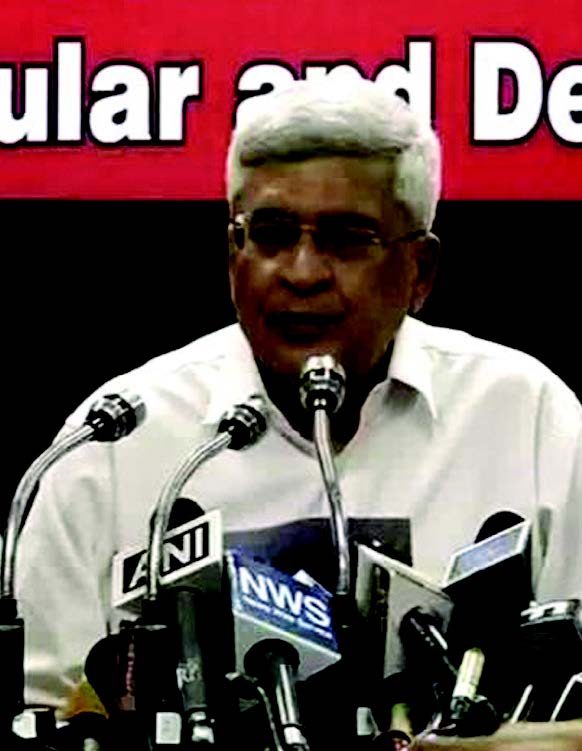
    Despite the desertion by key partners of Third Front, the CPM has not lost hope of cobbling up an alliance after the elections. Releasing the manifesto, party general secretary Prakash Karat said efforts would be made to form a non-Congress, non-BJP government after the results. “We (Left and regional parties) have decided to fight both Congress and BJP. We are going together…We are working to maximise our strengths and seats in respective states or areas of strength. A concrete shape will emerge after the elections,” Karat said.

    The CPM manifesto is high on a secular democratic alternative. Karat said, “We will pool in our resources and strengths after the elections…that is going to happen.” He also insisted that CPM or any constituent never called the 11-party alliance ‘Third Front. “Our coming together was not predicated on any alliance with each other,” he said. Karat also dismissed the viability of a federal front’, an idea floated by Mamata Banerjee. “Without Left no alternative is possible.” CPM general secretary said the left parties would contest about 100 seats across the country.

    He said there will be no impact on Left Front’s fortune in Kerala after the state unit of Revolutionary Socialist Party crossed over to Congress-led United Democratic Front. Taking on both Congress and BJP for turning the election into a personality battle, Karat said, “It is clear that the elections are being projected as a battle between certain leaders or personalities but devoid of major issues and policies afflicting the people.” While he criticized the Congress for its misrule, price rise, corruption and scams, BJP, Karat said, is “not only not an alternative to Congress, but a retrograde and reactionary alternative.”

    He said BJP is as corrupt as Congress. Party’s manifesto promises to reverse the deregulation of petroleum products, ban futures trade in agricultural commodities, enlarge resource base by taxing the rich and corporate profits; crackdown on tax evaders, black money and money laundering. Karat said party is not happy with the Food Security Act and promised to bring a new law which will be based on universal public distribution system. CPM manifesto also says there should be devolution of 50 per cent of the total collection of central taxes to states and transferring of centrally sponsored schemes under state subjects with funds to the Centre.

  • Muslim Vote Bank

    Muslim Vote Bank

    Isee positive things happening in India, and it is good. An increasing number of Muslims are contesting elections as Indians – and not as a Muslims. This is a positive movement of inclusiveness on the part of Muslims.

    This is a clear and rightful distinction, indeed, no one, be it Hindu, Muslim, Sikh or other should be voted in if he or she represents his or her own community – every elected representative represents his constituency and not religion.

    My friend Dr. Javed Jamil wrote in response to Kejriwal comment that Muslims have lend themselves as a vote bank, he says, “The truth on the other hand is that Muslims have failed to become “Vote Banks”. If they had succeeded in becoming vote banks, they would have by now got what they deserve.”

    One the other hand I advocate against becoming vote banks, be it Muslim, Hindu, Dalit, Sikh, Christian or others. It is not good for India. We need to break the stereotyping – that Muslims vote as a block, which is sheer nonsense. Muslims vote for the candidate who is inclusive and cares for them as much as he or she cares for fellow Indians.

    The argument that several Members of BJP run on exclusive interests of Hindus is true, but it is not good for India -because they do it, we have to do it logic is wrong. We have to rise above, we have to be better than the exclusive people and show them the right path of inclusiveness.

    It will take time, what have we done in the last six decades? Let Muslims run against Advani, Joshi, Modi, Rahul, Kejriwal and others as Indians with a determination to represent every resident – reach them out, even if some Hindu is resentful, reach them, the power of justness and caring is far more powerful than the agenda of duping the public with promises to build temples or mosques. A handful of Muslims will make a lot of noise, just like a handful of Hindus do, let them.

    One should be daring and say – I am running as an Indian from this constituency to represent all residents. I am not running as a Muslim. I will be fair and equitable to every citizen. If Muslims, Dalits, Brahmins or others are disadvantaged, I will give attention to their issue, but I will never represent any one community exclusively, as I am an Indian and my public service is for every Indian.

    From this day forward, if you find me cater to the interests of one community over the other, I will withdraw from public service. We have lost six decades, let’s take this approach and start getting ready for THE next elections – start taking initiative and see how we cannot change an India that cares for every one’s development without tearing into its cohesiveness. We can do it, all of us Indians together. Jai Hind, Mike Ghouse