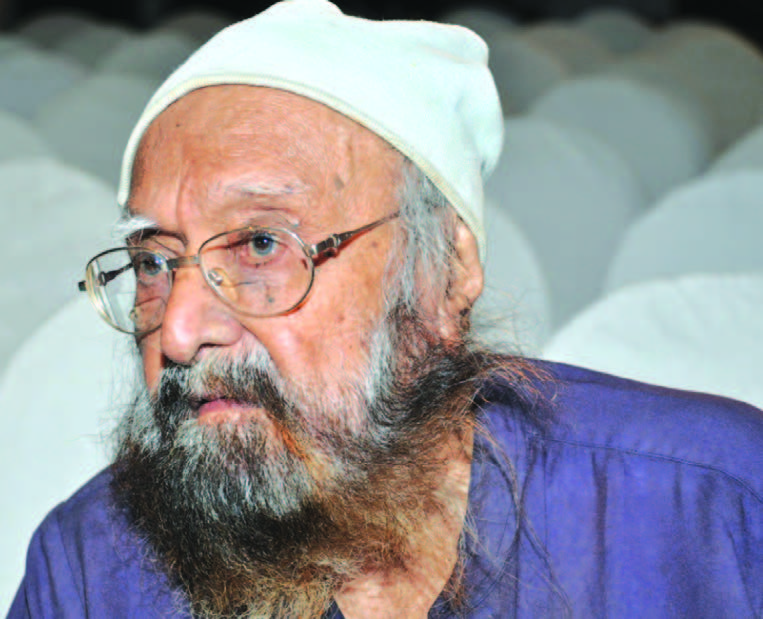
Tag: BJP

  • Khushwant Singh dies at 99

    Khushwant Singh dies at 99

    NEW DELHI (TIP): Writer, historian and columnist Khushwant Singh died of cardiac arrest at his residence here on March 20 morning. He was 99. The mortal remains of Singh were consigned to the flames later in afternoon, but not before the family donated his eyes as per his wish.

    The renowned journalist’s son, Rahul, said he was perfectly fine in the morning and “had his favourite malt whisky, his first meal of the day.” Condoling his death, President Pranab Mukherjee described Singh as a “fearless intellectual.” Prime Minister Manmohan Singh described the journalist as a “gifted author, candid commentator and a dear friend who lived a truly creative life.”

    He went in complete peace, says son Well known author and journalist Khushwant Singh was perfectly fine until he died of cardiac arrest on March 20 morning. “He was perfectly all right except that he was complaining of some breathing trouble for the last two days and he had started sleeping a bit more of late. Today he got up at his usual time at 4 a.m. and at 7 a.m. had his favourite malt whisky, his first meal of the day.

    Till the end he was solving the crossword puzzle as he was very fond of it. He read newspapers as usual. His mental faculties were perfect. He went exactly the way he wanted to; in complete peace and in the presence of his close ones in the family,” son Rahul Singh said. The renowned journalist’s death was announced by his son at 12.50 p.m. His immediate family members, including his two cousin sisters, granddaughter Naina Singh, his staff of six people, including his old secretary and typist and his tailor Samiuddin were the first to reach the house on hearing the news.

    Others who rushed there were his close friends and seasoned journalists Prem Shankar Jha and M.J. Akbar, painter Arpana Caur and her mother, eminent Punjabi writer Ajeet Caur. Prime Minister Manmohan Singh and Congress president Sonia Gandhi were among those who paid their respects at Mr. Singh’s residence. A number of media personalities and Mr. Singh’s long-time associates also paid their respects. Among them were columnist Kuldip Nayar, Justice Leela Seth, author Vikram Seth, Sadia Dehlvi, Planning Commission member Syeda S. Hameed, Justice Shahbuddin Ahmad, cricketer Bishan Singh Bedi and socialite Bina Ramani.

    “His death should not be mourned, it should be celebrated as he lived his life on his conditions and went with his head held high,” Mr. Bedi said. Around 4.10 p.m., the body was taken to the crematorium where Union Ministers Salman Khurshid and Farooq Abdullah, senior BJP leader L.K. Advani, former Chief Election Commissioner M.S. Gill, jurist Soli Sorabjee, former Union Minister and journalist Arun Shourie were among those present.

  • Indian Americans ensure a full house at FICCI FRAMES 2014 in Mumbai

    Indian Americans ensure a full house at FICCI FRAMES 2014 in Mumbai

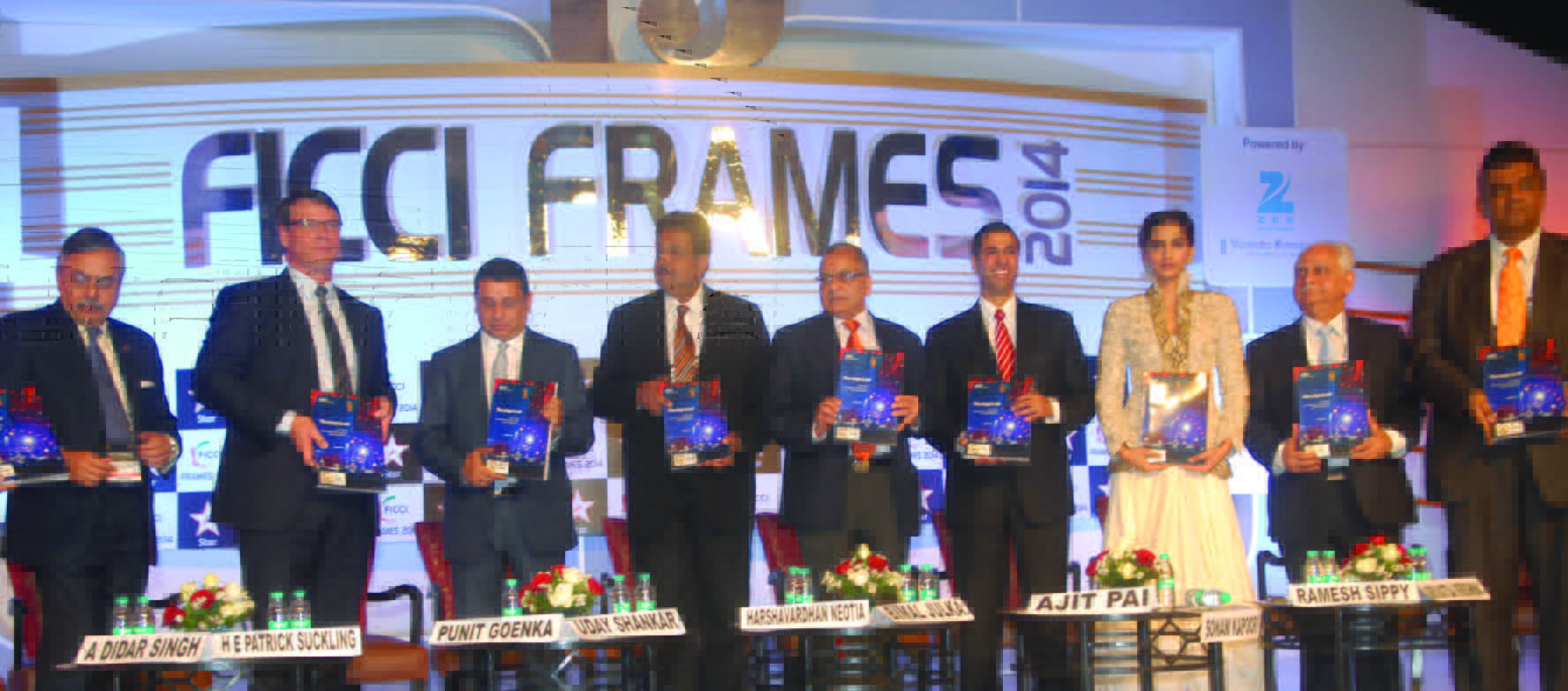
    The 15th Annual FICCI FRAMES conference on the Media & Entertainment (M&E) industry is back at the Rennaissance Hotel & Convention Centre situated on the picturesque Powai Lake in Mumbai. It’s Wednesday, March 12th 2014; Day 1 of the event, and the Indian American community is here again in full strength; veterans from the media business, aspirants in the field of entertainment, panelists, delegates, you name it, the conference has them all.

    About FICCI FRAMES 2014
    FICCI FRAMES is Asia’s largest global conference on the business of Media and Entertainment. Spanning three days, the conference covers the entire spectrum of the M&E industry, with back-to-back presentation sessions, panel discussions & master-classes focused on microspecializations such as film, television, radio, print, internet/digital media, animation and gaming among others. This highly-anticipated & most-respected industry event currently draws over 2,500 participants from all over the world, with India & USA together accounting for over 80% of the attendees.

    The list of known names at the conference reads like a virtual Who’s Who of the global M&E industry. Attendees get to rub shoulders and interact one-on-one with top achievers in the business; for 2014, the list of presenters & panelists boasts (in alphabetical order of first name) Abhay Deol, Abhishek Bachchan, Anupam Kher, Arnab Goswami, Ajit Pai, Andy Paterson, Collin Burrows, Farhan Akhtar, Guneet Monga, Hiromichi Masuda, Javed Akhtar, Jim Egan, Kajol, Kazutaka Akimoto, Kirron Kher, Lakshmi Praturi, Mark Eyers, Michael Best, Nancy Silberkleit, Priyanka Chopra, Punit Goenka, Rajeev Masand, Rakeysh Omprakash Mehra, Ramesh Sippy, Roger Fisk, Sanjay Gupta, Shanker Tucker, Siddharth Roy Kapur, Sonam Kapoor, Shaan, Sudhanshu Vats, Sudhir Mishra, Stuart Haskayne, Stuart Sender, Uday Shankar and Vikram Chandra, to name a few.

    Day 1 of the event saw the inauguration by actress Sonam Kapoor lighting the ceremonial lamp. This was followed by the welcome address from Harshavardhan Neotia, Vice President, FICCI. Harshvardhan highlighted critical developments within the M&E industry over the past 15 years. He spoke about the digitization of cable television, privatization of FM radio, clarifications in GST, introduction of a single window clearance system and future trends such as FDI in media, the mobile internet and simplification of policies. He ended his address by emphasizing the role of media in corporate governance and social responsibility. This was followed by opening remarks from Uday Shankar, Chairman, FICCI and also CEO, Star India.

    He discussed the role of government in the industry. Uday stated that government and the media needed to work together to sustain the vibrancy of the industry. He stressed that media’s role has evolved from mere reporting to seeking accountability & transparency from elected office-bearers of the nation. He also touched upon obstacles faced by the media when it published or broadcast coverage critical of the government of the day. He ended with the hope that the new government elected in May 2014 would look at media as a partner and not as an adversary. Punit Goenka, CEO, Zee Entertainment delivered the theme address next. He was followed by the vision statement from Bimal Julka, Secretary, Ministry of Information & Broadcasting.

    Bimal dwelt on the importance of censorship in the Indian media. Srivatsa Krishna, Secretary, Government of Karnataka (partner state for FRAMES 2014) was next; he emphasized the various initiatives being undertaken by his government in the field of media & entertainment. Finally, it was the turn of Ajit Pai, the dynamic young Commissioner of the FCC, USA (Federal Communications Commission). A second-generation Indian American, he shared insights about the role of FCC in America and the way in which the American government facilitates innovation within the M&E industry. He provided instances of successful partnerships between the government and key players from within the private sector in USA, which helps in enabling worldclass infrastructure for the industry. His address was very well-received by the audience.

    The FCC is an independent agency of the United States government, created by Congressional statute to regulate interstate and international communications by radio, television, wire, satellite, and cable in all 50 states, DC and US territories. The FICCI-KPMG 2014 report on the Indian Media & Entertainment industry was officially released after Ajit’s address; the highlight of this report is the growth registered by various disciplines within the industry. This inaugural session was followed by a series of presentations, panel discussions & master-classes. Detailed coverage of these sessions along with interviews of key presenters & panelists will be provided at the end of the conference.

    The list of media corporations at this year’s convention includes Archie Comics, BBC, Bloomberg, CNN IBN, Discovery Networks, Disney India, Fox Star Studios, Google, India Today, INK Salon, Microsoft, NBA, NDTV, Reliance Entertainment, Sony, Star India, Shochiku (Japan), Times Now, Turner International, TV France, Viacom18 and Zee Entertainment. The convention also features government bodies or political organizations such as the Australian High Commission (partner country for FRAMES 2014), BJP, CBFC, FCC (USA), INC, Ministry of Information & Broadcasting (India) and Obama’s Presidential Campaign Team for 2008 & 2012. Finally, there are a number of M&Ecentric corporations with booths at the event, looking to showcase a wide range of industry tools & accessories such as filmmaking & broadcasting equipment, studio apparatus, animation tools, software solutions & related technology.

    About FICCI
    Established in 1927, FICCI (Federation of Indian Chambers of Commerce & Industry) is the largest and oldest apex business organization in India. FICCI’s history is closely interwoven with India’s struggle for independence and subsequent emergence as one of the most rapidly growing economies globally. FICCI plays a leading role in policy debates that are at the forefront of social, economic and political change. A non-government, not-for-profit organization, FICCI is viewed as one of the major voices of India’s business and industry.

    It works closely with the government on policy issues, enhancing efficiency, competitiveness and expanding business opportunities for industry through a range of specialized services and global linkages. Partnerships with countries across the world carry forward it’s initiatives in inclusive development, which encompass critical issues such as health, education, livelihood, governance & skill development. Through its dedicated team of over 400 professionals, FICCI is active in 38 sectors of the global economy. FICCI’s stand on policy issues is sought out by think tanks, governments across the world and academia; it has joint business councils with 79 nations.

    Its publications are widely read for their in-depth research and policy prescriptions. FICCI’S Entertainment Division serves as the vital link between the Media & Entertainment industry, the Ministry for Information & Broadcasting (India) and global players. In addition to organizing FICCI FRAMES annually, this division conducts & releases pioneering studies related to the industry, assists in policy decisions and helps in scaling up the industry through various initiatives. The division is currently headed by Uday Shankar (Chairman) and Ramesh Sippy (Co-chairman).

  • JD-U to field filmmaker Prakash Jha in LS polls

    JD-U to field filmmaker Prakash Jha in LS polls

    PATNA (TIP): Filmmaker Prakash Jha will contest the Lok Sabha election from Bettiah parliamentary constituency in Bihar on a Janata Dal-United ticket, state JD-U president Vashisht Narain Singh said.

    Jha’s name figured in the first list of four candidates released by the JD-U for the general elections. Chief Minister Nitish Kumar announced Jha’s candidature for the polls Thursday during his Sankalp Yatra in East Champaran district, Singh said. The party has decided to field Jha, a native of a village near Bettiah, keeping in view the caste equation on the ground.

    Jha contested and lost the 2009 Lok Sabha election, but is hopeful of wooing voters of all sections, particularly Muslims, this time. He fought on a Lok Janshakti Party ticket in 2009. The filmmaker has been campaigning in the state, particularly in Bettiah, for nearly a month and addressed a public meeting Thursday along with the chief minister.

    Jha also staged a dharna with Nitish Kumar in a protest over the denial of special category status to Bihar March 2 in Patna. He announced he would soon make a film on the subject. Jha is known for making films like “Gangaajal”, “Apaharan”, “Raajneeti”, “Satyagraha” and “Aarakhshan”. A suspended BJP legislator, Avanish Kumar Singh also figured in the JD-U’s first list. Singh, who formally joined the JD-U, will contest the Lok Sabha election from East Champaran constituency.

  • Himachal MP in cash-on-camera case

    Himachal MP in cash-on-camera case

    SHIMLA (TIP):
    The Himachal Pradesh Vigilance and Anti-Corruption Bureau on March 6 booked sitting BJP MP Virender Kashyap, who was allegedly caught accepting cash on camera. The case against the MP was registered under Section 9 of the Prevention of Corruption Act in Shimla. The party has retained the one-time MP from the Shimla (reserved) seat.

    “The case was registered after the authenticity of the video CD was proved by the Central Forensic Science Laboratory of Chandigarh,” said the investigating official. In November, the Himachal Pradesh high court had issued a notice to Kashyap on a petition for quashing a police inquiry report giving a clean chit to him after he was allegedly caught accepting cash.

  • Ready to contest polls: VK Singh

    Ready to contest polls: VK Singh

    NEW DELHI (TIP):
    Former Army chief General V K Singh, who joined the BJP recently, said he was ready to fight the coming Lok Sabha elections, even as he came down heavily on the UPA government, especially the Congress, for allegedly neglecting the military. “Let me make a statement, so far as the armed forces are concerned, Congress party has not been a good party. It has not been a good party because a lot of things which the forces wanted, whether it was the commissions, whether it was the way the equipment should have been done, whether it was the protocols, Congress party has always tried to be against the forces if I can say so,” Gen Singh told a TV channel.

    In an unprecedented move, Gen Singh, when he was the Army chief, dragged the UPA government to Supreme Court claiming that he was born in 1951 and not in 1950 as the official records showed. The former chief withdrew the petition, amid a noticeable breakdown in his relations with the political establishment. Justifying his decision to join BJP, Gen Singh said, “See, if you look at the wide range of issues I started on right after retirement, some things appear as being close to BJP because they were pointing out faults with the existing system.” He said he joined the BJP not because of any assurance. “I am in the party because I was convinced by myself that I should join a political platform,” he said.

  • POLICE QUIZ AAP’S ASHUTOSH, SHAZIA

    POLICE QUIZ AAP’S ASHUTOSH, SHAZIA

    NEW DELHI (TIP):
    The BJP-AAP confrontation escalated on March 6 with the BJP accusing its opponent of waging a surrogate battle on behalf of the Congress that wanted to deflect focus from allegations of corruption and scams. Adding to the political attack, the police questioned senior AAP leaders Shazia Ilmi and Ashutosh and party workers after they were named in an FIR and accused of instigating violence outside the BJP headquarters on Wednesday.

    It promised to take action if “sufficient” evidence was found against them. Both Aushtosh and Ilmi were among 14 named in the FIR. They were charged with obstructing a public servant from doing his duty, unlawful assembly and under the Prevention of Damage to Public Property. “We found that prima facie, these 14 persons were part of unlawful assembly and indulged in violence,” a police officer said. The BJP moved the Election Commission demanding strict action — including de-recognition — against the fledgling party. AAP, too,moved the EC calling for an independent probe into the matter and alleged intimidation of its volunteers and members by the BJP.

    Soon after approaching the Election Commission, BJP spokesperson Meenakshi Lekhi said: “AAP happens to be the latest goon squad hired by the Congress’ dirty tricks department. A minor issue with Kejriwal in Gujarat has been blown up as if it impacts national security.Why? Simply because the practised deception of Congress is to create a diversion each time one of its scams starts unravelling. AAP is not a threat to the BJP or Modi. They are not even a national party of consequence. Everything about them is murky, including their funding sources.” Lekhi sought to draw attention to a statement made by an AAP council member suspecting the source of the party’s foreign funding. She also likened the tactics of the AAP with those adopted by Maoists in the country.

  • AAP-BJP clashes- Police failure, bias to the fore

    AAP-BJP clashes- Police failure, bias to the fore

    Almost every newspaper headline on March 6 said the same thing: “Kejriwal’s detention sparks AAP-BJP clashes”. The media, including TV channels, focused on three things: the detention of Arvind Kejriwal and attack on his car in Gujarat; AAP workers’ protests outside the BJP offices in Delhi and elsewhere leading to violent clashes.

    In Delhi 13 AAP activists and 10 BJP supporters were injured. Jhansi, Kanpur and Allahabad also witnessed a similar backlash. This was the day when the Election Commission announced the Lok Sabha poll schedule. It is an ominous beginning. Violence in any form by anyone is unacceptable.

    Arvind Kejriwal’s Gujarat visit would not have attracted the media attention that it did had the Gujarat police not detained his cavalcade. There were protests against his visit to Narendra Modi’s home state and his car was attacked.

    Why was no police protection provided to the former Chief Minister of Delhi? Yet the detention and the attack gave AAP workers no right to resort to protests, that too violent, without prior permission of the authorities when the code of conduct had come into force. The police in Delhi, Lucknow and elsewhere waited for clashes to happen before taking action.

    Why were the workers allowed to gather outside the centrally located BJP office in Delhi? Finally, since the clashes involved workers of both parties, why did the police single out AAP workers for registering cases of rioting and damage to public property against them? Obviously, the police in Delhi, Uttar Pradesh and Gujarat have a lot to answer.

    In the war of words that followed Wednesday’s developments BJP spokespersons were all full of sound and fury, while Arvind Kejriwal, a cool-headed master media strategist, apologized and asked his party workers to maintain calm. Narendra Modi, who is still the Chief Minister of Gujarat, has preferred to keep quiet. Perhaps, he does not want to involve himself in a slanging match with a challenger he calls too small to matter.

  • Paswan, BJP seal deal, change Bihar equations

    Paswan, BJP seal deal, change Bihar equations

    NEW DELHI (TIP): BJP and LJP leader Ram Vilas Paswan sealed a seat-sharing pact in Bihar that will see Paswan’s group contesting seven Lok Sabha seats, a development that marks the much-travelled politician’s return to the NDA-fold. Paswan surfaced on February 26 after keeping Congress, RJD and BJP on tenterhooks for the last few days and announced that his options are open.

    “Opinion in LJP is not against going with BJP. In our party’s interests we need to take tough decisions,” he said. The nitty gritty of the pact saw Paswan agree to contest on seats that are not currently being held by the BJP. The decision is bound to cause heart burn among BJP hopefuls, but the party is pleased with the bargain. Paswan is seen to command the loyalty of a dalit community that is assertive and can add three-four per cent votes to BJP’s base that includes upper castes and some middle castes as well. Paswan prepared the ground for breaking with Congress and RJD by saying he was made a measly offer of a few seats.

    But his decision to make up with BJP after having quit the NDA cabinet over the Gujarat 2002 riots seems driven by the assessment that saffron PM hopefulNarendra Modi is gaining traction in Bihar. Paswan’s switch helps BJP counter criticism that Modi’s projection as PM has isolated the party as sources point to Asom Gana Parishad leader Prafulla Mahanta’s statement on February 26 that he does not rule in or rule out a tie-up with BJP. Mahanta along with BJD leader Naveen Patnaik stayed away from a third front inaugural on Tuesday and the Odisha CM’s posture is seen to reflect a convergence with BJP on seeing Congress as the common enemy.

    “There is no seat sharing with BJD, but we can work in our own ways to contain Congress,” said a BJP leader about the Odisha scene. BJP leaders feel the party has a satisfactory understanding with Paswan, and talks have centred around the need to select “clean” candidates. Though CBI is threatening to question Paswan in an appointments scam, the process will not be complete until the elections. In Tamil Nadu, BJP is striving to stitch up an alliance with smaller parties like PMK and DMDK besides MDMK leader Vaiko who is already in NDA. Paswan’s return is significant as he had quit the NDA over the Gujarat 2002 riots, although he was also unhappy over being removed from the telecom ministry when he was in the Vajpayee government.

    A party leader close to Paswan said, “We have reached an understanding but have had to cede the choice to BJP. It’s a last minute alliance and BJP has already finalised candidates for more seats. We did not have much room to negotiate on the choice of seats. But we are not disappointed, the allocation is respectable.” Sources, however, said there is an agreement on LJP contesting from Vaishali, Hajipur, Jamui, Samastipur and Khagaria. Paswan’s son Chirag who is also the chairman of party’s Parliamentary board, said, “LJP Parliamentary Board has passed a resolution that all steps, even if they are strong ones, should be taken in the interest of the party and if an alternative alliance is to be firmed up, party chief Ram Vilas Paswan should take the decision.”

    Party leaders harped on the fact that the BJP alliance has come about because of Congress and RJD not giving the respect LJP deserved. Ram Vilas Paswan said :”We had our grievances with RJD for a long time. I had even gone to meet Lalu Prasad in jail. But soon after he was out, RJD leaders started saying LJP should be given three seats. That is why we left to Congress to decide the seat sharing. I waited for months, but there was no decision. “They assumed that LJP is nothing, it is irrelevant. If one takes 25 seats (RJD) and the other 15 (Cong). It means they do not treat LJP as part of the alliance…. That is why the party has authorised me to explore new alternative,” he said. With BJP also having tied up with a Kushwaha community leader Upendra Kushwaha, the party confirmed that it will give away three seats to them. The three likely seats are Jehanabad, Seohar and Sitamarhi Lok Sabha seats.

  • BJP DECLARES 54 LOK SABHA CANDIDATES

    BJP DECLARES 54 LOK SABHA CANDIDATES

    NEW DELHI (TIP): The Bharatiya Janata Party (BJP) Thursday announced its first list of 54 candidates for the Lok Sabha elections and fielded former party president Nitin Gadkari from Nagpur. The list was announced after a meeting of the party’s central election committee.

    It includes candidates for Jammu and Kashmir, Arunchal Pradesh, Goa, Manipur, West Bengal, Odisha, Maharashtra and Himachal Pradesh and has several sitting and former parliamentarians. Former union minister Shanta Kumar has been fielded from Kangra in Himachal Pradesh while Anurag Thakur, president of Bharatiya Janata Yuva Morcha, has been retained as candidate from Hamirpur.

    In Jammu and Kashmir, the BJP fielded state chief Jugal Kishore Sharma from Jammu and state spokesman Jitender Singh from Udhampur. Other candidates from Jammu and Kashmir include Thunpsthan Chhweang (Ladakh), Mushtaq Ahmad Malik (Anantnag) and G.M. Meer (Baramulla). The BJP declared 17 candidates from West Bengal, including former lawmaker Tapan Sikadar (Dum Dum), state party president Rahul Sinha (Kolkata Uttar), and magician P.C. Sorcar Jr. (Barasat).

    Apart from Gadkari, 17 candidates declared from Maharashtra include sitting parliamentarians Gopinath Munde (Beed), Hansraj Ahir (Chandrapur), Dilip Gandhi (Ahmadnagar) and former MP Kirit Somaiya (Mumbai North East). The party fielded former lawmaker Kiren Rijiju from Arunachal West and another former parliamentarian Tapir Gao from Arunachal East. Shripad Y. Naik was retained from North Goa and Narendra K. Sawaikar has been fielded from South Goa. In Odisha, the BJP has fielded Jual Oram from Sundargarh and Sangeeta Kumari Singh Deo from Bolangir. The party declared six candidates from Odisha. The party retained Virender Kashyap as its candidate from Shimla.

  • Dragnet Nation’, by Pulitzer Prize Winner Julia Angwin – Be Warned About Dangers of PCs / Mobile Phones Being Hacked

    Dragnet Nation’, by Pulitzer Prize Winner Julia Angwin – Be Warned About Dangers of PCs / Mobile Phones Being Hacked

    While driving back from Long Island on Monday, February 24, I listened to an absolutely fascinating interview of Pulitzer Prize winning journalist Julia Angwin, author of Dragnet Nation, on the issue of privacy and cyber crime.

    I was amazed at how easy it is for your personal financial information to stolen if you use mobile phones for your banking transactions – in particular if you use the Android operating system. There was a program on TV recently which showed how your laptop or mobile phone could be hacked within 15 seconds of your activating it in Sochi for the Olympic Games.

    Certain hi-tech global firms (and I worked for one such) instruct their consultants / executives going to China / Hong Kong / Russia / Eastern Europe to only carry essential information on a separate PC. Once back in the US these are to be trashed or the drives completely reformatted – the danger of worms and viruses is so great that the danger of contamination is not worth it. BTW those in the US need not be ‘holier than thou either’.

    When the People’s Republic of China ordered a Boeing transport for their President, Boeing based in the good old US of A sent the order with so many bugs pre-installed that the Chinese trashed the plane after discovering hundreds of them. Now we in India buying defense hardware from either the US or the Soviet bloc should be fully aware that it is possible that in the era of cyber warfare the sellers can render them non-functional anytime, if they want to.

    I hope our Italian barmaid’s Congress Party government in India is doing something about it. When Narendra Modi becomes Prime Minister, let us hope that he brings in some top flight IT cyber crime expert ‘ethical hacker’ types to assist him. The BJP is largely known (ahem!) for good solid Hindutva bhaiyya types of limited education and not for techno nerds of Silicon Valley.

  • Paswan, BJP seal deal, change Bihar equations

    Paswan, BJP seal deal, change Bihar equations

    NEW DELHI (TIP): BJP and LJP leader Ram Vilas Paswan sealed a seat-sharing pact in Bihar that will see Paswan’s group contesting seven Lok Sabha seats, a development that marks the much-travelled politician’s return to the NDA-fold. Paswan surfaced on February 26 after keeping Congress, RJD and BJP on tenterhooks for the last few days and announced that his options are open.

    “Opinion in LJP is not against going with BJP. In our party’s interests we need to take tough decisions,” he said. The nitty gritty of the pact saw Paswan agree to contest on seats that are not currently being held by the BJP. The decision is bound to cause heart burn among BJP hopefuls, but the party is pleased with the bargain. Paswan is seen to command the loyalty of a dalit community that is assertive and can add three-four per cent votes to BJP’s base that includes upper castes and some middle castes as well. Paswan prepared the ground for breaking with Congress and RJD by saying he was made a measly offer of a few seats.

    But his decision to make up with BJP after having quit the NDA cabinet over the Gujarat 2002 riots seems driven by the assessment that saffron PM hopefulNarendra Modi is gaining traction in Bihar. Paswan’s switch helps BJP counter criticism that Modi’s projection as PM has isolated the party as sources point to Asom Gana Parishad leader Prafulla Mahanta’s statement on February 26 that he does not rule in or rule out a tie-up with BJP.

    Mahanta along with BJD leader Naveen Patnaik stayed away from a third front inaugural on Tuesday and the Odisha CM’s posture is seen to reflect a convergence with BJP on seeing Congress as the common enemy. “There is no seat sharing with BJD, but we can work in our own ways to contain Congress,” said a BJP leader about the Odisha scene. BJP leaders feel the party has a satisfactory understanding with Paswan, and talks have centred around the need to select “clean” candidates.

    Though CBI is threatening to question Paswan in an appointments scam, the process will not be complete until the elections. In Tamil Nadu, BJP is striving to stitch up an alliance with smaller parties like PMK and DMDK besides MDMK leader Vaiko who is already in NDA. Paswan’s return is significant as he had quit the NDA over the Gujarat 2002 riots, although he was also unhappy over being removed from the telecom ministry when he was in the Vajpayee government.

    A party leader close to Paswan said, “We have reached an understanding but have had to cede the choice to BJP. It’s a last minute alliance and BJP has already finalised candidates for more seats. We did not have much room to negotiate on the choice of seats. But we are not disappointed, the allocation is respectable.” Sources, however, said there is an agreement on LJP contesting from Vaishali, Hajipur, Jamui, Samastipur and Khagaria.

    Paswan’s son Chirag who is also the chairman of party’s Parliamentary board, said, “LJP Parliamentary Board has passed a resolution that all steps, even if they are strong ones, should be taken in the interest of the party and if an alternative alliance is to be firmed up, party chief Ram Vilas Paswan should take the decision.” Party leaders harped on the fact that the BJP alliance has come about because of Congress and RJD not giving the respect LJP deserved.

    Ram Vilas Paswan said :”We had our grievances with RJD for a long time. I had even gone to meet Lalu Prasad in jail. But soon after he was out, RJD leaders started saying LJP should be given three seats. That is why we left to Congress to decide the seat sharing. I waited for months, but there was no decision. “They assumed that LJP is nothing, it is irrelevant. If one takes 25 seats (RJD) and the other 15 (Cong). It means they do not treat LJP as part of the alliance….

    That is why the party has authorised me to explore new alternative,” he said. With BJP also having tied up with a Kushwaha community leader Upendra Kushwaha, the party confirmed that it will give away three seats to them. The three likely seats are Jehanabad, Seohar and Sitamarhi Lok Sabha seats.

  • Strong Indian American challenge in US Congressional election in Silicon Valley

    Strong Indian American challenge in US Congressional election in Silicon Valley

    SAN JOSE (TIP): US Congressional election in Silicon Valley this year was being seen as a two-person race between incumbent Congressman Mike Honda (Democrat) and his main challenger Rohit “Ro” Khanna (Democrat) until recently. It all changed when Dr. Vanilla Mathur Singh (Republican), a member of Hindu American Foundation (HAF), entered the race in December 2013.

    The HAF first made headlines in 2005 with its failed attempt in California state to “improve 6th grade textbooks so that these books actually reflect their (Hindu) beliefs and their religious practices.” Media reports indicate that Singh was recruited to run by Shalabh “Shalli” Kumar, a Chicagobased Indian-American businessman and Republican fundraiser. Kumar is the founder of a super PAC, Indian Americans for Freedom, with close ties to Hindu Nationalists. He has been lobbying members of US Congress to help rehabilitate his “idol” Narendra Modi of India’s Hindu Nationalist Bharatiya Janata Party (BJP).

    Modi has been denied US visa multiple times by the State Department because of his widely suspected role in the killing of thousands of Muslims in 2002 Gujarat riots. Singh said that she raised $100,000 in the five days after declaring her candidacy, including $25,000 of her own money. The rest, she said, came from about “20 family and friends.” Kumar’s super PAC could change the dynamics of the South Bay race if he chooses to back Singh financially. In 2002, his super PAC spent $500,000 in an unsuccessful attempt to defeat Rep. Tammy Duckworth, D-Ill., including producing an ad set to Middle Eastern music that showed the double amputee Iraq war veteran wearing a headscarf during a visit to a local Muslim community center.

    Ro Khanna, a Silicon Valley patent attorney of Indian origin, is backed by many of Silicon Valley’s top VCs and executives at Google, Facebook, Yahoo and other tech companies. Other Notables include Marc Andreessen, the Netscape cofounder; John Doerr, the venture capitalist; and Randi Zuckerberg, the chief executive of Zuckerberg Media and the sister of Mark Zuckerberg and Sean Parker, former President pf Facebook. Four months before the primary, Khanna has $1,975,000 in cash on hand, or more than triple the incumbent’s $623,000, according to campaign finance records filed last Friday as reported by the New York Times.

    Khanna supporters expect him to win to push legislation in Congress to liberalize US visas for foreign workers needed to fill Silicon Valley tech jobs. He supports raising the number of H1-B visas, keeping a lid on capital gains taxes and cracking down on patent trolls while charting a progressive agenda on most social issues. Faced with the surprise new challenge from the Hindu Right, Ro Khanna has refused to denounce Narendra Modi for fear of alienating a significant chunk of the substantial pro-BJP Indian- American voters in Silicon Valley. Mike Honda, the incumbent congressman from 17th district, is a Japanese-American who was put by the United States in an internment camp as a child during World War II.

    He has been a featured speaker at many Muslim- American events where he has spoken out for American Muslims’ civil rights since the terrorist attacks of September 11, 2001. During a 2009 keynote speech at Human Development Foundation fund-raiser that I attended, Congressman Honda said the US foreign policy should have the same goals that the HDF has in Pakistan. Drawing from his experience as a US peace corps volunteer to support education and infrastructure development in Central America in the 1960s, he proposed a similar effort in restoring US credibility in Pakistan and Afghanistan. Honda praised the US emphasis on economic aid and said he supports the 80/20 rule that General Petraeus had outlined, with 80% emphasis on the political/economic effort backed by 20% military component to fight the Taliban insurgency.

    Honda says he has been a strong advocate for the tech industry in Congress. As a member of the House Appropriations Committee, he helped get millions of dollars in funding for BART extension to San Jose, a top priority for Valley leaders, as well as federal investment in nanotechnology research. His strong backing from organized labor and veteran Democrats reflects the decades he’s spent in public service. Honda also supports an increase in H1-B visas, although he’s also expressed concerns about its potential harm to the local labor pool.

    A number of polls in 17th district so far show that Honda enjoys a healthy lead over his challenger Khanna. Honda’s lead could increase if Singh takes a significant chunk of Indian-American votes away from Khanna. In spite of a powerful tech industry funded challenge by Ro Khanna, Honda remains a favorite to win. Honda also enjoys the strong endorsement of President Obama and Democratic Party’s establishment. Singh’s entry in the race could further help Honda extend his lead and keep his seat in Congress. I intend to vote for Mike Honda based on the Congressman’s strong record of service to Silicon Valley and his unambiguous procivil rights stance

  • 29th STATE JUST A SIGNATURE AWAY

    29th STATE JUST A SIGNATURE AWAY

    Rajya Sabha approves Telangana bill amid din and chaos
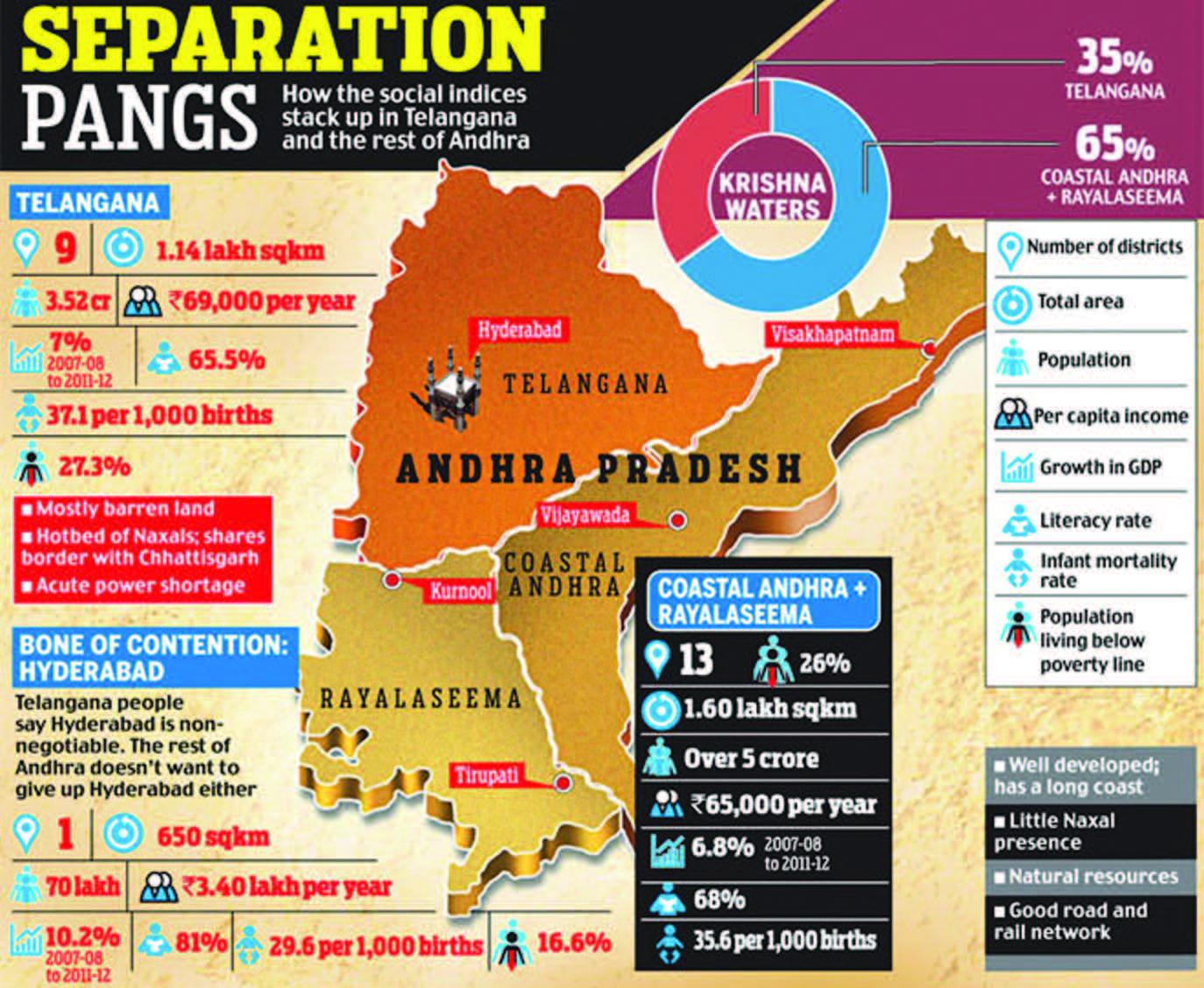
    NEW DELHI (TIP): With the Rajya Sabha putting its seal of approval on the Bill for creating Telangana amid bedlam, the birth of the 29th State of the Union is just a presidential signature away. The historic development was preceded by prolonged “labour pangs” beginning from July 30 last year, the day the Congress Working Committee (CWC) approved a resolution for bifurcation of Andhra Pradesh.

    On Feb 20, there was a great deal of anxiety about the fate of the State as the BJP, which had helped the government push through the Bill in the Lok Sabha on Tuesday, put a spanner in the works by insisting that without a Constitution amendment it faces the danger of being legally challenged. But, thanks to hectic backroom negotiations at the highest level of the government and the BJP, it was smooth sailing in the Upper House despite protests from Seemandhra MPs, who parked themselves in the Well of the House throughout the day with banners and placards.

    Prime Minister Manmohan Singh and his team of Ministers succeeded in persuading top BJP leaders not to press for a Constitution amendment, which would have complicated the process. Mr. Singh’s team convinced the BJP brass that the government was on sound legal footing on giving special powers to the Governor over safety and security of the residents of Hyderabad, which will be the joint capital for a maximum of 10 years. It was the understanding between the government and the BJP which prompted CPI(M) leader Sitaram Yechury and all others who opposed the Bill to describe it as a classic case of “match-fixing.”

    At the meeting, it was agreed that the Prime Minister would announce a package to address the concerns of the Seemandhra people as well as those in the backward regions of Telangana. Intervening in the debate in the Rajya Sabha, the Prime Minister announced that for the purposes of Central assistance, special category status would be extended to the successor state of Andhra Pradesh for five years. He said the Centre would take steps to offer tax incentives to promote industrialisation and economic growth in both States.

    In addition, a special development package for the backward regions of the successor state of Andhra Pradesh, in particular the districts of Rayalaseema and north-coastal Andhra Pradesh, will be given on the lines of the K-B-K (Koraput- Bolangir-Kalahandi) Special Plan in Odisha and the Bundelkhand special package in Madhya Pradesh and Uttar Pradesh. Speaking about the commitment of his party to creating Telangana, Leader of the Opposition Arun Jaitley expressed dismay over the manner in which the UPA had handled the entire issue. Initiating the debate, the BJP’s M. Venkaiah Naidu said: “Telangana and Andhra Pradesh are brothers and are Telugu-speaking. Telangana people want Telangana, we are saying yes… We are not dividing the country; we are only dividing a state for speedy development.” He blamed the Congress for delaying the creation of Telangana and playing “vote bank” and “opportunistic” politics.

  • Anna comes out in Mamata’s support but with a rider

    Anna comes out in Mamata’s support but with a rider

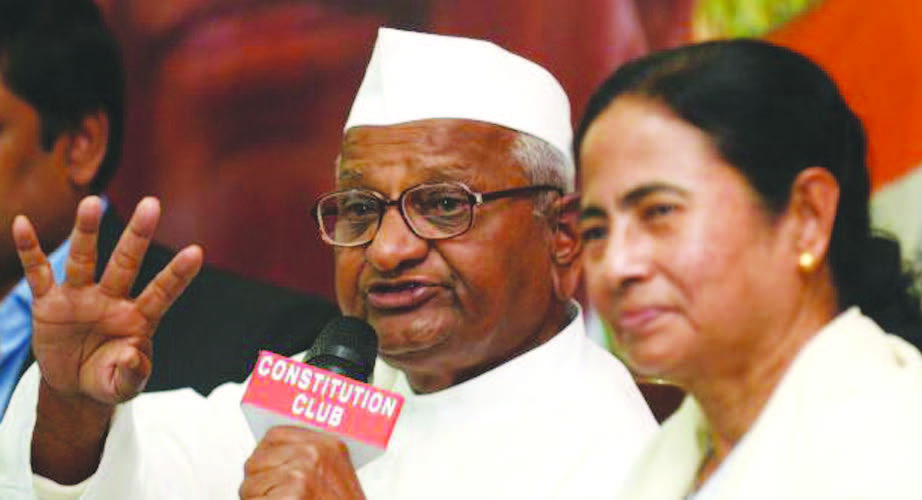
    NEW DELHI (TIP): Having fallen out with Arvind Kejriwal after he floated AAP, social activist Anna Hazare on February 19 threw his weight behind Trinamool Congress chief and West Bengal chief minister Mamata Banerjee who is eyeing a possible national role after the Lok Sabha elections.

    A day after their one-on-one meeting in the national capital, Anna and Mamata appeared together before the media to send the message of their new-found partnership. Pointing that it is for the first time that he is supporting a political leader, Hazare said he deviated from his stand after witnessing Mamata’s political struggle and simple lifestyle even as chief minister.

    “I had written a letter with my 17-point demands to all political parties but only Didi (Mamata) responded to it and agreed to implement it,” he said at the press conference where the backdrop read “sadgi, sachai, imaandari (simplicity, truthfulness and honesty).” But Hazare had a rider. He said his support to the TMC chief was limited to the few months of campaigning in the run-up to the polls and would end after the polls are over.

    Hazare mentioned that he had also written to Kejriwal about his 17-point agenda, but the APP leader he did not bother to reply to it. He said everybody talks of “regime change”, but that will not change the state of the nation for the better which can happen only through “systemic change”. Hazare was not short of words of praise for the TMC chief, saying she has the integrity of character to bring about a systemic change. “So, I thought of supporting a political leader for once,” he said.

    The anti-graft activist said he will be going around the country for the next five years to find at least 100 independent candidates with integrity of character for the 2019 Lok Sabha elections. “A hundred good people in Parliament can make a difference and bring about a change in the system that I am talking about,” he said.

    On her part, Mamata declared that she would consult Hazare on contestants from north and south Indian states including Delhi. The 17-point agenda that Hazare took up included legislations like protection to whistle-blowers and demand to make government decisions taken in all matters, except defence and foreign affairs, public after two months to bring in more transparency. His other demands include making villages as the nucleus before chalking out policies, land acquisition with farmers’ consent, major electoral changes like Right to Recall and Right to Reject and bringing back black money among other things. When asked whether he would oppose Kejriwal and BJP’s Prime Ministerial candidate Narendra Modi, Hazare said he would neither support nor oppose them.

  • ANDHRA MAY BE PUT UNDER CENTRAL RULE

    ANDHRA MAY BE PUT UNDER CENTRAL RULE

    NEW DELHI (TIP): Andhra Pradesh is likely to be put under President’s rule amid indications that a decision to this effect may be taken in the next couple of days. The state has been without a full-scale government after CM Kiran Reddy resigned on February 19 to protest against the passage of the Telangana bill in Lok Sabha.

    Sources, however, said it was clear that elections to new assemblies of Telangana and Andhra Pradesh may not be held along with Lok Sabha polls in May. The term of the assembly of undivided Andhra Pradesh runs out with that of the current Lok Sabha. But the fact that the House has now been split into two new assemblies — 175-strong one for Andhra Pradesh and a separate one with 119 for Telangana — may give the Centre and the Election Commission latitude to delay elections.

    The leeway may suit Congress which has to work out the modalities of alliance, even a merger with Telangana Rasthra Samithi. The two parties hope to sweep the 17 Lok Sabha seats in the Telangana region, arguably the sole driver for Centre getting into overdrive to partition AP after years of wavering and shuffling. Political circles estimate that Congress may be able to persuade TRS boss K Chandrasekhar Rao to leave the overwhelming majority of LS seats in exchange for a higher share of assembly seats for the Telangana outfit.

    Congress is still debating the pros and cons of a merger with TRS, with a strong school in the party feeling that the presence of a friendly Chandrasekhar Rao as an independent figure may help splinter the anti-incumbency sentiment. Having been okayed by the two Houses, the bill will be sent by the home ministry to President Pranab Mukherjee for his assent. The presidential go-ahead will clear the way for a notification in the Gazette of India about the birth of Telangana as the 29th state of the Union. The gazette notification will also mention the day on which Telangana will be deemed to be born.

    Cong, BJP sealed Telangana deal on Feb 19
    A deal on the Telangana bill was sealed late on February 19 evening with Congress troubleshooters agreeing to BJP’s demand that the government make a specific commitment on Seemandhra’s postpartition revenue deficit. Congress finalized its Telangana strategy after party managers knocked all unviable options like sending the Andhra Pradesh Reorganization Bill back to Lok Sabha with amendments spelling out guarantees for Seemandhra.

    BJP leader Arun Jaitley’s insistence that investing the AP governor with powers of law and order for Hyderabad needed a constitutional amendment was a key lever in hectic backstage negotiations over the bill. Reluctant to take the bill back to Lok Sabha and aware that a constitutional amendment needs order in the House besides two-thirds majority, Congress proposed that PM Manmohan Singh could spell out the assurances. BJP leaders, too, knew that any brinksmanship would have to stop short of stalling the Telangana bill as that would prove politically unwise given the party’s longstanding commitment to the bifurcation of Andhra Pradesh.

    The saffron party felt it had reasons to feel satisfied over its crucial role in formation of Telangana while its batting for the Seemandhra cause, even at a late stage, could keep the door open for a pact with Telugu Desam Party. The PM’s declaration that Seemandhra would get special category status along with a promise to make provisions for the “successor state” of AP in the 2014-15 budget were the concessions BJP was looking for. Given Congress chief Sonia Gandhi’s backing to Telangana, her political secretary Ahmed Patel, rural development minister Jairam Ramesh and parliamentary affairs ministers Kamal Nath and Rajiv Shukla worked to seal the deal with BJP leader Jaitley and Venkaiah Naidu.

    By February 20 morning, discussions between the government and BJP narrowed to modalities to facilitate functioning of Rajya Sabha with the opposition stressing that concessions to Seemandhra be spelt out unambiguously. By afternoon, home minister Sushil Shinde was able to tell Telangana Rashtra Samithi leader K Chandrasekhar Rao that the bill would be passed despite repeated disruptions in the upper House. Unlike other Telangana MPs, Rao has been quite calm over the past few days, confident that Congress would need to deliver on Sonia’s commitment. He was also clear that BJP, despite some hard bargaining, would not renege on Telangana.

    Lawyersto challenge Telangana formation in Supreme Court
    The Supreme Court now remains the last hope for Seemandhra advocates gunning for a united Andhra Pradesh. After the Telangana Bill was passed by the Parliament on Feb 20, Seemandhra advocates are now headed for New Delhi to challenge the bifurcation decision in the apex court as soon as the Telangana Bill becomes an Act after being signed by President Pranab Mukherjee. The advocates, who will wind up their 206-day relay hunger strike for Samaikyandhra on Friday, are also hopeful of bagging a stay order from the apex court as they feel that the entire process of bifurcation was done in an unconstitutional manner.

    While some of the advocates have already left for Delhi, others are leaving this weekend as they anticipate the President to sign the Bill by early next week. Senior advocate and president of the Forum of Legal Professionals, Kuppili Muralidhar said, “We will be moving the Supreme Court once the President signs the Bill and it becomes an Act to form the state of Telangana. After President Pranab Mukherjee signs it, the government has to issue a gazette notification. Lawyers are looking to the SC as the only saviour and will file a PIL to declare the proposed AP Reorganisation Act illegal and stay further proceedings on the issue.” Meanwhile, members of Vizag Bar Association will be winding up their 206 day-long relay hunger strike on Friday, said Vizag Bar Aassociation secretary N Sanyasi Rao and convener of advocates JAC K S Suresh Kumar.

    Congress faces rout in Andhra Pradesh
    India’s newest state of Telangana is to be carved out of its first linguistically demarcated unit, but the Congress would be obliterated in Andhra Pradesh if the Lok Sabha polls were to be held now. An India Today Group-CVoter opinion poll conducted across Andhra Pradesh earlier this week reveals a near complete wipeout of the Congress. The polarisation of votes across Andhra that has marked the runup to the passage of the Telangana Bill in Parliament is so extreme that the successor states will vote overwhelmingly for one party, Telangana for Telangana Rashtra Samiti (TRS) and Seemandhra for Jaganmohan Reddy’s YSR Congress.

    The Congress, boosted into power in 2009 by the 33 Lok Sabha seats it won of the 42 in Andhra Pradesh, is projected to come up with one seat each in the two successor states. The Bharatiya Janata Party (BJP) is predicted to win one seat in Telangana and the Telugu Desam Party (TDP) is set to take six seats. The 2009 elections were no fluke. Andhra Pradesh, India’s original ricebowl state, has been a favorite hunting ground for the Congress; it took 29 seats in the 2004 elections. In other words, a Congress or Congress-led government at the Centre is more or less predicated on a good show in Andhra Pradesh.

    The India Today Group-CVoter poll has thrown up a range of interesting findings. In Seemandhara, two-thirds of the population blames the Congress for the bifurcation, while in Telangana, the TRS seems to be laughing all the way to the votebank with the credit for facilitating the creation of the new state. The Congress is simply not a major player in the rump state of Seemandhra any more. The possible alliances in to-be divided Andhra Pradesh are beginning to get complicated already. In Seemandhra, Jagan is far ahead of everyone else.

    This is more bad news for the Congress, because Jagan will not join hands with them. In Telangana, TRS is said to be soft on the Congress. In both Seemandhara and Telangana, TRS may go with the Congress. On the leadership front, the divide is as clear as the new state border that is coming up. Jagan reigns supreme in Seemandhara and K. Chandrasekhar Rao in Telangana. Chandrababu Naidu is a distant second in both. The TDP has an existing voter base in both regions but the currently charged environment is not helping its cause.

    In terms of party branding, the BJP comes in second place after the TRS in Telangana while the TDP comes second in Seemandhara. So while the TDP stares at a bleak future in Telangana and the BJP in Seemandhra, they could derive mutual benefit by teaming up. Due to the possibility of split voting at the Assembly and Lok Sabha level, this could just work, particularly in Telangana. In terms of vote share, Congress has less than 10 per cent in both regions. The BJP has a miniscule vote share in Seemandhara but is in second position in Telangana. The TDP has about 30 per cent vote share in Seemandhra.

    If the TDP and BJP join hands, their vote share will almost be 35 per cent and the contests in this region will become much more bipolar. In terms of caste combinations, there is varied polarization in both regions. In Seemandhara, the Reddys are voting for Jagan while the Kammas are for TDP, but a big chunk for Jagan is coming from the Kapus. Kapus voted for Chiranjeevi in the last elections, but even though Chiranjeevi has merged with the Congress, they aren’t voting Congress at all. Jagan is also getting the Brahmin and Yadav votes. The Kamma vote share for the TDP is not good enough.

  • 29th STATE JUST A SIGNATURE AWAY

    29th STATE JUST A SIGNATURE AWAY

    Rajya Sabha approves Telangana bill amid din and chaos

    NEW DELHI (TIP): With the Rajya Sabha putting its seal of approval on the Bill for creating Telangana amid bedlam, the birth of the 29th State of the Union is just a presidential signature away. The historic development was preceded by prolonged “labour pangs” beginning from July 30 last year, the day the Congress Working Committee (CWC) approved a resolution for bifurcation of Andhra Pradesh.

    On Feb 20, there was a great deal of anxiety about the fate of the State as the BJP, which had helped the government push through the Bill in the Lok Sabha on Tuesday, put a spanner in the works by insisting that without a Constitution amendment it faces the danger of being legally challenged. But, thanks to hectic backroom negotiations at the highest level of the government and the BJP, it was smooth sailing in the Upper House despite protests from Seemandhra MPs, who parked themselves in the Well of the House throughout the day with banners and placards.

    Prime Minister Manmohan Singh and his team of Ministers succeeded in persuading top BJP leaders not to press for a Constitution amendment, which would have complicated the process. Mr. Singh’s team convinced the BJP brass that the government was on sound legal footing on giving special powers to the Governor over safety and security of the residents of Hyderabad, which will be the joint capital for a maximum of 10 years. It was the understanding between the government and the BJP which prompted CPI(M) leader Sitaram Yechury and all others who opposed the Bill to describe it as a classic case of “match-fixing.”

    At the meeting, it was agreed that the Prime Minister would announce a package to address the concerns of the Seemandhra people as well as those in the backward regions of Telangana. Intervening in the debate in the Rajya Sabha, the Prime Minister announced that for the purposes of Central assistance, special category status would be extended to the successor state of Andhra Pradesh for five years. He said the Centre would take steps to offer tax incentives to promote industrialisation and economic growth in both States.

    In addition, a special development package for the backward regions of the successor state of Andhra Pradesh, in particular the districts of Rayalaseema and north-coastal Andhra Pradesh, will be given on the lines of the K-B-K (Koraput-Bolangir-Kalahandi) Special Plan in Odisha and the Bundelkhand special package in Madhya Pradesh and Uttar Pradesh. Speaking about the commitment of his party to creating Telangana, Leader of the Opposition Arun Jaitley expressed dismay over the manner in which the UPA had handled the entire issue. Initiating the debate, the BJP’s M. Venkaiah Naidu said: “Telangana and Andhra Pradesh are brothers and are Telugu-speaking. Telangana people want Telangana, we are saying yes…We are not dividing the country; we are only dividing a state for speedy development.” He blamed the Congress for delaying the creation of Telangana and playing “vote bank” and “opportunistic” politics.

  • Strong Indian American challenge in US Congressional election in Silicon Valley

    Strong Indian American challenge in US Congressional election in Silicon Valley

    SAN JOSE (TIP): US Congressional election in Silicon Valley this year was being seen as a two-person race between incumbent Congressman Mike Honda (Democrat) and his main challenger Rohit “Ro” Khanna (Democrat) until recently. It all changed when Dr. Vanilla Mathur Singh (Republican), a member of Hindu American Foundation (HAF), entered the race in December 2013.

    The HAF first made headlines in 2005 with its failed attempt in California state to “improve 6th grade textbooks so that these books actually reflect their (Hindu) beliefs and their religious practices.” Media reports indicate that Singh was recruited to run by Shalabh “Shalli” Kumar, a Chicago-based Indian-American businessman and Republican fundraiser.

    Kumar is the founder of a super PAC, Indian Americans for Freedom, with close ties to Hindu Nationalists. He has been lobbying members of US Congress to help rehabilitate his “idol” Narendra Modi of India’s Hindu Nationalist Bharatiya Janata Party (BJP). Modi has been denied US visa multiple times by the State Department because of his widely suspected role in the killing of thousands of Muslims in 2002 Gujarat riots.

    Singh said that she raised $100,000 in the five days after declaring her candidacy, including $25,000 of her own money. The rest, she said, came from about “20 family and friends.” Kumar’s super PAC could change the dynamics of the South Bay race if he chooses to back Singh financially. In 2002, his super PAC spent $500,000 in an unsuccessful attempt to defeat Rep. Tammy Duckworth, D-Ill., including producing an ad set to Middle Eastern music that showed the double amputee Iraq war veteran wearing a headscarf during a visit to a local Muslim community center.

    Ro Khanna, a Silicon Valley patent attorney of Indian origin, is backed by many of Silicon Valley’s top VCs and executives at Google, Facebook, Yahoo and other tech companies. Other Notables include Marc Andreessen, the Netscape co-founder; John Doerr, the venture capitalist; and Randi Zuckerberg, the chief executive of Zuckerberg Media and the sister of Mark Zuckerberg and Sean Parker, former President pf Facebook.

    Four months before the primary, Khanna has $1,975,000 in cash on hand, or more than triple the incumbent’s $623,000, according to campaign finance records filed last Friday as reported by the New York Times. Khanna supporters expect him to win to push legislation in Congress to liberalize US visas for foreign workers needed to fill Silicon Valley tech jobs. He supports raising the number of H1-B visas, keeping a lid on capital gains taxes and cracking down on patent trolls while charting a progressive agenda on most social issues.

    Faced with the surprise new challenge from the Hindu Right, Ro Khanna has refused to denounce Narendra Modi for fear of alienating a significant chunk of the substantial pro-BJP Indian-American voters in Silicon Valley. Mike Honda, the incumbent congressman from 17th district, is a Japanese-American who was put by the United States in an internment camp as a child during World War II. He has been a featured speaker at many Muslim- American events where he has spoken out for American Muslims’ civil rights since the terrorist attacks of September 11, 2001.

    During a 2009 keynote speech at Human Development Foundation fund-raiser that I attended, Congressman Honda said the US foreign policy should have the same goals that the HDF has in Pakistan. Drawing from his experience as a US peace corps volunteer to support education and infrastructure development in Central America in the 1960s, he proposed a similar effort in restoring US credibility in Pakistan and Afghanistan. Honda praised the US emphasis on economic aid and said he supports the 80/20 rule that General Petraeus had outlined, with 80% emphasis on the political/economic effort backed by 20% military component to fight the Taliban insurgency. Honda says he has been a strong advocate for the tech industry in Congress.

    As a member of the House Appropriations Committee, he helped get millions of dollars in funding for BART extension to San Jose, a top priority for Valley leaders, as well as federal investment in nanotechnology research. His strong backing from organized labor and veteran Democrats reflects the decades he’s spent in public service. Honda also supports an increase in H1-B visas, although he’s also expressed concerns about its potential harm to the local labor pool.

    A number of polls in 17th district so far show that Honda enjoys a healthy lead over his challenger Khanna. Honda’s lead could increase if Singh takes a significant chunk of Indian- American votes away from Khanna. In spite of a powerful tech industry funded challenge by Ro Khanna, Honda remains a favorite to win. Honda also enjoys the strong endorsement of President Obama and Democratic Party’s establishment. Singh’s entry in the race could further help Honda extend his lead and keep his seat in Congress. I intend to vote for Mike Honda based on the Congressman’s strong record of service to Silicon Valley and his unambiguous pro-civil rights stance.

  • MAHARASHTRA CM AGREES TO SHUT 22 TOLL PLAZAS, RAJ THACKERAY KEEPS UP THREAT

    MAHARASHTRA CM AGREES TO SHUT 22 TOLL PLAZAS, RAJ THACKERAY KEEPS UP THREAT

    MUMBAI (TIP): MNS chief Raj Thackeray on February 13 wangled a promise from CM Prithviraj Chavan to shut down 22 toll plazas immediately and unveil a new policy before the poll model code of conduct starts in the first week of March. After several more assurances in a two-hour meeting, Thackeray said he was calling off his morcha scheduled for February 21, but kept up the heat on the government by exhorting citizens not to pay toll till the new policy. The CM admitted serious irregularities in toll collection and said a new policy awaits the cabinet’s nod.

    ST buses would be exempted from toll, he added, and offered the same hope for BEST, which could reduce fares. A comprehensive policy submitted to the government suggested several people-friendly measures like toll booths only beyond 5km from civic limits, time-bound projects, calculation of toll on road length, etc. After Feb 13 meeting, officials said other than withdrawal of 22 toll booths which are recovering less than Rs 10 crore by paying Rs 124 crore, the state is checking if it could eliminate 20-25 more toll booths by spending another Rs 350-400 crore. It would be discussed at a cabinet meeting soon. “The state can spend a maximum Rs 500-600 crore to buy back toll booths in the interest of the angry people. Around 80 major toll booths will have to be retained as buying them out would be an unaffordable burden on the state,” said a senior official.

    Thackeray offered his suggestion to the government to ease toll pain: divert the Rs 100 crore meant for a mammoth statue of Chhatrapati Shivaji in the Arabian Sea. The meeting on Thursday took place as the CM had invited Thackeray for talks at Sahyadri, the state-owned guest house at Malabar Hill, following which the MNS leader had called off a rasta roko in Mumbai on Wednesday. Thackeray was accompanied by party legislators and a battery of toll experts led by the fiesty Sanjay Shirodkar. PWD minister Chhagan Bhujbal and MSRDC minister Jaydutt Kshirsagar submitted their viewpoints on toll before Chavan spoke.

    The meeting drew disparaging comments from other parties. “This is Raj Thackeray’s face-saving exercise,” said a BJP functionary. Both the Shiv Sena and the BJP have described the entire sequence of events of the last four days as “match-fixing” between Chavan and Thackeray. Asked about the success of his party’s agitation, Thackeray said: “Anna Hazare had also written to the government against toll. But since our party’s first agitation, 65 toll booths have been shut. This means the government understands our language, and not that of Hazare’s.”

    At the meeting, Chavan unveiled some more measures to provide relief to travellers and to make toll collection more transparent. He announced exemption to ST buses from toll. “We have written to the Centre… We have fine-tuned a new formula under which the state will claim 75% share from additional toll collection, while the private contractor will get 25%. There is need for greater coordination between the public works department, the national highway authority and the Maharashtra State Road Development Corporation,” the CM said.

    The MNS delegation pointed out that the Khed-Shivapuri toll booth on the Pune-Kolhapur road had recovered toll from 19 lakh vehicles in three years and was supposed to be closed by January 26 this year. But it was still in operation. Chavan said an independent decision would be taken on booths where recovery has been completed following a heavy rise in the number of vehicles. The CM asked people to come up with evidence against toll posts recovering money beyond their mandate and assured action.

    He added that future toll projects would be mandatorily based on electronic vehicle count to help decide transparently when recovery should end. Also, private toll contractors will have to acquire land to set up user facilities along the state highways. Toll expert Shirodkar suggested measures like traffic sampling, internal audit and linking toll with the wholesale price index to streamline toll collection.

  • A Sad Day for Indian Parliament

    A Sad Day for Indian Parliament

    Even for a country with a long and unedifying history of parliamentary pandemonium, nothing can be as shameful and disgraceful as the use of pepper spray by a member on his peers to disrupt proceedings. Vijayawada MP Lagadapati Rajagopal, one of six Congress lawmakers expelled for disorderly behavior earlier, wielded this weapon in the Lok Sabha in a desperate bid to stall the introduction of the Telangana Bill.

    The Speaker herself was affected by the lachrymatory substance, and quite a few members required medical attention. Mr. Rajagopal’s claim that he used pepper spray in self-defense is absurd. Another member has been accused of brandishing a knife, but he has denied it, claiming what he was holding was a microphone, probably one wrenched from its fixture. Parliamentary security was perhaps prepared for what many saw as the final battle for Telangana as the time came to introduce the contentious Bill that will pave the way for the reorganization of Andhra Pradesh.

    One MP had threatened to set himself on fire if the Bill was introduced, but no one could have expected that assorted weaponry would find its way inside for actual use. Many a distressed observer of bedlam in the House had been dreading such an incident, and it was only a matter of time before a desperate member went beyond routine ruckus. Speaker Meira Kumar should no more restrict herself to feeble entreaties to maintain decorum but adopt sterner measures, ranging from ordering eviction to allowing criminal prosecution in select instances.

    Legislative business is often the casualty of unseemly behavior and even though Home Minister Sushilkumar Shinde managed to introduce the Telangana Bill, the principal opposition, the Bharatiya Janata Party, doubts whether it had been introduced at all. The incident raises the question whether Parliament should go the way of State legislatures and resort to eviction of unruly members to ensure the smooth functioning of the House. En masse eviction of whole groups of legislators is quite common in State Assemblies. Parliament has been more democratic and tolerant but this restraint has often led to a small group of obstreperous members blocking key legislation, such as the women’s reservation bill.

    The Congress must bear responsibility for the present logjam, as it has been unable to build enough support through discussions. The BJP’s stand has been ambiguous: it supports the formation of Telangana in principle, wants the concerns of Seemandhra to be addressed, blames the UPA for the mess in Parliament and has demanded that there should first be order in the House. Political consensus may be the ideal way, but legislative activity cannot forever be hostage to deliberate disorder.

  • Indian students in US launch website on Lok Sabha elections

    Indian students in US launch website on Lok Sabha elections

    NEW YORK: A group of Indian students at Columbia University here has launched a website focused exclusively on India’s upcoming general elections, promising to provide a comprehensive and “no high-brow and jargon-led” reportage of the event. The ‘FiveFortyFive.com’ is a “singlesubject website” focusing on the Indian general elections founded by six Columbia journalism school students. It is being described as a platform for a “variety of voices” including students, academics, professionals, bureaucrats, journalists and even the “discerning politician” talking about what the “election means to them” since elections are “not just about political leaders and political parties.”

    The students behind the day-old website – Devjyot Ghoshal, Anand Katakam, Iva Dixit, Indrani Basu, Rishi Iyengar and Aparna Alluri – chose the number 545 because that is the number of seats in the India’s Lok Sabha. The site hit 500 likes on Facebook in just about 36 hours and has over 400 followers on the microblogging site Twitter. The website will offer election trivia and news without any “high-brow, jargon-led, politically-driven journalism” and “will break through the clutter, delivering pieces that’ll interest even the most non-political of readers.” It will make use of charts, graphics and visuals to “tell interesting stories” tailored for online consumption. “This, after all, is the world’s biggest exercise in democracy.

    TheFiveFortyFive. com will try and reinvent how it’s reported, online,” the description of the website said. The website already has posts about India’s first experiment with democracy, Congress vice-president Rahul Gandhi’s recent first ever interview to a TV news channel as well as about the dressing styles of some of India’s most popular political leaders like BJP prime ministerial candidate Narendra Modi.

    A post titled ‘The Rahul Gandhi Interview In Numbers’ breaks down the number of times the Congress scion mentioned words like ‘system’, ‘economy’ and ‘riots’ in his interview to the TV channel. Another post “Dressing for Democracy” talks about India’s “most dapper politicians” “Be it bandhgala, handloom saree or Modi Kurta, dressing for politics doesn’t come easy,” it said.

  • DECLASSIFY BLUESTAR DOCUMENTS, DEMAND AKALIS

    DECLASSIFY BLUESTAR DOCUMENTS, DEMAND AKALIS

    New Delhi (TIP): In the wake of steaming debate on UK’s advisory role in Operation Bluestar, the Akalis on February 6 upped the ante against the government demanding immediate declassification of correspondence between the Indian and British Governments during that period.

    The demand for making official documents public got shriller with Akali MPs in both Houses giving notices for adjournment motion to discuss the issue which they termed as one of “grave national importance.” The notices given by Bathinda MP Harsimrat Badal in the Lok Sabha and Naresh Gujral in the Rajya Sabha could not be taken up as Houses were adjourned amid ruckus on several issues.

    The Akalis, however, vowed to keep up the pressure on the Congress-led government saying the country must know whether the then Prime Minister Indira Gandhi sought the advice on the operation only from the UK or more nations. With the BJP throwing its weight behind the Shiromani Akali Dal, the MPs of both parties said declassification of documents was equally important to reveal the real motive behind the operation.

    Rajya Sabha MP Naresh Gujral said: “The documents declassified in the UK show the correspondence pertaining to the military offensive on the Golden Temple had been going on for at least six months before the actual attack took place. The entire operation was premeditated.

    “We are seeking immediate declassification of official correspondence to know if the operation was actually a deep-rooted conspiracy to play the anti-Sikh card to give Congress an electoral advantage,” he said. The Akali-BJP combine said it would continue to protest in Parliament. “The anti-Sikh sentiment was being fanned by the Centre from 1982 when India organised the Asian Games.

    Every Sikh entering Delhi was searched at the border. No exception was made even for top military officers. We want to know why Jarnail Singh Bhindranwale was not arrested when he was at Mehta Chowk and later at Guru Nanak Niwas outside the Golden Temple in Amritsar,” said Gujral.

    All Akali MPs said it was important to know what exactly went into the planning of the operation. “The fact remains that the then PM did not even take Parliament into confidence over seeking foreign advice over an internal matter,” Gujral said.

  • Stormy start to parliament’s last session before election

    Stormy start to parliament’s last session before election

    NEW DELHI (TIP): Congress party hopes of pushing through new laws to tackle corruption stalled on February 5 when the parliament’s last session before a general election was adjourned amid rowdy scenes over the proposed creation of Telangana.

    The session, which will go through to February 21, is seen as a final chance for Congress, which leads the ruling United Progressive Alliance (UPA) coalition, to convince voters it is taking action on graft and to showcase leader Rahul Gandhi. After 10 years in power, its popularity has sagged in large part over a series of graft scandals as well as its inability to halt a slide in the economy.

    The main opposition Bharatiya Janata Party (BJP) calls it a lame duck government that is merely making a last-ditch attempt to shore up support. It should leave decisions to the next government, BJP leaders say. On the eve of parliament’s reopening, Prime Minister Manmohan Singh appealed to all parties to help push through legislation. But Finance Minister P. Chidambaram acknowledged that might be a forlorn hope. “I doubt whether it will pass any law.

    We’ve to go through the ritual of attending parliament every day and coming back empty handed,” Chidambaram said in a speech to students. Congress will try to push through 39 bills, including six anti-corruption bills, to address public anger over graft. They address issues such as protection for whistleblowers and corruption in the judiciary. It will also try to pass an interim budget expected to contain some pre-election sops for voters.

    But shouting and protests over the creation of a new southern state derailed other matters when the session began, despite speaker Meira Kumar’s appeals for calm. The new state, Telangana, would be carved out of Andhra Pradesh and should generate vote-winning support for Congress. Members of parliament from Andhra Pradesh crowded around the rostrum of the chamber to denounce the proposed split, some carrying placards saying “Hail United Andhra Pradesh”.

    The turn of events was hardly a surprise and the same might happen again on Thursday. The Economic Times urged the opposition not to block the functioning of what it called the worst-performing House since independence from Britain in 1947. “The opposition should also agree to cooperate in passing other important pieces of economic legislation cleared by various standing committees,” it said in an editorial.

    The world’s largest democracy must hold a parliamentary election by May and the date is expected to be announced round about the close of the session. The bills due to come up for debate cover issues that Gandhi, the fourth generation member of the Nehru- Gandhi dynasty that leads Congress, has championed, including women’s empowerment and graft. It may be too little, too late. Opinion polls put the BJP, a conservative Hindu nationalist party spearheaded by Narendra Modi, ahead of Congress.

    The newly formed Aam Aadmi, or Common Man, Party (AAP), which campaigns against corruption and took power in the capital Delhi in local elections in December, could draw voters away from either one while a number of smaller parties are discussing the formation of a “Third Front”. Chandan Mitra, a BJP Rajya sabha member, said parliament should not be rushed into passing bills without due scrutiny. “There is no obligation on the part of the opposition to allow Mr Rahul Gandhi to get his agenda pushed though,” Mitra told Reuters before the session opened. “The government is trying to end this term on a high, but we don’t want to give them an easy ride.”

    UPHILL STRUGGLE
    Also on the slate is a bill on reserving a bloc of parliamentary seats for women – reflecting the growing prominence of women’s issues after a series of sexual assaults. Mitra said the interim budget was a priority. “The interim budget will be passed as no one wants a shutdown,” he said. Ajay Gudavarthy, a politics professor at Jawaharlal Nehru University, said Congress hoped to use the session to present itself and Gandhi as forces that can fight corruption.

    “The party is trying to build an image for Rahul Gandhi. He is a bit of a non-symbol now and that is a big problem,” he said. Mandira Kala, head of research at PRS Legislative Research, said the corruption issue should not distract attention from the economy. Once a star performer, India’s growth has slowed in recent years and it is now weathering a storm in emerging markets. “When you look at what the economy needs there are a lot of bills that are not being looked at,” said Kala, picking out a pending higher education bill and a mining bill as examples.”

  • UTTARAKHAND CHIEF MINISTER VIJAY BAHUGUNA RESIGNS

    UTTARAKHAND CHIEF MINISTER VIJAY BAHUGUNA RESIGNS

    DEHRADUN (TIP): Uttarakhand chief minister Vijay Bahuguna, 66, has finally paid the price for the shoddy relief and rehabilitation work carried out by his government after last year’s flash floods.

    He drove down to Dehradun Raj Bhawan on January 31 and handed over his resignation to Governor Aziz Qureshi. Union minister Harish Rawat, who claims to enjoy the backing of a majority of the Congress lawmakers in the state, is the frontrunner in the race to replace Bahuguna. Bahuguna’s removal has been on the cards for quite some time, and is being viewed as part of the organizational revamp being undertaken by the Congress leadership ahead of the national elections, due by May this year.

    The party had earlier changed the state presidents of Rajasthan and Madhya Pradesh. Bahauguna, a surprise pick for the Uttarakhand chief minister’s post after the polls held in March 2012 had thrown a hung assembly, has earned a lot of flak for his poor handling of the relief work undertaken by his government after the natural calamity that wreaked havoc in large parts of Tehri district. He got a taste of popular disaffection against his rule in October, 2012, when his son Saket suffered a humiliating defeat at the hands of the BJP in the by-election to the Tehri Lok Sabha constituency.

    Bahuguna’s leadership has since then been called into question. In the 2012 polls, the Congress won 32 seats in the 70-member assembly, and was only marginally ahead of the BJP, which won a seat less. Despite commanding the support of a majority of the MLAs, Mr Rawat, who too is 66-years-old, found the chief minister’s post eluding him. It was, instead, offered to Bahuguna, the MP from Tehri. The Congress government in the state has the backing of three BSP lawmakers and the lone Uttarakhand Kranti Dal legislator. Three independent legislators too have offered their support to the Congress government. Uttarakhand sends five members to the Lok Sabha, and the party had made a clean sweep in 2009. The BJP had drawn a blank.

  • Opinion poll predicts gains for BJP, losses for UPA

    Opinion poll predicts gains for BJP, losses for UPA

    NEW DELHI (TIP): Despite an apparent wave of Arvind Kejriwal-led Aam Aadmi Party (AAP) till recently, the National Democratic Alliance (NDA) would have won 200-odd seats if the general elections were held in January 2014, the findings of the latest India Today Group’s Mood of the Nation opinion poll suggest.

    The opinion poll gives the Congress-led United Progressive Alliance (UPA) only around 100 seats, down by over 150 seats in the current Lok Sabha. It also underlines the significance of a possible Third Front in the forthcoming Lok Sabha election as the non-UPA, non-NDA parties and Independents are expected to win 220-odd seats. The NDA thus crosses the 200-mark for the first time since 2010. Both, the NDA and the likely Third Front, gains substantially in numbers and vote share. The opinion poll suggests that the NDA’s vote share of 34 per cent will be significantly more than the UPA’s 23.

    However, the others will have the maximum vote share of 43 per cent. Under the leadership of Narendra Modi as its prime ministerial candidate, the Bharatiya Janata Party (BJP) looks all set to become the single largest party as it is also likely to emerge the biggest gainer in the Lok Sabha polls. Its 2009 tally of 116 is expected to rise to 188 in 2014, an increase of more than 60 per cent. Congress, under the leadership of its vice-president Rahul Gandhi, might win just 91 seats, as compared to its current tally of 206, a drop of about 55 per cent. The Congress ploy of propping AAP to counter Modi at the national level seems to have a limited impact, as Kejriwal’s gains are restricted to areas around Delhi and a few metro cities only.

    Modi consolidates his position
    Modi, who emerged as the strongest leader within his party after the BJP’s hat-trick in Gujarat in December 2012, cemented his position further through strong campaigning across the country. As the party’s lead campaigner in the recently held assembly elections in Madhya Pradesh, Chhattisgarh, Rajasthan and Delhi he consolidated his position further. In the latest India Today Mood of the Nation opinion poll, as many as 47 per cent people voted him as the best prime ministerial candidate against his previous best of 42 per cent polled in August 2013.

    The Gandhi scion was way behind Modi with just 15 per cent votes, followed by Kejriwal with 9 per cent votes and 6 per cent votes each to Prime Minister Manmohan Singh and Congress president Sonia Gandhi. During these five months Modi was also able to improve his image from being a communal leader to being pro-development. To a question “what does Modi represent”, the option “communalism” saw a drop of 11 per cent from 18 per cent in August 2013, while “economic development” increased by 6 per cent to 30 per cent. The number of people thinking Modi should apologize for the 2002 Gujarat riots also fell drastically during this period to 39 per cent from the previous figure of 51 per cent.

    Modi as a role model
    The Gujarat chief minister emerged as a role model for the highest 17 per cent respondents, a gain of as much percentage as nobody earlier saw him as one among the overall personalities of India. Modi was followed by Kejriwal with 14 per cent votes, up from 2 per cent. Bollywood superstar Salman Khan too saw a big jump in his popularity as 10 per cent people saw him as a role model, up from the previous 1 per cent, followed by legendary singer Lata Mangeshkar’s 9 per cent against 2 per cent in the earlier opinion poll.Veteran anti-corruption activist Anna Hazare’s position as a role model remained unchanged with 7 per cent votes.

  • Akkineni Nageswara Rao is dead: Condolences pour in from across the world

    Akkineni Nageswara Rao is dead: Condolences pour in from across the world

    HYDERABAD (TIP): Legendary Telugu actor and film producer Akkineni Nageswara Rao, also known as ANR, died January 22 in Hyderabad at the age of 90. Dada Saheb Phalke Award winner ANR, who is the father of famous Telugu actor Nagarjuna, had been battling cancer for several months.

    He had in October last year told media that he was diagnosed with cancer and that he would fight it till the end. Nageswara Rao, who recently underwent a surgery for intestinal cancer, is survived by three daughters and two sons. His funeral on January 23 was attended by thousands of grieving admirers. The Telugu film industry wants a monument to be constructed for Akkineni Nageswara Rao on the premises of Annapurna Studios which he founded.


    6
    Thousands of grieving admirers of Akkineni Nageswara Rao joined the funeral procession on January 23, 2014Photos/

    Paying respect to ANR, Movie Artistes Association (MAA) president M Murali Mohan said it would be appropriate to have a monument near ANR’s museum where his awards are located. “We have made a suggestion to the family about it,” he said. Meanwhile, as a mark of respect, the film industry cancelled all shootings for two days. Mohan said an appeal has also been made to theatre owners to stop screenings and cancel shows on Thursday, January 23. Throughout the day, condolences and praises flooded in for the late actor from his Tollywood and Bollywood colleagues and politicians.

    Dadasaheb Phalke award winner D Rama Naidu said ANR had always adopted a discipline towards his work and life. “It used to be a pleasure working with him,” he said. Union minister for tourism Chiranjeevi said he had met ANR only a couple of weeks ago and spent nearly an hour with him. “I want to hit a century with the best wishes of the people,” ANR reportedly told him. “It is sad that he is no more,” Chiranjeevi said. He also recalled how his mother was a big fan of ANR and how when she was pregnant she wanted to watch a film. “My father was concerned. However, she did go to watch the movie in which ANR had acted,” he said, adding that his mother gave birth to a boy a few days later.

    “That boy was me,” he reminisced. Filmmaker S S Rajamouli said he was “saddened by the news of the legendary Nageswararao garu.” “He stood as a towering father figure for the Telugu film industry. Irreparable loss,” he said. Tributes also poured in from other parts of the country. Veteran actor Amitabh Bachchan tweeted: “Another great iconic legend of cinema passes away this morning: Nageshwar Rao, of Telugu cinema, a most affable considerate human!” Actor Anupam Kher described ANR as “an actor, a gentleman and a cinematic phenomenon”. “Have learnt a lot from him,” he . “He was not just a great artist but a wonderful human being. I had the opportunity to meet him four years ago… I had received an award from him.

    May god bless his soul and I pray for his family,” 84-year-old singer Lata Mangeshkar tweeted. Several political leaders also joined in paying tributes. Gujarat chief minister Narendra Modi described ANR as “one of Indian cinema’s stalwarts who will be remembered for his rich contribution. Saddened by his demise. RIP.” Union minister of state for information and broadcasting Manish Tewari recalled that he had met Nageshwar Rao in Hyderabad last January, describing it as an “inspirational experience”. BJP leader Rajnath Singh said Nageshwar Rao’s contribution to Indian cinema would always be cherished. TDP president N Chandrababu Naidu also said he was grieved beyond words at the demise of ‘legend’ ANR. “An era comes to an end.

    Great actor & a great human being,” he said on a social networking site. Naidu also visited Annapurna Studios to pay tributes to actor. In New York, Rao Anumolu, President, CEO & Founder at ASR International Corporation, a close friend of late ANR, said he was deeply saddened to hear of ANR’s death and that whereas in his death, Telugus had lost a great actor and a fine human being, for him it was the loss of a close friend and end of an era.