Transparent & fair probe a must to refute vendetta charge
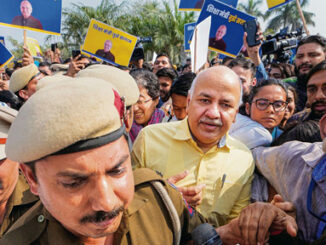
The arrest of Delhi’s Deputy Chief Minister Manish Sisodia by the CBI in connection with alleged irregularities in the formulation and implementation of the now-scrapped excise policy is a major setback for the ruling Aam Aadmi Party (AAP), which showcased corruption-free governance among its main planks to record thumping poll victories in Delhi and Punjab in recent years. The development has worsened the conflict between the state government and the BJP-ruled Centre, with the former accusing the latter of misusing Central agencies for political vendetta.
The contentious Delhi Excise Policy was scrapped in July last year after the Lieutenant Governor recommended a CBI inquiry into the allegations. Officials are accused of receiving kickbacks from liquor traders to grant licenses, extending undue favors to the licensees, waiving/reducing license fee and renewing L-1 license without due approval. It is apparent that the policy was withdrawn due to some anomalies in its execution; AAP needs to do the answering about what had gone wrong. Meanwhile, the onus is on the CBI to come up with irrefutable evidence to establish that Sisodia was directly or indirectly involved in any wrongdoing and whether the money trail leads to him. If any inconsistency or lacuna is detected in the case against the Deputy CM, it will lend credence to AAP’s allegation that he is being victimized.
At stake here is the credibility of the CBI as well as of the AAP government, particularly Sisodia, who has been entrusted with 18 of the 33 state departments by CM Arvind Kejriwal. Central probe agencies have repeatedly been accused of targeting ministers in Opposition-ruled states and turning a blind eye to irregularities in states where the BJP is in power. The CBI needs to allay apprehensions over its ‘pick-and-choose’ approach by bringing details of the excise policy case into the public domain and looking into the L-G’s role as well. A transparent and fair probe is a must to serve the interests of truth and justice; otherwise, the growing perception of vindictiveness will undermine the Centre’s credentials and offer a lifeline to AAP and the beleaguered Opposition a year ahead of the Lok Sabha polls.
Sisodia’s arrest has profound national implications for the direction the Opposition will eventually pursue. After tarring the TMC and AAP with the corruption taint, it is inconceivable that the Congress could include the Opposition in its anti-corruption blitzkrieg. That’s expecting too much. The core of its 2024 blueprint has only one strategy, and that is to position Rahul as Modi’s sole adversary.
“Refusing to reconcile with the reality that its pre-eminence as the Grand Old Party might be dated by now, Congress president Mallikarjun Kharge qualified his imploration to the Opposition with the caveat that the exercise would follow the UPA template with the Congress heading the coalition because it was the only party that had never done business with the BJP. It’s a fact few would dispute, but should the Congress grandstand at every opportunity on its ‘unsullied’ ideological ‘credentials’? Can parties such as the SP be labelled as BJP’s accomplices even as the subject of whether their campaigns against Hindutva were sufficiently robust should be debated? Has the Congress scored over other non-BJP entities on this marker? If the Congress’s pro-secular, pro-minority credentials were impeccable, why did Thiruvananthapuram MP Shashi Tharoor intervene at the AICC plenary to emphasize that his party could have been ‘more vocal’ on the release of Bilkis Bano’s rapists in Gujarat, the attacks on churches, lynchings in the name of cow vigilantism and the bulldozing of Muslim homes.”
By Radhika Ramaseshan
The ruling BJP could be sanguine in the belief that the country’s attention has been deflected from the Hindenburg-Adani row by the arrest of Delhi minister and Aam Aadmi Party’s backbone Manish Sisodia.
The development has profound national implications for the direction the Opposition will eventually pursue. The early indications augur well for the BJP because the arrest has reopened the fault lines running through the Congress and the regional parties, some of which it is counting on as its allies in the prelude to the 2024 General Election.
Delhi offers only seven parliamentary states. It is a quasi-state that is partially governed by the Centre, which has increasingly shrunk the space for the exercise of powers by the Arvind Kejriwal government after the BJP lost the 2015 and 2020 Assembly polls to the AAP.
Delhi is significant for the BJP because the seeds of the downfall of the Congress-helmed United Progressive Alliance (UPA) government were sown in the national capital in a long-drawn-out protest against the UPA’s ‘corruption’ and ‘misrule’; Kejriwal was then closely associated with the anti-corruption movement piloted by Anna Hazare. The India Against Corruption stir became a launch pad for Kejriwal’s political career, which was carefully camouflaged by his ‘activism’ with a moral underpinning. The Congress was the principal casualty of the protests and the BJP the eventual gainer.
The arrest of Sisodia, a founding member of the AAP, provoked strong reactions from regional forces, but invited the Congress’s endorsement. KT Rama Rao, working president of the Bharat Rashtra Samithi (BRS), accused the BJP of “resorting to stealth politics by inciting Central agencies against Opposition parties in states where it can’t come to power (on its own).” For the BJP, BRS-ruled Telangana is analogous to Delhi. The party’s exertions have not fructified into tangible political gains. At best, the BJP can hope to unseat the Congress as the main Opposition party in Telangana, unless the ground situation dramatically changes. Samajwadi Party (SP) chief Akhilesh Yadav lauded Sisodia’s record in making quality education accessible to Delhi’s underprivileged children and remarked, “The BJP proved that it is not only against education, but also against the future of Delhi’s children.”
The approval by the Congress’s Delhi unit stood out all the more against the backdrop of the party’s call for forging ‘Opposition unity’ before the next Lok Sabha battle at its just-concluded plenary in Raipur. Refusing to reconcile with the reality that its pre-eminence as the Grand Old Party might be dated by now, Congress president Mallikarjun Kharge qualified his imploration to the Opposition with the caveat that the exercise would follow the UPA template with the Congress heading the coalition because it was the only party that had never done business with the BJP. It’s a fact few would dispute, but should the Congress grandstand at every opportunity on its ‘unsullied’ ideological ‘credentials’? Can parties such as the SP be labelled as BJP’s accomplices even as the subject of whether their campaigns against Hindutva were sufficiently robust should be debated? Has the Congress scored over other non-BJP entities on this marker? If the Congress’s pro-secular, pro-minority credentials were impeccable, why did Thiruvananthapuram MP Shashi Tharoor intervene at the AICC plenary to emphasize that his party could have been ‘more vocal’ on the release of Bilkis Bano’s rapists in Gujarat, the attacks on churches, lynchings in the name of cow vigilantism and the bulldozing of Muslim homes? “If we don’t speak out in such cases, we are only surrendering our core responsibility of standing up for India’s diversity and pluralism, which should be central to the Congress’s core message,” Tharoor had stated.
More evidence followed to demonstrate that the Congress was unwilling to cede the leadership position to a leader from a prospective ally. Addressing a meeting in Shillong, Rahul Gandhi aggressively engaged with the Trinamool Congress (which fought the Meghalaya elections solo) and listed the violence in West Bengal, the Saradha scam and the alleged profligacy exhibited by the TMC in the Goa elections as proof of its ‘tradition’ and its propensity to ‘help’ the BJP and defeat the Congress. Meghalaya’s last Congress Chief Minister Mukul Sangma had crossed over to the TMC with a dozen legislators. At the same time, at a rally in Nagaland, Kharge made it amply clear that the Congress would lead the Opposition alliance that will come to power at the Centre in 2024. “The Congress will lead. We are talking with other parties. Because otherwise, democracy and the Constitution will go,” claimed the Congress president.
Secularism apart, it is apparent that the Congress has acquired a sense of proprietorship over the public articulation and projection of corruption, exemplified in the Centre’s alleged patronage to Adani and its silence on the questions raised by Rahul in Parliament. In his speech at the Raipur session, Rahul compared the Adani conglomerate with the East India Company and said, “History is being repeated.” “The Independence struggle was against the East India Company. That was also a company, the company that took away India’s wealth, infrastructure, ports….” he stressed.
After tarring the TMC and AAP with the corruption taint, it is inconceivable that the Congress could include the Opposition in its anti-corruption blitzkrieg. That’s expecting too much. The core of its 2024 blueprint has only one strategy, and that is to position Rahul as Narendra Modi’s sole adversary.
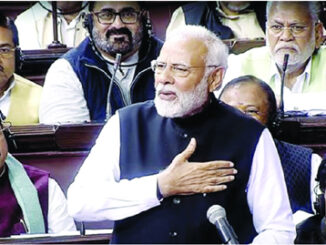
New Delhi (TIP)- Prime Minister Narendra Modi launched a fresh broadside against the opposition on Thursday, February 9, saying their “keechad” (dirt) of allegations will only help the lotus bloom more and asserting he alone outweighs all who had to take turns to shout slogans to oppose him.
Thumping his chest, Modi declared that he lives for the country and wants to do something for the country, which has rattled the opposition parties and they are playing political games just to save themselves.
“Desh dekh raha hai, ek akela kitno ko bhari padh raha hai (the country is watching how one person has outweighed so many),” he said as the opposition members kept shouting “Modi-Adani, bhai-bhai”.
Unperturbed by the jeering, Modi finished his 90-minute speech in reply to a debate on a motion thanking the President for her address to a joint sitting of Parliament, and listed various achievements of his government. With members of the treasury benches chanting “Modi-Modi”, he pointed at the opposition MPs who had gathered in the well of the House in a bid to shout him down and said, “Naare bolne ke liye bhi unko badal karna padhta hai (they have to take turns even to shout slogans).”
“Ek conviction ke karan chala hoon, desh ke liye jeeta hoon, desh ke liye kuch karne ke liye nikla hoon (I live for the country and have embarked with the conviction to serve the nation),” he said, adding that his political opponents are playing games as they do not have the courage to take him on.
The opposition, he said, is resorting to this means to save themselves. Replying to the Congress charge that the Bharatiya Janata Party was ignoring Jawaharlal Nehru’s efforts in nation-building after Independence, Modi retorted that if the first prime minister was so great, why have his scions never used his surname.
As he rose to speak, opposition MPs, some holding placards, rushed into the well shouting slogans against the prime minister and seeking a joint parliamentary committee probe into allegations levelled by the US short-seller Hindenburg Research against tycoon Gautam Adani.
Hitting back, Modi said, “Jitna keechad uchaloge, kamal utna hee zyada khilega (the more dirt you fling, the bigger the lotus – also the election symbol of the BJP -will bloom).”
“Keechad unke pass tha, mere pass gulal. Jo jis ke pass tha, usne diya uchal,” Modi quoted Manik Verma’s poem in response to the allegations opposition parties levelled on him and his government.
Roughly translated, it means they had dirt and I had gulal, whosoever had whatever they flung in the air.
Opposition parties used the debate on the motion to attack the government for the Adani group’s phenomenal rise during the last few years. In his reply, Modi accused the Congress of adopting only “tokenism” in solving problems the country faced and said it was bothered only about its political ambitions and not the welfare of the nation. “We don’t believe in tokenism. We have chosen the path of hardwork in taking the country forward,” he said, adding technology was being used as an aid in this mission.
He accused the Congress of trampling on the rights of states and regional parties by dismissing elected governments on 90 occasions by “misusing” Article 356 of the Constitution. “Who are the people?” he asked and responded that Indira Gandhi alone had used the article 50 times to dismiss governments.
“This country is not anyone’s fiefdom. Our policies reflect national and regional aspirations,” he said. “But these people who are now sitting (with the Congress), I want to expose them today.”
He then narrated how elected governments of the Left in Kerala, NT Rama Rao in Andhra Pradesh, Sharad Pawar in Maharashtra and M G Ramachandran in Tamil Nadu were dismissed by the Congress. And today these parties are sitting along with the Congress, he said.
“NT Rama Rao’s government was dismissed when he was in the US for medical treatment,” he said, adding M G Ramachandran must be turning in his grave seeing his DMK align with the Congress.
He also alleged that the Congress had committed sins in the past and is now trying to mislead the country.
The prime minister warned states against resorting to populist measures for political gains, saying it would be “anarth-niti” (disastrous policy). With many parties in states promising freebies and reverting to heavy cash outflow schemes like old pension in run-up to elections, he cited examples of near bankruptcy in neighbouring countries to say that they should not play with the financial health and economic policies. “Do not do any such sin which leaves the burden on the next generation.”
Taking exception to the expunction of certain remarks from his speech made in the Rajya Sabha on Wednesday, February 8, Leader of the Opposition in the Rajya Sabha Mallikarjun Kharge on Thursday, February 9, shot off a letter to Chairman Jagdeep Dhankhar, saying that it will be an “inversion of the system of governance” if Opposition MPs are to investigate, gather evidence and then raise issues in Parliament.
Dhankhar expunged Kharge’s remarks linking Prime Minister Narendra Modi with industrialist Gautam Adani and his charge that the PM remains silent on hate speech by BJP leaders.
Referring to Dhankhar’s direction to authenticate the charges with evidence, Kharge said Parliament was a platform to fix the accountability of the Executive and criticism of policies and decisions of the government should not be construed as allegations against any member of the House.
Kharge wrote that criticism of the government was natural in a parliamentary democracy. Arguing that there was no personal charge in any of his remarks, Kharge said an MP was required to authenticate only if any document was laid by the MP on the table of the House.
There was no convention of authentication of points made in a speech in Parliament, Kharge said. Any direction or rule of the House could not subvert the constitutional guarantee of freedom of speech laid down for an MP through Article 105. “The member, after due diligence, draws the attention of the House to such issues and it is incumbent upon the government to investigate the matter and take appropriate action in consonance with the law of the land,” the Congress MP wrote.
The principles Gandhiji stood for represent an ideal that is being weakened every day by those in power who are pushing their agenda of bigotry
“The contradiction is mirrored in the attitude of the Hindutva-inspired Bharatiya Janata Party (BJP) government of Prime Minister Narendra Modi. Mr. Modi was schooled, like other Rashtriya Swayamsevak Sangh (RSS) pracharaks, in an intense dislike of Mahatma Gandhi, whose message of tolerance and pluralism was emphatically rejected as minority appeasement by the Sangh Parivar, and whose credo of non-violence, or ahimsa, was seen as an admission of weakness unworthy of manly Hindus. Hindutva ideologue V.D. Savarkar, whom Mr. Modi has described as one of his heroes, had expressed contempt for Gandhiji’s ‘perverse doctrine of non-violence and truth’ and claimed it ‘was bound to destroy the power of the country’. But Prime Minister Modi, for all his Hindutva mindset, his admiration of Savarkar and his lifetime affiliation to the Sangh Parivar, has embraced Gandhiji, hailing the Mahatma and even using his glasses as a symbol of the Swachh Bharat campaign, linking it to a call to revive Gandhiji’s idea of seva through the recent ‘Swachhata Hi Seva’ campaign.”
By Shashi Tharoor
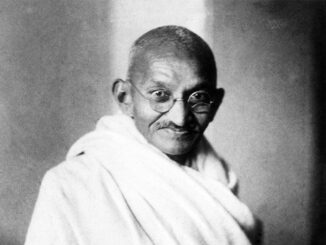
This year marks the 75th anniversary of Mahatma Gandhi’s assassination (January 30, 1948) by a Hindu fanatic who thought the Mahatma was too soft on Muslims. The momentous anniversary comes at a time when his legacy, the very idea of Gandhi, stands challenged by the prevailing ideological currents. At a time when the standing of his historic detractors, whose descendants now form the ruling dispensation in the country, is at an all-time high, Gandhiji has been criticized for weakness, for having bent over too far to accommodate Muslim interests, and for his pacifism, which is seen by the jingoistic Hindutva movement as unmanly.
The Mahatma was killed, with the name of Rama on his lips, for being too pro-Muslim; indeed, he had just come out of a fast he had conducted to coerce his own followers, the Ministers of the new Indian government, to transfer a larger share than they had intended of the assets of undivided India to the new state of Pakistan. Gandhiji had also announced his intention to spurn the country he had failed to keep united and to spend the rest of his years in Pakistan, a prospect that had made the government of Pakistan collectively choke.
But that was the enigma of Gandhiji in a nutshell: idealistic, quirky, quixotic, and determined, a man who answered to the beat of no other drummer, but got everyone else to march to his tune. Someone once called him a cross between a saint and a Tammany Hall politician; like the best crossbreeds, he managed to distil all the qualities of both and yet transcend their contradictions.
Explaining a contradiction now
Hinduism and Hindutva, as I have argued in my book Why I Am a Hindu, represent two very distinct and contrasting ideas, with vitally different implications for nationalism and the role of the Hindu faith. The principles Gandhiji stood for and the way in which he asserted them are easier to admire than to follow. But they represented an ideal that is betrayed every day by those who distort Hinduism to promote a narrow, exclusionary bigotry.
The contradiction is mirrored in the attitude of the Hindutva-inspired Bharatiya Janata Party (BJP) government of Prime Minister Narendra Modi. Mr. Modi was schooled, like other Rashtriya Swayamsevak Sangh (RSS) pracharaks, in an intense dislike of Mahatma Gandhi, whose message of tolerance and pluralism was emphatically rejected as minority appeasement by the Sangh Parivar, and whose credo of non-violence, or ahimsa, was seen as an admission of weakness unworthy of manly Hindus. Hindutva ideologue V.D. Savarkar, whom Mr. Modi has described as one of his heroes, had expressed contempt for Gandhiji’s ‘perverse doctrine of non-violence and truth’ and claimed it ‘was bound to destroy the power of the country’. But Prime Minister Modi, for all his Hindutva mindset, his admiration of Savarkar and his lifetime affiliation to the Sangh Parivar, has embraced Gandhiji, hailing the Mahatma and even using his glasses as a symbol of the Swachh Bharat campaign, linking it to a call to revive Gandhiji’s idea of seva through the recent ‘Swachhata Hi Seva’ campaign.
This may, or may not, represent a sincere conversion to Gandhism. The Prime Minister is hardly unaware of the tremendous worldwide reputation that Mahatma Gandhi enjoys, and is too savvy a marketing genius not to recognize the soft-power opportunity evoking Gandhiji provides, not to mention the global public relations disaster that would ensue if he were to denounce an Indian so universally admired. There may, therefore, be an element of insincerity to his newfound love for the Mahatma, as well as a shrewd domestic political calculation.
But the ambivalence speaks volumes: when many members of Mr. Modi’s BJP call for replacing Gandhiji’s statues across the country with those of his assassin, Nathuram Godse, the Prime Minister seeks to lay claim to the mantle of his fellow Gujarati for his own political benefit. At the same time, there is also a tangible dissonance between the official governmental embrace of Gandhiji and the unofficial ideological distaste for this icon, that is privately promoted by members and supporters of the present ruling dispensation, some of whose members have not hidden their view that his assassination was, in their eyes, a patriotic act.
The vision of the Mahatma
It is a well understood reality that the vision of Gandhiji, an openly practicing Hindu, differed greatly from that of Veer Savarkar and M.S. Golwalkar, the principal ideologues of the Hindu Mahasabha and its more militarized alter ego in the post-Independence era, the R SS and eventually, the BJP (formerly the Jana Sangh).
Gandhiji embodied the central approach of Advait Vedanta, which preached an inclusive universal religion. Gandhiji saw Hinduism as a faith that respected and embraced all other faiths. He was profoundly influenced by the principles of ahimsa and satya and gave both a profound meaning when he applied them to the nationalist cause. He was a synthesizer of cultural belief systems: his signature bhajan of ‘Raghupati Raghava Raja Ram’ had another line, ‘Ishwara Allah Tero naam’. This practice emerged from his Vedantic belief in the oneness of all human beings, who share the same atman and, therefore, should be treated equally.
Such behavior did not endear him to every Hindu. In his treatise on ‘Gandhi’s Hinduism and Savarkar’s Hindutva’, the social scientist Rudolf C. Heredia places his two protagonists within an ongoing debate between heterogeneity versus homogeneity in the Hindu faith, pointing out that while Gandhi’s response is inclusive and ethical, Savarkar politicizes Hinduism as a majoritarian creed.
But Gandhiji’s own understanding of religion, in Heredia’s words, “transcended religiosity, Hindu as well as that of any other tradition. It is essentially a spiritual quest for moksha but one rooted in the reality of service to the last and least in the world”. Unlike Savarkar, who believed in conformity, Gandhiji was a synthesizer like no other who took care to include Indians of other faiths in his capacious and agglomerative understanding of religion. He took inspiration from not just Advaita Vedanta but also the Jain concept of ‘Anekantavada’ — the notion that truth and reality are perceived differently by different people from their own different points of view, and that, therefore, no single perception can constitute the complete truth. This led him to once declare that ‘I am a Hindu, a Muslim, a Christian, a Parsi, a Jew’.
Hinduism and Hindutva, as I have argued in my book Why I Am a Hindu, represent two very distinct and contrasting ideas, with vitally different implications for nationalism and the role of the Hindu faith. The principles Gandhiji stood for and the way in which he asserted them are easier to admire than to follow. But they represented an ideal that is betrayed every day by those who distort Hinduism to promote a narrow, exclusionary bigotry.
(The author is a former senior UN official and a senior Congress leader)
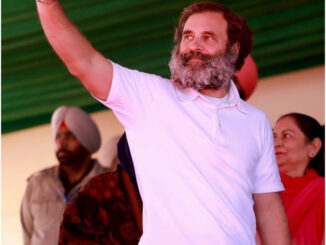
Pathankot (TIP)- Congress leader Rahul Gandhi launched a scathing attack on the BJP and RSS on Thursday, January 19, accusing them of creating an atmosphere of hatred, violence and fear in the country.
Addressing a rally here on the last day of Bharat Jodo Yatra’s Punjab leg, he alleged that the BJP was making one religion fight against another, one caste against another and one language against another.
“They create fear. All of their plans (policies) cause fear to someone or something,” he alleged.
Pointing towards the policies of the previous UPA government, Gandhi said it brought MGNREGA, waived farm loans, urban renewal mission, green revolution, white revolution. “Whatever we do is to wipe out fear. And whatever they do they (BJP) do is to spread fear.
“Look at their policies—farmers get up at 4 am in the morning and they toil hard daily and feed the nation. Farmers do not want anything in return, they only want respect,” he said.
He targeted the Centre over the now-repealed three agri laws and said these created fear in the minds of farmers.
“But what did BJP do for them—they brought black farm laws. These laws created fear among farmers,” he said.
Speaking about Pradhan Mantri Fasal Bima Yojana, the Congress leader claimed that farmers were not getting compensation for their crop damage because of the vagaries of weather. “Not even a single farmer told him that they got insurance compensation when they suffered crop loss due to natural calamities,” he claimed. Source: PTI
An ugly bout is playing out, not in the sporting arena but at Jantar Mantar in Delhi, and it calls for immediate and stringent action. Just like a wrestler is disqualified when she breaks the match rules, given the allegations of sexual misconduct against the Wrestling Federation of India (WFI) president Brij Bhushan Sharan Singh, who is also a BJP MP, he must be made to step down from his powerful position pending the inquiry into the charges. That the wrestling community — from Olympic stars to aspiring grapplers — is up in arms over Brij Bhushan’s character and manner of functioning lends gravitas to the situation and calls for a police probe. Spearheaded by Commonwealth Games medalistVignesh Phogat and Olympic medalists Bajrang Punia and Sakshi Malik, nearly 200 wrestlers have been demanding action against the federation chief and several coaches for sexually harassing many young women athletes at camps and running the game in a dictatorial way.
The veteran wrestlers have taken up cudgels for their younger counterparts who are too scared to take on the powerful MP who has been ruling the akhada as WFI chief for three consecutive terms. It is a courageous bid to clean up the management of wrestling — a sport that has been bringing glory to India with its rich haul of medals at global platforms.
The authorities must ensure Brij Bhushan’s ouster. For, it is not every day that one sees so many complainants coming out. The sad truth is that in a bid to achieve personal sporting glory, many sportspersons are forced to endure moral turpitude by those in control of things. Two recent exposes show how such perpetrators carry on with impunity for long before being called out. Last June, cycling coach RK Sharma was accused of sexually harassing a top female cyclist and threatening to derail her career. In 2021, the predatory behavior of a Tamil Nadu sports academy coach, P Nagarajan, was revealed when after a teenaged athlete accused him of sexual misconduct from 2013 to 2020, seven more women who had trained under him during his three-decade career said they had undergone similar torment. Zero tolerance for such transgressions should be the norm.
Amid a clash between the councillors of the Aam Aadmi Party (AAP) and the Bharatiya Janata Party (BJP), the maiden meeting of the newly elected Municipal Corporation of Delhi House on Friday, January 6, was adjourned without electing the mayor and the deputy mayor. The Arvind Kejriwal-led party also accused the BJP of trying to win the mayoral polls through “wrong means”. The BJP, in response, said that “AAP doesn’t have faith in the established rules and norms.” According to NDTV, AAP and BJP workers were seen hitting and pushing each other, falling and climbing on desks inside the MCD Civic Centre, at the meeting.
The protests on Friday erupted after BJP councillor Satya Sharma, the presiding officer overseeing the process, invited an alderman – a person over the age of 25 who is nominated to the corporation by the Lieutenant Governor (L-G) – to take oath. AAP MLAs and councillors rushed to the centre of the House, saying that elected councillors should have been sworn in before the nominated members.
New Delhi (TIP)- Senior Bharatiya Janata Party leader and former Madhya Pradesh chief minister Uma Bharti said her party does not “hold patents” on Lord Ram, Hanuman or the Hindu religion and anybody can have faith in them. In a series of tweets, Uma Bharti said it was not the BJP which inculcated in her the faith in Ram, the Tricolour, Ganga and cow, but it was “already within” her.
“The BJP does not hold patents on Ram and Hanuman or the Hindu religion. Anyone can have faith in them. The difference is that our faith is beyond political gains,” she said.
Bharti also questioned the purpose of Congress leader Rahul Gandhi’s Bharat Jodo Yatra while highlighting the BJP-led government’s decision to abrogate Article 370 to end the special status of Jammu and Kashmir. “But where is Bharat breaking? We have abrogated Article 370. What was breaking the country was Pakistan Occupied Kashmir (PoK). Rahul Gandhi should take this yatra to PoK,” she said.
Her stinging statement on the BJP came days after she courted trouble for her party by telling the Lodhi community that they were free to vote for any party by taking their own interest into account.
Speaking at a convention of marriageable boys and girls of her community, Bharti said she was loyal soldier of the BJP but the people of her community should take a decision on the basis of their own interests.
“I will come, I will come on the platform of my party, I will ask for votes. I never say that if you are a Lodhi then vote for the BJP. I tell everyone to vote for the BJP because I am a loyal soldier of my party. But I will expect a little from you that you will be a loyal soldier of the party,” she said.
“You have to see the surroundings and look for your interests. If you are not a party worker or a party voter, you have to decide for yourself. We are in the bond of love but from my side, you are completely free from the political bonding.”
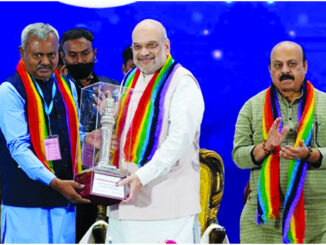
Bengaluru (TIP)- Hitting the ground running in poll-bound Karnataka, Union Home Minister Amit Shah called both the Congress and JD(S) as ‘parivaarvadi’ (dynastic politics) and corrupt and urged the people of Mandya and Old Mysuru region to support the BJP and bring it to power with a majority in the state.
The BJP is considered to be weak in the Vokkaliga-dominated Old Mysuru region, and is focusing on this belt to gain complete majority in 2023 Assembly polls.
“Enough of JD(S)-Congress, Congress-JD(S) this time Mandya, the Mysuru region should make BJP win with full majority. Congress and JD(S) are both parivaarvadi (dynastic politics) parties, they are corrupt pirates,” Shah said.
Addressing a massive public meeting as part of the ongoing ‘Janasankalpa Yatre’ of the state BJP, he said, “We have seen administration of both parties, when Congress comes, Karnataka will become Delhi’s ATM and when JD(S) comes it becomes ATM for a family. Repeatedly these two parties have through corruption have stopped Karnataka’s progress.” Stating that the time has come to get free from ‘parivaarvad’ and corruption, Shah asked people to give BJP an opportunity to form the government with full majority once, and bring a “double engine” government.
“In the next five years under the leadership of Modji we will take Karnataka much forward in the path of progress,” he said, accusing both Congress and JD(S) of being “corrupt, communal and also protectors of criminals”. Karnataka Chief Minister Basavaraj Bommai, Union Minister Pralhad Joshi, state BJP chief Nalin Kumar Kateel, party’s national General Secretary C T Ravi among other leaders were present at the event.
Reminding that he had begun campaigning for the 2018 Assembly polls from Mandya, he said, the people of Karnataka gave the BJP an opportunity to form the government making us the single largest party. Then again in 2019 Lok Sabha polls under the leadership of Modi with 52 per cent vote-share, Karnataka got 25 out 28 seats for the BJP, he added.
Challenges, if taken seriously, are often productive as they determine the path of progress. The turn of the year is the time not only to look back but also to set new challenges and targets ahead.
Punjab, once the sword and sports arm of the country, is at a crossroads. Its economy is tottering at the brink. Problems of drug addiction, suicides, unemployment, continuous exodus of youth, gangsterism, pollution, diversification of agriculture and poor delivery of civic services are aggravating day by day. Though AAP, the new ruling party in the State, has been in the saddle for more than nine months, long standing problems continue to elude solutions. The State needs a perestroika to be back on its footing as a dynamic and prosperous leader.
The Bhagwant Mann Government in the State has been patting its back for a number of revolutionary decisions it has taken in the first nine months of its governance. These include “zeero electricity bills”, start of 100 Mohalla clinics besides starting bus service to Indira Gandhi International Airport in New Delhi from various district headquarters, it has taken in the first nine months. It is also claiming credit for introducing “single pension for MLAs”, regulate supply of sand and gravel at affordable rates, control corruption in public offices and improving school education. The less said the better.
Intriguingly The State government was concerned more for wowing voters in Gujarat and Himachal Pradesh in its party fold than redress the chronic problems facing the State. Inserting full page advertisements in newspapers not read in the State and on TV channels that have larger viewership outside the geographical terrains of the State have evoked severe criticisms, both from the political opponents as well as eminent social scientists. These extra ventures in far off “greener” pastures even failed to get the ruling party mileage it was expecting to get. The only gain, as it claims, has been in its status of becoming a national party with its nominees sitting in four Assemblies. The progress on the national political horizon may be commendable for a party that made its debut less than a decade ago. Still, it falls far short of expectations of the people who have been posing their electoral trust in hoping it to be a harbinger of change in a country that has primarily been ruled by two parties – Congress and Bharatiya Janata Party – with brief spells of rule by alliances.
AAP may be working for a larger agenda as it has set its eyes to be a major political opponent to Narendra Modi’s BJP. It has been preparing itself for its bigger political challenge, the 2024 general elections. To succeed, it has to keep its already acquired flock together. Punjab and Delhi will be its biggest testing grounds. It has additional challenges and issues confronting the State. Farmers are still up in arms. Industry is facing a plethora of problems. Health care and basic civic infrastructure, including provision of safe potable water and disposal of solid garbage have been engaging the attention of the State but without much reprieve.
One of the major challenges facing the State is shortage of funds. It keeps looking towards the Centre for special packages rather than cutting down its wasteful expenditure, including its publicity budget besides rationalizing its security expenditure. Growing budget of subsidies and diminishing channels generating revenue coupled with rapidly increasing expenditure on maintenance of establishment, including the security of Chief Minister and other VIPs, are all contributing factors for the deteriorating fiscal health of the State.
Strong statesmanship and all-out effort to redress some of the chronic problems of the State are the minimum the people of the State expect from the incumbent government in the New Year. Looking for help from outside, including investments, is laudable but the State cannot be dependent upon others and the doles from the Centre. Punjab needs a hard and strong push as it will have to fight its own battle. Think more of Punjab than Delhi or Gujarat should be the motto of Bhagwant Mann government.
(Prabhjot Singh is a senior journalist. He can be reached at prabhjot416@gmail.com
Phone: +1 647 241 3806/+91 98140 02189
visit probingeye.com or follow him on Twitter.com/probingeye)
”The year 2018 could have marked a decisive shift for the Congress, if only the leadership had captured the zeitgeist it was leading to. The party had won Assembly elections in three states which were in the BJP’s thralldom. Madhya Pradesh, Rajasthan and Chhattisgarh were not easy states to wrest from the BJP. This was the juncture at which the Congress could have addressed the leadership question on a clean slate, without getting daunted by the entrenched provincial Old Guard. This was the juncture to spot and nurture younger leaders from the grassroots to helm the states instead of allowing a sclerotic hierarchy to work the system on rickety limbs.”
By Radhika Ramaseshan
The year 2018 could have marked a decisive shift for the Congress, if only the leadership had captured the zeitgeist it was leading to. The party had won Assembly elections in three states which were in the BJP’s thralldom. Madhya Pradesh, Rajasthan and Chhattisgarh were not easy states to wrest from the BJP. This was the juncture at which the Congress could have addressed the leadership question on a clean slate, without getting daunted by the entrenched provincial Old Guard. This was the juncture to spot and nurture younger leaders from the grassroots to helm the states instead of allowing a sclerotic hierarchy to work the system on rickety limbs.
The Congress displayed the spunk to shake up the system only in Chhattisgarh. It chose Bhupesh Baghel, then 57, as the chief minister in place of veteran TS Singh Deo, a running favorite, with a reported assurance to Singh Deo that the position was a rotational arrangement between him and Baghel. With just a year for Chhattisgarh to vote, the assurance, if real, never materialized. Baghel, a backward-caste Kurmi, not only survived internal challenges but also became a lynchpin of the national Congress organization. His ascendancy was a recognition and an acknowledgment on the Congress’s part that to survive and retain the base it is left with, strong state leaders were invaluable.
The Congress missed the bus in MP and Rajasthan. In MP, Kamal Nath, 72 in 2018 and remarkably agile, positioned himself as the frontrunner through deft footwork, leaving younger leaders, notably Jyotiraditya Scindia, to search for options.
In Rajasthan, evidently intimidated by the perception that Ashok Gehlot, then 67, had a formidable organizational network of his own (which inevitably failed after he completed his five-year term as the Congress’s rout in 2003 and 2008 testified), the party played safe and rooted for Gehlot to helm a third term. Like Scindia, a much younger Sachin Pilot, projected as Gehlot’s closest rival, was left hanging. The Congress’s fear was that Gehlot could inflict considerable damage to the party if driven up the wall.
The grit displayed in Chhattisgarh — that was perhaps because Singh Deo was seen as less troublesome than Nath and Gehlot — evaporated in Madhya Pradesh and Rajasthan.
It need not have played out that way because out of this trio of states, Chhattisgarh is regarded as a sure-fire winner a second time. If re-elected, it will prove that the limited experimentation paid off for the Congress.
In Himachal Pradesh, the Congress top brass overlooked the time-honored metric of lineage and ‘stature’ when it went for Sukhvinder Singh Sukhu as the CM. Lok Sabha MP Pratibha Singh held on to her claim to the last, insisting that the victory symbolized a homage to her departed husband and former CM Virbhadra Singh. Hers was a contention whose emotional quotient might have worked in the old days but in an era in which ordinariness commands a higher premium over bloodline in politics, Sukhu, the son of a bus driver, pipped her to the post.
The Congress awaits its next big leadership test in poll-bound Karnataka, where it is caught in a welter of rivalry between the old warhorses, Siddaramaiah and DK Shivakumar, who refuse to forfeit their assumed prerogative to lead the party even on peril of losing an election. Will the high command have the mettle to call their bluff or let the party go adrift amid their strife? By now, the Congress should have developed a second line of leadership, but it passed up the opportunity.
Leadership transition in politics, as in every winner-takes-all venture, is painful. While change ushers in the arrival of the next generation, it also brings the possibility of a different functioning mode from what the elite and the rank and file are used to.
Unlike industry, the fear in politics is partially unfounded because the original structure in which parties exist is rusted and will not countenance, let alone implement, the radical changes its timeworn frames are called on to do. Politics is essentially conservative and change-averse.
The BJP under Prime Minister Narendra Modi is often described as unrecognizably different from the party that existed under Atal Bihari Vajpayee and LK Advani. That is not true. The BJP and Modi command a majority of their own and are, therefore, supremely well placed to execute the RSS’s agenda in almost every sphere of governance. A centralized political entity, allowing marginal latitude to the states, has been at the heart of the Sangh’s political philosophy. So, it is not surprising that the BJP’s command structures have been refashioned to enforce the might of the center in which the losers take nothing, not even the leftovers. The compulsions in the preceding dispensations were different. Vajpayee ran an unwieldy coalition because the BJP never gained the numbers to stand on its own. It had to contend with pesky allies as well as the Sangh’s incessant demands and could keep neither very happy.
Does this mean that the seemingly invincible central BJP always overrides the states? Himachal partially busted the myth because the BJP’s rebels refused to heed Delhi’s entreaties to back off and help the official candidates. The BJP is struggling to get its Chhattisgarh, Bihar and Rajasthan organizations in place because these states are bereft of credible leaders to replace the veterans in Chhattisgarh and Rajasthan, while Bihar never had a helmsman. The BJP leaned so heavily on the Janata Dal (United) that the state party was eviscerated. The BJP’s lacunae do not solve the Congress’s problems. A stated objective of Rahul Gandhi’s Bharat Jodo Yatra was to re-energize the party organizations in the states. The aftermath? Days after the walkathon traversed Telangana, there was a virtual revolt against the state Congress president, A Revanth Reddy, for allegedly patronizing the TDP defectors over the original leaders. There are no short cuts.
Central agencies should reflect about the way they are used for political ends
A Special Court dealing with cases under the Prevention of Money Laundering Act (PMLA) in Mumbai has made some extraordinarily scathing observations about the way the Enforcement Directorate (ED) functions. While granting bail to Sanjay Raut, Shiv Sena (Uddhav Thackeray) MP, the court has termed his arrest not only illegal but also one recorded for “no reason” at all. The grant of bail and the observations made by Special Judge M.G. Deshpande have galvanized the ED to file an immediate appeal before the Bombay High Court, but the lengthy order contains enough material to substantiate the charge by Opposition parties that central agencies are being utilized to hound political opponents. The judge has found that the underlying criminal case of cheating concerned another set of people who had committed misdeeds, but they were not arrested. As far as Mr. Raut and his associate, Pravin Raut, who has also been given bail, were concerned, it was essentially a civil dispute, and there was nothing to show that money involved in their transactions were “proceeds of crime.” Their arrest under the PMLA was illegal, the court said, because there was no underlying scheduled offence. The ED has alleged that the proceeds of the fraudulent sale of tenements pertaining to a re-development project at Patra Chawl in Mumbai, amounted to ₹1,039 crore. It had further alleged that Mr. Pravin Raut was a proxy for Sanjay Raut, and that the latter and his wife had utilized ₹95 crore out of the proceeds to buy assets.
The misuse of agencies seems to be an unlaundered truth, going by the court’s remarks. There has indeed been a disproportionate targeting of non-BJP political leaders by investigating agencies of the Union government. While lawyers and activists have been arrested under anti-terrorism laws, mainstream political opponents often see tax raids and money-laundering cases. The latter class of cases is made possible by the PMLA that permits the ED to register a money-laundering case whenever there is an FIR by the police involving a given list of offences. In a sardonic comment, the Special judge has noted that the ED works at great speed while making an arrest, but proceeds with the trial at a snail’s pace. ED officers seem to be aware only of Section 19 (power to arrest) and Section 45 (stringent conditions for bail), but not the fact that they should also hold a trial. The judge’s remarks also drive home the fact that money-laundering prosecutions have an abysmally low rate of convictions. Instead of rushing to file appeals against adverse orders, central agencies ought to reflect on the manner in which they are being utilized for political ends.
NEW DELHI/NEW YORK (TIP): The Election Commission on Thursday, November 3, announced two-phase assembly polls in Gujarat, as voting for the first-leg will take place on December 1 and for the second on December 5. The counting of votes will be taken up on December 8 along with Himachal Pradesh. Announcing the decision of the poll panel Chief Election Commissioner (CEC) Rajiv Kumar said, 89 assembly segments will go to the polls in the first phase on December 1, and 93 seats in second phase on December 5. The CEC said there are over 4.9 crore electors eligible to vote this year. There will be more than 51,000 polling stations, which are going to be set up, including more than 34,000 in rural areas. Ahead of the polls, the Centre has deployed 160 companies of the Central Armed Police Forces to the state. The term of the 182-member state assembly ends on February 18, 2023. With the announcement of the election schedule, the Model Code of Conduct has (MCC) come into effect in the state. The much awaited, high-stake polls are seeing a three-cornered contest among the BJP, the Congress and the AAP. The BJP has been in power in the state – Prime Minister Narendra Modi’s home turf — for over two decades.
The upcoming “March For Unity” in Edison township of New Jersey on Oct. 30, 2022 is an insult to the minorities of Indian origin as well as majority Hindus that believe in human rights for all by the organizers. First of all, what is the relevance of this march in USA? After disturbing the peace, unity and respect among different ethnic groups of Indian origin living in USA with their Hindutva Agenda; what they are trying to prove with this Circus of self-proclaimed leaders of Hindus in the name of “March For Unity”?
Since 2014, with the rise of religious bigotry, gross human rights violations and violence against minorities in India; these organizations namely HSS, VHP, Seva International, Ekal Vidyalaya, Infinity Foundation, HAF, FIA, IBA and other locally based Hindu organizations of America; has yet to condemn state actions under PM Modi or has ever supported freedom of free speech, right to justice, religious and human rights of the minorities namely, Muslims, Christians, Tribals, SC & OBC. These organizations openly came out against Farmers protesting for their rights in India and those who were protesting against NRC & CAA for discriminating, especially Muslims. Rather they all have been publicly supporting Modi, his BJP and their parent organization RSS and its family of organizations. This is leading to create hate atmosphere against Indian American minorities by Pro Hindutva, high caste Hindus living in America. They are also assaulting the very American values; Freedom of Speech, Human Rights, Religious Freedom, Equal Rights and right to criticize wrong actions by US based Tax-Exempt organizations.
The individual members that are funding these US based organizations, they or their family members will never go back to India. They want Freedom of speech, human rights, right to worship and every right that is enshrined in the constitution of America. But when it comes to their so called “Bharat” aka India, they are supporting and financing PM’s Modi’s government of communal bigots, rapist, criminals, terrorist & bomb maker; denying basic human rights to minorities financed by world class Indian billionaires; a product of “Gangster Capitalism” of India where ruling party create Billionaires with wealth belonging to Indian public.
On Nov. 28, 2021 first time in American history an Indian movie “The Kashmir Files” made with a sole purpose to demonize Indian Muslims; 4 months before its release in India or worldwide was premiered in New Jersey, USA. Sunil Hali & Nilesh Dasondi the Publisher & CEO of “The Indian Eye” arranged a Citation to the movie maker of the “TKF” Vivek Agnihotri, from Mayor Thomas Lankey of Edison in New Jersey. This duo did the marketing of the film in USA as “Truth Unfold” when in the very first scenethere is a Disclaimer: “Based on Fiction.”. Entire ethnic Indian Media and Hindu Organizations of USA rallied behind them with full throttle publicity to demonize Indian Muslims. There were free shows of “TKF” with free bus ride & snacks in different parts of America with media coverage of reactions of the viewers demonizing Indian Muslims.
FIA also arranged a Citation for film maker Agnihotri on Dec 9, 2021 from Rhode Island by using the services of Rep. Brian Kennedy. Also in Dec 2021, Ohio State Senator Niraj Antani a Modi sympathizer arranged a Citation from Ohio state Senate & Governor for Agnihotri. Pathetically none of the US elected representatives involved in arranging or awarding Citations to “TKF” maker Agnihotri ever saw the movie or read the history of Kashmir. They did it for the heck of campaign contributions received for the Citations. They could have looked into the background of Vivek Agnihotri that has mostly made C-grade erotica and D-grade propaganda films only.
Eventually “TKF” was released on March 11, 2022 in India and worldwide with the full financial support of Modi government, RSS, VHP & other Hindu organizations. The maker Agnihotri while releasing the movie claimed in print, TV & social media, “First time in 32 years, any state in the world , the democratic & liberal state of USA- Rhode Island, has officially recognized Kashmir Genocide due to a very small film.” Canadian filmmaker Dylan Mohan Gray slammed the Vivek Agnihotri directorial “TKF” and described it as “hatemongering garbage of no artistic merit.” TKF is nothing but ‘hatred, bigotry and untruth; made to demonize Muslims & promote radical Hindutva as preached by Modi, BJP, RSS, VHP & other radical organizations.
This write has extensively written on India Day Parades in USA for over a decade that they do not represent India. Unfortunately, Insult India Parades in USA are Funded by India’s premier public enterprises: Ministry of Tourism, State Bank of India, Bank of Baroda, Bank of India etc. By financing FIA/IBA etc. they are promoting racism with Indian along with US Taxpayer’s money in America besides misuse of public funds by FIA/IBA owners for personal promotion. FIA or IBA are controlled by people practically from one community from one state; with no vision & honesty to understand that India is a multi-religious country with 30 states. For almost 2 decades, it is an annual mindless affair for local politicians & Photo Hungry Desi (PHD) Leaders posing as Indian Community Leaders along with their supporters who cannot be paraded for any cause anywhere in the world including world famous Pushkar Mela of Rajasthan in India. In 2013 itself India Day Parades in USA were used to promote BJP & its PM candidate Modi for the upcoming general elections in India. This was a violation as per US laws for a Tax-Exempt entity that they cannot indulge in politics. Especially after 2014 when Modi became PM of India; these Parades have been turning into Hindutva Day Parade promoting RSS group of families members including its political wing BJP and its US based supporting organizations. 2022 is the watershed year for totally Saffronizing these Insult India Parades with misguided Hindutva in the name of Hinduism. IBA put a Bulldozer featuring pictures of PM Modi and criminal & bigot Hindu Monk aka CM Yogi (Governor) of UP, in India, on 14 August 2022. Yogi started the use of Bulldozer to demolish the private homes and businesses, most of them owned by members of the Muslim minority in UP and all BJP ruled state followed him. Bulldozers have become symbols of oppression of minorities especially Muslims, Christians and schedule caste in India. “It symbolizes a threat that if you raise your voice against the BJP government or its leaders, your home or place of business will be demolished as well; your place of worship can also be demolished.” Although there is no provision in the constitution to unlawfully demolish houses or businesses or places of worship or to give collective punishment but no court in India will help you because they are for rich and upper-class Hindus only.
In 2017, Delhi Court asked the Municipal Body to Rebuilt homes demolished in “Sanik Farms” a 100% unauthorized colony for super rich and politically well-connected Hindus. Only about 24% of the population in India’s capital Delhi lived in planned colonies—the rest 76% lived in unauthorized constructions and slums, according to state government data from 2008-2009. As of 2019, there were over 1,700 such illegal colonies spread across Delhi, according to a ministry of housing and urban affairs estimate. A new master plan announced in 2021 lays out a blueprint for development till 2041. It, too, addressed the issue of the 1,700-odd unauthorized colonies, even considering ownership rights for residents.
IBAknowingly used the Bulldozer in the parade to offend the Indian American minority groups, especially Muslims, from the local area and across New Jersey and other parts of USA. Administration of Edison Mayor Sam Joshi & 2 councilman Ajay Patil & Nishith Patel can’t deny that they were not aware of it. Besides that,IBA invited a globally known Islamophobic hatemonger; BJP National Spokesperson Dr. Sambit Patra to walk in the parade as Grand Marshal. FIA also invited Sambit Patra along with another communal BJP National General Secretary Kailash Vijayvargiya for the Indian Flag hoisting at Times Square in New York on Aug. 15, 2022.
Whatever is happening in India and USA in the name of misguided Hindutva and Indian Nationalism; is very disturbing for the majority of Indian Americans. Personally, I am very hurt that the things that forced me to leave India; have come to USA to haunt me. Unfortunately, I was 3RD generation supporter of RSS & BJP. 3 incidents in my life forced me to leave financially socially & politically well-connected life in India to migrate to USA to start a new life from scratch. The 1989 RSS family of organizations led by BJP’s Islamophobic and blatantly communal Ram Mandir movement, 1990, Chandra Shekhar with 61 MP’s (out of 525-member lower house) was installed PM with the outside support of 195 Congress MP’s under Rajiv Gandhi & 25 MP’s of splinter groups, covert support of BJP by toppling the V P Singh government. The entire operation was financed by Dhirubhai Ambani with bribes to every MP because V P Singh government was pursuing money laundering, tax evasion and other wrong doings against Ambani group. In 1992 RSS, BJP, VHP & other prominent Hindu Leaders instigated a Hindu mob to demolish the 15th century old Babri Masjid claiming to be the birthplace of Lord Rama. On the other hand, Hindu scriptures say that “Kan Kan mei Vyape hein Ram” meaning “Lord Rama permeates every atom of this universe”.
There are more than two million Hindu temples and 300,000 Muslim mosques in India, including 23,000 Hindu temples in the riverside city of Varanasi alone. Varanasi happens to be the Parliamentary seat of PM Modi of India. On the other hand, 70% of students studying in government schools are ill-equipped to learn in the class because of poor infrastructure, no equipment, shortage of qualified teachers and inadequate budget. Over 18 mil children are living on the streets of India.
All my adulthood I spent in fighting Congress for never dismantling the British Master & Slave governance system of India. For that reason, I always say’s that India got Independence in 1947 but Indians never got independence or freedom from slavery. Then my fight with Congress was for “Gangster Capitalism” in which state was creating billionaires to financially support the Ruling Party. If Congress produced Ambani’s; Modi has produced Adani. This “Gangster Capitalism” is directly responsible for criminalization of politics, communalism, gross abuse of human rights and destruction of democratic institutions including Courts and Media in India. After coming to power BJP has proved to be worse than Congress and now India has been reduced to an elected autocracy. These organizers of “March For Unity”; if they are really sincerer, honest and respect human rights; must give a memorandum on behalf of all the Indian Americans to the CG Jaiswal for Government of India demanding human rights and freedom of speech for all communities and release of all young and other activists jailed for years under British slavery laws for opposing government policies, demanding human rights and restoration of Democracy in India.
(Compiled by Devendra Makkar from various internet sources & writings of prominent journalists)
There are signs, however faint, that the popularity of PM Modi is fraying at the edges and people are not too happy with the govt indulging in political games, even as they are feeling the pinch in terms of inflation and lack of jobs. And this is the time for Opposition parties, especially the Congress, to get a foot in the door. Bharat Jodo Yatra is expected to be the grand strategy to achieve a breakthrough. Time will tell whether the march has been worthwhile.
By Parsa Venkateshwar Rao Jr
Two major things are happening simultaneously in the Congress at a time when its friends and critics gave it up as being irredeemable. First, party’s former president Rahul Gandhi, who refused to take over as the chief despite the cringing pleas made by sycophants, has set out on a marathon padayatra based on the theme of ‘Bharat Jodo’ (unite India). Optimists believe that this move would revive the party, and party insiders and those who support the Nehru-Gandhi family believe that this would also show the challengers and the sceptics in the party as to who commands popular support in the country.
In many ways, the party’s presidential election has been almost reduced to a sideshow. The contest for the party’s top post is between seasoned Mallikarjun Kharge, who is seen as the Sonia-Rahul candidate — though ‘strenuous’ efforts were made to show that the family had not endorsed his name — and the party MP from Thiruvananthapuram, Shashi Tharoor.
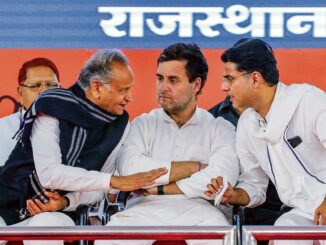
This was preceded by the tragicomedy of Rajasthan Chief Minister Ashok Gehlot leading a last-minute protest rally by the party’s MLAs in Jaipur, which showed the chinks in the Nehru-Gandhi armor and forced the family to adopt a tough stance towards the family loyalist. The attempt of former Madhya Pradesh Chief Minister and Rajya Sabha member Digvijaya Singh to enter the fray failed once Kharge entered the fray. It is quite clear that the contest between Kharge and Tharoor, interestingly both from south India — one from Kerala and the other from Karnataka — is no epic battle like the one between Subhas Chandra Bose and Mahatma Gandhi’s nominee Pattabhi Sitaramayya in 1938. This year’s Congress presidential contest is not even like the one that took place in 1996 between Sitaram Kesri, Sharad Pawar and Rajesh Pilot because at that time Sonia Gandhi had not entered politics. Jitendra Prasada challenging Sonia in the 2000 party presidential election was indeed a non-event. The contest between Kharge and Tharoor is not evenly balanced. Kharge, apart from the ‘tacit’ support from the Nehru-Gandhi family, is considered by many Congress people as one of them because he has been in the party for decades now. Tharoor, despite being a three-time MP, is viewed as an unreliable newcomer, if not a total outsider. The former international civil servant, with all his proven savvy, has no advantages with the Congress and its convoluted factionalism.
The fact that the Congress needs new ideas and a revamp is not a priority for the Rahul and Sonia camps; it is necessary to recognize that there are two camps, and the Congress deadlock since 2019 has been due to the tussle between the two groups. Tharoor does not belong to either of them. And it appears that the Rahul camp may tolerate Kharge better than they would Tharoor. The Nehru-Gandhi family should have favored Tharoor, but they are not sure of his loyalty quotient. Or, Sonia should have asked Sachin Pilot, the Gehlot rival in Rajasthan, to contest the presidential election. But it seems that they do not like the ‘ambitious’ Pilot, and his failed attempt to bring down the Gehlot government and his flirtation with the BJP have alienated him from the family. The palace intrigues of the Congress are indeed endless and they are not relevant when the question arises as to whether the Congress can revive itself sufficiently under Rahul to put up a credible fight against the Narendra Modi-Amit Shah BJP in the 2024 Lok Sabha elections. There are signs, however faint, that the popularity of Prime Minister Modi is fraying at the edges, and people are not too happy with the government indulging in political games, even as the people are feeling the pinch in terms of inflation and lack of jobs. And this is the time, indeed, for the Opposition parties, especially the Congress, to get a foot in the door. The Bharat Jodo Yatra is expected to be the grand strategy to achieve the breakthrough. Time will tell whether it has been worthwhile.
A member of G-23, the dissident faction inside the Congress, has remarked that the Bharat Jodo Yatra will help rebrand Rahul; and strengthening of the Congress is incidental. But many would say that if Rahul is successful in rebranding his image, it would amount to rebranding the Congress.
But Congress members of all camps should pay heed to what Union Home Minister Amit Shah told BJP members over a month ago; he advised the Union Cabinet Ministers to give time to the party work and party members. He said PM Modi was indeed popular across the country, but Modi would not be able to win the election if the party organization was not strong. It is a lovely commentary on the ruthlessly realistic approach of the BJP towards Modi and to elections in general.
It seems that the strategy of the Nehru-Gandhi family as well as other leaders in the party camp is to strengthen the brand image of Rahul and of the family, so that it helps the party. But Rahul seems to be working on a Mahatma Gandhi-like mass contact program. It is an idealistic plank that will work on the realistic plane of day-to-day politics as well, but the party has to close its ranks and present a united front.
Rahul is apparently focusing on making the Congress the lone alternative to the BJP because he seems to realize that Opposition unity is just a chimera. But he cannot ignore the imperative of making the party strong and broaden the base of inner-party consultation. A G-23 member’s complaint is that before 2019, Rahul did not like to have anything to do with the people above the age of 50, and now he has conceded to talk to people between the age group of 50 and 60. So, 80-year-old Kharge and 66-year-old Tharoor do not fall in this category.
New Delhi (TIP)- Reacting to Waqf Board chairman Amanatullah Khan’s arrest, Delhi Deputy Chief Minister Manish Sisodia on Saturday, September 17, accused the BJP of continuing with its Operation Lotus to “break” the AAP leaders. Khan, AAP MLA from Okhla, was arrested by the Anti-Corruption Branch on Friday in connection with the alleged irregularities in the Delhi Waqf Board recruitment, officials said.
“First, they arrested Satyendar Jain but there is no evidence against him in court. They raided my residence. Nothing was found. Then they initiated a fake probe against Kailash Gahlot, and now they arrested Amanatullah Khan. Operation Lotus to break each leader of AAP continues,” Sisodia said in a tweet in Hindi.
Earlier, the AAP leaders had alleged that the BJP was trying to buy AAP MLAs by offering them Rs 20 crore each to topple the Arvind Kejriwal government in Delhi.
SC Judge must probe ‘Operation Lotus’
Amid Aam Aadmi Party’s (AAP) allegations against BJP of trying to topple the Punjab government by poaching its MLAs, finance minister Harpal Cheema Thursday demanded a judicial probe into ‘Operation Lotus’ by a Supreme Court judge. Addressing the media here, Cheema said, “Not only Punjab, BJP indulged in poaching in other states like Goa, Karnataka, Madhya Pradesh, Assam. In all these states where the Operation Lotus took place should also be a part of investigation.”
“The BJP is offering ? 25 crore per MLA to switch sides. Operation Lotus may have succeeded in Karnataka, but the Delhi MLAs stayed firm and failed the BJP operation,” said Cheema. Cheema refused to give names of the BJP leaders against whom they had submitted an evidence to the police after which an FIR was registered by the Punjab Police Wednesday. “We have got the FIR registered. We will make the names public only after a thorough investigation is done. If we give out the names now, the Opposition will distort the facts.”
Ranchi (TIP)- MLAs of Jharkhand’s ruling United Progressive Alliance on Thursday, Septemner 1, asked Governor Ramesh Bais how selective information was being leaked to the media, ANI reported.
The legislators met Bais amid uncertainty about Chief Minister Hemant Soren continuing in his post and alleged attempts of the Bharatiya Janata Party to destabilise the Jharkhand government. Bandhu Tirkey, working president of the Congress’ Jharkhand unit, on Thursday said Soren will not resign. He also said that the governor has assured them that information is not being leaked from his office. “The governor is seeking legal opinion and has assured the situation will be made clear within two days,” Tirkey added. A political crisis has been looming over Jharkhand since last week after reports on August 25 said that the Election Commission has sought Soren’s disqualification as an MLA. The chief minister is facing allegations against him in an office-of-profit case. The case is based on a complaint filed by the Bharatiya Janata Party alleging that Soren allotted a mining lease in his own name. Soren also holds the mining portfolio in Jharkhand.The Election Commission had informed the governor about its decision in a sealed cover, the reports said last week. However, Soren maintained that he did not receive any communication either from the Election Commission or the governor. On August 27, the Jharkhand Mukti Morcha and its allies began moving its legislators out of Ranchi amid fears of poaching. In the 81-member Jharkhand Assembly, the Soren-led Jharkhand Mukti Morcha is the largest party with 30 MLAs. The Congress has 18 legislators, while the Rashtriya Janata Dal has one. The main opposition BJP has 26 MLAs in the House.
If the governor announces Soren’s disqualification, then he will have to resign as an MLA. Soren, however, can get re-elected within six months. He can also continue to remain the chief minister if legislators of the ruling United Progressive Alliance name him as the leader of the coalition.
It is with sadness that I write this letter as we watch several stalwarts who labored for the Congress party over the years say goodbye. The 2024 national elections are fast approaching. The Congress party has a monumental task ahead if we are to stand any chance against the Modi juggernaut.
Since Mr. Rahul Gandhi has resolved not to run for any party post, I make the following case below. Without casting blame against anyone for the current fiasco, let me state that INC can redeem itself in the nation’s eye while giving a fresh start if we select/elect someone of a great stature who can make an immediate impact. That person is none other than Dr. Shashi Tharoor. Anyone chosen else from the inner circle will have minimum impact and will be perceived only as an underling of the current system of governance. The Congress party can ill-afford to keep losing the perception battle.
Why should Shashi Tharoor be a candidate for the president of the AICC
Sonia Gandhi and Shashi Tharoor discuss a weighty issue.
First and foremost, the road to Delhi for the next non-BJP Government runs through South India. The Hindi belt is irretrievably lost for now and will take decades of work to rebuild. Therefore, selecting a leader like Mr. Shashi Tharoor from the South will only be advantageous in coalescing other reluctant leaders of the regional parties in the South and the East to join the fray.
Mr. Shashi Tharoor is considered by many to be a dynamic leader with scholarship, charisma, a pan-Indian appeal, and the wisdom to lead the party from the current doldrums. Shashi is a true admirer of Jawaharlal Nehru and a great proponent of the Nehruvian vision for India. He is a great advocate of secularism and argues strongly for a pluralistic India as a foundational philosophy for the society-at-large. He is known as a thinker in the Nehruvian mode and has authored several books and written extensively through articles and columns in several countries.
Shashi Tharoor’s speech at Oxford stands out as a masterpiece.
He is a master communicator who speaks several languages, including Hindi and Bengali, other than his native tongue Malayalam. His linguistic skillset in English is quite unrivaled. He is known to speak French as well. His oratorical skills are unmatched by very few, even in the international arena; his speech at Oxford stands out as a masterpiece. His debating skills and way with words are pretty evident across the visual and social media worldwide and will give any opponent a run for the money.
He has proved himself a great parliamentarian willing to do the research necessary to debunk many of the Government’s assertions. His learning skills are spectacular, and his speeches at the Lok Sabha reflect how well he analyzes data and disseminates the information for easy consumption by the public. No wonder he has won three times from a parliament seat in Kerala that the CPM could have easily captured.
We all know that he is someone who has run for the office of the Secretary-General of the United Nations and has a wealth of knowledge and experience in world affairs with friendship with several world leaders who are his peers. He possesses strong leadership skills as he has administered the international peacekeeping operation under Secretary-General Kofi Annan and was the head of the Department of Public Information for the United Nations before leaving the U.N. He is considered a mass leader who would attract a crowd anywhere he appears. The great demand for his participation during campaigns across India clearly indicates his mass appeal. His possible appointment will motivate millions of young people to take a fresh look at the Congress party and may sway others who were estranged during the last decade.
He is a 24×7 workaholic with the willpower to outwork any opponent or adversary toward achieving goals. He appears to be willing to delegate and is not at all defensive about issues as regard public policies. He relates well to people with diverse backgrounds in society and is empathetic to the plight of the poor and disadvantaged. He maintains excellent relationships with all religious groups and heads of religious organizations and firmly believes that a secular India is not hostile to any religion. Although religion is no bar to holding the title, he considers himself a proud Hindu while rejecting the exclusive Hindutva philosophy promoted by ultra-nationalists and Hindu fundamentalists. Finally, he is considered a man of integrity and honor who has served his constituency with ultimate dedication with a proven track record of an impressive body of work with a long-lasting impact on the lives of ordinary citizens. He has the maturity, knowledge, and skillset to lead the Congress party to a new horizon. It will also forever put to rest the dynasty and nepotism issue BJP is counting on exploiting to garner votes.
Yours and Rahul Ji’s support is crucial in this regard, and Mr. Tharoor can never shadow your position and influence in the party, but rather it would be complimentary. Mr. Tharoor, by nature, is a trust-worthy individual who has spoken of the deep respect he has for you, has defended Mr. Gandhi on several occasions, and believes in the dream of your husband, Prime Minister Rajiv Gandhi, and his dream of “an India, strong, self-reliant and in the front ranks of the nations of the world.” This dream is systematically being demolished by those in the sitting Government with a reckless disregard for the sacrifices of not just our founding fathers but also Prime Minister Rajiv Gandhi, who was one of the last of the foundation layers of modern India.
After speaking with many people both in India and abroad and gathering their personal views, I am writing to share a nation’s hopes, aspirations, and pulse at a precipice. Congress must lead the way forward out of the deep abyss the country is sliding into by near destruction of our most cherished democratic principles.
I personally beseech you, on behalf of a nation under siege, to consider Mr. Shashi Tharoor as a candidate for the position of the Presidency of the AICC and urge, guide, and lead the Congress party to support Mr. Tharoor. Time is of the most critical essence. The Congress party must be audible and visible in the nation’s mind for all the right reasons. The news media are now abuzz with what they describe as a “dysfunctional” party that learns no lessons. Mr. Tharoor becoming President of AICC will start to turn the tide of perception in favor of the Congress party.
Mr. Tharoor is Gandhian in principle, Nehruvian in vision, Patel-esque in will. All these traits will endear him to the masses, the daughters of India, the young, the aspiring, the creative, the captains of industry, and the reasonable thinkers who are aghast at the demolition of our hard-fought democratic, secular republic.
We must do all we can to strengthen the Congress party so that it presents a formidable alternative before the 2024 elections. Congress will not survive another loss. And India will change its face as we know it. Congress must lead the way. Mr. Tharoor’s Presidency of the AICC will be a step in that direction.
India is pining. India is waiting.
If not now, then when? If not Congress, then who?
Thank you.
Yours Sincerely,
George Abraham, Vice-Chair- Indian Overseas Congress, USA
In a major organizational reshuffle, the Bharatiya Janata Party dropped Union Minister Nitin Gadkari and Madhya Pradesh Chief Minister Shivraj Singh Chouhan from its parliamentary board, the party’s highest decision-making body. Nitin Gadkari has not exactly been comfortable in the company of Modi-Shah duo. A once vocal president of Bharatiya Janata Party, Gadkari has comparatively been, if not silent, quiet for some time. In the last three years one could see a different Gadkari than the nation had known as pushing forward vigorously the party agenda.
Gadkari’s performance as minister speaks for itself. I remember his keenness to learn from New York traffic control authorities how best traffic could be managed in Indian metropolitan cities. He spent a couple of hours to study the system at the Traffic control in New York. His passion to speed up work of construction of roads and bridges, the department he holds (Gadkari is Minister for Road Transport and Highways), is evident from the fact that he not only met the targets but met them in advance of the deadlines. A man who believes in action rather than in making tall claims, he is probably the best man in Modi’s cabinet. Why should Gadkari, a former President of the BJP and a performing senior minister in Modi cabinet be dropped from the Party’s highest policy making body- the BJP Parliamentary Board?
Well, it is a clear signal to RSS Chief Mohan Bhagwat that he does not control power; the power lies with Modi-Shah duo. The first clear indication came when, in a dramatic move, a Bhagwat favorite Devendra Fadnavis, was restrained from becoming the chief minister of Maharashtra when even the announcement about his oath taking was almost made.
And now comes the exclusion of Gadkari. One should not be surprised if a performing chief minister of UP whose model of governance came in for much appreciation and which is being sought to be replicated by many BJP chief ministers in their states, has failed to find favor with the BJP leadership of Modi-Shah duo because of his being a protégé of RSS Chief Mohan Bhagwat.
Clearly, Modi who is known to be ruthless with his perceived rivals, has conveyed to RSS chief who really controls the knobs of power Surely, all is not well in Modiland.
Bengaluru (TIP)- The Bharatiya Janata party (BJP) on Sunday, August 14, shared a seven-minute video blaming the first Indian Prime Minister, Jawahar Lal Nehru, and the Communist party for the Partition of India in 1947. The Congress hit back saying Prime Minister Narendra Modi was using “the most traumatic historical events as fodder for his current political battles”. The seven-minute video, uploaded on the BJP’s official handle, describes how the British tried to divide Bengal in 1905 and failed. “The factors that distinguish India in 1947 from Bengal in 1905 are the Congress party [with a close-up shot of Nehru], the Muslim League [showing a photo of Jinnah] and Indian Communists [with a group photo of founding members of the Communist Party of India (Marxist)],” the narrator states. “In a span of just three weeks, those having no knowledge of India’s cultural heritage, civilisation, values, [and] pilgrimage centres, drew the border between people living together for centuries,” he adds.
The party directly launched an attack on the “leaders of the country at the time” for “failing the people of India” that led to nearly a million deaths and even more displacements.
In 2021, Prime Minister Modi had declared August 14 as ‘Partition Horrors Rememberance Day’.
Congress’ media chief, Jairam Ramesh, criticised the BJP for indulging in politics over a tragic historic event. In a series of tweets, he said: “The real intent of PM to mark Aug 14 as Partition Horrors Remembrance Day is to use the most traumatic historical events as fodder for his current political battles. Lakhs upon lakhs were dislocated and lost their lives. Their sacrifices must not be forgotten or disrespected.”
He added that the “the tragedy of partition, cannot be misused to fuel hate & prejudice. The truth is Savarkar originated 2 nation theory and Jinnah perfected it. Sardar Patel wrote, ’I felt that if we did not accept partition, India would be split into many bits and would be completely ruined’,” he added.
Ramesh said that the modern day “Savarkars and Jinnahs” were continuing their efforts to “divide the nation”. “The Indian National Congress will uphold the legacy of Gandhi, Nehru, Patel and many others who were untiring in their efforts to unite the nation. The politics of hate will be defeated,” he added. Chhattisgarh chief minister Bhupesh Baghel also hit out at the party saying Rashtriya Swayamsevak Sangh (RSS) ideologue V D Savarkar had sown the seed of Partition in 1925. The RSS?is the ideological mentor of the BJP.
He also questioned the BJP’s role in the freedom struggle.
“Savarkar had sowed the seed of Partition in 1925. It was Savarkar who gave the two-nation theory, which was supported by Mohammad Ali Jinnah in 1937,” Baghel said. Source: HT
New Delhi (TIP)- Dressed in all black, Congress leaders took to streets on Friday as they held a nationwide protest against price rise, unemployment, and the Goods and Services Tax (GST) hike on essential items. However, the Congress’s plan to ‘gherao’ Prime Minister Narendra Modi’s residence was foiled by the Delhi Police as officials initiated a crackdown on protesters. Meanwhile, the Bharatiya Janata Party raised questions over why the Congress chose August 5 to hold the protest. The BJP leaders also slammed the Congress leaders’ choosing to protest in black clothes, alleging that it was to convey opposition to Ram temple in Ayodhya.
From Delhi to Assam to Madhya Pradesh and Telangana, the Congress workers hit the streets across the nation as they heeded the top leadership’s call for mass protest against price rise and unemployment.
In Delhi, several Congress MPs including former party president Rahul Gandhi staged a protest in the Parliament House complex and took out a march towards the Rashtrapati Bhawan as part of their nationwide stir.
The protesting MPs raised slogans against the government demanding that the GST hike on essential items be withdrawn, with party chief Sonia Gandhi standing with the women MPs of the party holding a banner outside Parliament gate. In Assam, the Congress attempted to gherao the Raj Bhavan at Guwahati as they held demonstration on Friday. In Madhya Pradesh, the protesters tried to march to the Raj Bhawan to hand over a memorandum of demands to the Governor, but were stopped by the police.
The Punjab unit staged a protest under the leadership of state Congress chief Amrinder Singh Raja Warring and Leader of Opposition Partap Singh Bajwa, while in Haryana, the protest was led by former chief minister Bhupinder Singh Hooda and state Congress president Udai Bhan.
CONGRESS LEADERS DETAINED
Hundreds of Congress workers were detained across the country as they organised protest against the government on Friday. The Delhi Police detained more than 200 Congress protesters, including 50 Members of Parliament, from Lutyens’ Delhi. Congress leaders Rahul Gandhi, Priyanka Gandhi Vadra, Deepender S Hooda, and Adhir Ranjan Chowdhury were among those detained by the police in Delhi. In Bihar, more than a hundred Congress workers, besides some senior leaders, were rounded up by the police on Friday.
Police had put up barricades on the routes leading to the Raj Bhawan, the official residence of the governor, from the Uttar Pradesh Congress Committee (UPCC) headquarters in UP.
INDIA WITNESSING DEATH OF DEMOCRACY: RAHUL GANDHI
Ahead of the Congress’s nationwide protest, Rahul Gandhi addressed a press conference at party headquarters in Delhi. Rahul Gandhi alleged that India is witnessing the “death of democracy” and anybody who raises people’s issues and stands against the onset of dictatorship is “viciously attacked” and put in jail. “What we are witnessing is the death of democracy. That is what India is witnessing. What India has built brick by brick, starting almost a century ago, is basically being destroyed in front of your eyes,” Rahul Gandhi said.
If we look at what BJP was under the long leadership of Atal Behari Vajpayee who was India’s Prime Minister three times and we look at what BJP has become under the leadership of Narendra Modi who is in his second term as Prime Minister, we find a huge contrast.
Vajpayee was a life-long, humble Hindu nationalist, a learned Hindi poet and a political leader. He first became PM after the May 1996 election for a period of 13 days, but not being able to muster majority in parliament he chose to resign rather than use horse-trading to reach that goal. Then after the May 1998 election he became PM of a coalition headed by BJP for a period of 13 months. In early 1999 the coalition lost its majority due to the defection of a constituent. Again, instead of horse-trading to retain majority, Vajpayee resigned. Another election was called and Vajpayee’s BJP coalition returned with a stable majority that lasted a full term of five years.
PM Vajpayee governed India and made chief ministers in states where BJP was in power, govern in a principled manner, what he called Raj Dharma – the governing philosophy from ancient days when Hindu kings ruled in India. For his cabinet of the central government Vajpayee choose capable people of integrity e.g., Murli Manohar Joshi, Jaswant Singh, Yashwant Sinha, Arun Shori et al. When in 2002 large scale killings of Muslims occurred in Gujarat, then ruled by Chief Minister Narendra Modi, Vajpayee publicly admonished Mr Modi and asked him to follow Raj Dharma. Vajpayee also wanted to remove Modi as CM but the BJP high command did not agree.
In contrast PM Modi has little use for principled politics and does not hesitate from horse-trading to govern. His machinations to form BJP governments in states in recent years where BJP did not get majority in election speak for themselves. Also, Mr Modi has little use for humility and asks for adulation from others. Mr Modi is a spell binding orator who has changed the color of Hindu nationalism and BJP from humility to aggressiveness. Both in Gujarat as CM and at the Center as PM, Mr Modi has often made grandiose promises of good times (acche din) without putting a system in place or putting competent leaders in place to implement those promises. Unlike Vajpayee’s competent ministers very few of Modi’s ministers are in that category and then he micro-manages them like a know-all. After five years very few of his promises to the people have been implemented.
However, to cover his tracks he has blindfolded the media, especially TV media to such an extent that major national problems like the extreme grief of starving farmers, huge unemployment of the youth and rampant corruption are routinely described by the media as conspiracies of the opposition in collusion with India’s enemies.
Vajpayee proudly glorified Hinduism and Hindu culture but did not allow BJP activists to make the religious minorities feel like they were second class citizens. Mr Modi has made hardly any real effort to control the militant folks from BJP and its allied groups from brutalizing the minorities or has asked chief ministers of BJP ruled states to use law & order forces to control violence against minorities.
“The report observes that the ‘development paradigm’ has aggravated the difficulties of the ‘marginalized’ as the benefits have been ‘disproportionately cornered by the dominant sections at the expense of the poor, who have borne most of the costs.’ In the case of the ‘tribes’, it resulted in their loss of cultural identity, destruction of their resource base and made them increasingly vulnerable to exploitation and daily violence.”
By Vappala Balachandran
It is very unfair to link the election of President Droupadi Murmu with the anticipated future electoral gains of the BJP, as some commentators have done. They had cried hosanna to the BJP leadership for flummoxing the Opposition by selecting the ‘first tribal’ and ‘second woman’ as the presidential candidate. This is not the way to hail the election of such a remarkable lady from a backward region who has braved personal and social difficulties to reach this high office. And, that too, at a time when India has slipped from 112 to 140 among 156 countries on the 2021 Global Gender Gap index compiled by the World Economic Forum (WEF), which conducts the annual Davos Conference. In Asia, only Pakistan and Afghanistan are behind India. The WEF attributed this slippage to inadequate political and economic woman empowerment in India.
Those opposed to the linking of electoral factors with her selection say that the new President would not be able to make much personal contribution for solving the deep-rooted problems faced by tribals or undo the wrongs done to them over centuries. This is because of the limitations built into her high constitutional position. Also, hyperbole or symbolic steps do not result in solving such underlying problems. This is true if history is any indication. An important milestone in their journey to correct these wrongs came in 1946 when attempts were made while drafting our Constitution on the eve of Independence. On December 11, 1946, Dr Rajendra Prasad, Chairman of the Constituent Assembly, introduced Jaipal Singh Munda as the “representative of the aboriginal tribes of Chhota Nagpur”.
In the Assembly records, Munda mentioned his religion as ‘Adibasi’ and caste as ‘nil’ as opposed to the others, including Jawaharlal Nehru, who wrote religion ‘Hindu’ and caste ‘Brahmin’. The only other representative who recorded as ‘Adibasi’ was L Sahu from Orissa. Their presence gave voice to that underprivileged section of our society in the Constitution-making body which gave special protection to them. Munda said that the dispossession of Adivasis did not begin with the arrival of the British, nor would it end with their departure. He said that “for the real rehabilitation and resettlement of the original people of India”, it was necessary that not only the British should quit, but also the others who had been exploiting and dispossessing Adivasis for thousands of years.
However, subsequent events would prove that independent India was not able to achieve even a modicum of reforms in this direction. Whatever we had attempted was diluted by political crosscurrents generated by upper classes, leading to frustration among this section, numbering 10.43 crore (8.6 per cent of our population) and divided among 705 notified tribes.
On the other hand, there is an increasing tendency by the government to treat such frustrations as ‘law and order’ problems during which the ‘dispossessed’ become the ‘accused’. The second milestone in their quest for justice came on January 5, 2011 when the Supreme Court (SC) sharply criticized the ‘historical injustice’ done to the tribals by the governance system and how these protections were not implemented even by a high court. This was during the SC verdict overturning an Aurangabad (Maharashtra) High Court’s acquittal of accused persons on technical grounds in which a young Bhil woman was stripped naked and beaten publicly. The SC also said: “Despite this horrible oppression on them, the tribals of India have generally (though not invariably) retained a higher level of ethics than the non-tribals in our country.” We have produced thousands of official pages on what needs to be done to improve the situation. However, no government has sincerely implemented the reforms suggested. One such good report is that of 2008, titled ‘Development Challenges in Extremist Affected Areas’. It is the result of the deliberations by a 16-member ‘expert group’ convened by D Bandopadhayay, which was constituted by the now defunct Planning Commission. The report covered not only the problems of Adivasis but also of Dalits and women in the vast landscape of land reforms, access to basic resources, forests, common property resources, harm done to them by the Special Economic Zones, mining and displacement of the poor due to big projects and how they could be rehabilitated. Development, which is insensitive to the needs of these communities, has invariably caused displacement and reduced them to a sub-human existence: “The poor have depended upon common property resources such as forests, pastures, and water sources for the satisfaction of their basic survival needs. With the increasing tendency to see all such resources as sources of profit, the poor are being deprived of whatever access they had to such resources.”
The report found that no government had seriously studied the underlying and foundational causes leading to unrest, discontent and extremism among the tribals nor had these subjects been “the subject matter of administrative or academic discourses in India.”
An important chapter of the report is on the ‘Political marginalization of Scheduled Castes and Scheduled Tribes’. It lists several ways in which SCs and STs are marginalized by the dominant classes, resulting in ‘tokenism’ of their political presence and leading to the suppression of their voice or empowerment. The report makes an important observation that the ‘development paradigm’ since Independence has aggravated the difficulties of the ‘marginalized’ as the benefits have been “disproportionately cornered by the dominant sections at the expense of the poor, who have borne most of the costs.” In the case of the ‘tribes’, it had resulted in their loss of cultural identity, destruction of their resource base and made them increasingly vulnerable to exploitation and daily violence.
Chapter 5 lists several important recommendations. Among them are an effective implementation of protective legislation, land-related measures, land acquisition for development and rehabilitation of those affected, livelihood security, standardization of social services and extension of the Panchayati Raj to Scheduled Areas Act and other administrative measures. No government since 2008 has done an open audit on how far these recommendations have been implemented. Thus, the best way to celebrate the election of President Murmu is that the Centre and the states should sincerely implement these recommendations as well as those made in other such reports.
(The author is Ex-Special Secretary, Cabinet Secretariat, Government of India)
New Delhi (TIP)- Congress leaders and workers protested across the country on Thursday, July 21, against what they called the government’s conspiracy to silence the Opposition as the Enforcement Directorate questioned Sonia Gandhi in the National Herald case. Senior leaders said there was no need for the interrogation as all the relevant information had been in the public domain for several years. They alleged that the government’s real objective was to frighten the Congress leadership into giving up posing uncomfortable questions to Narendra Modi. And the implied message to all critics and opponents of the government was that if Sonia and Rahul Gandhi could be treated in this manner, others could not hope to be spared, they said. “There is no substance to the National Herald case. They grilled Rahul Gandhi for five days, till late in the night every day. We never saw such an interrogation in history despite so many big scams,” Rajasthan chief minister Ashok Gehlot said. “Now the 75-year-old, ailing Congress president has been summoned. This is low-grade behaviour,” the chief minister added. “They could have sent a couple of officers to her residence to record her statement if it was that important to the investigation,” Gehlot said.
He added: “We know that everybody is equal before the law. But it is not so under the Modi regime. Those who are with Modi are immune to the power of law. Ongoing cases are put in the cold storage when you join the BJP. Only opponents are to be harassed. “They are setting a dangerous precedent. There is an atmosphere of fear and suffocation. Don’t think that Hindutva will keep you in power forever.” Party spokesperson Pawan Khera, who addressed the media with Gehot, said: “Everybody sees the political alliance of the Modi government with the central agencies. The conspiracy is to silence critics and opponents. They don’t want us to show them the mirror; they get intolerant when we recall their false promises and expose their betrayal. “But the perception of the Congress they have in mind is based on the cowards who defected. They don’t know the Gandhi-Nehru family and the real Congress.” If the government’s intention is indeed to scare the Congress into silence with the case, the result has so far been unsatisfactory because it has caused the largely inactive Congress workers to erupt in anger.
While party workers protested across the country, the mobilisation in Delhi was far bigger than the protests seen during Rahul’s interrogation. While all the office-bearers and senior leaders assembled at the Congress headquarters, MPs protested in both Houses and then marched to the party office. All of them courted arrest as the police refused to let them march to the ED office. Senior leaders and MPs were detained at various police stations and released only after Sonia’s three-hour questioning ended. The Youth Congress, Mahila Congress and student arm NSUI held flash demonstrations at several spots. Youth Congress workers stopped trains and road traffic in Delhi defying the heavy police deployment. The Congress sought a discussion in Parliament on the subject of the central agencies harassing Opposition leaders and the government’s other critics. A statement by 13 parties accusing the government of vendetta politics too was released.
“The Modi sarkar has unleashed a relentless campaign of vendetta against its political opponents and critics through the mischievous misuse of investigative agencies,” the statement said.
Source: Telegraphindia
Signup to our Newsletter!
Don’t miss out on all the happenings around the world