‘The current phase is bizarre when compared to the past because dominant parties appear to be actively encouraging splits and shifts and having no respect for the basic rules of the game’
K.K. Kailash
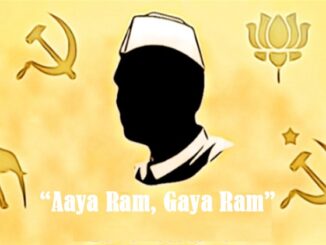
Political parties sometimes break up like marriages, and like remarriages, individual legislators switch parties. In both cases, the consequences can be severe. When individual legislators or a group decide to leave a party, form another party, or join another party, it could have repercussions in terms of government formation, maintenance, and termination. In Maharashtra, recently, and in Madhya Pradesh, a while ago, splits in the ruling party and a subsequent realignment of legislators inaugurated new governments.
Distinct waves
Splits and switches are commonplace in legislatures across the globe, and India has witnessed at least three distinct waves. The first wave occurred towards the latter half of the 1960s when challengers to the Congress attempted to displace it in the States. There was literally great shoving and pushing and a quick turnover of governments due to the free movement of legislators across political parties. The next phase was inaugurated with an attempt to end the free movement and regulate the behavior of legislators through the anti-defection law. While the law discouraged individual movement, it incentivized a collective movement of legislators since it laid down specific numbers to legitimize and validate party switches. When legislators switch in groups, the costs are shared, and the move also appears less opportunistic, which in many ways defeats the purpose of the legislation. Though the law has placed hurdles before splits and switches, the activity has continued. To make matters worse, the implications of the law now influence the strategies of legislators and parties.
The third phase was inaugurated in 2014 with the Bharatiya Janata Party (BJP) on the ascendance when already-dominant parties began to use splits and switches to weaken and destroy their competitors. Aided by friendly Governors, the BJP, like the Congress did earlier, benefited from a string of governmental changes, including Arunachal Pradesh (2016), Bihar (2017), Karnataka (2019), Madhya Pradesh (2020), and Maharashtra (2022), which were brought about by legislators switching sides. In Puducherry (2021), switches led to fresh elections, bringing a BJP alliance to power. In Goa (2022) and Manipur (2017), though the Congress was returned as the single-largest party, it was outmaneuvered by the BJP soon after. It was only in Uttarakhand that a Supreme Court of India intervention saved the Congress government.
A regional example
It is not the BJP alone, as around the same time, ruling parties had a field day in Telangana and Andhra Pradesh. In Telangana (2014), the Telangana Rashtra Samithi (TRS) decimated the Congress and the Telugu Desam Party (TDP) by encouraging shifts. In 2018, the Congress again crumbled under pressure. Likewise, in Andhra Pradesh, first, the TDP did the same to the Yuvajana Shramika Rythu Congress Party (YSRCP) after 2014, and subsequently, when the YSRCP came to power in 2019, it paid the TDP back in the same coin. In all these cases, the ruling party already had a comfortable majority of its own and did not necessarily need additional support.
Therefore, the current phase is bizarre when compared to the past because dominant parties appear to be actively cheering splits and shifts and having no respect for the basic rules of the game. The anti-defection law and control of institutions are now weaponized by dominant parties to intervene in the internal working of Opposition parties, and sometimes make and break them. Furthermore, legislators are switching support even if it does not count to the making or maintenance of governments.
A perspective
So, what do we make of the splits and switches? Much of our discussion is dominated by the morality of splits and switches, and this revolves around the damage it causes to the foundations of representative democracy. And these are undoubtedly reasonable arguments. First, switchers violate the trust relationship with their constituents as voters get something other than what they bargained for. Second, assuming voters vote for parties and not candidates, the argument is that uncohesive parties make it difficult for voters to draw definitive lines of responsibility. Consequently, it is difficult for voters to hold party governments accountable for their actions during elections.
Despite sound arguments about the despicable nature of splits and switches, they continue to happen routinely. The question then arises: Why do legislators split from and switch parties without fearing the negative connotations? We cannot answer this question as long as our perspective of political parties is dated. While we keep track of party system change, we ignore the point that the component parts, parties which make up the system, too, change and transform. Our conceptualization of parties is static and is drawn from an era long gone by. Parties constantly adapt new modes to sustain and find success for themselves.
Our popular image of a party is that of the classical mass party, which rises from societal movements and is essentially internally democratic. They are linked to mass organizations and groups that share a common goal encompassing different dimensions of societal life. The leadership comes from the organization, is accountable to it and is committed to the goal. Our normative posturing comes from this ideal type. This is what even the Election Commission of India imagines a party should be since many of its guidelines lay stress on the ‘democratic spirit’ and the need for transparency and participation in internal decision-making.
However, in reality, parties are anything but this. While they mobilize and compete around identity and group solidarity issues such as mass parties, the internal democracy element is missing, and their links with society and mass organizations are at best tenuous. Today’s parties are centralized vote-getting machines which primarily work to ensure the return of political leaders to office. Mass inputs and ideas do not matter, and it is the central leadership that counts. All party activities begin and end with elections.
In this model, it is not surprising that paid professionals occupy a central place. They pick strategies, run campaigns and are sometimes involved in ticket distribution. New forms of communication and campaign methods have displaced traditional campaign modes. Consequently, the vast pool of voluntary unpaid laborwhich traditionally formed the backbone of parties and linked parties with the grass roots are no longer as closely involved as they were in the past.
Leaders are “elected unanimously” and party conferences are choreographed events where ordinary members meet and greet leaders. These events are used to enhance the profile of the leadership elite and are indeed not a forum for intra-party debate and discussion. Since parties are mainly concerned with electoral success, anyone who enjoys the confidence of the top leadership and can help increase the seat share is likely to get a ticket. Moreover, we now know that parties prefer candidates who bring in their own money, fund other candidates and raise resources for the party. All this puts the party on the ground in the shade.
New alignment
Finally, the most significant change is that parties are more closely aligned with the state rather than civil society. Parties exchange material and psychological rewards, and goods and services the state provides for electoral advantage. Voters also see parties as a supplier of services. This connection pushes legislators and parties to be in government or at least close to the government. This was one of the most common reasons for Members of Legislative Assemblies who switched parties in the two Telugu-speaking States. As a corollary to this shift, the party has become a shadow of what it once was and has been reduced to an instrument to defend policies and programs of the government.
On the supply side, the party on the ground no longer calls the shots; parties are election vehicles and a supplier of services. The party bond exists only as long as it ensures success for the legislator. On the demand side, the voter does not appear to have any problem, whether it is ‘A’ or ‘B’, as long as “services” are available. Consequently, splits and switches are not seen as objectionable by legislators and are not punished by voters as well. Legislators will, therefore, be willing to do anything if the benefits exceed the costs.
(The author is with the Department of Political Science, University of Hyderabad)
“Apart from all the political maneuvering, one needs to look at the story of the Adivasis and make one’s own conclusions whether this nomination by BJP is part of a genuine effort to recognize the aspirations of a backward community or simply a charade slyly weaponizing its diversity, equity, and inclusion program. The upper caste politics have long realized that they can no longer control the people under ‘Chaturvarnya,’ the caste system. Today’s Hindutva agenda includes carefully crafted strategies to attract Scheduled Castes and Scheduled Tribes into their fold.”
By George Abraham
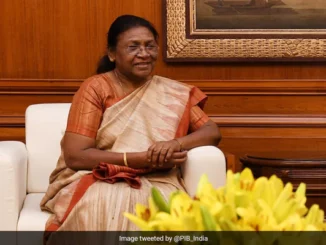
It is almost a foregone conclusion that Draupadi Murmu will be the next President of India. She belongs to the Scheduled Tribes and hails from the Santhal community in the district of Mayurbhanj in Odisha. When elected, she will be the first tribal woman to be the President of India. It is indeed a triumph for the community, and she deserves all the accolades that come her way. However, one cannot help but be dismayed by the blatant politics the BJP has employed to elect their favored candidate. BJP clearly lacked the necessary votes to elect someone outright. It is believed that they might be short of 2% votes to get their candidate over the hump. In the meantime, the divided opposition parties tried to line up behind a single candidate. A united opposition might have thwarted the BJP’s desire not to have a consensus candidate. However, with the selection of Murmu, the BJP appeared to have outplayed the opposition.
The selection of a Tribal candidate has just disarmed the opposition and has placed them in a precarious position, where any criticism could be construed as anti-tribal, anti-woman, or even anti-poor. Biju Janata Dal (BJD) has declared their early support stating that Murmu belongs to Odisha while expressing their pride and joy on the nomination. The selection has forced the Jharkhand Mukti Morcha (JMM) Hemant Soren to announce support for Draupadi Murmu, calling it a proud moment for tribals. Even Mamata Banerjee’s commitment to the opposition unity in this regard may be in doubt. As the opposition is in disarray and the support for Yashwant Sinha is fast vanishing, the die is cast that she will emerge victorious on the voting day. Apart from all the political maneuvering, one needs to look at the story of the Adivasis and make one’s own conclusions whether this nomination by BJP is part of a genuine effort to recognize the aspirations of a backward community or simply a charade slyly weaponizing its diversity, equity, and inclusion program. The upper caste politics have long realized that they can no longer control the people under ‘Chaturvarnya,’ the caste system. Today’s Hindutva agenda includes carefully crafted strategies to attract Scheduled Castes and Scheduled Tribes into their fold.
Sri Aurobindo’s lights on the system of Indian culture compiled the following, “There are, first and highest, the man of learning and thought and knowledge; next, the man of power and action, ruler, warrior, leader, administrator; third in the scale, the economic man, producer and wealth-getter, the merchant, artisan, cultivator: these were the twice-born, who received the initiation, Brahmin, Kshatriya, Vaishya. Last came the more undeveloped human type, not yet fit for these steps of the scale, unintellectual, without force, incapable of creation or intelligent production, the man fit only for unskilled labor and menial service, the Shudra.” The BJP certainly realizes that they need the votes of the last category to attain and keep them in power. That begs the question of whether the RSS-BJP’s effort is simply vote-bank politics or points to a genuine transformation from their original feudalistic-caste designs. Their record speaks an entirely different story. BJP’s idea of “sabka Saath, sabka vikas” runs entirely contrary to the tribal interests and their wellbeing as they are repeatedly told they must sacrifice their lands and resources for other people’s vikas. Media reports state that under the BJP rule in Chhattisgarh, 2003-18, villages were burnt, and thousands were killed in Salwa Judum and subsequent operations. The forest act of 2006 has been further diluted by the Modi regime, making the Scheduled tribe consent the last requirement for forest diversion to industry rather than the first.
For long the Modi Government has wanted to diminish these rights in favor of corporates or other vested interests. In May 2016, the BJP Government passed two legislations that enabled the transfer of tribal land to commercial interests. That legislation set in motion a struggle (Pathalgadi movement) between the tribal people and the government, resulting in a brutal crackdown by the authorities. Moreover, the movement was branded as anti-national, and hundreds of people were arrested and charged under the sedition laws. The government went a step further and linked the movement to ‘Maoists,’ which is labeled as anti-national and dedicated to the overthrow of the elected governments.
At this point, it is worth remembering the late Fr. Stan Swamy, who has been a vocal critic of the government policies and defender of the tribal rights over these lands. Sadly, he died in prison awaiting trial, being charged with plotting the government’s violent overthrow. To bolster their case, NIA, in their charge sheet, accused Fr. Stan as responsible for the violence in Bhima Koregaon in Maharashtra in 2017. He was not present at the rally celebrating British and Dalit forces’ victory over Brahmin Peshwas. Bhima Koregaon was an incident where Dalits were taught another lesson for daring such a celebration.
Historically, the BJP/RSS strategy resisted real enlightenment for the oppressed people. The feudalistic and casteist mindset under which they operate detests any individual or group that educates and inspires people from those impoverished conditions of their rights and privileges. Their anti-conversion campaign is often seen as camouflage to prevent the Tribal population from ever learning of their true worth as human beings but condemning them forever in a subservient role to the upper echelons of society. What Fr. Stan has done was to help this vulnerable population demand equal justice and freedom from servitude.
The RSS also refuses to recognize the Adivasi religion as distinct and deserving of the nation’s respect. Those who have been converted to Christianity often suffer attacks on their worship places. What happened to Fr. Stan Swamy is a harsh reality in today’s India and a lesson to anyone who dares to defend the rights of the Adivasis. Some would argue that RSS fronts like Vanavasi Kalyan and Vidya Bharati run schools filling a critical need. But in the process, the Adivasi children are converted into Hindutva followers and foot soldiers against Muslims and Christians, as in Gujarat in 2002 and Kandhamal, Odisha, in 2008, respectively. It has also been said that Adivasis in prisons are much higher than their percentage of the population.
To her credit, as Governor of Jharkhand, Murmu returned bills proposed by the BJP government that aimed at changing the land tenure legislation – CNTA (Chhota Nagpur Tenancy Act) and SPTA (Santhal Pargana Tenancy Act), which were intended to make it easier to take over the Adivasi land. However, under apparent pressure, she passed the anti-Adivasi changes in the Land Acquisition Act and the Freedom of Religion bill 2017, which criminalizes conversion. She appeared to be only a pawn in the BJP’s political game than a conscientious defender of the rights of her own people. Fr. Stan Swamy may not belong to the Adivasis; however, his legacy in defense of those impoverished and defenseless people will outshine forever any tokenism employed by the current regime.
(The author is a former Chief Technology Officer, the United Nations, and is Vice Chairman of the Indian Overseas Congress USA. He can be reached at gta777@gmail.com)
ELMONT, NY (TIP): The Indian Christian Day (Jesus Bhakti Divas) organized to celebrate the Indian heritage and Christian spirit to show solidarity with persecuted Christians in India, has made history. As Christians from all Indian states gathered, read the Bible in their own language and sang prayer songs, it became a bright union of fervent faith. The program was attended by Indian Christians from New York, New Jersey, and Connecticut. The event was organized by the Federation of Indian American Christian Organizations of North America (FIACONA), a forum of Christian organizations in response to the insidious attempts to alienate and attach the Christians through the propaganda that the Christian faith was left behind by British colonialism in India, despite its two thousand years of tradition. The event also coincided with the 1950th anniversary of the martyrdom of Saint Thomas. Historically, July 3rd is celebrated as St. Thomas day by Christians across India. However, starting from 2021, the day is being celebrated as Indian Christian Day in India and among the global Diaspora of Christians. In the United States, it is estimated that Christians from India constitute about 20% of the Diaspora, which amounts to close to a million non-resident Indians and people of Indian origin.
The gathering, which was blessed with the presence of bishops and priests from various churches, began with a chendamela and a procession. St. Vincent de Paul Malankara Catholic Church in Elmont became a platform for Christian unity. The conference started with the bishops lighting the lamp as a symbol of Indian heritage and patriotism. Fiacona President Koshy George pointed out in his welcome speech that our established belief is that Saint Thomas has brought the gospel to India and was martyred in AD 72. To mark its 1900 years, the government of India issued a postage stamp in 1972. So, this year marks the 1950th anniversary of the martyrdom of Saint Thomas. Mr. Koshy also expessed his deep concern growing persecution of Christians in India as the fundamental religious freedom guaranteed under India’s constitution is no longer guaranteed under the BJP rule under the Indian Courts’ eyes. Last year alone 761 cases of persecution have been identified which have been published in a book form by FIACONA. He said that the purpose of the meeting is to express our pain against such atrocities. Rt. Rev. Dr. Dharmaraj Rasalam, the Moderator of the Church of South India, spoke about how the arrival of St. Thomas not only impacted the lives of Christians and paid tribute to the sacrifices of the Christian community to the nation in uplifting the poor and oppressed. Rev. Dr. Ruben Mark, the Deputy moderator Bishop spoke about the love Indian Christians in the Diaspora have for India and encouraged them to continue with the unity they have exhibited at the gathering. He described how the arrival and activities of St. Thomas influenced India. The work of St. Thomas is crucial in the Christian faith. He also extolled the diaspora’s love for India. He said that we are proud to be Indian Christians. He said the willingness to sacrifice for the faith was part of the Christian faith. Despite being a persecuted community, Christians are not united. But today, all the sects of Christians are happy to attend this event.
Bishop Johncy Itty, Bishop of the Episcopal Church in Long Island, New York, said that India, along with the rest of the world, is going through a serious crisis today. However, our faith should sustain us in such a time as this. He pointed out that India and the world are in various conflicts. There is no time in life without conflict. But now it is too much. But God leads us by the hand. We may not be able to change the times, but we can make changes. Rev. Dr. Itty Abraham of the Indian Pentecostal Church, in his speech, encouraged Christians to be steadfast and said, “It is Christ that built the Church, and no forces would be able to undo it. The propaganda to paint Christianity in India as part of the colonial legacy is ill-conceived and will not gain footing.” Father John Thomas representing Orthodox Church, urged his fellow Christians to follow the path of St. Thomas in taking the message of Christ across the people.Christ had many followers. But in the end only a few remained. Faithful men like St. Thomas did not hesitate to sacrifice themselves. The situation can be dire. But trust in God. Let the cross of Jesus guide us, he said. The persecution against Christians is increasing Rev. Dr. Itti Abraham pointed out. But it won’t break us. Christ builds the church. No evil shall prevail against it. Jesus himself said that there will be such persecutions. In such situations, we need to move forward with unity. He said that it is wrong to think that the Indian Christianity is a faith arisen from British colonialism.
CSI Church General Secretary Adv. Fernandez Rathinaraja pointed to Saint Thomas as a social reformer. It was work against human sacrifice and caste system that led to his martyrdom. Secularism is enshrined in the preamble of the Indian Constitution. There have been concerted efforts to undermine it. Religion should not be a part of political life. The state should be neutral in religious matters. Protests against these are taking place in the states of Tamil Nadu, Andhra and Kerala. He pointed out that the administration is able to suppress the voice of protest in other states. Fr. John Thomas pointed out that we should be able to preach the gospel and bear witness like St. Thomas. Bishop Mar Joy Alappatt who has just been elevated to the head of Syro Malabar Eparchy of Saint Thomas the Apostle of Chicago expressed his thrill to participate in the program which he thought he had participated in ecumenical functions in New York and Chicago, this was the first time he was participating in one of this kind. just been elevated to the Bishop of the Syro Malabar diocese of Chicago. This gathering on St. Thomas Day is significant. We become Christian people through the mission work of Thomas. The contribution of Christians to the development of India is inestimable. We are saddened that Christians are being persecuted not only in India but all over the world. Prayer is our weapon against it. Christian faith strengthens us for martyrdom. Jesus himself has said that there will be such persecutions. But He has also assured that He will always be with us. So don’t be afraid. We do not hesitate to suffer. But persecution caused by injustice is unacceptable. We must question it. Through his own life and death, Thomas has shown us the way. So, we must strengthen our faith.
Saint Thomas is one of the strongest characters in the Bible. Especially in the Gospel of John. St. Thomas is mentioned there three times. In Chapter 11, Thomas arrives to comfort Martha and Mary’s family. They are mourning the death of their brother Lazarus. Thomas forces Jesus to visit Bethany. Thomas also witnessed a miracle when Jesus came. We see the bravery of St. Thomas in the Bible. But today’s Christians have lost that courage. We dare not bear witness to Christ.Likewise, we must strive for our unity should be willing to testify to Christ with prayer – he said. The General Secretary of Church South India, in Chennai, Adv. Fernandas Rathaniraja, in his speech, warned the audience about the concerted efforts vested interests are making to remove the word secularism from the constitution and transform India into a Hindu Rashtra and urged vigilance.George Abraham, one of the leading organizers of the program began his vote of thanks by repeating from Bible “how good andpleasant it is when God’s people live together in the unity”. He said that we have witnessed an extraordinary manifestation of unity, unit of Christians from India, across regions and languages despite the denominational differences. The program was enriched Bible readings in Malayalam, Telugu, English, Tamil, Punjabi, Kannada, Hindi, and Gujarati and prayer songs by choirs from Saint Mary’s Syro Malabar Catholic Church, St. Paul’s International Lutheran Church, CSI Jubilee Memorial Church, Immanuel Lutheran Church, and Bethlehem Punjabi Church. A group of nurses from Saint Mary’s Syro Malabar Church entertained with a Marggam Kali, a traditional Christian dance from Kerala. The program was moderated by Shre John and Leno Thomas.
Projecting Droupadi Murmu’s nomination as the National Democratic Alliance’s (NDA) presidential candidate as a testament of its inclusive politics, the Bharatiya Janata Party (BJP) is hopeful that it will consolidate its position and address a perceived leadership deficit among tribal communities. Murmu is a tribal leader from the Santhal tribe in Odisha.
Tribal communities that make up 8.6% of country’s population are an important constituency for the BJP that banks on a coalition of castes, especially the socially and economically marginalised communities, to cement its votebank. The party’s ideological mentor, the Rashtriya Swayamevak Sangh (RSS) has over the years focused on building networks with tribal communities, which it fears are vulnerable to proselytisation by non-Hindu faiths.
Meanwhile, opposition’s presidential candidate Yashwant Sinha asserted on Thursday that as a former Union minister he has done “much more” than his NDA rival Droupadi Murmu for Scheduled Tribes and other disadvantaged communities and questioned her record for their welfare in her various positions including as Jharkhand governor.
Right now, India’s global reputation as a viable Democracy and a Secular nation is under scrutiny as it has descended into a major milestone of steep descent into darkness of bigotry and Islamophobia. Modi that is known to invoke values of pluralism abroad, has remained silent as Indian democracy is humiliated with international backlash. It looks like Modi has successfully externalized his domestic agenda of targeting minorities, especially the 205 million Muslims with impunity and hate speeches, and with official sanctions. Prime example is Anurag Thakur who was elevated from a Junior Minister to Independent Minister after he made a remark in Jan 2020 targeting Muslims for protesting against Citizenship (Amendment) Act, “Desh ke gaddaron ko, goli maaro saalon ko (Shoot the traitors of the country)”
By Dave Makkar
For the first time in the 75 years history of Independent India, the government headed by BJP’s Modi is on the biggest diplomatic firefighting mission of apology to 15 Majority-Muslim nations and 57-member Organization of Islamic Cooperation (OIC) and the Gulf Cooperation Council (GCC) over the derogatory remarks made on Prophet Mohammed by leaders of the ruling BJP. This time it was not just Indian Muslims speaking out and protesting on the streets all across India but on June 5, 2022 the governments of Qatar, Kuwait, Oman, Iran, Saudi Arabia, Jordan, Libya, Turkey, Maldives, Iraq, Indonesia, United Arab Emirates, Bahrain, Pakistan and Malaysia issued stinging statements condemning the comments. Some countries are demanding written apologies besides calling the Indian Ambassadors to register their protest. In some countries, there were massive street protests, and in Qatar, “Boycott India” campaign was also trending on social media.
Dinner to be hosted by Deputy Emir of Qatar for India’s VP Venkaiah Naidu was cancelled. VP Naidu was on a 3-day state visit to Qatar. Qatari Minister of State for Foreign Affairs Al Muraikhi warned in a statement that “insulting remarks would lead to incitement of religious hatred and offend more than 2 billion Muslims around the world.”
In response to this diplomatic row, the Indian embassy in Doha released a statement insisting that the comments were made by “fringe elements” and “do not, in any manner, reflect the views of the Government of India”.
The 57-member OIC . condemned the remarks and said it came in a “context of intensifying hatred and abuse toward Islam in India and systematic practices against Muslims.” OIC also urged the United Nations to take necessary measures to ensure that the rights of minorities are protected in India. The Spokesperson for UN Secretary-General Antonio Guterres has called for a halt to any sort of violence, especially the one based on perceived religious differences and hatred, amidst protests in India over the controversial remarks against the Prophet by two now-suspended BJP leaders.
This gigantic diplomatic backlash comes on the heels of US Secretary of State Antony Blinken naming India while releasing the State Department’s International Religious Freedom Report (USCIRF) on June 2, 2022. Blinken said: “in India, the world’s largest democracy and home to a great diversity of faiths, we have seen rising attacks on people and places of worship.” Rashad Hussain, the Ambassador-at-Large for IRF called out the Indian government officials, who he said are “ignoring or even supporting rising attacks on people and places of worship.” The report also mentioned several Hindu extremist leaders; like Yati Narasinghanand, Maa Annapurna Bharti, Swami Paramatmananda, and BJP’s UP CM Yogi Adityanath, a close ally of PM Modi.
USCIRF has recommended U.S. Government to designate India as a “country of particular concern,” or CPC, for engaging in and tolerating systematic, ongoing, and egregious religious freedom violations, as defined by the International Religious Freedom Act (IRFA); Impose targeted sanctions on individuals and entities responsible for severe violations of religious freedom by freezing those individuals’ or entities’ assets and/or barring their entry into the United States.
“Desh ke gaddaron ko, goli maaro saalon ko (Shoot the traitors of the country)”: Anurag Thakur, Sports Minister of India.
Right now, India’s global reputation as a viable Democracy and a Secular nation is under scrutiny as it has descended into a major milestone of steep descent into darkness of bigotry and Islamophobia. Modi that is known to invoke values of pluralism abroad, has remained silent as Indian democracy is humiliated with international backlash. It looks like Modi has successfully externalized his domestic agenda of targeting minorities, especially the 205 million Muslims with impunity and hate speeches, and with official sanctions. Prime example is Anurag Thakur who was elevated from a Junior Minister to Independent Minister after he made a remark in Jan 2020 targeting Muslims for protesting against Citizenship (Amendment) Act, “Desh ke gaddaron ko, goli maaro saalon ko (Shoot the traitors of the country)”
After assuming power in 2014, Modi has been allowing rather encouraging without punishment; Islamophobic remarks by members of his government, his Party BJP, state governments under BJP, Hindu organizations, Media & educational institutions. In all the BJP ruled states Muslims & Christians are openly being denied basic human rights, right to justice as well as right to worship. Muslims, especially male and female student leaders & activists are maliciously prosecuted under the directions from BJP ruled states or Modi’s central government. They are beaten & lynched in broad daylight. Muslim Houses are demolished in (Israeli style) Collective Punishment for valid protests termed as riots or turned into riots by BJP or RSS or other Hindu organizations or as unauthorized structures even if they are there for 30-40 years & some have government documents. Hindu owned houses with similar or worst status in the same vicinity are left untouched. On social media, female Muslim journalists, activist and social workers have been ferociously trolled and issued threats of the worst kind, including rape. Muslim women have been put up for sale in fake auctions. Islamophobic memes and hashtags, taunting and tainting Muslims in India has become the norm.
Also, since 2014, Islamic structures including Mosques are being targeted under the excuse that they were built 5-9 centuries ago after demolishing Hindu Temples. UNESCO World Heritage Sites like Taj Mahal, Jama Masjid, Qutub Minar etc. are being disputed as built on Hindu temples. BJP ruled Karnataka that is referred as “Silicon Valley of India” has gone one step further and started doing surveys of Christian Churches also to establish if they were built after demolishing Hindu temples. Whereas “The 1991 Act says that a mosque, temple, church or any place of public worship in existence on August 15, 1947, will retain the same religious character that it had on that day – irrespective of its history – and cannot be changed by the courts or the government”.
Fringe elements? Home Minister Amit Shah, Prime Minister Narendra Modi, Chief Minister of UP Yogi Adityanath.
Modi’s government has maintained a studied silence or at the most has always blamed “fringe elements” for such actions. They do not hesitate even to include their own National Spokesperson currently Chairman of Tourism Department, “Sambit Patra as Fringe Element”. All this appears to have emboldened ordinary Hindus to beat Muslims in public, go online and tarnish Muslims with impunity. They publicly cry about being the victim and think they are entitled to revenge for what happened from 7th to 17th century. This itself constitutes a grave danger to the protection of human rights and may lead to further prejudice and marginalization, which will create a cycle of violence and hate against Indian Muslims including public lynching.
Role of Indian Media in spreading Islamophobia in India:
The Godi Media of India
Prime Time debates in India since 2014 have become a platform to encourage Hindu hate mongers to speak ill about other religions. The anchors encourage hatemongering and allow BJP or RSS or other Hindu organizations spokesperson to speak rubbish that is corrupting the moral and social fiber of the society and can incite violence against believers of other religions.
These media houses are called as Modi’s Godi(lapdog), bikau (saleable), dalal(agent) and bharkau(inflammatory) Media This is how a major section of India’s mainstream media is labelled by most Indians, especially Muslims, Christians and low-caste Hindus, opposition parties, as well as ½ a dozen national media — all because of their brazen support for the ruling party BJP, its ideological parent RSS and the government.
Their journalists and anchors routinely engage in spreading hatred towards the country’s 205 million Muslim population and Islam, thus nourishing Islamophobia. They also demonstrate a clear bias against the country’s low-caste Hindus, the poor, and less privileged and weaker sections of society. They openly favor the rich and powerful that owns or finance their channels. Shamelessly they promote Hindutva & Hindu Rashtra– an ideology that seeks to establish the hegemony of Hindus and the Hindu way of life — spearheaded by Rashtriya Swayamsevak Sangh (RSS), its ruling political front Bharatiya Janata Party (BJP). Any criticism of the BJP is narrated as “anti-nationalist” and any individual challenging or demanding answers from the party is labelled “anti-Indian”.
Here is Media ranking in descending order in spreading Islamophobia in India:
Republic TV- co-founded and majority-owner Arnab Goswami is the channel’s editor and news anchor. Known for opinionated reporting in favor of BJP & RSS and their Hindutva-Hindu Rashtra agenda including uncritically reproducing government narratives, avoiding criticism of BJP/RSS figures, and presenting their political opponents in a negative light. He shamelessly shows his bias. He is the King; “No one can beat him in spreading hatred against Muslims and fake news”. On top of that no one can match him in shouting contest.
CNN News 18 owned by Poster Boy of Gangster Capitalism, billionaire Mukesh Ambani. A supporter & 2nd top financier of Modi, RSS, Hindu Rashtra; owns 65 channels: English, Hindi and 14 regional language news, business, entertainment, music, movies, youth, Kids, factual entertainment and shopping channels. Its star news anchor Amish Devgan is a Clone of Republic TV’s Arnab in shouting and arrogance, and routinely indulges in Muslim bashing and spreading fake news.
Aaj Tak – Owned by Arun Purie’s India Today Group, Aaj Tak has three of the worst Islamophobic anchors in the Indian media — Anjana Om Kashyap, Rohit Sardana and Sweta Singh. They are notorious for their vitriolic attacks against Muslims and spreading communal hatred. They routinely indulge in Muslim bashing, while show deferential surrender to anything the BJP does.
India Today (English) Also owned by Purie’s India Today Group with main anchors Rajdeep Sardesai and Rahul Kanwal. Rajdeep is mildly anti-BJP and a bit critical of Modi. Rahul Kanwal in 2020 became a full-time supporter of Modi, BJP & RSS and its ideology after a punishment for being openly critical of Modi.
Wion (World is One News) – operated by Essel Group, owns nearly two dozen Zee channels (some of them merged with Sony TV in Feb. 2022). Its chairman Subhash Chandra was a BJP supported Rajya Sabha MP till June 11, 2022. He has been promoting its Hindutva aka Hindu Rashtra agenda and anti-Muslim tirades. His star prime time news anchor Sudhir Chaudhary was jailed for demanding bribes for not publishing news; is also the editor-in-chief. He is the Hindi version of Republic TV’s Arnab as he openly supports the BJP, RSS and Modi.
Times Now- owned by Pro BJP/RSS Sahu Jain family of Times of India News paper’s Group. Rahul Shivshankar Editor in Chief, Navika Kumar Gp Editor; openly support BJP and RSS by promoting its Hindutva aka Hindu Rashtra and anti-Muslim agenda
India TV – Founder Rajat Sharma and his wife Ritu Dhawan. Rajat was a member of ABVP (Student Wing of RSS) & very close friend of late Arun Jaitley, the most corrupt Modi’s BJP Finance Minister in the history of India. He openly supports BJP and RSS by promoting its Hindutva aka Hindu Rashtra and anti-Muslim agenda.
ABP News – Owned Pro BJP Aveek Sarkar of Anandabazar Patrika Group. It used to be neutral, but it turned pro-BJP a couple of years ago. after the Modi government objected to criticism of the BJP and Baba Ramdev by its star journalists Punya Prasoon Vajpayee and Abhisar Sharma. Both were fired and Rubika Liyaquat joined to replace them to became the commander-in-chief of its news anchors. A Muslim, with angry rhetoric against Muslim leaders and do not allow any criticism of Modi or BJP or RSS or their policies.
Republic Bharat — This sister channel of Republic TV is funded by the BJP and RSS. Its anchor Sucherita Kukreti, a female version of Arnab Goswami in shouting and spitting the venom of hatred against Muslims.
Sudarshan News — Its chairman, Suresh Chavhanke, knowingly disseminates anti-Muslim content and manufactures fake news with communal overtones, which has earned him titles such as “bigot” and “dangerous”. He was a long-term RSS volunteer and associated with ABVP. And prefers that the news programs over his channel be viewed as opinionated campaigns.
News Nation – Deepak Chaurasia, the consulting editor of this channel, which is owned by News Nation Network, is known as a “puppet” of Modi. He always makes fun of all the political parties except the BJP and its allies. He is notorious for his over-the-top coverage of news issues and for being uncritical of the BJP government.
News24 (India) – Owner B.A.G. Films and Media, promoters are Anurradha Prasad, sister of BJP Union Minister R S Prasad, along with her husband, Pro BJP Congress politician Rajeev Shukla.
Ethnic Indian media in USA
Unfortunately, 97% of the Ethnic Indian media in USA are like their counterparts in India. Their anchors are no less than Arnab Goswami or Amish Devgan or Sudhir Chowdhary or Navika Kumar or Anjana Om Kashyap etc. when it comes to spreading Islamophobia and fake news while promoting BJP & RSS’s Hindutva & Hindu Rashtra agenda in USA.
A glance over the few important Islamophobic incidents in last 31/2 years that has led to the unprecedented international outcry against India for the Islamophobic comments made by ruling party BJP’s 2 senior leaders about Prophet Muhammad.
June 2018, Michelin-starred chef Atul Kochar was fired from JW Marriott Marquis, Dubai after he tweeted that followers of Islam had “terrorized” Hindus for 2,000 years.
Sep. 2018 in a public meeting, India’s Home (Interior) Minister Amit Shah compared the illegal Bangladeshi Muslims migrants with “Termites”.
April 2019 Home (Interior) Minister Amit Shah in an election rally again said, “Infiltrators are like termites in the soil of Bengal.” “A Bharatiya Janata Party (BJP) government will pick up infiltrators one by one and throw them into the Bay of Bengal,” referring to illegal Muslim immigrants from neighboring Bangladesh.
April 2019, BJP’s Communal & a Criminal Hindu Priest CM Adityanath Yogi of UP the most populous state of India, spoke about a “green virus” in an election speech in reference to Muslim voters who he said were being wooed by opposition parties. In another election speech he referred Muslims as the “Taliban”
April 2019, BJP MLA Mayankeshwar Singh from UP’s Siddharthnagar in an election speech threatened Muslims with bodily harm for effectively just existing. “If Hindus in Hindustan wake up the beard will be pulled and made into a choti (a tightened braid). If you have to live in Hindustan you have to say ‘Radhe’ (chant Hindu God’s name), else, like those who went to Pakistan during the partition, you can go too… you have no use here,”
Dec 2019, PM Modi made a Islamophobic remark targeting Muslims protesting over Citizenship (Amendment) Act (CAA); “those indulging in arson “can be identified by their clothes”.
Feb. 2020, Modi’s Junior Minister Anurag Thakur while leading a pro CAA and National Register of Citizens (NRC) rally called a slogan, “Desh ke gaddaron ko, goli maaro saalo ko (Shoot the traitors of the country)” targeting the ongoing Muslim women’s 24X7 sit in protest against CAA & NRC at Shaheen Bagh, Delhi. After Thakur’s rally, the city saw deadly communal riots which left 53 dead and 700 injured – majority of them Muslims. Shaheen Bagh protest (Dec 15, 2019 to March 24, 2020) was a peaceful sit-in protest in Delhi lead by women only. Anurag Thakur was rewarded and elevated to a Minister with independent charge in July 2021.
Nov. 9, 2019, Travesty of justice in Babri Masjid vs Ram Janma Bhumi; in a unanimous verdict the Supreme Court of India under CJ Ranjan Gogoi who was retiring on Nov. 17, 2019; awarded the land of disputed Babri Masjid to Hindus. However, the court added that the demolition of the Babri mosque was against the rule of law but do not propose any prosecution for those responsible for the demolition; basically acquitting all the 49 accused high ranking leaders of instigating the mob. Babri Masjid was built in 1528-29 and demolished by the Hindu mob under the top leadership of BJP, RSS, VHP & other militant Hindu organization in 1992. It led to riots in different parts of India that killed nearly 2,000 people. All the Hindu organizations led by BJP had started instigating the Hindus from 1989 to demolish the Mosque by making them believe that the land is the “Birthplace of Lord Ram”. On the other hand, Hindu scriptures say that “Kan Kan mei Vyape hein Ram” meaning “Lord Rama permeates every atom of this universe”. Ever since the Modi-led BJP came to power in 2014, India has seen deepening social and religious divisions. The demand for Ram Janam Bhumi became louder and clearer. Chief Justice Ranjan Gogoi was rewarded by Modi regime in March 2020 by making him Rajya Sabha (Upper House of Parliament) member after awarding a verdict in favor of Hindus in Dec 2019.
April 2020, BJP MP Tejasvi Surya landed in a row for a tweet he had posted in 2015 with an “objectionable and disrespectful” comment about Arab Women. “95 percent Arab women never had orgasms in last few hundred years: Tarek Fatah.” Prominent businesspeople, lawyers and commentators in Dubai and Kuwait condemned his remarks. He deleted the tweet.
April 2020, When Indians living in Dubai began posting anti-Tablighi Jamaat congregation in Delhi as a supper spreader of Covid, Princess Hend Al Qassimi warned that “anyone that is openly racist and discriminatory in the UAE will be fined and made to leave”. Under Modi’s Home Minister Amit Shah, attendees of Tablighi Jamaat congregation in Delhi were accused of spreading the Covid-19 virus. Criminal cases were registered against several attendees including foreign nationals in the courts across India. in August 2020, the Bombay HC quashed three FIRs against 35 petitioners – 29 of them foreign nationals. The court observed: “A political government tries to find the scapegoat when there is pandemic or calamity and the circumstances show that there is probability that these foreigners were chosen to make them scapegoats. Some of the charge sheeted Muslims neither attended the Delhi congregation nor were they inclined to the Tablighi ideology, as evidenced in the case of eight charge sheeted individuals, whose case was dismissed by the Delhi’s Saket district court on 25 August 2020. The SC CJ Sharad Bobde observed “evasiveness” in that the Government of India’s affidavit filed in response to petitions challenging the discriminatory and communal coverage of the Tablighi Jamaat incident by some sections of the media. He termed it as “unnecessary, nonsensical” averments. On 16 December 2020, Chief Metropolitan Magistrate of a Delhi Court, Arun Kumar Garg, acquitted the 36 foreign nationals from 14 countries of all the charges levelled against them.
August 2021, BJP leader and Supreme Court lawyer Ashwini Upadhyay made anti Muslim slogans including calling for Muslims to be murdered, in a rally in favor of the uniform civil code, at Jantar Mantar, Delhi.
Sep. 2021, BJP’s UP CM Adityanath Yogi in a public rally said that prior to his government’s formation in 2017, the ration (subsidized food grains) meant for the poor would get ‘digested’ by those who utter “Abba Jaan” as a communal reference to Muslims. In several parts of India, Muslims use the phrase “Abba Jaan” to refer to their fathers or as an endearment.
Oct. 2021, Uttarakhand BJP president Mandan Kaushik told the media, “Our party line is clear that no [religious] conversion [from Hinduism] will be tolerated.”
November 2021,BJP Leader Ashwini Upadhyay was featured on a panel on the imaginary bogey of ‘thook jihad (spit jihad).’ where he said, these thook (spitting) jihadis are either being taught all this by their parents or at their madrassas (schools).” He even suggested that Muslim men may be mixing other body fluids in the food they prepare for sale to Hindus.
December 2021, Upadhyay was a notable BJP presence at the now-notorious Dharma Sansad which took place at Haridwar. Known Islamophobic Militant Hindu Priest Yati Narsinghanand called Muslims “demons”, threatened to “eliminate” them and said he is striving to create an India “free of Islam”.
Swami Prabodhanand Giri said the country now belongs to Hindus. “This is why, like in Myanmar, the police here, the politicians here, the army and every Hindu must pick up weapons, and we will have to conduct this cleanliness drive,” he said while referring to Muslims. “There is no solution apart from this.”
Maa Annapurna Bharti, alias Pooja Shakun Pandey, “Nothing is possible without weapons. If you want to eliminate their population then kill them. Even if 100 of us are ready to kill 20 lakhs of them (Muslims), then we will be victorious, and go to jail.”
Suresh Chavhanke, owner of Militant Hindu channel “Sudarhan News”, administered an oath to turn India into a Hindu-first country. “We make a resolution until our last breath: We will make India a Hindu nation, and keep it a Hindu-only nation,” he said. “We will fight and die if required, we will kill as well.” He then tweeted a video of the oath to his half a million followers.
The event concluded with an oath-taking which called for the “protection” of the Hindu religion against all those who might pose a threat to it ‘by any means necessary.
Feb. 2022, BJP MLA from UP’s Dumariganj, in a video said, “Since I became an MLA, they (the Muslims) have stopped wearing skull caps. If you vote for me again, they will start wearing tilaks.” Again on February 15, 2022 panel on India TV, he interrupted a Muslim panelist to hurl religious slurs and abuses against him, threatening to feed pig’s milk (derogatory for Muslims) to the panelist, whom he described as a “b*****d dog and an illegitimate child of Hindus”. He was seen in another video threatening Muslims and accused all Hindus who did not vote for him of being Muslims. He said, “Any Hindu who doesn’t vote for me has Miyan (Muslim) blood in his veins. He’s a traitor. He is a b*****d son of Jaichand. He’s a sinner son of his father…I am warning you this time…traitors of Hindu religion will be destroyed.” Further he goes on to threaten Muslims by saying, “Listen Muslims, if any Hindu is insulted and if you look at any Hindu girl, then I’ll get you beaten so much and cut so much…that…”. The latter part of his warning drowns out amidst ‘Jai Shri Ram’ chants.
April 2022, Bihar BJP MLA Haribhushan Thakur Bachaul said that Muslims should be set ablaze just as Hindus burn Ravana effigies during the festival of Dussehra. Earlier in Feb 2022, he had also said that Muslims living in India should be stripped of “Voting Rights” and treated as second-class citizens.
May 2022, 3 BJP MLA’s K.G. Bopaiah, Appachuranjan and Suja Kushalappa from BJP ruled Karnataka state Assembly were present at the “Arms training camp’ organized by the anti-Islam militant Hindu “Bajrang Dal”. A viral video on social media showed youths, appearing to be minors, in possession of airguns, trishuls(Tridents) and other weapons.
May 2022 in BJP ruled MP, a 65-year-old Hindu with cognitive disabilities Bhawarlal Jain, was beaten to death by a BJP worker Dinesh Kushwaha suspecting him to be a Muslim.
NEW DELHI, INDIA – JANUARY 21: BJP candidate from New Delhi Constituency Nupur Sharma arrives at Jamnagar House to file her nominations for the upcoming Delhi Assembly Elections 2015 on January 21, 2015 in New Delhi, India. Polling in Delhi will be held on February 7 and the counting of votes will take place on February 10. (Photo by Saumya Khandelwal/Hindustan Times via Getty Images)
May 27, 2022, BJP National Spokesperson & SC Lawyer Nupur Sharma’s made derogatory and insulting comments against Prophet Mohammad during a debate on Times Now with Anchor Navika Kumar on the dispute over the Gyanvapi mosque. Pro BJP Navika Kumar allowed Sharma to make insulting remarks about the prophet and his marriage. The party’s Delhi media head, Naveen Kumar Jindal, subsequently tweeted another offensive comment about Prophet Muhammad, the most revered figure in Islam. This has incensed Indian Muslims and a week later outraged more than a dozen Islamic nations.
Hindus claim that the Gyanvapi Mosque in the Hindu holy city of Varanasi is built on the ruins of a grand 16th Century Hindu shrine – destroyed in 1669 by Mughal emperor Aurangzeb – and some are now seeking a court’s permission to pray within the mosque complex.
May 27, 2022, Former Karnataka Deputy CM and at present BJP MLA Eshwarappa issued a statement to media that 36,000 temples were destroyed to build mosques over them. He stated that all of them would be reclaimed by Hindus legally.
June 5, 2022, repeat offender for Islamophobic comments including calling for genocide & derogatory comments against the Father of the Nation, Mahatama Gandhi; Maa Annapurna Bharti alias Shakun Pandey inked a letter “with her blood” to India’s President Kovind, asking him to take action against Friday Muslim prayers, which she claims are an “anti-Hindu congregation”. She said, “Friday is not a day for prayers. Instead, it is a day for terrorism. The Friday congregations by Muslims are not for worship but for the genocide of non-Muslims, loot, arson and sexual harassment. Hence, the Akhil Bharat Hindu Mahasabha demands that on Fridays, the entry of Muslims in small mosques should be restricted only to 10 Muslims while 25 Muslims should be allowed in bigger ones.
If all the above Islamophobic actions were done by the “Fringe Elements” then who is promoting and supporting “Islamophobia” in India? The answer is not difficult to find. It is India’s internationally known Hinduwadi and domestically known as Hindu Heart Throb aka Hindu Hriday Samrat aka Hindu King aka Prime Minister Narendra Modi…!! Under parliamentary system fashioned after the Westminster system the prime minister is the presiding and actual head of the government and head/owner of all the departments and executive power. The head of the state, the president in India, holds a largely ceremonial position, although often with reserve powers. In case of current President Kovind, it is a well-known fact that he only speaks the language of PM Modi.
Poster Boys of Gangster Capitalism of India. L to R: Rattan Tata, Mukesh Ambani, and Gautam Adani
The next question is who is financing Islamophobia and Modi that is representing each and every Hindu organization that wants to make India a “Hindu Rashtra” ? The answer is the gangster capitalist of India that is supporting Modi. The current top 3 Poster Boys of Gangster Capitalism of India are Gautam Adani, Mukesh Ambani, and Rattan Tata. Their net worth under Modi’s 8 years rule has gone up by 175% to 350% and now they own all the major industries, including defense and service sector of India.
“Modi’s eminence is due to the surrounding flatness of India”.
Unfortunately, here the flatness means; illiterate, communal & criminal Modi’s high reputation is only because of the terribly low morals, ethics, honesty and talents left in India these days. Since 2014, India under Modi has become a sad story. Over 60% Indians are gladly willing to pay Islamophobic Tax, even if it begets them unemployment, poverty, hunger and even starvation! No one can save a nation in death wish mode.
(Compiled by Devendra Makkar from various internet sources & writings of prominent journalists)
New Delhi (TIP)- With the schedule for presidential polls out, hectic political activity has begun in both the ruling Bharatiya Janata Party (BJP)-led National Democratic Alliance (NDA) and the opposition parties on the selection of their respective candidates to elect the 15th President of India. While the BJP-led NDA has thus far not revealed its cards, party president J.P. Nadda and defence minister Rajnath Singh are said to be consulting with other political parties for the Presidential election due on July 18. Various opposition parties have also started convening meetings to decide on a common candidate.
All eyes are now on who the two primary groups would nominate to be their presidential candidate, as till now there have only been two occasions when a President of India has won without a contest. The first occasion was when Dr Rajendra Prasad was sworn in as the first President of India in 1950, and the second was when Neelam Sanjiva Reddy won in 1977 after the nominations of all the 36 others were rejected.
This time around, the names of several prominent politicians and others in public life have already started doing the rounds as prospective candidates for both the NDA and the opposition.
‘Not in the race,’ say Sharad Pawar and Nitish Kumar
Two names had cropped up right in the beginning. One was that of Nationalist Congress Party leader and former Union minister Sharad Pawar. However, Pawar is learnt to have turned down the offer. Following a meeting with him, CPI (M) general secretary Sitaram Yechury said: “I have been informed that Pawar will not be the opposition face for the presidential poll, other names are under consideration.”
Likewise, the Janata Dal-United leader and Bihar chief minister Nitish Kumar also declared that he was not in the race. “I repeat I am not in the race to become the country’s next President,” he said, in response to a comment from Bihar rural development minister Shrawan Kumar that he was a worthy candidate for the post. Source: The Wire
On July 18, elected MLAs and MPs across the country will vote to elect India’s 15th President. Under Article 62(1) of the Constitution, “an election to fill a vacancy caused by the expiration of the term of office of President shall be completed before the expiration of the term”. President Ram Nath Kovind’s tenure ends on July 24. The counting of votes will take place on July 21 and the new president will take oath on July 25.
The notification for the presidential election has been issued on June 15 and the last day of filing a nomination will be June 29. The papers will be scrutinised on June 30. The last day to withdraw the nomination papers will be July 2.
“The Election Commission, in consultation with the Central Government, appoints the Secretary General of Lok Sabha and Rajya Sabha, by rotation, as the Returning Officer,” the EC said.
“Accordingly, the Secretary General, Rajya Sabha will be appointed as the Returning Officer for the present election to the Office of the President,” it added.
Here’s the process of electing a President
According to Article 55 of the Constitution, the President of India is elected by members of the Electoral College consisting of elected Members of Parliament and that of all the state assemblies including the National Capital Territory of Delhi and the Union Territory of Puducherry. It follows the system of proportional representation utilising a single transferable vote system and secret ballots.
Nominated members of Parliament, state assembly and members of legislative council are not eligible to vote.
Importantly, the members who are nominated to either House of Parliament or the Legislative Assemblies of State including NCT of Delhi and UT of Puducherry are not eligible to be included in the Electoral College.
This year, a total of 776 Members of Parliament and 4,033 MLAs will vote in the Presidential elections. The total value of votes is 10,86,431. The value of votes of MLAs is 5,43,231 and MPs are 5,43,200.
Who is eligible?
To be eligible for the election, the person: must be a citizen of India; have completed the age of 35 years; and is qualified for election as a member of the House of the People (Article 58).
The person will not be eligible if he/she holds any office of profit under the Government of India or the Government of any State or under any local or other authority that is controlled by any of the state governments.
What’s the process?
The process starts with the nomination. The Presidential candidate should get his nomination paper subscribed by at least 50 electors as proposers and at least 50 electors as seconders. Importantly, the elector should not subscribe to more than one nomination paper either as a proposer or as a seconder. The candidate is required to deposit security, which is Rs 15,000. It is supposed to be made along with the nomination paper. More than four nomination papers can not be filed by or on behalf of a candidate or received by the Returning Officer.
Where does the voting take place?
Voting for the Presidential election will take place in Parliament and the premises of state assemblies, while Rajya Sabha Secretary-General will be the returning officer. MPs cast their vote in Parliament and MLAs in their respective state assemblies.
Process of voting
The election follows proportional voting which means that the value of each vote varies as it based on the post. The value of each vote based on the population is also predetermined for an MLA vote. This year, the total number of electors for the election will be 4,809 – 776 MPs and 4,033 MLAs.
Who will be India’s next President?
India’s President does not exercise executive powers, but all executive decisions are carried out in her name. She is required by the Constitution to act on the advice of the council of ministers led by the Prime Minister.
But the President can ask the government to reconsider actions and offer advice. In matters of legislation, for example. So, it would be wrong to say that the role is only ceremonial or that the President is a mere figurehead or rubber stamp. Presidents like Pranab Mukherjee have been quite assertive, especially while dealing with mercy petitions from death row convicts. One of the most crucial roles of the President is seen when no party is able to get a parliamentary majority in a national election.
So, the presidential election is crucial, and you should care about it. The election is indirect, but the result does indicate how much popular support both camps, the government and the opposition, have in the country.
On your mind could be several key questions, from the poll process to front-runners to the numbers game, and to possible scenarios. But first let’s get some important dates out of our way.
The President is elected by members of the Electoral College comprising elected members of both Houses of Parliament, and elected members of the Legislative Assemblies of all states and the National Capital Territory of Delhi and the Union Territory of Puducherry.
This means nominated members of the Rajya Sabha and the Lok Sabha or Legislative Assemblies of states are not part of the Electoral College. Similarly, members of Legislative Councils also do not participate in the election process.
The value of votes of MPs and MLAs varies based on the population of states they come from.
It is mandatory for 50 MPs to propose the candidate, followed by another 50 seconding the candidature.
Polling will be held in the Parliament House and on the premises of the State Legislative Assemblies.
The election is held by secret ballot. A single transferable vote is used per the system of proportional representation.
On the ballot paper, there are two columns. The names of candidates are listed in the first column, and the order of preference is listed in the second column.
THE NUMBERS GAME
The Electoral College has 4,809 electors, including 776 Members of Parliament (MPs) and 4,033 Members of Legislative Assemblies (MLAs).
The total value of votes will be 10,86,431. To win, a candidate must get at least 5,43,216 votes.
In the last election in 2017, Ram Nath Kovind of the NDA defeated joint Opposition candidate Meira Kumar. Kovind polled 7,02,000 votes compared with Kumar’s 3,67,000, out of a total of 10,69,358 votes.
Roughly speaking, the ruling BJP-led National Democratic Alliance (NDA) has 48 per cent of the votes this time. It is 23 per cent for the Congress-led United Progressive Alliance (UPA).
So, the NDA should not have any problem in getting its candidate elected. But the contest will become tight if all non-BJP parties unite (this explains hectic consultations on both sides). Then the opposition will have about 51 per cent of the votes.
This is unlikely. Some reports say that “independents” such as Andhra Pradesh’s ruling YSRCP and Odisha’s ruling BJD may support the NDA. The BJP’s Tamil Nadu ally, the AIADMK, may also do so.
The BJP has authorised its party president JP Nadda and Union minister Rajnath Singh to hold consultations with constituents of the NDA and the UPA, besides other political parties, as well as independent members. A consensus candidate is always preferable.
PROBABLE CANDIDATES
The general impression is that the BJP is unlikely to re-nominate Kovind. Rajendra Prasad was the only President to get two full terms. Both camps have not named their candidates yet. But that does not mean we’re short of suggestions. Former West Bengal Governor and Mahatma Gandhi’s grandson, Gopalkrishna Gandhi, has been approached by some leaders to be a joint Opposition candidate. He is the Left’s suggestion. There is talk about NCP chief Sharad Pawar exploring the possibility of pushing dissident Congress leader Ghulam Nabi Azad as the Opposition nominee. On the other hand, NDA probables may include Kerala Governor Mohammad Arif Khan, former Jharkhand Governor and tribal leader from Odisha Draupadi Murmu, Chhattisgarh Governor and tribal leader Anusuiya Uikey, Telangana Governor Tamilsai Soundararajan, Karnataka Governor and Dalit leader Thawar Chand Gehlot, former Lok Sabha Speaker Sumitra Mahajan, and Odisha’s tribal leader Jual Oram
A disclaimer: The BJP remains capable of surprising everyone, like when it nominated APJ Abdul Kalam in 2002. The name of TMC leader Yashwant Sinha (though Bengal’s ruling party TMC has indicated none of its own members will be a candidate) is also being talked about. Earlier reports said that the Congress, the TMC, the AAP and the Shiv Sena wanted Pawar to be the opposition’s candidate, but he has declined the offer.
JD(U) leader and Bihar minister Shravan Kumar has said party chief and Bihar CM Nitish Kumar could be a good candidate. Maharashtra minister and NCP spokesperson Nawab Malik has said Kumar’s candidature as an opposition choice can be considered if the latter snaps ties with the BJP/NDA in Bihar. On his part, Nitish Kumar has clarified that he never wanted to, and will not, contest the President’s election.
CRACKS IN OPPOSITION
Cracks have appeared in the opposition camp. The Congress is currently preoccupied with rallying support for its leader Rahul Gandhi, being questioned by the Enforcement Directorate in the National Herald money-laundering case.
Actually, there is no one opposition camp. There is the Congress-led United Progressive Alliance (UPA). But that’s mostly the Congress with non-ruling allies like the RJD of Bihar. The Congress rules Rajasthan and Chhattisgarh and is a junior partner in states such as Maharashtra, Jharkhand and Tamil Nadu.
West Bengal Chief Minister and TMC leader Mamata Banerjee has met Sharad Pawar, whose party NCP is part of Maharashtra’s ruling coalition MVA, led by the Shiv Sena and also comprising the Congress. Banerjee is trying to bring everyone on a single platform but Congress, while attending consultations driven by her, does not want to be overshadowed by a former Congresswoman. The grand old party is also holding its own meetings.
The Left is not happy with Banerjee’s “unilaterally” organised deliberations. Delhi Chief Minister Arvind Kejriwal’s AAP (which is also ruling Punjab) has been a Congress critic and cautious of Banerjee in matters of national politics. On the other hand, Telangana Chief Minister K Chandrashekar Rao of TRS has his own ambitions.
The Congress has asked its leader Mallikarjun Kharge to hold talks with all like-minded parties on the possibility of fielding a joint candidate. Kharge met NCP chief Sharad Pawar at the latter’s residence in Mumbai on June 9.
Congress president Sonia Gandhi has herself reached out to Opposition leaders, including DMK chief MK Stalin, Pawar, CPM’s Sitaram Yechury. Banerjee and Telangana CM K Chandrashekar Rao, both non-UPA leaders, have also met leaders of the MVA. On June 15, Banerjee held a meeting with Opposition leaders in Delhi where no one from the AAP, the TRS and the BJD came despite invitations. Those who attended the meeting convened to prepare a joint strategy included Pawar, PDP’s Mehbooba Mufti, NC’s Omar Abdullah and SP’s Akhilesh Yadav, besides some Congress leaders including Kharge.
Looks like a fractured opposition may again end up helping the BJP in an important election. Unless, of course, the mirage of oft-cited total opposition unity finally becomes a reality.
Rocked by the gruesome assassination of folk singer-turned politician Sidhu Moose Wala on May 29, the ruling Aam Aadmi faces a litmus test in the Sangrur Lok Sabha seat bye-election scheduled for June 23.
The seat had fallen vacant after the incumbent Punjab Chief Minister Bhagwant Mann quit his Lok Sabha seat on his election to Punjab Vidhan Sabha from Dhuri. In the last two elections – in 2014 and 2019 – Bhagwant Mann had successfully contested from this seat.
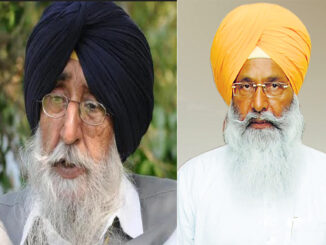
Of the five contestants in the fray this time include Simranjit Singh Mann, President of Shiromani Akali Dal (Mann), who represented Sangrur in Lok Sabha from 1999 to 2004. There were speculations that all Sikh organizations and political parties would put up a joint Panthic candidate in their endeavor to get early release of Sikh prisoners languishing in various jails of the country.
The proposal was first taken at a meeting of the Panthic organizations. It was followed by a visit of Shiromani Akali Dal chief Sukhbir Singh Badal to the residence of Simranjit Singh Mann, President of Shiromani Akali Dal (Mann).
At the closed door meeting the two leaders and other senior leaders reportedly failed to reach unanimity.
While Simranjit Singh Mann went ahead to file his nomination papers day after the meeting, Shiromani Akali Dal chief Sukhbir Singh Badal announced the candidature of Kamaldeep Kaur Rajoana, sister of jailed Balwant Singh Rajoana. Various Panthic organizations have been making concerted efforts to seek release of Balwant Singh Rajoana undergoing life imprisonment in the Beant Singh assassination case. Other candidates in the fray include Gurmail Singh of ruling Aam Aadmi Party. An environmentalist, Gurmail Singh has been active in AAP politics as a youth leader and heads the Sangrur unit of the party.
Other than Simranjit Singh Mann, who contested the last Lok Sabha election from this seat unsuccessfully, Kewal Singh Dhillon is also in the running this time. Though last time, he was a Congress candidate, now he is representing Bharatiya Janata Party. Interestingly, Kewal Dhillon, who twice represented Barnala in Punjab Vidhan Sabha as a Congressman, joined BJP only a day before his nomination as the party candidate for the ensuing bye-election. Though the BJP contested the State assembly elections in February in alliance with Punjab Lok Congress, a new outfit floated by former Chief Minister Capt Amarinder Singh after leaving Congress, and Sanyukat Shiromani Akali Dal led by former MP Sukhdev Singh Dhindsa, announcement of Kewal Dhillon’s candidature, indicates that the alliance is no more in existence.
At one stage, the Sanyukat Shiromani Akali Dal had raised objections on the way the BJP was going alone on both scouting for the candidate and contesting the election on its own.
In the 2019 elections, Parminder Singh Dhindsa, who unsuccessfully contested from Dirba in the last Assembly elections, was the Shiromani Akali Dal candidate. He finished third behind Bhagwant Singh Mann and Kewal Singh Dhillon by polling 2,63,498 votes.
Parminder Dhindsa had represented Dirba in Punjab Vidhan Sabha for the 2017-2022 term.
Congress has named former Dhuri MLA, Dalvir Singh Goldy, as its candidate.
In the Punjab Assembly elections held early this year, all nine assembly segments – Lehra, Dirba, Sunam, Bhadaur, Barnala, Mehal Kalan, Malerkotla, Dhuri and Sangrur – that constitute this Lok Sabha, AAP candidates made a clean sweep.
Sangrur has a unique record as it has been sending representatives of different political parties, including Communists, Congress, and various factions of Shiromani Akali Dal, to Lok Sabha.
Ranjit Singh was the first Lok Sabha winner from Sangrur. He won in the 1952 elections as a representative of Congress.
Nirlep Kaur, owing allegiance to the then Shiromani Akali Dal (Sant Fateh Singh), won from Sangrur in 1967, the first general election after the reorganization of Punjab. Subsequently, Teja Singh Swatantar, wrested back the seat for Communist Party of India. In 1962, Ranjit Singh was the first CPI nominee to win from Sangrur.
Two of SAD MPs from Sangrur – Surjit Singh Barnala and Sukhdev Singh Dhindsa – remained part of the Union Cabinet in the NDA governments of their time.
SAD (Mann) was successful twice in representing this constituency in Lok Sabha. In 1989, Rajdev Singh was elected from here and 10 years later, the SAD(Mann) chief, Simranjit Singh Mann, won from Sangrur.
Before Bhagwant Mann was elected for the first time in 2014, the seat was held by Vijay Inder Singla for a term – 2009-2014.
Sukhdev Singh Dhindsa succeeded Simranjit Singh in 2004.
For Congress, Gurcharan Singh Nihalsinghwala (1980) and Gurcharan Singh Dadhahoor (1991) represented Sangrur in Lok Sabha.
Political analysts hold that things have changed significantly primarily because of the assassination of Sidhu Moose Wala. Days before his killing, he had reportedly held a meeting with Simranjit Singh Mann pledging support to him in the Lok Sabha bye-election.
(Prabhjot Singh is a veteran journalist with over three decades of experience covering a wide spectrum of subjects and stories. He has covered Punjab and Sikh affairs for more than three decades besides covering seven Olympics and several major sporting events, including eight World Cups in Hockey. He has been hosting TV shows. For more in-depth analysis and stories by him please visit probingeye.com or follow him on Twitter.com/probingeye and on Facebook @PrabhjotSingh.Journalist. He can be reached at prabhjot416@gmail.com)
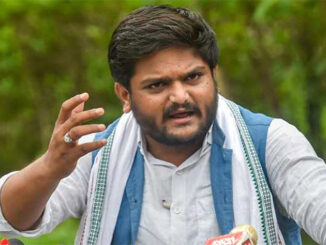
Ahead of joining the BJP on Thursday, June 2, Hardik Patel tweeted he is going to start a new chapter in his life with the national interest, state interest, public interest and social interest being on the top of his mind. Praising Prime Minister Narendra Modi’s leadership, Hardik Patel wrote, “I will work as a small soldier in the noble service of the nation under the successful leadership of PM Narendra Bhai Modi.”
The Patidar leader will be inducted into the BJP by Gujarat party president CR Paatil.
After expressing his disappointment with the Congress for months, Hardik Patel on May 18 resigned from the party accusing the senior leadership of the Grand Old Party of disinterest in the real issues of Gujarat.
“It is a fact that Congress benefited immensely in the 2017 Assembly polls due to the Patidar quota agitation (led by him). However, I was not given any responsibility even after making me working president. I was not even invited to the key meetings of the party. It never arranged my press conference during the last three years,” Hardik Patel said after he quit the Congress. Source: HT
New Delhi (TIP)- Sunil Jakhar, a prominent face of Punjab politics who quit the Congress recently, joined the BJP on Thursday, May 19, a development being seen as a big gain for the saffron party that aspires to get a toehold in the border state. Jakhar, unlike many other Congress deserters, has expressed sorrow at breaking ties with the Grand Old Party, saying it was not easy to snap a 50-year-old relationship that spanned three generations of his family. He stressed on Thursday that the Congress for him was not a party but “family”.
“I had a 50-year-old relationship with the Congress. Three generations of my family have been with the party since 1972. Considering the party my family, we stayed with it in good and bad times,” Jakhar said, claiming he quit not because of “fundamental disputes” with the party or any “personal dispute”.
BJP president J.P. Nadda was personally present to welcome Jakhar, underlining the importance the party was according to the latest catch from the Congress. Nadda claimed that Jakhar left the Congress owing to a “dispute over nationalism” and “Punjab’s unity and brotherhood”.
Claiming that the BJP was leading the “nationalist forces” in Punjab, Nadda said it was essential that people aligning with such an ideology joined the party. He said Jakhar would play a key role for the BJP in Punjab. After Jakhar, another key Congress deserter, Hardik Patel from Gujarat, is set to join the BJP soon, BJP leaders said. Hardik, who quit the Congress on Wednesday, has slammed the leadership in general and Rahul Gandhi in particular and dropped enough hints that he was headed towards the BJP. Jakhar quit the Congress after the party’s disciplinary committee recommended that he be suspended for two years and removed from all posts for criticising then chief minister Charanjit Singh Channi. The Congress lost the Punjab elections earlier this year. Jakhar holds a lot of importance for the BJP that has a marginal presence in Punjab. In the Sikh-dominated state sharing a border with Pakistan, the BJP had for years played second fiddle to then ally Akali Dal. The BJP was left virtually orphaned in the state after the Akali Dal snapped ties over the farm laws. Jakhar is a prominent non-Sikh politician from the state who commands a lot of goodwill. Led by Prime Minister Narendra Modi, the BJP has been running a determined campaign to woo the Sikhs after the Centre was forced to withdraw the three new farm laws, bowing to a prolonged struggle by farmers primarily led by the community. BJP insiders said Jakhar could soon be rewarded with a Rajya Sabha berth and a key responsibility in the effort to strengthen the BJP in Punjab.
“The Opposition space is so badly fragmented that it seems incapable of reaching the critical mass necessary to take on the BJP. At the heart of the problem is the thinly-spread-out Congress that has a notional presence across the country but lacks depth and gets quickly uprooted. Hence, it keeps losing bases to regional forces, such as the recent loss of Punjab to AAP. Attempts to stay afloat in the face of regional powerhouses have also produced dismal results as in Bengal and UP……………
Rational thought demands that the Congress and regional forces unite. It necessitates that the Congress pull itself up by its bootstraps and tie up with strong regional parties — ruling or in the Opposition in the states. But the irrational is happening. Last week, Rahul Gandhi travelled to Telangana, where he launched a scathing attack on Chief Minister K. Chandrashekar Rao. KCR, he tweeted, had single-handedly destroyed the dream of the people of Telangana when statehood was granted. He also said that Telangana was not ruled by the CM but by a ‘Raja’.”
It has been a year since two significant states, West Bengal and Tamil Nadu, were won by two big regional parties, the TMC and DMK, even as the Left Front retained Kerala, giving rise to speculation that some kind of national Opposition could be mustered against the BJP in 2024. But a year down the line, after the BJP’s recent win in state polls in Uttar Pradesh, Uttarakhand, Goa and Manipur, and the continued disarray in the Congress, the vision of a grand Opposition coalition against the BJP has evaporated. Indeed, one may well say that in 2022, two years before the next General Election, the world’s largest democracy is a country without a national Opposition.
This is cause for great concern in Opposition-ruled states: they are owed huge amounts in GST arrears and complain of being deliberately overlooked by the Centre. With inflation skyrocketing, they are coping with increased costs for infrastructure and development schemes even as avenues for raising revenue have shrunk since the roll-out of the GST. While they struggle for funds, both at the party and government levels, the BJP/RSS project of expanding to each part of the country, continues
with purpose and is well funded. For instance, the BJP is opening offices in the districts of Tamil Nadu, a state where they have no real presence, yet are investing in the long game. Opposition states are living through a particularly difficult era as all the niceties of cooperative federalism have been abandoned by the current Central dispensation. The onslaught is pretty ruthless and states not ruled by the national party, complain of being treated as hostile entities with enforcement wings of the Centre routinely used against them. For instance, in Maharashtra, two ministers of the ruling coalition are in jail, while a dozen are being investigated by Central agencies.
As prices soar in India and jobs are not created, in normal times the Opposition should have been emerging with strength and purpose. Instead, political narratives appear to be getting delinked from economic issues. Equally, the Opposition space is so badly fragmented that it seems incapable of reaching the critical mass necessary to take on the BJP. At the heart of the problem is the thinly-spread-out Congress that has a notional national presence across the country but lacks depth and gets quickly uprooted. Hence, it keeps losing bases to regional forces, such as the recent loss of Punjab to AAP. Attempts to stay afloat in the face of regional powerhouses have also produced dismal results, such as getting zero seats in Bengal and one in Uttar Pradesh. And when it comes to Congress vs BJP, even if the Congress wins, the BJP has a high strike rate in toppling the regimes through defections.
Rational thought demands that the Congress and regional forces unite. It necessitates that the Congress pull itself up by its bootstraps and tie up with strong regional parties – ruling or in the Opposition in the states. But the irrational is happening. Last week, Rahul Gandhi travelled to Telangana, where he launched a scathing attack on Chief Minister K. Chandrashekar Rao. KCR, he tweeted, had single-handedly destroyed the dream of the people of Telangana when statehood was granted. He also said that Telangana was not ruled by the CM but by a ‘Raja’.
It may be recalled that it was the Sonia Gandhi-led Congress that took political decisions that effectively destroyed the party’s own bases in erstwhile Andhra Pradesh (the largest chunk of Congress MPs during the decade of UPA rule came from undivided Andhra Pradesh). Central to this success was chief minister YSR Reddy, a pioneer in designing popular welfare schemes (and having links with big business donors). But YSR’s death in a plane crash in 2009, led to chaos that in turn resulted in the Congress national leadership taking decisions that in hindsight only finished them off in both Telangana, carved out of the state in 2014, and in Andhra Pradesh where YSR’s son Jagan Mohan Reddy, denied power by the Congress, is now in power with his party named YSR Congress.
It’s entirely possible that Rahul Gandhi feels compelled to speak up for what remains of his party in those parts; just as he would have been asked to do so by the Congress in Bengal. But surely it is time for the Congress leadership to get a reality check and recognize that ‘the party is over’ in many parts of India and the only way forward is to make arrangements with regional forces even if that involves giving up on what remains in the debris (the best template actually exists in Tamil Nadu where the Congress is the junior partner in the DMK-led alliance).
Presumably, political consultant Prashant Kishor had offered the blueprint of a national plan when he was negotiating to join the Congress last month. It may not have worked but the data with which the consultancy I-PAC, founded by Kishor, works would have been valuable as could have been the professionalism in calibrating other aspects of elections. Ironically, TRS is now reportedly a client of I-PAC just as Jagan Reddy was during the campaign that won him the state. But Kishor, meanwhile, after his talks with the Congress failed, has taken off for his home state Bihar where he has announced a padayatra and the beginning of a process that can culminate in the foundation of another political party/front.
Indeed, the great irony is that while there is not much of a national Opposition, the space is also getting very crowded. AAP is set to contest the Assembly elections in Gujarat and Himachal Pradesh later this year. The TMC has plans in the North-east, even as a foray into Goa was a disaster that did nothing to improve relations with the Congress. Kishor, consultant to various parties, has also begun a political process in Bihar where Chief Minister Nitish Kumar is again making enigmatic moves.
The Congress, meanwhile, has not revealed any plan. Rahul Gandhi is reportedly deeply interested in philosophies of the world and perhaps believes in the live-life-one-day-at-a-time and what-will-be-will-be approach. Currently, the hopes seem to exist on a wing and a prayer, a phrase that comes from a fighter pilot trying to land his aircraft in World War II after a wing was destroyed. The Congress will have a brainstorming meeting in Udaipur between May 13 and 15. Let’s hope the party leaders won’t spend all the time trying to chase their own tails. The expectations are very low, so perhaps they can pull a surprise.
Bagga held by Punjab Police in Delhi, Brought back from Haryana by Delhi Police
CHANDIGARH / NEW YORK (TIP): In a dramatic turn of events that brought the police of three states face to face, BJP leader Tajinder Pal Singh Bagga was arrested by the Punjab Police from his Delhi residence around 8.30 am today, stopped by the Haryana Police in Kurukshetra while being taken to Punjab and brought to the national capital by the Delhi cops a few hours later, reports TNS.
The incident triggered a political slugfest with the BJP accusing the Punjab Police of abducting its leader allegedly at the behest of AAP convener and Delhi CM Arvind Kejriwal, against whom Bagga (36) has been quite vocal in criticism. Rejecting the charge, the AAP claimed the Delhi BJP spokesperson was arrested for allegedly stoking communal tension in Punjab.
Based on a complaint by Bagga’s father Preetpal Singh, the Delhi Police registered a case of kidnapping against the Punjab Police personnel. Sources in the Delhi Police claimed that their Mohali (Punjab) counterparts “violated” the mandatory norm of informing local cops before arresting Bagga from his residence in Janakpuri.
In a statement, the Mohali police claimed that Bagga was arrested in a case related to making allegedly provocative, false and communal statements in an interview given to the media and through posts on Twitter on March 1. They said five notices were served on the accused on April 9, 11, 15, 22 and 28, but “he deliberately did not join the investigation”. They said a case under Sections 153-A, 505, 505(2) and 506 of the IPC was registered against him on the complaint of Mohali AAP leader Sunny Ahluwalia.
Bagga had demanded an apology from Kejriwal for his speech in the Delhi Assembly regarding film ‘The Kashmir Files’, which a few BJP leaders had demanded be made tax-free. Kejriwal had contended that the filmmakers should upload the film on YouTube for all to watch free of cost. The Punjab Government, on its part, moved the Punjab and Haryana High Court against the “detention” of its police team in Kurukshetra.
The Delhi Police registered the case under IPC Sections 452 (house trespass, assault or wrongful restraint), 392 (robbery), 342 (wrongful confinement), 365 (kidnapping), 295 (injuring or defiling place of worship with intent to insult the religion of any class) and 34 (common intension). In his complaint, Bagga’s father said, “I was present at my home along with my son when, around 8.30 am, someone knocked on the door repeatedly. When I opened, a few persons entered my home and manhandled me. Some of them had weapons.
“They started asking me where is Tajinder Singh Bagga? When I asked them what they wanted from Tajinder, they slapped me. Later, my son came there and they started beating him up and didn’t even allow him to put on his turban while they were arresting him. When I tried to intervene, they pushed me,” it said.
The Punjab Police team that had arrested Bagga was on way to Mohali when it was stopped on the NH-44 near Khanpur Kolian village in Kurukshetra around 11.30 am. As a large number of BJYM workers soon reached the spot demanding Bagga’s release, the BJP leader and the Punjab Police team were taken to the Thanesar Sadar police station. Delhi Police officials reached the police station around 2.10 pm and Bagga, based on a search warrant issued by a Delhi court, was taken back to the national capital. The Delhi Police had shared the warrant with the Haryana Police when the latter stopped their Punjab counterparts.
Sources said the Haryana Police had information that Bagga had been “forcibly” picked up from his residence and they needed to verify and crosscheck the allegations. Mohali DSP (City-1) Sukhnaaz Singh said, “A police team was sent from Mohali to Delhi last night. A team arrested them today morning and simultaneously, another team reached the police station concerned in Delhi to inform local cops. The entire process has been video-recorded. Although Bagga resisted arrest, no force was used against him or his father.”
“The BJP has travelled a long way from the early 2000s, when Vajpayee had to be mindful of his allies’ seeming distaste for communal politics. The Maharashtra and Delhi civic polls will test the BJP’s reinvigorated Hindutva programme. In Maharashtra, it has tied up with Raj Thackeray’s Maharashtra Navnirman Sena and backed its call to remove loudspeakers from mosques. In Delhi, the Hindu-Muslim fault lines evident after the Jahangirpuri violence might resonate across the city.”
It is incomprehensible what program of action the Rashtriya Swayamsevak Sangh (RSS) and its cohorts will spring upon the country each day. For decades, the BJP grappled with the dilemma of whether a linear progression of Hindutva best suited its politics, although the paterfamilias, residing at Nagpur, was clear that the doctrine of Hindu supremacy should be at the heart of the agenda it laid out for its political progeny. The BJP cut the first turf every now and then, but only just because it never lost sight of the fact that as it grew through childhood and adolescence, it relied on the parent for mid-course correction.
When Atal Bihari Vajpayee advocated Gandhian socialism and JP’s legacy after the BJP lost elections serially, his theories were rebuffed once the party was routed in the 1984-85 elections. Vajpayee was critiqued for missing the mark. Sikh militancy had overrun north India and the Congress played to Hindu angst and anger. LK Advani stepped in to lead the Rath Yatra across the country and create a narrative against Islamic rule, symbolized by the ‘destruction’ of hallowed places, notably the birthplace of Lord Ram in Ayodhya. Of course, he was fortunate in that the RSS and the Vishwa Hindu Parishad (VHP) had done the spadework before his chariot rolled. Advani put his finger on the pulse and handed out the BJP’s initial victories, enabling it to reach that critical mass which made it a contender to lead an anti-Congress Opposition. However, when it came to heading a coalition government, Vajpayee was chosen as the BJP/NDA’s PM candidate because his ‘moderate’ visage, in contrast to Advani’s militant Hindu image, appealed to allies who had to rationalize their decision to go with the BJP before their ‘secular’ constituents. Everything has changed unrecognizably now. Like Vajpayee’s socialism of 1985, Advani’s project to refurbish perceptions about himself by endorsing Muhammad Ali Jinnah publicly in Karachi almost broke the BJP’s back. The BJP’s architect had to go.
Narendra Modi, Advani’s successor, resolved every dilemma confronting the BJP and the Parivar seamlessly to take the party to heights the RSS never imagined. He was so powerful as the Gujarat chief minister — a position he consolidated by pursuing and embracing a radicalized stream of Hindutva without qualms, unlike Advani — that he could put down the occasional transgressions by the VHP or another Parivar member with ease. Modi successfully persuaded voters in northern and western India to give the Gujarat admixture of radical Hinduism — underpinned with deep-rooted antagonism towards the minorities — and ‘development’ fashioned after his notions of capitalism (welfare and populism were remarkably absent from the model because he often said he subscribed to people’s empowerment and not their entitlement) a chance to ‘prove’ itself at the Centre.
Modi’s 2014 campaign astutely centered ‘development’ (signified by the promise of investments and infrastructure) over Hindutva but he allowed the others in the BJP to talk up his credentials as the ‘Hindu hriday samrat’ (monarch of the Hindu heart) so that voters were convinced that they were in for a double bonanza: economic prosperity and Hindu asmita (identity) which ‘vanished’ during colonial rule. The formula worked quite successfully, although its limitations were exposed in the eastern and southern regions where the BJP still struggles to break through. The BJP might not have won every state election but once victory came its way, it fought hard to retain it in a successive election. However, the BJP’s recent second-time triumphs were determined by using Hindutva laced with populist welfare.
Assam and Uttar Pradesh are examples of the BJP’s determination to hold on to states wrested the hard way. The outcomes in both cases are similar. Assam is characterized by multiple ethnic, religious and linguistic identities. Even a party in pole position such as the Congress earlier and now the BJP had perforce to weave a coalition by making common cause with smaller entities with a niche following. The BJP’s use of Hindutva did not prevent the latest incarnation to emerge from the Adivasi-dominated Bodo region from joining hands and trumping its adversaries. Likewise, in UP, the leadership by an individual in saffron robes, who unabashedly swore by and deployed Hindutva to fulfil his agenda, never deterred identity-based outfits from taking shelter under the BJP umbrella and looking the other way when minorities were hunted down and victimized. Obviously, the party has travelled a long way from the 1990s and early 2000s, when Vajpayee had to be mindful of his allies’ seeming distaste for communal politics.
Modi’s victories in Gujarat were the tipping point of the BJP’s ascendancy. The social sanction for the 2002 violence spurred an active debate on the secular-communal issue and tilted the ideological balance in the latter’s favor. Therefore, it is highly improbable that the BJP will go back on the path it walked since 2019. In his first tenure, Modi mixed ‘governance’ and Hindutva almost in equal measure and was a tad defensive when the Parivar’s cattle vigilantes and ‘reconversion’ (shuddhikaran) crusaders showed their intent through lynching and coerced conversion. Post 2019, the Hindutva zealots felt so empowered that when the police tried to crack down on the VHP after the recent Jahangirpuri occurrences in Delhi, the VHP protested, and the cops promptly pulled back. Contrast the VHP’s withdrawal with Modi’s clampdown on Parivar constituents, notably the VHP, in Gujarat whenever they disagreed and protested government policies.
The Maharashtra and Delhi civic polls scheduled to be held this year will test the BJP’s reinvigorated Hindutva programme. In Maharashtra, it has tied up with Raj Thackeray’s Maharashtra Navnirman Sena and backed its call to remove loudspeakers from mosques. In Delhi, the Hindu-Muslim fault lines evident after the Jahangirpuri violence might resonate across the city.
NEW DELHI (TIP)- Maharashtra minister Nawab Malik’s plea to release him from jail in a money laundering case was on Friday rejected by the Supreme Court. “It is too nascent a stage to interfere with the investigation. We can’t interfere with the due process at this stage. You (should) move the competent court,” the top court said in its remarks. The 62-year-old NCP leader was arrested in February in a case linked to Dawood Ibrahim, the mastermind of 1993 Mumbai blasts. Earlier the Bombay High Court had rejected the application by the minister to release him from jail. The ruling Shiv Sena-NCP-Congress alliance in Maharashtra – in an attack on the BJP – has been claiming that the NCP leader’s arrest in the investigation by the central probe agency was “politics of vendetta”.
Earlier on Thursday, the Enforcement Directorate – that probes financial crimes – submitted a 5,000-page chargesheet in a Mumbai court. The special court for Prevention of Money Laundering Act (PMLA) cases will take cognizance of the charge-sheet after verification of the documents, news agency PTI reported, citing the probe agency’s lawyers.
The case is based on an FIR filed recently by the National Investigation Agency (NIA) against Dawood Ibrahim and his aides under the Unlawful Activities (Prevention) Act (UAPA).
Malik, the ED has alleged, funded a prominent member of ‘D-Gang’ (Dawood gang) for illegal occupation of a property.
Last week, the ED had provisionally attached eight properties belonging to Maharashtra minister Nawab Malik and his family members.
In a welcome intervention, the Supreme Court halted the anti-encroachment drive initiated by the North Delhi Municipal Corporation in violence-hit Jahangirpuri on Wednesday. Communal clashes during a Hanuman Jayanti procession in the area on Saturday had left eight police personnel and a local resident injured. With normalcy yet to be restored in the locality, undertaking the demolition of unauthorized structures — and that too without giving prior notices to the alleged violators — was an injudicious move at the outset. Its timing left no room for doubt about its intent: communalizing the illegalities and targeting members of a particular community. Encroachments and illegal constructions didn’t spring up overnight in Jahangirpuri; nor are these structures confined to this Delhi locality. Many such eyesores are spread around various places of worship in the Capital and elsewhere, mushrooming rampantly over the years, or even decades, thanks to administrative laxity and political patronage.
The pick-and-choose approach of the authorities reeks of a vindictive agenda, especially since it comes close on the heels of a similar crackdown on illegal constructions in Uttar Pradesh and Madhya Pradesh. Calling the goings-on a ploy to target minorities, especially Muslims, in the name of crime prevention, the Jamiat Ulama-i-Hind has filed a petition in the apex court against the use of bulldozers for razing houses and other buildings in BJP-ruled states.
It is not uncommon for an anti-encroachment drive to face resistance from local residents. Following the due process of law is a prerequisite for the smooth conduct of this exercise. However, this process is being repeatedly bypassed as the powers that be are riding roughshod over constitutionally granted rights. Presumption of innocence is a well-established and time-tested legal principle. And it is for the courts to pronounce the sentence after they find an accused guilty of an offence. The punitive action being ordered and executed without a hearing against the violators — singled out on the basis of the community they belong to — does not bode well for our justice delivery system. Officials involved in this extrajudicial and unconstitutional overdrive, and the politicians spurring them on, must be held accountable.
Governance has become irrelevant to win a popular mandate
By Radhika Ramaseshan
“The expanse of the violence, from the east to the west and the north, confirmed three perceptions: it was pre-planned, because in each case, the trajectory pursued the same path. RSS-aligned Hindu activists went on shobha yatras that wound through Muslim localities, got uncontrollable when they passed a mosque or sighted a gathering and seemed to have provoked a reaction from Muslims (stone-pelting was reported almost everywhere). Reports suggest in places it was difficult to tell who cast the first stone. The police, though present, were said to be passive. The MP Police, though, came down strong on Muslims who allegedly instigated clashes and flattened out their properties with bulldozers, borrowed from UP’s manual.”
Henceforward every Hindu festival might be anticipated with dread and not joyousness if the trail of violence, death and destruction left behind by the processions to ‘celebrate’ Ram Navami, and earlier Nav Samvatsar (the Hindu New Year) is a portent.
Ram Navami is one among the myriad festivals dotting the Hindu calendar. It is generally observed in the quietude of a puja room in a home following a nine-day Navratri, a period of fasting and praying in North India. It is a reflection on Hinduism’s plurality that Navratri has a different connotation in southern India. It coincides with Dasehra and is signified by nine days of uninterrupted festivity intended to engage and entertain children. There is no one New Year in Hinduism; in fact, there are a dozen across the regions, depending on whether the solar or lunar calendar is followed. The New Year ushered in on April 2 is known as Gudi Padwa in Maharashtra and Goa and Ugadi in Karnataka, Andhra Pradesh and Telangana.
However, Rajasthan — which triggered the latest cycle of violence —observes its New Year on Diwali. This didn’t deter members of the Vishwa Hindu Parishad (VHP), Bajrang Dal (BD) and Vidya Bharti, the RSS’s education wing — sweepingly classified as the ‘Hindu fringe’— from launching a Nav Samvatsar shobha yatra on motorbikes at Karauli. From all accounts, the yatra acquired the color and shape of a carnival rather than a religious occasion. The participants, young men sporting the VHP’s emblematic saffron ‘bandana’, danced to songs played at full blast when they passed a mosque. According to a report in Scroll.in, some numbers were singing VHP anthems, dating back to the Ayodhya era, with the refrain, ‘khaula khoon mera’ (my blood boils), denoting that the day this happened, you (meaning Muslims) will be put in your place and the sword will speak instead of a Hindu’s words. The tropes that figured in the songs were a topi or skullcap and ‘Hindu awakening’. The report quoted young Hindus (unemployed or engaged in semi-skilled work) saying the VHP’s ditties were as inspiring as ‘Vande Mataram’ and caused goosebumps because of lines like ‘those who wear the topi will have to bend and say Jai Shri Ram’. It no longer matters which party rules a state. Rajasthan has a Congress government, rickety from day one. This round of rampage also scorched non-BJP states like Jharkhand and West Bengal and raised a question on whether the local intelligence failed to foresee the mayhem or deliberately kept quiet. Among the BJP-ruled states, Madhya Pradesh was the worst hit.
Delhi BJP leader Kapil Mishra’s infamy precedes him. He is known to give incendiary speeches that polarize communities as he did before the 2020 Delhi violence. He was in MP’s Khargone, the center of the trouble, a day before it erupted. He shared a photo captioned, ‘Neither Musa nor Burhan, only Jai Jai Shri Ram’. The names were those of Burhan Wani and Zakir Musa, Kashmir’s militants, who were eliminated by security forces.
The expanse of the violence, from the east to the west and the north, confirmed three perceptions: it was pre-planned, because in each case, the trajectory pursued the same path. RSS-aligned Hindu activists went on shobha yatras that wound through Muslim localities, got uncontrollable when they passed a mosque or sighted a gathering and seemed to have provoked a reaction from Muslims (stone-pelting was reported almost everywhere). Reports suggest in places it was difficult to tell who cast the first stone. The police, though present, were said to be passive. The MP Police, though, came down strong on Muslims who allegedly instigated clashes and flattened out their properties with bulldozers, borrowed from UP’s manual.
The yatris were armed with swords and sticks. Smaller towns, like Himmatnagar and Khambhat (Gujarat), Lohardaga (Jharkhand), Bankura (West Bengal) and Vasco (Goa) were targeted, instead of more vulnerable cities like Ahmedabad and Ranchi to disseminate the Sangh’s message. The participants were young men, mostly unemployed, who seemed to have all the time in the world to wreak havoc.
Karnataka pushed the Hindutva agenda in different ways: from the hijab to halal meat. The latter has caught popular imagination to such a degree that on Ram Navami day, ABVP activists bore down on the JNU canteen which normally serves meat on a Sunday and assaulted students who challenged them. How does the disorder help the Centre? Indeed, the situation in Karnataka got excessive even for a senior state minister, JC Madhuswamy, who warned the ‘fringe’ groups to back off as CM Basavaraj Bommai remained mum. Reports claimed that the BJP’s central brass advised Bommai to focus on implementing his budgetary proposals and infrastructure projects but out of electoral and not humanitarian considerations; hijab and halal could only win ‘some’ votes.
The affected states stare at polls this year and the next. In Karnataka’s case, there are apprehensions that its unicorn companies and IT majors could relocate to the relatively peaceful neighboring states. Elections and the threat of economic instability do not compose a larger picture. The answers lie elsewhere.
The mandates the BJP has swung in states, bucking anti-incumbency, established that governance was not the criterion. Governance as it is understood in a fundamental sense: delivering on the basics required for a decent quality of life, based on equity, justice and welfare. Welfare there was in spades but in the most rudimentary sense, boiling down to ‘ration-paani’.
The BJP’s success came down to purveying Hindutva through a running organization of ‘karyakartas’. These yatras and such-like programs are meant to keep the workers on the ground and empower them through a simulated sense of bravado. What better way of deflecting people’s attention from inflation and an inability to create jobs?
The rout of the Congress in the recent Assembly elections confirms the view that the grand old party is in terminal decline, and that the 2024 parliamentary election would pit the BJP not against the Congress but a coalition of regional parties, with or without the Congress. When the BJP won power at the Centre in 2014, the Congress ruled nine states — now, with the loss of Punjab, the number is down to two. In the last eight years, the Congress has won just five of the 45 elections held in the country. Its hope of wresting back Himachal Pradesh from the BJP later this year would be reduced in the absence of state supremo Virbhadra Singh, who died last year; the two states it still rules, Rajasthan and Chhattisgarh, go to the polls in 2023 and there is a real possibility that by the 2024 General Election, it may be in power in no state at all. The decimation of the Congress robs the voter of a centrist option at the national level, and makes the contest in national electoral politics multipolar, with various regional parties — with vastly different ideologies and ambitions — coming together to challenge the BJP. India must have a strong Opposition to hold the government to account.
However, a motley collection of parties — competing for prime ministership among themselves — may not be best suited to serve the interests of democracy. The Congress, despite its spectacular decline over the last decade, had seemed the most viable alternative to the BJP, but even veteran Congressmen are losing hope now. The Congress’ vote share in the last two General Elections was the second-best — at 19.31% and 19.46% — behind the BJP, and it has the potential to represent Indian citizens across the country. It still may be the biggest single challenger to the BJP, but it’s obvious that it has got stuck in a rut. There is confusion at the top — after Rahul’s resignation as president in 2019, Sonia Gandhi has been interim president — and panic in the ranks. Organizational reform is the need of the hour, in the interest of a strong Opposition — and, thus, in the interests of India.
The public discourse in the election campaign and the results have shown that the BJP is not invincible. The significant increase in the Samajwadi Party’s vote-seat share shows the limits of communal politics, which further indicates that communal consciousness was not the decisive factor for many voters, and such consciousness is subject to change. The BJP’s handsome victory cannot trump the economic challenges facing the people. The wider issues thrown up in this election — the bulldozer approach to dissent, communal polarization, economic inequality, agrarian distress, joblessness and public health — will not go away, but continue to influence public discourse in the longer run.
While we must not disregard the significance of economic relief provided to people through free ration, it doesn’t explain the BJP’s success in UP. This alone could not have defanged the effect of economic distress and massive unemployment. It appears that the people voted for something else: they voted for the political agenda of this government, fueled by a communal campaign.
The results of the 2022 Assembly elections indicate a reinforcement of the decisive rightward shift that India’s polity had embarked upon in 2014. Barring a few setbacks, notably the defeat in the West Bengal elections in 2021, the trend is not reversing. The BJP, the party of the Far Right, has, in fact, consolidated its primacy in most states, barring those where the regional parties hold sway and have kept it at bay. The recent poll results have set the stage for the General Election in 2024, with the ruling BJP retaining control of four states, including winning a two-thirds majority in the politically crucial state of Uttar Pradesh.
Numerous media reports exposed multiple sources of economic discontent in UP. Voters complained ceaselessly about the joblessness, price rise and stray cattle menace among the host of issues reported by journalists covering the election campaign from western to eastern UP. While employment, public health, education or industrialization were not on the BJP’s agenda, they were on the people’s agenda and, yet, economic dissatisfaction did not translate into a large enough vote to defeat the BJP.
That the BJP has held power and increased its vote share has to be seen in the light of the issues it campaigned on which seemingly matter more to large numbers of people in the state.
Importantly, economic frustration was not blamed on the government. Instead, the people commended the government’s handling of cultural and security issues, with economic distress taking a backseat. Hence, this couldn’t become a counterweight to Hindu majoritarianism. Even the disastrous impact of the Covid-19 pandemic didn’t figure in the voter calculus.
The BJP’s massive win in UP has sparked a discussion about the balance between economic discontent and voter choices, government subsidies and voting preferences, and hate politics and vote. The materialist understanding led many commentators (including this writer) to argue that the economic discontent and shift in public discourse could trigger an electoral change in UP. But the assumption that the need to maximize material well-being would drive voting preferences hasn’t transpired. Four factors signpost why this didn’t happen. The four things that set the narrative for the BJP were: Hindu majoritarianism, rashan, prashasan and induction of caste under the Hindu canopy (though not in this order). Put differently, the Hindu-Muslim divide, free ration and law and order were the mainstays of this canopy. Communalism was the ideological driving force of the campaign and nearly 44 per cent of those who voted approved of this slant. The overall thrust was dominated by the Chief Minister’s messaging and his statement in the beginning of the campaign that UP was facing an 80-20 election, denoting the Hindu-Muslim conflict and competition. This template framed the meta-narrative of the campaign, signaling the central role of communalism in this landmark election.
Arguably, the campaign was not overtly communal; it was disguised through dog whistles of ‘law and order’. This was a code for converting Muslims into a security threat and then claiming to control this threat. The ‘law and order’ platform echoed fears about the ‘Muslim criminality’, depicted through front-page advertisements in newspapers with two images of a young man with a kaffiyeh around his neck, symbolizing a terrorist; and the other without the kaffiyeh, seeking pardon. And the caption was: now we have established law and order in the state. The use of the bulldozer to demolish those seen opposing the ruling party, and placing them outside election rallies, was another unabashed signal of the same message. The ‘law and order’ rhetoric was explicitly meant to divide citizens into two classes: those who are lawful by nature, and those who are not, who are inherently lawless. This created a strong sense of community identity that required protection. Above all, it created a communalized common sense. As a consequence, people were willing to overlook the economic failures of the government. Economic discontent was cancelled out by the much greater cultural and ideological acceptance of the BJP as a protector of the Hindus.
The third issue is the impact of ‘welfarism’ or, more precisely, free ration on voter choices. Free foodgrains provided by the Central scheme to tide over the pandemic period, and additional items like cooking oil provided by the UP Government, is claimed as the key to the BJP’s electoral success. Undoubtedly, free ration at the time of the pandemic, with little prospect of getting a job, did count for a lot. However, the point is that even this minimal economic security was not provided as a matter of right to decent living but as largesse from the state. MGNREGA, which was instituted as an economic right has been whittled down, while the distribution of free ration, gas cylinders, toilets or houses as one-time benefits have become the main items on the welfare list closely identified with the political leadership hailed for its benevolence in helping the poor at a time of economic crisis. In return, the beneficiaries support the party offering these benefits. In the bargain, the beneficiaries have emerged as a new electoral category of labharthis linked to political choice. The political logic of this beneficiary category has profited the ruling party.
While we must not disregard the significance of the economic relief provided to the people through free ration, it doesn’t explain the BJP’s spectacular success in UP. This alone could not have defanged the effect of economic distress and massive unemployment and the vote against it. It appears that the people voted for something else which was non-economic reasoning, which is to say, they voted for the political agenda of this government, fueled by a communal campaign. Those who see the BJP’s victory as a vindication of its welfare policies ignore the compelling logic of communalism in UP politics today, as its impact is reflected in the poll results.
Last but not least is the caste question. The caste-oriented social justice plank as a mobilization strategy of the Opposition was superseded by religion, as in the 2017 and 2019 elections, pushing traditional notions of caste-based identity politics to the margins. Caste politics was effectively countered by the BJP’s campaign, uniting voters across caste lines by emphasizing the Hindu identity of the backward castes under the capacious Hindutva umbrella. That paid rich dividends for the BJP, making lower castes indifferent to the Mandal politics and this also underlined the problems of a single-minded focus on caste-based empowerment and representation. In sum, what worked for the BJP was religion plus caste plus ‘welfarism’.
The public discourse in the election campaign and the results have shown that the BJP is not invincible. The significant increase in the Samajwadi Party’s vote-seat share shows the limits of communal politics, which further indicates that communal consciousness was not the decisive factor for many voters, and such consciousness is subject to change. The BJP’s handsome victory cannot trump the economic challenges facing the people. The wider issues thrown up in this election — the bulldozer approach to dissent, communal polarization, economic inequality, agrarian distress, joblessness and public health — will not go away, but continue to influence public discourse in the longer run.
“In the end, it is apparent that the credit for the victory will largely belong in UP’s case to Adityanath. His cheerleaders propagated the view of Yogi’s hard-bitten image as a man who will not tolerate law and order challenges and dissent on the ground — evident in the manner in which he put down the protests against the Citizenship Act amendments — and is incorruptible. It also puts Yogi in the reckoning as a future leader.”
As the BJP rewrote a serial and spectacular comeback for itself in Uttar Pradesh in the assembly elections, it was evident that the party’s electioneering went according to a script that coalesced multiple strategies and responses to the drawbacks its government in Lucknow ran into in the past five years. It was as though the BJP anticipated the electorate’s positive and negative feedback on the Yogi Adityanath government and switched on its feed-forward correction capabilities to the best possible extent. It takes a level-head to assess a party’s internal weaknesses and accept them as real before rectifying. That’s what the Delhi leadership did, sometimes in consultation with Chief Minister Yogi Adityanath and at times unilaterally. Given its experience with the maverick chief minister, the BJP brass recognized that while it was impossible to dump him like its two incumbents in Uttarakhand and Gujarat, it was not feasible to give him the long rope he desired. The mix-and-match formula the BJP adopted was fraught with uncertainty but the gamble paid off.
The Samajwadi Party (SP), in tandem with the Rashtriya Lok Dal (RLD) and other parties, positioned itself as the BJP’s principal challenger and converted the contest into a bipolar joust, hoping that the votes that went to the Bahujan Samaj Party (BSP) and the Congress — the other significant players — would pool into its kitty. The SP’s calculation was that this tactic alone would help enhance its depleted vote share to a level of parity with the BJP and make the contest fairly even. It didn’t happen.
Statistics speak for themselves. The SP, which was the incumbent in 2017, dropped from a high of 224 seats in the 403-member legislature to 47 in the election that year, its vote share plummeting to 21.82 per cent in the 311 seats it contested with the Congress as an ally. UP was awash with the Narendra Modi wave that swamped every party. The BSP picked up just 19 seats with a vote share of 22.23 per cent. The BJP was on top, winning 312 of the 384 seats it fought and posting a vote share of nearly 40 per cent. Its team-mates, the Apna Dal (Soneylal) and Suheldev Bharatiya Samaj Party (SBSP), benefitted immensely from the partnership. The SBSP left the BJP shortly thereafter while the Apna Dal stayed with it. Therefore, the SP had a vast swathe of ground to cover before it hoped to catch up with the BJP.
The SP’s role in the Opposition was not inspiring. For instance, during the horrific pandemic strikes when the Adityanath government seemed apathetic to people’s plight, the SP was nowhere on the ground to help people. Its defense was that the situation was not conducive for its workers to be mobile. The state government tactically unrolled the Centre’s scheme to hand over rations to the less well-off in the villages and stave off hunger, particularly among the migrants returning home. A realistic assessment would have it that the sops would not have recompensed the loss of lives suffered in this phase. But months later, people thought less of the sufferings inflicted by Covid-19 and remembered the “ration-paani” delivered to their doorstep.
The BJP had several problems in the prelude to the elections. Unlike the CMs “anointed” by the “high command”, Adityanath was not one to be subservient to Delhi’s diktat. From Day 1, the custodian of Gorakhpeeth, North India’s wealthiest monastery, fancied himself as a potentate and potentially a PM candidate. Delhi’s efforts to have a former Gujarat bureaucrat, Arvind Sharma, a Modi favorite, inducted in the UP cabinet after Sharma was elected a member of the UP legislative council, failed. Adityanath refused to have him. A perception that the CM in saffron was just as cattiest as any UP politician and pandered excessively and overtly to his Rajput community angered the Brahmins, core BJP voters since 1989, and alienated the backward castes and Dalits. The agrarian distress, caused by the state government’s obduracy to enhance the state advisory price for sugarcane farmers, and the scaled-up costs of agricultural inputs was too real to be brushed aside.
The Centre stepped into the breach, at times distanced the CM from the damage-control moves and addressed these issues. The repeal of the contentious farm laws that provoked protests in western UP among the Jat farmers went some way to assuage their anger.
A defeat is invariably followed by the unpleasant aftermath of apportioning blame; a victory means it is time to savor the fruits of hard work. The BJP organization worked as one army on the ground under the stewardship of Amit Shah, the Home Minister, who went on door-to-door visits in seats that seemed tricky. Prime Minister Modi camped for days in Varanasi, his Lok Sabha constituency, after reports of a couple of shaky constituencies came in and campaigned tirelessly.
However, in the end it is apparent that the credit for the victory will largely belong in UP’s case to Adityanath. His cheerleaders propagated the view that the Yogi’s hard-bitten image as a man who will not tolerate law and order challenges and dissent on the ground-evident in the manner in which he put down the protests against the Citizenship Act amendments-and is “incorruptible”. Like Modi, Adityanath is a singleton and, therefore, thought to be a politician who will not lust after wealth and favors for the family. The fact that he didn’t attend his father’s cremation in Uttarakhand because of his “preoccupation” with managing the pandemic added to the profile of a “singularly committed” leader. The “attribute” was accentuated in the BJP’s campaign as a counterpoint against the “dynasts”, represented by the SP and RLD leaders, Akhilesh Yadav and Chaudhary Jayant Singh. What does Adityanath’s ascendancy portend for the BJP? It marks the return of UP’s pre-eminence in the BJP’s political scheme after the Vajpayee years. Although Modi adopted Varanasi as his constituency, he is primarily identified with Gujarat, his home state. It puts Adityanath high in the reckoning as a future leader.
Elections to five assemblies in Indiain 2022 have been remarkable in terms of their enormity. Participation ofmillions of voters andthousands of candidates, and an imposing machineryto ensure that elections are fairand beyond any question with regard to their integrity made the elections challenging. Coming to the political parties in the fray, one can easily see that the biggest gainer in these elections is the Aam Aadmi Partywhich has swept the elections in Punjab in a mighty sweep of their broom, the party symbol. The party which made its presence in the state of Punjab in the last elections with about 20 seats, on the way, was reduced to half its number becauseits elected members switched loyalty and joined Congress, the ruling party. Now the party has won an astounding 92seats in this state assembly, which has 117 seats. Obviously, itis a record of sorts. I don’t recall any single party in Punjab having won that number ever. Another party which has done very well and that has been doing so well for the last 8 years now, ever since 2014, is the BJP.
BJP came to power in UP in 2017 with a thumping majority. It floored one-time strong parties like the BSP and the Samajwadi Party. People were expecting a change because of anti-incumbencyfactors but it did not work in the State of Uttar Pradesh where Yogi Adityanath has created a record by becoming a chief Minister for a second term in succession.No Chief Minister in UP has ever been elected twice in succession except GobindBallabh Pant a long time ago.
However, BJP did lose a couple of seats andsettled for 274 seats in a house of 403 seats. The BJP’s loss was the gain of the Samajwadi Party which managed to double its strength from 2017 by registering 124 wins.
The exit polls have been indicating that BJP and Congress will be close contestants in the States of Uttarakhand and Goa, but they were proved wrong because BJP made clean sweep in both the states.
Coming to the losers, one can clearly seethat the Congress has been the biggest loser. Its streak of losing elections has been continuing and the greatest loss has been the state of Punjab where Congress was the ruling party with 70 odd seats and has been mauled badly, wining just 18 seats. Also, the SAD Badal suffered humiliating defeats when both Parkash Singh Badal and his son Sukhbir Badal who have been Chief Ministers lost election, besides the party folding up with just 4 seats. Yet, another party that suffered heavily and has probably almost lost its base is the BSP in Uttar Pradesh. A party which ruled the state on two occasions got just 1 seat.
With the elections over and the results out, there are celebrations in the BJP and AAP quarters while those that got the drubbing are huddling together to take stock of the reasons for their failure. Come 2024, and we will be watching a much bigger fight when General Elections are due. It will be interesting to see the course which India adopts post 2024 elections. Only time will tell whether Indiawill stay a multi-cultural and multi-religious nation or move towards a theocratic state which is the dream of the BJP and the Sangh Parivar. The recent electoral wins must have come as a shot in the arm of the BJP
Uttarakhand votes for BJP, but CM Dhami loses; BJP to form govt in Goa with Independents, MGP; Adityanath back with higher vote share but fewer seats; AAP wins 92 of 117 seats in Punjab, In Manipur, BJP wins 32 seats in 60-member House
NEW DELHI / NEW YORK (TIP): The BJP retained power in all the four States that it was governing while the Congress lost Punjab to the Aam Aadmi Party (AAP). The AAP said it has emerged as the “natural, national” alternative to the BJP, even as the Congress declined to a new low of just 18 seats in Punjab, 2 in UP, 18 in Uttarakhand, 12 in Goa , and 5 in Manipur.
The BJP held on to power in Uttar Pradesh, where it won two-thirds of the seats (274), compared to three-fourths in 2017. The Samajwadi Party succeeded in improving upon its 2017 performance by bagging 124 seats. The BJP’s vote share though increased in U.P., Goa and Manipur. The party conclusively won Uttarakhand, and won enough seats to retain power in Manipur and Goa — three States where its main rival was the Congress. “This is a seal of approval by the people for the BJP’s pro-poor, proactive governance,” Prime Minister Narendra Modi said at the party headquarters on Thursday, March 10 evening. “We will learn from this,” Congress leader Rahul Gandhi posted on Twitter. In U.P., the Samajwadi Party doubled its 2017 tally but fell far short of a majority, in the second consecutive Assembly election defeat under the leadership of Akhilesh Yadav, who did not comment on the results. His call for a coalition of Ambedkarites and Samajwadis — a euphemism for Dalits and Other Backward Classes — had takers as the increase in SP’s vote share shows, but nowhere enough to dislodge the BJP. Bolstered by Hindutva, welfarism, and expansive accommodation of OBCs and Dalits, the BJP stayed ahead of the SP across all regions of the State.
Swami Prasad Maurya, an OBC leader who switched from the BJP to the SP on the eve of the elections lost his own seat; in west U.P., the SP’s alliance with the Rashtriya Lok Dal dented the BJP but only marginally. “This is a victory of nationalism and good governance,” Chief Minister Yogi Adityanath told an ecstatic crowd at the party office in Lucknow, concluding his speech with calls of “Jai Shriram”.
In Punjab, the AAP harnessed the resentment against the Congress and the Akali Dal that have been alternating in power, to build a decisive momentum that won it 92 of the 117 seats in the State. The Congress won 18 and the BJP two, which is as many as what the Congress won in U.P.
AAP with 92 seats has created history as never before has a single party in Punjab won as many seats. The highest number of 93 seats was once won by the coalition of SAD and BJP.
“This is a revolution,” AAP founder and Delhi Chief Minister Arvind Kejriwal said. “First this revolution happened in Delhi, then in Punjab and it will now happen all over country,” he said.
Party leader Raghav Chadha said Mr. Kejriwal would become the Prime Minister of the country one day. The AAP will have two Chief Ministers now- one in Delhi and another in Punjab which is as many as what the Congress has.
The Congress’s last minute efforts to rescue its fortunes in Punjab, which elected one-fifths of its Lok Sabha members, through a leadershipchange that brought Charanjit Singh Channi at the helm did not bear fruit. The party’s halfhearted attempt to profit from his Dalit identity appears to have alienated dominant social groups such as Jatt Sikhs. Mr. Channi lost both seats that he contested.
The father-son duo that helms the SAD — Sukhbir Singh Badal and Prakash Singh Badal — both former CMs, lost their seats, even as the party finished with just four seats in its second consecutive rout. Mr. Modi said the voters have punished dynastic parties, referring to the setbacks to the SP, RLD, SAD and the Congress, all controlled by particular families for generations.
A careful analysis of the election results since 1967 would reveal that the percentage of votes polled by national parties, mainly the Congress, except for 1977 and 1997, has been more than 50. In 1967, for example, when Punjab had its first coalition government — the United Front — the Congress had polled 36.56 per cent of the total votes against 26.47 per cent votes polled by all state parties. The overall votes polled by national parties, including the Congress, Jana Sangh, CPI, CPM, Praja Socialist Party and Swatantra Party — was 56.60. In 1969, the share of national parties rose to 58.34 per cent, with the Congress increasing its share to 39.18 per cent while the state parties accounted for only 30.44 per cent of the votes. In 1972, when the Congress returned to power in the State, the share of the national parties increased slightly to 58.77 per cent while those of state parties dropped to 28.73 per cent. The Congress had taken its poll percentage to 42.84, which had been surpassed only twice afterwards, first in 1980 when the Congress got 45.19 per cent of the total votes polled and again in 1992 when it got 43.71 per cent votes.
The 1992 election was exceptional in the history of Punjab. The mainstream Shiromani Akali Dal boycotted the elections. A faction of the Dal, led by the then rebel Akali leader, Capt Amarinder Singh, contested 58 seats and won only three. This was the only occasion when the percentage of votes dropped to 23.82, the lowest ever. The other lowest being 64.33 in 1980. The share of national parties dropped to 40.29 per cent, the only time below 50 per cent, in 1997 when besides 26.59 per cent of the votes secured by the Congress, all the national parties, including the BJP, CPI and CPM had aggregated 40.29 per cent. The most distinguishing aspect of Punjab politics has been that the Akalis, even at times securing clear majority, have been aligning themselves with the Jana Sangh/Bharatiya Janata Party. This combination alienated both Sikh and Hindu votes from the once powerful Congress.
The emergence of the Bahujan Samaj Party in the 1992 elections saw this political outfit of the downtrodden getting 16.32 per cent of the valid votes polled which in the 1992 elections was more than three times that secured by the Akali Dal led by Capt Amarinder Singh. Interestingly, the BSP had bagged nine seats against three by the Akalis. The BSP, however, failed to maintain its tempo and in the 1997 elections, after witnessing a vertical split-leading to the formation of the Bahujan Semaj Morcha headed by Mr. Satnam Singh Kainth — saw its share of vote coming down to 7.48 per cent of the total valid votes and its share in the Vidhan Sabha dropping to one. The electorate in Punjab have known to participate in the process enthusiastically, averaging more than 64 per cent in all the previous elections held in the State so far.
Till date, the Shiromani Akali Dal has never crossed the 40 per cent barrier. Its best performance was in 1985 when it got 38.01 per cent of the total valid votes. In 1997, this percentage dropped slightly to 37.64. Besides the Congress and the Akali Dal, other main players in Punjab politics have been Jana Sangh/BJP, CPI, CPM and briefly the Janata Party, which in the 1977 elections polled 14.99 per cent votes to win 25 seats out of 41 candidates put up by it.
The Communists — the CPI and the CPM — put together had been aggregating about 9 to 10 percent of the total valid votes polled till 1997. The exceptions were the 1967 and 1969 election when they polled less than 8 per cent but since 1972, they have been averaging 9 per cent and above. In the 1967 elections they polled 8.46 per cent votes, 7.91 per cent in 1969, 9.77 per cent in 1972 and 9.60 per cent in 1977 winning eight, six, 11 and 15 seats collectively, respectively.
In 1980, they crossed the double figure mark, aggregating 10.52 per cent to win 14 seats — nine by the CPI and five by the CPM. Since then, their share, both in percentage of valid votes and seats in the Vidhan Sabha, has been dropping as in the 1997 elections, they got only 4.77 per cent of total valid votes with two seats in the Vidhan Sabha. In the last Vidhan Sabha, the Communists went unrepresented. During the first term of Capt Amarinder Singh as Chief Minister, both the Communist legislators, defected and joined Congress. Since then, the Communists had been drawing a blank in Vidhan Sabha elections.
(Prabhjot Singh is a veteran journalist with over three decades of experience covering a wide spectrum of subjects and stories. He has covered Punjab and Sikh affairs for more than three decades besides covering seven Olympics and several major sporting events and hosting TV shows. For more in-depth analysis please visit probingeye.com or follow him on Twitter.com/probingeye)
Failed to fulfil its constitutional obligation to ensure safe passage to PM
By Julio Ribeiro
“I do not subscribe to the BJP’s charge that the Congress government willfully exposed the PM to danger in the hope that he would be harmed. That is a misstatement of facts meant to gain political mileage. The people are not so dumb. But what the people do not know is that unwittingly the state government has thrown itself open to the charge that the PM’s personal security could have been compromised by the sudden hold up on the bridge near his destination. Any unhinged person could have caused damage. That lapse cannot be excused and it will not be, though here again the charge that the Punjab Police purposely leaked the details of the route to be followed by the PM to the farmer protesters can be discarded as another instance of political grandstanding. A route prescribed for the travel has to be secured well in advance. Movement of policemen detailed for such work will be known to everyone, friend or foe, by the very nature of the exercise.”
The PM’s inability to reach his destination in Punjab on January 5 showed the state government and its police force in a very bad light. It failed to fulfil its constitutional obligation to ensure safe passage to the nation’s Chief Executive! This has not happened before, as far as my memory goes. There is an elaborate drill that precedes the PM’s visit to a state. State governments ruled by Opposition parties, as in the case of Punjab, have an added responsibility in this matter as they have to keep their own followers in check. If the newly installed CM thought he was teaching his rivals a lesson in political jugglery, I reckon he has picked on the wrong horse.
Before a PM crosses into a state, the SPG, which is in charge of the PM’s personal safety, sends an advance party of senior officers to thrash out every detail of his or her itinerary with the DGP and his Intelligence wing. Visits are paid to the spots where the PM is scheduled to visit. The law and order machinery of the police, as represented by the DSP and his juniors, is associated in the planning of the entire event.
The Intelligence Bureau (IB), which monitors the political pulse of the parties and people involved in the event, is associated with the security arrangements. The final call on every detail is with the SPG, which has been especially raised for securing the life of the country’s PM. In the case of Modi, the threat perception must be considerably higher than what it was for Dr Manmohan Singh or Atal Bihari Vajpayee.
I presume these drills, which cover all the special precautions to be taken in case of eventualities like a change in route, were discussed and finalized by the state’s police leadership with the SPG and the IB team. The PM was to use a helicopter to travel from Bathinda to Hussainiwala in Ferozepur district, where he was to honor the martyrs who laid down their lives to free the country from colonial rule. That the helicopter may have to be abandoned was always on the cards. Winter mist and rain that hampers visibility is a regular feature in Punjab at this time of the year. It must have been factored in during the course of the preparations for the visit.
I am afraid that the Congress government has messed up badly. No excuses can soften the blow, since no excuses will be accepted. The security of the PM is the topmost concern of every citizen of this country and not merely the agencies constituted to ensure that his life is safe. It is a matter of national honor.
While the SPG guards his proximity and his person, it is the responsibility of the state’s police to ensure that the PM moves about without any hindrance. Malcontents and sundry political opponents who wish to demonstrate against him have to be called and told what will be permitted and what will not be allowed. Uniformed police officers are adept in this particular police duty.
I do not subscribe to the BJP’s charge that the Congress government willfully exposed the PM to danger in the hope that he would be harmed. That is a misstatement of facts meant to gain political mileage. The people are not so dumb. But what the people do not know is that unwittingly the state government has thrown itself open to the charge that the PM’s personal security could have been compromised by the sudden hold up on the bridge near his destination. Any unhinged person could have caused damage. That lapse cannot be excused and it will not be, though here again the charge that the Punjab Police purposely leaked the details of the route to be followed by the PM to the farmer protesters can be discarded as another instance of political grandstanding. A route prescribed for the travel has to be secured well in advance. Movement of policemen detailed for such work will be known to everyone, friend or foe, by the very nature of the exercise.
But the act of the protesters in blocking the road had to be prevented at all cost. I cannot believe that the police had no inkling of the farmers’ moves. This was a group that was attempting to establish its individual identity on the political landscape. This was an added reason for the Intelligence wing to keep them under strict surveillance. The wing has obviously failed.
The normal drill is for the police to summon the leader of the demonstrators and tell them how far they could go in their constitutional right to protest. Simultaneously, the protesters needed to be told that the higher constitutional right of the nation’s top leader to go where he legitimately wished to go would be safeguarded by the state’s police, under any circumstance. If the protesters were determined to block the PM’s journey, they should have been temporarily detained till the PM had completed his meeting and departed. If they went further and resorted to violence, the police should have used force to disperse them. But in that case, the police would need enough men to chase, arrest and restrain, and a fleet of Black Marias or hired buses to whisk away those detained. All this needed to have been planned in advance.
This drill has been practiced by the police in all parts of the country over the years. Why was it not planned on this occasion? If the newly installed CM thought he was teaching his political rivals a lesson in political jugglery, I reckon he has picked on the wrong horse! It is a foolhardy venture that is bound to boomerang.
CM Channi’s taunt that the PM had to cancel his meeting in Ferozepur because only 700 of the 70,000 chairs were actually occupied is ridiculous. If you allow the roads to be blocked to ensure that those who were on their way to the venue could not get there in the first place, the taunt is not a taunt anymore. It is an outright lie which will diminish his credibility.
The BJP is convinced that unless its writ runs in the states, like it runs at the Centre, no real progress is possible. In short, it envisages an Opposition-free government in the country, which translates into one-party rule. This concept spells disaster for Indian democracy.
(The author is a former Director General of Punjab Police)
The lapse in Prime Minister Narendra Modi’s security arrangements, which left his convoy stranded on a flyover for around 20 minutes, near Ferozepur in Punjab on Wednesday is indeed a serious one as stated by the Union Home Ministry. But by quickly blaming the Punjab government and the State police, the Central functionaries triggered a blame game that has forestalled the possibility of a fair and credible inquiry into the incident. Two parallel inquiries have been announced, one by the Centre and another by the State, both of which are on hold until Monday when the Supreme Court of India will hear a plea on the issue. Discussions on national security are always surcharged in India but at least this one involving the personal security of the Prime Minister should have been more tempered. Union Ministers and Bharatiya Janata Party functionaries turned this into yet another loyalty test and resorted to hyperbole. India takes the security of its Prime Minister very seriously. After all, a sitting Prime Minister, a former Prime Minister, and the leader revered as the father of the nation are among the list of the country’s assassinated leaders. The Special Protection Group (SPG), with an outlay of around ₹600 crore in 2020 and around 3,000 personnel has just one job — protect one person, the Prime Minister.
The critical question that is to be probed is who made the decision that the Prime Minister could, and should, travel by road for more than 100 km, from Bathinda to Ferozepur and what inputs went into making that decision. Assuming that someone concluded that it was advisable for the Prime Minister to be on the road for nearly two hours, the process that preceded it must be probed. It was also decided that the Prime Minister should not be using a helicopter as was originally planned. The route was identified in advance as a contingency plan, but the decision to use it was made at the last moment — a version that both the State and Central governments agree on. Various scenarios involving miscommunication, misinformation and misjudgment are possible. Protesters who blocked the route were reportedly unaware of the Prime Minister’s travel. As the Union Home Minister said, accountability must be fixed, and loopholes must be plugged. Considering the mutual distrust the State and the Centre have now public, a Supreme Court-monitored probe could be a good way to get to the bottom of the matter in a credible manner. This episode must also lead to a more efficient protocol for the Prime Minister’s travel, and a repurposing of the SPG, if required. Meanwhile, loose talk, diatribe and electioneering on the issue must be shunned at all cost.
(The Hindu)
On the brink of a new year, the world faces a daunting array of challenges: the resurgent Covid-19 pandemic, the climate emergency, the struggle between democracy and authoritarianism, humanitarian crises, mass migration, and trans-national terrorism. There is the risk of new inter-state conflicts, exacerbated by the breakdown of the rules-based international order, and the spread of lethal autonomous weapons. All in all, for most people on Earth – and a handful in space – 2022 will be another year of living dangerously.
Middle East
Events in the Middle East will make global headlines again in 2022 – but for positive as well as negative reasons. A cause for optimism is football’s World Cup, which kicks off in Qatar in November. It’s the first time an Arab or a Muslim country has hosted the tournament. It is expected to provide a major fillip for the Gulf region in terms of future business and tourism – and, possibly, more open, progressive forms of governance.
But the choice of Qatar, overshadowed by allegations of corruption, was controversial from the start. Its human rights record will come under increased scrutiny. Its treatment of low-paid migrant workers is another flashpoint. The Guardian revealed that at least 6,500 workers have died since Qatar got the nod from Fifa in 2010, killed while building seven new stadiums, roads and hotels, and a new airport.
Concerns will also persist about Qatar’s illiberal attitude to free speech and women’s and LGBTQ+ rights in a country where it remains dangerous to openly criticise the government and where homosexuality is illegal. But analysts suggest most fans will not focus on these issues, which could make Qatar 2022 the most successful example of “sports-washing” to date.
More familiar subjects will otherwise dominate the regional agenda. Foremost is the question of whether Israel and/or the US will take new military and/or economic steps to curb Iran’s attempts, which Tehran denies, to acquire capability to build nuclear weapons. Israel has been threatening air strikes if slow-moving talks to revive the 2015 nuclear deal fail. Even football fans could not ignore a war in the Gulf.
Attention will focus on Turkey’s authoritarian president, Recep Tayyip Erdogan, whose neo-Islamist AKP party will mark 20 years in power in 2022. Erdogan’s rule has grown increasingly oppressive at home, while his aggressive foreign policy, rows with the EU and US, on-off collusion with Russia over Syria and chronic economic mismanagement could have unpredictable consequences.
Other hotspots are likely to be Lebanon – tottering on the verge of becoming a failed state like war-torn Yemen – and ever-chaotic Libya. Close attention should also be paid to Palestine, where the unpopular president, Mahmoud Abbas’s postponement of elections, Israeli settler violence and West Bank land-grabs, and the lack of an active peace process all loom large.
Asia Pacific
The eyes of the world will be on China at the beginning and the end of the year, and quite possibly in the intervening period as well. The Winter Olympics open in Beijing in February. But the crucial question, for sports fans, of who tops the medals table may be overshadowed by diplomatic boycotts by the US, UK and other countries in protest at China’s serial human rights abuses. They fear the Games may become a Chinese Communist party propaganda exercise.
The CCP’s 20th national congress, due towards the end of the year, will be the other headline-grabber. President Xi Jinping is hoping to secure an unprecedented third five-year term, which, if achieved, would confirm his position as China’s most powerful leader since Mao Zedong. There will also be jostling for senior positions in the Politburo and Politburo standing committee. It will not necessarily all go Xi’s way.
Western analysts differ sharply over how secure Xi’s position truly is. A slowing economy, a debt crisis, an ageing population, huge environmental and climate-related challenges, and US-led attempts to “contain” China by signing up neighbouring countries are all putting pressure on Xi. Yet, as matters stand, 2022 is likely to see ongoing, bullish attempts to expand China’s global economic and geopolitical influence. A military attack on Taiwan, which Xi has vowed to re-conquer by any or all means, could change everything.
India, China’s biggest regional competitor, may continue to punch below its weight on the world stage. In what could be a symbolically important moment, its total population could soon match or exceed China’s 1.41 billion, according to some estimates. Yet at the same time, Indian birth rates and average family sizes are falling. Not so symbolic, and more dangerous, are unresolved Himalayan border disputes between these two giant neighbours, which led to violence in 2020-21 and reflect a broader deterioration in bilateral relations.
The popularity of Narendra Modi, India’s authoritarian prime minister, has taken a dive of late, due to the pandemic and a sluggish economy. He was forced into an embarrassing U-turn on farm “reform” and is accused of using terrorism laws to silence critics. His BJP party will try to regain lost ground in a string of state elections in 2022. Modi’s policy of stronger ties with the west, exemplified by the Quad alliance (India, the US, Japan, Australia), will likely be reinforced, adding to China’s discomfort.
Elsewhere in Asia, violent repression in Myanmar and the desperate plight of the Afghan people following the Taliban takeover will likely provoke more western hand-wringing than concrete action. Afghanistan totters on the brink of disaster. “We’re looking at 23 million people marching towards starvation,” says David Beasley of the World Food Programme. “The next six months are going to be catastrophic.”
North Korea’s nuclear brinkmanship may bring a showdown as Kim Jong-un’s paranoid regime sends mixed signals about war and peace. The Philippines will elect a new president; the foul-mouthed incumbent, Rodrigo Duterte, is limited to a single term. Unfortunately this is not the case with Scott Morrison, who will seek re-election as Australia’s prime minister.
Europe
It will be a critical year for Europe as the EU and national leaders grapple with tense internal and external divisions, the social and economic impact of the unending pandemic, migration and the newly reinforced challenges, post-Cop26, posed by net zero emissions targets.
More fundamentally, Europe must decide whether it wants to be taken seriously as a global actor, or will surrender its international influence to China, the US and malign regimes such as Vladimir Putin’s Russia.
The tone may be set by spring elections in France and Hungary, where rightwing populist forces are again pushing divisive agendas. Viktor Orbán, the authoritarian Hungarian leader who has made a mockery of the EU over rule of law, democracy and free speech issues, will face a united opposition for the first time. His fate will be watched closely in Poland, the Czech Republic, Slovenia and other EU member states where reactionary far-right parties flourish.
Emmanuel Macron, the neo-Gaullist centrist who came from nowhere in 2017, will ask French voters for a second term in preference to his avowedly racist, Islamophobic rivals, Marine Le Pen and Éric Zemmour. Polls put him ahead, although he also faces what could be a strong challenge from the centre-right Republicans, whose candidate, Valérie Pécresse, is the first woman to lead the conservatives. With the left in disarray, the election could radicalise France in reactionary ways. Elections are also due in Sweden, Serbia and Austria.
Germany’s new SPD-led coalition government will come under close scrutiny as it attempts to do things differently after the long years of Angela Merkel’s reign. Despite some conciliatory pledges, friction will be hard to avoid with the European Commission, led by Merkel ally Ursula von der Leyen, and with France and other southern EU members over budgetary policy and debt. France assumes the EU presidency in January and Macron will try to advance his ideas about common defence and security policy – what he calls “strategic autonomy”.
Macron’s belief that Europe must stand up for itself in a hostile world will be put to the test on a range of fronts, notably Ukraine. Analysts suggest rising Russian military pressure, including a large border troop build-up and a threat to deploy nuclear missiles, could lead to renewed conflict early in the year as Nato hangs back.
Other trigger issues include Belarus’s weaponising of migration (and the continuing absence of a humane pan-European migration policy) and brewing separatist trouble in Bosnia-Herzegovina and the Balkans. The EU is planning a China summit, but there is no consensus over how to balance business and human rights. In isolated, increasingly impoverished Britain, Brexit buyers’ remorse looks certain to intensify.
Relations with the US, which takes a dim view of European autonomy but appears ambivalent over Ukraine, may prove tense at times. Nato, its credibility damaged post-Afghanistan, faces a difficult year as it seeks a new secretary-general. Smart money says a woman could get the top job for the first time. The former UK prime minister Theresa May has been mentioned – but the French will not want a Brit.
South America
The struggle to defeat Jair Bolsonaro, Brazil’s notorious rightwing president, in national elections due in October looks set to produce an epic battle with international ramifications. Inside Brazil, Bolsonaro has been widely condemned for his lethally negligent handling of the Covid pandemic. Over half a million Brazilians have died, more than in any country bar the US. Beyond Brazil, Bolsonaro is reviled for his climate change denial and the accelerated destruction of the Amazon rainforest.
Opinion polls show that, should he stand, Luiz Inácio Lula da Silva, the former president who was jailed and then cleared on corruption charges, would easily beat Bolsonaro. But that assumes a fair fight. Concern is growing that American supporters of Donald Trump are coaching the Bolsonaro camp on how to steal an election or mount a coup to overturn the result, as Trump tried and failed to do in Washington a year ago. Fears grow that Trump-style electoral subversion may find more emulators around the world.
Surveys in Europe suggest support for rightwing populist-nationalist politicians is waning, but that may not be the case in South America, outside Brazil, and other parts of the developing world in 2022. Populism feeds off the gap between corrupt “elites” and so-called “ordinary people”, and in many poorer countries, that gap, measured in wealth and power, is growing. In Cuba, Nicaragua, Haiti and Venezuela, supposed champions of the people have become their oppressors, and this phenomenon looks set to continue. In Chile, the presidential election’s first round produced strong support for José Antonio Kast, a hard-right Pinochet apologist, though he was ultimately defeated by Gabriel Boric, a leftist former student leader, who will become the country’s youngest leader after storming to a resounding victory in a run-off.
Argentina’s president, Alberto Fernández, faces a different kind of problem in what looks like a tough year ahead, after elections in which his Peronists, one of the world’s oldest populist parties, lost their majority in Congress for the first time in nearly 40 years. Mexico’s president, Andrés Manuel López Obrador, will face ongoing tensions with the US over trade, drugs and migration from Central America. But at least he no longer has to put up with Trump’s insults – for now.
North America
All eyes will be on the campaign for November’s mid-term elections when the Democrats will attempt to fend off a Republican bid to re-take control of the Senate and House of Representatives. The results will inevitably be viewed as a referendum on Joe Biden’s presidency. If the GOP does well in the battleground states, Donald Trump – who still falsely claims to have won the 2020 election – will almost certainly decide to run for a second term in 2024.
Certain issues will have nationwide resonance: in particular, progress (or otherwise) in stemming the pandemic and ongoing anti-vax resistance; the economy, with prices and interest rates set to rise; and divisive social issues such as migration, race and abortion rights, with the supreme court predicted to overrule or seriously weaken provisions of the landmark 1973 Roe v Wade decision.
The Democrats’ biggest problem in 2022 may be internal party divisions. The split between so-called progressives and moderates, especially in the Senate, undermined Biden’s signature social care and infrastructure spending bills, which were watered down. Some of the focus will be on Biden himself: whether he will run again in 2024, his age (he will be 80 in November), his mental agility and his ability to deliver his agenda. His mid-December minus-7 approval rating may prove hard to turn around.
Also under the microscope is Kamala Harris, the vice-president, who is said to be unsettled and under-performing – at least by those with an interest is destabilising the White House. Pete Buttigieg, the transportation secretary who sought the Democratic nomination in 2020, is a man to watch, as a possible replacement for Harris or even for Biden, should the president settle for one term.
Concern has grown, meanwhile, over whether the mid-terms will be free and fair, given extraordinary efforts by Republican state legislators to make it harder to vote and even harder for opponents to win gerrymandered congressional districts and precincts with in-built GOP majorities. One survey estimates Republicans will flip at least five House seats thanks to redrawn, absurdly distorted voting maps. This could be enough to assure a Republican House majority before voting even begins.
Pressure from would-be Central American migrants on the southern US border will likely be a running story in 2022 – a problem Harris, who was tasked with dealing with it, has fumbled so far. She and Biden are accused of continuing Trump’s harsh policies. Belief in Biden’s competence has also been undermined by the chaotic Afghan withdrawal, which felt to many like a Vietnam-scale humiliation.
Another big foreign policy setback or overseas conflagration – such as a Russian land-grab in Ukraine, direct Chinese aggression against Taiwan or an Israel-Iran conflict – has potential to suck in US forces and wreck Biden’s presidency.
In Canada, Prime Minister Justin Trudeau is expected to push new policy initiatives on affordable childcare and housing after winning re-election in September. But in 2021’s snap election his Liberals attracted the smallest share of the popular vote of any winning party in history, suggesting the Trudeau magic is wearing thin. Disputes swirl over alleged corruption, pandemic management, trade with the US and carbon reduction policy.
Africa
As befits this giant continent, some of 2022’s biggest themes will play out across Africa. Among the most striking is the fraught question of whether Africans, still largely unvaccinated, will pay a huge, avoidable price for the developed world’s monopolising of vaccines, its reluctance to distribute surpluses and share patents – and from the pandemic’s myriad, knock-on health and economic impacts.
This question in turn raises another: will such selfishness rebound on the wealthy north, as former UK prime minister Gordon Brown has repeatedly warned? The sudden spread of Omicron, first identified in South Africa, suggests more Covid variants could emerge in 2022. Yet once again, the response of developed countries may be to focus on domestic protection, not international cooperation. The course of the global pandemic in 2022 – both in terms of the threat to health and economic prosperity – is ultimately unknowable. But in many African countries, with relatively young populations less vulnerable to severe Covid harms, the bigger problem may be the negative impact on management of other diseases.
It’s estimated 25 million people in Africa will live with HIV-Aids in 2022. Malaria claims almost 400,000 lives in a typical year. Treatment of these diseases, and others such as TB and diabetes, may deteriorate further as a result of Covid-related strains on healthcare systems.
Replacing the Middle East, Africa has become the new ground zero for international terrorism, at least in the view of many analysts. This trend looks set to continue in 2022. The countries of the Sahel, in particular, have seen an upsurge of radical Islamist groups, mostly home-grown, yet often professing allegiance to global networks such as al-Qaida and Islamic State.
Source: Theguardian.com
Signup to our Newsletter!
Don’t miss out on all the happenings around the world