
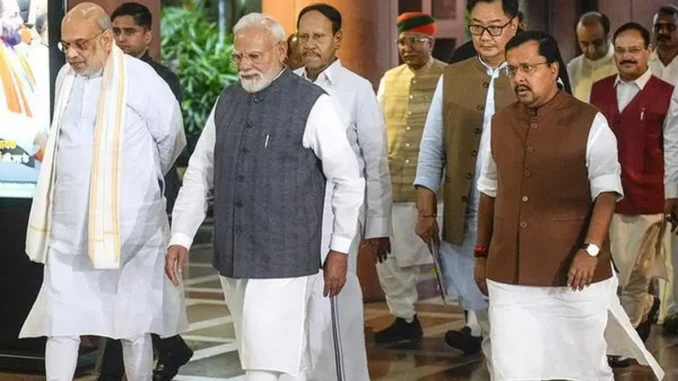

The BJP hopes its organisational revamp will help counter the multiple challenges posed by students, the CJP, and Gen Z, but its changes are neither radical nor imaginative.
The recent unveiling of a new team of national office-bearers by the BJP president Nitin Nabin is as clear an indication of the growing unease within the party’s ranks as any open statement about it.
It has been almost eight months since Nabin’s appointment as the BJP president, but it is the student protests and the reel onslaught that seem to have finally pushed the top bosses to unveil a new team in Nabin’s name. The changes took place after extensive deliberations not only among the party’s top brass but also with its ideological mentor, the RSS. The 64-strong new team includes 13 vice presidents, 8 general secretaries, and 16 secretaries, and is the core team that will carry forward the BJP’s election management strategies in the crucial years ahead.
The key members have been inducted keeping in mind the elections slated in 2027 and 2028 in Uttar Pradesh, Punjab, and Gujarat. In the next few days, Nabin is likely to allocate the new office-bearers crucial poll-related work.
The Samajwadi Party chief Akhilesh Yadav has already given a liberal interpretation of his PDA (Pichhda, Dalit, Alpasankhyak/Backward, Dalit, and Minority) social engineering slogan, which brought him a rich haul in the 2024 Lok Sabha election, by stating that the “P” also stands for Pandits.
The six others in Nabin’s team from Adityanath’s State represent a careful caste balance, as they are drawn from OBC, Yadav, Muslim (Pasmanda), and extremely backward castes (EBCs). As the party faces the heat of public ire over the Ram Mandir donation theft scam, the clean chit given to the powerful Vishwa Hindu Parishad leaders Champat Rai and Anil Mishra in charge of the temple might not be enough to save it, and so it clearly hopes to brazen out by playing the caste card.
Irani, dropped from the Modi Cabinet, has been rehabilitated. Her claim to fame came in the wake of defeating Rahul Gandhi in the Amethi Lok Sabha seat in 2019. But her defeat in 2024 at the hands of an unknown Gandhi loyalist, Kishori Lal Sharma, sent the former Saas Bhi Kabhi Bahu Thi star into political oblivion. Her induction into the team now may be read as the BJP’s desperate measure to find a loud voice against a likely alliance between Rahul Gandhi and Akhilesh Yadav, but it also reveals that the BJP faces a clear talent crunch to handle the critical State of Uttar Pradesh.
The BJP general secretary Vinod Tawde has been appointed as the party in-charge for the State. Tawde is the BJP’s rising star after he delivered a mammoth victory in Bihar where the saffron party for the first time grabbed the Chief Minister’s chair by persuading Nitish Kumar to opt for a Rajya Sabha seat.
How seriously worried the BJP is can also be gauged from the fact that Uttar Pradesh Chief Minister Adityanath is coming to New Delhi almost every week. The 2027 Assembly election in Uttar Pradesh, say observers, will be seen as a semi-final in national politics and also set the tone for the 2029 Lok Sabha election. If the BJP were to lose the State election, panic may set into the saffron camp.
RSS enters the frame
Ram Madhav has been named as party vice president, marking his formal return to the party fold after six years. Madhav’s earlier stint in the BJP was as national general secretary, with his status almost rivalling that of the then party president Amit Shah. Madhav would regularly attend meetings at 7, Race Course Road, now named Lok Kalyan Marg, the residence of the Prime Minister.
His return must be seen in the context of the evolving relations between the BJP and the RSS. Known for his outspokenness, Madhav as BJP vice president might be the route through which the RSS is likely to communicate with the BJP’s top brass. The RSS might also position Madhav as a check on the BJP’s bid to assert functional autonomy.
By recalling Smriti Irani as a general secretary and accommodating seven others from Uttar Pradesh, the BJP has dropped the first signal that the party is aware of the mounting challenge in its hitherto stronghold of the Hindi heartland and cow-belt. With Ram Madhav inside the party in an official position, the RSS has clearly taken a firm stand that the BJP must remain aligned with its Nagpur parent.
With the coming years likely to see a power tussle between the powerful groups in the BJP, especially as Modi gets older, Madhav is also likely to keep the RSS posted of the moves in play in the BJP on a real-time basis. With Madhav inside the party in an official position, the RSS has clearly taken a firm stand that the BJP must remain aligned with its Nagpur parent.
The heavy shadow of Shah
Even after joining the Modi Cabinet as Union Minister for Home Affairs in 2019, Shah has been known as the de-facto BJP president. His successor J.P. Nadda spent all of his six years leaving the impression that he had failed to assert any autonomy in the party’s functioning, since Shah commanded unprecedented influence on all the national office-bearers.
In Nabin’s new team too, Shah’s signature is bold. The core team consisting of general secretary (organization) B.L. Santhosh and his two deputies, Saudan Singh and Sriprakash (both joint general secretaries), powerful general secretaries Sunil Bansal and Vinod Tawde, and the office in-charge, Tarun Chugh, stays intact. Shah has brought his trusted lieutenants from other States as national secretaries into Nabin’s team. Shah’s key confidante Biplab Kumar Deb, who was in charge of Haryana, also joins Nabin’s team as national general secretary.
Despite coming with Nabin’s signature, the BJP leadership is now largely known as the Modi-Shah duo, and the Home Minister’s imprints in the affairs of the BJP are not at all likely to diminish. In his eight months in office, Nabin has failed to suggest that he will assert any independence in functioning, and within the BJP too, the buzz grows stronger every day that Nabin simply takes instructions from Shah.
Shah has further cemented his hold on the BJP by deputing his trusted lieutenant and Union Minister for Commerce Piyush Goyal as party treasurer. Goyal is known to be a key member of Shah’s inner circle, which includes the party’s media head Anil Baluni, who also retained his position in Nabin’s new team.
The CJP challenge
The Cockroach Janta Party took the scalp of one of Shah’s powerful allies, the former Union Minister Dharmendra Pradhan. The CJP can claim to have struck again by indirectly accounting for the ouster of BJP’s influential IT cell head Amit Malviya. Like Pradhan, Malviya too was a key asset for Shah, leading the BJP’s digital army through Nadda’s tenure even though the latter was reportedly not sanguine about Malviya’s performance.
But by dropping Malviya, the BJP is not signaling a course correction in its digital outlook. Successor Deepak Mhaskey and his co-convenors in the social media team—Priti Gandhi, Shivanand Dwivedi, Alok Bhatt, and Arun Yadav—have already been exposed on the Internet for their former vile and hate-filled posts. Even as they rapidly made their X accounts private or deleted posts, their older messages were dug out, revealing that they belong firmly to the Malviya school of trolls, attacking rivals with abuse and diatribes.
The new social media team, therefore, does not portray a course correction in the face of the CJP challenge but reveals that the BJP hopes to brazen out the Gen Z crisis with an even more aggressive deployment of its old social media toolkits.
Simultaneously, however, the BJP has sought to curry favor with Gen Z by bringing in as national secretaries new faces who are mostly in their 40s and 50s. Nabin himself is 47 and may be at ease with his new team of 16 national secretaries.
BJP strategy against Gen Z
The CJP’s success is now fueling a Gen Alpha movement against the dismal conditions of schools as children unleash an avalanche of reels showing the sad state of affairs in government schools across States. The campaign has already unnerved the BJP in Uttar Pradesh, Rajasthan, and West Bengal.
If the Jantar Mantar protest arguably knocked out the claims of good governance made by Modi at the Centre, the governance void in States ruled by the BJP is being laid bare by Gen Alpha through these videos. The BJP’s governance model built around freebies is now facing the challenge of heavy lapses in the field of education and health.
Within the BJP, the view is that the CJP is not a one-issue movement but a challenge that will confront the party on a regular basis. Governance reforms cannot be unleashed quickly enough to stop the short videos that are regularly ridiculing the BJP.
To meet this challenge, the BJP seems to be falling back on its core strength—unleashing its organizational might to focus on election management and electoral victories. Party leaders assert that they can bank on their cadre and on the RSS backbone to continue winning elections.
Whether the party can continue to prioritize electoral victories at the cost of governance and real reform will be severely tested in the coming days.
(Manish Anand is a Delhi-based journalist who has been covering the BJP for over two decades.)
(Source: Frontline)

Be the first to comment