Tag: BNP

  • Former Bangladesh Prime Minister Khaleda Zia dies at 80

    Former Bangladesh Prime Minister Khaleda Zia dies at 80

    PM Modi, Bangladesh Chief Adviser Yunus, Sheikh Hasina offer condolences

    NEW DELHI / NEW YORK (TIP): Khaleda Zia, the longtime chief of the Bangladesh Nationalist Party (BNP) and a three-time prime minister, died on Tuesday morning , December 30, 2025), in Dhaka after a prolonged illness. She was 80.

    Prime Minister Narendra Modi on Tuesday , December 30, conveyed his “sincerest condolences” to the family of the late former PM of Bangladesh Khaleda Zia and recollected her contributions to the development of Bangladesh and India-Bangladesh bilateral relations.

    The Chief Adviser of the interim government of Bangladesh, Prof. Mohammed Yunus, said that Begum Zia was not just the leader of a political party but in fact she was an “important chapter of Bangladesh’s history’. Paying tribute to Ms. Zia who passed away at a hospital in Dhaka, Prof. Yunus said, in her demise, Bangladesh has lost a “great guardian” of the nation.

    Deposed Prime Minister of Bangladesh, Sheikh Hasina, during whose tenure Khaleda Zia was imprisoned, also conveyed her condolences to BNP’s Acting Chairperson Tarique Zia and said, her demise is an “irreparable loss” for the political life of Bangladesh.

    PM Modi recalls meeting with Ms. Zia in 2015
    “As the first woman Prime Minister of Bangladesh, her important contributions towards the development of Bangladesh as well as India-Bangladesh relations will always be remembered,” said Prime Minister Modi, recollecting his meeting with Begum Zia in June 2015 when he visited Dhaka for the signing of the historic India-Bangladesh Land Boundary Agreement (LBA).

    “Our sincerest condolences to her family and all the people of Bangladesh. May the Almighty grant her family the fortitude to bear this tragic loss,” PM Modi said. Earlier the Bangladesh Nationalist Party had announced that Ms. Zia passed away at 6 a.m., on Tuesday (December 30), urging everyone to pray for the departed soul.

    “Professor Yunus stated that Begum Khaleda Zia was not merely the leader of a political party; she represented an important chapter in the history of Bangladesh. Considering her contributions, her long struggle, and the deep public sentiment towards her, the government declared her a Very, Very Important Person of the State earlier this month,” a statement from the press wing of the Chief Adviser.

    Mr. Yunus said Ms. Zia was responsible for enhancing education for women in the country that facilitated improving the condition of women in Bangladesh.

    “In her political life, she was enormously successful. She never lost an election. From 1991 to 2001, she was elected in five different parliamentary constituencies. She contested from three constituencies and won in all the three seats,” said Prof. Yunus who gave credit to Begum Zia for allowing structural adjustments in Bangladesh’s economy in the early 1990s.

    The statement from Prof. Yunus, described Begum Zia as a “unique symbol of struggle and resistance” for her role during the 16-year long tenure of Prime Minister Sheikh Hasina when BNP boycotted the elections of 2014, 2018 and January 2024.

    Ms. Zia’s last public appearance was on the Armed Forces Day November 21, 2025, an event she has been attending over the decades, as the widow of former Army Chief and President of Bangladesh General Ziaur Rahman.

    This year, however, she appeared in a wheelchair while meeting Prof. Yunus and Army Chief General Waker-uz-Zaman.

    She was admitted to the Evercare Hospital of Dhaka on November 23, following lung infection. Former Prime Minister Khaleda Zia was released from prison hours after the fall of the Sheikh Hasina government on August 5, 2024.

    However, Bangladesh Awami League shared the remarks of Ms. Hasina on the passing of Khaleda Zia, long considered to be her rival. “Her contribution is immense as the first Prime Minister of Bangladesh and for the establishment of democracy in Bangladesh. In her death the political life of Bangladesh and the leadership of BNP has suffered an irreparable loss,” Hasina said in her condolence message.
    (Source: The Hindu)

  • Turmoil in Bangladesh: Implications for Regional Stability and Communal Harmony

    Turmoil in Bangladesh: Implications for Regional Stability and Communal Harmony

    It is imperative that both Bangladesh and India, along with the international community, work together to defuse tensions, protect minority rights, and uphold the values of democracy and human dignity. Only through collective efforts can the region hope to achieve lasting peace and stability.

    “Indian electronic media, always hungry for sensational stories, has devoted hours to covering the atrocities against Hindus in Bangladesh. Graphic visuals, emotional narratives, and provocative debates dominate prime-time slots, often amplifying the crisis and shaping public perception.

    This relentless media focus has created a charged atmosphere in India, where communal sensitivities are already high. The portrayal of Hindus as victims of Islamist aggression resonates deeply in a country where religious identity often intersects with political agendas. The ruling Bharatiya Janata Party (BJP), led by Prime Minister Narendra Modi, has been accused by critics of leveraging such narratives to consolidate its Hindu nationalist base.”

    By Prof. Indrajit S Saluja
    Prof. Indrajit S Saluja

    Bangladesh, historically a beacon of resilience and progress in South Asia, is currently grappling with political and social turmoil of a magnitude that has sent ripples across the region. The ouster of Sheikh Hasina, the country’s longest-serving prime minister and leader of the Awami League, has left a void in the political landscape and unleashed a wave of uncertainty. The situation has been further exacerbated by the former leader seeking asylum in India, a move that has added fuel to the already simmering tensions between the two nations.

    The Political Vacuum in Bangladesh

    Sheikh Hasina’s leadership, marked by economic progress and relative political stability, came to an abrupt end amidst allegations of authoritarianism and electoral manipulation. Her ouster has plunged Bangladesh into a state of political uncertainty, with power struggles between rival factions, including the opposition Bangladesh Nationalist Party (BNP) and Islamist groups, intensifying. The absence of a strong central authority has emboldened extremist elements, leading to a spike in communal violence and targeted attacks.

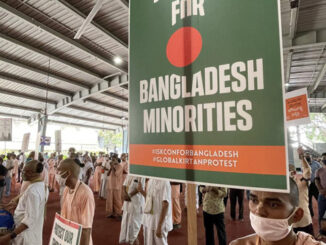
    The Hindu minority in Bangladesh, which constitutes approximately 8% of the population, has found itself at the center of this unrest. Reports of attacks on Hindu men and women, desecration of temples, and threats of mass killings by radical Islamist groups have surfaced, painting a grim picture of the ground reality.

    Atrocities Against Hindus: A Frightening Trend

    While communal violence in Bangladesh is not a new phenomenon, the scale and intensity of the recent attacks have raised alarm. In the past few months, several incidents have been reported.

    Desecration of Temples: At least 15 Hindu temples have been vandalized or destroyed since the political upheaval began, according to local sources. Religious idols and sacred texts have been desecrated, fueling fears among the Hindu community.

    Attacks on Individuals: Human rights organizations have documented over 200 cases of violence against Hindus, including physical assaults, abductions, and sexual violence against women.

    Mass Exodus: Fear of persecution has reportedly driven thousands of Hindus to flee their homes, with many seeking refuge in neighboring India. Border towns in West Bengal and Assam have reported a sharp increase in the arrival of Bangladeshi Hindu refugees.

    The situation has drawn widespread condemnation from international human rights groups, but the lack of decisive action from the interim government in Bangladesh has only emboldened extremist factions.

    India’s Media Frenzy and Political Implications

    Indian electronic media, always hungry for sensational stories, has devoted hours to covering the atrocities against Hindus in Bangladesh. Graphic visuals, emotional narratives, and provocative debates dominate prime-time slots, often amplifying the crisis and shaping public perception.

    This relentless media focus has created a charged atmosphere in India, where communal sensitivities are already high. The portrayal of Hindus as victims of Islamist aggression resonates deeply in a country where religious identity often intersects with political agendas. The ruling Bharatiya Janata Party (BJP), led by Prime Minister Narendra Modi, has been accused by critics of leveraging such narratives to consolidate its Hindu nationalist base.

    In recent years, the Modi government has faced allegations of using Hindu sentiment as a political tool, particularly during elections. The crisis in Bangladesh provides fertile ground for the BJP to further this narrative, potentially leading to a rise in anti-Muslim rhetoric and actions within India.

    The Danger of Escalation

    The repercussions of the Bangladesh crisis are not confined to its borders. In India, a country with a significant Muslim population, the politicization of the issue risks triggering communal clashes. Historically, incidents of violence against Hindus in neighboring countries have often been followed by retaliatory attacks on Muslims in India.

    There are already signs of tension:

    Communal Rhetoric: Religious leaders and political figures in India have begun invoking the atrocities in Bangladesh to rally support, often using inflammatory language.

    Protests and Violence: Demonstrations condemning the attacks in Bangladesh have been organized in several Indian cities, with some turning violent. Mosques and Muslim-owned businesses have been targeted in isolated incidents.

    Border Tensions: The influx of refugees from Bangladesh has strained resources and heightened security concerns in border states like West Bengal and Assam, where communal relations are precarious.

    If not managed responsibly, these developments could spiral into sustained clashes, not just in India but across the region, destabilizing South Asia as a whole.

    The Need for Responsible Leadership

    Amidst this volatile situation, the onus lies on the leadership in both Bangladesh and India to act responsibly. The political vacuum in Bangladesh must be addressed through dialogue and democratic processes to restore stability. International pressure and mediation may be necessary to ensure that minority rights are protected and extremist elements are curtailed.

    In India, the government must resist the temptation to exploit the crisis for political gains. Instead, it should focus on:

    Diplomatic Engagement: Collaborating with the interim government in Bangladesh to address the violence and ensure the safety of Hindus.

    Media Regulation: Encouraging responsible reporting that informs rather than inflames public sentiment.

    Community Outreach: Promoting interfaith dialogue and understanding to counter communal tensions within India.

    Refugee Management: Developing a humane and effective strategy for managing the influx of Bangladeshi refugees, while addressing the security concerns of border states.

    The Broader Implications for Regional and Global Peace

    The crisis in Bangladesh and its potential spillover into India underscore the interconnectedness of South Asia’s socio-political dynamics. The region, home to over a billion people, cannot afford to be mired in communal conflicts that hinder development and progress.

    Moreover, the international community must recognize the global implications of the crisis. Communal violence and political instability in South Asia have the potential to fuel extremism, disrupt trade routes, and impact global security.

    It is imperative that both Bangladesh and India, along with the international community, work together to defuse tensions, protect minority rights, and uphold the values of democracy and human dignity. Only through collective efforts can the region hope to achieve lasting peace and stability.

  • Bangladesh Prime Minister Sheikh Hasina lashes out at BNP’s ‘India Out’ campaign

    NEW DELHI / DHAKA (TIP): Bangladesh National Party (BNP) has been propogating an ‘India Out’ campaign for some time and has been asking people to boycott Indian products. Bangladesh’s Prime Minister Sheikh Hasina has lashed out at BNP for propagating this campaign.
    Challenging BNP, Sheikh Hasina sarcastically said, “Why they don’t burn their wives’ Indian sarees”, not use Indian spices in the kitchen.”
    This social media campaign against India surfaced on social media in January after their general elections.
    “How many Indian saris do their (BNP) wives have?,” PM Hasina said at an event organised on their Independence Day on March 26th.
    “When they burn their wives’ Indian saris in front of their party office, only then they will prove that they are truly committed,” she said making the audience laugh.
    After Maldives, Bangladesh is the second country where the opposition took up the ‘India Out’ campaign.
    Meanwhile, taking Sheikh Hasina’s stance of lashing out at the India Out campaigners, Bangladesh’s Foreign Minister, Dr Hasan Mahmud, spoke about the usage of Indian products.
    “They (BNP) eat food made with Indian onions, Sehri with Indian beef at night and wives wearing Indian saris when they go out. Which contradicts the call of Indian product boycotts.”
    Dr Mahmud criticized the BNP’s political stance stating that the actions do not benefit the country. He also said that the country’s image gets reflected badly overseas when such campaigns are run.
    India is the biggest trading partner of Bangladesh, in numerous industries. The relationship between both countries is marked by shared interdependence, as Bangladesh depends on India for essential imports including raw materials, machinery, and agricultural goods. At the same time, India gains from Bangladesh’s exports of garments, textiles, and medicines. Therefore, the implementation of the “India-Out” campaign requires strong support from citizens.
    Meanwhile, according to sources, PM Hasina is expected to visit Delhi in June after the conclusion of the upcoming Lok Sabha elections. (PTI)

  • Bangladesh shuts down main opposition newspaper

    DHAKA (TIP): The only newspaper of Bangladesh’s main opposition party halted printing on February 20 after a government suspension order was upheld, stoking fears about media freedom in the South Asian nation.
    Campaigners and foreign governments including the United States have long expressed worries about efforts by Prime Minister Sheikh Hasina to silence criticism and what they see as creeping authoritarianism.
    The Dainik Dinkal, a broadsheet Bengali-language newspaper, has been a vital voice of the Bangladesh Nationalist Party (BNP) for more than three decades. It employs hundreds of journalists and press workers.
    It covers news stories that the mainstream newspapers, most of which are controlled by pro-government businessmen, rarely do. This includes the frequent arrests of BNP activists and what the party says are thousands of fake cases against its supporters.
    The newspaper said the Dhaka district authorities ordered the shutdown on December 26, but it continued to publish after making an appeal at the Press Council headed by a top high court judge.
    “The council rejected our appeal yesterday (Sunday), upholding the district magistrate’s order to stop our publication,” Shamsur Rahman Shimul Biswas, managing editor of the newspaper, told AFP.
    The order, a copy of which was obtained by AFP, said the printing permit of the newspaper was cancelled after the newspaper violated the country’s printing and publication laws.
    The council said the paper’s publisher, Tarique Rahman — the acting chief of BNP — was a convicted criminal and was living abroad without handing over his job to another person.
    Biswas said Rahman, now based in London, submitted his resignation and appointed a new publisher, but the authorities did not accept the changes.
    “This shutdown is all part of the government crackdown on dissenting voices and freedom of speech,” Biswas said.
    The government on Monday did not comment on the shutdown.
    Two Dhaka-based journalist unions said in a joint statement that the decision was a “reflection of the repression of opposition voices”.
    Unions and journalists staged small street protests over the shutdown on Monday. Last month, Hasina’s government ordered the closure of 191 websites it accuses of publishing “anti-state news”, citing intelligence reports. The Bangladesh government has previously blocked websites several times, notably in December 2018 ahead of national elections.
    The 2022 World Press Freedom Index compiled by Reporters Without Borders ranked Bangladesh at 162, worse than Russia (155) and Afghanistan (156). Bangladesh’s draconian Digital Security Act, under which hundreds of people have been arrested since 2018, has caused particular alarm. (AFP)