Tag: Bodh Gaya

  • Bodh Gaya: The land of Nirvana

    Bodh Gaya: The land of Nirvana

    Bodh Gaya is a Buddhist pilgrimage site in Gaya District of Bihar. Famous for the Mahabodhi Temple, It was here under the Bodhi tree that Gautama Buddha attained enlightenment.
    It is now one of the UNESCO World Heritage Sites, and a lot of foreign countries, including Japan and China, have helped the Indian government in building facilities for the Buddhist pilgrims. The place is bustling with pilgrims all through the year from India and abroad who come to pay their homage in monasteries, temples and remnants of Bodhi Tree.
    Located near the river Neranjana, Bodh Gaya was earlier known as Uruwela. It was also known as Sambodhi, Vajrasana or Mahabodhi until the 18th century CE. It is one of the four important Buddhist sites that include: Kushinagar, Lumbini and Sarnath.
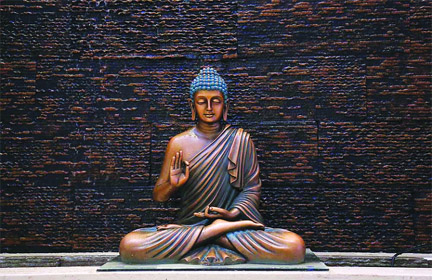
    Great Buddha Statue
    This statue of Lord Buddha is the tallest in India and was instated by the XIV Dalai Lama in 1989. It is a meditating Buddha resting on a giant lotus, constructed using intricately carved sandstone and red granite.

    PRETSHILA HILL
    Pretshila Hill (meaning Hill of Ghost), around 8 km north-west of Gaya, is a revered place for Hindus where they do pind daan (a religious ritual performed for the peace of the departed souls). On top of the hill lies a temple dedicated to Lord Yama, who as per Hindu mythology is the God of Death. The temple was initially constructed by Rani Ahilyabai Holkar of Indore but has been renovated several times. You can see a tank called Ramkund close to the temple, where it is believed that Lord Ram bathed once. People are of the belief that taking a bath in this tank washes away all the sins of devotees.
    DUNGESHWARI CAVE TEMPLES
    Drive about 12 km northeast of Gaya to reach the ancient Dungeshwari Cave Temples, also known as Mahakala Caves. It is believed that Lord Buddha meditated in the three caves here before continuing his journey to Bodhgaya. The caves here also feature Buddhist shrines which are called Sujata Sthan by the natives. There is an interesting story behind the existence of these cave temples, which states that during his self-mortification, Gautama became extremely weak and starved. At that time, a lady named Sujata from a nearby village offered him food and water. Later Gautama realised that one cannot attain enlightenment by self-indulgence or self-abasement. He then carried on with his journey and reached Bodhgaya where he finally attained enlightenment. In one of the cave temples, you can see a beautiful golden statue of Buddha, which is about 6 feet tall. When in Gaya, do not miss out on paying a visit to these ancient cave temples as the journey will add to your Buddhist experience.
    BARABAR CAVES
    About 24 km north from Gaya lies Barabar Caves, which are probably one of the oldest existing rock-cut caves in India. These caves, most of them dating from the Maurya Empire (322-185 BCE), are situated in Makhdumpur block of Jehanabad district, Bihar. Some caves here also have inscriptions from the Ashokan period. Four caves, namely Sudama, Karan Chaupar, Lomas Rishi and Vishwa Zopri, basically form the Barabar Caves. All these caves are fascinating in their own way. While Lomas Rishi caves resemble the huts where Buddhist monks used to live in, the Sudama Cave has arches like a bow. All these caves have some interesting stories to tell here. Make sure to carry some water along as there are no shops or for that matter no place to stay in the vicinity of these caves.
    DEO SUN TEMPLE
    Built during the 8th century by Chandravanshi King, Bhairavendra Singh, Deo Sun Temple in Aurangabad district is one of the most notable temples and a major crowd-puller in Bihar. It is often noticed that devotees and travellers visiting Gaya make a point to explore this age-old temple, which is about 70 km drive from the city.
    At present, the sanctum of the temple features beautiful idols of the presiding deities, namely Vishnu, Surya and Avalokitesawara. If you walk outside the main hall, you will see some broken idols of Gods and Goddess along with sculptures of Sun God.
    As the temple is among few existing ancient sun temples in the country, it makes for a must visit religious site for Hindus.

  • Buddha Purnima

    Buddha Purnima

    Also known as Buddha Jayanti or Vaisakhi Buddha Purnima or Vesak, the festival of Buddha Purnima is based on the Asian lunisolar calendar and marks the birth of Gautama Buddha. It is celebrated with great fervour in India, Sri Lanka, Nepal, Bhutan, Tibet and numerous other South East Asian countries including Thailand, Tibet, China, Korea, Laos, Vietnam, Mongolia, Cambodia and Indonesia.
    he birthday of Gautam Buddha, the founder of Buddhism, is celebrated as Buddha Purnima across the world since he was born as Prince Siddhartha Gautama on the Purnima Tithi (full moon day) in 563 BC in Lumbini (modern day Nepal). In Hinduism, Buddha is considered as the ninth avatar of Lord Vishnu hence, this day is commemorated by Buddhists and Hindus all over the world.
    In Theravada Buddhism, it is also observed as the day when Buddha, born as Prince Siddhartha Gautama (c. 563-483 BCE) attained Nirvana (salvation) under the Mahabodhi tree at Bodh Gaya, Bihar, as well as his death anniversary. Gautama Buddha preached Dharma (duty), non violence, harmony and kindness. He left his worldly possessions and princedom at the age of 30 to lead a life searching for the truth, seeking penance in the hopes of liberating himself from suffering (duhkha).
    Devotees of Buddha visit temples, light candles and incense sticks, pray and offer sweets and fruits before the statue of Lord Buddha. Sermons on the life and teachings of Buddha are held and attended by followers all over. People usually dress in white, do not consume non-vegetarian food and distribute kheer, as according to Buddhist lore, on this day a woman named Sujata had offered Buddha a bowl of milk porridge.
    Many followers also free caged birds on this day as a symbol of empathy and compassion for all living beings, one of the most important teachings of Lord Buddha. In India, a large fair takes place in Sarnath, Uttar Pradesh, a major Buddhist pilgrimage site where Buddha is said to have delivered his first sermon after attaining enlightenment.
    Celebrations around the world
    Japan
    The festival in Japan is based on a different legend that says, a dragon appeared in the sky on Buddha’s birthday and poured soma over him, which is a Vedic ritual drink. In the modern arena, Japan celebrates Vesak by pouring amacha, a sweet tea on statues.
    Nepal
    Nepal is home to Lumbini-birthplace of Buddha, and Swayambhu-the holy temple for Buddhists also known as the Monkey Temple. The main door of Swayambhu is opened only on this day; hence, people from all over Kathmandu valley are stimulated by the event. Pilgrims across the world gather in thousands to celebrate Buddha’s birthday at his birthplace.
    Sri Lanka
    Sri Lanka celebrates Vesak for about one week! During this time, the selling of alcohol and fresh meat is prohibited with abattoirs also being closed. The celebrations here include giving of alms and erection of pandals wherein each pandal illustrates a story from the Jataka Tales. Food stalls are set up by Buddhist devotees that provide eatables and drinks to passersby. Also birds, insects and animals are released by the thousands in what is known as a ‘symbolic act of liberation’; of giving freedom to those who are in captivity, imprisoned, or tortured against their will.
    Apart from these, other Asian countries like Korea, Vietnam, Malaysia, Indonesia, and Singapore also participate in processions and prayers by monks and make this day a true symbol of spirituality.
    What Do People Do?
    Many Buddhists visit temples on Vesak to listen to monks give talks and recite ancient verses. Devout Buddhists may spend all day in one or more temples. Some temples display a small statue of Buddha as a baby. The statue is placed in a basin filled with water and decorated with flowers. Visitors to the temple pour water over the statue. This symbolizes a pure and new beginning.
    Many Buddhists pay special attention to Buddha’s teachings during Vesak. They may wear white robes and only eat vegetarian food on and around Vesak. Many people also give money, food or goods to organizations that help the poor, the elderly and those who are sick. Caged animals are bought and set free to display care for all living creatures, as preached by Buddha.
    Government offices, post offices and banks are closed in India on Vesak. Stores and other businesses and organizations may be closed or have reduced opening hours. Transport is usually unaffected as many locals travel for religious celebrations.
    Background
    Gautama Buddha was a spiritual teacher in India. Many scholars are uncertain when he lived. It is believed that Buddha was born at some time between sixth and fourth centuries BCE. Opinions among scholars are generally divided between those who place Buddha’s death about 480 BCE and those who place it as much as a century later.
    Buddha was an influential spiritual teacher during and after his lifetime. Many Buddhists see him as the Supreme Buddha. Festivals to honor Buddha were held for many centuries. The decision to celebrate Vesak as the Buddha’s birthday was formalized at the first conference of the World Fellowship of Buddhists. This conference was held in Colombo, Sri Lanka, in May, 1950. The date was fixed as the day of the full moon in May. Different Buddhist communities may celebrate Vesak on different dates in years when there are two full moons in May. This is because the Buddhist lunar calendar can be interpreted in different ways.
    Symbols
    The dharmacakra or dharma wheel is a symbol often seen during Vesak. It is a wooden wheel with eight spokes. The wheel represents Buddha’s teaching on the path to enlightenment. The eight spokes symbolize the noble eightfold path of Buddhism.

  • Bodh Gaya: Buddha, Mahabodhi Tree and the land of Nirvana

    Bodh Gaya: Buddha, Mahabodhi Tree and the land of Nirvana

    Bodh Gaya is a Buddhist pilgrimage site in Gaya District of Bihar. Famous for the Mahabodhi Temple, It was here under the Bodhi tree that Gautama Buddha attained enlightenment. It is now one of the UNESCO World Heritage Sites, and a lot of foreign countries, including Japan and China, have helped the Indian government in building facilities for the Buddhist pilgrims. The place is bustling with pilgrims all through the year from India and abroad who come to pay their homage in monasteries, temples and remnants of Bodhi Tree. Located near the river Neranjana, Bodh Gaya was earlier known as Uruwela. It was also known as Sambodhi, Vajrasana or Mahabodhi until the 18th century CE. It is one of the four important Buddhist sites that include: Kushinagar, Lumbini and Sarnath.

    Places to visit – Mahabodhi Temple

    The Mahabodhi temple, also called the “Great Awakening Temple”, is a UNESCO World Heritage Site located in Bodhgaya, Bihar. It is a Buddhist temple that marks the location where the Lord Buddha is said to have attained enlightenment. Lord Buddha holds a very significant place in the religious history of India as he is believed to be the 9th and the most recent incarnation of Lord Vishnu to have walked the earth. The temple spreads over an area of a whopping 4.8 hectares and is 55 meters tall. The Bodhi Tree is situated to the left of the temple and is believed to be the direct descendant of the actual tree under which Lord Gautam Buddha meditated and attained enlightenment and laid down his philosophy for life. The original temple was built by Emperor Ashoka after he turned to Buddhism in order to seek peace and solitude from war and conquests.

    The great Emperor Ashoka visited Bodh Gaya in around 260 BC. During his visit, he constructed a small temple by a tree, which was the Bodhi tree- the tree under which Gautam Buddha was sitting when he attained enlightenment. An inscription dated back to between 1st century and 2nd century read that the temple built by Emperor Ashoka was replaced by a new one. Many monks and devotees can be seen performing countless prostrations to the tree. It’s a purificatory ritual, and some monks are known to do up to 1,00,000 prostrations at one time. The architecture of the temple and its overall silence and peace will surely enchant you as you visit it.

    Great Buddha Statue

    This statue of Lord Buddha is the tallest in India and was instated by the XIV Dalai Lama in 1989. It is a meditating Buddha resting on a giant lotus, constructed using intricately carved sandstone and red granite.

    Bodhi Tree

    The Bodhi Tree, located 100 kilometres to the south of Patna in the north Indian state of Bihar, is perhaps the most prominent and respected sacred places in Buddhism because of the rich historical significance attached to it. It is under this tree that Prince Siddhartha Gautama, the spiritual teacher who later became to be known as the Buddha, attained enlightenment. It is believed that Prince Siddhartha had to sit and meditate under this tree for seven days. Later on, a shrine known as Animisalocana Cetiya was erected on the spot where he had sat down. A small temple was also built near the Bodhi tree in the 7th century.

    The Bodhi tree is a frequently visited destination spot by tourists and is one of the four main Buddhist pilgrimage sites. In fact, the Anandabodhi tree in Sravasti and the Bodhi tree in Anuradhapura, both of which are again significant places that find mention in the history of Buddhism, are believed to have been propagated from this tree here at Bodh Gaya. The aura of the Bodhi tree and the temple complex in which this tree is located have attracted sages, meditators and yogis to it ever since the time of the Buddha. Great and renowned spiritual figures like Buddhajnana, Padmasambhava, Vimalamitra, Nagarjuna and Atisha, have lived and meditated underneath the historically and religiously significant Bodhi Tree. Bodh Gaya is also popular for its UNESCO World Heritage Site- the Mahabodhi Temple Complex, which is just beside the tree. Religious people, as well as lovers of history, find this place especially fascinating.

    Thai Monastery

    Well known for its curved roof covered with exquisite tiles of gold, the Thai Monastery houses a bronze statue of Buddha and another recently erected 25m high statue in the garden.

    Muchalinda Lake

    A popular site at Bodh Gaya, the Muchalinda Lake is located next to the main temple. It is associated with a mythological tale stating that Lord Buddha was protected from the storm by Snake King Muchalinda.

    A popular site at Bodh Gaya, the Muchalinda Lake is located next to the main temple. It is associated with a mythological tale stating that Lord Buddha was protected from the storm by Snake King Muchalinda.

    Vishnupad Temple

    As the name suggests, this temple was built as a dedication to Lord Vishnu and features a 40 cm long footprint of Lord Vishnu that is enclosed by a basin made of silver plates.

    This footprint marks the act of Lord Vishnu subduing Gayasur by placing his feet on Gayasur’s chest. Within the courtyard, there are other temples situated as well. One is dedicated to Lord Narasimha and another to Lord Shiva in the form of Phalgwisvara. This temple serves as a very significant place of worship for Hindus and is located in Gaya.

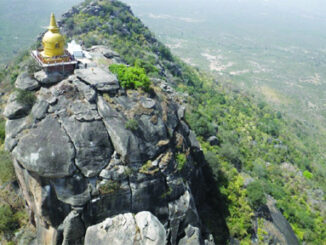
    Dungeshwari Hills

    Dungeshwari Hills is where Lord Buddha spent a few years before travelling to Bodh Gaya in search of enlightenment. The hills are mostly known for the caves that Gautam Buddha used for shelter and meditation. The Stupas/ Buddhist shrines exist even today amidst the beautiful natural surroundings. The picturesque location of the Dungeshwari Hills is also a well-known trekking destination and draws enthusiasts in large numbers.