Tag: Brazil

  • It’s a new era in India’s foreign policy as countries compete to woo Modi

    It’s a new era in India’s foreign policy as countries compete to woo Modi

    “The new majority government in power in New Delhi, freed from debilitating coalition politics and attaching priority to economic development, has aroused external interest”, says the author.

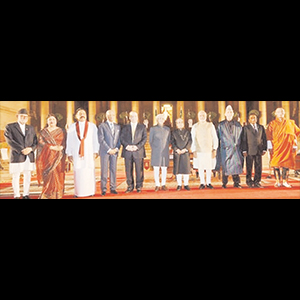
    In foreign policy, Prime Minister Modi has hit the ground running, taking unexpected initiatives. He reached out to our neighbors, taking the unprecedented step of inviting their leaders to his swearing-in ceremony. While invitations to Bangladesh, Nepal, Bhutan, Maldives and Afghanistan carried only positive connotations, those to Prime Minister Nawaz Sharif and President Rajapakse carried mixed political implications. It was felt that the plus points in extending invitations to Pakistan and Sri Lanka outweighed the negatives.

    Engagement

    In Pakistan’s case the dilemma is whether we should engage it at the highest level without any ground-clearing move by Nawaz Sharif on terrorism, the Mumbai trial and trade. The Pakistani premier has been, on the contrary, aggressive over Kashmir, invoking the UN resolutions and self-determination as a solution, seeking third party intervention, permitting tirades by Hafiz Saeed against India, maintaining the pitch on water issues and reneging on granting MFN status even under a modified nomenclature.

    In these circumstances, the move to invite him risked suggesting that, like the previous government, the new government too was willing to open the doors of a dialogue in the hope of creating a dynamics that would yield some satisfaction on the terrorism issue. In other words, practically delinking dialogue from terrorism, despite having taken a position to the contrary while in opposition.

    In Sri Lanka’s case, the whipped-up sentiments in Tamil Nadu against President Rajapakse for his triumphalist rather than reconciliatory policies on the Tamilian issue have upset the overall balance of India’s foreign policy towards Sri Lanka that requires that we adequately weigh the need to counter powerful adversarial external forces are at play there against our interests. Inviting President Rajapakse to New Delhi obviously risked provoking a strong reaction in Tamil Nadu, but the new government had to decide whether, like its predecessor, it would get cowed down by such regional opposition, or it would act in the greater interest of the country even when according importance to the sentiments of a section of our population.

    This dramatic outreach to the neighbors has elicited praise internally and externally, primarily focused on the invitation to the Pakistan president and its implication for the resumption of the Indo-Pak dialogue. Internally, those pro-dialogue lobbies that have espoused the previous government’s placative policies towards Pakistan have naturally welcomed the surprise move by Modi. Externally, India has always been counseled to have a dialogue with Pakistan irrespective of its conduct and its terrorist links, the argument being that these two South Asian nuclear armed neighbors with unresolved territorial conflicts risked sliding into a nuclear conflict unless they found a way to settle their differences for which a dialogue was an inescapable necessity. Such praise from within and without from predictable quarters should neither be surprising nor worth much attention.

    Outreach

    The new majority government in power in New Delhi, freed from debilitating coalition politics and attaching priority to economic development, has aroused external interest. The sentiment outside the country- as well as inside it – has been that the previous government lost its way, leading India into the quagmire of high fiscal deficits and tumbling growth, belying international expectations about its economic rise paralleling that of China.

    If India can be steered back into a high growth trajectory with stronger leadership and improved governance, more economic opportunities will open up for our foreign partners. This would also draw renewed attention to India’s geo-political importance which, though an accepted reality now, has receded from the foreground lately.

    Reassurance

    Modi is seen as the man of the moment. This would explain the telephone calls from world leaders to Modi and the invitations given and received. India is being courted, and Modi’s choice of the countries he first visits or foreign leaders he first receives, is drawing external attention as an indication of his diplomatic priorities.

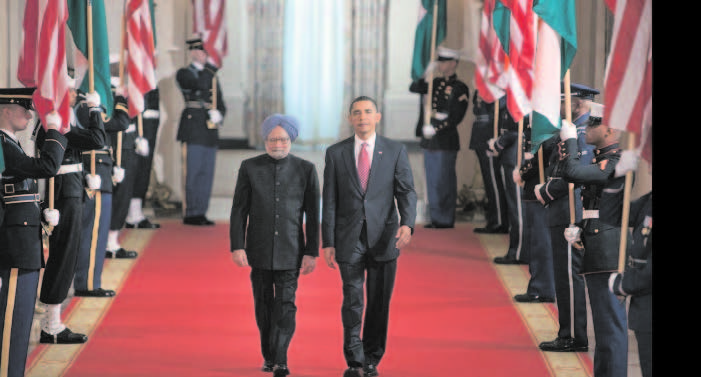
    On this broader front too, Modi is following an unanticipated script of his own. He is being generous to the US despite its reprehensible conduct in denying him a visa, by prioritizing national interest over his individual feelings. He has not waited for the stigma of visa refusal to be erased by a US executive order removing his name from the State Department black-list. He is planning to meet President Obama in Washington in September – the first external visit to be announced – quickly relieving the Americans of fears that the visa issue could become a hurdle in engaging him.

    In another remarkable gesture that the State Department would have noted for its political import, he has agreed to a book launch by an American think-tank at Race Course Road. China wants to complicate moves by Japan to strengthen strategic ties with India. Its decision to send its Foreign Minister to India after the swearing-in seems to have been motivated by this rivalry, apart from seeking to build on the personal contacts established by China with Modi when he was Chief Minister. If the Chinese FM was allowed to be the first consequential foreign leader to meet Modi, it appears Japan may be the first foreign country – barring Bhutan – the latter may visit en route to the BRICS meeting in July in Brazil.

    The Bhutan visit underscores the importance Modi intends attaching to neighbors. Russia’s Deputy Prime Minister is visiting Delhi on June 18. It would seem that Modi’s immediate priority is to reassure all his important interlocutors, friends or adversaries, that they should have no misgivings about him and the direction of his policies, and that he seeks to engage with all power centers in a balanced manner.

  • BRAZILIAN RIOT OF COLOURS

    BRAZILIAN RIOT OF COLOURS

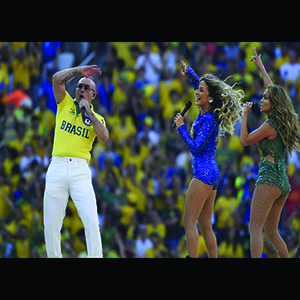
    SAO PAULO (TIP): The 2014 Fifa World Cup got under way with a colourful opening ceremony before hosts Brazil kicked off against Croatia. A cast of 660 dancers paid tribute to the country’s nature, people and football with a show around a “living” ball on the Arena de Sao Paulo pitch. The final act saw a performance of official World Cup song “We Are One” by Jennifer Lopez and rapper Pitbull.

    Many fans took to the streets to sing and chant their support for Brazil as excitement built in the hours before the tournament began. Performers dressed as trees, flowers and various musical instruments all performed in three acts before the central ball opened to reveal singers Claudia Leitte, Jennifer Lopez and rapper Pitbull as they sang the official World Cup song as the finale.


    2

    The 65,000-seater Arena de Sao Paulo chanted the official anthem during the opening There were also demonstrations from those unhappy with the expense of hosting the tournament. Police in Sao Paulo had to use tear gas to break up one protest, which involved about 50 people, while striking airport workers in Rio de Janeiro blocked a road outside the airport, demanding a wage increase and a World Cup bonus.

    No host nation have ever lost their opening World Cup game, with the previous 20 producing 14 victories and six draws for the hosts. Hosts Brazil start as favourites, while holders Spain are aiming to win a fourth major tournament in a row after winning the European Championship two years ago.

  • Desailly tips Argentina for World Cup, Belgium to surprise

    Desailly tips Argentina for World Cup, Belgium to surprise

    LONDON (TIP): Argentina are favourites to win the World Cup in Brazil, Belgium can reach the final and nobody expects much of England, according to former France international Marcel Desailly. The Ghana-born 1998 World Cup winner, who won the Champions League with Marseille and AC Milan, also predicted Ivory Coast could be the surprise team and Argentina’s Sergio Aguero the top scorer. Argentina have the talent to win even if Barcelona’s Lionel Messi does not play in every match, he told Laureus.com in an interview.

    “I am sure collectively Argentina will be able, with Messi at top or without Messi at his best, to win the World Cup,” said the Frenchman. “Honestly I see Argentina playing without Messi,” he continued. “Messi is not specially the key player of Argentina, you will see.” Desailly said champions Spain had the potential to defend the trophy, with fresh talent coming in to boost established players, but hosts Brazil could buckle under the burden of expectation.

    “The first game will be very important but I’m sure confusion will be in the team.” I’m sure it will be difficult for them to join altogether,” said the 45-year-old. “Brazil will face a lot of problems for this World Cup.” The former Chelsea centre back saw “no expectation” for 1966 winners England. “England do not have individual players who can make the difference,” he declared. “Obviously, people will talk about (Wayne) Rooney but in the previous World Cup he did not perform.

    “It will depend on the collective play of the team, good young players who fit in and the cleverness of your coaches,” Desailly added. “Otherwise, England will not go to the final stages. I think even Belgium have a better potential to go to the final stage than England, on their individual capacity.” France are managed by 1998 World Cup-winning captain Didier Deschamps and Desailly said individual talent was certainly there. “The only problem is collectively, France does not perform unless they are scared of getting eliminated,” said Desailly. “We are not expecting to win the World Cup. We are just there, hanging, hoping that game after game we can build up collective motivation.”

  • Fear and loathing in Washington

    Fear and loathing in Washington

    The known unknowns about Modi are perfect catalysts for a reset of India-US relations

    Over the past three years, Washington has also come to believe it did India too big a favor with the nuclear deal and received little payback. This premise conveniently ignores the many tangibles (Indian purchases of US defense platforms to the tune of $10 billion in less than a decade) and intangibles (India’s decision not to criticize wholesale spying by NSA). A strong government in New Delhi is unlikely to be as patient or as yielding

    The American establishment is registering a measure of fear while the liberal academic-NGO community a sense of loathing at the prospect of Narendra Modi becoming India’s next PM. They are full of questions with no real answers. If elected, how would a state CM play the national and international game? How would he deal with a US administration whose policy lately has been to hit India on multiple fronts to extract concessions? More importantly, how would he look at a country that denied him a visa and had no contact with him for seven years?

    The anti-Modi coalition of Christian evangelists, left-leaning Indian Americans and Muslim activists is gearing up to mount pressure through the US Congress. They will keep the heat on even though the old fervor is gone, especially among Republicans. The uncertainties, the ambiguities and the “known unknowns” about Modi are actually perfect catalysts for a “reset” of India-US relations currently running at a low. They can create the new chemistry necessary for a more balanced equation better suited to the times.

    It cannot be the responsibility of one partner to create equilibrium, constantly ignore provocations and appease. A good relationship bears traffic in both directions. Actually the reset has already begun. Ironically, the button was pushed by the Khobragade affair. Needless provocation sparked a strong Indian response and washed the fuzziness off the relationship. Dialogue has gained in clarity since. The defensive tone has been replaced by a confident articulation of Indian expectations from the relationship. It is neither arrogant nor whiney. Terms of engagement will change further if Indian voters give a clear mandate.

    Unfortunately, the last phase of the UPA government left the impression that India will reverse its policies in the face of pressure and noise from Washington. It did so on preferential market access and transfer pricing. This has emboldened US lobbies out to draw more blood. After all who wouldn’t use a tactic that works? Over the past three years, Washington has also come to believe it did India too big a favor with the nuclear deal and received little payback. This premise conveniently ignores the many tangibles (Indian purchases of US defense platforms to the tune of $10 billion in less than a decade) and intangibles (India’s decision not to criticize wholesale spying by NSA). A strong government in New Delhi is unlikely to be as patient or as yielding. Piling on public pressure is bad strategy for the general health of the relationship.

    It reduces the Indo-US story to one of trade and investment disputes and blurs the original idea for coming together – a geostrategic convergence of interests. The new government will realize soon enough that an inward-looking Obama administration has had only fitful engagement with the world. That it has paid no special homage to strategic vision, and instead allowed a disaggregation of the India-US relationship. Then it has come after New Delhi issue by issue. It has attacked India at the behest of big pharma and other business interests whose maximalist agenda has been repeatedly exposed.

    Their game is to scotch any serious attempt to keep medicine affordable while discrediting India’s generic drugs industry through means both fair and foul. In their calculation, if India bends, it would scare smaller, weaker countries from ever contemplating a compulsory license US pharma’s brutal overreach has even put the much-touted Trans-Pacific Partnership under a cloud as negotiating countries discover the traps set for them under the guise of protecting intellectual property and copyrights. If the US Trade Representative reviewing India’s intellectual property regime downgrades it and puts it on the list of ‘Special 301’ countries, this will add another twist to an already twisting relationship. Such naming and shaming could lead to sanctions.

    Pushing the business agenda of demands drafted by the US Chamber of Commerce at a time when the US is losing international partners faster than it is acquiring them is unwise. Especially when Obama’s signature foreign policy effort – the pivot to Asia – keeps reincarnating in lesser and lesser avatars. Obama had also pledged to strengthen bonds with emerging economies but today all Brics are piled up against America for various reasons. India, Brazil, China and South Africa abstained on a UN resolution condemning the fifth partner Russia’s annexation of Crimea. India also abstained on a US-sponsored resolution against Sri Lanka’s human rights situation.

    This reflects a post-Khobragade realism, a push-back, even a new equilibrium. India will give but also take. For every US demand to open the Indian economy, there would be an equal and opposite demand on completing a “tantalization agreement”. India may find it useful to cross-link and leverage defense contracts for something tangible. Surely $10 billion worth of arms can buy relief on H-1B visas or a more honest policy towards a certain neighbor that remains the hub of terrorism. The truth is if Washington can be transactional, so can others. But this new phase should not obscure the larger logic behind India and the US coming together because the many reasons for convergence remain. Those with a wider window than a four-year election cycle understand that. Equally importantly, those who make national security policy in India know what balance of power is more beneficial.

  • INDIA PIPS JAPAN TO BE THIRD LARGEST ECONOMY IN PPP

    INDIA PIPS JAPAN TO BE THIRD LARGEST ECONOMY IN PPP

    NEW DELHI (TIP):
    The global economic balance seems to be tilting towards the developing countries. India has overtaken Japan to emerge as the third largest economy in purchasing power parity (PPP) terms, after the US and China, latest data released by the World Bank showed. Separately, an analysis showed members of the OECD, a rich-country club, accounted for 50% of the global economy estimated at $90 trillion in 2011, compared to 60% of the $70 trillion economy in 2005. While developing countries made up the remaining half, large emerging market economies such as India, China, Brazil, Indonesia, Russia and South Africa now make up around 30% of the world GDP.

    The previous version of the World Bank’s International Comparison Program (ICP) report had said that India was ranked 10th in 2005 in terms of PPP. PPP is used to compare economies and incomes of people by adjusting for differences in prices in various countries. “The economies of Japan and the UK became smaller relative to the US, while Germany increased slightly and France and Italy remained the same,” the World Bank report said. It said that six of the world’s 12 largest economies were in the middle-income category.

    The dozen largest economies accounted for twothird of the world economy and 59% of the population, the report added. The six largest middle-income economies – China, India, Russia, Brazil, Indonesia and Mexico – accounted for 32.3% of world GDP, while the six largest high-income economies – US, Japan, Germany, France, UK and Italy – accounted for 32.9%, showing the distance that the emerging economies had travelled through rapid growth in recent years. At 27%, China has the largest share of the world’s expenditure for investment, with the US at half the level with 13% share. India, Japan and Indonesia followed with 7%, 4%, and 3%, respectively.

  • Coca-Cola ups 2014 FIFA World Cup campaign with football promotion

    Coca-Cola ups 2014 FIFA World Cup campaign with football promotion

    Coca-Cola has launched a new on-pack promotion as part of its latest 2014 FIFA World Cup campaign, which gives consumers the chance to win a limited edition football. As an official partner for the sporting event, the drinks giant is giving away around one million of the Coca-Cola branded footballs, as it aims to “inspire” people to get active this summer.

    The Win a Ball promotion will run from 29 April to 13 July 2014, with consumers invited to enter a unique code found on selected promotional packs of Coca-Cola and Coke Zero on the Win a Ball website to find out if they are a winner. The promotion, which focusses on the “power of football” inspiring people to be active, will be supported by a campaign to run across TV, digital, outdoor and print.

    Bríd Drohan-Stewart, marketing activation director, Coca-Cola Great Britain said: “Coca-Cola is using its support of the 2014 FIFA World Cup like never before; not only celebrating football in Brazil, but using people’s passion for football to motivate them to move, more often, for years to come.

    We hope that the footballs will inspire people to enjoy being active with friends and family and bring the spirit of the 2014 Brazil FIFA World Cup to their community.” In addition Coca-Cola has pledged to donate 10p for each valid entry made to UK charity StreetGames which gets disadvantaged young people into sport.

  • Hodgson: Everybody associates Brazil with football

    Hodgson: Everybody associates Brazil with football

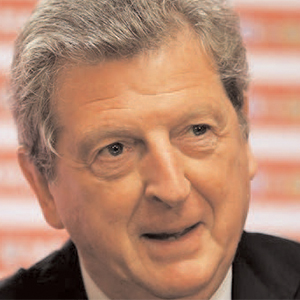
    In the final part of our three-part interview with Roy Hodgson, the England manager speaks about his FIFA World Cup™ memories from 1958, when he was just ten years old, to 1994 as coach of Switzerland. Having also toured Germany in 2006 as a member of FIFA’s Technical Study Group and worked as a pundit for the BBC in 2010, Hodgson has had a wide experience of World Cups from which to draw. And as the former Inter Milan and Liverpool boss told FIFA.com, he believes that Brazil 2014 will be a little special.

    ROY HODGSON: 1958 would be the first one, but mainly because of my time in Sweden when I sort of got reacquainted with it. It was something that should have interested England and Great Britain enormously, as I think it’s the last time all four home nations actually took part. I learned a lot about the ’58 World Cup in Sweden and in particular I became close friends with Orvar Bergmark,who for many years was the most-capped player in the world with his 92 caps. That’s been surpassed many times since, but around the 1958 mark he was right up there.

    And of course, playing against us, managers and colleagues, a lot of the people who played in that: Bengt Gustavsson and Agne Simonsson. All of these people were coaches in Sweden when I was there, and famous players from the ’58 team. Then when I went going to Italy I got to know Nils Leidholm and Gunnar Gren, so I got to know seven or eight of the team and took more interest, I suppose.

    The ’62 World Cup I don’t remember well. And the ’66 one I of course remember very, very well! WHERE WERE YOU DURING 1966? AT CRYSTAL PALACE, TRYING TO BE A PLAYER! Brazil is considered such a football crazy country,where the people basically live for the game. Being a footballer is as good as it gets for anybody in Brazil. WHAT ARE YOUR MEMORIES OF THE TOURNAMENT? DID YOU GO TO ANY OF THE GAMES? No.

    To be fair, aside from the games that were played at Wembley, a lot of the games were played around the country at that time. I was never in a position to get a ticket to be perfectly honest. So I watched the games on TV. I remember the games and the England games quite well. I remember the various moments and controversies. The same with ’70.We had high hopes of doing well because the ’70 team was as strong as the ’66 team on paper because we still had the remnants of the ’66 team and a few interesting younger players had come on the scene.

    In ’74 I was in South Africa, so I only saw the Final. And I saw that in retrospect. I drove from Pretoria to Johanesburg to Wits University. They actually bought the tape of the film for their students and me and my friend were playing in Pretoria,we drove up and got ourselves tickets and watched it in a hall. It was just a taped version of the Final.We knew the score. But that’s the only game we actually saw in ’74.

    Then obviously in ’78 I was in Sweden so I quite liked following that one. WHICH TEAMS OR WHICH MATCHES, PARTICULARLY OF THE LATER WORLD CUPS, STICK OUT FOR YOU? It has to be 1994 when I was involved with Switzerland. I remember all of the games, but in particular the first two, the ones played in Detroit against America and then Romania. I remember those very, very well. Both were in an indoor dome,where they rolled the grass in,which was quite revolutionary at the time. I think in Europe it was only Arnhem (GelreDome) that had a similar system,where they had a dome allowing them to roll in different surfaces. It was quite a novelty in that respect.

    THE HUMIDITY IN THE GAMES THERE WAS EXTREME,WASN’T IT? Our third game, in Palo Alto,was right in the midday sun. In terms of actual temperature it was the hottest. It was over 100 degrees Fahrenheit, because it was right in the heat of the day, with the sun right above you in California. But the worst, in terms of heat and humidity, I thought was the Silverdome in Detroit. They measured the temperature in the low 30s (Celsius) but because it was very hot outdoors, indoors it was even hotter and of course you get the humidity in there as well.

    Washington I don’t remember as being too bad. I think it was in the evening, a later kick-off, and I remember Washington being a normal summer’s day, in the mid-20s. WHAT DO YOU THINK WILL MAKE THE WORLD CUP IN BRAZIL SO SPECIAL? I think the real feeling that this World Cup is special because of Brazil’s relationship to football.

    Everybody associates Brazil with football. Partly because of the success the Brazilian national teams have had and the tournaments they’ve won. But it’s not just that, it’s all the Brazilian players who have played all over the world. They export so many thousands of players. We’re all used to seeing the Copacabana and other beaches filled with people playing on the sand and Brazil is considered such a football crazy country, where the people basically live for the game.

  • REFORMS TO GIVE 110 MILLION JOBS BOOST TO ECONOMY IN 10 YEARS

    REFORMS TO GIVE 110 MILLION JOBS BOOST TO ECONOMY IN 10 YEARS

    NEW YORK (TIP): As general elections draw closer in India, global financial major Goldman Sachs has said 40 million new manufacturing jobs can be created in a decade if states follow flexible labor laws like in Gujarat.

    Besides labor laws, implementation of proper reforms in other areas such as subsidies can lead to overall job gains rising to 110 million over the next 10 years – the largest for any major economy, Goldman Sachs said. The observations assume significance as they come at a time when a political debate is underway on the comparison between growth model of Narendra Modi-led Gujarat and that of other states ruled by Congress and other parties.

    Modi is the prime ministerial candidate of BJP, which is trying to wrestle power from Congress at the Centre. The report said the Gujarat government amended the Industrial Disputes Act in 2004 to allow for greater flexibility in the labor market for Special Economic Zones (SEZ). It allowed for companies within SEZs to lay off workers, without seeking the permission of the government, by simply giving a 1-month notice to the worker.

    In contrast, the West Bengal government, made several pro-worker changes. It changed the laws to make it virtually impossible to shut down a loss-making factory.Accordingly, Gujarat has witnessed a 60 per cent growth in manufacturing employment between 2000 and 2012 while West Bengal has seen only a 22 per cent increase.Goldman Sachs said as a new government takes charge from mid- 2014, it sees labor market reforms as a critical ingredient to accelerate India’s economic growth rate.

    “If India were to undertake significant reforms in the labor market, the benefits could be quite large,” Goldman Sachs said. In a bull scenario, it projected that India could add some 110 million workers over the next decade. At this level, the number of jobs that India could create would be larger than that of the US, China, Russia, and Brazil combined, Goldman Sachs said.

    According to the financial services firm, India’s stringent labor laws are a key factor constraining employment growth and the reforms like simpler labor laws, more flexibility to hire and fire, self-certification by the employers, amendment in the Trade Union Act and faster dispute settlement, are likely to increase flexibility and boost employment.India’s employment growth in recent years has been anemic. The economy added only about 2 million jobs each year between FY05 to FY12, compared to 12 million a year in the 5 years before this period, it said.

    “As a labor abundant country, India should be generating jobs in laborintensive manufacturing,” the report said.India has some 44 labor laws which are enacted by the central government and enforced by both the central as well as state governments. In addition, there are also labor laws enacted and enforced by the various state governments. Some laws date back to the colonial era. The Trade Unions Act is from 1926, the Workmen’s Compensation Act is from 1923, and the Factories Act from 1948.

  • India ranks 102 out of 132 nations on social development index

    India ranks 102 out of 132 nations on social development index

    NEW DELHI (TIP): India ranks 102nd among the 132 countries on the Social Progress Index, a measure of human wellbeing that goes beyond traditional economic measures such as GDP or per capita income. Of the BRICS countries — Brazil, Russia, India, China and South Africa — only India ranked lower than the 100th position on the list of the Social Progress Index 2014 compiled by USbased non-profit group Social Progress Imperative. China was next lowest of the five, in the 90th position, and Brazil was the highest, at 46th.

    Using measures of access to basic human needs such as food and shelter and of equality of opportunity such as education and personal freedom, the index aims to measure quality of life throughout the globe. Last year the first Social Progress Index ranked 50 countries. This year, its ranking includes 132 countries around the world. New Zealand tops the list followed by Switzerland, Iceland and Netherlands. Chad ranks the lowest in the index.

    India ranks 102nd on social progress with challenges across all three dimensions with particularly low scores on shelter (39.77) in the basic human needs dimension, access to information (39.87) in the foundations of wellbeing dimension, and tolerance and inclusion (21.54) in the opportunity dimension. The basic human needs dimension comprises parametres of nutrition and basic medical care, water and sanitation, shelter and personal safety.

    The foundations of wellbeing includes parametres of access to basic knowledge, information and communications, health and wellness and ecosystem sustainability, while opportunity dimension includes personal rights, freedom and choice, tolerance and inclusion and access to education. The report said that while the BRICS are generally seen as areas of great economic growth potential, social progress performance is mixed at best.

    Only Brazil (46th) ranks better on social progress than it does on GDP per capita (57th). Russia has a higher GDP than Brazil (39th) yet ranks lower on the Social Progress Index (80th); South Africa is 58th on GDP and 69th on social progress; China is 69th on GDP and 90th on social progress; and India is 94th on GDP and 102nd on social progress. Central and South Asia trails all regions but Sub-Saharan Africa in terms of overall index performance.

    The top performers for the region are Sri Lanka (85th), Kazakhstan (86th) and Mongolia (89th). The worst performance belongs to Pakistan, which is ranked 124th. “Tracking social progress trends over time will be important for understanding the speed with which social progress responds to changes in economic performance.

    It remains to be seen how quickly fast-growing economies such as India and China, that currently underperform on social progress relative to their GDP per capita, can turn economic success into improving social conditions,” the report said. “The Social Progress Index provides evidence that extreme poverty and poor social performance often go hand-inhand,” it said.

  • Bouchard holds off Venus in Charleston

    Bouchard holds off Venus in Charleston

    CHARLESTON (TIP): Canadian starlet Eugenie Bouchard held off former world number one Venus Williams 7-6 (8/6), 2-6, 6-4 on April 3 to reach the Family Circle Cup quarterfinals. Bouchard, an Australian Open semi-finalist who is seeded sixth in the green claycourt WTA premier level event, saved two set points in the first-set tiebreaker, and rallied from a break down in the third to advance to a meeting with either second-seeded Serbian Jelena Jankovic or Croatian Ajla Tomljanovic.

    Williams followed her younger sister, world number one and top seed Serena Williams, out of the tournament. Serena was stunned in her opening match by Slovakian Jana Cepelova, who followed up that big win with a 7-6 (7/4), 3-6, 6-3 victory over 13th-seeded Russian Elena Vesnina. Cepelova will face fellow Slovakian Daniela Hantuchova in the quarter-finals. Hantuchova breezed past Teliana Pereira of Brazil 6-2, 6-3. Venus Williams, who won the Charleston title in 2004, held two set points at 6-4 in the first-set tiebreaker, but 20-year-old Bouchard won four successive points en route to taking the set.

    Williams, bounced back with a strong second set, and broke for a 2-1 lead in the third, but her unforced errors allowed Bouchard to get back in it and the Canadian broke her in the final game to seal the win. “In the second set she really started going for her shots,” Bouchard said. “I just tried to keep fighting. It was a little bit ugly at times, but I just kept trying to fight through it.” Third-seeded Sara Errani of Italy advanced with a narrow 7-6 (8/6), 7-6 (7/5) victory over China’s Peng Shuai. Peng had a set point in each set but couldn’t convert. “It was an unbelievable match,” Errani said. “All the games were very close.”

  • JLR TO INVEST 100 MILLION POUNDS IN SAUDI ARABIA FOR NEW PLANT

    JLR TO INVEST 100 MILLION POUNDS IN SAUDI ARABIA FOR NEW PLANT

    LONDON (TIP):
    Tata Motors-owned Jaguar Land Rover (JLR) is planning to invest 100 million pounds into a new factory in Saudi Arabia to make 100,000 cars a year to meet the booming demand in the Middle East region. The UK-based luxury car maker is close to signing a deal with the Saudi government to build an assembly factory in the east of the country, according to ‘The Sunday Times’. The plant will initially make a new version of its popular Land Rover Discovery and is eventually expected to employ 4,000-5,000 people. It will be JLR’s third big foreign expansion after deals to open factories in China and Brazil were finalised. The Saudi government is also expected to invest in the plant as it seeks to develop its automotive industry.

    The company is likely to begin by assembling cars from components made in Britain, and progress to taking more parts from Saudi companies. The Middle East expansion will be another step in the car maker’s success story since being taken over by the Tata Group in 2008. A new 500 million pounds engine plant in the West Midlands is set to begin production next year. Jaguar confirmed a 240 million pounds agreement late last year to build a factory in Rio de Janeiro, and is also opening a plant in China in a 1 billion pounds joint-venture with the Chinese car maker Chery. The firm sold a record 425,006 vehicles in 2013, up 19 per cent on a year earlier, setting new sales records in 38 markets and recording strong growth across all the big regions.

  • FOREIGN RELATIONS OF INDIA

    FOREIGN RELATIONS OF INDIA

    India has formal diplomatic relations with most nations; it is the world’s second most populous country, the world’s mostpopulous democracy and one of the fastest growing major economies. With the world’s seventh largest military expenditure, ninth largest economy by nominal rates and third largest by purchasing power parity, India is a regional power, a nascent great power and a potential superpower.

    India’s growing international influence gives it a prominent voice in global affairs. The Economist magazine argues, however, that underinvestment in diplomacy and a lack of strategic vision have minimised India’s influence in the world. India is a newly industrialised country, it has a long history of collaboration with several countries and is considered one of the leaders of the developing world along with China, Brazil, Russia and South Africa (the BRICS countries). India was one of the founding members of several international organisations, most notably the United Nations, the Asian Development Bank, G20 industrial nations and the founder of the Non-aligned movement.


    32
    India has often represented the interests of developing countries at various international platforms. Shown here is Prime Minister Manmohan Singh with Dmitry Medvedev, Hu Jintao and Luiz Inácio Lula da Silva during BRIC summit

    India has also played an important and influential role in other international organisations like East Asia Summit, World Trade Organisation, International Monetary Fund (IMF), G8+5 and IBSA Dialogue Forum. Regionally, India is a part of SAARC and BIMSTEC. India has taken part in several UN peacekeeping missions and in 2007, it was the secondlargest troop contributor to the United Nations.[12] India is currently seeking a permanent seat in the UN Security Council, along with the G4 nations. India’s relations with the world have evolved since the British Raj (1857–1947), when the British Empire monopolised external and defence relations. When India gained independence in 1947, few Indians had experience in making or conducting foreign policy. However, the country’s oldest political party, the Indian National Congress, had established a small foreign department in 1925 to make overseas contacts and to publicise its freedom struggle.

    From the late 1920s on, Jawaharlal Nehru, who had a longstanding interest in world affairs among independence leaders, formulated the Congress stance on international issues. As a member of the interim government in 1946, Nehru articulated India’s approach to the world. India’s international influence varied over the years after independence. Indian prestige and moral authority were high in the 1950s and facilitated the acquisition of developmental assistance from both East and West. Although the prestige stemmed from India’s nonaligned stance, the nation was unable to prevent Cold War politics from becoming intertwined with interstate relations in South Asia.


    33

    In the 1960s and 1970s India’s international position among developed and developing countries faded in the course of wars with China and Pakistan, disputes with other countries in South Asia, and India’s attempt to balance Pakistan’s support from the United States and China by signing the Indo- Soviet Treaty of Friendship and Cooperation in August 1971. Although India obtained substantial Soviet military and economic aid, which helped to strengthen the nation, India’s influence was undercut regionally and internationally by the perception that its friendship with the Soviet Union prevented a more forthright condemnation of the Soviet presence in Afghanistan. In the late 1980s, India improved relations with the United States, other developed countries, and China while continuing close ties with the Soviet Union. Relations with its South Asian neighbours, especially Pakistan, Sri Lanka, and Nepal, occupied much of the energies of the Ministry of External Affairs.

    In the 1990s, India’s economic problems and the demise of the bipolar world political system forced India to reassess its foreign policy and adjust its foreign relations. Previous policies proved inadequate to cope with the serious domestic and international problems facing India. The end of the Cold War gutted the core meaning of nonalignment and left Indian foreign policy without significant direction. The hard, pragmatic considerations of the early 1990s were still viewed within the nonaligned framework of the past, but the disintegration of the Soviet Union removed much of India’s international leverage, for which relations with Russia and the other post-Soviet states could not compensate. After the dissolution of the Soviet Union, India improved its relations with the United States, Canada, France, Japan and Germany. In 1992, India established formal diplomatic relations with Israel and this relationship grew during the tenures of the Bharatiya Janata Party (BJP) government and the subsequent UPA (United Progressive Alliance) governments.

    In the mid-1990s, India attracted the world attention towards the Pakistan-backed terrorism in Kashmir. The Kargil War resulted in a major diplomatic victory for India. The United States and European Union recognised the fact that Pakistani military had illegally infiltrated into Indian territory and pressured Pakistan to withdraw from Kargil. Several anti-India militant groups based in Pakistan were labeled as terrorist groups by the United States and European Union. India has often represented the interests of developing countries at various international platforms. Shown here are Prime Minister Manmohan Singh with Dmitry Medvedev, Hu Jintao and Luiz Inácio Lula da Silva during BRIC summit in June, 2009. In 1998, India tested nuclear weapons for the second time which resulted in several US, Japanese and European sanctions on India.

    India’s then-defence minister, George Fernandes, said that India’s nuclear programme was necessary as it provided a deterrence to potential Chinese nuclear threat. Most of the sanctions imposed on India were removed by 2001. After the 11 September attacks in 2001, Indian intelligence agencies provided the U.S. with significant information on Al-Qaeda and related groups’ activities in Pakistan and Afghanistan. India’s extensive contribution to the War on Terror, coupled with a surge in its economy, has helped India’s diplomatic relations with several countries. Over the past three years, India has held numerous joint military exercises with U.S. and European nations that have resulted in a strengthened U.S.-India and E.U.-India bilateral relationship. India’s bilateral trade with Europe and United States has more than doubled in the last five years.

    India has been pushing for reforms in the UN and WTO with mixed results. India’s candidature for a permanent seat at the UN Security Council is currently backed by several countries including France, Russia,[50] the United Germany, Japan, Brazil, Australia and UAE. In 2004, the United States signed a nuclear co-operation agreement with India even though the latter is not a part of the Nuclear Non- Proliferation Treaty. The US argued that India’s strong nuclear non-proliferation record made it an exception, however this has not persuaded other Nuclear Suppliers Group members to sign similar deals with India. During a state visit to India in November 2010, US president Barack Obama announced US support for India’s bid for permanent membership to UN Security Council as well as India’s entry to Nuclear Suppliers Group, Wassenaar Arrangement, Australia Group and Missile Technology Control Regime.

  • Over 240 people were killed

    Over 240 people were killed

    Over 240 people were killed after a deadly fire broke out in the Kiss nightclub in Santa Maria in Brazil on January 27. Nearly 170 people were injured.

  • Nadal to return to Buenos Aires event after nine years

    Nadal to return to Buenos Aires event after nine years

    BUENOS AIRES (TIP): World number one Rafael Nadal will play in the Buenos Aires ATP tournament in February for the first time since 2005, the Spaniard said on December 3. The tournament to be held at the Buenos Aires Lawn Tennis Club from February 10 to 16 is part of the Latin American swing of claycourt events which also includes tournaments in Chile, Brazil and Mexico. “After a time when I was unable to go, this year I’m going to return to the Buenos Aires tournament and I’m excited to play the Copa Claro again,” Nadal said in a video shown at a news conference. Nadal lost to Argentine Gaston Gaudio, the 2004 French Open champion, in the quarterfinal of the 2005 Buenos Aires tournament at the start of a glittering career that has included 13 Grand Slam titles, eight at Roland Garros.

    “We’re very happy to have Rafa, to have a world number one playing for the points in Argentina,” said tournament director Martin Jaite, who is also his country’s Davis Cup captain. Nadal made his comeback from a long injury layoff at the Vina del Mar tournament in Chile last February, launching a comeback that took him back to the top of the rankings last month. He was in Argentina last month for exhibition matches against world number two Novak Djokovic and retired Argentine former number three David Nalbandian’s farewell to tennis. Buenos Aires champion David Ferrer will not be defending his title.

  • Substantial Foreign Direct Investment in the United States: Report

    Substantial Foreign Direct Investment in the United States: Report

    WASHINGTON (TIP): The United States has been the world’s largest recipient of foreign direct investment (FDI) since 2006. Every day, foreign companies establish new operations in the United States or provide additional capital to established businesses. With the world’s largest consumer market, skilled and productive workers, a highly innovative environment, appropriate legal protections, a predictable regulatory environment, and a growing energy sector, the United States offers an attractive investment climate for firms across the globe.

    Foreign direct investment in the United States is substantial
    ● In 2012, net U.S. assets of foreign affiliates totaled $3.9 trillion. The United States consistently ranks as one of the top destinations in the world for foreign direct investment (FDI), with inflows totaling $1.5 trillion in FDI just since 2006. For 2012, FDI inflows totaled $166 billion.
    ● The U.S. manufacturing sector draws a considerable share of FDI dollars, led by pharmaceuticals and petroleum and coal products. Outside manufacturing, wholesale trade; mining; non-bank holding companies; finance and insurance; and banking receive the greatest shares of foreign investment.
    ● Investment flows into the United States come mostly from a small number of industrial countries. Since 2010, Japan, Canada, Australia, Korea, and seven European countries collectively have accounted for more than 80 percent of new FDI. Although still small, flows from emerging economies like China and Brazil are growing rapidly.

    Foreign direct investment benefits the U.S. Economy
    ● In 2011, value-added by majority-owned U.S. affiliates of foreign companies accounted for 4.7 percent of total U.S. private output.
    ● These firms employed 5.6 million people in the United States, or 4.1 percent of private-sector employment. About one-third of jobs at U.S. affiliates are in the manufacturing sector.
    ● These affiliates account for 9.6 percent of U.S. private investment and 15.9 percent of U.S. private research and development spending.
    ● In the 2008-09 recession and subsequent recovery, employment at U.S. affiliates was more stable than overall private-sector employment. As a result, U.S. affiliates’ share of total U.S. manufacturing employment rose from 14.8 percent in 2007 to 17.8 percent in 2011.
    ● Compensation at U.S. affiliates has been consistently higher than the U.S. average over time, and the differential holds for both manufacturing and non-manufacturing jobs. Looking ahead, the United States will remain an attractive destination for foreign investment, and this investment will help bolster our economy. However, we need to continue to nurture and build upon the underlying strengths of the U.S. economy that make firms want to invest here; including an open investment regime, a large economy, a skilled labor force, community colleges, world-class research universities, predictable and stable regulatory regime, adequate infrastructure, and new energy sources.

  • The India of 2013 is not the India of 1991

    The India of 2013 is not the India of 1991

    With simple ideas that do not require big bang reforms, India can weather the storm caused by global and domestic economic factors, believes the author.

    There are ways of looking at India’s present economic woes marked by a rapid fall in the value of the rupee caused by persistent inflation of the past few years and the high current account deficit (CAD) of about $85 billion (4.5 per cent of GDP) which needs to be funded through uncertain capital inflows year after year. The description of the present crisis by various economic and political analysts by itself tends to carry shades of ideological bias.

    Some well known economists on the far right prefer to describe the external sector situation as worse than the 1991 economic crisis India had faced. This narrative suggests the 1991 crisis was marked by a severe, external sector crunch and it acted as a trigger for the big bang reforms of the early 1990s. This section believes that the present crisis may be worse than that of 1991 but the government this time round is much more complacent, and less inclined to implement drastic reforms to revive growth.

    Then and now

    Of course, not everyone agrees with the narrative that the India of 2013 is worse than it was in 1991. Actually it is not. And more of the same kind of reforms is perhaps not the answer either. The world was very different in 1991 when western economies were still strong and looking outward, trying to deepen the process of economic globalization.

    Today, major OECD economies are looking much more inward than before, trying to fix their own domestic economy and polity. Emerging economies like India,which managed to avoid until 2011 the negative impact of the global financial crisis, began to dramatically slowdown after 2011. Most of the BRICS economies have lost over four per cent off their peak GDP growth rates experienced until 2010.

    After 2010, excess global liquidity flowing from the West, the consequent high international oil and commodity prices fed seamlessly into India’s domestic mismanagement of the supply of key resources such as land, coal, iron ore and critical food items to create a potent cocktail of high inflation and low growth, and a bulging CAD. The key difference between 1991 and 2013 is the availability of global financial flows.

    In 1991,western finance capital had not significantly penetrated India. Now, a substantial part of western capital is tied to India and other emerging economies where OECD companies have developed a long-term stake. The broader logic of the global capital movement is that it will seamlessly move to every nook and corner of the world where unexploited factors of production exist and there is scope to homogenize the modes of production and consumption in a global template. This relentless process may indeed gather steam after the United States shows further signs of recovery.

    Indeed, some experienced watchers of the global economic scene have said that a recovery in the U.S. will eventually be beneficial for the emerging economies. This basic logic will sink into the financial markets in due course. At present, the prospect of the U.S. Federal Reserve withdrawing some of the liquidity it had poured into the global marketplace is causing emerging market currencies to sharply depreciate. In a sense, the depreciation of 15 to 20 per cent this year of the currencies in Brazil, South Africa, Turkey, Indonesia and India can be seen partially as a kneejerk reaction to the smart recovery of the housing market in the U.S. and the consequent prospect of the Federal Reserve gradually unwinding its ongoing $40 billion a month support to mortgage bonds over the next year or so.

    But eventually, a fuller recovery in the U.S. will mean better economic health globally. Besides, some tapering of liquidity by the U.S. Federal Reserve is inevitable as such an unconventional monetary policy cannot last forever. The U.S. Federal Reserve balance sheet was roughly $890 billion in 2007. It has ballooned to a little over $3 trillion today simply by printing more dollars. Such massive liquidity injection by printing dollars in such a short period is probably unprecedented in American history.

    This is also unsustainable because sooner rather than later, such excess liquidity could send both inflation and interest rates shooting up in the U.S. – which again may not be good for the rest of the financially connected world. So what should India learn from the current situation? One, it needs to understand that cheap, finance capital flowing in from the West is a doubleedged weapon. If not used judiciously to enhance productivity in the domestic economy, such finance will tend to become an external debt trap.

    This lesson is as important for the government as it is for the Indian capitalist class which has shown a tendency to use cheap finance and scarce resources such as spectrum, coal, land and iron ore to play stock market games in collusion with the political class. Of course, this is a systemic issue and needs to be addressed at the level of electoral funding reform. Indeed, this is more important than “fresh economic reforms” that blinkered economists advocate.

    Using natural resources

    India still has time to work towards insulating itself from the vagaries of global finance causing much weakness in the currency and the current account. To begin with, the government can easily generate $20 billion or one per cent of GDP by allowing higher coal and iron ore production from its large reserves. Our annual coal imports have gone up from roughly $7 billion five years ago to about $18 billion now. The increased dollar outflow was largely avoidable because India has among the largest coal reserves in Asia.

    India could have saved $10 billion simply by producing more domestic coal. The government must, under a specially regulated dispensation, maybe under the Supreme Court’s watch, revive the export of iron ore from Karnataka and Goa where much of the mining has stopped following judicial intervention. Prime Minister Manmohan Singh spoke about making a special plea to the Supreme Court to restart mining and exports from here.

    This could add another $7 to $8 billion to the foreign exchange reserves. These are simple ideas which do not require “big bang reforms,” as some overzealous economists might suggest. If some of these resources are produced optimally and gold imports are brought down by about $20 billion, to the levels that existed before 2011, the CAD should be back to the comfort zone of less than three per cent of GDP. The moment CAD comes below three per cent of GDP, the overall sentiment would definitely change for the better.

  • India gets 101st rank on global gender gap index

    India gets 101st rank on global gender gap index

    NEW DELHI/GENEVA (TIP): Indicating a poor state of affairs on gender parity front, India was today ranked at a low 101st position on a global Gender Gap Index despite an improvement by four places since last year. The index, compiled by Geneva-based World Economic Forum (WEF), has ranked 136 countries on how well resources and opportunities are divided between men and women in four broad areas of economy, education, politics, education and health. While India has been ranked very high at 9th place globally for political empowerment, it has got second-lowest position (135th) for health and survival. Its rankings for economic participation and opportunity are also low at 124th and for educational attainment at 120th. The high rank for political empowerment is mostly because of India getting the top-most score in terms of number of years with a female head of state (President), as its political scores is not very good for factors like number of women in Parliament and women in ministerial positions. While India has moved up four positions from its 105th position in 2012, it still remains lowest-ranked among the five BRICS nations.

    Top-four positions on the global have been retained by Iceland, Finland, Norway and Sweden. Philippines has moved up to 5th place, while Ireland has slipped one position to sixth rank. They are followed by New Zealand, Denmark, Switzerland and Nicaragua in the top ten. Other major countries on the list include Germany at 14th, South Africa at 17th, UK at 23rd, Russia at 61st, Brazil at 62nd and China at 69th. Those ranked lowest include Pakistan at 135th and Yemen at 136th. The countries that are ranked below India also include Japan (105th), UAE (109th), Republic of Korea (111th), Bahrain (112th) and Qatar (115th). About India, WEF said that India continues to struggle to demonstrate solid progress towards gender parity. Its economic participation and opportunity score has actually gone down in the past twelve months, although it has done well on political empowerment front. “This is largely down to the number of years it has had a female head of state and for the other two indicators — women in parliament and women in ministerial positions — it ranks 106 and 100 respectively,” it said. While no country has reached parity in terms of years with a female head of state, India has managed to get top rank for this indicator, whereas 65 per cent of countries have never had a female head of state over the past 50 years.

    India’s ninth position on political empowerment front is also its best-ever rank for this sub-index, where it was ranked 17th in 2012 and its lowest score was 25th in 2008. The overall ranking of 101st is also its highest in the past seven years. India had ranked better at 98th position in the WEF’s inaugural Gender Gap Index in 2006. WEF said that increased political participation has helped narrow the global gender gap across the world. A total of 86 countries have improved their rankings since last year, while Iceland has maintained narrowest gender gap for fifth year running. Globally, progress is being made in narrowing the gender gap for economic equality, but women’s presence is economic leadership positions is still limited in both developing and developed countries alike. “Countries will need to start thinking of human capital very differently ? including how they integrate women into leadership roles. This shift in mindset and practice is not a goal for the future, it is an imperative today,” WEF founder and executive chairman Klaus Schwab said. “Both within countries and between countries are two distinct tracks to economic gender equality, with education serving as the accelerator,” said Saadia Zahidi, co-author of the Report and Head of the Women Leaders and Gender Parity Programme at WEF. “For countries that provide this basic investment, women’s integration in the workforce is the next frontier of change. For those that have not invested in women’s education, addressing this obstacle is critical to women’s lives as well as the strength of economies,” Zahidi added.

  • US-India Relations Hit a Rough Patch

    US-India Relations Hit a Rough Patch

    The author feels that there are a number of vital issues which are unlikely to be settled within the tenures of either Obama or Singh, leaving a lingering note of ambivalence in the US-India relationship even as it deepens outside of the high politics.

    When Indian Prime Minister Manmohan Singh visited Washington last month for the first time in four years, the mood was distinctly subdued. India’s once-stratospheric growth rate is stubbornly depressed. The Indian government is low on political capital and stuck in risk-averse mode until next year’s general elections, with a huge question mark over Singh’s personal future. Most Indians anyway focused on Singh’s New York meeting with his Pakistani counterpart Nawaz Sharif – underwhelming, as it turned out, and marred by a perceived slur – rather than his meetings with President Obama. More generally, the promise of USIndia relations remains far below the levels anticipated only a few years ago.

    Why the stasis?
    There are any number of reasons. Indian journalist Indrani Bagchi suggests that ‘there remains a strong lobby within this government starting with [ruling Congress Party chairwoman] Sonia Gandhi and [Defense Minister] AK Antony downwards, which retains an instinctive aversion to America’. That same government’s slow rate of economic reform irks American companies who want to invest in India. In particular, a strict nuclear liability law limits those companies’ ability to exploit a landmark civil nuclear cooperation agreement initiated by the Bush administration in 2005. Also, India’s Byzantine procurement rules madden the American defense companies eager to sell into what is one of the few growing arms markets in the world. A sense prevails that the low-hanging fruit in the bilateral relationship was picked some years ago. But one less-noticed problem is that the limited bandwidth of US foreign policy is presently occupied by issues in which India is either wary of US policy or simply apathetic.

    The Middle East
    In his speech to the United Nations General Assembly on 24 September, President Obama noted that ‘in the near term, America’s diplomatic efforts will focus on two particular issues: Iran’s pursuit of nuclear weapons and the Arab-Israeli conflict’. India has much to gain from a rapprochement between Iran and the United States, not least the ability to once again freely import Iranian oil. India was circumventing international sanctions by paying for a diminished flow of Iranian oil in rupees, but the new Iranian government is insisting that India can only pay for half this way. India is a bystander rather than active participant in the broader dispute, watching from the sidelines as the P5+1 bloc, which includes Russia and China, participates in negotiations. On Syria, India is sympathetic to the regime of President Bashar al-Assad. It views the issue through the lens of the Afghan jihad in the 1980s, which Indians see as indelibly associated with the subsequent uprising in Kashmir and the growth of anti- Indian militancy. When the Indian Government summoned the Syrian Ambassador in Delhi last month, it was not because of Syrian policies but because the ambassador had alleged that Indian jihadists were fighting with the rebels. The ambassador stated, tellingly, that ‘he was always deeply appreciative of India’s position on Syria’.

    India unsurprisingly opposes efforts to arm the Syrian rebels, tends to see the armed opposition as irredeemably compromised by jihadists and reflexively opposes US proposals for military action, particularly outside the ambit of the UN Security Council. India has already had to abandon several oil fields in Syria and, in September 2013, India’s foreign secretary even referred to an existing Indian line of credit to the Syrian government. Yet, despite these equities, India has no leverage over the parties to the conflict. In May, an Iranian suggestion of greater Indian involvement went nowhere. There is little that Singh would usefully have been able to say to Obama on the subject. At a broader level, the more the Middle East distracts from US attention to Asia- Pacific – including the so-called ‘pivot’ of American military forces eastwards – the less high-level attention India receives in Washington. India was not mentioned once in Obama’s UN address (to compare: China was mentioned once, Iran 26 times, and Syria 20).

    Afghanistan
    India’s attitude to US policy in Afghanistan is even more conflicted. India is ostensibly supportive of US policy, and has formally signed on to an Afghan-led peace process. But Indian officials and strategists scarcely disguise their discomfort towards what they see as undue American haste in withdrawing troops, an overeagerness to accommodate the Taliban as part of political reconciliation, and a continued indulgence of Pakistan despite its support for Afghan insurgents. India felt that its views were vindicated by the June debacle over the opening of a Taliban office in Doha, which deviated from the agreed protocol, handed a propaganda victory to the Taliban, and angered the Afghan government. Indian national security reporter Praveen Swami summed up many Indians’ views in complaining that the US was ‘subcontracting the task of keeping the peace in Afghanistan to the ISI’, Pakistan’s premier intelligence service.

    In recent months, Indians have taken offence at statements by James Dobbins, the US Special Representative for Afghanistan and Pakistan, echoing earlier Indian anger at the late Richard Holbrooke, and have chafed at what they see as a Western equivalence between Indian and Pakistani policy in Afghanistan. For their part, US and British officials have grown increasingly frustrated with India’s approach to the issue, arguing that India offers no plausible alternative to the policy of reconciliation given the long-term weakness of the Afghan state. Yet it is in Obama’s interests to assuage Indian concerns, emphasize that reconciliation with the Taliban will be constrained by the established ‘red lines’, that the US will not abandon counterterrorism efforts in Afghanistan after 2014, and that India’s role in Afghanistan is not only welcome, but also necessary to the strengthening of the Afghan state. India rebuffed Afghan President Hamid Karzai’s request for arms earlier this year, wary of provoking Pakistan. But one area that deserves more discussion is greater direct cooperation between India and the NATO-led coalition in Afghanistan to train and equip Afghan National Security Forces (ANSF).

    According to one report, Obama asked Singh last week for an ‘increased effort’ in Afghanistan, although it’s unclear whether this included an implied or explicit training dimension. India, entirely reasonably, sees a potential eastward flow of militants from Afghanistan and Pakistan as a major security threat, particularly with violent trends in Kashmir worsening this year. India would therefore be particularly receptive to a US commitment to monitor and disrupt militant movement in the years after 2014. In truth, it will be difficult to make progress on these issues until Washington settles its own internal debates over what its posture in Afghanistan will be after 2014 (for example, how many (if any) troops will remain in a training capacity?), which in turn will depend on the peace process itself, President Karzai’s domestic political calculations in the face of presidential elections next year, the integrity of that election, and trends in Afghanistan.

    Where next?
    The level of US-India tension should not be exaggerated. It is telling that recent revelations over US intelligence collection against Indian diplomatic targets have, unlike in the case of Brazil, had negligible impact on the relationship. Indian officials chose to brush the issue under the carpet, presumably hoping that the issue had little domestic salience and perhaps even tacitly acknowledging that the NSA’s activities against Indian internet traffic were indirectly beneficial to Indian policy objectives. Twenty years ago, the Indian response may have been very different. It is these changes in tone that convey strategic shifts as much as any large policy initiative. And although the two countries differ on the contentious big-picture issues outlined above, this has not prevented the relationship from advancing on other tracks. In September, US Deputy Secretary of Defense Ashton Carter visited India to push ahead with the bilateral Defense Trade Initiative (DTI), which Carter co-chairs with India’s National Security Advisor, Shivshankar Menon.

    Carter reiterated his suggestion, dating from last year, that US and Indian firms cooperate to produce military equipment – including helicopters, nextgeneration anti-tank missiles, mine systems, and naval guns – for both countries’ use. India has been bafflingly slow and reticent to respond to these overtures, despite the possibility of much-needed technology transfer to Indian industry (though many analysts are skeptical as to its capacity for technology absorption). The negotiations nevertheless reflect the US perception that the defense strand of its relationship with India are a priority. The road ahead is rocky. Over the next eighteen months, the US-India relationship will be severely buffeted by US policy towards Afghanistan. As the American drawdown accelerates, one possibility is that the US intensifies diplomatic efforts to peel away moderate factions within the Afghan Taliban, Whether that amounts to anything or not (and few are optimistic) the process is certain to involve at least a period of deeper USPakistan consultations, at the expense of India. Later this month, for instance, a fourth Afghanistan-Pakistan-UK trilateral summit will take place in London.

    India has quietly seethed at the previous three, viewing them as a coordinated effort to reduce Indian influence. Yet, for the United States at least, the centre of gravity of the US-India relationship is not Afghanistan, but China. The Middle East’s fast-moving and highly visible crises have briefly distracted from a slow-moving background trend: the political and economic rise of China. Yet this remains where Indian and American strategic interests are most collectively at stake, if not necessarily congruent. Following India’s most recent crisis with China, involving deep Chinese incursions into disputed territory a few months ago, New Delhi’s instinctive response was not to make a prominent feint towards Washington – something that might have been the natural response of other states eager to balance against Beijing – but to engage China more intensively, including on the border dispute itself. Indeed, Singh will make a trip to Beijing next month, with indications that he may sign an upgraded border agreement. Nothing better underscores how India’s internal debate over the desired scope of its relationship with the United States is unsettled, on-going, and erratic. More generally, much of India’s press and strategic community have accepted the popular narrative that American leadership, as well as American power, is in decline, and that US reliability is therefore in question. These issues are unlikely to be settled within the tenures of either Obama or Singh, leaving a lingering note of ambivalence in the USIndia relationship even as it deepens outside of the high politics.

  • Ratan Tata, 8 Indian- Americans inducted in US engineering academy

    Ratan Tata, 8 Indian- Americans inducted in US engineering academy

    WASHINGTON (TIP): Leading Indian industrialist Ratan Tata has been inducted into the prestigious US National Academy of Engineering in the US for his “outstanding contributions to industrial development in India and the world”. Tata, chairman emeritus of the Tata Group, was inducted as one of 11 new foreign associates of the private, independent, nonprofit institution that provides independent advice to the US federal government on matters involving engineering and technology. Besides Tata, eight Indian- Americans were among 69 new elected members taking the total US membership to 2,250 and the number of foreign associates to 211. Addressing the annual meeting of the group on Sunday, NAE president CD Mote Jr lamented that talented engineering workforce was not being given desired priority attention in the US.

    At just four percent, the percentage of US engineering graduates among all its graduates is 1/3 of the European average (13 percent) and 1/6 of the Asian (India, Japan, China, Taiwan, South Korea, and Singapore) competitor average of 23%, he said. As part of its efforts to push its global reach, NAE has started bilateral “Frontiers of Engineering” programmes with India, Germany, Japan, China, and the EU and a new one with Brazil is scheduled for 2014, he said. The new Indian-American members are: Anant Agarwal, president, edX (online learning initiative of MIT and Harvard University) for contributions to shared-memory and multicore computer architectures. Murty P Bhavaraju, senior consultant, PJM Interconnection, Norristown, Pennsylvania for probabilistic reliability evaluation tools for large electric power systems. Ashok J Gadgil, director and senior scientist, environmental energy technologies division, Lawrence Berkeley National Laboratory for engineering solutions to the problems of potable water and energy in underdeveloped nations.

  • CARE Ratings to enter Europe via Singapore consortium

    CARE Ratings to enter Europe via Singapore consortium

    NEW DELHI (TIP): Credit rating agency Credit Analysis & Research Ltd (CARE) is entering the European market through a Singapore-based international arm. It has joined hands with credit rating agencies in four other countries — Brazil, Malaysia, South Africa and Portugal — to set up a Singapore-based entity called ARC Rating Holding. CARE will hold 20 per cent stake in this Singapore entity, which will hold 100 per cent in ARC Rating Europe, D. R. Dogra, Managing Director and CEO, CARE Ratings, told Business Line. “We can’t go international on our own and that is why the joint venture route. But we see lot of growth opportunities for us in Europe. ARC Rating Europe will have an office in London,” Dogra said. ARC Rating Europe will cater only to large companies and not offer rating services for small businesses. CARE, which had launched an initial public offering in December 2012, is the country’s second largest credit rating agency by revenue.

    A presence in London will help it serve Indian corporate clients, which have spread their wings in Europe, better. Indian companies need not only look to entrenched foreign credit rating players in those markets for their needs, it was pointed out. Dogra also said that CARE will set up an entity in Mauritius this fiscal, in which it would have a controlling interest of 51 per cent. The remaining stake may be picked up by African Development Bank, South African credit rating company Global Credit Rating (GCR) and others. CARE would look to enter Africa through the Mauritius entity. In Africa, plans are afoot to offer rating services for large companies as well as small and medium businesses, he said.

  • Security Council Reform discussed at the Ministerial Meeting of the G4 Countries

    Security Council Reform discussed at the Ministerial Meeting of the G4 Countries

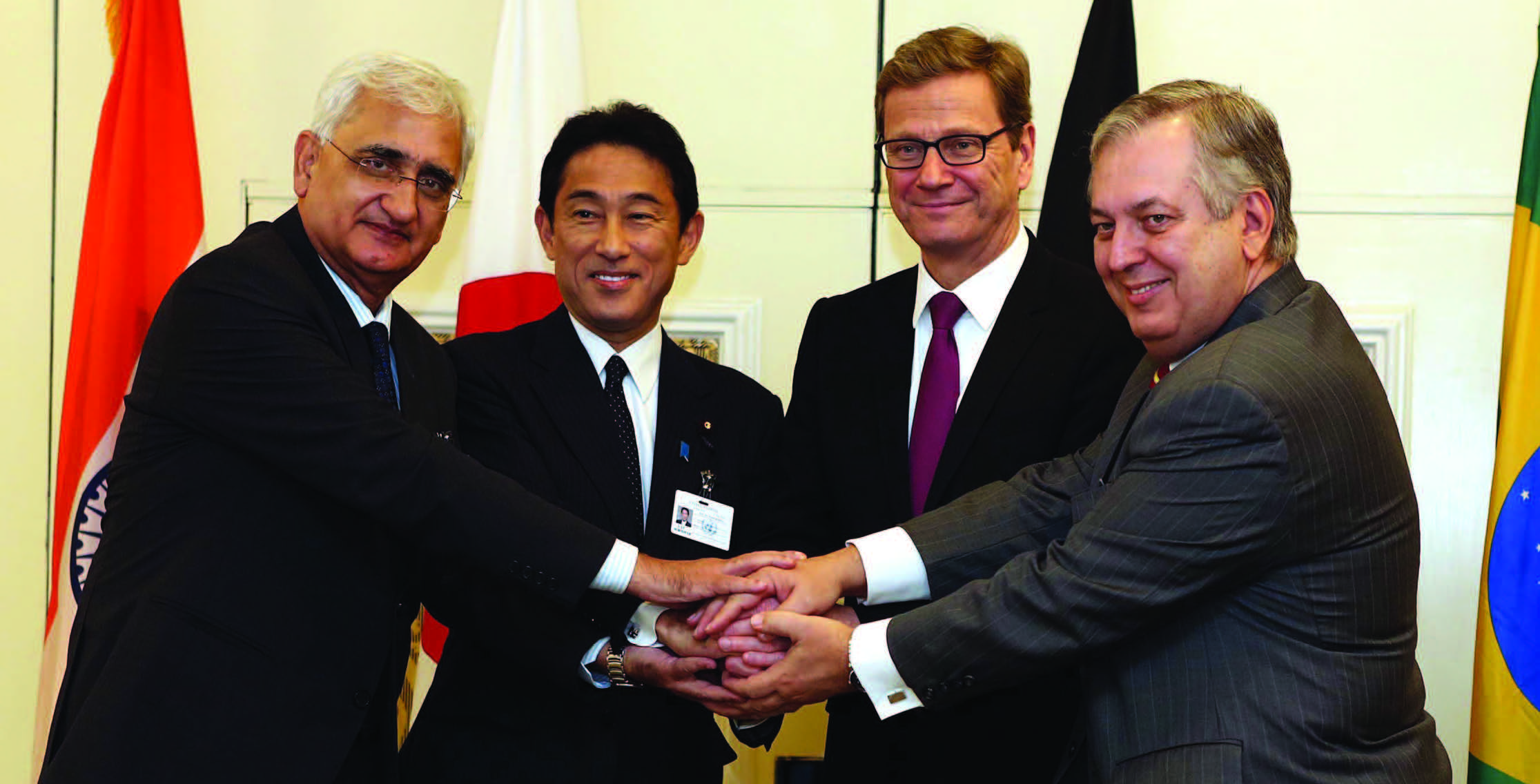
    NEW YORK (TIP): The Minister of External Relations of Brazil, the Federal Minister for Foreign Affairs of Germany, the Minister of External Affairs of India and the Minister for Foreign Affairs of Japan met in New York on 26 September 2013, in the margins of the opening of the 68th Session of the United Nations General Assembly, to exchange views on Security Council reform. The Ministers underscored that, almost 70 years after the creation of the United Nations, reform of the Security Council is long overdue. They agreed that difficulties of the Security Council in dealing with international challenges, including current ones, have further highlighted the need for U.N. Security Council reform in order to better reflect geopolitical realities of the 21st century and make the Council more broadly representative, efficient and transparent and thus to further enhance its effectiveness and the legitimacy and?implementation of its decisions.

    The Ministers recalled that almost 10 years ago, in the Outcome Document of the 2005 World Summit, international leaders committed themselves to an early reform of the Security Council. The Ministers stressed the need to intensify efforts to translate, at the latest by 2015, the existing agreement into concrete outcomes. Recalling previous G4 joint statements, the Ministers reiterated their common vision of a reformed Security Council, taking into consideration the contributions made by countries to the maintenance of international peace and security and other purposes of the organization, as well as the need for increased representation of developing countries in both categories, in order to better reflect today’s geopolitical realities. The G4 countries reiterated their commitments as aspiring new permanent members of the UN Security Council, as well as their support for each other’s candidatures. They also reaffirmed their view of the importance of developing countries, in particular Africa, to be represented in both the permanent and nonpermanent categories of an enlarged Council.

    In this context, the Ministers emphasized the importance to enhance dialogue and outreach with African countries on Security Council reform and commended the initiative of the Government of Japan in having convened the first Japan-Africa Summit Meeting on U.N. Security Council Reform in June. In addition, the Ministers noted with appreciation the directive of CARICOM Heads of State and Government in February 2013 calling for ‘greater urgency in achieving lasting Security Council Reform’ and the initiative of CARICOM to reinvigorate the Intergovernmental Negotiation process. The Ministers recognized the need for greater involvement of civil society, the media and academia on the discussions about the reform of the Security Council and in this context, they welcomed the Brazilian initiative of hosting a seminar, in April this year, to broaden the debate on the urgency and inevitability of the reform of the United Nations Security Council. The Ministers also discussed the outcome of the ninth round of the intergovernmental negotiations on Security Council reform. The Ministers emphasized the important role the Chairman of the intergovernmental negotiations, H.E. Ambassador Zahir Tanin, has played in the negotiations, notably reflected in his letter dated 25 July 2012 to the President of the General Assembly, and welcomed anew his recommendations therein.

    In this context, the Ministers reiterated that, given the overwhelming support by member states for an expansion of the Security Council in both categories of membership, permanent and non-permanent, this should be a key parameter in the negotiation process among member states. They called for the drafting of a concise working document as the basis for further negotiations, in line with the recommendations of the Chairman. The Ministers welcomed the decision by the General Assembly to immediately continue the process of intergovernmental negotiations in the informal plenary of the 68th Session, building on the progress achieved and the recommendations made by the Chairman. The Ministers underlined the need to achieve concrete progress in the 68th Session of the UN General Assembly and, in this context, expressed their commitment to continue to work in close cooperation and in a spirit of flexibility with other Member States and Groups of Member States, in particular Africa, in genuine text-based negotiations. The Ministers expressed gratitude for the efforts made by the President of the 67th General Assembly, H.E.Mr. Vuk Jeremic and the Chairman of the Intergovernmental Negotiations, H.E. Ambassador Zahir Tanin. They looked forward to working closely with H.E. Mr. John Ashe, the President of the 68th General Assembly, and the Chair of the Intergovernmental Negotiations in order to bring about the urgently needed reform of the Security Council.

  • Recast Security Council

    Recast Security Council

    It needs to become more relevant
    The 68th session of the United Nations General Assembly (UNGA) comes at a time when the world is looking at the UN for answers to many complex issues. The relevance of the United Nations has been dependent on various factors, not the least being the way the superpowers cooperate with it. For a while it seemed that the world body has become somewhat ineffectual, but recent events, including the crisis in Syria, have again pitched it centre stage. There has been a growing voice for reforms at the premium world body. Among them, perhaps, the most important one is that of expansion of the UN Security Council, which India has long supported, along with Brazil, Germany and Japan.

    These nations have earned the right to be on the Security Council, and it is indeed important for Prime Minister Manmohan Singh to stress on UN reforms. The Prime Minister is also likely to appeal to the international community to jointly combat the menace of terrorism, both in his interaction with world leaders as well as his forthcoming address to the UNGA. The world needs to put up a united effort to combat terrorist activities, and the UN can play a unique, proactive role in coordinating and effectively tackling terror. Nations that face terror need information that can help them thwart the designs of the perpetrators of such activities. More coordination is needed for curtailing the illicit arms trade and the illegal movement of funds. India has advocated a zero- tolerance approach on terror but it needs more push. India has a powerful voice in the United Nations; the world listens when the Prime Minister speaks. This UNGA meeting with its ‘Post-2015 Development Agenda: Setting the Stage’ focus is exactly what the developing countries need, and the Prime Minister will surely utilize the occasion to garner as much support for India as he can. It is time for the UN to undertake necessary reforms and adapt to a changing world. India must support the world body in this Endeavour.

  • Decade of IBSA fund celebrated

    Decade of IBSA fund celebrated

    NEW YORK, NY (TIP): The Permanent Mission of India to the United Nations (UN) in New York along with the Permanent Missions of Brazil and South Africa, and UN Office for South South Cooperation celebrated 10 years of the establishment of the India, Brazil, and South Africa (IBSA) fund on September 12. The day also marked as International Day for South South cooperation by the UN. The Event titled “IBSA Fund: A Flagship Initiative in South South Cooperation” was attended by permanent representatives of India, Brazil and South Africa. “It was exactly ten years ago in 2003, when India, Brazil and South Africa announced at the United Nations General Assembly, their decision to establish a Trust Fund in partnership with the UNDP, with one singular aim: to contributing to, in our own ways, eradicating poverty and alleviating hunger,” said ambassador Asoke K. Mukerji, Permanent Representative of India to the United Nations.


    img16
    Ambassadors releasing the IBSA publication. India’s Permanent Representative to the United Nations, Ambassador Asoke Mukerji is on extreme left.

    He added “What subsequently became operational with a mere $ 3 million initial corpus has today metamorphosed into a fund with accumulated and invested operating capital of more than $ 26 million, with 14 success stories implemented, and several others ongoing. These are spread all across the spectrum of the developing world, as examples of best practices in our common fight against “the greatest global challenge” of poverty eradication.” IBSA fund has been actively funding projects in Burundi, Cambodia, Cape Verde, Guinea-Bissau, Sierra Leone, Palestine, Viet NAM, Cape Verde, Haiti supporting a wide range of projects. The themes that the Fund has explored include promoting food security, addressing HIV/AIDS, extending access to safe drinking water, capacity building, building of hospitals for children with special needs- all with the singular aim of contributing to the achievement of the Millennium Development Goals in partnership with UNDP. The event was attended by Ambassadors of some select countries – Palestine, Burundi, Vietnam and Cambodia- which are being benefited from IBSA projects. “South South cooperation via this project is very important for my country especially in the fight against HIV/AIDS.

    The fund has helped build a facility for testing HIV and also to spread awareness about the disease especially in rural areas,” said Anesie Ndayishimiye, first counselor, permanent mission of Burundi to the United Nations, adding, “The percentage of population who have HIV is growing in rural region which was not affected as much as the urban region.” Ambassador Mukerji also addressed the issue of “increased burden sharing when such calls are placed upon the so called ‘rising South’”. The IBSA Trust Fund operates through a demand driven approach. Governments of other developing countries request support by this fund, the board of directors at IBSA fund review the proposal before releasing the funds. He said that, “The Fund is an exercise in solidarity which is initiated only at the explicit request of a developing partner, and not imposed from above.” And that the initiative is “in keeping with our (India’s) commitment on South South Cooperation in which we (India) have already invested billions of dollars since our independence,” he said. The event was followed by the inauguration of an IBSA Exhibition at the UN headquarters, which featured panels on projects completed under the IBSA Fund.

  • International Raise the cost for Pakistan army’s proxy war order be damned

    International Raise the cost for Pakistan army’s proxy war order be damned

    The West’s attempt to ride roughshod over the United Nations Security Council with a hastily drafted proposal to authorize the use of force in Syria sets the stage for its second military intervention in West Asia and North Africa in as many years. The resolution, drafted by the United Kingdom and backed by the United States and France, seeks two things from the Council: one, a condemnation of President Bashar al-Assad for using chemical weapons on his people and two, its blessings to deploy “all necessary measures” to protect Syrians. If the first asks the U.N. for a leap of faith on a premature claim, the second requires it to turn a blind eye to history.

    While acknowledging there exists no “smoking gun” to establish Mr. Assad’s culpability, the West has tried its best to impede the working of the U.N.’s team in Syria investigating claims if chemical weapons were used at all. The charade now unfolding before the UNSC reflects the West’s desperation to have its way with a military intervention that has few takers. If the Arab League, including key members and U.S. allies like Egypt, has expressed its reluctance to support the imminent assault, public opinion in the U.S., Britain and France too is overwhelmingly opposed to a new war. After the disastrous 2011 NATO bombing of Libya, which began with the objective of protecting civilians but ended up being a full-blown attack on the Muammar Qadhafi regime, the Security Council is rightly wary of the Anglo-American plans for a “limited” intervention in Syria. Expecting the world to believe a military attack will destroy Mr. Assad’s chemical weapons arsenal without inflicting unacceptable civilian casualties is silly.

    If anything, a targeted attack is not so much a guarantee of minimal damage, but an attempt to fulfill President Barack Obama’s vain promise to punish the Assad regime if it used chemical weapons. After proffering sketchy evidence in support of this grave allegation, the President is now being forced to walk his talk by the liberal interventionists who populate his administration and by a trigger-happy British Prime Minister. One senior U.S. official let slip that the planned assault will be “just muscular enough not to get mocked,” revealing how this issue is now entirely about American “credibility,” as opposed to the humanitarian tragedy in Syria. The Council’s likely rejection of the draft resolution will be portrayed as Russian and Chinese intransigence. The fact remains, however, that influential powers like India, Brazil and South Africa too are against military intervention pending a complete investigation of WMD claims. The West’s failure to act through the U.N. not only betrays the Syrian people but also reflects its contempt for the international order.

  • INDIA EYES LOCAL CURRENCY SWAPS

    INDIA EYES LOCAL CURRENCY SWAPS

    NEW DELHI (TIP): The government is planning to go for local-currency-swap deals with trading partners to lower its dependence on dollars to foot the soaring import bills. It is looking at establishing multiple arrangements with some of the country’s key trading partners — China being the primary one. Commerce Secretary S R Rao said: “We are exploring the option of trading in local currencies with select partners, somewhat like we are currently doing with Iran. It’s different from central banks’ currency swap agreements that India has with Japan and Bhutan.” In other words, the government is exploring the option of using the rupee to trade with some of its partners — an arrangement similar to that with Iran for importing crude oil. Unlike in the case of dollar-swap deals, a country enters into local-currency-swap arrangements when it intends to lower its dollar dependence.

    For this, India’s focus is likely to be on BRICS countries, which have a combined forex reserve of about $4.4 trillion. The grouping had signed a swap facility last year, too. The government was now looking to have such an arrangement with China, another senior commerce department official said, asking not to be named. China has been scouting for such swap deals with some its key trade partners to promote its own currency, the yuan or renminbi, to free up its financial markets. The government is not ruling out the option of having such deals with other non-FTA countries (the countries with which India does not have a free trade agreement in place). But the real challenge would be identifying the exportable items, as India did not enjoy an edge in manufactured exports. Besides, the country had a trade deficit of around $41 billion with China, which did not gave it the comparative advantage for entering into a swap agreement, an EXIM Bank official said. At present, within BRICS, Russia and Brazil swap its currencies with China, which exports around $140 billion worth of goods and services to its trading partners. Commerce Minister Anand Sharma announced setting up an internal task force under the commerce department to “examine, study and explore” the possibility of a currency-swap arrangement with its trading partners to help stabilise the rupee. It will have representatives from the finance ministry, EXIM Bank and RBI.