Tag: Brazil

  • Zydus to invest Rs 100 crore in Vadodara unit, expand hospital business

    Zydus to invest Rs 100 crore in Vadodara unit, expand hospital business

    AHMEDABAD (TIP): Zydus Cadila will set up an injectible facility at Vadodara at an investment of Rs 100 crore by 2015, a senior company official said, adding that land has been acquired. The Ahmedabad-based company also plans to expand its hospital business across Gujarat in the next three years. “We are coming up with a USFDA-approved injectible facility at Vadodara to cater to the high-value US market.

    Regulated markets like Brazil and Europe would be the next focus,” chief operating officer Ganesh Nayak of the Rs 6,300-crore company said on the sidelines of Nirma University’s marketing conclave, Ayatana-2013. The new facility would be commenced by 2015 and it is meant only for therapeutic segments other than oncology. Zydus Cadila already has a joint venture with US-based Hospira for manufacturing anti-oncology injectibles at Matoda SEZ plant, near Ahmedabad, where the company has another joint venture with Bharat Serum and Vaccine.

    Zydus Hospitals & Healthcare Research recently started its first hospital operations at Anand, better known as Amul’s hometown. “We would add four hospitals in the next three years at Surat, Vadodara, Ahmedabad and Rajkot,” says Mr Nayak. The second hospital would come up at Ahmedabad and have a helipad on the rooftop for air-ambulance services. However, Mr Nayak declined to disclose the quantum of investment for the hospitals’ expansion. Apart from the two new projects, Zydus is also looking at co-marketing or in-licensing of patented drugs for domestic markets.

    “A drug company has three ways to sustain its growth trajectory – own patent products, off patent (generic products) and the third way is through comarketing or in-licensing.” Elaborating on co-marketing or in-licensing strategy, Nayak says that the company has three co-marketing patented products-pantoprazole ( Nycomed Pharma, now acquired by Takeda Pharma), xarelto (Bayer Healthcare) and nexavar (Bayer Healthcare). Zydus has joint venture units with the patent holder companies and produces locally. “We are further seeking new co-marketing or in-licensing of patented products for our future growth,” added Mr Nayak.

  • A PICTORIAL HISTORY OF INDEPENDENT INDIA

    A PICTORIAL HISTORY OF INDEPENDENT INDIA

    A chronology of key events
    India has been home to several ancient civilisations and empires, some dating back to more than 2,000 BC. Culture and religions have flourished over the millennia, and foreign influence has ebbed and flowed. 1947 – End of British rule and partition of sub-continent into mainly Hindu India and Muslim-majority state of Pakistan.

    1947-48 – Hundreds of thousands die in widespread communal bloodshed after partition.
    1948 – Mahatma Gandhi assassinated by Hindu extremist.
    1948 – War with Pakistan over disputed territory of Kashmir.
    1951-52 – Congress Party wins first general elections under leadership of Jawaharlal Nehru. Regional tensions 1962 – India loses brief border war with China.
    1964 – Death of Prime Minister Jawaharlal Nehru.
    1965 – Second war with Pakistan over Kashmir.
    1966 – Nehru’s daughter Indira Gandhi becomes prime minister.
    1971 – Third war with Pakistan over creation of Bangladesh, formerly East Pakistan.
    1971 – Twenty-year treaty of friendship signed with Soviet Union.
    1974 – India explodes first nuclear device in underground test. Democratic strains
    1975 – Indira Gandhi declares state of emergency after being found guilty of electoral malpractice.
    1975-1977 – Nearly 1,000 political opponents imprisoned and programme of compulsory birth control introduced. 1977 – Indira Gandhi’s Congress Party loses general elections. 1980 – Indira Gandhi returns to power heading Congress party splinter group, Congress (Indira).
    1984 – Troops storm Golden Temple – Sikhs’ most holy shrine – to flush out Sikh militants pressing for self-rule.
    1984 – Indira Gandhi assassinated by Sikh bodyguards, following which her son, Rajiv, takes over.
    1984 December – Gas leak at Union Carbide pesticides plant in Bhopal. Thousands are killed immediately, many more subsequently die or are left disabled.
    1987 – India deploys troops for peacekeeping operation in Sri Lanka’s ethnic conflict.
    1989 – Falling public support leads to Congress defeat in general election.
    1990 – Indian troops withdrawn from Sri Lanka.
    1990 – Muslim separatist groups begin campaign of violence in Kashmir.
    1991 – Rajiv Gandhi assassinated by suicide bomber sympathetic to Sri Lanka’s Tamil Tigers.
    1991 – Economic reform programme begun by Prime Minister PV Narasimha Rao.
    1992 – Hindu extremists demolish mosque in Ayodhya, triggering widespread Hindu-Muslim violence. BJP to the fore
    1996 – Congress suffers worst ever electoral defeat as Hindu nationalist BJP emerges as largest single party. 1998 – BJP forms coalition government under Prime Minister Atal Behari Vajpayee.
    1998 – India carries out nuclear tests, leading to widespread international condemnation.
    1999 February – Vajpayee makes historic bus trip to Pakistan to meet Premier Nawaz Sharif and to sign bilateral Lahore peace declaration.
    1999 May – Tension in Kashmir leads to brief war with Pakistan-backed forces in the icy heights around Kargil in Indian-held Kashmir.
    1999 October – Cyclone devastates eastern state of Orissa, leaving at least 10,000 dead.
    2000 May – India marks the birth of its billionth citizen.
    2000 – US President Bill Clinton makes a groundbreaking visit to improve ties.
    2001 January – Massive earthquakes hit the western state of Gujarat, leaving at least 30,000 dead. 2001 April – 16 Indian and three Bangladeshi soldiers are killed in border clashes. A high-powered rocket is launched, propelling India into the club of countries able to fire big satellites deep into space.
    2001 July – Vajpayee meets Pakistani President Pervez Musharraf in the first summit between the two neighbours in more than two years. It ends without a breakthrough because of differences over Kashmir.

    2001 September – US lifts sanctions which it imposed against India and Pakistan after they staged nuclear tests in 1998. The move is seen as a reward for their support for the US-led anti-terror campaign. Kashmir tensions rise
    2001 October – India fires on Pakistani military posts in 1984 – Indira Gandhi assassinated by Sikh bodyguards, following which her son, Rajiv, takes over.

    1984 December – Gas leak at Union Carbide pesticides plant in Bhopal. Thousands are killed immediately, many more subsequently die or are left disabled.
    1987 – India deploys troops for peacekeeping operation in Sri Lanka’s ethnic conflict.
    1989 – Falling public support leads to Congress defeat in general election.
    1990 – Indian troops withdrawn from Sri Lanka.
    1990 – Muslim separatist groups begin campaign of violence in Kashmir.
    1991 – Rajiv Gandhi assassinated by suicide bomber sympathetic to Sri Lanka’s Tamil Tigers.
    1991 – Economic reform programme begun by Prime Minister PV Narasimha Rao.
    1992 – Hindu extremists demolish mosque in Ayodhya, triggering widespread Hindu- Muslim violence. BJP to the fore
    1996 – Congress suffers worst ever electoral defeat as Hindu nationalist BJP emerges as largest single party. 1998 – BJP forms coalition government under Prime Minister Atal Behari Vajpayee.
    1998 – India carries out nuclear tests, leading to widespread international condemnation. 1999 February –

    Vajpayee makes historic bus trip to Pakistan to meet Premier Nawaz Sharif and to sign bilateral Lahore peace declaration.
    1999 May – Tension in Kashmir leads to brief war with Pakistan-backed forces in the icy heights around Kargil in Indian-held Kashmir.
    1999 October – Cyclone devastates eastern state of Orissa, leaving at least 10,000 dead. 2000 May – India marks the birth of its billionth citizen.
    2000 – US President Bill Clinton makes a groundbreaking visit to improve ties. 2001 January – Massive earthquakes hit the western state of Gujarat, leaving at least 30,000 dead.
    2001 April – 16 Indian and three Bangladeshi soldiers are killed in border clashes. A high-powered rocket is launched, propelling India into the club of countries able to fire big satellites deep into space.
    2001 July – Vajpayee meets Pakistani President Pervez Musharraf in the first summit between the two neighbours in more than two years. It ends without a breakthrough because of differences over Kashmir.
    2001 September – US lifts sanctions which it imposed against India and Pakistan after they staged nuclear tests in 1998. The move is seen as a reward for their support for the US-led anti-terror campaign.

    Kashmir tensions rise
    2001 October – India fires on Pakistani military posts in the heaviest firing along the dividing line of control in Kashmir for almost a year.
    2001 December – Suicide squad attacks parliament in New Delhi, killing several police. The five gunmen die in the assault.
    2001 December – India imposes sanctions against Pakistan, to force it to take action against two Kashmir militant groups blamed for the suicide attack on parliament. Pakistan retaliates with similar sanctions, and bans the groups in January.
    2001 December – India, Pakistan mass troops on common border amid mounting fears of a looming war.
    2002 January – India successfully test-fires a nuclear-capable ballistic missile – the Agni – off its eastern coast.
    2002 February – Inter-religious bloodshed breaks out after 59 Hindu pilgrims returning from Ayodhya are killed in a train fire in Godhra, Gujarat. More than 1,000 people, mainly Muslims, die in subsequent violence. Police and officials blamed the fire on a Muslim mob, but a 2005 government investigation said it was an accident. In 2012 a court convicts 32 people over the Naroda Patiya riots in Ahmedabad. 2002 May – Pakistan test-fires three medium-range surface-to-surface Ghauri missiles, which are capable of carrying nuclear warheads.War of words between Indian and Pakistani leaders intensifies. Actual war seems imminent.

    2002 June – UK, US urge their citizens to leave India and Pakistan, while maintaining diplomatic offensive to avert war.
    2002 July – Retired scientist and architect of India’s missile programme APJ Abdul Kalam is elected president.
    2003 August – At least 50 people are killed in two simultaneous bomb blasts in Bombay. Kashmir ceasefire 2003 November – India matches Pakistan’s declaration of a Kashmir ceasefire. 2003 December – India, Pakistan agree to resume direct air links and to allow overflights.
    2004 January – Groundbreaking meeting held between government and moderate Kashmir separatists.
    2004 May – Surprise victory for Congress Party in general elections. Manmohan Singh is sworn in as prime minister.
    2004 September – India, along with Brazil, Germany and Japan, launches an application for a permanent seat on the UN Security Council.

    2005 7 April – Bus services, the first in 60 years, operate between Srinagar in Indianadministered Kashmir and Muzaffarabad in Pakistani-administered Kashmir.
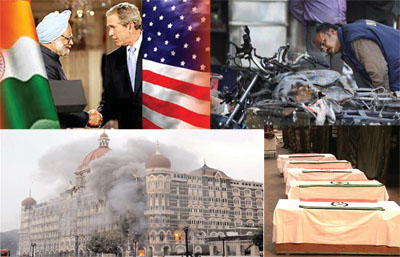
    2006 February – India’s largest-ever rural jobs scheme is launched, aimed at lifting around 60 million families out of poverty. Nuclear deal 2006 March – US and India sign a nuclear agreement during a visit by US President George W Bush.

    The US gives India access to civilian nuclear technology while India agrees to greater scrutiny for its nuclear programme.
    2006 November – Hu Jintao makes the first visit to India by a Chinese president in a decade.
    2006 December – US President George W Bush approves a controversial law allowing India to buy US nuclear reactors and fuel for the first time in 30 years.
    2007 March – Maoist rebels in Chhattisgarh state kill more than 50 policemen in a dawn attack.
    2007 April – India’s first commercial space rocket is launched, carrying an Italian satellite.
    2007 May – At least nine people are killed in a bomb explosion at the main mosque in Hyderabad. Several others are killed in subsequent rioting.
    2007 May – Government announces its strongest economic growth figures for 20 years – 9.4% in the year to March. First woman president 2007 July – Pratibha Patil becomes first woman to be elected president of India. 2008 July – Congress-led coalition survives vote of confidence brought after left-wing parties withdraw their support over controversial nuclear cooperation deal with US. After the vote, several left-wing and regional parties form new alliance to oppose government, saying it has been tainted by corruption. India successfully launches its first mission to the moon, the unmanned lunar probe Chandrayaan-1. Mumbai attacks

    2008 November – Nearly 200 people are killed and hundreds injured in a series of coordinated attacks by gunmen on the main tourist and business area of India’s financial capital Mumbai. India blames militants from Pakistan for the attacks and demands that Islamabad act against those responsible.
    2009 May – Resounding general election victory gives governing Congress-led alliance of PM Manmohan Singh an enhanced position in parliament, only 11 seats short of an absolute majority.
    2009 December – The government says it will allow a new state, Telangana, to be carved out of part of the southern state of Andhra Pradesh. Violent protests for and against break out.
    2010 May – The solve surviving gunman of the 2008 Mumbai attacks, Ajmal Amir Qasab, is convicted of murder, waging war on India and possessing explosives. 2010 June – A court in Bhopal sentences eight Indians to two years each in jail for “death by negligence” over the 1984 Union Carbide gas plant leak. Thousands died in this, the world’s worst industrial accident.
    Ayodha ruling 2010 September – Allahabad High Court rules that disputed holy site of Ayodhya should be divided between Hindus and Muslims; the destruction of a mosque on the site by Hindu extremists in 1992 led to rioting in which about 2,000 people died.
    2011 March – Results of 2011 census put India’s population at 1.21bn, an increase of 181 million over ten years.
    2011 August – Prominent social activist Anna Hazare stages 12-day hunger strike in Delhi in protest at state corruption.
    2011 November – Fourteen people including a government minister go on trial in one of India’s biggest ever corruption scandals – a telecoms deal alleged to have involved the selling of mobile phone licenses at knock-down prices in exchange for bribes.
    2012 May – Manmohan Singh pays first official visit to Burma by an Indian prime minister since 1987. He signs agreements aimed at providing border area development and an Indian credit line. 2012 June – Police in Delhi arrest a key figure allegedly involved in planning the 2008 Mumbai attacks. They say Abu Hamza, also known as Syed Zabiuddin, was the “handler” of the 10 gunmen. 2012 July – Pranab Mukherjee from the ruling Congress party is elected as president, comfortably beating his rival P.A. Sangma.

    2012 August – Court convicts 32 people over the 2002 religious riots in Gujarat and acquits 29 others. Among those convicted in the Naroda Patiya killings in Ahmedabad are former state minister Maya Kodnani and Babu Bajrangi, a former leader of the militant Hindu group Bajrang Dal.

    2012 December – The rape and murder of a young woman in Delhi triggers nationwide protests and a debate about sexual violence.
    2013 February – Two explosions in crowded Dilsukhnagar area of central Hyderabad kill 16 people. Police suspect the Indian Mujahideen Islamist armed group.
    2013 March – Five policemen are killed in a militant assault in Indian-administered Kashmir – the first major attack in the region in three years
    2013 August – In a deadly instance of firing on Indian Army troops on the Line of Control from Pakistan-occupied Kashmir, five Indian soldiers died in Poonch sector in Jammu and Kashmir.

  • INDIA’S JOURNEY TO BECOMING AN ECONOMIC SUPERPOWER

    INDIA’S JOURNEY TO BECOMING AN ECONOMIC SUPERPOWER

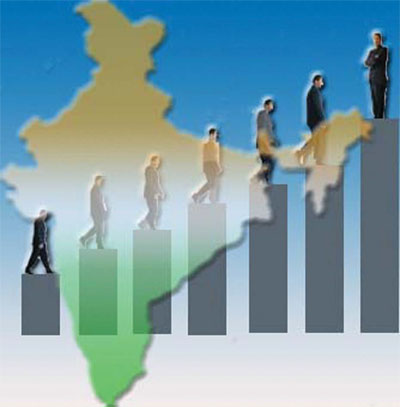
    The economic development in India followed socialist-inspired policies for most of its independent history, including state-ownership of many sectors; India’s per capita income increased at only around 1% annualised rate in the three decades after Independence. Since the mid-1980s, India has slowly opened up its markets through economic liberalisation.

    After more fundamental reforms since 1991 and their renewal in the 2000s, India has progressed towards a free market economy. In the late 2000s, India’s growth reached 7.5%, which will double the average income in a decade. Analysts] say that if India pushed more fundamental market reforms, it could sustain the rate and even reach the government’s 2011 target of 10%. States have large responsibilities over their economies.

    The annualised 1999-2008 growth rates for Tamil Nadu (9.8), Gujarat (9.6%),Haryana (9.1%), or Delhi (8.9%) were significantly higher than for Bihar (5.1%), Uttar Pradesh (4.4%), or Madhya Pradesh (6.5%). India is the tenth-largest economy in the world and the third largest by purchasing power parity adjusted exchange rates (PPP). On per capita basis, it ranks 140th in the world or 129th by PPP. The economic growth has been driven by the expansion of services that have been growing consistently faster than other sectors.

    It is argued that the pattern of Indian development has been a specific one and that the country may be able to skip the intermediate industrialisationled phase in the transformation of its economic structure. Serious concerns have been raised about the jobless nature of the economic growth. Favourable macroeconomic performance has been a necessary but not sufficient condition for the significant reduction of poverty amongst the Indian population.

    The rate of poverty decline has not been higher in the post-reform period (since 1991). The improvements in some other non-economic dimensions of social development have been even less favourable. The most pronounced example is an exceptionally high and persistent level of child malnutrition (46% in 2005-6). The progress of economic reforms in India is followed closely. The World Bank suggests that the most important priorities are public sector reform, infrastructure, agricultural and rural development, removal of labour regulations, reforms in lagging states, and HIV/AIDS.

    [5] For 2012, India ranked 132nd in Ease of Doing Business Index, which is setback as compared with China 91st and Brazil 126th. According to Index of Economic Freedom World Ranking an annual survey on economic freedom of the nations, India ranks 123rd as compared with China and Russia which ranks 138th and 144th respectively in 2012. India ranks second worldwide in farm output.

    Agriculture and allied sectors like forestry, logging and fishing accounted for 18.6% of the GDP in 2005, employed 60% of the total workforce and despite a steady decline of its share in the GDP, is still the largest economic sector and plays a significant role in the overall socioeconomic development of India. Yields per unit area of all crops have grown since 1950, due to the special emphasis placed on agriculture in the five-year plans and steady improvements in irrigation, technology, application of modern agricultural practices and provision of agricultural credit and subsidies since the green revolution.

    India is the largest producer in the world of milk, cashew nuts, coconuts, tea, ginger, turmeric and black pepper. It also has the world’s largest cattle population (193 million). It is the second largest producer of wheat, rice, sugar, groundnut and inland fish. It is the third largest producer of tobacco. India accounts for 10% of the world fruit production with first rank in the production of banana and sapota. The required level of investment for the development of marketing, storage and cold storage infrastructure is estimated to be huge.

    The government has implemented various schemes to raise investment in marketing infrastructure. Amongst these schemes are Construction of Rural Go downs, Market Research and Information Network, and Development / Strengthening of Agricultural Marketing Infrastructure, Grading and Standardisation.

    Main problems in the agricultural sector, as listed by the World Bank, are:

  • INDIA’S RELATIONS WITH NEIGHBOURING COUNTRIES

    INDIA’S RELATIONS WITH NEIGHBOURING COUNTRIES

    India has formal diplomatic relations with most nations; it is the world’s second most populous country, the world’s most-populous democracy and one of the fastest growing major economies. With the world’s seventh largest military expenditure, ninth largest economy by nominal rates and third largest by purchasing power parity, India is a regional power, a nascent great power and a potential superpower. India’s growing international influence gives it a prominent voice in global affairs.

    The Economist magazine argues, however, that underinvestment in diplomacy and a lack of strategic vision have minimised India’s influence in the world. India is a newly industrialised country, it has a long history of collaboration with several countries and is considered one of the leaders of the developing world along with China, Brazil, Russia and South Africa (the BRICS countries). India was one of the founding members of several international organisations, most notably the United Nations, the Asian Development Bank, G20 industrial nations and the founder of the Nonaligned movement.

    India has also played an important and influential role in other international organisations like East Asia Summit, World Trade Organisation, International Monetary Fund (IMF), G8+5 and IBSA Dialogue Forum. Regionally, India is a part of SAARC and BIMSTEC. India has taken part in several UN peacekeeping missions and in 2007, it was the secondlargest troop contributor to the United Nations. India is currently seeking a permanent seat in the UN Security Council, along with the G4 nations.

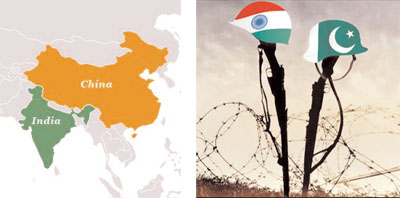
    Relations with PakistanDespite historical, cultural and ethnic links between them, relations between India and Pakistan have been plagued by years of mistrust and suspicion ever since the partition of India in 1947. The principal source of contention between India and its western neighbor has been the Kashmir conflict. After an invasion by Pashtun tribesmen and Pakistani paramilitary forces, the Hindu Maharaja of the Dogra Kingdom of Jammu and Kashmir, Hari Singh, and its Muslim Prime Minister, Sheikh Abdullah, signed an Instrument of Accession with New Delhi.

    The First Kashmir War started after the Indian Army entered Srinagar, the capital of the state, to secure the area from the invading forces. The war ended in December 1948 with the Line of Control dividing the erstwhile princely state into territories administered by Pakistan (northern and western areas) and India (southern, central and northeastern areas). Pakistan contested the legality of the Instrument of Accession since the Dogra Kingdom has signed a standstill agreement with it.

    The Indo-Pakistani War of 1965 started following the failure of Pakistan’s Operation Gibraltar, which was designed to infiltrate forces into Jammu and Kashmir to precipitate an insurgency against rule by India. The five-week war caused thousands of casualties on both sides. It ended in a United Nations (UN) mandated ceasefire and the subsequent issuance of the Tashkent Declaration. India and Pakistan went to war again in 1971, this time the conflict being over East Pakistan.

    The large-scale atrocities committed there by the Pakistan army led to millions of Bengali refugees pouring over into India. India, along with the Mukti Bahini, defeated Pakistan and the Pakistani forces surrendered on the eastern front. The war resulted in the creation of Bangladesh. In 1998, India carried out the Pokhran-II nuclear tests which was followed by Pakistan’s Chagai-I tests. Following the Lahore Declaration in February 1999, relations briefly improved. A few months later however,Pakistani paramilitary forces and Pakistani Army, infiltrated in large numbers into the Kargil district of Indian Kashmir.

    This initiated the Kargil conflict after India moved in thousands of troops to successfully flush out the infiltrators. Although the conflict did not result in a full-scale war between India and Pakistan, relations between the two reached all-time low which worsened even further following the involvement of Pakistan-based terrorists in the hijacking of the Indian Airlines IC814 plane in December 1999. Attempts to normalise relations, such as the Agra summit held in July 2001, failed.

    An attack on the Indian Parliament in December 2001, which was blamed on Pakistan, which had condemned the attack[105] caused a military standoff between the two countries which lasted for nearly a year raising fears of a nuclear conflict. However, a peace process, initiated in 2003, led to improved relations in the following years. Since the initiation of the peace process, several confidence-buildingmeasures (CBMs) between India and Pakistan have taken shape. The Samjhauta Express and Delhi–Lahore Bus service are two of these successful measures which have played a crucial role in expanding people-to-people contact between the two countries.

    [106] The initiation of Srinagar–Muzaffarabad Bus service in 2005 and opening of a historic trade route across the Line of Control in 2008 further reflects increasing eagerness between the two sides to improve relations. Although bilateral trade between India and Pakistan was a modest US$1.7 billion in March 2007, it is expected to cross US$10 billion by 2010. After the Kashmir earthquake in 2005, India sent aid to affected areas in Pakistani Kashmir & Punjab as well as Indian Kashmir.

    The 2008 Mumbai attacks seriously undermined the relations between the two countries. India alleged Pakistan of harboring militants on their soil, while Pakistan vehemently denies such claims. Relations are currently hampered since India has sent a list of 40 alleged fugitive in various terror strikes to Pakistan, expecting them to be handed over to India. Pakistan, on the other hand, has declared that it has no intentions whatsoever of carrying out their extradition. The August 2013 attack by the Pak army on the LoC killed five Indian army men,which further strained the relations between the two nations.

    China Despite lingering suspicions remaining from the 1962 Sino-Indian War and continuing boundary disputes over Aksai Chin and Arunachal Pradesh, Sino-Indian relations have improved gradually since 1988. Both countries have sought to reduce tensions along the frontier, expand trade and cultural ties, and normalise relations. A series of high-level visits between the two nations have helped improve relations. In December 1996, PRC President Jiang Zemin visited India during a tour of South Asia.

    While in New Delhi, he signed with the Indian Prime Minister a series of confidence-building measures for the disputed borders. Sino-Indian relations suffered a brief setback in May 1998 when the Indian Defence minister justified the country’s nuclear tests by citing potential threats from the PRC. However, in June 1999, during the Kargil crisis, then-External Affairs Minister Jaswant Singh visited Beijing and stated that India did not consider China a threat. By 2001, relations between India and the PRC were on the mend, and the two sides handled the move from Tibet to India of the 17th Karmapa in January 2000 with delicacy and tact.

    In 2003, India formally recognised Tibet as a part of China, and China recognised Sikkim as a formal part of India in 2004. Since 2004, the economic rise of both China and India has also helped forge closer relations between the two. Sino-Indian trade reached US$36 billion in 2007, making China the single largest trading partner of India. The increasing economic reliance between India and China has also bought the two nations closer politically, with both India and China eager to resolve their boundary dispute.

    They have also collaborated on several issues ranging from WTO’s Doha round in 2008 to regional free trade agreement. Similar to Indo-US nuclear deal, India and China have also agreed to cooperate in the field of civilian nuclear energy. However, China’s economic interests have clashed with those of India. Both the countries are the largest Asian investors in Africa and have competed for control over its large natural resources. India and China agreed to take bilateral trade up to US$100 billion on a recent visit by Wen Jiabao to India.

  • Joe Biden Bats For More Skilled Visas

    Joe Biden Bats For More Skilled Visas

    MUMBAI (TIP): US is considering increasing the number of temporary visas and availability of Green Cards to highly skilled Indians, Joe Biden, the first US vice-president to visit India in three decades, said in his address to India Inc in the financial capital on Jukly 24. Biden, who sought a greater cooperation between the two countries to boost trade and investments five-fold, acknowledged the contribution of Indian expatriates to America’s growth story.

    “The US has benefited due to Indian human capital,” said Biden. He pointed out that Indians received more skilledworker visas to the United States than any other country in the world. “And the legislation our Congress is considering increases the number of temporary visas and Green Cards availability for highly skilled Indians to come work in the United States,” the 47th vice-president of US said while addressing the industry gathering at theBombay Stock Exchange.

    In a 40-minute speech which was interspersed with lighter moments, Biden said, “Our bilateral trade has increased five-fold to touch $100 billion in the last 13 years. We see tremendous opportunity and there is no reason that if our countries make the right choices, trade cannot grow five-fold or more,” he said. Making a strong case for India to further open up its economy in a serious bid to attract more foreign investment, Biden, said, “A young Indian woman graduating from IIT-Bombay who wants to start the next Tata Motors should be able to buy the best technology and parts, wherever in the world they come from — as her competitors around the world are able to do.”

    However, Biden said, a lot more is needed to remove trade barriers. “We still have a lot of work to do on a wide range of issues, including limit in FDI, inconsistent tax system, barriers to market access, civil nuclear cooperation, bilateral investment treaty and policies protecting innovations,” said Biden.

    Biden later addressed India Inc at the Taj Mahal hotel too in south Mumbai. While assuring US support for India’s candidacy for a permanent seat at the United Nations Security Council (UNSC), Biden said, “That’s why yesterday, on behalf of the President Obama, I invited Prime Minister Singh to make a visit to Washington at the end of September.” India has been vying for a permanent seat in UNSC along with Japan, Brazil and Germany.

    On India’s military needs, Biden pointed out how cargo aircraft C-130s that US had sold to India were now saving the lives of flood victims in Uttarakhand. Biden also called by a greater cooperation between India, China and US. “We are three big nations — China, India and the United States — with our own perspectives. We have significant common interests. All three of us and the entire region would benefit if we coordinated more closely,” said Biden.

  • One barefoot step, a giant administrative leap

    One barefoot step, a giant administrative leap

    As the world observed U.N. Public Service Day on June 23, it was hard to miss the perfect storm brewing across the globe. Disenchantment with public service delivery has engulfed Brazil, Greece, Turkey and South Africa. Closer home, the disaster in Uttarakhand has highlighted the potential of public service to make or mar thousands of lives. Critically, public management is seen as failing the disadvantaged, especially those who have no choice but to resign to its inadequacies.

    In response to trenchant criticism, the global development discourse has focused on devising numerous policies, structures and strategies. But, inevitably, the front line, institutional mechanism has not received the kind of analytical attention it warrants. Across the world, public organizations are typically characterized by rigid weberian structures with minimal space for individual innovation or creativity. Governance frameworks exhibit command and control characterized by top-down leadership and delegation upwards.

    Employees are adept at both overly respecting and exercising power, suppressing values of self in deference to those of the system. Not surprisingly, World Bank studies show that public service reform programs are the most intractable. The recurrent challenge is to bring about changes in people and system performance.

    Harvard’s Frauke de Weijer associates these failures with treating such socio-human resource challenges as mere technical ones to be tamed by procedures and bureaucratic structures. Essentially, preoccupations with form need to be replaced by an understanding that development is predicated on an uninhibited rejection of the status quo – that is, understanding development as a change endeavor focused on facilitating those at the bottom of the pyramid towards higher satisfaction levels.

    What this means is that change should necessarily begin at the bottom, the site of frequent interaction between citizens and the monolithic state. It is the experience of this interface that determines the quality of the service and how citizens subsequently view the state. This front line actuality epitomizes the concept of Barefoot Bureaucracy – a construct that is bureaucratic in its regulatory behavior yet barefoot in its proximity with the citizen and their shared socio-cultural and economic milieu.

    Barefoot bureaucracies reflect this personality paradox in the wide gamut of their choice, ranging from the whimsical bureaucratic gatekeeping in routine implementation, to yeoman barefoot service during disasters. In a world of scarce resources, who is granted access to free medicines, the water tap or the destitute pension? These are the many moral judgments they make everyday. Yet, there is potential in this paradox.

    Research has shown that successful public organizations are characterized by unusual dedication of ground-level employees to their jobs, with a strong sense of mission, purpose and the capacity to build relationships based on trust and ownership with communities. Globally, public services are under intense pressure to improve performance. While many structural reforms have been tried, barefoot bureaucracy has been consistently bypassed.

    Undeniably, sustained development can only be achieved by triggering the value creating potential at the bottom of the public service environment. Global policymakers should repose faith in these subalterns and reap the benefit of silent evolutionary change. With just mundane means they can generate spectacular ends. The tiger will change its stripes.

  • India fourth biggest market for Sony with Rs 8,000 crore sales

    India fourth biggest market for Sony with Rs 8,000 crore sales

    NEW DELHI (TIP): Despite weak demand in the industry, Sony India has managed to break into the top five markets in the Japanese giant’s global operations, riding on healthy sales of televisions. The upsurge — to the fourth position — has been quick for the Indian subsidiary that till two years ago was a distant ninth in Sony’s global markets. Sony India finished last fiscal (2012-13) with a 27% growth at overall revenue of Rs 8,000 crore.

    With this, India is ahead of many of Sony’s key markets like Brazil, Russia, Germany and Britain. India now trails US (top market for the company), China and Japan. Kenichiro Hibi, MD of Sony India, said that televisions and mobile phones (under the Xperia range) remain among the fastest-growing segments for the company. Hibi, however, expressed concern over weakening demand in line with the slowdown of the Indian economy. “The market situation is difficult and there are pressures,” Hibi told TOI after launching the premium ‘4K’ Bravia TV range that is priced upwards of Rs 3 lakh.

    Hibi said that the retail end was under stress and things at the ground are “not easy”. However, new launches as well as expectations of a turnaround towards the latter part of the year make the company confident as it expects to maintain the previous year’s growth in this fiscal as well. But despite witnessing growth in India, Sony India does not have any immediate plans to start manufacturing operations here.

    The company currently imports its product line-up from a clutch of countries like China, Malaysia, Japan and Thailand. Hibi said TV sales will continue to lead the charge for the company and it expects to sell 13 lakh units this fiscal against 11 lakh units in the previous year. Televisions contribute around 35% to Sony India’s revenues.

  • BRAZIL PROTESTS RAMP UP, WITH 800,000 IN STREETS

    BRAZIL PROTESTS RAMP UP, WITH 800,000 IN STREETS

    RIO DE JANEIRO (TIP): Hundreds of thousands of people rallied across Brazil on June 20, as a protest movement over the quality of public services and the high cost of staging the World Cup gathered steam. The mounting pressure on the government of President Dilma Rousseff in the face of the biggest street protests the South American country has seen in 20 years prompted her to cancel a trip to Japan planned for next week.

    Police fired tear gas in Rio de Janeiro, scene of the biggest protest where 300,000 people demonstrated near City Hall, while in the capital Brasilia, security forces blocked protesters trying to break into the foreign ministry. About 800,000 people marched in rallies across the country of 194 million people, according to an AFP tally — an intensification of a movement sparked two weeks ago by public anger about a hike in public transport fares.

    The protests have spiraled into a wider call for an end to government corruption in the world’s seventh largest economy, a call fueled by resentment over the $15 billion cost of hosting the Confederations Cup and the World Cup. In Rio, police fired tear gas to disperse a small group of stone-throwing protesters. At least one person was injured in the clashes, which sparked panic in the crowd. “Don’t run, don’t run,” some shouted as they ran through the clouds of tear gas.

    Demonstrators meanwhile set ablaze a vehicle owned by the SBT television station. On Wednesday, protesters had scored a major victory when authorities in Rio and Sao Paulo, Brazil’s two biggest cities, canceled the controversial transit fare hikes, but that was not enough to placate the demonstrators. In Sao Paulo, an estimated 110,000 people flooded the main avenida Paulista to celebrate the fare rollback and keep the pressure on Rousseff’s leftist government to increase social spending.

    But clashes erupted between a group of ultra-leftists marching behind their red banners and a majority of demonstrators who objected to the presence of political parties. “This is a social movement, not a political movement. This has nothing to do with ideology,” 28-year-old protester Maria Vidal told AFP. “We don’t want parties in the demonstration.” One of the leftists was hit in the head by a projectile and blamed a member of the ruling Workers Party.

    Police were forced to intervene to put an end to the clashes. Protesters say they want higher funding for education and health and a cut in salaries of public officials. They are also railing against what they viewed as rampant corruption within the political class. In the capital Brasilia, security forces pushed back demonstrators who tried to break in the foreign ministry and were throwing burning objects, an AFP reporter saw. Military police threw a security cordon around the building.

    Some 15,000 people, most of them in their 20s, meanwhile gathered just before dusk on the Alfonso Pena thoroughfare in Belo Horizonte, but a prompt police response of rubber bullets sent them scuttling for cover. “Brazil, country of corruption,” “We want a serious economic policy,” “Enough, it’s time to speak” and “Brazil is waking up,” were just some of the slogans marchers held aloft as they wound their way through the city center. “I know that in principle staging the Cups is good for Brazil.

    This should bring development and money. But for decades, the governments we have had have just wasted money,” explained Thiago, a 28-year old medical student. Thousands more marched in Salvador, the capital of Bahia state, and Recife. As the protests heated up in the evening, Rousseff’s office announced that she would not travel to Japan on June 26-28 as planned for talks with Prime Minister Shinzo Abe. “She has ultimately decided to postpone this trip, which would have involved several days of travel. She has decided to stay in Brazil due to current events,” a source in her office told AFP.

    Social media networks have been key to the organization of the mass protests, with demonstrators using the slogan “It’s more than just 20 cents” — a reference to the bus fare hikes — to rally people to their cause. The movement has no political coloration and no clearly identified leadership. Those opposing the hosting of the World Cup are planning a mammoth march to Rio’s iconic Maracana stadium on June 30, the day of the Confederations Cup final. In Belo Horizonte, some marchers predicted the wave of protests could have far-reaching consequences. “I think they could even bring down the government,” said Nancy Borges, a 26-yearold pharmacist.

  • India’s economic growth falls to a decade low of 5%

    India’s economic growth falls to a decade low of 5%

    NEW DELHI (TIP): India announced growth figures for its full financial year on Friday showing the once-booming South Asian economy expanded by 5.0% in 2012/13, its slowest pace in a decade. Low business confidence, slumping investment, high inflation and weak export demand from Western countries were blamed for the bleak performance which comes ahead of national elections scheduled for next year. In the fourth quarter to the end of March, gross domestic product grew by 4.8% year-on-year, slightly higher than the previous quarter when it expanded by 4.5%, according to the data from the statistics ministry. Despite government efforts to talk up the economy after a burst of promarket reforms at the end of last year, most independent analysts see continuing slack demand and few quick fixes. “Business activity is still sluggish,” Rupa Rege Nitsure, chief economist with state-run Bank of Baroda said ahead of the release of the data. The economy grew by 6.2 percent in 2011/12.

    Global ratings agency Standard and Poor’s warned earlier this month that India faces at least “a one-in-three” chance of losing its prized sovereign grade rating amid new threats to economic growth and reforms. India’s BBB-minus investment rating is already the lowest among its BRICS peers Brazil, Russia, China and South Africa and cutting it to “junk status” would raise the country’s hefty borrowing costs.

    The Organisation for Economic Cooperation and Development (OECD) this week lowered its projection of India’s GDP to 5.3% in 2013, from 5.9% earlier. “The government needs to go all-out to turn around investment sentiment,” said Yes Bank chief economist Shubhada Rao. The government led by Prime Minister Manmohan Singh and the Congress party has been dogged by corruption scandals during its second term in office and has struggled to push through promised pro-business legislation.

    It is scheduled to face the electorate next year having been unable to sustain the scorching growth rates of the last decade which were frequently near 10%. In a brief reforming period last year, the government opened up the retail and aviation sectors to wider foreign investment and partly freed fuel prices to reduce its burgeoning subsidy bill. But faced with a hostile parliament and a shaky ruling coalition, it has since failed to pass mooted legislation to open up the insurance and pension sectors or a longdelayed law to simplify land acquisition.

    Government pressure has mounted on the central bank to ease borrowing costs after it raised interest rates aggressively in 2010 and 2011 to combat double-digit inflation last year. It has obliged by cutting interest rates three times in 2013, but Reserve Bank of India governor Duvvuri Subbarao has said the bank has “limited space” to ease monetary policy further due to the risk of inflation flaring up again.

    India’s wholesale inflation, its most widely watched measure, cooled last month to a surprise 41-month low of 4.89%. But the consumer price index is at 9.39%, led mainly by high food and beverage prices.

  • High Import Charges Hike Prices Of Indian Mangoes In US

    High Import Charges Hike Prices Of Indian Mangoes In US

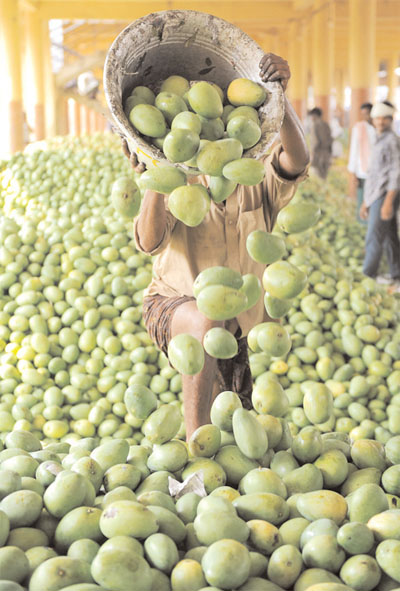
    WASHINGTON (TIP): Consumers in the United States are finding it difficult to buy Indian mangoes due to the high prices as compared to the ones imported from South American countries, a study has found out. According to a study report released by the US department of agriculture, the rise in the price is attributed to high shipping charges and profit margins kept by traders, and not the costs of meeting US health and food safety requirements for imports, an argument being put forth so far by major mango traders.

    In fact Indian mangoes – considered to be the best in the world, costs five to six times higher in the US than the prices of varieties imported from Mexico and Brazil sold at $1 per pound, the study said. “Many attribute the high prices of such products to the costs of meeting US health and food safety requirements for imports,” the report said.

    “Despite recent regulatory changes designed to ease access of US imports of certain speciality crops, concerns remain that regulatory and treatment costs inhibit growth of developing country exports,” it added. An analysis carried out by the Economic Research Service – or ERS which is the research wing of the federal agricultural agency — however, finds that in the case of Indian mangoes, “shipping and wholesale markups” are in fact the biggest factor behind the high prices.

    Through their research, the ERS broke down the price structure of Indian mangoes which averages $ 4.20 per pound in the US. This includes Indian farm cost (29 cents per pound), irradiation costs (14 cents per pound), inspection costs (35 cents per pound), air freight costs ($1.24 per pound), and US wholesaler costs and margins ($1.88 per pound). “Costs associated with the regulation and treatment of Indian mangoes account for a much smaller share of total costs than air freight or wholesale costs and markups.

    Severe reductions in the regulatory and treatment costs associated with Indian mango imports would bring less downward pressure on prices than innovations in shipping or changes in market structure that would reduce markups,” the ERS report said. After several decades the previous Bush Administration allowed import of Indian mangoes with the first shipment arriving in 2006. Persistently high prices of Indian mangoes from 2006 to 2011, however, suggest that some other structural factors kept prices high.

    “Irradiation did add to costs, and these costs might be reduced with further regulatory liberalization. But the period was also marked by high shipping costs and high wholesale markups associated with the still small volume of trade,” the report added.

  • India, Egypt trade may double in next  few years, says Morsi

    India, Egypt trade may double in next few years, says Morsi

    NEW DELHI (TIP): Bilateral trade between India and Egypt may double to $10 billion in the next few years, said Egypt president Mohammed Morsi. President Morsi who is heading a high-level delegation of ministers and business leaders, is on a four-day visit to India which started on March 18. “Currently, the bilateral trade between both countries is around $5 billion. We are looking to double this exchange trade volume in the next few years. The trade surge between India and Egypt pushes us to set up more ambitious goal of doubling this volume within the coming few years,” president Morsi said at an interaction jointly organized by industry chambers. “One of our main focus is on attracting foreign direct investment.

    Both countries can co-operate in areas like trade, energy, technology and space science. I would like to invite Indian companies, businessmen and investors to take advantage of the promising opportunities Egypt offers and to assure that we will provide all required facilities and create the most inducting atmosphere for investment and business practices,” he added.

    Prior to visiting India, Morsi also visited Pakistan. “Egypt needs more grains, which could be exported by India,” he said. Anand Sharma, commerce and industry minister said, “I will urge Indian companies to look at Egypt more seriously and invest in various sectors. Indian companies can also partner with Egyptian firms in sectors like infrastructure, biotechnology, energy and pharmaceuticals.” Morsi said that due to Egypt’s location, it could act as bridge between Asia and Africa, and as a major global trade route, makes it an attractive business destination for India. He added that Egypt would ensure that there wouldn’t be any obstacles for investors while setting up businesses there. Egypt is also looking into setting up free economic zones by Indian companies to trade with third countries.

    Morsi also said that Brics nations like Brazil, India, China, Russia and South Africa have a major role to play in the development of the country in a democratic set up. He indicated that Egypt is looking forward to a time when it also becomes part of Brics, forming E-Brics. Meanwhile, Egypt, Small Industries Development Bank of India (SIDBI) and World Bank also signed a tripartite memorandum of understanding (MoU) wherein, SIDBI would help in income generation and employment creation in Egypt and provide boost to strengthen the ties between India and Egypt.

  • Horse Meat Row Spreads To Asia

    Horse Meat Row Spreads To Asia

    PARIS (TIP): The fallout from Europe’s horse meatscandal has spread outside the continent, with animported lasagne brand pulled from the shelves in HongKong and a new row over the treatment of horsesfarmed in the Americas.A host of top players have been caught up in thespiralling scandal including Nestle, the world’s biggestfood company, top beef producer JBS of Brazil andBritish supermarket chain Tesco.

    Hong Kong authorities ordered ParknShop, one of thebiggest supermarket chains in the city, to removelasagne made by frozen food giant Findus, one of thefirms at the centre of the scandal. The product wasimported from Britain and made by French firmComigel.Hong Kong’s Centre for Food Safety said onWednesday that the item “might be adulterated withhorse meat which has not undergone tests for veterinarydrugs”.

  • Nadal Wins In Singles Debut At Brazil Open

    Nadal Wins In Singles Debut At Brazil Open

    SAO PAULO (TIP): Spain’s Rafael Nadal scored an easy two-set victory in his singles debut at the Brazil Open late Thursday.

    The former world number one needed only 78 minutes to prevail over Brazilian Joao Souza, ranked 101st in the world 6-3, 6-4. Nadal advanced to the quarterfinals which will be played Friday. “It was an important victory for me,” Nadal said. “the conditions are very difficult.

    The court is very fast, the ball too.” Asked about his injured left knee, he replied: “Today I think it was acceptable, normal. Let’s hope it will be the same tomorrow. The important things is that it (the knee) does not hurt.” The Spanish star withdrew from a scheduled doubles match he was to have played with Argentina’s David Nalbandian against Argentine Horacio Zeballos and Austrian Oliver Marach, citing “knee overuse”.

    Nadal, currently ranked number five in the world, only returned to the tour in Chile last week after a seven-month injury absence.

    The 11-time grand slam champion, who lost both the singles and doubles finals Sunday at his comeback event in Vina del Mar, Chile, is the top seed at this week’s event here.

    The $455,775 Brazil Open is part of the Latin American clay court circuit, along with the Vina del Mar and the Mexico Open in Acapulco where Nadal plans to play later this month.

  • Bank of India CMD to meet US Clients

    Bank of India CMD to meet US Clients

    NEW YORK, NY (TIP): Bank of India Chairperson & Managing Director Mrs. V.R. Iyer, Executive Director Mr. N. Seshadri and General Manager (International) Mr. S.K. Datta, are scheduled to visit New York on January 30th and 31st to meet US clients and attend an Investors’ Meet.

    It will be Mrs. Iyer’s first visit to New York after she took over as CMD of Bank of India on November 5, 2012. Mrs. V. R. Iyer took over as Chairperson & Managing Director of the Bank of India on 5th November, 2012.

    Prior to this assignment, Mrs. Iyer was Executive Director of Central Bank of India from September 01, 2010 till she joined Bank of India. Mrs. Iyer, born on June 1, 1955 is a post-graduate in Commerce with CAIIB. She started her career in Union Bank of India in 1975. In her long career spanning 33 years, has had good stint in branch banking having worked in very large and extra large branches.

    She has extensive exposure in Credit Department, Credit Monitoring Department and has contributed significantly in setting up of Risk Management Department, rolling out CBS, alternate channels and various other e-initiatives. Mrs. Iyer served as Deputy General Manager (Information Technology) during 2006-07 before getting elevated as General Manager in January, 2008 and was holding the portfolios of Information Technology and Risk Management.

    Mrs. Iyer was elevated as Executive Director of Central Bank of India with effect from 1st September, 2010 where she looked after Credit, Treasury, Forex, IT, CBS, Risk Management and Inspection & Audit portfolios. Mr. N. Seshadri took over as Executive Director of Bank of India on 1st November, 2010. Earlier, he was General Manager at the Canara Bank. Born on 30th April, 1953, Mr. Seshadri joined Canara Bank as an officer in 1975. He has held several distinguished positions in the Bank’s hierarchy in a career spanning 35 years. MBA and a certified Associate of the Indian Institute of Bankers, Mr. Seshadri has worked extensively throughout the country and abroad

    About Bank of India in USA

    Bank of India, US Center is having three offices. New York Branch and San Francisco Agency are in operation since December 1978 and December 1977 respectively, whereas Cayman Island branch has been functional since September 1980. In U.S., Bank of India’s activities cover businesses related to Letter of Credit, issuing guarantee and offering advisory services, ECB loans, acquisition finance, trade finance Certificate of Deposit and effecting remittances. New York Branch is the main contributor for the business of the Center.

    The Branch is FDIC insured and offers various services as mentioned earlier. San Francisco Agency pursues trade finance and Wire Transfer as its main line of business. The US Center’s contribution was 6.45% in the total business mix of bank’s global operations. The Business mix increased by 32% in 2011-12, from USD 5.6 bn to USD 7.4 bn. The center contributed to 26% in the total business mix of bank’s foreign operations in the financial year 2011-12.

    FACTORS FOR SUCCESS
    Leveraging the India Advantage
    As is estimated, by 2025, India’s economy is projected to be the third largest in the world. This provides a huge potential for business growth.
    NRI Services The Bank has state of the art technology platform for NRI service and convenience. Funds from USA to India are remitted within one working day. Bank also provides free of cost remittances of funds to any of its branches for making various NRI deposits in India.
    Trade Finance/Credit
    This is the Bank’s major thrust area and contributes substantially to both revenue and profit growth. The bank facilitates trade finance and funds credit needs of India -based businesses both in and outside India.
    Technology
    With implementation of Straight Through Processing software in 2008 at US Center, Bank of India is offering hassle-free state of the art money transfer facilities with competitive charges.
    Strong parental support and strong local management
    Bank of India has a strong customer base in India. Over 106 years old, the Bank has a network of over 4000 branches in India and 50 Offices abroad across all the continents.

    All the branches of the Bank are fully computerized and domestic branches are under Core Banking network.
    Future Plan
    US Center has achieved a business growth of 24% in Customer Deposits and 23% in Advances during the three quarters of December 2012 over March 2012, and this robust growth is expected to continue in the coming years. In fact, American Continent is one of the priority areas for Bank of India. As part of the growth strategy in the Continent, Bank plans to open offices in Canada and Brazil and a Rep Office in New Jersey.
    Leading from the Front
    Bank Of India’s global operations are headed by the Chairperson-cum- Managing Director Smt. V.R. Iyer along with three Executive Directors Mr. N. Seshadri, Mr. M. S. Raghavan and Mr. B. P. Sharma. The US Center is making impressive strides under the able leadership of its Chief Executive Mr. Bhuwanchandra B. Joshi, who has been at the helm of US Center since June, 2012. An amiable person, he is always welcome in business, professional and social circles.

  • Woman, 116, Listed as ‘World’s Oldest’ Dies in US

    Woman, 116, Listed as ‘World’s Oldest’ Dies in US

    MONROE, GEORGIA (TIP): The woman who was listed as the world’s oldest person died Tuesday in a Georgia nursing home at age 116. Besse Cooper died peacefully on Tuesday afternoon in Monroe, according to her son Sidney Cooper. Monroe is about 45 miles (72 kilometers) east of Atlanta. Cooper said his mother had been ill recently with a stomach virus, then felt better on Monday.

    On Tuesday he said she had her hair set and watched a Christmas video, but later had trouble breathing. She was put on oxygen in her room and died there about 2pm, Cooper said. “With her hair fixed it looked like she was ready to go,” he said. Besse Cooper was declared the world’s oldest person in January 2011. In May 2011, Guinness World Records learned that Maria Gomes Valentin of Brazil was 48 days older. Valentin died the next month. “It’s a sad day for me,” said Robert Young, Guinness senior consultant for gerontology.

    He recalls meeting Cooper when she was 111 and took note of her mental agility. “At that age she was doing really well, she was able to read books,” Young said. Last year on Cooper’s 115th birthday, she celebrated with friends and relatives, enjoyed two small slivers of birthday cake and was serenaded by a musician from Nashville who sang “Tennessee Waltz.” Sidney Cooper said his family will likely hold a funeral for his mother later this week. Besse Cooper was the first Georgian to hold the world record.

    She was born in Tennessee and moved to Georgia during World War I to look for work as a teacher. The title of world’s oldest person now belongs to 115- year-old Dina Manfredini, of Johnston, Iowa, Young said. The oldest known person of all time was Jeanne Calment, a French woman who lived to be 122 years old and died in 1997.

  • Hedging Bets: Washington’s Pivot to India

    Hedging Bets: Washington’s Pivot to India

    In November 2010, President Obama visited India for three days. In addition to meeting with top Indian business leaders and announcing deals between the two countries worth more than $10 billion, the president declared on several occasions that the US and India’s would be the “defining partnership of the twenty-first century.” Afterward, Obama flew straight to Jakarta without any plans to visit Pakistan, officially the US’s major non-NATO ally in the region.

    No president, except Jimmy Carter, had done such a thing before. The US has traditionally seen its India and Pakistan policies as being deeply linked, and except for Richard Nixon’s brief “tilt” in 1971, the US has been cautious of elevating one neighbor over the other. Despite India’s non-aligned status and pro-Soviet posture during the Cold War, Washington has tried to ensure that its relationship with Pakistan would not disadvantage India.

    Obama’s visit, however, illustrated that this era of evenhandedness was now over. With India’s economic rise, fears of Chinese hegemony, and the unraveling relationship with Pakistan, the US is now pursuing what previously would have been regarded as an asymmetrical foreign policy agenda in South Asia. As part of its new Asia-Pacific strategy, the US is committed to strengthening India in all major sectors of national development, with the hope of making it a global power and a bulwark against Chinese influence in Asia. Meanwhile, Washington is looking for a minimalist relationship with Pakistan, focused almost exclusively on security concerns.

    The US and India are natural allies, but Obama has let China and Pakistan get in the way of New Delhi’s importance. Early signals of this gradual tilt toward India can be found in the final years of the Clinton administration. During his 1999 visit to South Asia, President Clinton spent five days in India, praising the nation’s accomplishments, and mingling with everyday Indians. During his speech to the Indian Parliament, Clinton referred to the US and India as “natural allies” and offered a program for a close partnership in the twenty-first century. In sharp contrast, his stop in Pakistan lasted only five hours and was blemished with security concerns, a refusal to be photographed shaking hands with the country’s military dictator, General Pervez Musharraf (who would become the country’s president in two years), and a blunt warning that Pakistan was increasingly becoming an international pariah.

    The Bush administration took office wanting to take this policy even further by actually de-linking the US’s India and Pakistan policies, and enhancing its relationship with India. As former Deputy Secretary of State Richard Armitage explained to me, “The Bush administration came in with our stated desire to obviously improve relations with India, but also to remove the hyphen from ‘India-Pakistan.’” And the administration did just that. While relations with Pakistan improved dramatically in the aftermath of the 9/11 attacks, they were based almost exclusively on combating terrorism. On the other hand, relations with India, which deepened more slowly but also more surely, were focused on broad economic, security, and energy sectors. The most significant achievement in this regard was the US-India civilnuclear deal that was announced during President Bush’s 2006 visit to New Delhi. The fact that this agreement was extremely controversial because India, like Pakistan, has not signed on to the Nuclear Non- Proliferation Treaty, was evidence of the US’s commitment to transforming relations with India and facilitating its rise as a global power.

    This redefinition of regional priorities has continued during the current administration. While the strategic partnership with India continued to be strengthened, Pakistan was declared the source of America’s Afghanistan troubles in the first few months of the Obama presidency. Since then, as mutual mistrust has grown because of policies such as US drone strikes in Pakistan’s tribal areas and Pakistan’s eight-month blockade of NATO supply lines, the US-Pakistan engagement has reached one of its all-time lows. The difference between Washington’s relationship with India and its relationship with Pakistan is best illustrated by the actual words used by members of the administration. While Secretary of State Hillary Clinton describes US-India ties as “an affair of the heart,” Secretary of Defense Leon Panetta characterized relations with Pakistan as “complicated, but necessary.”

    This affair of the heart is hardheaded and unemotional. The defining feature of evolving US-India relations is that, unlike the US and Pakistan, the two countries actually share a number of common interests, and have also managed to create a broad-based partnership centered along deepening trade ties and energy and security cooperation. Bilateral trade and investment are the most significant components of the two countries’ engagement. The US-India trade relationship has become increasingly strong over the past decade-especially after the lifting of US sanctions in 2001-with the result that today the US is India’s thirdlargest trading partner (see Figure 1). India’s industrial and service sectors have now become increasingly linked to the American market. In the first half of 2012 alone, the US imported almost $20 billion worth of goods and $16 billion worth of services from India, while in 2011 US-India bilateral trade in goods and services peaked at almost $86.3 billion. Standing at $18.9 billion in 2001, bilateral trade in goods and services has doubled twice within a decade. This steady rise has made the US one of the largest investors in the Indian economy. According to the Office of the US Trade Representative, US foreign direct investment in India was $27.1 billion in 2010 (latest available data), a thirty-percent increase from 2009. Even Indian FDI in the US increased by forty percent between 2009 and 2010, reaching $3.3 billion.

    It was, of course, cooperation over energy that symbolized the coming-of-age of Indo-American relations. The landmark civil-nuclear deal signed in 2008 was intended to help India meet its growing energy demand through the use of nuclear technology. The US agreed to supply nuclear fuel to India and convince members of the Nuclear Suppliers Group to follow suit. In addition to this, the US has also been helping India access oil from suppliers other than Iran, with the aim of reducing Indo-Iranian cooperation.

    Along with deepening economic and energy ties, the two countries’ defense cooperation has also strengthened over the past decade. In addition to closely cooperating with India over counterterrorism and conducting joint military exercises with it since 2007, the US has included India in the “Quad” forum, along with Japan, Australia, and Singapore, thereby making it an integral part of its emerging Asian security architecture. Moreover, during his visit President Obama also announced more than $5 billion worth of military sales to India, adding to the $8 billion of military hardware India had already purchased from US companies between 2007 and 2011. As reported by the Times of India, India will spend almost $100 billion over the next decade to acquire weapons systems and platforms. This push for sales comes partly from the US Defense Department’s strong desire to equip India with modern weaponry, to collaborate with it on high-end defense technology such as unmanned aerial vehicles (“drones”), and to become India’s largest weapons supplier.

    Beyond defense technology, the US and India have also cooperated successfully in space. The joint venture between NASA and the Indian Space Research Organization during India’s Chandrayaan-1 lunar mission, which detected water on the lunar surface for the first time, is a significant example. Moreover, members of the US and Indian public and private sectors have also promoted the idea of cooperation to harness space-based solar power. Finally, the US has offered New Delhi increasingly strong political support as exemplified in Obama’s unequivocal backing of India’s bid to become a permanent member of the UN Security Council. Furthermore, despite Pakistan’s request for American assistance in negotiating the Kashmir dispute, the US has yielded to Indian demands that it not get involved. When Richard Holbrooke was appointed the US special envoy to Afghanistan and Pakistan in 2009, India and Kashmir, as revealed by US officials to the Washington Post, were covered within Holbrooke’s mandate under “related matters.” The Indian government, however, lobbied the Obama administration swiftly and strongly with the result that Kashmir was eliminated from Holbrooke’s portfolio altogether.

    Although the evolving Indo-American partnership is rooted in multiple areas of common interest, from Washington’s perspective one priority looms larger than others in its partnership with India, and that is China. Simply put, India has become a central component in America’s grand strategy to balance Chinese power in Asia. China’s strengthening military capabilities and several moves in Asia, such as its claim of territorial sovereignty in the South China Sea, assertiveness in the Pacific Ocean, and growing naval and commercial presence in the Indian Ocean, have increasingly worried the US. For example, China’s aggressive posture and territorial claims inundated Secretary Clinton’s agenda when she visited the region in September. Further, according to one report, in 2007 a senior Chinese naval officer even suggested to the former US Pacific Fleet commander, Admiral Timothy Keating, a plan to limit US naval influence at Hawaii. Moreover, through its “string of pearls” policy China has acquired rights to base or resupply its navy at several ports from Africa though the Middle East and South Asia to the South China Sea.

    Over the last decade Washington has considered several strategies to check Chinese power, with India essential to all of them. The National Security Strategy 2002 made it clear that India could aid the US in creating a “strategically stable Asia.” George Bush’s secretary of state, Condoleezza Rice, had also voiced this view in a Foreign Affairs article written during the 2000 presidential campaign. Moreover, a 2011 report by the Council on Foreign Relations and Aspen Institute India argued that “a militarily strong India is a uniquely stabilizing factor in a dynamic twenty-firstcentury Asia.” India’s role in balancing China was most vividly described later on in the Obama administration. The 2012 Defense Strategic Review recognized that China’s rise would affect the US economy and security, and declared that the US “will of necessity rebalance [its military] toward the Asia- Pacific region.” Secretary of State Clinton had previously outlined this policy in greater detail in an article titled “America’s Pacific Century,” explaining that to sustain its global leadership the US would invest militarily, diplomatically, and economically in the Asia-Pacific region. The US security agenda, she highlighted,

    would include countering North Korea’s proliferation efforts, defending “freedom of navigation through the South China Sea,” and ensuring “transparency in the military activities of the region’s key players.” Two of the three objectives, in other words, were targeted directly at China. While in the past the US had projected power into the Asia-Pacific through colonization and occupation-notable examples being Guam and the Philippines in 1898 and Japan after 1945-its new presence is based on creating strong bilateral economic and military alliances with regional countries, and efforts to organize the region into multilateral economic and security institutions to balance China’s economic and military influence. Thus, in addition to strongly supporting the Association of Southeast Asian Nations (ASEAN) and the Asia- Pacific Economic Cooperation (APEC), America also backs other organizations like the Trans- Pacific Partnership and Pacific Islands Forum, and formal security dialogue groups such as the “Quad” and the US-India-Japan trilateral forum.

    Not only is the US looking to enhance India’s Pacific presence by integrating it into these organizations, but, as described in the Defense Strategic Review, through its long-term goal of helping it become an “economic anchor and provider of security in the broader Indian Ocean region.” The grand strategies are in play, but will the US and India be able to manage a strong alliance whose chief objective is enabling the US to effectively accomplish its goals vis-à-vis China? To put the question more simply, will India play the balancing game? And will India also support the US on other foreign policy objectives in Asia?

    The strategic goals of at least a section of the Indian foreign policy elite can be gauged from the report Nonalignment 2.0, published in 2012 by the Center for Policy Research (CPR), an influential Indian think tank. The report’s study group included prominent retired officials such as Ambassador Shyam Saran, who helped negotiate the US-India civil nuclear deal, and Lieutenant General Prakash Menon. The deliberations were also attended by the sitting national security adviser, Shivshanker Menon, and his deputies, thus signaling some level of official endorsement. The report argued that “strategic autonomy” in the international sphere has and should continue to define Indian foreign policy so that India can benefit from a variety of partnerships and economic opportunities to spur internal development, which in turn will propel its rise to great-power status.

    Even if India were to abandon strategic autonomy, as some of the report’s critics advocate, it is essential to note that the Sino-Indian relationship is a little too complex for the sort of balancing game the US played with the USSR during the Cold War. As highlighted by Mohan Malik, the relationship faces several tensions, including territorial disputes, China’s aggressive patrolling of borders, maritime competition, and the race for alliances with littoral states in the Indian and Pacific Oceans. But China also happens to be India’s second-largest trading partner. Sino- Indian bilateral trade in 2011 peaked at almost $74 billion. In short, the relationship is adversarial in certain areas, but symbiotic in others.

    India is also engaged with China in international forums that are often perceived as emerging balancers against US power, such as the India-Russia-China forum and the Brazil-Russia-India-China- South Africa (BRICS) group, which has not only criticized US policies, but also called for replacing the US dollar as the international currency. Furthermore, the Indo-US relationship has troubles of its own, especially in dealing with Iran and Afghanistan, which signal the limits of Indian support for US policies in Asia. Because Iran is a key resource for energy supplies, India has not participated in efforts to pressure Iran economically to curtail its nuclear program. When US sanctions against Iran were heightened in early 2012, Iran and India proposed a plan to barter oil for wheat and other exports. India is also perturbed by the US’s planned departure from Afghanistan in 2014, which it fears may lead to chaos there. Moreover, it is wary of US-Taliban negotiations, afraid that the Taliban’s return to power will put Indian investments in Afghanistan at risk and also offer strategic space to anti-Indian militant groups.

    For these and other reasons, while the US and India share a range of common interests now and have been cooperating in a variety of areas, they still have a long way to go before establishing a truly close partnership. While the growing strength of this relationship is obvious, so are its limitations, and the ultimate nature of this relationship is as yet an open question. India’s global rise and the position it can acquire within US grand strategy is also dependent on things beyond America’s control-its continued economic growth and ability to tackle domestic challenges such as poverty and underdevelopment, infrastructural weaknesses, and multiple insurgent conflicts. It also fundamentally depends on the US’s continued ability to financially and politically afford a strong military and diplomatic presence in Asia. The current strategic commitments of American and Indian policymakers have also placed limits on the relationship. In Washington’s game plan, India is only one country in a larger web of alliancesstretching from India to Japan and Mongolia to Australia-that the US is developing. For its part, New Delhi is not looking to commit to an exclusive alliance with the US, but rather enter into a series of partnerships with a number of countries to gain what it can in terms of resources, trade, and security cooperation.

    Nevertheless, while this affair of the heart may remain unconsummated, both parties are growing more serious about each other and implementing policies to strengthen the strategic partnership. As for the US and Pakistan, they should limit their relationship to cooperation over issues that are truly of common interest. Moreover, though Islamabad will remain uneasy with increasing US-India coziness, this partnership does not necessarily forebode trouble for it. Such an outcome is especially avoidable with continued normalization of diplomatic relations and increased trade relations between India and Pakistan. That the Pakistani military and civilian leaderships are becoming committed to reducing tensions is a welcome sign.

  • Visa Interview Waiver Program Gaining Popularity in India

    Visa Interview Waiver Program Gaining Popularity in India

    NEW YORK (TIP): After Brazil and China, a recently launched pilot program to waive off interview for an American visa is gaining popularity in India as the US government intends to target the country to increase tourist flow in the years to come.

    In the brief span of a few months, since its launch in April, the US mission in India processed some 4,000 visa applications under its interview waiver pilot program (IWPP), the State Department said in a report.

    China and Brazil were the first two countries where IWPP was launched January 20, by the State Department and the Department of Homeland Security as part of its effort to streamline processing for low-risk visa applicants.
    The pilot program is for two years.

    “The IWPP is very popular in China and Brazil, where over 80 percent of IWPP cases are processed.
    State’s Mission (the Embassy and constituent consulates) in Brazil processed almost 33,000 IWPP cases between March 2012 and June 2012, while Mission China processed over 20,000 IWPP cases between February 2012 and June 2012,” the report said.

    “The IWPP is gaining popularity in other key markets, including India.

    Mission India processed almost 4,000 IWPP applications since it launched its program in April 2012,” the State Department said, adding that the program has been expanded to other countries including Mexico and Germany in July.
    According to latest figures available from the Department of Commerce, visitors from India spent a record-breaking USD 4.4 billion in the United States in 2011, an increase of more than 10 per cent from 2010.

    Visitation from Indian nationals is expected to increase by more than 30 per cent over the next five years, the Commerce Department report said, adding that the annual US travel and tourism exports to India have risen by double-digits in seven of the last eight years.

    The State Department is in front of this demand – visa applicants in India typically wait less than a week for an interview appointment and spend less than an hour in the consular section, and 97 per cent of visas are processed within 24 hours, the State Department report said.

    The State Department said it is taking steps to anticipate surges in visa demand from countries exhibiting strong economic growth.

  • Queens College New York  launches ‘Year of India’ 2012

    Queens College New York launches ‘Year of India’ 2012

    Pooja Premchandran

    NEW YORK (TIP)New York’s Queens College dedicated academic year 2012 to India, by officially launching ‘Year of India’ at an event held at the Consulate General of India last week. The program was launched in the presence of Consulate General Prabhu Dayal and it went on to exhibit the rich cultural heritage India is renowned for. Queens College President Mr. James Muyskens presided over the event by providing a description of what the events throughout the year will comprise of.

    The student body representatives of Queens College present at the event said that it is an honor to have India recognized as the country of the Year of India. Student Body representative Sumit Singh explains, “The focus is going to not just be on Indian culture, so people will be more aware of other factors of India such as economy, politics, films, etc. which will help them in understanding our culture better. ”

    Consulate General Mr. Parbhu Dayal also expressed his enthusiasm in having India as the primary focus at Queens College this year. “We are very honored that India has been given this very important recognition. As you know, Indo-US relations are growing by leaps and bounds. And the gesture of Queens College to recognize this year as ‘Year of India’ is probably also an affirmation of the strength of this relation,” said Mr. Dayal.

    Recognizing a country each year is a tradition and an important part of the academic calendar at Queens College. The college recognized China in 2010 and Turkey in 2012. Mr. Muyskens told The Indian Panorama that the campus unanimously chose India as the country to focus in 2012. “We asked the campus several years back which countries do we have expertise in at the campus, which country will the students and others would like to focus on and study.

    Selecting a country meant, we would focus that year on its religion, politics, history and the current world we live in. And so they all selected India. The next year we have Brazil the South Africa but I am especially excited about India. I think there is no place more exciting than India,” said Mr. Muyskens.

    Mr. Muyskens also stressed on the importance of holding such events especially today’s scenario. “It is incredibly important to have such events. The borough of Queens is a very diverse borough. We have people from all over the world. And that is the future. We must have a genuine understanding of all countries and not just be shallow. To really understand each country in depth we need events like this.”

    Mr. Dayal also affirmed this thought by saying, “I think it is very important to hold such events because they reach out to young people. And our youth is the torchbearer for the future. And we feel that it is extremely important that a college that is as highly ranked as Queens College has taken this unique step to recognize this year as the ‘Year of India’.”

    To represent the cultural heritage and diversity of India, the program had the famous Odissi dancer Bani Ray, perform before her guests. The program concluded with an exhilarating display of Hindustani Carnatic music leaving the audience astounded.

    Year of India comprises of many events that resonate culture, traditions, politics, films, economy and sports of India. These programs aim to explore India and its values as well as map its influence in South Asia. The events will also plans to strengthen ties with the United States by enabling student and faculty exchanges between the two countries. It also will provide a massive audience and immense recognition to the best talents of India and to those Indians making world class contribution. The event at the Consulate General was a preview for the audience to what they can expect this year. The energy and enthusiasm of the participants was reciprocated by the audience with a standing ovation for the Queens College team, for its excellent efforts.

  • As i see it: Dollar Billionaires in Poor Countries India’s Philanthrocapitalism

    As i see it: Dollar Billionaires in Poor Countries India’s Philanthrocapitalism

    In this time of global financial crisis, when so many are suffering financial hardship, most countries have witnessed increases in their number of dollar millionaires. These ‘High Net-Worth Individuals’ (HNWI), according to a report by Capgemini and Merrill Lynch Wealth Management, have in recent years more than doubled in India. In 2008-09, India had 84,000 HNWIs. By 2010, it had risen by 50 per cent (126,700), the biggest increase of all countries.

    In the worldwide list of dollar billionaires for 2010, India ranked third with 69, behind China (128) and the US (403). Forbes states, however, that the wealthiest 100 Indians are collectively worth $276 billion, while their top 100 Chinese counterparts are worth $170 billion. The three richest Indians together had more wealth than the top 24 Chinese billionaires combined.

    You don’t have to look very far for evidence of their wealth, with more than 30 luxury skyscrapers springing up in Mumbai. For the rich occupants, the taller, the better, to escape from the reality of India below – the railway tracks, low-rise tenements, choking traffic and the 55 per cent of the city’s population who live in slums. People are paying nearly two million dollars for a designer apartment, built in complexes with private cinemas, swimming pools, floodlit tennis courts and high-level security. Developers believe each year Mumbai can absorb between 30,000 and 40,000 more homes in the one million dollar-plus category. (Another housing bubble in the making?)

    Such extreme wealth doesn’t go unnoticed. In the UK, people are questioning the decision to keep giving India some $460 million of aid annually, which makes India the largest single recipient of British aid. Many ordinary Brits are asking if it can be right that the downtrodden British taxpayer gives such sums to a nation that boasts such wealth (albeit highly concentrated).

    Siphoning off the country’s wealth

    Some of the most damning comments about India come from French author Dominique Lapierre, whose book royalties from ‘City of Joy’ fund projects for the underprivileged in India. He is frustrated by the greed and corruption that he encounters.

    Lapierre’s nonprofit organization, City of Joy Aid, runs a network of clinics, schools, rehabilitation centers and hospital boats. It operates 14 projects in India, most in the Sunderbans area. However, 90 per cent of free medicines get stolen in the journey from Delhi to Kolkata, and the project is thus forced to buy them at high prices from the market.

    A few years ago, Lapierre set up in Delhi a trust which offers a tax-deductible certificate for all donations. With more than a hint of disappointment, he notes the foundation still does not have any funds from affluent Indians who seem reluctant to help their fellow country-folk.

    Quite the opposite, it seems. Much of India’s wealth has been creamed off into Swiss banks, robbing ordinary folk of a quality of life they can now only but dream of. According to some estimates, it could be over Rs 7,280,000 crore (around $1.6 trillion). Data from the Swiss Banking Association in 2006 indicated that India had more black money than the rest of the world combined, or 13 times India’s total national debt. Global Finance Integrity notes this siphoning of wealth has served to widen the gap between rich and poor and asserts the main guilty parties have been private organizations and High Net Worth Individuals.

    By contrast, Global management and consulting firm Bain notes philanthropic donations amount to just 0.6 per cent of India’s GDP. This is not too good when compared to giving in the US and UK, for example, but is better than rates in other developing countries like Brazil and China. In the US, individuals and corporations are responsible for 75 per cent of charitable gifts, whereas in India individual and corporate donations make up only 10 per cent of charitable giving. Some 65 per cent comes from India’s central and state government, and the remaining gifts are provided by foreign organizations.

    In India, giving does not rise with income and education. As a percentage of household income, donations by the wealthy actually decrease. From an analysis of 30 HNWIs in India, Bain noted that they contribute, on average, just around one-fourth of one per cent of their net worth to social and charitable causes.

    All of this is not meant to imply that philanthropy is absent in India. Far from it. Vineet Nayyar’s Rs 30 crore gift (just under $7 million) to the Essel Social Welfare Foundation is a high-profile example of philanthropic giving. Over the years, Rohini Nilekani has donated $40 million to numerous causes that try to tackle the root causes of social problems and not merely the symptoms. Her biggest contribution has been to Arghyam, a Bangalore foundation that promotes clean water and hygiene, which now has projects in 800 villages. Philanthropy can and does positively impact people’s daily lives.

    Philanthrocapitalism: a plaster on a gaping wound

    What is really required, though, is a proper redistributive system of taxation, effective welfare provision and genuine economic democracy through forms of common ownership to help address inequality and poverty. In the absence of such things, wealthy philanthrocapitalists will have a major say in deciding which problems are addressed and how, and some will be highly selective.

    For instance, critics of Bill Gates say his foundation often ends up favoring his commercial investments. Instead of paying taxes to the state coffers, he donates his profits where it is favorable to him economically, such as supporting GM crops in Africa or high tech patented medicines. ‘Giving’ often acts as a smokescreen for channeling funds into pet projects and ‘business as usual’, with rich corporations receiving money to shape the world in their own image and ultimately for their own benefit. Apparent benevolence can have sinister motives, just like certain governments which provide money in the form of ‘development aid’ that is intentionally used to fund actions that serve geo-political self interest and ultimately undermine the recipient state.

    Philanthropy isn’t necessarily opposed to capitalism; it’s very much part of it. Capitalism is designed to ensure that the flow of wealth goes upwards and remains there via, among other things, the privatization of public assets, deregulation of the financial sector, the use of subsidies and tax policies that favor the rich, the legal obligation to maximize shareholder profits and the consistent downward pressures on labor costs.

    Professor Ha Joon Chang of Cambridge University says that economics isn’t a social science anymore, but adopts the role the Catholic Church played in medieval Europe. Essentially, economic neo liberalism is secular theology used to justify the prevailing system, with the hope that some drops of wealth will trickle down an extremely thin funnel to placate the mass of the population. Widening the funnel slightly by making benevolent donations will not address the underlying issues of a failed system.

    For example, consider that one in four people in India, is hungry and every second child is underweight and stunted. Environmentalist Vandana Shiva argues that hunger is a structural part of the design of the industrialized, globalize food system and of the design of capital-intensive, chemical-intensive monocultures of industrial agriculture. The long-term solution for hunger lies in moving away from and challenging the centralized, globalised food supply controlled by a handful of profiteering corporations.

    This type of built-in structural inequality, whether it concerns hunger, poverty, housing, income or health, is part and parcel of a development process that is skewed by elite interests in India and at the World Bank and by the corporations that pull the strings at the World Trade Organization, who have all succeeded in getting their ‘globalization’ agenda accepted. No amount of philanthropy, regardless of how well meaning it may be, will remedy the overall destructive effects of the type of capitalism (and massive corruption) being embraced by India’s economic and political leaders.

    (Originally from the northwest of England, Colin Todhunter has spent many years in India. He has written extensively for the Bangalore-based Deccan Herald, New Indian Express and Morning Star (Britain). His articles have also appeared in many other newspapers, journals and books. His East by Northwest site is at: http://colintodhunter.blogspot.com)

  • U.N General Assembly opens its 67th Session

    U.N General Assembly opens its 67th Session

    UNITED NATIONS (TIP): The United Nations General Assembly officially opened for its 67th session on Tuesday, September 18, and an estimated 123 world leaders arrived at U.N. Headquarters in New York before the General Debate which will begin on September 25 and conclude on October 1, 2012.

    As the 66th Session of the General Assembly came to a close and the new President of the Assembly of the 193-member body Vuk Jeremic took the gavel, Secretary-General Ban Ki-moon opened the new session with a note of caution:
    “We are living through a period of unease. These are times of rising unemployment, rising inequality, rising temperatures – and rising intolerance.”

    There was also an urgent call for cooperation to tackle the economic and political uncertainty which is being experienced in many parts of the world and ensure there are peaceful solutions to international disputes.
    And President of 67th UNGA, Vuk Jeremic emphasized that resolving international disputes by peaceful means is the overarching theme of the 67th session of the General Assembly.

    He said maintenance of international peace and security was enshrined in the UN Charter as the first stated purpose of the world organization to make it possible for human beings to live in greater prosperity.

    Jeremić said although the United Nations cannot solve all the problems overnight, he is strongly convinced that the Organization remains critical to addressing the growing needs of humankind.

    “One simply cannot imagine a world in which peace and the dignity of all could flourish without the United Nations. Having consulted widely on the matter, I have chosen bringing about adjustment or settlement of international disputes or situations by peaceful means as the overarching theme for our work over the next 12 months.”

    President of the 67th UNGA stressed that the Assembly should focus not just on achieving the eight anti-poverty targets known as the Millennium Development Goals (MDGs), but also on the post-2015 agenda. In particular, he underscored the importance of fulfilling the commitments made during the UN Sustainable Development Conference (Rio+20), which was held in Brazil in June. He stated :-

    “Our objective should be the full implementation of the mandate this body received at the Rio+20 Conference. This will require a decisive commitment to observe not only procedural deadlines but also the political and financial objectives it has been designed to accomplish.”

    The General Assembly is the main deliberative, policymaking and representative organ of the United. Comprising all 193 Members of the United Nations, the General Assembly meets in regular session intensively from September to December each year and thereafter as required.

    In the next two weeks world leaders will converge on New York to debate various global issues.

  • India beats China on Internet user additions

    India beats China on Internet user additions

    New Delhi (TIP): A report by industry body Assocham along with independent research firm comScore said that among the Brazil, Russia, India and China (BRIC) nations, India has been the fastest growing market adding over 18 million Internet users during the last one year.

    The report said the Internet users’ base in the country is growing at an annual rate of 41 per cent to reach 124 million users in July. The time spent has increased by 33 per cent over the past one year with the user base spending 48 billion minutes online in a month. The consumption of content has grown to 70 billion pages a month from 54.6 billion pages in July 2011.

    This is expected to be a continuing trend in coming years, given the age distribution in India. The top five popular categories accessed online are social networking, e-commerce portals, search, entertainment and news sites, the study titled ‘State of e-Commerce in India’ said. In comparison, China added over 14 million users to reach 336 million Internet users by July-end, followed by Russia and Brazil with 10 million and 3.1 million additions, respectively.
    According to Assocham, the e-Commerce revenues in India will increase from $1.6 billion in 2012 to $ 8.8 billion in 2016.

  • Indian drug companies break into world’s fastest growing list

    Indian drug companies break into world’s fastest growing list

    In yet another instance of India Inc occupying a larger seat in the global league tables,three out of the top 10 fastest-growing generic companies globally are now from India. Besides being an indication of the acceptance of domestic pharmaceutical companies and their growing clout, this is also a stamp of their command on manufacturing processes, innovation and marketing muscle at a global scale.On the list is Glenmark Pharmaceuticals which, with a growth of 37%, is the fifth fastest growing generic company globally,followed by Dr Reddy’s which grew34% in FY 2011-12, according to global pharmaceutical research firm, Evaluate Pharma. The third domestic company on the list, Sun Pharma witnessed a growth of 29%, occupying the eighth rank, right below its subsidiary Taro which had a 33%growth (Taro reports its own numbers since it’s listed in the US, while the domestic company has started combining the Israel-based company’s financials since September 2010).The club of the fastest growing generic companies in the world is dominated by US companies, led by US-based Sagent Pharma, which witnessed a huge growth of 106%during the period, according to the research firm’s latest analysis.Perrigo, another US company, is the world’s second fastest-growing company with an 80% growth. Nichi-Iko Pharmaceutical of Japan is on thethird slot, posting a growth of 79%,while Watson Pharma of US grew 46%during the period.Pharma companies have taken advantage of the blockbuster drugswhich are losing patent protection,and have already raked in millions of dollars by introducing their copy-catversions. For instance, Dr Reddy’slaunched generic versions ofblock buster drugs Zyprexa and Plavix,while Ranbaxy mopped up hugerevenues from sales of generic Lipitor. Significant product launches, market exclusivity of drugs going offpatent,and growth in regulated markets have contributed to the development, industry experts say. According to Sujay Shetty, India leader for pharma and life sciences at PwC India, “This shows the growingsignificance of domestic companies interms of quality, portfolio strategy and certain significant first-to-file(FTF) products. Strong revenues fromregulated markets are another factor which contributed to the huge growth. Most of the companies have sales of around 50% coming from US, which isthe largest market for generics globally. Domestic companies like DrReddy’s capitalized on key FTF opportunities, while others including Sun Pharma posted gains on account of US sales.”The growth in domestic companieshas also been driven by their robusthome businesses. The Indian pharmamarket is clocking a growth of around15-20% year-on-year. Commenting on Glenmark’s strategy, CMD Glenn Saldanha says,”The high growth is due to our focusin building a strong emerging markets business in addition to having significant presence in India and US.The growth from markets, particularly Russia, Brazil and the US, has been exceptional. We have invested in these markets for the lastsix-seven years and we are just beginning to make huge inroads in these markets. Glenmark will continue to build its presence in markets like Russia, Brazil and Mexico where it has invested for the last five years and these markets willdrive strong growth.”