

-
By Prabhjot Singh/ I.S. Saluja
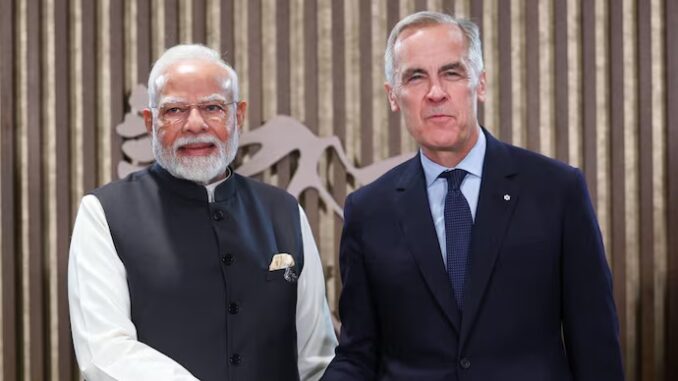
MUMBAI/TORONTO/NEW YORK (TIP): Canadian Prime Minister Mark Carney is scheduled to arrive in New Delhi on March 1, 2026, according to the information released by the Ministry of External Affairs, government of India.
This marks the second leg of his official four-day visit to India, which begins on February 27 in Mumbai. While his specific arrival time in New Delhi has not been publicly released, his primary official business in the capital—delegation-level talks with Prime Minister Narendra Modi—is scheduled for March 2 at Hyderabad House.
Canadian Prime Minister will have a busy schedule in India.
Arriving in Mumbai on February 27, he will interact with Canadian and Indian business leaders and pension fund experts.
He will arrive in New Delhi on March 1, and on March 2, he is scheduled to have official talks with India’s Prime Minister Narendra Modi at which the two Prime Ministers will review the India-Canada Strategic Partnership.
The meeting between the two leaders is taking place at a time when the world is faced with a multiplicity of challenging situations, including the global anxiety caused by US President’s imposition of tariffs on a number of nations, including Canada and India, impacting their economies.
A communique from the External Affairs Ministry of India on February 26, says: “The visit comes at an important juncture in normalization of India-Canada bilateral relations. The two Prime Ministers have earlier agreed to pursue a constructive and balanced partnership grounded in mutual respect for each other’s concerns and sensitivities, strong people-to-people ties, and growing economic complementarities. The forthcoming meeting between the leaders will provide an opportunity to reaffirm the positive momentum and shared vision of India and Canada in building a forward-looking partnership.”
The last time a Canadian Prime Minister visited India was Justin Trudeau in 2023. He had visited earlier in 2018. Before Justin Trudeau, his predecessor, Stephen Harper, had also visited India in 2009 and 2012.
A statement by the Prime Minister’s office said: “In a more divided and uncertain world, Canada’s new government is focused on what we can control. We are building a stronger, more independent, and more resilient economy. We are building our strength at home, diversifying our trade abroad, and attracting massive new international investment.
To these ends, the Prime Minister, Mark Carney, announced that he will travel to India, Australia, and Japan from February 26 to March 7 to unlock new opportunities for Canadian workers and businesses across trade, energy, technology, and defense. Through these visits to three of Canada’s strongest Indo-Pacific partners, the Prime Minister will deepen regional ties that are critical to our security and prosperity.
“In a more uncertain world, Canada is focused on what we can control. We are diversifying our trade and attracting massive new investment to create new opportunities for our workers and businesses. We are forging new partnerships abroad to create greater certainty, security and prosperity at home,” said Mark Carney while announcing dates of his travel.
Prime Minister Carney will first visit Mumbai, then New Delhi, India, where he will meet with Prime Minister Narendra Modi. The leaders will focus on elevating and expanding the Canada-India relationship, with ambitious new partnerships in trade, energy, technology and artificial intelligence (AI), talent and culture, and defense. He will meet with business leaders to identify investment opportunities in Canada and create new partnerships between businesses in both nations.
India is the world’s fastest-growing major economy and a powerhouse in global commerce and technology. In 2024, India was Canada’s seventh-largest goods and services trading partner, with two-way trade coming to $30.8 billion.
At last year’s G20 Leaders’ Summit, Canada and India agreed to formally launch negotiations for an ambitious Comprehensive Economic Partnership Agreement that will support Canada’s goal to more than double two-way trade to $70 billion by 2030.
Canada and Australia have a robust trade relationship, with bilateral merchandise trade totaling $6.1 billion in 2024 and Canadian direct investment in Australia amounting to $58.8 billion that same year.
Last fall, on the margins of the G20 Leaders’ Summit, Canada, India, and Australia entered into a new trilateral technology and innovation partnership to deepen strategic collaboration on critical and emerging technologies and drive further diversification of supply chains toward a secure, sustainable, and resilient future.
Japan is the world’s fourth-largest national economy and a critical commercial partner for Canada, with bilateral trade between our countries worth $36.4 billion annually.
The Prime Minister will then travel to Sydney and Canberra, Australia, to meet with Prime Minister Anthony Albanese and deepen cooperation on defense and maritime security, critical minerals, trade, and advanced technologies, including AI. He will deliver an address to both Houses of Australia’s Parliament and invited dignitaries – marking the first such address by a Canadian Prime Minister in nearly 20 years. Prime Minister Carney will also meet with business leaders and investors to attract new capital into Canada and support two-way trade and investment with Australia.
In Tokyo, Japan, Prime Minister Carney will meet with Prime Minister Takaichi Sanae to strengthen mutual investment and partnerships in clean energy, advanced manufacturing, critical minerals, and food security. The leaders will also discuss strengthening joint efforts on security and defense, including to support a free and open Indo-Pacific.
Canada has what the world wants – abundant energy, critical minerals, expertise in technology, and world-class talent. In a changing world, we are investing in our strength, diversifying our trade, and cultivating a dense web of new connections throughout the world to build Canada strong.


I like the valuable info you provide in your articles. I will bookmark your blog and check again here regularly. I am quite sure I’ll learn many new stuff right here! Good luck for the next!