
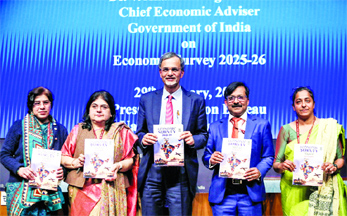

New Delhi (TIP)- India’s economy is projected to grow by 6.8-7.2 per cent in the fiscal year starting April, the government’s pre-Budget Economic Survey said on Thursday, January 29, reaffirming the country’s status as the world’s fastest-growing major economy despite trade risks and global volatility clouding the outlook.
The forecast for 2026-27 is slower than the 7.4 per cent projection for the current financial year, driven by consumption and investment.
“The cumulative impact of policy reforms over recent years appears to have lifted the economy’s medium-term growth potential closer to 7 per cent”, from the 6.5 per cent estimated three years back due to efficiency gains from reforms, the annual report card on the economy said.
“The outlook, therefore, is one of steady growth amid global uncertainty, requiring caution, but not pessimism.” While the current year GDP growth estimate of 7.4 per cent is higher than the 6.3-6.8 per cent range that the survey had forecast last year, the projection for the next year retains India’s world-beating economic expansion despite trade tensions with the US. India, which has been slapped with the highest 50 per cent tariffs on goods it sends to the US, remains one of the few large economies that is yet to sign a trade deal with Washington.
In response to the labour-intensive sector-hurting tariffs, the Modi government has unleashed policy and tax reforms, including cutting GST rates, raising the bar for levy of income tax, an overhaul of labour laws to ease compliance burden on businesses, and concluded four free trade agreements since May 2025, including a mega deal with the European Union.
While inflation is low, balance sheets of firms and households are healthier, and consumption demand remains resilient, US tariffs have led to the rupee falling 5 per cent, and it is now “punching below its weight”.
“The rupee’s valuation does not accurately reflect India’s stellar economic fundamentals,” the survey said, even though the “undervalued” currency “offsets, to some extent, the impact of higher American tariffs on Indian goods”. The macroeconomic conditions, however, “provide resilience against external shocks and support the continuation of growth momentum”, it said.
The International Monetary Fund forecasts 6.2 per cent growth in the coming financial year, if steep tariffs remain in place.
The Economic Survey, authored by Chief Economic Adviser V Anantha Nageswaran, said the “ongoing trade negotiations with the United States are expected to conclude during the year, which could help reduce uncertainty on the external front”.
Commenting on the Survey, Prime Minister Narendra Modi said it highlights strong macroeconomic fundamentals, sustained growth momentum and the expanding role of innovation, entrepreneurship and infrastructure in nation-building.
“The economic survey tabled today presents a comprehensive picture of India’s Reform Express, reflecting steady progress in a challenging global environment. It highlights strong macroeconomic fundamentals, sustained growth momentum and the expanding role of innovation, entrepreneurship and infrastructure in nation-building,” he said in a post on X.
Finance Minister Nirmala Sitharaman, who tabled the Survey in Parliament on Thursday, in a post on X said India’s “macroeconomic fundamentals are stronger than ever”. “We have successfully navigated global headwinds to place India on a high-growth trajectory, improving our potential GDP growth to 7 per cent,” she said.
Stating that domestic inflation averaged 1.7 per cent during April-December 2025, the survey said core inflation stickiness was largely due to precious metals prices and excluding this, inflation remains muted. Outlook is favourable due to strong agricultural output and gradual GST pass-through.
One of the tools the survey suggested to counter global trade and other headwinds was the implementation of ‘Swadeshi’ as a disciplined strategy – moving from self-reliance to strategic indispensability.
Stating that while not all import substitution is either feasible or desirable, it said Swadeshi is inevitable and necessary in the wake of export control and technology denials by developed nations.
It called for a ‘National Input Cost Reduction’ strategy.
From a revenue buoyancy standpoint, both direct and indirect tax collections been robust for the current FY26, in particular growth of non-corporate tax collections (within that, individual tax collections) is notably growing faster than other components of overall mix, and that clearly underlines the changing dynamics of tax collection buckets, administrative reforms and even the measure of success for future tax reforms.
The survey also emphasises the significance of the new Income tax legislation, due to take effect from April 1st, with the aim to provide for simplicity and structural clarity for taxpayers, and encourage voluntary compliance.
The document unveiled before Sitharaman presents the annual Budget for 2026-27 on February 1, flagged shortcomings in India’s export policies, particularly for agriculture.



Be the first to comment