Tag: California

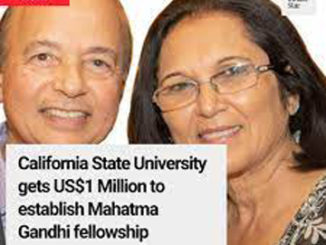
  • Ravi & Naina Patel Foundation donates $1.5 million for Gandhi Center

    Ravi & Naina Patel Foundation donates $1.5 million for Gandhi Center

    Paraminder Aujla

    FRESNO, CA (TIP): California State University, Fresno, plans to establish a Gandhi Center to promote the development of Mahatma Gandhi’s philosophy of inner peace and sarvodaya (universal uplift) with a $1.5 million donation from an Indian American foundation.

    “The Ravi and Naina Patel Foundation members appreciate one of Gandhi’s most beloved principles, vasudhaiva kutumbakam (the whole world is my family),” the Indian American doctor couple stated. “In the spirit of this principle, although based in Bakersfield, we had no problem reaching outside our home city to create learning opportunities at Fresno State.”

    “In a time of increasing unrest and polarization, we are excited by this one of its kind collaborations with the incredible leadership team at Fresno State to create a learning center emphasizing the two central pillars of Mahatma Gandhi’s philosophy — inner peace and sarvodaya,” they added.

    The donation from the Foundation would be used to establish an endowed fund to create and support the “M.K. Gandhi Center: Inner Peace and Sarvodaya” in the College of Arts and Humanities, the University announced in a press release.

    The Gandhi Center will promote the development of intellectual understanding and experiential learning of Gandhi’s philosophy of inner peace and sarvodaya. The idea of sarvodaya focuses on the development of the entire person and the construction of a nonviolent, peaceful and equitable society, the release noted.

    A virtual gift announcement will be held Feb. 18. The Gandhi Center Fund will support a director, student scholarly research, curriculum development, and activities like conferences, essay and art competitions, and public lectures to bring campus and community together.

    The Gandhi Center will be located in the campus library. Reflected in the library’s windows, the Fresno State Peace Garden occupies a central place on the campus.

    Spearheaded by Dr. Sudarshan Kapoor, professor emeritus and a supporter of the initiative, the Peace Garden holds the bust of Gandhi which looks east towards the monuments of leaders Jane Addams, Martin Luther King Jr. and Cesar Chavez.

    These leaders were influenced by Gandhi’s philosophy of nonviolence, soul-force and the upliftment of all, the release noted.

    As the Peace Garden is reflected in the glass, so is Gandhi’s philosophy reflected in Fresno State’s values of discovery, diversity and distinction. “Mahatma Gandhi’s philosophy of nonviolence changed the course of human history by illuminating a path for the individual to make lasting change through peaceful and creative action,” University President Saúl Jiménez-Sandoval said. “His ideals of peace, equity and sarvodaya are intertwined in the mission, vision and values at Fresno State.”

    “Thanks to Drs. Ravi and Naina Patel’s generosity, the M.K. Gandhi Center: Inner Peace and Sarvodaya will enable an immersive experience for students who will become better equipped to make our community and the world a better place,” he said.

    Dr. Honora Chapman, dean of the College of Arts and Humanities at Fresno State, is enthusiastic about the impact of this initiative.

    “We are very grateful to the Patels for forging this unique partnership that underscores the University’s commitment to educate current and future generations about the principles and practices of inner peace and sarvodaya through courses, service-learning projects, public events and research.”

    Sarvodaya is connected with the principles of equality, justice, sustainability and dignity. Gandhi proposed programs that were meant to create economic, social, religious and political welfare, the release noted.

    These programs addressed all aspects of human life, including health, education, growing local and organic food, developing moral citizenry, sanitation practices, interfaith harmony, industries and local government structures.

    Dr. Veena Howard, a Fresno State religious studies professor who holds the Endowed Chair in Jain and Hindu Dharma, said, “The Gandhi Center will create academic and experiential opportunities for students to learn the value and social impact of Gandhi’s philosophy of inner peace and sarvodaya alongside his methods of satyagraha and ahimsa. “They will also learn the historical connections with American leaders, influenced by Gandhi in their nonviolent struggles to confront violence and injustice,” she added.

  • Indian American Tiara Abraham, 15, soprano prodigy, receives YoungArts award

    Indian American Tiara Abraham, 15, soprano prodigy, receives YoungArts award

    Parminder Aujla

    SACRAMENTO, CA (TIP): Tiara Abraham, an Indian American soprano prodigy from Sacramento, California, has received a 2022 YoungArts award in Classical Voice in recognition of her caliber of artistic achievement. A senior at University of California Davis, majoring in vocal performance, Tiara has received an Honorable Mention, the organization’s second highest honor.

    She joins 720 of the most accomplished young visual, literary and preforming artists from throughout the country, according to press release from YoungArts.

    The distinguished group includes Daniel Arsham, Terence Blanchard, Camille A. Brown, Timothée Chalamet, Viola Davis, Amanda Gorman, Judith Hill, Jennifer Koh, Tarell Alvin McCraney, Andrew Rannells, Desmond Richardson and Hunter Schafer.

    Tiara started singing at a young age and began classical voice lessons at seven. In May, she debuted her junior solo recital at UC Davis where she is a University Regents Scholar and also a University Honors Program (UHP) Scholar.

    Though her passion is singing, she also enjoys playing piano and violin, composing, orchestration and music theory. For her UHP project, Tiara has composed for voice and piano on a set of poems from the under-represented African American poet, Georgia Douglas Johnson.

    Tiara has performed nationally and internationally at venues like Carnegie Hall, Vatican, Musikverein (Vienna Austria), and for the San Francisco Giants. She also enjoys performing for the seniors at memory care and assisted living centers.

    Selected through the organization’s prestigious competition, YoungArts award winners, all 15-18 years old or in grades 10–12, are chosen for their caliber of artistic achievement.

    YoungArts award winners gain access to one of the most comprehensive programs for artists in the United States, in which they will have opportunities for financial, creative and professional development support throughout their entire careers.

    Executive Director Jewel Malone congratulated the “extraordinary group of promising, accomplished young artists on this exciting milestone in their artistic careers.”

    “YoungArts empowers artists to pursue a life in the arts beginning at the critical time when many are faced with decisions about life after high school,” said Malone.

    “We are proud to support these young artists at the beginning of their journeys and look forward to becoming a resource for them at all stages of their careers.”

    YoungArts award winners become eligible for exclusive creative and professional development support including a wide range of fellowships, residencies and awards; microgrants and financial awards; virtual and in-person presentation opportunities in collaboration with major venues and cultural partners nationwide; and access to YoungArts Post, a free, private online platform for YoungArts artists to connect, collaborate and discover new opportunities.

    YoungArts was established in 1981 by Lin and Ted Arison to identify the most accomplished young artists in the visual, literary and performing arts and provide them with creative and professional development opportunities throughout their careers.

  • Sabalenka returns with win over Tomljanovic at Kremlin Cup

    Aryna Sabalenka played a match for the first time since reaching the U.S. Open semifinals and subsequently testing positive for the coronavirus, beating Ajla Tomljanovic 7-6 (2), 4-6, 6-1 Wednesday to reach the quarterfinals of the Kremlin Cup. The second-ranked Belarusian, who had a bye in the first round, had 10 aces but also made 30 unforced errors. “She’s a tough opponent for the first match after a long time out on a break,” Sabalenka said. “I calmed down a bit and started playing well.” Sabalenka had not played since her three-set loss to Leylah Fernandez in the U.S. Open semifinals. She was due to play in Indian Wells, California, but said she had tested positive for the coronavirus the day before play started. Sabalenka will next play Ekaterina Alexandrova, who beat Anhelina Kalinina 6-4, 6-1. Garbine Muguruza reach the quarterfinals by beating Tereza Martincova 6-4, 4-6, 6-3. She will next face either Anett Kontaveit or Andrea Petkovic.

  • Indian American Illinois boy Sahasrad Sathish wins South Asian Spelling Bee 2021

    Indian American Illinois boy Sahasrad Sathish wins South Asian Spelling Bee 2021

    EDISON, NJ (TIP): Sahasrad Sathish, 12, of Grayslake, Illinois is the national champion of the South Asian Spelling Bee 2021 with Akshainie Kamma, 13, of Round Rock, Texas finishing as the first runner up.

    The Bee attracted some top talent in the circuit with spellers from across the country participating in six virtual regionals in the past four weeks and the finals in Edison, New Jersey on August 6,

    Champion’s grand prize of $3,000 was awarded to the national winner Sahasrad Sathish at the finals.

    An initiative of the South Asian Engagement Foundation and managed by leading multicultural marketing firm Touchdown Media, the South Asian Spelling Bee is celebrating its 14th anniversary this year.

    “Even with the competition going virtual, the raw talent of these spellers was on full display,” said Bee Director Daisy Walia.

    “We are happy to provide a veritable platform for these spellers so they can showcase their spelling prowess,” she added.

    “I applaud the efforts of the team and spellers for yet another successful season despite the odds,” said Rahul Walia, founder.

    Results:

    In Houston, Texas, Ishika Varipilli, 11, of Spring, Texas was the regional champion and Yash Ganesh, 9, of Tulsa, Oklahoma was the first runner up.

    In Dallas, Texas, Michael Kolagani, 13, of Austin, Texas was the regional champion and Rishi Nemmani, 12, of McKinney, Texas was the first runner up.

    In Seattle, Washington, Pranav Chandar, 13, of Newburgh, Indiana and Saharsh Vuppala, 13, of Bellevue, Washington were the two co-champions.

    In Raleigh, North Carolina, Akshita Balaji, 14, of Herndon, Virginia and Maya Jadhav, 13, of Fitchburg, Wisconsin, were the two co-champions.

    In Edison, New Jersey Akshainie Kamma, 13, of Round Rock, Texas was the regional champion and Dev Shah, 12, of Seminole, Florida was the first runner up.

    In Fremont, California, Harini Logan, 13, of Shavano Park, Texas was the regional champ and Shradha Rachamreddy, 11, of San Jose, California was the first runner up.

    The top two spellers of each regional competition advanced to the finals.

  • New theory: Earth’s longer days kick-started oxygen growth

    New theory: Earth’s longer days kick-started oxygen growth

    Caption: This June 19, 2019, photo provided by NOAA Thunder Bay National Marine Sanctuary shows purple microbial mats in the Middle Island Sinkhole in Lake Huron, Mich. Small hills and “fingers” like this one in the mats are caused by gases like methane and hydrogen sulfide bubbling up beneath them. Feel like days are just getting longer? They are and it’s a good thing because we wouldn’t have much to breathe if they weren’t, according to a new explanation for how Earth’s oxygen rich atmosphere may have developed because of Earth’s rotation slowing. Scientists provided evidence for this new hypothesis by lab testing gooey smelly purple bacteria from a deep sinkhole in Lake Huron. (Phil Hartmeyer/NOAA Thunder Bay National Marine Sanctuary via AP) Scientists have a new idea for how Earth got its oxygen: It’s because the planet slowed down and days got longer. A study published Monday proposes and puts to the test the theory that longer, continuous daylight kick-started weird bacteria into producing lots of oxygen, making most of life as we know it possible. They dredged up gooey purple bacteria from a deep sinkhole in Lake Huron and tinkered with how much light it got in lab experiments. The more continuous light the smelly microbes got, the more oxygen they produced. One of the great mysteries in science is just how Earth went from a planet with minimal oxygen to the breathable air we have now. Scientists long figured microbes called cyanobacteria, were involved, but couldn’t tell what started the great oxygenation event. Researchers in a study in Monday’s Nature Geoscience theorise that Earth’s slowing rotation, which gradually lengthened days from six hours to the current 24 hours, was key for the cyanobacteria in making the planet more breathable. About 2.4 billion years ago there was so little oxygen in Earth’s atmosphere that it could barely be measured, so no animal or plant life like we know could live. Instead, lots of microbes breathed in carbon dioxide, and in the case of cyanobacteria, produced oxygen in the earliest form of photosynthesis. At first it wasn’t much, but in only about 400 million years Earth’s atmosphere went to one-tenth the amount of oxygen we have now – a huge jump, said the study’s lead author, Judith Klatt, a biogeochemist at the Max Planck Institute in Germany. That oxygen burst allowed plants and animals to evolve, with other plants now joining in the oxygen-making party, she said. But why did the bacteria go on the oxygen making binge? That’s where University of Michigan oceanographer Brian Arbic comes in. He studies tidal forces on Earth and how they’ve slowed Earth’s rotation. Arbic was listening to a colleague’s lecture about cyanobacteria and he noticed that the oxygen event coincided with the timing of Earth’s days getting longer. The planet’s rotation slows because of the complicated physics of tidal friction and interaction with the moon. The Michigan and German researchers put their theory to the test with bacteria similar to what would have been around 2.4 billion years ago. They used purple and white mats of cyanobacteria living in an eerie world of the sinkhole nearly 79 feet (24 meters) deep in Lake Huron. “We actually imagine that the world looked kind of like the Middle Island sinkhole for most of its history,” Klatt said. Divers brought up the gelatinous carpets of bacteria, which smell like rotten eggs. Klatt and colleagues exposed them to varying amounts of light, up to 26 straight hours. They found that more continuous light caused the microbes to produce more oxygen. The study authors and outside scientists said this is just one possible but plausible explanation for Earth’s oxygen increase. What makes the idea so impressive is that it doesn’t require any big biological changes in bacteria or the world’s oceans, said Tim Lyons, a professor of biogeochemistry at the University of California, Riverside, who wasn’t part of the research team.

    Source: AP

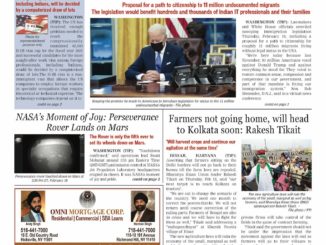
  • February 19 New York & Dallas E – Edition

    February 19 New York & Dallas E – Edition

    [vc_row][vc_column][vc_column_text]

    E-Edition

    [/vc_column_text][/vc_column][/vc_row][vc_row][vc_column width=”2/3″][vc_custom_heading text=”Dual Edition” font_container=”tag:h2|text_align:center” google_fonts=”font_family:Istok%20Web%3Aregular%2Citalic%2C700%2C700italic|font_style:700%20bold%20regular%3A700%3Anormal” link=”url:https%3A%2F%2Fwww.theindianpanorama.news%2Fwp-content%2Fuploads%2F2021%2F02%2FTIP-FEBRUARY-19-DUAL-EDITION.pdf|||”][vc_single_image image=”106575″ img_size=”full” add_caption=”yes” alignment=”center” onclick=”custom_link” link=”https://www.theindianpanorama.news/wp-content/uploads/2021/02/TIP-FEBRUARY-19-DUAL-EDITION.pdf”][/vc_column][vc_column width=”1/3″][vc_single_image image=”82828″ img_size=”medium” alignment=”center” onclick=”custom_link” link=”https://www.theindianpanorama.news/advertising-media-kit-portal-indian-panorama/”][vc_single_image image=”82829″ img_size=”medium” alignment=”center” onclick=”custom_link” link=”https://www.theindianpanorama.news/advertising-media-kit-portal-indian-panorama/”][/vc_column][/vc_row][vc_row][vc_column width=”2/3″][vc_custom_heading text=”Lead Stories This Week” font_container=”tag:h2|text_align:center” google_fonts=”font_family:Istok%20Web%3Aregular%2Citalic%2C700%2C700italic|font_style:700%20bold%20regular%3A700%3Anormal” link=”url:https%3A%2F%2Fwww.theindianpanorama.news%2F%20|||”][/vc_column][vc_column width=”1/3″][vc_widget_sidebar sidebar_id=”mh-sidebar”][/vc_column][/vc_row]

  • Indian Americans Protest after another Mahatma Gandhi Statue is Vandalized

    Indian Americans Protest after another Mahatma Gandhi Statue is Vandalized

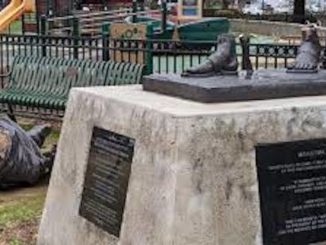
    DAVIS, CA (TIP): Indian Americans on Sunday, January 31, held protest against the vandalism of a Mahatma Gandhi statue in California’s Davis and demanded reinstallation of the statue.

    In a statement by Deputy Chief Paul Doroshov of the Davis Police Department, the statue, broken off at the ankles and the top half of its head broken off, was found by a park worker around 9 am (local time) on Wednesday.

    Stepping up in support of the Indian community at the vigil was the Mayor of Davis Gloria Partida who deeply regretted the incident. The mayor informed the protesters that they have initiated an investigation. “Vandalism will never be condoned. Mahatma Gandhi is our inspiration and we will not allow this. Not on our watch,” the mayor added.

    “Pro-Khalistan radical groups from neighboring towns outside of Davis tried to intimidate the attendees in an attempt to stop the event and tried to assault a lady speaker at the event,” Bhaskar Vempati, President of the Indian Association of Sacramento, one of the cohosts of the event told media.

    “Police had to be called in to control the aggressive protestors. A police report has been filed on the incident of assault on the lady speaker,” Vempati further added.

    The Consulate General of India in San Francisco has separately taken up the matter with the City of Davis and local law enforcement authorities.

    Speaking to Media, Dr TV Nagendra Prasad, Consul General of India, San Francisco said, “The City Council has condemned the incident and issued a statement. I did take it up separately and the city council and police authorities assured me to bring the culprits to justice. They also allowed and provided security to the vigil by the community today.”

  • Indian American Congressman Condemns Vandalization Of Gandhi Statue

    Indian American Congressman Condemns Vandalization Of Gandhi Statue

    WASHINGTON (TIP): Indian American Congressman Ro Khanna on Monday, Feb 1, strongly condemned the vandalization of a statue of Mahatma Gandhi in the US state of California, calling it as a shameful act.

    The 6-ft tall, 650-pound (294 kg) bronze statue of Gandhi in the Central Park of the City of Davis in Northern California was vandalized, broken and ripped from the base by unknown criminals early this week.

    “Nonviolent, respectful protest was the essence of Gandhi’s life mission. To see the desecration of this magnificent statue only underscores the need for more people to study Gandhi’s teachings, not unilaterally erase him from the public discourse,” Khanna said.

    “This was a shameful act. At a moment in our history when disagreement needs to be managed with tolerance and patience, I urge everyone involved to take the time to listen and talk instead of resorting to acts of public vandalism,” he said.

    As the Democratic Vice Chair of the India Caucus, Khanna said he will continue to work with his colleagues to build bridges across these divisions.

    “I encourage everyone to join me in working through disagreement with dialogue and discussion, rather than resorting to violence that tears at the fabric of our society,” he said.

    Meanwhile, two groups gathered at the park in Davis on Sunday where the statue was vandalized, local media reported. While one group demanded that the statue be restored, the other opposed such a move.

    The City of Davis has launched an investigation into the incident.

    “The City of Davis condemns the vandalism that destroyed the statue of Mahatma Mohandas Gandhi in Central Park. We do not support any actions that include the destruction of property,” the city said in a statement on Sunday.

    “We understand that our community reflects a diversity of views and values, but we expect that everyone will extend respect to each other and to shared spaces,” it said.

    But we reiterate our belief that the solution to solving such differences is never in violent acts but through compromise and dialogue. It is our sincere desire that our community move forward with peaceful and positive discourse and reconciliation,” the city said in its statement.

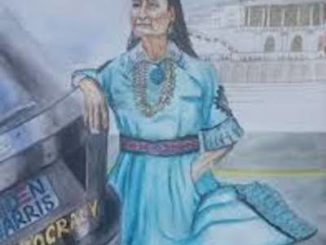
  • Indian American artist Sujata Tibrewala’s painting “Bloody Immigrant” depicts Deb Haaland

    Indian American artist Sujata Tibrewala’s painting “Bloody Immigrant” depicts Deb Haaland

    SAN JOSE, CA (TIP): Back in 1637, there was a massacre in which Pilgrims killed Native Americans and stole their land.  And so goes the story of Thanksgiving, where the Native Americans taught the Pilgrims how to live in the winter, ploughing the land and growing food, and Pilgrims then thanking their host. A plague perishing all Native Americans is a whitewashed story – a story where they insist that there are no rightful owners of the land that was usurped, so they don’t have to pay back for sins or atone to anyone.

    In reality, the Pilgrims stole the Native American land, raped and killed them as a manner of “giving thanks”. This killing symbolically continues today by the mainstream America pretending that they don’t exist. For example, Donald Trump said that Sen. Elizabeth Warren was not Native American since her blood is mixed with white blood. This is an age-old technique colonialism has used to make their victims disappear.

    When I think about their story, I really feel pity for them because they don’t get to tell their side of the story and have to continue living with their oppressors. Although in India, British did equally bad, at least they left and then we rewrote our history, teaching children about our freedom fighters and soldiers. Whereas in America, the opposite happened: the Native Americans are portrayed as savages, uncivilized tribes who don’t even exist today.

    It must be noted that I am not calling them Indians, because they were never Indians. I am an Indian from South Asia, not a Native American. It is like Columbus came here, discovered Native Americans thinking they were Indians, and instead of correcting their mistake, now insist on continuing to call them Indians hundreds of years later.

    These were some of the thoughts that were running in my mind when I painted this work. So, this painting is a tribute to 5 million Native Americans who live in the United States today. A majority of them are living on reservation land as forced by the famous “trail of tears” displacement, perpetrated by state where thousands died in transit or after reaching their destinations due to diseases. This happened between 1830 and 1850, because the US government wanted to acquire the land east of Mississippi. And this continues to this day. Native American land is where most polluting industries are likely to be located and they are in danger of being acquired to lay pipelines for fossil fuel industry or being dug for mining.

    There is a savior complex within the white population and yet within their own backyards, the indigenous people are always struggling to keep their land. Deb Halaand, one of the first two Native Americans to enter U.S. Congress and first from New Mexico, has a history of fighting for tribal sovereignty and advocating for natural resources. She was nominated by Joe Biden for interior secretary to serve in the new administration.

    Hence it is just fitting that she gets to do the honors in my painting to be squashing out Trump, an immigrant-hating president who has no place in American democracy.  The imagery used is based on actual footage of George Floyd’s killing while he was crying for help “I can’t breathe,” which has become an anthem for the Black Lives Matter movement. I used this image to comment that though the position of blacks in America is bad, at least they are in popular consciousness, however the Native Americans and their issues are not even part of the dialogue.

    (Sujata Tibrewala is an eco-feminist, artist and engineer, based in San Jose, California. She has exhibited her works at various prestigious venues in the United States and India. More of her work can be seen on www.Pratibimba.info.)

  • Indian -Origin Satwinder Singhspends lakhs on mineral water for protesting farmers

    Indian -Origin Satwinder Singhspends lakhs on mineral water for protesting farmers

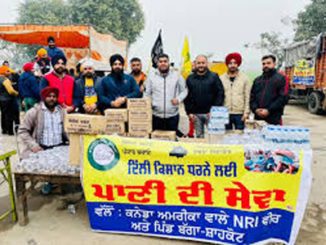
    SACRAMENTO (TIP): Indian – Origin California – based Satwinder Singh from Bagga village in Jalandhar came to Punjab a year ago. Living in California for the past 20 years, he came back only last year. Little did he know that he would be staying here for longer than he decided.

    When the farmers’ movement began, he went full throttle to participate in the campaign. For the last two months, Satwinder has gone all out to participate in the movement. He has been organizing langar for farmers and those who are going to be a part of the movement.

    Satwinder said, ‘Until now, we have brought mineral water worth Rs 10 lakh, along with the support of other volunteers. Right now, we are just 4 km away from Fatehgarh, where we provide water bottles to those who don’t have it,” he said.

    Satwinder said while towards Singhu border he met a group of people who had ration with them, but not water. “So, I decided to organize a langar of water for the passers-by,” he said.

    Singh said he was a farmer himself and couldn’t see their pain. “Asi apne bhrava layi khade haan. Jo vi zarurat hai, poori karange (We are there for our brothers, will provide them whatever they need).”

  • President-Elect Joe Biden unveils  ambitious 1.9 trillion ‘American Rescue Plan’

    President-Elect Joe Biden unveils ambitious 1.9 trillion ‘American Rescue Plan’

    • $1 trillion to assist families needing direct financial support: $1400.00 more to each American
    • $440 billion to emergency funds for small businesses and communities
    • $400 billion for COVID-19 response and increasing vaccine capabilities
    • Outlines plan to revive manufacturing and a minimum wage of $15

    I.S. Saluja

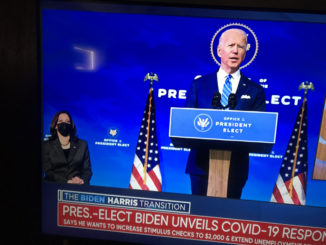
    WILMINGTON, DEL (TIP): Emphasizing on the  strength of unity of Americans,  President-elect Joe Biden in his speech, January 14 here  said,  “Unity is not some pie-in-the-sky dream. It’s a practical step to get any of the things we have to get done as a country, get done together,” Biden said .

    “I’m convinced we are ready to get this done,” he said. “The very health of our nation is at stake.”

    The package is titled the “American Rescue Plan.” Biden described it as a package of emergency measures to meet the nation’s immediate economic and health-care needs, to be followed in February by a broader relief plan he will unveil in his first appearance before a joint meeting of Congress.

    January 14 proposal comes at a critical time for the nation. More than 4,200 people in the United States died of the coronavirus on Tuesday, a new daily-record high. The economic recovery appears to be backsliding, with jobless claims spiking to a new high since August, as nearly 1 million people filed for unemployment last week, says a  Washington Post report.

    It also comes six days before Biden’s inauguration, and a day after the House of Representatives impeached President Trump, highlighting the president-elect’s challenge of trying to get his top agenda item passed as the Senate is likely to be enmeshed in an impeachment trial. Biden has expressed the hope that the Senate can simultaneously move forward on his agenda while weighing impeachment, although it’s unclear how well that might work in practice. Biden alluded only in passing to the political challenges his proposal will confront, remarking of his proposal to raise the minimum wage: “People tell me that’s going to be hard to do,” but noting that it just happened in Florida.

    The plan contains a raft of provisions that build on the approximately $4 trillion Congress has already devoted to addressing the pandemic, which included a $900 billion measure Trump signed last month. Biden has repeatedly described that last bill as unfinished business, saying Thursday, “We will finish the job.”

    Biden’s proposal is divided into three major areas: $400 billion for provisions to fight the coronavirus with more vaccines and testing, while reopening schools; more than $1 trillion in direct relief to families, including through stimulus payments and increased unemployment insurance benefits; and $440 billion for aid to communities and businesses, including $350 billion in emergency funding to state, local and tribal governments.

    The proposal will aim to make good on Biden’s plan for a universal vaccination program, devoting $20 billion to that goal, as well as $50 billion for a “massive expansion” of testing and $130 billion to help schools reopen safely. Among the many goals laid out in the proposal, Biden hopes to deliver 100 million vaccine shots in 100 days, and reopen a majority of K-12 public schools in that time frame.

    Incoming Senate majority leader Charles E. Schumer (D-N.Y.) had urged Biden to consider a higher price tag than what he was initially eyeing for the proposal, according to a person familiar with the conversation who spoke on the condition of anonymity to recount the private conversation freely. Still, the size and scope of the package exceeded the expectations of a number of outside advocates, while answering demands from economists for a major new investment to get the economy on a sounder footing. “I know what I just described will not come cheaply,” Biden said Thursday night. “But failure to do so will cost us dearly.”

    The legislation includes a number of priorities sought by top congressional Democrats, including some of the more liberal members, from increasing the federal minimum wage to $15 an hour to adding billions in funding for childcare. Biden called for increasing federal unemployment benefits from $300 per week to $400 per week for millions of jobless Americans. The benefits would be extended through September, preventing millions of people from losing their jobless aid in March, as would occur under current law. Biden’s plan states that he will also seek to link the level of unemployment benefits to general economic factors, so that benefits increase automatically when the unemployment rate spikes.

    As expected, Biden’s proposal would also increase from $600 to $2,000 per person the stimulus payments approved by Congress last month. Trump enthusiastically endorsed the $2,000 stimulus payments, as did congressional Democratic leaders, but many Republicans opposed the idea. Biden’s plan would also expand eligibility for the stimulus payments to families where one parent is an immigrant, as well as to adult children claimed as dependents on their parents’ tax returns. Both categories were excluded in the last relief packages due to GOP opposition. About 13.5 million adult dependents were excluded from the checks as a result, including millions of disabled people.

    A major expansion of tax credits is also included in Biden’s proposal, for children and lower-income workers. Biden’s plan would expand a tax credit for children to $3,600 a year per child under 6, as well as $3,000 a year for children under 17. It would also extend eligibility for the credit to millions of very poor families. It would dramatically boost the Earned Income Tax Credit, a benefit for workers, from $530 to $1,500.

    Biden’s plan also contains new initiatives aimed at buoying the ailing U.S. economy, such as a combined 14 weeks of paid sick and family medical leave for millions of workers. It would provide grants to more than 1 million small businesses, and approve about $35 billion toward making low-interest loans available, particularly for clean-energy investments. Biden’s plan would put tens of billions of dollars into other needs facing the country, from food and water assistance, food stamps, and funding for U.S. territories such as Puerto Rico.

    CBSN Screenshot

    The size of the package and its embrace of multiple liberal priorities that are anathema to Republicans — including a large sum for state and local governments — raises questions about how much bipartisan support Biden will be able to get for the proposal. He is already facing pressure from liberals on Capitol Hill who want to use Democrats’ newfound control of Congress to push through aggressive and costly legislation.

    Sen. Bernie Sanders (I-Vt.), who will chair the Budget Committee, has said he is working to put together a massive stimulus bill that could pass under special budget rules with a simple majority vote in the Senate, instead of the 60-vote margin normally required.

    Biden, however, wants to try for a bipartisan majority on his first bill — although his team appears to have conducted little outreach to congressional Republicans on the plan. Democratic aides say that if Republicans do not appear willing to cooperate, they can shift gears quickly and move to “budget reconciliation,” the procedure that would allow them to pass legislation without GOP votes. That’s how Republicans passed their big tax-cut bill after Trump took office, and how President Barack Obama passed the Affordable Care Act.

    The Senate will be divided 50-to-50 between Republicans and Democrats in the new Congress, giving Democrats control because Vice President-elect Kamala D. Harris will have the tie-breaking vote. Democrats’ 222-to-211 majority in the House is the narrowest for either party in years.

    With those margins, even holding enough Democrats together to pass legislation along party lines could prove a challenge. The most conservative Senate Democrat, Sen. Joe Manchin III (W.Va.), has already expressed skepticism about the need for a new round of stimulus checks, while Rep. Alexandria Ocasio-Cortez (D-N.Y.) said Thursday that Biden isn’t going far enough by proposing $1,400 checks, even though Biden’s approach means most people will end up with $2,000 given the earlier batch of $600 checks. “$2,000 means $2,000. $2,000 does not mean $1,400,″ Ocasio-Cortez said.

    “I know what I just described will not come cheaply,” Biden said Thursday night. “But failure to do so will cost us dearly.” (CBSN Screenshot)

    Foreshadowing the legislative fight to come, Biden’s plan quickly attracted criticism from advocates on the right and the left. Stephen Moore, an outside economic adviser to Trump, slammed it as “fiscally irresponsible.” Mark Wolfe, head of the National Energy Assistance Directors’ Association, said he was disappointed the proposal didn’t include more money for rental assistance or low-income energy assistance.

    The $130 billion in K-12 funding in the proposal is aimed at paying expenses associated with mitigating the spread of virus inside schools, such as improving ventilation systems. Although Biden has said he wants to open a majority of schools, there is no federal tally of how many are open to date, and some research suggests a majority of them may be offering in-person options already.

    (With inputs from Washington Post and agencies)

  • Mohinder Kaur files plaint against Kangana

    Mohinder Kaur files plaint against Kangana

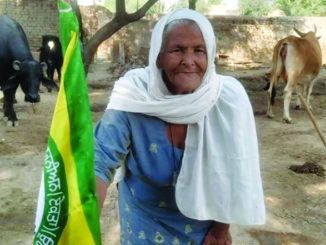
    Bathinda (TIP): Mohinder Kaur of Bahadurgarh Jandian village here, who hit the headlines after Kangana Ranaut tweeted her picture claiming that she was the same “Dadi” who was part of the Shaheen Bagh protest, has filed a complaint against the actress. The complaint has been filed in a court here and a hearing has been fixed for January 11. In the complaint, filed though advocate Raghubir Singh Behniwal, Mohinder Kaur claimed that due to Kangana’s false tweet, she suffered grave mental tension, agony, botheration, harassment, humiliation, loss of reputation, defamation in eyes of her family members, relatives, co-villagers and public in large. Further, she also claimed that due to the allegation, she had fallen in her own estimation and also in the eyes of protesting farmers. The complaint also said Kangana had not apologised to her or farmers.

  • HOLIDAY CHEER (By Mabel Pais)

    HOLIDAY CHEER (By Mabel Pais)

    PATTERN OF LOVE 

    By Jack Smith

    I didn’t question Timmy, age nine, or his seven-year-old brother Billy, about the brown wrapping paper they passed back and forth between them as we visited each store. Every year at Christmas time, our Service Club takes the children from poor families in our town on a personally conducted shopping tour. I was assigned Timmy and Billy, whose father was out of work. After giving them the allotted $4 each, we began our trip. At different stores I made suggestions, but always their answer was a solemn shake of the head, no. Finally I asked, “Where would you suggest we look?”

    “Could we go to a shoe store, Sir?” answered Timmy. “We’d like a pair of shoes for our Daddy so he can go to work.”

    In the shoe store the clerk asked what the boys wanted. Out came the brown paper. “We want a pair of work shoes to fit this foot,” they said.

    Billy explained that it was a pattern of their Daddy’s foot. They had drawn it while he was asleep in a chair.

    The clerk held the paper against a measuring stick, then walked away. Soon he returned with an open box. “Will these do?” he asked.

    Timmy and Billy handled the shoes with great eagerness. “How much do they cost?” asked Billy. Then Timmy saw the price on the box. “They’re $16.95,” he said in dismay. “We only have $8.”

    I looked at the clerk and he cleared his throat. “That’s the regular price,” he said, “but they’re on sale – $3.98 – today only.”

    Then, with shoes happily in hand, the boys bought gifts for their mother and two little sisters. Not once did they think of themselves.

    The day after Christmas the boy’s father stopped me on the street. The new shoes were on his feet and gratitude was in his eyes. “I just thank God for people who care,” he said.

    “And I thank God for your two sons.” I replied. “They taught me more about Christmas in one evening than I had learned in a lifetime.” May love fill your heart and your home during this blessed holiday season!

    ————————————————-

    Joshua Bell with Pianist Jeremy Denk

    Saturday, December 19, 2020 at 3PM EST

    Joshua Bell is “a thoroughly serious, intelligent musician” (Financial Times, London … Jeremy Denk) “played with tremendous verve and contagious brilliance” (The Los Angeles Times)

    The New Jersey Performing Arts Center (NJPAC) presents internationally acclaimed violinist Joshua Bell with Pianist Jeremy Denk on Saturday, December 19, 2021 at 3:00 p.m.

    These friends, who teamed on the recording “For the Love of Brahms” (Sony Classical) to critical acclaim in 2016, plan an emotionally engaging program for the NJPAC audience. The afternoon concert will showcase Mendelssohn’s Piano Trio No. 1, an immediate success for its composer and featuring a passionate finale; Shostakovich’s elegiac Piano Trio No. 2 in E minor, a World War II-era lamentation; the expressive Trio élégiaque No. 1, written by Rachmaninoff at the age of 19, and the poetically seductive Piano Trio in A minor by Ravel.

    Tickets

    For tickets, follow the link:  njpac.org/event/joshua-bell-with-pianist-jeremy-denk

    ———————————–

    LEDISI

    Friday, December 18, 2020 at 9 p.m. EST

    Join NJPAC for a soulful live-stream concert with ‘Ledisi: Live at the Troubadour.’ The 13-time GRAMMY-nominated R&B powerhouse will perform songs from her new album, “The Wild Card,” and favorites that span her career.

    Ledisi is a chart-topping singer-songwriter known for infusing her signature R&B vocals with a distinctly jazzy touch. Ledisi also lent her talent to the acclaimed 2014 film Selma, in which she portrayed American music icon, Mahalia Jackson. Ledisi is not only a singer and actress, but she’s also an author, playwright, film producer, and now CEO of her record label ‘Listen Back Entertainment/BMG.’

    For Tickets, follow the link boxoffice.mandolin.com/collections/ledisi-live-at-the-troubadour?oid=5&affid=16

    —————————————

    CHEVY CHASE & BEVERLY D’ANGELO

    Saturday, December 19, 2020 Live on Zoom @ 8PM

    Switch on the Christmas lights and join Chevy Chase (Clark Griswold) and Beverly D’Angelo (Ellen Griswold) for this online salute to the holiday classic, ‘National Lampoon’s Christmas Vacation.’ Expect the unexpected as these legends share a no-holds-barred trip down memory lane and unveil the behind-the-scenes secrets of the ‘Vacation’ film franchise.

    They’ll also answer questions from the virtual audience during the live Q&A. So gather the family and cozy up on the couch as NJPAC streams the Griswolds directly to your living room for a virtual holiday celebration. Chestnuts and eggnog recommended!

    Upgrade to VIP

    TREAT yourself to an upgraded experience when you add on the VIP option. VIP ticket holders will have the opportunity to engage in a one-minute one-one video chat with Chevy and Beverly. The capacity for this experience is extremely limited and must be purchased in advance.

     Tickets

    For Tickets, visit passportshows.com/checkout2/cv-checkout-1219208

    ————————————————-

    KEEPING SAFE DURING THE HOLIDAYS

    Message from John Screiber, President & CEO of NJPAC

    “Thank you so much for joining us (Friday, December 11, 2020) for our virtual NJPAC Business Partners Roundtable @ Home with Governor Phil Murphy.

     I hope that you were as engaged as I was by the Governor’s frank and detailed assessment of how the state has managed the current health crisis so far, the precautions we all still need to take and, happily, the very good news about vaccines and other assistance that should arrive in our state in a matter of weeks.

    I was particularly moved by the Governor’s commitment to “never let this get impersonal” and his practice of reaching out to speak to teachers, business owners and especially the families of those who have lost loved ones to COVID-19 to guide him as he makes the incredibly difficult and complex decisions involved in managing the pandemic.

    His compassion, and his insistence on “checking partisan bias at the door” to work with leaders across the country to establish best practices for handling this unprecedented challenge, were both truly inspirational.Until then, everyone here at NJPAC joins me in wishing you a happy and healthy holiday season!

    May the New Year bring better days for us all.”

    (Mabel Pais writes on The Arts and Entertainment, Social Issues, Spirituality, and Health & Wellness)


  • Democrats  clinch House control, but reduced majority likely

    Democrats  clinch House control, but reduced majority likely

    WASHINGTON (TIP): Democrats clinched two more years of controlling the House but with a potentially razor-thin majority, a bittersweet finale to last week’s elections that has left them divided and with scant margin for error for advancing their agenda.The party on Tuesday nailed down at least 218 seats, according to The Associated Press, and could win a few others when more votes are counted.

    While that assures command of the 435-member chamber, blindsided Democrats were all but certain to see their current 232-seat majority shrink after an unforeseen surge of Republican voters transformed expected gains of perhaps 15 seats into losses potentially approaching that amount.

    “We have the gavel, we have the gavel,” said House Speaker Nancy Pelosi (California), who seems all but certain to continue in that role. While she bemoaned Democrats’ losses in districts where GOP votes proved “almost insurmountable,” she told reporters last week, “We’ve lost some battles but we’ve won the war.”

    By retaining the House, Democrats will control the chamber for four consecutive years for only the second time since 1995. As the news sunk in, Rep. Cheri Bustos, D-Ill., who led House Democrats’ campaign committee, announced Monday she wouldn’t seek another term leading that organization.

    (Source: PTI)

  • November on track to be worst month of pandemic so far in US as cases surge

    November on track to be worst month of pandemic so far in US as cases surge

    • Wednesday marked new record for daily cases with 143,231 new infections and 2,005 deaths

    NEW YORK (TIP): November is on track to be the worst month of the pandemic so far in the US as new cases and hospitalizations continue to surge to record highs. There were 143,231 new cases and 2,005 deaths in the US on Wednesday, November 11, according to figures recorded by Johns Hopkins University. It marked the ninth consecutive day of cases topping 100,000 and a new record for daily cases. It comes after the country recorded more than a million cases in the first 10 days of November. Total cases in the US have now r eached over 10.3m and 241,910 people have died, the highest totals in the world.Health experts have in part put the increase down to incoming cold weather driving people indoors and frustration with public health precautions such as masks. Dr Anthony Fauci, America’s top infectious disease expert, said America can slow the spread by “doubling down” on precautions such as mask-wearing, avoiding crowds, keeping activities outdoors and social distancing – and that if people do so a national lockdown could be avoided.

    “We would like to stay away from that [a national lockdown] because there is no appetite for locking down in the American public. But I believe that we can do it without a lockdown, I really do,” he told ABC on Thursday morning.

    He added: “The best opposite strategy to locking down is to intensify the public health measures short of locking down. So if you can do that well, you don’t have to take that step that people are trying to avoid which has so many implications, both psychologically and economically.”

    He urged the American public to “hang in there”, saying a vaccine should be on its way to highest priority people in December and to everyone else within the second quarter of 2021.

    “The cavalry is coming. Vaccines are going to have a major positive impact … So if we can just hang in there, do the public health measures that we’re talking about, we’re going to get this under control, I promise you,” he said.

    Daily cases are on the rise in 49 states, and deaths per day are climbing in 39.

    North and South Dakota and Wisconsin are among the worst affected states, while Texas this week became the first state to record a million cases.

    California is also heading towards the 1m mark, recording a total of 995,575 cases, according to Johns Hopkins data. In Los Angeles, the Dodger stadium is being used as a testing center.

    A White House coronavirus taskforce report distributed to states on Tuesday, November 10 evening reportedly said: “There is continued, accelerating community spread across the top half of the country, where temperatures have cooled and Americans have moved indoors.”

    It also warned of continued deterioration in the so-called sun belt states across the south and “the most diffuse spread experienced to date”, reported CNN.

    Hospitalizations in the US broke records for a second consecutive day. The Covid Tracking Project recorded 65,368 people hospitalized on Wednesday – up from 61,964 the previous day and double the figure for a month ago. Amid healthcare staffing concerns in North Dakota, the governor, Doug Burgum, has said that asymptomatic healthcare workers with Covid-19 will be allowed to continue working in Covid-19 hospital units. In New York, where infection rates are on the rise, the governor, Andrew Cuomo, announced on Wednesday, November 11,  that restaurants, bars and gyms would be required to close at 10pm, starting on Friday, November 13 and that gatherings at private homes would be limited to 10 people. “If you look at where the cases are coming from, if you do the contact tracing, you’ll see they’re coming from three main areas: establishments where alcohol is served, gyms and indoor gatherings at private homes,” Cuomo said. New York City was the world’s worst hotspot for the virus back in the early spring, then gradually got infections under control and is now urgently trying to ensure that the city and state do not experience a full-blown “second wave” of coronavirus.

    (Source: The Guardian)

  • Four Democratic Indian American Lawmakers of “Samosa Caucus” Re-Elected to US House of Representatives

    Four Democratic Indian American Lawmakers of “Samosa Caucus” Re-Elected to US House of Representatives

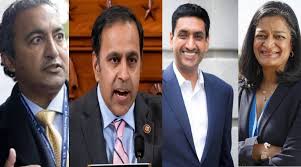
    WASHINGTON  (TIP): In an impressive show, all the four Indian American Democratic lawmakers – Dr Ami Bera, Pramila Jayapal, Ro Khanna and Raja Krishnamoorthi – have been re-elected to the US House of Representatives.

    The Indian American community has emerged as a force to reckon with for the first time in the history of the US presidential election. Both the Democrat and the Republican campaigns had initiated several measures to woo the approximately 1.8 million members of the community who have emerged as a critical voting bloc in the battleground states of Florida, Georgia, Michigan, North Carolina, Pennsylvania, and Texas.The ‘Samosa caucus’ currently comprises five Indian American lawmakers, including the four members of the House of Representatives and Senator and Democratic vice-presidential nominee Kamala Harris, 56.

    Raja Krishnamoorthi, 47, easily defeated Preston Nelson, 30, of the Libertarian Party. When last reports came in, he had accounted for nearly 71 per cent of the total votes counted.

    Ro Khanna, 44, easily defeated fellow Indian-American Ritesh Tandon, 48, of the Republican Party with a margin of more than 50 percentage points. This was his third-consecutive win from the 17th Congressional district of California. Dr Ami Bera, 55, the senior most member of the ‘Samosa Caucus’, won the seventh Congressional District of California for the fifth consecutive term. When the last report came in, he had established an inaccessible lead by more than 25 percentage points against his Republican rival 65-year-old Buzz Patterson. The House of Representatives is the lower house of the US Congress, with the Senate being the upper house.

  • Indian Americans make a splash in yet another election cycle

    Indian Americans make a splash in yet another election cycle

    NEW YORK (TIP): Besides the four member ‘Samosa Caucus’ of Indian American lawmakers re-elected to the US House of Representatives, over a dozen others, including five women have won state level elections scoring a few firsts for the community.

    Among the five women, Democrat lawyer Jenifer Rajkumar, 38, became the first South Asian woman elected to the New York state assembly defeating her Republican rival Giovanni Perna.

    Rajkumar, a Stanford-educated lawyer and an immigrant rights advocate, is a professor at the City University of New York. She has previously served as the Director of Immigration Affairs and Special Counsel for New York state.

    Democrat Kesha Ram, who served in the Vermont House of Representatives from 2009 to 2016, became the first woman of color elected to the Vermont State Senate.

    Daughter of a Punjabi from India, she was one of the youngest ever to be elected to State Assembly at the age of 21.

    Other three elected to state houses were immigration attorney Nima Kulkarni in Kentucky, Vandana Slatter, a pharmacist, and scientist, in Washington and Democrat Padma Kuppa in Michigan. Kuppa was the first Indian immigrant and Hindu in the Michigan Legislature.

    “This year’s election represented a giant leap forward for the Indian Americans’ role in US politics,” says Neil Makhija, Executive Director of IMPACT.

    The leading Indian American advocacy and political action committee had raised a $10 million war chest to get Democratic vice-presidential candidate Kamala Harris and other Indian origin candidates elected. “Indian American voters and candidates demonstrated the burgeoning power and influence of this important voting bloc in decisive fashion,” he said.

    With a record number of Indian American candidates running for office across the nation, around two million Indian Americans voted in the 2020 election, according to the Center for American Progress.

    Winners

    US House:

    The longest serving Indian American House member Ami Bera, 55, won his fifth consecutive term to the House from California. Son of immigrant parents from Gujarat, Bera is a physician by profession. New Delhi-born lawyer Krishnamoorthi, 47, defeated his Libertarian Party rival in Illinois to win a third term.

    So did lawyer, academic Ro Khanna, 44, who defeated another Indian American challenger Ritesh Tandon of Republican Party in California.

    Chenna-born civil rights activist Jayapal, 55, the first and the only Indian American woman in the House, also won a third consecutive term from Washington State.

    States:

    In Arizona, Democrat Amish Shah, a doctor who defeated incumbent Ken Clark in 2018 was reelected to the State House from District 24.

    In California, Ash Kalra was re-elected to the California State Assembly for the third consecutive term.

    In Michigan, Democrat Ranjeev Puri was elected to 21st House District with a promise to help fight for a better Michigan.

    Also elected to Michigan state House 3rd District was Shri Thanedar, 65, millionaire businessman, scientist, who made an unsuccessful bid for governor two years ago,

    In New York,  Jeremy Cooney of Democratic Party, Working Families Party, was elected to the state senate from district 56.

    Born in an Indian orphanage, Cooney was adopted by a single-mother and grew up in the South Wedge neighborhood of the City of Rochester.

    Zohran Mamdani, son of filmmaker Mira Nair, won a New York State Assembly seat.

    In North Carolina, Democrat attorney and professor Jay Chaudhuri, who in 2016 became the first Indian American state legislator, was re-elected from State Senate’s 15th District.

    In Ohio, Republican Niraj Antani, 29, who in 2014 became the youngest member of the Ohio state house, has been elected as Ohio’s first Indian American state senator.

    He was the first Indian American Republican to serve in the Ohio House and second to get elected from the community to the statehouse.

    In Pennsylvania Democrat Nikil Saval, a writer and community organizer, was elected to District 1 of State Senate. He was the first Indian American elected to the Pennsylvania General Assembly.

    In Texas, Ravi Sandill, who in November 2008 became the first judge of South Asian descent elected in Texas, was re-elected as District Judge in Harris County.

    A number of Indian Americans also lost their races on Tuesday.

    In Maine, state house speaker Sara Gideon, 48, lost the US senate race to incumbent veteran Republican Senator Susan Collins.

    Gideon grew up in East Greenwich, Rhode Island, where her father was a pediatrician who emigrated from India and her Armenian American mother was a psychiatrist.

    In New Jersey, Republican Rik Mehta, 42, a pharmaceutical entrepreneur and political newcomer, lost to popular Democrat senator Cory Booker, a former mayor of New Jersey’s largest city and onetime Democratic presidential aspirant.

    In California, Republican Ritesh Tandon lost the US House race to fellow Indian American lawyer, academic Ro Khanna.

    So did Nisha Sharma, another Republican, to sitting Democrat Mark DeSaulnier.

    In Texas, former US diplomat Sri Preston Kulkarni, 42, lost to his Republican rival Troy Nehls in the state’s 22nd congressional district. He had narrowly lost the race in 2018, too.

    In Arizona’s 6th congressional district, Democrat Hiral Tiperneni is trailing narrowly at 10:30 am EST.

    In Virginia, Republican Manga Anantatmula failed to unseat Democrat Gerry Connolly.

  • Lori Loughlin will serve full two months in prison

    Lori Loughlin will serve full two months in prison

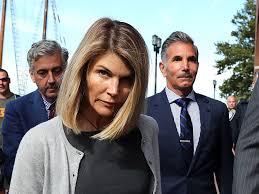
    Lori Loughlin will serve her full two months in prison, unless there’s a coronavirus outbreak. The ‘Full House’ star will be isolated for her first two weeks at Dublin Federal Prison in Northern California before joining the prison for the remainder of her sentence, with unlikely chance of her sentence being shortened. However, it may be possible that if there is an outbreak of COVID-19 that she will serve the rest of her sentence elsewhere, TMZ reports.

    As well as serving two months in jail, Lori was also asked to pay $150,000 fine and complete 150 hours of community service for her part in the exams scandal. The 56-year-old actress originally pleaded not guilty to conspiracy to commit bribery, but she subsequently decided to take a plea deal. Mossimo Giannulli – Lori’s husband, with whom she has Olivia, 21, and Isabella, 22 – has also received five months in jail, as well as a $250,000 fine and 250 hours of service for his part in the controversy.

  • Indian Americans believe Joe Biden, Kamala Harris have best Understanding of Community

    Indian Americans believe Joe Biden, Kamala Harris have best Understanding of Community


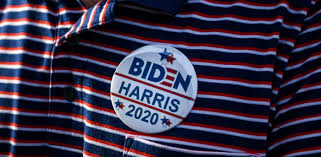
    WASHINGTON (TIP): Joe Biden and his running mate Senator Kamala Harris have the best understanding of the Indian-American community, the leaders supporting the two Democratic candidates have said, describing US President Donald Trump as a “foe” who criticizes India on the world stage.

    With less than four  to go for the November 3 presidential election, Indian Americans on Friday asserted that Biden, first as a US Senator and thereafter as the vice president, has a strong track record of helping the community.

    Trump, a Republican, is being challenged by Biden in the US presidential election.

    “After four years of the Trump administration, we know our children and grandchildren will not have the same opportunities as we had. We need a leader who understands our community, our values, our pride and appreciates our hard work and gives equal opportunity and say in his administration,” said Ajay Jain Bhutoria, a Silicon Valley-based entrepreneur.

    Mr Bhutoria said that Biden and Harris are the leaders who will lead the country out of this mess and restore its soul, revive the middle-class economy and re-establish America’s leadership on the world stage and best relationship with India.

    Referring to the final presidential debate between Trump and Biden on Friday, Mr Bhutoria said that the president criticized India on the world stage. “The community understands who the real friend of India is, who the foe. Trump is a foe. Most recently on the debate stage saying- you cannot trust India’s COVID-19 numbers and India is filthy. He has suspended the H1 Visa Programme, put trade deals with India in jeopardy, and has used (Indian Prime Minister Narendra) Modi’s friendship for photo opportunities only,” he alleged.

    During the final presidential debate, Trump accused China, India and Russia of not taking care of their “filthy air” as he justified America’s withdrawal from the landmark Paris climate agreement.

    “Biden celebrated Diwali with (former) President Obama in the White House and at his residence. The former vice president has a deep connection with Indo-American community and India. Biden understands the values of Indo Americans. In his recent Op-ed he shares how he felt deeply connected to the Indian community and the values of the Indian community,” he said.

    Indian-Americans share deep connections with Biden and Kamala Harris, he said. According to a recent survey, 80 per cent of Indian-American community is strongly behind Biden and Harris.

    “Indo Americans understand that the way they share their values with Biden and Harris, (they) think that (US President Donald) Trump does not share their values and has failed and is leading America on the wrong path,” Mr Bhutoria said.

    California State Assembly member Ash Kalra said that he has known Senator Harris and her sister Maya for over two decades.

    “Kamala’s pride of her Indian heritage runs as deep as her love for her late mother, Shyamala Gopalan Harris. Kamala speaks fondly of her trips to India as a child and connects many of the ideals she fights for as an elected leader to the Indian values of her upbringing,” he said.

    “With Joe Biden, a leader who during the course of his long career has proven his deep understanding of the needs of the Indian community, Kamala Harris will reaffirm the commitment our future president will have to our needs. The entire Indian community will be well represented with her as our next vice president,” Kalra said.
    Aditi Pal with Desi Blue said that the community has always known Biden as a friend of India.

    “Seven years ago, as vice president, he told business leaders in Mumbai that the US-India partnership was the defining relationship of the 21st Century. As a Senator, he was instrumental in the passing of India’s Civil Nuclear Deal. And it was during Obama-Biden administration that the two countries saw their best years for the Indo-US relationship. Joe’s choice of Kamala Harris also gave us immigrants from India a sense of pride,” she said.

    “Joel’s humility & inclusiveness is evident when he tells immigrants ”thank you for choosing America”,” she added.

    According to Ashok Bhatt, businessman and former California Water commissioner, Obama-Biden administration Democrats gave India priority. When Narendra Modi became Prime Minister, Obama-Biden welcomed him and opened up economic areas and visas to students and tourists. H1 visas became so liberal and India benefitted the most from it.

    “I believe the Biden-Kamala team will be great for Indo-American relationships and the economy of both countries will be flourishing,” Mr Bhatt said.

    Biden is deeply connected to the Indian American community. As vice president, Biden strengthened relations with India and Indian Americans, said Neha Dewan from South Asians for Biden.

    “The Obama-Biden administration appointed Indian Americans to serve in high level cabinet and ambassador positions, and as judges. Biden has consistently recognized Indian Americans,” she said.

  • U.S. coronavirus cases cross nine million: a Reuters report says

    U.S. coronavirus cases cross nine million: a Reuters report says

    NEW YORK (TIP): U.S. coronavirus cases crossed the 9 million mark on Friday, October 30, rising by 1 million in two weeks as the world’s worst-affected country faces a resurgence in the pandemic just ahead of elections, Reuters says.

    Cases are rising faster than ever before. The previous record for 1 million new cases was during a surge in infection in July and August – when it took 16 days. Now the country has recorded over 1 million cases in 14 days with no sign of the outbreak slowing.On Thursday, October 30, the United States reported a record 91,254 new cases. On average, over 77,000 cases are being reported every day in the last seven days, double the level seen two months ago. Hospitalizations of COVID-19 patients are hitting records in 21 out of 50 states. Deaths are also trending higher and have reached nearly 230,000.For every 10,000 people in the United States, over 272 coronavirus cases have been reported and about seven people have died, according to a Reuters analysis. In Europe there have been 127 cases and four deaths per 10,000 residents. Texas has surpassed California as the worst-affected state in the United States, with Florida in third place. More than a half million lives could be lost to COVID-19 across the United States by the end of February, according to researchers at the University of Washington’s Institute for Health Metrics and Evaluation (IHME).U.S. President Donald Trump, who is seeking a second term  has been saying for weeks that the country is “rounding the turn,” even as new cases and hospitalizations soar.The United States performed 7.7 million coronavirus tests last week, of which 6.3% came back positive, compared with 5.4% the prior week, according to data from The COVID Tracking Project, a volunteer-run effort to track the outbreak. South Dakota led the nation with the highest positive test rate at 40%, followed by Idaho at 34% and Wyoming at 29%. A total of 14 states had a positive test rate of over 10%.

    According to a Reuters analysis, the South region comprises nearly 44% of all the cases in the United States, with nearly 4 million cases in the region alone, followed by the Midwest, West and Northeast.

    (Source: Reuters)

  • The Global Beat Foundation of USA organized online discussion on the  impact of US Presidential elections on South Asian communities

    Dr. Zafar Iqbal in Washington

    WASHINGTON (TIP): The Global Beat Foundation of USA (TGBF) organized an online discussion on US Presidential elections on 18th October 2020.  Using Zoom technology and Facebook, the overall discussion centered on the possible impact of the election on South Asian communities in the US and in South-Asia. The overall impression of the panelists comprising South Asian scholars, social activists, and journalists was that in Pakistan national politics seems to have pushed US elections out of focus while in India President Trump dominates the narrative as PM Modi’s friend. The participants at this debate also noted most Americans were not even discussing foreign policy issues this election season.  John Lennon, a veteran Journalist with vast experience as an international reporter at the Voice of America, observed that the Presidential election 2020 is the most contentious election in his adult life. He apprised the audience of the prevailing issues facing the nation and their possible impact on the election. He mentioned the enhanced racial tensions, concerns related to surging COVID-19 infection due to the lack of comprehensive policies of the administration, increasing unemployment and its influence on economic problems, etc. Currently, there are more than 60 million people are unemployed, he said.

    Saima Iqbal, a former BBC journalist, who now works for a French media outlet in New Delhi, said that the Indian media are currently centered around PM Modi’s ideology. “The coverage of the US election in India is influenced by Modi’s friendship with President Trump and the media continues to talk about “marrying of thoughts between Trump and Modi,” she added. The Indians, however, did take notice of Kamala Harris’s nomination because her mother was an Indian but quickly moved back to the Trump-Modi friendship, she added.

    Farrukh Pitafi, journalist, analyst, and talk show host Pakistan Television in Islamabad observed that initially the US election generated some interest in Pakistan but as “our politics heated up, the focus moved almost entirely to national politics. Most Pakistanis believed that both Trump and his Democratic rival Joe Biden had similar views on Pakistan, and so “whoever comes to power, things are going to remain the same,” he added.

    Misbah Azam, a Pakistani American scholar and  Talk4Pak news show host from San Jose, California, opined that the main difference between President Trump and Vice President Biden is that Trump likes to continue his “America First” policy, while Biden would be more inclined towards re-forming the US leadership role in the world which the US is losing during Trump presidency.

    Meriam Sabih, a Pakistani American journalist and public speaker, Philadelphia, said that a Biden-Harris White House would be more interested in strengthening democracy in Pakistan while “a Trump presidency would be more careless on this issue.”  She urged Pakistani Americans to focus more on our local issues here and not to oppose Kamala Harris just because she was an Indian.

    Fareeha Rehman, Digital editor working for a US news channel, was excited by the inclusion of a South Asian woman in this election. “A lot of South Asians are enthusiastic about someone from their own community,” she said.

    Anwar Iqbal, a veteran journalist, and correspondent, Daily Dawn was the MC, and Nadeem Hotiana, former Minister Press and Information, Embassy of Pakistan moderated the discussion. Raza Rumi of Ithaca College, Cornell University, New York gave concluding remarks.

  • Indian American Committee IMPACT raises $10 million war chest for Indian American candidates

    Indian American Committee IMPACT raises $10 million war chest for Indian American candidates

    NEW YORK (TIP): IMPACT, the leading Indian American advocacy and political action committee, has raised a $10 million war chest to get Indian origin candidates including Kamala Harris, the first Indian American on a national ticket, and Joe Biden, elected. Raised in just three months, the funds will be spent to support turnout efforts in the Asian American and Indian American community and to elect IMPACT’s 2020 slate of candidates, as well as Indian American candidates running up and down ballots in states across the country.
    Besides the Democratic presidential ticket of Biden and Harris, the slate includes six candidates for the US House and 16 candidates for Statewide and local offices: seven for State Senates, Five for State Houses and four others.
    “IMPACT’s fundraising strength reflects trends we’re seeing across the country,” IMPACT Executive Director Neil Makhija, said Monday, October 19, announcing the organization’s groundbreaking effort.
    “There’s a level of enthusiasm and excitement about this year’s election among Indian American voters that is palpable, and unrivaled in previous cycles,” he said.
    “With an Indian American on the presidential ticket for the first time in history, and a record number of Indian American candidates running for office, Indian American voters are poised to exert a considerable amount of influence in this year’s election, and IMPACT will help mobilize and harness this emerging power.”
    IMPACT said it will invest in the presidential, state-wide, and congressional races in battleground states across the country. Investments include committee contributions, paid advertising, targeted turnout operations, and infrastructure building.
    This groundbreaking investment comes at a time when Indian Americans — the second largest immigrant group in the US — are beginning to flex their political muscle on the national political stage, it said.
    In addition to an Indian American being a historic Democratic nominee for Vice President, the number of Indian Americans in Congress has grown five-fold in just the past eight years and the campaign arm charged with electing Democrats to Congress released its first-ever Hindi-language political ad earlier this year, it noted.
    All of these developments have come less than 75 years since South Asians began emigrating to the US, and 55 years after the Immigration and Nationality Act of 1965, which ended discriminatory quotas and opened the doors to Asian immigrants, IMPACT said.
    Besides four sitting members of US Congress — Ami Bera (California), Ro Khanna (California), Pramila Jayapal (Washington), Raja Krishnamoorthi (Illinois) — Impact is backing two more, Sri Kulkarni (Texas), and Hiral Tipirneni (Arizona) for the US House.
    Seven State Senate candidates backed by IMPACT are: Sara Gideon (Maine), Jay Chaudhuri (North Carolina), Jeremy Cooney (New York), Kevin Thomas (New York), Rupande Mehta (New Jersey), Kesha Ram (Vermont), and Nikil Saval (Pennsylvania).
    Five candidates for State Houses are: Nima Kulkarni (Kentucky) Padma Kuppa (Michigan), Jennifer Rajkumar (New York), Amish Shah (Arizona), and Vandana Slatter (Washington).
    Impact is also backing Nina Ahmad (Pennsylvania Auditor General), Ronnie Chatterji (North Carolina Treasurer), Pavan Parikh (Ohio Hamilton County Court of Common Pleas) and Ravi Sandill (Texas District Judge).


  • Indian American Couple Convicted for Forced Labor

    Indian American Couple Convicted for Forced Labor

    Parminder Aujla

    SACRAMENTO (TIP): An Indian American woman from California has been sentenced to 15 years in prison for forced labor violations.

    Sharmistha Barai and her husband Satish Kartan were found guilty of conspiracy to obtain forced labor and two counts of obtaining forced labor by a federal jury on March 14, 2019, after an 11-day trial.

    Kartan will be sentenced on October 22.

    “The United States abolished slavery and involuntary servitude more than 150 years ago. Yet, inhuman forced labor and deprivations of liberty and dignity persist because human traffickers are modern-day slave masters who endeavor to exploit their fellow human beings for profit and other gruesome purposes,” said Assistant Attorney General Eric Dreiband.

    The Indian American couple compelled the victims into servitude for up to 18 hours a day, with minimal pay, through intimidation, threats and violence, he said, adding this is an unconscionable violation of the victims’ individual rights, freedom and dignity.

    According to court documents and evidence presented at trial, between February 2014 and October 2016, Kartan and Barai hired workers from overseas to perform domestic labor in their home in Stockton, California.

    In advertisements seeking workers on the internet and India-based newspapers, they made false claims about the wages and conditions of employment.

    Once the workers arrived at their residence, Kartan and Barai compelled them to work up to 18 hours a day with limited rest and nourishment, federal prosecutors alleged.

    Few of them were paid any wages. The couple kept the domestic workers from leaving and coerced them to continue working by threatening them, by creating an atmosphere of fear, control, and disempowerment, and at times by physically hitting or burning them.

    “When a victim resisted or expressed a desire to leave, the threats and abuse became worse,” the Department of Justice added.

  • Indian Origin Sikh Man Dies Trying to Rescue 3 Children from Drowning

    Indian Origin Sikh Man Dies Trying to Rescue 3 Children from Drowning

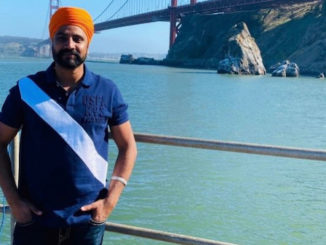
    CALIFORNIA (TIP): A 29-year-old Sikh man died after he jumped into a river to rescue three children who were swept away in the US state of California, according to media reports.

    The man, identified as Manjeet Singh, was visiting Reedley Beach on Wednesday evening near his home in Fresno County when he saw the three children struggling in the Kings River, the media reported on Friday.

    Two eight-year-old girls and a 10-year-old boy were playing in the river when they were pulled under a bridge by the current, CNN quoted Reedley Police Department commander Mark Ediger as saying.

    Manjeet Singh, who was at the river with his brother-in-law and other friends, removed his turban and attempted to use it as a rope to pull the children in but was quickly pulled under himself.

    “He went in to try and help them and unfortunately, went underwater fairly quickly and never came back up,” said Reedley police commander Marc Ediger.

    Manjeet Singh was found unresponsive 40 minutes later, downriver. He was taken to a hospital, where he was pronounced dead.

    Other bystanders were able to pull two of the children out to safety. One of the eight-year-old girls was underwater for about 15 minutes before she was pulled out, Ediger said. She was taken to Valley Children’s Hospital in Fresno and as of Friday afternoon remained in critical condition and on life support.

    Singh moved to California from India two years ago. He had plans to start a trucking business and had been taking truck-driving lessons on Wednesday before visiting the river.

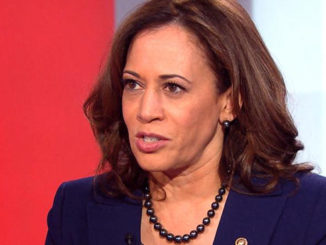
  • KAMALA HARRIS COULD WIN THE DEMOCRATIC PARTY’S NOMINATION FOR PRESIDENT IN JULY 2020

    KAMALA HARRIS COULD WIN THE DEMOCRATIC PARTY’S NOMINATION FOR PRESIDENT IN JULY 2020

    By   Ven Parameswaran

    Before the debate Kamala Harris had the name recognition problem.  Vice President Biden was well known and was enjoying a commanding lead in the polls.  Kamala Harris had to formulate strategy to become most competitive.  She knew the power and influence of the national TV audience could make a difference.  Therefore, she came to the debate very well prepared.

    Born to her mother from Chennai, India and father from Jamaica, both Ph.D.’s, Kamala Harris is a smart student and had accumulated political skills by serving as San Francisco’s District Attorney and California’s Attorney General, before she was elected U.S. Senator, first for Indian American.

    Kamala Harris knew that unless she is most competitive with Biden and Sanders, she had no chance to emerge out of 20 candidates.  Thus, she applied the principle: WHO INFUENCES WHOM WHEN WHERE AND HOW IS THE ESSENCE OF POLITICS.

    She was well aware that the national debate would draw a large audience and if she makes a difference she could break out.  She turned out to be right.  The second debate drew an audience of 18 million people against 24 million for first Trump debate.

    She knew that once she impresses such a large audience, political equilibrium and polls would change.  She was right.  How did she do it? What was her strategy?

    NBC had several anchors, who were not well organized.  The debate was not well programmed.  Different anchors were asking questions after questions giving very little time for the candidate to answer.  As a result, the competition to be heard was stiff.  It was not easy to break in especially when several were attempting to speak.  There was total confusion and no order.  This is where Kamala Harris emerged as a big winner.  Her tactics and strategy succeeded.

    Kamala Harris was bent upon taking the big elephant Biden blocking her march to the convention.

    Gentlemen, you can’t fight here, this is the debate stage!  Senator Kamala Harris’s first attempt at a breakout moment in this debate was a painfully rehearsed line designed to be dropped the minute there was some crosstalk she could break into:

    “Hey guys, America does not want to witness a food fight.  They want us to know how we are going to put food on their table.”

    It won immediate applause, sustained applause, undermining their party’s political well-being.  This is a debate.  Everyone on stage is supposed to be making a case for why they should be president, which when facing other candidates in an election, is traditionally done by drawing distinctions between yourself and your opponents.

    More broadly, the line speaks to the self-defeating tendency of Democrats to imagine that their own affinity for compromise reflects the median voter’s preference for conciliatory politics.  People say they have partisan conflict, yes—but they vote for people who draw sharp distinctions between themselves and their (negatively defined)opponents.   It was a good line for Harris in the moment, but it was a cynical line masquerading as a plea for unity. 

    Kamala Harris ( extreme right) gives Joe Biden (extreme left) the punch in the debate. Seen in the center is Bernie Sanders.
    CNN Screenshot

    “I believe you are not a racist.  It was hurtful to hear you talk about the reputations of two U.S. Senators who built their reputations and career on segregation of race in this country.  And it was not only that, but you also worked with them to oppose bussing.  And you know, there was a little girl in California who was part of the Second Class to integrate her public schools and she was bussed to school every day and that little girl was me.”

    Almost immediately after she punched Biden, a video of Kamala Harris as a child dressed for school was circulated in the social media.

    Biden was flustered, caught off-guard by this unexpected expression of lived experience.  Biden was not just criticized for his nostalgia play.  He was confronted with the fact that his efforts as a young senator would have ended one of the country’s few attempts to make equal treatment a reality, to give black students the kind of education that white students took for granted .  And while it is tempting to portray this as ancient history, it is not.  Harris was born in 1964, just three months after President Johnson signed the Civil Rights Bill.  Biden joined the Senate in 1973.  It was 1977 when Biden introduced Bill that would, in his words, “strike at the injustice of court-ordered busing.”

    A string of recent polls suggest that Kamala Harris’s performance in the debate last week has propelled her campaign for the Democratic presidential nomination in July 2020.    A Quinnipiac University poll of Democrats and Democratic leaning voters nationally showed Kamala Harris, whose criticism of Biden’s record on race was one of the most discussed moments of the second debate last week, gaining significant momentum in the campaign.

    KAMALA HARRIS POLLS AT 20% IN THE QUINNIPIAC POLL, TRAILING FRONT RUNNING BIDEN BY JUST 2 POINTS.

    Other polls also show strong support for the California Democrat.  A Suffolk University/USA Today poll of likely Iowa Democratic caucus goers also showed her in second place to Biden.  The former Vice President led that poll with 24% of respondents saying they support him, and 15.6% reported favoring Harris.

    In a poll of Democrats and Democratic leaning independents conducted by CNN and SSRS in the days after the debate, 17% of respondents said they supported Harris, again placing her in second place to Biden.  That represented a jump from 8% from the month before.

    After the second debate, it is clear that both Biden and Sanders have lost their momentum to the women candidates, Kamala Harris and Elizabeth Warren.   56% of the primary voters are women.  If so, it is possible that the voters may prefer to elect a woman.

    ROADMAP TO NOMINATION

    I list below the number of delegates from early States till March 3, 2020:  Iowa 49; New Hampshire 33; Nevada 48; S.C. 63 – total of 193.   CA 495; Texas 262; NY 270, MA 114, IL 184, FL 248, MI 147.  Before March 3, we would have elected 193. By the end of March, two thirds of all delegates would have been elected.

    Therefore, if Kamala Harris does reasonably well in Iowa, NH, S.C. and Nevada, she would become the front runner on March 3 after the primaries because CA has 495 delegates.  Right now, the wind in California is blowing in her favor.  Biden has lost his territory big.

    Kamala Harris has already tested the national waters thru her first debate.  It is easier for her to challenge her competitors Biden, Sanders, and Elizabeth Warren in the second and future debates.  Kamala Harris is continuing to receive wide media coverage.

    STRATEGIC SKILLS AND ABILITY TO CHALLENGE THE OPPONENT IN THE GENERAL ELECTION WILL BE THE DECIDING FACTOR FOR SELECTING THE NOMINEE.    Based on Kamala Harris’ performance and her competitiveness, there is no doubt in my mind that she will be able to convince the delegates at the nominating convention that she is second to none.  Patrick Buchanan, political pundit and the former Speaker, Newt Gingrich have also said that Kamala Harris is likely to be the candidate.

    Winning the nomination is one thing.  Can Kamala Harris challenge President Trump in the General Election in November 2020?  Will she able to draw working class white votes from the rust belt states of PA, WI, OH, MI?  Will the moderate and conservative White women vote for her?  Will she compromise too much with the extreme left to get the nomination but only to lose in the general election?   Can she suggest a workable bipartisan solution to the Immigration problem?  These questions cannot be answered now until the political process takes place.

    If Kamala Harris clinches the nomination for the President from the Democratic Party, it would be a great achievement for her,  and the Indian Americans will be proud.

    (The author is MBA, Columbia School of Business and Chairman, Asian American Republican Committee. He can be reached at vpwaren@gmail.com)