BERKELEY, CALIF (TIP): A 21st-birthday party thrown by a group of visiting Irish college students turned tragic early June 15 when the fifth-floor balcony they were crammed onto collapsed with a sharp crack, spilling them about 50 feet onto the pavement. Six people were killed and seven seriously injured.
Police and fire and building officials were working to figure out why the small balcony broke loose from the side of the stucco apartment house a couple of blocks from the campus of the University of California, Berkeley. But one structural engineer said it may have been overloaded if, as city officials said, it was holding 13 people.
High school student Jason Biswas’ family nearby was awakened by the noise.
“They thought there was an earthquake, but then we looked out the window and saw seven or eight people on the ground,” the 16-year-old said. “There were piles of blood everywhere.”
Five of the dead were 21-year-olds from Ireland who were in the country on so-called J-1 visas that enable young people to work and travel in the U.S. over the summer, while the sixth victim was from California, authorities said.
The news brought an outpouring of grief in Ireland from the prime minister on down, with the country’s consul general in San Francisco calling it a “national tragedy.”
Police had gotten a complaint about a loud party in the apartment about an hour before the accident but had not yet arrived when the balcony gave way just after 12:30 a.m., spokesman Byron White said.
“I just heard a bang and a lot of shouting,” said Dan Sullivan, a 21-year-old student from Ireland who was asleep in the five-story building. Mark Neville, another Irish student in the building, said: “I walked out and I saw rubble on the street and a bunch of Irish students crying.”
The U.S. government’s J-1 program brings 100,000 college students to this country every year, many of them landing jobs at resorts, summer camps and other attractions. The San Francisco Bay area is especially popular with Irish students, about 700 of whom are working and playing in the region this summer, according to Ireland’s Consul General Philip Grant. Many work at Fisherman’s Wharf and other tourist sites.
Sinead Loftus, 21, who attends Trinity College Dublin and is living this summer in a different apartment in Berkeley, said Berkeley is “the Irish hub.” In fact, she said, “I’ve heard people complain there are too many people from Ireland here.”
“It’s student-friendly, it’s warm and it’s a lot cheaper than San Francisco,” she said.
Berkeley Police Chief Michael Neeham said the response to the noise complaint had been given a lower priority after police received a call of shots fired elsewhere.
Police arrived to find the metal-rail balcony had fallen off the side of the building and landed on the fourth-floor balcony beneath it. The pavement was strewn with rubble and the red plastic cups that are standard at practically every college party.
Investigators will probably look at such things as whether the balcony was built to code, whether it was overloaded and whether rain or other weather weakened it, said Kevin Moore, a San Francisco-based engineer and chairman of the structural standards committee of the Structural Engineers Association of California.
Berkeley officials said the building code would have required the balcony to hold at least 60 pounds per square foot. Its exact dimensions were not released, but Grace Kang, a structural engineer and spokeswoman for Pacific Earthquake Engineering Research Center at Berkeley, said it looked to her to be 4 by 6 feet, or 24 square feet. That would mean it was supposed to hold at least 1,440 pounds.
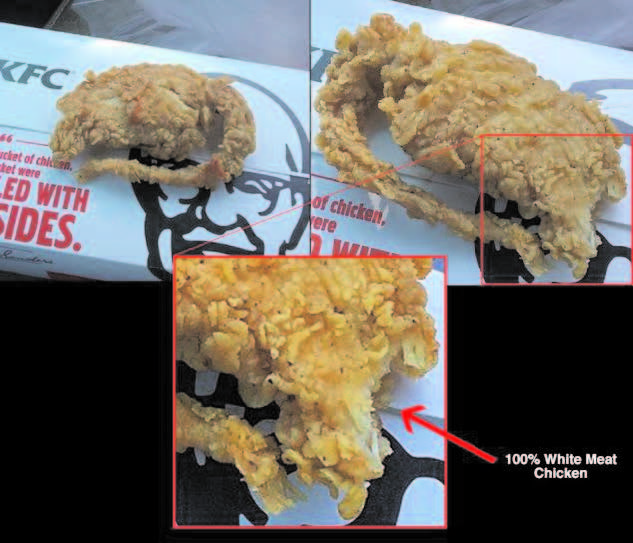
CALIFORNIA (TIP): When most of us share a photo of our dinner on Facebook, it’s usually to show off how delicious it looks – not because it resembles mistakenly deep-fried vermin.
But that’s exactly why a photo taken by a KFC customer in California has gone viral, after he claimed he found a rat in his meal at the fast-food restaurant.
Former Child Development and Education student Devorise Dixon shared an image online of what appeared to be a rodent, complete with a long tail, rotund belly, and pointy face.
Dixon warned his Facebook friends not to eat at KFC, and claimed that the manager had apologised and said it was a rat.
“It’s time for a lawyer,” he wrote, adding: “Be safe don’t eat fast food!!!”
Describing the moment he began eating what he believes was a rat, he wrote on Facebook: “As I bit into it I noticed that it was very hard and rubbery which made me look at it.
“As I looked down at it I noticed that it was was in a shape of a rat with a tail,” he said.
Dixon also shared a video of the ‘rat’ in an attempt to prove the original photo wasn’t tampered with.
However, KFC are skeptical and said in a statement on social media that Dixon has not responded to their attempts to contact him.
The fast food giant said in a statement seen by Yahoo News: “KFC has made various attempts to contact this customer, but he is refusing to talk to us directly or through an attorney.
“Our chicken tenders often vary in size and shape, and we currently have no evidence to support this allegation. We have extended the opportunity to have an independent lab evaluate the product at our own expense, but the customer refuses to provide the product in question.”
KFC bosses told the Mirror that an investigation found no evidence to support this claim, however they did not confirm what the food was made of.
Three Indian Americans are among the national finalists for the 2015-16 White House Fellowship that offers exceptional Americans first-hand experience working at the highest levels of the federal government.
Luxme Hariharan, Payal Patel and Anil Yallapragada are among those representing “an accomplished and diverse cross-section of professionals from the private sector, academia, medicine, and armed services”.
The national finalists, selected through a highly competitive selection process, will be evaluated by the President’s Commission on White House Fellowships in Washington from June 11-14, according to a statement.
Luxme Hariharan is a pediatric cataract, glaucoma, cornea and international health fellow, at the Children’s Hospital of Los Angeles, University of Southern California Eye Institute.
Payal Patel is infectious diseases fellow, Beth Israel Deaconess Medical Center, Harvard Medical School, in Houston.
Anil Yallapragada is Medical Director, South Carolina Stroke Institute, Grand Strand Medical Centre.
There are more than 700 White House Fellow alumni, a distinguished group that includes former secretary of state Colin Powell, CNN chief medical correspondent Sanjay Gupta, and Pulitzer Prize-winning author and historian Doris Kearns Goodwin.
The US Department of Labor has opened up an investigation against TCS and Infosys for possible violations of H-1B visa rules, indicating that there could be tougher regulations ahead for onsite workers.
As the campaigning for the 2016 US Presidential elections starts to gain steam, Indian outsourcers find themselves in the midst of yet another storm.
In the latest round, the Labor Department is investigating possible violations of rules for visas for foreign technology workers contracted with Southern California Edison, an electric utility company.
Senators Richard Durbin of Illinois and Jeff Sessions of Alabama announced the investigation after they were notified by the Department, according to reports.
SACRAMENTO (TIP): Drought-stricken California has ordered the largest cuts on record to farmers holding some of the state’s strongest water rights.
State water officials yesterday told more than a hundred senior rights holders in California’s Sacramento, San Joaquin and delta watersheds to stop pumping from those waterways.
The move by the State Water Resources Control Board marked the first time that the state has forced large numbers of holders of senior-water rights to curtail use. Those rights holders include water districts that serve thousands of farmers and others.
The move shows California is sparing fewer and fewer users in the push to cut back on water using during the state’s four-year drought.
“We are now at the point where demand in our system is outstripping supply for even the most senior water rights holders,” said Caren Trgovcich, chief deputy director of the water board.
The order applies to farmers and others whose rights to water were staked more than a century ago. Many farmers holding those senior-water rights contend the state has no authority to order cuts.
The reductions are enforced largely on an honour system because there are few meters and sensors in place to monitor consumption.
California already has ordered cuts in water use by cities and towns and by many other farmers.
The move yesterday marked the first significant mandatory cuts because of drought for senior water rights holders since the last major drought in the late 1970s.
One group of farmers with prized claims have made a deal with the state to voluntarily cut water use by 25 per cent to be spared deep mandatory cuts in the future.
The San Joaquin River watershed runs from the Sierra Nevada to San Francisco Bay and is a key water source for farms and communities.
WASHINGTON (TIP): US secretary of defense Ashton Carter has called on Beijing to stop building artificial islands in the disputed waters of the South China Sea, as he hosted a top Chinese general.
The visit to the Pentagon of General Fan Changlong, vice chairman of China’s central military commission, was relatively low key amid simmering tensions over the maritime dispute and a massive hack of US federal employees.
China insists it has sovereignty over nearly all of the South China Sea, a major global shipping route believed to be home to oil and gas reserves, but rival claimants accuse it of expansionism.
“Carter reiterated US concerns on the South China Sea and called on China and all claimants to implement a lasting halt on land reclamation, cease further militarization and pursue a peaceful resolution of territorial disputes in accordance with international law,” the Pentagon said in a statement.
Carter had previously accused China of being out of step with international rules in its conduct in the South China Sea.
Unlike previous trips, including one last year, there was no joint press conference.
“The Chinese did request that there not be a lot of media attention around this trip,” Pentagon spokesman Colonel Steven Warren said.
Also raising tensions is this month’s revelation by the US government that hackers accessed the personal data of at least four million current and former federal employees.
The vast cyberattack is suspected to have originated in China, though Beijing has said the charge was
“irresponsible” and stressed that Chinese laws prohibit cybercrimes.
Prior to visiting Washington, Fan went to California and Texas.
His trip is part of a years-long effort to build a regular dialogue between the American and Chinese armed forces to defuse potential tensions and avoid miscalculations.
Carter’s predecessor, Chuck Hagel, visited China in 2014 in a trip that was marked by friction, with each side trading sharply worded criticism.
Thank you for allowing me to share this evening with you. I’m delighted to meet these exceptional journalists whose achievements you honor with the Helen Bernstein Book Award.
What happens to a society fed a diet of rushed, re-purposed, thinly reported “content?” Or “branded content” that is really merchandising — propaganda — posing as journalism? But I gulped when [New York Public Library President] Tony Marx asked me to talk about the challenges facing journalism today and gave me 10 to 15 minutes to do so. I seriously thought of taking a powder. Those challenges to journalism are so well identified, so mournfully lamented, and so passionately debated that I wonder if the subject isn’t exhausted. Or if we aren’t exhausted from hearing about it. I wouldn’t presume to speak for journalism or for other journalists or for any journalist except myself. Ted Gup, who teaches journalism at Emerson and Boston College, once bemoaned the tendency to lump all of us under the term “media.” As if everyone with a pen, a microphone, a camera (today, a laptop or smartphone) – or just a loud voice – were all one and the same. I consider myself a journalist. But so does James O’Keefe. Matt Drudge is not E.J. Dionne. The National Review is not The Guardian, or Reuters The Huffington Post. Ann Coulter doesn’t speak for Katrina Vanden Heuvel, or Rush Limbaugh for Ira Glass. Yet we are all “media” and as Ted Gup says, “the media” speaks for us all.
So I was just about to email Tony to say, “Sorry, you don’t want someone from the Jurassic era to talk about what’s happening to journalism in the digital era,” when I remembered one of my favorite stories about the late humorist Robert Benchley. He arrived for his final exam in international law at Harvard to find that the test consisted of one instruction: “Discuss the international fisheries problem in respect to hatcheries protocol and dragnet and procedure as it affects (a) the point of view of the United States and (b) the point of view of Great Britain.” Benchley was desperate but he was also honest, and he wrote: “I know nothing about the point of view of Great Britain in the arbitration of the international fisheries problem, and nothing about the point of view of the United States. I shall therefore discuss the question from the point of view of the fish.”
So shall I, briefly. One small fish in the vast ocean of media.
I look at your honorees this evening and realize they have already won one of the biggest prizes in journalism — support from venerable institutions: The New Yorker, The New York Times, NPR, The Wall Street Journal and The Christian Science Monitor. These esteemed news organizations paid — yes, you heard me, paid — them to report and to report painstakingly, intrepidly, often at great risk. Your honorees then took time — money buys time, perhaps its most valuable purchase — to craft the exquisite writing that transports us, their readers, to distant places – China, Afghanistan, the Great Barrier Reef, even that murky hotbed of conspiracy and secession known as Texas.
And after we read these stories, when we put down our Kindles and iPads, or — what’s that other device called? Oh yes – when we put down our books – we emerge with a different take on a slice of reality, a more precise insight into some of the forces changing our world.
Although they were indeed paid for their work, I’m sure that’s not what drove them to spend months based in Beijing, Kabul and Dallas. Their passion was to go find the story, dig up the facts and follow the trail around every bend in the road until they had the evidence. But to do this — to find what’s been overlooked, or forgotten, or hidden; to put their skill and talent and curiosity to work on behalf of their readers — us — they needed funding. It’s an old story: When our oldest son turned 16 he asked for a raise in his allowance, I said: “Don’t you know there are some things more important than money?” And he answered: “Sure, Dad, but it takes money to date them.” Democracy needs journalists, but it takes money to support them. Yet if present trends continue, Elizabeth Kolbert may well have to update her book with a new chapter on how the dinosaurs of journalism went extinct in the Great Age of Disruption.
You may have read that two Pulitzer Prize winners this year had already left the profession by the time the prize was announced. One had investigated corruption in a tiny, cash-strapped school district for The Daily Breeze of Torrance, California. His story led to changes in California state law. He left journalism for a public relations job that would make it easier to pay his rent. The other helped document domestic violence in South Carolina, which forced the issue onto the state legislative agenda. She left the Charleston Post and Courier for PR, too.
These are but two of thousands. And we are left to wonder what will happen when the old business models no longer support reporters at local news outlets? There’s an ecosystem out there and if the smaller fish die out, eventually the bigger fish will be malnourished, too.
A few examples: The New York Times reporter who rattled the city this month with her report on the awful conditions for nail salon workers was given a month just to see whether it was a story, and a year to conduct her investigation. Money bought time. She began, with the help of six translators, by reading several years of back issues of the foreign language press in this country… and began to understand the scope of the problem. She took up her reporting from there. Big fish, like The New York Times, can amplify the work of the foreign language press and wake the rest of us up.
A free press, you see, doesn’t operate for free at all. Fearless journalism requires a steady stream of independent income. It was the publisher of the Bergen Record, a family-owned paper in New Jersey who got a call from an acquaintance about an unusual traffic jam on the George Washington Bridge. The editor assigned their traffic reporter to investigate. (Can you believe? They had a traffic reporter!) The reporter who covered the Port Authority for the Record joined in and discovered a staggering abuse of power by Governor Chris Christie’s minions. WNYC Radio picked up the story and doggedly stuck to it, helped give it a larger audience and broadened its scope to a pattern of political malfeasance that resulted in high-profile resignations and criminal investigations into the Port Authority. Quite a one-two punch: WNYC won a Peabody Award, the Record won a Polk.
A Boston Phoenix reporter broke the story about sexual abuse within the city’s Catholic Church nine months before the Boston Globe picked up the thread. The Globe intensified the reporting and gave the story national and international reach. The Boston Phoenix, alas, died from financial malnutrition in 2013 after 47 years in business.
NEW YORK (TIP): A U.S.-based Sikh advocacy group has filed suit against Facebook, accusing the social media giant of blocking access to its Facebook page in India and raising concerns over the company’s censorship policies.
Sikhs for Justice (SFJ), a non-profit organization with offices in New York City that advocates for issues important to members of the Sikh religious tradition, filed suit in California federal court this week requesting that a judge force Facebook to stop blocking its website in India and release all its communications with national Indian officials. The complaint alleges that the company illegally restricted access to SFJ’s page, presumably at the request of the Indian government, who disagrees with the group’s controversial activism. Among other things, the website criticized Indian Prime Minister Narendra Modi and campaigned against “forced conversions of Christians and Muslims to Hinduism,” an unsettling practice that has been reported to occur throughout India at the hands of Hindu nationalists.
“In or around the first week of May 1, 2015, the plaintiff learnt the contents of the Plaintiff’s Facebook Page … were blocked completely in India without notice, reason, explanation, or proper and lawful cause,” the complaint, which was provided to Think Progress, read. The group’s lawyer reportedly sent Facebook a cease and desist letter asking for access to the be restored, but only received an automated response.
“Blocking of SFJ’s page for exposing India with regard to the plight of religious minorities and advocating Sikh referendum in Punjab, Facebook Inc. violates section 2000a of 42 U.S. Code which prohibits discrimination on the grounds of religion, race or national origin,” the complaint argued.
The lawsuit, which also sought compensatory and punitive damages, is unusual in that it challenges Facebook here in the United States, where free speech laws are well protected. But the digital juggernaut has long endured harsh criticism for helping foreign governments silence free expression. Free speech advocates have blasted Facebook for banning the pages of political rock bands in Pakistan at the urging of government censors, and opposition leaders in Russia lashed out at the company after it removed a website dedicated to organizing a protest against President Vladimir V. Putin in December of last year.
Facebook has seen a rapid increase in requests to limit content all over the world, but India appears to be the worst offender: the company’s own Global Government Requests Report listed it as the top country asking for webpage takedowns from July to December 2014, with Facebook ultimately restricting 5,832 “pieces of content” on behalf of the Indian government. Although the report did not detail the reasoning for each request, Facebook hinted that many of the inquiries were related to religious issues.
“We restricted access in India to content reported primarily by law enforcement agencies and the India Computer Emergency Response Team within the Ministry of Communications and Information Technology including anti-religious content and hate speech that could cause unrest and disharmony,” Facebook’s report reads.
Indeed, while India’s Supreme Court recently struck down a law that allowed the government to jail citizens for posting “controversial” comments on social media, faith remains an especially inflammatory subject in the subcontinent. Hindu, Muslim, Sikh, and Christian groups have long clashed with each other and local authorities in various parts of the country, but the arrival of new political leadership may be escalating tensions: Prime Minister Modi, a hardline Hindu nationalist elected last year, has been accused by various groups — including SFJ — of doing little to stop sectarian riots that led to the deaths of more than a thousand Muslims in 2002.
“Since the election of Narendra Modi as Prime Minister of India in May 2014, religious minorities especially Christians, Muslims and Sikhs are under increased attacks from the Hindu supremacist groups closely aligned with the ruling party of India,” SFJ’s complaint read.
The Associated Students of the Graduate Division (ASGD) and the Graduate Division Alumni Association (GDAA) have selected Dr. Hiten Madhani, MD, PhD, as this year’s Outstanding Faculty Mentorship Awardee.
Dr. Madhani is a professor in the Department of Biochemistry and Biophysics. A graduate of UCSF himself, Madhani now focuses on researching “the battles within and between organisms that drive the evolution of eukaryotic organisms,” as described on his lab website. Specifically, the lab studies the mechanisms of chromatin- and RNA-based gene control and mechanisms of fungal virulence.
Elected to the American Academy of Microbiology last year, he is the author of a textbook on yeast as a model organism, and Nature Genetics described it as “one of the most pleasantly readable books in biology…a ‘must read’ for anyone beginning to experiment with yeast.”
Dr. Madhani received glowing nomination letters from former students, and it is clear that he is deeply committed to both his science and the scientists in his lab.
In keeping with the clarity of his book, Madhani’s nomination letters describe him as “a superb lecturer, presenting topics thoroughly, cogently, and in a historical context.” Beyond his thorough knowledge of scientific history and current inquiries, his deep “admiration for scientific ingenuity and clever experiments is contagious.”
On a more personal level, one letter described Hiten as “a truly life-altering mentor…[whose] deep intellectual curiosity and pure excitement for science kept me excited about my work, even when things were going slowly.” Madhani is deeply committed to his students’ work, sending emails even on nights and weekends because he is hard at work thinking about what experiments to do and “contacting intellectual or scientific collaborators…from all over the world” for even small questions. As a scientist, Madhani leads by example, working hard even though he has already “made it” because he is simply that excited about the science.
Importantly, as physician-scientist, Madhani is supportive of his MSTP students who have to return to medical school well beyond their time in his lab.
Dr. Madhani will unfortunately be traveling during the Graduate Division Commencement Ceremony at the William J. Rutter Center on the Mission Bay Campus on May 16. Phillip Dumesic, an MSTP student and former member of the Madhani Lab, will present the award.
While Dr. Madhani was the recipient of the award, there were many other deserving nominees. The other nominees are listed as follows:
Manish K. Aghi, Biomedical Sciences and Neurological Surgery
Allan Balmain, Biochemistry and Biophysics
Charles Chiu, Laboratory Medicine
Ryan Hernandez, Bioengineering & Therapeutic Sciences
Richard M. Locksley, Medicine
Emmanuelle Passegue, Medicine
Betty Smoot, Physical Therapy and Rehabilitation Sciences
Elizabeth Watkins, Anthropology, History, and Social Medicine
Save Jobs USA urged a D.C. federal court Tuesday to keep alive their challenge to a new U.S. Department of Homeland Security H-4 visa rule that allows certain spouses of high-skilled immigrants to get work authorization, saying the department wrongly argued that they didn’t properly plead an injury.
Save Jobs USA, a group of former Southern California Edison tech workers who say they were replaced by foreign nationals on H-1B visas, filed an opposition to the government’s motion to have the case tossed, arguing that the group has standing to challenge the H-4 visa rule because the rule harmed its members and that DHS was wrong to argue otherwise.
The opposition, filed on the day the DHS rule took effect, also contended that dismissal at this stage would be premature.
“The fundamental problem DHS faces making a lack of standing argument is that the H-4 rule creates injury so widespread that nearly every American worker has been injured by it and thus possesses standing to challenge it,” the opposition said. “The court should reject DHS’s argument.”
Under the regulation, certain H-4 visa holders who are married to foreign workers on H-1B visas and have begun the process of becoming legal permanent residents themselves can apply for their own temporary work permits.
The group launched its suit on April 23, a month before the H-4 employment rule was slated to go into effect. Save Jobs argues that DHS lacks statutory authority to allow H-4 visa holders to work and that the rule’s purpose is simply to increase foreign labor by drawing more people to the H-1B program. The group also contends that the rule is arbitrary and capricious since the law restricts H-4 visas to residency only.
The group says the H-4 work rule hurts its members by increasing the number of “economic competitors” and depriving them of protections from foreign labor.
On Sunday, U.S. District Judge Tanya S. Chutkan denied Save Jobs’ bid for a preliminary injunction, saying the group failed to show it would suffer irreparable harm without the order. The rule went into effect Tuesday, allowing certain H-4 visa holders to begin applying for work authorization.
Earlier this month, DHS strongly urged Judge Chutkan to dismiss the suit, arguing that Save Jobs has failed to show that its members directly compete with any potential beneficiaries of the new rule and has fallen far short of showing how the members have been hurt for standing purposes.
But Save Jobs’ opposition Tuesday listed several injuries it suffered as a result of the H-4 rule, including that the rule deprives it of statutory protections from foreign labor, creates increased competition from both H-1B and H-4 workers and confers benefits on Save Jobs’ H-1B competitors.
DHS’ motion to dismiss has “once again employed its repeatedly failed argument that a plaintiff who alleges competitive standing injury must prove that she or he applied for a job and didn’t get the job but for an alien worker,” the group said.
Further, Save Jobs said it properly stated a viable claim that DHS acted beyond its authority in promulgating the H-4 rule because it has no authority to authorize H-4 visa holders to work.
The group also reiterated its contention that DHS acted arbitrarily and capriciously in enacting the rule, in part by overturning a nearly five-decade-old policy of Congress.
“Unlike the work visas in the H category, the H-4 visa contains no protections for American workers,” it said. “By allowing aliens to work on an H-4 visa, instead of a guest worker visa, DHS circumvents the protections for domestic labor in the immigration system.”
Ultimately, Save Jobs said the case boils down to whether, under the Immigration and Nationality Act, Congress defines the classes of noncitizens allowed to work in the U.S. and DHS has broad authority to determine which individuals within those classes may be admitted, or whether DHS and Congress share “dual authority” to define those classes.
“The outcome has major implications because, should the court hold that DHS has ‘dual authority’ to define classes of aliens allowed to work in the U.S., the entire system of admitting nonimmigrant labor into the United States will be upended,” the opposition said.
WASHINGTON (TIP): A judge on June 4 formally granted a retrial for the man convicted of killing Chandra Levy, the Washington intern whose case became a national sensation after she was romantically linked to a married congressman.
Judge Gerald Fisher on Thursday granted a motion for a new trial in the case of Ingmar Guandique, who was convicted in 2010 of killing Levy. The move was largely expected after prosecutors dropped their opposition to a retrial last month.
Guandique’s attorneys had been pushing for a new trial because they said a key witness in the case gave false or misleading testimony.
Prosecutors last month told a judge they believe the jury’s verdict was correct but that they would no longer oppose the new-trial request. Prosecutors said at the time that the “passage of time and the unique circumstances of this case” had made opposing a new trial more difficult.
Prosecutors and lawyers for Guandique are scheduled to return to court next week and are expected to set a new trial date then.
Levy’s 2001 disappearance created a national sensation after the 24-year-old California native was romantically linked with then US republican Gary Condit, who was ultimately ruled out as a suspect.
In late 2013, Guandique’s lawyers requested a new trial after prosecutors brought to the judge issues with one of their key witnesses, Guandique’s one-time cellmate, Armando Morales.
Morales testified that Guandique had confided in him that he was responsible for Levy’s death, and because there was no physical evidence linking Guandique to Levy’s murder, Morales provided some of the trial’s most powerful testimony. But Morales also testified that he didn’t know how to come forward with information to law enforcement when, in fact, he had previously provided information.
Guandique’s lawyers argued that prosecutors knew or should have known that Morales’ testimony was problematic and investigated further.
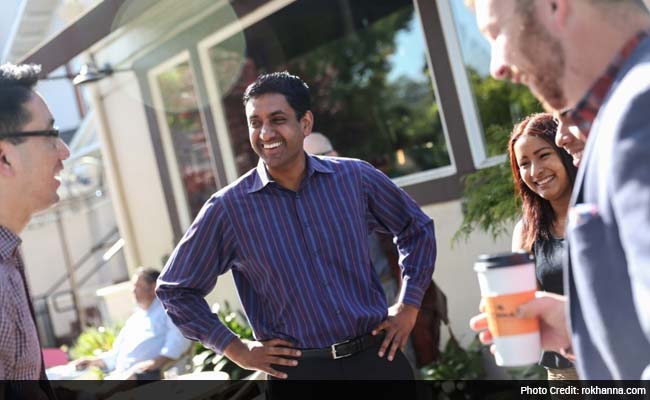
Indian-American Ro Khanna has announced that he will contest for a US House of Representatives seat that represents most of the Silicon Valley in California for a second time after losing out in the 2014 polls by a narrow margin.
“I am running to represent this community in Congress,” Mr Khanna said yesterday as he announced his bid for the 2016 elections. He lost to veteran Democrat and his own party colleague Mike Honda in his maiden Congressional bid in 2014.
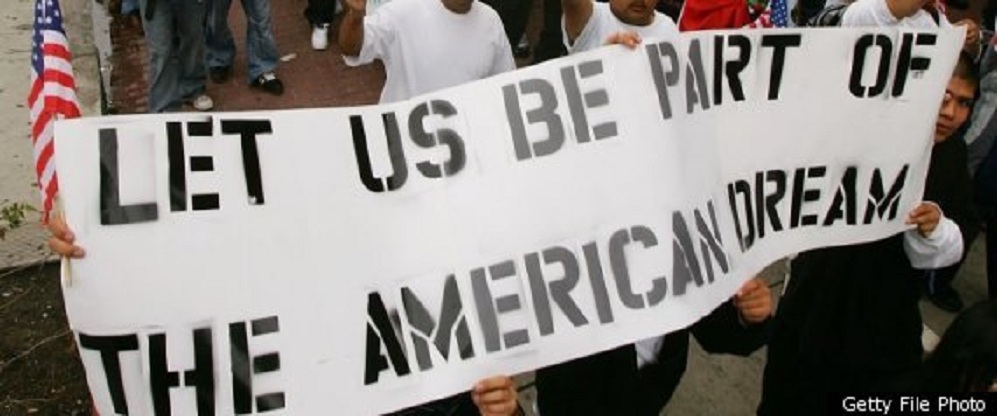
“I was raised to believe in the American Dream. My parents immigrated to the United States so that my brother and I could have a shot at it through a good education and hard work,” Mr Khanna said.
“What’s heartbreaking is that today, for the first time, there’s an anxiety about whether that American Dream will exist for the next generation. It’s an anxiety driven by economics. We’re earning less, but working more. The cost of living, especially here in the Bay Area, is through the roof,” he said.Mr Khanna announced that this time too he would be contesting against his own party colleague Honda, who won the 2014 polls by a narrow margin of 3.6 per cent votes. California laws provides for contesting against own party colleague.Mr Honda has accepted the challenge.
“Mike Honda welcomes the challenge and believes his long history of serving the district honourably and with principle will outweigh the determination of the wealthy interests backing his overly ambitious challenger,” a statement issued by Mr Honda’s office said.
WASHINGTON (TIP): The Centers for Disease Control and Prevention said it is investigating what the Pentagon called an inadvertent shipment of live anthrax spores to government and commercial laboratories in as many as nine states, as well as one overseas, that expected to receive dead spores.
“At this time we do not suspect any risk to the general public,” CDC spokeswoman Kathy Harben said Wednesday.
A Pentagon spokesman, Col. Steve Warren, said the suspected live anthrax samples were shipped from Dugway Proving Ground, an Army facility in Utah, using a commercial delivery service.
Warren said the government has confirmed one recipient, a laboratory in Maryland, received live spores. It is suspected, but not yet confirmed, that anthrax sent to labs in as many as eight other states also contained live spores, he said. Later he said an anthrax sample from the same batch at Dugway also was sent to a U.S. military laboratory at Osan air base in South Korea; no personnel there have shown signs of exposure, he said, and the sample was destroyed.
“There is no known risk to the general public, and there are no suspected or confirmed cases of anthrax infection in potentially exposed lab workers,” Warren said.
A U.S. official said Wednesday evening that four people in three commercial labs had worked with the suspect anthrax samples and the CDC has recommended the four be provided “post-exposure prophylaxis,” or preventive treatment. The official was not authorized to discuss the details because they involved non-government lab employees, and so spoke on condition of anonymity.
The anthrax samples were shipped from Dugway to government and commercial labs in Texas, Maryland, Wisconsin, Delaware, New Jersey, Tennessee, New York, California and Virginia.
The Defense Department, acting “out of an abundance of caution,” has halted “the shipment of this material from its labs pending completion of the investigation,” Warren said.
Contact with anthrax spores can cause severe illness.
Harben said one of the laboratories contacted the CDC to request “technical consultation.” It was working as part of a Pentagon effort to develop a new diagnostic test to identify biological threats, she said. “Although an inactivated agent was expected, the lab reported they were able to grow live Bacillus anthracis,” she said, referring to the bacteria that cause anthrax disease. The CDC is working with state and federal agencies on an investigation with the labs that received samples from the Defense Department, she said.
Harben said all samples involved in the investigation will be securely transferred to the CDC or other laboratories for further testing.
DALLAS (TIP): Flood waters submerged Texas highways and threatened more homes Friday when a squall line stalled over Dallas overnight Thursday, dropping record-setting rainfall and triggering a Flash Flood Emergency in North Texas.
The most recent rain added to the damage inflicted by thunderstorms that have killed at least 23 people statewide, including two overnight in North Texas, and left 13 missing.
The rain seeped into homes and stranded hundreds of drivers across the Metroplex, many of whom lingered along Dallas’ Loop 12 for six hours Friday morning after being gridlocked by high water and abandoned vehicles.
Overnight, Dallas Fire-Rescue crews responded to more than 270 calls that included trapped vehicles and crashes, authorities said.
Mesquite Fire Department Capt. Kelly Turner said a man’s body was found early Friday morning after his truck had been swept into a culvert and submerged.
The Dallas County Medical Examiner’s Office identified the flood victim as 47-year-old John Jeffrey Usfrey.
In Dallas, police said Friday afternoon the body of a man was found near California Crossing and Northwest Highway as flood waters receded. Police did not release the man’s identity, but did say he was not found in a vehicle.
Recent storms are being blamed for killing seven people in Oklahoma and at least 23 in Texas, where 13 remain missing or unaccounted for.
Rainfall Sets New Record
Thursday’s storm, which dropped nearly five inches of rain overnight at Dallas Love Field and more than two inches elsewhere around the Metroplex, helped set a record for the wettest May in Dallas-Fort Worth history.
The previous record for May rainfall was set in 1982 at 13.66 inches and was eclipsed at midnight when 13.87 inches had been recorded for the month. By 8 a.m., the total rose to 16.07 inches; 8.62 inches received in the last week alone.
According to The National Weather Service in Fort Worth, those 16 inches of rainfall amount to more than 35 trillion gallons of rain.
[quote_box_center] “I’ve covered corrupt regimes all over the world, and I find it ineffably sad to come home and behold institutionalized sleaze in the United States”, says the author.[/quote_box_center]
I’ve admired the Clintons’ foundation for years for its fine work on AIDS and global poverty, and I’ve moderated many panels at the annual Clinton Global Initiative. Yet with each revelation of failed disclosures or the appearance of a conflict of interest from speaking fees of $500,000 for the former president, I have wondered: What were they thinking?
But the problem is not precisely the Clintons. It’s our entire disgraceful money-based political system. Look around:
Gov. Chris Christie of New Jersey accepted flights and playoff tickets from the Dallas Cowboys owner, Jerry Jones, who has business interests Christie can affect.
Senator Marco Rubio of Florida has received financial assistance from a billionaire, Norman Braman, and has channeled public money to Braman’s causes.
Jeb Bush likely has delayed his formal candidacy because then he would have to stop coordinating with his “super PAC” and raising money for it. He is breaching at least the spirit of the law.
“For meaningful change to arrive, ‘voters need to reach a point of revulsion.’ Hey, folks, that time has come.”
When problems are this widespread, the problem is not crooked individuals but perverse incentives from a rotten structure.
“There is a systemic corruption here,” says Sheila Krumholz of the Center for Responsive Politics, which tracks campaign money. “It’s kind of baked in.”
Most politicians are good people. Then they discover that money is the only fuel that makes the system work and sometimes step into the bog themselves.
Money isn’t a new problem, of course. John F. Kennedy was accused of using his father’s wealth to buy elections. In response, he joked that he had received the following telegram from his dad: “Don’t buy another vote. I won’t pay for a landslide!”
Yet Robert Reich, Bill Clinton’s labor secretary and now chairman of the national governing board of Common Cause, a nonpartisan watchdog group, notes that inequality has hugely exacerbated the problem. Billionaires adopt presidential candidates as if they were prize racehorses. Yet for them, it’s only a hobby expense.
For example, Sheldon and Miriam Adelson donated $92 million to super PACs in the 2012 election cycle; as a share of their net worth, that was equivalent to $300 from the median American family. So a multibillionaire can influence a national election for the same sacrifice an average family bears in, say, a weekend driving getaway.
Money doesn’t always succeed, of course, and billionaires often end up wasting money on campaigns. According to The San Jose Mercury News, Meg Whitman spent $43 per vote in her failed campaign for governor of California in 2010, mostly from her own pocket. But Michael Bloomberg won his 2009 re-election campaign for mayor of New York City after, according to the New York Daily News, spending $185 of his own money per vote.
The real bargain is lobbying — and that’s why corporations spend 13 times as much lobbying as they do contributing to campaigns, by the calculations of Lee Drutman, author of a recent book on lobbying.
The health care industry hires about five times as many lobbyists as there are members of Congress. That’s a shrewd investment. Drug company lobbyists have prevented Medicare from getting bulk discounts, amounting to perhaps $50 billion a year in extra profits for the sector.
Likewise, lobbying has carved out the egregious carried interest tax loophole, allowing many financiers to pay vastly reduced tax rates. In that respect, money in politics both reflects inequality and amplifies it.
Lobbyists exert influence because they bring a potent combination of expertise and money to the game. They gain access, offer a well-informed take on obscure issues — and, for a member of Congress, you think twice before biting the hand that feeds you.
The Supreme Court is partly to blame for the present money game, for its misguided rulings that struck down limits in campaign spending by corporations and unions and the overall political donation cap for individuals.
Still, President Obama could take one step that would help: an executive order requiring federal contractors to disclose all political contributions.
“President Obama could bring the dark money into the sunlight in time for the 2016 election,” notes Michael Waldman of the Brennan Center for Justice at the New York University School of Law. “It’s the single most tangible thing anyone could do to expose the dark money that is now polluting politics.”
I’ve covered corrupt regimes all over the world, and I find it ineffably sad to come home and behold institutionalized sleaze in the United States.
Reich told me that for meaningful change to arrive, “voters need to reach a point of revulsion.” Hey, folks, that time has come.
NEW YORK (TIP) – The spouses of guest workers with H-4 visas may apply for jobs in the United States, after a federal judge declined to stop the new policy.
Save Jobs USA, a group made up of former Southern California Edison computer workers replaced by foreign workers with H-1B visas, filed suit against the U.S. Department of Homeland Security in April seeking to stop the regulation.
The group alleged it is already difficult for its members to find work after they were replaced with H-1B workers, and that the new policy will further increase competition for jobs.
U.S. District Judge Tanya S. Chutkan found in a memorandum opinion filed Sunday that Save Jobs USA failed to prove that its members would suffer injuries under the policy.
“There is no indication, and Save Jobs has not provided any evidence, that it is certain that H-4 visa holders will apply for IT jobs and compete with Save Jobs members,” Chutkan wrote. “Save Jobs is correct that this couldhappen, and eventually it may in fact happen. But at this stage, it is entirely speculative whether any H-4 visa holders will ever apply for IT jobs at SCE, IT jobs in California (where the members of Save Jobs reside), or IT jobs at all.”
According to DHS, nearly 180,000 new foreign workers may be added to the U.S. workforce in the first year of the rule with as many as 55,000 jobs added annually thereafter.
“Save Jobs does not explain how many IT jobs may be taken by H-4 visa holders, how many of those jobs its members may have sought themselves, what pay or benefits its members risk losing while the case is pending, or what other harm its members may face,” Chutkan wrote. “The court is left to speculate as to the magnitude of the injury, and speculation is not enough to turn economic loss into irreparable harm.”
A bipartisan letter written by 10 U.S. senators called for the U.S. Department of Labor to investigate Southern California Edison’s alleged replacement of American employees with H-1B visa holders. Solicitor General M. Patricia Smith declined to investigate, citing a “lack of basis.”
“At this point, Save Jobs has provided no evidence that any H-1B visa holder has or will stay in the United States as a result of the rule,” Chutkan found. “There is also no evidence that the rule will lead to an increase in the number of H-1B visa holders seeking permanent residence and competing with Save Jobs’ members.”
Save Jobs attorney Dale L. Wilcox, of the Immigration Reform Law Institute, says public policy should “benefit Americans, not foreigners.”
“Our immigration laws are supposed to restrain corporations from manipulating the labor market in order to collapse wages and displace American workers,” Wilcox said in a statement.
Chutkan’s ruling stated that both parties presented compelling arguments, and neither party’s arguments “significantly outweigh” the other.
“Whether American workers and the U.S. economy are better served with more or fewer foreign workers is a policy question the court need not answer,” Chutkan wrote.
The Department of Homeland Security declined to comment on the ruling.
Los Angeles: An Indian-American home-schooled boy has surprised one and all by graduating from a US college at the age of 11 with three associate degrees in mathematics, science and foreign language studies.
Tanishq Abraham, a native of Sacramento, California, graduated from American River College in Sacramento (ARC), California, alongside 1,800 students.
Abraham is the youngest person to graduate from American River College this year.
“The assumption is that he’s the all-time youngest,” American River College spokesman Scott Crow told NBC News.
Abraham, last year, became one of the youngest ever in the US to graduate high school.
Home-schooled since the age of 7, Abraham passed a state exam in March last year that certified he had met the appropriate academic standards to receive his high school diploma. His achievement last year had earned the attention of President Barack Obama — who had sent Tanishq a congratulatory letter.
Abraham joined MENSA, the prominent high IQ society, when he was only four-years-old.
Abraham told a local TV station that the milestone of graduating from college was not “much of a big thing for me.”
His mother, Taji Abraham, said he has always been ahead of the class.
“Even in kindergarten he was pretty ahead, a few years ahead – and then it just went from there,” she told KCRA-TV.
Abraham said some of the students at the college “were intimidated” by him but a lot of others “were really happy” to have a kid in their classes. He graduated with three associate degrees from the college.
On his college graduation cap, Abraham wore his favourite “Toy Story” quote: “2 Infinity and Beyond.”
As for what comes next for the child prodigy, Abraham said: “I want to become a doctor, but I also want to become a medical researcher, and also the president of the United States.”
“I like to learn. So I just followed my passion of learning, and that’s how I ended up here,” he told Fox News.
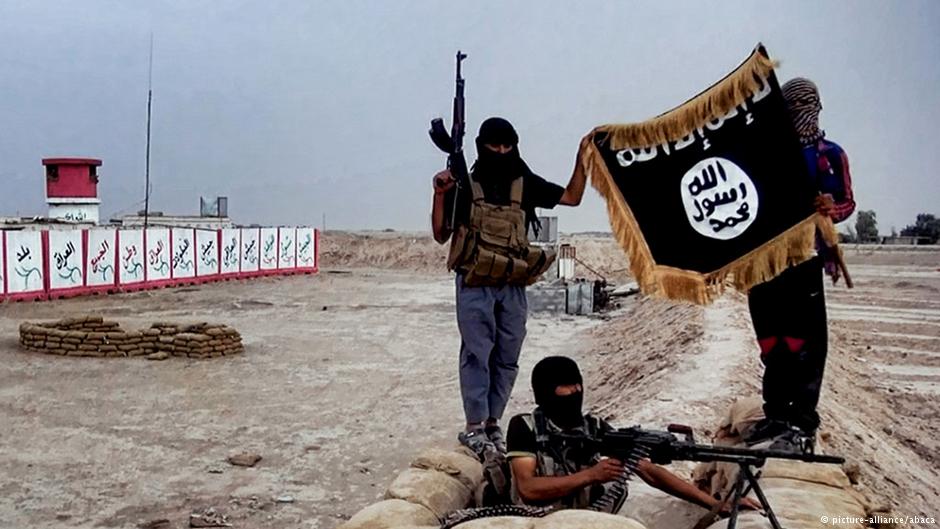
Two men accused of plotting to provide material support to “Islamic State” (IS) appeared before a court in California on Friday. The prosecutors charged Anaheim residents Muhanad Badawi and Nader Elhuzayel, both 24, after investigators tracked their communications on social media and found messages claiming their support for IS.
According to court documents, on May 7 Elhuzayel used Badawi’s credit card to purchase a ticket to Tel Aviv, Israel, via Istanbul, Turkey. Police arrested Elhuzayel at Los Angeles International Airport on May 21 as he prepared to depart and Badawi in Anaheim, the home to Disneyland, on the same day. Badawi suggested that he, too, eventually planned to go to the region to join the fight, the Justice Department reported.
Elhuzayel told authorities that he had planned on getting off the plane in Turkey and traveling to fight with IS in Syria, according to the complaint. However, his father, Salem Elhuzayel, told the Orange County Register that he had dropped his son off for the Israel-bound flight so that he could visit Palestinian aunts and cousins.
“I think they’re looking for a victim,” he said. “He’s an innocent human being.” Officials searched the motel room where the family has lived since their eviction from their home, Salem Elhuzayel said.
On Friday, IS claimed responsibility for a deadly mosque attack in Saudi Arabia.
mkg/rc (Reuters, AFP, AP,DW)
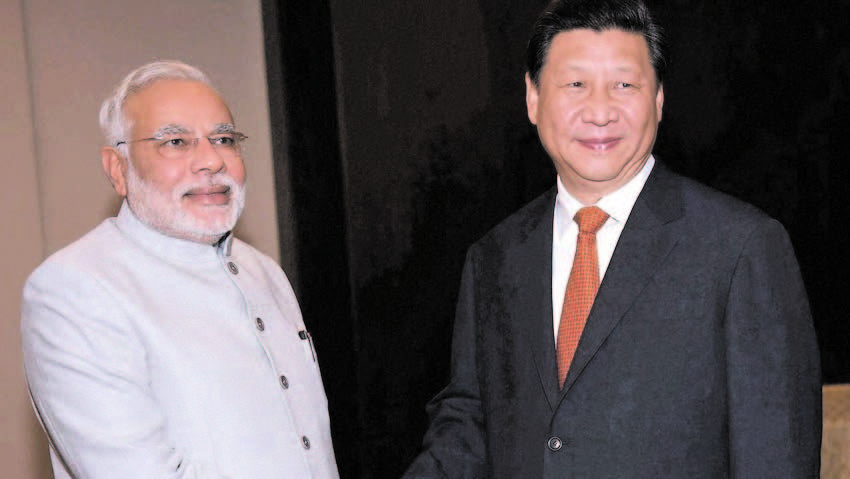
During his China visit, Prime Minister Modi has been unusually forthright in speaking about the problems that hold back the India-China relationship. He probably feels that his desire to strengthen ties with China being so clear, he has earned the confidence of the Chinese leaders enough to be able to pinpoint India’s concerns about some aspects of China’s policies that we find difficult to digest. This is a new approach Modi has fashioned. Our earlier approach has been to soft pedal differences, avoid airing them in public and pretend they are more manageable than they actually are. There has been a tendency also to explain China’s behaviour to ourselves by becoming their spokespersons to our own people, and in the process accept some of the blame for the problems that endure.
Modi is following a different tack, that of creating consciousness in the Chinese public that China has a responsibility of addressing outstanding issues if it wants the bilateral relationship to move forward and bring about the Asian century that its leadership visualises. This is a more self-confident approach. Whether this more robust attitude will produce the results we want is not certain. China is used to such exhortations by the US, which, unlike our case, are also backed by US power. Yet, China both bends and defies to the degree necessary to manage the relationship with the US, but without changing its fundamental course of building its national power and commensurately raising the level of its strategic challenge to the US. In other words, China does not get cowed down, nor is willing to yield on essentials even when its policies do not make sense always in the light of its own self-interest as seen by external observers.
Prime Minister Modi interacts with people at the India China business forum (Photo courtesy: Twitter/PIB)
Whatever the caveats, Modi is moving the Chinese out of their present comfort zone and dealing with China with greater self-assurance which cannot but have some impact on how it treats India in the future. This is a new balance that Modi is establishing between leveraging economically the China connection for India’s development and not losing politically by diffidence in mentioning differences that endure. There are some indications that China believes that of all the partners that India is wooing for investments, it is the one best placed to meet India’s needs, especially in modernising its poor infrastructure. In other words, India’s choices are limited and this gives China a strong hand to play even in the economic field. Modi is implicitly making China reexamine its assumptions
By choice or consequence, Modi is linking the economic to the political by his double messaging in Beijing. On the one hand, the joint statement issued during the visit explicitly says that outstanding differences, including on the boundary question, should not be allowed to come in the way of continued development of bilateral relations. On the other, Modi stressed in his joint press conference with Chinese premier Li Keqiang that China needed to “reconsider its approach on some of the issues that hold us back from realising the full potential of our partnership” and “take a strategic and long term view of our relations”. This suggested that the long term relationship could be either jeopardised or impeded if China continued with its present approach. It is interesting that in asking China to think long term he summarily debunked the widely accepted myth that China thinks not years but decades ahead in policy making. Standing alongside Li Keqiang, Modi reiterated the “importance of clarification of the Line of Actual Control”, a point he had made in Xi’s presence during the latter’s September visit to India, and “tangible progress on issues relating to visa policy (stapled visa issue, no doubt) and trans-border rivers”. He also alluded to “some our regional concerns” (undoubtedly China’s policies in our neighbourhood, especially in Pakistan). It is clear that Modi raised all these issues in his private conversations with Xi and Li Keqiang, as otherwise publicly mentioning them in the latter’s presence would have seen as a form of political ambush by the Chinese premier. Modi’s intention was obviously to make public his political expectations from China in the years ahead.
Modi expatiated further on these points in his address at the Tsinghua University. He put more pressure on the Chinese government by stating publicly that if the two countries “have to realise the extraordinary potential of our relationship, we must also address the issues that lead to hesitation and doubts, even distrust, in our relationship”. This is extraordinary plain speaking. He spoke of trying “to settle the boundary question quickly” in a way that does “not cause new disruptions”- an allusion no doubt to China’s unreasonable demands in the eastern sector. This amounts to, again, asking the Chinese publicly to rethink its posture on the package deal on the border. To remove “a shadow of uncertainty” that “hangs over the sensitive areas of the border region” because “neither side knows where the Line of Actual Control is in these areas”, he recalled his proposal to resume the process of clarifying the LAC
“without prejudice to our position on the boundary question”. This is a via media he is seeking between, on the one hand, stabilising the border and eliminating periodic stand-offs that damage the political relationship and make headway in other areas that much more difficult and, on the other, a permanent solution to the boundary question. It is doubtful whether China would accept this option that was always open. indeed, China was committed to this process but abandoned it favour of the Special Representatives (SR) mechanism. It is unclear, moreover, how the LAC clarification process and the SR mechanism can proceed simultaneously.
Voicing concerns about China’s increased engagement “in our shared neighbourhood”, Modi, in his Tsinghua address, called for “deeper strategic communication to build mutual trust and confidence” so as to “ensure that our relationships with other countries do not become a source of concern to each other”. In talking of “shared neighbourhood” Modi is talking about South Asia and not the western Pacific, and this is significant. To strengthen our international cooperation, he frontally sought China’s support for India’s permanent membership of the UN Security Council and India’s membership of export control regimes like the Nuclear Suppliers Group. This was unusual as such a public appeal does not normally come from his elevated position. A prime Minister should not seen as a supplicant. Anyhow, by stating all this, Modi has, in a sense, laid out the political agenda of the relationship in the years ahead from his side, which if not achieved in some measure in a reasonable time frame can become a source of criticism and could even make the economic agenda with China even more controversial as a one-sided strategic compromise.
The joint statement and the Tsinghua speech contain some notable formulations, omissions and iterations, some curious, many positive and a few negative. If the India relationship was for president Obama a defining one for the 21st century, the joint statement notes, as a rhetorical balance, that the “India-China relations are poised to play a defining role in the 21st century in Asia and, indeed, globally”. A China that supposedly rejects an equal status for India accepts in the joint statement that the two countries are “major poles in the global architecture”. On the boundary question, the old, cliched language is repeated and the emphasis remains on improved border management. No mention is made to China’s self-serving One Road One Belt
(OBOR) initiative to which Xi attaches much importance, and which figured prominently in his recent Pakistan visit. Our neighbours like Sri Lanka and Nepal would have particularly noted this omission. Significantly, the joint statement contains no reference to security in the Asia-Pacific region, unlike in September 2014, which suggests a failure to agree on language on this sensitive issue. Maritime cooperation too does not figure in it, which suggests difficulties in drafting the joint statement.
We have again thanked China’s Foreign Ministry and the government of “the Tibetan Autonomous Region of the People’s Republic of China” for facilitating the Kailash Manasarovar Yatra. It would have been sufficient to have simply thanked “China” in September 2014 and now, but the Chinese obviously press us to include formulations that recognise TAR as part of the PRC in our joint statements- a practice that was discontinued by the UPA government in the face of China’s increasingly strident claims on Arunachal Pradesh. These offensive claims unfortunately continue and therefore do not justify such politically one-sided gestures by us. Maybe we think this is too sensitive a subject for us to reticent about and to keep the relationship on even keel we feel we can keep giving China comfort over Tibet even when China cynically uses Tibet to make outlandish territorial claims on us. This gesture could also have been a quid pro quo for the stronger formulation on terrorism in the joint statement that could not have pleased Pakistan (though it should be noted that the statement refers not to “cross-border terrorism” which is a formulation India uses to accuse Pakistan, but to “cross border movement of terrorists” which has a different connotation), as well as the separate joint statement on Climate Change that fully reflects India’s position and assumes importance in the context of the Climate Change summit in Paris where the effort would be to isolate India and use the US-China agreement to that end. The question though remains how India will reconcile its commitment to work closely with the US to make the Paris Conference a success with the enunciation of a common position with China which conflicts with the basic US approach.
The reference in the joint statement to the “commonalities” in the approach of the two countries to global arms control and nonproliferation is puzzling as it conflicts with reality and whitewashes China’s historical and current proliferation activities in Pakistan. To have China in return “note” our aspirations to join the NSG, is an altogether insufficient reason to make this concession and lose a political card against China and Pakistan. Opening ISRO to China through a Space Cooperation Outline (2015-2020) Cooperation may also seem premature to some, given the actual state of India-China relations.
In his Tsinghua speech, Modi noted pointedly that while both countries seek to connect a fragmented Asia, “there are projects we will pursue individually”, which implies cold shouldering China’s idea of linking our Mausam and Spice Route projects with OBOR. Progress in the BCIM (Bangladesh, China, India, Myanmar) Economic Corridor is mentioned in the joint statement, despite the danger of opening up our inadequately nationally integrated northeast to more economic integration with China. Why Modi mentioned this corridor again in his university speech is unclear, but then, having participated in the joint working group discussions on the project for some time now, it might have been tactically difficult to close the door on it abruptly.
That Modi himself announced at the last minute at Tsinghua the grant of e-visas to the Chinese after the Foreign Secretary had told the media earlier that no decision had been taken, raises questions about policy making, especially as the stapled visa issue remains unresolved. Of course, enhanced economic engagement requires easier visas and to that extent such a decision can be seen as pragmatic, but we have given up a valuable card touching upon sovereignty issues without sufficient return. No wonder the Chinese Foreign Minister was delighted by this gift from the Prime Minister.
The driving force behind Modi’s wooing of China being trade and investment, the progress achieved on that front was of principal interest in terms of outcomes. Here, the results have been less than expected. In a sense this was to be expected as too little time had elapsed between Xi’s visit to India and Modi’s visit to China to produce dramatic results. The $20 billion of investment five years promised by Xi would take time to materialise under any circumstances, but more so in the case of China as it has so far invested little in the country, its investors have limited experience of working in India, its leaders are looking for preferential treatment and want a better understanding of the legal conditions. The joint statement largely repeats what was said in September 2014 during Xi’s visit on taking joint measures to alleviate the problem of deficit and cooperate in providing Indian products more market access in China. The language is very noncommittal and it is left to the India-China Joint Economic Group to work on these issues. It was agreed that the next meeting of the Strategic Economic Dialogue, co-chaired by Vice Chairman of NITI Aayog of India and Chairman of NDRC of China, will be held in India during the second half of 2015. On the other hand, China’s economic interests in India are treated more concretely, with satisfaction expressed with the progress achieved in the Railway sector cooperation including the projects on raising the speed on the existing Chennai-Bengaluru-Mysore line, the proposed feasibility studies for the Delhi-Nagpur section of high speed rail link, the station redevelopment planning for Bhubaneswar & Baiyappanahalli, heavy haul transportation training and setting up of a railway university.
Although 24 agreements were signed during the visit and the number is impressive, in reality the most significant one relates to the opening of our respective consulates in Chengdu and Chennai and space cooperation. There is no economic agreement of note that figures in the list. Surprisingly, the joint statement contains no reference to the two industrial parks that China will be setting up in India, even if it were to merely record some progress in implementing this initiative. Even the figure of $20 billion of Chinese investments in India in the next 5 years- if nothing but for its positive optical effect- is not mentioned this time. No doubt 26 “agreements” were signed during the visit to Shanghai- mostly MOUs involving the private sector that have no binding value- in the areas of renewable energy, power, steel etc. These are sectors in which China is either already strongly present in India or is a global player as in the case of solar power. Its aim would be to capture the Indian market in what would be a highly fecund area for Chinese business given India’s massive plans in developing the solar power sector. A point to consider is whether the unfettered entry of Chinese firms would suffocate Indian enterprise in the renewable industry sector as has happened in the power and telecom sectors. Even financing of private Indian companies by Chinese banks has been put on the positive ledger in projecting the results of Modi’s visit, even though all that is meant is that China will lend money to Indian companies to buy more Chinese products and only add to the burgeoning trade deficit between the two countries. That these MOUs, if and when implemented ( many are in the form of intentions only) are potentially worth $ 22 billion is a PR exercise, which all countries resort to in order to embellish the economic “success” of visits by their leaders abroad, and can therefore be excused as standard diplomatic practice.
All in all, the China challenge for India has not been reduced by Modi’s visit. On the contrary, Modi has highlighted the political challenges ahead, as China has remained reticent on the points raised by him. Modi is to be commended for largely making the right points during the visit. There were some slippages, but this was perhaps inevitable because China holds the stronger hand. The attempt always is to enlarge the areas of real or potential convergences rather than get bogged down over contentious issues and create a situation where it becomes difficult to issue any meaningful joint statement. The problem in the India-China case is that we are not strategic partners in reality and yet claim that we are. At the end of the day, making the right points and winning them the are two different things.
As for personal chemistry between Xi and Modi, it would have been better if Xi too had avowed publicly that the two had a “plus one” friendship, otherwise the psychological advantage is with the side that remains silent. Let us also note personal chemistry can have a short shelf life in the face of hard political and strategic realities. Obama and Xi have had a shirtsleeves meeting in Palm Springs in California in 2013, Bush read Putin’s soul in Slovenia in 2001 and Obama had hamburgers with Medvedev in Washington in 2010, but these get-to-know informal meetings intended to create a personal rapport do not help resolve issues beyond a point. It remains though that both Xi and Li Keqiang made unprecedented personal gestures to Modi.
(The author is a former Foreign Affairs Secretary and Dean, Centre for International Relations and Diplomacy, Vivekananda International Foundation. He can be reached at sibalk@gmail.com)
SAN JOSE, CA (TIP): 13-year-old Indian-origin student from San Jose, California developed a device to help visually impaired navigate has been named one of America’s top 10 youth volunteers of 2015 and granted a 5,000 dollars award by The Prudential Spirit of Community Awards.
Raghav started a quest to help the visually impaired by focusing his attention on the white canes used to detect obstacles in their path.
“I saw how, despite being used for several centuries, the white cane does not provide users enough information about their environment,” he said.
Raghav designed and built a device that uses sensors to detect objects beyond the reach of the canes.
His device clamps onto the cane, uses ultrasonic and infrared sensors to detect obstacles more than six feet beyond the end of the cane and communicates this information to the user through vibrations in the cane’s handle.
Raghav secured a grant to make multiple copies and hopes to create an open patent so that organizations for the blind around the world can make the device for their clients.
For his efforts, Raghav was one of the 10 middle and high school students named America’s top youth volunteers for 2015 at Prudential’s 20th annual Spirit of Community Awards on May 4.
Students at UC San Diego must take their final exam in the nude, or risk failing.
The final exam for the art visual class at the University of California at San Diego involved students acting out a series of gestures, according to the teacher. The last gesture was labeled “erotic self.”
According to the Huffington Post, Ricardo Dominguez, a professor at University of California, San Diego, stands by his teaching methods for the “Visual Arts 104A: Performing the Self” module.
“At the very end of the class, we’ve done several gestures, they have to nude gesture. The prompt is to speak about or do a gesture to create an installation that says, ‘what is more you than you are,’” Dominguez was quoted saying.
The Chair of the University of California San Diego’s Visual Arts Department refuted the professor’s claim that nudity was a requirement. He said students could perform the so-called “nude gesture” without having to remove their clothes. He also said the class was not a requirement for graduation.
The proffesor added that he has been taking the class for 11 years, and has never received a single complaint about the final exam.
WASHINGTON: Three people including an aide of Indian-American Attorney General of California Kamala Harris have been arrested on charges of running a rogue police force.
Brandon Kiel, an aide of 50-year-old Harris, who worked as deputy director of community affairs at the California Department of Justice was arrested for impersonating a police officer.
Kiel, 31, who is reportedly on leave from his job, reportedly called himself the “chief deputy director” of the masonic Fraternal Police Department in letters to various southern California police departments requesting meetings.
The rogue police force claims to have existed for more than 3,000 years and have jurisdiction in 33 states and
Mexico.
Investigators, during a search of Kiel’s home – who is accused of misusing his government identification – found uniforms, weapons, badges and vehicles.
Harris, a rising star of the Democratic Party, is running for the Senate seat from California.
India’s IT industry has long been seen as a back-office backwater, even by its own engineers who started moving abroad in their droves in the 1970s. After losing top engineering talent for years to America’s tech heartland of Silicon Valley, India is luring them back as an e-commerce boom sparks a thriving start-up culture, unprecedented pay, and perks including free healthcare for in-laws.
The e-commerce sector, led by companies such as Flipkart and Snapdeal, attracted more than $5 billion of investment last year, Morgan Stanley says, compared with less than $2 billion in 2013.
That growth is fuelling the hunt for talent to drive the next stage of expansion – for many, an initial public offering or a push into overseas markets.
“The appetite for finding engineering talent … is great,” said George Kaszacs of Silicon Valley-based headhunters Riviera Partners, who helps Indian startups scout for potential hires.
India’s biggest e-commerce company, Flipkart (IPO-FLPK.N), recently hired two senior executives from Google Inc (GOOGL.O) in California, both engineers of Indian origin, for its headquarters in Bengaluru in southern India.
Flipkart did not disclose their pay, but headhunters say remuneration packages can reach $1 million over 3-4 years.
Headhunter Kaszacs said several factors are drawing Indians back home, including the chance to join a fast-growing start-up. Joining bonuses, stock options and other perks were also helping.
A California civil liberties group launched a mobile application on April 30, that will let bystanders record cell phone videos of possible cases of police misconduct and then quickly save the footage to the organization’s computer servers.
The California chapter of the American Civil Liberties Union said the app will send the video to the organization and preserve it even if a phone is seized by police or destroyed.
The launch of the ACLU’s “Mobile Justice CA” app comes as law enforcement agencies face scrutiny over the use of lethal force, especially against African-Americans, following several high-profile deaths of unarmed black men in encounters with police over the last year in the United States.
“It’s critical that people understand what is being done by police officers, because what is being done is being done in the name of the public,” said Hector Villagra, executive director of the ACLU of Southern California.
The app is targeted at residents of the most populous U.S. state, but ACLU chapters have launched similar mobile apps in at least five other states, including New York, Missouri and Mississippi over the last three years.
It also sends an alert to anyone with the app who might be in the area, giving them an opportunity to go to the location and observe, the ACLU said.
LONDON (TIP): No Indian university has made it to the list of the world’s top 100 which are under 50 years old.
Institutes from 28 countries are present in the list of rising global higher education universities poised to challenge the traditional Anglo-American dominance of the sector.
Over 800 universities worldwide had submitted data for analysis of which 20 were from India.
Phil Baty, rankings editor, Times Higher Education, told media, “A number of these Indian institutions did not meet our data providers’ strict criteria for inclusion in the rankings which includes a minimum number of research papers to be published each year and were therefore excluded. Many of the remaining institutions were also founded before 1964 which meant that they could not be considered for the 100 under 50.”
Three factors were identified which helped the rise of these institutions. Citation Impact – how much a university’s research papers are being referenced by other academics; a measure of the influence its research has on the rest of the world. The second is ‘Income from Industry’ – how much companies are working with academics and applying their research to the real-world. Lastly, ‘International Outlook’, a measure of how many international students and staff a university attracts and how much it is collaborating on international research papers with other institutions.
Ecole Polytechnique Federale de Lausanne moved to pole position from second place, where it has sat since the first 100 under 50 was published in 2012. It swaps places with South Korea’s Pohang University of Science and Technology. The remainder of the top five is static: the Korea Advanced Institute of Science and Technology (KAIST) holds on to third, the Hong Kong University of Science and Technology retains fourth, while Singapore’s Nanyang Technological University remains in fifth.
The top 10 includes representatives from eight countries overall: the Netherlands’ Maastricht University holds on to sixth; the US’ University of California, Irvine is seventh with its UC stablemate Santa Cruz moving up three places to eighth; the UK’s University of Warwick rises from 12th to ninth and France’s Paris-Sud University falls two places to 10th.
Australia has emerged as the number one nation, with 16 top 100 institutions, up from 14 last year. It also has a new number one, the University of Technology, Sydney, in 21st spot overall: it overtakes the University of Newcastle (30th in 2015).
This contrasts favourably with the UK’s representatives, which are heavily concentrated in the 1960s. They are led by the University of Warwick in ninth, followed by the University of Dundee (joint 19th). This is Warwick’s final year in the list due to its 1965 foundation date, and Dundee has only two years left. Only four of the 15 UK universities in the list were founded after the 1960s.
Signup to our Newsletter!
Don’t miss out on all the happenings around the world