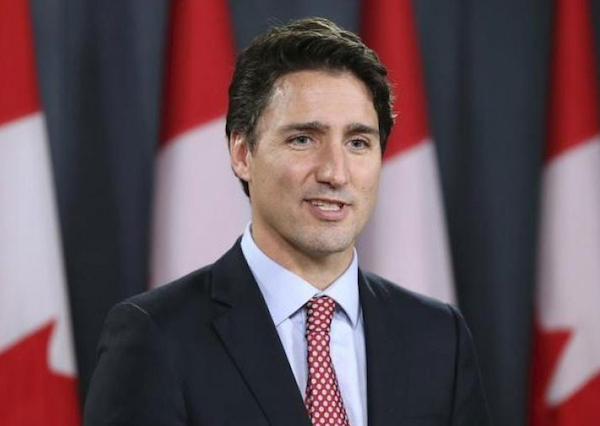
Tag: Canadian Prime Minister Justin Trudeau

  • Trump imposes steel and aluminum tariffs on the E.U., Canada and Mexico

    Trump imposes steel and aluminum tariffs on the E.U., Canada and Mexico

    Tensions rise over potential Trade War-US Allies Retaliate, American Businesses and Farmers Upset

    WASHINGTON(TIP): President Trump on Thursday, May 31 imposed tariffs on imported steel and aluminum from the European Union, Canada and Mexico, triggering immediate retaliation from U.S. allies and protests from American businesses and farmers.

    The tariffs — 25 percent on steel and 10 percent on aluminum — take effect at midnight Thursday, May 31, giving rise to fears of a major escalation of the trade war between the United States and its top trading partners.

    The White House has said the U.S. tariffs — 25 percent duties on steel and 10 percent on aluminum shipments from Canada, EU member states and Mexico — are necessary to safeguard U.S. national security.

    Stung by the U.S. action, the allies quickly hit back.

    In announcing his country’s response, Canadian Prime Minister Justin Trudeau said it was “inconceivable” that Canada “could be considered a national security threat to the United States,” noting that U.S. fighter planes and tanks contain Canadian steel.

    “These tariffs will harm industries and workers on both sides of the Canada-U.S. border and will disrupt supply chains that have made steel and aluminum from North America more competitive across the whole world,” he said in a press conference in Ottawa.

    Effective July 1, Canada will impose tariffs of 25 percent on shipments of U.S. steel and 10 percent on aluminum, as well as on other products, such as playing cards, inflatable boats and yogurt. Canada’s finance ministry estimated the value of the U.S. goods subject to those tariffs at up to C$16.6 billion ($12.8 billion),

    Jean-Claude Juncker, president of the European Commission, said the European Union also will apply news tariffs on American goods, with the trading bloc signaling it would target products made in states represented by key Republican leaders. The EU has said it would respond with tariffs on $3.3 billion in American imports as early as June 20.

    “The U.S. now leaves us with no choice but to proceed with a [World Trade Organization] dispute settlement case and with the imposition of additional duties on a number of imports from the U.S. We will defend the Union’s interests, in full compliance with international trade law,” Juncker said in a statement.

    The E.U. said it would impose import taxes on politically sensitive items like bourbon from Senate Majority Leader Mitch McConnell’s home state of Kentucky. Mexico said it would levy tariffs on American farm products, while Canada zeroed in on the same metals that Trump has targeted.

    The Mexican government said it would levy import taxes on U.S. exports of pork bellies, apples, cranberries, grapes, certain cheeses and various types of steel.

    Thursday’s action was driven by the president’s conviction that allies and adversaries routinely take advantage of the United States and that efforts to resolve trade disputes are doomed unless he wields a big tariff stick.

    “The United States has been taken advantage of for many decades on trade,” Trump said in a statement. “Those days are over. Earlier today, this message was conveyed to Prime Minister Justin Trudeau of Canada: The United State[s] will agree to a fair deal, or there will be no deal at all.”

    Officials from the three trading partners — among Washington’s closest allies for decades — have dismissed the idea that their shipments to American customers endanger the United States — and some prominent Republicans attacked the tariffs as wrongheaded.

    At home, some have expressed doubts about the position Trump has taken.

    Sen. Ben Sasse was blunter in criticizing the tariffs.

    “This is dumb. Europe, Canada and Mexico are not China, and you don’t treat allies the same way you treat opponents,” the Nebraska Republican said in a statement. “We’ve been down this road before — blanket protectionism is a big part of why America had a Great Depression. ‘Make America Great Again’ shouldn’t mean ‘Make America 1929 Again.’ “

  • Trudeau’s India visit mired in controversy over dinner invite to “convicted Khalistani terrorist”

    Trudeau’s India visit mired in controversy over dinner invite to “convicted Khalistani terrorist”

    NEW DELHI (TIP): Canadian Prime Minister Justin Trudeau’s India visit kicked off with rather a cold reception by government of India. Prime Minister Narendra Modi who has been very warm to visiting heads of state and government who he received warmly on arrival, sent in a junior minister to receive the visiting Prime Minister of Canada, ostensibly to convey the displeasure of his government for his assumed close proximity to Sikh separatists in Canada.  And, on February 22, Canadian Prime Minister’s maiden India visit plunged into yet another controversy over a dinner invitation to a convicted Khalistani terrorist Jaspal Atwal by the Canadian High Commissioner to India.

    Swiftly moving to control damage, High Commissioner Nadir Patel cancelled the invite for the dinner, hosted for Trudeau, while the external affairs ministry said it will “ascertain” how Atwal entered India.

    “The High Commission has rescinded Mr Atwal’s invitation. We do not comment of matters relating to the PM’s security,” the Canadian mission said in a statement.

    Reacting to the controversy, Trudeau told reporters “Obviously we take this situation extremely seriously. The individual in question never should have received an invitation and, as soon as we found out, we rescinded the invitation immediately… The member of Parliament who included this individual has, and will, assume full responsibility for his actions.”

    The Canadian PMO also said in a statement that Atwal was not part of Trudeau’s official delegation.

    Atwal was convicted for trying to kill the then Punjab minister Malkiat Singh Sidhu in Vancouver in 1986.

    When asked how Atwal got a visa, external affairs ministry spokesperson Raveesh Kumar said the government is “ascertaining” details how he got a visa to enter India.

    “There are two aspects of this. One is his presence at the event. I think this is something which should be addressed by the Canadian side. They have said that it was an oversight. And that is the reason the invitation for the reception tonight has been withdrawn.”

    “On the visa part, I cannot immediately say how that happened. There are different ways of people coming into India, whether you are an Indian national, or OCI card holder. We are ascertaining details from our mission. We will have to see how this happened,” Kumar told reporters.

    He also said that the fact the ministry issued a visa means that Atwal is not an Indian national.

    On whether Atwal can be arrested in India, Kumar said there were cases against him for which he has served his sentence. The ministry is not aware whether there are cases against him in India, that has to be checked with the law-enforcement agencies, he added.

    Union home ministry officials said Atwal no longer figured in the government’s blacklist of Sikh extremists.

    The invite cancellation comes at a time when Trudeau’s pro-Khalistan approach is being criticized by many including Punjab Chief Minister Amarinder Singh, who raised the issue with the Canadian prime minister during a meeting.

    On his part, Trudeau had assured Singh that his country does not support separatism in India or elsewhere.

    Reacting to the controversy involving him, Atwal told Canada’s Postmedia that he did not plan to attend the dinner as he was in Mumbai on business, The Vancouver Sun reported.

    He also said it was unfair to raise his criminal conviction for shooting a visiting Punjabi cabinet minister on Vancouver Island in 1986 given how long ago the crime occurred.

    (With inputs from PTI)