Tag: Capt Amarinder Singh

  • Mild Fluctuations in Share of National and Regional Parties

    Mild Fluctuations in Share of National and Regional Parties

    By Prabhjot Singh

    A careful analysis of the election results since 1967 would reveal that the percentage of votes polled by national parties, mainly the Congress, except for 1977 and 1997, has been more than 50. In 1967, for example, when Punjab had its first coalition government — the United Front — the Congress had polled 36.56 per cent of the total votes against 26.47 per cent votes polled by all state parties. The overall votes polled by national parties, including the Congress, Jana Sangh, CPI, CPM, Praja Socialist Party and Swatantra Party — was 56.60. In 1969, the share of national parties rose to 58.34 per cent, with the Congress increasing its share to 39.18 per cent while the state parties accounted for only 30.44 per cent of the votes. In 1972, when the Congress returned to power in the State, the share of the national parties increased slightly to 58.77 per cent while those of state parties dropped to 28.73 per cent. The Congress had taken its poll percentage to 42.84, which had been surpassed only twice afterwards, first in 1980 when the Congress got 45.19 per cent of the total votes polled and again in 1992 when it got 43.71 per cent votes.

    The 1992 election was exceptional in the history of Punjab. The mainstream Shiromani Akali Dal boycotted the elections. A faction of the Dal, led by the then rebel Akali leader, Capt Amarinder Singh, contested 58 seats and won only three. This was the only occasion when the percentage of votes dropped to 23.82, the lowest ever. The other lowest being 64.33 in 1980. The share of national parties dropped to 40.29 per cent, the only time below 50 per cent, in 1997 when besides 26.59 per cent of the votes secured by the Congress, all the national parties, including the BJP, CPI and CPM had aggregated 40.29 per cent. The most distinguishing aspect of Punjab politics has been that the Akalis, even at times securing clear majority, have been aligning themselves with the Jana Sangh/Bharatiya Janata Party. This combination alienated both Sikh and Hindu votes from the once powerful Congress.

    The emergence of the Bahujan Samaj Party in the 1992 elections saw this political outfit of the downtrodden getting 16.32 per cent of the valid votes polled which in the 1992 elections was more than three times that secured by the Akali Dal led by Capt Amarinder Singh. Interestingly, the BSP had bagged nine seats against three by the Akalis. The BSP, however, failed to maintain its tempo and in the 1997 elections, after witnessing a vertical split-leading to the formation of the Bahujan Semaj Morcha headed by Mr. Satnam Singh Kainth — saw its share of vote coming down to 7.48 per cent of the total valid votes and its share in the Vidhan Sabha dropping to one. The electorate in Punjab have known to participate in the process enthusiastically, averaging more than 64 per cent in all the previous elections held in the State so far.

    Till date, the Shiromani Akali Dal has never crossed the 40 per cent barrier. Its best performance was in 1985 when it got 38.01 per cent of the total valid votes. In 1997, this percentage dropped slightly to 37.64. Besides the Congress and the Akali Dal, other main players in Punjab politics have been Jana Sangh/BJP, CPI, CPM and briefly the Janata Party, which in the 1977 elections polled 14.99 per cent votes to win 25 seats out of 41 candidates put up by it.

    The Communists — the CPI and the CPM — put together had been aggregating about 9 to 10 percent of the total valid votes polled till 1997. The exceptions were the 1967 and 1969 election when they polled less than 8 per cent but since 1972, they have been averaging 9 per cent and above. In the 1967 elections they polled 8.46 per cent votes, 7.91 per cent in 1969, 9.77 per cent in 1972 and 9.60 per cent in 1977 winning eight, six, 11 and 15 seats collectively, respectively.

    In 1980, they crossed the double figure mark, aggregating 10.52 per cent to win 14 seats — nine by the CPI and five by the CPM. Since then, their share, both in percentage of valid votes and seats in the Vidhan Sabha, has been dropping as in the 1997 elections, they got only 4.77 per cent of total valid votes with two seats in the Vidhan Sabha. In the last Vidhan Sabha, the Communists went unrepresented. During the first term of Capt Amarinder Singh as Chief Minister, both the Communist legislators, defected and joined Congress. Since then, the Communists had been drawing a blank in Vidhan Sabha elections.

    (Prabhjot Singh is a veteran journalist with over three decades of experience covering a wide spectrum of subjects and stories. He has covered  Punjab and Sikh affairs for more than three decades besides covering seven Olympics and several major sporting events and hosting TV shows. For more in-depth analysis please visit probingeye.com  or follow him on Twitter.com/probingeye)

  • President’s rule in Punjab is not a good idea

    One has been hearing a demand by certain sections of politicians, both in Delhi and in Punjab for imposition of president’s rule in the state of Punjab, following the lapse in the security of Prime Minister Narendra Modi on his visit to the state.

    Prime Minister was to announce developmental schemes and address a party rally in Ferozepur in Punjab. He was to travel from Bathinda to Hussainiwala by a helicopter where he was to pay tribute to the three martyrs -Bhagat Singh, Rajguru and Sukhdev. But a bad weather forced him to make changes to his travel plan.
    It was decided that he would travel by road from Bathinda to Hussainiwala- a good two hours’ drive. Somewhere on the road some 20 miles shy of Hussainiwala his convoy had to stop because there were, as alleged, protesting farmers who had blocked the road.

    Prime Minister’s convey was held up there for about 20 minutes. And then the PM returned to Bathinda where he told a Punjab government official to convey his thanks to Punjab chief minister that he had come back alive to Bathinda.

    The Prime Minister’s remark generated all kinds of conspiracy theories. The central government blamed the Punjab government for the lapses and Punjab government defended its police officers, administration and itself by saying that the security of the Prime Minister is the responsibility of the SPG which cleared all plans of movement of the Prime Minister. However, since Punjab is going to elections in the next couple of months, the state is politically surcharged.

    The BJP which has lost ground in Punjab, after its break with SAD knows very well that it doesn’t have the kind of strength to win elections and therefore, it decided to go with Capt Amarinder Singh only to realize soon that Capt did not have enough sway in the State and that an alliance with his party was not going to get them the number of assembly seats they wanted.

    The Indian Panorama had pointed out a couple of months ago when the center had given BSF special powers and control over 50 kilometers of area of the state of Punjab along the Pakistan border that it was the beginning of an exercise to prevent elections in Punjab. Today, we hear a clamor for imposition of president’s rule. Unconfirmed reports say that when Prime Minister Modi and Home Minister Shah went to President Kovind and requested him for imposing President’s rule, President did not oblige them. BJP leaders demanding President’s rule in Punjab say that because Punjab government is not able to secure law and order which is evident from the lapse in the security of the Prime Minister, the government has no right to remain in power.
    The fact is that BJP government is looking for a pretext to not hold elections in Punjab knowing full well that it has no chance of winning enough seats to be able to in any way form a government. Therefore, it is better that elections are not held. What the BJP wants is a number of Rajya Sabha members from any state because that is where they need people. They need people to be able to amend the Constitution to make India a theocratic state, a Hindu Rashtra. If opposition parties have their Raja Sabha members, that will weaken the strength of the BJP in the parliament.

    We are concerned over this scenario. It’s not going to help democracy in the country. It is not going to serve the interests of the people of India. It is not going to serve the interests of the people of Punjab, and it certainly will be a bad precedent if the BJP government at the center made the issue of lapse in the security of the Prime Minister a reason for imposition of President’s rule in Punjab.

  • Congress fiasco

    Congress fiasco

    Captain’s exit as CM leaves party on sticky wicket in Punjab

    Capt Amarinder Singh’s unceremonious exit as the Punjab Chief Minister is a new low for the self-destructive Congress. It’s inexplicable that a party with an ever-dwindling national footprint is bent on frittering away its few gains in the states. Sheer mishandling of the situation by the high command has destabilized the state government and triggered chaos in Punjab, which will go to the polls in barely five months. The gross failure to tackle the crisis and take timely remedial action has severely dented the party’s electoral prospects, and that too at a time when the main Opposition parties — the Shiromani Akali Dal and Aam Aadmi Party — are desperately trying to regroup and regain the electorate’s trust.

    The party stirred a hornets’ nest two months ago when it elevated Navjot Singh Sidhu as the PPCC chief, overruling objections by Capt Amarinder. If the top brass had wanted Sidhu to be the CM face, it should have made things clear right from the outset. Giving Sidhu carte blanche to take potshots at the CM was an invitation to disaster. The feeble, unconvincing attempts to bring about a patch-up between Capt Amarinder and Sidhu only made things worse.

    The high command’s lackadaisical approach can be gauged from the fact that it set up the election manifesto implementation committee in Punjab as late as January 2020, almost three years after Capt Amarinder led the party to a thumping victory in 2017. If misgovernance and the failure to fulfil poll promises were the all-important issues, course correction should have been done much earlier, not at the eleventh hour when the party needs all hands-on deck. Now, it would be naive of the Congress to consider Punjab as a low-hanging fruit. The party will have to go back to the drawing board to gear up for the 2022 elections. The state leaders have already expended too much time and energy on political intrigue and one-upmanship. With the Congress’ credibility in tatters, it will be an uphill task for the grand old party to retain power.

    (Tribune India)

  • SUNIL JAKHAR APPOINTED PUNJAB CONG PRESIDENT

    SUNIL JAKHAR APPOINTED PUNJAB CONG PRESIDENT

    NEW DELHI (TIP): Eyes on the 2019 Lok Sabha elections, the Congress on May 4 appointed Sunil Jakhar, former minister and a staunch Capt Amarinder Singh loyalist, as the new president of the Punjab unit. Jakhar, 63, who lost the Assembly election, will replace Capt Amarinder, who took oath as Chief Minister this March 17.

    Jakhar was Capt Amarinder’s choice for the post. Congress president Sonia Gandhi and party vice-president Rahul Gandhi both endorsed it.

    Jakhar said he would act as a bridge between the government and the party and ensure the grassroots connect of the Congress stayed intact.

    Jakhar’s appointment is strategic as the central leadership wants complete coordination between the government and the organisation to ensure a strong footing in the state where the party has only three Lok Sabha seats (Ludhiana, Amritsar and Jalandhar) of 13.

    “We have challenges ahead. The LS poll of 2019 are just two years away. The organisation has to be strengthened. I will endeavour equally to ensure that election manifesto promises are fulfilled,” Jakhar said.

    He said he had sought an appointment with Rahul Gandhi for tomorrow. A former minister in the Amarinder Singh cabinet, a three-time MLA from Abohar, and until recently Congress’ Legislature Party Leader in Punjab, Jakhar has been a diehard Amarinder loyalist.

    On the eve of Punjab elections, he was the one to consistently urge the Congress leadership to replace Partap Bajwa with Capt Amarinder as state chief. When that finally happened a year before the state polls, Jakhar was dropped as the CLP leader and Bajwa as state chief.

    While Rahul Gandhi sent Bajwa to Rajya Sabha, Jakhar was left in the cold only to be unsuitably placated later by being named party’s chief spokesperson in Punjab. In between, on poll eve, Jakhar was sour with his mentor Amarinder Singh, who today redeemed his friend politically.

    In Congress circles, Jakhar is known for his straight talk and is someone who has always spoken his mind frankly even in meetings chaired by Rahul Gandhi. His appointment, sources say, indicates that the Congress won’t ignore regional satraps anymore and will value their opinion. Besides, the move is important as the Congress has given Hindu leaders a pride of place in its Punjab scheme. The state has 45 per cent Hindus, who backed the Congress to victory this time.

    Jakhar, when asked how he saw his appointment, said, “I have received the affection of all communities. It’s up to you to analyse my appointment politically.” As the son of former LS Speaker Balram Jakhar, he realises he has a lot riding on him. His acid test will be organisational strengthening ahead of the 2019 LS poll.

    Source: The Tribune

  • Capt says many Sikh Canadian ministers, MPs Khalistani sympathisers; Canada terms it disappointing, inaccurate

    Capt says many Sikh Canadian ministers, MPs Khalistani sympathisers; Canada terms it disappointing, inaccurate

    CHANDIGARH (TIP): Punjab chief minister Captain Amarinder Singh’s statement against Canadian defence minister Harjit Singh Sajjan terming him a “Khalistani sympathiser” has triggered a diplomatic row with the Canadian high commission on April 13 terming it “disappointing and inaccurate”.

    Reacting to the remarks, the Canadian high commission here said Canada greatly values its relationship with the people and the government of Punjab, and look forward to further advancing it. “We regret that the CM of Punjab is unavailable to meet with Canada’s minister of defence. The CM is welcome to visit Canada,” the high commission added.

    However, Amarinder rejected Canada’s defence and said he stood by his principled stand of not associating himself with any “Khalistani sympathiser”. Amarinder reiterated that the Canadian defence minister and several other top leaders in Canada were sympathising with those indulging in anti-India activities, notwithstanding Canada’s claims to the contrary, said a press note issued by his office.

    He named other Canadian political leaders, including Navdeep Bains, Amarjit Sohi, Sukh Dhaliwal, Darshan Kang, Raj Grewal, Harinder Malhi, Roby Sahota, Jagmeet Singh and Randeep Sari, as “well known for their leanings towards the Khalistani movement”.

    Amarinder had on April 12 alleged that Sajjan, like his father, is a “Khalistani sympathiser” and he would not meet him during his scheduled visit to India from April 17 as he (Sajjan) and four other Sikh ministers in the Justin Trudeau cabinet scuttled his visit to Canada before Punjab assembly polls.

    Canadian Defense minister Harjit Singh Sajjan
    Canadian Defense minister Harjit Singh Sajjan

    The CM said while Sajjan was welcome to attend conferences and meets, and even to visit the Golden Temple in Amritsar, he would personally not entertain the Canadian minister. The state government would provide full security to the minister and also ensure that he gets due treatment as per protocol, said Amarinder.

    Amarinder also lashed out at the Aam Aadmi Party (AAP) and the Dal Khalsa for their criticism of his refusal to meet Sajjan.

    In Canadian federal elections of 2015, Jutin Trudeau and his liberal party faced criticism from a section of Punjabi diaspora in Vancouver over World Sikh organisation (WSO), said to be a radical organisation, supporting Punjabi-Sikh candidates in the polls, including Sajjan.

  • Congress needs a winning strategy ‘Captain Model’ may work

    Congress needs a winning strategy ‘Captain Model’ may work

    George Abraham
    George Abraham

    Captain Amarinder Singh is often referred to as ‘Raja’ for his authoritarian style and imposing mannerism dealing with complex issues involving people. However, he has proved once again that a strong and charismatic leadership can inspire confidence in the cadre and motivate them to work hard for the success of the party. That is the basic essence of political leadership, Gandhiji has taught us- the sheer ability to motivate and mobilize the masses,” says the author – George Abraham.

    Amid the talk of the Modi Tsunami in Uttar Pradesh, the election victory by Congress Party in Punjab hasn’t received the needed attention it deserved. Captain Amarinder Singh, the leader of the Congress Party in Punjab scored a very impressive win surprising even the most ardent supporters while embarrassing many pundits in the media who predicted that AAP would form the next Government.

    What is significant about this decisive victory in Punjab is that Captain Amarinder Singh is credited for his charisma, inspiring leadership and simply plain hard work in motivating the party cadre to make this victory possible. Therefore, in the midst of a sea of failures during the 2017 election, Punjab stands out not only as a bright spot for the Congress Party but as a case study in planning for the future.

    There is indeed a rush to judgment when the party loses, often laying the entire blame at the foot of the Gandhi family. Ultimately, the leadership at the top bears a greater responsibility for success or failure of any entity. However, the collective failures of many in the senior leadership who concentrated on self-development while they were in power and marginalization and decimation of the party cadre during the UPA I and UPA II regimes have much more to do with the falling fortune of the party now than anything else.

    However, that does not absolve the tactical errors or strategic failures at the top in dealing with elections and more importantly running the daily operations in a diverse and complex environment. At present, there is too much power concentrated at the top and its inability to communicate in a timely fashion, and failure to address recurring conflicts at the local level, appear to have done some damage to the credibility and standing of the party apparatus. Many in the top leadership, who are decision makers, are said to be living in their own bubble totally detached from real people never having to see them or even ask for their votes.

    If the party has strong leadership at the top – a perception of the public that is critical for influencing events and changing mindsets – similar to the days of Nehru and Indira Gandhi, there would be discipline within the cadre and strict adherence to party directives across the board. However, the current dispensation calls for a rethinking of the status quo with the goal of decentralizing control and ceding more of the decision-making powers to the local level.

    History teaches us that when the party had stronger regional leadership, it has performed better in those States. K. Karunakaran (Kerala), Sharad Pawar (Maharashtra), Kamaraj Nadar (Tamil Nadu) and YSR (Andhra Pradesh) are among some of the notable regional leaders who have managed the party and governed their states with the great success of their own.

    There has been a strong suspicion among the pundits that many in the High Command were not thrilled about strong personalities at the local level. Consequently, ‘groupism’ was allowed to flourish in every State thereby weakening the local leadership and leaving all the decision making powers at the top. Therefore, those local leaders were forced to travel to Delhi for even minor decisions and wait for days to get resolutions to some of their pressing issues and often the same wait merely to get an appointment to air their grievances. Stories have been abounding of people returning home without an appointment, and some have simply left the party in disgust and joined the opposition simply to vent their frustrations. It is common knowledge that many in the top leadership wouldn’t even acknowledge a letter or an email from the grass roots willing to share their ideas to improve the party’s sagging fortune!

    The ‘Introspection’ by the Congress Party after every election is turning into a butt of jokes in many circles simply because little or no action has been accompanied by that process. However, here is an opportunity to look at the Punjab election and re-learn some of the lessons from the past. Captain Amarinder Singh is often referred to as ‘Raja’ for his authoritarian style and imposing mannerism dealing with complex issues involving people. However, he has proved once again that a strong and charismatic leadership can inspire confidence in the cadre and motivate them to work hard for the success of the party. That is the basic essence of political leadership, Gandhiji has taught us- the sheer ability to motivate and mobilize the masses.

    If the party can cultivate a new generation of influential leaders at the local level, it is bound to bounce back.

    Narendra Modi could only keep up with his polarizing and misleading rhetoric for so long, and a day of the reckoning appears to be not too far away. However, Congress needs a new awakening, and it can only happen with some decisive restructuring at the top which will allow a new dynamism to flourish and spread across every facet of the party’s life. Only a reinvigorated Congress Party could defend the vision of an inclusive India envisaged by Nehru and Ambedkar, the founding architects of the modern India.

    Those who have written off the 2019 election already for another Modi sweep may be making a grave error of judgment. History has taught us that in a democracy two years is a long period to sustain any momentum. A lot could happen in these uncertain times between now and April 2019. For example, in a lesson learned for ages, in 2004, the BJP was so sure of its ‘India Shining’ campaign and confident of a big victory yet they fell short of their goals. Therefore, this moment of disappointment is a time to find new resolve and to fight, not to surrender.

    Along with empowering local leadership, Congress party needs go to work urgently with like-minded parties to create a grand coalition, similar to the one that was cobbled up during the election in Bihar. In 2014, BJP was able to collect only 31 percent of the votes cast, and in the just concluded UP election, their vote share zoomed to 42 percent in total. It proves that the plurality of the votes was still cast for secular-minded parties and the Congress Party should do everything in its power to make alliances with regional parties towards a higher index of opposition unity for the ultimate purpose of defeating BJP in 2019.

    Undoubtedly, BJP has won UP on a platform of polarization of religious communities, and if they continue to succeed along those lines while splintering the non-BJP vote, the future of a plural India will be at stake. A gain of a 2/3 majority in both houses would even embolden them to transform the nation from a democratic one to a majoritarian one, and hence, history would never forgive the grand old party for its colossal failure in preserving the very idea of India for which their founding fathers have fought and died. If it takes the ‘Captain model’ of change that we have just witnessed in Punjab to reverse the current tide, go for it!

    (The author is a former Chief Technology Officer of the United Nations and the Chairman of the Indian National Overseas Congress, USA. He is a regular contributor to The Indian Panorama. He can be reached at inocusa@gmail.com)

  • Jubilant crowd in USA welcomes Capt. Amarinder Singh’s landslide victory in the Punjab Vidhan Sabha Elections

    Jubilant crowd in USA welcomes Capt. Amarinder Singh’s landslide victory in the Punjab Vidhan Sabha Elections

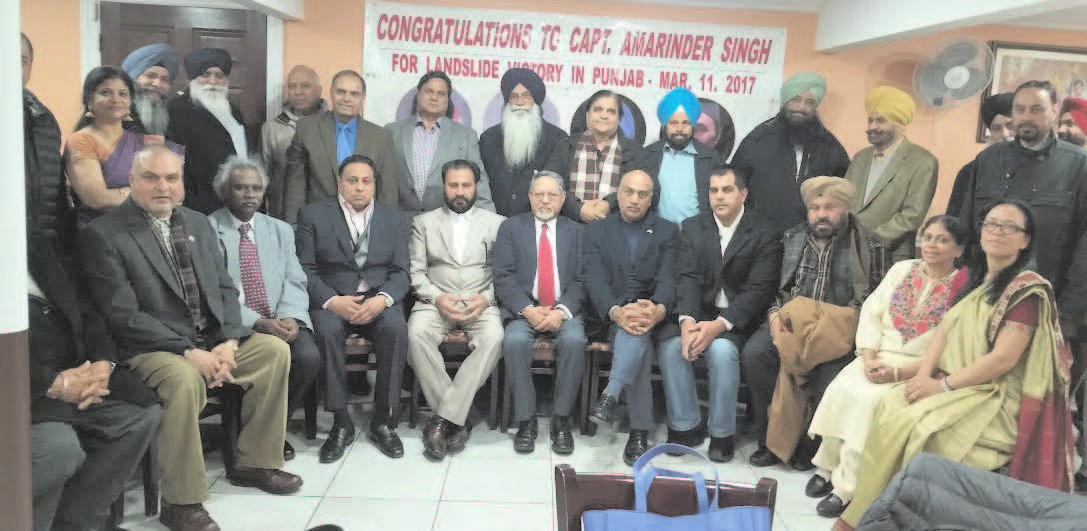
    NEW YORK (TIP): A large crowd of the Indian National Overseas Congress, USA officials, members and supporters welcomed the long-awaited news of Capt. Amarinder Singh’s landslide victory (77/117) in the state assembly elections in Punjab.

    Led by Harbachan Singh, Secretary-General of INOC, USA, loud chants of “Congress Party Zindabad, and Capt. Amarinder Singh Zindabad,” resonated in the hall where a large gathering had assembled.

    Harbachan Singh congratulated the gathering andannounced”, “Congress party has scored a phenomenal success. The vibrant Congress spirit is fully focused again. There is no stopping now.”

    Singh, who congratulatedparty president Sonia Gandhi and each MLA for his or her victory, was addressing the assembly in the absence of George Abraham, Chairman and Mohinder Singh Gilzian, President of INOC, USA. who were both in Punjab to welcome the election results.

    Tejinder Singh Gill, Senior Vice President, Karamjit Singh Dhaliwal, Vice President, and Jasvir Singh Nawanshahar, President of Punjab Chapter of INOC, USA greeted the crowd and thanked everyone for their hard work and expressed full confidence in the great leadership of Capt. Amarinder Singh. They believed that the enthusiasm which Capt. Amarinder Singh witnessed in New York during his last visit strengthened his resolve to fight harder for the people. It was acknowledged that Mohinder Singh Gilzian and Tejinder Singh Gill had spent considerable time meeting people in Punjab. Others had kept in touch with their relatives and friends from here.

    Harbachan Singh declared that voters are very educated now and know how to stand for their rights and for what is right. The respect for truth and integrity is on the riseas evidenced by the social media stronghold. “Let’s therefore stand up and roll up the sleeves now and respond to the Capt.’s call, “he added. The Capt. wants to hit the ground running andimmediately begin work on his progressive agenda and with the help of science and technology, bring hope and relief to people. The Congress Party is over 127 years old and has the most experience of all the political parties in India. “Economic recovery is paramount,”the Capt. laid out, “and it is the will of the people that shall guide his administration in all areas, using state of the art strategies, in the creation of jobs, improving health and education system, eliminatingdrugs, increasingdevelopment, dealingseverely with corruption, encouraging industries, modernizing agriculture, transportation and infrastructure, etc.”

    Several prominent community leaders took the rostrum and spoke passionately about the dire needs of Punjab which had been neglected for the past 10 years and which, for sure, will be addressed now. Kulbir Singh, Jagir Singh, Piara Singh Barnala, Harminder Singh Panam, Ms.Malini Shah, Harry Singh, Ms. Jaya Sundaram, John Joseph, BaldevSingh, RajeshAlladad, Ms. Leila Maret, Shangara Singh Rana and Devindra Vora were amongst the many important speakers.

  • Captain Amarinder Singh takes over as the 26th Chief Minister of Punjab

    Captain Amarinder Singh takes over as the 26th Chief Minister of Punjab

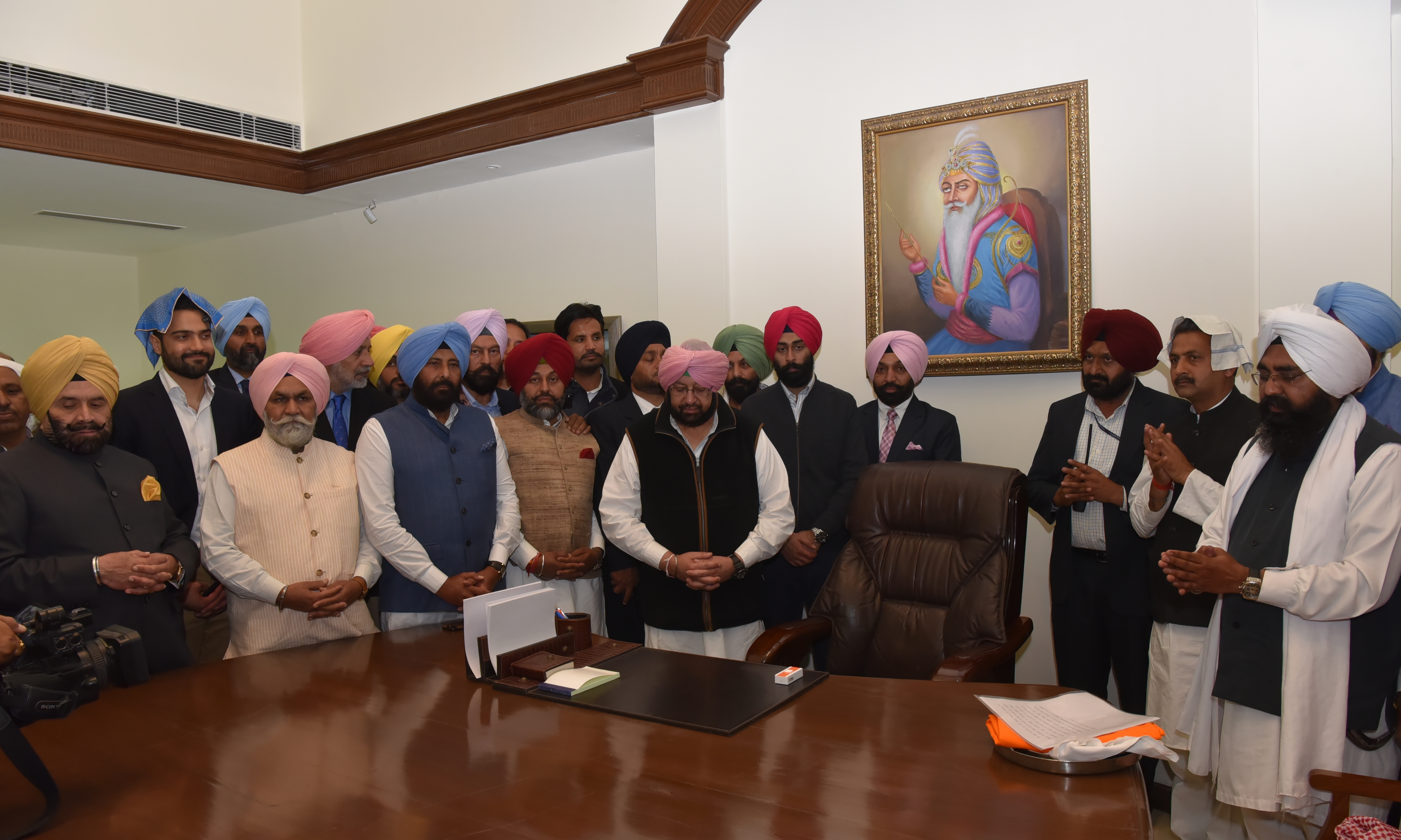
    CHANDIGARH (TIP): Capt Amarinder Singh was on March 16 sworn-in, at a simple ceremony, as the Punjab chief minister for the second time with nine ministers, including Navjot Singh Sidhu also taking the oath. Earlier, he had led the Congress government from 2002 to 2007.

    Navjot Sidhu, the cricketer-turned politician, was second among the list of nine ministers to be sworn in. Brahm Mohindra was sworn in as cabinet minister right after Amarinder.

    Two ministers of State — both women — were sworn in at the ceremony attended among others by former Prime Minister Manmohan Singh and Congress vice-president Rahul Gandhi. The ceremony was held at the Raj Bhawan here and the oath was administered by governor VP Singh Badnore.

    Sporting a black sleeveless jacket adorned with army medals, Amarinder took the oath in English.

    Besides Sidhu those sworn in were Manpreet Singh Badal, estranged nephew of former chief minister Parkash Singh Badal, Sadhu Singh Dharamsot, Tript Rajinder Singh Bajwa, Rana Gurjit Singh and Charanjit Singh Channi.

    Two women MLAs Aruna Chaudhary and Razia Sultana were sworn in as Ministers of State (Independent Charge).

    The Council of Ministers has representation from different castes, regions and religious faiths.

    While Mohindra, the senior-most minister after Amarinder, is a Hindu face in the cabinet hailing from the CM’s home district Patiala, the rest of the cabinet ministers are Sikhs which include Charanjit Singh Channi and Sadhu Singh Dharamsot, both from the Dalit community.

  • Capt Amarinder Singh has team in place: Time to bat for Punjab

    Capt Amarinder Singh has team in place: Time to bat for Punjab

    Capt Amarinder Singh, the new Chief Minister of Punjab, has put together a Cabinet that represents a selection of veterans which, if tea leaves are to be read, portends well for the state. He has managed a delicate balancing act. Although there are some who have been ministers before, many are new to a ministerial assignment. Brahm Mohindra, Manpreet Singh Badal and Tripat Rajinder Singh Bajwa have held ministerial assignments, but the untested Navjot Singh Sidhu, Rana Gurjit Singh and Charanjit Singh Channi are no spring chickens. Some kind of balance has been attempted among Malwa, Majha and Doaba regions. The ministers come from various castes and communities, and two of the Cabinet members are women.

    The new Chief Minister needs to be complimented for weaving together a team of administrators, and the initial selection is of officers known for both integrity and efficiency, essential for working towards all-round development of the state. The temptation for any new political chief is always to seek the familiar. This can often be a mistake, more so in the case of Capt Amarinder Singh, whose coterie politics was widely believed to have been a major cause of discontent during his last term as Chief Minister. His successor, Parkash Singh Badal, succumbed to nepotism, which can equally be the undoing of any power figure.

    Now that Capt Amarinder Singh’s core team is in place, the pressure would be on him from Day 1 to deliver on the promises, which would, of course, include those made behind closed doors as well as those to the public. If he concentrates on the latter, he will be able to ignore the puerile. The relatively simple swearing-in ceremony should set the tone. Punjab has had to bear the burden of ‘adjusting’ political and other ‘leaders’ in public offices rather than appointing capable individuals who may do justice to the responsibilities assigned. Change is expected by the voters, and those who entrusted with delivering it must keep their focus on the larger interests of Punjab, not just political gymnastics that have long been the bane of the state.

  • Amarinder’s son gets notice for lying about foreign bank accounts

    Amarinder’s son gets notice for lying about foreign bank accounts

    LUDHIANA (TIP): Chief judicial magistrate Ranjeev Kumar in Ludhiana issued notice to Raninder Singh, the son of Punjab Congress president Capt Amarinder Singh, for lying to the income tax department about his foreign bank accounts.

    Acting on a criminal complaint by Amit Dua, income tax deputy director, investigation, against Raninder for giving false information under oath, the court asked him to file a reply on July 26, the next date of hearing.

    The income tax department has found that the former chief minister’s son is a direct beneficiary of assets maintained and controlled through foreign business entities. These include accounts with HSBC Private Bank, Geneva. Raninder is also a trustee of the UK-based Jacaranda Trust.

    When the department confronted Raninder with this information last year, he denied having any foreign bank accounts.

    This led the department to file the complaint under Sections 181 (false statement on oath) and 177 (furnishing false information) under the Indian Penal Code and Section 277 (false statement in verification) of the Income Tax Act.

  • Will canvass rather than contest: Capt

    Will canvass rather than contest: Capt

    NEW DELHI (TIP): The Congress hunt for a strong candidate for the Amritsar seat is likely to stop at senior leader OP Soni with former Punjab Chief Minister Capt Amarinder Singh learnt to have expressed a desire to canvass for the party rather than contest.

    Though Amarinder on March 20 said he would abide by whatever Congress president Sonia Gandhi decided for him, there were indications that he was more interested in campaigning for the party across Punjab and the country. He is part of the 50-member central campaign committee of the party that Sonia heads.

    Amarinder reportedly met Sonia to apprise her of his views. His stand over his preference for campaigning vis-a-vis contesting remained unchanged since his name was first proposed for the Bathinda Lok Sabha seat by some Punjab Pradesh Election Committee members, including state party chief Partap Singh Bajwa. Bajwa today reiterated that Amarinder was a potential candidate against BJP’s Arun Jaitley, provided he decided to contest. “If Amarinder takes on Jaitley, there will be a mega fight and secular forces will win.

    If a leader of Amarinder’s stature fights, Jaitley will be history,” he said. Amarinder, however, maintained that he had left the decision on Sonia Gandhi and it would be worthwhile to wait for her decision. The comment is being seen as a hint that he is unlikely to be fielded. Senior Punjab Congress leaders said Amarinder’s case could not be equated to that of sitting MPs Bajwa and Manish Tewari, who were seen to be running away from elections till the high command forced them into the contest.