Tag: Cassini

  • METHANOL DISCOVERED AROUND SATURN MOON ENCELADUS

    METHANOL DISCOVERED AROUND SATURN MOON ENCELADUS

    LONDON (TIP): For the first time, scientists have detected large quantities of methanol molecules around Saturn’s moon Enceladus, a finding that has significant implications for the search for alien life.

    Enceladus has peaked scientists’ interest since water rich plumes were discovered gushing from its south pole. The discovery was made by the Cassini spacecraft, which has since flown through the plumes and sampled organic compounds.

    The latest results, however, were gained using the IRAM 30-metre radio telescope in the Spanish Sierra Nevada, and reveal a higher-than-expected quantity of the molecule methanol around Enceladus.

    This is the first detection of a molecule from Enceladus with a ground-based telescope. Enceladus’s plumes are thought to originate in water escaping from a subsurface ocean through cracks in the moon’s icy surface.

    Eventually these plumes feed into Saturn’s second outermost ring, the E-ring. Recent work has found similar amounts of methanol in Earth’s oceans and Enceladus’s plumes.

    However, the new discovery suggests that material spewed from Enceladus undertakes a complex chemical journey once vented into space. “Recent discoveries that icy moons in our outer Solar System could host oceans of liquid water and ingredients for life have sparked exciting possibilities for their habitability,” said Emily Drabek-Maunder, from Cardiff University in the UK.

    “But in this case, our findings suggest that that methanol is being created by further chemical reactions once the plume is ejected into space, making it unlikely it is an indication for life on Enceladus,” said Drabek-Maunder.

    The team suggests the unexpectedly large quantity of methanol may have two possible origins: either a cloud of gas expelled from Enceladus has been trapped by Saturn’s magnetic field, or gas has spread further out into Saturn’s Ering.

    In either case, the methanol has been greatly enhanced compared to detections in the plumes. “Observations aren’t always straightforward. To interpret our results, we needed the wealth of information Cassini gave us about Enceladus’s environment,” said Dave Clements from Imperial College of London.

    “This study suggests a degree of caution needs to be taken when reporting on the presence of molecules that could be interpreted as evidence for life,” said Clements. “This finding shows that detections of molecules at Enceladus are possible using ground-based facilities,” said Drabek-Maunder.

    “However, to understand the complex chemistry in these subsurface oceans, we will need further direct observations by future spacecraft flying through Enceladus’s plumes,” she said.

    Source: PTI

  • NASA’S CASSINI SET TO  FLY CLOSEST EVER TO SATURN’S RINGS

    NASA’S CASSINI SET TO FLY CLOSEST EVER TO SATURN’S RINGS

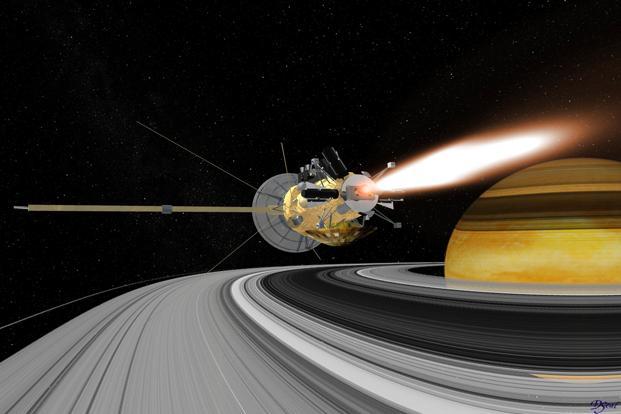
    WASHINGTON (TIP): NASA’s Cassini spacecraft is set to begin a thrilling ride around Saturn, grazing past its outer rings to provide the closest-ever insight into the planet’s features.

    Between November 30 and April 22, the Cassini spacecraft will circle high over and under the poles of Saturn, diving every seven days – a total of 20 times -through the unexplored region at the outer edge of the main rings.

    Engineers at NASA have been pumping up the spacecraft’s orbit around Saturn this year to increase its tilt with respect to the planet’s equator and rings.

    On November 30, following a gravitational nudge from Saturn’s moon Titan, Cassini will enter the first phase of the mission’s dramatic endgame.

    Launched in 1997, Cassini has been touring the Saturn system since arriving there in 2004 for an up-close study of the planet, its rings and moons.

    During its journey, Cassini has made numerous dramatic discoveries, including a global ocean within Enceladus and liquid methane seas on Titan.

    “We’re calling this phase of the mission Cassini’s Ring-Grazing Orbits, because we’ll be skimming past the outer edge of the rings,” said Linda Spilker, Cassini project scientist at NASA’s Jet Propulsion Laboratory in the US.

    “In addition, we have two instruments that can sample particles and gases as we cross the ringplane, so in a sense Cassini is also ‘grazing’ on the rings,” said Spilker.

    On many of these passes, Cassini’s instruments will attempt to directly sample ring particles and molecules of faint gases that are found close to the rings.

    During the first two orbits, the spacecraft will pass directly through an extremely faint ring produced by tiny meteors striking the two small moons Janus and Epimetheus.Ring crossings in March and April will send the spacecraft through the dusty outer reaches of the F ring. “Even though we’re flying closer to the F ring than we ever have, we’ll still be more than 7,800 kilometres distant. There’s very little concern over dust hazard at that range,” said Earl Maize, Cassini project manager at JPL. The F ring marks the outer boundary of the main ring system; Saturn has several other, much fainter rings that lie farther from the planet.

    The F ring is complex and constantly changing. Earlier Cassini images have shown structures like bright streamers, wispy filaments and dark channels that appear and develop over mere hours.

    The ring is also quite narrow – only about 800 kilometres wide. At its core is a denser region about 50 kilometres wide.

    Cassini’s ring-grazing orbits offer unprecedented opportunities to observe the menagerie of small moons that orbit in or near the edges of the rings, including best-ever looks at the moons Pandora, Atlas, Pan and Daphnis.

    Grazing the edges of the rings also will provide some of the closest-ever studies of the outer portions of Saturn’s main rings (the A, B and F rings).