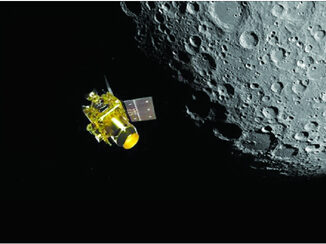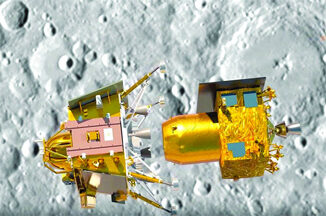
The Indian Space Research Organization (ISRO) has successfully brought the propulsion module from the Chandrayaan-3 mission back to Earth’s orbit.
While not in the original mission plan, ISRO used the logistical advantages from a near perfect Chandrayaan-3 mission to bring back the module which had been orbiting around the Moon, after travelling nearly 384,000 km. “In another unique experiment, like the hop experiment on the Vikram Lander, the Propulsion Module (PM) of Chandrayaan-3 was moved from an orbit around Moon to an orbit around Earth,” ISRO announced on Monday (December 10). The module had left Earth’s on August 1.
Unlike Chandrayaan-2, which had a full fledged orbiter with major payloads and communications systems, Chandrayaan-3 featured a lighter propulsion module. For the lander’s communications with Earth, the mission used the Chandrayaan-2 orbiter, which remains functional four years after the 2019 mission.
The only scientific instrument aboard was the Spectro Polarimetry of Habitable Planet Earth (SHAPE) — an experimental payload which studies the signatures that make Earth a habitable planet, in order to possibly identify habitable planets outside the solar system. After the propulsion module separated from the lander on August 17 — 100 km from the lunar surface, and six days before the scheduled landing — it was supposed to continue orbiting the Moon for six months or more.
“The main function of PM is to carry the LM (lander module) from launch vehicle injection till final lunar 100 km circular polar orbit and separate the LM from PM. Apart from this, the PM also has one scientific payload as a value addition which will be operated post separation of the Lander Module,” ISRO had stated ahead of the mission.
There were no plans to bring the propulsion module back to Earth, with ISRO stating that it simply wanted to operate the SHAPE payload for about three months — the mission life of the module. What helped was just how precise and efficient the Chandrayaan-3 Mission had gone thus far. “The meticulous mission planning of the earth and lunar burn maneuvers and precise injection orbit by launch vehicle resulted in propellant saving,” P Veeramuthuvel, Chandrayaan-3’s project director, told The Indian Express. To be precise, after over a month of operations, the PM continued to hold over 100 kg of fuel. “It was decided to use the available fuel in the PM to derive additional information for future lunar missions, and demonstrate the mission operation strategies for a sample return mission,” the space agency said on Tuesday.
A mission plan was created to ensure the PM’s return without crashing on to the lunar surface, or entering into a low Earth orbit. “Considering the estimated fuel availability, and the safety to GEO spacecrafts, the optimal Earth return trajectory was designed for October 2023 month,” ISRO said on Tuesday. ISRO initially performed a maneuver on October 9, to raise the altitude of orbit of the PM around the moon to 5112 km from 150 km (from 2.1 hrs to 7.2 hrs). The Trans-Earth injection (TEI) maneuver was performed on October 13, following which the propulsion module made four Moon fly-bys before leaving the Moon’s sphere of influence on November 10.
Tag: Chandrayaan-3
-

Another milestone achieved as Isro brings Chandrayaan-3 home
-

‘Proud, glad to be your partner’: America hails India on Chandrayaan-3 moon landing
WASHINGTON D.C. (TIP): American politicians, newspapers and space research institutions hailed India Wednesday, August 23, on the successful moon landing of Chandrayaan-3 as the country entered the elite club of three other nations — United States, Russia and China — that have a rover on the lunar surface.
In the process, India became the first country among the elite group to have its rover on the moon’s south pole region, which the Indian Space Research Organisation believes could have traces of water.
“Congratulations to India for the historic landing of Chandrayaan-3 on the southern polar region of the moon,” US Vice President Kamala Harris said on X, known as Twitter till recently. “It is an incredible feat for all the scientists and engineers involved. We are proud to partner with you on this mission and space exploration more broadly,” said Harris, whose mother was from India. The vice president heads the National Space Council.
Space cooperation was one of the major topics of discussion during Prime Minister Narendra Modi’s State visit to the US this summer. India signed the Artemis accord, and also the two countries decided to work together on an international space station.
“Congratulations ISRO on your successful Chandrayaan-3 lunar South Pole landing! And congratulations to India on being the 4th country to successfully soft-land a spacecraft on the Moon. We’re glad to be your partner on this mission!” said NASA Administrator Bill Nelson. Chandrayaan-3 touched down on the unchartered lunar south pole at 6.04 pm on Wednesday. No country has ever landed on the treacherous south pole that scientists believe could hold important reserves of frozen water and precious elements. Russia’s south pole-bound Luna-25 spacecraft crashed into the Moon on Sunday after spinning out of control.
“Congratulations to ISRO and the people of India for the Chandrayaan-3’s historic landing on the South Pole of the Moon. We look forward to deepening our partnership with India on space exploration in the years ahead,” US National Security Advisor Jake Sullivan said.
Senator John Cornyn, Co-Chair of the Senate India Caucus, said Chandrayaan-3 landing on the moon was a ‘victory cry of a new India’. Congressman Rich McCormick said it was an “amazing achievement for our friends in India”. Congressman Don Beyer congratulated the ISRO and all who worked to make the “remarkable and historic” achievement possible.
Indian-American Congressman Raja Krishnamoorthi said the successful landing of the Vikram lander on the moon’s surface is a historic accomplishment for India, and a major step in lunar discovery for the world.
Congressman Michael McCaul, the Chairman of the House Foreign Affairs Committee, said he was looking forward to see what India and the US can accomplish in the outer space together. “I want to congratulate India for being the fourth country to land on the moon. This historic success adds a new dimension to our partnership.”
Congratulations to India for its successful landing of Chandrayaan3 on the moon, said Congressman Brad Sherman. “India is the first country to ever land a craft on this part of the lunar surface.”
The Science wing of the US Department of State congratulated their “Artemis Accords partner ISRO”. “Your success will power the imagination and light the future of people around the world,” it said.
Mainstream American newspapers, many of which had been skeptical of India’s space mission and sometimes even made fun of it through cartoons, noted the great Indian achievement.
“The Chandrayaan-3 mission makes India the first country to reach the lunar south polar region in one piece and adds to the achievements of the country’s homegrown space program,” The New York Times reported.
The Washington Post wrote a couple of stories covering various perspectives and an opinion piece to celebrate this historic occasion.
“It is a marvelous achievement for India’s space program — and symbolic of an important moment in geopolitics. For the successful landing came just days after a Russian mission to the same region went haywire and smashed into the lunar surface like a hammer coming down on the last nail in the coffin of Russia’s decline,” wrote David Von Drehle, Deputy Opinion Editor of the daily.
“‘India Is on the Moon’: Chandrayaan-3 Spacecraft Lands on Lunar South Pole,” wrote The Wall Street Journal.
Congratulatory messages came from several eminent people as well. Indian American CEOs Satya Nadell from Microsoft and Sunder Pichai of Google led the US corporate sector in lauding the success of India’s mission.
“My congratulations to ISRO on the moon landing of the Chandrayaan-3. What an exciting moment for India – and the future of space exploration,” Nadella wrote.
Pichai described an incredible moment! “Congratulations to ISRO for the successful landing of #Chandrayaan3 on the moon this morning. Today India became the first country to successfully achieve a soft landing on the southern polar region of the moon,” he said.
“Wow! Chandrayaan-3’s moon landing is a great achievement for India and all humanity! Congratulations to the ISRO team and all of India,” said Gita Gopinath, First Deputy Managing Director of the IMF.
“India, you have made history today,” said African American singer Mary Millben in a video message posted on various social media platforms.
Astrophysicist Neil deGrasse Tyson, who has more than 14 million followers on X, said, “Congratulations to India for landing Chandrayaan-3 on the Moon — joining Russia, USA, & China as the only countries to have achieved this feat. More importantly, it’s the first mission of any country to arrive near the Lunar South Pole – a possible location for future Moon bases.”
Dr. Michael Salla, author of the Secret Space Programs Book series, said India is fast becoming a major space power. “It’s PM, N. Modi, believes ancient Vedic India also flew to the Moon on Vimanas,” he said.
Sending her “warmest congratulations” to everyone at ISRO for becoming the very first team to land at the lunar south pole, US Energy Secretary Jennifer Granholm said the global scientific community is a strong and united one, and together “we advance opportunity for all humankind”.
(Source: PTI)
-

What will Chandrayaan-3 do on the Moon?
As the Indian Space Research Organisation (ISRO) gears up to launch the Chandrayaan-3 mission to the Moon, the world is awaiting the discoveries that it will unravel on the lunar surface. The mission is likely to be launched this year and Isro has learned from the failure of the previous mission.
Chandrayaan-3 is a follow-up to the Chandrayan-2 mission that will demonstrate end-to-end capability in safe landing and roving on the lunar surface and consists of a lander-rover configuration. The mission will be launched aboard India’s most powerful rocket, the LVM-III, from the Satish Dhawan Space Centre in Sriharikota.
While the Indian space agency is yet to say anything about the final launch dates, it is likely to be in the second or third quarter of 2023.
The mission is aimed at better understanding the Moon’s composition. Isro has laid out three main objectives for the mission, which include demonstrating a safe and soft landing on the lunar surface, demonstrating the rover’s roving capabilities on the moon and performing in-situ scientific observations. Isro said that the mission’s Chandra Surface Thermophysical Experiment (ChaSTE) will measure the thermal conductivity and temperature, while the Instrument for Lunar Seismic Activity (ILSA) will measure the seismicity around the landing site. The Langmuir Probe (LP) will estimate the plasma density and its variations and a passive Laser Retroreflector Array from NASA is accommodated on the mission for lunar laser ranging studies.
“Chandrayaan-3 consists of an indigenous Lander module (LM), Propulsion module (PM), and a Rover with the objective of developing and demonstrating new technologies required for Interplanetary missions. The Lander will have the capability to soft land at a specified lunar site and deploy the Rover which will carry out in-situ chemical analysis of the lunar surface during the course of its mobility. The Lander and the Rover have scientific payloads to carry out experiments on the lunar surface,” Isro said in new detail.
Source: India Today