Tag: Chhattisgarh

  • THE FIRST INDIA DAY PARADE IN SEATTLE SHOWCASES ALL 28 STATES OF INDIA

    THE FIRST INDIA DAY PARADE IN SEATTLE SHOWCASES ALL 28 STATES OF INDIA

    SEATTLE (TIP): As part of the 79th Independence Day celebrations, the Consulate General of India in Seattle, in partnership with the City of Seattle, organized the First India Day Parade in Downtown Seattle on 16 August 2025. It showcased the rich cultural diversity of all states of India, including their cultural dance performances, along with an India Pavilion that put-on display ODOP (One District One Product) of each state and union territory of India.

    Participants representing Kashmir at the First India Day Parade in Seattle.
    Float and participants representing Kerala at the First India Day Parade in Seattle.

    Several dignitaries graced the occasion as Guests of Honor, including Hon’ble Mayor of Seattle Bruce Harrell, US Congressman Adam Smith, Seattle Port Commissioner Sam Cho, Seattle Parks & Recreation Superintendent/Director Mr. A P Diaz, King County Councilmember Claudia Balducci, US Coast Guard’s Northwest District Commander Rear Admiral Arex Avanni, Washington Supreme Court Justice Steven Gonzalez, along with Mayors of Mercer Island, Normandy Park, Sammamish and North Bend.

    Float and participants portraying culture of West Bengal at the First India Day Parade in Seattle.
    Performance representing celebration of Janmashtami in Uttar Pradesh at the First India Day Parade in Seattle.

    The inaugural ceremony began with a prayer invocation from the Vedas, followed by flag hoisting of India and national anthems of India and the United States. A vibrant cultural performance, Natyam: A Dance Mosaic of Bharat, showcasing the diverse dance traditions from across India, enthralled the audience. Consul General, along with Mayor of Seattle and other participating dignitaries ceremonially flagged off the India Day Parade, with tricolor balloons rising in the sky and marking the start of the grand procession.

    Float representing Rajasthan at the First India Day Parade in Seattle.
    Mayor of Seattle Bruce Harrell addressing the participants and visitors of the First India Day Parade in Seattle.

    Addressing the gathering of over 2000 attendees, Mayor of Seattle Bruce Harell welcomed the opening of the Indian Consulate in Seattle as a landmark development and noted that Seattle was diverse and a city of technological repute because of the contributions of Indian Americans and that Seattle City was honored to co-host the first-ever India Day Parade. He added that USA needs to learn India’s message of love, compassion and non-violence. U.S. Congressman Adam Smith, in his address, emphasized that peace and security across the globe are of paramount importance, noting that the United States has no better partner in working towards those goals than India.

    Participants representing Gujarat booth in India Pavilion as part of the First India Day Parade in Seattle.
    Visitors at Chhattisgarh booth in India Pavilion as part of the First India Day Parade in Seattle.

    In the true Indian spirit of Unity in Diversity, thousands of Indian-Americans from across all States of India took part in the parade through floats and performances that showcased their region’s unique culture, languages, and art forms. Each float and performance was coordinated by community groups led by prominent Indian-American community leaders. While WATA (Washington Telangana Association) was the community lead, some highlights included Gujarat’s vibrant Garba, Maharashtra’s spirited Lavani folk dance, Andhra Pradesh’s graceful Kuchipudi, Odisha’s Boita Bandana with Vande Utkala Janani, and West Bengal’s float depicting the values of Swami Vivekananda.

    One District One Product (ODOP) items in Rajasthan booth in India Pavilion as part of the First India Day Parade in Seattle.
    Booths representing the States of India in India Pavilion as part of the First India Day Parade in Seattle.

    Alongside the States and regional representations, thematic performances added further depth—such as Indian Heritage Arts, which displayed traditional paintings created by young Indian-Americans, and Gurukul, which celebrated India’s vast linguistic diversity, and an energetic performance by Beats of Washington depicting the valor and legacy of Chhatrapati Shivaji among many others.

    Visitors witnessing the flag hoisting at the First India Day Parade in Seattle.
    Float representing Telangana at the First India Day Parade in Seattle.
    Float representing Janmashtami at the First India Day Parade in Seattle.
    Uttar Pradesh booth in India Pavilion as part of the First India Day Parade in Seattle.

    A major attraction of the event was the “India Pavilion,” where more than 30 booths were set up to represent the 28 States of India along with several thematic exhibits. Each booth showcased distinctive One District One Product (ODOP) items, accompanied by descriptions highlighting their cultural and historical significance. Dignitaries and visitors also enjoyed sampling regional culinary specialties and exploring cultural artifacts, offering a vivid glimpse into India’s heritage and traditions.

    (Based on a press release issued by Soumith Raju K, Consul, Press, Information & Culture, Consulate General of India, Seattle)

    Beats of Washington representing the legacy of Chhatrapati Shivaji at the First India Day Parade in Seattle.


  • Documentary Screening on Vivek Tankha draws a large crowd of Indian Diaspora Leaders at the New York Indian Film Festival

    Documentary Screening on Vivek Tankha draws a large crowd of Indian Diaspora Leaders at the New York Indian Film Festival

    NEW YORK CITY (TIP): The Indian Overseas Congress (IOC) USA hosted a remarkable celebration on Saturday, June 21, at the iconic Village East by Angelika theater in Manhattan, marking the screening of “The Renaissance Man”, a documentary film chronicling the inspiring life and legacy of Vivek Tankha. The event was part of the New York Indian Film Festival and drew an enthusiastic audience, including senior leaders of IOC-USA and distinguished members of the Indian diaspora.

    The documentary highlights the extraordinary journey of Shri Vivek Tankha ji —Senior Advocate of the Supreme Court of India, former Additional Solicitor General, sitting Rajya Sabha MP, and a dedicated humanitarian. His contributions span multiple sectors, including public interest litigation, tribal healthcare, education, disability rights, and disaster relief. The film captures both his legal brilliance and his compassionate leadership, especially through his widely acclaimed initiative “Rahat”, which has provided critical medical and disaster aid to marginalized communities in Madhya Pradesh, Chhattisgarh, and beyond.

    Photos of documentary viewing of film “ The Renaissance Man: Life and Times of Vivek Tankha” at the New York Film festival on June 21, 2025. showing Shri Vivek Tankha ji (sitting in center) responding to questions from the audience.

    During the post-screening interaction, Mr. Tankha shared powerful insights into his motivations and lifelong mission to use law and public service as instruments for justice and upliftment.  He spoke of landmark cases, including his pivotal legal work for the Bhopal Gas Tragedy victims, and emphasized the need for ethical and empathetic leadership in contemporary India.

    The event was held under the leadership of Mohinder Singh Gilzian, President of the Indian Overseas Congress USA, who opened the celebration with high praise for Mr. Tankha.

    “If even one percent of India’s population embodied the intellect, integrity, and compassion of Vivek Tankha,” said Mr. Gilzian, “India would be a different country. His life offers a blueprint for the kind of leadership our nation urgently needs.”

    Adding to the evening’s grace and significance, Mr. Sam Pitroda, Global Chairman of Overseas Congress Department of A.I.C.C., sent a heartfelt video message applauding Mr. Tankha’s decades of service in law, policy, and social reform.

    “Vivek is not just a legal scholar; he’s a people’s advocate. His work touches lives where it matters most,” Mr. Pitroda said.

    The celebration was inaugurated with an inspiring and powerful opening remarks by Harbachan Singh, Secretary-General of IOC-USA, who recognized very highly Mr. Tankha’s awesome enduring legacy of justice and social responsibility.  He likened all the solid attributes of Shri Vivek Tankha ji to those of Mahatmas and Heros and made a moving equation of his personality and service to them.  Mr. Tankha embodied humility, softness and a profound depth of knowledge and human experience which has drawn crowds of people to him in total acceptance of him as no less than acclaimed Mahatmas and Heros.

    The screening was more than a celebration of an individual—it was a tribute to a life of purpose, service, and vision. It resonated as a rallying call to the Indian diaspora to identify, support, and champion leaders like Vivek Tankha, whose integrity and impact go far beyond the boundaries of law and politics.

    The event was graced by a wide array of IOC-USA leaders who honored Mr. Tankha with a bouquet and a traditional shawl, a symbolic gesture of respect and admiration.  Among the IOC USA senior leaders present were: Working President (North East Zone) Pradeep Samala;  Vice President John Joseph: Vice President Baldev Randhawa;  General Secretaries; Sharath Chandra, Sophia Sharma and  Rajeev Mohan;  President of Maryland Chapter Chaudhry Pratap Singh;  President of Andhra Chapter Srinivasrao Bhimineni; Chairman of the Punjab Chapter; Phuman Singh Ibrahimpur; Secretary, IOC.USA Jaswinder Singh Kang and his team; Dr.Yogesh Dayma from Boston: Rockland Chapter President Shaimi Jacob: Amanpreet Aman and Mukesh (Mike) from New Jersey: Patel Sridhar Reddy from Telengana Chapter Detroit: Harpreet Singh Happy and Sunny Singh:   Harvendar Singh and Qayam Masumi representing the New Jersey Chapter, among others.

    In addition, several local IOC-USA leaders, business professionals, lawyers, dignitaries, activists, and scholars from across the United States traveled to New York to attend the event and personally extend their congratulations to Mr. Tankha.

    The event concluded with a vibrant Q&A session, where attendees engaged with Mr. Tankha on a range of topics—from his legal battles and legislative work in Parliament to his grassroots efforts for the underprivileged and youth empowerment.

    The screening was more than a celebration of an individual—it was a tribute to a life of purpose, service, and vision. It resonated as a rallying call to the Indian diaspora to identify, support, and champion leaders like Vivek Tankha, whose integrity and impact go far beyond the boundaries of law and politics.

    At the reception, Secretary General  Harbachan Singh led with the award of a Proclamation of Honor by Shri Vivek Tankha ji and Mohinder Singh ji to Attorney Jaspreet Singh in appreciation of his outstanding leadership, benevolent services and support of the community.

    Following the above, Harbachan Singh requested the entire gathering to rise in solemn observance of a moment of silence in condolence and sympathy of the victims of the recent Air India airplane crash and sharing the sorrow and pain with the aggrieved families.  Similar solemn observance was also observed to grief the sudden, shocking and painful to bear demise of the brother of Shri Vivek Tankha ji in India the day before this event accelerating the swift return to India of Mr. Vivek Tankha ji.  May all the departed souls Rest in Peace! by the grace of Almighty God.

  • Punjab cadre IPS officer Parag Jain to head R&AW, played key role in Op Sindoor

    Punjab cadre IPS officer Parag Jain to head R&AW, played key role in Op Sindoor

    NEW DELHI (TIP): Senior Indian Police Service (IPS) officer Parag Jain, widely known for his expertise in intelligence gathering and affairs related to India’s neighborhood, has been appointed as the new head of the country’s external intelligence agency, the Research and Analysis Wing (R&AW), officials said on Saturday.

    Jain is a 1989-batch IPS officer of Punjab cadre. He will succeed Ravi Sinha, who completes his tenure on June 30.

    Sinha is a 1988 batch IPS officer of Chhattisgarh cadre. Jain is currently heading the Aviation Research Centre, which played a vital role during ‘Operation Sindoor’ by collecting intelligence on the Pakistani armed forces.

    Jain has previously served as Senior Superintendent of Police (SSP), Chandigarh, and has represented India in Canada and Sri Lanka. He has also been posted in Jammu and Kashmir, where he played an important role in the Centre’s counter-terrorism strategy in the strife-torn Union Territory.

  • In big blow to Naxals, 31shot dead in Chhattisgarh encounter

    In big blow to Naxals, 31shot dead in Chhattisgarh encounter

    Dantewada (TIP)- The bodies of three more Naxalites were recovered on Saturday, October 5, morning in Chhattisgarh’s Bastar region, where a fierce encounter with security personnel took place a day ago, police said. With this, the number of Naxalites killed in the gun battle with the security personnel on Friday has risen to 31, they said, adding that a search operation is still under way in the area. “Bodies of three more Naxalites were recovered this morning from the dense forest where the encounter took place on Friday,” Inspector General of Police (Bastar range) Sundarraj P told PTI.
    “With this, the toll of Naxalites in the encounter rose to 31. The identity of the Naxalites is yet to be ascertained, but prima facie it appears that they belonged to PLGA (People’s Liberation Guerilla Army) company No. 6, Platoon 16 of Maoists and east Bastar division of Maoists,” he said.
    On Friday, the gunfight broke out between security forces and Naxalites around 1 am in a forest between Nendur and Thulthuli villages on Dantewada and Narayanpur inter-district border, where a joint team of District Reserve Guard (DRG) and Special Task Force (STF) was out on an anti-Naxal operation.
    The intermittent firing lasted for a long time and the security forces continued search operations in the area.
    This is the highest number of fatalities suffered by Maoists in a single operation since the creation of the state 24 years ago and the offensive comes more than five months after 29 Naxalites, including higher-ranking cadres, were gunned down in an encounter with security personnel in Kanker district.
    A jawan of the state police’s DRG sustained injuries in a blast in a shell of Under Barrel Grenade Launcher (BGL) fired by Maoists during the gunfight, the official said.
    Along with the bodies, a cache of weapons, including an AK-47 rifle, one SLR (self-loading rifle), one INSAS rifle, one LMG rifle and one .303 rifle were also recovered from the encounter spot, the IGP said.
    With this, as many as 185 Maoists have been killed in 93 separate major encounters in Bastar in 2024 so far. While 663 Naxals were arrested, 656 ultras have surrendered in Bastar so far. The slain Maoists included three senior Naxal leaders, Jaganna, Rupesh and Jagdish, who were members of Dandakaranya Special Zonal Committee (DKSZC), the most powerful wing of Maoists. Security forces have intensified counterinsurgency operations in Bastar in the wake of Union home minister Amit Shah setting March, 2025 the deadline to end Naxalism in Chhattisgarh. Chhattisgarh chief minister Vishnu Deo Sai has hailed the security forces for executing the biggest ever counterinsurgency operation in Bastar in the state in which 28 Maoists were killed in Abujhmad on Friday. He said that Naxalism is going to end in Bastar soon and peace will return. Mr Sai recalled the deadline set by Union home minister Amit Shah to root out Leftwing extremism in the country by March 2026 and expressed confidence that it would be met. Sai convened a meeting of senior police officers here on Friday night to review the security situation in Bastar in the wake of the Abujhmad encounter.

  • It’s back to the drawing board for the Congress

    It’s back to the drawing board for the Congress

    The Congress needs to go beyond the current focus on the negative aspects of the ruling dispensation or its perceived faultlines

    “The Congress can build on this base, but to take this process forward, it needs to project a clear ideological narrative and articulate its own politics. For a start, it shouldn’t try to outdo the BJP as a ‘more Hindu’ party, particularly when voters have the option to go for the real thing. The ideological counter must reflect a different model of development with an emphasis on rights-based welfare, especially employment guarantees interlaced with social harmony. In sum, the Congress has to reboot its political discourse by foregrounding something substantive, which is best done by advocating a positive agenda that can galvanize the electorate and goes beyond the current focus on the negative aspects of the ruling dispensation or the perceived faultlines within it and the politics it has promoted.”

    By Zoya Hasan

    The Congress’ remarkable victory in Telangana was overshadowed by its devastating defeat in the Hindi heartland in the just-concluded Assembly elections. The Congress has suffered a big blow as it lost all three states — Madhya Pradesh, Rajasthan and Chhattisgarh — it had won in 2018. The Bharatiya Janata Party’s (BJP) comprehensive victory was backed by support across most regions in these states and a strong showing in urban areas. But the Congress, despite its defeat, has managed to retain its vote share — Madhya Pradesh (40.4 per cent), Rajasthan (39.5 per cent) and Chhattisgarh (42.23 per cent). The BJP has gained mostly at the expense of others in the fray. With these triumphs, the BJP has expanded its dominance of a key region ahead of the 2024 General Election. However, the Congress vote share holds considerable significance in the run-up to the Lok Sabha elections.

    The Congress tried to highlight issues such as joblessness and caste discrimination in the hope that it would appeal locally in the state elections and nationally in the General Election. But its two-pronged plank of welfare schemes and social justice was upstaged by the subtext of Hindu nationalism and communal politics. The BJP’s victories highlight the consolidation of Hindu nationalism and the great resonance it enjoys in the heartland states. The use of state machinery, ample financial resources and the party’s organizational framework, buttressed by RSS cadres, have helped it promote itself as a champion of a strong nation, development and welfarism as well as of Hindu interests and the Hindu religion.

    From the outset, the BJP’s campaign pivoted on Prime Minister Narendra Modi, relegating established state leaders to the sidelines. The party decided not to nominate a chief ministerial candidate for any of the states going to the polls. This meant that even popular state leaders of the Congress like Ashok Gehlot and Bhupesh Baghel were not pitted against their local BJP rivals, but against Modi himself. The PM’s huge popularity in north and central India neutralized the public acceptance of these leaders.

    Taking a cue from its experience in Karnataka, where the visibility and prominence of local leaders paid off, the Congress projected state leaders, who were given a free hand. However, the infighting and overweening ambitions of its leaders in Rajasthan and Chhattisgarh put paid to this strategy. Factionalism and divided state leadership, which have been the undoing of the Congress in many states, was on full display throughout its term in office in these two states. Leaders were attacking each other until a few months before the elections, which sent a message to voters that this was a party that couldn’t keep its house in order. A settlement was forged between the warring leaders in both states, but it was a case of too little, too late.

    Apart from factionalism, there was no accord or concord between the state leadership and the high command. The Congress campaign lacked coherence; it appeared disjointed, with powerful state satraps unwilling to countenance any interference on their turf. In contrast, the BJP’s campaign was intensive and focused and the party spoke in one voice. This is not surprising, as the contemporary BJP is a highly centralized party, while the Congress, in a departure from the past, is relatively decentralized.

    To make matters worse, there was no agreement between the Congress and its allies in the state elections. The 28-party INDIA grouping led by the Congress, which came together to fight the BJP, did not feature in the state polls due to inter-party rivalries. Opposition parties should have negotiated state-specific alliances and seat adjustment in a spirit of give-and-take. This is easier said than done. Seat-sharing didn’t happen, which hurt the Congress as well as the INDIA bloc, which the voters saw as a divided house. The fate of the Congress and other parties in this election makes it clear that they can tackle the BJP only when they are united against it.

    A caste-based census was the big battlecry of the Congress to undercut the BJP’s support among the OBCs, but it turned out to be a ‘no-ball’. This call had little traction on the ground, with the issue not paying dividends — the BJP’s share of OBC votes has increased. In any case, it is doubtful that the demand for a caste census is an inspiring or effective counter to Hindu identity politics, which holds much greater appeal for subaltern groups in the current conjuncture. Caste politics and ideas of social justice were not enough without a clear political plank to serve as a counterpoint to the BJP’s politics in these states or effective campaigning, ideological clarity and organizational cohesion to communicate its message.

    There is limited evidence of a correlation between state and national elections. Yet, there’s little doubt that the Congress’ decisive defeat at the hands of the BJP in straight contests has undermined its credibility and is bound to demoralize it at a crucial time when the Lok Sabha elections are just five months away. However, all is not lost as the majority of the voters have opted for non-BJP parties in these critical states.

    The Congress can build on this base, but to take this process forward, it needs to project a clear ideological narrative and articulate its own politics. For a start, it shouldn’t try to outdo the BJP as a ‘more Hindu’ party, particularly when voters have the option to go for the real thing. The ideological counter must reflect a different model of development with an emphasis on rights-based welfare, especially employment guarantees interlaced with social harmony. In sum, the Congress has to reboot its political discourse by foregrounding something substantive, which is best done by advocating a positive agenda that can galvanize the electorate and goes beyond the current focus on the negative aspects of the ruling dispensation or the perceived faultlines within it and the politics it has promoted.
    (The author is Professor Emerita, Centre for Political Studies, JNU)

  • Time for the Congress party to reach out and work together for a united front to save democracy and the nation

    George Abraham, Vice-Chair of IOCUSA

    I salute the victory in Telangana while blaming overconfidence and infighting for the losses in the other three states!
    Telangana stands out as the shining light for the Congress party in the unfortunate defeats elsewhere in the just concluded state elections. Yet, the Congress Party should not give up the fight but rather garner all the energy and strengthen the INDIA alliance for the ultimate prize fight in 2024,” said George Abraham, Vice-Chairman of the IOCUSA and Global coordinator of the IT & Social media for IOC.
    Instead of engaging in the so-called introspection exercise, the leadership should quickly move to clean up the INC Secretariat and engage people who might bring contrasting perspectives that would enrich the debate and arrive at well-thought-out solutions to resolve various issues confronting the party. Keeping Shashi Tharoor at arms-length or removing him as the chairman of the Professional Congress right in the middle of an election is not an intelligent strategy. It is not only a united leadership that may win an election but also using modern strategy and employing the latest technologies that make a difference.
    There must be zero tolerance for groupism all across the party if it wishes to come back to power at the center again. The recent victory in Karnataka may have made some in the leadership a little cocky to the point where the ongoing talk on the INDIA alliance almost appeared to have come to a halt. Congress needs to be cognizant of the fact that fighting the Modi behemoth machine alone would not suffice; Congress may have to take a step back and reach a consensus. The ultimate aim for the next election must be the defeat of Modi but not the debate of who would be the Prime Minister.
    A change of leadership in many state units with young and dynamic individuals with a new vision would go a long way for the party. The victory led by Mr. Revanth Reddy in Telangana is a case in point. The appetite for corruption is still quite rampant in some party circles, and it ought to be seriously checked. In Rajasthan, the simmering leadership dispute should have been brought to an end a long time ago. In Chhattisgarh, a tribal community was driven out of their own homes on allegations of conversions, and the state government closed its eyes for political expediency; in Madhya Pradesh, the leadership appeared to have been practicing soft-Hindutva rather than championing the Nehruvian vision and Ambedkar’s constitution. Why would anybody opt for duplicates when the original BJP, which practices Hindutva ideology, is readily available? It is also time to check the EVMs and make sure the systems are performing well and fulfilling its constitutionally assigned responsibilities.
    It is time for the Congress party to reach out and work together for a united front to save democracy and the nation.
    (The opinion expressed above is strictly personal)

  • Challenge to Hindutva

    Challenge to Hindutva

    • The clamour for a caste census can redefine political equations and alliances in the run-up to Lok Sabha polls

    It’s premature to conjecture if caste is a robust counter to the BJP’s Hindutva. But the BJP’s strategy of employing religion to heighten a pan-Hindu identity among the non-upper castes might be past its shelf life, at least in the state elections.

    “The belated wisdom of a national party such as the Congress plunging headlong into sectional politics discomfited some of its insiders, who believed that it should focus on the economy’s big picture, inflation and livelihood and leave matters like a caste count to the identity-wedded entities it is aligned with in the regions. Insiders said that would be more in keeping with the ‘character’ of these players, some of whom, incidentally, are products of the post-Mandal period.”

    By Radhika Ramaseshan

    The upcoming Assembly elections in Madhya Pradesh, Chhattisgarh, Rajasthan and Telangana have got inextricably linked with three factors — the Bihar Government’s release of a comprehensive caste survey (CCS), the Congress’ promise to conduct a similar caste count if elected to power in these states and the BJP’s response to frame the discourse in a different idiom, featuring leitmotifs drawn from the Hindutva ideology. As the BJP garnered a little over 40 per cent of the OBC votes in the 2019 elections, largely by projecting Modi both as an OBC mascot and a Hindu icon, the Congress was bereft of any such attribute.

    A little before and immediately after the Bihar CCS demonstrated the potential of resurrecting the issue of the empowerment of Other Backward Classes (OBCs) or backward castes, the Congress strongly advocated for a caste count. Former party president Rahul Gandhi described it as an ‘X-ray’ that would reveal the socioeconomic condition of the OBCs, Dalits and Adivasis and challenged Prime Minister Narendra Modi to lay bare the findings of a socioeconomic caste survey undertaken during then PM Manmohan Singh’s tenure. Rahul claimed that the Congress governments in Rajasthan and Chhattisgarh had initiated a process to carry out a CCS — brave words from the Congress, which belatedly recognized and acknowledged the seriousness of OBC empowerment in shaping the politics of the Hindi heartland. Successive Congress Prime Ministers — from Jawaharlal Nehru to Rajiv Gandhi — did not pursue the recommendations of the Kaka Kalelkar Commission, the first Backward Classes panel, which submitted its report in 1955. It identified 2,399 backward castes in the country, with 837 of them classified as ‘most backward’. The commission also recommended undertaking a caste-wise enumeration of the population during the 1961 census and establishing a connection between the social backwardness of a caste and its low position in the traditional caste hierarchy, among other suggestions.

    The Congress ignored the Mandal Commission’s report mandated to identify the socially and educationally backward castes and adopt ameliorative measures to bring them on a par with the upper and intermediate castes. While the BJP was quick to grasp the political ramifications of the Mandal report and co-opted large OBC sub-groupings under the Hindutva umbrella, the Congress was convinced that its time-tested coalition of the upper castes, Muslims and Dalits/Adivasis would endure an epic churn. As it happened, the amalgam came apart and the party lost its base in the heartland, except in pockets. As the BJP garnered a little over 40 per cent of the OBC votes in the 2019 elections, largely by projecting Modi both as an OBC mascot and a Hindu icon, the Congress was bereft of any such attribute. Now, the party is making a concerted effort to position, front and center, its OBC Chief Ministers Siddaramaiah (Karnataka), Bhupesh Baghel (Chhattisgarh) and Ashok Gehlot (Rajasthan), despite the high command’s express misgivings about Gehlot.

    The belated wisdom of a national party such as the Congress plunging headlong into sectional politics discomfited some of its insiders, who believed that it should focus on the economy’s big picture, inflation and livelihood and leave matters like a caste count to the identity-wedded entities it is aligned with in the regions. Insiders said that would be more in keeping with the ‘character’ of these players, some of whom, incidentally, are products of the post-Mandal period.

    There is more than a grain of truth in this belief if the rejoinder coming from a regional party is an indication. Flagging the caste count issue in Telangana, Rahul contextualized his rationale with the alleged corruption by the Bharat Rashtra Samithi government, Chief Minister K Chandrashekar Rao and his family. A caste survey, Rahul claimed, would bring to light the extent to which the KCR clan had ‘looted’ Telangana. Can caste become a synonym for corruption, considering that the party of Lalu Prasad, whose household is enmeshed in graft charges, is a Congress ally and the Rashtriya Janata Dal draws its sustenance from identity politics? Can the RJD survive without its Muslim-Yadav support?

    The Telangana Government was not in slumber. In 2014, it carried out a household survey of the OBCs which showed that they made up 51 per cent of its 3.6 crore population. With the Dalits and Adivasis, the figure went up to 85 per cent.

    The Chief Minister is from the Velama community, a dominant caste of agriculturists, but in his two stints in office, he made space for OBCs such as the Gouds, Yadavs, Munnuru Kapu and Padmashali as ministers and Rajya Sabha MPs. Having been vociferous about a caste count, the Congress might be hoist by its own petard because its OBC leaders have clamored for three Assembly seats each in Telangana’s 17 Lok Sabha constituencies that add up to 51 OBC candidates in the 119 Assembly segments.

    The Chhattisgarh Government’s OBC survey in 2022 puts their population at 43.5 per cent, while as per the Madhya Pradesh and Rajasthan Backward Classes Commissions, the figures stand at 48 per cent and 42 per cent, respectively. Confronted with the data, the three governments — Chhattisgarh and Rajasthan are Congress-ruled, while MP is BJP-helmed — have made OBCs the centerpiece of their policies and welfare initiatives.

    Madhya Pradesh CM Shivraj Singh Chouhan set up dedicated welfare boards for specific sub-castes, as have Gehlot and Baghel. Rajasthan earmarked 64 per cent reservation in government employment and educational institutions with 16 per cent for the Dalits, 12 per cent for the Adivasis, 26 per cent for the OBCs and most backward castes and 10 per cent for the ‘economically weaker’ sections. In MP, despite the BJP high command’s manifest distrust of Chouhan, he was nominated again from his Budhni seat shortly after the caste census and the accent on OBC empowerment gained currency. Chouhan is from a backward caste. In Chhattisgarh, Baghel legislated an increase in the OBC reservation quota from 14 to 27 per cent and that of the Adivasis (a sizeable population) from 12 to 13 per cent in public employment and educational admissions.

    It’s premature to conjecture if caste is a robust counter to the BJP’s Hindutva. But the BJP’s strategy of employing religion to heighten a pan-Hindu identity among the non-upper castes might be past its shelf life, at least in the state elections.
    (The author is a Senior Journalist)

  • Rahul Gandhi speaks his mind on his visit to the US

    Rahul Gandhi in US

    Rahul Gandhi gets a warm reception on arrival at the San Francisco airport on May 30, 2023. Seen among others is IOC USA President Mohinder Gilzian in white turban (Photo / PTI

    I.S. Saluja

    NEW YORK (TIP): On his first visit abroad after being disqualified from the Lok Sabha, Rahul Gandhi spoke candidly on a number of national and international issues at a number of events which included a National Press Club appearance in Washington, D.C. , meetings with students at universities, and with the public in California and Washington D.C.
    On a six-day visit to the US, Rahul Gandhi was in California on May 30 and 31 on the first leg of his tour where he spoke at the ‘Mohabbat Ki Dukaan’ event organized by Indian Overseas Congress USA in Santa Clara on Tuesday, May 30.
    On May 31, he held interactions with Silicon Valley AI experts and startup entrepreneurs.
    Rahul Gandhi was in Washington, D.C. on June 1 and 2 where he appeared at a number of events including the National Press Club appearance , held meetings with students, business and trade representatives, the Indian Diaspora organizations and with US lawmakers.
    He would arrive in New York on June 3 on the last leg of his tour where the Indian Overseas Congress USA has planned a huge public meeting at the Javits Center in Manhattan on Sunday, June 4, and before that, on June 3, a dinner has been organized where Rahul Gandhi will meet people in an informal setting.
    During his stay in New York, he will be meeting with representatives of various organizations and have interactions with a number of delegations . He will also speak to students.

    Indian Overseas Congress chairperson Sam Pitroda said Gandhi’s visit is aimed at promoting shared values and a vision of “real democracy”.

    “The purpose of his (Gandhi’s) trip is to connect, interact and begin a new conversation with various individuals, institutions and media, including the Indian diaspora that is growing in numbers in the United States and abroad to promote the shared values and vision of the real democracy with a focus on freedom, inclusion, sustainability, justice, peace and opportunities world over,” Pitroda said in a statement on Sunday, May 28. The Indian Panorama brings you below the media coverage of Rahul Gandhi’s visit to the US from May 30 to June 2, 2023.

    BJP can be defeated if Opposition is ‘aligned properly’: Rahul Gandhi

    @RahulGandhi Interacts with activists, academics and civil society at University of California, Santa Cruz (Twitter photo)

    SANTA CLARA, CA (TIP): The ruling BJP can be defeated if the Opposition is “aligned properly” and the Congress party is working towards it and it is “coming along very nicely”, Rahul Gandhi has told Indian Americans here, citing his party’s emphatic victory in the recent assembly elections in Karnataka.

    Responding to questions from the moderator and the audiences at an event at the Silicon Valley Campus of the University of California in Santa Cruz on Tuesday, Gandhi said he can clearly see “vulnerabilities” in the BJP.

    “As a political entrepreneur, I can clearly see vulnerabilities in the BJP… The BJP can be defeated if the Opposition is aligned properly,” he said.

    “If you look at the Karnataka elections, the general sense is that the Congress Party fought the BJP and defeated the BJP. But what is not well understood is the mechanics that we used,” he said.

    The Congress party used a completely different approach to fighting an election and building a narrative, Gandhi said, adding that elements of what happened in Karnataka came out of the ‘Bharat Jodo Yatra’.

    In the May 10 elections to the 224-member Karnataka Assembly, the Congress won 135 seats, while incumbent BJP and the former prime minister H D Deve Gowda-led Janata Dal (Secular) got 66 and 19, respectively.

    Gandhi said in the Karnataka elections, the BJP spent 10 times more money than the Congress party.

    He said the country needed an alternative vision to defeat the ruling Bharatiya Janata Party (BJP), in addition to having a united Opposition in the 2024 general elections.

    “On the matter of opposition unity, we are working towards it and it is coming along very nicely. But I think in order to defeat the BJP, you need more than just opposition unity. Just opposition unity, in my opinion, is not going to be enough to do the job. I think you need an alternative vision to the BJP,” he said.

    “Part of Bharat Jodo Yatra was the first step in proposing such a vision. It’s the vision that all opposition parties are aligned with. No opposition party would disagree with the idea of the Bharat Jodo Yatra,” he said.

    Bharat Jodo Yatra (Unite India March) was a Gandhi-led mass movement aimed at uniting India. The yatra began on September 7 from Kanyakumari, passed through 12 states and culminated in Jammu and Kashmir on January 31. During the course of the yatra, Gandhi, 52, addressed 12 public meetings, over 100 corner meetings and 13 press conferences. He had over 275 planned walking interactions and more than 100 sitting interactions.

    “So, I think bringing the opposition together is important, but also aligning the opposition and making the people of India understand that there is not just a group of opposition parties that have combined but a proposed way forward for the country. And we’re working on those things,” Gandhi said.

    The ex-Wayanad MP said it is the president of the Congress party who will decide the prime ministerial candidate.

    “We believe that everybody in India, regardless of who they are, whichever part of the society they come from, they should have a voice that voice should be respected, to be listened to be appreciated. And I think that voice is an asset,” he said.

    In his address, Gandhi also took a dig at the ruling BJP government, saying it is “threatening” the people and “misusing” the country’s agencies.

    “The BJP is threatening people and misusing government agencies. The Bharat Jodo Yatra started because all the instruments that we needed to connect with the people were controlled by the BJP-RSS,” he said.

    “We were also finding that in some way, it had become quite difficult to act politically. And that’s why we decided to walk from the southernmost tip of India to Srinagar,” he said.

    Gandhi said the yatra carried the spirit of affection, respect and humility.

    “If one studies history, it can be seen that all spiritual leaders — including Guru Nanak Dev ji, Guru Basavanna ji, Narayana Guru ji — united the nation in a similar way,” he said.

    Gandhi said India is not what is being shown in the media which likes to promote a political narrative that is far from reality, asserting that there is a “huge distortion”.

    “It was very clear to me in the Yatra that it’s in the media’s interest to project these things, it helps the BJP. So, don’t think that everything you see in the media is the truth,” he said.

    “India is not what the media shows. The media likes to show a particular narrative. It likes to promote a political narrative that is actually not what is going on in India,” he said.

    The Congress leader arrived here on Tuesday, May 30 on a three-city US tour during which he will interact with the Indian diaspora and meet American lawmakers.

    He had a first-hand experience of the American immigration system as he had to wait for about two hours along with his other co-passengers on the Air India flight because of the common shortage of staff at the US airports.

    People were seen taking selfies with him and asking him questions. He was seen interacting and mingling with other traveler’s at the San Francisco airport.
    (Source: PTI)

    Rahul Gandhi says PM Modi thinks he knows more than God, calls him ‘specimen’

    SANTA CLARA, CA (TIP): There are people in India who think they know more than God and Prime Minister Narendra Modi is “one such specimen”, Congress leader Rahul Gandhi has said.

    Speaking at the ‘Mohabbat Ki Dukaan’ event organized by Indian Overseas Congress USA in Santa Clara in the US state of California on Tuesday, May 30, Gandhi said these people are “absolutely convinced” that they know everything and can explain history to historians, science to scientists and warfare to the army.

    “The world is too big and complicated for any person to know everything. That is the disease…There is a group of people in India who are absolutely convinced they know everything. They think they know even more than God.

    “They can sit with God and explain to him what’s going on. And of course, our prime minister is one such specimen. If you sat Modiji with God, he would explain to God how the universe works and God will get confused about what have I created,” he said, evoking peals of laughter from hundreds of his Indian American supporters.

    “They think they can explain history to historians, science to scientists and warfare to the army. But at the core of it is mediocrity. They’re not ready to listen!” he said.

    Gandhi’s event was attended by community members not only in Silicon Valley but also from Los Angeles and Canada. Gandhi told the Indian Americans that the idea of India was under attack and is being challenged.

    He applauded the Indian Americans for holding up the Indian flag in America, showing the American people what it means to be an Indian by respecting their culture and learning from them while also allowing the Americans to learn from them.

    “You make us all proud. When we think of our country, you are all our ambassadors. When America says Indian people are extremely intelligent. Indian people are masters of IT, Indian people are respectful. All these ideas that have come, they’ve come because of you and because of your actions and your behaviors,” he said.
    (Source: PTI)

    Rahul Gandhi says his disqualification from Lok Sabha has given him huge opportunity

    Congress @INCIndia
    Scenes from @RahulGandhi ji’s interaction with the Indian diaspora in San Francisco, California, in the United States.
    Twitter photo

    SAN FRANCISCO (TIP): Congress leader Rahul Gandhi has said that he did not imagine his disqualification from Lok Sabha was possible when he joined politics but asserted that it has given him a “huge opportunity” to serve the people.

    Gandhi, who is in the US for a three-city US tour, made the remarks on Wednesday, June 31 night in response to a series of questions from Indian students at the prestigious Stanford University Campus in California.

    The Wayanad (Kerala) Member of Parliament was disqualified from Lok Sabha earlier this year after he was convicted by a Surat court in a 2019 criminal defamation case over his “Modi surname” remark.

    In his remarks, Gandhi said that when he joined politics in 2000, he never imagined this is what he would go through. What he sees is going on now is way outside anything that he had thought when he joined politics.

    Referring to his disqualification from Lok Sabha as a Member of Parliament, Gandhi, 52, said he didn’t imagine that something like this was possible.

    “But then I think it’s actually given me a huge opportunity. Probably much bigger than the opportunity I would have. That’s just the way politics works,” he said.

    “I think the drama started really, about six months ago. We were struggling. The entire opposition is struggling in India. Huge financial dominance. Institutional capture. We’re struggling to fight the democratic fight in our country,” he said, adding that at this point in time, he decided to go for the ‘Bharat Jodo Yatra’.

    “I am very clear, our fight is ours fight,” he said. “But there is a group of young students from India here. I want to have a relationship with them and want to talk to them. It’s my right to do it,” he said during his interaction with Indian students and academicians of Indian origin at the University here.

    He also emphasized in his frequent foreign trips like this, he is not seeking support from anybody.

    “I don’t understand why the prime minister doesn’t come here and do it,” Gandhi asked amidst applause from the audience who had packed the entire auditorium at Stanford.

    The moderator said that the Prime Minister is welcome to come to Stanford anytime and interact with the students and academicians.

    Some of the students were denied entry as the auditorium was packed. Students started queuing up two hours before the event started. In the last one and a half years, several Indian ministers have interacted with Indian students.
    (Source: PTI)

    Rahul Gandhi holds interactions with Silicon Valley AI experts, startup entrepreneurs

    SUNNYWALE, CA (TIP): Congress leader Rahul Gandhi Wednesday, May 31 spent the first half of his day with Silicon Valley-based startup entrepreneurs, known for doing path-breaking work in the field of Artificial Intelligence and cutting-edge technologies.Sitting in the front row of the Plug and Play auditorium along with Indian Overseas Congress chairperson Sam Pitroda and some other key aides who have been travelling with him from India, Gandhi was seen engrossed in the panel discussion of experts on various aspects of artificial intelligence, big data, machine learning and their implications on mankind in general and on issues like governance, social welfare measures and also disinformation and misinformation.

    Based out of Sunnyvale in California, the Plug and Play Tech Centre is one of the largest incubators of startups. According to its CEO and Founder Saeed Amidi, more than 50 per cent of the startups founder at Plug and Play have been Indians or Indian Americans. Amidi told PTI after the event that Gandhi has shown a deep understanding of the IT sector and his knowledge of the latest and cutting edge technologies are quite impressive.

    Participating in a fireside chat with Amidi and Shaun Shankaran, founder of FixNix Startup, Gandhi tried to link all the technologies with the impact this would have on the common man in the remote villages of India.

    “If you want to spread any technology in India, you have to have a system where power is relatively decentralized,” he said in response to a question and then went on to share with the select group of invited entrepreneurs about his personal experience of drone technology and its regulation, which, according to him, “faced massive bureaucratic hurdles”.

    Data, Gandhi said, is the new gold and countries like India have realized the real potential of it. “There is need to have appropriate regulations on data safety and security”. However, on the issue of Pegasus spyware and similar technologies, Gandhi told the audience he is not worried about it. At one point of time he said he knows his phone is being tapped. And jokingly said, “Hello! Mr Modi” on his iPhone.

    “I presume my iPhone is being tapped. You need establish rules with regard to privacy of data information as a nation and also as an individual,” he said.

    “If a nation state decides that they want to tap your phone, no one can stop you. This is my sense,” he said. “If the nation is interested in tapping phone, then this is not a battle worth fighting. I think whatever I do and work, is available to the government,” he claimed.

    Shankaran, who hosted Gandhi for the AI event at Plug and Play, said he is very much impressed about the knowledge he has shown about the latest developments in technology.
    (Source: PTI)

    India, China relationship is going to be ‘tough’, says Rahul Gandhi

    Rahul Gandhi speaks at a gathering during his US visit (Photo / ANI)

    SAN FRANCISCO (TIP): Congress leader Rahul Gandhi has asserted that India cannot be pushed around by China as he underlined that the relationship between the two neighbors is going to be “tough” and not an easy one.

    Gandhi, who is in the US for a three-city US tour, made the remarks on Wednesday, May 31 night in response to a question from Indian students at the Stanford University Campus in California.

    “How do you see the India-China relationship evolving in the next 5-10 years?” he was asked.

    Gandhi replied, “It’s tough right now. I mean, they’ve occupied some of our territory. It’s rough. It’s not too easy (a relationship).” “India cannot be pushed around. That something is not going to happen,” Gandhi said.

    India and China are also locked in a lingering border standoff in eastern Ladakh for three years.

    The bilateral relationship came under severe strain following the deadly clash in Galwan Valley in eastern Ladakh in June 2020.

    India has maintained that the bilateral relationship cannot be normal unless there is peace in the border area.

    During his interaction at Stanford University, Gandhi supported New Delhi’s policy of having its relationship with Russia in the context of the Ukrainian war, despite the pressure it feels from the West.

    “We have a relationship with Russia, we have certain dependencies on Russia. So, I would have a similar stance as the Government of India,” Gandhi said in response to a question when asked does he supports India’s neutral stance on Russia. At the end of the day, India has to look for its own interest. India, he said, is a big enough country whereby it generally will have relationships with other countries.

    It’s not so small and dependent that it will have a relationship with one and nobody else, he added.

    “We will always have these types of relationships. We will have better relationships with some people, evolving relationships with other people. So that balance is there,” the former Congress president said.

    Supporting a strong relationship between India and the United States, Gandhi underscored the importance of manufacturing and both countries collaborating in emerging fields like data and artificial intelligence. Simply focusing on the security and defense aspect of this bilateral relationship is not enough he said.
    (Source: PTI)

    BJP will be ‘decimated’ in the next three-four assembly elections: Rahul Gandhi

    WASHINGTON, D.C. (TIP): Rahul Gandhi has said that the BJP will be “decimated” in the next three-four assembly elections by the Congress, emphasizing that they have the basic requirements that are needed to defeat the ruling party which do not have the support of the vast majority of the Indian population.

    These remarks were made by Gandhi, who is in the US for a three-city US tour, on Thursday, June 1, at a reception hosted for him by eminent Indian American Frank Islam.

    “There is a tendency of people to believe that this sort of juggernaut of the RSS and the BJP is unstoppable. This is not the case. I’ll make a little prediction here. You will see that the next three or four elections that we fight directly with the BJP will be decimated,” Gandhi said in response to a question at the reception.

    “I can give it to you right now, that they’re gonna have a really tough time in these assembly elections. We’ll do to them the very similar stuff that we’ve done in Karnataka. But if you ask the Indian media that’s not going to happen,” he said.

    The Congress secured a comfortable majority and ousted the BJP from power in Karnataka in the May 10 assembly elections. The visiting leader told the invited group of Indian Americans, members of the think-tank community and lawmakers that the Indian press is currently giving a highly favorable version of the BJP.

    “Please realize that 60 per cent of India does not vote for the BJP, does not vote for Narendra Modi. That’s something you have to remember. The BJP has the instruments of noise in their hand, so they can shout, they can scream, they can distort, they can yell, and they are much better at doing that. But they do not have the vast majority of the Indian population (supporting them),” he said.

    Responding to another question, Gandhi said that he is convinced that the Congress will be able to defeat the BJP.

    Assembly elections will be held in five states — Madhya Pradesh, Chhattisgarh, Rajasthan, Telangana and Mizoram — later this year, setting the stage for the crucial general elections in 2024.

    “Rebuilding the democratic architecture is not gonna be easy. It’s gonna be difficult. It’s gonna take time. But we are absolutely convinced that we have the basic requirements that are needed to defeat the BJP,” the 52-year-old former Congress party President said.

    “You will hear from the media that Modi is impossible to defeat. A lot of it is exaggerated. Modi is actually quite vulnerable. There’s huge unemployment in the country, a massive increase in prices in the country, and these things in India, pinch people, very, very quickly and very hard,” he said.

    “But it’s been a very interesting time for me to see how this process plays out. I would’ve never imagined that this is how democracy is attacked. This is the method of attacking a democracy. It has been very good for me,” he said responding to a question on his disqualification as an MP.

    The Wayanad (Kerala) Member of Parliament was disqualified from Lok Sabha earlier this year after he was convicted by a Surat court in a 2019 criminal defamation case over his “Modi surname” remark.

    “These are good things for me because they teach me and they crystallize exactly what I’m supposed to do and how I’m supposed to do it. I thank all of you for your support, your love and affection. It means a lot to me, especially coming to the United States and seeing that there are many, many people who are ready to fight for Indian democracy and protection,” he said.
    (Source: PTI )

    Indian democracy is a ‘global public good’; its ‘collapse’ will have an impact on world says Rahul Gandhi

    Rahul Gandhi at the National Press Club in Washington D.C. Photo / PTI

    WASHINGTON, D.C. (TIP): Asserting that Indian democracy is a “global public good”, Congress leader Rahul Gandhi has said that its “collapse” will have an impact on the world and is not in America’s national interest.

    At the same time, Gandhi, who is currently on a six-day tour of the United States, said in multiple settings that the issue of democracy is an internal matter of the country, and he is committed to fighting against it.

    “It’s our job, it’s our business, and it’s our work to fight the battle for democracy in India. “And it’s something that we understand, we accept, and we do,” he told reporters at a news conference here at the National Press Club on Thursday, June 1.

    “But the thing to remember is that Indian democracy is a global public good. Because India is large enough that a collapse in democracy in India will affect…will have an impact on the world. So that is for you to think about how much you have to value Indian democracy. But for us, it’s an internal matter, and it’s a fight that we are committed to, and we are going to, we are going to win,” Gandhi said. He gave a similar answer to questions on democracy at a reception hosted for him by eminent Indian American Frank Islam.

    Responding to a question, Gandhi said that there is a need to broaden the India-US relationship and it should not be restricted to just defense relationships alone. “India has to do what’s in its interest. And that’s what will guide us… So, I am not entirely convinced about the sort of autocratic vision that is being promoted. I think that it’s very important that democracy is protected on the planet. So, India has a role there. India, of course, has its view on things, and I think that that view should be put on the table, but I don’t think one should think about these things as the center of things. I think that’s, that would be arrogant,” he said.

    “We understand the strengths that we bring to the table: democratic values, data, these are some of the things that technology, a highly educated, technically educated population. These are our strengths. I think we have to chart our course based on these strengths,” he said in response to a question on the India-US relationship.

    During an interaction with the media at the National Press Club, Gandhi said that “the US and India have synergies, that if they come together can be very powerful. What we are facing is a particular vision of the world, the Chinese vision of the world that offers productivity, and prosperity, but under a non-Democratic field.”

    “That’s not acceptable to us, because we simply cannot thrive under non-democratic. So, we have to think about productive production and prosperity in a Democratic field. And I think that’s where the bridge between India and the United States can play a very important role for us and for you,” he said.

    Responding to a question on China, at a dinner reception, Gandhi said the Chinese system offers prosperity, but under a non-democratic system. “I feel that an alternative vision needs to be put on the table. I think that’s the real challenge facing the United States and India and other democracies. What exactly does a countervailing vision look like and what are the core elements of that vision?” he said.

    “I think we are in the midst of a number of transitions. We are in the midst of a transition in mobility, a transition in energy, a transition in communication. How do we, how do we think about those transitions? I think those are really the big questions. Of course, uh, with regards to the United States, we have cooperation on defense, and that’s very important, but I think it’s equally important to widen the relationship and make it broader so it’s more secure,” Gandhi said.
    China is occupying Indian territory, the former Congress party chief claimed.

    “It’s an accepted fact. I think 1,500 square kilometers of land the size of Delhi is occupied by them. It’s absolutely unacceptable. The Prime Minister seems to believe otherwise. Maybe he knows something that we don’t know,” he said at the National Press Club.
    (Source: PTI)

  • India finds 5.9 million tonnes lithium deposits in Jammu and Kashmir

    The Union Government on Thursday, February 9,  said that 5.9 million tonnes of lithium reserves have been found for the first time in the country in Jammu and Kashmir. Lithium is a non-ferrous metal and is one of the key components in EV batteries. “Geological Survey of India for the first time established Lithium inferred resources (G3) of 5.9 million tonnes in the Salal-Haimana area of the Reasi district of Jammu and Kashmir,” the Ministry of Mines said on Thursday. It further that 51 mineral blocks including Lithium and Gold were handed over to respective state governments.

    “Out of these 51 mineral blocks, 5 blocks pertain to gold and other blocks pertain to commodities like potash, molybdenum, base metals etc. spread across 11 states of Jammu and Kashmir (UT), Andhra Pradesh, Chhattisgarh, Gujarat, Jharkhand, Karnataka, Madhya Pradesh, Odisha, Rajasthan, Tamil Nadu, and Telangana,” the ministry added. The blocks were prepared based on the work carried out by GSI from field seasons 2018-19 to till date. Apart from these, 17 reports of Coal and Lignite with a total resource of 7897 million tonnes were also handed over to the Ministry of Coal.                 Source: ANI

  • Row over video targeting Nehru, his exclusion from Karnataka govt ad

    Bengaluru (TIP)-  The Bharatiya Janata party (BJP) on Sunday, August 14,  shared a seven-minute video blaming the first Indian Prime Minister, Jawahar Lal Nehru, and the Communist party for the Partition of India in 1947. The Congress hit back saying Prime Minister Narendra Modi was using “the most traumatic historical events as fodder for his current political battles”. The seven-minute video, uploaded on the BJP’s official handle, describes how the British tried to divide Bengal in 1905 and failed. “The factors that distinguish India in 1947 from Bengal in 1905 are the Congress party [with a close-up shot of Nehru], the Muslim League [showing a photo of Jinnah] and Indian Communists [with a group photo of founding members of the Communist Party of India (Marxist)],” the narrator states. “In a span of just three weeks, those having no knowledge of India’s cultural heritage, civilisation, values, [and] pilgrimage centres, drew the border between people living together for centuries,” he adds.

    The party directly launched an attack on the “leaders of the country at the time” for “failing the people of India” that led to nearly a million deaths and even more displacements.

    In 2021, Prime Minister Modi had declared August 14 as ‘Partition Horrors Rememberance Day’.

    Congress’ media chief, Jairam Ramesh, criticised the BJP for indulging in politics over a tragic historic event. In a series of tweets, he said: “The real intent of PM to mark Aug 14 as Partition Horrors Remembrance Day is to use the most traumatic historical events as fodder for his current political battles. Lakhs upon lakhs were dislocated and lost their lives. Their sacrifices must not be forgotten or disrespected.”

    He added that the “the tragedy of partition, cannot be misused to fuel hate & prejudice. The truth is Savarkar originated 2 nation theory and Jinnah perfected it. Sardar Patel wrote, ’I felt that if we did not accept partition, India would be split into many bits and would be completely ruined’,” he added.

    Ramesh said that the modern day “Savarkars and Jinnahs” were continuing their efforts to “divide the nation”. “The Indian National Congress will uphold the legacy of Gandhi, Nehru, Patel and many others who were untiring in their efforts to unite the nation. The politics of hate will be defeated,” he added. Chhattisgarh chief minister Bhupesh Baghel also hit out at the party saying Rashtriya Swayamsevak Sangh (RSS) ideologue V D Savarkar had sown the seed of Partition in 1925. The RSS?is the ideological mentor of the BJP.

    He also questioned the BJP’s role in the freedom struggle.

    “Savarkar had sowed the seed of Partition in 1925. It was Savarkar who gave the two-nation theory, which was supported by Mohammad Ali Jinnah in 1937,” Baghel said. Source: HT

  • FIA Chicago is celebrating 75 years of Independent India under the banner of “The Azadi Ka Amrit Mahotsav

    FIA Chicago is celebrating 75 years of Independent India under the banner of “The Azadi Ka Amrit Mahotsav

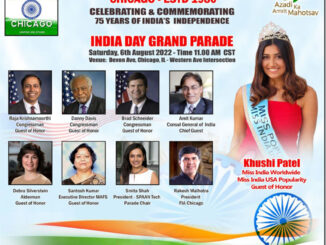
    CHICAGO, IL (TIP): : Federation of Indian Association, Chicago is celebrating 75 years of Independent India under the banner of “The Azadi Ka Amrit Mahotsav”. Independence Day is always memorable – the day to rejoice in the glory of what India has been able to achieve and to remember the contributions, battles, and sacrifices of all the people who helped achieve it. During the past 75 years, India has emerged as a mature democracy. This is very special for all of us as INDIA completes 75 years of independence. FIA celebrations include the grand India Day Parade at the Devon Ave, Chicago on Saturday, 6th August at 11 pm. The Indian National flag rising will be on 15th August at the prestigious Daley Center in Chicago Downtown, and there will be a patriotic Gala Banquet on Friday, 12th August to commemorate and recognize the people who have been serving the community selflessly. “The entire Indian diaspora living the United States is very excited and looking forward to FIA annual India day Parade and celebrating Azadi Ka Amrit Mahotsav”, said Rakesh Malhotra, President of the Federation of Indian Associations, Chicago

    Celebrating Indian Independence Day 2022

    FIA has been organizing these events for the past forty years here in Chicago, in which the spirit of the freedom movement, honor to the martyrs, and their vow to develop India can be experienced. “It is important to make the new generation aware of India’s freedom struggle and the contributions made by the freedom fighters to get India its independence. Our goal is to inspire the young generation to connect with their roots, values, and rich heritage and work hard to make India Vishwa Guru Again”, said Rakesh Malhotra, President of the Federation. Miss India Worldwide Khushi Patel has been invited to India Day Parade. Indian diaspora living from Chicago land are excited about participation in the Grand Parade. Multiple community-based organizations representing various Indian states like Bengal, Punjab, Uttar Pradesh, Madhya Pradesh, Chhattisgarh, Maharashtra, Telangana, Andhra Pradesh, and Kerala will be showcasing their decorative floats during the grand parade to commemorate 75 years of Independence. Consul General of Chicago Amit Kumar, US Congressman Danny Davis, Congressman Raja Krishnamurthy, Congressman Brad Schneider, Alderman Debra Silverstein, Alderman Shweta Baid, Prominent Community leaders including Dr Bharat Barai, Dr Darshan Sigh Dhaliwal,  Mr Santosh Kumar, Executive Director MAFS , Dr. Ram Chakroborty, founder of Chicago Kali Bari and Mrs. Smita Shah President & CEO of Spaan Tech. are likely to attend the FIA India@75-day events.  Aparna Chakravarty, Mrs India Worldwide 2ndRU will be joining the Chicago Kali Bari colorful float to reflect the spirit of community and festivity

    Connecting with the roots

    To engage the young students, a poster and painting contest on the theme of “My Idea of India” is being organized so that the younger generation can express their impression and vision of India. Likewise, a “Rangoli Making” competition for all age groups has also been organized.  Participation in these contests is free and entries can be submitted digitally. FIA Chicago proudly shares that all plaques and trophies to be given during its annual India@75 Gala are handmade in India by Tribal from the State of Chhattisgarh.

    Federation of Indian Associations, Chicago will be also releasing India@75 souvenir on this momentous occasion to commemorate the glory of India. “Souvenir will capture iconic moments that shaped India”, informed Rakesh Malhotra. Young students, women and professionals are amongst the contributors.

    About the Federation of Indian Associations, Chicago

    Federation of Indian Associations (FIA), Chicago is the largest non-profit Indian American organization. It was established in 1980 to primarily serve the community and promote and educate Indian Cultural Heritage while making meaningful contributions to America’s growth. More than 50 Illinois-based community organizations and nonprofits are members of the Federation. Besides engagement with various organizations across Chicago land, the FIA also takes a lead role in bringing the community together to celebrate various events of historical importance to both the United States and India.

    (Press release and photo /Asian Media USA)

  • Know how President of India is elected

    Know how President of India is elected

    On July 18, elected MLAs and MPs across the country will vote to elect India’s 15th President. Under Article 62(1) of the Constitution, “an election to fill a vacancy caused by the expiration of the term of office of President shall be completed before the expiration of the term”. President Ram Nath Kovind’s tenure ends on July 24. The counting of votes will take place on July 21 and the new president will take oath on July 25.

    The notification for the presidential election has been issued on June 15 and the last day of filing a nomination will be June 29. The papers will be scrutinised on June 30. The last day to withdraw the nomination papers will be July 2.

    “The Election Commission, in consultation with the Central Government, appoints the Secretary General of Lok Sabha and Rajya Sabha, by rotation, as the Returning Officer,” the EC said.

    “Accordingly, the Secretary General, Rajya Sabha will be appointed as the Returning Officer for the present election to the Office of the President,” it added.

    Here’s the process of electing a President

    According to Article 55 of the Constitution, the President of India is elected by members of the Electoral College consisting of elected Members of Parliament and that of all the state assemblies including the National Capital Territory of Delhi and the Union Territory of Puducherry. It follows the system of proportional representation utilising a single transferable vote system and secret ballots.

    Nominated members of Parliament, state assembly and members of legislative council are not eligible to vote.

    Importantly, the members who are nominated to either House of Parliament or the Legislative Assemblies of State including NCT of Delhi and UT of Puducherry are not eligible to be included in the Electoral College.

    This year, a total of 776 Members of Parliament and 4,033 MLAs will vote in the Presidential elections. The total value of votes is 10,86,431. The value of votes of MLAs is 5,43,231 and MPs are 5,43,200.

    Who is eligible?

    To be eligible for the election, the person: must be a citizen of India; have completed the age of 35 years; and is qualified for election as a member of the House of the People (Article 58).

    The person will not be eligible if he/she holds any office of profit under the Government of India or the Government of any State or under any local or other authority that is controlled by any of the state governments.

    What’s the process?

    The process starts with the nomination. The Presidential candidate should get his nomination paper subscribed by at least 50 electors as proposers and at least 50 electors as seconders. Importantly, the elector should not subscribe to more than one nomination paper either as a proposer or as a seconder. The candidate is required to deposit security, which is Rs 15,000. It is supposed to be made along with the nomination paper. More than four nomination papers can not be filed by or on behalf of a candidate or received by the Returning Officer.

    Where does the voting take place?

    Voting for the Presidential election will take place in Parliament and the premises of state assemblies, while Rajya Sabha Secretary-General will be the returning officer. MPs cast their vote in Parliament and MLAs in their respective state assemblies.

    Process of voting

    The election follows proportional voting which means that the value of each vote varies as it based on the post. The value of each vote based on the population is also predetermined for an MLA vote. This year, the total number of electors for the election will be 4,809 – 776 MPs and 4,033 MLAs.

    Who will be India’s next President?

    India’s President does not exercise executive powers, but all executive decisions are carried out in her name. She is required by the Constitution to act on the advice of the council of ministers led by the Prime Minister.

    But the President can ask the government to reconsider actions and offer advice. In matters of legislation, for example. So, it would be wrong to say that the role is only ceremonial or that the President is a mere figurehead or rubber stamp. Presidents like Pranab Mukherjee have been quite assertive, especially while dealing with mercy petitions from death row convicts. One of the most crucial roles of the President is seen when no party is able to get a parliamentary majority in a national election.

    So, the presidential election is crucial, and you should care about it. The election is indirect, but the result does indicate how much popular support both camps, the government and the opposition, have in the country.

    On your mind could be several key questions, from the poll process to front-runners to the numbers game, and to possible scenarios. But first let’s get some important dates out of our way.

    The President is elected by members of the Electoral College comprising elected members of both Houses of Parliament, and elected members of the Legislative Assemblies of all states and the National Capital Territory of Delhi and the Union Territory of Puducherry.

    This means nominated members of the Rajya Sabha and the Lok Sabha or Legislative Assemblies of states are not part of the Electoral College. Similarly, members of Legislative Councils also do not participate in the election process.

    The value of votes of MPs and MLAs varies based on the population of states they come from.

    It is mandatory for 50 MPs to propose the candidate, followed by another 50 seconding the candidature.

    Polling will be held in the Parliament House and on the premises of the State Legislative Assemblies.

    The election is held by secret ballot. A single transferable vote is used per the system of proportional representation.

    On the ballot paper, there are two columns. The names of candidates are listed in the first column, and the order of preference is listed in the second column.

    THE NUMBERS GAME

    The Electoral College has 4,809 electors, including 776 Members of Parliament (MPs) and 4,033 Members of Legislative Assemblies (MLAs).

    The total value of votes will be 10,86,431. To win, a candidate must get at least 5,43,216 votes.

    In the last election in 2017, Ram Nath Kovind of the NDA defeated joint Opposition candidate Meira Kumar. Kovind polled 7,02,000 votes compared with Kumar’s 3,67,000, out of a total of 10,69,358 votes.

    Roughly speaking, the ruling BJP-led National Democratic Alliance (NDA) has 48 per cent of the votes this time. It is 23 per cent for the Congress-led United Progressive Alliance (UPA).

    So, the NDA should not have any problem in getting its candidate elected. But the contest will become tight if all non-BJP parties unite (this explains hectic consultations on both sides). Then the opposition will have about 51 per cent of the votes.

    This is unlikely. Some reports say that “independents” such as Andhra Pradesh’s ruling YSRCP and Odisha’s ruling BJD may support the NDA. The BJP’s Tamil Nadu ally, the AIADMK, may also do so.

    The BJP has authorised its party president JP Nadda and Union minister Rajnath Singh to hold consultations with constituents of the NDA and the UPA, besides other political parties, as well as independent members. A consensus candidate is always preferable.

    PROBABLE CANDIDATES

    The general impression is that the BJP is unlikely to re-nominate Kovind. Rajendra Prasad was the only President to get two full terms. Both camps have not named their candidates yet. But that does not mean we’re short of suggestions. Former West Bengal Governor and Mahatma Gandhi’s grandson, Gopalkrishna Gandhi, has been approached by some leaders to be a joint Opposition candidate. He is the Left’s suggestion. There is talk about NCP chief Sharad Pawar exploring the possibility of pushing dissident Congress leader Ghulam Nabi Azad as the Opposition nominee. On the other hand, NDA probables may include Kerala Governor Mohammad Arif Khan, former Jharkhand Governor and tribal leader from Odisha Draupadi Murmu, Chhattisgarh Governor and tribal leader Anusuiya Uikey, Telangana Governor Tamilsai Soundararajan, Karnataka Governor and Dalit leader Thawar Chand Gehlot, former Lok Sabha Speaker Sumitra Mahajan, and Odisha’s tribal leader Jual Oram

    A disclaimer: The BJP remains capable of surprising everyone, like when it nominated APJ Abdul Kalam in 2002. The name of TMC leader Yashwant Sinha (though Bengal’s ruling party TMC has indicated none of its own members will be a candidate) is also being talked about. Earlier reports said that the Congress, the TMC, the AAP and the Shiv Sena wanted Pawar to be the opposition’s candidate, but he has declined the offer.

    JD(U) leader and Bihar minister Shravan Kumar has said party chief and Bihar CM Nitish Kumar could be a good candidate. Maharashtra minister and NCP spokesperson Nawab Malik has said Kumar’s candidature as an opposition choice can be considered if the latter snaps ties with the BJP/NDA in Bihar. On his part, Nitish Kumar has clarified that he never wanted to, and will not, contest the President’s election.

    CRACKS IN OPPOSITION

    Cracks have appeared in the opposition camp. The Congress is currently preoccupied with rallying support for its leader Rahul Gandhi, being questioned by the Enforcement Directorate in the National Herald money-laundering case.

    Actually, there is no one opposition camp. There is the Congress-led United Progressive Alliance (UPA). But that’s mostly the Congress with non-ruling allies like the RJD of Bihar. The Congress rules Rajasthan and Chhattisgarh and is a junior partner in states such as Maharashtra, Jharkhand and Tamil Nadu.

    West Bengal Chief Minister and TMC leader Mamata Banerjee has met Sharad Pawar, whose party NCP is part of Maharashtra’s ruling coalition MVA, led by the Shiv Sena and also comprising the Congress. Banerjee is trying to bring everyone on a single platform but Congress, while attending consultations driven by her, does not want to be overshadowed by a former Congresswoman. The grand old party is also holding its own meetings.

    The Left is not happy with Banerjee’s “unilaterally” organised deliberations. Delhi Chief Minister Arvind Kejriwal’s AAP (which is also ruling Punjab) has been a Congress critic and cautious of Banerjee in matters of national politics. On the other hand, Telangana Chief Minister K Chandrashekar Rao of TRS has his own ambitions.

    The Congress has asked its leader Mallikarjun Kharge to hold talks with all like-minded parties on the possibility of fielding a joint candidate. Kharge met NCP chief Sharad Pawar at the latter’s residence in Mumbai on June 9.

    Congress president Sonia Gandhi has herself reached out to Opposition leaders, including DMK chief MK Stalin, Pawar, CPM’s Sitaram Yechury. Banerjee and Telangana CM K Chandrashekar Rao, both non-UPA leaders, have also met leaders of the MVA. On June 15, Banerjee held a meeting with Opposition leaders in Delhi where no one from the AAP, the TRS and the BJD came despite invitations. Those who attended the meeting convened to prepare a joint strategy included Pawar, PDP’s Mehbooba Mufti, NC’s Omar Abdullah and SP’s Akhilesh Yadav, besides some Congress leaders including Kharge.

    Looks like a fractured opposition may again end up helping the BJP in an important election. Unless, of course, the mirage of oft-cited total opposition unity finally becomes a reality.

  • Congress must reform: It’s in the interest of democracy

    The rout of the Congress in the recent Assembly elections confirms the view that the grand old party is in terminal decline, and that the 2024 parliamentary election would pit the BJP not against the Congress but a coalition of regional parties, with or without the Congress. When the BJP won power at the Centre in 2014, the Congress ruled nine states — now, with the loss of Punjab, the number is down to two. In the last eight years, the Congress has won just five of the 45 elections held in the country. Its hope of wresting back Himachal Pradesh from the BJP later this year would be reduced in the absence of state supremo Virbhadra Singh, who died last year; the two states it still rules, Rajasthan and Chhattisgarh, go to the polls in 2023 and there is a real possibility that by the 2024 General Election, it may be in power in no state at all. The decimation of the Congress robs the voter of a centrist option at the national level, and makes the contest in national electoral politics multipolar, with various regional parties — with vastly different ideologies and ambitions — coming together to challenge the BJP. India must have a strong Opposition to hold the government to account.

    However, a motley collection of parties — competing for prime ministership among themselves — may not be best suited to serve the interests of democracy. The Congress, despite its spectacular decline over the last decade, had seemed the most viable alternative to the BJP, but even veteran Congressmen are losing hope now. The Congress’ vote share in the last two General Elections was the second-best — at 19.31% and 19.46% — behind the BJP, and it has the potential to represent Indian citizens across the country. It still may be the biggest single challenger to the BJP, but it’s obvious that it has got stuck in a rut. There is confusion at the top — after Rahul’s resignation as president in 2019, Sonia Gandhi has been interim president — and panic in the ranks. Organizational reform is the need of the hour, in the interest of a strong Opposition — and, thus, in the interests of India.

    (Tribune, India)

  • India in history this Week- December 3 to December 9, 2021

    India in history this Week- December 3 to December 9, 2021

    03 DECEMBER

    1844       The first President of the country Dr. Rajendra Prasad was born.

    1751       Battle of Arnie in India (Second Carnatic War): A British East India Company-led army under Robert Clive defeats a very large Franco-Indian army under the command of Rana Sahib at Archana.

    1796       Baji Rao II was made the Peshwa of the Maratha Empire. He was the last Peshwa of the Maratha Empire.

    1889       The youngest hanged revolutionary, Khudiram Bose, was born in the independence movement.

    1915       A magnitude 6.5 earthquake in Bhutan and Arunachal Pradesh killed 170 people and destroyed many homes.

    1971       The Emergency came into force in the country after the war between India and Pakistan started.

    1979       Hockey magician Major Dhyanchand  died.

    2004       India and Pakistan agreed to restore rail connectivity between Munabav and Khokhrapar after 40 years.

    2011       Film actor Dev Anand died.

    1984       Leaking toxic gas from the Union Carbide factory in Bhopal killed at least 3000 people and caused several thousands of physical deformities.

    1959       India and Nepal signed the agreement of Gandak Irrigation and Power Project.

    1967       India’s first rocket (Rohini RH 75) was launched from Thumba.

    2008       Chief Minister of Maharashtra Vilasrao Deshmukh resigned from his post on the day after the terrorist incident of 23 November in Mumbai.

    04 DECEMBER

    2008       Renowned historian Romila Thapar was chosen for the Cluj honor.

    1888       Birth of historian Ramesh Chandra Majumdar.

    1860       Agustino Lawrenceo of Margao, Goa, received a doctorate in chemistry from the University of Paris. He became the first Indian to pursue a doctorate from a foreign university.

    1899       For the first time, the vaccine of typhoid was used to protect humans from this disease.

    1919       The twelfth Prime Minister of India, Indra Kumar Gujral was born.

    1910       Ramaswamy Venkataraman, the eighth president of India, was born.

    1971       The Indian Navy attacked the Pakistani Navy and Karachi.

    05 DECEMBER

    1955       The STD service that provides long distance telephone calls to every home came into existence on this day in 1955.

    1971       India recognized Bangladesh as a country.

    1895       The birth of Josh Malihabadi, the famous Urdu poet of India and Pakistan.

    1941       Famous Indian female painter Amrita Shergill died in Lahore. Many of his artworks were appreciated worldwide.

    1969       The birth of Anjali Bhagwat, the famous shooter who has illuminated the name of India in the world in shooting.

    1998       Russia agrees to give ‘Krivak class’ multi-purpose warship to Indian Navy.

    1999       Yukta Mukhi took the title of Miss World to her name.

    1657       Shah Jahan’s younger son Murad proclaimed himself king.

    1943       Japanese airplane bombed Kolkata.

    1950       Freedom fighter, poet, yogi and philosopher Arvind Ghosh died in Puducherry.

    1950       Sikkim became a protected state of India.

    06 DECEMBER

    1732       Warren Hastings, the first Governor General of the East India Company, was born.

    1907       The first incident of dacoity related to India’s freedom struggle took place at Chingaripota railway station.

    1992       Babri Masjid in Ayodhya was demolished by fierce Hindu kar sevaks. After this, riots broke out in many states of India.

    1907       The first incident of dacoity related to India’s freedom struggle took place at Chingaripota railway station.

    1956       Bahujan political leader and constitution builder Babasaheb Bhimrao Ambedkar died.

    1987       MiG-29 joined the Indian Air Force, renamed ‘Baz’.

    07 DECEMBER

    1949       Indian Armed Forces Flag Day is celebrated.

    1782       Hyder Ali, the ruler of Mysore died.

    1825       The first steam-powered ship ‘Enterprise reached Kolkata.

    1856       The ‘Hindu widow’ was officially married for the first time in the country.

    1995       India launched communication satellite INSAT-2C.

    2003       Raman Singh holds the post of Chief Minister of Chhattisgarh.

    2008       Indian golfer Jeev Milkha Singh won the Japan Tour title.

    2016       Famous Indian actor, comedian, political satirist, playwright, film director and advocate Cho Ramaswamy passed away.

    08 DECEMBER

    1875       The great liberal leader Tej Bahadur Sapru was born in Aligarh.

    1879       The great revolutionary Yatindra Nath Mukherjee aka Barrier Jatin was born.

    1900       Pandit Uday Shankar, born dancer and dance director of modern dance of India, was born.

    2002       Gomutra was patented by the United States after India’s traditional bio-wealth, neem, turmeric and berries.

    2005       The Red Cross and Red Crescent Society accepted a red crystal of diamond shape in the white background as a new additional symbol.

    1967       The first submarine INS Kalwari was inducted into the Indian Navy.

    1990       Uday Shankar, the famous Indian classical dance dancer, dance director and ballet producer was born.

    1947       Parmanand, the great revolutionary brother of the Indian freedom struggle, died.

    09 DECEMBER

    1946       The first meeting of the Constituent Assembly that made the country’s highest law was on this day.

    1946       UPA Chairperson Sonia Gandhi was born.

    1971       During the Liberation War, the Indian Army had pierced the air campaign Meghna Heli Bridge.

    1484       The great poet and saint Surdas was born.

    1758       The thirteen-month-long war of Madras began in India. This was the most dangerous war between Britain and France in India.

    1898       Belur Math was established in Kolkata.

    2001       United National Party leader Ranil Vikram Singhe was sworn in as the Prime Minister of Sri Lanka.

    1825       Rao Tula Ram, a prominent hero of the Sepoy Mutiny was born.

  • Chhattisgarh : The land of temples and waterfalls

    Chhattisgarh : The land of temples and waterfalls

    Chhattisgarh, one of the few landlocked states in central India, is a treasure house of natural beauty. Tourists wanting to experience the raw side of nature will find themselves at home here. It is its rusticity that makes you fall in love with it. Dense forests abound in the state, and in them, reside various tribes, each with their unique customs, traditions and way of life. The points of tourist interest in Chhattisgarh also include ancient temples and towns which have constantly attracted historians and archaeologists. There are plenty of wildlife sanctuaries which house a rich wildlife, with the gaur never ceasing to surprise onlookers. Other must visit tourist attractions include dams, museums and waterfalls.

    Travelling to Chhattisgarh is like planning a trip to ultimate bliss. The state is blessed generously by nature and you come across examples of that every few miles. Its landscape, which is dominated for the most part by dense forests, is dotted with waterfalls, caves and a rich wildlife. Located in central India, it offers its fair share of adventure, sightseeing and exploration. The state is home to many temples and some towns which trace their origin to historical times, thus fascinating tourists, historians and archaeologists constantly. To escape the sweltering heat during summers, nature has gifted it with several hill stations, each as beautiful as the other.

    Barnawapara Wildlife Sanctuary

    One of the most famous tourist attractions in Chhattisgarh, the Barnawapara Wildlife Sanctuary is home to the Bar and Nawapura forest villages. It was established in the year of 1976 and is spread over a vast area of 245 sq. Km. The rich and lush vegetation caters to a broad spectrum of wildlife in this region. The landscape is mostly flat terrain with occasional low and high hillocks.

    Raipur

    The capital of Chhattisgarh, Raipur is the largest city in the state. With more than hundreds of steel mills and six steel plants, Raipur is also one of the largest industrial centres of the country. Besides steel, it is also home to the aluminium and coal industries. A primary business and industrial hub, Raipur is even fast emerging in the tourism sector, attracting tourists from across the world. The city is known for its temples, lakes, factories, educational centres as well as the development of Naya Raipur. Naya Raipur is a newly planned city and is about 17km away from the current town. The Swami Vivekananda Airport lies in between Raipur and Naya Raipur facilitating travel.

    Raipur has a rich history and until 2000 was a part of Madhya Pradesh. After the formation of the new state of Chhattisgarh, Raipur was made its capital, primarily because of its centralised location. Located in the centre of the plains that are also called the ‘rice bowl of India’, Raipur is surrounded by the districts of Durg and Bemetara. The city is a bustling capital city with a multicultural and multi-religious society. With many festivals, shopping outlets and city landscapes Raipur is also an excellent base for venturing into the surrounding attractions. These include the Barnawapara Wildlife Sanctuary, Dandak Caves, Bilaspur, Chitrakoot Falls, Amarkantak, Bhilai, Kanha National Park and the Sitanadi Wildlife Sanctuary.

    Visit Raipur to explore its various natural, wildlife and historical tourist attractions. Chhattisgarh is mostly a forested region. Raipur understands the importance of maintaining its ecological balance, and there is a government proposal under works to construct a micro-forest in the heart of the city. Raipur is also about its various festivals, such as Hareli, Champaran Mela, Pola and Teeja that are celebrated during monsoons. And no city in India is complete without a taste of its unique flavours. Raipur is no different offering its many fascinating cuisines and street food that are an integral part of the city’s cultural and social layout.

    Charre Marre Waterfalls

    Charre Marre Waterfalls is a refreshing and offbeat place to visit in the state of Chattisgarh. The tortuous waterfall is 16 meters high and the clear water falling from such a great height is quite a sight to see. The bountiful and pristine Jogidhara river is the reason behind the birth of this mesmerizing and bubbling waterfall. The water meanders through hills and verdant trees producing ear pleasing sounds. The reservoir that forms at the bottom of the waterfall is perfect to take a dip in. The cool water will rejuvenate your soul and body. You can also dangle your feet into the small pond formed at the bottom and spend some peaceful time enjoying the picturesque beauty of this place.

    Sirpur

    Sirpur is a small village located in the state of Chhattisgarh, situated on the banks of river Mahanadi. It is 35 km away from the Mahasamund district and around 78 km away from the city of Raipur, which is the capital of Chhattisgarh. The village of Sirpur is an archaeological wonder. Inspiration to many architects, this village is rich in its temple culture. A quaint hidden gem, it has a deep connection to the Buddhism world and a treasure for archaeological findings from the 8th century.

    There are numerous temples one can visit, and is generally a hub for passionate historians. A look at the historical artefacts and the deep carvings on the walls of the temples have inspired many architects around the world. The Buddhist monasteries of this village are said to be one of the most important and most significant in India. Apart from the rich historical importance and fascinating findings in these villages, there is more to this village. The Chhattisgarh Tourism Board organises a music and dance festival here to promote the Buddhist sites and celebrate its culture. Offering a rare mix of art and culture with different performance and a deep history and evolution of art, Sirpur is a peaceful village filled with wonders.

    Mainpat

    Mainpat is an underrated hill station with green pastures, deep valleys, breathtaking waterfalls, dense forests and untouched rivulets. The hill station hasn’t been completely commercialised yet and receives a relatively smaller influx of tourists compared to its counterparts. Mainpat is often called as Shimla of Chhattisgarh and Mini Tibet owing to its huge Tibetan population and influence over the area. The Tibetan refugees were rehabilitated in Mainpat after the Chinese invasion of Tibet and have since found a home in Mainpat. That’s another great thing about Mainpat, the confluence of cultures and diverse traditions only add to the picturesque village’s charm.

    Madku Dweep

    Madku dweep is a beautiful island situated near the silent river, Shivnath, in the Bilaspur district of Chhattisgarh. The name Madku stems out from the fact that the island is of the shape of a frog. The beauty of this island is considered to be spell-bounding. The picturesque Madku Dweep has an area of around 24 hectares and is full of greenery. The island is also famous for its ancient temples and their historical and archaeological importance.

    Archaeologists have discovered prehistoric stone tools, epigraphs, and coins on this island. Stone inscriptions have also been found, which are believed to date back to the 3rd century BC. One stone inscription was in Brahmi script and another in Shankha script. Madku Dweep is also home to several ancient and unique idols of Lord Shiva, Ganesha, Shiv-Parvati, Nandi and various other Gods. There are temples, both old and new, that are frequented equally by devotees from across the globe. Madku Dweep is popularly known as Kedar Tirth and Harihar Kshetra Kedar Dweep.

  • Trumping majoritarianism in the Hindi heartland

    Trumping majoritarianism in the Hindi heartland

    By Zoya Hasan
    While regional parties will continue to be significant in various States of the Union, the principal challenge of overcoming majoritarianism lies in the Hindi heartland, especially in U.P. Oppositional electoral alliances, notably the formation of a federal front, are important strategies in this battle but it is no less important to challenge the ideological foundations of the majoritarian project through progressive and inclusive politics.

    The landslide victory of the All India Trinamool Congress in the West Bengal Assembly elections and the pushback of the Bharatiya Janata Party (BJP) in West Bengal, Tamil Nadu and Kerala have given rise to a pervasive belief that right-wing politics can be defeated by regional assertions. Undoubtedly, regional and cultural assertion in these States acted as an effective bulwark against the BJP’s expansionary plans in southern and eastern India. The regional-cultural tropes deployed by Mamata Banerjee, for example, worked so well that at one point, Home Minister and BJP leader Amit Shah was even forced to clarify that if the BJP is elected, someone from Bengal would be the Chief Minister. This underlines the effectiveness of regional culture and politics in trumping communal politics. However, this claim needs to be tempered by the realism that it cannot work in the Hindi heartland, which is dominated by caste and communal politics, and has so far not seen any serious ideological and political challenge to politics based on these identities.

    Encompassing nine States whose official language is Hindi, namely Bihar, Chhattisgarh, Haryana, Himachal Pradesh, Jharkhand, Madhya Pradesh, Rajasthan, Uttar Pradesh (U.P.) and Uttarakhand, this region retains a central position in the electoral strategies of the BJP and its larger political imagination. The party’s stunning show in these States propelled it to power in the 2014 and 2019 parliamentary elections. Its continued political dominance in the heartland will neutralize its losses now as well as in future in States where it has been bested by regional players. I will focus here on U.P. to illustrate the limits of the regional assertion.

    Dimensions in the heartland

    The Hindi heartland is clearly different. There are at least four important dimensions of this difference. First is the absence of regional identity in States such as U.P. This is evident from the debate on States reorganization and the reorganization of Uttar Pradesh in the 1950s. The compulsions of nation-oriented identity emerged very clearly from the discussions in the States Reorganization Commission on suggestions for the division of U.P. for administrative convenience. U.P. leaders argued for a large and powerful State in the Gangetic valley as a guarantee of India’s unity.

    In this sense, U.P. was considered the backbone of India and the centerpiece of political identity in modern India. Importantly, it was supposed to provide the chief bulwark against growing regionalization and fragmentation elsewhere. Instilling a sense of regional pride, an essential part of Congress strategy in southern and coastal India, was not followed in U.P. U.P. was seen as the political heartland in contrast to Punjab and Bengal for instance, which were splintered and incorporated into two different nation states. As is well known, the bases of this post-colonial identity varied from its location in the freedom struggle to staking claim as the cultural homeland of Hindi and Hinduism. In both cases, it was centered in the idiom of the nation-state and strong central authority.

    Second, although U.P.’s cultural homogeneity remains a matter of disagreement, the idea of the heartland had great resonance among the political elite who opposed the demand for U.P.’s reorganization. The long-standing traditions of composite cultural identity and shared plural cultures began to yield place to a singular homogenized identity. The Hindi-Urdu divide, which mirrored the communal cleavage of U.P. society, played a crucial role in this process. Urdu was excluded as it was seen to symbolize Muslim cultural identity in independent India, while Hindi was boosted to promote the development of a Hindi-Hindu heritage for this region. The project of homogenization of Indian/U.P. culture as Hindu culture was quickened in later decades. Even though it would be hard to assume a direct link between Hindi dominance and communal politics of subsequent decades, it is nevertheless a fact that all political parties in the State used it as an ingredient of social and cultural differentiation and a means to consolidate political dominance.

    Role of communal politics

    Third, it is clear that communal politics and communal movements have played a key role in U.P.’s modern history which in turn have diluted other identities.

    In some respects, this process gained momentum in the wake of Partition which cast its long shadow upon political institutions and culture in U.P. and to a great extent affected the perspectives of Hindus and Muslims alike. Hindu nationalism was marginalized within the Congress party but many of its ideas were accepted in framing party policies. The State leadership was instrumental in forging a conservative consensus in the State under Chief Minister G.B. Pant who steered the affairs of the state for eight years after Independence.

    The intensification of communal politics took a new turn with the mass mobilization for the construction of a Ram temple at Ayodhya which was deftly used by the Hindu right to establish a major presence in U.P. and to facilitate the political reconstruction of U.P. through the promotion of a collective Hindu identity. The crusade for the appropriation of disputed shrines is central to the communalization of politics and short circuiting the more complex process of political expansion for the BJP.

    Importantly, this has laid the groundwork for building permanent electoral majorities through the deployment of ascriptive symbols in U.P. which, given its huge size, helps it to establish a strong base in the Hindi heartland to offset the appeal of countervailing identities elsewhere in India.

    Caste politics too

    Finally, caste politics which was expected to counter Hindutva expansion has failed to do so; in fact, caste politics has become a building block for the BJP’s expansion. The party has reached out to Dalits, actively mobilizing them and other backward castes to assimilate them into the Hindutva meta-narrative. Instead of erasing caste from electoral politics, the BJP-Rastriya Swayamsevak Sangh has sought to court fragments of castes as a way of undermining broad-based political movements and opposition to it. It has used the wider appeal of Hindu nationalism to co-opt backward castes and Dalits who are keen to align themselves to the larger narrative of Hindu nationalism.

    A reset is needed

    While regional parties will continue to be significant in various States of the Union, the principal challenge of overcoming majoritarianism lies in the Hindi heartland, especially in U.P. Oppositional electoral alliances, notably the formation of a federal front, are important strategies in this battle but it is no less important to challenge the ideological foundations of the majoritarian project through progressive and inclusive politics. This requires a reset of the basic political mindset in U.P. which can only be done by reviving the splendid heritage of the national movement in which this region played a central role and in which Gandhiji and Nehru played a heroic part. Invoking the spirit of the Bhakti movement which was the first major challenge to the religious orthodoxy of Hinduism would also help in resetting the cultural clock. This must, however, combine with much greater concern for the fundamental social and economic issues of the State, and making the struggle between communal and secular forces the central issue through public campaigns that address the problems of religious traditionalism and the cultural underpinning that this provides to the push to make India a Hindu state.

    (Zoya Hasan is Professor Emerita, Jawaharlal Nehru University)

  • Bihar has strong message for Opposition

    Bihar has strong message for Opposition

    The results of the Bihar elections have a message for all states headed for polls in the months ahead on taking on the BJP under Modi.

    By Neerja Chowdhury

    Bihar has sent a strong message to the Opposition parties. They will have to combine effectively to have any chance of taking on the Modi-led BJP in states going to the polls. The RJD’s alliance with the Left parties in Bihar— CPI(ML), CPI(M) and CPI— did well, leading to a high strike rate.

    Even though Nitish Kumar has been weakened, the BJP will find it difficult to replace the chief minister with one of its own, having burnt its fingers in Maharashtra, where Uddhav Thackeray, denied the chief ministership, joined hands with the Congress and the NCP. The BJP is expected to tread more carefully in Bihar after the outcome.

    Economic distress of an unprecedented kind, compounded by a health pandemic of the last nine months, the migrant march of lakhs of workers on foot with probably the largest number walking back to their villages in Bihar, incursions made into Indian territory by China in the last few months which could have created a nationalistic upsurge against the government, palpable anger against Chief Minister Nitish Kumar that was evident — if these could not bring about a change of government in Bihar, it only shows that the other factors were more dominant. This when, in this instance, there was a clear alternative in Tejashwi Yadav leading the charge on the Opposition side and getting a popular response.

    Clearly, Brand Modi managed to slow down the Tejashwi chariot, though it was a closely run race. And Tejashwi, though not able to form a government in Patna, has established himself as a leader of the Mahagathbandhan at the age of 31. He set the terms of the poll narrative when he flagged ‘joblessness’ as the central theme of Bihar 2020, for the first time giving an economic — and aspirational — spin to caste which has determined poll outcomes in Bihar for three decades and more.

    Given the downturn in the economy, creation of jobs is increasingly going to find resonance, particularly among the young, as also in other states going to polls in the next few months. The first phase of the election was going the Tejashwi way. The turning point came with Narendra Modi’s invocation of ‘jungle raj’ of the Lalu Yadav-Rabri Devi years. This sent those among the most backward castes and women, who were beginning to look at Tejashwi with new eyes — Yeh naya ladka hai— scurrying back to the NDA again. The upper castes are anyway more enamored of the Hindutva, nationalist theme than of any economic hardship, and stayed by the BJP’s side.

    Bihar has reinforced the invincible image of Narendra Modi. He swayed the voters in national elections. This was not always the case in state polls. The BJP did not make it in many states, be it Maharashtra, Jharkhand, Telangana, Andhra Pradesh, Karnataka, Delhi, Rajasthan, Madhya Pradesh and Chhattisgarh. In Bihar, the Prime Minister made a difference to the poll outcome. The Bihar strategy may help the BJP in states which are going to the polls in the coming months — in West Bengal, Assam, Punjab, Kerala and then UP in 2022. It combined Modi’s undimmed popularity and sharp articulation, with Hindutva and nationalism (Ayodhya, Pulwama, Jai Shree Ram) as not so covert a theme, undergirded by a subtle appeal to certain castes. The PM has for some time now emphasized the help given to the poor by his government at the Centre, through the programs he has initiated. So, if money was transferred to the people in Bihar during COVID-19 times, they saw it coming ‘from Narendra Modi’ and ‘not from Nitish Kumar’. In the handling of the pandemic, which exacerbated the problems of the migrants, the Central Government successfully managed to shift the responsibility to the chief ministers. In Bihar, the BJP went one step further. It even managed to distance itself from the Bihar CM, even though it was part of the government headed by him. By going hammer and tongs at only Nitish Kumar, and urging the people to vote for the BJP, Chirag Paswan helped shield the BJP while directing the popular ire towards the CM. The BJP’s seats went up substantially, and those of the JD(U) came down, equally substantially. The BJP as the senior partner in the government will have its obvious advantages, and will increase its clout in the decision-making process.

    Even though Nitish Kumar has been weakened, the BJP will find it difficult to replace the chief minister with one of its own. Having burnt its fingers in Maharashtra, where Uddhav Thackeray, denied the chief ministership, joined hands with the Congress and NCP, the BJP is expected to tread more carefully in Bihar. For Nitish Kumar, with his reputation for doing ‘flip flops’, can always extend outside support to Tejashwi Yadav, if the BJP tries to replace him. Unless the BJP can, at a future date, break the JD(U), the Congress and wean away MLAs also from the RJD to form its ‘own’ government. But that does not seem to be on the cards for the moment.

    Bihar has sent a strong message to the Opposition parties. They will have to combine effectively to have any chance of taking on the Modi-led BJP in states going to the polls. The RJD’s alliance with the Left parties in Bihar— CPI(ML), CPI(M) and CPI— did well, leading to a high strike rate.

    Tejashwi Yadav might have just made it, had he not allowed Mukesh Sahni’s Mallah (Most backward)-based VIP party to leave the Mahagathbandhan over the issue of seat-sharing. This might have been possible had he given less seats to the Congress and accommodated the ‘VIP’ party and enabled Left parties to fight more seats, the ticket distribution based on the ground level strength of the parties today rather than on the position they enjoyed in the past. This Congress’ tally came down from what it was in 2015. While the RJD was able to transfer its votes to the Congress, the Congress could not ensure this for the RJD candidates. As it is, the Congress’ kitty does not have much to transfer.

    The five seats won by Asaddudin Owaisi, who did well in the Muslim-dominated areas of Bihar (Seemanchal) should come as a wake-up call for the Congress. The Muslims, who feel beleaguered and apprehensive, particularly with the way they have been targeted by the BJP, after the NRC, CAA and abrogation of Article 370, have looked to the Congress as the only party which would be able to take on the BJP nationally. For them to turn to Owaisi’s party which was not in a position to form the government in Bihar, being part of the small so-called ‘Third Front’, and not to the Congress, shows their growing sense of alienation from the grand old party. This is not good news for the Congress.

    The crisis — and drift — in the Congress is not likely to go away unless the party settles the question of its leadership, which is hanging out there unaddressed.

    Given the Bihar outcome, will the Opposition parties look afresh at the new challenge being mounted by a BJP determined to increase its footprint all over India, state after state, and go for one-party dominance in the country? Or will it remain business as usual?

    (The author is a senior political commentator)

  • #SUKMAATTACK  – Maoists claim responsibility in audio message, warn security forces not to crush ‘revolution’

    #SUKMAATTACK – Maoists claim responsibility in audio message, warn security forces not to crush ‘revolution’

    NEW DELHI (TIP): Maoists based in the Bastar region of Chhattisgarh have claimed responsibility for the recent attack on CRPF jawans – the worst in few years – and warned the security forces not to come in way of their ‘revolution’.

    A News18.com report claimed on April 28 (Friday) that the home-grown rebels have released an audio message in which they have claimed responsibility for the gruesome attack.

    Their attack on the CRPF jawan was in retaliation to Operation Green Hunt launched by the government against Naxals, they claimed.

    In the 16-minute long audio message clip, a spokesperson of the banned Communist Party of India (Maoist) also hailed the attack by the outfit’s military arm People’s Liberation Guerrilla Army (PLGA) on the CRPF personnel.

    The Maoists’ spokesperson, who spoke in Hindi, said that their “fight” was not with the paramilitary personnel, but warned central forces against standing in the way of “revolution”.

    He also appealed to them and to the police personnel to leave the forces, which he said were targeting activists and journalists.

    “In 2016, the government killed nine of our people in Chhattisgarh and 21 in Odisha. The ambush is a reaction to these killings and sexual violence against our women,” Vikalp, the Maoists spokesperson reportedly said.

    He also alleged that the state police had gang-raped tribal women and killed villagers in “fake” encounters.

    However, the veracity of the purported audio clip, which has become viral on the social media, and the claims made by the Maoists could not be confirmed.

  • On his third US tour, Chhattisgarh CM eyes investment in ‘Priority Industries’

    On his third US tour, Chhattisgarh CM eyes investment in ‘Priority Industries’

    NEW YORK CITY (TIP): Every time he comes to the US, he ‘takes home something new.’ On his third US tour, Chief Minister of Chhattisgarh, Dr Raman Singh wooed investors to invest in new sectors, highlighting the tremendous potential across those sectors in the state that has been declared as the ‘Best fiscally managed State’ by Reserve Bank of India. Singh, currently on an official tour of the US, highlighted investment opportunities in Chhattisgarh in front of a gathering at the Indian Consulate, New York on November 29. Senior state government officials accompanied him at the interactive luncheon event, jointly hosted by US India Business Council (USIBC) and the Consulate.

    In his welcome address, Subodh Kumar Singh, Secretary to Chief Minister and Commerce & Industries, described how some of the key initiatives under Raman Singh’s leadership including railway network, industrial infrastructure and smart cities in Chhattisgarh has become the main driver of growth and development in the State. He also briefed the audience about the priority industries for investment – food processing, energy, life sciences, defense, information technology, electronics, and manufacturing.

    Dr Mukesh Aghi, President of USIBC in his special remark, stressed on enhanced investment partnership between US and India.

    There was a brief Power Point presentation by Vivek Dhand, Chief Secretary of Chhattisgarh, that highlighted recently implemented reforms including single window system, tax reforms, construction permits, environment & labor reforms, inspection reforms and commercial dispute and paperless courts. Given that the state came into existence only 16 years ago, he took the opportunity to mention that the World Bank has recently ranked Chhattisgarh fourth in Ease of Doing Business as per Ranking 2016 among all Indian states and Union Territories.

    While giving introduction of Dr Raman Singh, the longest ever serving Chief Minister from BJP, Deputy Consul General Dr Manoj Kumar Mohapatra said, “Indo-US relationship is measured by number of visits. In the last two years Prime Minister Modi and President Obama met more than 12 times. That shows the defining partnership.”

    Describing Chhattisgarh as ‘Heart of India’, the Chief Minister said, “I just want to tell you what it was 16 years back and what it is today.” Mentioning the reforms and policies undertaken during his tenure that has made the state a frontrunner in ease of doing business, Dr Singh said, “Chhattisgarh is the best destination for investment not just in the core sectors of mines and minerals but also in areas like IT, engineering and solar energy.”

    Noting that investors may not be fully aware of the investment opportunities in the young, not so known resource-rich state, Dr Singh invited investors to visit Chhattisgarh to see the investment potential of the state. “Come, see, and then invest.”

    A token of appreciation was presented to him by Dr Mukesh Aghi, followed by a Q&A session.

    During the brief Q & A session, Prof. Indrajit S Saluja asked the chief minister to clarify on the allegation of a Rs. 36000 crore scam in the public distribution system in the State. Dr. Singh categorically denied there was any scam. He said it was a conspiracy. 60 lakh families benefitted from the scheme and nobody complained. “Our PDS model is unique. So far, no other state could follow that model”, Mr. Singh said.


    Later, speaking with The Indian Panorama Chief Editor I S Saluja, in an exclusive interview, Dr Singh appealed to the NRIs to invest in Chhattisgarh. “Our state is the destination for investment. You will get all facilities there. The infrastructure is top class. I want investments in sectors like IT, engineering and solar energy. I am sure if they (NRIs) visit the state they will be convinced to invest. So, I want them to visit (Chhattisgarh).”

    When asked if he wants to invite the media to visit Chhattisgarh so that they can project the bright side of the state, Dr Singh said, “Of course. I would invite my media friends here to visit Chhattisgarh. Every year in the first week of November we organize special event to showcase the development activities of our state. I will invite the media from US to come and have a fair idea about our activities.”

    Dr Singh also said that he will ask his officials to be in direct touch with the ethnic media in US for a closer relationship to help boost the image of his state.

  • Sahara properties to be auctioned at Rs 722 crore reserve price

    Sahara properties to be auctioned at Rs 722 crore reserve price

    NEW DELHI (TIP) : Tasked by markets regulator Sebi to sell land parcels of Sahara, HDFC Realty will e-auction on July 4 five properties owned by the beleaguered group at a reserve price of Rs 722 crore.

    HDFC Realty has been asked to auction a total of 31 land parcels at Rs 2,400 crore, while SBI Cap has been tasked to auction another 30 land properties with an estimated market value of about Rs 4,100 crore.

    The Securities and Exchange Board of India (Sebi) roped in HDFC Realty and SBI Cap after being asked by the Supreme Court to initiate the process of selling Sahara properties whose titles have been deposited with it by the group.

    Following a go-ahead from the Court, the two entities have put in place a mechanism to auction these properties.

    In a public notice issued on Thursday, HDFC Realty said it will e-auction as many as five land parcels on July 4 between 11 am and 12 pm. These properties will fetch around Rs 722 crore at reserve price.

    These properties are located in Andhra Pradesh, Tamil Nadu, Madhya Pradesh, Chhattisgarh and Uttar Pradesh. The assets being sold include agricultural non-agri land.

    Interested bidder can inspect these land parcels on June 10. As per the court directions, these properties cannot be sold at less than 90% of circle rates.

    After spending two years in jail, Sahara chief Subrata Roy is currently out on parole. He was sent to jail on the orders of the Supreme Court in a long running dispute with Sebi.

  • PADMA AWARDS 2016

    PADMA AWARDS 2016

    NEW DELHI (TIP): Former Comptroller and Auditor General of India Vinod Rai, actor Rajinikanth, spiritual guru Sri Sri Ravishankar and tennis player Sania Mirza are on the list of 112 Padma awardees whose names were announced on Monday by the government.

    The awards will be given across three categories: the Padma Vibhushan, Padma Bhushan and Padma Shri. These awards are given on Republic Day, for the over six decades now, to people who the government recognises have excelled in their fields.

    Padma Vibhushan

    1. Shri Rajinikanth    Art-Cinema    Tamil Nadu
    2. Ms. Yamini Krishnamurthi Art- Classical dance Delhi
    3. Smt. Girija Devi    Art-Classical Vocal    West Bengal
    4. Shri Ramoji Rao    Literature & Education-Journalism   Andhra Pradesh
    5. Dr. Viswanathan Shanta    Medicine- Oncology    Tamil Nadu
    6. Shri Shri Ravi Shankar    Others-Spiritualism    Karnataka
    7. Shri Jagmohan    Public Affairs    Delhi
    8. Dr.Vasudev Kalkunte Aatre    Science & Engineering    Karnataka
    9. Shri Avinash Dixit (Foreigner)    Literature & Education
    10. Late Shri Dhiru Bhai Ambani (Posthumous)    Trade & Industry    Maharashtra

    Padma Bhushan

    11. Shri Anupam Kher Art-Cinema Maharashtra
    12. Shri Udit Narayan Jha Art-Playback Singing Maharashtra
    13. Shri Ram V. Sutar Art-Sculpture Uttar Pradesh
    14. Shri Heisnam Kanhailal Art-Theatre Manipur
    15. Shri Vinod Rai Civil Service Kerala
    16. Dr. Yarlagadda Lakshmi Prasad Literature & Education Andhra Pradesh
    17. Prof. N. S. Ramanuja Tatacharya Literature & Education Maharashtra
    18. Dr. Barjinder Singh Hamdard Literature & Education – Journalism Punjab
    19. Prof. D. Nageshwar Reddy Medicine-Gastroenterology Telangana
    20. Swami Tejomayananda Other-Spiritualism Maharashtra
    21. Shri Hafeez Contractor Others-Architecture Maharashtra
    22. Shri Ravindra Chandra Bhargava Public Affairs Uttar Pradesh
    23. Dr.Venkata Rama Rao Alla Science & Engineering Andhra Pradesh
    24. Ms. Saina Nehwal Sports-Badminton Telangana
    25. Ms. Sania Mirza Sports-Tennis Telangana
    26. Ms. Indu Jain Trade & Industry Delhi
    27. Late Swami Dayanand Sarawasati (Posthumous) Others- Spiritualism Uttarakhand
    28. Shri Robert Blackwill (Foreigner) Public Affairs USA
    29. Shri Pallonji Shapoorji Mistry (NRI/PIO) Trade & Industry Ireland

    Padma Shri

    30. Smt. Prathibha Prahlad Art- Classical Dance Delhi
    31. Shri Bhikhudan Gadhvi Art- Folk Music Gujarat
    32. Shri Sribhas Chandra Supakar Art- Textile Designing Uttar Pradesh
    33. Shri Ajay Devgn Art-Cinema Maharashtra
    34. Ms. Priyanka Chopra Art-Cinema Maharashtra
    35. Pt. Tulsidas Borkar Art-Classical Music Goa
    36. Dr. Soma Ghosh Art-Classical Vocal Uttar Pradesh
    37. Shri Nila Madhab Panda Art-Film Direction and Production Delhi
    38. Shri S.S. Rajamouli Art-Film Direction and Production Karnataka
    39. Shri Madhur Bhandarkar Art-Film Direction and Production Maharashtra
    40. Prof. M. Venkatesh Kumar Art-Folk Artist Karnataka
    41. Ms. Gulabi Sapera Art-Folk Dance Rajasthan
    42. Smt. Mamta Chandrakar Art-Folk Music Chhattisgarh
    43. Ms. Malini Awasthi Art-Folk Music Uttar Pradesh
    44. Shri Jai Prakash Lekhiwal Art-Miniature Painting Delhi
    45. Shri K. Laxma Goud Art-Painting Telangana
    46. Shri Bhalchandra Dattatray Mondhe Art-Photography Madhya Pradesh
    47. Shri Naresh Chander Lal Art-Theatre & Cinema Andaman & Nicobar
    48. Shri Dhirendra Nath Bezbaruah Literature & Education Assam
    49. Shri Prahlad Chandra Tasa Literature & Education Assam
    50. Dr.Ravindra Nagar Literature & Education Delhi
    51. Shri Dahyabhai Shastri Literature & Education Gujarat
    52. Dr.Santeshivara Bhyrappa Literature & Education Karnataka
    53. Shri Haldar Nag Literature & Education Odisha
    54. Shri Kameshwaram Brahma Literature & Education – Journalism Assam
    55. Prof. Pushpesh Pant Literature & Education-Journalism Delhi
    56. Shri Jawaharlal Kaul Literature & Education-Journalism Jammu & Kashmir
    57. Shri Ashok Malik Literature &Education Delhi
    58. Dr.Mannam Gopi Chand Medicine-Cardio Thoracic Surgery Telangana
    59. Prof. Ravi Kant Medicine-Surgery Uttar Pradesh
    60. Prof. Ram Harsh Singh Medicine- Ayurveda Uttar Pradesh
    61. Prof. Shiv Narain Kureel Medicine- Paediatric Surgery Uttar Pradesh
    62. Dr.Sabya Sachi Sarkar Medicine -Radiology Uttar Pradesh
    63. Dr. Alla Gopala Krishna Gokhale Medicine-Cardiac Surgery Andhra Pradesh
    64. Prof. T.K. Lahiri Medicine-Cardio Thoracic Surgery Uttar Pradesh
    65. Dr. Praveen Chandra Medicine-Cardiology Delhi
    66. Prof. (Dr) Daljeet Singh Gambhir Medicine-Cardiology Uttar Pradesh
    67. Dr.Chandrasekar Shesadri Thoguluva Medicine- Gastroenterology Tamil Nadu
    68. Dr. (Mrs.) Anil Kumari Malhotra Medicine-Homeopathy Delhi
    69. Prof. M.V. Padma Srivastava Medicine-Neurology Delhi
    70. Dr. Sudhir V. Shah Medicine-Neurology Gujarat
    71. Dr. M. M. Joshi Medicine-Ophthalmology Karnataka
    72. Prof. (Dr) John Ebnezar Medicine-Orthopaedic Surgery Karnataka
    73. Dr. Nayudamma Yarlagadda Medicine-Paediatric Surgery Andhra Pradesh
    74. Shri Simon Oraon Other -Environment Conservation Jharkhand
    75. Shri Imitiaz Qureshi Other-Culinary Delhi
    76. Shri Piyush Pandey Others-Advertising & Communication Maharashtra
    77. Shri Subhash Palekar Others-Farming Maharashtra
    78. Shri Ravinder Kumar Sinha Others-Wildlife Conservation Bihar
    79. Dr. H.R. Nagendra Others-Yoga Karnataka
    80. Shri M. C. Mehta Public Affairs Delhi
    81. Shri M. N. Krishna Mani Public Affairs Delhi
    82. Shri Ujjwal Nikam Public Affairs Maharashtra
    83. Shri Tokheho Sema Public Affairs Nagaland
    84. Dr. Satish Kumar Science & Engineering Delhi
    85. Dr.Mylswamy Annadurai Science & Engineering Karnataka
    86. Prof. Dipankar Chatterji Science & Engineering Karnataka
    87. Prof.(Dr.) Ganapati Dadasaheb Yadav Science & Engineering Maharashtra
    88. Smt. (Prof.) Veena Tandon Science & Engineering Meghalaya
    89. Shri Onkar Nath Srivastava Science and Engineering Uttar Pradesh
    90. Ms. Sunita Krishnan Social Work Andhra Pradesh
    91. Shri Ajoy Kumar Dutta Social Work Assam
    92. Shri M. Pandit Dasa Social Work Karnataka
    93. Shri P. P. Gopinathan Nair Social Work Kerala
    94. Smt. Madeleine Herman de Blic Social Work Puducherry
    95. Shri Srinivasan Damal Kandalai Social work Tamil Nadu
    96. Shri Sudhakar Olwe Social Work Maharashtra
    97. Dr. T.V. Narayana Social Work Telangana
    98. Shri Arunachalam Murugantham Social Work Tamil Nadu
    99. Ms. Deepika Kumari Sports-Archery Jharkhand
    100. Shri Sushil Doshi Sports-commentary Madhya Pradesh
    101. Shri Mahesh Sharma Trade & Industry Delhi
    102. Shri Saurabh Srivastava Trade & Industry Delhi
    103. Sh Dilip Sanghvi Trade & Industry Maharashtra
    104. Dr. Keki Hormusji Gharda Trade & Industry Maharashtra
    105. Late Shri Prakash Chand Surana (Posthumous) Art – Classical Music Rajasthan
    106. Late Shri Saeed Jaffrey (NRI/PIO/Posthumous) Art- Cinema UK
    107. Shri Michael Postel (Foreigner) Art-Archaeology France
    108. Shri Salman Amin Sal Khan (NRI/PIO) Literature & Education USA
    109. Smt. Hui Lan Zhang (Foreigner) Others-Yoga China
    110. Shri Predrag K. Nikic (Foreigner) Others-Yoga Serbia
    111. Dr.Sundar Aditya Menon (NRI/PIO) Social Work UAE
    112. Shri Ajaypal Singh Banga (NRI/PIO) Trade & Industry USA

  • Meet India’s bravehearts

    Meet India’s bravehearts

    NEW DELHI (TIP): National Bravery Award-winning boys and girls drew applause from the audience at the Republic Day parade here for saving human lives in dangerous situations.

    As 23 out of the 25 award winners were driven in a jeep at the parade.

    From a 16-year-old who fought off a tiger to a 13-year-old who lost his life while trying to save his friend from drowning, three girls and 22 boys showed incredible bravery in the face of dangerous situations.

    Bharat Award, the highest of the National Bravery Awards, has been posthumously awarded to Gaurav Kawduji Sahastrabuddhe from Maharashtra who sacrificed his life during an attempt to save four of his friends.

    Shivansh Singh, who lost his life while undertaking a valiant effort to save his friend from drowning in Sarayu river was also awarded posthumously.

    The prestigious Geeta Chopra award has been given to eight-year-old Shivampet Ruchitha of Telangana who displayed exemplary valour in saving two lives when a train hit her school bus.

    Sixteen-year-old Arjun Singh was honoured with Sanjay Chopra Award for displaying outstanding bravery in fighting off a tiger to save his mother. Ramdinthara (15) of Mizoram, who saved two persons from electrocution, was awarded Bapu Gaidhani Award, along with Rakeshbhai Shanabhai Patel (13) of Gujarat and Aromal SM (12) from Kerala.

    While Rakeshbhai saved a boy who accidentally fell into a deep well, Aromal rescued two women from drowning.

    Other recipients of the bravery awards are Kashish Dhanani (Gujarat), Maurice Yengkhom and Chongtham Kuber Meitei from Manipur, Angelica Tynsong (Meghalaya), Sai Krishna Akhil Kilambi (Telangana), Joena Chakbraborty and Sarwanand Saha (Chhattisgarh) and Dishant Mehndiratta (Haryana). Beedhovan, Nithin Philip Mathew, Abhijit KV, Anandu Dillep, Muhammad Shamnad (all from Kerala), Mohit Mahdenrda Dalvi, Nilesh Revaram Bhil, Vaibhav Ramesh Ghangare (all from Maharashtra), Abinash Mishra (Odisha) and Bhimsen from Uttar Pradesh were also given the award.

  • SUPREME COURT: IF WE END DEATH PENALTY, SHOULDN’T LIFE TERM BE TILL DEATH?

    SUPREME COURT: IF WE END DEATH PENALTY, SHOULDN’T LIFE TERM BE TILL DEATH?

    NEW DELHI (TIP): Taking note of the high-pitched push for abolition of death penalty when Mumbai serial blasts convict Yakub Memon desperately attempted to avoid the gallows, the Supreme Court on Thursday asked whether life imprisonment could be truncated through remission if death penalty was done away with.

    The court was reacting to the demand from a section of legal experts for abolition of death penalty while dealing with petitions by five men rom Chhattisgarh challenging their conviction for a murder. They were seeking bail during pendency of their appeal on the ground that they had been in jail for more than five years.

    A bench of Justices T S Thakur and V Gopala Gowda said, “Today , there is a movement against death penalty . They say that instead of hanging a condemned prisoner, put him in jail for entire life.” The Supreme Court on Thursday, while raising the question whether abolition of death penalty and limiting life term to 14 years could co-exist, said, “Most of the prisoners sentenced to life imprisonment get out of jail after 14 years as government remits the rest of the sentence.And general public thinks that life imprisonment is only for 14 years. If convicts are awarded life sentence even in brutal and heinous crimes, they come to court and ask for bail during pendency of their appeal against conviction if they have served five or more years in jail on the ground that life sentence is only for 14 years. Is it not incongruous?” The bench was possibly attempting to include an important point -if life sentence is to be awarded in `rarest of rare’ category of murder cases where death penalty is given at present, would it mean these are at par with other life sentences spanning 14 years?

    Over the years, the SC has been extremely reluctant to award death penalty and has been finding some lacuna or the other in concurrent judgments of trial court and high court awarding death penalty to commute it to life imprisonment.

    But it has been reluctant to completely do away with award of death penalty , saying there were certain cases where, as long as the extreme penalty was stipulated by law, capital punishment was in sync with the gravity and brutality of the crime and socie ty’s cry for justice.

    The attempt by the bench of Justices Thakur and Gowda will have a strong bearing on future debates and could well be taken note of by another bench which has reserved judgment on the crucial issue -whether life sentence means imprisonment for entire life -in the case relating to convicts in Rajiv Gandhi assassination case.

    Immediately after the SC commuted the death penalty of four convicts in the case to life imprisonment, the Tamil Nadu government used its constitutional power to decide commutation of the rest of their sentence saying they had already undergone 23 years imprisonment.

  • Birla to buy two Lafarge India cement units

    Birla to buy two Lafarge India cement units

    Birla Corp. Ltd on Monday said it had agreed to acquire two cement assets from the local arm of Lafarge SA with a combined production capacity of around 5.15 million tonnes (mt) for a total enterprise value of Rs.5,000 crore.

    The plants in Chhattisgarh and Jharkhand were put up for sale after Holcim of Switzerland and France-based Lafarge agreed this year to a global merger that required the divestment of the assets to meet local competition rules.

    Although driven by the antitrust regulator, the Competition Commission of India (CCI), the deal also reflects the perennially consolidating nature of the cement industry in India, which has seen 20 mt of production capacity change hands in seven deals worth a combined Rs.16,000 crore in the past two years. With some more cement assets on the block, industry experts expect more consolidation.

    Birla Corp. will acquire Lafarge’s Sonadih Cement, a grinding unit in Jojobera, Jharkhand, along with its brands Concreto and PSC. It will also acquire the Sonadih unit in Chhattisgarh.

    The two units being sold by Lafarge are among the most profitable cement plants in India, generating about Rs.700 crore in pre-tax profits a year even in the current depressed market. That is partly because of the availability of raw materials in close proximity to the plants.

    “The acquisition, together with the Concreto and PSC brands, perfectly fit into our strategic vision and ambition of enhancing competitiveness in our chosen markets,” said Harsh Lodha, chairman of Birla Corp.

    Besides regulatory clearances, the deal is conditional upon Birla Corp. securing the limestone mining rights of the two units. The mining rights may not be automatically transferred to Birla Corp., but without access to the deposits estimated at 145 mt, the plants will have to be mothballed.

    The brands Concreto and PSC were crucial for the closure of the transaction, which would take Birla Corp.’s total annual capacity to manufacture the building material from 10 mt to 15 mt.

    Concreto is one of the strongest cement brands in India, and in some markets commands a premium of up to Rs.55 for a 50kg bag. PSC, too, is considered a premium brand.

    “The deal would not have happened had these brands not been a part of the deal. Birla Corp. was keen on these brands, as they are established brands names in the relevant market,” a person directly involved in the deal said on condition of anonymity.

    Birla Corp.’s shares jumped 19.27% to Rs.540.25 on BSE on a day the benchmark Sensex fell 0.67% to 27,878.27 points.

    Birla Corp. plans to fund the transaction with existing cash reserves and incremental debt. As of 31 March, Birla Corp. had total debt of Rs.1,300 crore and a debt-equity ratio of 0.5 times.

    Birla Corp. has secured commitment from its lenders for up to Rs.3,500 crore of loans, according to chairman Lodha. The remaining Rs.1,500-1,700 crore will come from the company’s own coffers.

    If the deal goes through, Birla Corp. will make small investments in the plants such as for generating electricity from waste heat recovery, he added.

    The deal may not be earnings per share accretive—or shore up Birla Corp.’s profit per share—in the short term, according to an analyst. “It may, however, turn out to be a prized catch in the long run because the acquisition can potentially bring down the cost of operation of Birla Corp.’s own units,” this person said, asking not to be identified.

    The top management of Birla Corp. was initially divided over whether to bid for the plants, according to a key official who also did not wish to be named. “Because of the price, one section was a little apprehensive, but in the end, we decided to go for it,” this person said. “Because building a new plant from scratch with such raw material linkages isn’t easy.”

    Last year, Holcim and Lafarge announced plans for a merger of equals to create LafargeHolcim. The transaction was concluded in July this year. As a precondition to clearing the Indian leg of the union, the Competition Commission of India directed Lafarge to sell the two assets in Chhattisgarh and Jharkhand.

    Discussions between Birla Corp and Lafarge, according to people familiar with the situation, started in May 2015.

    “To close the deal by August, this deal has surely been a rapid-fire one. However, Lafarge, with its strong global presence, has been a hard negotiator,” the person cited in the first instance said.

    The person added that Irish firm CRH Plc. and HeidelbergCement India Ltd and a couple of private equity firms were also interested in acquiring the assets.

    Heidelberg Cement India on 24 July told BSE that it is “not considering any such proposal at the moment”.

    “JSW Cement was part of the bidding initially, however, did not pursue it further as it did not fit the company’s strategic interests,” said another person directly involved in the initial talks between JSW Cement and Lafarge.

    LafargeHolcim plans to utilize the Rs.5,000 crore cash proceeds to retire debt at the global level, a spokesperson for LafargeHolcim said in an emailed response on Monday to queries from Mint.

    While the sale of the LafargeHolcim assets had been anticipated, analysts say further consolidation in the cement sector cannot be ruled out.

    In March 2015, Mint had reported Aditya Birla Group’s UltraTech Cement Ltd, Rajasthan-based JK Lakshmi Cement Ltd, HeidelbergCement India, JSW Cement and Orient Cement Ltd were among the companies evaluating potential acquisitions.

    Most of these firms continue to scout for potential acquisition targets.

    “Looking at more assets is a regular process,” said Sushil Agarwal, chief financial officer, Grasim Industries Ltd of the Aditya Birla Group, at a 7 August press conference where the company announced its latest quarterly results.

    The group could not bid for the Lafarge assets because of a rider imposed by the CCI that only cement companies with a less than 5% market share in the relevant market can buy the Lafarge plants.

    There seems to be no dearth of sellers in the market either.

    “Surely, we expect more consolidation in the cement sector. In the next few years, the Indian cement industry would be dominated by five to six prominent cement companies as a result of this consolidation. We expect deals in the South India cement market and debt-laden cement companies to offload assets,” said Amey Joshi, associate director at India Ratings and Research Pvt. Ltd.

    “Jaypee group is looking for a buyer for its Bhilai cement plant and one of its assets in South India,” said a banker with a domestic investment bank who did not wish to be identified.

    Jaiprakash Associates has a 2.2 million tonne grinding unit in Bhilai, Chhattisgarh. In South India, Jaiprakash Associates has two cement units in Andhra Pradesh with six million tonnes of combined operational capacity.

    An email sent to officials at Jaypee Group on Monday remained unanswered.

    Reliance Infrastructure Ltd and ABG Cement were earlier on the lookout for buyers for their cement assets.

    On 9 March, Reliance Infrastructure informed the BSE that the company was constantly exploring strategic opportunities to unlock value in its existing businesses, which may or may not necessarily result in transactions. Reliance Infrastructure has an operational cement capacity of 5.8 mt.

    ABG Cement was in the market looking for a buyer for its six million tonnes cement capacity in Gujarat, said an executive from a cement company looking to buy assets.

    This was earlier confirmed by a banker with a foreign investment bank advising cement clients.

    The company’s promoter Rishi Agarwal said in a text message that ABG Cement wasn’t in the market.

  • Embarrassed Cong disowns Digvijaya, Tharoor remarks on Yakub hanging

    Embarrassed Cong disowns Digvijaya, Tharoor remarks on Yakub hanging

    DigvijayaTharoorNEW DELHI (TIP): Congress on July 30  scrambled to disown the controversial remarks of its party leaders Digvijaya Singh and Shashi Tharoor over the hanging of Yakub Memon.

    With finance minister Arun Jaitley pouncing on what he called “irresponsible” remark of Singh where he seemed to contrast the “urgency” shown in Yakub Memon’s case with the the soft-peddaling of other terror accused, a harried Congress distanced itself from the remarks of the party general secretary as well as those of Tharoor.

    In a series of tweets, Tharoor also questioned the death sentence. “Saddened by news that our government has hanged a human being. State-sponsored killing diminishes us all by reducing us to murderers too”, said Tharoor, while terming hanging
    “unworthy of a government” and questioning its effectiveness as a deterrent against terrorism.

    The twin comments triggered a row, especially Singh’s sentiment being seen as a bid to compare the Yakub hanging with other terror accused including those involving Hindu terrorists. “No individual, howsoever big, can change the stand of a political party,” AICC spokesman Randeep Surjewala said as the party tried to douse the controversy.

    Congress said the comments of individuals were their personal opinion, citing senior BJP leader and MPs Shatrughan Sinha and Ram Jethmalani who signed the petition in favour of mercy for Yakub, owning the argument that he was innocent in Mumbai blasts. “What Sinha and Jethmalani say do not become the BJP stand,” Surjewala said.

    Congress questioned BJP’s track record on terror while arguing that it had lost two prime ministers among other leaders to the menace while the saffron party had only released terrorists when it has been in power.

    Surjewala said, “Jaitley and BJP leaders should not lecture Congress and the country on terror. From Punjab to North-East, we faced terror and also ended it. Congress lost Indira Gandhi and Rajiv Gandhi, a chief minister in Punjab, to terrorists and top leaders in Chhattisgarh to naxals.”

    He said BJP’s track record on terror was questionable as it released top terror merchants led by Masood Azhar to Afghanistan in the Vajpayee government while in the coalition government led by VP Singh, terrorists were released in exchange of Rabaiyya Sayeed. Also, when PM Vajpayee went to Pakistan on a bus, Pakistan captured the Kargil heights and hundreds of soldiers had to sacrifice their lives to win back the territory.

    After Tharoor’s remarks were slammed by BJP and a section of netizens, the Congress leader noted in an article on a website that he had joined the public debate by expressing his sadness that the government has hanged a human being, whatever his crimes may have been. “I stressed that I was not commenting on the merits of this or any specific case: that’s for the Supreme Court to decide. My problem is with the principle and practice of the death penalty in our country,” he said in a blog.