Tag: Chhattisgarh

  • MOST LIVE ON LESS THAN RS 200 A DAY IN 7 OUT OF 10 RURAL HOMES

    MOST LIVE ON LESS THAN RS 200 A DAY IN 7 OUT OF 10 RURAL HOMES

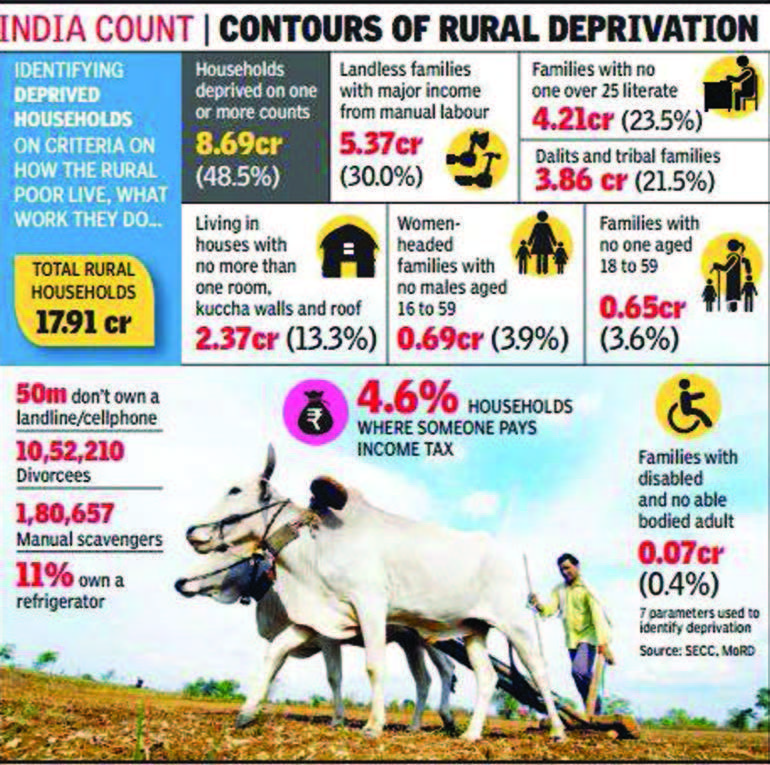
    NEW DELHI (TIP): A worrying picture emerged on last week as the government released new data which showed that rural India accounted for 73 per cent households and 74 per cent of these survived on a monthly income of less than Rs 5,000 of its highest earner.

    According to the data, 51 per cent of the households are engaged in casual, manual labour and 30 per cent in cultivation. Provisional findings of the Socio Economic Caste Census (SECC) recognise “multidimensional” aspects of poverty and will form the basis for determination of beneficiaries of government schemes in rural areas. Conducted between 2011 and 2013, it will facilitate identification of the poor and deprived in rural areas.

    The census covered 24.39 crore households across the country – 17.91 crore are rural households. The highest number of rural households are in Bihar – 90 per cent. The census also showed that 21.53 per cent of rural households belong to the Scheduled Caste/Scheduled Tribes. The contentious caste break-up data was not released. “This is the jurisdiction of the DG Census. It is for him to decide what he thinks about it. This is entirely in the DG’s domain. Only he can comment on it. Only he can satisfy your queries,” Rural Development Minister Birender Singh said while releasing the data with Finance Minister Arun Jaitley. “The name of the report indicates (caste), but caste is not reflected in our data… still the name is Socio Economic and Caste Census,” he said. When the SECC process began in 2011, OBC leaders of parties like the SP, RJD, JD(U) pressed for enumeration of caste on the lines of the 1931 census.

    There was division even in the UPA whichwas in power then. Those opposed to it had cautioned that findings of the caste census could lead to new demands for reservation.

    According to the SECC data, 31.26 per cent of the total rural households can be broadly identified as “poor”‘ where the main earner has an “insecure and uncertain” source of income and the household lives in a “one room house with kutcha walls and kutcha roof”.

    This figure is the Rural Development Ministry’s internal assessment and will not be released officially. Sources said this is because it has been left to states to determine their own poverty ratios using the findings of this census. It is not the mandate of the ministry under this census to determine overall BPL figures, sources said. As many as 74.49 per cent rural households survive on a monthly income of less than Rs 5,000 of its highest earner. The largest number of such households is in Chhattisgarh – over 90 per cent. Five percent of rural households derive salaries from government jobs, 1.11 per cent from public and 3.57 per cent from private sources. Overall, 94 per cent of households own houses, but only 17.70 per cent of SC and 10.50 per cent of ST households have their own houses.

    Only 4.58 percent of rural households pay income tax. The findings show 56 per cent households are landless and 70 per cent of SC households fall in this category. In rural households, 38.27 per cent are “landless households deriving major part of their income from manual casual labour”. The highest are in Tamil Nadu (55.80 per cent) and Bihar (54.33 per cent). The largest proportion of households with “destitute/living on alms” is in Orissa. The census distributed rural households into three categories: those that have to be compulsorily excluded; those that have to be compulsorily included; and those that fall in-between, which were then ranked based on seven deprivation criteria.

    Information was collected on a range of parameters at the individual and householdlevels like occupation, education, disability, religion, SC/ST status, name of caste/tribe, employment, income and source of income, assets, housing, possession of consumer durables and non-durables and land owned. Those to be automatically included are households without shelter, destitute living on alms, manual scavengers, primitive tribal groups and legally released bonded labourers.

    This figure has been pegged at less than 1 per cent. In this, 0.11 per cent of SCs and 0.46 per cent of STs have been automatically included. The automatically excluded constitute 39.4 per cent of the total rural population and include households with any of the following: motorised vehicles, mechanised agricultural equipment, kisan credit card with credit limit of Rs 50,000 and above, households with any member as a government employee, households with non-agricultural enterprises registered with the government, any family member earning more than Rs 10,000 a month, those paying income/professional tax, living in houses with three or more rooms with all having pucca walls and roof, owning a refrigerator, landline phone, possessing irrigated land etc.

    Finance Minister Arun Jaitley said, “It’s after seven-eight decades that we have this document after 1932 of the caste census… It’s going to be a very important document for all policy makers both in central and state governments… this document will help us target groups for support in terms of policy planning.”

    “It is also a document which contains various details with regard to the specifics of regions, communities, caste groups, economic groups and give us an opportunity to measure the progress which households in India have made. Who are the ones who have qualitatively moved up in terms of quality of life and who are the ones in terms of geographical regions, social groupings which in future planning need to be targeted,” he said.

    The ministry’s internal poverty estimate from the census is similar to that of the Rangarajan committee, a technical experts group set up by the UPA government in 2012 after criticism that the poverty line had been pegged much lower than it should have been by the Tendulkar committee. According to the Rangarajan committee, the percentage of people below the poverty line in 2011-12 was 30.95 in rural areas and 26.4 in urban areas as compared to 25.7 and 13.7 respectively as per the Tendulkar methodology.MOST LIVE ON LESS THAN RS 200 A DAY Stats

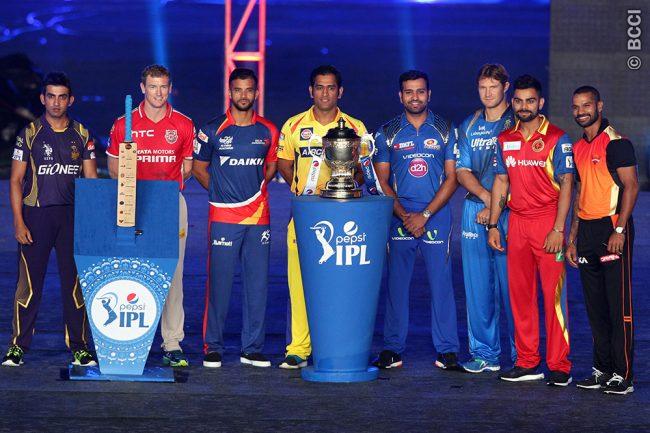
  • IPL 2015 Season 8 Match Schedule – Starting April 8

    IPL 2015 Season 8 Match Schedule – Starting April 8

    No of Match Team Time Day Date Stadium  City
    Match 1 Kolkata Knight Riders vs Mumbai Indians 8:00pm IST (2:30pm GMT) Wednesday Apr 8, 2015 Eden Gardens Kolkata
    Match 2 Chennai Super Kings vs Delhi Daredevils 8:00pm IST (2:30pm GMT) Thursday Apr 9, 2015 M. A. Chidambaram Stadium Chennai 
    Match 3 Kings XI Punjab vs Rajasthan Royals 8:00pm IST (2:30pm GMT) Friday Apr 10, 2015 MCA International Stadium Pune 
    Match 4 Chennai Super Kings vs Sunrisers Hyderabad 4:00pm IST (10:30am GMT) Saturday Apr 11, 2015 M. A. Chidambaram Stadium Chennai 
    Match 5 Kolkata Knight Riders vs Royal Challengers Bangalore 8:00pm IST (2:30pm GMT) Saturday Apr 11, 2015 Eden Gardens Kolkata
    Match 6 Delhi Daredevils vs Rajasthan Royals 4:00pm IST (10:30am GMT) Sunday Apr 12, 2015 Ferozeshah Kotla Delhi
    Match 7 Mumbai Indians vs Kings XI Punjab 8:00pm IST (2:30pm GMT) Sunday Apr 12, 2015 Wankhede Stadium Mumbai
    Match 8 Royal Challengers Bangalore vs Sunrisers Hyderabad 8:00pm IST (2:30pm GMT) Monday Apr 13, 2015 M. Chinnaswamy Stadium Bengaluru
    Match 9 Rajasthan Royals vs Mumbai Indians 4:00pm IST (10:30am GMT) Tuesday Apr 14, 2015 Sardar Patel Stadium Ahmedabad
    Match 10 Kolkata Knight Riders vs Chennai Super Kings 8:00pm IST (2:30pm GMT) Tuesday Apr 14, 2015 Eden Gardens Kolkata
    Match 11 Kings XI Punjab vs Delhi Daredevils 8:00pm IST (2:30pm GMT) Wednesday Apr 15, 2015 MCA International Stadium Pune 
    Match 12 Sunrisers Hyderabad vs Rajasthan Royals 8:00pm IST (2:30pm GMT) Thursday Apr 16, 2015 ACA-VDCA Stadium Visakhapatnam
    Match 13 Mumbai Indians vs Chennai Super Kings 8:00pm IST (2:30pm GMT) Friday Apr 17, 2015 Wankhede Stadium Mumbai
    Match 14 Sunrisers Hyderabad vs Delhi Daredevils 4:00pm IST (10:30am GMT) Saturday Apr 18, 2015 ACA-VDCA Stadium Visakhapatnam
    Match 15 Kings XI Punjab vs Kolkata Knight Riders 8:00pm IST (2:30pm GMT) Saturday Apr 18, 2015 MCA International Stadium Pune 
    Match 16 Rajasthan Royals vs Chennai Super Kings 4:00pm IST (10:30am GMT) Sunday Apr 19, 2015 Sardar Patel Stadium Ahmedabad
    Match 17 Royal Challengers Bangalore vs Mumbai Indians 8:00pm IST (2:30pm GMT) Sunday Apr 19, 2015 M. Chinnaswamy Stadium Bengaluru
    Match 18 Delhi Daredevils vs Kolkata Knight Riders 8:00pm IST (2:30pm GMT) Monday Apr 20, 2015 Ferozeshah Kotla Delhi
    Match 19 Rajasthan Royals vs Kings XI Punjab 8:00pm IST (2:30pm GMT) Tuesday Apr 21, 2015 Sardar Patel Stadium Ahmedabad
    Match 20 Sunrisers Hyderabad vs Kolkata Knight Riders 4:00pm IST (10:30am GMT) Wednesday Apr 22, 2015 ACA-VDCA Stadium Visakhapatnam
    Match 21 Royal Challengers Bangalore vs Chennai Super Kings 8:00pm IST (2:30pm GMT) Wednesday Apr 22, 2015 M. Chinnaswamy Stadium Bengaluru
    Match 22 Delhi Daredevils vs Mumbai Indians 8:00pm IST (2:30pm GMT) Thursday Apr 23, 2015 Ferozeshah Kotla Delhi
    Match 23 Rajasthan Royals vs Royal Challengers Bangalore 8:00pm IST (2:30pm GMT) Friday Apr 24, 2015 Sardar Patel Stadium Ahmedabad
    Match 24 Mumbai Indians vs Sunrisers Hyderabad 4:00pm IST (10:30am GMT) Saturday Apr 25, 2015 Wankhede Stadium Mumbai
    Match 25 Chennai Super Kings vs Kings XI Punjab 8:00pm IST (2:30pm GMT) Saturday Apr 25, 2015 M. A. Chidambaram Stadium Chennai 
    Match 26 Kolkata Knight Riders vs Rajasthan Royals 4:00pm IST (10:30am GMT) Sunday Apr 26, 2015 Eden Gardens Kolkata
    Match 27 Delhi Daredevils vs Royal Challengers Bangalore 8:00pm IST (2:30pm GMT) Sunday Apr 26, 2015 Ferozeshah Kotla Delhi
    Match 28 Kings XI Punjab vs Sunrisers Hyderabad 8:00pm IST (2:30pm GMT) Monday Apr 27, 2015 Punjab Cricket Association Stadium Mohali
    Match 29 Kolkata Knight Riders vs Delhi Daredevils 8:00pm IST (2:30pm GMT) Tuesday Apr 28, 2015 Eden Gardens Kolkata
    Match 30 Royal Challengers Bangalore vs Rajasthan Royals 8:00pm IST (2:30pm GMT) Wednesday Apr 29, 2015 M. Chinnaswamy Stadium Bengaluru
    Match 31 Chennai Super Kings vs Kolkata Knight Riders 8:00pm IST (2:30pm GMT) Thursday Apr 30, 2015 M. A. Chidambaram Stadium Chennai 
    Match 32 Delhi Daredevils vs Kings XI Punjab 4:00pm IST (10:30am GMT) Friday May 1, 2015 Ferozeshah Kotla Delhi
    Match 33 Mumbai Indians vs Rajasthan Royals 8:00pm IST (2:30pm GMT) Friday May 1, 2015 Wankhede Stadium Mumbai
    Match 34 Royal Challengers Bangalore vs Kolkata Knight Riders 4:00pm IST (10:30am GMT) Saturday May 2, 2015 M. Chinnaswamy Stadium Bengaluru
    Match 35 Sunrisers Hyderabad vs Chennai Super Kings 8:00pm IST (2:30pm GMT) Saturday May 2, 2015 Rajiv Gandhi International Cricket Stadium Hyderabad
    Match 36 Kings XI Punjab vs Mumbai Indians 4:00pm IST (10:30am GMT) Sunday May 3, 2015 Punjab Cricket Association Stadium Mohali
    Match 37 Rajasthan Royals vs Delhi Daredevils 8:00pm IST (2:30pm GMT) Sunday May 3, 2015 Brabourne Stadium Mumbai
    Match 38 Chennai Super Kings vs Royal Challengers Bangalore 4:00pm IST (10:30am GMT) Monday May 4, 2015 M. A. Chidambaram Stadium Chennai 
    Match 39 Kolkata Knight Riders vs Sunrisers Hyderabad 8:00pm IST (2:30pm GMT) Monday May 4, 2015 Eden Gardens Kolkata
    Match 40 Mumbai Indians vs Delhi Daredevils 8:00pm IST (2:30pm GMT) Tuesday May 5, 2015 Wankhede Stadium Mumbai
    Match 41 Royal Challengers Bangalore vs Kings XI Punjab 8:00pm IST (2:30pm GMT) Wednesday May 6, 2015 M. Chinnaswamy Stadium Bengaluru
    Match 42 Rajasthan Royals vs Sunrisers Hyderabad 8:00pm IST (2:30pm GMT) Thursday May 7, 2015 Brabourne Stadium Mumbai
    Match 43 Chennai Super Kings vs Mumbai Indians 8:00pm IST (2:30pm GMT) Friday May 8, 2015 M. A. Chidambaram Stadium Chennai 
    Match 44 Kolkata Knight Riders vs Kings XI Punjab 4:00pm IST (10:30am GMT) Saturday May 9, 2015 Eden Gardens Kolkata
    Match 45 Delhi Daredevils vs Sunrisers Hyderabad 8:00pm IST (2:30pm GMT) Saturday May 9, 2015 Chhattisgarh International Cricket Stadium Raipur
    Match 46 Mumbai Indians vs Royal Challengers Bangalore 4:00pm IST (10:30am GMT) Sunday May 10, 2015 Wankhede Stadium Mumbai
    Match 47 Chennai Super Kings vs Rajasthan Royals 8:00pm IST (2:30pm GMT) Sunday May 10, 2015 M. A. Chidambaram Stadium Chennai 
    Match 48 Sunrisers Hyderabad vs Kings XI Punjab 8:00pm IST (2:30pm GMT) Monday May 11, 2015 Rajiv Gandhi International Cricket Stadium Hyderabad
    Match 49 Delhi Daredevils vs Chennai Super Kings 8:00pm IST (2:30pm GMT) Tuesday May 12, 2015 Chhattisgarh International Cricket Stadium Raipur
    Match 50 Kings XI Punjab vs Royal Challengers Bangalore 8:00pm IST (2:30pm GMT) Wednesday May 13, 2015 Punjab Cricket Association Stadium Mohali
    Match 51 Mumbai Indians vs Kolkata Knight Riders 8:00pm IST (2:30pm GMT) Thursday May 14, 2015 Wankhede Stadium Mumbai
    Match 52 Sunrisers Hyderabad vs Royal Challengers Bangalore 8:00pm IST (2:30pm GMT) Friday May 15, 2015 Rajiv Gandhi International Cricket Stadium Hyderabad
    Match 53 Kings XI Punjab vs Chennai Super Kings 4:00pm IST (10:30am GMT) Saturday May 16, 2015 Punjab Cricket Association Stadium Mohali
    Match 54 Rajasthan Royals vs Kolkata Knight Riders 8:00pm IST (2:30pm GMT) Saturday May 16, 2015 Brabourne Stadium Mumbai
    Match 55 Royal Challengers Bangalore vs Delhi Daredevils 4:00pm IST (10:30am GMT) Sunday May 17, 2015 M. Chinnaswamy Stadium Bengaluru
    Match 56 Sunrisers Hyderabad vs Mumbai Indians 8:00pm IST (2:30pm GMT) Sunday May 17, 2015 Rajiv Gandhi International Cricket Stadium Hyderabad
    Qualifier 1  TBD vs TBD 8:00pm IST (2:30pm GMT) Tuesday May 19, 2015 TBC TBC
    Eliminator TBD vs TBD 8:00pm IST (2:30pm GMT) Wednesday May 20, 2015 TBC TBC
    Qualifier 2 TBD vs TBD 8:00pm IST (2:30pm GMT) Friday May 22, 2015 TBC TBC
    Final  TBD vs TBD 8:00pm IST (2:30pm GMT) Sunday May 24, 2015 Eden Gardens Kolkata
  • INVESTMENT PROPOSALS DON’T MEET PROMISES

    INVESTMENT PROPOSALS DON’T MEET PROMISES

    NEW DELHI (TIP): Investment proposals by corporates are generally associated with improving business sentiment and often linked with the possibility of job creation. The comparison of proposed investment with actual implementation and job creation in the past 23 years, however, shows that the actual delivery has fallen well short of the promise.

    Data from the department of industrial policy and promotion shows that between August 1991 and March 2014, the government received about 94,000 investment proposals. These proposals include Industrial Investment Intentions through Entrepreneurs Memorandum — IEMs (delicensed sector) and Direct Industrial Licences (licensable sector).

    Put together, these proposed the investment of more than Rs 102 lakh crore and were supposed to create 2.3 crore jobs. The data on actual implementation of these proposals shows that only Rs 5.1 lakh crore was actually invested and just 20.1 lakh jobs created. That’s less than 5% of the proposed investments and 8.9% of the promised jobs.

    A state-wise analysis of proposals shows that between August 1991 and March 2014 corporates proposed to invest Rs 15.4 lakh crore in Orissa —the highest in the country. It was followed by Gujarat and Chhattisgarh receiving over Rs 10 lakh crore of proposed investments and Maharashtra just a tad below that mark. Overall, there were 15 states, which were each supposed to get over Rs 1 lakh crore of investments in these 23 years.

    When one analyses actual investments, Haryana has been the most successful among these 15 states in converting proposals to reality as 18.9% of the proposed money actually reached the state. It is followed by Gujarat (12.6%) and Uttar Pradesh (11.4%). The states that fared the worst in this conversion are Bihar, Jharkhand, Chhattisgarh and Orissa, where less than 1% of the proposed money actually arrived.

    So, what is the investment to job creation ratio? Overall, the Rs 5 lakh crore actually invested created a little over 20 lakh jobs, which amounts to four jobs per crore of investment. There were 25 states which witnessed the actual investment of more Rs 1,000 crore. Among these states, Jammu and Kashmir witnessed the most labour intensive investments, while Gujarat had the most capital intensive ones. Every crore of rupee invested in Jammu and Kashmir created about 12 jobs, while in Gujarat a crore of investment yielded only two jobs.

    In the investment to job creation ratio, Jammu and Kashmir is followed by Goa, Uttarakhand, Kerala and Punjab, where ten or more jobs were created per crore of investment. The worst state/UTs in this list are Madhya Pradesh, Jharkhand, Daman & Diu, Uttar Pradesh and Gujarat.

  • Gujarat may let officials join RSS

    GANDHINAGAR (TIP): BJP-ruled Gujarat may follow Chhattisgarh in al lowing government employees to join the RSS.

    A senior official of the state general administration department (GAD) said the state government is considering delisting the RSS from its “negative list of organisations” which government employees cannot join.

    Senior cabinet minister Nitin Patel did not deny the move but said the matter has not yet been discussed formally as the state assembly session is in session. “We will decide after examining the Chhattisgarh government’s order,” Patel said.

    In an order issued on February 23, the Chhattisgarh government had allowed government staff to join RSS saying its rule dating back to 1965, restricting government staff from taking part in political activity , “does not apply to the RSS”.

    Earlier, in 1999, the then Gujarat CM Keshubhai Patel had made a similar attempt, but withdrew his orders soon following Congress-led protests. But this time, the Gujarat government might allow saffronisation of its employees using the Chhattisgarh government’s argument that RSS is not a political organisation.

    “Employees of the state government cannot join political parties or communal institutions, but the RSS falls in the category of cultural and social institutions.So government employees can be permitted to join it,” said the GAD official.

    Currently , as per the Gujarat Civil Services (Conduct) Rules, RSS figures in the list of organisations that employees can’t join.

  • 134 companies enter final coal block race

    NEW DELHI (TIP): Altogether 134 of the 176 companies that queued up for 21 producing coal mines have been found technically qualified to make their financial bid, coal secretary Anil Swarup said on Thursday.

    Adani group, Jindal Steel and Power Ltd, Balco, Essar Power MP Ltd, GMR Chhattisgarh Energy Ltd, GVK Power, JSW Energy, Reliance Cement Company Ltd, Ambuja Cement, Hindustan Zinc, Sesa Sterlite are some of the major companies whose bids have been found technically sound.

    Of the 134 bids that were qualified, 12 are for Gare Palma IV/7 mine in Chhattisgarh, making it the most sought-after block. Balco, Hindalco, JSPL, Jaiprakash Associates Ltd, Monnet Ispat & Energy Ltd, Rungta Mines Ltd, Ultratech Cement are among the 12 interested bidders.

    Amelia (North) block and Bicharpur mine, both in Madhya Pradesh, have attracted 10 bidders each.

    The government had initially planned to auction 23 mines in the first lot but has put on hold bidding for two mines due to litigations. Swarup said the coal ministry would go ahead with the auction as per schedule, though there have been some changes due to court cases.

    “Consequent to an interim order of Jabalpur (High Court), the auction of two mines has been put on hold in schedule II (producing mines). These are Gotitoria East and Gotitoria West,” Swarup said.

    The ministry, he said, had put both the blocks in the unregulated sector (steel, cment, captive power) but the court directed that they be considered for regulated sector (power). “This will require a lot of study … so right now (only) these two mines have been put on hold ….,” he said.

    Swarup said in case of Schedule III mines (ready to produce) there are three blocks that have been taken out of auction process consequent to the order of the Delhi High Court.

    “We are referring this to a technical committee which will re-examine it in the context and as per the directives of the high court,” Swarup said, adding that in all, five blocks have been impacted by two court orders.

  • Video clip shows Naxals training to gun down choppers

    Video clip shows Naxals training to gun down choppers

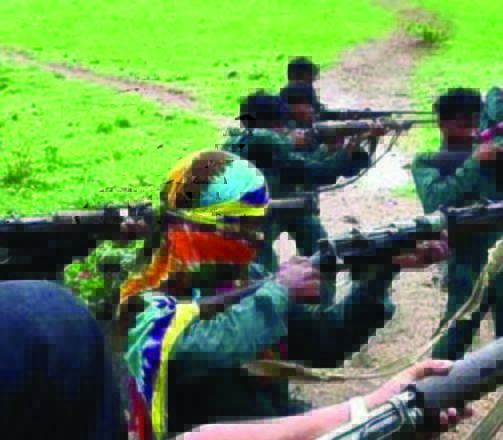
    RAIPUR (TIP): A rare video footage of Maoists purportedly showing the rebels conducting a ‘commando-style’ training to gun down helicopters, used to ferry security personnel and VIPs in Chhattisgarh’s worst insurgency-hit Bastar region, has been recovered by police.

    The video of the outlawed CPI (Maoist) at a training camp apparently in forests of Sukma – south Bastar adjoining Andhra Pradesh and Odisha -shows a group of 15-20 guerrilla cadres doing a practice to bring down a chopper by using its ‘dummy’ with LMGs (light machine guns) and small weapons.

    “Documents detailing Naxals’ nefarious strategies to target choppers have been seized a number of the times from various places of Bastar, but for the first time it has come to our knowledge that they have made its clippings. Now it’s clear that the Naxals are conducting such trainings,” state Additional Director General of Police (anti-Naxal operations) R K Vij said.

    “Security will be beefed up around helipads in the dense forests and all necessary precautionary measures will be taken to ensure that Maoists do not get a chance to target choppers,” Vij said.

    The video clip, believed to be shot recently, shows a dummy of a flying machine, prepared with raw wood, plastic sheets and branches of trees, suspended on a rope tied to trees from two sides.

    In the footage, few cadres are seen swinging off the ‘dummy’ from one side to another in a descending pattern, quite like a helicopter lands from some specific height at the helipad, while the armed cadres positioned on the ground are seen firing at its bottom.

    The video also shows Maoists training in different techniques to engage helicopters with small weapons along with some sophisticated weapons positioned at strategic points.

    Machine guns mounted on tripods made of tree branches were also being used in the training, as per the footage.

    A Central Reserve Police Force (CRPF) official posted in Chhattisgarh said, “We have received number of inputs that they are being trained to bring down choppers generally used in casualty evacuation mission and to ferry VIPs and VVIPs.”

    Maoists generally try to fire at copters at the time of landing and take-off from around a kilometre away from the landing site, but they hardly get any success, he said on condition of anonymity.

    The rebels have also tried to divert the choppers to land at a wrong place in the dense forests, but they have never been successful in it, the paramilitary official said. As per police statistics, the Naxals last year looted as many as 41 assault rifles, including AK-47, Insas and SLR, after encounter with security forces in Bastar.

    Around eight of the snatched sophisticated weapons were built with Under Barrel Grenade Launchers
    (UBGL), which has a capacity to target to at least 800 metres.

    “The looted sophisticated weapons could be used to target choppers. We have asked our men to trace the locations of such camps (if any) meant to train to shoot down choppers, in Sukma and Bijapur,” the CRPF official said. In the past, the Naxals had targeted choppers several times in Bastar.

    In January 2013, an IAF helicopter, on a rescue mission to airlift an injured CRPF jawan and the body of another, was forced to make an emergency landing at a field in the densely-forested Sukma district after it came under fire from Maoists.

    In another incident in Sukma, Naxals had fired at an IAF helicopter flying to retrieve an injured CRPF personnel in November last year. An IAF commando had sustained bullet injuries on his leg in the Naxal firing.

  • 22 STATES, UTS SUPPORT BILL TO PREVENT ‘HONOUR KILLINGS’

    22 STATES, UTS SUPPORT BILL TO PREVENT ‘HONOUR KILLINGS’

    NEW DELHI (TIP): The government has initiated the process of drafting a law against honour killings by treating crimes in the name of honour as a separate category of offences. The moves comes after 22 states, including Punjab, Haryana, Himachal Pradesh and Chandigarh (UT), supported the recommendations of the Law Commission of India to treat honour crimes as a standalone offence. Law Minister Sadananda Gowda said in Parliament today that the government would, after considering the comments from states, hold consultations on the enactment of the legislation against honour crimes. “After considering the responses of all states and UTs and consultations with stakeholders, the policy decision to enact the legislation on the subject will be taken. It would be difficult to fix a timeline but the department has initiated the process of implementation of the report of the Law Commission in this respect,” Gowda said.

    The Law Commission had in its 242nd Report on “Prevention of Interference with the Freedom of Matrimonial Alliances in the Name of Honour and Tradition” recommended a strict law against honour crimes being perpetuated by community panchayats working by different names in different parts of the country. The proposal to bring the law was first initiated during Congress-led UPA-II which had formed a Group of Ministers to make recommendations. The GOM never presented its report and was disbanded once its chairman – Pranab Mukherjee – proceeded to become President. At that time, Haryana had opposed the move. The BJP government, after coming to power, circulated the proposal again and 22 states, including Haryana (which now has a BJP government), have supported the recommendations of the Law Commission.

    Apart from Punjab, Haryana, Himachal and Chandigarh, the states that have backed the law are: Andhra, Assam, Chhattisgarh, Goa, Jharkhand, Karnataka, Kerala, Meghalaya, Mizoram, Nagaland, Odisha, Uttar Pradesh, West Bengal and the UTs of Dadra and Nagar Haveli; Daman and Diu, Lakshadweep and Puducherry. The responses of the remaining states are awaited. Consensus of states on the law to curb honour crimes is critical because the subject falls in List III (Concurrent List) of the Seventh Schedule of the Constitution and the Centre alone cannot legislate on it.

  • CRPF men’s uniforms in garbage bin to be probed

    CRPF men’s uniforms in garbage bin to be probed

    NEW DELHI (TIP): A day after blood-stained uniforms and shoes of CRPF troops killed by Maoists were found in a garbage bin, Union Home Minister Rajnath Singh on December 4 instructed Chhattisgarh Chief Minister Raman Singh to “order a probe and fix responsibility” on those who “insulted” the martyrs. Soon after the callous handling of the effects of the martyrs became public, the Home Minister ordered the probe amid claims by senior CRPF officials of mischief by political leaders to gain political mileage. “I have asked Ch’garh CM to fix responsibility and punish those involved in insulting the uniform of the deceased CRPF men,” the Home Minister tweeted.

    He said security personnel of the state as well as central forces should be appropriately honoured. The CRPF also would inquire into the incident. Acting Central Reserve Police Force Director General R C Tayal said the inquiry would be conducted by an officer deputed by the Inspector General (Operations) in Chhattisgarh and a report would be submitted soon. “We suspect some political workers took these items from the lower staff of the hospital in Raipur.We are looking into it,” Tayal said. Sources said the uniforms of the dead personnel were handed over to local police as per procedure. “My message is that we have all respect for our martyrs.

    If I need to say sorry to the families of those killed, I will do so. The usual process in such cases is that these (personal effects) are taken by the case investigating police officer. Let me get the details of the inquiry and we will take required action,” Tayal said.

  • Botched sterilizations: Fungus-laden anaesthesia used at health camp

    Botched sterilizations: Fungus-laden anaesthesia used at health camp

    RAIPUR (TIP): It was not just antibiotics laced with rat poison (zinc phosphide) that was administered on victims of botched surgeries at Bilaspur health camps, local anaesthesia injected on women at the Gaurella camp in the district were laden with fungus. One woman died after tubectomy at this camp. Sources said a few batches of fungus-ridden Lignocaine injection, used as anaesthesia, were supplied by Indore-based company Kabra Drugs. Though government withdrew the stock of contaminated injections from the government hospital and health centres, officials admit these injections were used at the Gaurella camp. Health commissioner Pratap Singh said though fungus was found in 3 batches of Lignocaine, vials were removed last September.

    He said the company had been blacklisted for 5 years. Pratap said Chhattisgarh Medical Services Corporation (CGMSC) had been procuring and supplying injections from the company since September, 2013, and the last batch was received earlier this month. “We do stability tests on stocks. It was a manufacturing glitch on vials, which developed spores and fungus was detected on Wednesday evening,” he said. Data available at CGMSC website show around 2.37 lakh vials (30 ml each) of Lignocaine injection from batches recalled by the government are still in stock. About 13,836 units are in the Bilaspur warehouse. This is the second instance in less than four months when drugs procured by CGMSC have been found contaminated with fungus. In July, the corporation recalled 98 batches of the intravenous fluid bottles manufactured by a Madhya Pradesh company, DJ Laboratory, after detection of fungus

  • An Avoidable Tragedy

    An Avoidable Tragedy

    It is at once sobering and shocking that the sterilization procedures (laparoscopic tubectomy) carried out on 83 women at a camp in Pendari village of Chhattisgarh’s Bilaspur district on November 8 ended up killing 11 women and leaving 69 others ill, some of them critically. In another such sterilization camp held in Guarella in the same district on November 10, one of the 56 women sterilized has died and 12 remain in critical condition. Even as the precise cause of the tragedies is being investigated, what is abundantly clear is that the standard operating procedures were thrown to the winds.

    It is appalling that a single doctor and a health worker carried out the procedures on all the women in both the camps. According to a 2008 document dealing with standard operating procedures for sterilization services in such camps, a surgeon can carry out no more than 30 tubectomies using three laparoscopes on a given day. Even a team with additional surgeons, support staff and instruments can at the most conduct 50 procedures a day. Even if more than one laparoscope was used, the detailed procedure of decontaminating and cleaning the laparoscope prior to disinfecting it for 20 minutes would have made it impossible to conduct 83 procedures in less than five hours at Pendari and 56 procedures at Guarella in such a short time.

    It is an irony that though laparoscopic tubectomy is a bloodless procedure, many women in the Pendari camp went into hemorrhagic shock due to excessive blood loss. Along with anesthesia and drugs given to women, the needle of suspicion points to sepsis arising from the use of contaminated laparoscopes. Sadly, rules will continue to be flouted and deaths will be the order of the day as long as the lethal combination of pressure to meet sterilization targets, “compensation” amounts given to women and payment to doctors on the basis of numbers, are in place. Making it worse is the undivided attention the government has been giving to sterilization as a means of achieving by 2020 the Millennium Development Goal on reproductive, maternal, newborn, child and adolescent health.

    This comes out clearly in a letter sent out on October 20, 2014 by the Ministry of Health and Family Welfare to the Chief Ministers of 11 “high focus States.” The “compensation” and payment made to all the parties have been increased for these States. Already, the number of sterilization procedures carried out in India is disproportionately high compared with other family planning measures such as the use of intrauterine devices. If the accredited social health activists (ASHA) are under pressure to mobilize women for sterilization, the increased focus on the 11 States would mean that women in these States are even less likely to be counseled and informed of safer contraceptive methods to choose from.

    (The Hindu)

  • CHHATTISGARH

    CHHATTISGARH

    The newly formed state of Chhattisgarh is an interesting tourist destination considering the blend of tribal tourism, history, nature and wildlife that it offers. The bulk of

    tourist attractions in Chhattisgarh however lie virtually unexplored. The virgin forests, dotted with picturesque waterfalls, scenic plateaus and winding rivers offer a feast to eyes and the lens of your camera. The forests of Chhattisgarh incidentally occupy 42% of the state’s land surface. The tourist attractions in Chhattisgarh India therefore cater to a large tourist taste and has infinite prospect of harboring a flourishing tourism industry. The small town of Kawardha is offers breathtaking views of nature and a rich tribal life.


    29


    The royal palace at Kawardha is one of the major tourist attractions in Chhattisgarh. The village of Bastar, apart from offering a vivid glimpse of the tribal life, offers a wide array of metal crafted handicrafts. These molded iron objects are original tribal products of Bastar and is quite popular among tourists.

    Tourist attractions

    Anand Prabhu Kudi Vihar

    Anand Prabhu Kudi Vihar, Mahasamund is the most famous amongst all Sirpur’s Buddhist vihars. The historical and picturesque city of Mahasamund is a municipality in the Mahasamund District. The Mahasamund District possesses a tribal population of 28.9%. The different types of tribes living in the district are Pardhi, Binjhwar, Dhanwar, Halba, Kamar, Kanwar, Kharai, Munda, Bahalia, Saur, Saharia, Sonar, Sanwara, Kharwar and Bhujia. There is a great scope for intense mining activity as Granite rocks and Limestone rocks are found in the district.

    Gandheswar Temple

    Gandheswar Temple, Mahasamund is situated on the banks of the Mahanadi river. The historical city of Mahasamund is a municipality in the Mahasamund District. It is also the administrative headquarters of the Mahasamund District. Apart from the Gandheswar Temple, Mahasamund, there are other temples in the city as well. The other temples are Swastik Vihar, Anand Prabhu Kudi Vihar and


    31


    Laxman Temple.

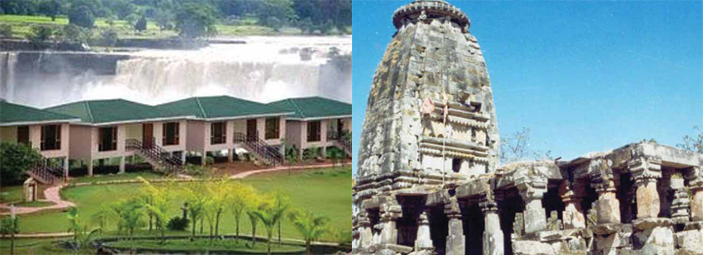
    There are also a number of different types of tribes living in the city. The different types of tribes are Kamar, Kanwar, Dhanwar, Kharai, Munda, Bahalia, Saur, Pardhi, Binjhwar, Saharia, Sanwara, Kharwar, Bhujia, Sonar and Halba. Laxman Temple Laxman Temple, Mahasamund is one of the finest and top quality brick temples in India. Exquisite carvings and precise construction characterizes the temple. The historical and picturesque city of Mahasamund is a municipality in the Mahasamund District. It is also the administrative headquarters of the Mahasamund District.

    Lakes and waterfalls

    The rugged terrain and voluptuous rivers of Chhattisgarh make beautiful waterfalls and springs all around the state. The lakes, waterfalls and springs in Chhattisgarh are popular tourist and picnic spots and are yet another facet of the already beautiful natural wealth of Chhattisgarh. The Chitrakoot Waterfalls in Jagdalpur in Chhattisgarh are often termed the Niagra of India and is one spot that has been rigorously promoted by state’s tourism department.

    The Chitrakoot Falls roaring down the rocks with a huge volume of water makes a sight surely not to be forgotten. On a tour to visit the Lakes, Waterfalls and springs In Chhattisgarh In India one spot you must never forget to visit the Chitrakoot Falls. The Lakes, Waterfalls and springs In Chhattisgarh India are in fact some of the most visited spots on a tour to Chhattisgarh. Nestled amidst the dense forest growth that Chhattisgarh is blessed with, the Lakes, Waterfalls and springs In Chhattisgarh are also important ecological balancing factors in the environment of the state.

    In a country where the skies are blackening by the day, the forests receding by miles and the fauna struggling to cope up with the surroundings, states like Chhattisgarh are national asset and every effort on part of the government have been initiated to ensure the safekeeping of the natural splendor of the Chhattisgarh greens. Kendai water fall, Tatapani, Ruksganda water fall, Amritdhara water fall, Kothali water fall, Gangrail Jalashaya, Kharkhara Bandh, Keshkal Teerathgarh waterfall, are the other major lakes waterfalls and springs in Chhattisgarh.

    Rivers and Caves

    There are quite a few Rivers and Caves in Chhattisgarh. Every year thousands of tourists from each and every corner of the world and from all across India visit these Rivers and Caves in Chhattisgarh. Some of the popular Rivers and Caves in Chhattisgarh, India include Kailash Gufa in Jashpur, Kotebira Eb River in Jashpur, Kutumsar Caves and Kailash Gufa in Bastar. The well known waterfalls in Chhattisgarh are Danpuri Waterfall, Chitradhara Waterfalls, Rani Dah Waterfall, Chitrakote Waterfalls, Mandawa Waterfalls, Thamada Ghumar Waterfalls and Tiratgarh Waterfalls.

    To speak about the Rivers and Caves in Chhattisgarh, there are quite a few places worth mentioning. The Kailash Gufa in Jashpur is a beautiful rock-cut cave surrounded by exotic and mesmerizing fountains. There is a picturesque and eye catching waterfall near Kailsah Gufa. The Kotebira Eb River in Jashpur is a very pleasant and graceful river with catchy scenery and a rocky spot. Every year a fair is held here. The Kutumsar Caves and Kailash Gufa in Bastar are also quite famous.

    These caves are ancient and a feast for the eyes. Apart form the rivers, caves and waterfalls, the other tourist attraction places in Chhattisgarh include holy places, Mountains and Peaks, wildlife and monuments. The tribal culture in Chhattisgarh and its various ways and means are also something to look out for. The tourists can also visit the thousands of fairs that go on throughout the year and purchase a wide range of artifacts and traditional items.

  • BJP TO ROLL OUT BIG GUNS FOR ASSEMBLY POLLS

    BJP TO ROLL OUT BIG GUNS FOR ASSEMBLY POLLS

    NEW DELHI (TIP): With Dussehra over, BJP will get into campaign mode for the Haryana and Maharashtra assembly polls on a war footing.

    Prime Minister Narendra Modi and his senior ministers will have little time for anything else, criss-crossing the two states over the next two weeks, addressing rallies. BJP plans to hold at least four big rallies a day in each state till campaign ends for the October 15 polls.

    Modi will begin his charge on Saturday morning from Karnal in Haryana and move to Maharashtra to address three rallies in Beed, Aurangabad and Mahalakshmi (Mumbai). The PM will address 8-10 rallies in Haryana and around 22 in Maharashtra.

    Two senior ministers — home minister Rajnath Singh and external affairs minister Sushma Swaraj — will be all over Haryana on Saturday, holding four rallies each in the state. Singh will be at Radaur, Kalayat, Julana and Jakholi Rai while Swaraj will address rallies in Kalka, Thanachhapar, Shahbad and Gohana. Singh will address about 15 rallies in each state.

    The party has decided to have Swaraj, who belongs to Haryana, focus on the state where BJP is contesting on its own and is aiming to replace the Congress government. Similarly, road transport minister Nitin Gadkari has been asked to concentrate on Maharashtra, his home state, where BJP is contesting without its 25-year-old partner Shiv Sena this time.

    Swaraj is scheduled to address about 22 rallies in Haryana and will be in Maharashtra only for a day on October 6, attending three rallies. She will take a break from campaigning as she is travelling abroad between October 8 and 10. Gadkari is expected to address about 36 rallies in Maharashtra.

    Party veteran L K Advani will address six rallies in Maharashtra and two in Haryana, while Murli Manohar Joshi will address two rallies in Maharashtra and one in Haryana.

    Urban development minister M Venkaiah Naidu is slated to spend four days in Maharashtra and two in Haryana. Other ministers who will address a few rallies in both states are chemical and fertilizer minister Ananth Kumar, HRD minister Smriti Irani and social justice minister Thawar Chand Gehlot. Party chief Amit Shah will address about 15 rallies in each state.

    The party has roped in all its chief ministers to ensure its good governance campaign is showcased. Goa CM Manohar Parikkar will focus on Maharashtra while Madhya Pradesh CM Shivraj Singh Chouhan will spare three days for Maharashtra and one for Haryana. Rajasthan CM Vasundhara Raje has three days in Maharashtra and two days in Haryana, Chhattisgarh CM Raman Singh and Gujarat CM Anandiben Patel will each spend two days in Maharashtra. On an average, the chief ministers will address three rallies a day, party vice-president M A Naqvi said.

    Not to forget its star power, BJP has roped in actor-turned-MPs Hema Malini, Vinod Khanna and Shatrughan Sinha to campaign in both states.

  • No new VIP security duties for NSG

    No new VIP security duties for NSG

    NEW DELHI (TIP):

    VIPs may no more enjoy the cover of coveted ‘Black Cat’ commandos. Government is learnt to have decided that VIPs would no longer get the cover of NSG commandos and the force would be redirected to keep 100% focus on counter-terror operations. The elite commando force was established as an emergency force to respond to terror attacks but has been diluted over the years with the burden of VIP security. As the force’s commandos are known to be the best in the country, they are coveted for security cover by politicians and VIPs as a status symbol. This may change soon, though. NSG DG J N Choudhary on Thursday told TOI, “The government is aware that VIP security is not our core competence.

    If any more responsibility of VIP cover is given to us, it would dilute our capability to counter terror attacks. That is why the government is not giving us such responsibility anymore.” He added that NSG was a lean force, as any specialized force should be, and increasing VIP duties would spread it thin and unavailable to consistent counter-terror training, an absolute essential for such a force. Though the force has been demanding for long that its VIP duties be limited, successive governments have only increased the number of VIPs under its protection. Chhattisgarh CM Raman Singh and UP CM Akhilesh Yadav were added to the list in recent years.

    However, the new government has been careful of the force’s concerns and has assigned other paramilitary forces to secure VIP protectees. A case in point is that of BJP chief Amit Shah and NSA Ajit Doval, both having very high threat perception, but still given CRPF and CISF security respectively. It will, however, continue to provide security to the 15 VVIPs that it guards at present until further orders.

    The NSG guards CMs like Raman Singh (Chhattisgarh), J Jayalalithaa (Tamil Nadu), Tarun Gogoi (Assam), Akhilesh Yadav (Uttar Pradesh), Parkash Singh Badal (Punjab) and a host of other political figures like senior BJP leaders L K Advani and Rajnath Singh. It is also securing former CMs like Prafulla Mahanta (Assam), K Karunanidhi (Tamil Nadu) and Mulayam Singh Yadav (Uttar Pradesh).

    The concept and thought process to reduce VVIP security duties of the elite force was mooted about two years back when the force decided to pull out about 900 commandos from its VVIP security duties and train them for specialized operational tasks of counter-terror and counter-hijack operations for which it was raised in 1984.

  • Rewarding Democracy

    Rewarding Democracy

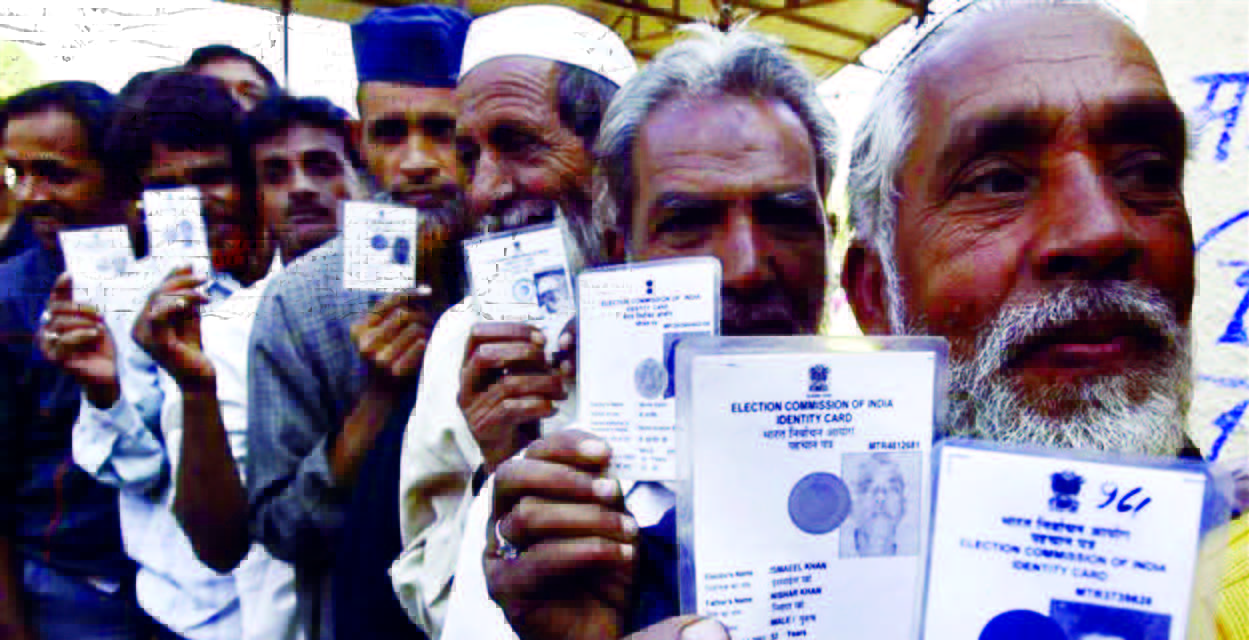
    One of the most encouraging aspects of the 2014 Lok Sabha elections has been the significantly high voter turnout in areas affected by Left-wing extremism. Bastar in Chhattisgarh, that remains severely affected by Maoist insurgency, saw a voter turnout of almost 60 per cent as opposed to 47.33 per cent in 2009.

    Here, as well as in other areas, the Maoists had called for a total boycott of elections. But in most areas, in spite of the violence perpetrated by the Maoist rebels, people have come out in large numbers to cast their vote. In Gadchiroli constituency in Maharashtra, that is a part of the Maoists’ foremost guerrilla zone, the Dandakaranya Special Zone Committee, over 68 per cent votes were cast as opposed to 65.21 per cent in the 2009 elections.

    Munger and Jamui in Bihar also saw a 10 per cent increase in voter turnout. The only affected area where the turnout was low is Orissa’s Malkangiri that recorded a voting percentage of 48 per cent. One reason attributed to the higher turnout is the enthusiasm of first-time voters who came out in large numbers. Also, in many Maoist-affected areas, people are tired of the long cycle of violence, and want things to change. The voter turnout in Bastar has left the Maoists worried.

    After the elections in Bastar on April 10, they have held meetings at several places with Adivasis to understand what prompted this high turnout. Even in the formerly Maoist-hit areas in West Bengal, that went to the polls on May 7, the turnout has been exceptional. West Medinipur, Purulia and Bankura registered a turnout of 81.41, 78.75, 80.55 per cent respectively till 5 p.m. In Jhargram, it was almost 88 per cent. The challenge for the new government would be to focus on the development of the red corridor, especially when people there have expressed their faith in democracy.

    One major reason why the Maoists were able to entrench themselves in these regions was that the Indian state had completely forsaken its people. The void left by the state was just filled by Maoists. The onus is on whosoever forms the next government in New Delhi to change the equation. In many areas, there is sympathy among the Adivasis for Maoists. Security operations in these areas may have put Maoists on the back foot, but this can only be a temporary trend.

    In the absence of a real developmental intervention by the new government, there will be no ebb in violence in Bastar and other Maoist-affected areas. One of the biggest challenges before the new government will be to instill a sense of security among the people. That will only happen if the people have confidence in the government – after which they will reject Maoism.

  • Phase 5: Voter turnouts higher than 2009 poll figures

    Phase 5: Voter turnouts higher than 2009 poll figures

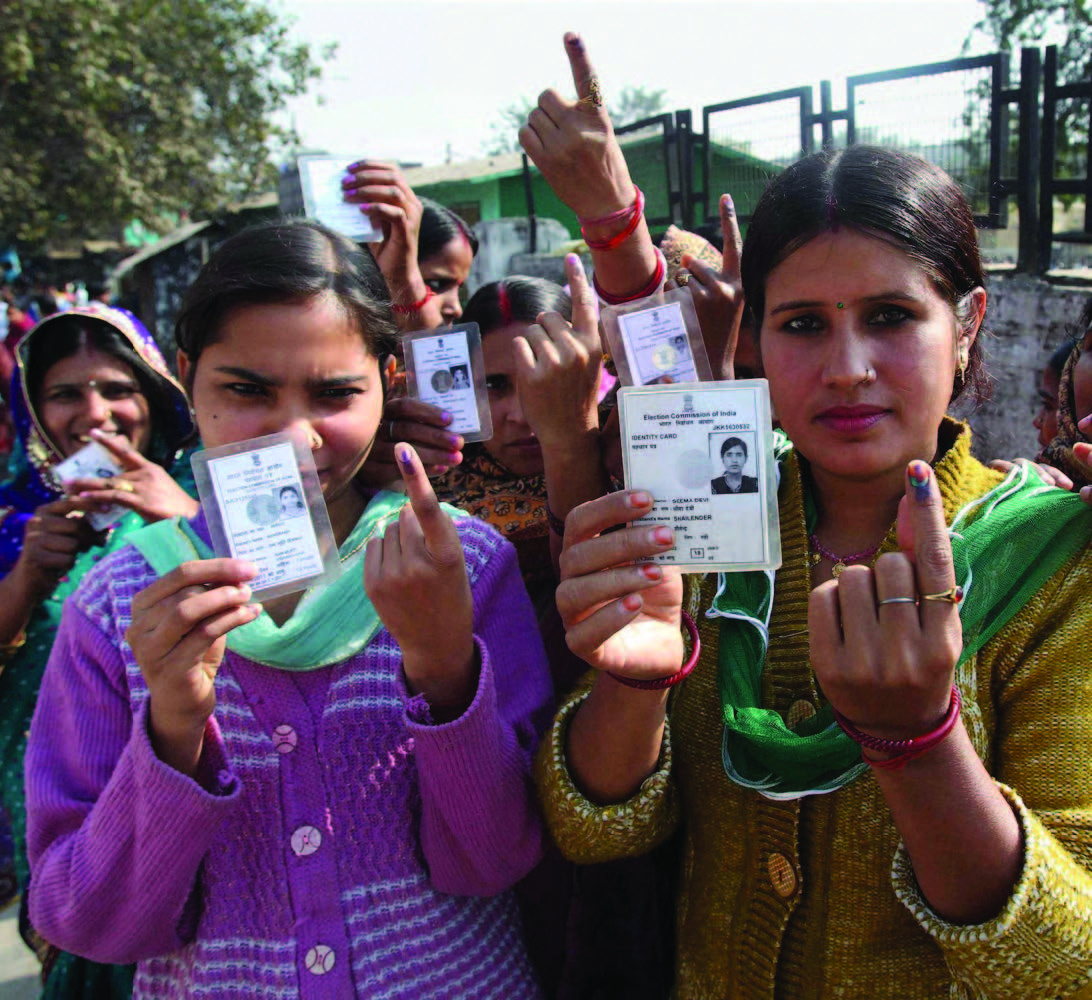
    NEW DELHI (TIP): Voter turnouts higher than the 2009 poll figures marked the fifth and biggest round of Lok Sabha elections covering 121 seats across 12 states amidst largely peaceful balloting on April 17. A good turnout is considered a strong sign of antiincumbency, a cause of worry for the Congress. While the Election Commission was yet to announce the final voting figures late on Thursday, nearly 65% of the eligible electors cast their ballot across the 12 states.

    The highest turnout of 81.57% was recorded in four constituencies in West Bengal, which has a total of 39 seats, while the lowest was recorded in Madhya Pradesh at 54%. While 80.6% had voted in the four seats in West Bengal in the 2009 general elections, the Madhya Pradesh figure stood at 46%. “After this phase, a large section of India has already voted,” said BJP’s prime ministerial candidate Narendra Modi. “People have voted in the heat and have voted for a strong government.”

    He added that the long queues of first-time and women voters “are positive steps”. In the key battleground state of Karnataka, where polling was held in the all the 28 seats, the voting percentage was 66% and in the 11 seats of Uttar Pradesh, electorally the most important state with 80 seats in the Lower House, the turnout was 62.52%, up from 2009’s 54.2%. A good show for Congress in Karnataka could help it check the BJP’s perceived surge nationally. In the previous Lok Sabha poll in the state, the BJP had won 18 seats in the state but is struggling this time. Maoists struck in Jharkhand, exploding a land mine at Bokaro in Giridih constituency and injuring four paramilitary troopers.

    They also blew up a school building and a rail track. Allegations of voter intimidation came from parts of Bihar and West Bengal. The Election Commission ordered repolling in nine polling stations in Bihar. Thursday’s election covered a vast part of the Indian landscape — from Jammu and Kashmir in the north to Karnataka in the south, from Maharashtra along the west coast to West Bengal in the east. Polling took place in all 28 Lok Sabha seats in Karnataka, 20 of the 25 in Rajasthan, 19 of the 48 in Maharashtra, 11 seats each in Odisha and Uttar Pradesh, 10 in Madhya Pradesh, seven in Bihar, six in Jharkhand, four in West Bengal, three in Chhattisgarh and one seat each in Manipur and Jammu and Kashmir.

    Simultaneous balloting was held for 77 of the 147 assembly seats in Odisha and two assembly bypolls in West Bengal. The BJP claimed it was confident of winning most seats contested on April 17. “We are sure of winning all 25 seats (in Rajasthan),” chief minister Vasundhara Raje said in Jaipur. Former central minister Ananth Kumar voiced confidence about the BJP’s ability to do well in Karnataka, where it is the main opposition party to the ruling Congress. Central ministers Sushilkumar Shinde and Jyotiraditya Scindia brushed aside the BJP’s claims. “There is no Modi wave,” Scindia said after voting in Guna in Madhya Pradesh. Shinde said in Sholapur: “There is no Modi wave here, only Shinde wave.”

    With Thursday’s round, polling has been completed in 232 of the 543 seats in the Lok Sabha. Thursday was important both for the BJP and the Congress, which held 40 and 36 of the Lok Sabha seats that went to the polls, as well as the Janata Dal-United, Jharkhand Mukti Morcha, Janata Dal-Secular, Shiv Sena, Maharashtra Navnirman Sena, Aam Aadmi Party, Biju Janata Dal, Samajwadi Party, Bahujan Samaj Party and Trinamool Congress. Around 70% votes — up from the 2009 figure of 44.9% — were polled in Jammu and Kashmir’s Udhampur seat where elections passed off peacefully. In Bihar, where polls were held in seven Lok Sabha constituencies, 56% voting was recorded as compared to 39.3% during 2009 Lok Sabha elections.

    Polling in Odisha saw 70% people vote as compared to 66.28% in 2009. In Chhattisgarh, 63.44% polling was reported. Polling in another important state, Maharashtra, which has a total of 48 seats, 19 constituencies which went to poll on Thursday saw a turnout of 61.7%. Prominent candidates in the fray included Ananth Kumar and Nandan Nilekani (Bangalore South), Jaswant Singh (Barmer), Sachin Pilot (Ajmer), Ashok Chavan (Nanded), Misha Bharti (Pataliputra), Supriya Sule (Baramati), BS Yeddyurappa (Shimoga), Ghulam Nabi Azad (Udhampur), Maneka Gandhi (Pilibhit), Shatrughan Sinha (Patna Sahib), M Veerappa Moily (Chikkaballapur), Sushilkumar Shinde (Solapur), V Balakrishnan (Banglaore Central), and SS Ahluwalia and Bhaichung Bhutia (Darjeeling).

    About 1.37 million staff oversaw the polling, watched over by hundreds of thousands of police and paramilitary personnel. April 17 saw the largest number of Lok Sabha seats in contention on any one day since the staggered balloting started April 7. Four more rounds of voting are due until May 12. The result will be declared May 16.

  • High voter turnout in 91 seats in LS polls, crosses the 2009 mark

    High voter turnout in 91 seats in LS polls, crosses the 2009 mark

    NEW DELHI (TIP): Marking a considerably high voter turnout as compared to the 2009 Lok Sabha elections, India voted for 91 constituencies in 14 states and Union Territories which went to polls in the third and substantial phase on April 10, with Chandigarh witnessing the highest percentage of 74.

    The national capital of Delhi, too, recorded a 64 per cent voter turnout in the mega-battle for seven Lok Sabha seats where a faction-ridden BJP tried to sail on ‘Modi wave’ while AAP and Congress attempted to regain the lost ground. A substantial increase of 12 per cent was seen in the voter turn in Delhi as compared to the 2009 polls. Muzaffarnagar and Shamli in Uttar Pradesh, which witnessed communal riots in August 2013, recorded “above average” voter turnout of 67.78 per cent and 70.85 per cent, respectively.

    The 10 seats of Uttar Pradesh, which went to polls on Thursday, reported a record turnout of 65 per cent as compared to 51.30 per cent recorded in the last LS polls. The turnout in Delhi was 64 per cent, up by 12 per cent as against 2009 elections. Chandigarh constituency recorded the highest turnout of 74 per cent, against 64 per cent in 2009 polls. Kerala, which went to polls in single phase, recorded 73.4 per cent voter turnout, up from 73.2 per cent last time. Chhattisgarh’s Bastar seat witnessed the lowest voter turnout among the 91 seats of 51.4 per cent.

    But it was higher as compared to 47.33 per cent recorded in the last LS polls. There was a voter turnout between 67 and 55.9 per cent for the 21 Lok Sabha seats in three states and a union territory, besides 70 Assembly constituencies in Odisha in eastern India. An estimated 50 per cent of the 191 million electorate had voted in eight hours of brisk polling, with men and women of all age groups queuing up at the 140,850 voting centres from the time they opened at 7 am. EC maintained that the turnout could be “much higher” in all the seats as final reports were yet to come in with voting still on after the stipulated hours in various areas.

    Although the polls were mostly peaceful, there were some incidents of violence reported from Chhattisgarh, Odisha and Bihar in Naxal related violence. In Bihar, two Central Reserve Police Force (CRPF) personnel were killed when Maoists exploded a concealed land mine in Munger district when they were on their way to neighbouring Jamui where polling was on. Maoists also blasted a school in Bihar’s Lakhisarai district. In Odisha, Maoists snatched EVMs and took away the battery of one voting machine. Though the staggered nine-phase balloting began April 7, the first two rounds involved only 13 constituencies from the country’s northeast where the BJP is not a major player. While the people of India have made their choice, the results will be known when the votes are counted on May 16.

    CONSTITUENCY-WISE VOTER TURNOUT FOR LS SEATS IN 2014

    BIHAR
    1. Sasaram – 54 per cent
    2. Karakat – 51 per cent
    3. Aurangabad – 47.5 per cent
    4. Gaya – 51.64 per cent
    5. Nawada – 49 per cent
    MAHARASHTRA
    1. Buldhana -44 per cent
    2. Akola -39 per cent
    3. Amravati – 46 per cent
    4. Wardha – 42 per cent
    5. Ramtek -40.3 per cent
    6. Nagpur – 48 per cent
    7. Bhandara-Gondiya – 53 per cent
    8. Gadchiroli-Chimur – 59 per cent
    9. Chandrapur -43.49 per cent
    10. Yavatmal-Washim -40 per cent
    JAMMU & KASHMIR
    1. Jammu – 68 per cent
    CHHATTISGARH
    1. Bastar – 47 per cent
    UTTAR PRADESH
    1. Saharanpur – 68.40 per cent
    2. Kairana – 64.90 per cent
    3. Muzaffarnagar – 63.53 per cent
    4. Bijnor – 62.96 per cent
    5. Meerut – 60.50 per cent
    6. Baghpat – 61.52 per cent
    7. Ghaziabad – 60.20 per cent
    8. Gautam buddha nagar – 47.20 per cent
    9. Bulandshahar – 61.60 per cent
    10. Aligarh – 55.60 per cent
    DELHI
    1. Chandni chowk – 66.8 per cent
    2. West Delhi – 65.64 per cent
    3. East Delhi – 65.59 per cent
    4. South Delhi – 62.67 per cent
    5. Northwest Delhi – 61.38 per cent
    6. North-East Delhi – 67.08 per cent
    HARYANA
    1. Ambala – 70.7 per cent
    2. Kurukshetra – 75.8 per cent
    3. Sirsa – 76 per cent
    4. Gurgaon – 70.02 per cent
    5. Faridabad – 60.08 per cent
    JHARKHAND
    1. Chatra – 53.88 per cent
    2. Kodarma – 60.97 per cent
    3. Lohardaga – 59 per cent
    4. Palamau – 59.30 per cent
    LAKSHADWEEP
    1. Lakshadweep – 71.36 per cent
    ANDAMAN & NICOBAR ISLANDS
    1. Andaman & Nicobar Island – 70 per cent
    MADHYA PRADESH
    1. Satna -53.77 per cent
    2. Rewa -53.99 per cent
    3. Sidh -56.45 per cent
    4. Shahdol -60.79 per cent
    5. Jabalpur -48.14 per cent
    6. Mandla -65.53 per cent
    7. Balaghat -62.52 per cent
    8 Chhindwara -70.93 per cent
    9. Hoshangabad -65.01 per cent

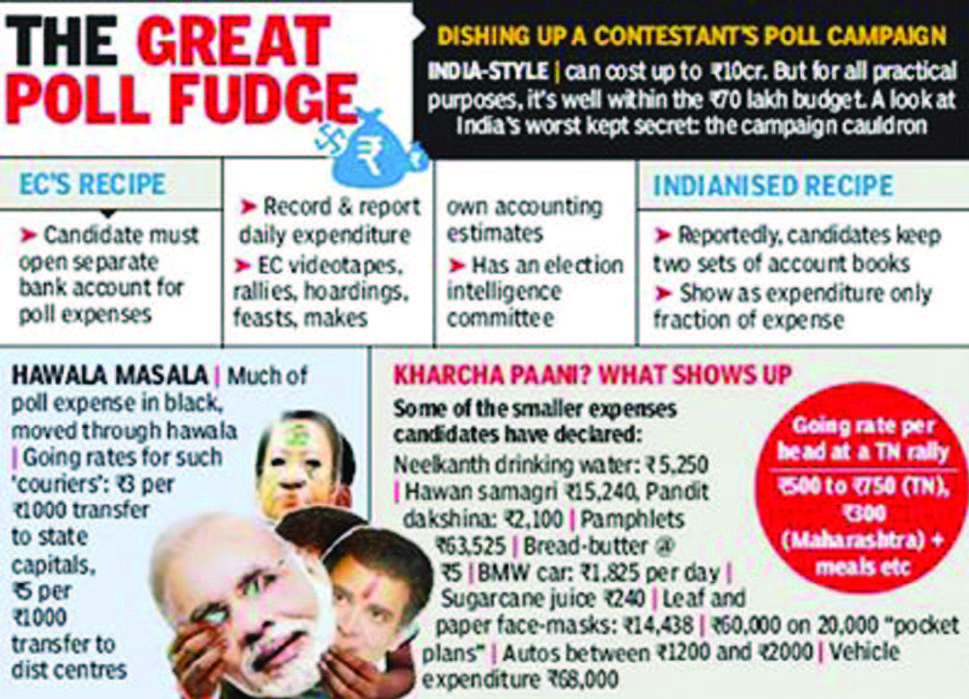
  • How candidates cook books to spend crores over Election Commission limit

    How candidates cook books to spend crores over Election Commission limit

    NEW DELHI (TIP): Elections, it is said, are about spending big. This despite repeated poll panel efforts to curb candidate expenses. The EC rule book is clear: Each candidate is entitled to spend a maximum of Rs 70 lakh and it is mandatory for the nominee to file daily expenses. On the ground, a different story plays out and contestants find ways to beat the book. Politicians begin spending the day their names surface as a potential candidate.

    Many engage image consultants to get their projection right and build a “winnability” perception. After the contestant bags a ticket his election expenses start the day he files nomination. The EC requires candidates to open separate accounts only for their poll expense, and if that weren’t bother enough, to account for day-to-day expenses. For LS polls, a general category nominee must pay a Rs 25,000-security deposit.

    The meter starts ticking. “We fix heads under which we need to spend,” Vishwas Sarang, campaign manager for a BJP LS candidate in MP says. Typically these include daily campaign expenditure, spend on banners, and publicity material and, crucially, booth management on polling day. “Bhopal alone has 1,600 polling booths. To staff them adequately, we need manpower and resources,” Sarang says. But even the best of plans spin out of control as campaigning picks up. “It’s like budgeting for a wedding, things usually go wrong.

    There are so many imponderables,” campaign manager for a senior politician says. MP BJP leader Mahendra Singh Chouhan concedes: “It’s very difficult to earmark a particular percentage of Rs 70 lakh under a specific category. Expenses fluctuate.” A rival’s ability to spend and his/her visibility quotient dictate expenses. “Truth is if the rival is running a low-steam campaign, you also cut back on expense. But if the opponent is extravagant, you’re left with no option,” Chouhan says.

    Former MP from Chhattisgarh Chandrashekhar Sahu says travel and promotional material are major components of total expenses. But in practice, much is not accounted for. “Party workers need cars, fuel and food. These account for a lot of money, most of the spending under these heads don’t go into the books,” a Congressman says. So, how much does the candidate really disclose? Here are some startling figures to show how they dodge the watchdog body.

    In the 2011 Bengal assembly polls, candidate expense statements filed to EC showed three elected nominees held no public meetings, 163 of the 217 MLAs chose to simply ignore print and electronic media advertisement costs, 53 said they never paid a paisa to their campaign workers, even for food. Forget the Rs 70 lakh limit, truth is most contestants spend upwards of Rs 10 crore each.

    9

    A Tamil Nadu politician concedes: “By conservative estimates, a minimum of Rs 2.5 crore is a must to contest. On average there are 1,300 booths per constituency. I pay at least Rs 15,000 per booth (each booth as four agents) to ensure it’s well covered and my men are everywhere ensuring there’s no rigging — that alone works out to about Rs 2 crore. Over and above that, printing of pamphlets, flex boards cost roughly Rs 20 lakh. Fuel expenses and vehicle rentals notch up another Rs 20 lakh, ad campaigns an additional Rs 15 lakh to Rs 20 lakh.” Booth management is one of the biggest headaches and a big cost centre, politicians in Chhattisgarh agree.

    This expense can’t be shown in the accounts that are forwarded to EC else the prescribed spending limits would be breached by miles. So, it has to be adjusted or dressed up. “While filing returns, we hardly ever show the money spent on polling booth agents. While we disclose an expenditure of Rs 4 lakh to Rs 5 lakh per public meeting addressed by a senior leader, the actual expense could be well over Rs 2 crore to Rs 3 crore,” an election manager in MP says.

    Political observers in Karnataka claim each Narendra Modi rally in that state could have cost close to Rs 1.5 crore, all expenses are put together. You need sacks of liquid cash to bring crowds to rallies. “The current practice in TN is to pay those attending Rs 500 to Rs 750 per head,” a campaign manager informs. In Maharashtra, the rent-a-crowd rate in 2009 was Rs 100 per person. The going rate in the state now has shot up to Rs 300 and more.

    The person coming for the meeting expects to be fed a decent meal. These expenses are hidden and none of it goes into the accounts. All major parties concede that planning a senior leader’s logistics for a big election rally can send expenses through the roof. The national leader is a star campaigner. His hotel arrangements have to be made, transportation taken care of and security arranged.

    These are huge costs. The heat adds to the problem. Parties spend big on pandals and safe drinking water. Nobody will come if they’re made to sit in the open under the scorching sun.

  • CBI ARRESTS 5 WITH FAKE MEDICAL DEGREES

    CBI ARRESTS 5 WITH FAKE MEDICAL DEGREES

    NEW DELHI (TIP): In a countrywide crackdown, the Central Bureau of Investigation on Thursday arrested five people possessing medical degrees from Russia and China and obtaining recognition from Medical Council of India through allegedly fraudulent means. CBI said based on information gathered, FIR had been filed against eight people who claimed they had medical degrees from Russia and China.

    At least three of the doctors, who had allegedly got a forged registration from MCI, were working in government hospitals in Gujarat, West Bengal and Chhattisgarh. The CBI has also registered case against unnamed officials of MCI and some other individuals. CBI conducted raids at the premises of a Meerut medical practitioner who was allegedly a conduit between MCI officials and the potential candidates coming from these countries.

    According to CBI, those arrested told the agency that they paid upto Rs 20 lakh for getting registration from MCI. Government has made it mandatory for screening test of medical students from erstwhile USSR countries and China to be eligible for medical practice in India. CBI alleged these candidates had colluded with MCI officials who gave them permission to practice in return for illegal gratification even as the doctors did not fulfill the necessary parameters.

    CBI sources said they would interrogate the accused on the role of officials in MCI, who are giving these fake registrations. Sources said more arrests are likely. The registration documents recovered during searches on Thursday would be sent for CFSL examination and files would also be taken from MCI. CBI Director Ranjit Sinha, who is personally monitoring the case, said, “This is a very important case as such people were playing with the lives of patients.”

  • Opinion poll predicts gains for BJP, losses for UPA

    Opinion poll predicts gains for BJP, losses for UPA

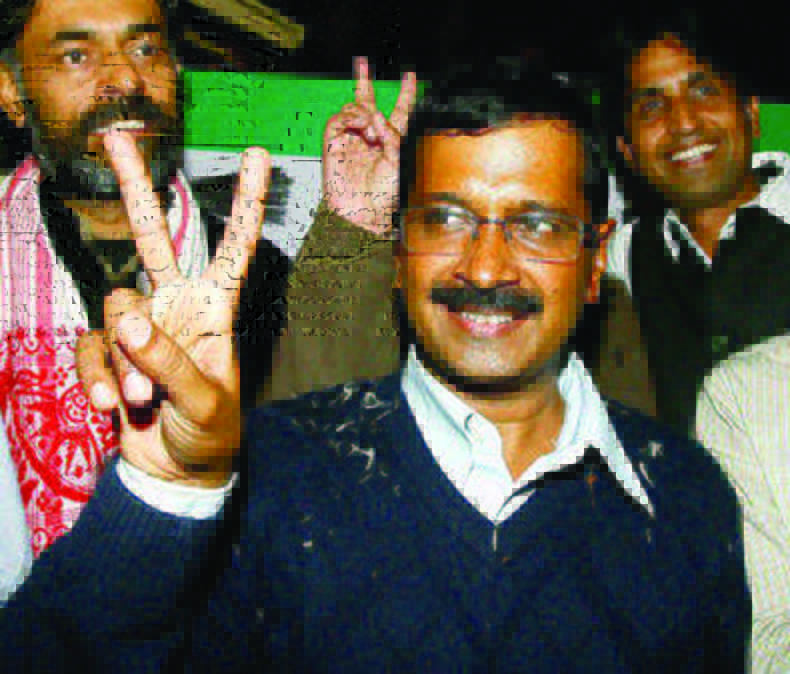
    NEW DELHI (TIP): Despite an apparent wave of Arvind Kejriwal-led Aam Aadmi Party (AAP) till recently, the National Democratic Alliance (NDA) would have won 200-odd seats if the general elections were held in January 2014, the findings of the latest India Today Group’s Mood of the Nation opinion poll suggest.

    The opinion poll gives the Congress-led United Progressive Alliance (UPA) only around 100 seats, down by over 150 seats in the current Lok Sabha. It also underlines the significance of a possible Third Front in the forthcoming Lok Sabha election as the non-UPA, non-NDA parties and Independents are expected to win 220-odd seats. The NDA thus crosses the 200-mark for the first time since 2010. Both, the NDA and the likely Third Front, gains substantially in numbers and vote share. The opinion poll suggests that the NDA’s vote share of 34 per cent will be significantly more than the UPA’s 23.

    However, the others will have the maximum vote share of 43 per cent. Under the leadership of Narendra Modi as its prime ministerial candidate, the Bharatiya Janata Party (BJP) looks all set to become the single largest party as it is also likely to emerge the biggest gainer in the Lok Sabha polls. Its 2009 tally of 116 is expected to rise to 188 in 2014, an increase of more than 60 per cent. Congress, under the leadership of its vice-president Rahul Gandhi, might win just 91 seats, as compared to its current tally of 206, a drop of about 55 per cent. The Congress ploy of propping AAP to counter Modi at the national level seems to have a limited impact, as Kejriwal’s gains are restricted to areas around Delhi and a few metro cities only.

    Modi consolidates his position
    Modi, who emerged as the strongest leader within his party after the BJP’s hat-trick in Gujarat in December 2012, cemented his position further through strong campaigning across the country. As the party’s lead campaigner in the recently held assembly elections in Madhya Pradesh, Chhattisgarh, Rajasthan and Delhi he consolidated his position further. In the latest India Today Mood of the Nation opinion poll, as many as 47 per cent people voted him as the best prime ministerial candidate against his previous best of 42 per cent polled in August 2013.

    The Gandhi scion was way behind Modi with just 15 per cent votes, followed by Kejriwal with 9 per cent votes and 6 per cent votes each to Prime Minister Manmohan Singh and Congress president Sonia Gandhi. During these five months Modi was also able to improve his image from being a communal leader to being pro-development. To a question “what does Modi represent”, the option “communalism” saw a drop of 11 per cent from 18 per cent in August 2013, while “economic development” increased by 6 per cent to 30 per cent. The number of people thinking Modi should apologize for the 2002 Gujarat riots also fell drastically during this period to 39 per cent from the previous figure of 51 per cent.

    Modi as a role model
    The Gujarat chief minister emerged as a role model for the highest 17 per cent respondents, a gain of as much percentage as nobody earlier saw him as one among the overall personalities of India. Modi was followed by Kejriwal with 14 per cent votes, up from 2 per cent. Bollywood superstar Salman Khan too saw a big jump in his popularity as 10 per cent people saw him as a role model, up from the previous 1 per cent, followed by legendary singer Lata Mangeshkar’s 9 per cent against 2 per cent in the earlier opinion poll.Veteran anti-corruption activist Anna Hazare’s position as a role model remained unchanged with 7 per cent votes.

  • Winds of Change

    Winds of Change

    November, 2013 gave a clear idea of which way the political wind in India was blowing. The rout of Congress in Delhi and Rajasthan; and its rejection by the electorate in Madhya Pradesh and Chhattisgarh indicated the loss of popularity of the party.

    Without going in to details of causes for the decline in popularity of a party that had managed to rule the center for almost 10 years at a stretch, it can now be said that the grand old party is tottering. The latest India Today Group’s Mood of the Nation opinion poll indicates huge losses for the Congress led UPA.

    The BJP led National Democratic Alliance (NDA) has been found to make significant gains. The projections are it could win 200-odd seats if the general elections were held in January 2014, the findings of the poll say. The opinion poll gives the Congress-led United Progressive Alliance (UPA) only around 100 seats, down by over 150 seats in the current Lok Sabha.

    It also underlines the significance of a possible Third Front in the forthcoming Lok Sabha election as the non-UPA, non- NDA parties and Independents are expected to win 220- odd seats. The NDA thus crosses the 200-mark for the first time since 2010. Both, the NDA and the likely Third Front, gain substantially in numbers and vote share at the cost of the Congress led UPA. The opinion poll suggests that the NDA’s vote share of 34 per cent will be significantly more than the UPA’s 23.

    However, the others will have the maximum vote share of 43 per cent. The scenario is frightening. The BJP emerges as the single largest party and yet it will not be able to form a government on its own. With its alliance partners, Shiv Sena, SAD and a few others, too, that form NDA, a government led by BJP does not appear in sight. The “others” are disparate groups. They cannot be expected to cobble together a government even though they will together be the largest group, according to the results of the poll. What happens then? Horse trading and unholy alliances will prevail. What happens then? Another round of misrule. Another five years of suffering for the common man. The writing is on the wall.

  • Opinion poll predicts gains for BJP, losses for UPA

    Opinion poll predicts gains for BJP, losses for UPA

    NEW DELHI (TIP): Despite an apparent wave of Arvind Kejriwal-led Aam Aadmi Party (AAP) till recently, the National Democratic Alliance (NDA) would have won 200- odd seats if the general elections were held in January 2014, the findings of the latest India Today Group’s Mood of the Nation opinion poll suggest.

    The opinion poll gives the Congress-led United Progressive Alliance (UPA) only around 100 seats, down by over 150 seats in the current Lok Sabha. It also underlines the significance of a possible Third Front in the forthcoming Lok Sabha election as the non- UPA, non-NDA parties and Independents are expected to win 220-odd seats.

    The NDA thus crosses the 200-mark for the first time since 2010. Both, the NDA and the likely Third Front, gains substantially in numbers and vote share. The opinion poll suggests that the NDA’s vote share of 34 per cent will be significantly more than the UPA’s 23. However, the others will have the maximum vote share of 43 per cent. Under the leadership of Narendra Modi as its prime ministerial candidate, the Bharatiya Janata Party (BJP) looks all set to become the single largest party as it is also likely to emerge the biggest gainer in the Lok Sabha polls.

    Its 2009 tally of 116 is expected to rise to 188 in 2014, an increase of more than 60 per cent. Congress, under the leadership of its vice-president Rahul Gandhi, might win just 91 seats, as compared to its current tally of 206, a drop of about 55 per cent. The Congress ploy of propping AAP to counter Modi at the national level seems to have a limited impact, as Kejriwal’s gains are restricted to areas around Delhi and a few metro cities only.

    Modi consolidates his position
    Modi, who emerged as the strongest leader within his party after the BJP’s hat-trick in Gujarat in December 2012, cemented his position further through strong campaigning across the country. As the party’s lead campaigner in the recently held assembly elections in Madhya Pradesh, Chhattisgarh, Rajasthan and Delhi he consolidated his position further. In the latest India Today Mood of the Nation opinion poll, as many as 47 per cent people voted him as the best prime ministerial candidate against his previous best of 42 per cent polled in August 2013.

    The Gandhi scion was way behind Modi with just 15 per cent votes, followed by Kejriwal with 9 per cent votes and 6 per cent votes each to Prime Minister Manmohan Singh and Congress president Sonia Gandhi. During these five months Modi was also able to improve his image from being a communal leader to being pro-development. To a question “what does Modi represent”, the option “communalism” saw a drop of 11 per cent from 18 per cent in August 2013, while “economic development” increased by 6 per cent to 30 per cent. The number of people thinking Modi should apologize for the 2002 Gujarat riots also fell drastically during this period to 39 per cent from the previous figure of 51 per cent.

    Modi as a role model
    The Gujarat chief minister emerged as a role model for the highest 17 per cent respondents, a gain of as much percentage as nobody earlier saw him as one among the overall personalities of India. Modi was followed by Kejriwal with 14 per cent votes, up from 2 per cent. Bollywood superstar Salman Khan too saw a big jump in his popularity as 10 per cent people saw him as a role model, up from the previous 1 per cent, followed by legendary singer Lata Mangeshkar’s 9 per cent against 2 per cent in the earlier opinion poll.Veteran anti-corruption activist Anna Hazare’s position as a role model remained unchanged with 7 per cent votes.

  • 2013 — THE DEAR DEPARTED

    2013 — THE DEAR DEPARTED

    Renowned film actor Farooq Sheikh passed away on December 28 following a massive heart attack in Dubai. The 64-year-old actor was last seen in Club 60, released earlier this month. Sheikh was best known for his roles in Satyajit Ray’s Shatranj Ke Khiladi, Sai Paranjpe’s Chashme Baddoor and Sagar Sarhadi’s Bazaar.


    6
    PETER O’TOOLE

    Peter O’Toole was an Irish actor. Often called the Hamlet of his generation. Nominated for eight Academy Awards for Best Actor in his lifetime. Some of his well-known works include ‘Lawrence of Arabia’, ‘Venus’ and ‘The Stunt Man’. Died on December 14.


    5
    VIDYA CHARAN SHUKLA

    Vidya Charan Shukla, Former Union Cabinet minister and Congress leader. Close aide of Indira Gandhi. Critically injured in Maoist attack in Chhattisgarh on May 25. Succumbed to his injuries on June 11.


    4
    TARLA DALAL

    Tarla Dalal, one of India’s most celebrated chefs and prolific cookbook writers. Died on November 6.


    3
    SYD FIELD

    Syd Field was an American screenwriting guru. Died on November 17.


    2
    SRIKANTA DATTA WODEYAR

    Scion of the erstwhile Mysore royal family, former Congress MP from the Mysore constituency and also a fashion designer. Died on December 10.

    SIR JOHN TAVENER
    Famous British composer. Some of his wellknown works include ‘Song for Athene’ and ‘The Whale’. Died on November 12.

    SIR ANTHONY CARO
    Widely regarded as the greatest British sculptor of his generation and worked as an assistant to Henry Moore in the 1950s. Died on October 23.


    1
    SHAMSHAD BEGUM

    She was one of the first playback singers in the Hindi film industry. Died on April 23.

    SHAKUNTALA DEVI
    Known for her mathematical prowess and the ability to compute complex equations mentally. Died on April 21.

    SEAMUS HEANEY
    One of the world’s best-known poets and winner of the 1995 Nobel Prize for literature. Died on August 30.


    5
    SANDEEP ACHARYA

    Winner of second season of Indian Idol. Died on December 15.


    14
    RITUPARNO GHOSH

    National Award winner filmmaker. His widely acclaimed films include ‘Unishe April’, ‘Dahan’, ‘Asukh’, ‘Chokher Bali’, ‘Raincoat’, ‘Bariwali’, ‘Antarmahal’ and ‘Noukadubi’. Died on May 30.

    RAY PRICE
    Famous American singer and guitarist. Some of his well-known works include ‘Night Life’, ‘Release Me’ and ‘Crazy Arms’. Died on December 16.

    RAJENDRA YADAV
    Noted Hindi author and a pioneer of the literary movement ‘Nayi Kahani’. Died on October 28.


    3
    PRAN

    Appeared in over 350 films. His widely acclaimed films include ‘Madhumati’, ‘Ram Aur Shyam’, ‘Don’, ‘Zanjeer’ and ‘Upkar’. Winner of Padma Bhushan and Dadasaheb Phalke Award. Died on July 12.

    Hugo Chavez (March 5)
    Venezuelan President Hugo Chavez died after a two-year battle with cancer, ending 14 years of tumultuous rule that made the socialist leader a hero for the poor but a hate figure to his opponents. The flamboyant 58-year-old had undergone four operations in Cuba for a cancer that was first detected in his pelvic region in mid-2011. His last surgery was on December 11, 2012 and he had not been seen in public since.


    2
    Margaret Thatcher (April 8)

    Britain’s first woman Prime Minister Margaret Thatcher, known as the Iron Lady, passed away in April this year following a stroke at the age of 87. Thatcher’s three terms as Prime Minister brought enormous change to the UK.

    ABIR GOSWAMI (MAY 30)
    Television actor Abir Goswami, who acted in Hindi films such as ‘Khakee, Lakshya’ and ‘Darna Mana Hai’, died at the age of 37 following a heart attack.. Abir Goswami had acted in TV serials like ‘Kkusum, Yahan Main Ghar Ghar Kheli, Hotel Kingston’ and ‘Pyar Ka Dard Hai’. Abir was diagnosed with lymphoma in May 2012 and had unndergone surgery.

    JIAH KHAN (JUNE 3)
    The 25-year-old actress, best remembered as the ‘Nishabd’ girl, was found hanging at her flat in suburban Mumbai this year. A six-page suicide note was discovered by Jiah Khan’s mother a few days after her death. In the note Jiah wrote about her relationship with Suraj Pancholi, that landed the budding actor in jail. After spending over 20 days in jail, Suraj was released on bail. While the police claimed it was a case of suicide, Jiah’s mother Rabiya Khan alleged that it was not suicide and sought police to probe the angle of murder.

    CORY MONTEITH (JULY 13)
    ‘Glee’ star Cory Monteith died of intravenous heroin use combined with the ingestion of alcohol in his hotel room in Vancouver. Monteith became famous as Finn Hudson with the success of Fox’s musical series since its launch in 2009. He was dating Lea Michele, who also played his onscreen love interest in the series and supported his decision to get into rehab.

    MANNA DEY (OCTOBER 24)
    Legendary playback singer Manna Dey died at a city hospital in October after prolonged illness. Manna Dey, 94, who was admitted to Narayana Hrudayalaya five months ago for respiratory problems, died of cardiac arrest. He was born as Prabodh Chandra Dey but was popularly known as Manna Dey. Manna Dey then began his journey in Bollywood as an assistant music director in 1942 when he accompanied Krishna Chandra Dey to Mumbai (then Bombay). During his lifespan, the legendary singer received Dadasaheb Phalke Award and National Film Award for Best Male Playback Singer.

    RESHMA (NOVEMBER 3)
    Legendary Pakistani folk singer Reshma, who mesmerised music lovers in the Indian subcontinent with soulful rendition of songs like ‘Lambi Judai’ and ‘Dama Dam Mast Kalandar’ in her trademark rustic voice, died in Lahore on after a prolonged battle with throat cancer.

    PAUL WALKER (NOVEMBER 30)
    The star of the ‘Fast & Furious’ movie series died in a tragic car crash this November. The horrifying car crash killed Walker and his friend in north of Los Angeles. Walker, 40, was working on ‘Fast & Furious 7’ at the time of his death. He also starred in the suspense drama, ‘Hours’, which is set for release this month.


    1
    NELSON MANDELA (DEC 5)

    Anti-Apartheid leader and former President of South Africa Nelson Mandela died at his Johannesburg home after a prolonged lung infection. He was born on 18th July 1918 in a small village of Mvezo which was then a part of South Africa’s Cape Town province. He was given the forename Rolihlahla which basically means ‘troublemaker’. Mandela’s name was going to have a huge effect on him in the future as he would go onto create enormous trouble for the ruling racist regime in South Africa.

    DAVID COLEMAN (DEC 21)
    British sports broadcaster David Coleman, who covered 11 Summer Olympics for the BBC and six football World Cups, died at the age of 87. Coleman retired from the BBC in 2000 after covering the Sydney Olympics. He became the first broadcaster to receive an Olympic Order medal to recognize his contribution to the Olympic movement.

    MIKHAIL KALASHNIKOV (DECEMBER 23)
    Mikhail Kalashnikov, the designer of famed Russian AK-47 assault rifle, passed away in his home city of Izhevsk, an industrial town. Kalashnikov was the carnage of World War II, when Nazi Germany overran much of the Soviet Union, which altered his course and made his name as well-known for bloodshed as Smith, Wesson and Colt. The distinctive shape of the gun, often called “a Kalashnikov,” appeared on revolutionary flags and adorns memorabilia

  • BJP WINNER, CONG ZERO, AAP HERO

    BJP WINNER, CONG ZERO, AAP HERO

    Congress party’s 0-4 mauling and BJP’s triumph in Madhya Pradesh, Rajasthan and Chhattisgarh in what was billed as the “semifinal” for the 2014 elections was the big headline, but the central takeaway was Aam Aadmi Party’s stunning debut in Delhi, prising open space in national politics for an outsider.

  • RED TERROR

    RED TERROR

    The Maoists’ ambush of a Congress rally that led to the massacre of some leaders of the party’s Chhattisgarh unit represents a serious setback for the state as well as the Centre’s paramilitary campaign against left-wing guerrillas. The state continues to test the capacity of the central and state government to coordinate their counter-insurgency offensive. It was, however, heartening to see people coming out to vote in large number in the recently concluded state elections, defying the Maoist threat.

  • Chhattisgarh

    Chhattisgarh

    The newly formed state of Chhattisgarh is an interesting tourist destination considering the blend of tribal tourism, history, nature and wildlife that it offers. The bulk of tourist attractions in Chhattisgarh however lie virtually unexplored. The virgin forests, dotted with picturesque waterfalls, scenic plateaus and winding rivers offer a feast to eyes and the lens of your camera. The forests of Chhattisgarh incidentally occupy 42% of the state’s land surface.

    The tourist attractions in Chhattisgarh India therefore cater to a large tourist taste and has infinite prospect of harboring a flourishing tourism industry. The small town of Kawardha is offers breathtaking views of nature and a rich tribal life. The royal palace at Kawardha is one of the major tourist attractions in Chhattisgarh. The village of Bastar, apart from offering a vivid glimpse of the tribal life, offers a wide array of metal crafted handicrafts. These molded iron objects are original tribal products of Bastar and is quite popular among tourists.


    40

    Tourist attractions
    Anand Prabhu Kudi Vihar

    Anand Prabhu Kudi Vihar, Mahasamund is the most famous amongst all Sirpur’s Buddhist vihars. The historical and picturesque city of Mahasamund is a municipality in the Mahasamund District. The Mahasamund District possesses a tribal population of 28.9%. The different types of tribes living in the district are Pardhi, Binjhwar, Dhanwar, Halba, Kamar, Kanwar, Kharai, Munda, Bahalia, Saur, Saharia, Sonar, Sanwara, Kharwar and Bhujia. There is a great scope for intense mining activity as Granite rocks and Limestone rocks are found in the district.

    Gandheswar Temple
    Gandheswar Temple, Mahasamund is situated on the banks of the Mahanadi river. The historical city of Mahasamund is a municipality in the Mahasamund District. It is also the administrative headquarters of the Mahasamund District. Apart from the Gandheswar Temple, Mahasamund, there are other temples in the city as well. The other temples are Swastik Vihar, Anand Prabhu Kudi Vihar and Laxman Temple. There are also a number of different types of tribes living in the city. The different types of tribes are Kamar, Kanwar, Dhanwar, Kharai, Munda, Bahalia, Saur, Pardhi, Binjhwar, Saharia, Sanwara, Kharwar, Bhujia, Sonar and Halba.

    Laxman Temple
    Laxman Temple, Mahasamund is one of the finest and top quality brick temples in India. Exquisite carvings and precise construction characterizes the temple. The historical and picturesque city of Mahasamund is a municipality in the Mahasamund District. It is also the administrative headquarters of the Mahasamund District.

    Lakes and waterfalls
    The rugged terrain and voluptuous rivers of Chhattisgarh make beautiful waterfalls and springs all around the state. The lakes, waterfalls and springs in Chhattisgarh are popular tourist and picnic spots and are yet another facet of the already beautiful natural wealth of Chhattisgarh. The Chitrakoot Waterfalls in Jagdalpur in Chhattisgarh are often termed the Niagra of India and is one spot that has been rigorously promoted by state’s tourism department. The Chitrakoot Falls roaring down the rocks with a huge volume of water makes a sight surely not to be forgotten. On a tour to visit the Lakes, Waterfalls and springs In Chhattisgarh In India one spot you must never forget to visit the Chitrakoot Falls.

    The Lakes, Waterfalls and springs In Chhattisgarh India are in fact some of the most visited spots on a tour to Chhattisgarh. Nestled amidst the dense forest growth that Chhattisgarh is blessed with, the Lakes, Waterfalls and springs In Chhattisgarh are also important ecological balancing factors in the environment of the state. In a country where the skies are blackening by the day, the forests receding by miles and the fauna struggling to cope up with the surroundings, states like Chhattisgarh are national asset and every effort on part of the government have been initiated to ensure the safekeeping of the natural splendor of the Chhattisgarh greens. Kendai water fall, Tatapani, Ruksganda water fall, Amritdhara water fall, Kothali water fall, Gangrail Jalashaya, Kharkhara Bandh, Keshkal Teerathgarh waterfall, are the other major lakes waterfalls and springs in Chhattisgarh.

    Rivers and Caves
    There are quite a few Rivers and Caves in Chhattisgarh. Every year thousands of tourists from each and every corner of the world and from all across India visit these Rivers and Caves in Chhattisgarh. Some of the popular Rivers and Caves in Chhattisgarh, India include Kailash Gufa in Jashpur, Kotebira Eb River in Jashpur, Kutumsar Caves and Kailash Gufa in Bastar. The well known waterfalls in Chhattisgarh are Danpuri Waterfall, Chitradhara Waterfalls, Rani Dah Waterfall, Chitrakote Waterfalls, Mandawa Waterfalls, Thamada Ghumar Waterfalls and Tiratgarh Waterfalls. To speak about the Rivers and Caves in Chhattisgarh, there are quite a few places worth mentioning. The Kailash Gufa in Jashpur is a beautiful rock-cut cave surrounded by exotic and mesmerizing fountains.

    There is a picturesque and eye catching waterfall near Kailsah Gufa. The Kotebira Eb River in Jashpur is a very pleasant and graceful river with catchy scenery and a rocky spot. Every year a fair is held here. The Kutumsar Caves and Kailash Gufa in Bastar are also quite famous. These caves are ancient and a feast for the eyes. Apart form the rivers, caves and waterfalls, the other tourist attraction places in Chhattisgarh include holy places, Mountains and Peaks, wildlife and monuments. The tribal culture in Chhattisgarh and its various ways and means are also something to look out for. The tourists can also visit the thousands of fairs that go on throughout the year and purchase a wide range of artifacts and traditional items.