Tag: Chhattisgarh

  • President Pranab Mukherjee May Turn Down 5 More Mercy Pleas

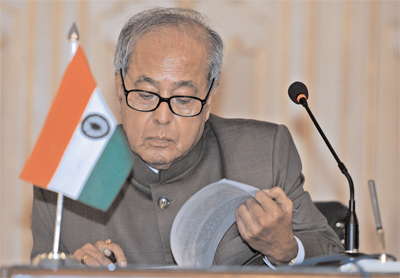
    President Pranab Mukherjee May Turn Down 5 More Mercy Pleas

    NEW DELHI (TIP): The Union homeministry is learnt to have recommendedrejection of mercy petitions in five morecases as it seeks to speedily dispose of allthe cases of death row convicts pendingwith it.Seeking to have a swift closure on thecases of those who have filed mercy pleasagainst capital punishment awarded tothem, the ministry has sent all the pendingfiles to President Pranab Mukherjee for afinal call.Sources said that seven cases involvingthe fate of nine people have been sent to thePresident, with the ministryrecommending rejection of the mercy pleasin five cases. It has and left the tworemaining ones open for commutation ofdeath sentence to life imprisonment withthe rider that the life term means jail forthe entire life of the convict and not just 20years or 14 years in prison.

    The President had sent the files to Unionhome minister Sushilkumar Shinde onOctober 30 for his review and opinion.Shinde sent the files back within 100 daysin a major shift from the pattern wheredecisions on mercy petitions wereindefinitely delayed with files shuttlingbetween the home ministry and theRashtrapati Bhavan.Though the case-wise recommendationsfor convicts were not known as both thehome ministry and Rashtrapati Bhavancontinue to remain tightlipped on mercypetition files, the seven cases relate tomultiple murders, including one in which arape convict out on bail killed five membersof the victim’s family.

    While two files were sent to RashtrapatiBhavan on February 9 (the day ParliamentHouse attack case convict Afzal Guru washanged), the remaining five files weredispatched last month.The mercy files, which have beenpending for years while moving to and frobetween Rashtrapati Bhavan and the homeministry, saw unprecedented movement oflate, resulting in two quick hangings(Ajmal Kasab and Afzal Guru) within lessthan three months. Mukherjee had rejectedthe mercy plea of Kasab on November 5,and Guru on February 3.The files, which are now with PresidentMukherjee, include the longest pendingcase of Gurmeet Singh of Uttar Pradesh,who was convicted for killing 13 membersof a family on August 17, 1986.

    The otherscases are of Suresh and Ramji, also fromUP, who were convicted for killing fivemembers of their brother’s family andDharampal from Haryana, who hadmurdered five members of the family of agirl he had raped in 1993. He had murderedthe family while on bail in the rape case.The other cases are of Sonia, daughter ofa former Haryana MLA, and her husbandSanjeev, who drugged and killed eight ofher family in Hisar in 2001, including herparents. Sunder Singh from Uttarakhand isconvicted for rape and murder on June 30,1989, Jafar Ali from Uttar Pradesh who wasconvicted for killing wife and five daughterin 2002 and Praveen Kumar of Karnataka,convicted for killing four members of afamily on February 23, 1994.

    Mukherjee has so far disposed of mercypetitions of eight death row convicts in fivecases.The President has also rejected themercy petitions of Saibanna NingappaNatikar (Karnataka: convicted for killingwife and daughter) and mercy petitions ofslain forest brigand Veerappan’s associatesGnanaprakash, Simon, ‘Meesai’ Madaianand Pilavendran, who were sentenced todeath for killing 22 police personnel in 1993.However, the mercy petition of Atbir(Delhi), who was convicted for murder ofhis step-mother, step-sister and step-brotherover property, was commuted to lifeimprisonment by the President.

    Strained mercy:
    1,455 persons awarded death penaltyin India from 2001 to 2011Sentences for 4,321 persons werecommuted from death penalty to lifeimprisonment during the same period.Highest number of death penalty wasimposed in Uttar Pradesh (370)followed by Bihar (132), Maharashtra(125), Karnataka and Tamil Nadu (95each), Madhya Pradesh (87),Jharkhand (81), West Bengal (79),Delhi (71), Gujarat (57), Rajasthan (38),Kerala (34), Odisha (33), Haryana (31),Assam (21), Jammu & Kashmir (20),Punjab (19), Chhattisgarh (18),Uttarakhand (16), Andhra Pradesh (8),Meghalaya (6), Chandigarh and Daman& Diu (4 each), Manipur and HimachalPradesh (3 each), Tripura andPondicherry (2 each) and Goa (1)No death penalty imposed inArunachal Pradesh, Mizoram,Nagaland and Sikkim and UnionTerritories of Andaman & NicobarIslands, Dadra & Nagar Haveli andLakshadweepSentences of 4,321 persons werecommuted from death penalty to lifeimprisonment in the country during2001-11.

  • Hit by raids, Nitin Gadkari threatens I-T officials

    Hit by raids, Nitin Gadkari threatens I-T officials

    NAGPUR (TIP): A day after BJP’s parliamentary board replaced him with UP leader Rajnath Singh as the next party chief following income tax action against firms linked to the Purti Group, an unfazed Nitin Gadkari instead threatened tax officials. Far from chastened by his sudden exit as BJP chief, Gadkari took on I-T officials, CBI, media and Congress as he hit out in all directions. “When BJP comes to power at the Centre, we will not spare any of them,” he said referring to I-T officials. Back on home turf, Gadkari warned officials that “There will no Sonia and Chidambaram to help you when BJP wins the next election in 2014”, accusing the UPA government of using the I-T department to fabricate cases against him. Holding the Centre responsible for the I-T action against Purti that triggered a last-minute revolt against him just as a second term as BJP president was in his grasp, he said officials should remember Congress is a sinking boat. “There’s only one ruler in Congress and others are her servants,” said Gadkari. In a show of defiance and petulance that might be more common in civic politics, the former BJP president said, “Mard hoon, dekh loonga. (I am a man, I will see you). I-T department yaad rakhe, BJP ki sarkar ayegi tab kahan jaoge…na Sonia rahegi na Chidambaram bachane ke liye.” A modest crowd of party workers, led by state party president Sudhir Mugantiwar, local MLAs and functionaries braved modest showers the orange city received on Thursday to try and boost the sagging spirits of their leader who is an MLC in the state legislature. “As BJP president, I had to maintain dignity and exercise restraint.

    Now, I am a free man,” said Gadkari while addressing the gathering unmindful of a huge traffic jam the rally caused close to the airport approach road. For about 90 minutes, not a single vehicle could move on the road. Clearly smarting from the I-T surveys being deftly used by his detractors in the party to seek a change in leadership on the ground that this is needed to control damage to BJP, Gadkari alternated between bluster and protestations of innocence. This is the second time Gadkari threatened action against I-T officials. Last year when the department had launched a probe to find the source of funding in Purti Group companies, he had leveled similar charges. “Earlier the Congress used the CBI to settle political scores, now it has started using I-T officials too,” he alleged. “I know how they are hatching conspiracies against me sitting in Delhi, Nagpur and Pune… I also know their names.

    Some people in the organization who are sympathetic to me and the BJP have told me about this,” he said. Gadkari said it was a political conspiracy to malign his image. “False allegations were made against me with issues that I had nothing to do with.

    I am going to fight it out till I come clean,” he said. Targeting the English media, he said a simple letter written to the government seeking release of funds for the Gosikhurd project was seen as favouring contractors. “Similarly when I took up project to provide cheap houses to industrial workers at Butibori, one TV channel said I had turned a builder. Nobody has the right to indulge in character assassination,” said Gadkari. The deposed BJP president got the support of Congress MP Vijay Darda, an old friend. “Gadkari is like a tiger, he did not compromise with his honour. Ups and downs keep happening in politics.

    He is one leader who has worked hard for Vidarbha,” Darda said. Referring to Gadkari as “mere azeez mitr (my dear friend)”, Darda added, “In the coming days we will work shoulder-to-shoulder.” Present on the dais were Congress MLA from Saoner Sunil Kedar, city BJP MLA Devendra Fadnavis, former BJP MP Banwarilal Puruhit, Chandrapur MP Hansraj Ahir, Chhattisgarh agriculture minister Chandrakant Sahu and several other zilla parishad presidents. SHIMLA (TIP): Congress

  • Opposition Steals UPA’s Food Bill Thunder

    Opposition Steals UPA’s Food Bill Thunder

    NEW DELHI (TIP): The benchmark has been set higher for the UPA’s overdue National Food Security Bill, with Opposition-ruled states expanding the coverage of cheap food grains and improvising services under the public distribution system. Chhattisgarh may have scored recently with its state food act that expands coverage to almost 90% of the state’s voters but other states are also gearing up to do more even as the central government is yet to legislate its bill that is stuck in a standing committee. The central draft envisages covering 67% of India’s population and while states are setting the bar higher.

    Uttar Pradesh has sought 100% coverage while in Tamil Nadu it is already universal. The slow pace of the draft bill’s progress has frustrated Congress as the proposed law has the strong backing of Congress chief Sonia Gandhi. Take the case of Madhya Pradesh where the state extended the PDS for below poverty line rates to 71 lakh families against 56 lakh odd beneficiaries the Centre currently approves of. With a bumper crop in 2012 and a decent coffer, the state is looking to reduce prices at which it offers food grains to the poor. Others, such as BJD-ruled Odisha too are buying food grains out of their own pocket to supply to bigger number of beneficiaries than what the Centre supports.

    Odisha’s BJD government may have come under the CAG scanner for altering norms, but it has been more than happy to advertise that it is buying 8,669 metric tonnes rice every month beyond what the Centre’s supplies. The state provides an additional annual subsidy of around Rs 189 crore to distribute subsidized grains. With the new BPL survey still pending, Congress’s task to churn out a law offering greater benefits to reap a political dividend could get tougher in coming days. The central government had retained flexibility in the design of the survey to prune or expand the list of beneficiaries after the raw data is available.

    But pruning the numbers – already a friction point with influential chief ministers like Bihar’s Nitish Kumar disputing the Centre’s numbers — by a fiat is bound to be politically imprudent and invite a backlash. Since the time it began working on the bill, UPA and its various arms and agencies – relevant ministries, National Advisory Council, PMO and the Planning Commission – have often been at loggerheads about what was billed as ‘the’ flagship scheme for UPA2. The differences in approach, coverage and benefits is continuing. The new ‘game-changer’ social sector scheme – cash transfers – has only confounded the case further.

    The government’s reluctance to provide food subsidy through cash transfers has also added greater uncertainty about the proposed law. Finance minister P Chidambaram reiterated that the government would not include food subsidy in the cash transfer scheme at the moment. But debate rages on within the government and while sections f the from civil society, including some NAC members, are opposed to the Centre’s formulations.

  • Crime against children up by 24% in 2010-11

    Crime against children up by 24% in 2010-11

    NEW DELHI (TIP): India is fast earning the label of a country unsafe for children, with an alarming 24% increase in crimes against children in 2011 compared to the previous year. Nearly 33,100 cases were reported in 2011 against 26,694 cases in 2010.

    Uttar Pradesh accounted for 16.6% of total crimes against children in 2011, followed by Madhya Pradesh (13.2%), Delhi (12.8%), Maharashtra (10.2%), Bihar (6.7%) and Andhra Pradesh (6.7%).

    Maharashtra accounted for 74% of the total 27 cases of “buying of girls for prostitution” while West Bengal accounted for 77% of the total 113 cases of “selling of girls for prostitution”.

    Last year also saw a 43% increase in cases abduction, while cases of rape increased by 30%. UP and Delhi together accounted for 47.6% abduction of children while MP, UP and Maharashtra together made up 44.5% of child rape cases in 2011.

    These are the findings of the latest ‘Children in India 2012’ report brought out by the ministry of statistics and programme implementation. The last time such a report on the state of India’s children came out was in 2008.

    Feticide cases increased by 19% a year

    Feticide cases increased by 19% over 2010 to 132 cases in 2011, most of which were registered from Madhya Pradesh, followed by Chhattisgarh and Punjab, says a ministerial report. The three states together reported 56% of the foeticide cases last year.

    The report said, “The analysis of crime and children as presented here, puts forward a few upsetting revelations about the child victims as well as child offenders, which points out to the vulnerable conditions of children that need to be addressed urgently especially poverty.”

    India’s chief statistician T C A Anant said in the report, “Even today, after six decades of independence, the condition of children remains a cause of concern in the country. As the statistics speaks out loudly, we have miles to go to ensure a bright future for the children in all spheres of their life.” According to the report, procurement of minor girls saw a 27% spike—862 cases in 2011 compared to 679 cases in 2010. West Bengal reported the highest chunk of these cases (298) —a share of 34.6% followed by Bihar (183), Assam (142) and Andhra (106).

    The average chargesheeting rate for all crimes against children was 82.5% in 2011, which was the same in 2010 as well.

    The highest chargesheet rate was observed in cases under ‘buying of girls for prostitution’ (100%) followed by ‘rape’ (97.3%) in comparison to the prevailing national level chargesheeting rate of 78.8% for the IPC crimes. The lowest charge sheet rate was found in cases of feticide.

    The conviction rate at national level for the crimes committed against children stood at 34.6%. The conviction rate for ‘infanticide (other than murder)’ was highest at 46.9% followed by cases under ‘murder’ (45.5%).

    When taking all the crimes against children into account, the crime rate (ratio of number of crimes to population) saw a marginal increased from 2.3 in 2009 to 2.7 in 2011. Delhi, however, topped the crime rate (25.4) followed by Andaman and Nicobar Islands (20.3), Chandigarh (7) and Chhattisgarh (7), Madhya Pradesh (6) and Goa (5.1).

    The 2012 data showed that juvenile IPC crimes in 2011 increased by 10.5% over 2010 as 22,740 IPC crimes by juveniles were registered during 2010 which increased to 25,125 cases in 2011. Out of the total 888 juvenile murder cases reported in the country in 2011, Maharashtra and Madhya Pradesh reported 16.3% and 12.6% cases.

    The highest incidence of the juvenile rape cases was reported from Madhya Pradesh (23.6%) followed by UP (12.7%) and Maharashtra (10.9%). Among such disturbing trends, the report also had some good news. In 2011, buying of girls for prostitution showed a decline of 65%, and selling of girls for prostitution reported a decline of 13% compared to 2010. Cases of infanticide too showed a decline of 37 points during this period.
