Tag: China-Pakistan Economic Corridor (CPEC)

  • Turn the prism of the past

    Turn the prism of the past

    India must view in a new light its ties with both China and Pakistan

    By MK Bhadrakumar
    Succinctly put, China’s initiative to create a trilateral forum to foster amity between Afghanistan and Pakistan has gained traction. In fact, China and Pakistan have agreed to look at extending their $57 billion China-Pakistan Economic Corridor to Afghanistan. To be sure, India-China-Pakistan triangle always brought to bear the regional backdrop. Therefore, we need to comprehend that Chinese policies too cannot be stereotyped through the prism of a bygone era. Regional stability and security providing the external environment in which development objectives are optimally realized becomes a top priority for Chinese policies. Thus, China is acting as a moderating influence on Pakistan.

    Without doubt, a new criticality has arisen in the state of Jammu and Kashmir, but as can happen, ‘sweet are the uses of adversity’ — to borrow from Shakespeare. There are both internal and external factors at work here. The contradictions in the political situation in J&K may ease if a level playing field is made available for all political parties and groups to make a new beginning. It doesn’t have to be the case that things move from the frying pan into the fire.

    One important reason for expressing cautious optimism is that in the external environment, an opportunity is at hand to take a road less travelled by, which could make all the difference. This involves engaging with Pakistan. The political dynamics within J&K invariably have an external dimension and not engaging with Pakistan is untenable. No one probably knows this better than the incumbent Governor NN Vohra in Srinagar, given his vast experience in statecraft. During the transition ahead, it will help matters a great deal if the disconnect between the efforts to shore up internal security and engagement with Pakistan is addressed. Of course, a hugely consequential electoral battle is looming ahead in the country in less than a year, which makes it obligatory for political parties to engage in grandstanding, but again, a non-partisan eye cannot miss the point that the reactions to the latest events in J&K suggest that no one is in any real combative mood. In fact, the mood is somber. There are no victors here. Pakistan was not even dragged into media discourse.

    A question is often put why engage with Pakistan at all, given the past experience? But then, that is a self-serving digression, neither fair nor honest, because engaging Pakistan was never a substitute for doing homework that was also needed on our part, which was never quite forthcoming, for one reason or another. Yet, the past serves a purpose insofar as the scars remind us that we did survive our deepest wounds and it is not only an accomplishment, but an enduring reminder that the heavy toll that life took left us more resilient, and perhaps, better equipped to face the present. The ruins of a stupendous past are all around us today.

    Second, a nation never replays its history. Despite our dogmas regarding Pakistan, that country of yesteryear no longer exists. Pakistan has been in transition with a searing knowledge that the past cannot be altered and is fixed, and the present is its reflecting actuality, while the future remains undefined and nebulous until a part of the present becomes a part of the past so that an unrealized future can become the new present. Plainly put, what is playing out in the Hindu Kush in recent weeks testify to a rethink in Pakistan. Curiously, this rethink is attributed to none other than army chief Gen Qamar Bajwa. With an interim government training its energies on the conduct of the forthcoming election, General Bajwa is having a free hand to withdraw the sticky tentacles of past Afghan policies from the present so that a future dawns for Pakistan in terms of regional connectivity, a flourishing economy and a nation at peace with itself and its neighbors. From the Indian perspective, therefore, it is hugely consequential that General Bajwa has held out positive signals for better relations with New Delhi. The Modi government seems to appreciate it.

    The dramatic happenings of the past few weeks testify to the winds of change sweeping Pakistan-Afghanistan relations, especially the Eid festivities with Taliban fighters and security forces taking ‘selfies’ in cities and towns, and secondly, the killing in Afghanistan of the Pakistan Taliban chief, Mullah Fazlullah, variously described as the mastermind of Pakistan’s suicide culture, in a US drone strike. The latter is particularly important, as evident from Afghan President Ashraf Ghani’s eagerness to personally transmit to General Bajwa the fulfilment of a long-standing Pakistani demand. Ghani expects him to reciprocate.

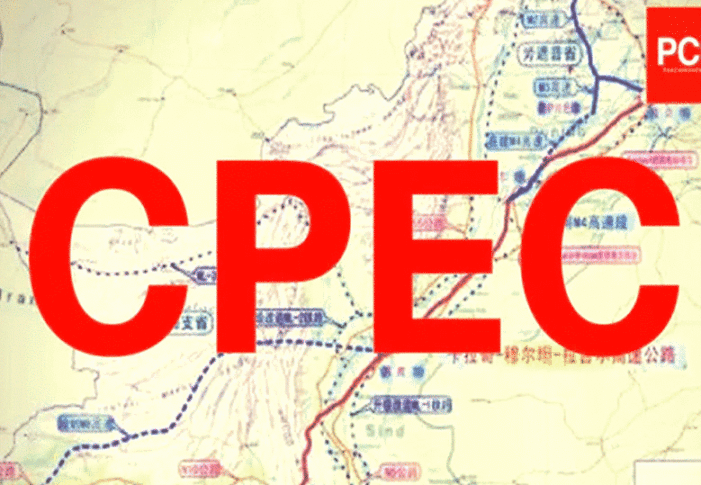
    Succinctly put, China’s initiative to create a trilateral forum to foster amity between Afghanistan and Pakistan has gained traction. In fact, China and Pakistan have agreed to look at extending their $57 billion China-Pakistan Economic Corridor to Afghanistan. To be sure, India-China-Pakistan triangle always brought to bear the regional backdrop. Therefore, we need to comprehend that Chinese policies too cannot be stereotyped through the prism of a bygone era. Regional stability and security providing the external environment in which development objectives are optimally realized becomes a top priority for Chinese policies. Thus, China is acting as a moderating influence on Pakistan.

    On the other hand, if there was a past when China was indifferent toward India, it is far from the case today. India’s impressive growth is taken seriously by the Chinese. All evidence suggests that despite the drift in the Sino-Indian relationship in the most recent years, the Chinese perception regarding PM Modi remain positive and his reform agenda has consistently drawn praise from Chinese commentators — underscoring faith in him that he is a strong leader who can take difficult decisions leading to a paradigm shift in Sino-Indian ties. Above all, China hopes that a bonding with India — ‘China India Plus’s — can be a game changer in the prevailing international milieu, characterized by anti-globalization trends, protectionism and growing pressure from the entrenched West, which is chary of redistribution of power in favor of emerging powers.

    It is highly significant that in a speech last Monday in Delhi, outlining Beijing’s strategy toward India, Chinese ambassador Luo Zhaohui singled out the idea of creating a new platform of China-India-Pakistan leaders’ meeting under the framework of the Shanghai Cooperation Organisation. Taking into account foreign minister Wang Yi’s recent remarks after the SCO summit in Qingdao that membership of India and Pakistan will strengthen the fight against terrorism and promote India’s connectivity with Central Asia, one can quite figure out the Chinese intentions. The bottom line is that China sees it as in its self-interest that India-Pakistan tensions do not pose a contradiction in its efforts to boost the content and inject new verve into its relations with India.

    Interestingly, Ambassador Luo also revisited the long-standing proposal on signing a ‘Treaty of Good Neighborliness and Friendly Cooperation’ with India. Suffice to say, it will be to India’s advantage if an imaginative approach toward the situation in J&K could run parallel with a diplomatic track attuned to the positive power shift in the region.

    (The author is a former ambassador)

  • Pak trips on free run: 37-nation Financial Action Task Force to probe terror funding

    Pak trips on free run: 37-nation Financial Action Task Force to probe terror funding

    By G Parthasarathy

    Pakistan will now have to provide a detailed action plan on actions it proposes to take on curbing funding for UN-designated terrorist groups. It would then be placed on the FATF grey list, where its financial flows would be subject to intense international scrutiny. Pakistan would, thereafter, be placed on the FATF “black list” if it fails to present a credible and comprehensive action plan to the FATF by June. This would virtually end any prospect of it receiving adequate financial flows.

    The Financial Action Task Force (FATF), set up in 1989 by the G7 countries, and with headquarters in Paris, acts as an “international watchdog” on issues of money laundering and financing of terrorism. It has 37 members, including all five permanent members of the Security Council, and countries with economic influence all across the world. Two regional organizations — the Gulf Cooperation and the European Commission — are members of the FATF. Saudi Arabia and Israel are observers. India became a full member of the FATF in June 2010. The FATF is empowered to ensure that financing of UN-designated terrorist organizations is blocked. It has the power to publicly name countries not abiding by its norms, making it difficult for them to source financial flows internationally.

    Pakistan is particularly vulnerable to pressures from this task force as the Afghan Taliban, Haqqani network, LeT and JeM — all internationally designated terrorist groups — operate from its soil. Pakistan has long claimed that it has done its best to prevent terrorism emanating from its soil. It has also averred that there is no firm evidence against the LeT and the JeM, even after these groups have publicly acknowledged that they were promoting terrorism in India. Pakistan has also rejected evidence like wireless transcripts of conversations of Jaish terrorists involved in the Pathankot airport and the vast evidence available internationally of the Lashkar role in the Mumbai 26/11 attack. The Americans and their allies have focused attention primarily on Pakistan support for the Haqqani network in Afghanistan.

    Pakistan has believed that sooner, rather than later, the Americans would cut their losses and withdraw from Afghanistan, leaving the country open for a Pakistan-backed Taliban takeover. President Donald Trump, however, made it clear that he was determined that the US would not “lose” in Afghanistan. He is augmenting the US troop presence and moving fast to strengthen the Afghan armed forces, including its air force. American economic assistance to Pakistan has been placed on hold. In addition, the US has mobilized its NATO allies to take a tougher line on Pakistan. The NATO allies are also expanding their deployments in Afghanistan. More recently, the US has initiated moves to get the task force to place Pakistan on its “grey list” at its next meeting in June.

    The American effort in the FATF on Pakistan funding of terrorist groups predictably ran into problems initially. Pakistan had mobilized support from China, the Gulf Cooperation Council led by Saudi Arabia, Turkey and quite evidently Russia to counter the American-led move. Islamabad banked on Russian support, given the bonhomie that Russian foreign minister Sergei Lavrov manifested when he invited his Pakistani counterpart Khawaja Asif to Moscow on the eve of the FATF meeting. Further, despite parliamentary opposition, Pakistan declared, just over a week before the FATF meeting, that it would be deploying additional troops in Saudi Arabia. It clearly expected Saudi support in the FATF after its decision was announced. The Lavrov bonhomie led the inexperienced Khawaja Asif to proclaim hastily and prematurely that Pakistan had succeeded in prevailing over moves to place it on the FATF “grey list” involving monitoring of its international financial flows.

    The Americans responded immediately to these developments. Saudi Arabia and the GCC fell in line with American demands for the FATF to act against Pakistan. European powers like the UK, Germany and France remained steadfast in their determination to corner Pakistan. Russia quietly receded to the background. Recognizing that its support for Pakistan would leave it isolated in the FATF, where it was aspiring to become its vice-chairman at the forthcoming FATF session in June, Pakistan’s “all-weather friend” China pulled back its support for Pakistan. The only country that steadfastly continued supporting Pakistan was Turkey, whose egotistic President Recep Erdogan would certainly not win an international popularity contest today!

    Pakistan will now have to provide a detailed action plan on actions it proposes to take on curbing funding for UN-designated terrorist groups. It would then be placed on the FATF grey list, where its financial flows would be subject to intense international scrutiny. Pakistan would, thereafter, be placed on the FATF “black list” if it fails to present a credible and comprehensive action plan to the FATF by June. This would virtually end any prospect of it receiving adequate financial flows. There has been disappointment, anger and frustration in Pakistan at the FATF decision. Hardly anyone in Pakistan is prepared to publicly advise that it is time for Pakistan’s rogue army to end support on its soil to armed terrorist groups, acting against India and Afghanistan. While Pakistan recently claimed it had closed Lashkar offices, it was soon found that only the gates of these offices were closed, while routine activities continued inside.

    In these circumstances, India should urge members of the European Union and Japan to join the US and end providing concessional credits to Pakistan. Given its precarious foreign exchange position, Pakistan will inevitably have to go to the IMF for a bailout in a few months. Institutions like the IMF, World Bank and Asian Development Bank need to be persuaded to withhold providing concessional credits to Pakistan, even if it takes some token measures to claim it has acted against UN-designated terrorist outfits. India should urge that no concessional credits should be provided to Pakistan till it dismantles the infrastructure of terrorism on its soil irrevocably. China will not follow suit; but its “aid” for the China-Pakistan Economic Corridor will only increase Pakistan’s already heavy debt burden.

    The withdrawal of Chinese support in the FATF has shaken the Pakistan establishment’s belief that Chinese support to “contain India” has no limitations. China recognizes that backing Pakistan unconditionally in the FATF would not only earn it the ire of the mercurial Donald Trump but would also sully its image internationally. At the same time, this does not mean that there will be any change in China’s policies on issues like declaring Jaish chief Masood Azhar an international terrorist. Moreover, we should also clearly recognize that President Trump’s actions are primarily in response to Pakistan’s support for the Haqqani network in Afghanistan. They are not highly or significantly focused on Pakistan-sponsored terrorism on Indian soil. That is a battle that will have to be fought primarily by us.

    (The author is an Indian career diplomat. He was High Commissioner of India to Pakistan in 1998-2000)


  • As I see It : On the Road to Bankruptcy

    As I see It : On the Road to Bankruptcy

    Countries ‘benefiting’ from China’s ‘largesse’ will end in a debt burden

    By G Parthasarathy

    Unable to repay its debts to China, Sri Lanka has been forced to convert Chinese investments into equity in Hambantota, giving the Chinese partial ownership of the port. Following discreet Indian expressions of concern, Sri Lanka has retained operational control of the port, ensuring that Chinese submarines and warships do not freely berth there. Some pre-emptive action has also been taken to ensure that the eastern port of Trincomalee does not become the next port of interest for Chinese strategic ambitions, says the author.

    China’s much-touted “Silk Roads” and “Maritime Silk Routes” trace their origin historically to its trade across Central Asia and the Indian Ocean. Interestingly, silk constituted a relatively small portion of Chinese trade, though it gave an exotic content to what was primarily commercial activity, in which China was the principal beneficiary. The Maritime Silk Route across the Indian Ocean was first set during the course of seven expeditions between 1404 and 1433 by a Chinese naval fleet headed by Admiral Zheng He, a Mongolian Muslim eunuch, appointed by Ming emperor Yongle. During the course of these expeditions to Indonesia, Malaysia, Sri Lanka and Calicut, Zheng brought back kings and princes to “kowtow” (genuflect) before the Ming emperor.

    Indonesia has ensured that it responds cautiously to Chinese inducements and avoids getting closely drawn into a Chinese embrace. Beijing, however, seems to have drawn Sri Lanka into its spiders’ web, taking advantage of the island’s economic vulnerabilities. One has to recall what Admiral Zheng did to the hapless island-nation after a visit to Calicut in 1406, to “get the Buddha’s tooth relic”. He returned to Sri Lanka in 1411 with a large army to take revenge for an earlier perceived insult. Parts of the island were plundered and the Sri Lankan king, Vira Alakeswara, taken back to Nanjing to kowtow before the emperor, together with the holy relic. The king was replaced by a “malleable” ruler. While the humiliated king was returned to his people a few years later, the relic was returned six centuries later in 1960, by PM Chou en Lai, as a gesture of “goodwill”, Chinese style. Chinese trade was historically as exploitative as trade by the British East India Company!

    Colombo is, nowadays, full of hoardings of China’s “magnanimity”, manifested in its “assistance” in infrastructure, industrial and construction projects. Beyond the Galle Main Road in Colombo is the $1.4 billion Port City Project to be filled with Chinese built, owned, or managed, luxury apartments, golf course, theme park, hotels and office buildings. All these projects will soon become part of Sri Lanka’s mounting official debt burdens and accentuate the already unbearable debt burden Colombo has accumulated, from earlier Chinese “aid”. The main instruments of this aid and plunder of natural resources are the China Communications Construction Company and its subsidiary, the China Harbour Engineering Company. World Bank has blacklisted both these companies across the world because of their corrupt practices, including bribery. The only well executed and profitable Chinese-built project in Sri Lanka is the Container Terminal in Colombo.

    Apart from the crushing debt burden of the Colombo Port City Project, Chinese projects located in President Rajapakse’s own constituency, Hambantota, have imposed an unsustainable debt burden on Sri Lanka. Given Western aversion for his regime and Indian doubts about the project’s viability, President Rajapakse welcomed Chinese “assistance” to develop his constituency. He sought and obtained Chinese “support” to heavily finance projects ranging from the Hambantota Port to a power plant, an airport, an industrial park, a cricket stadium and a sports complex. All these investments have proved uneconomical. Hardly any ships visit Hambantota Port, barely one aircraft lands at the airport daily and the sports facilities remain unutilized, even as local opinion was outraged by the proposed construction of an industrial park. Sri Lanka has been spending 90 per cent of government revenues to service debts.

    Unable to repay its debts to China, Sri Lanka has been forced to convert Chinese investments into equity in Hambantota, giving the Chinese partial ownership of the port. Following discreet Indian expressions of concern, Sri Lanka has retained operational control of the port, ensuring that Chinese submarines and warships do not freely berth there. Some pre-emptive action has also been taken to ensure that the eastern port of Trincomalee does not become the next port of interest for Chinese strategic ambitions, thanks to a timely initiative of Petroleum Minister Dharmendra Pradhan. The Indian Oil Corporation has established a business presence in Sri Lanka for progressive involvement in the use of Trincomalee for import and processing of petroleum products. It is imperative to build on this by constructing a modern petroleum refinery on equitable terms in Trincomalee.

    China’s Belt and Road Initiative in Myanmar is primarily concentrated on developing the Bay of Bengal port of Kyaukpyu and connecting it to its neighboring Yunnan province by oil and gas pipelines and road and rail networks. But, Myanmar is wary of overdependence on China, among other reasons, because of Beijing’s insatiable quest for environmentally damaging energy projects and its yearning for access to precious metals and stones. Myanmar may, however, find it difficult to resist Chinese pressures on such projects unless India, Japan, South Korea, the US, the EU and neighboring ASEAN countries make a coordinated effort to strengthen economic relations with it. A similar approach would be needed to China’s approach to construction projects in Nepal and Bangladesh.

    China’s “all-weather friend” Pakistan is also facing problems in implementing the much-touted CPEC. Despite high-level meetings, important projects like the Diamer-Bhasha Dam located in Gilgit-Baltistan, in POK, are stalled because of disagreements on financial terms set by the Chinese. There are also differences on implementing the railway projects based out of Peshawar and Karachi, apart from a series of road projects. Moreover, there is very little transfer of technology and knowhow, and minimal local participation in Chinese construction projects. Beijing has, after all, to utilize its vast surplus labor force and construction machinery and materials, abroad as its unprecedented domestic construction projects at home are completed.

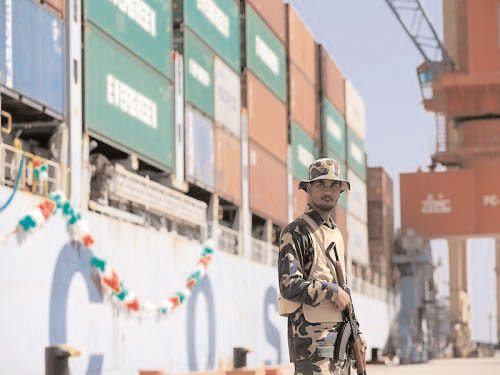
    Questions are now being raised in Pakistan about where resources will come from to repay the over $50 billion debt that will accrue from CPEC projects, where local participation is minimal. Moreover, Pakistan will soon be unable to credibly claim that it exercises its sovereignty in places like the Gwadar Port, which is all set to become a Chinese-run military base, close to the strategic Straits of Hormuz. Writing in the respected Dawn newspaper, columnist Khurram Hussein perceptively observes: “In reality, the China-Pakistan Economic Corridor is about allowing Chinese enterprises to assume dominant positions in all dynamic sectors of Pakistan’s economy, as well as a ‘strategic’ direction that is often hinted at, but never fleshed out.”

    (The author is an Indian  career diplomat)


  • China stops funding CPEC road projects over graft issue, Pakistan ‘stunned’: Report

    China stops funding CPEC road projects over graft issue, Pakistan ‘stunned’: Report

    ISLAMABAD (TIP): China has decided to temporarily stop funding at least three major road projects in Pakistan, being built as part of the $50 billion China-Pakistan Economic Corridor, following reports of corruption, a decision that has left officials in Islamabad “stunned”, a media report said on Dec 5.

    The decision by the Chinese government is likely hit over Rs 1 trillion-worth road projects of the Pakistan’s National Highway Authority (NHA), and initially, may delay at least three such ventures, Dawn newspaper reported.

    According to a senior government official, the funds would be released after Beijing issues ‘new guidelines’.

    The nearly $60 billion CPEC, a flagship project of China’s prestigious One Belt One Road, passes through Pakistan – occupied Kashmir (PoK). It links China’s restive Xinjiang region with Pakistan’s Balochistan province.

    The road projects that are likely to be affected include 210- km-long Dera Ismail Khan-Zhob Road, being built at an estimated cost of Rs 81 billion. Of this, Rs 66 billion would be spent on construction of road while Rs 15 billion on land acquisition. The other project which is going to be hit is 110- km-long Khuzdar-Basima Road, having an estimated cost of Rs 19.76 billion. The third project is Rs 8.5 billion worth, the remaining 136-km of Karakarom Highway (KKH) from Raikot to Thakot.

    Originally, all the three projects were part of the Pakistan government’s own development programme, but in December 2016, the NHA spokesperson had announced that they would be included under the CPEC umbrella so as to become eligible for concessionary finance from China.

    “The funds for the three road projects were approved in the 6th Joint Cooperation Committee meeting held last year, pending necessary procedural formalities.

    “It was expected that the funding of the three projects would be finalised during the Joint Working Group (JWG) meeting held on November 20, but Pakistan was informed in the meeting that ‘new guidelines’ will be issued from Beijing under which new modus operandi for release of the funds will be described,” the official was quoted as saying by the newspaper. (PTI)

  • China rejects US criticism of OBOR passing through PoK

    China rejects US criticism of OBOR passing through PoK

    BEIJING (TIP): Claiming UN support for its controversial One Belt One Road (OBOR) initiative, China on Friday rejected US criticism saying the project has not changed its stand that the Kashmir issue should be resolved by India and Pakistan bilaterally.

    “We have repeatedly reiterated that the China-Pakistan Economic Corridor (CPEC) is an economic cooperation initiative that is not directed against third parties and has nothing to do with territorial sovereignty disputes and does not affect China’s principled stance on the Kashmir issue,” the Chinese foreign ministry told PTI here.

    The ministry was responding to comments by US defence secretary Jim Mattis that the Belt and Road Initiative “also goes through disputed territory, and I think, that in itself shows the vulnerability of trying to establish that sort of a dictate”.

    In a globalised world, there are many belts and many roads, and no one nation should put itself into a position of dictating ‘One Belt, One Road’, Mattis told a Senate Armed Services Committee during a Congressional hearing on October 4.

    Mattis’ comments were widely interpreted as the US backing India’s stand on OBOR especially related to the $50 billion CPEC which is being built through Pakistan-occupied Kashmir (PoK). India has protested to China in this regard.

    Rejecting criticism that it is dictating to the world through OBOR, the ministry said it is an “important international public product”.

    It is an important platform for China to cooperate with relevant countries. It is an open and inclusive development platform and more than 100 countries and international organisations actively supported and participated in it since it was proposed four years ago, it said.

    More than 70 countries and international organisations which have signed cooperation agreements with China on OBOR, including the UN General Assembly and the UN Security Council, have incorporated it in their important resolutions, it said.

    Over 130 countries and more than 70 international organisations sent representatives to attend the international cooperation summit – ‘Belt and Road Forum’, organised by China here in May and spoke highly of the initiative, the ministry said.

    “This fully explains that the OBOR initiative is in line with the trend of the times and conforms to the rules of development and is in line with the interests of the people of all countries and has a broad and bright prospects for development,” the ministry said.

    India skipped the Belt and Road Forum due to its sovereignty concerns over the CPEC, a flagship project of China’s prestigious Silk Road project, officially called OBOR.

    The 3,000-km CPEC is aimed at connecting China and Pakistan with rail, road, pipelines and optical fibre cable networks.It will connect Xinjiang province with Gwadar port, providing China with access to the Arabian Sea.

    The project, when completed, would enable China to route its oil supplies from the Middle East through pipelines to Xinjiang, cutting considerable distance for Chinese ships to travel to China. (PTI)

  • SCO SUMMIT- PM Modi meets China’s Xi Jinping to repair ties

    SCO SUMMIT- PM Modi meets China’s Xi Jinping to repair ties

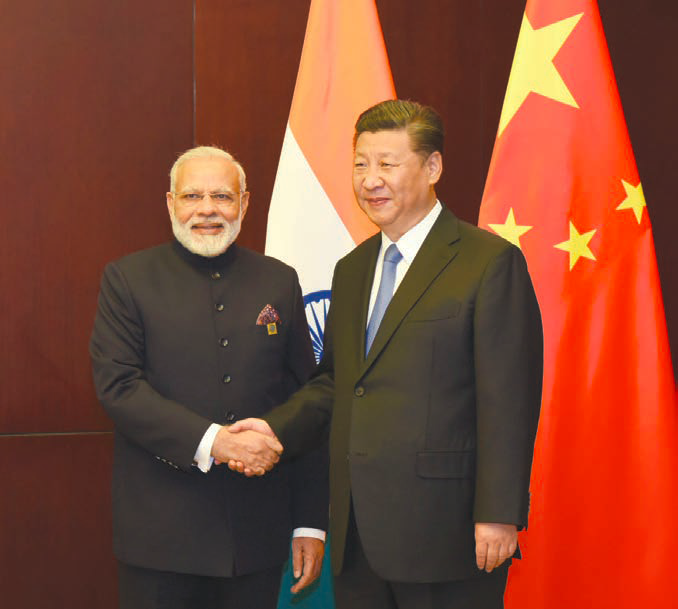
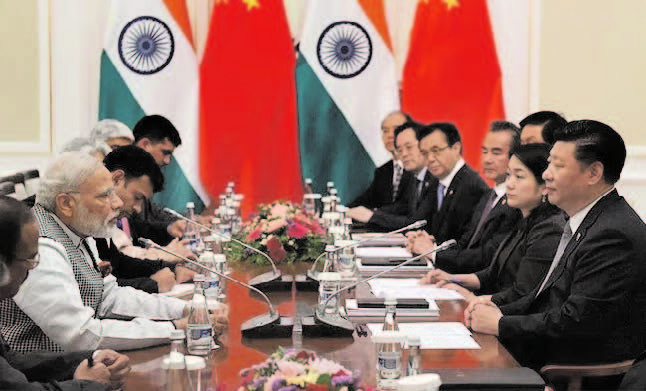
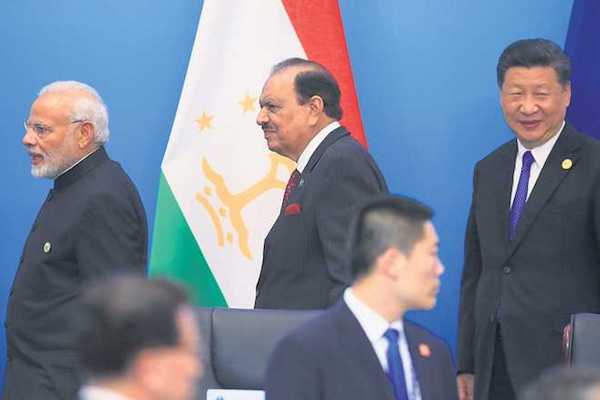
    ASTANA (TIP): Prime Minister Narendra Modi and Chinese President Xi Jinping met here on June 9 on the sidelines of the SCO summit, seen as an effort to repair ties hit by growing differences between the two countries over a host of issues, including the China- Pakistan Economic Corridor and NSG.

    It is the first between the two leaders after India boycotted the high-profile Belt and Road Forum held in Beijing last month in which 29 world leaders took part.

    India abstained from the summit to highlight its concerns over the US$ 50 billion China Pakistan Economic Corridor, which is part of the Belt and Road Initiative (BRI) and passes through Gilgit and Baltistan in Pakistan-occupied Kashmir (PoK).

    Prime Minister Modi and Xi are here to attend the annual summit of the Shanghai Cooperation Organisation (SCO). “PM @narendramodi meets President of China #XiJinping on margins of SCO Summit in Astana,” External Affairs Ministry Spokesperson Gopal Baglay tweeted.

    China is vocal about its stand to block India’s admission into the 48-member Nuclear Suppliers Group (NSG). It had also stalled India’s move to list JeM chief Masood Azhar as a global terrorist by the UN. After Astana, Modi and Xi are also expected to cross paths at the G20 summit to be held next month in Hamburg, Germany followed by Brazil, Russia, India, China, South Africa (BRICS) summit to be held in Xiamen, China in September.

    Modi also met Uzbek President Shavkat Mirziyoyev on the sidelines of the SCO. “Taking forward #IndiaUzbekistan coop’n. PM @narendramodi meets President Shavkat Mirziyoyev of Uzbekistan on the sidelines of SCO Summit,” Baglay tweeted.

    Source: PTI

  • Islamic State claims it killed two Chinese in Pakistan

    Islamic State claims it killed two Chinese in Pakistan

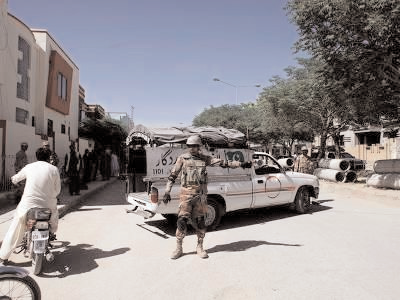
    CAIRO/QUETTA (TIP): Islamic State has killed two Chinese teachers it kidnapped in Pakistan’s southwestern Balochistan province last month, the militant group’s Amaq news agency said on June 8, in a blow to Islamabad’s efforts to safeguard Chinese workers. China’s foreign ministry said it was “gravely concerned” about the report and working to verify the information.

    Armed men pretending to be policemen kidnapped the two language teachers in the provincial capital, Quetta, on May 24. The kidnapping was a rare security incident involving Chinese nationals in Pakistan, where Beijing has pledged $57 billion for its “Belt and Road” plan.

    “Islamic State fighters killed two Chinese people they had been holding in Balochistan province, southwest Pakistan,” Amaq said. A Balochistan government spokesman said officials were in the process of confirming “whether the report is true”. China’s foreign ministry said it noted the report and expressed “grave concern”. “We have been trying to rescue the two kidnapped hostages over the past days,” the ministry said in a short statement.

    “The Chinese side is working to learn about and verify relevant information through various channels, including working with Pakistani authorities,” it said. “The Chinese side is firmly opposed to the acts of kidnapping civilians in any form, as well as terrorism and extreme violence in any form.”

    There was no immediate comment from Pakistan’s interior ministry or its foreign office. Islamic State, which controls some territory in neighbouring Afghanistan, has struggled to establish a presence in Pakistan. But it has claimed several major attacks, including one on the deputy chairman of the Senate last month in Balochistan, in which 25 people were killed.

    Earlier on Thursday, Pakistan’s military published details of a three-day raid on a militant hideout in a cave not far from Quetta, saying it had killed 12 “hardcore terrorists” from a banned local Islamist group and prevented Islamic State from gaining a “foothold” in Balochistan.

    China’s ambassador to Pakistan and other officials have often urged Islamabad to improve security, especially in Balochistan, where China is building a new port and funding roads to link its western regions with the Arabian Sea.

    The numbers of Pakistanis studying Mandarin has skyrocketed since 2014, when President Xi Jinping signed off on the China-Pakistan Economic Corridor, pledging to invest $57 billion in Pakistani road, rail and power infrastructure. Security in Balochistan has improved in recent years.

    However, separatists, who view the project as a ruse to steal natural resources, killed 10 Pakistani workers building a road near the new port of Gwadar this month, a key part of the economic corridor.

    China has also expressed concern about militants in Pakistan linking up with what China views as separatists in the far western Chinese region of Xinjiang, where hundreds have been killed in violence in recent years.

    (Reuters)

  • Why China is pressuring India to join OBOR meeting

    Why China is pressuring India to join OBOR meeting

    BEIJING (TIP): China is putting pressure on India to participate in an international conference on its One Belt, One Road or Silk Road programme next May after realizing that showcasing the China-Pakistan Economic Corridor (CPEC) would not be enough to sell the OBOR idea.

    This is evident from several comments from Chinese officials and experts about the Indian reluctance to join the OBOR program that involves creating road, rail and port infrastructure connecting China to the world.

    A Chinese expert has now accused India of taking a “biased view” of the OBOR program. The expert, Lin Minwang of the Institute of International Studies at Shaghai’s Fudan University, even tried to shame India by citing some reports about Russia expressing interest in it.

    “New Delhi may also feel embarrassed as Moscow has actively responded to the Belt and Road (OBOR) initiative and will build an economic corridor with China and Mongolia,” Lin said adding, “Since the beginning of this year, there have been reports on Russia and Iran seeking to join the China-Pakistan Economic Corridor (CPEC), which will likely put India in a more awkward position”.

    However, Russia has not sanctioned any specific programme for connecting with OBOR apart from making a few statements about its interests.

    China expects heads of at least 20 countries to participate in the OBOR conference, when it will try to persuade governments in Asia and Europe to join the programme. Beijing desperately wants India to participate because that would make it attractive to other South Asian countries.

    China is sore because India’s reluctance has made it difficult for China to extend the OBOR network to Nepal, Bangladesh, Sri Lanka and Myanmar. But Lin maintained that these countries are also interested in joining the program.

    He said, “Beijing has expressed, on various occasions, its anticipation to see New Delhi join the grand project and to make concerted effort with India in building economic corridors involving China, India, Sri Lanka, Nepal, Bangladesh, and Myanmar.”

    Writing in the state-backed Global Times, Lin said that “other smaller states in South Asia have shown interest toward the One Belt, One Road initiative. India is definitely reluctant to see itself being left out of all these economic cooperation projects between China and other South Asian nations. Whether to continue to boycott or join the Belt and Road remains a conundrum for New Delhi.”

    On its part, India has pointed out that China is building infrastructure projects in the disputed Pakistan Occupied Kashmir, and thus hurting its interest in the name of China Pakistan Economic Corridor and OBOR. New Delhi cannot join a program that hurts Indian territorial interests.

    “The official reason why the Indian government rejected the offer to join the initiative is that it is designed to pass Kashmir, a disputed area between India and Pakistan. However, it is just an unfounded excuse as Beijing has been maintaining a consistent position on the Kashmir issue, which has never changed,” said Lin.

    He seemed to suggest that India should accept Beijing’s oral assurances in the face of mounting evidence of China creating infrastructure and legitimizing Pakistan’s claim over POK.

    (TOI)

  • China to ‘authorise’ Pakistan to build missiles, tanks, FC-1 Xiaolong combat aircraft

    China to ‘authorise’ Pakistan to build missiles, tanks, FC-1 Xiaolong combat aircraft

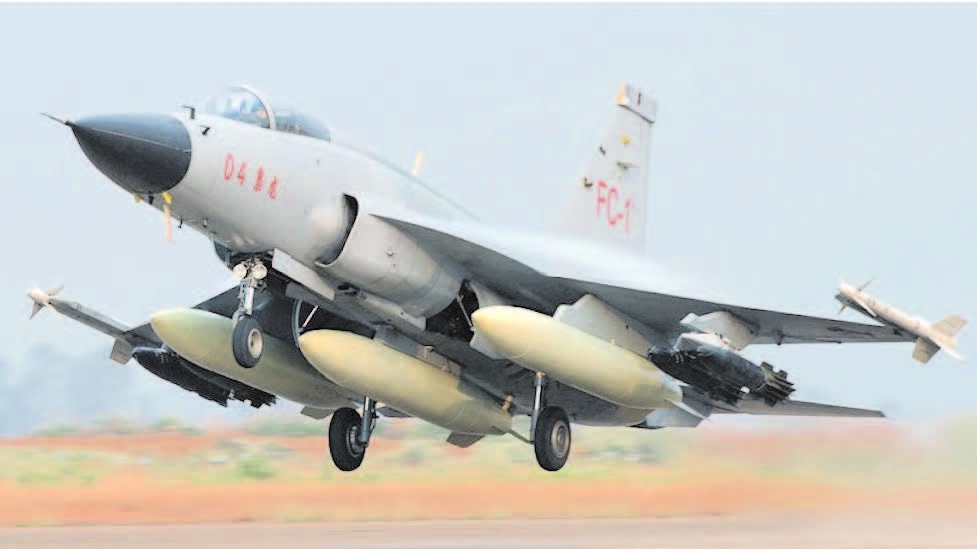
    ISLAMABAD (TIP): : In what will come as bad news for India, ‘all-weather friends’ China and Pakistan are set to not just increase weapons exchanges, the former is also expected to ‘authorise’ the latter to produce ballistic, cruise, anti-aircraft and anti-ship missiles, and battle tanks, China’s state-run media reported on March 16.

    The weapons exchanges include the mass production of FC-1 Xiaolong, a lightweight and multi-role combat aircraft developed jointly by the two countries, reported Global Times, the Chinese Communist Party’s news outlet. The two sides also agreed to strengthen anti-terrorism cooperation and strike terrorist forces including China’s insurgent East Turkestan Islamic Movement.

    These were the outcomes of yesterday’s meeting in Beijing between Pakistan’s army chief+ Qamar Bajwa and a top Chinese military official, Fang Fenghui. In exchange for Beijing’s largesse, Islamabad agreed to ensure the safety of the China-Pakistan Economic Corridor (CPEC)+ .

    “Pakistan and China enjoy a special friendly relationship with each other and have a common destiny,” Bajwa reportedly said at the meeting, according to a statement on the website of China’s defence ministry.

    Pakistan has deployed more than 15,000 troops to protect CPEC+ and the country’s navy has raised a security contingent to protect the Gwadar Port, said Masood Khalid, Pakistan’s Ambassador to China, at a news conference on Tuesday, according to Global Times. The Port is a key CPEC project.

    “As Pakistan faces frequent threats from terrorist forces such as the Taliban and al-Qaeda, military support is necessary to ensure a safe environment for the regions where there is huge investment from China”, said Song Zhongping, a military expert who has served in the Chinese army, to Global Times.

    Pakistan’s Bajwa is reported to have said the country’s army is willing to “deepen the cooperation with the Chinese army and fully support the Quadrilateral Cooperation and Coordination Mechanism in Counter Terrorism by Afghanistan-China-Pakistan-Tajikistan Armed Forces.” (PTI)

  • Pakistani MPs fear China-Pakistan Economic Corridor could benefit India

    Pakistani MPs fear China-Pakistan Economic Corridor could benefit India

    ISLAMABAD (TIP): A group of Pakistani lawmakers has expressed concern that Beijing could eventually use the $46 billion China-Pakistan Economic Corridor+ (CPEC) to boost its trade with India. The 2442km corridor stretches from the Chinese border to Pakistan’s Gwadar port+ on the Arabian Sea.

    According to a report in Dawn, some members of Pakistan National Assembly , during a meeting of the senate standing committee on planning and development on Wednesday , said that China was investing in the CPEC project to explore new vistas of trade with different countries from India to Central Asian states as well as Europe.

    Committee chairman Syed Tahir Hussain Mashhadi said, “With improved rail and road links with India… China would expand its trade not only with Central Asian states and European countries but also with India to economically strengthen its eight underdeveloped provinces.”

    “Irrespective of sour India-Pakistan, China will definitely use CPEC to expand its trade with India because one who invests always watches one’s interests first.” Mashhadi also suggested that China’s trade relations with India were far bigger than Pakistan, as China had inked $100 billion trade agreements with India last year.

    Meanwhile, The Economist said that Balochistan was one of Pakistan’s troubled regions and, therefore, a “surprising location for (CPEC) what officials hope will become one of the world’s great trade routes”. (PTI)

  • Pakistan PM fails to win US support against India

    Pakistan PM fails to win US support against India

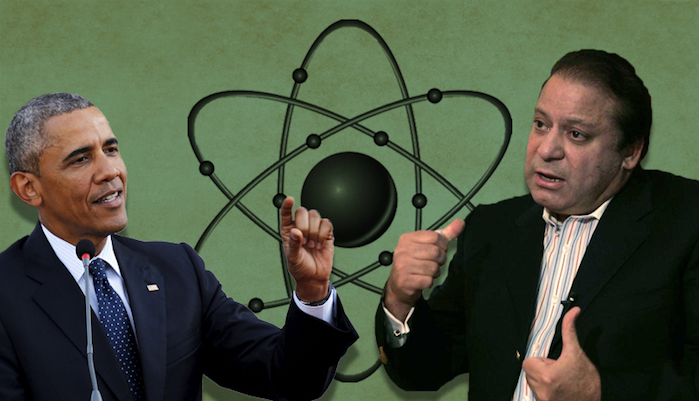
    WASHINGTON (TIP): Pakistan Prime Minister must be a disappointed man. His bilateral with US President Barack Obama is being viewed as a diplomatic failure. India has watched the Sharif-Obama summit in Washington keenly, and while it is clear that Prime Minister Nawaz Sharif returns to Islamabad without any big announcement to show for the bilateral, and no progress on US-Pakistan civil nuclear negotiations, there are many parts to the 2015 joint statement issued by the two that could  be worrisome for India.

    Here are the key statements in the US-Pakistan joint statement which may cause concern to India.

    1.  Hydroelectric projects in PoK/Gilgit-Baltistan 

    President Obama expressed support for Pakistan’s efforts to secure funding for the Diamer Bhasha and Dasu dams to help meet Pakistan’s energy and water needs.

    India has opposed the construction of hydro-electric projects in the disputed region of Kashmir that includes PoK and Gilgit-Baltistan. Most recently, External Affairs Minister Sushma Swaraj had called the China-Pakistan Economic Corridor (CPEC) unacceptable because it includes these projects, while India had told the UNGA that “India’s reservations about the proposed China-Pakistan Economic Corridor stem from the fact that it passes through Indian territory illegally occupied by Pakistan for many years.”

    In recent years, the 4,500 m W Diamer Bhasha dam (DBD) project, that the Pakistan government says will halve its electricity shortfall when constructed, had come to a standstill over funding. In 2013, prospective investors – the ADB, China and Russia – had asked Pakistan to obtain an NOC (No objection certificate) from India before they could proceed on loans. Even after the announcement of the China-Pakistan Economic Corridor by President Xi Jinping for projects including dams in PoK in April 2015, China has shown a preference for the $1.6 billion Karot project, rather than DBD, which would now cost an estimated $14 billion. It is significant that the US wants to play ‘White Knight’ on these two dams, and for India, the construction of major projects like these endorsed by the US would be a blow to its claim on PoK. Earlier this month, reports suggested India had protested over a USAID event aimed raising funding for DBD, where US firm Mott McDonald has been contracted to perform a technical engineering review.

    2.  Talks with the Taliban
    President Obama commended Pakistan for hosting and facilitating the first public talks between the Afghan government and the Taliban in July 2015 and highlighted the opportunity presented by Pakistan’s willingness to facilitate a reconciliation process that would help end insurgent violence in Afghanistan.

    India has felt cut out of the Taliban peace process, and relations with President Ghani’s government underwent a strain when New Delhi learned that Pakistan would be allowed to host the talks in Murree. “This is an open acknowledgement that Pakistan controls the Taliban,” a senior official had told The Hindu at the time, “And rather than castigate Pakistan for not curbing the Taliban’s violence, these talks will legitimize its actions.”

    When the talks collapsed over the announcement of Mullah Omar’s death, it was felt Pakistan’s claim of being a ‘peacemaker’ rather than a sponsor of Taliban-terror would end. However, despite a surge in violence by the Taliban, including the brutal siege of Kunduz that was overthrown by Afghan and US special forces last month, the Joint statement seems to indicate the US is prepared to let Pakistan host the talks again.

    3.  Resume India-Pakistan talks
    President Obama and Prime Minister Sharif stressed that improvement in Pakistan-India bilateral relations would greatly enhance prospects for lasting peace, stability, and prosperity in the region. The two leaders expressed concern over violence along the Line of Control, and noted their support for confidence-building measures and effective mechanisms that are acceptable to both parties. The leaders emphasized the importance of a sustained and resilient dialogue process between the two neighbors aimed at resolving all outstanding territorial and other disputes, including Kashmir, through peaceful means and working together to address mutual concerns of India and Pakistan regarding terrorism.

    For over a decade, the US has stayed away from openly pushing India towards talks with Pakistan. In the period between 2003-2008, this was because India and Pakistan were engaging each other, and both the composite dialogue and back-channel diplomacy yielded many important confidence building measures between them. After the Mumbai 26/11 attacks, the US recognized India’s legitimate anger over the attacks being planned and funded in Pakistan, and abstained from making any comments on the resumption of India-Pakistan dialogue, restricting itself only to “welcoming” talks between their leaders in Thimphu, Delhi, New York and Ufa. The US-Pakistan joint statement doesn’t just put the importance of “sustained and resilient dialogue process” (codeword for comprehensive dialogue) back in focus, it makes a new mention of “violence along the LoC” which India squarely blames Pakistan for initiating. India believes ceasefire violations are aimed at “infiltrating terrorists”, a charge the government repeated when the NSA talks were cancelled. Of particular worry for India will be the US-Pakistan joint statement’s reference to “mutual concerns of terrorism”, as it comes in the wake of Pakistan’s latest claims of Indian support to terrorism inside Pakistan. Pakistan NSA Sartaj Aziz had told the press that Indian agency “involvement” in Balochistan and FATA would be taken up during the summit.

    4.  Action on LeT?
    In this context, the Prime Minister apprised the President about Pakistan’s resolve to take effective action against United Nations-designated terrorist individuals and entities, including Lashkar-e-Tayyiba and its affiliates, as per its international commitments and obligations under UN Security Council resolutions and the Financial Action Task Force.

    Action against the LeT has been India’s most sustained demand from Pakistan, especially after the 26/11 attacks, when the LeT’s top leadership was charged with planning and executing the carnage in Mumbai. Yet years later, chief Hafiz Saeed is free, LeT operations chief Zaki Ur Rahman Lakhvi is out on bail, and there seems little evidence that Pakistani forces have conducted any sort of crackdown on the Lashkar e Toiba, especially when compared to action against other groups after the Peshawar school attack of December 2014. While the US-Pakistan joint statement doesn’t note President Obama’s acceptance of Pakistan’s claims of keeping its “international commitments and obligations”, it is significant that the US has not raised the obvious violation of the UNSC and FATF requirements earlier this year during the bail process of Lakhvi. Despite Indian representations to the US and UN, there has been little pressure on Pakistan how Lakhvi raised the funds when according to the UNSC 1267 Committee rules, a designated terrorist cannot be allowed recourse to finances.

    5.  Nuclear talks
    The leaders noted Pakistan’s efforts to improve its strategic trade controls and enhance its engagement with multilateral export control regimes. Recognizing the importance of bilateral engagement in the Security, Strategic Stability and Non-Proliferation Working Group, the two leaders noted that both sides will continue to stay engaged to further build on the ongoing discussions in the working group.

    Both, the US and Pakistan, have denied a report in the Washington Post that they had planned what it called a “diplomatic blockbuster”: negotiations over a civil nuclear deal on the lines the US and India signed in 2005. Pakistan’s foreign secretary reacted to the report with a detailed account of Pakistan’s “low-yield tactical nuclear weapons” aimed at India, to calm fears in Pakistan that the government was giving up its weapons program. Even so the details in the Post have left lingering doubts over what the US intends, including pushing for a possible NSG waiver for Pakistan in exchange for limiting Pakistan’s missile capability. The report goaded the MEA into counseling the US on taking a closer look at Pakistan’s past on supplying nuclear weapons to North Korea and Iran, “Whosoever is examining that particular dossier should be well aware of Pakistan’s track record in proliferation. And when India got this particular deal, it was on the basis of our own impeccable non-proliferation track record,” the MEA spokesperson said on October 9, given that India will watch this space closely, particularly the phrase on “engagement with multilateral export regimes” mentioned in the US-Pakistan joint statement.

  • Putting India Emphatically on Global Map – Part 2

    Putting India Emphatically on Global Map – Part 2

    Continued from Putting India Emphatically on Global Map – Part 1

    It defies logic that a country that is considered as our most serious adversary and whose policies in our region has done us incalculable strategic harm should have been accepted as India’s strategic partner during Manmohan Singh’s time. Such a concession that clouds realities serves China’s purpose and once given cannot be reversed. Pursuant to discussions already held during the tenure of the previous government, the Chinese announced during Xi’s visit the establishment of two industrial parks in India, one in Gujarat and the other in Maharashtra, and the “endeavour to realise” an investment of US $ 20 billion in the next five years in various industrial and infrastructure development projects in India, including in the railways sector. The Chinese Prime Minister’s statement just before Modi goes to China on May 14 that China is looking for preferential policies and investment facilitation for its businesses to make this investment suggests that the promised investment may not materialise in a hurry. While the decision during Xi’s visit to continue defence contacts is useful in order to obtain an insight into PLA’s thinking and capacities at first hand, the agreement, carried forward from Manmohan Singh’s time, to explore possibilities of civilian nuclear cooperation puzzles because this helps to legitimise China’s nuclear cooperation with Pakistan.

    Even as Modi has been making his overall interest in forging stronger ties with China clear, he has not shied away from allusions to Chinese expansionism, not only on Indian soil but also during his visit to Japan. During his own visit to US in September 2014 and President Obama’s visit to India in January 2015, the joint statements issued have language on South China Sea and Asia-Pacific which is China-directed. A stand alone US-India Joint Vision for Asia Pacific and the Indian Ocean Region issued during Obama’s Delhi visit was a departure from previous Indian reticence to show convergence with the US on China-related issues. India has now indirectly accepted a link between its Act East policy and US rebalance towards Asia. The Chinese have officially chosen to overlook these statements as they would want to wean away India from too strong a US embrace. During Sushma Swaraj’s call on Xi during her visit to China in February 2015 she seems to have pushed for an early resolution of the border issue, with out-of-the-box thinking between the two strong leaders that lead their respective countries today. Turning the Chinese formulation on its head, she called for leaving a resolved border issue for future generations.

    It is not clear what the External Affairs Minister had in mind when she advocated
    “out-of-the-box” thinking, as such an approach can recoil on us. That China has no intention to look at any out-of-the-box solution has been made clear by the unusual vehemence of its reaction to Modi’s visit to Arunachal Pradesh in February 2015 to inaugurate two development projects on the anniversary of the state’s formation in 1987. The pressure will be on us to do out-of-the-box thinking as it is we who suggested this approach. China is making clear that it considers Arunachal Pradesh not “disputed territory” but China’s sovereign territory. This intemperate Chinese reaction came despite Modi’s visit to China in May. The 18th round of talks between the Special Representatives (SRs) on the boundary question has taken place without any significant result, which is not surprising in view of China’s position on the border. The Chinese PM has recited the mantra a few days ago of settling the boundary issue “as early as possible” and has referred to “the historical responsibility that falls on both governments” to resolve the issue, which means nothing in practical terms. As against this, India has chosen to remain silent on the China-Pakistan Economic Corridor (CPEC) which will traverse territory that is legally Indian, and which even the 1963 China-Pakistan border agreement recognises as territory whose legal status has not been finally settled. The CPEC cannot be built if China were to respect its own position with regard to “disputed” territories which it applies aggressively to Arunachal Pradesh. Why we are hesitant to put China under pressure on this subject is another puzzle.

    Modi’s visit to Seychelles, Mauritius and Sri Lanka in March 2015 signified heightened attention to our critical interests in the Indian Ocean area. The bulk of our trade- 77% by value and 90% by volume- is seaborne. Modi was the first Indian Prime Minister to visit Seychelles in 34 years, which demonstrates our neglect of the Indian Ocean area at high political level and Modi’s strategic sense in making political amends. During his visit Modi focused on maritime security with agreement on a Coastal Surveillance Radar Project and the supply of another Dornier aircraft. In Mauritius, Modi signed an agreement on the development of Agalega Island and also attended the commissioning of the Barracuda, a 1300 tonne Indian-built patrol vessel ship for the country’s National Coast Guard, with more such vessels to follow. According to Sushma Swaraj, Modi’s visit to Seychelles and Mauritius was intended to integrate these two countries in our trilateral maritime cooperation with Sri Lanka and Maldives.

    In Pakistan’s case, Modi too seems unsure of the policy he should follow- whether he should wait for Pakistan to change its conduct before engaging it or engage it nevertheless in the hope that its conduct will change for the better in the future. Modi announced FS level talks with Pakistan when Nawaz Sharif visited Delhi for the swearing-in ceremony, even though Pakistan had made no moves to control the activities of Hafiz Saeed and the jihadi groups in Pakistan.

    The Pakistani argument that Nawaz Sharif was bold in visiting India for the occasion and that he has not been politically rewarded for it is a bogus one. He had a choice to attend or not attend, and it was no favour to India that he did. Indeed he did a favour to himself as Pakistan would have voluntarily isolated itself. The FS level talks were cancelled when just before they were to be held when the Pakistan High Commissioner met the Hurriyet leaders in Delhi. Pakistan’s argument that we over-reacted is again dishonest because it wanted to retrieve the ground it thought it had lost when Nawaz Sharif did not meet the Hurriyet leaders in March 2014.

    Modi ordered a robust response to Pakistani cease-fire violations across the LOC and the international border during the year, which suggested less tolerance of Pakistan’s provocative conduct. We have also been stating that talks and terrorism cannot go together. Yet, in a repetition of a wavering approach, the government sent the FS to Islamabad in March 2015 on a so-called “SAARC Yatra”. Pakistan responded by releasing the mastermind of the Mumbai attack, Lakhvi, on bail and followed it up by several provocative statements on recent demonstrations by pro-Pakistani separatists in Srinagar, without any real response from our side. Surprisingly, in an internal political document involving the BJP and the PDP in J&K, we agreed to include a reference to engaging Pakistan in a dialogue as part of a common minimum programme, undermining our diplomacy with Pakistan in the process.

    Pakistan believes that it is US intervention that spurred India to take the initiative to send the FS to Pakistan, which is why it feels it can remain intransigent. Pakistan chose to make the bilateral agenda even more contentious after the visit by the FS by raising not only the Kashmir cause, but also Indian involvement in Balochistan and FATA. On our side, we raised the issue of cross border terrorism, the Mumbai terror trial and LOC violations, with only negative statements on these issues by Pakistan. Since then the Pakistani army chief has accused India of abetting terrorism in Pakistan. The huge gulf in our respective positions will not enable us to “find common ground and narrow differences” in further rounds of dialogue, about which the Pakistani High Commissioner in Delhi is now publicly sceptical.

    Even though one is used to Pakistan’s pathological hostility towards India, the tantrums that Nawaz Sharif’s Foreign Policy Adviser, Sartaj Aziz, threw after President Obama’s successful visit to India were unconscionable. He objected to US support for India’s permanent seat in the UNSC and to its membership of the Nuclear Suppliers Group (NSG). He castigated the Indo-US nuclear deal, projecting it as directed against Pakistan and threatened to take all necessary steps to safeguard Pakistan’s security- in other words, to continue to expand its nuclear arsenal.

    Chinese President Xi’s April 2015 visit to Pakistan risks to entrench Pakistan in all its negative attitudes towards India. The huge investments China intends making through POK constitutes a major security threat to India. China is boosting a militarily dominated, terrorist infested, jihadi riven country marked by sectarian conflict and one that is fast expanding its nuclear arsenal, including the development of tactical nuclear weapons, without much reaction from the West. President Ashraf Ghani’s assumption of power in Afghanistan and his tilt towards Pakistan and China, as well as the West’s support for accommodating the Taliban in Afghanistan with Pakistan’s help will further bolster Pakistan’s negative strategic policies directed at India. Ghani’s delayed visit to India in April 2015 has not helped to clarify the scenario in Afghanistan for us, as no change of course in Ghani’s policies can be expected unless Pakistan compels him to do by overplaying its hand in his country. Modi is right in biding his time in Afghanistan and not expressing any undue anxiety about developments there while continuing our policies of assistance so that the goodwill we have earned there is nurtured.

    Prime Minister Modi, belying expectations, moved rapidly and decisively towards the US on assuming office. He blindsided political analysts by putting aside his personal feelings at having been denied a visa to visit the US for nine years for violating the US law on religious freedoms.