Governors admit worries but rally behind Biden : ‘We have his back’
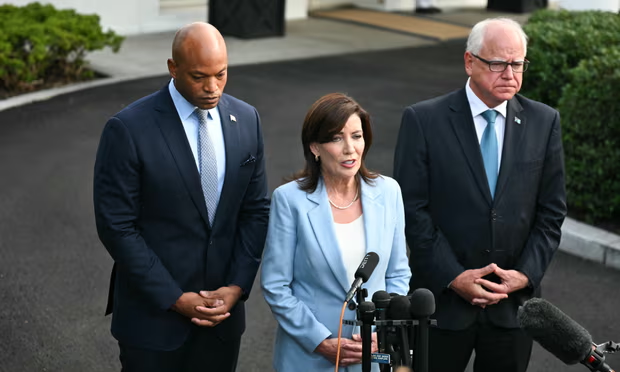
WASHINGTON, D.C. (TIP): A group of leading Democratic governors offered words of support for Joe Biden on Wednesday as pressure mounted on the president to leave the race. The governors, including Tim Walz of Minnesota, Wes Moore of Maryland, Gavin Newsom of California and Kathy Hochul of New York, held a closed-door meeting with Biden in Washington as he sought to reassure his party – and the public – that he is up to the job after a shaky debate performance.
Biden met for more than an hour at the White House in person and virtually with more than 20 governors from his party. The governors told reporters afterward that the conversation was “candid” and said they expressed concerns about Biden’s debate performance last week. They reiterated that defeating Donald Trump in November was the priority, but said they were still standing behind Biden and did not join other Democrats who have been urging him to withdraw his candidacy.
“We, like many Americans, are worried,” Walz of Minnesota said. “We are all looking for the path to win – all the governors agree with that. President Biden agrees with that. He has had our backs through Covid … the governors have his back. We’re working together just to make very, very clear that a path to victory in November is the No 1 priority and that’s the No 1 priority of the president … The feedback was good. The conversation was honest.” “The president is our nominee. The president is our party leader,” added Moore of Maryland. He said Biden “was very clear that he’s in this to win it”.
“We were honest about the feedback we’re getting … and the concerns we’re hearing from people,” Moore said. “We’re going to have his back … the results we’ve been able to see under this administration have been undeniable.”
The meeting capped a tumultuous day for Biden as members of his own party, and a major democratic donor, urged him to step aside amid questions over his fitness for office. Two Democratic lawmakers have called on Biden to exit the race, and a third Congressman said he had “grave concerns” about Biden’s ability to beat Trump. The White House, meanwhile, was forced to deny reports that Biden is weighing whether his candidacy is still viable. Biden, for his part, has forcefully insisted that he is staying in the race.
“Let me say this as clearly as I possibly can, as simply and straightforward as I can: I am running … no one’s pushing me out,” Biden said on a call with staffers from his re-election campaign. “I’m not leaving. I’m in this race to the end and we’re going to win.”
Kamala Harris has also stood by his side, despite some insiders reportedly rallying around her as a possible replacement. “We will not back down. We will follow our president’s lead,” the vice-president reportedly told staffers on Wednesday.
Michigan governor Gretchen Whitmer also threw her support behind Biden. “He is in it to win it and I support him,” she said on Twitter/X after the meeting.
Whitmer is one of several Democratic governors who have been cited as possible replacements if Biden were to withdraw his candidacy. Gavin Newsom, whose name has also been floated, flew in for the governors’ meeting on Wednesday, saying afterwards: “I heard three words from the president tonight – he’s all in. And so am I.”
Newsom has been a top surrogate for Biden’s re-election campaign, but has also garnered increasing buzz as a potential replacement if Biden were to withdraw. He was swarmed by reporters after the debate ended last week, some asking him if he’d replace Biden.
A Siena College/New York Times poll released Wednesday suggested Trump’s lead had increased since the debate, with him winning 49% of likely voters compared to 43% for Biden. Only 48% of Democrats in the poll said Biden should remain the nominee. A Reuters/Ipsos poll published Tuesday, July 2, said that former first lady Michelle Obama is the only hypothetical candidate to definitively defeat Trump, but she has previously said she’s not running. That poll had Biden and Trump tied.
Meanwhile, as Joe Biden faces increasing pressure to withdraw his candidacy following last week’s poor debate performance, Kamala Harris has emerged as the frontrunner to replace him.
Senior sources at the Biden campaign, the White House and the Democratic National Committee told the media that the vice-president was the top alternative.
Harris, a former senator from California, has stood by the president’s side as he weathers the debate fallout this week, and reportedly told campaign staffers on Wednesday: “We will not back down. We will follow our president’s lead.”
A CNN poll published Tuesday, July 2, found Harris “within striking distance of Trump in a hypothetical matchup” – 47% supporting the former president, and 45% supporting Harris, a result within the margin of error. The Biden-Trump matchup in that poll had Trump earning 49% of votes and Biden earning 43%. Harris’s modest advantage was due partly to her having broader support from women and independents, CNN said.
With two Democratic congressmen now publicly calling on Biden to step aside, other party leaders have privately suggested they favor Harris as his potential replacement, according to reports. Hakeem Jeffries, House minority leader, signaled to members that she would be the best option, the Washington Post reported.
James Clyburn, a senior congressional Democrat, said publicly he’d support Harris if Biden were to withdraw his candidacy, urging Democrats to “do everything to bolster her, whether she’s in second place or at the top of the ticket”. Summer Lee, a House Democrat from Pennsylvania, also said Wednesday that Harris was the “obvious choice” to replace Biden, if he decided not to run.
Some Harris supporters who are advocating she take over the campaign have argued that she would perform better than Biden with Black and Latino communities, and that she is a more powerful abortion-rights spokesperson than Biden.
Skeptics, however, have noted that Harris also remains fairly unpopular and have pointed to polls suggesting she has vulnerabilities in terms of voters’ trust in her ability to handle immigration, China relations and Israel’s war on Gaza.
The other names that have been floated as possible replacements include California governor Gavin Newsom, Michigan governor Gretchen Whitmer, Illinois governor J B Pritzker and Kentucky governor Andy Beshear. The Reuters poll, however, suggested they would all perform worse than Biden and Harris. If Harris became the presidential candidate, she could take over the funds raised by the campaign since the account is registered under Biden and Harris.
On Wednesday, the White House also announced a series of “summer of engagement” events for Harris, including visits to New Orleans, Las Vegas, Dallas and Indianapolis.
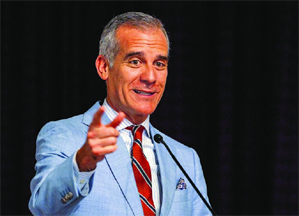
US Ambassador Eric Garcetti described Indo-US ties as “not an additive relationship but a multiplicative relationship” and criticised China for renaming places in Arunachal Pradesh.
Stating that China has no business renaming places that are part of India’s territory, Garcetti fully backed New Delhi and said its defence cooperation with Washington was reaching unprecedented levels so as to deter aggressive authoritarian rival countries. As two democracies, the US and India thought and felt alike about the threat posed by dictatorial regimes like that of China and that the convergence of values was the key factor driving Washington and New Delhi closer.
During an interactive session with students of the Sonepat-based OP Jindal University, Garcetti also took questions regarding comments made by US officials about internal developments in India. “The US is a unique democracy where every branch of government, the news media and civil society has its own views and opinions about different countries. These opinions are frequently aired publicly as part of the open American political system,” he explained.
Garcetti claimed that the US was ready to also take criticism from other countries as part of this liberal ethos.
Beijing (TIP): China is reportedly pressing ahead with the construction of border villages in the disputed territory with Bhutan, despite the ongoing border talks between the two countries. At least three villages have been built in the mountainous region separating the two countries, the Hong Kong-based South China Morning Post reported on February 19.
The rapid expansion began as a poverty alleviation scheme but serves a dual national security role, the report quoted the ruling Chinese Communist Party officials as saying.
In a disputed remote village inside a border zone that has long been disputed by China and Bhutan, 18 new residents were waiting to enter their newly built houses. (PTI)
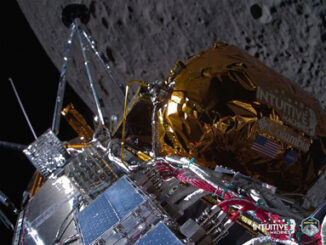
WASHINGTON, D.C. (TIP): A private American company has scripted history by landing the first commercial spacecraft on the Moon as well as the first US vehicle on the Earth’s only natural satellite in more than 50 years, joining earlier feats by India, Russia, the US and China.
Built by Intuitive Machines, the lander — named Odysseus — touched down on the moon at 6.23 pm ET on Thursday, February 22, making it the first American spacecraft on the Moon since the Apollo 17 mission in 1972. “Today, for the first time in half a century, America has returned to the Moon,” Bill Nelson, NASA Administrator said. The lander will have seven days before darkness descends on the landing site, preventing the spacecraft’s solar panels from gathering energy from sunlight and bringing freezing temperatures, ABC News reported.
(Source: PTI)
NEW DELHI (TIP): Four people survived and two are unaccounted for after a Russian plane crashed in mountainous northeastern Afghanistan, the air transport agency Rosaviatsia said.
The Falcon 10 business jet was believed to be carrying six people on a hospital flight to Uzbekistan and Russia before communication was lost on Saturday evening.
“Of the six people on board the aircraft, tentatively, four are alive. They have various injuries. The fate of two people is being clarified,” Rosaviatsia said, citing the Russian embassy in Afghanistan. The ministry of airport transport and aviation in Afghanistan said that the aircraft crashed in Koof-Aab district of Badakhshan province, and claimed that four passengers survived the crash. A provincial government official in Afghanistan told AFP the aircraft came down in Badakhshan province, which borders China, Tajikistan and Pakistan. The aircraft had taken off from Thailand and had made a brief technical stopover in Gaya airport for refueling,’’ according to the Ministry of Civil Aviation. (AFP)
Geneva (TIP) – The airline industry is projected to post a net profit of USD 25.7 billion and revenue at a historic high of USD 964 billion in 2024 as more normal growth is expected in both passenger and cargo segments, global grouping IATA said on Wednesday. For 2023, the net profit is estimated at USD 23.3 billion, significantly higher than the USD 9.8 billion projected by the International Air Transport Association (IATA) in June this year. Briefing reporters here, IATA Director General Willie Walsh said India is a “hugely exciting market” and that he was very optimistic. He was responding to a query related to India — one of the world’s fastest growing civil aviation markets. IATA is a grouping of more than 300 airlines.
It said industry revenues are expected to touch a historic high of USD 964 billion next year.
“An inventory of 40.1 million flights is expected to be available in 2024, exceeding the 2019 level of 38.9 million and up from the 36.8 million flights expected in 2023,” it noted.
The airline industry’s operating profit is expected to touch USD 49.3 billion in 2024 from USD 40.7 billion this year. “Some 4.7 billion people are expected to travel in 2024, a historic high that exceeds the pre-pandemic level of 4.5 billion recorded in 2019,” IATA said.
Industry passenger load factor is nearing its 2019 level, which is supporting the financial recovery of the airlines, IATA Director Policy and Economics Andrew Matters said.
“The airline industry net profit is expected to reach USD 25.7 billion in 2024 (2.7 per cent net profit margin). That will be a slight improvement over 2023, which is expected to show a USD 23.3 billion net profit (2.6 per cent net profit margin),” IATA said, while releasing its review of 2023 and the outlook for 2024 here. The industry is estimated to have a total fuel bill of USD 281 billion, accounting for 31 per cent of all operating costs, next year as the fuel price is expected to average USD 113.8 per barrel. “Airlines are expected to consume 99 billion gallons of fuel in 2024,” IATA said. Next year, the total expenses are estimated to rise to USD 914 billion. As per the grouping, high demand for travel coupled with limited capacity due to persistent supply chain issues continues to create supply and demand conditions supporting yield growth.”Passenger yields in 2024 are expected to improve by 1.8 per cent compared to 2023,” it added. The cargo volume is expected to be higher at 61 million tonnes next year compared to 58 million tonnes in 2023.
“From 2024, the outlook indicates that we can expect more normal growth patterns for both passenger and cargo… while the recovery is impressive, a net profit margin of 2.7 per cent is far below what investors in almost any other industry would accept,” Walsh said.
According to him, the airlines will always compete ferociously for their customers but they remain far too burdened by onerous regulation, fragmentation, high infrastructure costs, and a supply chain populated with oligopolies. About the Asia Pacific market, IATA said while some of the region’s main domestic markets — China, Australia and India — recovered quickly from the pandemic, international travel to/ from the region was subdued as China only eliminated the last of its international travel restrictions in mid-2023. The Asia Pacific region is expected to report a net loss of USD 0.1 billion in 2023 and have a net profit of USD 1.1 billion in 2024. Source: PTI
BEIJING (TIP): China has become the first country to confer diplomatic status to a Taliban-nominated official as Afghanistan’s Ambassador to Beijing, thereby formally recognising the Taliban-run administration as a legitimate government in Kabul.
“As a long-standing friendly neighbour of Afghanistan, China believes that Afghanistan should not be excluded from the international community,” Chinese Foreign Ministry spokesman Wang Wenbin told a media briefing on Tuesday when asked whether China recognised the Taliban as the legitimate government of Afghanistan.
Earlier reports from Kabul said China has given Bilal Karimi, a Taliban nominee the status of Ambassador and he has submitted his credentials to the foreign ministry here.
China along with Pakistan and Russia maintained its embassy in Kabul after the Taliban took control of Afghanistan in August 2021 following the withdrawal of American troops from the war-ravaged country.
While maintaining close contact with the Taliban interim administration, Beijing withheld recognition, especially over global criticism of the Taliban’s treatment of women and girls, excluding them from educational institutions.
No other country has formally recognised the Taliban government, which has been criticised over human rights violations and crushing women’s rights.
Defending China’s move, Wang said, “We hope Afghanistan will further respond to the expectations of the international community, build an open and inclusive political structure, adopt moderate and prudent domestic and foreign policies, firmly combat all forms of terrorist forces, develop friendly relations with other countries, especially with its neighbours, and integrate itself into the world community.”
“We believe that diplomatic recognition of the Afghan government will come naturally as the concerns of various parties are effectively addressed,” Wang said. China, which shares borders with Afghanistan, also has serious concerns over the regrouping of the East Turkistan Islamic Movement (ETIM), a banned outfit comprising Uighur militants from the volatile Xinjiang province, and pressing the Taliban administration to crack down on the outfit.
Significantly, China’s diplomatic recognition comes at a time when Pakistan, Beijing’s all-weather ally, is having serious problems with the Taliban which it once nurtured.
Pakistan is now blaming the Taliban government for recurring terrorist attacks in the country and criticised it for not cracking down hard on Pakistan Islamic militant groups, especially the Pakistani Taliban, operating from Afghanistan. In retaliation, Islamabad has ordered forceful evacuation of thousands of Afghan refugees living in the country for decades. (pti)
YANGON (TIP): Myanmar’s military has lost control of a strategic town on the Chinese border following days of clashes with ethnic armed groups, in what analysts say is the biggest military challenge it has faced since seizing power. Fighting has raged on November 3 across northern Shan state, with an alliance of ethnic groups claiming to have seized four towns, blocked trade routes to China and captured dozens of military outposts.
The remoteness of the rugged, jungle-clad region — home to pipelines that supply oil and gas to China — and patchy communications make it difficult to verify casualty numbers in the fighting, which the United Nations fears have displaced thousands.
Government, administrative organisations and security forces were “no longer present” in the trade hub of Chinshwehaw, which borders China’s Yunnan province, junta spokesman Zaw Min Tun said in a statement late Wednesday.
More than a quarter of Myanmar’s $1.8 billion border trade with China passed through Chinshwehaw between April and September, junta-controlled media reported in September, citing the commerce ministry.
The Myanmar National Democratic Alliance Army (MNDAA), the Ta’ang National Liberation Army (TNLA) and the Arakan Army (AA) said on Thursday they also had control over the towns of Hpaung Seng, Hsenwi, and Kyukok. Clashes were ongoing in Kunlong and Hsenwi, the statement said, without giving details on casualties.
China called on Thursday for an “immediate” ceasefire in northern Shan state — home to a planned billion-dollar rail link in its Belt and Road infrastructure project.
A resident of Hsenwi, around 90 kilometres (55 miles) from Chinshwehaw, told AFP on Thursday that some junta troops remained in the town.
Internet access was patchy and thousands of people had arrived in the town seeking safety, the resident said, asking for anonymity for security reasons.
The price of rice and some commodities brought in from southern Myanmar had more than doubled at some shops in Muse, a trade hub north of Hsenwi on the China border, a resident in Muse told AFP. There was no fighting in or around the town, they said, also asking to remain anonymous for security reasons.
Clashes have taken place at 10 locations across Shan state over the past six days, the junta spokesman said, without giving details on casualties.
He accused the three armed groups of “blowing up power stations, blowing up bridges, destroying transportation routes”, without providing details.
Thousands displaced
“The military hasn’t faced this level of lightning offensive since the coup,” independent analyst David Mathieson told AFP.
“It was a stunning military and intelligence failure that illustrates how stretched the Myanmar army really is.”
Myanmar’s borderlands are home to more than a dozen ethnic armed groups, some of which have fought the military for decades over autonomy and control of lucrative resources.
Some have trained and equipped newer “People’s Defence Forces” that have sprung up since the 2021 coup and the military’s bloody crackdown on dissent.
The three armed groups say the military has suffered dozens killed, wounded and captured since Friday.
Analysts say both sides likely inflate or deflate casualty figures. (AFP)
PM Narendra Modi will be heading for the BRICS summit after host and South African President Cyril Ramaphosa invited him for the meet in a phone call on Thursday, Aug 3.
During a phone call with Modi on Thursday evening, South African President Cyril Ramaphosa invited the prime minister to the Brics Summit and briefed him on preparations for the meeting.
“PM accepted the invitation and conveyed that he looked forward to his visit to Johannesburg to participate in the summit,” the external affairs ministry said in a readout of the conversation.
The ministry had earlier described as “speculative” media reports that Modi might skip the summit of the leaders of Brazil, Russia, India, China and South Africa.
Russia has said Putin will join the summit virtually while foreign minister Sergey Lavrov will lead a delegation to Johannesburg.
New Delhi (TIP)– For all the Chinese talk about Prime Minister Narendra Modi reaching a “consensus” with President Xi Jinping at the G20 Bali summit dinner on stabilizing relations, the issuance of stapled visas to Indian Wushu athletes from Arunachal Pradesh for the Chengdu games shows that Beijing wants to keep bilateral ties permanently on the edge. Basically, consensus on Chinese terms.
While India has rightly decided to pull out the entire Wushu team from University games as a mark of protest on stapled visas, the Chinese decision is part of its wolf warrior diplomacy that began in August 2010 when they refused to issue a visa to the then Northern Army Commander Lt Gen B S Jaswal for military dialogue stating that Jammu and Kashmir was disputed territory.
Even though much has been made out of the Chinese readout of meeting between National Security Advisor Ajit Doval and his Chinese counterpart Wang Yi on the sidelines of the BRICS NSA meeting in Johannesburg, fact is that since there was no agreed text, Beijing and New Delhi can interpret the meetings on their own terms and issue a statement. The same happened during External Affairs Minister S Jaishankar’s meeting with Wang Yi in his Foreign Minister avatar on the sidelines of the G-20 Ministerial in Bali. EAM Jaishankar described the meeting in a simple tweet, while Beijing issued a multi-page statement. Simply put, “consensus” is the Chinese description, perhaps mischievous, of PM Modi’s informal exchange with President Xi Jinping over the dinner table and may have to do with the Chinese leader’s visit to India for the G-20 summit in September. New Delhi, on its part, is not even wasting a breath on this description of bilateral ties as there was no agreed text, just a positive mandarin spin on an informal meeting.
However, India has taken the stapled visa issue very seriously as clearly with China the more things change, the more they remain the same with Beijing not moving a millimeter from its stated past positions on the LAC, Arunachal Pradesh or CPEC in Occupied Kashmir via Shaksgam Valley, illegally ceded by tributary state Pakistan to the Middle Kingdom. But the matters have got more complicated since the 2017 Doklam stand-off on India-Bhutan-China trijunction and after the May 2020 PLA belligerence on Pangong Tso in East Ladakh as Beijing threw out the 1993 and 1996 bilateral agreements out of the window.
In this context, the Modi government is under no illusions about expansionist China as there is PLA posturing all along the 3488 km LAC as well as the Indian Ocean, where Chinese surveillance and ballistic missile tracking ships are busy mapping route and ocean floor for Chinese nuclear submarines in the near future.
Source: HT
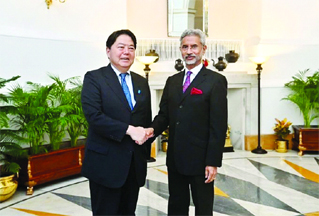
New Delhi (TIP)- Japan’s foreign minister Yoshimasa Hayashi on Friday, July 28, held up India as an “indispensable” partner for achieving a free and open Indo-Pacific, while his Indian counterpart S Jaishankar said the two sides are “natural partners” for taking on challenges in areas ranging from the economy to emerging technologies. The two ministers were speaking at the second India-Japan Forum organised by the external affairs ministry. India was the first stop on Hayashi’s three-nation tour, which will also take him to Sri Lanka and the Maldives. During talks on Thursday, Jaishankar and Hayashi discussed ways to step up Japanese investments in India and deepen defence cooperation.
Building on the “Free and Open Indo-Pacific (FOIP)” vision unveiled by Japanese Prime Minister Fumio Kishida during a visit to New Delhi in March this year, Hayashi said Japan intends to deepen cooperation with India in all areas. Japan and India are also working closely together under their presidencies of the G7 and the G20 respectively, he said.
Pointing to Kishida announcing the new FOIP plan in New Delhi, he said: “This fact itself is a reflection of the critical importance Japan places on India, as your nation is an indispensable partner in achieving FOIP.”
Hayashi added: “At a time when there are many pressing challenges, including Russia’s aggression against Ukraine, Japan and India fully share the necessity to lead the world to cooperation, rather than to division and confrontation.”
Lauding the Indian G20 presidency’s focus on the Global South, Hayashi said the call to uphold a rules-based international order may sound like a slogan if there isn’t an adequate commitment to address challenges facing developing countries. At the same time, he noted that food security has deteriorated because of Russia’s aggression against Ukraine.
Hayashi said India and Japan have made progress in new initiatives in areas such as cyber and space, while discussions are underway for “substantial cooperation” in defence equipment and technology.
In his speech, Jaishankar highlighted key challenges confronting the world, including artificial intelligence, building reliable supply chains, ensuring trust and transparency in the digital domain, and upholding democratic values.
Jaishankar said India and Japan are natural partners for jointly addressing these challenges. “I would say today whether it is the future of the international order, strategy, economics, technology, culture or indeed whether it’s history or geography, I think India and Japan have a lot going for each other,” he said.
Hayashi also spoke about Japan’s plans to revise its “Development Cooperation Charter”, the basic document for development cooperation. “Under this revised charter, we will continue to undertake efforts to build quality infrastructure in India, including high-speed rail and urban transportation,” he said.
When a Japanese reporter pointed out that a bilateral partnership is tested by a war or a crisis and asked how the two sides would collaborate in case of a war in the Taiwan Strait or a conflict on the India-China border, Jaishankar replied: “I fundamentally disagree with your question because I think it is actually peacetime cooperation which is when you are tested, because if you don’t work every day to build a relationship and to put in place capabilities, comfort and structures, then when something more severe comes – if I can’t handle a good day, how will I handle a difficult day.” Source: HT
The Indian duo of Dipika Pallikal Karthik and Harinderpal Singh Sandhu won the gold medal at the Asian Squash Mixed Doubles Championships at Huangzhou (China) on June 30.
Overall, India ended its campaign with two medals as the duo of Anahat Singh and Abhay Singh secured a bronze after losing a close semifinal battle to Ivan Yuen and Rachel Arnold of Malaysia.
Ivan and Rachel, however, were handed a defeat by Dipika and Sandhu, who won a hard-fought contest 11-10 11-8 to clinch the title.
NEW YORK (TIP)- Oil prices climbed about 3% as the second straight weekly draw from U.S. crude stockpiles was bigger than expected, offsetting worries that further interest rate hikes could slow economic growth and reduce global oil demand.
Brent futures rose $1.77, or 2.5%, to settle at $74.03 a barrel. U.S. West Texas Intermediate (WTI) crude rose $1.86, or 2.8%, to settle at $69.56, narrowing Brent’s premium over WTI to its lowest since June 9.
The U.S. Energy Information Administration (EIA) said crude inventories dropped by 9.6 million barrels in the week ended June 23, far exceeding the 1.8-million barrel draw analysts forecast in a Reuters poll and also much bigger than the 2.8 million barrel draw a year earlier. It also exceeded the average draw in the five years from 2018-2022.
“Overall, very solid numbers that kind of fly in the face of people who have been saying that the market is oversupplied. This report could be a bottom (for oil prices),” said Phil Flynn, an analyst at Price Futures Group. Investors remained cautious that interest rate hikes could slow economic growth and reduce oil demand. “If anybody is going to rain on the bull market it will be (U.S. Federal Reserve Chair) Jerome Powell,” Flynn said.
Leaders of the world’s top central banks reaffirmed that they see further policy tightening needed to tame inflation. Powell did not rule out further hikes at consecutive Fed meetings while European Central Bank President Christine Lagarde confirmed expectations the bank will raise rates in July, calling such a move “likely”.
The 12-month backwardation for Brent and WTI – a pricing dynamic indicating higher demand for immediate delivery – both at their lowest levels since December 2022. Analysts at energy consulting firm Gelber and Associates said that suggested “diminishing worries over potential supply shortages.”
Some analysts expect the market to tighten in the second half, citing ongoing supply cuts by OPEC+, the Organization of the Petroleum Exporting Countries (OPEC) and allies like Russia, and Saudi Arabia’s voluntary reduction for July.
In China, the world’s second-biggest oil consumer, annual profits at industrial firms extended a double-digit decline in the first five months as softening demand squeezed margins, reinforcing hopes of more policy support for a stuttering post-COVID economic recovery.
Fed chair Powell hints at 2 more rate hikes to cool US inflation
Federal Reserve Chairman Jerome Powell talked tough on inflation saying at a forum that he expects multiple interest rate increases ahead and possibly at an aggressive pace.
“We believe there’s more restriction coming,” Powell said during a monetary policy session in Sintra, Portugal. “What’s really driving it … is a very strong labor market.”
The comments reiterate a position taken by Powell’s fellow policymakers at their June meeting, during which they indicated the likelihood of another half percentage point of increases through the end of 2023.
Assuming a quarter point per meeting, that would mean two more hikes.
This week we are looking at Prime Minister Narendra Modi’s visit to Washington, which saw US President Joseph Biden roll out the red carpet for him. PM Modi’s visit included a private dinner at the White House, a ceremonial welcome, a state banquet, an address to the US Congress joint session and lunch at the State Department.
PM Modi is the third international leader, after French President Macron and South Korean President Yoon Suk Yeol to be invited as a State guest to the Biden White House. He is also the third Indian leader to be invited as a State visitor to Washington. In 2009, Prime Minister Manmohan Singh was invited by President Barack Obama, and in 1963, President Sarvepalli Radhakrishnan was invited by President John F Kennedy.
“Decades from now — decades from now, people will look back and say the Quad bent the arc of history toward “global good,” as the Prime Minister describes it. Together, India and the United States are working closely on everything from ending poverty and expanding access to healthcare to addressing climate change to tackling food and energy insecurity stoked by Russia’s unprovoked war on Ukraine,” U.S President Joe Biden said.
“We were strangers in defense cooperation at the turn of the century. Now, the United States has become one of our most important defense partners. Today India and the US are working together, in space and in the seas, in science and in semi-conductors, in start-ups and sustainability, in tech and in trade, in farming and finance, in art and artificial intelligence, in energy and education, in healthcare and humanitarian efforts, PM Narendra Modi said.
High-Tech partnership
The big deal announced during this visit was the MoU for a co-production deal between GE and HAL to manufacture GE-F414 jet engines in India for Tejas Light Combat Aircraft
Semiconductor supply chains: Micron Technology will invest $800 million toward a new $2.75 billion semiconductor assembly and test facility in Gujarat- the Indian Semiconductor mission will fund the rest of the project
Under the newly launched Initiative on Critical and Emerging Technology (iCET), a number of innovation partnerships, also on India and the United States have established a Joint Indo-U.S. Quantum Coordination Mechanism to facilitate joint research looking at Quantum, Advanced Computing, and Artificial Intelligence
India to join the 11-nation minerals security partnership (msp) meant to reduce dependence on China for critical minerals
Defense cooperation
India will buy 16 Drones- armed MQ-9B SeaGuardian UAVs.
The US Navy has concluded a Master Ship Repair Agreement (MSRA) with Larsen and Toubro Shipyard in Kattupalli (Chennai) and is finalizing agreements with Mazagon Dock Limited (Mumbai) and Goa Shipyard (Goa).
Placing Indian liaison officers at 3 US commands
Launch of India-U.S. Defense Acceleration Ecosystem (INDUS-X)— between private defense industries in US and India
Space cooperation:
India signed the Artemis Accords, joining 26 other countries working on exploration of the Moon, Mars, and beyond.
NASA will provide advanced training to Indian Space Research Organization (ISRO) astronauts with the goal of launching a joint effort to the International Space Station in 2024.
NASA and the ISRO are developing a strategic framework for human spaceflight cooperation by the end of 2023
Trade and Consular issues
Resolution of six of seven outstanding WTO disputes between the two countries through mutually agreed solutions, market access
India to set up consulate in Seattle, 2 other US cities. US to set up new consulates in Ahmedabad and Bengaluru
Relaxation in H1B visa norms for in country renewal and more availability of visas
The broad geopolitical takeaways of the Modi visit
Reaffirmation of India-US strategic ties, also within Quad and the Indo-Pacific, although no specific messaging on China.
High technology partnerships will drive the next phase of the relationship, just as the nuclear deal, or the defense agreements, or the search for an FTA once did. In particular, the Jet engine deal if it goes through could pave the way for more technology transfer that has thus far eluded the relationship
Leadership level summits and meetings continue to ensure India-US ties grow year on year as they have over the past two decades. Biden will visit India for the G20 summit in September, and there’s speculation PM Modi will be invited to California for the APEC summit in November, where leaders of 21 countries including US and China will meet.
Reading the fine print- the left-outs
The big-ticket item on this visit- for the GE F414 jet engines to be co-produced in India still has a long regulatory road ahead- a manufacturing license agreement has now been submitted for Congressional Notification. US Congress will need to clear the deal on two counts of Export Administration Regulations (EAR) and International Traffic in Arms Regulations (ITAR). Questions are still open on just how much technology will actually be transferred- and whether India will accept conditions attached to that….some of the reasons previous attempts on jet engine tech transfer, as the two countries attempted from 2010-2019 under DTTI, failed.
Indian regulations have similarly held up the Indo US nuclear deal between Nuclear Power Corporation of India Limited (NPCIL) and Westinghouse Electric Company (WEC) for the construction of six nuclear reactors in Kovvada, Andhra Pradesh. 8 years after Modi-Obama announced the nuclear deal is done, and worked a way around the CLNDA, there’s still no techno-commercial offer. ‘
The Biden administration has made it clear it has no interest in continuing the Trump-era FTA talks, and the Modi government has made it clear it still expects the Biden administration to restore India’s GSP status for exports. But no movement during this visit
The big ticket deal from 2019 on an Indian investment in a US LNG plant- specifically the $2.5 bn planned by Petronet in Tellurian’s Driftwood LNG project- has not been revived, nor was any announcement made on GAIL India’s plans to invest in US LNG plants.
India and US agreed to disagree, but differences over the Russian war in Ukraine remained- while Biden referred to what he called Russia’s brutal war on two occasions, PM Modi didn’t, nor did the Joint statement reflect it.
Human Rights-this remains as prickly an issue as it was in 2014, when PM Modi visited India for the first time after his visa was revoked in 2005. Ahead of this visit as many as 75 members of the US Congress wrote to President Biden demanding that he raise concerns over human rights and democracy in India publicly, which he did not.
And former President Obama said this in an interview that released the same day as the State visit:
“I think it is true that if the President meets with Prime Minister Modi, then the protection of the Muslim minority in a majority Hindu India, that’s something worth mentioning. Because, and by the way, if I had a conversation with Prime Minister Modi, who I know Well, part of my argument would be that if you do not protect the rights of ethnic minorities in India, then there is a strong possibility, and at some point, starts pulling apart. And we’ve seen what happens when you start getting those kinds of large internal conflicts”
When asked at a rare press event with – where he answered a few questions from the media, here’s what PM Modi said
“We have proven that democracy can deliver, and there is no discrimination in India on the issues of cast, creed, religion”
World View Take
Quite aside from the moment at hand, the underlying logic for India-US relations, especially between its people has always been strong- and is the reason relations remained close despite cold war tensions. PM Modi’s state visit to Washington is one more step in ties that have grown year on year over 2 decades and are poised to take the next leap on technology transfer. When it comes to questions over Indian democracy, that are internal to India, PM Modi made a rare exception in taking questions in the US, but it is the answers he gives to Indians in India on democratic freedoms that will actually count.
Rahul Gandhi gets a warm reception on arrival at the San Francisco airport on May 30, 2023. Seen among others is IOC USA President Mohinder Gilzian in white turban (Photo / PTI
I.S. Saluja
NEW YORK (TIP): On his first visit abroad after being disqualified from the Lok Sabha, Rahul Gandhi spoke candidly on a number of national and international issues at a number of events which included a National Press Club appearance in Washington, D.C. , meetings with students at universities, and with the public in California and Washington D.C.
On a six-day visit to the US, Rahul Gandhi was in California on May 30 and 31 on the first leg of his tour where he spoke at the ‘Mohabbat Ki Dukaan’ event organized by Indian Overseas Congress USA in Santa Clara on Tuesday, May 30.
On May 31, he held interactions with Silicon Valley AI experts and startup entrepreneurs.
Rahul Gandhi was in Washington, D.C. on June 1 and 2 where he appeared at a number of events including the National Press Club appearance , held meetings with students, business and trade representatives, the Indian Diaspora organizations and with US lawmakers.
He would arrive in New York on June 3 on the last leg of his tour where the Indian Overseas Congress USA has planned a huge public meeting at the Javits Center in Manhattan on Sunday, June 4, and before that, on June 3, a dinner has been organized where Rahul Gandhi will meet people in an informal setting.
During his stay in New York, he will be meeting with representatives of various organizations and have interactions with a number of delegations . He will also speak to students.
Indian Overseas Congress chairperson Sam Pitroda said Gandhi’s visit is aimed at promoting shared values and a vision of “real democracy”.
“The purpose of his (Gandhi’s) trip is to connect, interact and begin a new conversation with various individuals, institutions and media, including the Indian diaspora that is growing in numbers in the United States and abroad to promote the shared values and vision of the real democracy with a focus on freedom, inclusion, sustainability, justice, peace and opportunities world over,” Pitroda said in a statement on Sunday, May 28. The Indian Panorama brings you below the media coverage of Rahul Gandhi’s visit to the US from May 30 to June 2, 2023.
BJP can be defeated if Opposition is ‘aligned properly’: Rahul Gandhi
@RahulGandhi Interacts with activists, academics and civil society at University of California, Santa Cruz (Twitter photo)
SANTA CLARA, CA (TIP): The ruling BJP can be defeated if the Opposition is “aligned properly” and the Congress party is working towards it and it is “coming along very nicely”, Rahul Gandhi has told Indian Americans here, citing his party’s emphatic victory in the recent assembly elections in Karnataka.
Responding to questions from the moderator and the audiences at an event at the Silicon Valley Campus of the University of California in Santa Cruz on Tuesday, Gandhi said he can clearly see “vulnerabilities” in the BJP.
“As a political entrepreneur, I can clearly see vulnerabilities in the BJP… The BJP can be defeated if the Opposition is aligned properly,” he said.
“If you look at the Karnataka elections, the general sense is that the Congress Party fought the BJP and defeated the BJP. But what is not well understood is the mechanics that we used,” he said.
The Congress party used a completely different approach to fighting an election and building a narrative, Gandhi said, adding that elements of what happened in Karnataka came out of the ‘Bharat Jodo Yatra’.
In the May 10 elections to the 224-member Karnataka Assembly, the Congress won 135 seats, while incumbent BJP and the former prime minister H D Deve Gowda-led Janata Dal (Secular) got 66 and 19, respectively.
Gandhi said in the Karnataka elections, the BJP spent 10 times more money than the Congress party.
He said the country needed an alternative vision to defeat the ruling Bharatiya Janata Party (BJP), in addition to having a united Opposition in the 2024 general elections.
“On the matter of opposition unity, we are working towards it and it is coming along very nicely. But I think in order to defeat the BJP, you need more than just opposition unity. Just opposition unity, in my opinion, is not going to be enough to do the job. I think you need an alternative vision to the BJP,” he said.
“Part of Bharat Jodo Yatra was the first step in proposing such a vision. It’s the vision that all opposition parties are aligned with. No opposition party would disagree with the idea of the Bharat Jodo Yatra,” he said.
Bharat Jodo Yatra (Unite India March) was a Gandhi-led mass movement aimed at uniting India. The yatra began on September 7 from Kanyakumari, passed through 12 states and culminated in Jammu and Kashmir on January 31. During the course of the yatra, Gandhi, 52, addressed 12 public meetings, over 100 corner meetings and 13 press conferences. He had over 275 planned walking interactions and more than 100 sitting interactions.
“So, I think bringing the opposition together is important, but also aligning the opposition and making the people of India understand that there is not just a group of opposition parties that have combined but a proposed way forward for the country. And we’re working on those things,” Gandhi said.
The ex-Wayanad MP said it is the president of the Congress party who will decide the prime ministerial candidate.
“We believe that everybody in India, regardless of who they are, whichever part of the society they come from, they should have a voice that voice should be respected, to be listened to be appreciated. And I think that voice is an asset,” he said.
In his address, Gandhi also took a dig at the ruling BJP government, saying it is “threatening” the people and “misusing” the country’s agencies.
“The BJP is threatening people and misusing government agencies. The Bharat Jodo Yatra started because all the instruments that we needed to connect with the people were controlled by the BJP-RSS,” he said.
“We were also finding that in some way, it had become quite difficult to act politically. And that’s why we decided to walk from the southernmost tip of India to Srinagar,” he said.
Gandhi said the yatra carried the spirit of affection, respect and humility.
“If one studies history, it can be seen that all spiritual leaders — including Guru Nanak Dev ji, Guru Basavanna ji, Narayana Guru ji — united the nation in a similar way,” he said.
Gandhi said India is not what is being shown in the media which likes to promote a political narrative that is far from reality, asserting that there is a “huge distortion”.
“It was very clear to me in the Yatra that it’s in the media’s interest to project these things, it helps the BJP. So, don’t think that everything you see in the media is the truth,” he said.
“India is not what the media shows. The media likes to show a particular narrative. It likes to promote a political narrative that is actually not what is going on in India,” he said.
The Congress leader arrived here on Tuesday, May 30 on a three-city US tour during which he will interact with the Indian diaspora and meet American lawmakers.
He had a first-hand experience of the American immigration system as he had to wait for about two hours along with his other co-passengers on the Air India flight because of the common shortage of staff at the US airports.
People were seen taking selfies with him and asking him questions. He was seen interacting and mingling with other traveler’s at the San Francisco airport.
(Source: PTI)
Rahul Gandhi says PM Modi thinks he knows more than God, calls him ‘specimen’
SANTA CLARA, CA (TIP): There are people in India who think they know more than God and Prime Minister Narendra Modi is “one such specimen”, Congress leader Rahul Gandhi has said.
Speaking at the ‘Mohabbat Ki Dukaan’ event organized by Indian Overseas Congress USA in Santa Clara in the US state of California on Tuesday, May 30, Gandhi said these people are “absolutely convinced” that they know everything and can explain history to historians, science to scientists and warfare to the army.
“The world is too big and complicated for any person to know everything. That is the disease…There is a group of people in India who are absolutely convinced they know everything. They think they know even more than God.
“They can sit with God and explain to him what’s going on. And of course, our prime minister is one such specimen. If you sat Modiji with God, he would explain to God how the universe works and God will get confused about what have I created,” he said, evoking peals of laughter from hundreds of his Indian American supporters.
“They think they can explain history to historians, science to scientists and warfare to the army. But at the core of it is mediocrity. They’re not ready to listen!” he said.
Gandhi’s event was attended by community members not only in Silicon Valley but also from Los Angeles and Canada. Gandhi told the Indian Americans that the idea of India was under attack and is being challenged.
He applauded the Indian Americans for holding up the Indian flag in America, showing the American people what it means to be an Indian by respecting their culture and learning from them while also allowing the Americans to learn from them.
“You make us all proud. When we think of our country, you are all our ambassadors. When America says Indian people are extremely intelligent. Indian people are masters of IT, Indian people are respectful. All these ideas that have come, they’ve come because of you and because of your actions and your behaviors,” he said.
(Source: PTI)
Rahul Gandhi says his disqualification from Lok Sabha has given him huge opportunity
Congress @INCIndia Scenes from @RahulGandhi ji’s interaction with the Indian diaspora in San Francisco, California, in the United States. Twitter photo
SAN FRANCISCO (TIP): Congress leader Rahul Gandhi has said that he did not imagine his disqualification from Lok Sabha was possible when he joined politics but asserted that it has given him a “huge opportunity” to serve the people.
Gandhi, who is in the US for a three-city US tour, made the remarks on Wednesday, June 31 night in response to a series of questions from Indian students at the prestigious Stanford University Campus in California.
The Wayanad (Kerala) Member of Parliament was disqualified from Lok Sabha earlier this year after he was convicted by a Surat court in a 2019 criminal defamation case over his “Modi surname” remark.
In his remarks, Gandhi said that when he joined politics in 2000, he never imagined this is what he would go through. What he sees is going on now is way outside anything that he had thought when he joined politics.
Referring to his disqualification from Lok Sabha as a Member of Parliament, Gandhi, 52, said he didn’t imagine that something like this was possible.
“But then I think it’s actually given me a huge opportunity. Probably much bigger than the opportunity I would have. That’s just the way politics works,” he said.
“I think the drama started really, about six months ago. We were struggling. The entire opposition is struggling in India. Huge financial dominance. Institutional capture. We’re struggling to fight the democratic fight in our country,” he said, adding that at this point in time, he decided to go for the ‘Bharat Jodo Yatra’.
“I am very clear, our fight is ours fight,” he said. “But there is a group of young students from India here. I want to have a relationship with them and want to talk to them. It’s my right to do it,” he said during his interaction with Indian students and academicians of Indian origin at the University here.
He also emphasized in his frequent foreign trips like this, he is not seeking support from anybody.
“I don’t understand why the prime minister doesn’t come here and do it,” Gandhi asked amidst applause from the audience who had packed the entire auditorium at Stanford.
The moderator said that the Prime Minister is welcome to come to Stanford anytime and interact with the students and academicians.
Some of the students were denied entry as the auditorium was packed. Students started queuing up two hours before the event started. In the last one and a half years, several Indian ministers have interacted with Indian students.
(Source: PTI)
Rahul Gandhi holds interactions with Silicon Valley AI experts, startup entrepreneurs
SUNNYWALE, CA (TIP): Congress leader Rahul Gandhi Wednesday, May 31 spent the first half of his day with Silicon Valley-based startup entrepreneurs, known for doing path-breaking work in the field of Artificial Intelligence and cutting-edge technologies.Sitting in the front row of the Plug and Play auditorium along with Indian Overseas Congress chairperson Sam Pitroda and some other key aides who have been travelling with him from India, Gandhi was seen engrossed in the panel discussion of experts on various aspects of artificial intelligence, big data, machine learning and their implications on mankind in general and on issues like governance, social welfare measures and also disinformation and misinformation.
Based out of Sunnyvale in California, the Plug and Play Tech Centre is one of the largest incubators of startups. According to its CEO and Founder Saeed Amidi, more than 50 per cent of the startups founder at Plug and Play have been Indians or Indian Americans. Amidi told PTI after the event that Gandhi has shown a deep understanding of the IT sector and his knowledge of the latest and cutting edge technologies are quite impressive.
Participating in a fireside chat with Amidi and Shaun Shankaran, founder of FixNix Startup, Gandhi tried to link all the technologies with the impact this would have on the common man in the remote villages of India.
“If you want to spread any technology in India, you have to have a system where power is relatively decentralized,” he said in response to a question and then went on to share with the select group of invited entrepreneurs about his personal experience of drone technology and its regulation, which, according to him, “faced massive bureaucratic hurdles”.
Data, Gandhi said, is the new gold and countries like India have realized the real potential of it. “There is need to have appropriate regulations on data safety and security”. However, on the issue of Pegasus spyware and similar technologies, Gandhi told the audience he is not worried about it. At one point of time he said he knows his phone is being tapped. And jokingly said, “Hello! Mr Modi” on his iPhone.
“I presume my iPhone is being tapped. You need establish rules with regard to privacy of data information as a nation and also as an individual,” he said.
“If a nation state decides that they want to tap your phone, no one can stop you. This is my sense,” he said. “If the nation is interested in tapping phone, then this is not a battle worth fighting. I think whatever I do and work, is available to the government,” he claimed.
Shankaran, who hosted Gandhi for the AI event at Plug and Play, said he is very much impressed about the knowledge he has shown about the latest developments in technology.
(Source: PTI)
India, China relationship is going to be ‘tough’, says Rahul Gandhi
Rahul Gandhi speaks at a gathering during his US visit (Photo / ANI)
SAN FRANCISCO (TIP): Congress leader Rahul Gandhi has asserted that India cannot be pushed around by China as he underlined that the relationship between the two neighbors is going to be “tough” and not an easy one.
Gandhi, who is in the US for a three-city US tour, made the remarks on Wednesday, May 31 night in response to a question from Indian students at the Stanford University Campus in California.
“How do you see the India-China relationship evolving in the next 5-10 years?” he was asked.
Gandhi replied, “It’s tough right now. I mean, they’ve occupied some of our territory. It’s rough. It’s not too easy (a relationship).” “India cannot be pushed around. That something is not going to happen,” Gandhi said.
India and China are also locked in a lingering border standoff in eastern Ladakh for three years.
The bilateral relationship came under severe strain following the deadly clash in Galwan Valley in eastern Ladakh in June 2020.
India has maintained that the bilateral relationship cannot be normal unless there is peace in the border area.
During his interaction at Stanford University, Gandhi supported New Delhi’s policy of having its relationship with Russia in the context of the Ukrainian war, despite the pressure it feels from the West.
“We have a relationship with Russia, we have certain dependencies on Russia. So, I would have a similar stance as the Government of India,” Gandhi said in response to a question when asked does he supports India’s neutral stance on Russia. At the end of the day, India has to look for its own interest. India, he said, is a big enough country whereby it generally will have relationships with other countries.
It’s not so small and dependent that it will have a relationship with one and nobody else, he added.
“We will always have these types of relationships. We will have better relationships with some people, evolving relationships with other people. So that balance is there,” the former Congress president said.
Supporting a strong relationship between India and the United States, Gandhi underscored the importance of manufacturing and both countries collaborating in emerging fields like data and artificial intelligence. Simply focusing on the security and defense aspect of this bilateral relationship is not enough he said.
(Source: PTI)
BJP will be ‘decimated’ in the next three-four assembly elections: Rahul Gandhi
WASHINGTON, D.C. (TIP): Rahul Gandhi has said that the BJP will be “decimated” in the next three-four assembly elections by the Congress, emphasizing that they have the basic requirements that are needed to defeat the ruling party which do not have the support of the vast majority of the Indian population.
These remarks were made by Gandhi, who is in the US for a three-city US tour, on Thursday, June 1, at a reception hosted for him by eminent Indian American Frank Islam.
“There is a tendency of people to believe that this sort of juggernaut of the RSS and the BJP is unstoppable. This is not the case. I’ll make a little prediction here. You will see that the next three or four elections that we fight directly with the BJP will be decimated,” Gandhi said in response to a question at the reception.
“I can give it to you right now, that they’re gonna have a really tough time in these assembly elections. We’ll do to them the very similar stuff that we’ve done in Karnataka. But if you ask the Indian media that’s not going to happen,” he said.
The Congress secured a comfortable majority and ousted the BJP from power in Karnataka in the May 10 assembly elections. The visiting leader told the invited group of Indian Americans, members of the think-tank community and lawmakers that the Indian press is currently giving a highly favorable version of the BJP.
“Please realize that 60 per cent of India does not vote for the BJP, does not vote for Narendra Modi. That’s something you have to remember. The BJP has the instruments of noise in their hand, so they can shout, they can scream, they can distort, they can yell, and they are much better at doing that. But they do not have the vast majority of the Indian population (supporting them),” he said.
Responding to another question, Gandhi said that he is convinced that the Congress will be able to defeat the BJP.
Assembly elections will be held in five states — Madhya Pradesh, Chhattisgarh, Rajasthan, Telangana and Mizoram — later this year, setting the stage for the crucial general elections in 2024.
“Rebuilding the democratic architecture is not gonna be easy. It’s gonna be difficult. It’s gonna take time. But we are absolutely convinced that we have the basic requirements that are needed to defeat the BJP,” the 52-year-old former Congress party President said.
“You will hear from the media that Modi is impossible to defeat. A lot of it is exaggerated. Modi is actually quite vulnerable. There’s huge unemployment in the country, a massive increase in prices in the country, and these things in India, pinch people, very, very quickly and very hard,” he said.
“But it’s been a very interesting time for me to see how this process plays out. I would’ve never imagined that this is how democracy is attacked. This is the method of attacking a democracy. It has been very good for me,” he said responding to a question on his disqualification as an MP.
The Wayanad (Kerala) Member of Parliament was disqualified from Lok Sabha earlier this year after he was convicted by a Surat court in a 2019 criminal defamation case over his “Modi surname” remark.
“These are good things for me because they teach me and they crystallize exactly what I’m supposed to do and how I’m supposed to do it. I thank all of you for your support, your love and affection. It means a lot to me, especially coming to the United States and seeing that there are many, many people who are ready to fight for Indian democracy and protection,” he said.
(Source: PTI )
Indian democracy is a ‘global public good’; its ‘collapse’ will have an impact on world says Rahul Gandhi
Rahul Gandhi at the National Press Club in Washington D.C. Photo / PTI
WASHINGTON, D.C. (TIP): Asserting that Indian democracy is a “global public good”, Congress leader Rahul Gandhi has said that its “collapse” will have an impact on the world and is not in America’s national interest.
At the same time, Gandhi, who is currently on a six-day tour of the United States, said in multiple settings that the issue of democracy is an internal matter of the country, and he is committed to fighting against it.
“It’s our job, it’s our business, and it’s our work to fight the battle for democracy in India. “And it’s something that we understand, we accept, and we do,” he told reporters at a news conference here at the National Press Club on Thursday, June 1.
“But the thing to remember is that Indian democracy is a global public good. Because India is large enough that a collapse in democracy in India will affect…will have an impact on the world. So that is for you to think about how much you have to value Indian democracy. But for us, it’s an internal matter, and it’s a fight that we are committed to, and we are going to, we are going to win,” Gandhi said. He gave a similar answer to questions on democracy at a reception hosted for him by eminent Indian American Frank Islam.
Responding to a question, Gandhi said that there is a need to broaden the India-US relationship and it should not be restricted to just defense relationships alone. “India has to do what’s in its interest. And that’s what will guide us… So, I am not entirely convinced about the sort of autocratic vision that is being promoted. I think that it’s very important that democracy is protected on the planet. So, India has a role there. India, of course, has its view on things, and I think that that view should be put on the table, but I don’t think one should think about these things as the center of things. I think that’s, that would be arrogant,” he said.
“We understand the strengths that we bring to the table: democratic values, data, these are some of the things that technology, a highly educated, technically educated population. These are our strengths. I think we have to chart our course based on these strengths,” he said in response to a question on the India-US relationship.
During an interaction with the media at the National Press Club, Gandhi said that “the US and India have synergies, that if they come together can be very powerful. What we are facing is a particular vision of the world, the Chinese vision of the world that offers productivity, and prosperity, but under a non-Democratic field.”
“That’s not acceptable to us, because we simply cannot thrive under non-democratic. So, we have to think about productive production and prosperity in a Democratic field. And I think that’s where the bridge between India and the United States can play a very important role for us and for you,” he said.
Responding to a question on China, at a dinner reception, Gandhi said the Chinese system offers prosperity, but under a non-democratic system. “I feel that an alternative vision needs to be put on the table. I think that’s the real challenge facing the United States and India and other democracies. What exactly does a countervailing vision look like and what are the core elements of that vision?” he said.
“I think we are in the midst of a number of transitions. We are in the midst of a transition in mobility, a transition in energy, a transition in communication. How do we, how do we think about those transitions? I think those are really the big questions. Of course, uh, with regards to the United States, we have cooperation on defense, and that’s very important, but I think it’s equally important to widen the relationship and make it broader so it’s more secure,” Gandhi said.
China is occupying Indian territory, the former Congress party chief claimed.
“It’s an accepted fact. I think 1,500 square kilometers of land the size of Delhi is occupied by them. It’s absolutely unacceptable. The Prime Minister seems to believe otherwise. Maybe he knows something that we don’t know,” he said at the National Press Club.
(Source: PTI)
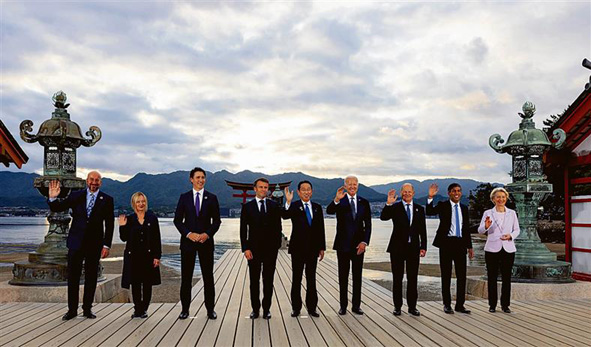
HIROSHIMA (TIP): Leaders of the Group of Seven rich nations called on Friday, May 19, for a “world without nuclear weapons”, urging Russia, Iran, China and North Korea to cease nuclear escalation and embrace non-proliferation, a statement released by the White House showed.
Russia’s nuclear rhetoric and stated intent to deploy nuclear weapons in Belarus “are dangerous and unacceptable,” and Russia should return to full implementation of New START treaty, the leaders said in the statement. The leaders also agreed on Friday to stiffen sanctions against Russia, while a draft communique to be issued after their talks in the Japanese city of Hiroshima stressed the need to reduce reliance on trade with China.
G7 leaders said they had ensured that Ukraine had the budget support it needs for this year and early 2024. “Today we are taking new steps to ensure that Russia’s illegal aggression against the sovereign state of Ukraine fails,” they said in a statement. A French government plane took Zelenskyy to the Arab League Summit in Saudi Arabia and will later take him to the G7 summit in Hiroshima, a source familiar with the matter said.
Ukraine wants its allies to be bolder in imposing sanctions on Russia, including by targeting banks that provide financial services to serving soldiers, a senior adviser said.
German Chancellor Olaf Scholz said his government wanted pragmatic measures to prevent the circumvention of sanctions imposed on Russia. G7 members are prepared to build “constructive and stable relations” with China while acting in their national interests, according to a draft version of their communique.
Islamabad (TIP): In yet another effort to build trust with the Taliban government, China and Pakistan agreed to include Afghanistan as part of the Belt and Road Initiative (BRI).
Sources here pointed out that China had issued a joint statement with the earlier regime of Hamid Karzai and this latest reiteration comes soon after the Taliban government inked a MoU with a Chinese firm to prospect for oil in the Amu Darya basin in northern Afghanistan. It is estimated that Afghanistan has mineral resources estimated at $1 trillion. Seven Indian companies headed by SAIL had been allocated a huge iron ore mine in Bamyan district by the previous regime but the project now appears to have been mothballed.
India is also building a communication route into Afghanistan from Iran’s Chabahar port. It has also built a road connecting Afghanistan’s Garland Highway with a town on the border with Iran. Another enduring road or rail link from that town of Zahedan to Chabahar will make it the shortest route from the sea into non-Pashtun areas.
The latest announcement, however, did not involve the Taliban side because it is under economic sanctions. With Taliban Interim Foreign Minister Amir Khan Muttaqi was also part of the deliberations, the decision was presented as one taken between Chinese Foreign Minister Qin Gang and his Pakistani counterpart Bilawal Bhutto Zardari in Islamabad on Saturday, a day after the duo returned from the Shanghai Cooperation Organisation (SCO) meeting in Goa. In 2016, the joint statement had welcomed Afghanistan’s participation in the BRI and China agreed to support Kabul’s “integration into regional cooperation by taking advantage of its location as a natural continental bridge and the center of Asia”. The latest joint statement signed by China and Pakistan agreed to enhance development cooperation in Afghanistan, “including through extension of China-Pakistan Economic Corridor (CPEC)”. Last December, China began implementing zero tariff on 98 per cent of products from Afghanistan.
The decision to extend the BRI into Afghanistan followed several meetings between Pakistan and China. The CPEC, however, has so far not lived up to its original intentions. IT has suffered delays and cost overruns due to the Covid pandemic, Pakistan’s bankruptcy, the regime turnover in Afghanistan and attacks on some of the projects.
India too is attempting trust building with the Taliban regime, having provided huge amounts of humanitarian assistance. A ‘technical team’ now means its Embassy in Kabul which is attempting to maintain or complete projects financed by India. Recently, Afghan Foreign Ministry officials have been joining MEA’s training programmes for diplomats from developing countries. However, unlike China, India still recognises the previous regime’s envoy in Delhi. (TNS)
BEIJING (TIP): China’s Foreign Minister Qin Gang will travel to Pakistan on May 5 on a two-day visit after attending the meeting of the SCO Foreign Ministers hosted by India in Goa, it was announced here on Thursday.
Qin is attending the SCO (Shanghai Cooperation Organisation) Foreign Ministers meeting being held on May 4 and 5 at Panaji in Goa where his Pakistan counterpart Bilawal Bhutto Zardari too is taking part.
Besides being the Foreign Minister, Qin is also the State Councillor, a higher rank associated with the ruling Communist Party of China (CPC). SCO bloc consists of China, India, Kazakhstan, Kyrgyzstan, Russia, Pakistan, Tajikistan and Uzbekistan. India holds the presidency of the grouping for this year.
Significantly the Chinese Foreign Ministry while announcing the visit of Qin to Myanmar and India on May 2 did not include his visit to Islamabad though Pakistan media reported about it.
Instead, the ministry announced his visit to Pakistan separately on Thursday during which he is due to take part in China-Afghanistan-Pakistan Foreign Ministers’ meeting.
The trilateral is being held less than a month after the Neighbouring Countries of Afghanistan Plus Afghanistan Foreign Ministers meeting of China, Russia, Pakistan and Iran in Samarkand, in which Qin presided.
Announcing Qin’s visit to Pakistan, the Chinese foreign ministry spokesperson said that this will be his first visit to Pakistan after taking charge and an important part of the recent close and frequent interactions between the high levels of China and Pakistan. The reference apparently was the just concluded maiden visit of Pakistan’s new Army Chief Asim Munir, here during which he held a series of meetings with top Chinese Generals and top diplomat Wang Yi who is the Director of the Office of the Foreign Affairs Commission of the CPC Central Committee.
During Gen.Munir’s visit, China’s new Premier Li Qiang also held his first phone call with Pakistan Prime Minister Shehbaz Sharif and promised continued financial help for Pakistan which is facing a serious political and economic crisis. “In Pakistan Qin will meet with the leader of Pakistan and co-chair the fourth round of China-Pakistan Foreign Ministers’ Strategic Dialogue with Pakistani Foreign Minister Bilawal Bhutto Zardari”, the foreign ministry statement which included a Q&A posted on the website on Friday said.
“The two sides will have in-person and in-depth communication on bilateral relations and the international and regional situation,” it said. “China and Pakistan are all-weather strategic cooperative partners and ironclad friends. The friendship is time honoured”, it further said recalling Sharif’s successful visit to China last November and Li’s April 27 phone call with him. The foreign ministry also hoped that the ties between the two nations would further deepen with the visit of the Chinese foreign minister.
“China hopes that this visit will follow through on the important common understandings between the leaders of the two countries, further, deepen strategic communication and practical cooperation, promote the building of an ever-closer China-Pakistan community with a shared future in the new era, and contribute positive energy to the region and the wider world,” it said.
About why the fifth China-Afghanistan-Pakistan Foreign Ministers’ Dialogue in less than a month of Samarkand meeting, it said, although the people of Afghanistan have tided over the most difficult time, they still face severe challenges at the moment and are in dire need of more support and help from the rest of the world.
The international community need to step up contact and dialogue with the Afghan interim government, support its effort of reconstruction and development, and encourage it to build an inclusive government, exercise moderate governance, develop friendly relations with its neighbours and firmly fight terrorism, it said.
The Foreign Ministers’ Meeting among the Neighbouring Countries of Afghanistan and the China-Afghanistan-Pakistan Foreign Ministers’ Dialogue are both important platforms for exchanges and cooperation on issues related to Afghanistan and conducive to more consensus among regional countries on the Afghan issue, it said.
“China hopes to exchange views with Afghanistan and Pakistan on the situation in Afghanistan and tri-party cooperation at the Dialogue, so as to build up consensus, consolidate mutual trust, and jointly contribute to peace, stability, development and prosperity in the region,” it said. (PTI)
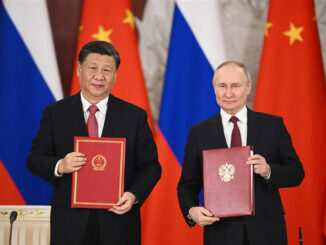
China and Russia agree to stand together on issues involving security interests
“The declaration is a clear signal from Russia and China that they are prepared to stand together on issues involving each other’s security interests. While India finds mention on some issues of regional cooperation, there is nothing in the declaration to which it could take objection to. What now emerges is that Russia and China have much in common in dealing with the US and its allies. China prefers to keep out any mention of India. This should not surprise anyone with even a cursory understanding of China’s growing hubris, as it moves to attain global recognition of its economic clout and military potential. Moreover, there is considerable focus by China on Sino-Russian cooperation to build a security framework in the oil-rich Gulf region. China and Russia appear more than pleased that thanks to clumsy diplomacy by the Biden administration, they have been able to commence a rapprochement process between Iran and Saudi Arabia. Similar efforts are underway to forge normal ties between Syria and Saudi Arabia. These developments have resulted in a stronger Russian and Chinese presence in the region.”
By G Parthasarathy
The US and its Western allies were hoping that the Putin-Xi Jinping summit would turn out to be a damp squib. The recent Moscow summit has, however, produced a comprehensive plan by China and Russia to jointly meet the challenges they face from the US-led global order. The US and its allies have been repeatedly calling for sanctions against Russia, following its conflict with Ukraine. Some hope was also unrealistically expressed that China could follow through on its Ukraine plan by joining them in persuading Russia to pull out of Ukraine on Western terms. That hope now lies shattered. The joint declaration ends any illusion that Western powers may have had about China backing them on how the Ukraine conflict should be ended.
The joint declaration states that the US and its allies would have to respect the legitimate security concerns of all countries, while adding that confrontation must be avoided. Russia and China have emphasized that ‘responsible dialogue’ is the best way to resolve problems and the international community should support constructive efforts. The declaration, in fact, calls on all parties to stop actions that promote tension to prevent the crisis from further aggravating, and even getting out of control. It concludes that China and Russia are opposed to unilateral sanctions not authorized by the UN Security Council.
The US has, rather unconvincingly, been denying allegations made by one of its best-known investigative journalists, Seymour Hersh, that Washington had a hand in, and indeed organized, the bomb attack that destroyed the undersea Beixi gas pipeline (known also as Nordstream) carrying gas from Russia to Germany. Russia and China have bluntly noted, ‘The banner of extremism and the use of terrorist and extremist organizations to interfere in the internal affairs of other countries and achieve geopolitical goals.’ They have also demanded ‘an objective, impartial and professional investigation should be conducted on the Beixi pipeline explosion.’ It is going to be difficult for the US, and even Germany, which is reputed for observing high standards of respect for international law, to claim that they do not know who was responsible for blowing up the pipeline.
Expectations in the international community that Russia may be persuaded by China to be more flexible on the withdrawal from Ukraine have been dashed. Russia and China announced that the ‘legitimate security concerns of all countries must be respected’, and that confrontation between camps, ‘adding fuel to the flames’, must be avoided. China firmly backs Russia’s position on the Ukraine crisis, averring that ‘responsible dialogue is the best way to solve problems steadily’. Most importantly, Russia has been assured of Chinese backing in the UN Security Council to ensure that ‘parties to the conflict stop all actions that promote tension and delay the end of war.’ Putin could not have asked for anything more from his Chinese guest. What remains to be seen is whether China will provide the military supplies that Moscow needs. The countries that would be most concerned by these developments are the US and its NATO allies. The declaration ends any illusion that Western powers, who speak for the so-called international community, have about China backing them on how the Ukraine conflict should be ended. China and Russia have also signaled that they have no regard for sanctions being imposed by Western powers. President Zelenskyy and the US would also have to think afresh on Russia’s concerns about the safety and security of Russians living in south-eastern Ukraine, while facing the reality that Russia intends to stay in Crimea, where it has exercised sovereignty for three centuries now.
The declaration is a clear signal from Russia and China that they are prepared to stand together on issues involving each other’s security interests. While India finds mention on some issues of regional cooperation, there is nothing in the declaration to which it could take objection to. What now emerges is that Russia and China have much in common in dealing with the US and its allies. China prefers to keep out any mention of India. This should not surprise anyone with even a cursory understanding of China’s growing hubris, as it moves to attain global recognition of its economic clout and military potential. Moreover, there is considerable focus by China on Sino-Russian cooperation to build a security framework in the oil-rich Gulf region. China and Russia appear more than pleased that thanks to clumsy diplomacy by the Biden administration, they have been able to commence a rapprochement process between Iran and Saudi Arabia. Similar efforts are underway to forge normal ties between Syria and Saudi Arabia. These developments have resulted in a stronger Russian and Chinese presence in the region. There have sometimes been concerns about the impact of the growing Sino-Russia cooperation on Russia’s relations with India. Russia has for long been India’s largest supplier of modern weapons systems and has been helpful in India’s production of nuclear submarines. India is also manufacturing Russian-designed BrahMos missiles, which it has provided to friendly countries, with prospects of more buyers. Moreover, purchases of petroleum products at very reasonable prices from Russia have been helpful in managing India’s balance of payments. Russia, in turn, evidently understands that India’s defense cooperation with the US, together with its security links in groupings like Quad and I2U2 across the Indo-Pacific, are set to grow. While Russia is furious with Pakistan for supplying weapons to Ukraine, China would make every effort to get Moscow to assist Pakistan. Strategic autonomy, meanwhile, has been, and should remain, the hallmark of India’s defense and foreign policies.
(The author is Chancellor, Jammu Central University & former High Commissioner to Pakistan)
NEW DELHI (TIP): With the ongoing Shanghai Cooperation Organisation (SCO) presidency, India has been hosting various meetings and also inviting all members, including Pakistan. However, Pakistan has skipped these meetings, barring once which it attended virtually last week (the Chief Justice meeting) but only after Pakistan downgraded its participation.
India has sent an invite to Pakistan for the Foreign Ministers meet that would be held on May 4 in Goa but hasn’t got a response yet. Invites have also been sent to them to attend the Home Ministers’ meet and National Security Adviser (NSA) meetings on March 29 and Defence Ministers’ meeting on March 27.
Pakistan’s foreign ministry spokesperson, regarding their participation in the foreign ministers meet, had earlier said that the country would revert to the invitation in time before the event.
Earlier in January, Pakistan was the only country among the eight Shanghai Cooperation Organisation members that had not sent any entry for the SCO film festival that took place in Mumbai. Other members had sent 57 entries. The eight-member SCO includes India, Russia, China, Kazakhstan, Kyrgyzstan, Tajikistan, Uzbekistan and Pakistan. While Afghanistan, Belarus, Iran and Mongolia are SCO observers and Armenia, Azerbaijan, Cambodia and Nepal are SCO dialogue partners.
From the outset, the SCO presented itself as a bulwark against “terrorism, separatism and extremism”, a language that sought to capitalise on the global counter-terrorist consensus of the 9/11 era, as well as reflecting real concerns in Beijing about threats to Chinese Communist Party power.
However, India is part of the four-nation security Quad that includes the US, Australia, Japan and India. (ENS)
WASHINGTON, D.C. (TIP): A strong India-US relationship is a must for democracy, advancement in technology and a robust world economy, a top American senator has said, emphasizing that close bilateral ties will be a crucial counterweight to outcompete China.
Describing India as one of the “leading powers” of the world, Senator Chuck Schumer said close India-US ties would also be key to responding to China’s authoritarianism. The Senate Majority Leader is leading a high-powered Congressional delegation of senators to India. The delegation, led by Schumer, called on Prime Minister Narendra Modi in New Delhi on Monday, February 20. They discussed new opportunities for consolidating the India-US ties in critical technologies, clean energy transition, joint development and production, and trusted and resilient supply chains.
The prime minister welcomed the Congressional delegation to India and appreciated the consistent and bipartisan support of the US Congress for deepening India-US bilateral ties, his office said in a statement.
“We need nations such as India, the world’s largest democracy, to work with us to strengthen democracies in Asia and around the globe,” Schumer said in a statement issued here on Monday following his hour-long meeting with Prime Minister Modi in New Delhi.
“In our meeting with Prime Minister Modi, we stressed that close ties between our two countries would be a crucial counterweight to outcompete China and respond to its authoritarianism,” he said.
India is one of the “leading powers” of the world and a strong US-India relationship is a must for democracy, technology advancement, and a strong world economy, he said.
“I made India my first Congressional Member Delegation (CODEL) as Majority Leader to show my commitment to the important US-India relationship,” he said in the statement.
Other members of the delegation are Senators Ron Wyden, Jack Reed, Maria Cantwell, Amy Klobuchar, Mark Warner, Gary Peters, Catherine Cortez-Masto, and Peter Welch.All are from the ruling Democratic Party.
“I am proud that the senators in our delegation are strong representatives of America’s commitment to the US-Indian economic and security partnership,” he said. Schumer said, in his meeting with Modi, they discussed the growing US-India relationship and the common interests that unite the two largest democracies in the world.
“It was a substantive and productive conversation about strengthening ties on our shared strategic interests including outcompeting China, combating climate change, increasing trade, and deepening bonds between our two countries,” he said.
“We stressed that close cooperation between the US and India in areas such as AI, green hydrogen, and advanced tech manufacturing will give our two countries the advantage for decades to come. I strongly believe the continued and strengthened US-India relationship will be the great story that will define the 21st century,” he said.
All the senators expressed their commitment to continue working with the Indian government to deepen the bilateral relationship to advance their mutual interest, he added.
(Inputs from PTI and Press release from Schumer’s office)
BEIJING (TIP)- Asian markets sank Wednesday as a mixed US inflation report did little to soothe investor worries that the Federal Reserve will continue to ramp up interest rates, which many fear could cause a recession.
The much-anticipated figures from January’s consumer price index showed a slight slowdown from the previous month, but the 6.4 percent reading was higher than forecast, suggesting a return to normality will take longer than hoped.
A number of top Fed officials also lined up to restate that borrowing costs will likely need to go higher and for an extended period if they are to bring inflation down to their two percent target.
Recent data had suggested the bank’s almost year-long rate-hike campaign was beginning to show results, providing fuel for a healthy run-up in global markets in January as traders began factoring in a possible cut towards the end of 2023.
But that optimism has taken a severe hit, with a blockbuster jobs report confirming that the world’s top economy remains robust, narrowing the scope for the Fed to ease up. After the figures were released, monetary policymakers reiterated their determination to stay the course, with expectations that rates could go well above five percent, from the current 4.5-4.75 percent.
Dallas Fed president Lorie Logan said: “We must remain prepared to continue rate increases for a longer period than previously anticipated, if such a path is necessary to respond to changes in the economic outlook or to offset any undesired easing in conditions.” However, Philadelphia Fed chief Patrick Harker said he thought the bank was “likely close” to being restrictive enough.
Wall Street ended mixed, having fluctuated after the data release.
But Asia sank back into the red.
Hong Kong led losses, shedding more than one percent, with China’s reopening from zero-Covid no longer able to provide any cushion to sentiment.Shanghai, Tokyo, Singapore, Seoul, Sydney, Taipei, Wellington, Manila and Jakarta were also well down.The prospect of more rate hikes lifted the dollar against its peers on Tuesday, and it held its gains in Asian trade.”While in line, the CPI release is a reminder that lowering inflation towards the Fed’s target may be more gradual than conventional thinking,” said SPI Asset Management’s Stephen Innes.
“And this environment may also result in a higher-for-longer rate environment — somewhat counter to a market still pricing in a Fed funds rate cut later this year.”
Exports dip by 6.58 per cent in January; trade deficit lowest in 12 months at USD 17.75 billion
Contracting for the second month in a row, India’s exports dipped by 6.58 per cent to USD 32.91 billion in January due to slowdown in global demand, even as the trade deficit touched a 12-month low of USD 17.75 billion during the month, according to official data released on Wednesday. Imports in January too contracted by 3.63 per cent, the second consecutive month, to USD 50.66 billion.
Cumulatively, however, during April-January 2022-23, the country’s merchandise exports rose 8.51 per cent to USD 369.25 billion, while imports increased 21.89 per cent to USD 602.20 billion, the data showed.
The merchandise trade deficit for the April-January this fiscal stood at about USD 233 billion.
The country’s exports had contracted by 12.2 per cent to USD 34.48 billion in December 2022.
Source: Agencies
United States President Joe Biden knows he must focus on both the U.S. economy and global challenges
In his second State of the Union address, U.S. President Joe Biden tried to articulate several messages under one big theme — his administration was committed to rebuilding America’s economy while standing up to its challenges abroad. Much of the 72-minute speech was on the domestic agenda, particularly his economic optimism. The speech saw self-appreciation, ideas and rhetoric — he took pride in his economic policies, emphasizing the low unemployment rate and easing inflation, repeated the calls for taxing the super rich and bringing down prices of essential drugs, promised not to cut Social Security and Medicare and declared that democracies have become stronger and autocracies weaker.
While there was no major policy shift, the 80-year-old President repeated the phrase “finish the job”, indicating that he needed more time to build on what he has already done — seen as a pitch for his re-election campaign. Mr. Biden also referred to Russia and China as key foreign policy challenges — the Ukraine invasion as “a test for America”, and that America “will act to protect our country” if its sovereignty is threatened, an indirect reference to the balloon incident.
If Mr. Biden used the speech to defend his legacy and lay his vision, it also laid bare his administration’s critical challenges. To be sure, the unemployment rate fell to the lowest level since 1969 — to 3.4% in January 2023 — and inflation continued to ease in the month. Still, most Americans (58% as in a recent survey), burdened by high energy prices and slow growth in wages, remain unhappy with his handling of the economy. The President may have plans for re-election, but only 37% Democrats back him. Mr. Biden will also face growing resistance to his policies from Congress in a Republican-controlled House.
On foreign policy, the U.S. has so far stood resolutely behind Ukraine, but, as the war grinds on, there are rising questions about a possible endgame. A bigger challenge for Mr. Biden is how to handle ties with China at a time when the two superpowers compete for global influence. The balloon incident suggests that it is not an easy task. Half of Mr. Biden’s first term is over. As the election season is heating up, time is running short and his task is cut out — he has to act more decisively on the economic front if he wants to build a fair order of competition and opportunities, work towards ending the war in Ukraine without compromising on America’s standing in Europe, and put in place stronger guardrails in U.S.-China relations to check an escalation in tensions and deterioration in ties.
‘Spy balloon’ underlines need for constant alertness
Days after a US Air Force fighter jet shot down a Chinese surveillance balloon — which the US claimed was a ‘spy balloon’ — off the South Carolina coast, it has been reported that China operates a fleet of such balloons and has targeted several countries, including India and Japan, in the past. A US media report, quoting several unnamed defense and intelligence officials, alleged that the spy balloon project has been operating for several years, and ‘has collected information on military assets in countries and areas of emerging strategic interest to China including Japan, India, Vietnam, Taiwan and the Philippines’. Senior US officials are reported to have briefed ‘nearly 150 foreign diplomats across 40 embassies’ in the US and Beijing, explaining its action of shooting down the balloon, presenting reasons why it was not a ‘civilian’ weather balloon, as China claimed, but an intelligence-gathering device.
It seems counterintuitive to use an apparently low-tech method such as a balloon for intelligence-gathering when high-resolution satellite images of the earth’s surface are easily available, but such debates are best left to techint experts. Also, China keeping a spying eye on its neighbors and adversaries is not a significant point — it’s a fact that all countries engage in intelligence-gathering, or spying, even if not one would admit it publicly. What is really remarkable about the Chinese balloon is that if it were indeed spying, it was doing so in a very brazen manner; and if it indeed was a ‘civilian airship’ intended for ‘meteorological research’, China’s secretiveness about it is quite inexplicable.
One takeaway for India from this episode is that it must keep its eyes open — it’s not quite a new lesson but the reinforcement of one, because China’s increased aggressiveness at the borders during the last few years has already underlined the need for India to always keep its guard up. For the countries that are concerned over China’s hegemonistic ambitions, it is imperative to share technology and intelligence in order to not be outsmarted and outmaneuvered in geopolitical games.
WASHINGTON, D.C. (TIP): Amidst massive layoffs in the American tech sector that have resulted in a large number of Indian professionals being jobless, two Indian-American organizations have launched an online petition urging President Joe Biden to extend the grace period of H-1B visas holders from two months to a year.
This means that once fired from a job, a foreign tech worker on H-1B visas would have one year to find a new job instead of the existing duration of 60 days, after which they have to leave the country.
The H-1B visa is a non-immigrant visa that allows US companies to employ foreign workers in specialty occupations that require theoretical or technical expertise. Technology companies depend on it to hire tens of thousands of employees each year from countries like India and China.
“On behalf of immigrants (from the world, mainly from India and China) as well as naturalized citizens like Indian-Americans, Foundation for India and Indian Diaspora Studies and Global Technology Professionals Association (GITPRO) has submitted an appeal to the President of the United States, the Secretary of DHS (Department of Homeland Security) and the director of USCIS (US Citizenship and Immigration Services) to extend the current grace period from 60 days to 1 year (minimum 6 months),” the online petition said.
“We join the appeal and request to sympathetically consider the impact of the families on humanitarian grounds. We believe that this extension will pause this brain drain and ensure that the US will continue to be a world leader in technology and innovation. We also request elected officials to support this extension and if needed introduce a bill in the House of Representatives,” said the online petition that has been signed by more than 2,200 people so far. According to LayoffTracker.com, 91,000 were laid off just in January 2023 and this number may grow in the coming months. This has a huge impact on them, and their families, especially on the H-1B holders who would need to leave the US immediately within 10 days beyond the H-1B grace period, the petition said.
In addition to the impact on them and their families, this is also a long-term impact on the talent that the US has. For example, 70 per cent of startup founders are immigrants. About 50+ CEOs of public companies are of Indian origin. Hence, the exodus of this talent from the US is harmful for the long-term interests of the US, especially in the modern age of Artificial Intelligence competition, it said.
“The laid-off H-1B holders currently have about 60 days to find another employer to file for the H-1B transfer or leave the country. During the current economic situation, it would be impossible for these hardworking, tax-paying and talented people to get hired till the economy recovers,” said the petition.
Meanwhile, a Facebook group of overseas Indians has launched a petition urging the Indian government to hire the laid-off Indian tech workers in the US. “Considering the ongoing layoff situation, we are requesting you to consider hiring the recently laid-off and returning Indian IT workers as consultants as part of the digitization initiatives undertaken by your ministries,” said the letter addressed to Ashwini Vaishnav, the Minister of Electronics and Information Technology.
(Source: PTI)
Signup to our Newsletter!
Don’t miss out on all the happenings around the world