Tag: China

  • PM’s pledges can’t be implemented in a year

    PM’s pledges can’t be implemented in a year

    The media is being flooded with assessments of the Prime Minister’s “first year”in office. Has he taken the bull by the horns or has he been gored by an untamed beast?

    Fashionable as these exercises are, they beg the question: What’s so sacrosanct about one year -come to think of it, nothing really. One year or birthdays are different according to the lunar and solar calendars, both prevalent in India. Then again, if you are born in a leap year, you have a longer stretch of time before your birthday arrives. And monarchs have their official birthdays. Leaving these complications aside, substantive issues plague us. Reforms the PM has promised can’t succeed or fail and be abandoned in a year. They can come in two forms, often complementing one another: Either they occur slowly but gather speed defined by the democratic process that sets up roadblocks identified centuries ago by Niccolo Machiavelli when he argued: “There’s nothing more difficult to take in hand… or more uncertain… than to take the lead in the introduction of a new order of things…The innovator has for enemies all those who’ve done well under the old conditions and lukewarm defenders in those who may do well under the new.”

    Today we say more pointedly that old ideas resulting in policies we wish to dismantle, now that our ideas have changed, run into difficulties as democratic leaders try to navigate around institutions built around old policies (the licensing system under the defunct brand of socialism) and interest (lobbies) that prospered under old policies (businessmen who enjoy monopoly rents in sheltered markets).

    Thus, while PM Narasimha Rao and his FM Manmohan Singh understood reforms such as the defanging of the counterproductive industrial licensing system starting 1991, and opening of the economy to imports, they could only start a long-term process of reduction of trade barriers that went on for almost 15 years. Any hastening of that process would have led to a revolt by business lobbies and a reversal of the process: As policy economists say, if you try to kick a door open, it will likely rebound shut. So, as of today, Indian trade barriers have come down hugely: “Gradualism”worked where excessive speed would have undermined the reform.

    So, we must give PM Modi full credit for the accretion of important reforms, steadily moving India in desired directions, since he assumed office. These include his reforms in the factor markets for labor and land, in each using the brilliant tactic of letting states initiate these reforms (just as Gujarat under his leadership used openness to trade and inward foreign investment to demonstrate their efficacy). Thus, MP and Rajasthan have undertaken important labor market reforms which should lead to diffusion through emulation of success.

    Modi has shown ingenious resilience using Ordinances to get around legislative obstructionism by the defeated Congress, especially in Rajya Sabha. This parallels President Obama’s resort to executive action to get around Republican obstructionism in the US Congress. While progressive constitutional lawyers in the US generally support Obama, some “committed”Indian constitutional lawyers fault the PM; but they’re best dismissed as ideologically blinkered.

    The PM succeeded in turning the economic situation back from the brink where UPA II had led it, increasing social spending while the revenue intake had fallen. The resulting inflation, which hurt the poor, has been tamed. GDP growth has been turned around; and India is now regarded as a good prospect by investors.

    The Economist had run a cover story about India in its February 2127, 2015 issue with the title: “India’s Chance to Fly”, correcting its earlier approach which had flown in the face of growing evidence that Modi would win and then indeed fly . Now, it seems, this illustrious magazine has regained its perspective and joins the many that see India as a growing economic success that may even better China’s performance.

    Despite the ill-informed ideological contention by left-wing Indians that Modi has enriched the rich and immiserized the poor, evidence shows that Indian poverty has declined significantly as growth accelerated after the 1991 reforms and the same is promised by the accentuation of these reforms since Modi took power.

    Perhaps the most impressive aspect of Modi’s performance to date is on the social side. There has been no communal violence in his Gujarat in recent years when it was commonplace for decades; and the recent allegations that Modi and BJP were persecuting Christians has been exposed as a canard that was unfortunately bought into by unsuspecting Christians: a small minority that is much beloved in India, like the Parsis.

    (Jagdish Bhagwati is a professor at Columbia University and Pravin Krishna is a professor at Johns Hopkins
    University)

  • SUPPRESSING DISSENT – Why Greenpeace is first on the Indian government’s chopping block

    Source: World Resources Institute
    Source: World Resources Institute

    As Greenpeace India struggles to stay afloat, the real reason why the government wants to shut down the global environmental NGO hasn’t got much attention: Coal, the single biggest source of primary energy in India, is at the heart of the Narendra Modi government’s ambitious plans to ramp up industrial production in the country.

    Source: PwC
    Source: PwC

    A total of 1,199 new coal-based thermal power plants with a total installed capacity of more than 1.4 million MW proposed worldwide, the lion’s share – 455 plants – are in India, according to data from the World Resources Institute.

    India is overwhelmingly dependent on fossil fuels – coal, oil and gas – which meet more than three fourths of the country’s energy needs, despite Modi’s plans to promote alternative energy sources.

    Of the fossil fuels, oil and gas account for just about 30% of India’s energy needs, the bulk imported (80% in the case of crude oil). India has abundant reserves of coal, the fourth-largest in the world.

    Coal meets 54.5% of India’s energy needs, and 61.5% of the installed power generation capacity, and plays a key role in industries like steel and cement.

    India is set to more than double its coal consumption by 2035 and become the world’s largest coal importer by around 2020, according to the International Energy Agency.

    The cheapest of fossil fuels, coal is also the most polluting in terms of carbon emissions. Coal-burning power plants are the single biggest cause of climate change, way ahead of the burning of petroleum in transportation.

    Greenpeace has been at the forefront of a global campaign against coal mining and burning, and its Indian wing has mounted several high-visibility campaigns against coal-burning thermal power plants and coal mining in forest areas.

    Coal India and Adani in the spotlight

    Greenpeace graph2
    Especially irksome to the government must have been Greenpeace’s targeting of two domestic entities that are also major global players in coal – public-sector company Coal India, India’s 5th most valuable company by market capitalization at $35.9 billion (Rs 2.3 lakh crore) and the Gujarat-based Adani Group, whose promoter Gautam Adani is known to have a close relationship with Modi.

    Coal India is number one, and the Adani Group number three on the list of the top 200 coal companies globally ranked by the potential carbon emissions content of their reported reserves, according to Fossil Free Indexes, a stock market index that promotes ethical investing.

    Greenpeace has campaigned against both companies, exposing their claims on reserves and financial health, and documenting environmental and other violations. Greenpeace’s Australia chapter has opposed Adani’s plans to develop the world’s largest coal deposit, the Carmichael mine in Queensland, which it acquired for 16.5 billion dollars.

    Breakneck industrialization, Chinese style Companies like Coal India and Adani are expected to play a vital role in the Modi government’s grand plan for India to take over from China as the new ‘factory of the world’. With GDP growth dipping to 7% for the first quarter of 2015 (the lowest since 2009), China is clearly slowing down. India seems intent on capitalizing on this slowdown and the newfound limits on growth imposed by environmental and health concerns in China.

    The first signs that the Modi government is pushing for a Chinese-style industrialization project came when it announced a clutch of mega projects under the Make-In-India initiative. Work is underway on the most ambitious of these projects, the Delhi-Mumbai Industrial Corridor, across six states, to be built at an estimated cost of $100 billion.

    For the government, one of the chief obstacles in this path is land acquisition, which is being tackled through amendments to the existing legislation. The other big hurdle is energy, in which coal will continue to play the biggest part-and this is at the core of its grouse with organizations such as Greenpeace.

    Coal and Climate Change – an existential threat

    The burning of fossil fuels – coal, oil and gas, in that order – releases massive amounts of carbon into the atmosphere, and has been proven to be the biggest culprit behind climate change.green peace chart 4

    With carbon-dioxide levels at record highs – as IndiaSpend reported – only a fraction of the known extractable fossil fuel reserves, least of all, coal, can be burned without endangering the world’s future, the reason why campaigners like Greenpeace are dead set against the fuel. But for the Modi government, and India’s elites and middle classes in general, this would amount to the big prize being snatched away from sniffing distance. That’s why the shots fired against Greenpeace may be only the first in the long, bruising battle ahead.

    (This article was originally published on IndiaSpend.com, a data-driven and public-interest journalism non-profit)

  • MODI IN CHINA – A high-octane reception

    MODI IN CHINA – A high-octane reception

    [vc_row][vc_column width=”1/1″][vc_images_carousel images=”35692,35693,35694,35695″ onclick=”link_no” custom_links_target=”_self” mode=”horizontal” speed=”1500″ slides_per_view=”2″ autoplay=”yes” hide_pagination_control=”yes” hide_prev_next_buttons=”yes” partial_view=”” wrap=”yes” title=”LIST OF 24 AGREEMENTS SIGNED BETWEEN INDIA AND CHINA – India and China on Friday signed 24 deals worth over $10 billion during Modi’s visit to the country.” img_size=”full”][/vc_column][/vc_row][vc_row][vc_column][vc_column_text][quote_box_center]Here’s the complete list[/quote_box_center]

    1. Protocols between India and China on the establishment of cousulates-general at Chengdu and Chennai and the extension of the consular district of the consulate general of India in Guanzhou to include Jiangxi province.
    2. MoU between the ministry of skill development and entrepreneurship of India and the ministry of human resources and social security of China on cooperation in the field of vocational education and skill development.
    3. Action plan on cooperation in setting up of the Mahatma Gandhi National Institute for Skill Development and Entrepreneurship in Ahmedabad/Gandhinagar in Gujarat.
    4. MoU between India and China on consultative mechanism for cooperation in TRADE negotiations.
    5. MoU on cooperation between the ministry of external affairs of India and international department of the central committee of the Communist Party of China.
    6. Action plan between the National Railway Administration of China and the ministry of railways of India on enhancing cooperation in the railway sector. (2015-16).
    7. MoU on education exchange programme.
    8. MoU between the ministry of mines of India and the ministry of land and resources of China on the cooperation in the mining and minerals sector.
    9. Space Cooperation Outline (2015-2020).
    10. Protocol on health and safety regulations on importing Indian rapeseed meal between the export inspection council, ministry of commerce and industry of India and the general administration of quality supervision, inspection and quarantine.
    11. MoU between Doordarshan and China Central Television on cooperation in the field of broadcasting.
    12. Agreement between the ministry of tourism of India and the national tourism administration of China on cooperation in the field of tourism.
    13. MoU on establishing India-China think-tanks forum.
    14. MoU between India’s Niti Aayog and the Development Research Centre, State Council of China.
    15. MoU between India’s ministry of earth sciences and the China Earthquake Administration concerning cooperation in the field of earthquake science and earthquake engineering.
    16. MoU between India’s ministry of earth sciences and the State Oceanic Administration of China on cooperation in the field of ocean science, ocean technology, climate change, polar science and cryosphere.
    17. MoU on scientific cooperation between Geological Survey of India, ministry of mines of India and the China Geological Survey, ministry of land and resources of China in geoscience.
    18. MoU between the ministry of external affairs of India and ministry of foreign affairs of China on establishment of states/provincial leaders’ forum.
    19. Agreement on the establishment of sister-state/province relations between state government of Karnataka and provincial government of Sichuan of China.
    20. Agreement on establishment of sister-city relations between Chennai and Chongqing of China.
    21. Agreement on establishment of sister-city relations between Hyderabad and Qingdao of China.
    22. Agreement on establishment of sister-city relations between Aurangabad and Dunhuang of China.
    23. MoU between the Indian Council for Cultural Relations and Fudan University on the establishment of a centre for Gandhian and Indian studies.
    24. MoU between Indian Council for Cultural Relations and Yunnan Minzu University on the establishment of a yoga college.

    [/vc_column_text][/vc_column][/vc_row]

  • INDIA AWARDS AIRBUS $1.9B MILITARY PLANE ORDER

    INDIA AWARDS AIRBUS $1.9B MILITARY PLANE ORDER

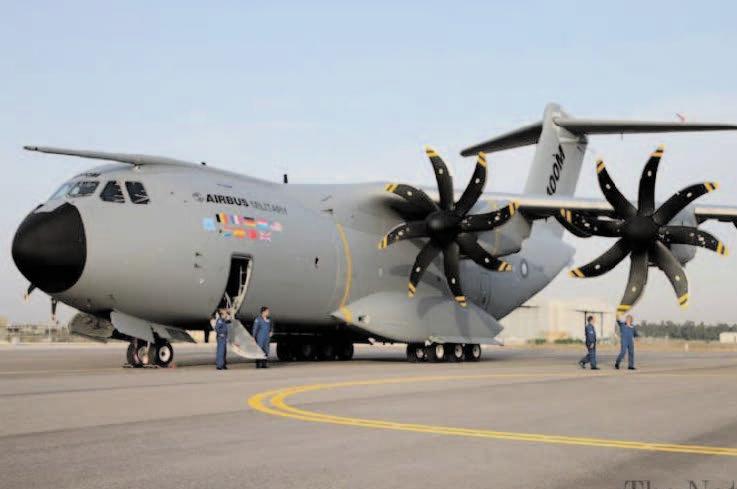
    NEW DELHI (TIP): India’s defence ministry has agreed to buy 56 planes from Airbus for$1.87 billion, as Prime Minister Narendra Modi moves to modernise the country’s military, an official said on May 14.

    The ministry’s defence acquisition council, which approves big ticket orders, agreed Airbus and India’s Tata Advanced Systems would jointly build military transport aircraft to replace an ageing fleet.

    The deal for the C295s worth 119.

    30 billion rupees ($1.87b) was agreed late Wednesday by the council along with other orders worth $875m, the defence ministry official said.

    “The council has approved a joint bid by European giant Airbus Defence and Space and Tata Advanced Systems to supply the Airbus C295s,” the official said on condition of anonymity.

    India is in the middle of a major upgrade of its Soviet-era military, partly to keep up with neighbouring rival Pakistan and big-spending China.

    Since coming to power one year ago, Modi’s government has approved a string of military projects that had stalled under the previous left-leaning Congress government, in part over corruption scandals.

    Modi wants to end India’s status as the world’s number one defence importer and to have 70 percent of hardware manufactured domestically by the turn of the decade.

    His government lifted the cap of foreign investment in defence to 49 percent last year.

    The council last year deferred approval of the project for Airbus, which was the sole bidder.

    Under the project proposal, Airbus would build 16 twin-turboprop aircraft in “fly-away condition”, while Tata would assemble the remaining 40 in the southern Indian city of Hyderabad in a technology transfer.

    Other orders approved include 145 BAE Systems ultra-light artillery howitzers, Indo-Russian BrahMos cruise missiles for six warships and 197 Russian Kamov helicopters, the official said.

    The council, chaired by Defence Minister Manohar Parrikar, also set up a committee to work out the details for the already agreed purchase of 36 Rafale fighter jets from France.

    During a visit to France last month, Modi announced India would buy 36 Rafale planes in a deal estimated to be worth five billion euros ($5 billion) following tortuous years-long negotiations.

    But the purchase agreement fell a long way short of previous proposals for India to buy 126 of the jets made by French firm Dassault.

    Frustrating negotiations for that deal stalled over costs and assembly guarantees.


  • Chinese N-plants in Pakistan violate NSG rules: US

    Chinese N-plants in Pakistan violate NSG rules: US

    WASHINGTON (TIP): China’s move to build nuclear power plants in Pakistan is not consistent with the rules of the Nuclear Suppliers Group (NSG) and the United States has raised this issue in its bilateral meetings with the communist nation, a top Obama Administration official has said.

    “When China became a member of the NSG, there was a consensus from other members to grandfather construction of plants in Pakistan which China had initiated. However, there was not agreement that that was an open-ended clause,” Assistant Secretary of State for International Security and Non-Proliferation Thomas Countryman said.

    “The problem is that China has since announced other power plants that it intends to build in Pakistan, and this is not consistent with the rules of the Nuclear Suppliers Group, which it joined. We raised this issue both as a bilateral issue and within the context of the Nuclear Suppliers Group,” he said in response to a question from Senator Bob Corker who noted that they (China) are not honoring the NSG guidelines.

    “What measures have been built into the agreement to prevent China from exploiting nuclear technology to countries that are proliferation rich? Because China says it will abide by the nuclear suppliers group’s rules for exports but it’s already violating these rules through its continuing work on Pakistani reactors,” Senator Robert Menendez asked.

    “The agreement prohibits the transfer of any US-provided technology to another country without US consent,” Countryman answered.

    “But it is already violating these rules through its continuing work on Pakistani reactors,” the Senator asked.

    “There’s I think a difference between violating NSG rules and, of course, the Chinese would say their action is a matter of interpretation rather than violation.

    “There’s a difference between that and violating a 123 agreement, particularly when this agreement, unlike the agreement it replaces, has a specific clause that calls for temporary suspension or permanent suspension in case of violation,” Countryman said during the Congressional hearing on civil nuclear agreement with China.

    The agreement, he argued, will have benefits for the US- China bilateral relationship, for nuclear safety in the US and worldwide, for our economy, and for the climate.

    In his testimony, Countryman said the US relationship with China is one of the most important and complex relationships it has in the world.

    “Over the last six years, the Obama Administration has established a ‘new normal’ of US engagement with the Asia-Pacific that includes relations with China defined by building high quality cooperation on a range of bilateral, regional, and global issues while constructively managing our differences and areas of competition,” he said.

  • New Nepal quake cuts off China-Nepal highway

    BEIJING (TIP) : Chinese authorities are trying to reopen a section of China-Nepal highway which was blocked by 40,000 cubic meters of debris in the latest 7.3-magnitude temblor that struck Nepal.

    Over 120 police officers together with 18 excavators are cleaning the debris on the 13-km section between Zham Township and Zham Port in Tibet, as the segment has caved in at nine points, Liu Guorong, head of the operation, was quoted as saying by state-run Xinhua news agency.

    Early this morning, Chinese reporters saw rocks falling from the mountain along the blocked road due to aftershocks, the report said.

    The fresh earthquake has killed 65 people in Nepal and one person in Tibet.

    Another section of the China-Nepal highway between Zham Port and Kathmandu, the Nepalese capital, was cut off by the 7.9-magnitude quake that jolted Nepal on April 25.

    Two weeks later, Chinese armed police helped reopen it. The previous temblor had claimed over 8,000 lives in Nepal and left 26 dead in southwest China’s Tibet.

  • India at 100 on human capital index, Finland leads pack

    GENEVA (TIP): India has been ranked at a lowly 100 position on the global Human Capital Index, which measures countries on development and deployment of human capital.

    Finland has topped the 124-nation list. India is ranked lower than all its BRICS peers — Russia, China, Brazil and South Africa – – and smaller neighbours like Sri Lanka, Bhutan and Bangladesh. But Pakistan follows at 113.

    In the top 10 of the list, compiled by the World Economic Forum (WEF), Finland is followed by Norway, Switzerland, Canada, Japan, Sweden, Denmark, the Netherlands, New Zealand and Belgium. WEF said the list has been compiled on the basis of 46 indicators about “how well countries are developing and deploying their human capital, focusing on education, skills and employment”. “It aims to understand whether countries are wasting or leveraging their human potential,” it added.

    On India, the report said that although the educational attainment has improved markedly over different age groups, its youth literacy rate is still only 90 per cent, well behind the rates of other emerging economies.

  • Vinesh bags silver; Narsingh wins bronze in Asian championship

    Vinesh bags silver; Narsingh wins bronze in Asian championship

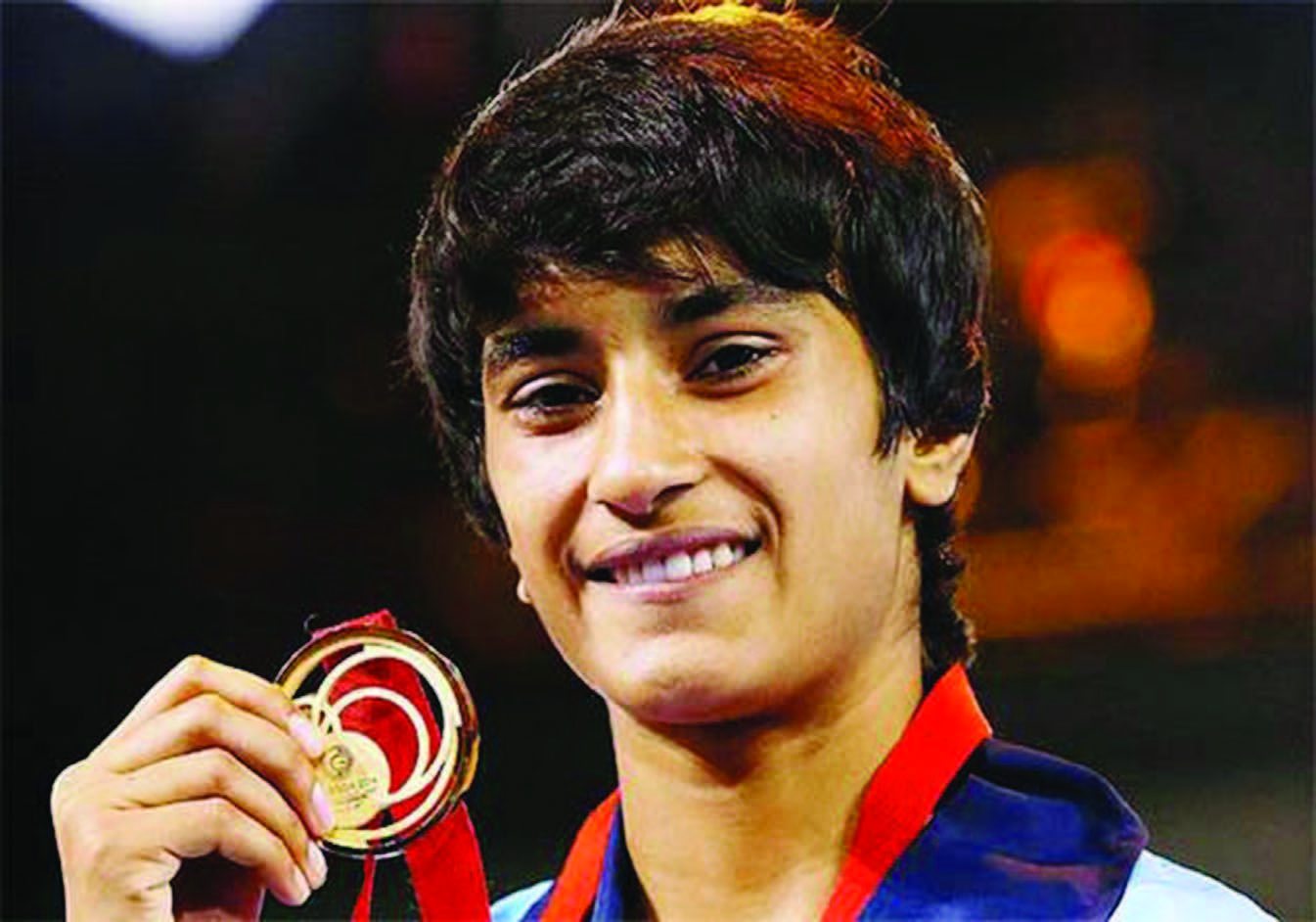
    NEW DELHI (TIP): Vinesh settled for silver in Women’s Freestyle 48kg division after losing her final bout to Japan’s Yuki Irie, while Narsingh Pancham Yadav bagged a bronze in Men’s 74kg category in the Senior Asian Wrestling championship in Doha on May 7.

    Vinesh put up an impressive show before going down in the final, while Narsingh was lucky to have reached the bronze medal play-off despite losing in the qualification round initially.

    On her way to the final, Vinesh comfortably beat Tatyana Amanzhol-Bakatyuk of Kazakhstan in the semifinals after getting the better of Mongolia’s Tsogtbaatar Byambazaya in quarterfinals 8-0.

    In the final bout, however, Vinesh could not overcome the challenge from her Japanese opponent, who proved to be too strong for the Indian girl. Vinesh lost 2-3 in the end.

    Narsingh, who has been included in 74kg category in the absence of double-Olympic medallist Sushil Kumar, lost to Daisuke Shimada of Japan 9-12 in the qualification round but could make it to repechage after his Japanese rival reached the final.

    During his repachage bout, Narsingh defeated Byungmin Kong of Korea 15-4 to enter the bronze-medal play-off. He then bagged 3-1 classification points to outplay Zhiger Zakirov of Kazakhstan and clinched the bronze medal.

    In Men’s 70kg category, Parveen Rana missed out on a third-place finish as he went down fighting to Takafumi Kojima of Japan in the bronze medal play-off.

    Rana had earlier lost to Uzbekistan’s Bekzod Abdurakhmonov 8-13 by Fall in the semifinals.

    En-route to the semis, however, Rana did well to beat Tat Du Can of Vietnam 12-2 in his quarterfinal bout after clearing the qualification round against Sri Lanka’s Shanaka Madushanka Ranwalage by fall, 2-0.

    Meanwhile, other Indians in the fray on Thursday — Sonu and Khatri Mausum — failed to make it to the medal round.

    In Men’s 61kg category, Sonu was defeated by Masakazu Kamoi of Japan 5- 1 in the qualification round itself, while Japan’s Takeshi Yamaguchi defeated Khatri Mausam 10-6 in the quarterfinals of 97kg category.

    Mausam got the better of CUI Xiaocheng of China 8-0 in the qualification round earlier.

  • China blacklists 4 tourists for unruly behaviour

    BEIJING (TIP): Chinese authorities have blacklisted four people for misbehaving while traveling, as Beijing seeks to improve the image of its tourists who are visiting the world’s touristy spots in increasingly large numbers but also are earning a reputation for rudeness.

    The four blacklisted this week by the China National Tourism Administration include a woman who poured instant noodles soaked in hot water onto an AirAsia flight attendant and made insults and threats at the attendant. Her male traveling companion was also blacklisted after getting into an altercation with the attendant. Their behaviors necessitated the flight returning to Bangkok.

    Zhang Yan and Wang Sheng were the first two people to be blacklisted by the national agency under a rule that took effect in April.

    It allows authorities to blacklist a person for unruly, disruptive, disrespectful or illegal behaviors on travel and to notify police, customs, border security, transportation agencies and credit agencies.

    No punishments are specified but the blacklisting means people could see their travel plans affected during a specified timeframe.

    The third person on the blacklist forcibly opened emergency doors on a domestic flight and was detained 15 days. The tourism administration said he should be blacklisted for two years.

    The fourth one climbed onto statues of revolutionary soldiers for taking photo, drawing widespread condemnation, the tourism administration said. He would be sanctioned for 10 years.

  • Salman’s verdict features in Chinese media

    BEIJING (TIP): The court verdict sending movie actor Salman Khan to jail was featured in the news bulletin of China Central Television, the state broadcaster, this evening. The news was also circulated by the official Xinhua to hundreds of media outlets that subscribe to it. This is significant because news from the Bollywood is seldom covered in the Chinese media although Hindi movies viewed across the country. They are mostly dubbed in Chinese or carry Chinese subtitles. Khan is particularly popular among the people of Xinjiang province, which borders Central Asia and Pakistan, sources said. He is also popular in Central Asia, and parts of South East Asia including Malaysia and Indonesia. In its New Delhi datelined story, Xinhua said Bollywood actors have come forward to express their sympathy towards Khan, who has been found guilty in a 13-year old hit and run case.

  • Strategic Autonomy as an Indian Foreign Policy Option

    Strategic Autonomy as an Indian Foreign Policy Option

    [quote_right]For a large country like India, which has the potential of becoming a big power in the future, strategic autonomy is a compelling choice. By virtue of its demographic, geographic, economic and military size, India must lead, but does not have yet the comprehensive national power to do so. It cannot subordinate itself to the policies and interests of another country, however powerful, as its political tradition and the functioning of its democracy will not allow this. India may not be strong enough to lead, but it is sufficiently strong not to be led”, says the author.[/quote_right]

    In the joint statement issued during the Indian prime minister’s visit to France in April, the two sides reaffirmed “their independence and strategic autonomy” in joint efforts to tackle global challenges. In the French case, as a member of NATO it is not so clear what strategic autonomy might mean, but in our case it would essentially mean independence in making strategic foreign policy decisions, and, consequently, rejecting any alliance relationship. It would imply the freedom to choose partnerships as suits our national interest and be able to forge productive relationships with countries that may be strategic adversaries among themselves.

    In practical terms, this means that India can improve relations with the United States of America and China while maintaining close ties with Russia. It can forge stronger ties with Japan and still seek a more stable relationship with China. It can forge strong ties with Israel and maintain very productive ties with the Arab world, including backing the Palestinians in the United Nations. It means that India can have strategic partnerships with several countries, as is the case at present with the US, France, Germany, the United Kingdom, the European Union, Russia, China, Japan, Brazil, Saudi Arabia, Australia, Canada, Kazakhstan, Afghanistan, Vietnam, Iran and the like.

    It means that India can be a member of BRICS and the RIC dialogues, as well as IBSA, which exclude the West, and also forge closer political, economic and military ties with the Western countries. Our strategic autonomy is being expressed in other ways too. India is a democracy and believes that its spread favors its interests, but it is against the imposition of democracy by force on any country. If the spread of democracy is in India’s strategic interest, using force to spread it is against its strategic interest too, as is shown by the use of force to bring about democratic changes in West Asia by destroying secular authoritarian regimes and replacing them with Islamic authoritarian regimes. Likewise, India believes in respect for human rights, but is against the use of the human rights agenda to further the geo-political interests of particular countries, essentially Western, on a selective basis.

    For a large country like India, which has the potential of becoming a big power in the future, strategic autonomy is a compelling choice. By virtue of its demographic, geographic, economic and military size, India must lead, but does not have yet the comprehensive national power to do so. It cannot subordinate itself to the policies and interests of another country, however powerful, as its political tradition and the functioning of its democracy will not allow this. India may not be strong enough to lead, but it is sufficiently strong not to be led.

    India preserved its strategic autonomy even in the face of severe technology sanctions from the West on nuclear and missile issues. It preserved it by not signing the non-proliferation treaty and continuing its missile program. By going overtly nuclear in 1998, India once again exercised its strategic autonomy faced with attempts to close the doors permanently on its nuclear program by the permanent extension of the NPT and the comprehensive nuclear test ban treaty and fissile material cutoff treaty initiatives.

    In some quarters in India and abroad, the idea of strategic autonomy is contested as another manifestation of India’s non-aligned mindset, its propensity to sit on the fence, and avoid taking sides and assuming responsibility for upholding the present international order as a rising power should. These critics want India to join the US camp more firmly to realize its great power ambitions. These arguments ignore the reality that while the US has been crucial to China’s economic rise, China has been sitting on the fence for many years, even as a permanent member of the UN security council. Far from sacrificing its strategic autonomy, it has become a strategic challenger of the US.

    To be clear, the US government has officially stated its respect for India’s position on preserving its strategic autonomy, and denies any expectation that India would establish an alliance kind of relationship with it. It is looking for greater convergence in the foreign policies of the two countries, which is being realized.

    During Narendra Modi’s visit to the US in September, 2014, and Barack Obama’s visit to India in January this year, a strategic understanding on Asia Pacific and Indian Ocean issues, encapsulated in the January 2015 joint strategic vision for the Asia Pacific and the Indian Ocean has emerged. This document suggests a shift in India’s strategic thinking, with a more public position against Chinese maritime threat and a willingness to join the US in promoting partnerships in the region.

    Modi chose a striking formulation in his joint press conference with Obama in September when he said that the US was intrinsic to our Look East and Link West policies, which would suggest a growing role for the US in our foreign policy thinking. During Obama’s January visit, the joint statement noted that India’s Act East policy and the US rebalance to Asia provided opportunities for India, the US and other Asia-Pacific countries to work closely to strengthen regional ties. This was the first time that India implicitly endorsed the US rebalance towards Asia and connected our Act East policy to it.

    Rather than interpreting it as watering down our strategic autonomy, one can see it as strengthening it. So far, India has been hesitant to be seen drawing too close strategically to the US because of Chinese sensitivities. China watches closely what it sees are US efforts to rope India into its bid to contain China. At the same time, China continues its policies to strengthen its strategic posture in India’s neighborhood and in the Indian Ocean at India’s expense, besides aggressively claiming Indian territory.

    By strengthening relations with the US (which is strategically an Asian power), Japan and Vietnam, and, at the same time, seeking Chinese investments and maintaining a high-level dialogue with it, India is emulating what China does with India, which is to seek to build overall ties as much as possible on the economic front, disavow any negative anti-India element in its policies in our neighborhood, but pursue, simultaneously, strategic policies intended to contain India’s power in its neighborhood and delay its regional extension to Asia.

    In discussing the scope of our strategic autonomy, one should recognize that the strength of US-China ties, especially economic and financial, far exceeds that of India-US ties. India has to be careful, therefore, in how far it wants to go with the US with a view to improving its bargaining power with China. The other point to consider is the US-Pakistan equation. The US has just announced $1 billion of military aid to Pakistan; its position on the Taliban is against our strategic interests in Afghanistan; its stand on Pakistan’s sponsorship of terrorism against us is not robust enough.

    To conclude, strategic autonomy for India means that it would like to rely as far as possible on its own judgment on international issues, balance its relations with all major countries, forge partnerships with individual powers and take foreign-policy positions based on pragmatism and self-interest, and not any alliance or group compulsion.

    (The author is former foreign secretary of India. He can be reached at sibalkanwal@gmail.com)

  • Beijing pulls up PLA over India’s swift rescue operations

    Beijing pulls up PLA over India’s swift rescue operations

    BEIJING (TIP): The Indian military’s swift evacuation of thousands of Indians from earthquake-hit Nepal has put China’s PLA on the defensive with questions raised as to why its efforts to rescue stranded Chinese nationals did not match those of India.

    The media in China has questioned why air force planes were not deployed to airlift over 8,000 Chinese, many of whom are still stranded in Nepal.

    In a rare comparison of India’s military with the People’s Liberation Army (PLA), the world’s largest, Chinese defence spokesman Geng Yansheng was on Thursday confronted with the question at a briefing as to why the military did not use planes to airlift stranded Chinese when India had done so to ferry its nationals.

    There is considerable annoyance in China over the slow process of airlifting of Chinese tourists as well as workers employed in various Beijing-funded projects in Nepal as the task was given to a number of civilian airlines. There were also reports of some airline companies demanding heavy fares, but they were subsequently denied.

    Besides airlifting thousands of its citizens, the Indian Air Force also transported about 170 foreign nationals from 15 countries to India. Several others were also transported through special buses from across the border to Bihar.

    Defending the move to use civilian aircraft, Geng said “Whether to use military aircraft to transport people from a disaster area — this is to be decided by various factors.”

    He said that after the earthquake, the Chinese government had organized a number of civilian commercial flights to evacuate Chinese citizens stranded in Nepal. He added that soon after the quake, three helicopters from Tibet flew in food and water to a number of Chinese employees working on a hydel project and some of them were even airlifted.

    India’s quick response to send search and rescue teams besides relief supplies has been reported by sections of the Chinese media, while China too dispatched rescue teams and planes with supplies, by which time the Indian presence on the ground had swelled. Earlier, the Chinese foreign ministry had played down reports of competition with India to assist quakehit Nepal and offered to work with New Delhi “positively” in the relief efforts to help the Himalayan nation overcome the crisis.

  • Manhunt in Hong Kong as kidnapper vanishes with$3.6 million ransom

    BEIJING (TIP): The Hong Kong police has launched an intense manhunt for a man who extracted a ransom of$3.6 million after kidnapping a 29-year old woman. The woman is safe but the kidnapper has vanished after picking up the money from her family.

    The kidnapper first broker into her apartment stole some valuables and kidnapped the woman on Saturday, the police said. Her family paid him $3.6 million as ramsom, the highest ransom amount paid in Hong Kong in past decades. She was returned unharmed on Tuesday after the amount was paid.

    Hong Kong authorities have publicized description of four men, believed to be the main kidnapped and his accomplices, while asking the public to report if they are seen anywhere. The police has also created roadblocks on major routes leading to Mainland China to prevent them from leaving the city.

    Police said the accused men escaped in a white car after receiving the ransom payment.

    Kidnapping for ransom, once a major crime, has now reduced sharply as Chinese authorities have cracked down on it.

  • Chinese rescue Indian mountaineers

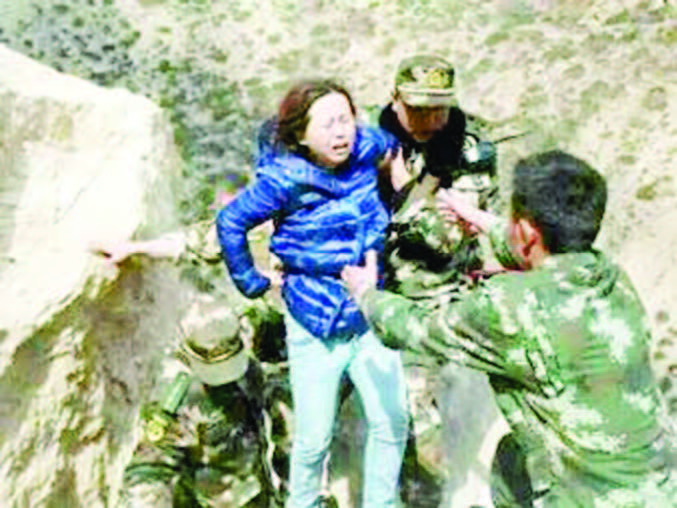
    HYDERABAD (TIP): Over 20 mountaineers from Andhra Pradesh and Telangana were on their way home via Lhasa after Chinese Mountaineering Association (CMA) on April 30 rescued them from Everest base camp, where they had been stranded following the Nepal earthquake.

    Nalgonda resident Shekhar Babu-led climbers planned to scale the world’s highest mountain from dangerous North Col.

    They had stayed put at the camp as avalanches triggered by the earthquake had blocked the highway connecting Nepal and China.

    “The team is safe and will be reaching Lhasa on Friday evening,” said a representative from Hyderabad’s Transcend Adventures that had organized the expedition. He said the climbers would be flown from Lhasa to India.

    As posted on the adventure club’s Facebook wall, Nima Tsering, vice-chairman, CMA, visited the base camp and told the climbers that they will be taken down, much to the relief of team leader Shekhar Babu and his boys.

    Tsering also carried some good news with him, which brought some cheer and relief to the mountaineers who pay huge sums to plan a trip to Everest. The CMA said the registration fee of the climbers for this year would hold good for the next three years.

    “We are grateful for this gesture,” said Prithvi Raj, a representative from the adventure club.

    Anxious family members have been calling the club with queries about their loved ones. “We have informed them and they are relieved that they are safe and are being escorted to safety,” said Raj. The team will return to India in a few days time.

  • India, China win hearts, minds in quake-hit Nepal

    India, China win hearts, minds in quake-hit Nepal

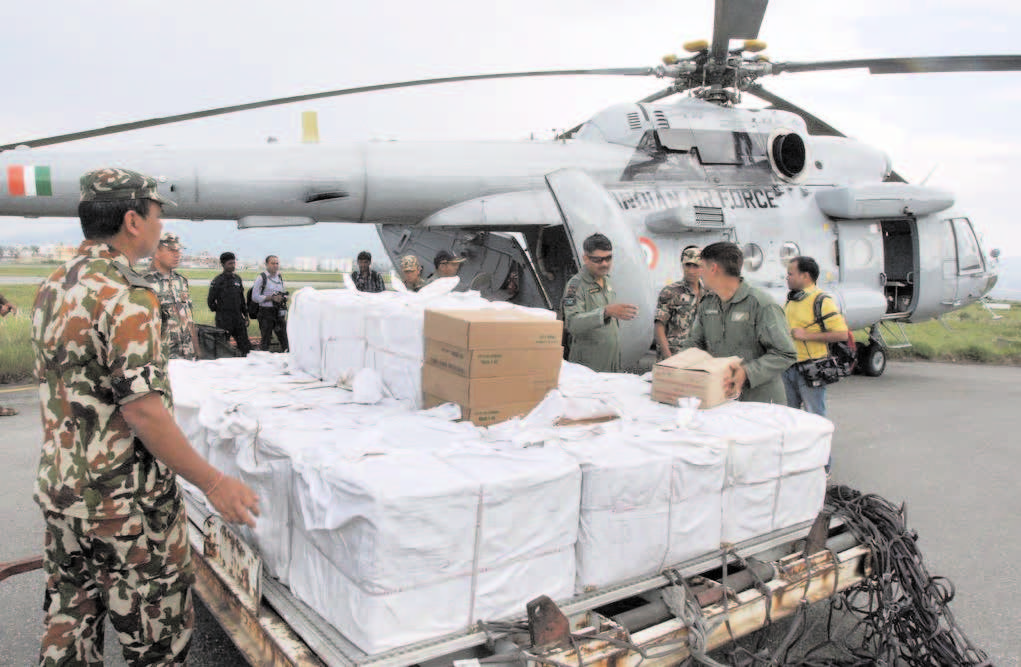
    POKHARA (TIP): At Pokhara airport in the Himalayas, Indian soldiers race back and forth loading rice, blankets, tarpaulins and other aid onto waiting helicopters for delivery to Nepal’s quake-devastated villages.

    In the ruined ancient town of Bhaktapur outside the capital Kathmandu, Chinese rescuers in blue uniforms search for survivors in the rubble of toppled temples and homes.

    Nepal’s overwhelmed government has been criticised by frustrated residents, hundreds of thousands of whom are desperate for assistance after Saturday’s monster quake.

    But foreign countries, with their medics, specialist rescuers and helicopter sorties, have won applause, with giant neighbour India sometimes singled out for praise as the biggest provider.

    “We are hungry, we have no food, and we’ve had no help from our own government,” Arjun Budhathoki, 30, said as he queued, along with thousands of others, for a bus out of Kathmandu this week.

    “The Indian government is the only one helping our citizens, they are doing so much for us,” Budhathoki said.

    India and economic powerhouse China have long vied for influence in the impoverished Himalayan country which was ripped apart by the quake, leaving more than 6,200 people dead.

    China has dispatched about 300 personnel to Nepal and announced about $10 million in aid so far, according to state media.

    Indian Prime Minister Narendra Modi has promised to “wipe the tears of every Nepali” while the country’s air force alone has sent 950 personnel and dropped more than 400 tonnes of aid across the country.

    India’s hyperactive media have devoted hours to the country’s assistance, including plucking stranded climbers from Everest base camp. But analyst Rajrishi Singhal said India’s efforts involved a degree of self-interest.

    “We share a long border with Nepal and any turmoil there can spill into India,” Singhal, senior fellow at the Gateway House think-tank in Mumbai, said.

    “It is in our interest to see that Nepal gets back on its feet as soon as possible.”

    Singhal said both India and China could play a significant role in Nepal’s reconstruction once the relief effort has concluded.

    “Affordable housing is one area where India can really help Nepal because we have seen the large-scale devastation and the way houses have been destroyed,” he said.

    “In that sense when it comes to rebuilding and reconstruction, both India and China must be prepared for the long haul in Nepal.”

    Beijing has swept aside any suggestion it is being overshadowed by its rival in the quake zone, although it says it is planning to “intensify our efforts in disaster relief”.

    “The assistance shows that all the Asian countries are part of the community of common destiny and we will work together with Nepal to help them rebuild their homeland as soon as possible,” foreign ministry spokesman Hong Lei said in Beijing on Thursday.

    Nepal’s foreign minister Mahendra Bahadur Pandey has attempted to strike a balance, saying his government is grateful to its “very good friend” India, but also quick to mention China.

    “They (China) too are sending teams of people and medicines,” Pandey said in an interview with the Indian Express newspaper on Tuesday.

    “They are trying their best to rescue our people. We have divided areas between India and China.”

    Modi has made clear since being elected last May that boosting India’s influence in its backyard is a priority.

  • Pakistan Buys 110 JF-17 fighter jets from China

    Pakistan Buys 110 JF-17 fighter jets from China

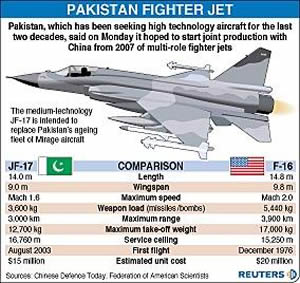
    ISLAMABAD: Pakistan will acquire 110 latest JF-17 Thunder fighter jets from China as the two countries forge closer economic and defence cooperation following President Xi Jinping’s visit to Islamabad earlier this week, a media report said on Saturday.

    Radio Pakistan reported that China will deliver the first batch of 50 jets over a period of three years. The head of Chinese aircraft industry told a Chinese daily that under the contract signed between the two countries, Pakistan will receive a total of 110 JF-17 Thunder fighter aircraft from China.

    It is not clear when the delivery of the remaining 60 jets will be completed.

    The JF-17 Thunder is also built in Pakistan as China has already transferred its technology. But Pakistan needs more of these jets at faster pace due to its fight against Taliban militants.

    Xi also launched a $46 billion economic corridor to link China’s western region to Pakistan’s Gwadar port on the Arabian Sea.

    During Xi’s visit, a fleet of eight JF-17 jets escorted the Chinese president’s plane when it entered Pakistan’s airspace. The two countries signed 51 agreements to boost economic cooperation during Xi’s trip. Earlier, reports said China would provide eight latest submarines to Pakistan, more than doubling its fleet, in a deal worth $4-5 billion.


  • China fines Mercedes $57 million in price-fixing probe

    BEIJING (TIP): A Chinese regulator said on April 23 it has fined Mercedes Benz 350 million yuan ($57 million) on price-fixing charges in a wide-ranging probe of the auto industry that has prompted complaints foreign automakers are being treated unfairly.

    The unit of Germany’s Daimler AG was fined for violating anti-monopoly law by enforcing minimum prices dealers were required to charge for vehicles and replacement parts, according to the price bureau of the eastern province of Jiangsu. Setting minimum retail prices is common in other countries but Chinese regulators reject it as a violation of free market competition. Regulators have targeted automakers, technology suppliers and dairies in a series of anti-monopoly investigations over the past two years in an apparent effort to force down prices.

  • 21 confirmed dead in north China coal mine flood

    BEIJING (TIP): Search teams have recovered the bodies of 21 Chinese coal miners who died when the shaft where they were working filled with water, an official said April 23.

    After days of frantic rescue efforts following the accident Sunday, the final death toll of 21 was confirmed by a Datong city government official who gave only his surname, Meng. More than 600 rescuers had been working to pump water from the shaft and drill holes from the surface at the Jiangjiawan mine near the northern city of Datong. A total of 247 miners were underground when water rushed into the shaft Sunday evening.

  • China cracks down on strippers at funerals

    BEIJING (TIP): Chinese authorities on Thursday bared the details of their latest anti-vice sweep: a campaign to halt the hiring of strippers at funerals

    In a statement posted on its website, China’s ministry of culture pledged a “crackdown” on the practice, which it said has become increasingly common in rural areas.

    “From time to time, ‘stripteases’ and other illegal performances have occurred in the countryside,” the statement said, adding that authorities will “promptly investigate and punish” businesses and individuals involved in the risque shows.

    China’s official Xinhua news agency said such performances are typically organised in order to draw a larger crowd at last rites. One example cited by the ministry of culture was a funeral in north China’s Hebei province. “Two strippers wearing revealing clothes danced on a stage at a public square in our village at night on February 15,” an eyewitness surnamed Zhang told the state-run Global Times newspaper earlier this month.

    “They first danced passionately and then took off their clothes piece by piece,” the man said. “Behind them, an electronic screen was displaying a picture of the deceased with elegiac couplets on either side.”

    In another case later that month, a troupe in east China’s Jiangsu province was detained for funeral performances that drew crowds of as many as 500 local residents, according to provincial news site xichu.net.

    The troupe engaged in “erotic performances on the stage with sexual organs exposed and imitating sexual acts,” police officer Tang Jinyang told the news site.

  • Pakistan stood by us when China was isolated: Xi Jinping

    Pakistan stood by us when China was isolated: Xi Jinping

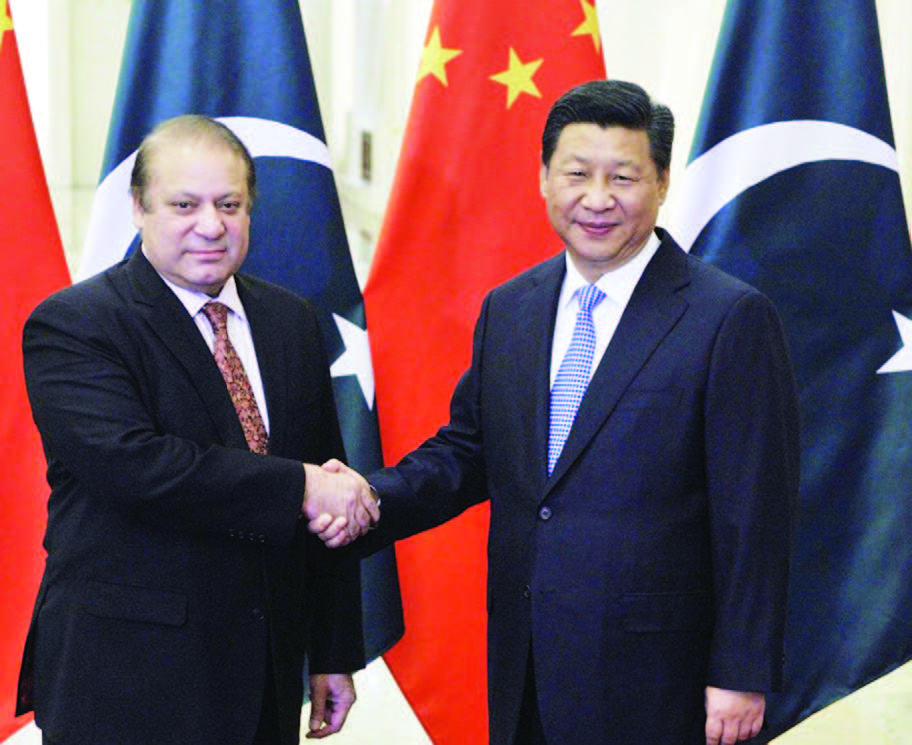
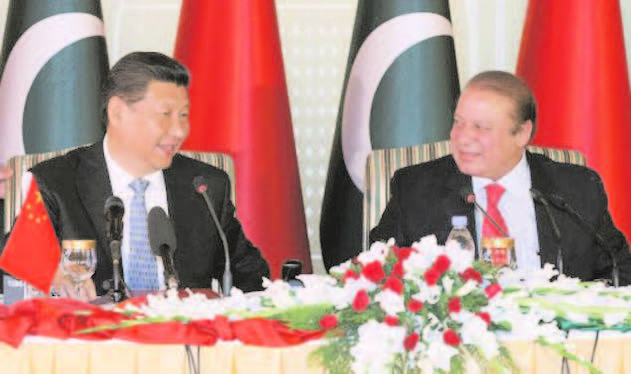
    ISLAMABAD (TIP): Chinese President Xi Jinping on April 21 described Pakistan as China’s “dependable” friend and firmly backed its territorial integrity, as he announced long-term support for the cash-strapped country’s economic development.

    Addressing a joint sitting of Pakistan’s parliament on the final day of his two-day maiden trip during which he oversaw signing of 51 agreements, Xi stressed that the bilateral ties are based on mutual trust and support.

    Xi, also the general-secretary of ruling Communist party, said China and Pakistan will always move forward together and the Chinese people will always stand together with the Pakistani people.

    “During my current visit, President Mamnoon Hussain, PM (Pakistan Prime Minister Nawaz) Sharif and I jointly agreed to elevate China-Pakistan relations to an all-weather strategic partnership,” Xi said, a day after unveiling USD 46 billion ambitious China-Pakistan Economic Corridor.

    The 3,000-km corridor linking China’s far-western region to Pakistan’s south-western Gwadar port on the Arabian Sea through Pakistan-occupied Kashmir (PoK) is massive project of road, rail, energy schemes, pipelines and investment parks.

    Xi lavished praise on Pakistan and said it stood with China from the earliest days of founding of the People’s Republic of China. He said Islamabad stood by Beijing at a time when China stood isolated on the world stage.

    He said both countries have tremendous support to each other and stood by each other in times of need.

    The two countries should support each other’s core interests, Xi said, noting that China firmly backs Pakistan’s territorial integrity.

    “Pakistan is the first foreign country that I visit this year and (it is my) first visit to your country, but Pakistan is not at all unfamiliar to me,” said Xi, the first Chinese President to visit Pakistan in nine years.

    He said he brought warm greetings and best wishes to the “brotherly people of Pakistan” on behalf of the 1.3 billion people of China.

    “Pakistan and China’s struggles have brought their hearts and minds together,” he said.

    He referred to the assistance offered by the two countries to one another in the events of natural disasters.

    Xi also praised Pakistan’s anti-terror effort, saying that Islamabad has always stood at the frontlines in the fight against terrorism and has made huge sacrifices to that end.

    He outlined the vision of Chinese development and said that China wants to go ahead by forging “win-win” cooperative deals with other countries, especially neighbours.

    Xi said China will open up all sectors of its economy. He said South Asia has great potential and China was eager to have close cooperation with all countries of the region.

    He mentioned his last year visit to three regional countries including India.

    Xi mentioned his concept of “Roads and Belts” and said China-Pakistan Economic Corridor will benefit all region of Pakistan and the region.

    He said China was also working for another regional connectivity plan to link with India, Bangladesh and Myanmar.

    Xi also said that China would work with Pakistan for reconciliation and peaceful transition in Afghanistan.

    Earlier, Xi arrived at the Parliament amid tight security. He was welcomed by Pakistan Prime Minister Sharif, National Assembly Speaker Ayaz Sadiq and Chairman Senate Mian Raza Rabbani.

    Sadiq officially welcomed the Chinese president and his delegation for visiting Pakistan.

    Sharif in his brief address at the end said that the two countries were committed to have closer cooperation in all fields.

  • India’s Land Acquisition Act: Bonanza for Rulers & their Financiers

    India’s Land Acquisition Act: Bonanza for Rulers & their Financiers

    India has a long history of its ruler’s fascination with farm land. Whether it was ancient Kings or Moghuls or British invaders turned rulers as well as the current rulers after independence; every one has been robbing the farmers of their land in broad daylight by claiming that they are doing it for the sake of development.

    Let us have a close look at the largest democracy of the world. India is a country of 1.35 billion, where 665 million practice open defecation against 37 million doing so in China. India has the world’s largest army of 85 million child labor out of 830 million poor living in extreme poverty. India’s elite, world famous billionaires, part of the 56 million rich Indians, live side by side with almost a billion poor and treat them as sub humans who are viewed as burden for the country.

    A former diplomat, politician, author and thinker Pavan Varma wrote in his book “Being Indian” that in the Indian elite “there is a remarkable tolerance for inequality, filth and human suffering”. He adds that “concern for the deprived and the suffering is not a prominent feature of the Indian personality. The rich in India have always lived a life, quite oblivious to the ocean of poverty around them”. Less than 10-15 minutes from every slum in any major city of India there are very expensive heavily guarded residential areas with mini palaces costing from a few million dollars to $1 billion Mukesh Ambani’s Palace. One city: two universes.

    India’s Land Acquisition Act was enacted in 1894 by British rulers. It gave unlimited power to the government to acquire any land. The Act allowed governments all over India to acquire land from the public. After independence India adopted the same Land Acquisition Act and no one bothered to make any changes in it because it was an easy way for the politicians and corporations to make money. The only person who lost money and livelihood was the individual and his family whose land was acquired. In 1985, an amendment made it easier for politicians and corporate to take over land at throw away prices. “Whenever it appears to the [appropriate Government] the land in any locality [is needed or] is likely to be needed for any public purpose [or for a company], a notification to that effect shall be published in the Official Gazette [and in two daily newspapers circulating in that locality of which at least one shall be in the regional language], and the Collector shall cause public notice of the substance of such notification to be given at convenient places in the said locality.” Practically for 66 years, from 1947 to 2013, every political party and at the center as well as all the states chose not to do anything and has been using this law as a source to generate black money to fight elections. It was only in 2013, the Congress led United Progressive Alliance (UPA) brought in “The Right to Fair Compensation and Transparency in Land Acquisition, Rehabilitation and Resettlement Act 2013. Although this also has some major flaws but it was the first time that some one thought of protecting the farmers, tribals and landless poor. However, UPA could not implement this law as it lost power and in 2014 a new government under Modi was installed at the center by the corporate world.

    Corporations and politicians all these years, in daylight robbery, after taking over farm land at throw away prices, have been getting the “land use” changed overnight and land becomes 1,000 to 10,000 times more its original price. Then the scam of acquiring Panchayat land or Shamlat land that is owned by the entire village marked for animal grazing especially for marginal farmers and landless owners of a few animals has been going on for over a century. This is done by the prospective buyer with bribes to revenue officials, from Patwari, Gram Panchayat members, Nayab Tehsildar, Tehsildar, District Collector, to ministers and judges, in case if a petition against an allotment is made for stay and, of course, the Chief Minister of the State who gets his/her share before any one else and only then a green signal is issued to go ahead with the project. Now after acquiring the farm land, to get its “land use” changed the buyer once again pays bribes to Chief Minister of the State, the District Collector, the Minister concerned, never forgetting the judicial officials in case a petitioner approaches the court for stay. The buyer also pays the usual development charges as per the rules.

    Farm Land has always been the biggest black money source for every ruling party in every state. If a serious investigation is done one can find how the real estate companies came into existence and some of the famous 5 star hotels, resorts, malls, luxury farm houses and residential complexes were built on farm land as well as Shamlat or Panchayat Land. The worst part is the farmers and their family members who used to own this land are now working as help- gardener, watchman, cleaner, cook and drivers on these properties.
    The forest land on which millions of people specially tribal and landless villagers depend for their survival by collecting minor wild oil seeds, herbs, fruits and flower, is much easier to acquire. Bribe all the concerned politicians, bureaucrats, Judges and environmentalists and get the land for a paltry sum per year on a per yard lease for 99 years. There is absolutely no need to buy and spend money on stamp papers etc.! And, in the long rum, have it to yourself, almost for free.
    Every central and state government in India believed that it owned the country’s resources. That is the reason we had numerous scams under Congress, Janata Party and BJP governments and their allies. But this time BJP that has come to rule the country at the Center as a single party with a massive majority for any party, after 30 years, has gone a step forward. It is openly sending a message that they own the resources. BJP must understand that “Country’s resources belong to the people and the land owned by farmers must remain with the farmers.” Let them decide what is to be done with the resources in the best interest of the country. Let the issue be decided by the majority of India’s citizens, not by the 1% that own the politicians and are trying to take over the country.
    Governments in India have always advanced the argument that the land is required for public use. That, it is required to build infrastructure- roads, bridges, power plants etc. That the land is required for the vital defense projects. For each of these projects that go in to private sector, the players get their profits. Even in case of government projects, governments get to recover the cost through various taxes. Where is the need to provide land at subsidized rates to any of them? The Indian industrial houses -Reliance, Adani, Tata, Jindal, Ruia etc have unprecedented political access and power. All these corporations, unlike East India Company, do not have their private army but soon will be making all kinds of warheads, missiles, helicopters, airplanes, ammunition and other sophisticated military gadgets because BJP’s Finance Minister Arun Jaitley has increased the FDI limit to 49% from 26% for defense industry. Just a few days before the budget the institution of Lobbyist ( Middleman) has been legalized in India for deals with the government, including defense deals. Now there won’t be any shortage of Radias openly operating in the corridors of power to influence law makers for favors for their corporate clients. Do these multi-billionaires really need to be given land at a subsidized rate?
    Even after Congress party’s catastrophic defeat in 2014 due to rampant corruption and massive scams the country’s crony capitalists are unlikely to suffer as a result. The nexus between business and politics, today under BJP rule, is as tight as it has ever been. BJP spent Rs 32,000 crore to bring Narendra Modi to power with massive corporate donations. BJP is estimated to have spent at least Rs 6,200 crore on print and broadcast advertising alone. Of these donations, around 90% comes from unlisted corporate sources who will be rewarded when the times comes. May be, under Land Acquisition Act it is pay back time for BJP to its financial supporters with cheap land besides the Rs. 62,398.6 crore for 2014-2015, the revenue government is expected to forego because of exemptions and deductions given to corporates.

    Modi’s Finance Minister Arun Jailey is bringing down the Corporate Tax from 30 per cent to 25 per cent in the next four years. In USA where the corporate Tax is 35% according to CAG ; US Corporation’s effective rate of tax was 12.1% in 2011 that is 40 years low. If the effective rate in USA is 12.1% in India it has to be under 10% or in some cases 0 because Indian Corporations are more innovative; they get subsidized loans, land, electricity, break on all kinds of taxes including custom, excise, dividend tax and can book their profits in foreign countries by over invoicing or under invoicing and route it back through government approved Mauritius route. Besides with the plethora of credits and deductions in tax code they buy super luxury cars, luxury homes & farm houses, air planes, yachts and expensive holidays abroad in their corporation’s name for their personal, family, executive and for the use of politicians and top bureaucrats. Interestingly, the bigger the corporate the more deductions and exemptions they take.!
    PM Modi has been going to every country in the world and telling investors: ‘Come to India; make in India; we will give you cheap land and labor’. PM Modi is certainly not lying. After robbing the farmers of their land, the farmers and their family members will have no choice but to become cheap laborers for his financial supporters- the MNC’s and the local industrial houses.
    (The New Jersey based author is a regular contributor to The Indian Panorama. He can be reached at davemakkar@yahoo.com)

  • Saina Nehwal regains top spot in latest BWF rankings

    Saina Nehwal regains top spot in latest BWF rankings

    NEW DELHI (TIP): Ace Indian shuttler Saina Nehwal regained the number one position in international rankings after China’s Li Xuerui dropped a couple of rungs to third in the latest list issued on Thursday.

    Saina, the first Indian woman shuttler to be world number one after her India Open Grand Prix Gold triumph earlier this month, had dropped to the second place following her semifinal finish in the Malaysia Open Super Series.

    She skipped last week’s Singapore Open Super Series but gained in the rankings after Xuerui also pulled out from the tournament, leading to loss of two positions in the women’s singles chart.

    Elsewhere, PV Sindhu dropped out of the top 10 and was placed 12th this week after slipping three spots.

  • OLA RAISES $400M, LED BY DST GLOBAL

    MUMBAI (TIP): In one of the largest financing rounds for an Indian internet startup, taxi-hailing service Ola said it has raised $400 million – or around Rs 2,500 crore – led by Russian tech billionaire Yuri Milner’s investment firm DST Global. With this, the four-year-old company is now valued at $2.5 billion, or more than Rs 15,000 crore.

    Ola has mopped up about $675 million across five rounds of funding in the backdrop of an all-time high investor sentiment around Indian consumer-facing tech companies.

    DST, known for its bets on Facebook and Twitter, is joined in the new round by Singapore’s sovereign wealth fund GIC, hedge fund Falcon Edge, Japan’s SoftBank, Tiger Global, Steadview Capital and Accel Partners US.

    A company statement said on Thursday the capital raised will be used to strengthen Ola’s leadership, expand into smaller markets by adding another 100 cities and pump$100 million into growing TaxiForSure (TFS), which it acquired recently. With this fund-raise, Ola becomes the third most valued domestic consumer internet company after Flipkart and Snapdeal, valued at $11 billion and $5 billion respectively. Just six months back, the taxi service venture was valued at $650 million when it raised funds from Softbank, making it a four-fold jump in its valuation.

    People familiar with the fund-raise said Milner’s DST will own 9% in Ola, having put $225 million. SoftBank, which is expected to have shelled out $90 million, will see its stake trim down to 25% from about 32%. Milner had personally invested in Ola last year.

    Founded by Bhavish Aggarwal and Ankit Bhati, batchmates at IIT-Bombay, Ola operates across 100 cities at present and, along with TFS, is a clear leader in the taxi aggregation market. The TFS buyout and now this massive raise are expected to give it a huge leg up over Uber which entered India in 2013. Aggarwal said Ola’s vision is that people shouldn’t find the need to own a car.

    “We have been able to make this possible for millions of customers in the past four years by creating over a hundred thousand driver entrepreneurs on the platform. With increasing smartphone penetration and immense growth in smaller cities and towns, we will be able to drive the benefits of this on-demand platform deeper into the lives of our customers and partners.” 

    Recently, Ola launched an on-demand cafe service and is also said to be toying with the idea of entering the highly competitive grocery delivery space. In the US, Uber has also been experimenting with other lines of businesses based on the delivery platform like Uber Movers for shifting house, UberRush, a courier service, and Uber Corner Store for grocery deliveries.

    India’s taxi market, estimated at over $10 billion in size, is largely unorganized but is fast changing with the advent of asset-light, aggregator services backed by heavy technology. Over the past year, the three players (Ola, Uber, TFS) have slugged it out with cut-throat competition, guzzling millions in investor money and throwing discounts to get larger market shares. Ola is said to be losing $30 million every month. It claims to be clocking 2 lakh average monthly rides.

    DST has been bullish about Asian tech-backed taxi companies as it picked up a stake in China’s largest taxi-hailing app Didi Dache, which recently merged with its closest competitor Kuaidi Dache, to form a $6-billion transportation behemoth. Buoyed by increased smartphone penetration, the 300-million strong internet user base in India is the next big opportunity for investors after China. Having come to the Silicon Valley as a relative unknown, Milner bulked up the DST portfolio by sinking in millions of dollars behind fast-growing internet firms like Airbnb, Spotify and Zynga, and is today one of the most sought after investors globally. Last year, it led a $210-million financing round in Flipkart, signalling the Russian investor’s interest in domestic tech firms.

  • China reviewing policy on Mumbai attack ahead of Xi visit to Pakistan

    BEIJING: China is reviewing its approach towards the 2008 Mumbai terror attack carried out by Pakistani terrorists. It feels “awkward” about its own neutral stance, which has caused grave dissatisfaction in India. The revelation came from a Chinese think tank focussed on South Asia ahead of president Xi Jinping’s planned visit to Pakistan, and Prime Minister Narendra Modi upcoming tour of China next month. Pakistani media has said Xi will be visiting Islamabad on April 20. “China also feels quite awkward. It does not mean China is sympathizing with terrorist attacks. It is awkward diplomatically. It needs to handle this ticklish issue in a more diplomatic way,” Hu Shisheng, director of the government-run Institute of South Asia, South East Asia and Oceanic Affairs, which is part of the China Institute of Contemporary International Relations, said. There are signs China might advise Pakistan to take a more sensible approach in dealing with Lashkar-e-Taiba operative Zaki-ur Rehman Lakhvi, a prime accused in the Mumbai attack case, who was releases from a jail in Pakistan. India, US and France has opposed it but China has kept quiet.

  • Chinese president to visit Pakistan, hammer out $46-billion deal

    Chinese president to visit Pakistan, hammer out $46-billion deal

    ISLAMABAD (TIP): Chinese President Xi Jinping will launch energy and infrastructure projects worth $46 billion on a visit to Pakistan next week as China cements links with its old ally and generates opportunities for firms hit by slack growth at home.

    Also being finalized is a long-discussed plan to sell Pakistan eight Chinese submarines. The deal, worth between $4 billion and $5 billion, according to media reports, may be among those signed on the trip.

    Xi will visit next Monday and Tuesday, Pakistan’s foreign ministry said.

    Commercial and defence ties are drawing together the two countries, which share a remote border and long-standing mistrust of their increasingly powerful neighbour, India, and many Western nations.

    “China treats us as a friend, an ally, a partner and above all an equal — not how the Americans and others do,” said Mushahid Hussain Sayed, chairman of the Pakistan parliament’s defence committee.

    Pakistan and China often boast of being “iron brothers” and two-way trade grew to $10 billion last year from $4 billion in 2007, Pakistani data shows.

    Xi’s trip is expected to focus on a Pakistan-China Economic Corridor, a planned $46 billion network of roads, railways and energy projects linking Pakistan’s deepwater Gwadar port on the Arabian Sea with China’s far-western Xinjiang region.

    It would shorten the route for China’s energy imports, bypassing the Straits of Malacca between Malaysia and Indonesia, a bottleneck at risk of blockade in wartime.

    If the submarine deal is signed, China may also offer Pakistan concessions on building a refuelling and mechanical station in Gwadar, a defence analyst said.

    China’s own submarines could use the station to extend their range in the Indian Ocean.

    “China is thinking in terms of a maritime silk road now, something to connect the Indian Ocean and Pacific Ocean,” said a Pakistani defence official, who declined to be identified.

    For Pakistan, the corridor is a cheap way to develop its violence-plagued and poverty-stricken Baluchistan province, home to Gwadar.

    China has promised to invest about$34 billion in energy projects and nearly$12 billion in infrastructure.

    Xi is also likely to raise fears that Muslim separatists from Xinjiang are linking up with Pakistani militants, and he could also push for closer efforts for a more stable Afghanistan.

    “One of China’s top priorities on this trip will be to discuss Xinjiang,” said a Western diplomat in Beijing. “China is very worried about the security situation there.”