Tag: China

  • WHY INDIA MATTERS TO CANADA

    WHY INDIA MATTERS TO CANADA

    For two countries that Prime Minister Stephen Harper calls “natural partners” in a new global economy, Canada and India might appear to share a rather meek business relationship.

    Not even one per cent of Canadian exports currently ship to India, with goods exports around $3.1 billion in 2014 – less than one-sixth what Canada exports to China.

    Promising to open India to global commerce, Indian Prime Minister Narendra Modi’s historic three-day Canadian tour this week seeks to change that.

    His trip ends a 42-year dry spell since a head of state from the world’s largest democracy visited to talk bilateral relations.

    As Harper pushes for a free-trade pact with Modi, Canadian economists and business leaders representing South Asian professionals lay out their case for why India is a social, political, cultural and economic force that matters.

    1. A hot opportunity

    “Let’s not forget there’s a race to get to India’s door,” says Jaswinder Kaur, director of the Canada-India Centre of Excellence in Ottawa.

    “We’re competing against Japan, the French, the Australians, and this is an opportunity for Canada to demonstrate how we can contribute and make a true partnership.”

    Canada’s Global Markets Action Plan identified India as a priority market, with a burgeoning economy and roughly 11 million people under 30 entering the workforce each year.

    India has for years remained the largest market for Canada’s pulses (grain legumes such as lentils and peas), and Canada also supplies lumber and potash.

    “But are Canadian companies ready to do business?” Kaur says. “That’s where the real work is going to begin.”

    The International Monetary Fund projects that by 2016, India’s GDP growth will outpace that of China’s becoming the fastest-growing major economy in the world.

    In the meantime, two-way bilateral trade has grown to $6 billion, up 47 per cent since 2010, when trade was around $4.09 billion.

    2. Energy demands

    Much has been made, Kaur notes, of Modi “shopping for uranium” as part of this Canadian tour.

    India needs the radioactive element to feed its nuclear reactors, and Canada has a vast supply.

    ‘Mr. Modi will be looking for a signed contract for Canada to be a supplier of uranium, as India desperately needs energy as it expands.’ – Elliot Tepper, Carleton University South Asian studies professor

    If Ottawa allows, Saskatchewan-based Cameco Corp. could resume uranium exports to India following a ban 40 years ago, when India was accused of testing a nuclear weapon in 1974, and then again in 1998, using Candu technology supplied by Canada.

    “Since then, our relations have slowly climbed back up to the point where we have a nuclear agreement,” said Elliot Tepper, a South Asian studies professor at Carleton University.

    “Mr. Modi will be looking for a signed contract for Canada to be a supplier of uranium, as India desperately needs energy as it expands, and wants to rely more on nuclear power.”

    Meanwhile, Canadian natural gas and oil will continue to be useful resources to India.

    3. Young population

    The under-35 demographic represents more than 65 per cent of India’s population, and many of them are migrating from rural areas to cities searching for education and employment, both of which Canada can help supply.

    Open for business. India’s Prime Minister Narendra Modi addresses the world’s largest industrial technology fair, the Hannover Messe, in Hanover, Germany, earlier this month. He has been on something of a world tour, trying to drum up industrial investment in job-hungry India.

    Modi’s “Make in India” initiative is encouraging international firms to set up manufacturing plants in India to spur job creation at home and become a low-cost alternative to China.

    Flipping the saying that China will grow old before it grows rich, Gary Comerford, president of the Canadian Indian Business Council, believes

    “India will grow wealthy before it grows old.”

    Over the last decade, he says, a large number of Indians have “pulled themselves out of poverty” and into a rising middle class.

    “And that means they’re consuming,” Comerford says of the next generation of big spenders. “They’re getting a fridge, a TV, a cellphone.

    “If you take that sheer population of 1.2 billion and convert it into a consuming group, as well as being an economic powerhouse, it will be a political powerhouse as well.”

    4. Cross-cultural understanding

    India remains a democracy with a “remarkably pluralistic society,” which Canada can appreciate as a state that welcomes diversity as a foundation of the country, says Tepper.

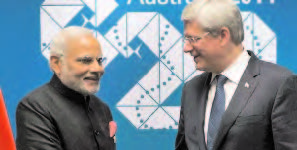
    Two business-friendly PMs, India’s Narendra Modi and Canada’s Stephen Harper chat at the G20 summit in Australia in November. (The Canadian Press)

    “That makes our two countries both natural allies and rather special in terms of the states of the world,” he says, adding that the two countries have worked together quietly for years on such things as counter-terrorism and sharing concerns about violent extremists.

    University of Toronto professor Kanta Murali, who analyzes Indian politics at the Centre for South Asian Studies, points to a 1.2 million-strong Indian diaspora in Canada as “central to the excitement surrounding Modi’s visit.”

    A shared history under British colonial rule, a broadly English-speaking population and a democratic system add to a sense of kinship, adds Comerford.

    5. A knowledge economy

    According to Dherma Jain, president of the Indo-Canada Chamber of Commerce, more than 15,000 Indian students have decided to pursue foreign studies at universities and colleges in Canada.

    Modi’s visit is expected to seal some educational co-operation agreements such as twinning programs, Tepper said.

    “Canada will be providing expertise that India invites as it wants to upscale its own capacity, from technology to agriculture, and attracting people to come to Canada instead of going elsewhere,” he said.

    India is interested in harnessing green tech as well, notes Karunakar Papala, chairman of the Indo-Canada Ottawa Business Chamber, which represents some 600 business owners in the capital.

    Modi’s plan for India to develop 100 high-tech “smart cities” that are more energy and resource efficient, could benefit from Canadian know-how. (The Indian prime minister made a similar pitch when he visited Germany recently.)

    “Solar technologies, green technologies, Canada has got a lot to offer there,” Papala said.

  • China’s economic growth dips to six-year low

    BEIJING (TIP): China’s annual economic growth slowed to a six-year low of 7.0 per cent in the first quarter as demand stayed weak, meeting analyst forecasts but fanning expectations that authorities will roll out more policy stimulus to avert a sharper slowdown. In the last quarter of 2014, China’s economy grew 7.3 per cent on an annual basis. On a quarterly basis, economic growth slowed to 1.3 per cent between January and March after seasonal adjustments, the National Bureau of Statistics said on Wednesday, compared with growth of 1.5 per cent in the previous three months.

  • India builds first smart city as urban population swells

    GANDHINAGAR (TIP): India’s push to accommodate a booming urban population and attract investment rests in large part with dozens of “smart” cities like the one being built on the dusty banks of the Sabarmati river in Gujarat.

    So far, it boasts modern underground infrastructure, two office blocks and not much else.

    The plan, however, is for a meticulously planned metropolis complete with gleaming towers, drinking water on tap, automated waste collection and a dedicated power supply – luxuries to many Indians.

    With an urban population set to rise by more than 400 million people to 814 million by 2050, India faces the kind of mass urbanisation only seen before in China, and many of its biggest cities are already bursting at the seams.

    Ahead of his election last May, Prime Minister Narendra Modi promised 100 so-called smart cities by 2022 to help meet the rush.

    At a cost of about $1 trillion, according to estimates from consultants KPMG, the plan is also crucial to Modi’s ambition of attracting investment while providing jobs for the million or more Indians who join the workforce every month.

    His grand scheme, still a nebulous concept involving quality communications and infrastructure, is beginning to take shape outside Gandhinagar, capital of Gujarat, with the first “smart” city the government hopes will provide a model for India’s urban future.

    “Most (Indian) cities have not been planned in an integrated way,” said Jagan Shah, director of the National Institute of Urban Affairs which is helping the government set guidelines for the new developments.

    Among the challenges to getting new cities built or existing cities transformed is the lack of experts who can make such huge projects work and attracting private finance.

    “To get the private sector in, there is a lot of risk mitigation that needs to happen because nobody wants a risky proposition,” he told Reuters, stressing the need for detailed planning.

  • China jails journalist accused of leaking state secrets for 7 years

    BEIJING (TIP): A Chinese court has sentenced a journalist accused of leaking an internal Communist Party document to a foreign website to seven years in prison, her lawyer said on Friday, a ruling that reflects the sensitivity surrounding the party’s inner workings.

    Gao Yu, 71, who was tried behind closed doors in Beijing last November, was convicted on a charge of providing state secrets to foreign contacts, her lawyer, Mo Shaoping, said.

    Rights activists have condemned Gao’s detention and trial, saying it indicates a widening crackdown on dissent. The United States called on China to release Gao at the United Nations Human Rights Council session in Geneva last month. Mo said Gao had indicated as she was leaving the courtroom that she would appeal against the decision. “As defending counsel, I do not approve of the judgment. I feel the court has not sufficiently respected the facts and evidence in issuing this mistaken sentence,” Mo told Reuters by telephone.

    Gao was detained on accusations she had leaked a party document, which warned senior members against “seven mistaken ideologies”, including the “universal values” of human rights, according to Gao’s other lawyer, Shang Baojun. The State Council Information Office, the Cabinet’s media arm, did not respond to a request for comment.

    Gao, who was detained last May, was accused of passing the document to Ho Pin, head of Mirror Books, Shang said. Ho told Reuters from New York that Gao did not pass him the document. The maximum sentence for leaking state secrets is life imprisonment. However, prosecutors recommended a sentence of 5-10 years based on the level of sensitivity of the secrets Gao was accused of leaking, Shang said.

  • Nuclear Fears in South Asia – Pak Vs Ind

    Nuclear Fears in South Asia – Pak Vs Ind

    The world’s attention has rightly been riveted on negotiations aimed at curbing Iran’s nuclear program. If and when that deal is made final, America and the other major powers that worked on it — China, Russia, Britain, France and Germany — should turn their attention to South Asia, a troubled region with growing nuclear risks of its own. 

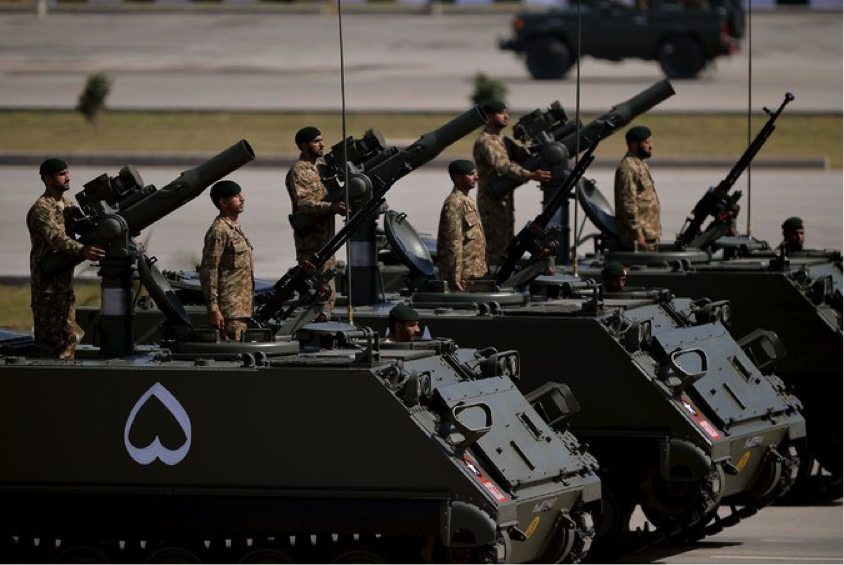
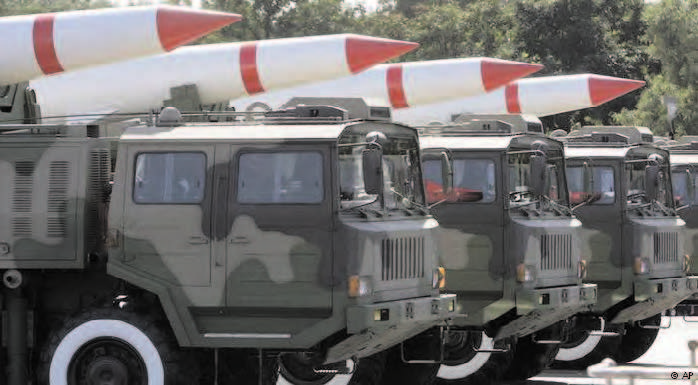
    Pakistan, with the world’s fastest-growing nuclear arsenal, is unquestionably the biggest concern, one reinforced by several recent developments. Last week, Pakistan’s prime minister, Nawaz Sharif, announced that he had approved a new deal to purchase eight diesel-electric submarines from China, which could be equipped with nuclear missiles, for an estimated $5 billion. Last month, Pakistan test-fired a ballistic missile that appears capable of carrying a nuclear warhead to any part of India. And a senior adviser, Khalid Ahmed Kidwai, reaffirmed Pakistan’s determination to continue developing short-range tactical nuclear weapons whose only purpose is use on the battlefield in a war against India.

    These investments reflect the Pakistani Army’s continuing obsession with India as the enemy, a rationale that allows the generals to maintain maximum power over the government and demand maximum national resources. Pakistan now has an arsenal of as many as 120 nuclear weapons and is expected to triple that in a decade. An increase of that size makes no sense, especially since India’s nuclear arsenal, estimated at about 110 weapons, is growing more slowly. 

    The two countries have a troubled history, having fought four wars since independence in 1947, and deep animosities persist. Prime Minister Narendra Modi of India has made it clear that Pakistan can expect retaliation if Islamic militants carry out a terrorist attack in India, as happened with the 2008 bombing in Mumbai. But the latest major conflict was in 1999, and since then India, a vibrant democracy, has focused on becoming a regional economic and political power.

    At the same time, Pakistan has sunk deeper into chaos, threatened by economic collapse, the weakening of political institutions and, most of all, a Taliban insurgency that aims to bring down the state. Advanced military equipment — new submarines, the medium-range Shaheen-III missile with a reported range of up to 1,700 miles, short-range tactical nuclear weapons — are of little use in defending against such threats. The billions of dollars wasted on these systems would be better spent investing in health, education and jobs for Pakistan’s people.

    Even more troubling, the Pakistani Army has become increasingly dependent on the nuclear arsenal because Pakistan cannot match the size and sophistication of India’s conventional forces. Pakistan has left open the possibility that it could be the first to use nuclear weapons in a confrontation, even one that began with conventional arms. Adding short-range tactical nuclear weapons that can hit their targets quickly compounds the danger.

    Pakistan is hardly alone in its potential to cause regional instability. China, which considers Pakistan a close ally and India a potential threat, is continuing to build up its nuclear arsenal, now estimated at 250 weapons, while all three countries are moving ahead with plans to deploy nuclear weapons at sea in the Indian Ocean.

    This is not a situation that can be ignored by the major powers, however preoccupied they may be by the long negotiations with Iran.

  • MOODY’S UPGRADES INDIA RATING OUTLOOK TO POSITIVE

    MOODY’S UPGRADES INDIA RATING OUTLOOK TO POSITIVE

    MUMBAI (TIP): Moody’s ratings revised India’s sovereign rating outlook to “positive” from “stable” on Thursday as it expects the actions by policymakers will enhance the country’s economic strength in the medium term.

    Moody’s also said that it expected structural advantages, supported by relatively benign commodity prices and liquidity conditions globally, will keep India’s growth above its peers over the rating horizon.

    The outlook revision was announced before Indian markets opened on Thursday. Analysts said they expected bank stocks to rise and the rupee to strengthen on the upgrade.

    The investor-friendly Narendra Modi government, which came to power last May promising faster growth, more jobs and quick clearances, has taken measures to fast-track clearances for investment projects, boost infrastructure investment and remove policy uncertainty in mining and coal sectors.

    The government has also relaxed foreign investments in sectors such as defence, insurance, e-commerce, railways and eased steps to allow businesses to acquire land and set up factories.

    “India’s policymakers are establishing a framework that will likely allow India’s growth to continue to outperform that of its peers over medium term and improve India’s macro-economic, infrastructure and institutional profile,” Moody’s said in its statement. However, Moody’s stopped short of raising the sovereign credit rating due to relative weakness in fiscal, inflation, infrastructure and poor asset quality among Indian banks.

    Constrained credit profile 

    “Recurrent inflationary pressures, occasional balance of payments pressures, and an uncertain regulatory environment have contributed to periods of volatility in growth, and have exposed India to external and financial shocks, constraining its credit profile,” Moody’s said.

    Moody’s has a Baa3 rating on India 

    After a recent revision in the methodology of measuring gross domestic product, which raised a lot of scepticism from policymakers including government and central bank officials, India registered growth of 7.5 per cent in the December quarter, higher than China’s.

    Under this new method, the Reserve Bank of India expects India to growth at 7.8 per cent for 2015/16, lower than the government’s estimate of 8.0-8.5 per cent.

    The government has been pitching to rating agencies to improve India’s credit rating, citing reforms, and on Thursday officials were to quick to welcome Moody’s improved outlook.

    “Upgrade of outlook proves government is moving in the right direction … it validates India’s commitment on fiscal discipline,” India’s chief economic adviser Arvind Subramanian said on news channel CNBC TV18.

  • Alarm bells for India? China plans to build rail link with Nepal through Mt Everest

    Alarm bells for India? China plans to build rail link with Nepal through Mt Everest

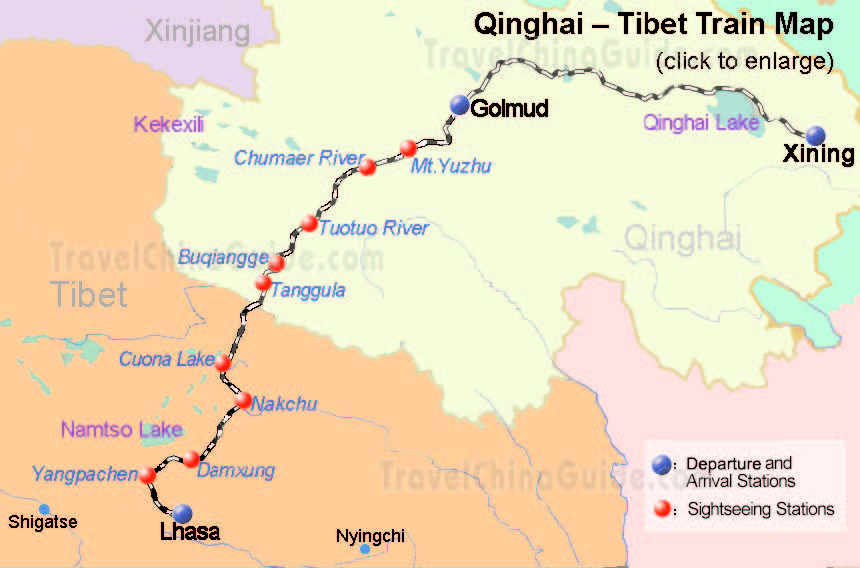
    BEIJING (TIP): China is planning to build a tunnel under Mount Everest, called Qomolangma in Tibetan, as part of its plan to extend its rail link to Nepal, the state run China Daily said on April 9.

    “The line will probably have to go through Qomolangma so that workers may have to dig some very long tunnels,” railway expert Wang Mengshu told China Daily.

    He said that the changes in elevation along the line were remarkable and added that the speed of trains on the proposed Nepal line would be restricted at 120 km per hour because of the difficult mountain terrain.

    China picking major infrastructure deals in Nepal

    This is the first time a tunnel plan has been revealed to reach Nepal. China had earlier discussed extending the Qinghai-Lhasa line to the Nepalese border without digging a tunnel.

    Sources said the idea was to find a short route to Nepal for accessing the vast Indian market. Besides, China might be trying to involve Nepal for its Bangladesh-China-India-Myanmar (BCIM) project because New Delhi has shown little enthusiasm for this corridor, sources said.

    “If the proposal becomes a reality, bilateral trade, especially in agricultural products, will get a strong boost, along with tourism and people-to-people exchange,” Wang said.

    The Nepal rail project, which has been taken up at Kathmandu’s request, will be completed by 2020, China Daily quoted a Tibetan official as saying. The project was discussed during the visit of Chinese foreign minister Wang Yi to Kathmandu in December, according to Nepalese reports.

    In August last year, China completed a 253-km long railway line extending the Lhasa line to Xigaze, the second biggest city of Tibet which is closer to the Nepalese border.

    In another move involving India’s neighborhood, China is likely to sign a deal to help Pakistan build a natural gas pipeline to Iran. The contract is expected to be signed during president Xi Jinping’s upcoming visit to Islamabad.

  • Saina Nehwal is World No. 1 badminton player

    Saina Nehwal is World No. 1 badminton player

    NEW DELHI (TIP): Indian ace Saina Nehwal’s ascent to the top of women’s badminton was
    officially confirmed on Thursday, April 2, with the release of the latest rankings by the game’s international governing body.

    In becoming the first Indian woman shuttler to attain the number one spot in world rankings, Saina took over the reins from China’s Li Xuerui, who slipped to third with Spain’s Carolina Marin claiming the second position.

    Saina, who had clinched the India Open Super Series title on March 29, was already assured of the top spot after her closest challenger for the position, Carolina, lost in the semifinals.

    Saina thus becomes only the second Indian overall to be world number one after Prakash Padukone had the distinction of being the numero uno men’s badminton player.

    Rising women’s shuttler PV Sindhu held her ninth position.

    Saina, who shuttled past former world champion Ratchanok Intanon of Thailand 21-16, 21-14 in the summit clash at the Siri Fort Sports Complex had said: “I think the consistency with which I am playing is great. I reached three finals in last two months and it is not easy.””Titles makes me hungry. Next I hope to win more and more titles, I hope to be fit and injury free. This result will motivate me to win more titles.”

    The London Olympic bronze-medallist has won a staggering 14 international titles in her glorious career and most recently became the first Indian woman to make the finals of the prestigious All England Championships in Manchester.

    In the men’s category, India Open Super Series winner Kidambi Srikanth stayed at the fourth spot with China’s Chen Long leading the rankings chart.

  • PFIZER TO SHUTTER VACCINES SALES BUSINESS IN CHINA

    PFIZER TO SHUTTER VACCINES SALES BUSINESS IN CHINA

    SHANGHAI (TIP): US drugmaker Pfizer Inc said it would cease its vaccines sales operations in China after an import licence for one of its top-selling treatments, the only vaccine it sold in the country, was not renewed.

    A Pfizer spokeswoman declined to say why the Chinese import licence for Prevenar, an anti-bacterial treatment, had not been renewed. The China Food and Drug Administration regulatory agency could not immediately be reached for comment.

    The move comes as drugmakers face growing difficulties obtaining approvals for medicines in China, the world’s No. 2 drug market, where pharmaceutical executives say over-stretched regulators have added more red tape to the process of bringing drugs to market.

    “Based on a careful assessment of this situation, we have decided to cease our vaccines commercial operations in China at this time, effective immediately,” Pfizer spokeswoman Trupti Wagh said in comments emailed to Reuters.

    Prevenar is the only vaccine Pfizer sells in China, and the move doesn’t affect its other operations in the country.

    Strong growth in China sales of drugs including Prevenar helped Pfizer offset weaker global revenue growth last year.

    Pfizer’s vaccines sales team has around 200 staff and “most colleagues will be impacted”, Wagh added. Pfizer has over 9,000 employees in China, according to its website, working in business segments including research and development, prescription drugs and consumer health products.

    China’s fast-growing healthcare market is a magnet for global drugmakers, medical device firms and hospital operators, all keen to get a slice of a medical bill estimated to hit $1 trillion by 2020. Drug spending alone is set to hit $185 billion by 2018, according to IMS Health.

    However, China’s drug approval backlog jumped a third last year, authorities said earlier this month, reflecting rising industry concern that it is getting harder to get medicines approved.

    Wagh said Pfizer would work with Chinese regulators to bring Prevenar 13 – an updated version of the vaccine -to market at some point in future, although she added there was no clear timeframe for this.

    Pfizer’s global revenues from the Prevenar family of products, which includes Prevenar, was $4.5 billion last year, up 12 percent against 2013, the firm said in its annual report. This included “strong operational growth” in China.

    Prevenar is used to help prevent pneumococcal disease, a bacterial infection which can lead to illnesses such as pneumonia, meningitis and sepsis, according to the National Foundation for Infectious Diseases. It is the only vaccine approved to treat children under two years-old for the condition in China, Pfizer’s Wagh said.

    The World Health Organization estimates there were around 14.5 million cases of serious pneumococcal disease in 2000, resulting in nearly 1 million deaths of young children.

  • US commander accuses China of creating artificial landmass in South China Sea

    BEIJING: A US navy commander has accused China of creating an “artificial landmass” in the disputed waters of the South China Sea.

    “China is building artificial land by pumping sand on to live coral reefs — some of them submerged — and paving over them with concrete. China has now created over 4 sq km (1.5 sq miles) of artificial landmass,” US Pacific Fleet Commander Admiral Harry Harris said in a speech in Australia. Harris said the move has raised “serious questions” about China’s intensions. He said China was pumping vast amounts of sand and concrete to create a “Great Wall of sand” and fake islands.

    Harris added it was endangering the environment because the sand was being poured on live corals. He described the move as part of a “pattern of provocative actions towards smaller claimant states” in the South China Sea.

    Observers said the creation of new landmass near the disputed islands would strengthen China’s claims over them. China’s foreign ministry spokeswoman Hua Chunying had earlier said the country’s operations in the disputed Spratly Islands fell “entirely within China’s sovereignty and are totally justifiable”.

  • Pakistan close to buying eight Chinese submarines: Financial Times

    BEIJING (TIP): Pakistan is close to signing a $4 to $5 billion deal to buy eight submarines from China, the Financial Times said on April 2, in what it added would likely be China’s largest overseas arms sale.

    The decision had been agreed “in principle”, the newspaper said, citing a hearing in the Pakistani parliament’s defence committee.

    Pakistani newspaper the Dawn said on Wednesday that negotiations with China on the sale were at an advanced stage.

    Neither China’s Defence nor Foreign Ministries immediately responded to a request for comment.

    China and Pakistan call each other “all-weather friends” and their close ties have been underpinned by long-standing wariness of their common neighbour, India, and a desire to hedge against U.S. influence across the region.

    China and Pakistan already have close defence ties and China has sold a large amount of military equipment to the country in the past.

  • By 2050, Hindus will become the world’s third largest population: Study

    By 2050, Hindus will become the world’s third largest population: Study

    WASHINGTON (TIP): Hindus will become the world’s third largest population by 2050, while India will overtake Indonesia as the country with the largest Muslim population according to a new study. According to the Pew Research Center’s religious profile predictions assessed data released on Thursday, the Hindu population is projected to rise by 34 per cent worldwide, from a little over 1 billion to nearly 1.4 billion by 2050.

    By 2050, Hindus will be third, making up 14.9 per cent of the world’s total population, followed by people who do not affiliate with any religion, accounting for 13.2 per cent, the report said.

    The people with no religious affiliation currently have the third largest share of the world’s total population.

    Muslims are projected to grow faster than the world’s overall population and that Hindus and Christians are projected to roughly keep pace with worldwide population growth, the report said.

    “India will retain a Hindu majority but also will have the largest Muslim population of any country in the world, surpassing Indonesia,” it said.

    “Over the next four decades, Christians will remain the largest religious group, but Islam will grow faster than any other major religion,” according to the report.

    The report predicted that by 2050 there will be near parity between Muslims (2.8 billion, or 30 per cent of the population) and Christians (2.9 billion, or 31 per cent), possibly for the first time in history.

    There were 1.6 billion Muslims in 2010, compared to 2.17 billion Christians.

    “The number of Muslims will nearly equal the number of Christians around the world,” it added.

    If the trend continues, Islam will be the most popular faith in the world after 2070, it said.

    By 2050, Muslims will make up about 10 per cent of the Europe’s population, up from 5.9 per cent in 2010.

    Over the same period, the number of Hindus in Europe is expected to roughly double, from a little under 1.4 million (0.2 per cent of Europe’s population) to nearly 2.7 million (0.4 per cent), mainly as a result of immigration, it said.

    In North America, the Hindu share of the population is expected to nearly double in the decades ahead, from 0.7 per cent in 2010 to 1.3 per cent in 2050, when migration is included in the projection models. Without migration, the Hindu share of the region’s population would remain the same.

    Buddhism is the only faith that is not expected to increase its followers, due to an ageing population and stable fertility rates in Buddhist countries, such as China, Japan and Thailand.

    The projections considered fertility rates, trends in youth population growth and religious conversion statistics.

  • US targets overseas cyber attackers with new sanctions program

    US targets overseas cyber attackers with new sanctions program

    WASHINGTON (TIP): The Obama administration on April 1 launched the first-ever sanctions program to financially punish individuals and groups outside the United States that are engaged in malicious cyber attacks.

    US President Barack, in an executive order, declared such activities a “national emergency” and allowed the US Treasury to freeze the assets and bar other financial transactions of entities engaged in cyber attacks.

    Under the program, first reported by the Washington Post, cyber attackers or those who conduct commercial espionage in cyberspace can be listed on the official sanctions list of specially designated nationals, a deterrent long-sought by the cyber community.

    The move, which the paper said has been in development for two years, comes after a string of high-profile cyber attacks ranging from corporate hacks targeting Target, Home Depot and other retailers, to an attack on Sony and other data breaches.

    Subjecting cyber criminals, companies that benefit from commercial espionage and even foreign intelligence operatives, to tough financial sanctions could have a “momentous” effect in deterring the growing number of cyber attacks seen daily on US networks, said Dmitri Alperovitch, chief technology officer of Crowdstrike, a cybersecurity firm.

    “Today, the White House is making yet another huge leap forward in the effort to raise the cost to our cyber adversaries and establish a more effective deterrent framework to punish actors engaged in serious intentional destructive or disruptive attacks,” Alperovitch wrote in a blog posted on the company’s website.

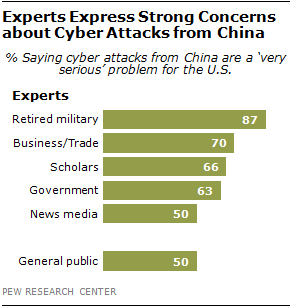
    The executive order gives the administration the same sanctions tools it now deploys to address other threats -including crises in the Middle East and Russia’s aggression in Ukraine – and makes them available for less visible cyber threats. The program could prompt a strong reaction from China. Cybersecurity has been a significant irritant in US-China ties, with US investigators saying hackers backed by the Chinese government have been behind attacks on US companies, and China rejecting the charges.

    Obama has moved cybersecurity toward the top of his 2015 agenda after recent breaches, and last month, the Central Intelligence Agency announced a major overhaul aimed in part at sharpening its focus on cyber operations.

  • China excited about India’s visa-on-arrival plan

    BEIJING (TIP): China’s government and the tourism industry are both excited about the prospects of India offering visa-on-arrival facility to Chinese tourists. Industry sources said this will result in more than doubling the number of Chinese tourists visiting India.

    “Many Chinese are put off by complicated visa procedures. If visa on arrival is introduced it will double the number of visitors from China to India,” Liang Yaofeng, managing director of Beijing Nimbus International Travel Service, told TOI.

    Both India and China have introduced visa on arrival for a section of world travelers. But they have not extended the facility for travelers from each other’s countries. Some observers think Prime Minister Narendra Modi would make an announcement about extending VOA for Chinese tourists during his forthcoming visit to Beijing in May.

    “We welcome this,” Chinese foreign ministry spokeswoman Hua Chunying said when asked about an India move to offer the VOA facility for the world’s biggest travelers, the Chinese tourists.

    But Hus hedged her bets when asked if China would make a reciprocal gesture towards Indian tourists if New Delhi opted for the VOA scheme for Chinese visitors.

    “We are willing to work with the Indian side to facilitate the personal exchanges between the two countries and promote mutual understanding and mutual trust between two people and lay solid foundation for the bilateral cooperation,” she said. Indian businesses connected with tourism in China feel that VOA scheme will be a major success.

  • SMART MOVES – Modi Government on US & China

    SMART MOVES – Modi Government on US & China

    [vc_row][vc_column][vc_column_text]

    “The Modi government will face the test of managing closer strategic relations with the US, which are in part directed against China, and forging closer ties with China that go against this strategic thrust, besides the reality that China has actually stronger ties with the US than it can ever have with India, though the underlying tensions between the two are of an altogether different order than between India and the US.”


    [/vc_column_text][/vc_column][/vc_row][vc_row][vc_column width=”1/2″][vc_column_text]

    [quote_box_center]China[/quote_box_center] 

    Prime Minister Modi has been quick to court both US and China. His first overtures were to China, prompted no doubt by his several visits there as Chief Minister of Gujarat, Chinese investments in his home state and his general admiration for China’s economic achievements. Beyond this personal element, many in the government and corporate sectors in India believe that our politically contentious issues with China, especially the unresolved border issue, should be held in abeyance and that economic cooperation with that country should be expanded, as India can gain much from China’s phenomenal rise and the expertise it has developed in specific sectors, especially in infrastructure. It is also believed that China, which is now sitting over $4 trillion of foreign exchange reserves, has huge surplus resources to invest and India should actively tap them for its own developmental needs. In this there is continuity in thinking and policy from the previous government, with Modi, as is his wont, giving it a strong personal imprint.

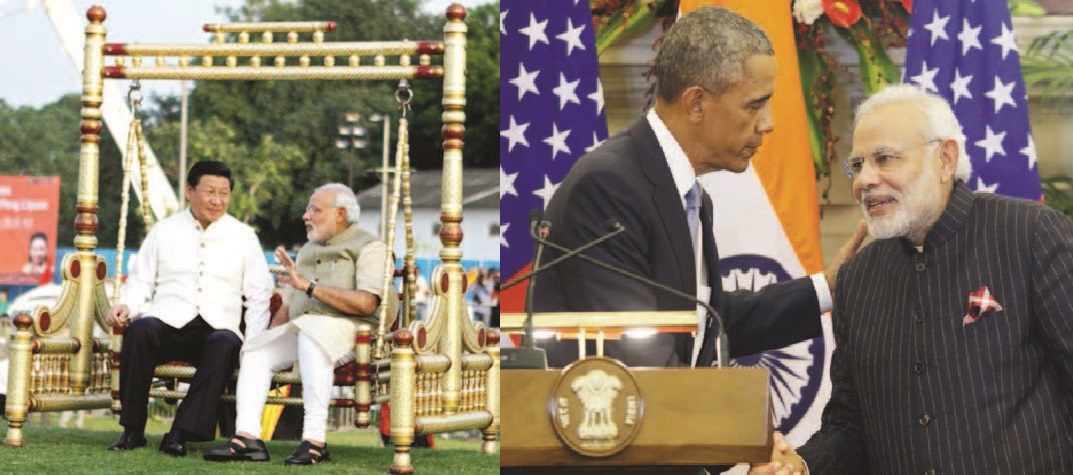
    The first foreign dignitary to be received by Modi after he became Prime Minister was the Chinese Foreign Minister, representing the Chinese President. This was followed by up by his unusually long conversation on the telephone with the Chinese Prime Minister. Our Vice-President was sent to Beijing to celebrate the 60th anniversary of the Panchsheel Agreement even though China has blatantly violated this agreement and India’s high level diplomatic endorsement of it only bolsters Chinese diplomacy, especially in the context of China-created tensions in the South China and East China Seas. Modi had occasion to meet President Xi Jinxing in July at the BRICS summit in July 2014, and this was followed up by the Chinese President’s state visit to India in September 2014, during which the Prime Minister made unprecedented personal gestures to him in an informal setting in Ahmedabad.

    The dramatics of Modi’s outreach to the Chinese aside, his objectives in strengthening economic ties with China, essentially imply a consolidation of the approach followed in the last decade or so, with some course correction here and there. In this period, China made very significant headway in our power and telecom sectors, disregarding obvious security concerns associated with China’s cyber capabilities and the links of Chinese companies to the Chinese military establishment. Many of our top companies have tapped Chinese banks and financial institutions for funds, and this has produced a pro-Chinese corporate lobby in our country. This lobby will obviously highlight the advantages of economic engagement over security concerns. The previous Prime Minister followed the approach of emphasizing shared interests with China rather than highlighting differences. The position his government took on the Depsang incident in May 2013 showed his inclination to temporize rather than confront. Externally, he took the line, which Chinese leaders repeated, that the world is big enough for India and China to grow, suggesting that he did not see potential conflict with China for access to global markets and resources. Under him, India’s participation in the triangular Russia-India-China format (RIC) and the BRICS format continued, with India-originated proposal for a BRICS Development Bank eventually materializing. Indian concerns about the imbalance in trade were voiced, but without any action by China to redress the situation. India sought more access to the Chinese domestic market for our competitive IT and pharmaceutical products, as well as agricultural commodities, without success. Concerns about cheap Chinese products flooding the India market and wiping out parts of our small-scale sector were voiced now and then, but without any notable remedial steps. The Strategic Economic Dialogue set up with China, which focused primarily on the railway sector and potential Chinese investments in India, did not produce tangible results.

    The Manmohan Singh government, despite China’s aggressive claims on Arunachal Pradesh and lack of progress in talks between the Special Representatives on the boundary issue as well as concerns about China’s strategic threats to our security flowing from its policies in our neighborhood, especially towards Pakistan and Sri Lanka, declared a strategic and cooperative partnership with that country. During Manmohan Singh’s visit to China in September 2013, we signed on to some contestable formulations, as, for example, the two sides committing themselves to taking a positive view of and supporting each other’s friendship with other countries, and even more surprisingly, to support each other enhancing friendly relations with their common neighbors for mutual benefit and win-win results. This wipes off on paper our concerns about Chinese policies in our neighborhood. We supported the BCIM (Bangladesh, China, India, Myanmar) Economic Corridor, including people to people exchanges, overlooking Chinese claims on Arunachal Pradesh and the dangers of giving the Chinese access to our northeast at people to people level. The agreement to carry out civil nuclear cooperation with China was surprising, as this makes our objections to China-Pakistan nuclear ties politically illogical. We also agreed to enhance bilateral cooperation on maritime security, which serves to legitimize China’s presence in the Indian Ocean when China’s penetration into this zone poses a strategic threat to us.

    As a mark of continuity under the Modi government, during President Xi Jinxing’s September 2014 visit to India, the two sides agreed to further consolidate their Strategic and Cooperative Partnership, recognized that their developments goals are interlinked and that their respective growth processes are mutually reinforcing. They agreed to make this developmental partnership a core component of their Strategic and Cooperative Partnership. The India-China Strategic Economic Dialogue was tasked to explore industrial investment and infrastructure development.

    To address the issue of the yawning trade imbalance, measures in the field of pharmaceuticals, IT, agro-products were identified and a Five-Year Development Program for economic and Trade Cooperation to deepen and balance bilateral trade engagement was signed. Pursuant to discussions during the tenure of the previous government, the Chinese announced the establishment of two industrial parks in India, one in Gujarat and the other in Maharashtra, and the “Endeavour to realize” an investment of US $ 20 billion in the next five years in various industrial and infrastructure development projects in India, with production and supply chain linkages also in view. In the railway sector, the two sides the two sides agreed to identify the technical inputs required to increase speed on the existing railway line from Chennai to Mysore via Bangalore, with the Chinese side agreeing to provide training in heavy haul for 100 Indian railway officials and cooperating in redevelopment of existing railway stations and establishment of a railway university in India. The Indian side agreed to actively consider cooperating with the Chinese on a High Speed Rail project. In the area of financial cooperation, the Indian side approved in principle the request of the Bank of China to open a branch in Mumbai.

    The Modi government has agreed to continue defense contacts, besides holding the first round of the maritime cooperation dialogue this year, even though by engaging India in this area it disarms our objections to its increasing presence in the Indian Ocean area, besides drawing negative attention away from its policies in the South China Sea as well as projecting itself as a country committed to maritime cooperation with reasonable partners. The joint statement issued during Xi Jinxing’s visit omitted any mention of developments in western Pacific, though it contained an anodyne formulation on Asia-Pacific. This becomes relevant in view of the statements on Asia-pacific and the Indian Ocean region issued during President Obama’s visit to India in January 2015.

    Our support, even if tepid, continues for the BCIM Economic Corridor. On our Security Council permanent membership, China continues its equivocal position, stating that it “understands and supports India’s aspiration to play a greater role in the United Nations including in the Security Council”. It is careful not to pronounce support for India’s “permanent membership”. During Foreign Minister Sushma Swaraj’s visit to China for the RIC Foreign Ministers meeting, China has maintained its equivocation, although the press has wrongly presented the formulation as an advance. China is openly opposed to Japan’s candidature in view of the sharp deterioration of their ties. In India’s case, it avoids creating a political hurdle to improved ties by openly opposing India’s candidature. “A greater role” could well mean a formula of immediately re-electable non-permanent members, of the kind being proposed by a former UN Secretary General and others.

    On counter-terrorism lip service is being paid to cooperation. On Climate Change, the two countries support the principle of “equity, common but differentiated responsibilities and respective capabilities”, although the US-China agreement on emission reduction targets has created a gap in Indian and Chinese positions, with the Modi government deciding to delink itself from China in international discussions to follow.

    In diplomacy, once concessions or mistakes are made, retrieval is very difficult unless a crisis supervenes. The Modi government, for reasons that are not too clear, repeated the intention of the two countries to carry out bilateral cooperation in civil nuclear energy in line with their respective international commitments, which has the unfortunate implication of India circumscribing its own headroom to object to the China-Pakistan nuclear nexus, besides the nuance introduced that China is observing its international commitments in engaging in such cooperation. The calculation that this might make China more amenable to support India’s NSG membership may well prove to be a mistaken one. Surprisingly, stepping back from the Manmohan government’s refusal towards the end to make one-sided statements in support of China’s sovereignty over Tibet when China continues to make claims on Indian territory, the new government yielded to the Chinese ruse in making us thank the “Tibetan Autonomous Region of the People’s Republic of China” as well as the Chinese Ministry of Foreign Affairs – as if both are independent of the Chinese government- for facilitating the Kailash Mansarovar Yatra and opening the new route through Nathu La, even though this is not the  most rational route because it involves a far longer journey, made easier of course by much better infrastructure. On receiving the flood season hydrological date the Chinese have stuck to their minimalist position.

    On the sensitive border issue, the disconnect between the joint statement which repeats the usual cliches and the serious incident in Chumar coinciding with Xi’s visit was obvious. China’s double game of reaching out to India- with greater confidence now as the gap between it and India has greatly widened and it has begun to believe that India now needs China for its growth and development goals- and staging a provocation at the time of a high level visit, continues. This is a way to remind India of its vulnerability and the likely cost of challenging China’s interests, unmindful that its conduct stokes the already high levels of India’s distrust of that country. It went to Modi’s credit that he raised the border issue frontally with XI Jinping at their joint press conference, expressing “our serious concern over repeated incidents along the border” and asking that the understanding to maintain peace and tranquility on the border “should be strictly observed”. He rightly called for resuming the stalled process of clarifying the Line of Actual Control (LAC). While this more confident approach towards China is to be lauded, we are unable to persuade China to be less obdurate on the border issue because we are signaling our willingness to embrace it nonetheless virtually in all other areas.

    That Modi mentioned “India’s concerns relating to China’s visa policy and Trans Border Rivers” while standing alongside Xi Jinping at the joint press conference indicated a refreshing change from the past in terms of a more open expression of India’s concerns. With regard to Bangladesh-China-India-Myanmar Economic Corridor that China is pushing hard, Modi rightly added a caveat by declaring that “our efforts to rebuild physical connectivity in the region would also require a peaceful, stable and cooperative environment”. He also did not back another pet proposal of Xi: the Maritime Silk Road, which is a re-packaged version of the notorious “string of pearls” strategy, as the joint statement omits any mention of it.

    Even as Modi has been making his overall interest in forging stronger ties with China clear, he has not shied away from allusions to Chinese expansionism, not only on Indian soil but also during his visit to Japan. After President Obama’s visit to India and the joint statements on South China Sea and Asia-Pacific issued on the occasion which can be construed as directed at China, Foreign Minister Sushma Swaraj’s recent visit there acquired more than normal interest in watching out for indications of China’s reaction. Her call on Xi Jinping was projected, quite wrongly, as going beyond normal protocol, when in actual fact the Chinese Foreign Minister gets access to the highest levels in India during visits. Swaraj seems to have pushed for an early resolution of the border issue, with out-of-the-box thinking between the two strong leaders that lead their respective countries today. Turning the Chinese formulation on its head, she called for leaving a resolved border issue for future generations.

    That China has no intention to look at any out-of-the-box solution- unless India is willing to make a concession under cover of “original thinking”- has been made clear by the vehemence of its reaction to Modi’s recent visit to Arunachal Pradesh to inaugurate two development projects on the anniversary of the state’s formation in 1987. It has fulminated over the Modi visit over two days, summoning the Indian Ambassador to lodge a protest, inventing Tibetan names for sub-divisions within Arunachal Pradesh to mark the point that this area has been under Tibetan administrative control historically. The Chinese Vice-Foreign Minister arrogantly told our Ambassador that Modi’s visit undermined “China’s territorial sovereignty, right and interests” and “violates the consensus to appropriately handle the border issue.” China is making clear that it considers Arunachal Pradesh not “disputed territory” but China’s sovereign territory. It is also inventing a non-existent “consensus” that Indian leaders will not visit Arunachal Pradesh to respect China’s position. There is a parallel between China’s position on the Senkakus where it accuses the Japanese government to change the status quo and inviting a Chinese reaction, and its latest broadside against India. This intemperate Chinese reaction casts a shadow on Modi’s planned visit to China in May and next round of talks between the Special Representatives (SRs) on the boundary question. If without a strong riposte these planned visits go ahead we would have allowed the Chinese to shift the ground on the outstanding border issue even more in their favor. It would be advisable for our Defense Minister to visit Tawang before Modi’s visit. A very categorical enunciation of our position that goes beyond previous formulations should be made by the Indian side. The Chinese position makes the SR talks pointless, as the terms of reference China is laying down cannot be agreed to by our side.

    [/vc_column_text][/vc_column][vc_column width=”1/2″][vc_column_text]

    [quote_box_center]UNITED STATES[/quote_box_center] 

    Prime Minister Modi, contrary to expectations, moved rapidly and decisively towards the US on assuming office. He confounded political analysts by putting aside his personal pique at having been denied a visa to visit the US for nine years for violating the US law on religious freedoms, the only individual to be sanctioned under this law. The first foreign visit by Modi to be announced was that to the US. Clearly, he believes that strong relations with the US gives India greater strategic space in foreign affairs and that its support is crucial for his developmental plans for India.

    To assess the Modi government’s policies towards the US, the results of his visit to Washington in September 2014 and that of Obama to India in January 2015 need to be analyzed, keeping in mind the approach of the previous government and the element of continuity and change that can be discerned.

    The joint statement issued during his US visit set out the future agenda of the relationship, with some goals clearly unachievable, but the ambitions of the two countries were underscored nonetheless. It was stated that both sides will facilitate actions to increase trade five-fold, implying US-China trade levels, which is not achievable in any realistic time-frame. They pledged to establish an Indo-US Investment Initiative and an Infrastructure Collaboration Platform to develop and finance infrastructure. An agreement on the Investment Initiative was signed in Washington prior to Obama’s visit to India, but bringing about capital reforms in India, which the Initiative aims at, is not something that can be realized quickly. India wants foreign investment in infrastructure and would want to tap into US capabilities in this broad sector, but the US is not in the game of developing industrial corridors like Japan or competitively building highways, ports or airports. Cooperation in the railway sector was identified, but it can only be in some specific technologies because this is the field in which Japan and China are competing for opportunities in India, whether by way of implementing high speed freight corridors or building high speed train networks in the country. India offered to the U.S. industry lead partnership in developing three smart cities, even if the concept of smart cities is not entirely clear. Some preliminary steps seem to have been taken by US companies to implement the concept. The decision to establish an annual high-level Intellectual Property (IP) Working Group with appropriate decision-making and technical-level meetings as part of this Forum was done at US insistence as IPR issues are high on the US agenda in the context of contentious issues that have arisen between the US companies and the Indian government on patent protection, compulsory licensing and local manufacturing content requirements.

    In his joint press briefing with Obama, Modi raised IT related issues, pressing Obama’s support  “for continued openness and ease of access for Indian services companies in the US market”, without obtaining a reaction from  the latter then or later when Obama visited India. On the food subsidy versus trade facilitation stand off in the WTO, Modi maintained his position firmly and compelling the US to accept a compromise. Modi’s firmness on an issue of vital political importance to India showed that he could stand up to US pressure if the country’s interest so demanded. He welcomed “the US defense companies to participate in developing the Indian defense industry”, without singling out any of the several co-development and co-production projects offered by the US as part of the Defense Technology and Trade Initiative (DTTI). Clearly, it was too early to conclude discussions on the US proposals before his September visit.

    The more broad based reference in the joint statement to India and the US intending to expand defense cooperation to bolster national, regional and global security was, on the contrary, rather bold and ambitious, the import of which became clearer during Obama’s January visit. While bolstering such cooperation for national security makes sense, regional security cannot be advanced together by both countries so long as the US continues to give military aid to Pakistan, which it is doing even now by issuing presidential waivers to overcome the provisions of the Kerry-Lugar legislation that requires Pakistan to act verifiably against terrorist groups on its soil before the aid can be released. As regards India-US defense cooperation bolstering global security, securing the sea lanes of communication in the Indian Ocean and the Asia-Pacific region is the obvious context. It was decided to renew for 10 years more the 2005 Framework for US-India Defense Relations, with defense teams of the two countries directed to “develop plans” for more ambitious programs, including enhanced technology partnerships for India’s Navy, including assessing possible areas of technology cooperation.

    The US reiterated its commitment to support India’s membership of the four technology control regimes: the Nuclear Suppliers Group (NSG), the Missile Technology Control Regime (MTCR), the Wassenaar Agreement and the Australia Group, with Obama noting that India met MTCR requirements and is ready for NSG membership, but without setting any time-tables. An actual push by the US in favor of India’s membership has been lacking because of issues of nuclear liability and administrative arrangements have remained unresolved until now and the US has wanted to use their resolution as a leverage. US support for India’s membership of these export control organizations was reiterated during Obama’s January visit, but how quickly the US will move remains unclear even after the political resolution of outstanding nuclear issues.

    The US at one time described India as a lynchpin of its pivot or rebalance towards Asia. The underlying motivation behind the pivot and US interest in drawing India into this strategy is China, though this is not stated publicly in such open terms. India has been cautious about the US pivot towards Asia as its capacity and willingness to “contain” Chinese power has been doubted because of the huge financial and commercial interdependence forged between the two countries. India seeks stable and economically productive relations with China and has wanted to avoid the risk of being used by the US to serve its China strategy that raises uncertainties in the mind of even the US allies in Asia. However, under the Modi government, India has become more affirmative in its statements about the situation in the western Pacific and the commonalities of interests between India and the US and other countries in the Indo-Pacific region. The government has decided to “Act East”, to strengthen strategic ties with Japan and Australia, as well as Vietnam, conduct more military exercises bilaterally with the US armed forces as well as naval exercises trilaterally with Japan. Modi has spoken publicly about greater India-US convergences in the Asia-Pacific region, to the point of calling the US  intrinsic to India’s Act East and Link West policies, a bold formulation in its geopolitical connotations never used before that suggested that India now viewed the US as being almost central to its foreign policy initiatives in both directions.

    On  geopolitical issues, India showed strategic boldness in the formulations that figured in the September joint statement. These laid the ground for more robust demonstration of strategic convergences between the two countries during Obama’s visit later. The reference in September to the great convergence on “peace and stability in the Asia Pacific region” was significant in terms of China’s growing assertiveness there. The joint statement spoke of a commitment to work more closely with other Asia Pacific countries, including through joint exercises, pointing implicitly to Japan and Australia, and even Vietnam. In this context, the decision to explore holding the trilateral India-US-Japan dialogue at Foreign Minister’s level- a proposition that figured also in the India-Japan joint statement during Modi’s visit there- was significant as it suggested an upgrading of the trilateral relationship at the political level, again with China in view.

    On the issue of terrorism and religious extremism, India and the US have rhetorical convergence  and some useful cooperation in specific counter-terrorism issues, but, on the whole, our concerns are  inadequately met because US regional interests are not fully aligned with those of India. The September joint statement called for the dismantling of safe havens for terrorist and criminal networks and disruption of all financial and tactical support for networks such as Al Qaeda, Lashkar-e-Taiba, Jaish-e-Mohammad, the D-company and the Haqqanis, but the Taliban were conspicuously omitted from the list. In any case, such statements against Pakistan-based terrorist groups have been made before but are ignored  by Pakistan in the absence of any real US pressure on it to curb Hafiz Saeed or credibly try Lakhvi despite repeated joint calls for bringing those responsible for the Mumbai terrorist massacre to justice.

    We had a paragraph on Iran in the joint statement in Washington, clearly at US insistence, which the Iranians would have noted with some displeasure. The Modi government is also willing to accommodate the US on Iran within acceptable limits. While the US supports India’s permanent membership of the UN Security Council, the support remains on paper as the US is not politically ready to promote the expansion of the Council.

    At Washington, India and the US agreed on an enhanced strategic partnership on climate change issues, and we committed ourselves to working with the US to make the UN Conference on Climate Change in Paris in December this year a success. This carried the risk of giving a handle to the US to ratchet up pressure to obtain some emission reduction commitments from India, encouraged  diplomatically by the US-China agreement.

    The unusually strong personal element in Modi’s diplomacy towards the US came apparent when during his Washington visit he invited Obama to be the chief guest at our Republic Day on January 26, 2015- a bold and imaginative move characteristic of his style of functioning. That this unprecedented invitation was made was surprising in itself, as was its acceptance by Obama at such short notice. Modi and Obama evidently struck a good personal equation, with the earlier alienation supplanted by empathy. Obama made the unprecedented gesture of accompanying Modi to the Martin Luther King Memorial in Washington, perhaps taking a leaf from the personal gestures made  to Modi in Japan by Prime Minister Abe.

    On the occasion of Obama’s January visit, Modi has moved decisively, if somewhat controversially, on the nuclear front, as this was the critical diplomatic moment to work for a breakthrough to underline India’s commitment to the strategic relationship with the US, which is the way that US commentators have looked at this issue. While in opposition the BJP had opposed the India-US nuclear agreement, introduced liability clauses that became a major hurdle in implementing the commitment to procure US supplied nuclear reactors for producing 10,000 MWs of power, and had even spoken of seeking a revision of the agreement whenever it came to power. During Obama’s  visit, the “breakthrough understandings” on the nuclear liability issue and that of administrative arrangements to track US supplied nuclear material or third party material passing through US supplied reactors, became the highlight of its success, with Modi himself calling nuclear cooperation issues as central to India-US ties. The supplier liability issue seems to have resolved at the level of the two governments by India’s decision to set up an insurance pool to cover supplier liability, as well as a written clarification through a Memorandum of Law on the applicability of Section 46 only to operators and not suppliers. On the national tracking issue the nature of the understanding has left some questions unanswered; it would appear that we have accepted monitoring beyond IAEA safeguards as required under the US law. However, the larger question of the commercial viability of US supplied reactors remains, a point that Modi alluded to in joint press conference. On the whole, whatever the ambiguities and shortfalls, transferring the subject away from government to company level to eliminate  the negative politics surrounding the subject is not an unwelcome development.

    For the US, defense cooperation has been another touchstone for the US to measure India’s willingness to deepen the strategic partnership. While the significant progress expected to be announced under the DTTI during Obama’s visit did not materialize, some advance was made with the announcement of four “pathfinder” projects involving minor technologies, with cooperation in the area of aircraft engines and aircraft carrier technologies to be explored later. The government has already chosen for price reasons the Israeli missile over the Javelin that was part of the several proposals made to India under the DTTI. As expected, the India-US Defense Framework Agreement of 2005 was extended for another 10 years, without disclosing the new text. It is believed  that India is now more open to discussions on the three foundational agreements that the US considers necessary for transfer of high defense technologies to India.

    The US-India Joint Strategic Vision for the Asia-Pacific and Indian Ocean Region signed during the visit is a major document which in the eyes of some reflects India’s move away from the shibboleths of the past associated with nonalignment and the obsession with strategic autonomy. Issuing a separate document was intended to highlight the growing strategic convergences between the two countries, with full awareness of how this might be interpreted by some countries, notably China. It affirms the “importance of safeguarding maritime security and ensuring freedom of navigation and overflight throughout the region , especially in the South China Sea”, while calling also on all parties to avoid the threat or use of force and pursue resolution of territorial and maritime disputes through all peaceful means in accordance with international law, including the Law of the Sea Convention. It speaks, in addition, of India and the US investing in making trilateral countries with third countries in the region, with Japan and Australia clearly in mind. This is a direct message addressed to China, reflecting less inhibition on India’s part both to pronounce on the subject and do it jointly with the US, irrespective of Chinese sensibilities. Some Chinese commentary has criticized this effort by the US to make India part of its containment strategy, without taking cognizance of how India views China’s maritime strategy in the Indian Ocean involving its strategic investments in Sri Lanka, Maldives, Pakistan and other countries. In the joint statement issued during  Obama’s visit, the two sides noted that India’s Act East Policy and the US rebalance to Asia provided opportunities to the two countries to work closely to strengthen regional ties, in what amounted to an indirect endorsement of the US pivot to Asia.

    Obama’s visit also demonstrated the consolidation of the good personal rapport established between him and Shri Modi, with embraces and first name familiarity- possibly overdone on Modi’s part- walk in the park and talk over tea, all of which boosted the prime minister’s personal stature as a man comfortable and confident in his dealings with the world’s most powerful leader on the basis of equality. This personal rapport should assist in greater White House oversight over the Administration’s policies towards India, which experience shows greatly benefits the bilateral relationship.

    Counter-terrorism is always highlighted as an expanding area of India-US cooperation because of shared threats. The joint statement in Delhi spoke dramatically of making the US-India partnership in this area a “defining” relationship for the 21st century. Does this mean that the US will share actionable intelligence on terrorist threats to us emanating from Pakistani soil? This is doubtful. The continued omission of the Afghan Taliban from the list of entities India and the US will work against is disquieting, as it indicates US determination to engage the Taliban, even when it knows that it is Pakistan’s only instrument to exert influence on developments in Afghanistan at India’s cost. The subsequent refusal of the US spokesperson to characterize the Taliban as a terrorist organization and preferring to call it an armed insurgency has only served to confirm this.

    On trade, investment and IPR issues, the two sides will continue their engagement with the impulse given to the overall relationship by the Obama-Modi exchanges. On a high standard Bilateral Investment Treaty the two sides will
    “assess the prospects for moving forward”, which indicates the hard work ahead. On the tantalization agreement the two will “hold a discussion on the elements requires in both countries to pursue” it, a language that is conspicuously non-committal. On IPRs there will be enhanced engagement in 2015 under the High Level Working Group.

    On climate change, we reiterated again the decision to work together this year to achieve a successful agreement at the UN conference in Paris, even when our respective positions are opposed on the core issue of India making specific emission reduction commitments. While stating  that neither the US nor the US-China agreement put any pressure on India, Modi spoke in his joint press conference about pressure on all countries to take steps for the sake of posterity. While  finessing the issue with high-sounding phraseology, he has left the door open for practical compromises with the US.

    As a general point, hyping-up our relations with the US is not wise as it reduces our political space to criticize its actions when we disagree. The previous government made this mistake and the Modi government is not being careful enough in this regard. Obama’s objectionable lecture to us at Siri Fort on religious freedom and his pointed reference to Article 25 of our Constitution, illustrates this. He showed unpardonable ignorance of Indian history and Hindu religious traditions in asking us to “look beyond any differences in religion” because “nowhere in the world is it going to more necessary for that foundational value to be upheld” than in India. To say that “India will succeed so long as it is not splintered around religious lines” was a wilful exaggeration of the import of some recent incidents  and amounted to playing the anti-Hindutva card by a foreign leader prompted by local Christian and “secular” lobbies. Reminding us of three national cinema and sport icons belonging only to minority religions- when their mass adulation is unconnected to their faith- was to actually encourage religiously fissured thinking in our society. On return to Washington Obama pursued his offensive line of exaggerating incidents of religious intolerance in India. On cue, a sanctimonious editorial also appeared in the New York Times. The government could not attack Obama for his insidious parting kick at Siri Fort so as not to dim the halo of a successful visit and therefore pretended that it was not directed at the Modi team. The opposition, instead of deprecating Obama’s remarks, chose to politically exploit them against Modi, as did some Obama-adoring Indians unencumbered by notions of self-respect.

    While giving gratuitous lessons on religious tolerance to the wrong country Obama announced $1 billion civil and military support to Pakistan that splintered from a united India because of religious intolerance in 1947 and has been decimating its minorities since. Obama has also invited the Chinese president to visit the US on a state visit this year, to balance his visit to India and the “strategic convergences” reached there on the Asia-Pacific region. Obama’s claim that the US can be India’s “best partner” remains to be tested as many contradictions in US policy towards India still exist.

    The Modi government will face the test of managing closer strategic relations with the US, which are in part directed against China, and forging closer ties with China that go against this strategic thrust, besides the reality that China has actually stronger ties with the US than it can ever have with India, though the underlying tensions between the two are of an altogether different order than between India and the US.

    [/vc_column_text][/vc_column][/vc_row]

  • RESCUE PLAN FOR SAHARA THROWN IN DOUBT AS SPANISH BANK DENIES LOAN

    RESCUE PLAN FOR SAHARA THROWN IN DOUBT AS SPANISH BANK DENIES LOAN

    MADRID/MUMBAI (TIP): A rescue plan for Sahara was thrown into disarray on Wednesday, when Spanish bank BBVA  SA denied offering a credit line to the bank, scuppering the conglomerate’s claims it would use it to help secure bail for its jailed boss.

    Sahara, once one of India’s most high-profile firms, told the Supreme Court this week that it had secured a 900 million euro ($985 million) line of credit from BBVA, one of several financial deals it said it had struck.

    The court allowed Sahara three more months to raise bail.

    Sahara’s extravagant founder and boss Subrata Roy has been held in jail for more than a year, after Sahara failed to comply with a court order to refund billions of dollars to investors in a bond programme that was ruled illegal.

    Sahara has made several failed attempts to raise the bail money.

    The court has set Roy’s bail at $1.6 billion, a product of the cost of the bond programme, estimated by regulators to be as much as $7 billion. Sahara has said it has paid most of the dues to the bondholders, but the Securities and Exchange Board of India disputes that.

    A senior executive at BBVA separately said on condition of anonymity that the bank was never in talks with Sahara for a loan and that the mention of its name in the court proceedings was a “surprise”.

    Sahara had on Monday submitted a letter in the court written on BBVA notepaper and signed by bank executive Jose Ramon Vizmanos, taking responsibility for the credit it was giving Sahara.

    “I have never worked with any Indian company … The only thing I know about Sahara is the desert in Africa,” Vizmanos said by phone.

    Loan default

    Sahara had told the court it planned to use the loan from BBVA to replace a loan from Bank of China tied to its three overseas hotels, which include New York’s Plaza hotel and Grosvenor House in London.

    Sahara has a debt of $852 million from the Chinese bank, the company lawyer told the court. Earlier this month, Grosvenor House was put up for sale, after Bank of China’s loan, partly backed by the hotel, was declared in default.

    Sahara, a conglomerate whose assets range from Formula One to property and TV, has been trying to raise bail using its properties including Aamby Valley township outside Mumbai, which has luxury villas and a golf course.

    The company’s talks with US-based Mirach Capital Group to raise $2 billion collapsed last month after Reuters reported that a bank letter underpinning the proposed deal was forged.

    The Supreme Court has said it could ask a receiver to auction Sahara’s assets if it failed to raise bail.

    Roy, the company’s founder, styles himself “managing worker” and guardian of the world’s largest family. Several employees said operations across the group had been hit over the past year without him.

    He built the group from a standing start with just 2,000 rupees and a Lambretta scooter in the late 1970s, but later could draw the country’s prime minister, state chief ministers, actors and cricketers to his extravagant parties.

    Roy is not only the face of the conglomerate, but also single-handedly controls an operation spread across dozens of tiny subsidiaries in India, Mauritius and Britain, several employees said.

  • India 37th among 102 in govt tansparency index

    MUMBAI (TIP): India ranks 37 out of 102 countries on the Open Government Index 2015, which ranks countries on how transparent their governments are and the ease with which citizens can hold their government accountable.

    The report, released on March 26  by Washington-based World Justice Project, is a perception survey on a random sample in three cities in each country, and has also interviewed experts in the field of transparency.

    Those that topped the list were high income countries such as Sweden, New Zealand, Norway, Denmark and Netherlands. “Richer countries rank higher as they have more resources and more people connected to the internet. But on removing high-income countries from the list, the correlation between a country’s per capita gross domestic product and its rank on the Open Government Index disappears,” says Juan Carlos Botero, one of the authors of the report, said.

    This is evident when one compares India with China. While China is on the list of upper middle income countries and India is on the list of lower middle income countries, India outperforms China by 50 ranks when it comes to transparency in governance, with China ranking 87 on the list.

    Incidentally, US ranked 11 on the index, despite it facing heat over spying on its citizens. “In other studies, such as the Rule of Law Index, the US does not fare well on privacy,” says Botero.

    Of the four parameters used to rank countries, India ranked 27 for publicized laws and government data. But it ranked 66 on Right to Information index. In India, the survey was carried out in Mumbai, Delhi and Bangalore, and only 1% of those studied had requested information under the Act. Botero points out that there is no correlation between a country having a RTI law and implementing it. “Countries, like Germany, do not have a freedom of information law, but score well on open governance. India, on the other hand, has a strong transparency law. It now needs to implement it,” he adds. The study showed that worldwide 40% of those surveyed were aware of laws supporting their right to access government data.

  • Mumbai airport’s new luxury lounge

    Mumbai airport’s new luxury lounge

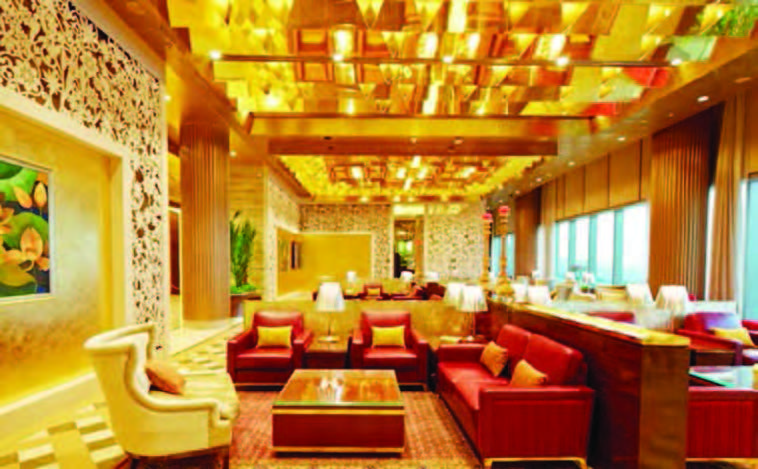
    Since it opened earlier this year, Terminal 2 at Mumbai’s Chhatrapati Shivaji International Airport has been getting a lot of love-it was chosen by travelers as their second most Favorite International Airport in the world. Now, it just got better with the opening of the GVK Lounge, the world’s first luxury airport lounge common to passengers of all airlines.

    [quote_box_center]Why you should check out Mumbai airport’s new luxury lounge [/quote_box_center]

    The look

    Spread across 30,000sqft over levels 3 and 4, the lounge can accommodate up to 440 passengers. Designed by celebrated fashion designer Sandeep Khosla and acclaimed architect Alfaz Miller, the lounge sports an Indian theme, accentuated through jali screens, contemporary chandeliers, a strategic lighting display and the signature glass peacock installation. While level 3 has silver theme, level 4 has been given a gold theme.

    What you get

    The lounge is divided into three categories: First, Business and Premium Class. Located on level 4, the First Class section offers personalized services, as well as amenities such as à la carte dining and individual spa treatments. The Premium Class section, also on level 4, comes with an opulent buffet area (connected to a live tandoori kitchen), a juice bar and a whiskey lounge, plus additional services such as foot massages. The maximum privacy is, however, assured to Business Class guests on level 3, who can also partake of a range of multi-cuisine dishes and barista offerings.

    Key facilities include:

    • Concierge services
    • A smoking zone
    • Food and beverages
    • Bar
    • A luxurious spa
    • Shower facilities
    • A relaxation area
    • Library
    • A business centre

    Who can use the lounge

    The lounge is available for First and Business Class passengers. Access is at the airline’s discretion.

    CREDIT CARD ACCESS PROGRAMMES

    (Please check if the credit card/s you hold permits use of the Mumbai lounge)

    Globally, credit card providers offer their premium customers access to lounges. Both MasterCard (for its World, Platinum and World Elite cardholders) and Visa (for its Signature and Infinite cardholders) provide lounge-access programs at major airports in cities such as New Delhi, Mumbai, Bengaluru, Chennai and Kolkata. But depending on the provider and the bank issuing the card, the number of visits may vary. For example, Visa limits free lounge access to two visits per quarter, while MasterCard (depending on the type of card) offers unlimited access. Check out premium cards from Axis Bank, Citibank, HDFC, HSBC, ICICI, IndusInd, Kotak Mahindra, SBI and Standard Chartered, which all give desirable privileges. Unlike most others, Citibank’s Premier Miles World MasterCard allows ‘add-on cardholders’ complimentary lounge access. American Express operates its own branded lounges at Mumbai (Domestic, T1C) and New Delhi (Domestic, T3) airports, and gives free access to Platinum cardholders.

    PAY-IN LOUNGES

    These are independently run lounges that a traveller can access for a fee.

    Priority Pass

    With more than 600 airport lounges in 100 cities, including London, Paris, Jeddah, Phuket and Goa, Priority Pass is one of the world’s largest pay-in lounge operators. To take advantage of it, you have to be a member. Standard Membership costs US$99 (Rs6,100) per year and comes with an additional per-visit fee of US$27 (Rs1,660), which can be redeemed against unlimited food and beverages as well as use of the wi-fi, conference rooms and, at some airports, showers. Priority Pass also has Standard Plus Membership for US$249 (Rs15,300) per year, which grants 10 complimentary visits, after which, he or she pays US$27 (Rs1,660) per visit. If you would rather make a one-time annual payment, opt for its Prestige Membership at US$399 (Rs22,500). Many credit cards (such as ICICI, HSBC and HDFC) offer free Standard Membership to Priority Pass on their premium-category cards.

    (www.prioritypass.com) 

    Plaza Premium Lounge

    Plaza has one of the largest pay-in lounge networks in Asia, with a strong presence in China (Beijing, Shanghai, Macau and Hong Kong), Malaysia, Singapore and the Middle East (Saudi Arabia, UAE and Oman). It’s ideal for infrequent travelers, as it does not require an annual membership; however, you will be charged per visit. Two hours in its New Delhi lounge in Terminal 1D costs Rs1,000-Rs1,500, while the Hong Kong lounge offers two-hour packages for HK$400 (Rs3,170). You gain access to food, drinks and showers. The Plaza network also offers VIP Meet and Greet services, as well as transit beds, concierge, baggage handling and delivery and limousine services.
    (www.plaza-network.com)

    AIRLINE LOUNGES

    If you’re spending a lot of time flying within or through America, consider buying an annual membership to a specific airline’s lounge. Or, if you’re using different airlines, opt for day passes. The Alaska Airlines Board Room, American Airlines’ Admirals Club, United’s Red Carpet Club, Delta’s Sky Club and the US Airways Club can be accessed with a day pass, (US$45-US$55 or Rs2,800-Rs3,400) per day, or about US$500 (Rs31,530) annually. Save money by buying a day pass in advance: US Airways almost halves its fee if you buy one along with your ticket. Remember that most of these airlines’ passes are limited to their US domestic lounges.

  • CHINA NOW WORLD’S THIRD-BIGGEST ARMS EXPORTER: SIPRI

    CHINA NOW WORLD’S THIRD-BIGGEST ARMS EXPORTER: SIPRI

    BEIJING (TIP): China has overtaken Germany to become the world’s third-biggest arms exporter, although its 5 per cent of the market remains small compared to the combined 58 per cent of exports from the US and Russia, a new study says.

    China’s share of the global arms market rose 143 per cent during the years from 2010- 2014, a period during which the total volume of global arms transfers rose by 16 per cent over the previous five years, the Stockholm International Peace Research Institute said in a report released Monday.

    Its share of the world market was up from 3 per cent in the 2009-2014 period, when China was ranked ninth among exporters of warplanes, ships, side arms and other weaponry, said the institute, known as SIPRI.

    The data show the growing strength of China’s domestic arms industry, now producing fourth-generation fighter jets, navy frigates and a wide-range of relatively cheap, simple and reliable smaller weapons used in conflicts around the globe.

    China had long been a major importer of weapons, mainly from Russia and Ukraine, but its soaring economy and the copying of foreign technology has largely reversed the trend, except for the most cutting-edge designs and sophisticated parts such as aircraft engines.

    China supplies weapons to 35 countries, led by Pakistan, Bangladesh and Myanmar, SIPRI said.

    Chinese sales included those of armored vehicles and transport and trainer aircraft to Venezuela, three frigates to Algeria, anti-ship missiles to Indonesia and unmanned combat aerial vehicles, or drones, to Nigeria, which is battling the Boko Haram insurgency in its north.

    China’s comparative advantages include its low prices, easy financing and friendliness toward authoritarian governments, said Philip Saunders, director of the Center for the Study of Chinese Military Affairs at the US National Defense University.

    “Generally speaking, China offers medium quality weapons systems at affordable prices, a combination attractive to cash-strapped militaries in South Asia, Africa and Latin America,” Saunders said.

    Notable successes include a co-production deal with Pakistan to produce the JF-17 fighter, widespread sales of the basic but effective C- 802 anti-ship cruise missile, and an agreement to sell the HQ-9 air defense missile system to Turkey that has run into controversy over its incompatibility with NATO weapons systems.

    China also has exploited niche markets such as North Korea and Iran that the West won’t sell to, emphasizing its attractiveness to impoverished countries and pariah states, said Ian Easton, research fellow at The Project 2049 Institute, an Arlington, Virginia-based Asian security think tank.

    Both those US foes appear to have received satellite jamming and cyber warfare capabilities from China, along with technologies to break into private communications and spy on government opponents, Easton said.

    “All of these sales should be very disconcerting to American policymakers and military leaders,” he said, calling China’s rise to the third-place spot among exporters a “disturbing development” that could threaten the security of the US and its allies.

    China also offers leading-edge drone technology at competitive prices. One model, known variously as the Yilong, Wing Loong or Pterodactyl, has become especially popular with foreign buyers, although Chinese secrecy surrounding such sales makes it difficult to know how many are in service and where.

    Chinese state broadcaster CCTV quoted retired People’s Liberation Army Gen. Xu Guangyu saying at an air show two years ago that the unmanned aircraft, which can be armed with two guided missiles, would cost only about $1 million each. That is about 10 to 20 per cent of the price of a comparable US model such as the MQ-1 Predator. Rumored buyers include the United Arab Emirates, Uzbekistan and Saudi Arabia.

    However, China’s incremental growth and the yawning gap with industry leaders America and Russia show the limitations of its aspirations.

    The US retained a 31 per cent share of the global arms market, exporting to at least 94 recipients, SIPRI said. Countries in Asia and Oceania took 48 per cent of US exports, followed by the Middle East with 32 per cent and Europe at 11 per cent, it said.

    Russia was second with a 27 per cent global share, 39 per cent of which went to India — the world’s largest arms importer overall. China took 11 per cent of Russia’s exports, followed by Algeria.

    SIPRI uses a five-year moving average to account for fluctuations in the volume of arms deliveries from year-to-year and doesn’t provide monetary values, which are often distorted by governments providing weapons as gifts or at below-market prices.

  • India’s emergence as a major player good for world: Ambassador Richard Verma

    India’s emergence as a major player good for world: Ambassador Richard Verma

    NEW DELHI (TIP): Envoys of six leading world powers — US, Japan, China, Britain, Germany and Canada- hailed, March 14,  India’s emergence as a major player at the “global high table” and complimented the new government for its efforts to stimulate economic growth, says a PTI report.

      The Ambassadors and High Commissioners said India’s role was crucial in combating major challenges facing the globe such as terrorism and climate change while noting that the country has huge untapped potential in trade and economic spheres.

      US Ambassador Richard Verma said the strategic partnership between the two countries has moved into a new phase and that the visit here by President Barack Obama had led to breakthroughs on a number of issues.  

    “Our strategic partnership has moved into a new phase, a more mature one that I would characterize as “strategic plus”.

     Our leaders share an understanding that if our democracies work in tandem, we can have a positive impact on global peace, democracy and economic prosperity,” Verma said addressing the India Today conclave.

    He said since Prime Minister Narendra Modi visited the US in September last year, both sides have “convened, signed, and cooperated on no fewer than 30 dialogues, declarations, and agreements.”

    On India-US partnership on clean energy, he said over USD 2.4 billion has been “mobilized” to invest in clean energy projects.

    “We have agreed to make concrete progress this year towards phasing out hudrofluorocarbons under the Montreal Protocol as well as pursuing a strong global climate agreement in Paris this year,” he said adding US has offered its support to Indian cities to combat air pollution.

    He said last week, a team of experts from the US Environmental Protection Agency met with senior officials and experts of the Ministry of Environment and the Central Pollution Control Board.

  • Saina Nehwal rises to No. 2 in world rankings

    Saina Nehwal rises to No. 2 in world rankings

    NEW DELHI (TIP): Ace Indian shuttler Saina Nehwal rose to second place in the latest Badminton World Federation (BWF) women’s singles rankings, despite losing in the final of All England Badminton Championship, released on March 11.

    Saina, who recently suffered a heartbreaking loss in the All England Saina, who recently suffered a heartbreaking loss in the All England

    The top-ranked Indian has a total of 74381 points while Xuerui led the charts with 79214 points. Wang Shixian of China, whom Saina defeated in the quarterfinal of the All England Championships, dropped a rung and is now at No. 3.

    Another star shuttler PV Sindhu remained static in the top-10 at No. 9.

    In the men’s singles category, Kidambi Srikanth of India also gained one place to be at No. 4 in the list led by Chen Long (China) followed by Jan O Jorgensen (Denmark) and Lin Dan
    (China).

  • Five killed after boat catches fire in China

    BEIJING (TIP): At least five people were killed and 10 others rescued after a fishing boat caught fire on March 11 in waters off eastern China.

    The fire broke out in the engine cabin of the boat around 7.00am in Zhoushan City, officials said.

    A total of 15 fishermen were on board, state-run Xinhua news agency reported. The cause of the fire in under investigation.

  • China approves 1st nuclear power project since 2011

    BEIJING (TIP): China is reviving growth of its nuclear power industry with approval of its first new project since Japan’s 2011 Fukushima disaster.

    A unit of state-owned China General Nuclear Power Corp. says the Cabinet’s planning agency has approved construction of two additional reactors at a generation station in the northeastern province of Liaoning.

    China is the world’s biggest energy consumer and nuclear power plays a key role in government plans to curb surging demand for imported oil and gas.

    Beijing suspended approvals of new nuclear plants after a tsunami in March 2011 crippled the Fukushima plant’s cooling and backup power systems, causing partial meltdowns in the worst nuclear disaster since the 1986 Chernobyl catastrophe.

    The moratorium was lifted last year.

  • Talks under way on ending UN sanctions on Iran

    Talks under way on ending UN sanctions on Iran

    UNITED NATIONS (TIP) : Major world powers have begun talks about a United Nations Security Council resolution to lift UN sanctions on Iran if a nuclear agreement is struck with Tehran, a step that could make it harder for the US Congress to undo a deal, Western officials said.

    The talks between Britain, China, France, Russia and the United States -the five permanent members of the Security Council – plus Germany and Iran, are taking place ahead of difficult negotiations that resume next week over constricting Iran’s nuclear ability.

    Some eight UN resolutions – four of them imposing sanctions – ban Iran from uranium enrichment and other sensitive atomic work and bar it from buying and selling atomic technology and anything linked to ballistic missiles. There is also a UN arms embargo.

    Iran sees their removal as crucial as UN measures are a legal basis for more stringent US and European Union measures to be enforced. The US and EU often cite violations of the UN ban on enrichment and other sensitive nuclear work as justification for imposing additional penalties on Iran.

    US Secretary of State John Kerry told Congress on Wednesday that an Iran nuclear deal would not be legally binding, meaning future US presidents could decide not to implement it. That point was emphasized in an open letter by 47 Republican senators sent on Monday to Iran’s leaders asserting any deal could be discarded once President Barack Obama leaves office in January 2017.

    But a Security Council resolution on a nuclear deal with Iran could be legally binding, say Western diplomatic officials. That could complicate and possibly undercut future attempts by Republicans in Washington to unravel an agreement.

    Iran and the six powers are aiming to complete the framework of a nuclear deal by the end of March, and achieve a full agreement by June 30, to curb Iran’s most sensitive nuclear activities for at least 10 years in exchange for a gradual end to all sanctions on the Islamic Republic.

    So far, those talks have focused on separate US and European Union sanctions on Iran’s energy and financial sectors, which Tehran desperately wants removed. The sanctions question is a sticking point in the talks that resume next week in Lausanne, Switzerland, between Iran and the six powers.

    But Western officials involved in the negotiations said they are also discussing elements to include in a draft resolution for the 15-nation Security Council to begin easing UN nuclear-related sanctions that have been in place since December 2006.

  • As I See IT – A Chinese-American game plan

    As I See IT – A Chinese-American game plan

    Describing Hinduism in India as “anti-human rights” and accusing former Afghan President Hamid Karzai of helping “India stab Pakistan in the back,” General Musharraf acknowledged on February 13 that “Pakistan had its own proxies” in Afghanistan and that his intelligence agencies had been “in contact with Taliban groups”. A reputed Pakistani journalist noted that the very next day. Afghanistan’s former Intelligence Tsar, Amrollah Saleh, hit back at Pakistanis piously disavowing any links with terrorism in Afghanistan. Saleh asserted: “Pakistan is the source of all ills in Afghanistan. Your own President has made the confession of having cultivated and supported the Taliban”. Saleh also lashed out at China for “pushing us to talk to Taliban terrorists”. He noted that while China was cracking down on the “Chinese Taliban,” associated with the East Turkistan Islamic Movement in Xinjiang, it had placed no sanctions on a “a state that abets terrorism (Pakistan)”.

    Responding to Saleh, a senior Chinese official observed that his government was only trying to “facilitate intra-Afghan reconciliation,” urging Saleh not to call the Chinese effort a “surrender to terrorists”. Obviously irritated, the Chinese official asserted: “The Taliban are your people and your President Ashraf Ghani has been asking for help in reaching out to the insurgent group. We will do as much as we can, as long as the Afghans want us to”. It is interesting that both the Chinese and Americans now refer to the Taliban as “insurgents” and not “terrorists”. This, after the Talban have killed over 2,000 American soldiers in Afghanistan. President Obama has evidently converted what President Bush called the “War of Terror” into a mere 14-year-old “counter-insurgency” operation! It is no secret that the American and Chinese efforts for “reconciliation” with the Taliban are being run in a carefully crafted and coordinated manner.

    Both the US and China are jointly attempting to mid-wife an ISI-led effort to legitimize Pakistani aims to give the Taliban a major say in the future governance of Afghanistan. There are reliable reports suggesting that in the talks in Qatar, the US has offered the Taliban the Governorship of the Uruzgan, Helmand and Kandahar Provinces and ministerial slots in Kabul in the Ministries of Frontier and Rural Development and Religious Affairs. Two hot American favorites from the Taliban leadership are reported to be Wakil Ahmed Muttawakil, who unloaded the luggage of the hijackers of IC 814 in Kandahar into his car, and Mullah Akhtar Muhammad Mansour, who allegedly provided the hijackers with explosives and assault weapons.

    China’s policies in Afghanistan are largely mercantilist. Beijing has offered very little economic aid to Afghanistan over the past one and half decades. It has, however, set its eyes on access to Afghanistan’s natural resources
    (estimated at $1 trillion) ranging from iron ore to coal, cooper, lithium and natural gas. China is, however, yet to spend a cent on developing the Aynak copper mines to which it has been granted access in northeast Afghanistan. It is using the
    “reconciliation” with the Taliban to protect its commercial interests by keeping the Taliban away from Muslim separatists of the ETIM based in Afghanistan, while being on the same page as its “all-weather friend” Pakistan. China has barred all Islamic religious practices and prayer meetings in government buildings, schools, business premises in Xinjiang. A recent Australian television documentary described details of a Chinese crackdown on Muslims in Xinjiang. Muslim women wearing veils or head scarves cannot travel in public transport. Muslim men sporting beards, attired in Muslim dress, or displaying an Islamic Crescent, receive similar treatment.

    Persecuted Muslims in Xinjiang sought refuge in the Taliban-ruled Afghanistan in the 1990s and associated themselves with Osama bin Laden’s International Islamic Front formed in Kandahar in February 1998. China’s links with the Taliban go back to 1998. While offering economic aid for the development of communications networks in Kabul and elsewhere, China asked Mullah Omar to end support for the ETIM separatists. While the Taliban did not hand over Uighur separatists, they allowed them space in camps for Chechens and Central Asian Jihadis from the Islamic Movement of Uzbekistan. It is well known that over the past five years, the ISI has facilitated China’s links with the Mullah Omar-led Quetta Shura of the Taliban. This has ensured that while the Taliban and the ISI-backed Haqqani network target Indian nationals in Afghanistan at the behest of the ISI, Chinese nationals roam around the country freely, having secured ISI insurance. At the same time, China has sought to remain in the good books of the Afghan Government, having signed a strategic partnership agreement with Kabul and expressed its readiness to provide security assistance.

    These developments have led to a congruence of Chinese and American interests and policies in Afghanistan. But there are several complications which lie ahead in this Chinese-American game plan. Both Washington and Beijing are going on the assumption that once they entered the portals power, the Taliban would play by the rules they set. They seem to forget that Mullah Omar regards himself as the ‘Amir ul Momineen’
    (Leader of the Faithful) and his cadres have no faith in any form of pluralism. Any attempt by President Ashraf Ghani to acquiesce in the sort of power sharing with the Taliban that the ISI wants will not only meet fierce resistance from Tajiks, Uzbeks, Turkmens and Hazara Shias, but also from substantial sections of the Pashtuns, who have no desire to return to an era of Taliban medievalism. Ever since Ashton Carter took over as the American Defense Secretary, the Obama Administration has become more cautious about the speed of their troop withdrawal schedule.

    India’s imaginatively crafted economic assistance over the past 14 years has won it vast political goodwill across the ethnic divide in Afghanistan. New Delhi is thus not without its own political leverage. This leverage, combined with imaginative diplomacy, is required to see that Afghanistan does not again become a hotbed for ISI-backed terrorist groups, or a destination for hijacking Indian Airlines’ aircraft.