Tag: China

  • FOUR INDIANS FIGURE IN THE TOP 100 GLOBAL RICH LIST

    FOUR INDIANS FIGURE IN THE TOP 100 GLOBAL RICH LIST

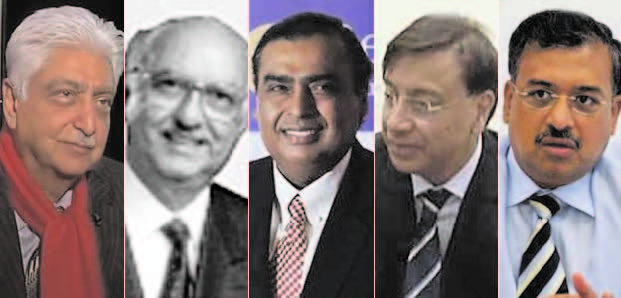
    LONDON (TIP): Four Indians have made it to the top 100 global rich list, as the country records for the first time more billionaires than Britain and Russia.


    The world now has a record 2,089 billionaires with Mukesh Ambani being the richest Indian in the list.


    The Reliance chief however ranks 41 in the top 100 global rich list.


    The other Indians to figure in the top 100 are Dilip Sanghvi of Sun Pharma who is ranked 53, Pallonji Mistry & family who own Tata Sons ranked 60 and Wipro’s Azim Premzi who is ranked 74.


    India has leapfrogged Russia and the UK to third place with 97 billionaires, 27 more than 2014. Manufacturing and Pharma are the preferred sectors with 23 and 14 billionaires respectively. Combined wealth of the Indian billionaires comes to $266 billion. Mumbai is headquarters to most of the Indian billionaires.


    The latest Harun Global Rich List 2015 shows an additional 222 billionaires were created last year, almost a third of whom were in China. Bill Gates remains the world’s wealthiest individual increasing his wealth to $85 billion. Mexican tycoon Carlos Slim is second with $83bn, while Facebook founder Mark Zuckerburg breaks into the global top 10 for the first time.


    The US still holds the crown for most mega-wealthy residents, at 537. But China is not far behind with 430, having acquired 72 new billionaires in 2014.


    Russia has 93 billionaires and UK has 80.


    New York remains the favourite city of the super-rich, with 91 billionaires while London is still fifth with 49.


    But six cities in Asia now make the top 10: Mumbai, Hong Kong, Beijing, Shenzhen, Taipei and Shanghai.


    The List ranked 2089 billionaires from 68 countries, up 222 from last year.


    Mark Zuckerberg at 30 is the youngest member of the Top 10. His wealth soared 42%, moving him up 11 places to number 7.


    The ‘Big Two’ in the list are the USA and China with 537 and 430 billionaires respectively, amounting to almost half of the billionaires on the planet. Russia had a bad year, losing 10 billionaires.

  • India asks Japan if it’s interested in Rs 50,000 crore submarine project

    India asks Japan if it’s interested in Rs 50,000 crore submarine project

    NEW DELHI (TIP): Russia, France, Germany and Spain, all better watch out. They may have to contend with Japan in the race to supply submarines to India. In keeping with their expanding strategic partnership, the Modi government has asked the Shinzo Abe administration whether it would be interested in the over Rs 50,000 crore project to build six stealth submarines in India.


    With Japan recently ending its decades old self-imposed arms export embargo, New Delhi has forwarded “a proposal” to Tokyo to “consider the possibility” of making its latest diesel-electric Soryu-class submarines in India, say sources.


    This “feeler” dovetails into PM Narendra Modi’s strategic outreach to Japan, as well as Australia and the US, since he took over last year. The possible sale of Japanese US-2i ShinMayva amphibious aircraft to the Indian Navy is already being discussed. Australia, too, is considering the Soryu submarines to replace its ageing Collins-class vessels.


    The US, on its part, has been pushing for greater defence cooperation among India, Japan and Australia to counter China’s assertiveness in the Asia-Pacific region. The recent Obama-Modi summit led to the “joint strategic vision for Asia-Pacific and Indian Ocean Region” with a direct reference to South China Sea, where China is locked in territorial disputes with its neighbours. Both Japan and Australia are also keen to participate in the annual Indo-US Malabar naval exercise on a regular basis, which has riled China in the past.


    But the 4,200-tonne Soryu submarines, manufactured by Mitsubishi Heavy Industries and Kawasaki Heavy Industries, may not meet Indian requirements. Japan will also be just one of the contenders for the mega programme, called Project- 75-India, if it agrees to throw its hat into the ring.


    Countries like France (ship-builder DCNS), Germany (HDW), Russia
    (Rosoboronexport) and Spain
    (Navantia) are already girding up, with the first three having the experience of building submarines for India.

  • Communist officials in Tibet punished for helping Dalai Lama

    Communist officials in Tibet punished for helping Dalai Lama

    BEIJING (TIP): Investigators have found that 15 Communist Party officials in Tibet joined underground Tibetan independence organizations, provided intelligence to the Dalai Lama and his supporters or participated in activities deemed harmful to China’s security, a party agency said on January 28.


    The publicizing of party officials supporting Tibetan separatism was highly unusual and suggested continuing unrest in the Himalayan region, which has had a heavy security presence since a wave of riots and protests against Chinese rule in 2008. The involvement was uncovered last year during an investigation of a small group of party officials, according to a statement from the Communist Party Disciplinary Commission of Tibet posted on its website. Fifteen officials received unspecified punishment for violating party and political discipline, the commission said.


    It was not immediately clear why the cases were announced this week. The commission’s statement gave no details of the groups that the party members joined, the intelligence they provided or other activities that would have harmed national security. Calls to party representatives in Tibet were not answered, and the discipline commission’s phone number was not publicly available.


    Journalists’ access to Tibet is tightly restricted and all information from the region is extremely difficult to confirm. While details such as the name of the officials punished were not provided, it is likely they were ethnic Tibetans who traditionally practice a form of Tantric Buddhism of which the Dalai Lama is the spiritual leader.


    Ethnic minorities, including Tibetans and Muslim Uighurs from the neighboring Xinjiang region, make up about 6 percent of the Communist Party’s 86 million members. They are recruited to fill posts at various levels as a key component of the party’s united front policy, although the top party official in provinces and regions such as Tibet is always a member of China’s overwhelming majority Han ethnic group.

  • China plans army parade with Putin as chief guest

    China plans army parade with Putin as chief guest

    BEIJING (TIP): Close on the heels of India inviting US President Barack Obama for its Republic Day parade, China on January 28 announced plans to hold a major military parade and inviting Russian President Vladimir Putin.


    Departing from a practice of conducting such events once in a decade, China will hold the military parade this year in Beijing to celebrate the 70th anniversary of the victories of World War II, official media here reported. China will tighten security for the event, Fu Zhenghua, chief of the Beijing Public Security Bureau was quoted as saying by state run China-org.cn.


    The Chinese foreign ministry has confirmed that Russian state leaders will attend the war commemoration, making this the first time that foreign state leaders will attend a Chinese military parade. President Vladimir Putin 8%is likely to be present at the event.


    China usually holds a military parade every 10 years to celebrate the founding of the People’s Republic of China in 1949. The most recent parade was held in 2009

  • INDIA’S RELATIONS WITH THE US MUST NOT BE ONE-SIDED

    INDIA’S RELATIONS WITH THE US MUST NOT BE ONE-SIDED

    ‘It is in the interest of both sides that the visit is seen as being successful. Both sides have invested considerable political capital in it…….This rapid exchange of visits and the decisions taken have to be justified, beyond the symbolism, which is no doubt important in itself. This opportunity to impart a fresh momentum to ties should not be missed………. What we need is a pragmatic approach by both sides. On the side this is assured by Modi. He has shown that he is essentially pragmatic. The only principle he is attached to is India First”, says the author. 


    Prime Minister Narendra Modi’s ready acceptance of United States President Barack Obama’s invitation to visit Washington in September 2014 came as a surprise against the background of the visa denial humiliation heaped on him for nine years.


    Modi’s invitation to Obama to visit India as chief guest at our 2015 Republic day celebrations came as an equal surprise, as did Obama’s acceptance at such short notice.


    The messaging from both sides is clear. Modi wants to give a fresh impetus to the India-US relationship, seen as languishing for some time now. Obama has conveyed that he is ready to respond.


    Now that Obama is coming and the two sides want to reinvigorate the relationship, the outcome of the visit will be watched closely not only in India and the US, but internationally too.


    To look ahead, we should look backwards a little bit so that the potential for the future can be seen through a better understanding of the past.


    There are no instant solutions to the issues in India-US relations. The US demands in many cases require policy, legislative and administrative responses by India, not to mention care by us that a balance in our external relations is maintained.


    Obama had said during his visit to India in 2009 that he saw the India-US relations as potentially a ‘defining partnership of the 21st century.’ It is very hard to define what a defining partnership is, but what he meant presumably is that relations between the oldest and the largest democracy, between the world’s foremost economic power and, in time, the third biggest economy will define the contours of international relations in the decades ahead.


    Our leaders say that India and the US are natural partners. This is not borne out objectively by the history of the relationship, the differences that currently exist on a whole host of issues and the inherently unequal nature of the relationship.


    The US is the world’s only superpower with global interests whose contradictory pulls and pressures they have to manage even in our region, and we are not even a credible regional power yet.


    If the argument is that it is the shared values of democracy, pluralism and respect for human rights make us natural partners, then the US relationship with Pakistan and China — often at our cost — which are not democracies, has to be explained. US interests often take precedence over its declared values.


    Even if rhetoric does not measure up to realities, the fact remains that improvement of India-US ties has been the most important development in India’s external relations in the last decade.


    It is the 2005 nuclear deal that opened the doors to a transformative change in bilateral ties. Reflecting the new intensity of bilateral engagement, about 28 dialogues were set up between the two sides covering the fields of energy, health, education, development, S&T, trade, defence, counter-terrorism, nonproliferation, high technology, innovation etc.


    The US now supports India’s permanent membership of the UN Security Council in principle. It is backing India’s membership of the four international export control organisations — the Nuclear Suppliers Group, the Missile Technology Control Regime, the Wassenaar Arrangement and the Australia Group.


    Trade in goods and services between the two countries has grown to almost $100 billion (about Rs 620,000 crore).


    A big breakthrough has been made in defence. In the last five or six years the US has bagged defence orders worth about $10 billion (about Rs 62,000 crore). These include C-130, C-17 and P-80 I aircraft and heavy lift, attack and VIP helicopters. The US has emerged as the biggest supplier of arms to India in this period.


    The US has proposed joint manufacture of several defence items in India under its Defence Trade and Technology Initiative. While India has overcome its mistrust of the US and fears that at critical moments the US may cut off spares for its equipment as part of its liberally used sanctions instrument, India has been reticent in its response to the DTTI, possibly because it is still not convinced that the US will transfer the technologies that India would want or not tag unacceptable conditions to it.


    The US proposed at one time three ‘foundational’ agreements covering the areas of logistics, interoperability and access to high technology equipment, but India has been cautious, presumably because it was concerned about slipping into the US defence orbit and losing its autonomy.


    To balance this, India and the US have been conducting a large number of military exercises, far more than with any other country. The naval exercises in the Indian Ocean to protect the sea lanes of communication are particularly important because of their geopolitical implications. Trilateral India-US-Japan naval exercises have obvious significance.


    In Obama’s second term, however, the ties lost momentum for various reasons. Economic reforms in India slowed down, its growth rates fell, India was seen as reluctant to deepen the strategic partnership, it was lukewarm to the US pivot towards Asia, US nuclear firms saw their business opportunities in India blocked because of our Nuclear Liability Act, major US corporations began campaigning against India’s trade, investment and intellectual property rights policies in the US Congress and instigated investigations into them by the US International Trade Commission and the US Trade Representative.


    The US began criticising India for being a fence sitter, a free-loader on the international system because of its reluctance to uphold it even at the cost of its interests as other Western powers were supposedly doing. This was the sense of the ‘burden sharing’ demand of the US.


    India had its own complaints against the US regarding the implications of the new US immigration legislation for India’s IT industry, the movement of its professionals, the increase in cost of H1B and L1 visas, the totalisation agreement and outsourcing.


    During his Washington visit, Modi struck an unexpectedly good rapport with Obama who accompanied him personally to the Martin Luther King Jr Memorial and later in Myanmar described him as a ‘man of action.’


    Modi clearly signalled during the visit that he intends to reinvigorate bilateral ties and that he views them as vital for his development agenda at home.


    The joint press conference by the two leaders and their joint statement set an ambitious agenda, with many positives, if all goes according to plan.


    The two leaders agreed to increase the bilateral trade five-fold to $500 billion (about Rs 36 lakh crore).


    Modi asked publicly for more openness and ease of access to the US market for Indian IT companies, even if Obama failed to give any response.


    In order to raise investment by institutional investors and corporate entities, it was agreed to establish an Indo-US Investment Initiative led by India’s finance ministry and the US department of treasury, with special focus on capital market development and financing of infrastructure.


    It was also agreed to establish an Infrastructure Collaboration Platform convened by the ministry of finance and the US department of commerce to enhance participation of US companies in infrastructure projects in India.


    Modi invited the US to send two trade missions to India in 2015 focused on India’s infrastructure needs with US technology and services.


    It was decided to activate the Trade Policy Forum that had not been convened for a long time. An empowered annual working group was approved for addressing IPR issues and it was agreed to set up a contact group for implementing the India-US civil nuclear deal.


    US involvement was sought in the railways sector and in smart city projects (Ajmer, Visakhapatnam and Allahabad).


    It was also agreed that USAID will serve as knowledge partner to support Modi’s 500 Cities National Urban Development Mission and Clean India Campaign.


    Obama offered to reinvigorate the higher education dialogue, which has languished. He welcomed India’s proposal to establish the Global Initiative of Academic Networks under which India would invite and host up to 1,000 American academics each year to teach in centrally-recognised Indian universities, at their convenience.


    The decisions and understandings reflected in the joint statement on the energy front are potentially problematic as they could give the US more handle to put pressure on India on climate change issues.


    Both leaders expressed their commitment to work towards a successful outcome in Paris in 2015 of the conference of the UN Framework Convention on Climate Change, including the creation of a new global agreement on climate change.


    The two leaders, in recognition of the critical importance of reducing greenhouse gas emissions and improving resilience in the face of climate change, agreed to ‘a new and enhanced strategic partnership’ on energy security, clean energy, and climate change, to further which a new US-India Climate Fellowship Programme to build long-term capacity to address climate change-related issues in both countries was launched.


    A MoU was concluded between the Export-Import Bank and the Indian Renewable Energy Development Agency, which would make up to $1 billion (about Rs 6,200 core) in financing available to bolster India’s transition to a low-carbon and climate-resilient energy economy, while boosting US renewable energy exports to India.


    Modi and Obama stated their intention to expand defence cooperation to bolster national, regional, and global security. This broad-based formulation has important geopolitical implications. They agreed to renew for ten more years the 2005 Framework for the US-India Defence Relationship with plans for more ambitious programs and activities.


    They welcomed the first meeting under the framework of the DTTI in September 2014 and its decision to establish a task force to expeditiously evaluate and decide on unique projects and technologies for enhancing India’s defence industry and military capabilities.


    To intensify cooperation in maritime security, the two sides considered enhancing technology partnerships for India’s Navy, besides upgrading their existing bilateral exercise Malabar.


    They committed to pursue provision of US-made mine-resistanta ambush-protected vehicles to India.


    On terrorism, they stressed the need for dismantling of safe havens for terrorist and criminal networks, to disrupt all financial and tactical support for networks such as Al Qaeda, Lashkar-e-Tayiba, Jaish-e-Mohammad, the D-Company, and the Haqqani Network.


    The two countries also expressed the intention to start a new dialogue on space situational awareness.


    Obama affirmed that India met MTCR requirements and was ready for NSG membership. Noting India’s ‘Act East’ policy and the United States’ rebalance to Asia, the leaders committed to work more closely with other Asia Pacific countries through consultations, dialogues, and joint exercises. They underlined the importance of their trilateral dialogue with Japan and decided to explore holding this dialogue among their foreign ministers.


    Modi spoke of great convergence on the issue of peace and stability in Asia-Pacific and more joint exercises with Asia-Pacific countries.


    Very significantly, he stated that the US was intrinsic to India’s Look East and Link West policies, according thus a central role for the US in India’s foreign policy.


    They agreed to continue close consultations and cooperation in support of Afghanistan’s future.


    The principal points agreed during Modi’s visit will serve as a guide to what can be realistically achieved during Obama’s visit. To assess that, we should take into account some limitations and negatives that mark the India-US relationship.


    Already, what was agreed to is mostly not capable of quick implementation or rapid results. These are largely medium term objectives and not always clear in implications. In the course of implementation, many issues will provoke internal political debates, will require detailed processing and negotiations, parliamentary approval and intensive diplomatic effort on the international front by both parties. In some cases real differences have been glossed over by use of diplomatic language.


    On IPR issues it will not be easy to reconcile US demands on IPRs and our position that our IPR policies are in conformity with the World Trade Organisation’s Trade-Related Aspects of Intellectual Property Rights agreement. Legal issues involving our courts are involved.


    The USTR decided to put unilateral pressure on India by investigating India’s IPR policies under Section 301, but this has been halted in November 2014 in view of some forward looking announcements by the Modi government. The USTR’s ‘cautiously optimistic’ statements during his Delhi visit in November suggest that the US will wait and watch what the Modi government actually delivers.


    The US Congress has extended the investigation of India’s investment, trade and IPR policies by the USITC by another year.


    On climate change issues, under cover of its ‘political’ agreement with China, the US seems determined to put pressure on India to agree to some reduction commitments. In actual fact, this is political pressure unrelated to the merits of India’s case. Climate change is a multilateral issue, but the US is making it a bilateral one, with the commercial interests of its companies in mind.


    While the US claims that what it is offering under the DTTI has the green light from all those in the US who control technology exports, it can be doubted whether the US will be as liberal in transfer of technologies as it would have us believe. The US record in this regard with even its allies and partners is not inspiring.


    The US has shown no activism in pushing for India’s membership of NSG or MTCR as a start. It is to be hoped that it is not looking


    for a resolution of the nuclear liability issue and the finalisation of the vexed question of ‘administrative arrangements’ that is needed to complete the India-US nuclear deal before


    it does the heavy lifting again to promote India’s membership of the cartels in question.


    Surprisingly, the list of terror organisations against whom US and India have agreed to work together excludes the Taliban, pointing to a crucial difference between the two countries on the issue of accommodating this extremist force with its close Pakistani links into the power structure in Afghanistan.


    In reaching out to the Taliban the US gives priority to orderly withdrawal of its forces from Afghanistan, treating India’s concerns as secondary. The language on Afghanistan in the Modi-Obama joint statement in Washington was remarkably perfunctory.


    Worse, the US wants to retain complete freedom of action in dealing with Pakistan, irrespective of India’s concerns about its continuing military aid to that country. General Raheel Sharif, the Pakistani army chief, was accorded high level treatment during his recent visit to the US, meeting Secretary John Kerry who indirectly endorsed the role of the Pakistani army in nation building and politics by terming it as a truly binding force.


    It is worth recalling that after accepting the invitation to visit India, Obama felt diplomatically obliged to phone Premier Nawaz Sharif to say he could not visit Pakistan now and would do so later.


    The US involvement in developing our inadequate infrastructure — our ports, airports, railways highways etc — seems unrealistic as its companies are hardly likely stand up to international competition in India.


    As regards our nuclear liability legislation, it appears that the US government may be moving away from its fundamentalist position that supplier liability cannot be accepted and may be open to some practical solution to the issue in terms of limiting the liability in time and costs. The lawyers at Westinghouse and General Electric will, of course, have to be convinced.


    This is a highly charged issue politically and it is doubtful whether the decks can be cleared before Obama’s visit. The larger question of the economic viability of US-supplied nuclear power plants remains, not to mention the fact that GE does not have as yet a certified reactor.


    Work on a bilateral investment treaty will take time It appears that our side wants to be able to announce a couple of projects under the DTTI during Obama’s visit. In this connection anti-tank missiles, naval guns, pilotless aircraft and magnetic catapult for our aircraft carrier are being mentioned as possibilities.


    The US would want at least one project to be announced. Defence Minister Manohar Parrikar has let it be known publicly that US proposals are being seriously examined.


    The announcement of a more ambitious Defence Cooperation Framework Agreement valid for another 10 years is a certainty.


    The government’s decision on the GST, raising the FDI ceiling in insurance, the amendment to the land acquisition law are advance signals of its commitment to reform and attracting FDI, which is a positive from the US point of view.


    The emphasis on Make in India and developing India’s manufacturing sector, coupled with a commitment to ease doing business in India, have begun to change investor sentiment towards India, and this creates a better atmosphere for Obama’s visit.


    It is in the interest of both sides that the US President’s visit is seen as being successful. Both sides have invested considerable political capital in it.


    This rapid exchange of visits between the two leaders, leaving little time to process the decisions taken in Washington in September, has to be justified, beyond the symbolism, which is no doubt important in itself. This opportunity to impart a fresh momentum to ties should not be missed.


    But there is need also to be clear-headed about the relationship that is not easy to manage given US power, expectations, impatience and constant endeavour to do things the way it wants.


    It is a bit disturbing that an atmosphere has been created in which the focus is on what we can do for the US and Obama and not what the US must do to meet our needs and concerns. The agenda has become one-sided.


    The US should not expect India to support all its demands and polices, however questionable. India does not have to prove it is a responsible country by supporting even irresponsible US policies. Of course, India too should not expect the US to always adjust its policies to suit us.


    What we need is a pragmatic approach by both sides. On the side this is assured by Modi. He has shown that he is essentially pragmatic. The only principle he is attached to is India First.


    (By Kanwal Sibal who is a former Foreign Secretary of India)
    (British English)

  • India-US strategic partnership

    India-US strategic partnership

    In future, India may be willing to conduct joint military operations with the US in its area of strategic interest in a contingency in which India’s vital national interests are threatened, preferably as a Chapter 7 intervention under the UN flag and failing that, as part of a “coalition of the willing”, says the author.


    President Barack Obama’s forthcoming visit as the chief guest on Republic Day is likely to give a fresh impetus to the Indo-US strategic partnership. While the relationship is substantive and broad based, the impressive achievements of the strategic partnership are to a large extent attributable to the successful implementation of the 10-year Defence Framework Agreement signed in June 2005. The renewal of this agreement will be a major item on the bilateral agenda during the summit meeting.


    During the Obama-Narendra Modi meeting in September 2014, the two leaders had stated their intention to expand defence cooperation to bolster national, regional, and global security. It was agreed that the two countries would build an enduring partnership in which both sides treat each other at the same level as their closest partners, including defence technology transfers, trade, research, co-production, and co-development.


    Prime Minister Modi and President Obama welcomed the first meeting under the framework of the Defence Trade and Technology Initiative in September 2014 and endorsed the decision to establish a task force to expeditiously evaluate and decide on unique projects and technologies which would have a transformative impact on bilateral defence relations and enhance India’s defence industry and military capabilities.


    For several decades, India’s procurement of weapons platforms and other defence equipment had remained mired in disadvantageous buyer-seller, patron-client relationships like that with the erstwhile Soviet Union and Russia. While India has been manufacturing Russian fighter aircraft and tanks under licence, the Russians never actually transferred weapons technology to India.


    The country has now diversified its acquisition sources beyond Russia to Western countries and Israel. From the US, India has purchased weapons platforms and other items of defence equipment worth around US $10 billion over the last five years. However, none of the recent deals with the US have included the transfer of technology clauses. There is now a growing realisation in India that future defence acquisitions must simultaneously lead to a transformative change in the country’s defence technology base and manufacturing prowess. Hence, it is imperative that whatever India procures now must be procured with a transfer of technology clause being built into the contract even though it means having to pay a higher price. The aim should be to make India a design, development, manufacturing and export hub for defence equipment in two to three decades.


    In September 2013, Deputy Secretary of Defence Ashton Carter, now the US Defence Secretary designate, had offered India a “Defence Trade and Technology Initiative” under which the US will share sensitive cutting-edge defence technology and permit US companies to enter into joint production and co-development ventures in India. Carter had then said, “We changed our mindset around technology transfer to India in the Department of Defence from a culture of presumptive no to one of presumptive yes.” 


    The Javelin anti-tank guided missile is another key candidate for joint production, though so far the US has been hesitant to offer its seeker and warhead technology. India is also looking for high-end counter-IED technologies. In future, the two countries will conduct joint research and development for new weapons systems and the US may offer even nuclear power packs for submarines and aircraft carriers and fighter aircraft engines. Cooperation of such a high order will raise India’s technology base by an order of magnitude and help the country move several notches higher in its quest for self-reliance in defence production. stepping down as Secretary of Defence, Chuck Hagel had nominated Frank Kendall, the Department’s Undersecretary for Acquisition, Technology and Logistics, as the defence initiative’s American lead. With Ashton Carter soon to become Secretary of Defence, the initiative will get a fresh boost. The biggest boost will come from a show-piece joint development project like the BrahMos supersonic cruise missile jointly developed with Russia.


    The extended Defence Framework Agreement should take stock of the goals of the 2005 agreement that have not been fully achieved. For example, there has been no progress in cooperation on BMD technology. This needs to be rectified. Intelligence sharing is limited to ongoing counter-terrorism operations at present. It should be extended to the sharing of data bases as well, particularly the terrorism data base maintained by the US NCTC and India’s NATGRID.


    Prime Minister Modi’s government has raised the FDI limit for defence joint ventures to 49 per cent equity participation. It is likely to be open to modifying the offsets policy and amending export laws, which are considered a stumbling block. The agreement should take into account the Indian PM’s exhortation to industry to “Make in India”. The two governments should act as facilitators for their public and private sector companies to form joint ventures for the design and development, co-production and export of future weapons platforms.


    There is a mutual recognition of the adverse implications of China’s increasing assertiveness in the South China Sea and in dealing with the dispute over the Senkaku (Diaoyu) islands with Japan. This has undermined international and regional confidence in China’s desire to resolve disputes peacefully. There is need to work in unison with the international community to uphold the unfettered use of the global commons. India is building robust military intervention capabilities and the armed forces are engaged in the process of formulating a doctrine to give effect to these capabilities.


    Though India values its strategic autonomy and recognises that each bilateral relationship is important in its own way, the policymakers realise that the geo-political contours of the 21st century and peace and stability, particularly in the India-Pacific region, will be shaped through cooperative security. In future, India may be willing to conduct joint military operations with the US in its area of strategic interest in a contingency in which India’s vital national interests are threatened, preferably as a Chapter 7 intervention under the UN flag and failing that, as part of a “coalition of the willing”.

  • Textile major Arvind to step into footwear business

    Textile major Arvind to step into footwear business

    AHMEDABAD (TIP): Textile major Arvind is looking to go beyond its core businesses. Riding high on e-commerce wave, textiles and apparels company Arvind Ltd is readying to foray into the Rs 30,000 crore Indian footwear market in a big way. The company will launch its own footwear brand in coming days.

    “Footwear will be a mix of own brands, acquired, licensed and joint ventures. Initially we will have footwear items from our brands such as Arrow, Tommy Hilfiger and Calvin Klein among others,” said Sanjay Lalbhai, chairman and managing director, Arvind Ltd, which aims to bring in national and international brands under its portfolio and retail them mostly through the online platform. The Arvind group has already forayed into the realty market.

    As per latest estimates of Council for Leather Exports, India is the second largest global producer of footwear after China, accounting for 13% of global footwear production of 16 billion pairs. Interestingly, 95%of its production goes into meeting domestic demand.

  • IMF cuts global growth outlook, calls for accommodative policy

    IMF cuts global growth outlook, calls for accommodative policy

    BEIJING (TIP): The International Monetary Fund lowered its forecast for global economic growth in 2015, and called on Tuesday for governments and central banks to pursue accommodative monetary policies and structural reforms to support growth.

    Global growth is projected at 3.5 per cent for 2015 and 3.7 per cent for 2016, the IMF said in its latest World Economic Outlook report, lowering its forecast by 0.3 per centage points for both years.

    “New factors supporting growth – lower oil prices, but also depreciation of euro and yen – are more than offset by persistent negative forces, including the lingering legacies of the crisis and lower potential growth in many countries,” Olivier Blanchard, the IMF’s chief economist, said in a statement released by the Washington-based lender.
    The IMF advised advanced economies to maintain accommodative monetary policies to avoid increases in real interest rates as cheaper oil increases the risk of deflation.
    If policy rates could not be reduced further, the IMF recommended pursuing an accommodative policy “through other means”.

    The United States was the lone bright spot in an otherwise gloomy report for major economies, with projected growth raised to 3.6 per cent from 3.1 per cent for 2015. The United States largely offset prospects of more weakness in the euroarea, where only Spain’s growth was adjusted upward.

    Projections for emerging economies were also broadly cut back, with the outlook for oil exporters Russia, Nigeria and Saudi Arabia worsening the most.

    The IMF predicts that a slowdown in China will draw a more limited policy response as authorities in Beijing will be more concerned with the risks of rapid credit and investment growth.

    The IMF also cut projections for Brazil and India.

    Lower oil prices will give central banks in emerging economies leeway to delay raising benchmark interest rates, although “macroeconomic policy space to support growth remains limited,” the report said.

    Falling prices will also give countries a chance to reform energy subsidies and taxes, the IMF said.

    The prospects of commodity importers and exporters will further diverge.

    Oil exporters can draw on funds they amassed when prices were high and can further allow for substantial depreciation in their currencies to dull the economic shock of plunging prices.

    The report is largely in line with remarks by IMF Managing Director Christine Lagarde last week, in which she said falling oil prices and strong U.S. growth were unlikely to make the IMF more upbeat.

  • At 7.4%, China growth hits 24-year low

    At 7.4%, China growth hits 24-year low

    BEIJING (TIP): China’s economy has slowed down drastically to 7.4% in 2014, which is the lowest rate of GDP growth in the past 24 years. The economy grew 7.7%in 2013, according to the country’s auditors.

    The slowdown in the world’s second biggest economy has raised serious questions about its impact on the world financial system. China is likely to withdraw money parked in various funds to boost its banks to prop up the local economy, observers said.

    “The country’s period of miraculous break-neck growth is over, but let’s get over it,” the official Xinhua news service said, referring to the decades of double-digit expansion earlier. “The end of the high-speed growth era does not spell an end for China’s economy.”

    The economy even missed the lowered target of 7.5%growth for 2014. The fourth-quarter saw growth of 7.3%from a year earlier, which is slightly better than expectations.

  • BENGALURU STANDS TALL WITH $2.6-BILLION VENTURE CAPITAL

    BENGALURU STANDS TALL WITH $2.6-BILLION VENTURE CAPITAL

    BENGALURU (TIP): India’s IT hub, Bengaluru, came in fifth in a list of cities globally that received the most venture capital in 2014, an indication of the growing vibrancy of its startup ecosystem.

    San Francisco led the list with $13 billion of VC investments, followed by Beijing ($6.4 billion), New York ($5.7 billion), Palo Alto ($3.2 billion) and Bengaluru ($2.6 billion). The list has been put together by Crunchbase, a global startup ecosystem database.

    Among countries, India received the third highest VC funding ($4.6 billion) after the US ($58.9 billion) and China ($8.9 billion).

    Ravi Gururaj, chairman of the Nasscom Product Council, says India enjoyed record VC investments in the second half of 2014, and the wave shows no sign of slowing down. “This was kicked off by the historic election results which boosted investor confidence tremendously. Additionally, private equity investors worldwide, particularly those that missed out on the meteoric rise in Chinese startup valuations, flocked to high performing Indian consumer startups determined not to miss out on a fast ride on the India Startup Express.”

    Sanjeev Aggarwal, co-founder of Helion Venture Partners, says Bengaluru’s lead position is because of its ability to attract tech talent. “The cycle kicked in with Infosys and Wipro, followed by global companies coming in large numbers. Engineers employed with companies like Google and Yahoo wanted to experiment with new ideas, and that has spawned a startup culture. Mobile apps and cloud have reduced entry barriers to build companies,” he told TOI.

    CrunchBase does not give a breakup of the investments in each city. In Bengaluru’s case, a significant portion of the $2.6 billion would likely be on account of Flipkart’s two rounds of funding that happened last year. The e-commerce company received an estimated $1.7 billion.

    Parag Dhol, MD of Inventus Advisors India, believes Bengaluru’s startup ecosystem is beginning to have a multiplier effect. “You have an ecosystem where companies have gone public, there are good product startups, and new-age entrepreneurs are turning into angels. In that sense, success begets success. Venture capitalists are looking at India with a fresh set of eyes,” he adds.

    Aggarwal notes that capital is going particularly to the leaders who are building companies in large under-served markets, and to companies like Flipkart, Snapdeal and Ola. “Investors are paying a leadership premium,” he says.

    Japanese internet giant Softbank invested $627 million in Snapdeal and $210 million in Ola Cabs last year.

  • Artist paints daughter in the nude, irks China

    Artist paints daughter in the nude, irks China

    BEIJING (TIP): A Chinese artist has caused a huge controversy by using his daughter as a nude model for a collection of his paintings titled ‘Oriental Goddess and Mountain spirit’. This has sparked an intense debate on ‘sexual morality’ among the artist community and art lovers in China.

    The painter, Li Zhuangping used his daughter, Li Qin as a nude model to pose with various animals, including a tiger and a eagle. The issue came to fore after an art critic, Yuan Zushe, published an article in a local newspaper, China Youth, and termed Li’s act of using his 23-year-old daughter for the paintings as unethical. “Such a practice could have a negative impact on society’s sexual morality,” he wrote.

    Yuan’s criticism was backed by thousands of art lovers and internet users, who said the father-daughter relationship is of a nobler kind and should not be put to such test.

    But Li and his wife, as well as the daughter, see nothing wrong in the nude paintings. “I’ve never looked at the matter from an ethical point of view. After I got the approval of my wife and daughter, we began working together,” said Li.

    He added that none of the family members felt awkward working on the painting. “Actually, it was no different than giving her a bath in her childhood,” said Li.

    The daughter completely backed her father saying, “I’m also a painter. Being a model for my father is a sacred thing. No matter what other people think about us, we are very magnanimous.” Though Li is receiving flak on internet, some members from the artist community are supporting him. “Some artists ask their wives to model for them. But asking one’s daughter to model is less common. It’s very respectable that he has challenged the ethics and morality,” said Lin Mu, an art critic and professor at Sichuan University. Art website, oilpaintingcentre.com, said Li felt his daughter was best suited to portray a goddess in his mythological paintings that he was planning. “So he asked her whether she was willing to go nude for the paintings. Li Qin agreed, and both of them worked on the paintings for several years, finally creating these amazing works,” the website said in an article.

  • Boat sinks on China’s Yangtze River, 20 missing: Report

    Boat sinks on China’s Yangtze River, 20 missing: Report

    BEIJING: China’s state-run Xinhua News Agency is reporting that more than 20 people, including several foreigners, are missing after a tugboat sank on the Yangtze River. The January 15 morning report says the boat sank Thursday afternoon during a trial voyage in the eastern province of Jiangsu and that three people were saved. The report said Japanese and Singaporeans were among the missing, and that a Frenchman may also be missing. The boat’s owner and technicians working on the boat were also missing.

  • India to grow at China’s pace by FY17: World Bank

    India to grow at China’s pace by FY17: World Bank

    NEW DELHI/WASHINGTON (TIP): The Indian economy is expected to catch up with China by 2016-17 and is expected to grow 6.4% in 2015 on the back of reform measures unveiled by the new government, the World Bank has said. The steps taken by the government to reviv growth and boost sentiment since it assumed power in May and the sharp slide in global crude oil prices would help the economy to expand. “India will catch up with China’s growth in the year 2016 and 2017,” World Bank Chief Economist and Senior Vice- President Kaushik Basu said at the release of the multilateral agency’s global economic outlook. “China’s growth will remain high, but will begin to taper very gently, reaching 6.9% in 2017,” World Bank chief economist and senior vice-president Kaushik Basu said at the release of the multilateral agency’s global economic outlook. The World Bank expects the Indian economy to grow 5.6% in 2014 while China is likely to grow China 7.4% in 2014 and 7.1% in 2015. By 2016, the Indian economy is forecast to grow 7%, as much as China’s estimated pace of 7%. Indian authorities expect the economy to grow 5-5.5% in the current fiscal year and then accelerate to 6-6.5% in 2015- 16 as the impact of the reform measures kick in. Policymakers expect the Indian economy to return to a 8% growth trajectory in the medium term. The World Bank revised global growth downwards for 2015 due sluggishness in the euro zone, Japan and other emerging market economies. The global economy is expected to grow 3%, slower than the previous forecast of 3.4% in June. After growing by an estimated 2.6% in 2014, the global economy is projected to expand by 3% this year, 3.3% in 2016 and 3.2% in 2017, the World Bank forecast. Developing countries grew by 4.4% in 2014 and are expected to edge up to 4.8% in 2015, strengthening to 5.3 and 5.4% in 2016 and 2017, respectively.

  • IMPLICATIONS OF AMERICAN WITHDRAWAL FROM AFGHANISTAN

    IMPLICATIONS OF AMERICAN WITHDRAWAL FROM AFGHANISTAN

    “The Taliban attacks within Afghanistan reached unprecedented levels in 2014. Moreover, while Washington proclaims that any process of “reconciliation” between the Taliban and the Afghan Government will be “Afghan led and Afghan driven,” the reality is that Rawalpindi will ensure that the entire “reconciliation” process will be controlled and driven by the ISI”, says the author.

    American military interventions in recent times – be these in Vietnam, Somalia, Lebanon, Libya, or Iraq -have undermined regional stability and left deep scars on the body politic of these countries. The society and the body politic of America have felt the tremors of these misadventures. The American military intervention in Afghanistan, code-named
    “Operation Enduring Freedom”, commenced in the aftermath of 9/11. Its combat role ended 13 years later on December 31, 2014. The Americans tried to win “Operation Enduring Freedom” cheaply, outsourcing many operations to the erstwhile Northern Alliance. Adversaries comprising the Mullah Omar-led Afghan Taliban, Al-Qaida, thousands of Islamic radicals from the Arab world, Chechnya, Uzbekistan, Tajikistan, China’s Xinjiang province and ISI-linked Pakistani terrorist groups escaped across the Durand Line, to safe havens under ISI protection, in Pakistan.

    The US has paid a heavy price for this folly. Some 2,200 of its soldiers were killed in combat, suffering heavy losses in the last four years after it became evident that it was pulling out. As the US was winding down its military presence and transferring combat responsibilities to the Afghan National Army (ANA), an emboldened Taliban and its Chechen, Uzbek, Uighur and Turkmen allies have emerged from their Pakistani safe havens and moved northwards. In subsequent fighting 4,600 Afghan soldiers were killed in combat in 2014 alone. The Afghan army cannot obviously afford such heavy casualties continuously, if morale is to be sustained. Its available tactical air support and air transport infrastructure are woefully inadequate. The Afghans do not have air assets which were available to the NATO forces.

    Apart from what is happening in southern Afghanistan, Taliban-affiliated groups are now increasing their activities in northern Afghanistan, along its borders with Turkmenistan, Uzbekistan, Tajikistan and China’s Xinjiang province. Afghanistan’s northern provinces like Kunduz, Faryab and Takhar have seen increased attacks by the Taliban allies, from Tajikistan, Turkmenistan and Uzbekistan. These Central Asian countries are getting increasingly concerned about the security situation along their borders. American forces are scheduled to be halved in 2015 and reduced to a token presence, just sufficient to protect American diplomatic missions by the end of 2016. Not surprisingly, President Ashraf Ghani has asked the US to review its withdrawal schedule.

    Afghanistan’s southern provinces, bordering the disputed Durand Line with Pakistan, are increasingly ungovernable. Following Gen Raheel Sharif’s assault on the Pashtuns in Pakistan’s tribal areas, over one million Pashtun tribals have fled their homes in Pakistan, with an estimated 2, 50,000 fleeing into neighboring Afghanistan. If Mullah Omar, his Taliban associates and Sirajuddin Haqqani’s terrorist outfit are finding safe havens in Pakistan, Mullah Fazlullah and his followers in the Pakistani Taliban (TTP) appear to have disappeared into the wilderness, in Afghanistan. Senator Kerry will likely secure a waiver on legislative requirements that Pakistan has stopped assistance to terrorist groups operating against Afghanistan and India, to enable the flow of American aid to Pakistan. The reality, however, is that even after the Peshawar massacre of schoolchildren, terrorist groups like the Haqqani network, Jaish e Mohammed and Lashkar e taiba receive safe haven and support in Pakistan.

    Despite professed American understanding of a “change of heart” in Islamabad and Rawalpindi, the reality remains that Mullah Omar is still leading the Afghan Taliban from a safe house in Karachi. The day-to-day conduct of operations in Afghanistan has reportedly been transferred by the ISI to one of his deputies, Mullah Akhtar Muhammad Mansour. The Taliban attacks within Afghanistan reached unprecedented levels in 2014. Moreover, while Washington proclaims that any process of
    “reconciliation” between the Taliban and the Afghan Government will be “Afghan led and Afghan driven,” the reality is that Rawalpindi will ensure that the entire
    “reconciliation” process will be controlled and driven by the ISI. China, now endorsed by the US as the new “Good Samaritan” to facilitate Afghan “reconciliation,” has maintained ISI-facilitated links with Mullah Omar’s Quetta Shura. Beijing will naturally endorse the wishes of its “all-weather friend,” Pakistan.

    Afghanistan’s Central Asian neighbors, which are members of the Shanghai Cooperation Organization (SCO), to which India was recently admitted, can expect little from this organization to deal effectively with their concerns, given the fact that China has been now joined by Pakistan as a member of the SCO. Given its growing economic woes and sanctions imposed by the US and its allies, Russia will have little choice, but to fall in line with China, though its special envoy Zamir Kabulov has expressed Moscow’s readiness to supply weapons to Kabul “when it will be necessary to supply them”. Past Russian policy has been to supply weapons to Kabul on strictly commercial terms.

    Adding to the prevailing uncertainty is the fact that Afghanistan is today ruled not by the provisions of its Constitution, but by a patchwork coalition of two formerly implacable political foes, President Ashraf Ghani and Chief Executive Abdullah Abdullah. The political gridlock in Kabul is tight. After the presidential elections, which were internationally regarded as neither free nor fair, the ruling duo, stitched together by Senator John Kerry, took months just to agree on the names of new ministers.

    India can obviously not countenance the return of an ISI-backed Taliban order in Afghanistan. The US-Afghanistan Bilateral Security Agreement envisages the possibility of a US military presence “until the end of 2024 and beyond.” Will it be realistic to expect a war-weary US and its NATO partners, now heavily focused on combating ISIL and radical groups across the Islamic world ranging from Iraq, Syria, Libya and Lebanon, to Somalia and Nigeria, to continue to bail out a politically unstable Afghanistan? Will the Americans and their allies continue providing Afghanistan adequate air support, weapons and financial assistance amounting to $5-10 billion annually?

    These are realities we cannot gloss over. A thorough review of issues like safety and security of Indian nationals and our missions in Afghanistan, access and connectivity through Iran and completion of assistance projects like Salma Dam and Afghan Parliament, has to be undertaken.

    By G Parthasarathy (The author is a career diplomat and author. He remained envoy of India to many countries, including Pakistan and was spokesperson of the Ministry of External Affairs and the Prime Minister’s Office)

  • China punishes 17 officials after Xinjiang attack

    China punishes 17 officials after Xinjiang attack

    BEIJING (TIP): China punished 17 officials in Xinjiang for security lapses surrounding deadly explosions and riots in September, state media said, as the Communist Party boss in the western region warned the fight against “terrorism” had entered a “more intense” phase.

    Dozens were killed near Xinjiang’s Luntai county in the unrest after explosions killed six people, triggering a shootout with police. Police shot dead 40 rioters, some of whom were seeking to blow themselves up, said state media at the time.

    The incident was one of a series of deadly attacks that have rocked the region in recent years. The government has blamed the violence on ethnic Uighur separatists, who it says want to form an independent country called East Turkestan. It is difficult for foreign journalists to report in Xinjiang, rendering it almost impossible to reach an independent assessment of the security situation. After an investigation into the Sept. 21 incident, Xinjiang’s Communist Party committee gave 17 officials “party and government disciplinary” punishment for lapses including those related to security and publicity duties, news website www.ts.cn, which is run by the committee, said late on January 8.

  • World Economy Past and future tense

    World Economy Past and future tense

    A Financial crash in Russia; falling oil prices and a strong dollar; a new gold rush in Silicon Valley and a resurgent American economy; weakness in Germany and Japan; tumbling currencies in emerging markets from Brazil to Indonesia; an embattled Democrat in the White House. Is that a forecast of the world in 2015 or a portrait of the late 1990s?

    Recent economic history has been so dominated by the credit crunch of 2008-09 that it is easy to forget what happened in the decades before. But looking back 15 years or so is instructive-in terms of both what to do and what to avoid.

    Then, as now, the United States was in the vanguard of a disruptive digital revolution. The advent of the internet spawned a burst of innovation and euphoria about America’s prospects. By 1999 GDP was rising by more than 4% a year, almost twice the rich-country average. Unemployment fell to 4%, a 30-year low. Foreign investors piled in, boosting both the dollar and share prices. The S&P 500 index rose to almost 30 times earnings; tech stocks went wild.

    The optimism in America stood in stark contrast to gloom elsewhere, as it does today. Japan’s economy had slipped into deflation in 1997. Germany was “the sick man of Europe”, its firms held back by rigid labor markets and other high costs. Emerging markets, having soared ahead, were in crisis: between 1997 and 1999 countries from Thailand to Brazil saw their currencies crash as foreign capital fled and dollar-denominated debts proved unpayable.

    Eventually, America ran into trouble too. The tech-stock bubble burst in early 2000, prompting a broader share price slump. Business investment, particularly in technology, sank; and as share prices fell, consumers cut back. By early 2001 America, along with most of the rich world, had slipped into recession, albeit a mild one.

    America the powerful

    Inevitably the parallels are not perfect. The biggest difference is China, a bit-part player in 1999 and now the world’s second-biggest economy, contributing disproportionately to global growth. But there are three trends at work that destabilized the world economy then and could do the same now.

    The first is the gap between America, where growth is accelerating, and almost everywhere else, where it is slowing. In the late 1990s Larry Summers, then the US deputy treasury secretary, warned that the world economy was “flying on one engine”. For 2015 The Economist’s panel of forecasters expects 3% growth in America, compared with 1.1% in Japan and the euro area. China’s growth rate may fall to around 7%.

    Americans can comfort themselves that, as in the late 1990s, the optimism gap is partially warranted. Jobs are being created in their country faster than at any time since 1999, cheap petrol has buoyed consumer spending and business investment has picked up. But the news is not all good: cheaper oil could tip plenty of America’s shale producers into bankruptcy in 2015, while a stronger dollar and weakness abroad will hurt exporters-just as they did 15 years ago. Britain, the other Anglosphere champion, may also be clobbered by the euro zone’s woes.

    The second worrying parallel with the late 1990s is the dismal outlook for the rich world’s two other big economies. Germany’s growth rate has tumbled to around 1% and there is a deeper malaise caused by years of underinvestment, a disastrous energy policy and a government that is too obsessed by its fiscal targets to spend money and too frightened of its voters to push through the sort of structural reforms that Gerhard Schröder implemented in 2003. Meanwhile Japan has repeated the error it made in 1997-thwarting its escape from stagnation with a premature rise in consumption tax.

    The third echo of the 1990s is the danger in emerging markets. Back then the problem was fixed exchange rates and hefty foreign debt. Now the debts are lower, the exchange rates float and most governments have built up reserves. Still, there are growing signs of trouble, especially in Russia. But other commodity exporters also look vulnerable, especially in Africa. Oil accounts for 95% of Nigeria’s exports and 75% of its government revenue. Ghana has already gone to the IMF for support. In other countries the danger lies in the corporate sector. Many Brazilian firms are heavily indebted in dollars. A rash of corporate defaults may prove less spectacular than Asia’s sovereign-debt crises in the 1990s, but they will make investors nervous and push up the dollar.

    Fear the hangover

    Add all this up and 2015 seems likely to be bumpy. Bears will bet that a surging dollar coupled with euro-zone torpor and a few emerging-market crises will eventually prompt a downturn in America. On the plus side, stock markets do not look as frothy as they did in the 1990s: the price/earnings ratio of the S&P 500 is 18, not far above its historical average. Although many big tech firms are investing recklessly, most have decent balance-sheets . And the global financial system is less leveraged and hence less vulnerable to contagion. In 1998 Russia’s default felled LTCM, a big American hedge fund. Such knock-on effects are less likely today.

    But if the world economy does stumble, restoring stability will be harder this time round because policymakers have so little room for maneuver. Back in 1999 the Federal Reserve’s policy rate was around 5%, leaving plenty of scope for cutting when the economy slowed. Nowadays interest rates all over the rich world are close to zero.

    The political scene is also different, and not in a good way. At the end of the 1990s most people in the rich world had enjoyed the fruits of the boom: median American wages rose by 7.7%in real terms in 1995-2000. Since 2007, by contrast, they have been flat in America, and have fallen in Britain and much of the euro zone. All over the rich world voters are already grumpy with their governments, as polling numbers and their willingness to vote for protest parties show. If they are squeezed next year discontent will turn to anger. The economics of 2015 may look similar to the late 1990s, but the politics will probably be rather worse.

    By James G Rickards

    The world economy in 2015 will carry troubling echoes of the late 1990s
    Economist, Jim Rickards explains the coming economic crisis in 2015.
    (The author is an American lawyer. He is a regular commentator on finance, and is the author of The New York Times bestseller Currency Wars: The Making of the Next Global Crisis, published in 2011, and The Death of Money: The Coming Collapse of the International Monetary System, published in 2014)

    (Source: The Economist)

  • China raises Nepal aid 5-fold to compete with India

    China raises Nepal aid 5-fold to compete with India

    BEIJING (TIP): In what appears to be a straight competition for influence with India, China has increased its official aid to Nepal by more than five times. China has also promised to build electricity infrastructure in Nepal worth $1.6 billion to counter an Indian offer of soft loan for the power sector.

    Chinese aid to the Himalayan nation will rise from the present level of $24 million to $128 million in 2015-16. The announcement came after talks between Chinese foreign minister Wang Yi and his Nepali counterpart Mahendra Bahadur Pandey in Kathmandu on Friday.

    Besides, Beijing is building a police academy for Nepal as a special gift. This is probably because Nepalese police help control the flow of Tibetan refugees trying to enter India through Nepal.”As neighbors China and Nepal have common security needs … we need to work together to crack down on illegal border crossings and transnational crimes,” Wang said.Nepali elite have for sometime complained that India has taken its relationship with the country for granted, and has not done enough to meet its development aspirations.

  • Fifty Shades of Saffron

    Fifty Shades of Saffron

    On December 11, 2014, when the U.N. General Assembly adopted June 21 as the International Day of Yoga, as recommended by Prime Minister Narendra Modi, India rejoiced. Never mind that the day before was the first Human Rights Day under his watch; this crept by unnoticed.

    At the SAARC Summit, Mr. Modi declaimed, “As we seek to build bridges to prosperity, we must not lose sight of our responsibility to the millions living without hope.” He was, as always, matchless as a kathakar, an artiste whose fabulous retelling of fables reinforces them in the minds of the faithful as fact. But while his performances have zero defects, on the lives of the multitudes hanging on to his words, believing in them and daring to hope, they have had zero effect so far, because the responsibility of which the Prime Minister spoke is usually ignored.

    In 1990, the U.N. launched the Human Development Report based on the challenging predicate that “people are the real wealth of a nation.” How wealthy are we really? After two decades of rapid GDP growth, we bestride SAARC like a colossus doing the splits, one foot splayed eastward to keep China out, the other westward to keep Pakistan down. We loom like a giant among midgets, but on every parameter that measures equity in development, there is little to choose between us and our neighbors.

    The Human Development Index (HDI) for 2014 ranks us at 135 among 187 countries; Sri Lanka at 73 did way better than us, and we were shadowed by Bhutan at 136, Bangladesh at 142, Nepal at 145 and Pakistan at 146. The fact that India was a stable democracy, as the others were not, that our economy had galloped along, as theirs had not, had made very little difference to the lives of our citizens.

    Within the HDI, the Gender Inequality Index which measures three critical parameters – reproductive health, women’s empowerment and their participation in the labor market – is particularly important because it shows how a society treats its more vulnerable half. Sri Lanka at 75 is well ahead of us, but so is Nepal at 98, Bhutan at 102 and Bangladesh at 115. India is in lock-step with Pakistan, both ranked at 127. The Criminal Law Amendment Act, which brought in far-reaching measures to protect women, is now almost two years old; sadly, it has made little difference.

    Depth of deprivation

    My five years on the National Human Rights Commission were a humbling experience. In 2009, we had 82,000 complaints, in 2013, a lakh. A five-member Commission could not possibly do justice to more than a fraction of these. We dismissed 60 per cent of complaints in limine, or at the outset, 11 per cent with directions to officials to act (but never had the time to check if they did) and transferred 6 per cent to the State Human Rights Commissions, which were mostly ramshackle.

    Our investigative visits to rural India were dives into the darkness that contained the mass of the iceberg of which the complaints coming to us were only the tip. In a country still largely illiterate, a terrible violation of human rights in itself, very few knew the NHRC existed. Those who did wondered if it would be able to help; many thought it would not. For every complaint that came to us, a hundred did not, but since so many were on systemic problems affecting entire communities, they brought home to us the range, depth and persistence of discrimination and deprivation in India. The two are often linked, and that is the real cause of worry with our new dispensation. The poorest and the most vulnerable – women, Scheduled Tribes, Scheduled Castes and Muslims – suffer because the social bias against them is rooted in Hindu belief and practice, and still so strong that the laws meant to protect them are impotent. Even under a secular government, public servants would plead with the NHRC that there would be law and order problems if they tried to implement these. The danger now is that under a government so overtly Hindu, these practices will flourish even more. The hate speeches of Cabinet members signal where this could lead us.

    “Discrimination and deprivation are often linked to one another, and that is the real cause of worry with our new dispensation”

    Mr. Modi wants his party to be careful with their words, but there are fifty shades of saffron around, most of it strident. He wants civil servants to be sensitive, but they always are, to the wishes of the powers that be. He wants the police to be SMART, but they already are, reporting to the National Crime Records Bureau that in 2013 there were only two incidents of human rights violations by their personnel. The same year, 33,753 complaints to the NHRC, a third of the total received, were against the police, detailing how they preyed on those they should protect.

    In Mr. Modi’s defense, these are national problems he has inherited, not created, but Gujarat is the template he holds up to the rest of India, and there are a range of impartial reports that show how cavalier it has been about the lives of the State’s people. A 2013 Lancet study found that among the 11 rich States, Gujarat had done the worst in bringing down the mortality rate of children under five, one of the Millennium Development Goals. The Census established that the sex ratio in Gujarat has declined from 934 in 1991 to 920 in 2001 to 918 in 2011. Not surprisingly, the NCRB data shows a high incidence of crimes against women. So too, the data shows, are crimes against Scheduled Castes, at levels higher than in the other developed States: Maharashtra, Punjab and Tamil Nadu. The ASER/Pratham Reports on Education show low percentages of students in Standard V who could read a Standard II text, and could do divisions. That is not a model to copy.

    Dreadful cost

    Despite what he said in Kathmandu, Mr. Modi’s record as Gujarat Chief Minister shows that his sights are set on prosperity, not on “the millions living without hope.” ‘Make in India’ is his priority, and there the signs are ominous. A few weeks back, ASSOCHAM issued an advertisement which announced, “Repeal of archaic laws is the need of modern times…ASSOCHAM has identified 105 laws for review, which can promote a better regulatory framework for successfully actualizing Mr. Modi’s vision of ‘Make in India’.” These include 43 laws that protect human rights and safeguard labor welfare, including the Bonded Labor System (Abolition) Act, Protection of Forest Rights Act, Inter-State Migrant Workers Act, Child Labor (Prohibition and Regulation) Act, and the Minimum Wages Act. If these are the voices he listens to, development will come at a dreadful cost.

    India’s governments have so far pursued development with a human face. Vast social welfare programs protect those whom the market forces savage, but these are riddled with huge problems. For instance, hardly any materials go into the rural employment guarantee projects, but each year material costs claimed are well over 20 per cent of its budget. A survey done for the NHRC showed that 60 per cent of the allocation for the Integrated Child Development Services was being stolen. The list goes on. The answer does not lie in jettisoning these programs, but in making them work better. Without them, rural India will empty out.

    Our Prime Minister’s many admirers believe that Sardar Patel’s mantle has descended on him. Vallabhbhai Patel made India, Narendra Modi can unmake it. But with his extraordinary talents, integrity and ability, our Prime Minister can also be the making of India, and make India, all of India, proud. That should be his tribute to his idol, not the monstrous statue of the Sardar now rising in Gujarat like a prelapsarian Ozymandias.

    By Satyabrata Pal

  • ‘300 Chinese fighting for ISIS in Mideast’

    ‘300 Chinese fighting for ISIS in Mideast’

    BAGHDAD (TIP): About 300 Chinese people are fighting alongside the ISIS in Iraq and Syria, a Chinese state-run newspaper said on Monday, December 15, a rare tally that is likely to fuel worry in China that militants pose a threat to security. China has expressed concern about the rise of ISIS in the Middle East, nervous about the effect it could have on its Xinjiang region. But it has also shown no sign of wanting to join US efforts to use military force against the group.


    Chinese members of the East Turkestan Islamic Movement are traveling to Syria via Turkey to join the ISIS, the Global Times, a tabloid run by China’s ruling Communist Party’s official newspaper, the People’s Daily, said.

    “According to information from sources, including security officers from Iraq’s Kurdish region, Syria and Lebanon, around 300 Chinese extremists are fighting with IS in Iraq and Syria,” the Global Times reported.

    Chinese officials blame the ETIM for carrying out attacks in Xinjiang, home to the Muslim Uighur people. But the government has been vague about how many people from China are fighting in the Middle East.

    In July, China’s envoy to the Middle East, Wu Sike, cited media reports when he said about 100 Chinese citizens, most of them from the ETIM, were in the Middle East fighting or being trained.

    China says ETIM militants are also holed up along the ungoverned Afghan-Pakistani border and want to create a separate state in Xinjiang, though many foreign experts doubt the group’s cohesiveness.

    Instead, human rights advocates argue that economic marginalization of Uighurs and curbs on their culture and religion are main causes of ethnic violence in Xinjiang that has killed hundreds of people in the past two years.

    China has criticized the Turkish government for offering shelter to Uighur refugees who have fled China through Southeast Asia and said such a channel creates security risks.

  • Woman in China tries to sell daughter for husband’s operation

    Woman in China tries to sell daughter for husband’s operation

    BEIJING (TIP): A Chinese woman was spotted trying to sell her baby daughter to raise money for the medical treatment of her hospitalized husband in Fuzhou city on December 10. Her husband suffered serious injuries after falling from a building, where he was working.


    Photographs in several online news sites in China show the woman, Ni Qiong, on her knees carrying a placard with the words, “Begging to sell child”. The placard further said, “The supervisor disappeared after my husband’s work injury. We have no money for the treatment. Trying to sell my child in order to save her father.”

    “I have no other option,” Ni told local journalists. She was carrying her year-old daughter, and was accompanied by two other daughters. Her husband Zhou Guixing needs surgery which she cannot afford, Ni said.

    Zhou fell from the third floor of a building, where he was working last Thursday. His supervisor gave him 7,000 RMB ($115) before disappearing. However Ni’s older daughters told local journalists, “No, please don’t sell our sister.”

  • INDIA IS FASTEST-GROWING, THIRD-LARGEST MARKET FOR DELL

    INDIA IS FASTEST-GROWING, THIRD-LARGEST MARKET FOR DELL

    BENGALURU (TIP): Michael Dell’s decision to take Dell private last year has started showing signs of change for the company in India, where it has grown to become a $2-billion entity. Growing at close to 50% in the last one year, India has now become Dell’s third largest market in terms of revenue after the US and China.

    “Our pace of growth makes India the fastest growing market for Dell globally and India has now emerged as the third largest market for Dell, next only to the US and China,” Alok Ohrie, managing director at Dell India, told ET. “India is also the largest workforce for Dell outside of the US and representative of every single business of Dell”

    The company has been rapidly growing in most of the segments it is present in. As per market research firm IDC’s latest India PC market report, Dell has inched closer to the top position in the third quarter of 2014 with 22% market share, trailing HP by 3.5% in terms of total number of units.

    For the same period last year, the company was the third largest player with only 11.8% marketshare. “In the server business, we have grown at an even faster rate,” Ohrie said.

    The growth has been driven by the company’s aggressive expansion in smaller towns and cities, using partners to sell its products instead of selling everything directly to the customer, and due to IBM’s exit from the entry-level server business.

    Dell India has completely revamped its go-to-market strategy in India post privatisation—trying to offer integrated solutions to enterprises as it attempts to fill in a void created by IBM’s exit from commoditised x86 server business.

    “We are in a very unique position because now we are the only company in the IT industry with truly end-to-end solutions, starting from tablets to cloud computing and everything in between. That is our biggest strength in the market,” Ohrie said.

    Dell went private in November last year after CEO and founder Michael Dell acquired the company with the help of private equity firm Silver Lake Partners for $24.9 billion. In an interview with ET in January, Dell said “Privatisation just gives us an enormous amount of freedom to execute in the way we believe is the right way and that is for me incredibly energising.”

    With its new aggressive go-to-market strategy, Dell has expanded its presence from 15 top cities to 45 cities in the country. The company is also now using distributors to sell its PCs, notebooks and entry-level servers and storage. This has given the company access to additional 1,000 towns in India.

    “In the last 6-12 months, Dell has been moving up the value chain, targeting solutions like virtualisation, cloud and mobility to large enterprises in India,” said Naveen Mishra, research director at Gartner. “They are trying to have more feet on the ground, which has helped them win some large deals.

    “Not only did the renewed strategy help the company expand its presence in the country, but has also enabled them to sell larger IT solutions to companies instead of selling just servers and storage—thus improving profitability as well.

    “The model has expanded our IT solutions capability by the addition of new partners with different skills that we did not have. We can now offer everything together as an end-to-end solution,” Ohrie said.

  • ‘We’ll be back’: Hong Kong protesters chant as camp site dismantled

    ‘We’ll be back’: Hong Kong protesters chant as camp site dismantled

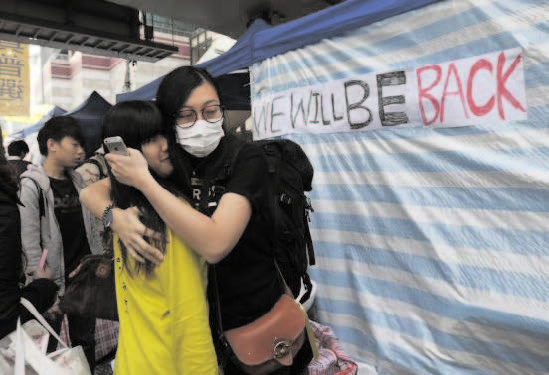
    HONG KONG (TIP): Hong Kong police arrested pro-democracy activists and cleared most of the main protest site on december 11, marking an end to more than two months of street demonstrations in the Chinese-controlled city, but many chanted: “We will be back”. Most activists chose to leave the Admiralty site, next to the Central business area, peacefully, despite their demands for a free vote not being met. But the overall mood remained defiant.

    Hong Kong Federation of Students leader Alex Chow said: “You might have the clearance today but people will come back on to the streets another day.” Groups of up to four police arrested holdout protesters one by one, hours after workers used wire cutters to remove barricades and dismantle bamboo scaffolding. Martin Lee, one of the founders of the main opposition Democratic Party, student leader Nathan Law, media mogul Jimmy Lai and legislators were among those arrested. Lai said 75 days of protests would never have been enough to see the demands met. “We are not so naive,” he told CNN before he was arrested. “We know there will be many battles before we win the war.”

    The mainly peaceful protests have represented one of the most serious challenges to China’s authority since the 1989 pro-democracy demonstrations and bloody crackdown in and around Beijing’s Tiananmen Square. Protest leaders have said they will consider other forms of civil disobedience, given Beijing’s continued refusal to grant any concessions. “Blocking government may be even more powerful than blocking roads,” Benny Tai, one of the leaders of the movement, has said. “Refusal to pay taxes, delaying rent payments … and filibustering in the Legislative Council, along with other acts of non-cooperation, could make governing more inconvenient.” At the protest site, authorities used around 20 trucks with cranes to remove mountains of rubbish.

    By late evening, traffic had resumed along two lanes of the previously blocked highway. Hundreds of police swept through other parts of Admiralty, checking tents before dragging them away along with metal barriers, plastic sheets and umbrellas, which activists had used during clashes to guard against pepper spray and baton blows. A decapitated cardboard cutout of Chinese President Xi Jinping stood in front of a police line. “The movement has been surreal. No one knew it could last more than two months … in a place where time and money are most important,” said protester Javis Luk, 27.

    Expensive real estate

    There was little resistance as protesters packed up pillows, blankets and other belongings from inside tents pitched on some of the world’s most expensive real estate and left the site. Protesters mocked police warnings, shouting their own aimed at Hong Kong’s embattled leader, Leung Chun-ying. “This is the last warning for CY Leung! Show your face, CY Leung,” they shouted. All of the hundreds of tents that had dotted the eight-lane highway that connects some of the former British colony’s most important financial and commercial districts had been removed by the evening and just a few dozen protesters remained.

    Hong Kong returned to Chinese rule in 1997 under a “one country, two systems” formula that gives the city more autonomy and freedom than the mainland and a goal of universal suffrage. The protesters are demanding open nominations in the city’s next election for chief executive in 2017. Beijing has said it will allow a 2017 vote but only between pre-screened candidates. US State Department spokeswoman Jen Psaki said the United States still hoped to a see a competitive process and noted that a new round of public consulations was due in coming weeks.

    “We encourage Hong Kong authorities and the people of Hong Kong to work together to ensure there’s a competitive process for the selection of the chief executive through universal suffrage,” she told a regular news briefing. Despite the clearance, the Occupy movement has been a social watershed, with people pushing back against increasing control and standing up to Beijing to preserve democracy and freedoms largely denied on the mainland. For many, it was a tearful farewell to the site where thousands had gathered in recent weeks and many have called home during the occupation.

  • Chinese social media compare bus assault on Henan woman with Nirbhaya case

    Chinese social media compare bus assault on Henan woman with Nirbhaya case

    BEIJING (TIP): Chinese social media users have pulled out details of the December 2012 Nirbhaya case in New Delhi to draw comparisons with assault and molestation of a woman in Henan province in central China. Microblogging sites like Weibo and other Internet platforms are giving vent to angry Chinese protesting against the thrashing and molestation of a 22-year-old girl inside a moving bus last week. The anger is largely directed at bus passengers and the driver who did nothing to stop a 51-year-old man from molesting the girl in public, and beating her up when she resisted. She lost consciousness during the assault but the driver did not stop the bus despite the huge commotion. “I am furious with the bus driver.

    Why didn’t he respond to her desperate cries for help?” asked the girl’s father in Dahe News in Henan, expressing strong disapproval of passengers refusing to help her during the attack on December 5. The girl had managed to call her father before the attacker snatched her mobile phone and pinned her to the bus seat. The assailant and two of his accomplices dragged her out after the driver stopped under pressure from passengers. Chinese media routinely report rapes and molestations in India, projected as a country notorious for crimes against women. This is why netizens with a fair knowledge of the Nirbhaya case in Delhi are recalling the December 12 rape and drawing comparisons. The difference, they said, is there were no passengers in the Delhi bus, and it was being driven by an accomplice of the assailant. Also the Henan girl was unaccompanied. Anger was directed at the lenient punishment to the assailant: 15 days of administrative detention. But the bus driver lost his job.

  • INDIA LIKELY TO IMPROVE ECONOMIC GROWTH TO 6.3% IN 2016: UN

    INDIA LIKELY TO IMPROVE ECONOMIC GROWTH TO 6.3% IN 2016: UN

    UNITED NATIONS: India’s economic growth is expected to improve to 6.3 per cent in 2016 with the country leading economic recovery in South Asia, according to a United Nations report. The UN World Economic Situation and Prospects 2015 (WESP) report, launched here on Wednesday, also said India is likely to make progress in implementing economic policy reforms and help provide support to business and consumer confidence.

    It said global economic growth is forecast to continue increasing over the next two years, despite legacies from the financial crisis continuing to weigh on growth, and the emergence of new challenges, including geopolitical conflicts such as in Ukraine, and the Ebola outbreak in West Africa. The global economy is expected to grow 3.1 per cent in 2015 and 3.3 per cent in 2016, compared with an estimated growth of 2.6 per cent for 2014, when the pace of expansion has been moderate and uneven.

    It said India, which is estimated to record a 5.4 per cent economic growth in 2014, will see GDP growth improving to 5.9 per cent next year and 6.3 per cent in 2016. Economic growth in South Asia is also set to gradually pick up from an estimated 4.9 per cent in 2014 to 5.4 per cent in 2015 and 5.7 per cent in 2016. “While the recovery will be led by India, which accounts for about 70 per cent of regional output, other economies such as Bangladesh and Iran are also projected to see stronger growth in the forecast period,” the report said.

    The about six per cent growth projected for India in 2016 will be the highest since the 2008-2011 period when it had grown at about 7.3 per cent. Economic growth had slowed to 4.7 per cent in 2012, according to the UN report. During 2014, East Asia, including China, managed to register relatively robust growth, while India led South Asia to a moderate strengthening. Developing countries as a group are expected to grow at 4.8 per cent in 2015 and 5.1 per cent in 2016, up from the 4.3 per cent estimated for 2014.

    The report added that along with robust external demand, growth is expected to be underpinned by a moderate strengthening of domestic consumption and investment as countries benefit from improved macroeconomic conditions. “Several countries, notably India, are likely to make progress in implementing economic policy reforms, thus providing support to business and consumer confidence,” it said.

  • Was Mona Lisa a Chinese slave? Italian’s theory raises eyebrows

    Was Mona Lisa a Chinese slave? Italian’s theory raises eyebrows

    BEIJING: An Italian historian’s theory that Mona Lisa might be a Chinese slave and Leonardo da Vinci’s mother, making the 15thcentury polymath half-Chinese, sent online commentators into a frenzy on Wednesday. Angelo Paratico, a Hong Kong-based historian and novelist from Italy, told the South China Morning Post: “On the back of Mona Lisa, there is a Chinese landscape and even her face looks Chinese.” Chinese web users expressed astonishment and disbelief on Wednesday, posting dozens of parodies of the painting, with faces from Chinese comedians to British actor Rowan Atkinson grafted over her delicate features.


    30


    Little is known about Caterina, the mother of the artist, writer, mathematician and inventor, and the identity of the sitter for the portrait hanging in Paris’ Louvre museum has long been a matter of debate. Paratico, who is finishing a book entitled Leonardo da Vinci: a Chinese scholar lost in Renaissance Italy, cited Austrian neurologist Sigmund Freud’s 1910 assumption that the painting was inspired by the artist’s mother. “One wealthy client of Leonardo’s father had a slave called Caterina.

    After 1452, Leonardo’s date of birth, she disappeared from the documents,” he told the paper. The evidence for a Chinese connection appears to be slight, with Paratico saying he was sure “up to a point” that da Vinci’s mother was from the Orient. “To make her an oriental Chinese, we need to use a deductive method,” he added. Many posters on China’s Twitter-like Sina Weibo were incredulous. “I’m so sad that you thought I’m a foreigner!” wrote one, with an image of a frowning Mona Lisa holding two rolls of toilet paper and blowing her nose. “I’d rather be from wherever I am loved.”

    Another user replaced her features with unlikely faces ranging from Chinese male comedian Zhao Benshan to British actor Rowan Atkinson, to a grimacing robot holding a Mona Lisa mask. The topic had been viewed more than four million times and triggered 160,000 postings by midday on Wednesday. “I now understand why her smile looks so mysterious and concealed, it’s typically Chinese,” said another poster.