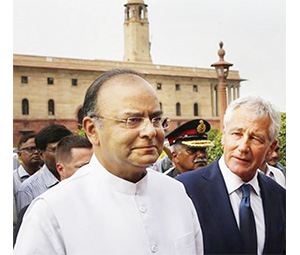
NEW DELHI (TIP):
The US Secretary of Defense Chuck Hagel, on August 9, proposed a trilateral military alliance involving India, Japan and the US, while advising New Delhi that it does not have to choose between Beijing and Washington, but continue to work with both. Hagel who ended his three-day visit to India by proposing the alliance, said “as US and Indian security interests converge, so should our partnerships with other nations”.
“The United States and India should consider expanding their security cooperation with Japan … We should elevate our trilateral defense cooperation”, Hagel said. Japanese Prime Minister Shinzo Abe has been votary of such an alliance which could turn out to be the most powerful outside the US-led NATO.
China, which has tense relations with Japan since the World War-II (1939-1945), in the past has protested against such a grouping. In May last year, the Communist Party-run Global Times newspaper reported “India gets close to Japan at its own peril”. Prime Minister Narendra Modi is slated to visit Tokyo at this month-end. Hagel was delivering a lecture, “achieving the potential of the US-India strategic partnership”, to mark 25 years of think-tank Observer Research Foundation in New Delhi.
He chose to strike a balance in its strategy to bring India and Japan closer. “India need not choose between the closer partnership with America and the improved ties with China,” Hagel advised. In strategic circles, this is being seen as the US understanding India’s point of view which does not see a conflict with China – both nations share a 3,488-km disputed boundary called the Line of Actual Control (LAC). Hagel went on to highlight that China can work “cooperatively” with both India and the US.
“In our relations with Beijing, both Delhi and Washington seek to manage competition but avoid the traps of rivalry. We will continue to seek a stable and peaceful order in which China is a fellow trustee”, Hagel said, probably fully knowing that his words are bound to resonate loudly in Beijing, Tokyo and Moscow – the last one being India’s trusted allay for five decades. Addressing the issue of the hydrocarbon rich disputed South China Sea, Hagel was candid “We ( India and US ) have a shared interest in maritime security across the region, including at the global crossroads of the South China Sea.
We also have a shared stake in the security of global energy and natural resource supplies”. China has claimed total sovereignty over the South China Sea and consequently sole rights over the hydrocarbons under the seabed. Indian has gas-oil block off the coast of Vietnam in the same sea and most of its east bound trade passes through these waters. The dispute is pending in the United Nations.
Hagel reiterated the promise to cooperate with India in co-production, co-development, and freer exchange of technology under the Defence Trade and Technology Initiative (DTTI), saying: “The DTTI now has on the table over a dozen cooperative proposals which would transfer significant qualitative capability, technology, and production knowhow”.
Tag: China
-

Hagel calls for US, Japan, India alliance
-

Pope to fly over China, rare chance for greetings
VATICAN CITY (TIP): Pope Francis’ upcoming trip to South Korea will provide him with an unusual opportunity to speak directly to the Chinese leadership: His plane is due to fly through Chinese airspace, and Vatican protocol calls for the pope to send greetings to leaders of all the countries he flies over.When St. John Paul II last visited South Korea in 1989, China refused to let his plane fly overhead. Instead, the Alitalia charter flew via Russian airspace, providing John Paul with a first-ever opportunity to send radio greetings to Soviet President Mikhail Gorbachev. He said he hoped to soon visit Moscow.
The Vatican spokesman, the Rev Federico Lombardi, said on Thursday he didn’t know what Francis’ Chinese greetings might entail. But he confirmed the Aug. 13-14 flight plan to Seoul involved flying through Chinese airspace. Relations between Beijing and Rome have been tense since 1951, when China severed ties with the Holy See after the officially atheistic Communist Party took power and set up its own church outside the pope’s authority. China persecuted the church for years until restoring a degree of religious freedom and freeing imprisoned priests in the late 1970s.
Emeritus Pope Benedict XVI sought to improve relations with China and encourage the estimated 8 million to 12 million Catholics who live there, around half of whom worship in underground congregations. Francis has continued the initiative, revealing in a recent newspaper interview that he had written a letter to Chinese President Xi Jinping after his election, which occurred within hours of his own, and that Xi had replied. -

BILLIONS SPENT, BUT VISION FOR FAST TRAINS IN US IS UNREALIZED
WASHINGTON (TIP) :
High-speed rail was supposed to be President Obama’s signature transportation project, but despite the administration spending nearly $11 billion since 2009 to develop faster passenger trains, the projects have gone mostly nowhere and the United States still lags far behind Europe and China. While Republican opposition and community protests have slowed the projects here, transportation policy experts and members of both parties also place blame for the failures on missteps by the Obama administration – which in July asked Congress for nearly $10 billion more for highspeed initiatives.
Instead of putting the $11 billion directly into those projects, critics say, the administration made the mistake of parceling out the money to upgrade existing Amtrak service, which will allow trains to go no faster than 110 miles per hour. None of the money originally went to service in the Northeast Corridor, the most likely place for high-speed rail. On a 30-mile stretch of railroad between Westerly and Cranston, RI, Amtrak’s 150mph.
Acela hits its top speed — for five or 10 minutes. On the crowded New York to Washington corridor, the Acela averages only 80mph, and a plan to bring it up to the speed of Japanese bullet-trains, which can top 220mph, will take $150 billion and 26 years, if it ever happens. Florida, Ohio and Wisconsin, all led by Republican governors, canceled high-speed rail projects and returned federal funds after deeming the projects too expensive and unnecessary.
“The Obama administration’s management of previously appropriated high-speed rail funding has been as clumsy as its superintending of the Affordable Care Act’s rollout,” said Frank N Wilner, a former chief of staff at the Surface Transportation Board, a bipartisan body with oversight of the nation’s railroads. When Obama first presented his vision for high-speed rail nearly four years ago, he described a future of sleek bullet trains hurtling passengers between far-flung American cities at more than 200mph.
“Within 25 years, our goal is to give 80 per cent of Americans access to high-speed rail,” Obama said in his 2011 State of the Union address. “This could allow you to go places in half the time it takes to travel by car. For some trips, it will be faster than flying — without the pat-down.” But as Obama’s second term nears an end, some experts say the president’s words were a fantasy.
“The idea that we would have a high-speed system that 80 per cent of Americans could access in that short period of time was unadulterated hype, and it didn’t take an expert to see through it,” said Kenneth Orski, the editor and publisher of an influential transportation newsletter who served in the Nixon and Ford administrations. “And scattering money all around the country rather than focusing it on areas ripe for highspeed rail didn’t help.” The Acela, introduced by Amtrak in 2000, was America’s first successful high-speed train, and most days its cars are full.
The train has reduced the time it takes to travel between Washington, New York and Boston, but aging tracks and bridges – including Baltimore’s 100-year-old tunnel where trains come to a crawl – have slowed it down. It takes two hours and 45 minutes to travel from New York to Washington on the Acela. If the Acela were a bullet train traveling on new tracks, it would take 90 minutes. Another problem is that Amtrak’s funding is tied to annual appropriations from Congress, leaving it without a long-term source of money. “I do what I can do,” said Joseph Boardman, Amtrak’s president. “But I don’t sit back and wait for $15 billion to rebuild the Northeast Corridor.” For now, Amtrak is rebuilding a stretch of track in central New Jersey that will permit travel at 160mph for 23 miles.
But advocates say they are hopeful. “Once something gets built, then we’re going to see more projects get going,” said Ray LaHood, Obama’s first transportation secretary. LaHood said it took the Interstate System of highways decades to be completed, and he predicts that high-speed rail will be the same. LaHood said California seemed the most likely candidate for success with high-speed rail, even though plans for a 520-mile train route between Los Angeles and San Francisco have been mired in controversy.
Despite strong backing from Gov. Jerry Brown, a court ruling had tied up state bond funding for the $68 billion project. An appeals court on July 31 threw out that ruling, which had been based on a lawsuit. But opponents are still increasing calls to kill the project, and polls show waning public support for it. Still, California has begun construction of the tracks and put out bids for a vendor to build the trains. And the new rail project will get an infusion of funds from the state’s cap-and-trade program, which requires business to pay for excess pollution. -

US Bonhomie for India: US Secretaries Storm New Delhi
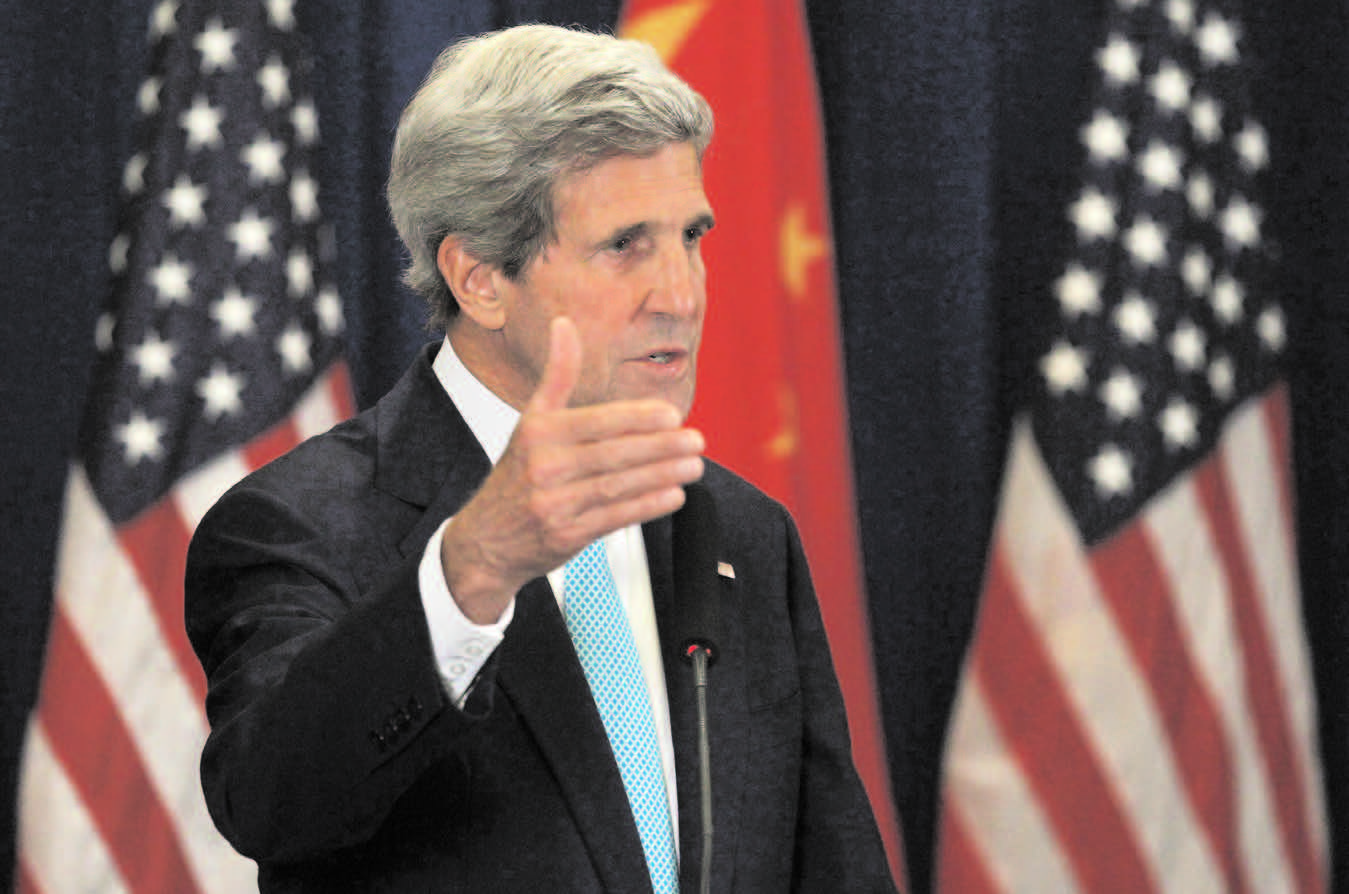
The recent visits of Secretary of Commerce Penny Pritzker, Secretary of State John Kerry, and Secretary of Defense Chuck Hagel are being seen as demonstrative of the resurgence of U.S. interest in India as both countries try to strengthen ties.
NEW DELHI (TIP): It may be a coincidence that the Union cabinet announced August 6, a day before US Secretary of Defense arrived in New Delhi, the decision to allow 49% FDI in Defense. Also announced were the cabinet decisions to allow 100% FDI in Close on the heels of the visits to India by U.S. Secretary of Commerce Penny Pritzker and U.S. Secretary of State John Kerry, U.S. Secretary of Defense Chuck Hagel arrived in India Thursday, August 7, for a three-day visit.
The fact that these high-profile trips by American officials have occurred so close to one another indicates the resurgence of American interest in India. Furthermore, the emergence of a strong, decisive, and reformist government under the Bharatiya Janata Party (BJP) in India has suddenly put India back on the U.S. agenda. India’s Prime Minister Narendra Modi is keen on reminding the world that India is a large country that cannot be ignored and whose interests must be taken seriously.
Secretary Hagel is scheduled to meet Prime Minister Narendra Modi and India’s Defense and Finance Minister Arun Jaitley on Friday, August 8 as well as U.S. and Indian defense company executives. Talks are expected to be fruitful for both countries. Hagel is in India to strengthen defense ties between the two nations. Although the two nations have been moving closer over the past decade, they have not become as close as some U.S. policymakers would have liked.
In fact, events of the past year, including India’s support for Russia in Crimea and the Devyani Khobragade case, show the limitations of a U.S.-India relationship. Nonetheless, both countries are interested in strengthening defense ties when possible, as they still share many common interests, including stability in Afghanistan, as well as concerns over China. It is unlikely that India and the U.S. will remain on anything but cordial terms, despite some occasional bumps. Secretary Hagel himself recognized this, stating that U.S. relationships with new partners in Asia represented both opportunities and challenges.
The Wall Street Journal quotes Rear Admiral John Kirby, the Pentagon press secretary, as saying that “Secretary Hagel’s meetings will focus on the United States’ and India’s converging interests in the Asia Pacific, our common interests in Afghanistan and initiatives to strengthen our defense cooperation, including military exercises, defense, trade, co-production and co-development and research.” One of Secretary Hagel’s goals is to seek more defense projects between the two countries.
There is much scope for this. India is the largest importer of U.S. arms, although it still imports up to 75 percent of its arms from Russia. The two countries are close to finalizing a $1.4 billion deal in which India will buy at least 22 U.S. Apache and 15 Chinook helicopters made by Boeing, as well as other aircraft. Discussion of this deal will be at the top of Hagel’s agenda during his visit. India is also keen on bringing in more foreign investment in its defense sector, so it can meet more of its defense needs indigenously.
India is becoming increasingly ambitious on this front, building, for example, ever-larger warships in India. U.S. investment in India’s defense sector could bolster India’s ability to meet its security needs and be another way in which both the U.S. and India cooperate and profit together. Hagel may also discuss a U.S. offer to jointly develop and produce the next generation of the Javelin missile in India for the Indian market as well for export.
Analysts are optimistic on the outcome of Hagel’s visit to India. According to Vivek Lall, a former Boeing executive and current chairman of the aerospace and defense committee of the Indo-American Chamber of Commerce, “this visit could be the inflection point of deeper defense ties between both countries, specifically to help boost defense production and state-of-the-art technology absorption.” -

Imam of China’s biggest mosque killed in Xinjiang
BEIJING (TIP): The head of a China’s largest mosque was murdered after conducting morning prayers, the local government in the far western region of Xinjiang said Thursday, amid intensifying violence in the turbulent region. Jume Tahir, the governmentappointed imam of the 600-year-old Id Kah mosque in the city of Kashgar, was killed on Wednesday by “three thugs influenced by religious extremist ideology”, the Xinjiang government web portal Tianshan said.
Police launched an all-out investigation and shot dead two of the alleged assailants while capturing the other at about noon on Wednesday as they violently resisted with “knives and hatchets,” Tianshan said. Tianshan said Tahir’s killing was “premeditated” and that the suspects intended to commit a “ruthless murder”. It also said they wanted to “increase their influence through ‘doing something big’”. Tianshan identified the suspects by their names in phonetic Chinese. The official Xinhua news agency in an English-language report gave their names as Turghun Tursun, Memetjan Remutillan and Nurmemet Abidilimit. Neither Tianshan nor Xinhua initially identified who among them was shot dead and who was apprehended.
Tahir was found dead in a pool of blood outside the mosque’s prayer house, Radio Free Asia (RFA) reported earlier on its website. Xinjiang, home to China’s mostly Muslim Uighur ethnic minority, has seen escalating violence which in the past year has spilled over into other parts of China. RFA cited what it described as “witnesses and other officials”, including the director of a neighbourhood stability committee in Kashgar, who described the killing as an assassination. Imams and other religious leaders in China are appointed by the government and subject to strict control on the content of their preaching.
US-based RFA said that Tahir had been critical of violence carried out by Uighurs, and China’s official Xinhua news agency in early July quoted him as condemning terrorist violence carried out in the name of ethnicity and religion. Tahir, 74, “enjoyed a high reputation among Muslims nationwide”, Xinhua said in its dispatch on July 31. -

US Vice President Joe Biden praises Japan’s new military policy
WASHINGTON (TIP):
US Vice President Joe Biden is welcoming Japan’s decision to loosen restrictions on its military to allow greater use of force to defend other countries. Biden spoke to Japanese Prime Minister Shinzo Abe on Thursday.
The White House says the two agreed that Japan’s policy will strengthen US-Japanese ties and help Japan contribute more to regional peace and security. Japan’s move has drawn criticism from rival China as Beijing increases its own military posture.
The White House says Biden also praised Japan’s sanctions on Russia. The US and Europe are sanctioning Russia over its actions in Ukraine. Japan is part of the Group of Seven nations seeking to pressure Moscow. The two leaders also discussed the nuclear threats from North Korea and Iran, plus conflicts in Iraq and Syria. -

India holds its ground, WTO fails to reach $1 trillion deal on customs rules
GENEVA (TIP): The World Trade Organization failed on July 31 to reach a deal to standardise customs rules, which would have been the first failed global trade reform in two decades but was blocked by India’s demands for concessions on agricultural stockpiling. “We have not been able to find a solution that would allow us to bridge that gap,” WTO director-general Roberto Azevedo told trade diplomats in Geneva just two hours before the final deadline for a deal. “Of course it is true that everything remains in play until midnight, but at present there is no workable solution on the table, and I have no indication that one will be forthcoming.”
The deadline passed without a breakthrough. WTO ministers had already agreed the global reform of customs procedures known as “trade facilitation” last December, but it needed to be put into the WTO rule book by July 31. Most diplomats saw that as rubberstamping a unique success in the WTO’s 19 year history, which according to some estimates would add $1 trillion and 21 million jobs to the world economy, so they were shocked when India unveiled its veto.
Trade experts say on Thursday’s failure is likely to end the era of trying to cobble together global trade agreements and to accelerate efforts by smaller groups of likeminded nations to liberalise trade among themselves. India has been vocal in opposing such moves, making its veto even more surprising. “Today’s developments suggest that there is little hope for truly global trade talks to take place,” said Jake Colvin at the National Foreign Trade Council, a leading US business group.
“The vast majority of countries who understand the importance of modernizing trade rules and keeping their promises will have to pick up the pieces and figure out how to move forward.” Some nations have already discussed a plan to exclude India from the agreement and push ahead regardless, and the International Chamber of Commerce urged officials to “make it happen.” “Our message is clear. Get back to the table, save this deal and get the multilateral trade agenda back on the road to completion sooner rather than later,” ICC secretary general John Danilovich said.
US secretary of state John Kerry, on a visit to New Delhi, had earlier said he was hopeful that differences between India and much of the rest of the world could be resolved. But after Azevedo’s speech, US ambassador to the WTO Michael Punke was downbeat. “We’re obviously sad and disappointed that a very small handful of countries were unwilling to keep their commitments from the December conference in Bali, and we agree with the Director- General that that action has put this institution on very uncertain new ground,” Punke told reporters.
India had insisted that, in exchange for signing the trade facilitation agreement, it must see more progress on a parallel pact giving it more freedom to subsidise and stockpile food grains than is allowed by WTO rules. It got support from Cuba, Venezuela and Bolivia. India’s new nationalist government has insisted that a permanent agreement on its subsidised food stockpiling must be in place at the same time as the trade facilitation deal, well ahead of a 2017 target set last December in Bali. Kerry, whose visit to India was aimed at revitalising bilateral ties but was overshadowed by the standoff, said the United States understood India’s position that it needs to provide food security for its poor but India would lose out if it refused to maintained its veto.
Deal without India?
Diplomats say India could technically attract a trade dispute if it caused the deal to collapse, although nobody wanted to threaten legal action at this stage. The summer break will give diplomats time to mull options, including moving ahead without India. Technical details would still have to be ironed out, but there was a “credible core group” that would be ready to start talking about a such a deal in September, a source involved in the discussions said.
“What began as a murmur has become a much more active discussion in Geneva and I think that there are a lot of members in town right now that have reached the reluctant conclusion that that may be the only way to go,” he said. An Australian trade official with knowledge of the talks said a group of countries including the United States, European Union, Australia, Japan, Canada and Norway began discussing the possibility in Geneva on Wednesday afternoon. New Delhi cannot be deliberately excluded, since that would mean other countries slowing down containers destined for India, but if it becomes a “free-rider” it will add another nail in the coffin of attempts to hammer out global trade reform.
Trade diplomats had previously said they were reluctant to consider the idea of the allbut- India option, but momentum behind the trade facilitation pace means it may be hard to stop. Many countries, including China and Brazil, have already notified the WTO of steps they plan to take to implement the customs accord immediately. Other nations have begun bringing the rules into domestic law, and the WTO has set up a funding mechanism to assist.
But WTO head Azevedo said he feared that while major economies had options open to them, the poorest would be left behind. “If the system fails to function properly then the smallest nations will be the biggest losers,” he said. “It would be a tragic outcome for those economies — and therefore a tragic outcome for us all.” -

Japan to participate in Malabar exercise with India and US
WASHINGTON (TIP): In an effort to strengthen the tri-lateral cooperation, Japan will participate in this year’s Malabar naval exercise to be held at the end of this month, with India and the US.”Japan will participate in MALABAR this year which is our largest bilateral naval exercise with India and it’s scheduled to take place at the end of this month,” Deputy assistant secretary of defense for South and Southeast Asia Amy Searight told lawmakers during a Congressional hearing on yesterday. The assistant secretary of state for South and Central Asia Nisha Desai Biswal said there is strong trilateral partnership between the three countries.
“We were about to hold the fifth iteration of the US-India-Japan trilat earlier this summer. We have had to reschedule that but we have seen a tremendous growth in the amount of collaboration that we’re able to have, not only in terms of sharing of intelligence and analysis but also looking at active areas of cooperation,” she said. The Malabar series has historically been an India-US affair, but its scope has widened with Japan being invited for the annual naval engagement. “We will be doing joint exercises with Japan and India in the MALABAR exercises later this fall.
And we see opportunities for increasing the collaboration across Southeast Asia. We are engaging more frequently in consultations and dialogue with the Indians on Asean and look forward to increased and frequent consultations across the East Asia sphere,” Biswal said while replying to a question from Senator John McCain. Lisa Curtis of The Heritage Foundation said there’s a realm opportunity to build the US-India-Japan trilateral cooperation. In the past few years India has focused increasingly on buttressing security ties with Japan, South Korea, and Vietnam to meet the challenges of a rapidly rising China, she said.
“Indo-Japanese ties, in particular, are expected to get a major boost under Modi’s administration since Modi and Japanese Prime Minister Shinzo Abe are both increasingly concerned about China and appear prepared to take new policy directions to deal with the challenges posed by Beijing’s rapid military and economic ascendance,” Curtis said. Both the heads of state, Shinzo Abe and Narendra Modi have developed a close personal rapport, she said. “As chief minister, Modi traveled to Japan in 2007, marking the first time an Indian chief minister had travelled to the country. Modi was one of the first foreign dignitaries to congratulate Abe when he was reelected in 2012. The recent postponement of Modi’s visit to Japan is all the more perplexing, given the history of the personal relationship between Abe and Modi,” she added.
-

Kerry arrives in Afghanistan to meet candidates
KABUL, AFGHANISTAN (TIP): The US and its allies are growing increasingly concerned as Afghanistan shows signs of unraveling in its first democratic transfer of power from President Hamid Karzai. With Iraq wracked by insurgency, Afghanistan’s dispute over election results poses a new challenge to President Barack Obama’s effort to leave behind two secure states while ending America’s long wars. US Secretary of State John Kerry made a hastily arranged visit to Afghanistan on Friday to help resolve the election crisis, which is sowing chaos in a country that the US has spent hundreds of billions of dollars and lost more than 2,000 lives trying to stabilize. He was to meet with the two candidates claiming victory in last month’s presidential election runoff. “I’ve been in touch with both candidates several times as well as President (Hamid) Karzai,” Kerry said before leaving Beijing, where he attended a US-China economic meeting.
He called on them to “show critical statesmanship and leadership at a time when Afghanistan obviously needs it.” “This is a critical moment for the transition, which is essential to future governance of the country and the capacity of the (US and its allies) to be able to continue to be supportive and be able to carry out the mission which so many have sacrificed so much to achieve.” With Iraq wracked by insurgency, Afghanistan’s power dispute over the election results is posing a new challenge to President Barack Obama’s 5 1/2-year effort to leave behind two secure nations while ending America’s long wars in the Muslim world. Obama wants to pull out all but about 10,000 US troops from Afghanistan by the end of the year, and the election of a new Afghan president was supposed to enshrine the progress the nation has made since the US-led invasion after the 9/11 terrorist attacks.
The preliminary results of the presidential election runoff suggested a massive turnaround in favor of former Finance Minister Ashraf Ghani Ahmadzai, a onetime World Bank economist who lagged significantly behind former Foreign Minister Abdullah Abdullah in first-round voting. Abdullah, a top leader of the Northern Alliance that battled the Taliban before the American-led invasion, claims the runoff was a fraud, and his supporters have spoken of establishing a “parallel government,” raising the specter of the Afghan state collapsing. Abdullah was runner-up to Karzai in a fraud-riddled 2009 presidential vote before he pulled out of that runoff.
Chief electoral officer Zia ul-Haq Amarkhail has resigned, denying any involvement in fraud but saying he would step down for the national interest. Kerry will seek to persuade both candidates to hold off from rash action while the ballots are examined and political leaders are consulted across Afghanistan’s ethnic spectrum. The US wants to ensure that whoever wins will create a government that welcomes all ethnic factions. If neither candidate gains credibility as the rightful leader, the winner could be the Taliban.
Many Afghans fear the insurgent forces will only gain strength as the US military presence recedes. Internal instability could aid the insurgency. Abdullah and Ghani each have said that as president they’d sign a bilateral security agreement with the United States, granting American forces immunity from local prosecution. Without such an agreement, the Obama administration has said it would have to pull all US troops out of Afghanistan, a scenario that played out in Iraq three years ago. Karzai has refused to finalize the deal, leaving it to his successor. James Dobbins, the State Department’s special representative for Afghanistan and Pakistan, said this week some degree of fraud was expected, but it’s believed the fraud was “quite extensive.
” Speaking in Washington, Dobbins said the Abdullah campaign particularly mistrusts the impartiality of the Afghan electoral institutions. Both campaigns and Karzai have asked the Un for help, he noted, and the Un has been designing a plan for deciding how ballots can be reviewed and which ones would be reviewed for possible fraud. A Un audit, however rudimentary, probably could be done within two weeks, US officials believe. The focus would be on clear fraud indicators, including districts with high turnout or more women going to the ballots than men. -

California man sentenced to 15 years for espionage
OAKLAND (US) (TIP): A federal judge has sentenced a California chemical engineer to 15 years in prison and fined him USD 28.3 million for a rare economicespionage conviction for selling China a secret recipe to a widely used white pigment. US District Court Judge Jeffrey White in Oakland said Liew, a naturalised US citizen, had “turned against his adopted country over greed.” A jury previously convicted the 56-yearold Liew of receiving USD 28 million from companies controlled by the Chinese government in exchange for DuPont Co’s pigment technology for making cars, paper and a long list of everyday items whiter.
Along with the USD 28.3 million Liew was ordered to forfeit and pay to DuPont, the engineering company launched by him and his wife was fined $18.9 million. White expressed doubt yesterday that Liew would pay back much of his debt. White noted that US authorities had managed to trace USD 22 million of the $28 million received by Liew to various Singapore and Chinese companies controlled by Liew’s in-laws before losing the trail. “We’ll never get it,” White said. “It has been spirited out of the country.” Liew and his wife, Christina Liew, launched a small California company in the 1990s aimed at exploiting China’s desire to build a DuPont-like factory to manufacture the white pigment known as titanium dioxide.
The Liews hired retired DuPont engineers and, according to the FBI, paid them thousands of dollars for sensitive company documents laying out a process to make the pigment. Two former DuPont engineers have also been convicted of economic espionage. Another engineer committed suicide in early 2012 on the day he was to sign a plea bargain acknowledging his role in the conspiracy. Except for a few months of release on bail, Liew has been in jail since his arrest in 2011. Wearing yellow jail garb and with his wife and family looking on from the gallery, Liew apologised for his actions. “There are many things I would have liked to have done differently,” Liew told the judge. “I regret my actions.” Liew was born on a farm in Malaysia to Chinese parents and went on to earn advanced degrees in chemical engineering. -

PROSTITUTE LEFT GOOGLE EXECUTIVE TO DIE ON BOAT: POLICE
SANTA CRUZ, CALIFORNIA (TIP): As a Google executive lay dying on his yacht, an upscale prostitute casually walks over him, picks up her clothes and heroin and swallows the last of a glass of wine before lowering the boat’s blinds and walking back on the dock to shore, police say surveillance footage shows. Authorities charged Alix Tichelman, 26, with manslaughter on Wednesday for her role in the death of Forrest Hayes, who was found dead by the captain of his 50-foot (15-meter) yacht last November.
Police said the surveillance video from the yacht shows everything that happened from the time Tichelman came aboard to when she left. Santa Cruz Deputy Police Chief Steve Clark told the Associated Press on Wednesday that Hayes, 51, had hired Tichelman before, and that their November 23 encounter “was a mutually consensual encounter including the introduction of the heroin.” Clark said it appears this might not have been the first time she left someone in trouble without calling police or trying to help. Without elaborating, he said his agency is cooperating with police in a different state on a similar case.
“There’s a pattern of behavior here where she doesn’t seek help when someone is in trouble,” he said. News vans gathered outside Hayes hilltop estate overlooking the glittering Monterey Bay, where the five-bedroom home is on the market for $4.2 million. Hayes’ widow has not spoken publicly and a blog created in his memory was deleted. On the website, friends and coworkers were seemingly unaware of how he died. They fondly described their time together, Christmas parties on his boat, engineering teams at Sun Microsystems, traveling to China for Apple and most recently at Google, where they said he was involved in the Glass eyewear projects.
Clark said it’s not clear if Hayes was a frequent drug user, and that in the video, it appears he needed Tichelman to help him shoot up. Clark described Tichelman as a high-end prostitute, who charged $1,000 and lived three hours away in the Sacramento suburb of Folsom. He said she had other clients from Silicon Valley, home to about 50 billionaires and tens of thousands of millionaires. “There’s no question that Silicon Valley feels different than it felt 28 years ago when I moved here,” said Russell Hancock, president of Joint Venture Silicon Valley, an organization focused on the local economy and quality of life.
“Something has happened. We used to be a Valley full of techies living middle class lives, and now we’re a Valley of the uber-rich carrying toy poodles around with them.” Tichelman was arrested on July 4 after police said a detective lured her back to the Santa Cruz area by posing as a potential client at an upscale resort. Clark said they didn’t just arrest her because they didn’t know exactly where she lived, and they were concerned she would flee. Police said Tichelman boasted she had more than 200 clients and met them through a website that purports to connect wealthy men and women with attractive companions.
Her clients included other Silicon Valley executives, Clark said. Tichelman’s father has ties to the tech industry. Folsom software firm SynapSense announced hiring her father, Bart Tichelman in 2012. Neither the firm nor her father responded to immediate requests for comment. She is being held on $1.5 million bail after appearing in court Wednesday wearing red jail scrubs. Santa Cruz Superior Court Judge Timothy Volkmann approved a request from Tichelman’s court appointed attorney, Diana August, to continue the arraignment until July 16. August did not immediately return a call seeking comment.
Assistant District Attorney Rafael Vazquez said authorities are still investigating and may file more serious charges. Santa Clara University Finance professor Robert Hendershott said financial windfalls like those seen in the Silicon Valley often bring problems as people have trouble managing their newfound wealth. But he said there’s no obvious hedonistic culture in the Silicon Valley. “There’s no Great Gatsby type of parties famous in the Silicon Valley,” he said. -

World famous Astrologer Bejan Daruwalla predicts for America
Bejan Daruwalla, one of the best known astrologers of the world, based in Ahmedabad, India is known to have come up with predictions on men and matters that have mostly proved true.
The Indian Panorama carries his predictions regularly and we are happy our readers feel happy that we have introduced Bejan’s column.
Here we bring our readers, on the occasion of America’s Independence Day, Bejan Daruwalla’s predictions for America.
Cancerian country America (Born July 4) will have sinew and muscle power. China will not be able to get better of America. Leo Obama will prove his mettle. For America I take three signs Cancer, Gemini and Sagittarius. The actual mix is my very own. America will lead.
That says it all. I am no God but I think a new and good chapter will be written as mighty Prime Minister of India Narendra Modi will meet super boss of America Obama and something good will come out it. Leave the rest to the God.
There will be a good change in the situation of the people of America. Moreover more job opportunities will take place. Besides this there will be a lot of positive changes seen in the coming year. Improvement will be seen in the financial position of the people. Obama is a Leo.
Jupiter will be in Leo from July 17, 2014 to August 11, 2015. Ganesha says this will be a great and glorious period for Obama and America. The big bang theory excites me. The God particle will be discovered between 2015 to 2017.The New Age, simply put is all about the Cs — Connection, Communication, Collectivity, Contacts, Creativity, Circulation and Consciouness. Paul Brunton says it all.
“There is peace behind the tumult, goodness behind the evil. Happiness behind the agony.”
Bejan Daruwalla can be reached at
info@bejandaruwalla . His phone
number in India is +919825470377 . -

China bans Ramzan fasting in Xinjiang
BEIJING (TIP): China has ordered schools and government offices in the northwest Xinjiang region to ban fasting during the ongoing holy month of Ramzan. The ban orders are being issued through websites of schools and government agencies in the region as well. “Civil servants and students cannot take part in fasting and other religious activities,” said Turfan city’s commercial affairs bureau on its website.The local government in Xinjiang had earlier asked its employees to refrain from observing Ramzan saying fasting can hurt their health.”We remind everyone that they are not permitted to observe Ramadan fast,” the state-run Bozhou Radio and TV University said on its website. “We would enforce the ban on party members, teachers, and young people from taking part in Ramzan activities.
” The Chinese Communist Party and the local government in Xinjiang discourage large prayer meetings and gatherings due to fears of separatism. The fasting ban orders are believed to have come from Beijing’s Public Security Bureau. A weather bureau in Qaraqash County in western Xinjiang cited “instructions from higher authorities” while asking “all current and retired staff not to fast during Ramzan”.
“China taking these kinds of coercive measures, restricting the faith of Uighurs, will create more conflict,” exiled World Uyghur Congress spokesman Dilxat Raxit said in a statement. “We call on China to ensure religious freedom for Uighurs and stop political repression of Ramzan.
-

US urges China to let Hong Kong’s voices be heard
WASHINGTON (TIP): China must give Hong Kong the space to debate its political future and allow the “vigorous” voices of the city’s residents to be heard, a top US diplomat said on July 2.
Discontent in Hong Kong, which reverted back to Chinese rule in 1997, is at its highest level in years over Beijing’s insistence that it vet candidates before a 2017 vote for the city’s next leader. Under the terms of its handover by Britain, the vibrant city enjoys a special status for 50 years according it greater liberties than other parts of China.
But there are fears that some of these freedoms are being eroded. “We want to see continued evidence that the rights of the people of Hong Kong are being respected and that the principles that China embraced in connection with reversion are honored,” America’s top diplomat for East Asia, Assistant Secretary of State Daniel Russel, told AFP. “Key among those principles… is universal suffrage.”
Organizers say that half a million people protested on Tuesday in Hong Kong demanding democratic reforms including the right to have a say in the nominees to be the city’s next leader. Russel, who visited Hong Kong earlier this year, said there were “a lot of ideas” about how to ensure universal suffrage in the run-up to 2017 and a “lot of back and forth” with Beijing.
“We believe it’s very much in China’s interests to demonstrate that it is living up to its commitments and honoring the principles in the Basic Law” which governs the territory. “We hope that China will show restraint and create the space for the people of Hong Kong to peacefully express their views,” he added. He praised Tuesday’s protests for being “vigorous and peaceful.” More than 500 protesters were arrested at a sit-in early Wednesday after the march, but Russel said he had heard no reports of violence.
-

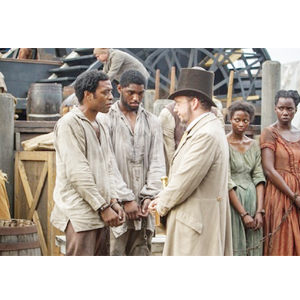
A scene from the movie 12 Years
supervision of voter registration in states and individual voting districts where such tests were being used. The act had an immediate and positive effect for African Americans. In 1965, Mississippi had the highest black voter turnout at 74% and led the nation in the number of black public officials elected. Atlanta elected its First black mayor, Andrew Young, as did Jackson, Mississippi, with Harvey Johnson, Jr., and New Orleans, with Ernest Morial. Black politicians on the state level included first Southern woman Barbara Jordan, elected to the Texas house of as Representatives.
Julian Bond was elected to the Georgia State Legislature in 1965. On April 4, 1968 Dr King was assassinated in Memphis, Tennessee, and Riots broke out in black neighborhoods in more than 110 cities across the United States in the days that followed, notably in Chicago, Baltimore, and in Washington, D.C. The damage done in many cities destroyed black businesses and homes, and slowed economic development for a generation. But Americans were not deterred. America ushered into an era of real vibrant Democracy with participation of all. But it took America nearly two hundred years to let all enjoy the fruit of freedom and liberty, with real equality still eluding the nation. Economic inequality was destroying the American Dream. The deindustrialization of the late 1960s and early 1970s manipulated by American Bankers and Multinational companies to enhance their own fortunes, forced income inequality to increase dramatically to levels never seen before.

On August 28, 1963, Martin Luther King Jr., prominent figure of the Civil Rights Movement, stood before the Lincoln Memorial in Washington, DC and delivered his iconic “I Have A Dream” speech. Here was a turning point in the history of America.
Supporters of this illconceived deindustrialization wrote death warrants for American Dream, domestic Industry and the Middle Class; the economists and most policy makers across the isles pointed to the fact that consumers could buy so many goods, even with the inflation of the 1970s, as evidence that the general shift away from manufacturing and into services was creating widespread prosperity. In 2008 economic disasters hit the country and indeed the entire world. 8.8 million jobs were lost and many for forever by July 2010, according to the Bureau of Labor Statistics. The worst recession since the great depression began with the collapse of housing prices and the construction industries all around USA.

Wall Street in New York: Symbol of America’s economic power
Millions of mortgages mostly averaging about $200,000 each had been bundled into exotic financial instruments/securities called collateralized debt obligations that were resold worldwide. Many banks and hedge funds had borrowed hundreds of billions of dollars to buy these securities, which were now “toxic” because their value was unknown and no one wanted to buy them. Number of largest US and European banks collapsed; some went bankrupt, such as Lehman Brothers with $690 billion in assets; others such as the leading insurance company AIG, the leading bank Citigroup, and the two largest mortgage companies were bailed out by the government.
Congress voted $700 billion in bailout money ($418 billion actual disbursement) under the program, and the Treasury and Federal Reserve committed trillions of dollars to shoring up the financial system, but the measures did not reverse the declines. Banks drastically tightened their lending policies, despite infusions of federal money. The government for the first time took major ownership positions in the largest banks. The stock market plunged 40%, wiping out tens of trillions of dollars in wealth; housing prices fell 20% -30% nationwide wiping out trillions more. By late 2008 distress was spreading beyond the financial and housing sectors, especially as the “Big Three” of the automobile industry; General Motors, Ford and Chrysler were on the verge of bankruptcy, and the retail sector showed major weaknesses.
The Critics of the $700 billion Troubled Assets Relief Program (TARP) expressed anger that much of the TARP money that has been distributed to the rich at Wall Street rather then saving the common people who lost their jobs, houses and life savings. In an international study, Americans ranked 11th in happiness and a discouraging 24th in economy. Another study of 8th graders found only 7 percent of American students rated advanced in mathematics compared to 47 and 48 percent in Singapore and South Korea. Our President, according to a Forbes power rating, comes in second behind Vladimir Putin. Yet, the United States is the world leader and likely to remain there for decades. It has the greatest soft power in the world by far.
The United States still receives far more immigrants each year (1 million) than any other country in the world. The United States leads the world in high technology (Silicon Valley), finance and business (Wall Street), the movies (Hollywood) and higher education (17 of the top 20 universities in the world in Shanghai’s Jaotong University survey). The United States has a First World trade profile (massive exports of consumer and technology goods and imports of natural resources).
It is still the world’s leader for FDI at 180 billion dollars, almost twice its nearest competitor. The United States, spending 560 billion dollars a year, has the most powerful military in the world. Its GDP (16 trillion dollars) is more than twice the size of China’s GDP. As the first new nation, it has the world’s longest functioning democracy in a world filled with semidemocratic or non-democratic countries. Its stock market, at an all time high, still reflects American leadership of the global economy.
For the past 80 years, the United States is the leader in fundamental advances in telecommunications and technology. AT&T’s Bell Laboratories spearheaded the American technological revolution with a series of inventions including the light emitted diode (LED), the transistor, the C programming language, and the UNIX computer operating system. SRI International and Xerox PARC in Silicon Valley helped give birth to the personal computer industry, while ARPA and NASA funded the development of the ARPANET and the Internet. In Physics and Chemistry, Americans have dominated the Nobel Prize for physiology or medicine since World War II. US biomedical research has played a key role in the advancement of diagnosis, medicines, cure and patient care in the world. America’s Walmart is the world’s largest public corporation.
According to the Fortune Global 500 list in 2014, Walmart is the biggest private employer in the world with over two million employees with 11,000 stores in 27 countries, and the largest retailer in the world with a revenue of US $ 476.294 billion. US Entertainment Industry is world leader and generated $522 billion dollars in revenue in 2013. The United States with over $ 48 Billion Dollars; is the world’s leading donor of government aid to other countries, distributing twice as much as any other nation. Besides, another $30 Billion was given by US foundations, Corporations, religious organizations, Universities, Private and voluntary organization.
As the old political saying goes, you can’t beat someone with no one. And, right now, there is no one on the horizon that will overtake or even seriously challenge the United States, however ailing, for at least the next decade or two. I salute the great nation, its vibrant democracy and its people, as we celebrate Independence of America.
-

Chinese activist freed after Tiananmen anniversary
BEIJING (TIP): A leading figure of a small citizen movement in southern China was released on bail on June 25, nearly one month after he was taken into police custody, his lawyers said. Wang Aizhong has been a key figure of the amorphous Southern Street Movement that seeks an end to China’s one-party rule and urges its followers to take to the street to make their appeals public.
Wang was detained on May 29, among dozens of activists ahead of the 25th anniversary of a bloody crackdown on the Tiananmen Square pro-democracy protests in 1989. Authorities had sought to block any commemoration of the event. Many have since been released, although several remain in detention or have been indicted, such as the prominent rights lawyer Pu Zhiqiang. Wang could not be reached Thursday, but his lawyers Wu Kuiming and Zhang Xuezhong confirmed his release.
Zhang said authorities may have failed to find enough evidence to prosecute Wang on criminal charges. He said Wang’s release is an “isolated case” and should not be seen as a sign that China is relaxing prosecution against activists.
China has increasingly been using public disorder charges against political dissidents. Most recently, a court in Beijing jailed the legal scholar Xu Zhiyong after convicting him of gathering crowds to disrupt public order, a charge largely stemming from several rallies Xu organized before the Ministry of Education to demand education equality. “Wang Aizhong has not done anything like that, with which the police can find some legal clauses to charge him,” Zhang said. “It shows there are times when police cannot find excuses for prosecution.”
-

Ansari in China to commemorate the 60th anniversary of Panchsheel
BEIJING (TIP): Vice-President Hamid Ansari arrived in Xian, June 26, on his maiden visit to China. He said he would discuss all matters of “bilateral agenda” with his Chinese counterpart while simultaneously emphasizing on the continued relevance and applicability of the Panchsheel. His statement came in response to a question on whether he intended to discuss the continuing incidents of intrusion and aggression by China’s People’s Liberation Army along the Line of Actual Control (LAC).
“All matters of bilateral agenda will be taken up,” he said while avoiding giving a direct answer to a supplementary question on whether Chinese military intrusions would specifically get discussed. “Bilateral agenda means bilateral agenda; that is the totality of substance between the two countries discussed from time to time. We will discuss but I cannot anticipate the talks”, he said. The two countries are scheduled to sign several bilateral agreements, most likely pertaining to trade and commerce.
One issue on which Vice President Ansari was more forthcoming was the balance of trade. In reply to a question he said the two governments were working on this. “It is a matter of concern to us that while trade is increasing, the balance of trade is not coming down. The two governments are seized of the matter and will address them in time”, he said adding that Union Minister of Commerce Nirmala Sitaraman, who is accompanying him on the official visit, is expected to discuss this with her Chinese counterparts.
That India attaches high importance to its relations with China was evident from Ansari’s opening statement at a brief interaction he held with the media on board the special Air India flight soon after take off from New Delhi. “China is a very important country. It is our most important neighbor. It is a country with which our bilateral trade is almost at the top with only one or two countries recording higher bilateral trade”, he said adding, “Both governments are committed to furthering our relations”.
Ansari’s visit is the first by a high ranking Indian this year which incidentally has been designated as the ‘Year of Friendly Exchanges’. His visit is preceded by Premier Li Keqiang’s congratulatory phone call to newly elected Prime Minster Narendra Modi which was followed by a visit of a special Chinese envoy to New Delhi. He is scheduled to meet the Communist Party of China’s secretary for Shaanxi province before arriving in Beijing tomorrow night. Incidentally, Shaanxi province is the birth place of Chinese President Xi Jinping. He was received by the Vice Governor of Shaanxi province Wang Lixia.
In Beijing, the Vice President is scheduled to hold a set of both bilateral and trilateral meetings. His bilateral meetings with the Chinese leadership will include holding discussions with his counterpart Vice President Li Yuanchao, a meeting with Premier Li Keqiang and a call on President Xi Jinping. He will also hold a bilateral meeting with Myanmar President Thein Sein. But the significant occasion for which he is here is the India-China-Myanmar trilateral summit meeting to commemorate the 60th anniversary of the historic Panchsheel, a joint statement on which was issued by the then Indian Prime Minister Jawaharlal Nehru and Chinese Premier Zhou Enlai in New Delhi on June 28, 1954.
Asked about the relevance of the Panchsheel, Ansari, who is a former IFS officer, replied “Panchsheel are of universal value. So much so that not only China, India and Myanmar, but the entire non alignment movement and a majority of the nations subscribe to it. Inter-state relations can only be on these principles”, he added pointing out that the “principles (of Panchsheel) are impeccable and there is no dispute about it.” The Panchsheel or the five principles of peaceful co-existence comprises mutual respect for each other’s territorial integrity and sovereignty, mutual non aggression, mutual non-interference, equality and mutual benefit and peaceful co-existence.
-

CHINA-PAK NUCLEAR PROLIFERATION
India should counter the challenge diplomatically
“India has passively not taken up its concerns about the China- Pakistan missile and nuclear collaboration strongly with Beijing. This challenge surely needs to be more seriously addressed and countered, both diplomatically and strategically”, says the author.
While explaining the rationale for Pakistan’s nuclear weapon program, its then Prime Minister Z.A. Bhutto noted that while the Christian, Jewish and Hindu civilizations had nuclear weapons capability, it was the Islamic civilization alone that did not possess nuclear weapons.
He asserted that he would be remembered as the man who had provided the Islamic civilization with full nuclear capability. Bhutto’s views on Pakistan’s nuclear weapons contributing to the capabilities of the Islamic civilization were shared by Pakistan’s senior nuclear scientist Sultan Bashiruddin Mehmood who, along with his colleague Chaudhri Abdul Majeed, was detained shortly after the terrorist strikes of 9/11.
They were both charged with helping Al Qaida acquire nuclear and biological weapon capabilities. Two other Pakistan scientists, Suleiman Asad and Al Mukhtar, wanted for questioning about their links with Osama bin Laden, disappeared after it was claimed that they had gone to Myanmar.
The original sinner in nuclear proliferation, however, is not Pakistan, but China. Director of the Wisconsin Project of Arms Control Gary Milhollin has commented: “If you subtract China’s help from the Pakistani nuclear program, there is no Pakistani nuclear program”.
There is evidence, including hints from Bhutto’s prison memoirs, that suggest that China initially agreed to help Pakistan develop nuclear weapons when Bhutto visited Beijing in 1976. It is now acknowledged that by 1983 China had supplied Pakistan with enough enriched uranium for around two weapons and the designs for a 25- Kiloton bomb. Chinese support for the Pakistan program is believed to have included a quid pro quo in the form of Pakistan providing China the designs of centrifuge enrichment plants.
Interestingly, thanks to China, Pakistan acquired nuclear arsenal at least five years before India decided to cross the nuclear threshold. China’s assistance to Pakistan continued even after Beijing acceded to the NPT. When Pakistan’s enrichment program faced problems in 1995, China supplied Pakistan 5,000 ring magnets.
China has subsequently supplied Pakistan with unsafeguarded plutonium processing facilities at Khushab. There is also evidence that China has supplied Pakistan with a range of nuclear weapons designs with the passage of time. While the nuclear weapons designs supplied by Dr A.Q. Khan to Libya were of a Chinese warhead tested in the 1960s, the nuclear warheads tested by Pakistan in 1998 were of a different design According to Thomas Reed, a former Secretary of the US Air Force, who was closely associated with the US nuclear weapons establishment and Dan Stillman, a US nuclear expert who had extensive interactions with his Chinese counterparts a Pakistani derivative of the Chinese CHIV-4 nuclear bomb was tested by Pakistan in China on May 26, 1990.
This was eight years before India’s 1998 tests that validated its nuclear weapons. Reed stated that while in China, Stillman had noted that his stay at the Shanghai Institute of Nuclear Research “also produced a first insight into the extensive hospitality extended to Pakistani nuclear scientists during the late 1980s time period”.
Reed has disclosed that “in 1982, China’s Premier Deng Xiao Ping began the transfer of nuclear technology to Pakistan”. Moreover, after warmly welcoming Prime Minister Rajiv Gandhi in Beijing in 1988, Deng commenced missile collaboration with Pakistan, with the supply of short range Hatf 2 missiles. This was followed up by assistance to manufacture Shaheen 1 (750 km range) and Shaheen 2 (range 1500-2000 km), at Fatehjang.
China has thus not only provided Pakistan assistance for manufacturing nuclear weapons, but also for missiles which can target population centres across India. Not satisfied with providing nuclear weapons designs, knowhow and modern uranium enrichment centrifuges, China soon found that Pakistan’s arsenal would become more potent if it included lighter plutonium warheads, both for easier mating with the Chinese designed ballistic missile and for development of tactical nuclear weapons.
Pakistan and China adopt a parallel approach on nuclear and missile proliferation in the Islamic world. Saudi Arabia’s Defence Minister, Prince Sultan, was given unprecedented access to Pakistan’s nuclear weapons facilities in Kahuta in March 1999. Shortly thereafter Dr. A.Q. Khan paid a visit to Saudi Arabia at the invitation of Prince Sultan in November 1999.
Khan’s visit was followed by a visit to Pakistan’s nuclear facilities by Saudi scientists who had been invited by him to visit Pakistan. Given these developments and the fact that China had supplied long-range CSS 2 Saudi missiles to Saudi Arabia in the past, there is interest about the precise directions that nuclear and missile collaboration of Pakistan, China and Saudi Arabia could take. Pakistan could, for example, justify the deployment of nuclear weapons and missiles on Saudi soil.
It is not without significance that the Chairman of Pakistan’s Joint Chiefs of Staff Committee, Gen Khalid Shamim Wynne, who handles its nuclear arsenal, was received at a high level in Saudi Arabia. Similarly, while Pakistan provided the designs of nuclear centrifuges to Iran over two decades ago, China is known to have been on the forefront of transfer of ballistic missile knowhow and technology to Tehran.
The issue of Beijing issuing stapled visas for Indian nationals from Arunachal Pradesh visiting China was raised by External Affairs Minister Sushma Swaraj during the recent visit of Chinese Foreign Minister Wang Yi by pointedly calling on China to adopt a “One India” policy.
While the Chinese provide stapled visas for Indian nationals from Arunachal Pradesh and oppose international funding for projects in Arunachal Pradesh and J&K, they warmly and officially welcome high functionaries from PoK, Gilgit and Baltistan. Members of China’s Peoples’ Liberation Army (PLA) have in recent years been involved in large numbers in building roads and tunnels in Gilgit/Baltistan. The construction work is said to be for a transportation corridor linking China to Arabian Sea at the Port of Gwadar.
But tunnels across high mountains slopes are also ideal locations for nuclear weapon silos. India has passively not taken up its concerns about the China-Pakistan missile and nuclear collaboration strongly with Beijing. This challenge surely needs to be more seriously addressed and countered, both diplomatically and strategically.