Tag: China

  • Ukraine War, Chinese Protest, Imran Khan’s Ouster; top global Events in 2022

    The year 2022 has been a tumultuous one, with many uprisings, new faces coming to prominence and dictators losing hold of power. It has been a year of economic shockers, from the West to the East. Needless to say, it has been a year of clashes and of new alliances.

    This year saw a significant rise of leaders like Ukraine President Zelensky, French President Macron and Chinese leader Xi Jinping. On the other hand, prominent international leaders, considered to have clout, including former US President Trump and Brazilian President Bolsonaro lost their power.

    There were several prominent events which shaped 2022 in their own ways. To name a few, the Ukraine War, Sri Lankan Economic crisis and the unprecedented protests in China defined the year in their unusual ways.

    UKRAINE WAR

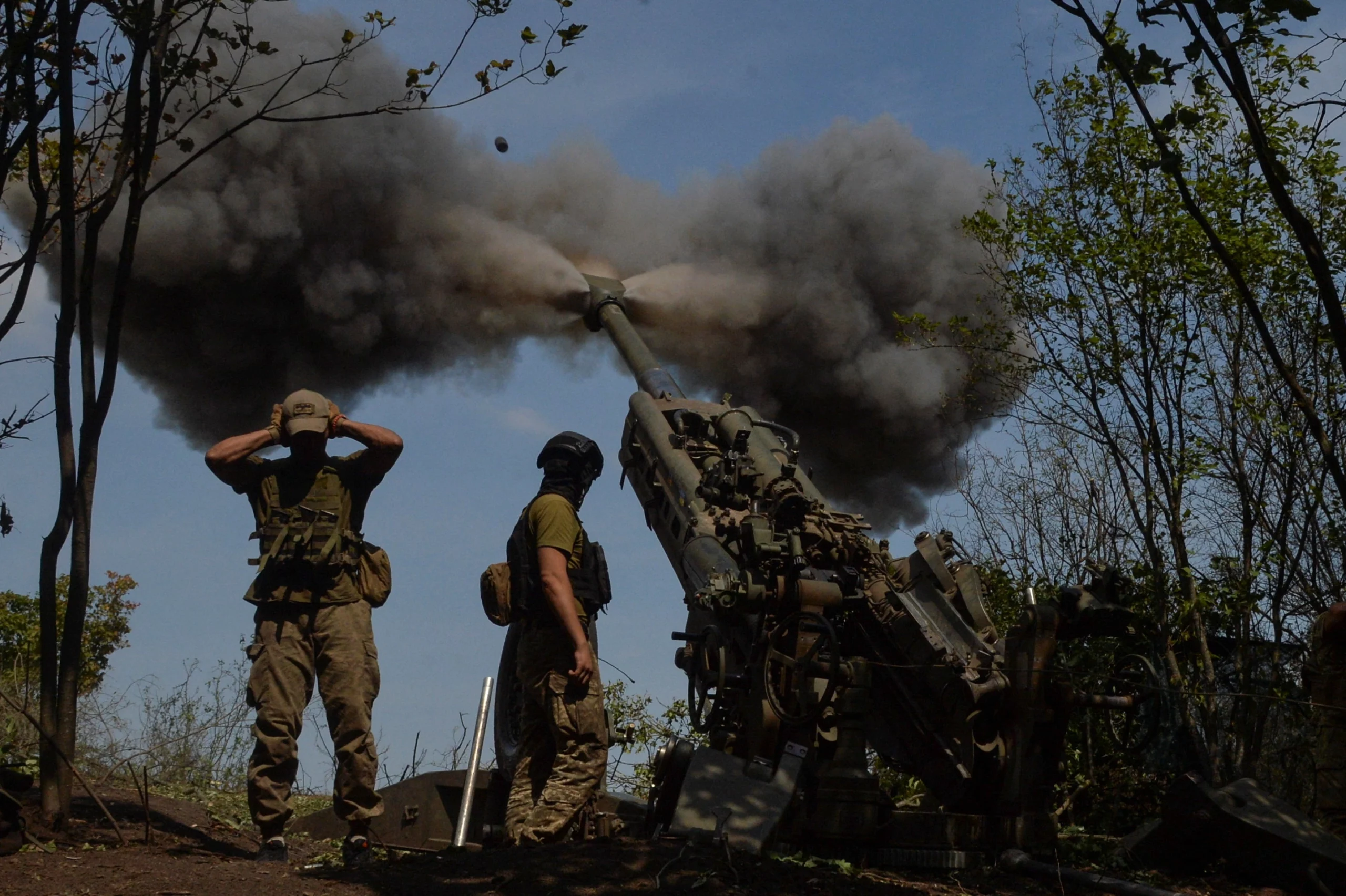
    The Russian invasion of Ukraine, which began earlier this year in February, has entered its 300th day this month, proving to be a tough challenge for both Russia and Ukraine. Russian President Vladimir Putin, who began a blitzkrieg assault on Kyiv taking over the eastern and southern part of the country, is now facing challenge to keep the war going amid reports of ailing health and internal strife.

    So far, over 100,000 Russian and 100,000 Ukrainian soldiers have been killed or injured in the war in Ukraine. For the Ukrainians, this winter is going to be tough with Russian attacks on Ukrainian power plans and consecutive Russian missile attacks. However, the war has shaped the hero out of Ukraine’s President Zelensky, who not only stood against the Russian aggression, but also managed to forge a western unity.

    SRI LANKAN CRISIS

    The Sri Lanka protests which started in April had led to the ouster of President Gotabaya Rajapaksa and two-time President and former Prime Minister Mahinda Rajapaksa. The Sri Lankan crisis, which started as a protest in Colombo, spread across the country with the people demanding reforms in the government.

    Ranil Wickremesinghe was elected President through a parliamentary vote, in which the Rajapaksas’ party backed him in July. The government blamed the Covid pandemic, which badly affected Sri Lanka’s tourist trade, and later led to a shortage of fuel and foreign dollars. However, many experts blame President Rajapaksa’s poor economic mismanagement.

    The country continues to remain under crisis with Colombo anticipating the IMF loan to secure the country’s economy.

    OUSTER OF IMRAN KHAN

    Former Pakistan Prime Minister Imran Khan, who came to power in 2018, is the only Pakistani Prime Minister to be ousted in a no-confidence vote in Parliament earlier this year.

    Khan was ousted from power in April after losing a no-confidence vote in his leadership, which he alleged was part of a US-led conspiracy targeting him because of his independent foreign policy decisions on Russia, China, and Afghanistan.

    Since he lost the vote in Parliament, Khan has mobilized mass rallies across the country, whipping up crowds with claims that he was a victim of a conspiracy by his successor, Prime Minister Shahbaz Sharif, and the United States.

    IRAN PROTESTS

    Iran has been rattled by protests over opposition to the mandatory hijab law as thousands of common citizens have taken to the streets.

    Iran has been rocked by protests since September 16, with the death of 22-year-old Mahsa Amini, who died after being detained by the morality police. The protests have since morphed into one of the most serious challenges to Iran’s theocracy installed by the 1979 Islamic Revolution.

    So far, the country’s police have arrested renowned actresses, footballers, actors and influencers for supporting the protests. It has also executed two protestors for participation in the protests.

    RARE PROTEST IN CHINA

    China saw two major developments this year- Xi Jinping becoming President for the third time and rare protests weeks after against tough anti-Covid restrictions.

    In November, thousands of people took to the streets in several major cities across China, including Beijing and Shanghai, to call for an end to lockdowns and greater political freedoms, in a wave of protests not seen since pro-democracy rallies in 1989 were crushed.

    Despite heavy crackdown, surveillance and censorship, the protests expanded into calls for broader political freedom and left a major negative impact on the reputation of Xi and the Party.

    US MIDTERM ELECTIONS

    The midterm elections in the US, which is usually seen as a mandate against the ruling government, failed to make a Republican sweep as the Democrats gained razor-thin control of the Senate, while the Republicans got a narrow margin against the dems in the House of Representatives.

    However, the misterms was special in the sense that it rained down on the ambitions of former President Donald Trump, who was looking forward to run for the second term, his “Make America Great Again” movement and the broader Republican agenda.

    A silver lining which came out of the midterm elections for the Republicans has been the victory of Florida Governor Ron DeSantis. DeSantis is seen as the possible challenger to Trump and a possible source of revival for the GOP.

    Surging inflation, ongoing strikes, economic crisis and war in Europe: the new UK Prime Minister Rishi Sunak faces these major challenges. Sunak came to Power after his predecessor Truss resigned after just 44 days in power.

    After 12 years in power, the Conservative party is more divided than ever. Earlier this year, Boris Johnson had resigned as PM in July after losing the confidence of some 60 ministers.

    Sunak has become the fifth Tory prime minister since 2016 — following David Cameron, Theresa May, Johnson and Truss. The challenges continue to mount for Sunak, who hopes to get his country out of the economic and political mess.

    BOLSONARO’S EXIT

    Brazilian President Jair Bolsonaro, lost election in October in a nail-biting presidential vote count against Luiz Inacio Lula da Silva.

    Almost from the start of his controversial mandate in 2019, Bolsonaro racked up accusations and investigations for everything from spreading disinformation to crimes against humanity. He survived more than 150 impeachment bids — a record.

    Most of these were over his flawed management of the coronavirus pandemic, which claimed the lives of more than 685,000 people in Brazil — the world’s second-highest toll after the United States.

    On January 1, 2023, Bolsonaro’s arch-rival, leftist ex-president Luiz Inacio Lula da Silva will take over the reins once more and Bolsonaro loses his presidential immunity.

    COP27 SUMMIT

    The UN COP27 climate summit in Egypt had some success and some failures. While the summit achieved a landmark deal on funding to help vulnerable countries cope with devastating climate impacts, the talks stalled on key issues and failed to secure commitments to stop greenhouse gas emissions.

    Though the participating nations agreed to contribute to the cost of the harm an overheated planet causes to developing nations, but they concluded the talks without doing anything more to address the burning of fossil fuels, which is the primary cause of these catastrophes.

  • Jay Mandal

    More worried today than in last 50 years

    (As told by Jay Mandal to Priyanka Khanna)

    Asked to put my thoughts together about India, my home country, and global affairs – I simply could not get myself to see the silver lining.

    Those who know me, know that I am rarely downcast. And when I managed to circumvent the world on a rickety bicycle, traversing the length and breadth of 154 countries back in 1970s  and 1980s, I developed a deep sense of hopefulness for the human race. So often I had no place to sleep in the 17 years that I rode my cycle solo but somehow, I always found food and water to sustain me even in God forsaken places.

    And I did grow more hopeful than most people when I was helped by perfect strangers on countless occasions, survived accidents, even facing wild elephants in southern Africa that few feel were survivable, besides facing the full fury of nature during my cycling days. So, when I ended my tour and began covering Indian and global affairs from my base in New York, I did so through my lenses and with the heart of a survivor.

    But after spending the year 2021 waiting for the promised recovery post the COVID-19 pandemic, the year 2022 made me truly sad. Starting from revelations of how deep corruption is steeped in the State where I come from – West Bengal – to Russia’s war on Ukraine, the state of women in Afghanistan, Iran and so many other places, to the lack of specific actions against Climate Change – which is already a reality and not a possibility – left me wondering if I have seen any similarly bad phase while chronologizing global and Indian affairs over the last five decades.

    I have covered the UN and the White House here in the US just as well as I have witnessed history in the making at 7 Racecourse in Lutyens’ Delhi for half-a-century, but I haven’t heard so much collective bad news from all corners of the world in such a short time.

    What bewilders me more is that the pandemic showed us the importance of working together swiftly to contain a contagious pathogen. Yet, the hope that coming out of 2020 we will learn lessons and work more closely together seems dashed. Yes, there is a lot of good that is happening as well but on the whole I feel this year we had more misses than hits.

    Beyond the more obvious attention-grabbing headlines, this year saw collapse of entire economies  right at India’s southern Island Nation of Sri Lanka as well as global tensions raising over Algeria, Belarus, Morocco, Turkey, Taiwan, South China Sea, Korean peninsula, Gaza, Iran’s nuclear programme, the opening up of Arctic routes, the escalation of tensions in India’s own backyard with Pakistan and China and of course the ongoing global trade wars.

    While India has actually done very well on many fronts in 2022, did well on Sri Lanka front, is now on at the helms of the influential G20 and is set to become the most populous country in the world in 2023, I am entering 2023 worrisome and apprehensive. My only hope really is that this too shall pass so I end by wishing for more consensuses in Indian and global affairs.

    (Jay Mandal is a Veteran photo-journalist and world Traveler)

  • Ashok Vyas

    Year to Year : Optimistic and Hopeful

    Impressions of any person, place or period are made of two parts. One relates to external circumstances, as we come to know of through media, another part is the internal response mechanism to any development or event.

    Looking at 2022, I would begin on an optimistic note, overall, we saw the world coming out of the clutches of the threat of Covid 19. We still have lingering effects of the epidemic and more apprehensions about its possible return with reports from China.

    This year also showed how quick our collective memories function in terms of forgetting the lessons of an unprecedented challenge faced by us as human race in recent times.

    The war between Russia and Ukraine captured our attention more intensely, gradually, less news but the challenge of war and destruction of a beautiful country as well as loss of innocent lives continues. The world order seems to be changing, the perception that USA’s support has helped Ukraine put on a brave fight against mighty Russia is gaining more ground with the recent visit of Ukraine president to the Whitehouse.

    India played a key role on the world scene in terms of successfully establishing its stand on several issues, including the stand adopted regarding its dealings with Russia. The Indian foreign minister showed on several forums that with calm mannerism and simple words, the strength of a nation can be expressed. Indian Prime Minister Narendra Modi continued to be the central figure in Indian politics as well as Global diplomacy. The only  leader, who openly and directly conveyed to Russian President Putin, that this is not the age of war. India didn’t stop buying Oil from Russia and while cornered, made it clear that Indian purchase is much less that the European nations. While the world economy has taken a hit after covid, the financial situation of the UK resulted in quick change of its prime minister. As we move towards 2023, Britisher with Indian roots Rishi Sunak, the first Hindu is leading the Great Britain.

    My expectations in 2023 are empowered by my hope and prayers. I believe we learn lessons but take time in implementing them, I look forward to the new year with greater awareness of taking care of the environment, leading a healthy life, building harmony and realizing the glory of being human. In addition to International day of Yoga, India gets the credit of drawing the attention of the world towards the significance of ‘Millet’ . Welcome to ‘The international year of Millet 2023 as declared by the United Nations in support of India’s initiative. We will have impactful impressions of India with creative and constructive insight under India leadsG20 as president. While saw massive layoffs, especially in the tech sector in the last few months of 2022 and the big news of twitter takeover by Elon Musk. I hope things would settle down and we will have a healthy, wealthy and growth oriented peaceful new year.

    Ashok Vyas


    (Poet, Hindu priest, author, program director with ITVGold for 25 years, founder of Heramba Art and Culture center with youtube channel ‘HerambaStudio’. President of Insight for Creativity LLC. Ashok has been working on three books for a few years, all are due to be published in 2023. (insightashok@Yahoo.com)

  • China reports 10,000 new virus cases, capital closes parks

    China reports 10,000 new virus cases, capital closes parks

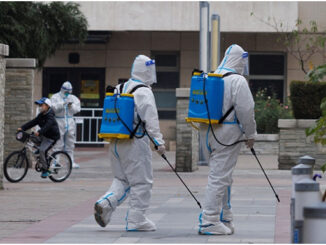
    Beijing (TIP): China’s capital Beijing has closed city parks and imposed other restrictions as the country faces a new wave of covid cases.

    Elsewhere, more than five million people were under lockdown on Nov 10 in the southern manufacturing hub Guangzhou and the western megacity Chongqing. The country reported 10,729 new cases on Friday, almost all of them testing positive while showing no symptoms. With the bulk of Beijing’s 21 million people undergoing near daily testing, another 118 new cases were recorded in the sprawling city. Many city schools switched to online classes, hospitals restricted services and some shops and restaurants were shuttered, with their staff taken to quarantine. Videos on social media showed people in some areas protesting or fighting with police and health workers. Chinese leaders promised on Thursday to respond to public frustration over its severe “zero-covid” strategy that has confined millions to their homes and severely disrupted the economy.

    No details were offered other than a promise to release “stranded people” who have been in quarantine or blocked for weeks from leaving cities where there are cases. People from cities with a single case in the past week are barred from visiting Beijing, while travelers from abroad are required to be quarantined in a hotel for seven to 10 days — if they are able to navigate the timely and opaque process of acquiring a visa. Business groups say that discourages foreign executives from visiting, which has prompted companies to shift investment plans to other countries. Visits from US officials and lawmakers charged with maintaining the crucial trading relations amid tensions over tariffs, Taiwan and human rights have come to a virtual standstill.

    Speculation on when measures will be eased has centred on whether the government is willing to import or domestically produce more effective vaccines, with the elderly population left particularly vulnerable. That could come as soon as next spring, when a new slate of officials are due to be named under Xi’s continuing leadership.

    Or, restrictions could persist much longer if the government continues to reject the notion of living to learn with a relatively low level of cases that cause far fewer hospitalisations and deaths than when the pandemic was at its height.  (PTI)

  • Canada, India Out of FIFA U-17 Women’s World Cup

    Canada, India Out of FIFA U-17 Women’s World Cup

    By Prabhjot Singh

    TORONTO (TIP)- The hosts and debutants India and Canada have made their exit from the FIFA U-17 Women’s World Cup. Columbia, Spain (defending champions), Japan and African debutants Tanzania have qualified for the last eight rounds. In the last round of the pool matches, Spain edged out China by a solitary goal while Columbia got the better of Mexico 2-1 in an all-American encounter. Canada played a 1-1 draw with Tanzania to bow out of the competition while Japan, the only Asian team left in the contest recorded an impressive 2-0 win over  France.

    Led by Ruiqi Qiao, China pushed Spain back in the early stages, though the reigning FIFA U-17 Women’s World Cup champions created better chances as the first half wore on. First, Chen Liu parried Lucia Corrales’s cross-shot, with the rebound falling to Carla Camacho, who fired the ball against the bar. Vicky Lopez then engineered an opportunity from the edge of the box, the keeper again doing well to keep her fierce drive out. The second half began how the first ended, as Spain retained the initiative. The only goal of the game came just after the hour mark, when Marina Artero headed home a corner from the left. China later celebrated an equalizer, only for Video umpire (VAR) to rule it out. The win kept Spain’s hopes of defending its title alive, while China fell once again in the group phase, beyond which it has never advanced.

    With all four sides in the section tied on three points at the start of the day, it was no surprise to see a cagey start to the game between the two American teams. Mexico had more of the ball but failed to create any clear-cut chances. It paid the price when Juana Ortegon’s fine strike from outside the box put the Colombians ahead four minutes from half-time. Linda Caicedo made it 2-0 with another long-range effort after the break, and though Mexico pulled one back when the Colombian star put through her own goal, Mexico could not find an equalizer, despite applying some late pressure.

    The three points took Colombia into the quarterfinals for the first time in its history, while the 2018 runners-up Mexico went out.

    “I’m so happy,” said Caicedo. “Luck didn’t come into it. It was a process and a job really well done. We hope to keep going and do more than make history. We want to fulfil this big dream that we have.” Japan wasted no time showing why it had won their first two matches, creating two excellent chances in the opening minute. The pressure eventually told on the French, as Momoko Tanikawa fired home from outside the box to give the Japanese the lead in the 29th minutes. Fiona Liaigre did her best to unsettle the Asians down the left flank and haul her team level, but the half ended with the French trailing to that Tanikawa strike.

    After missing a succession of chances, Japan was eventually rewarded for its second-half pressure when Sayami Kusunoki scored in injury time to seal top spot for her side and ensure France’s elimination.

    “I think we did well against Japan, but we have a lot of regrets after the games against Canada and Tanzania,” said France midfielder Lucie Calba. “Like our coach said, we should have been playing for first place in the group today, not for qualification. “We’ve experienced other cultures here, other styles of football, and we’ve learned a lot. We’ve learned that when it comes to World Cups you need to play every match with intensity.”

    Having already broken new ground by becoming the first side from their country to contest a FIFA competition in any age category, Tanzania began the game intent on achieving even greater things and struck the bar from a corner. It was the Canadians who opened the scoring with Amanda Allen converting a penalty after 14 minutes.

    Tanzania pulled level thanks to another corner, with Veronica Mapunda popping up inside the box to force home an opportunistic equalizer.

    Canada did all it could after the restart to score the goal that would have taken it into the next round. The pioneering Africans had other ideas and held on to check into the quarterfinals against all odds.

  • WHARTON ARTS’ HELEN CHA-PYO RECEIVES CENTENNIAL AWARD

    Helen Cha-Pyo, Artistic Director (Photo / Courtesy Wharton Arts)

    By Mabel Pais

    Wharton Arts, New Jersey’s largest non-profit community performing arts education organization, proudly announces that Artistic Director Helen H. Cha-Pyo is one of 100 select individuals chosen to receive the prestigious Eastman School of Music Centennial Award. The award is granted to those who exemplify the school’s mission and legacy through their commitment to artistry, scholarship, leadership, community engagement, and philanthropy.

    Cha-Pyo joins Renée Fleming, Ron Carter, Chuck Mangione, and Maria Schneider, among other notable artists, as a Centennial Awardee. For a complete list of awardees, visit rochester.edu/adv/eastman-centennial/centennial-awards.

    Cha-Pyo said, “This award was a complete surprise to me, and needless to say, I’m deeply humbled by it. One thing I still carry in my heart from my studies at the Eastman School of Music is the phrase engraved on the facade of the Eastman Theater, ‘for the enrichment of community life.’ I am grateful to be able to work at Wharton Arts which shares the same mission of enriching life through music.”

    HELEN CHA-PYO

    Helen H. Cha-Pyo is currently in her fifth season as the Artistic Director and Principal Conductor of the Wharton Institute for the Performing Arts (WIPA), New Jersey’s largest independent performing arts education organization, comprising four programs. Under her leadership, Wharton Arts serves close nearly 2,000 students from 10 New Jersey counties through a range of private lessons and group classes at the Wharton Performing Arts School, 15 performing ensembles at the New Jersey Youth Symphony, five performing ensembles at the New Jersey Youth Chorus, and the Paterson Music Project, an El Sistema-inspired program that provides free after-school instrumental music instruction to over 450 children in Paterson, NJ.

    Achievements

    For 16 years as Music Director and Conductor of the Empire State Youth Orchestra (ESYO), Cha-Pyo inspired hundreds of young musicians to perform at the highest levels, resulting in ESYO being recognized as one of the nation’s premier music organizations for youth musicians. Cha-Pyo’s vision was instrumental in the founding of ESYO CHIME in 2015, a music education program dedicated to serving underprivileged youth of Schenectady and Troy, NY. In 2018, ESYO established the Helen Cha-Pyo Golden Baton Award and Scholarships for students who embody her passionate commitment to music as a means to uplift and enrich communities. From 1996 to 2002, Cha-Pyo served as Artistic Director and Conductor of the Riverside Philharmonic Orchestra and Choir, as well as Associate Director of Music at The Riverside Church in New York City. She released three recordings with the Riverside Choir. (JAV Recordings)

    Awards

    Helen Cha-Pyo is the recipient of The Dove Leadership Award in 2019; the 2022 Angelos Artist Award from the Angelos Mission Ensemble; the Eastman Centennial Award from Eastman School of Music given to those who exemplify the school’s mission and legacy through their commitment to artistry, scholarship, leadership, community engagement, and/or philanthropy and the ASCAP’s (American Society of Composers, Authors, & Publishers) Adventurous Programming Awards for championing music by American composers.

    Tours

    She led the orchestra on three international tours: Europe in 2008, China and South Korea in 2012, and Portugal in 2016. Read more at helenchapyo.com.

    ——————————————-

    Wharton Arts Makes Key Appointments

    (Clockwise, left to right): Debra Joyal, Roger Sweet, Eva Dooley, Andrew Nitkin, and Shanna Lin. (Photo : Courtesy Wharton Arts)

    By Mabel Pais

    “As we enter the second year of our five-year strategic plan, Wharton Arts is making key senior staff appointments in order to move the organization forward,” said Peter H. Gistelinck, Executive Director at Wharton Arts. “Continued investment in people is essential for any organization. We are confident that the continuity of our exemplary team will help us in achieving our ambitious goals.”

     APPOINTMENTS

    Shanna Lin, Director of Paterson Music Project (PMP) (Paterson Music Project)

    As Co-Founder of the PMP program and her tenure of 10 years with Wharton Arts, it was logical to appoint Shanna Lin as Director of PMP, thus filling in the role of former PMP Director Elizabeth Mouthrop, recently appointed as Executive Director of El Sistema USA.

    Debra Joyal, Director of Performing Arts School (PAS) (Wharton Performing Arts School)

    Debra Joyal is a classically trained musician, administrator, skilled writer, and researcher in institutional funding and communication with degrees from the New England Conservatory of Music in Boston, MA and Skidmore College in Saratoga Springs, NY. Her overall focus is on building connections to communicate the vision and mission of nonprofit organizations. She is welcomed as the new Director of the Performing Arts School in Berkeley Heights, NJ.

    Andrew Nitkin, Director of Community Partnerships (Wharton Performing Arts School)

    Andrew Nitkin, having been instrumental for many years in successfully leading the Performing Arts School at Wharton Arts in Berkeley Heights, NJ is now appointed in the role of Director of Community Partnerships for the Performing Arts School.

    Roger Sweet, Manager of Orchestras (NJYS) (New Jersey Youth Symphony)

    Roger Sweet has been with Wharton Arts as a Production Assistant of the Operations department. He is now appointed as the new Manager of Orchestras of the New Jersey Youth Symphony in New Providence, NJ.

    Eva Dooley, Director of Finance & Administration (Wharton Arts)

    Eva Dooley has been appointed as the new Director of Finance & Administration of Wharton Arts. Eva has long-time expertise in accounting and financial analysis with an emphasis on business analytics, strategic planning, project management, and overall bookkeeping. In each of these roles, she has gained skill sets that allow her to work in many different capacities including human resources. She is welcomed as a new member of the senior staff team.

    Wharton Arts

    Wharton Arts’ mission is to offer accessible, high quality, transformative performing arts education that sparks personal growth while building inclusive communities.

    Wharton Arts is New Jersey’s largest independent non-profit community performing arts education center serving nearly 2,000 students through a range of classes and ensembles. Through the New Jersey Youth Symphony, the Paterson Music Project, and the Performing Arts School, Wharton Arts offers both private and group classes for instruments and voice for all ages and all abilities. With the belief in the positive and unifying influence of music and that performing arts education should be accessible to all people regardless of their ability to pay, Wharton Arts offers need-based scholarships.

    Wharton Arts is located in Berkeley Heights, New Providence, and Paterson, NJ and reaches students from 12 counties. All of Wharton Arts’ extraordinary teaching artists, faculty members, and conductors hold degrees in their teaching specialty and have been vetted and trained to enable our students to achieve their personal best.  To learn more, visit whartonarts.org

    (Mabel Pais writes on The Arts and Entertainment, Social Issues, Health & Wellness, Cuisine and Spirituality)

  • Jaishankar holds talks with NZ counterpart on Indo-Pacific and Ukraine conflict

    Jaishankar holds talks with NZ counterpart on Indo-Pacific and Ukraine conflict

    Auckland (TIP)- External Affairs Minister S Jaishankar on Thursday, October 6,  held “warm and productive” talks with his New Zealand counterpart Nanaia Mahuta during which the two leaders exchanged views on issues of international concerns such as the Indo-Pacific and the Ukraine conflict. It is Jaishankar’s first visit to New Zealand as External Affairs Minister.

    “Warm and productive talks with New Zealand Foreign Minister @NanaiaMahuta this afternoon. Two societies, respectful of tradition and culture, are seeking to forge a more contemporary relationship,” Jaishankar tweeted after the meeting.

    “Appreciated the exchange of views on (issues of) international concerns such as the Indo-Pacific and the Ukraine conflict. Value our working together in multilateral forums including the UN and Commonwealth,” he said.

    India, the US and several other world powers have been talking about the need to ensure a free, open and thriving Indo-Pacific in the backdrop of China’s rising military manoeuvring in the resource-rich region.

    India has repeatedly emphasised on the immediate cessation of hostilities in Ukraine and the need to resolve the ongoing conflict through dialogue and diplomacy. Jaishankar also took up the issue of Indian students impacted by covid measures in New Zealand and urged expeditious visa processing of those desirous of studying in New Zealand now.

    India is the second largest source of international students in New Zealand pursuing higher education in various disciplines such as information technology, hospitality, science, engineering and architecture.

    He also met Associate Minister for foreign affairs Aupito William Sio during his meeting with Mahuta.

    “Pleasure to meet Associate Minister for foreign affairs @AupitoWSio_MP during my talks with FM @NanaiaMahuta Benefitted from his insights on Pacific Islands,” Jaishankar tweeted.        Source: PTI

  • Russia-Ukraine war unlikely to end soon

    Russia-Ukraine war unlikely to end soon

    The rise in Russia’s industrial output in recent months has foxed western analysts. As long as the conflict continues, Russia can continue to sell its massive gas reserves — on which there are no sanctions yet — and make tidy profits. Besides, the US is in no hurry to end the conflict for its own strategic reasons. Its aim is to deplete Russia’s military capabilities.

    The ongoing war has given the American arms industry a new market.

    Russian President Vladimir Putin is an old master of the strategy of “escalating to de-escalate.” It means that by threatening a nuclear retaliation, he plans to continue fighting a long war of attrition to serve his strategic agenda. These could be: First, prolong the conflict to wear down the Ukrainian resistance, as he steadily absorbs the border regions of Donetsk, Luhansk, Mariupol and Kherson, with a referendum followed by annexations. These territories give Russia the land buffer against a NATO-EU-led expansion towards Russia’s borders. Secondly, it shows the impotency of the US and NATO, whatever the sanctions.

    In fact, the rise in Russia’s industrial output in recent months has foxed western analysts. Thirdly, as long as this conflict continues, Russia can continue to sell its massive gas reserves — on which there are no sanctions yet, for EU’s sake — and make tidy profits over it. Finally, the US in particular also is in no hurry to end the conflict for its own strategic reasons. And it is for these reasons, the conflict in Ukraine isn’t likely to end soon, even as the expectations rose that Russia would sue for peace after the recent Ukrainian counter-offensive and its success around Kharkiv.

    Few, if at all, had explained why the Russians allowed their forces to be pushed back or did they pull back as part of a bigger battle plan of Moscow? One cannot rule out that the Russians had pulled back to regroup their forces for another fight elsewhere on another day. It is for this reason that President Putin has ordered the largest ever post-war mobilization of three hundred thousand reservists. From the early days of Russia’s offensives in Ukraine, its approach smacked of hubris, an excessive confidence in their ability to steamroll over Ukraine. However, Ukraine’s defenses were strengthened by its ability to quickly mobilize its population and its reservists, that more than matched the numbers of Russian troops on its land, and additional US and NATO troops — over 1,00,000 — deployed in various forms in Ukraine and on Russia’s borders with the NATO. But it is the reported deployment of an estimated 100 nuclear gravity bombs in NATO bases that Russia has had eyes on, and, hence, the threat of using nuclear arsenal by Putin, when he renews his offensive next month before Europe’s harsh winter sets in.

    Here, it is important to understand the essentials of the nuclear strategy. First, the history of nuclear threats is based on non-use of nuclear weapons. And the only occasion nuclear weapons were used, as was the case in August 1945, was done with the devastating effect on Hiroshima and Nagasaki in Japan. It led to Japan’s surrender and checked Soviet plans to capture Japan in World War-II. Moscow hasn’t forgotten that. Secondly, the use of nuclear weapons is not the first option of a nuclear-weapon state. It’s in fact their last option, when their survival — as a nation-state — is at stake. And even then, as massive nuclear bombings would lead to a simultaneous counter-force response from the other side, the fear of mutually assured destruction is enough to withhold even a deranged dictator from using his nukes.But finally, there is still the possibility that ‘tactical nukes’ — small bombs to be used in battles — could be used to prevent major reverses in battles. Here the warnings by the US may not stop the Russians, because the Americans hadn’t in the past enforced their threats if their ‘red line’ was crossed, as was done with the use of chemical weapons in Syria during Obama’s days.

    So, Russia isn’t likely to buckle down that easily. For one, a superpower of the size of Russia with the scale of resources it has — being the largest producer of oil and gas — outside the Organisation of the Petroleum Exporting Countries, can last out much longer than the US expects.

    Remember, the US was stuck in Afghanistan for two decades and is still raring to go. The immediate impact of the US-led sanctions was mitigated by the Russian Central Bank with capital control measures and hikes in interest rates. It is estimated that the Russian state controls more than 60 per cent of the large businesses that influence the GDP and 25 per cent of its MSMEs. This imbalance does restrict growth, but it also insulates the economy in a crisis. And as the Russians have faced financial challenges in the past — this is their fifth since 1991 — they could tide over this one for longer than the West assumes. Most importantly, President Putin still holds the keys to the “gas supplies” to Europe and gives them the taste of a freezing winter, regardless of the claims of the EU that they’ll be prepared for a gas supply crunch by early December. In reality, the Europeans are buying gas from wherever they can, even China, as China doesn’t come under the sanctions initiated by the US. So, Beijing buys Russian gas and is selling it with a tidy profit in containers to the Europeans, since the Chinese economy has currently slowed down, and China has surplus of gas for now. By knowledgeable accounts, Russia has made over $175 billion with the sales of oil and gas since the sanctions were announced.

    Finally, what is less talked about is why the US wants to let the conflict in Ukraine continue. For one, its aim is to deplete Russia’s military capabilities, and thus decrease the threat to Europe, since the leadership of Europe has given the US a new purpose in geopolitics after its humiliation in Afghanistan.

    The other is that the conflict in Ukraine (being fought by proxy) unites the Americans and spares them the return of body bags, as they witnessed in the past two decades of wars in Asia. And finally, it gives the US’s arms industry new market — in Ukraine and Europe — to arm and test their new weapon systems, with sales and lend-lease debt agreements.In short, the US has turned the Cold War strategy on its head: earlier, the purpose was to exhaust the Soviet Union economically with an arms race; and now, it is to exhaust the Russians by getting them to pour their man-machine mix into the quagmire that is Ukraine.

    (The author is a Strategic Affairs Analyst)

  • Chinese factory churns out British flags after queen’s death

    Chinese factory churns out British flags after queen’s death

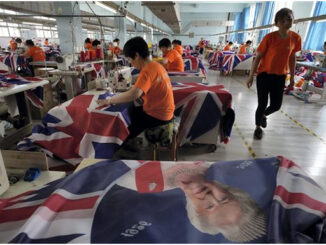
    Shaoxing (China) (TIP): Ninety minutes after Queen Elizabeth II died, orders for thousands of British flags started to flood into a factory south of Shanghai. More than 100 employees at Shaoxing Chuangdong Tour Articles Co set aside other work and put in 14-hour days starting at 7:30 am making nothing but British-themed flags.

    They turned out at least 500,000 the first week, according to general manager Fan Aiping.

    Some are British flags to be carried by mourners or hung outside homes. Others show Elizabeth’s portrait and the years of her birth and death. They range in size from 21 to 150 cm (8 to 59 inches) wide and sell for 7 yuan ($1).

    The first customer sent an order at 3 am Chinese time for tens of thousands, according to Fan. She said 20,000 the factory had in stock were sent out that morning. “The customer came to our factory directly to grab the products,” Fan said. “Many of the flags weren’t even packaged. They were put in a box and shipped away.”

    The factory had been making flags for the football World Cup before Elizabeth’s death. Chuangdong has been in the industry since 2005 and produces flags for the World Cup and other sports events or national day celebrations. It also makes sports-themed scarves and banners. Employees pay attention to news for events that might bring in orders. “There is a business opportunity behind every news event,” Fan said.

    Ni Guozhen, an employee since 2005, said she has learned about the world through her work. “I’ve learned a lot about current events,” said Ni, who was sewing flags with the queen’s portrait. “My knowledge has grown. Therefore I’m proud and happy that I’m making flags.” Ni remembers filling orders for British-themed flags for a royal wedding.

    “There is a story behind each flag,” Fan said. “This time it’s about the queen in the United Kingdom. They are buying these flags to mourn the queen deeply.” AP

  • Death toll from Pakistan floods reaches 1,186

    Death toll from Pakistan floods reaches 1,186

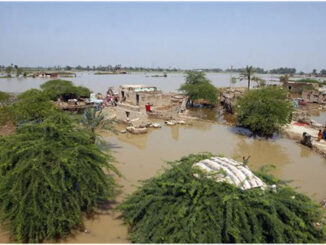
    Islamabad  (TIP): The death toll from flash floods triggered by record monsoon rains across much of Pakistan reached 1,186 on September 1, as authorities scrambled to provide relief materials to tens of thousands of affected people. Record monsoon rains in the last three decades triggered floods which inundated one third of the country, including most of Balochistan and Sindh provinces.

    “So far 1,186 people have died and 4,896 injured while 5,063 kms of roads damaged, 1,172,549 houses partially or completely destroyed and 733,488 livestock killed,” said the National Disaster Management Authority (NDMA), the main body dealing with calamities.

    On Thursday, the army said that some 50,000 people have been evacuated since rescue efforts began.

    Foreign Office spokesperson AsimIftikhar Ahmed said that more than 33 million people have been affected due to “colossal scale of devastation”.

    During a media briefing here, he said Pakistan mounted coordinated rescue and relief operations mobilising all possible resources but the sheer scale of the calamity “stretched our resources and capacities to the limit, thus necessitating support from the international community”.

    The cash-strapped Pakistan government on Tuesday teamed up with the United Nations to issue a flash appeal for USD 160 million to deal with the disaster in the country that has become the “ground zero” of global warming.

    “The Flash Appeal launch was well attended by Member States both in Islamabad and Geneva, Heads of UN agencies in Pakistan, representatives of international organizations, among others. Participants offered condolences and expressions of solidarity, and assured continued support for Pakistan,” the spokesman said.

    He also said that Pakistan faced a “climate-induced calamity” because the monsoons were not ordinary, “as the UNSG termed them ‘monsoons on steroid’.” UN Secretary-General Antonio Guterres will be visiting Pakistan on September 9-10 on an important visit to “express solidarity and international community’s support for Pakistan at this difficult time,” he said.

    Talking about the outpouring of relief supplies, he said till last night, Pakistan received flood relief goods through 21 flights notably from Turkey, UAE and China.

    He said a large number of countries and international organisations pledged to support and are extending cash or in-kind assistance including Australia, Azerbaijan, Canada, China, EU, France, Iran, Japan, Kazakhstan, Kuwait, New Zealand, Norway, Palestine, Qatar, South Korea, Saudi Arabia, Singapore, Turkiye, the UAE, United Kingdom, the United States, Uzbekistan, along with various international organisations including World Bank, Asian Development Bank and other UN Agencies. He said Pakistan on Wednesday signed the Green Framework Engagement Agreement with Denmark in Copenhagen, which marks the first step in creating stronger collaboration in areas such as climate change mitigation and adaptation, and a just and sustainable green transition.

    Separately, Prime Minister Shehbaz Sharif while addressing lawmakers of his Pakistan Muslim League-Nawaz asked them to visit the flood victims with relief goods. The prime minister said that he had never seen such a calamity before. “Water has wreaked havoc everywhere,” he said.

    He also asked Finance Minister Miftah Ismail to devise a plan to give relief to the flood-affected people with electricity bills. Army chief General Qamar JavedBajwa visited the Rohjan area of Punjab and met flood victims whom he assured that the Pakistan Army will help them to overcome their problems in these difficult times, the army said.

    He also directed ground troops to “take this responsibility as a noble cause and spare no effort to lessen the burden of flood-affected brothers and sisters”.

    Advisor to the Prime Minister on Kashmir and Gilgit-Baltistan Affairs Qamar Zaman Kaira said that Prime Minister Sharif would visit Gilgit-Baltistan on Friday and announce a relief package for the flood victims.

    Separately, the United Nations International Children’s Emergency Fund (Unicef) said in a statement that more than three million children were in need of humanitarian assistance in Pakistan and at increased risk of waterborne diseases, drowning and malnutrition due to flooding.

    “These floods have already taken a devastating toll on children and families, and the situation could become even worse,” the statement quoted Unicef representative in Pakistan Abdullah Fadil as saying.

    To add to worries, the Pakistan Meteorological Department (PMD) has forecast more rain in September, saying that La Nina conditions — responsible for recent spells of flood-triggering deluge in the country — would persist in September but become less intense.

    “Tendency for normal to above normal precipitation is likely over the country during September,” the Met Office said, predicting above-normal rainfall in northeastern Punjab and Sindh. (PTI)

  • World’s oldest male giant panda dies at age 35 in Hong Kong

    Hong Kong (TIP): The oldest-ever male giant panda in captivity has died at age 35 at a Hong Kong theme park after his health deteriorated. ‘An An’ lived most of his life at Ocean Park after he and a female panda were gifted to Hong Kong by China in 1999. The female panda, ‘JiaJia’, died in 2016 at age 38, making her the oldest-ever female panda in captivity. Ocean Park mourned AnAn as a family member who grew with the park and built bonds with locals and tourists. “An An has brought us fond memories with numerous heart-warming moments. His cleverness and playfulness will be dearly missed,” Paulo Pong, chairman of Ocean Park Corporation, said in a statement.

    An An had high blood pressure, a common condition among geriatric pandas. Over the past three weeks, AnAn had been kept out of sight from visitors at the park as his health worsened. He stopped eating solid food and was significantly less active in recent days.

    Last week, hundreds left comments on an Ocean Park post about AnAn’s condition, wishing him a speedy recovery.

    He was euthanized to prevent further suffering Thursday morning after veterinarians from Ocean Park and government authorities consulted the China Conservation and Research Center for the Giant Panda, Ocean Park said.

    “An An lived a full life that ended at the respectable age of 35 – the equivalent of 105 years in human age,” the statement read. Hong Kong was given another panda pair — Ying Ying, a female, and a male, Le Le — in 2007 to celebrate the 10th anniversary of the city’s return to China. China commonly engages in “panda diplomacy” where the mammals exclusively found in China are leased to other countries as a sign of goodwill. (AP)

  • Quo Vadis, Mother Russia?

    Quo Vadis, Mother Russia?

    By Patrick J. Buchanan

    “During some of the coldest days of the Cold War, U.S. presidents like Dwight Eisenhower, Richard Nixon and Ronald Reagan sought to find common ground on which to stand with Russia to avoid conflict. Ike invited the “Butcher of Budapest,” Nikita Khrushchev, for a 12-day U.S. visit in 1959. Nixon initiated a “detente” with Leonid Brezhnev, who had ordered the Warsaw Pact to crush the “Prague Spring” in 1968. Reagan and Mikhail Gorbachev negotiated the dismantling of an entire class of nuclear weapons in the 1987 Intermediate-Range Nuclear Forces treaty.”

    Where does Mother Russia go from here?  Bitter at their losses in the Cold War and post-Cold War years, many Russian nationalists are urging the regime to align with today’s great power antagonist of the United States, Xi Jinping’s China.

    “The demise of the Soviet Union was the greatest geopolitical catastrophe of the century,” said Russia’s new ruler Vladimir Putin in his 2005 state of the nation address.

    “As for the Russian people,” Putin went on, “it became a genuine tragedy. Tens of millions of our fellow citizens and countrymen found themselves beyond the fringes of Russian territory.”

    From Putin’s standpoint, the statement was then and remains today understandable.

    Consider. When Putin entered his country’s secret service, Berlin was 110 miles deep inside a Soviet-occupied East Germany. Poland, Czechoslovakia, Hungary, Romania and Bulgaria were member states of the Warsaw Pact.

    Lithuania, Latvia and Estonia were republics of the USSR. Ukraine was the most populous and ethnically closest of the Soviet republics to Russia itself.

    And today? Berlin is the capital of a united, free and democratic Germany, a member of NATO, that is beginning a rearmament campaign triggered by Putin’s invasion of Ukraine.

    Poland, the Czech Republic, Slovakia, Hungary, Romania and Bulgaria are members of the U.S.-led North Atlantic Treaty Organization.

    Former Soviet republics Lithuania, Latvia and Estonia are also members of that Western alliance established to contain Russia.

    Sweden and Finland, neutral through the Cold War, are applying for membership in NATO.

    Ukraine, backed by the U.S. and NATO, is fighting a war to push the Russian army out of its territory, a war that has the support of almost every country on the continent of Europe.

    Even the falls of the British and French empires at the end of World War II do not match as geo-strategic disasters the collapse of the Soviet Empire and breakup of the Soviet Union since the end of the Cold War.

    How goes the Russian war in Ukraine launched on Feb. 24?

    Russia has enlarged the territory it controls in Crimea and its Luhansk and Donetsk enclaves in the Donbas. And now, with the fall of Mariupol, Moscow controls the entire Sea of Azov and has completed its land bridge from Russia to Crimea. But Russia has failed to capture and been forced by the Ukrainian army to retreat from Kyiv and Kharkiv, the largest cities in Ukraine, and Putin has seen his forces humiliated again and again. Yet, withal, Russia today remains a great power.

    The largest nation on earth with twice the territory of the U.S., Russia has the world’s largest nuclear arsenal and exceeds the U.S. and China in tactical nuclear weapons. It has vast tracks of land and sits on huge deposits of minerals, coal, oil and gas.

    But Russia also has glaring weaknesses and growing vulnerabilities.

    While Putin has built up impressive forces in the Arctic, the Baltic Sea, with Finland and Sweden joining the Western alliance, is becoming a NATO lake. Russian warships sailing out of St. Petersburg to the Atlantic have to traverse the coastal defenses of 11 present or future NATO nations: Finland, Estonia, Latvia, Lithuania, Sweden, Poland, Germany, Denmark, Norway, Britain and France.

    Among the questions that Russia, shrunken in so many ways from the great U.S. rival of the Cold War it once was, must answer is, “Quo Vadis?”

    Where does Mother Russia go from here?

    Bitter at their losses in the Cold War and post-Cold War years, many Russian nationalists are urging the regime to align with today’s great power antagonist of the United States, Xi Jinping’s China.

    This is a recipe for a Second Cold War, but how would that war avail the Russian nation and its people?

    In any Russia-China alliance, there is no doubt who will be senior partner. And it is not the U.S. that covets and wishes one day to control the resources of Russia from Novosibirsk to the Bering Sea. China’s population of 1.4 billion people is 10 times Russia’s. East of the Urals, China’s population is 50 to 100 times the size of Russia’s in Siberia and the Far East. What of a U.S.-Russia detente as Moscow’s future rather than Cold War II?

    During some of the coldest days of the Cold War, U.S. presidents like Dwight Eisenhower, Richard Nixon and Ronald Reagan sought to find common ground on which to stand with Russia to avoid conflict.

    Ike invited the “Butcher of Budapest,” Nikita Khrushchev, for a 12-day U.S. visit in 1959. Nixon initiated a “detente” with Leonid Brezhnev, who had ordered the Warsaw Pact to crush the “Prague Spring” in 1968. Reagan and Mikhail Gorbachev negotiated the dismantling of an entire class of nuclear weapons in the 1987 Intermediate-Range Nuclear Forces treaty. Given the hostility Putin has generated by his invasion of Ukraine, Western leaders may be unable to bring Russia in from the cold. But if we isolate Russia, push it out of the West, Moscow has only one direction in which to go — east, to China.

    In 230 years, the United States has never gone to war with Russia. Not with the Romanovs nor with the Stalinists, not with the Cold War Communists nor with the Putinists.

    U.S. vital interests dictate that we maintain that tradition.

     (Patrick Joseph Buchanan is a political commentator, columnist, politician and broadcaster)

  • HRWFF RETURNS WITH 33RD EDITION

    By Mabel Pais

    The Human Rights Watch Film Festival (HRWFF), now in its 33rd year, will present a hybrid full edition of 10 groundbreaking new films, available both in-person and online nationwide in the U.S., from May 20 to 26, 2022.

    For the first time in two years, the New York festival will be back with a full program of in-person screenings at Film at Lincoln Center and IFC Center, with in-depth discussions with filmmakers, film participants, activists and Human Rights Watch researchers. The festival will continue to offer the opportunity to watch all 10 new films online across the U.S. with a full digital edition of the film festival.

    This year’s edition highlights activism and features courageous individuals around the world standing up to powerful forces and demanding change. John Biaggi, Director of the Human Rights Watch Film Festival, said, “We are thrilled to be back in theaters after two years away, bringing our audience a full slate of powerful films tackling urgent human rights issues including China, Russia, the climate crisis and reproductive rights.” Lesli Klainberg, President of Film at Lincoln Center said, “History has shown that film not only empowers understanding, but also ignites urgent public dialogues about how to help the most vulnerable.” John Vanco, Senior Vice President and General Manager at IFC Center said, “IFC Center is proud to continue our partnership with the Human Rights Watch Film Festival and support their mission to use cinema to shine a light on important issues.”

    FILM LINEUP

    REBELLION – OPENING NIGHT

    U.S. Premiere

    Dirs: Maia Kenworthy & Elena Sanchez Bellot l 2021 l UK, Poland l Eng l Doc l 1h 22m

    Opening Film (Photo / www.ff.hrw.org, 2022.)

    “Rebellion” brings viewers behind-the-scenes with Extinction Rebellion (XR), as the group confronts the climate emergency – reminding the world there is no time to wait. Emerging as action on climate change dangerously slipped from the political agenda, XR took bold steps to break through the deadlock: mass civil disobedience. It worked. “Rebellion” reminds viewers to question white Western environmentalism and push back against a fight that ignores structural racism and oppression.

    In-person screening:

    Friday, May 20, 7:00pm, Film at Lincoln Center, Walter Reade Theater

    THE JANES – CLOSING NIGHT

    Dirs: Tia Lessin & Emma Pildes l 2022 l USA l Eng l Doc l 1h 41m

    Grand Jury Prize Documentary Nominee, Sundance Festival, 2022

    Closing Film. (Photo / www.ff.hrw.org, 2022.)

    Seven women were part of a clandestine network that built an underground service for women seeking safe, affordable abortions in the pre-Roe v. Wade era. They called themselves “The Janes.” This galvanizing documentary tells the story of the past and, potentially, the future.

    In-person screening:

    Thursday, May 26, 7:00pm, IFC Center

    CLARISSA’S BATTLE         

    World Premiere

    Dir: Tamara Perkins l 2022 l USA l Eng l Doc l 1h 30m

    Single mother and organizer Clarissa Doutherd is building a powerful coalition of parents fighting for childcare and early education funds, from her own experience of losing childcare and becoming unhoused, desperately needed by low-and middle-income parents and children across the United States. “Clarissa’s Battle” offers an insight into an erupting movement, as communities across the country follow Clarissa’s successes, setbacks and indomitable resilience.

    In-person screenings:

    Saturday, May 21, 8:00pm, Film at Lincoln Center, Elinor Bunin Munroe Film Center

    Sunday, May 22, 5:15pm, Film at Lincoln Center, Elinor Bunin Munroe Film Center

    DELIKADO          

    New York Premiere

    Dir: Karl Malakunas l 2022 l Philippines, Hong Kong, Australia, USA, UK l Eng, Filipino l Doc l 1h 34m

    Official Selection, Hot Docs 2022

    A small network of environmental crusaders, Bobby, Tata and Nieves – a charismatic lawyer, a former illegal logger and a fearless politician – are three magnetic leaders fighting to stop corporations and governments seeking to plunder increasingly valuable natural resources in Palawan in the Philippines.

    In-person screenings:

    Sunday, May 22, 8:00pm, Film at Lincoln Center, Elinor Bunin Munroe Film Center

    Tuesday, May 24, 9:00pm, IFC Center

    ETERNAL SPRING     

    U.S. Premiere

    Dir: Jason Loftus l 2022 l Canada l Eng, Mandarin Chinese l Doc l 1h 26m

    In March 2002, members of the outlawed spiritual group Falun Gong hijacked a state TV station in China. Their goal was to counter the government narrative about their practice. In the aftermath, police raids sweep Changchun City, and comic book illustrator, Daxiong (Justice League, Star Wars), a Falun Gong practitioner, is forced to flee.

    In-person screenings:

    Monday, May 23, 6:15pm, Film at Lincoln Center, Elinor Bunin Munroe Film Center

    Tuesday, May 24, 6:30pm, IFC Center

    MIDWIVES     

    New York Premiere

    Dir: Snow Hnin Ei Hlaing l 2022 l Myanmar, Germany, Canada l Rohingya, Rakhine, Burmese l Doc l 1h 31m

    Winner, World Cinema Documentary Special Jury Award: Excellence in Verité Filmmaking, Sundance 2022

    Hla is a Buddhist and the owner of an under-resourced medical clinic in western Myanmar, where the Rohingya (a Muslim minority community) are persecuted and denied basic rights. Nyo is a Rohingya and an apprentice midwife who acts as assistant and translator at the clinic. Risking her own safety daily by helping Muslim patients, she is determined to become a steady healthcare provider and resource for the families who desperately need her.

    In-person screenings:

    Saturday, May 21, 5:15pm, Film at Lincoln Center, Elinor Bunin Munroe Film Center

    Monday, May 23, 6:30pm, IFC Center

    THE NEW GREATNESS CASE

    World Premiere

    Dir: Anna Shishova l 2022 l Finland, Croatia, Norway l Russian l Doc l 1h 32m

    In “The New Greatness Case” with hidden camera footage, and an intimate relationship with the protagonists, the director, Anna Shishova, shows the complete repression of present-day Russia, and how young, free-thinking people are seen as a threat to the government.

    In-person screenings:

    Tuesday, May 24, 9:00pm, Film at Lincoln Center, Elinor Bunin Munroe Film Center

    Wednesday, May 25, 6:30pm, IFC Center

    NO U-TURN

    New York Premiere

    Dir: Ike Nnaebue l 2022 l France, Nigeria, South Africa, Germany l Eng, Igbo, French, Nigerian Pidgin l Doc l 1h 34m

    Special Mention, Documentary Award, Berlinale 2022

    In his first documentary, “No U-Turn,” Nigerian director Ike Nnaebue retraces the life-changing journey he made over 20 years ago. Overlaid with a powerful poetic commentary, this self-reflective travelog hints at the deep longing of an entire generation for a better life.

    In-person screenings:

    Tuesday, May 24, 6:15pm, Film at Lincoln Center, Elinor Bunin Munroe Film Center

    Wednesday, May 25, 9:00pm, IFC Center

    UP TO G-CUP

    World Premiere

    Dir: Jacqueline van Vugt l 2022 l Netherlands l Kurdish, Arabic l Doc l 1h 20m

    Northern Iraq’s first lingerie store not only sells underwear, but also acts as a meeting place where women connect to their bodies and sensuality after overcoming the traumas of oppression, war, and conservative morality. Director Jacqueline van Vugt captures intimate stories about love, sex, shame, and war.

    In-person screenings:

    Monday, May 23, 9:00pm, IFC Center

    Wednesday, May 25, 9:00pm, Film at Lincoln Center, Elinor Bunin Munroe Film Center

    YOU RESEMBLE ME

    New York Premiere

    Dir: Dina Amer l 2021 l  France,Egypt,USA l Arabic, French l Drama l 1h 31m

    Who was Hasna Aït Boulahcen? After the November 2015 Paris bombings, she was labelled “Europe’s first female suicide bomber.” Director Dina Amer, in this nuanced drama shows what happens when society fails to protect a child, and how discrimination, poverty, and abuse facing young people can allow radicalization to plant roots and grow, with devastating impact on the wider community.

    Digital Screenings:

    DIGITAL SCREENINGS for each film are available to watch at your own pace, any time between May 20-26, 2022 on the festival’s digital streaming platform.

    TICKETS

    TICKETS can be purchased at the IFC Center, Film at Lincoln Center and Human Rights Watch. In-Theater tickets are available online or at the Film at Lincoln Center (FLC) and the IFC box offices. For individual film tickets or a Festival Pass at a discounted price, visit ff.hrw.org/newyork, filmlinc.org or ifccenter.com. The entire Festival can be rented on the festival streaming site May 20, 9 a.m. EDT until May 26, 11:59 PST. For more information and accessibility options for each digital presentation, visit ff.hrw.org.

    HUMAN RIGHTS WATCH FILM FESTIVAL

    For Details and Program updates, visit ff.hrw.org. For more information and accessibility options for each digital presentation, visit ff.hrw.org.

    FESTIVAL IN-PERSON SAFETY PROTOCOLS

    For Festival disclaimers, and other Safety Protocols, visit ff.hrw.org

    (Mabel Pais writes on Social Issues, The Arts and Entertainment, Cuisine, Health & Wellness and Spirituality)

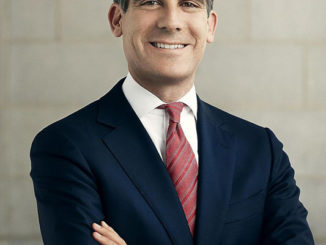
  • Key Congressional panel clears nomination of LA mayor as US envoy to India

    Key Congressional panel clears nomination of LA mayor as US envoy to India

    WASHINGTON, D.C. (TIP) A key Congressional panel has voted in favor of the nomination of Los Angeles Mayor Eric M Garcetti to serve as the US Ambassador to India. US President Joe Biden nominated Garcetti as his ambassador to India in July last year. If confirmed by the Senate, Garcetti, 50, would replace Kenneth Juster, who served as the US Ambassador to India during the Trump administration. Juster was appointed as a distinguished fellow at the Council on Foreign Relations in July.

    Besides Garcetti, the powerful Senate Foreign Relations Committee on Wednesday endorsed 11 other ambassadorial nominations, including Amy Gutmann to be the US Ambassador to Germany, Donald Armin Blome to be the Ambassador to Pakistan and Joe Donnelly to be the envoy to the Holy See.

    The nominations now move to the Senate floor for a final confirmation vote. “It is bipartisan that these vacancies be filled whichever party is in control of the White House,” Ranking Member Jim Risch said.

    Senator Bob Menendez, Chairman of the Senate Foreign Relations Committee, rued that over 55 nominees were still pending before the committee and many challenges around the world are awaiting them. “As I have said many times before this committee and on the Senate floor, prolonged vacancies are not in our interests. They undermine our national security, hinder our leadership role abroad and benefit only our adversaries,” he said.

    “Turning to the nominees we are considering today, I won’t speak about each of them, but I do want to say that I believe they are all well qualified and deserving of their nominations. I will be voting for them and look forward to their swift confirmation,” Menendez said.Risch voted ‘No’ against the German ambassadorial nominee.”I’m going to record a ‘no’ vote against Dr Guttman, but it is not personal. I stand ready to work with her and to strengthen our alliance with Germany. I also expect her to engage in efforts to stop the construction of the Nord Stream two pipeline. I am a no, not because of her qualifications,” he said.

    “Certainly, she’s qualified, she’s had a long and successful career, but I think that probably as with her position with the University of Pennsylvania, it really is a poster child for the ongoing and growing malign influence of China and at our institutions of higher learning, the University of Pennsylvania has accepted millions and millions of dollars in donations in contracts from China,” Risch said. “The issue of foreign influence, particularly that of the Chinese, in US higher education institutions is very important to this committee and we have made efforts and we continue, and I have worked with the chairman on this to pursue efforts to put a stop to this. And it is important. We do so the University of Pennsylvania is a large organization, but I remain troubled,” he said.

    After Biden’s nomination, Garcetti had said he was honored to accept the nomination and will bring the same energy, commitment and love with which he served the sprawling city to his new role in the world’s largest democracy.

    “Today, the President announced that I am his nominee to serve as US Ambassador to India. I am honored to accept his nomination to serve in this role,” Garcetti, a Democrat, had said in a statement soon after Biden announced his nomination. He has travelled several times to India, most recently as a councilman. In college, he spent a year studying Hindi and Urdu.

    “It’s the largest democracy in the world, soon to be the most populous country in the world, one of the top handful of superpowers in the world,” Garcetti said. “We can’t get our climate goals without India hitting its climate goals. We can’t see the economy truly reopened to international commerce and tourism until COVID is under control. We’re all very closely connected,” he told the Los Angeles Times in an interview. During 12 years as an Intelligence Officer in the U.S. Navy Reserve Component, Garcetti served under the Commander, US Pacific Fleet and the Defense Intelligence Agency, retiring in 2017 as a Lieutenant. Garcetti has also served as a national co-chair of Biden’s presidential campaign. Commenting on his nomination, the Los Angeles Times wrote that the ambassadorship in President Biden’s administration gives Garcetti a new career path, away from electoral politics.

    (Source: PTI)

  • The world in 2022: Another year of living dangerously

    The world in 2022: Another year of living dangerously

    On the brink of a new year, the world faces a daunting array of challenges: the resurgent Covid-19 pandemic, the climate emergency, the struggle between democracy and authoritarianism, humanitarian crises, mass migration, and trans-national terrorism. There is the risk of new inter-state conflicts, exacerbated by the breakdown of the rules-based international order, and the spread of lethal autonomous weapons. All in all, for most people on Earth – and a handful in space – 2022 will be another year of living dangerously.

    Middle East

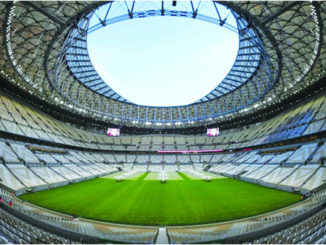
    Events in the Middle East will make global headlines again in 2022 – but for positive as well as negative reasons. A cause for optimism is football’s World Cup, which kicks off in Qatar in November. It’s the first time an Arab or a Muslim country has hosted the tournament. It is expected to provide a major fillip for the Gulf region in terms of future business and tourism – and, possibly, more open, progressive forms of governance.

    But the choice of Qatar, overshadowed by allegations of corruption, was controversial from the start. Its human rights record will come under increased scrutiny. Its treatment of low-paid migrant workers is another flashpoint. The Guardian revealed that at least 6,500 workers have died since Qatar got the nod from Fifa in 2010, killed while building seven new stadiums, roads and hotels, and a new airport.

    Concerns will also persist about Qatar’s illiberal attitude to free speech and women’s and LGBTQ+ rights in a country where it remains dangerous to openly criticise the government and where homosexuality is illegal. But analysts suggest most fans will not focus on these issues, which could make Qatar 2022 the most successful example of “sports-washing” to date.

    More familiar subjects will otherwise dominate the regional agenda. Foremost is the question of whether Israel and/or the US will take new military and/or economic steps to curb Iran’s attempts, which Tehran denies, to acquire capability to build nuclear weapons. Israel has been threatening air strikes if slow-moving talks to revive the 2015 nuclear deal fail. Even football fans could not ignore a war in the Gulf.

    Attention will focus on Turkey’s authoritarian president, Recep Tayyip Erdogan, whose neo-Islamist AKP party will mark 20 years in power in 2022. Erdogan’s rule has grown increasingly oppressive at home, while his aggressive foreign policy, rows with the EU and US, on-off collusion with Russia over Syria and chronic economic mismanagement could have unpredictable consequences.

    Other hotspots are likely to be Lebanon – tottering on the verge of becoming a failed state like war-torn Yemen – and ever-chaotic Libya. Close attention should also be paid to Palestine, where the unpopular president, Mahmoud Abbas’s postponement of elections, Israeli settler violence and West Bank land-grabs, and the lack of an active peace process all loom large.

    Asia Pacific

    The eyes of the world will be on China at the beginning and the end of the year, and quite possibly in the intervening period as well. The Winter Olympics open in Beijing in February. But the crucial question, for sports fans, of who tops the medals table may be overshadowed by diplomatic boycotts by the US, UK and other countries in protest at China’s serial human rights abuses. They fear the Games may become a Chinese Communist party propaganda exercise.

    The CCP’s 20th national congress, due towards the end of the year, will be the other headline-grabber. President Xi Jinping is hoping to secure an unprecedented third five-year term, which, if achieved, would confirm his position as China’s most powerful leader since Mao Zedong. There will also be jostling for senior positions in the Politburo and Politburo standing committee. It will not necessarily all go Xi’s way.

    Western analysts differ sharply over how secure Xi’s position truly is. A slowing economy, a debt crisis, an ageing population, huge environmental and climate-related challenges, and US-led attempts to “contain” China by signing up neighbouring countries are all putting pressure on Xi. Yet, as matters stand, 2022 is likely to see ongoing, bullish attempts to expand China’s global economic and geopolitical influence. A military attack on Taiwan, which Xi has vowed to re-conquer by any or all means, could change everything.

    India, China’s biggest regional competitor, may continue to punch below its weight on the world stage. In what could be a symbolically important moment, its total population could soon match or exceed China’s 1.41 billion, according to some estimates. Yet at the same time, Indian birth rates and average family sizes are falling. Not so symbolic, and more dangerous, are unresolved Himalayan border disputes between these two giant neighbours, which led to violence in 2020-21 and reflect a broader deterioration in bilateral relations.

    The popularity of Narendra Modi, India’s authoritarian prime minister, has taken a dive of late, due to the pandemic and a sluggish economy. He was forced into an embarrassing U-turn on farm “reform” and is accused of using terrorism laws to silence critics. His BJP party will try to regain lost ground in a string of state elections in 2022. Modi’s policy of stronger ties with the west, exemplified by the Quad alliance (India, the US, Japan, Australia), will likely be reinforced, adding to China’s discomfort.

    Elsewhere in Asia, violent repression in Myanmar and the desperate plight of the Afghan people following the Taliban takeover will likely provoke more western hand-wringing than concrete action. Afghanistan totters on the brink of disaster. “We’re looking at 23 million people marching towards starvation,” says David Beasley of the World Food Programme. “The next six months are going to be catastrophic.”

    North Korea’s nuclear brinkmanship may bring a showdown as Kim Jong-un’s paranoid regime sends mixed signals about war and peace. The Philippines will elect a new president; the foul-mouthed incumbent, Rodrigo Duterte, is limited to a single term. Unfortunately this is not the case with Scott Morrison, who will seek re-election as Australia’s prime minister.

    Europe

    It will be a critical year for Europe as the EU and national leaders grapple with tense internal and external divisions, the social and economic impact of the unending pandemic, migration and the newly reinforced challenges, post-Cop26, posed by net zero emissions targets.

    More fundamentally, Europe must decide whether it wants to be taken seriously as a global actor, or will surrender its international influence to China, the US and malign regimes such as Vladimir Putin’s Russia.

    The tone may be set by spring elections in France and Hungary, where rightwing populist forces are again pushing divisive agendas. Viktor Orbán, the authoritarian Hungarian leader who has made a mockery of the EU over rule of law, democracy and free speech issues, will face a united opposition for the first time. His fate will be watched closely in Poland, the Czech Republic, Slovenia and other EU member states where reactionary far-right parties flourish.

    Emmanuel Macron, the neo-Gaullist centrist who came from nowhere in 2017, will ask French voters for a second term in preference to his avowedly racist, Islamophobic rivals, Marine Le Pen and Éric Zemmour. Polls put him ahead, although he also faces what could be a strong challenge from the centre-right Republicans, whose candidate, Valérie Pécresse, is the first woman to lead the conservatives. With the left in disarray, the election could radicalise France in reactionary ways. Elections are also due in Sweden, Serbia and Austria.

    Germany’s new SPD-led coalition government will come under close scrutiny as it attempts to do things differently after the long years of Angela Merkel’s reign. Despite some conciliatory pledges, friction will be hard to avoid with the European Commission, led by Merkel ally Ursula von der Leyen, and with France and other southern EU members over budgetary policy and debt. France assumes the EU presidency in January and Macron will try to advance his ideas about common defence and security policy – what he calls “strategic autonomy”.

    Macron’s belief that Europe must stand up for itself in a hostile world will be put to the test on a range of fronts, notably Ukraine. Analysts suggest rising Russian military pressure, including a large border troop build-up and a threat to deploy nuclear missiles, could lead to renewed conflict early in the year as Nato hangs back.

    Other trigger issues include Belarus’s weaponising of migration (and the continuing absence of a humane pan-European migration policy) and brewing separatist trouble in Bosnia-Herzegovina and the Balkans. The EU is planning a China summit, but there is no consensus over how to balance business and human rights. In isolated, increasingly impoverished Britain, Brexit buyers’ remorse looks certain to intensify.

    Relations with the US, which takes a dim view of European autonomy but appears ambivalent over Ukraine, may prove tense at times. Nato, its credibility damaged post-Afghanistan, faces a difficult year as it seeks a new secretary-general. Smart money says a woman could get the top job for the first time. The former UK prime minister Theresa May has been mentioned – but the French will not want a Brit.

    South America

    The struggle to defeat Jair Bolsonaro, Brazil’s notorious rightwing president, in national elections due in October looks set to produce an epic battle with international ramifications. Inside Brazil, Bolsonaro has been widely condemned for his lethally negligent handling of the Covid pandemic. Over half a million Brazilians have died, more than in any country bar the US. Beyond Brazil, Bolsonaro is reviled for his climate change denial and the accelerated destruction of the Amazon rainforest.

    Opinion polls show that, should he stand, Luiz Inácio Lula da Silva, the former president who was jailed and then cleared on corruption charges, would easily beat Bolsonaro. But that assumes a fair fight. Concern is growing that American supporters of Donald Trump are coaching the Bolsonaro camp on how to steal an election or mount a coup to overturn the result, as Trump tried and failed to do in Washington a year ago. Fears grow that Trump-style electoral subversion may find more emulators around the world.

    Surveys in Europe suggest support for rightwing populist-nationalist politicians is waning, but that may not be the case in South America, outside Brazil, and other parts of the developing world in 2022. Populism feeds off the gap between corrupt “elites” and so-called “ordinary people”, and in many poorer countries, that gap, measured in wealth and power, is growing. In Cuba, Nicaragua, Haiti and Venezuela, supposed champions of the people have become their oppressors, and this phenomenon looks set to continue. In Chile, the presidential election’s first round produced strong support for José Antonio Kast, a hard-right Pinochet apologist, though he was ultimately defeated by Gabriel Boric, a leftist former student leader, who will become the country’s youngest leader after storming to a resounding victory in a run-off.

    Argentina’s president, Alberto Fernández, faces a different kind of problem in what looks like a tough year ahead, after elections in which his Peronists, one of the world’s oldest populist parties, lost their majority in Congress for the first time in nearly 40 years. Mexico’s president, Andrés Manuel López Obrador, will face ongoing tensions with the US over trade, drugs and migration from Central America. But at least he no longer has to put up with Trump’s insults – for now.

    North America

    All eyes will be on the campaign for November’s mid-term elections when the Democrats will attempt to fend off a Republican bid to re-take control of the Senate and House of Representatives. The results will inevitably be viewed as a referendum on Joe Biden’s presidency. If the GOP does well in the battleground states, Donald Trump – who still falsely claims to have won the 2020 election – will almost certainly decide to run for a second term in 2024.

    Certain issues will have nationwide resonance: in particular, progress (or otherwise) in stemming the pandemic and ongoing anti-vax resistance; the economy, with prices and interest rates set to rise; and divisive social issues such as migration, race and abortion rights, with the supreme court predicted to overrule or seriously weaken provisions of the landmark 1973 Roe v Wade decision.

    The Democrats’ biggest problem in 2022 may be internal party divisions. The split between so-called progressives and moderates, especially in the Senate, undermined Biden’s signature social care and infrastructure spending bills, which were watered down. Some of the focus will be on Biden himself: whether he will run again in 2024, his age (he will be 80 in November), his mental agility and his ability to deliver his agenda. His mid-December minus-7 approval rating may prove hard to turn around.

    Also under the microscope is Kamala Harris, the vice-president, who is said to be unsettled and under-performing – at least by those with an interest is destabilising the White House. Pete Buttigieg, the transportation secretary who sought the Democratic nomination in 2020, is a man to watch, as a possible replacement for Harris or even for Biden, should the president settle for one term.

    Concern has grown, meanwhile, over whether the mid-terms will be free and fair, given extraordinary efforts by Republican state legislators to make it harder to vote and even harder for opponents to win gerrymandered congressional districts and precincts with in-built GOP majorities. One survey estimates Republicans will flip at least five House seats thanks to redrawn, absurdly distorted voting maps. This could be enough to assure a Republican House majority before voting even begins.

    Pressure from would-be Central American migrants on the southern US border will likely be a running story in 2022 – a problem Harris, who was tasked with dealing with it, has fumbled so far. She and Biden are accused of continuing Trump’s harsh policies. Belief in Biden’s competence has also been undermined by the chaotic Afghan withdrawal, which felt to many like a Vietnam-scale humiliation.

    Another big foreign policy setback or overseas conflagration – such as a Russian land-grab in Ukraine, direct Chinese aggression against Taiwan or an Israel-Iran conflict – has potential to suck in US forces and wreck Biden’s presidency.

    In Canada, Prime Minister Justin Trudeau is expected to push new policy initiatives on affordable childcare and housing after winning re-election in September. But in 2021’s snap election his Liberals attracted the smallest share of the popular vote of any winning party in history, suggesting the Trudeau magic is wearing thin. Disputes swirl over alleged corruption, pandemic management, trade with the US and carbon reduction policy.

    Africa

    As befits this giant continent, some of 2022’s biggest themes will play out across Africa. Among the most striking is the fraught question of whether Africans, still largely unvaccinated, will pay a huge, avoidable price for the developed world’s monopolising of vaccines, its reluctance to distribute surpluses and share patents – and from the pandemic’s myriad, knock-on health and economic impacts.

    This question in turn raises another: will such selfishness rebound on the wealthy north, as former UK prime minister Gordon Brown has repeatedly warned? The sudden spread of Omicron, first identified in South Africa, suggests more Covid variants could emerge in 2022. Yet once again, the response of developed countries may be to focus on domestic protection, not international cooperation. The course of the global pandemic in 2022 – both in terms of the threat to health and economic prosperity – is ultimately unknowable. But in many African countries, with relatively young populations less vulnerable to severe Covid harms, the bigger problem may be the negative impact on management of other diseases.

    It’s estimated 25 million people in Africa will live with HIV-Aids in 2022. Malaria claims almost 400,000 lives in a typical year. Treatment of these diseases, and others such as TB and diabetes, may deteriorate further as a result of Covid-related strains on healthcare systems.

    Replacing the Middle East, Africa has become the new ground zero for international terrorism, at least in the view of many analysts. This trend looks set to continue in 2022. The countries of the Sahel, in particular, have seen an upsurge of radical Islamist groups, mostly home-grown, yet often professing allegiance to global networks such as al-Qaida and Islamic State.

                    Source: Theguardian.com

  • Achievements by Indians on the global scene

    Achievements by Indians on the global scene

    2021 had its share of highs and lows, but what we’re choosing to focus on as the year comes to a close are the Indians who broke barriers and reached significant milestones in their chosen fields. From award-winning graphic novels to sporting glory and the brief window of time where the president of the United States was a woman of Indian origin, here is a round-up of landmark moments that should leave you feeling proud of the individuals that represented us so well—and hopeful that 2022 will lead to bigger and better things.

    Indian illustrator Anand Radhakrishnan won an Eisner Award for the graphic novel Blue in Green

    Widely known as the ‘Oscars of the comic world,’ this year’s Will Eisner Comic Industry Award in the Best Painter/Multimedia Artist category was bagged by 32-year-old Anand Radhakrishnan for his work on British author Ram V’s graphic novel, Blue in Green. The horror-themed visual narrative presents a dark and haunting portrayal of a young musician’s quest for creative genius that threatens to consume him—which Radhakrishnan describes as “jazz meets horror”. His artwork for the book involved a mixed media approach with graphite, ink and acrylic making the skeletal system and digital colour over it. Radhakrishnan shared the award with UK-based colourist John Pearson.

    Sirisha Bandla became the second Indian-born woman to go into space

    Andhra Pradesh native Sirisha Bandla was among six passengers on the Unity 22 spaceflight in July 2021, a historic feat—not only because Richard Branson’s Virgin Galactic is the world’s first fully-crewed suborbital test flight, but also because Bandla, an aeronautical engineer, is only the second Indian-born woman to have gone into space. The first was Kalpana Chawla, of whom Bandla said, “I saw in her an exceptional Indian woman doing something I wanted to do,” in a cover interview for Vogue.

    Harnaaz Sandhu was crowned Miss Universe

    21 years after Lara Dutta’s win in 2000, Harnaaz Sandhu brought the Miss Universe crown back to India. The 21-year-old from Chandigarh is also an advocate for women’s rights and empowerment, and has worked with her gynaecologist mother to spread awareness about women’s hygiene at health camps across the country.

    Kamala Harris had a brief taste of the U.S. presidency

    Before heading to a medical check-up that involved sedation, American president Joe Biden transferred presidential powers to Kamala Harris in case of any complications or a worst-case scenario. Although temporary and notional, Harris—owing to her multicultural parentage—became the first-ever woman and the first African-American and Indian-American woman to hold the seat of presidential power in the United States. As Vice President, she is also the first woman to hold the second-highest position of power in the country.

    Indian documentary Writing With Fire made the 2022 Oscar shortlist for Best Documentary Feature

    Delhi-based filmmakers Rintu Thomas and Sushmit Ghosh made a documentary that chronicles Dalit women-run newspaper Khabar Lahariya’s ascent as it takes the leap from print to digital. Titled Writing With Fire, the documentary won a slew of awards—including the Special Jury (Impact for Change) and Audience Award at the Sundance Film Festival—before being nominated for Best Documentary Feature at the 2022 Academy Awards, set to take place in February next year.

    Sunjeev Sahota was longlisted for the 2021 Booker Prize for Fiction

    The British-Indian author’s novel, China Room, was among 13 titles longlisted for the prestigious Booker Prize, alongside authors like Nobel Prize-winner Kazuo Ishiguro and Pultizer prize-winner Richard Powers. The semi-autobiographical book is about three women who are married off to three brothers without any clue of their identity, their acquaintance only limited to conjugal visits in the dark of the night, until one of the sisters grows desperate to know more about her husband. Sahota was previously on this list in 2015 for his book, The Year of the Runaways.

    India bagged three nominations at the International Emmy Awards

    While the Primetime Emmys have been famously criticised for predominantly choosing White winners, its international counterpart, which held its first ceremony in 1973, has evolved to become a more inclusive and diverse platform spotlighting talent outside of the U.S. The nominations for this year’s International Emmys included comedian Vir Das for his Netflix stand-up comedy special, Vir Das: For India, actor Nawazuddin Siddiqui in the Best Performance by an Actor category for his role in Sudhir Mishra’s Serious Men adapted from Manu Joseph’s book of the same name and Ram Madhvani’s crime drama web series, Aarya, on Disney+ Hotstar for Best Drama.

    Indian composer Ricky Kej was nominated for a Grammy

    Indian composer and Grammy winner Ricky Kej was nominated for another Grammy award, this time for his album Divine Tides, with Stewart Copeland of rock band The Police. Kej won his first Grammy for his album Winds of Samsara, which debuted at number one on the US Billboard New Age Albums chart in 2015. Divine Tides is an ode to the natural world and the resilience of humankind and features nine songs and eight music videos, shot in places as diverse as the Himalayas and the forests of Spain. The winners will be announced at the 64th Annual Grammy Awards in January 2022.

  • Most significant events in 2021

    One good thing can be said about 2021: it wasn’t as tumultuous as 2020, which put in a claim to be the worst year ever. That, however, may be damning with faint praise. Yes, the past twelve months did bring some good news. Indeed, for a moment in early summer it seemed that COVID-19 was in the rearview mirror. However, it isn’t. And 2021 brought other bad news. So here are my top ten world events in 2021. You may want to read what follows closely. Several of these stories will continue into 2022 and beyond.

    The AUKUS Deal Debuts

    On September 15, President Joe Biden, Australian Prime Minister Scott Morrison, and British Prime Minister Boris Johnson jointly announced a new trilateral security partnership named AUKUS. The most significant part of the deal was the U.S. pledge to provide Australia with technology to build eight nuclear-powered (but not nuclear-armed) submarines. The only other country to receive similar access to U.S. technology is the United Kingdom. The statement announcing the pact justified it as necessary to “preserve security and stability in the Indo-Pacific.” Although none of the three leaders mentioned China by name, AUKUS was widely seen as a response to growing Chinese assertiveness. Not surprisingly, Beijing denounced the pact as “extremely irresponsible” and “polarizing.” But China wasn’t the only country unhappy with deal. France fumed because AUKUS terminated a $37 billion agreement it struck with Australia in 2016 to build a dozen diesel-electric powered submarines. As a result, Paris recalled its ambassadors to Canberra and Washington, a move without precedent in bilateral relations with either country.

    Migration Crises Test Rich Countries

    The downturn in international migration flows in 2020 triggered by COVID-19 continued into 2021. That didn’t translate, however, into the end of migration crises. A case in point was the southern U.S. border. By October, the number of people entering the United States illegally had hit 1.7 million over the prior year, the highest number since 1960. COVID-19, economic hardship, and political and natural events—the assassination of Haiti’s president and a subsequent earthquake sent thousands of Haitians abroad—drove the surge. But so too did the expectation that the Biden administration would be more welcoming than the Trump administration. To stem the inflow of migrants the Biden administration continued many of its predecessor’s harsh anti-immigration policies. Where it didn’t, the Supreme Court ordered it to. The European Union saw a 70 percent rise compared to 2020 in the number people entering illegally, with critics arguing that the EU was failing its duty to help migrants. A surge in migrants crossing the English Channel from France triggered a diplomatic row between Paris and London.

    Iran’s Nuclear Program Advances

    The year began with optimism that the Iran nuclear deal might be revived three years after President Donald Trump quit the agreement. Joe Biden came to office calling Trump’s Iran policy a “self-inflicted disaster” and pledging to return to the deal if Iran returned to compliance. Making that happen was easier said than done, however. In February the Biden administration accepted an invitation from the European Union to rejoin negotiations. Diplomatic jockeying between Tehran and Washington delayed the start of talks until April. An explosion at an Iranian nuclear facility in mid-April, likely the result of Israeli sabotage, prompted Iran to announce it had begun enriching uranium to 60 percent, a level that has no civilian use though it is below the threshold required for a weapon. Five more rounds of negotiations took place before Iran’s presidential election in June, which saw hardliner Ebrahim Raisi emerge victorious. He immediately dampened speculation that an agreement was near, saying “that the situation in Iran has changed through the people’s vote.” Negotiations finally resumed in late November, but Iran walked away from the concessions it made in earlier rounds and restated its initial demand that the United States lift all the sanctions the Trump administration imposed. As 2021 came to a close, the talks were on the verge of collapse, with Iran by some estimates just a month away from acquiring weapons-grade uranium and the Biden administration facing the question of what to do should diplomacy fail.

    The Taliban Return to Power

    The U.S. war in Afghanistan ended as it started twenty years earlier: with the Taliban in power. In 2020, President Donald Trump struck a deal with the Taliban that required withdrawing all U.S. troops by May 1, 2021. Two weeks before that deadline, President Joe Biden ordered that a complete U.S. withdrawal be concluded by no later than September 11, 2021—the twentieth anniversary of the 9/11 attacks. As the withdrawal proceeded, the Afghanistan national army collapsed and the Taliban overran the country. Kabul fell on August 15, trapping thousands of foreigners in the capital city. The United States launched a massive effort to evacuate stranded Americans by August 31, a deadline set by the Taliban. The U.S. withdrawal ended on August 30, leaving behind more than one hundred U.S. citizens and as many as 300,000 Afghans who may have qualified for expedited U.S. visas. Biden called the withdrawal an “extraordinary success.” Most Americans disagreed and his public approval ratings hit new lows. Allied dignitaries called the withdrawal “imbecilic” and a “debacle” among other things. The United States spent more than $2.3 trillion on Afghanistan over two decades, or roughly $300 million a day for twenty years. More than 2,500 U.S. service members and 4,000 U.S. civilian contractors died in Afghanistan. The number of Afghans who lost their lives likely topped 170,000. Despite claiming to be different, the new Taliban government so far has looked and acted just like the one that horrified the world twenty years ago and a massive humanitarian crisis looms.

    Joe Biden Becomes President

    “America is back.” Joe Biden made that point repeatedly in 2021. He moved quickly upon taking office to fulfill his promise to strengthen relations with America’s allies. He returned the United States to the Paris Climate Agreement and the World Health Organization, renewed New START for five years, sought to revive the Iran nuclear deal, and ended U.S. support for offensive military operations in Yemen. These moves away from former President Donald Trump’s America First policies drew applause overseas; initial polls showed a sharp improvement in the U.S. image abroad. As the year progressed, however, many foreign capitals openly wondered just how different, and how sustainable, Biden’s foreign policies were. On critical issues like China and trade, Biden’s policies differed from his predecessor’s more in tone than in substance. Biden also alarmed many allies, especially in Europe, with his penchant for unilateral action. He canceled the Keystone XL pipeline, withdrew from Afghanistan, supported a waiver for intellectual property rights for vaccines, and created AUKUS without significant consultations with critical partners. The bungled Afghanistan withdrawal, the clumsy AUKUS rollout, and the slow pace of announcing ambassadors also raised doubts about the Biden administration’s competence, which had been presumed to be its strength. With Biden’s approval rating sinking at home and the odds improving that Republicans will retake one or both houses of Congress in the 2022 midterm elections, U.S. allies have to entertain the thought that Trump and America First might return to the White House in 2025.

    United States Capitol attack

    On January 6, 2021, a mob of supporters of President Donald Trump attacked the United States Capitol in Washington, D.C.[note 1][28] They sought to overturn his defeat in the 2020 presidential election by disrupting the joint session of Congress assembled to count electoral votes that would formalize then President-elect Joe Biden’s victory.  The Capitol Complex was locked down and lawmakers and staff were evacuated, while rioters assaulted law enforcement officers, vandalized property and occupied the building for several hours. Five people died either shortly before, during, or following the event: one was shot by Capitol Police, another died of a drug overdose, and three died of natural causes. Many people were injured, including 138 police officers. Four officers who responded to the attack died by suicide within seven months.

  • What’s this ‘mystery house’ that Chinese rover found on Moon?

    What’s this ‘mystery house’ that Chinese rover found on Moon?

    A few days back, photos of a cube-shaped object spotted on the surface of the Moon was relased by China’s Yutu-2 moon rover. It is now the talk of social media. According to Space.com, the rover spotted the object as it made its way across the Von Karman crater on the far side of the Moon.

    The Yutu-2 rover is part of the Chinese Chang’e 4 mission to the Moon since 2019.

    Andrew Jones, a journalist for Space.com, highlighted the unusual sighting in a series of tweets shared Friday. “Image of a cubic shape on the northern horizon – 80m away from the rover in Von Karman crater,” he wrote.

    According to CNET, the object has been dubbed “mystery house” and scientists are likely to drive the rover closer to it in order to get a better look.

                    Source: TNS

  • Chinese, Russian naval vessels jointly sail through Japan strait

    TOKYO (TIP): A group of 10 naval vessels from China and Russia sailed through a strait separating Japan’s main island and its northern island of Hokkaido on October 22, the Japanese Government said, adding it was closely watching such activities. It was the first time Japan has confirmed the passage of Chinese and Russian naval vessels sailing together through the Tsugaru Strait, which separates the Sea of Japan from the Pacific.

    While the strait is regarded as international waters, Japan’s ties with China have long been plagued by conflicting claims over a group of tiny East China Sea islets. Tokyo has a territorial dispute with Moscow as well.

    “The government is closely watching Chinese and Russian naval vessels’ activities around Japan like this one with high interest,” Deputy Chief Cabinet Secretary Yoshihiko Isozaki told a regular news conference on Tuesday.

    A Japanese Defence Ministry spokesperson said there had been no violation of Japanese territorial waters and no international rules were violated by the passage of the vessels. — Reuters

    South asia page

  • The White House & Quad

    The White House & Quad

    Amid global realignments, India should secure its interests

    The strategic reverberations of Narendra Modi’s September 24 double bill in Washington will be felt for long — a meeting with US President Joe Biden, followed by the first in-person Quad Summit where they were joined by the PMs of Australia and Japan. For starters, China was carefully omitted from the joint statements of both meetings. All opening statements by the President and the PMs suggested that the Quad had relegated the security aspect from its exertions. It was even felt that AUKUS, a security trilateral between the UK and two Quad partners, Australia and the US, had overtaken Quad by being more proactive in digging the trenches for a future battle with a new adversary.

    However, the simultaneous presence of the Quad spy chiefs in Washington, and Quad’s commencement of joint work in emerging technology indicates China was the elephant in the room. The growing proximity of common purpose may help India access the currencies of tomorrow such as military drones, 6G, semiconductors and specialized solar panels. It was almost a decade back that South Block had ruled out Russia as an across-the-board partner in frontier areas. But it is also noteworthy that even during the UNGA address Biden did not name China. Biden also broke a long-running China-US stalemate by facilitating the release of Huawei executive Meng Wanzhou, and Beijing reciprocated by freeing two Canadians.

    The challenge before India is to lean on the West to attain global standards in technological and military fields. Yet it must avoid being used as a proxy diplomatic weapon, for there is the risk of being left in the lurch if America’s priorities change. The Biden bilateral and the Quad Summit have promised much in regional infrastructure and co-development in frontier areas. But on the ground, India is yet to recover the trade concessions rescinded by Trump and the PM’s expectation of a generous immigration quota was merely acknowledged by Biden. India also can ill-afford to close all communications with two of its neighbors. In these fast-changing global realignments, India should steadfastly secure its own interests.

    (Tribune India)

  • India must commit to net zero emissions

    India must commit to net zero emissions

    The country will need to take a stand on climate change action or risk being cast globally as an outlier

    By Patrick Suckling

    “The transition of the global economy to net zero emissions is the biggest commercial opportunity in history. In just the energy sector alone, an estimated $1.6 to $3.8 trillion of investment is required every year until 2050. China gets this, which is why it is investing heavily in gaining an advantage in the technologies of the new economy, be it renewable energy and storage, electric and hydrogen transport, low emissions industry, green cities or sustainable agriculture. India needs to be riding this wave.”

    Yet, in the end, India’s tryst with destiny rests in its own remarkable hands, as it always has been. In a land where the earth is called mother, and Mahatma Gandhi, major religions and the Constitution enshrine environmental care, commitment to net zero emissions by 2050 should almost be foretold. The world hopes we will see it soon.

    India is at the risk of being cast globally as an outlier on climate action, with a negative fallout. With over 50% of the global economy already committed to net zero emissions by 2050 — and China committing to be so before 2060 — this is not where you want to be.

    The pace and scale of climate action is only set to increase, with the recent Intergovernmental Panel on Climate Change (IPCC) report unequivocal on the need for urgent and stronger responses. Events around the world underline the point — towns washed away in Germany, subways turned into storm water drains in China, forests fried in the United States and so many more lives lost to flooding in India.

    Massive opportunities

    It is not only governments that are increasing climate action. The business world is too, not just to protect themselves against the risks of climate change but also to take advantage of the massive opportunities arising as the global economy shifts to net zero emissions. Last year, investors injected over $500 billion into climate transition. In my country, Australia, the number of major companies that have put in place a target of reaching net zero emissions by 2050 has more than trebled in the past year.

    The United Nations Climate Change Conference (COP26) in November in Glasgow is shaping up to be the most important climate meeting since the Paris Agreement in 2015. It is squarely focused on supercharging global ambition and action on climate change, as all countries, including India, agreed to do in the historic Paris Agreement.

    Over 100 countries have already committed to net zero emissions by 2050, with more expected at COP26. Two key holdouts are India and Australia. In the case of my country, under mounting pressure at home and internationally, the government is moving toward such an announcement and I am confident they will do so by or at COP26.

    I am not so confident about India. From what I hear through networks from my time as the Australian High Commissioner to India and as Australia’s Ambassador for the Environment, India is resolutely not committing to net zero by 2050, including on the basis that as a developing country, it needs to see significant support from developed countries for climate action as part of making any such commitment.

    Perhaps this is negotiating tactics. Either way, I fear India may shoot itself in the foot by resisting net zero by 2050.

    First, India itself has a national interest in ambitious global and national climate action. Like Australia, it is among the most vulnerable countries to climate change and, therefore, should be among the more active against the threats. India faces harmful impacts related to sea level rise, heat stress, drought, water stress and flooding, biodiversity and natural disasters. Climate change is not coming — it is here.

    Second, as a rising power, India naturally seeks stronger influence globally. Being an outlier on the global challenge facing our generation does not support this aim. India is already the third largest emitter in the world and is set to be the largest as the United States, China, and the European Union are all now signed up to net zero.

    This will become a significant drag on India’s international diplomacy. This applies not just to key relationships like with the U.S., where President Joe Biden’s administration is mainstreaming climate action into its economic, foreign and security policy, but also with much of the Group of 77 (G77) states, who are increasingly concerned to see climate action, and in multilateral groupings such as the United Nations and ASEAN-APEC.

    Finally, as the famous phrase goes, “it’s the economy, stupid”. There is no longer a trade-off between reducing emissions and economic growth. For example, the U.K. has reduced emissions over 40% and grown its economy over 70% since 1990. Solar energy costs have fallen 90% in recent years, providing the cheapest electricity in India ever seen. Also, given the negative impacts, addressing climate change in India’s economic development is now central to success, not an added luxury to consider. For example, agricultural policy that does not consider adaptive approaches to maximize productivity in the face of increased flooding and drought due to climate change is derelict.

    The report also said that if climate change is addressed and acted upon boldly and rapidly in the next decade, average global temperature rises can be limited to around 1.5° Celsius by 2050. File photo

    The transition of the global economy to net zero emissions is the biggest commercial opportunity in history. In just the energy sector alone, an estimated $1.6 to $3.8 trillion of investment is required every year until 2050. China gets this, which is why it is investing heavily in gaining an advantage in the technologies of the new economy, be it renewable energy and storage, electric and hydrogen transport, low emissions industry, green cities or sustainable agriculture. India needs to be riding this wave.

    It is not as if India is at a standing start. It is set to significantly exceed its Paris Agreement commitment of reducing the emissions intensity of its GDP by 33-35% below 2005 levels by 2030, providing ready room for higher ambition. India is impressing the world with its leading roll-out of renewable energy and target for 450GW by 2030, linked to its leadership on the International Solar Alliance and recent national hydrogen strategy. Indian corporates are also stepping up, with the Tata Group winning awards on sustainability, Mahindra committing to net zero by 2040 and Reliance by 2035. There is plenty on which to build.

    A low-carbon future through sector-led change

    And India should not be expected to build alone. India’s national interests on climate action are now engaged in ways that go significantly beyond waiting for donor support to drive ambition, notwithstanding reasonable arguments about historical responsibility, per capita emissions and equity. With growing wealth and stature, India is increasingly disinclined toward handouts. But that does not mean well-targeted donor investments and international partnerships should not be a factor in raising India’s climate ambition. In fact, they should be, as it is more and more obvious that the world needs to work together for success.

    This could come in many guises, from stronger political engagement and dialogue to policy support in areas of mutual challenge such as energy policy, carbon markets and post-COVID green economic recovery. Practical support and cooperation in areas like rolling out renewable energy and integrating it with the national grid, zero emissions transport, decarbonizing hard to abate sectors like steel, cement and chemicals and decarbonizing agriculture offer significant scope to raise ambition. As does working with India on innovative green financing for decarbonizing investments, including using donor support to mobilize private sector finance, green bonds and climate transition funds. Whichever it is, they need to be lasting partnerships that deliver results.

    Yet, in the end, India’s tryst with destiny rests in its own remarkable hands, as it always has been. In a land where the earth is called mother, and Mahatma Gandhi, major religions and the Constitution enshrine environmental care, commitment to net zero emissions by 2050 should almost be foretold. The world hopes we will see it soon.

    (Patrick Suckling was Australia’s High Commissioner to India and Ambassador for the Environment. He is a senior fellow at the Asia Society Policy Institute (ASPI) and senior partner in Pollination, a specialist climate advisory and investment firm. This oped draws from his recent paper for ASPI on Catalysing India’s Climate Ambition)

  • Indian Americans top in family stability: Institute of Family Studies

    Indian Americans top in family stability: Institute of Family Studies

    CHARLOTTESVILLE, VA (TIP):  As a group, immigrant families tend to be more stable than families of native-born Americans with Indian Americans ranking at the top in family stability, according to new study.

    But not all immigrant families are equal when it comes to family structure, according to an analysis of census data by the Institute of Family Studies (IFS), a Charlottesville, Virginia, -based think tank.

    Among the 30 largest groups of working-age immigrants in the US, Indian Americans rank at the top in family stability, noted Wendy Wang, director of research at the IFS.

    Almost all (first-generation) Indian immigrants with children are stably married (94%), according to an IFS analysis of the 2019 American community survey. About 4% are remarried, and the share of unmarried Indian immigrants with children is only 2%. Family stability is also higher among immigrants from other parts of Asia, such as Bangladesh, Pakistan, Taiwan, Korea, China, and Japan, the study noted.

    More than 80% of immigrant families from these countries comprise two stably married adults with their children.

    The conventional wisdom that higher education and higher income drive family stability applies to immigrant families to some extent, says Wang, For example, immigrants from Asia tend to have higher educational levels than other immigrants and their family stability is also higher.

    More than six-in-ten Asian immigrants with children are college-educated (64%), compared with 13% of their Hispanic peers.And Indian immigrants not only top the list of family stability but also are one of the most highly educated and financially successful immigrant groups, IFS noted.

    Compared with native-born American parents, however, immigrants with children overall have lower levels of education and higher rates of poverty.

    Some 48% of immigrant parents have a high school or less education, compared with only 29% of native-born parents. And the poverty rate is 15% for immigrant families with children, compared to 11% for native-born American families. Yet, immigrant families are more stable than native-born American families.

    In fact, after controlling for education, income, race/ethnicity and age, immigrants with children are twice as likely to be in an intact family than native-born parents.

    Native-born Asian Americans with children are less likely to be in a stable marriage than first-generation Asian immigrants (78% vs. 85%), even though their income is higher. While Indian immigrants have the highest family stability: 94% of Indian immigrants with children are stably married, the share of intact marriage drops to 87% among native-born Indian Americans with children, the study noted.

    This is so despite the fact that they have higher incomes than the first-generation Indian immigrants, and their educational levels are equally high, Wang wrote. After controlling for education, income and age, Indian immigrants are more than twice likely to be in an intact family than native-born Indian Americans.

    “Obviously, education and income alone cannot explain this family advantage of first-generation immigrants. So, what is it that makes immigrants stand out?” Wang asked and suggested, “In a word: culture.”

    Immigrants are more likely than native-born Americans to embrace a family-first mindset when it comes to marriage and children.

    The families that immigrants embrace not only provides them a safe harbor when facing the challenges as newcomers, it also helps to provide a better environment for their children to advance in life, the study noted.

    According to a recent analysis by IFS senior fellow Nicholas Zill, children of immigrants are doing surprisingly well in school: they are more likely to get “As” and are less likely to have behavior problems.

    The reason for their academic success is not because these children are from better-off families (in fact, the majority of them are not), it is partly because they are more likely to live in intact families with two married parents, Wang wrote. With the share of immigrants in the US population near a historic high of about 14% or 45 million, the IFS study highlighting their cultural diversity noted the strength of immigrant families. Specifically, 72% of immigrants with children are still in their first marriage, whereas the share among native-born Americans is just 60%, it noted. Behind these numbers are the relatively higher marriage rates and lower divorce rates of immigrants in general. For every 1,000 unmarried immigrants ages 18 to 64 in 2019, 59 got married.

    The corresponding number for native-born Americans was 39. Likewise, only 13 out of 1000 married immigrants ages 18-64 got a divorce in 2019, compared with 20 out of 1000 among native-born Americans of same age.

    While immigrants represent a diverse array of cultures and traditions, what many new immigrants have in common is a dedication to family that translates into better performance in school and a stronger shot at realizing the American Dream, Wang wrote.

    Top 10 US immigrant groups leading in marriage stability:

    1. India – 94%
    2. Bangladesh – 90%
    3. Pakistan – 87%
    4. Taiwan – 86%
    5. Korea – 85%
    6. China – 84%
    7. Japan – 83%
    8. Poland – 80%
    9. Iran – 78%
    10. Canada – 78%

  • Russia, China sign MoU to build lunar space station

    Russia and China signed a memorandum of understanding  to set up an international lunar research station, Russia’s Roscosmos space agency said. Moscow and Beijing will draw up a roadmap to establish the station and cooperate closely on planning, designing and implementing the project as well as presenting it to the world space community, it said. “An international lunar science station is a complex of experimental and research facilities created on the surface and/or in orbit of the moon, designed to conduct multidisciplinary and multipurpose research work,” it said. Russia and China will promote international cooperation on the project and offer equal access to any nation that wants to take part, the agency said in a statement on its website.

    The memorandum was signed by Roscosmos chief Dmitry Rogozin and Zhang Kejian, head of the China National Space Administration, during a meeting by video conference, it said.

    Mars on Earth: Turkish lake may hold clues to ancient life on planet

    As NASA’s rover Perseverance explores the surface of Mars, scientists hunting for signs of ancient life on the distant planet are using data gathered on a mission much closer to home at a lake in southwest Turkey.

    NASA says the minerals and rock deposits at Salda are the nearest match on earth to those around the Jezero Crater where the spacecraft landed and which is believed to have once been flooded with water.

    Information gathered from Lake Salda may help the scientists as they search for fossilised traces of microbial life preserved in sediment thought to have been deposited around the delta and the long-vanished lake it once fed.

    “Salda … will serve as a powerful analogue in which we can learn and interrogate,” Thomas Zurbuchen, NASA associate administrator for science, told Reuters. A team of American and Turkish planetary scientists carried out research in 2019 on the shorelines of the lake, known as Turkey’s Maldives because of its azure water and white shores. Scientists believe that the sediments around the lake eroded from large mounds that are formed with the help of microbes and are known as microbialites.

    The team behind the Perseverance rover, the most advanced astrobiology lab ever flown to another world, wants to find out whether there are microbialites in Jezero Crater.

  • China to spend $30 billion in Tibet on infrastructure development

    China to spend $30 billion in Tibet on infrastructure development

    Beijing (TIP): China is planning to spend big in Tibet as its new Five-Year Plan has allocated about $30 billion to ramp up the infrastructure in the remote Himalayan province, including building new expressways and upgrading the present ones which have been laid out till the Indian borders. According to the 14th Five-Year Plan, China is planning to spend about 190 billion yuan (about USD 29.3 billion) in the 2021-2025 period on transportation infrastructure projects. The money will be used on building new expressways, upgrading existing highways and improving the road conditions in rural areas, among other fields, state-run Xinhua news agency reported, quoting the regional transportation department in Tibet. By 2025, the total mileage of highways in Tibet will exceed 120,000 km, and that of expressways will exceed 1,300 km, the department said in a statement. A comprehensive transport system that is convenient, fair, shared, safe and green will generally take shape by 2025, it added. With strong support from the central government, Tibet’s transportation infrastructure saw marked improvement in the 2016-2020 period, it said.

    Its road network reached a total length of 118,800 km at the end of last year, up over 50 per cent from the end of 2015, it said. A senior Chinese official announced on Saturday that China would operate bullet trains in Tibet, close to the Indian border in Arunachal Pradesh, before July this year, marking the opening of high-speed train services to all Chinese mainland provincial-level regions.

    A 435-km rail link to the regional capital of Lhasa will run Fuxing high-speed trains powered by both internal-combustion and electricity, Lu Dongfu, board chairman of China State Railway Group Company Limited, told state-run Xinhua news agency.

    China is developing its train network in Tibet, connecting its remote parts with Chinese mainland.

    In December last year, the track-laying work was completed for a railway line linking the cities of Lhasa and Nyingchi in Tibet close to the Arunachal Pradesh border. PTI

  • U.S. will seek to rejoin UNHRC: Blinken

    U.S. will seek to rejoin UNHRC: Blinken

    NEW YORK (TIP): The U.S. will seek re-election to the United Nations Human Rights Council (UNHRC), Secretary of State Antony Blinken announced on Tuesday, February 23, as he “humbly” asked for the support of UN member states. This is the latest in a series of moves by the Biden administration to reverse a pattern of retreat from multilateralism that was characteristic of the Trump administration. Former U.S. President Donald Trump had taken the U.S. out of the Council in 2018 saying it was biased against Israel and had members who were human rights abusers. While acknowledging that American democracy was “imperfect” and often fell short of its ideals, Mr Blinken, in a video message to the 47-member Council which is currently in session, said the U.S. was placing human rights at the center of its foreign policy and therefore seeking to rejoin the Council.

    “…I’m pleased to announce the United States will seek election to the human rights council for the 2022 to 2024 term. We humbly ask for the support of all UN member States in our bid to return to a seat in this body,” Mr Blinken said. Mr. Blinken also alleged that the Council was biased against Israel – a position shared by Democrats and Republicans. The Secretary also referred to the Council’s membership.

    While he praised the Council for bringing attention to the coup d’état in Myanmar, he said those with the “worst human rights record” should not be part of the Council.

    “We must work together to improve the work and membership of the council,” Mr Blinken said.

    The Secretary spoke of challenges to racial justice in the U.S. and said the fight for racial justice should be on top of the global human rights agenda. Mr. Blinken also said there was no moral equivalence between the actions of the United States and authoritarian regimes.

    “The United States does not claim to be perfect, but we strive every day to improve, to hold ourselves accountable, to become a more perfect union,” he said.

    “There’s no moral equivalence between the actions of the United States, which are subject to robust, impartial, and transparent accountability mechanisms. And those of authoritarian regimes, which violate and abuse human rights with impunity. together, we must push back against blatant attempts to subvert the values upon which the United nations was founded…,” Mr. Blinken said those who use economic development as a reason to undermine human rights will be held accountable.

    “Those who hide under the mantle of promoting economic development while seeking to undermine human rights will be held to account including for their own human rights violations,” he said. The Secretary called for Russia to unconditionally release dissident Alex Navalny and others wrongfully detained.

    Sri Lanka, China named

    Other countries that were mentioned by name included China and Sri Lanka.

    “We’ll speak out for universal values when atrocities are committed in Xinjiang, or when fundamental freedoms are undermined in Hong Kong,” Mr Blinken said. He also called on the Council to adopt resolutions in this session including one on Sri Lanka’s lack of accountability for war crimes. “We encourage the council to support resolutions in the session, addressing issues of concern around the world, including ongoing human rights violations in Syria, North Korea, the lack of accountability for past atrocities in Sri Lanka and the need for further investigation into the situation in South Sudan,” Mr. Blinken said. The U.K. and other countries have circulated a draft resolution asking for accountability for war crimes in Sri Lanka’s 26-year civil war.

    (Agencies)