Tag: China

  • Mandarin Lessons To Help Army In Covert Operations

    Mandarin Lessons To Help Army In Covert Operations

    NEW DELHI: The Army’s elite special forces, along with sharpening their clandestine warfare skills, will now hone their linguistic skills as well. The Army is stepping up training of its Para and Para-SF battalions in “strategic foreign languages”, with special emphasis being placed on “Chinese languages”.

    The Army feels its special forces should be wellversed in “linguistic, cultural and behaviour patterns” of potentially hostile countries because their mandate is to undertake covert and unconventional missions deep inside enemy territory “to neutralise high-value targets” in a surgical manner. A detailed analysis — of the “strategic languages” the special forces should be proficient in — was carried out with this is mind, which was followed by a presentation being made to Army chief General Bikram Singh, said sources.

    It was then decided that Chinese language skills should be made a thrust area since Mandarin and Cantonese speakers are few and far between. While the special forces have been getting some foreign language training, the aim is to now step it up. “Sharpening verbal communication skills will enhance their operational capability in different regions,” said a source. The American SEAL Team Six which took down Osama bin Laden at Abbottabad on May 2, 2011, for instance, had some Pashto and Urdu speakers.

    “The language and culture as far as Pakistan is concerned is not a problem. There are some experts in Afghan Pashto and Dari as well as some other languages. But China is a problem area. Overall, the plan is to make a pool of 993 linguist personnel available to the Para-SF battalions by 2014,” said a source. This comes at a time when the Army is also trying to transform and modernise its eight Para-SF and five Para battalions.

    Plans are also afoot to add two more Para-SF battalions — each of which has around 620 soldiers — by 2017 to add to the eight existing ones tasked with “reconnaissance, out-ofarea contingencies, surgical strikes, targetdesignation” and the like. These battalions are also slowly being equipped with 5.56mm TAR-21 Tavor assault rifles, 7.62mm Galil sniper rifles, M4A1 carbines, all-terrain multiutility vehicles, GPS navigation systems, modular acquisition devices, laser range-finders, highfrequency communication sets, combat free-fall parachutes, underwater remotely-operated vehicles from countries like the US, Israel, France and Sweden.

    Experts, however, criticise the government for dragging its feet in establishing the desperatelyneeded Special Operations Command (SOC) to bring together disparate special forces of the Army, Navy, IAF, Cabinet Secretariat and home ministry under a unified command and control structure. Only then will the Indian special forces, which currently wallow in the “tactical domain”, be able to effectively execute strategic or politico-military operations in tune with national security objectives.

    The SOC, in fact, was one of the key recommendations of the Naresh Chandra taskforce report submitted to Prime Minister Manmohan Singh in May, 2012. The chiefs of staff committee — led by Air Chief Marshal N A K Browne and including General Bikram Singh and Admiral D K Joshi — has also virtually finalized a proposal for the government to create tri-Service Special Operations, Cyber and Aerospace Commands.

  • ‘Unprecedented Freedom’ In Tibet, Xinjiang: China To United States

    ‘Unprecedented Freedom’ In Tibet, Xinjiang: China To United States

    WASHINGTON (TIP) : China said on July 11 that its Tibetan and Uighur minorities enjoyed happiness and “unprecedented” freedom as it hit back at US criticism by urging Washington to examine its own record. “China has made important progress on human rights.

    People in various regions in China including Xinjiang and Tibet are enjoying happier lives and they are enjoying unprecedented freedoms,” State councilor Yang Jiechi said in a joint press appearance after two days of US-China talks. “We hope the United States will improve its own human rights situation on the basis of mutual respect and non-intervention in each other’s internal affairs,” he said.

    The US state department in its annual human rights report said that conditions had deteriorated in Tibetan areas and Xinjiang. More than 110 Tibetans have set themselves alight since 2009 to protest what they see as China’s harsh rule. Overseas groups said Chinese forces opened fire Saturday on Tibetans who celebrated the birthday of their exiled spiritual leader, the Dalai Lama. Xinjiang, a vast northwestern region of China, has seen periodic unrest as the largely Muslim Uighur community complains of discrimination and a lack of rights at the hands of members of China’s majority Han community.

    Deputy Secretary of State William Burns said that the United States spoke out about the treatment of Tibetans and Uighurs as the two countries held wideranging annual talks, the Strategic and Economic Dialogue. “The goal of this conversation was to emphasize the importance of human rights to our bilateral relationship,” Burns said at the joint press appearance.

    “We firmly believe that respect for universal rights and fundamental freedoms will make China more peaceful, more prosperous and ultimately more secure,” he said. Burns was filling in for secretary of state John Kerry, who officials said raised human rights among other issues during the first day of talks before he returned to Boston where his wife has been hospitalized.

  • New Bhutan Govt Has To Win India’s Trust

    New Bhutan Govt Has To Win India’s Trust

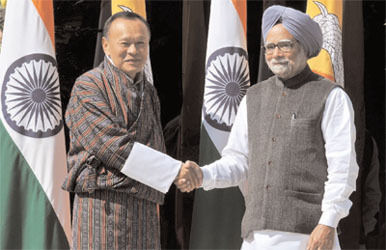
    HIMPHU (TIP): Irrespective of the results in July 13 election, the new Bhutan government will have to go the extra mile to end suspicion and distrust that cloud its relationship with India. New Delhi is understood to be upset with the manner Bhutan under Druk Phuensum Tshogpa (DPT) allegedly overlooked India’s basic national interests in the past five years.

    Bhutan’s stated policy is that it won’t allow the UN Big Five to have diplomatic missions in Thimphu. But, New Delhi believes, Bhutan circumvented this by appointing a Briton to act as UK’s honorary consul in its capital and subsequently gave him Bhutanese citizenship. This, many felt, is not in alignment with Bhutan’s stated policy. So far, the kingdom, acknowledged as India’s staunchest ally worldwide, had refrained from taking any such step in deference to Delhi’s security concerns.

    Ex-PM Jigmi Y Thinley’s critics in Bhutan and India claimed that the first strain in bilateral ties appeared over the way he described his meeting with then Chinese premier Wen Jiabao in 2012. They alleged that although the meeting was “pre-arranged” , Thimphu projected it as “an impromptu interaction”. They were of the view that such “distortion” of facts made New Delhi suspicious of Thimphu’s intentions.

    Many saw New Delhi’s decision to invite the King to this year’s Republic Day ceremony as a signal that it wants to directly deal with the palace and the people. All Bhutanese Kings, according to them, have been great protagonists of India-Bhutan friendship. It was perhaps because of this that New Delhi in 2007 agreed to revise the 1949 India-Bhutan Treaty after the king reportedly expressed his wish to have an agreement suitable to a country on the threshold of democracy. The revised treaty gave Thimphu freedom to pursue an independent foreign policy.

    A year later, the kingdom embraced democracy. The revision of the treaty enabled the DPT government to extend Bhutan’s diplomatic ties from 21 to 53 countries between 2008 and 2013. New Delhi apparently wanted Thimphu to take geopolitical realities into consideration while expanding its diplomacy across the globe.

    India, Thinley’s detractors claimed, did not take kindly to the alleged use of Chinese experts to instal heavy machinery in Bhutan. For China, they said, investing in a small country like Bhutan is a pittance. Amid reports of friction in India-Bhutan friendship, New Delhi recently cut cooking gas and kerosene subsidies for Bhutan. This not only became an election issue but also spread fear among the Bhutanese that India would punish their country because of diplomatic reasons.

    Against this backdrop, Bhutan on Saturday will choose between DPT and PDP to head it new government. In 2008, DTP won 45 of 47 seats and PDP two. Bhutan follows a bi-party system. In the primary round that was held weeks ago to choose the top two parties for Saturday’s polls, DPT won in 33 and PDP 12. The remaining two seats went to Druk Nyamdrup Tshogpa that merged with the PDP.

    The PDP-DNT union may put DPT in trouble in a number of constituencies where it won by small margins in the preliminary round. Bhutan’s three giant leaps First big reform: Third King Jigme Dorji Wangchuk set up National Assembly (Tshogdu) in 1953 It elected members representing Gewogs (smallest administrative units) This was legislating body, people discussed national issues SECOND BIG REFORM: Setting up of Royal Advisory Council (Lodoe Tshogde) in 1963 Served as link between king, council of ministers and people Liaison ensured projects’ timely implementation King Jigme Singye Wangchuk set up District Development Committee in 1981 (Dzongkhag Yargay Tshogdue) In 1991, he set up Gewog Yargay Tshogchhung (block development committees) THIRD BIG REFORM: The 1998 devolution of powers to cabinet ministers King became head of state while PM head of govt PM has council of ministers Constitution signed in 2008

  • China Moving Towards Greater Economic Openness, US Official Says

    China Moving Towards Greater Economic Openness, US Official Says

    WASHINGTON (TIP): The United States on July 11 said China agreed to drop certain exceptions before restarting negotiations on a bilateral investment treaty between the two countries. The move is an encouraging sign that the world’s second largest economy is willing to open up more sectors to foreign competition, a US treasury official told reporters on the sidelines of USChina economic talks in Washington.

    China also plans to establish a Shanghai Free Trade Zone pilot program and permit foreign firms to compete in certain services sectors, including e-commerce, the official said, speaking on condition of anonymity. The United States also expects to see more progress on China’s move towards a freelyfloating exchange rate in coming weeks, the official said.

  • Sujatha Singh is new Foreign Secy

    Sujatha Singh is new Foreign Secy

    NEW DELHI (TIP): Adhering to the seniority principle, the government on July 3 named Indian Ambassador to Germany Sujatha Singh as the next Foreign Secretary to succeed Ranjan Mathai on his retirement on July 31. An IFS officer of the 1976 batch, Sujatha will be the third woman to navigate India’s foreign policy as the country’s top diplomat. Earlier, Chokila Iyer and Nirupama Rao have held the coveted post. Sujatha, who was due to retire in July next year, will now have a two-year term from August 1. Though she has not done any diplomatic posting in India’s neighbourhood, clearly an added qualification for any Foreign Secretary, she was Undersecretary in the External Affairs Ministry looking after Nepal in early 80s. Apart from Sujatha, there were four contenders for the Foreign Secretary’s post. They were S Jaishankar, India’s Ambassador to China, Jaimini Bhagwati, Indian High Commissioner to Britain, Sudhir Vyas, Secretary (West) in the External Affairs Ministry, and Pinak Ranjan Chakravarty, Secretary (Economic Relations) in the ministry.

  • China hosts Antony, Sharif

    China hosts Antony, Sharif

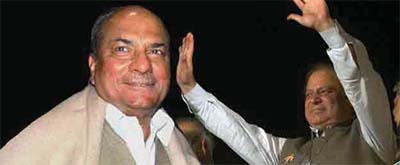
    China hosts Antony, SharifNEW DELHI (TIP): Desperate to play ‘peace-broker’ in India-Pakistan ties, China on July 4 hosted Defence Minister AK Antony and Pakistani Prime Minister Nawaz Sharif separately, but projected it as a rare diplomatic event. As Sharif and Antony arrived in Beijing, the country’s State-television said China was setting off a new phase of cordial ties between the two nations by hosting top leaders from both the countries – . “Both India and Pakistan are very important countries in our neighbourhood,” Wang Shida, a researcher with the China Institute of Contemporary Relations, told CCTV news. “China-India have established strategic cooperative partnership since 2005. Meanwhile, China and Pakistan enjoyed an all-weather partnership for half a century. “It means both India and Pakistan are important diplomatically to China.

    Premier Li Keqiang’s visit to both the countries last month sets a very good example,” he said. Though their visits were a coincidence, Sharif and Antony were not expected to cross paths. Antony, who is the first Indian Defence Minister to visit China in seven years, is in Beijing on a four-day visit. The recent border incursion by Chinese troops, finalisation of the Border Defence Coordination Agreement (BDSA) to maintain peace at the disputed borders as well as resumption of bilateral Military exercises top Antony’s agenda for talks with the Chinese leadership. Hours before AK Antony arrived in Beijing for high-level talks on Thursday, a hawkish Chinese General warned India against provoking ‘new trouble’ by increasing its Military deployment at the border.

    Don’t provoke China with new trouble: PLA General warns India “There is no denying that there are tensions and problems between China and India particularly at the border areas,” Major General Luo Yuan, executive vice president and secretary general of China Strategy Culture Promotion Association, said. “The Indian side should not provoke new problems and increase the Military deployment at the border areas and start new trouble,” General Luo, known for his hawkish and extreme views on China’s strategic and military relations with its neighbours and the US, said. Sharif, who arrived in Beijing on his first foreign visit after returning to power, met Chinese President Xi Jinping and sought assistance in energy, transport and infrastructure projects. During his meeting, Sharif spoke about the numerous challenges that Pakistan was faced with, including pulling the economy out from its current difficulties.

  • China hosts Antony, Sharif

    China hosts Antony, Sharif

    NEW DELHI (TIP): Desperate to play ‘peace-broker’ in India-Pakistan ties, China on July 4 hosted Defence Minister AK Antony and Pakistani Prime Minister Nawaz Sharif separately, but projected it as a rare diplomatic event. As Sharif and Antony arrived in Beijing, the country’s State-television said China was setting off a new phase of cordial ties between the two nations by hosting top leaders from both the countries – .

    “Both India and Pakistan are very important countries in our neighbourhood,” Wang Shida, a researcher with the China Institute of Contemporary Relations, told CCTV news. “China-India have established strategic cooperative partnership since 2005. Meanwhile, China and Pakistan enjoyed an all-weather partnership for half a century.

    “It means both India and Pakistan are important diplomatically to China. Premier Li Keqiang’s visit to both the countries last month sets a very good example,” he said. Though their visits were a coincidence, Sharif and Antony were not expected to cross paths. Antony, who is the first Indian Defence Minister to visit China in seven years, is in Beijing on a four-day visit. The recent border incursion by Chinese troops, finalisation of the Border Defence Coordination Agreement (BDSA) to maintain peace at the disputed borders as well as resumption of bilateral Military exercises top Antony’s agenda for talks with the Chinese leadership. Hours before AK Antony arrived in Beijing for high-level talks on Thursday, a hawkish Chinese General warned India against provoking ‘new trouble’ by increasing its Military deployment at the border.

    Don’t provoke China with new trouble: PLA General warns India
    “There is no denying that there are tensions and problems between China and India particularly at the border areas,” Major General Luo Yuan, executive vice president and secretary general of China Strategy Culture Promotion Association, said. “The Indian side should not provoke new problems and increase the Military deployment at the border areas and start new trouble,” General Luo, known for his hawkish and extreme views on China’s strategic and military relations with its neighbours and the US, said.

    Sharif, who arrived in Beijing on his first foreign visit after returning to power, met Chinese President Xi Jinping and sought assistance in energy, transport and infrastructure projects. During his meeting, Sharif spoke about the numerous challenges that Pakistan was faced with, including pulling the economy out from its current difficulties.

  • Vivek Wadhwa named to Time’s List of Top Tech Thinkers

    Vivek Wadhwa named to Time’s List of Top Tech Thinkers

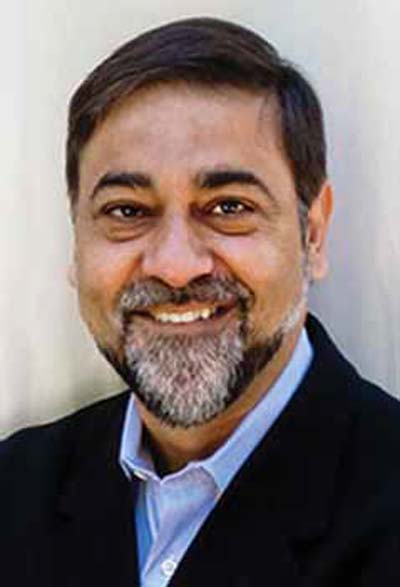
    NEW YORK (TIP): Vivek Wadhwa, who holds academic appointments at Singularity University, Stanford University and Duke University, and last year was named to Foreign Policy magazine’s list of the Top 100 Global Thinkers, was named by Time magazine recently to its list of the 40 “Most Influential Minds in Tech.” Wadhwa, the magazine said, “has become a leading voice in debates over technology policy, particularly with respect to entrepreneurship, innovation and immigration.” “In his recent book, ‘The Immigrant Exodus: Why America Is Losing the Global Race to Capture Entrepreneurial Talent,’ Wadhwa describes how the U.S. is now telling the best immigrants to go home, due to a lack of immigration visas,” Time said. “As a result of this ‘reverse brain drain,’ as Wadhwa and his colleagues call it, highly skilled workers and professionals are increasingly looking to other global markets to locate their businesses.” “We’re seeing a boom in technology entrepreneurship in India, China, and even Russia, because the U.S. won’t let people stay here,” Wadhwa told Time. Early in his career, Wadhwa worked at Credit Suisse First Boston, where he helped develop technology for creating computeraided software-writing systems. The Indian American entrepreneur later founded software firm Relativity Technologies. Wadhwa is a columnist at Bloomberg Business Week and a contributor to various other publications, including The Indian Panorama.

  • NSA Shiv Shankar Menon In Beijing For Border Talks

    NSA Shiv Shankar Menon In Beijing For Border Talks

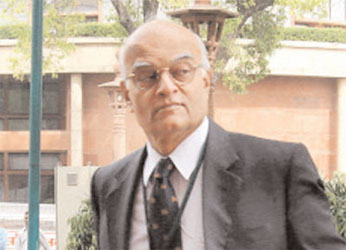
    BEIJING (TIP): China is according high importance to national security adviser Shiv Shankar Menon’s visit to the country, with Premier Li Keqiang and foreign minister Wang Yi among those scheduled to meet him. Menon will hold negotiations on the boundary issue and lay the ground for defence minister A K Anthony’s visit to Beijing early next month. At the same time, the Chinese foreign ministry has cautioned against having high hopes about the outcome of the two-day boundary talks that Menon will have with China’s state councillor Yang Jeichi from Friday.

    “The boundary question is an issue left over from history (and) it cannot be solved overnight, but you should see that (the) two sides have made long-lasting efforts in order to solve the issue and a lot of achievements have already been made,” Chinese foreign ministry spokeswoman Hua Chunying said. She said China was looking forward to an acceptable solution pending the final settlement of boundary question.

    “We should work together to maintain peace and tranquillity of (the) border areas and ensure the boundary issue does not affect overall relations between China and India,” she said. Chinese troops had recently entered Indian territory in Daulat Beg Oldi sector in eastern Ladakh. That stand-off could only be resolved after about three weeks.

  • Bhutan’s Road To Democracy Leads To China?

    Bhutan’s Road To Democracy Leads To China?

    NEW DELHI (TIP): There’s a new anxiety in the top echelons of New Delhi about what’s arguably India’s only friendly neighbour, Bhutan. As the hill kingdom takes another baby step in its transition from monarchy to democracy with its second parliamentary election on July 13, there’s realization here that complacence has possibly allowed some disturbing developments there to go unnoticed. Friendship with Bhutan is often taken for granted by our foreign policy mandarins.

    So, it was a rude shock when they learned last year from a Chinese press release that the new Bhutan PM, JigmeThinley, has had a meeting with the then Chinese premier Wen Jiabao and the two countries were set to establish diplomatic ties. Given that Bhutan’s foreign policy is conducted by and large in close consultation with New Delhi, such an important step without its knowledge created disquiet.

    Although the PM’s office in Thimpu sought to play it down, senior officers recalled that Thinley had said months after taking over as PM that he only saw growing opportunities in China and no threat. As part of Bhutan’s outreach to China was the decision last year to procure 20 Chinese buses, typically the kind of purchase that would normally be booked with, say, Tata Motors. It raised eyebrows. It did not help that the person who got the contract for supplying the buses was reported to be a relative of Thinley.

    What’s ironic is that in his poll campaign, Thinley is said to be impressing upon the electorate that he was the best upholder of Bhutan’s ties with India, whereas he has possibly complicated them. Thinley’s Bhutan Peace and Prosperity Party is again the main contender for power in this tiny, landlocked nation of 700,000 which saw transition to democracy from an over 100-yearold hereditary monarchy in 2008.

    Democracy in Bhutan was ushered in by Bhutan’s benevolent fourth king Jigme Singye Wangchuck. The last month saw the Bhutanese repose faith in the system with 55% of 380,000-strong electorate braving thunderstorms and landslides to exercise their franchise. As the world’s largest democracy, India welcomed Bhutan’s transition in 2008, but not everyone in South Block realized that the proposed model wasn’t like India’s Westminister model of parliamentary democracy. It’s a diarchy in Bhutan with the monarch retaining certain overriding powers.

    Article 20.7 of Bhutan’s Constitution says the cabinet shall be collectively responsible to the Druk Gya88lpo (the king) and to Parliament”. The government must also enjoy the confidence of the king as well as parliament. Further Article 20.4 says “the PM shall keep the Druk Gyalpo informed from time to time about the affairs of the state, including international affairs, and shall submit such information and files as called for by the Druk Gyalpo”. It now appears that the king wasn’t quite in the loop as Bhutan expanded its diplomatic ties with 53 countries, as against 22 in 2008.

  • Chinese Female Student Pictures Cause University Website To Crash

    Chinese Female Student Pictures Cause University Website To Crash

    BEIJING (TIP): An attractive Chinese female student’s graduation pictures have proved so popular that they caused her university website to crash after being uploaded onto the homepage. The website of one of China’s top universities crashed after it had an unprecedented number of visitors who apparently logged in to check out the uploaded photos of the young female graduate.

    In the pictures, the girl named Kang Kang is seen flaunting her graduation robes and holding a mortarboard hat, in a variety of poses on and around the university campus. The incident occurred at the Renmin University of China and many people suspect the pictures are one of the ways the university uses to attract new students, ‘South China Morning Post’ reported. The decision to put up the pictures — which is unusual for conservative Chinese universities — not only drew countless clicks on its website, but also excited people’s curiosity as to who the student was.

    According to Beijing News, the girl is the university’s arts school graduate majoring in the double bass. Her photo was shot by a professional photographer Mao Yanzheng. “It’s unbelievable that it takes only one photo to make a person famous,” Mao said. Mao shot over 300 photos and chose two he thought were the best for the university’s website. He said he only did it as a favour. The varsity’s decision to use the photo sparked different views online. Some netizens praised the picture for capturing the beauty of youth during graduation time.

    “This student embodies the elegant, fresh look of our graduates,” a Renmin University graduate commented online. Some admirers even dubbed the attractive graduate a ” RenminU goddess” — a term very popular among young people in China to refer to pretty women whom they find unattainable. However, others did not approve of the photo on the website, saying it was a deviation from the university’s fundamental principles.

  • Pew Survey On Attitudes Towards Homosexuality Released

    Pew Survey On Attitudes Towards Homosexuality Released

    UNITED NATIONS (TIP): “Should Society Accept Homosexuality?” A global Pew Research Centre survey was released June 4, finding a wide variety of regional opinion on the question. Pew found that generally more positive attitudes were observed amongst younger people, and that in countries where a gender gap was observed, women tended to be more accepting than men. The survey polled nearly forty thousand people in 39 countries, asking questions about religion, age and gender.

    Senior Researcher at Pew Global Attitudes Juliana Menasce Horowitz observed, “What is surprising is the level of global polarization that we see on this subject. We have been collecting public opinion data all over the world on various issues, and I can’t think of any questions or subjects where we see such large percentages on one side in a group of countries and equally high percentages on the other side in other parts of the world.” The most tolerant responses to the question were predominantly secular and affluent, and either Latin American and Western.

    The least tolerant were found to be the 13 Middle Eastern and African nations polled. The strongest support came from Spain where 88 per cent of respondents answered “Yes” to the question. The study found a strong relationship between a country’s religiosity and its opinion on homosexuality. In countries where religiosity was low, attitudes were mostly positive. This was measured by three factors; whether they believe faith in god to be a necessity for morality; whether or not they say that religion is important in their lives; and whether they pray every day.

    This trend excluded Russia and China where religiosity was found to be low, but only around 20 percent answered “Yes” on the question of whether homosexuality should be accepted in society. In 2012, Russia’s top court upheld a ban on gay pride marches for the next 100 years in Moscow. On the other hand religiosity was measured to be high in the Philippines and attitudes were positive, with 73 per cent of respondents answering “Yes.”

    The results of the survey have been published at a time when many countries are debating same-sex marriage, France in particular having conducted its first official ceremony last week, and the UK preparing to pass a law soon. There are currently fifteen countries worldwide in which there is legal recognition of same-sex marriages.

  • India fourth biggest market for Sony with Rs 8,000 crore sales

    India fourth biggest market for Sony with Rs 8,000 crore sales

    NEW DELHI (TIP): Despite weak demand in the industry, Sony India has managed to break into the top five markets in the Japanese giant’s global operations, riding on healthy sales of televisions. The upsurge — to the fourth position — has been quick for the Indian subsidiary that till two years ago was a distant ninth in Sony’s global markets. Sony India finished last fiscal (2012-13) with a 27% growth at overall revenue of Rs 8,000 crore.

    With this, India is ahead of many of Sony’s key markets like Brazil, Russia, Germany and Britain. India now trails US (top market for the company), China and Japan. Kenichiro Hibi, MD of Sony India, said that televisions and mobile phones (under the Xperia range) remain among the fastest-growing segments for the company. Hibi, however, expressed concern over weakening demand in line with the slowdown of the Indian economy. “The market situation is difficult and there are pressures,” Hibi told TOI after launching the premium ‘4K’ Bravia TV range that is priced upwards of Rs 3 lakh.

    Hibi said that the retail end was under stress and things at the ground are “not easy”. However, new launches as well as expectations of a turnaround towards the latter part of the year make the company confident as it expects to maintain the previous year’s growth in this fiscal as well. But despite witnessing growth in India, Sony India does not have any immediate plans to start manufacturing operations here.

    The company currently imports its product line-up from a clutch of countries like China, Malaysia, Japan and Thailand. Hibi said TV sales will continue to lead the charge for the company and it expects to sell 13 lakh units this fiscal against 11 lakh units in the previous year. Televisions contribute around 35% to Sony India’s revenues.

  • IT INDUSTRY WILL GROW 13-14%: SOM MITTAL

    IT INDUSTRY WILL GROW 13-14%: SOM MITTAL

    CHENNAI (TIP): Software industry body Nasscom expects the country’s information technology (IT) services sector to grow 13-14 per cent in the current financial year and to touch $225 billion (Rs 13.22 lakh crore) by 2020. Speaking to reporters after addressing Nasscom’s EmergeOut Conclave here, the industry body’s president, Som Mittal, said the sector had been growing at a compound annual growth rate of 12-13 per cent till two years earlier, and reaching the $225 billion target was not impossible.

    The first main driver will be new geographies. At present, the US, the UK and other European markets contribute to around 90 per cent of the total business, while other markets, including India, China and Latin America, contribute the rest. “Only three per cent of the business we do in China and Japan, which shows there is plenty of opportunities in those markets,” said Mittal. Many small companies have now started focussing only on these markets. “Our estimate is that around 20 per cent of the business would come from new geographies by 2020,” said Mittal. The second driver will be new verticals.

    At present, banking, financial services and insurance, hi-tech and telecom and manufacturing contribute around 80 per cent of the business, while utilities, transport, health care and media and entertainment open up new opportunities. “Not that the existing verticals will have a setback. The growth will not be at the cost of others, it will be an an expansion,” said Mittal. The third driver will be new customers, especially small and medium business companies, said Mittal.

  • INDIA, CHINA OPEN TO CO-PRODUCTION OF FILMS

    INDIA, CHINA OPEN TO CO-PRODUCTION OF FILMS

    NEW DELHI (TIP): India and China are looking to strengthen co-operation in the area of films and broadcasting, and are also exploring the potential of co-production of films. Information and Broadcasting Minister Manish Tewari led an Indian delegation on Tuesday and held a twohour discussion on future ties with a 10-member Chinese delegation led by Cai Fuchao, the Chinese Minister of State Administration of Press, Publication, Radio, Film and Television.

    More access India asked China to provide more access to Indian films and also raised the issue of giving landing rights to public broadcaster Doordarshan in China. China has a fixed quota for the number of international films that are allowed to be released every year. If a television channel is uplinked abroad, it requires landing rights to be able to telecast the channels in another country. Tewari told reporters that the two delegations had discussions on strengthening people-to-people contact.

    “Both felt that there is potential to further enhance cultural exchanges… in the field of films, personnel, public broadcasters, coproduction of films, exchanges between film industries as well as between our Film Institute and the Beijing film school,” he said. I&B Secretary Uday Kumar Varma also raised the issue of easing restrictions for allowing more Indian films to be shown in China. Tewari added, “We are going to constitute a joint working group and this will be a part of its agenda.” The working group is expected to meet at regular intervals to look into issues surrounding the film and broadcasting sectors.

    He said India had invited China to become the ‘principal guest country’ at the International Film Festival of India (IFFI) 2014, scheduled to be held in Goa and had requested them to send classical Chinese films. He said that the two countries looked forward to agreement on co-production in films as well as in radio and television. “An audio-visual agreement would not only promote our shooting locations, but will also boost film-related tourism in the two countries and hence pave the way for more vibrant people-to-people contact,” he added.

    Fuchao, who is here for the inaugural ceremony of the six-day Chinese Film Festival being held in Delhi, said the two countries agreed on the potential of strengthening ties in the areas of films, television and culture. He also said there is a potential for co-production of movies. Jackie Chan’s latest film Chinese Zodiac was the opening film of the Festival.

  • China rejects US report on human trafficking

    China rejects US report on human trafficking

    BEIJING (TIP): China has rejected a US move to downgrade it in the ranking of nations making significant efforts to control human trafficking, saying Washington’s assessment lacked objectivity. Chinese foreign ministry spokeswoman Hua Chunying said her country attached “great importance to fighting all crimes of trafficking”.

    “We believe that the US side should take an objective and impartial view of China’s efforts and stop making unilateral or arbitrary judgements of China,” she said. In its report on human trafficking, the US drew attention to continuing cases of child and adult forced labour, and sex trafficking of women and girls.

    But it acknowledged China had taken steps to raise awareness and work with international organizations. “Despite these modest signs of interest in anti-trafficking reforms, the Chinese government did not demonstrate significant efforts to comprehensively prohibit and punish all forms of trafficking and to prosecute traffickers,” the US report said.

  • India Outpaces Major Steel Producers With 5.8% Growth In Fy’13

    India Outpaces Major Steel Producers With 5.8% Growth In Fy’13

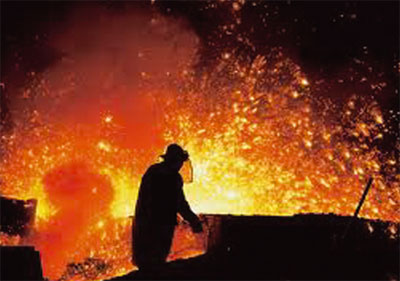
    NEW DELHI (TIP): India, the world’s fourth largest steel maker, logged 5.86 per cent growth in production in 2012-13 – the highest among major global producers, World Steel Association has said. According to WSA, India produced 78.12 million tonne (MT) steel during the fiscal as against 73.39 MT in 2011-12. China had produced the maximum steel during the fiscal at 726.33 MT, almost half of the world’s total output of 1,521 MT; but India outpaced the neighbour in the rate of growth.

    Production in China grew by 5.39 per cent during 2012-13 over 689.192 MT in 2011-12. Global production grew by 1.59 per cent during the fiscal. World’s second largest steel maker Japan produced 107.30 MT in 2012-13, clocking 0.78 per cent growth over 106.46 MT produced in the previous fiscal.

    The US, the world’s third largest steel producing nation, clocked a negative rate, down 1.61 per cent, during the fiscal at 86.94 MT compared to 88.36 MT a year ago. Russia produced 69.56 MT steel in 2012-13, recording just 0.17 per cent growth over the previous fiscal. South Korea has also clocked a de-growth of 1.62 per cent to produce 68.15 MT steel during the year.

  • Shed Illusions On China

    Shed Illusions On China

    India’s appeasement policy won’t help
    It is high time the PMO and the MEA gathered courage to speak on the South China Sea and the issues having a bearing on national security, particularly in forums like the East Asia Summit, with the same clarity as the Defense Minister did.

    During the past month China inflicted a national humiliation on India by intruding 19 kilometers across what has been the traditional border between Ladakh and Tibet since the 17th century and forcing India to not only pull back from its own territory in the Daulat Beg Oldi sector, but also to dismantle defense structures in the Chumar sector.

    China has consistently refused to define where the so-called “Line of Actual Control” lies and acted aggressively when it finds Indian defenses neutralize its tactical and strategic advantages by pushing its claims westwards and well beyond what its own maps had earlier depicted. Moreover, apart from violating all past agreements on the Ladakh-Tibet border, China’s territorial claims also violate the provisions of the Wen Jiabao – Manmohan Singh Agreement of 2005 on the guiding principles for a border settlement which state: “The (Sino-Indian) boundary should be along well defined and easily identifiable geographical features, to be mutually agreed upon”.

    India’s claims, based on historical data, also fulfill the provisions of the 2005 agreement as they set the western borders up to the Indus river watershed, with the Karakoram mountains forming the natural boundary. After being militarily humiliated, India chose to subject itself to diplomatic ridicule in the joint statement issued after the visit of Premier Li Keqiang.

    While the joint statement paid lip service to the 2005 guiding principles, there was no mention of the need for defining the LAC in accordance with these guiding principles. Unless we do this and insist on China furnishing its version of the LAC, the Chinese will continue to stall and obfuscate while placing our forces in an untenable position along the borders, with India meekly agreeing to pull down any defenses the Chinese demand.

    Worse still, India agreed to accept some ridiculous and one-sided provisions which are clearly detrimental to its national interests. The most astonishing provision of the joint statement was the sentence: “The two sides are committed to taking a positive view and support each other’s friendship with other countries”. This, in effect, was an endorsement of Chinese policies of “low cost containment” of India.

    Over the past three decades China has provided Pakistan designs for its nuclear weapon, allowed the use of its territory in 1990 by Pakistan for testing nuclear weapons, upgraded Pakistan’s enrichment centrifuges, provided unsafeguarded plutonium production and reprocessing facilities and violated its commitment to the MTCR, by providing Pakistan wherewithal for manufacturing medium and long-range ballistic and cruise missiles.

    China is also Pakistan’s largest arms supplier, providing equipment ranging from JF 17 fighters and T 90 tanks to modern frigates. General Musharraf had made it clear just after the visit of then Chinese Premier Zhu Rongji that the Gwadar port being built with Chinese assistance would be made available to China if there were tensions with India. Moreover, does our ill-advised endorsement of the nature of Sino-Pakistani collusion not suggest an endorsement of Chinese growing presence in POK and the Northern Areas of Gilgit-Baltistan? As the Chinese government mouthpiece, The Global Times, mockingly observed: “India must accept and adapt to the enviable friendship between China and Pakistan.

    China cannot scale down this partnership merely because of India’s feelings!” On May 28 President Rajapakse of Sri Lanka signed a “strategic cooperation partnership” agreement with President Xi Jinping in Beijing, in which the two sides agreed to strengthen defense cooperation while jointly cracking down on the “three challenges of terrorism, separatism and extremism” and expanding cooperation on “international and regional affairs”.

    Virtually every South Asian leader choosing to challenge India, ranging from President Waheed in the Maldives to Begum Khaleda Zia in Bangladesh and Prachanda in Nepal, has received a warm welcome at the highest levels in Beijing. Moreover, China is bent on blocking India’s entry into forums like the Nuclear Suppliers Group. Worse still, India grandiosely agreed to support a Chinese role in the Gulf of Aden, without getting similar Chinese endorsement for its maritime and energy interests in the South China Sea, most notably for its exploration projects in the Phu Khanh Basin off the coast of Vietnam.

    Interestingly, while commissioning the first squadron of carrier-based Mig 29 aircraft on May 13, the Defense Minster, Mr. A.K. Antony, asserted that there should be freedom of navigation in the South China Sea, adding that while India is not a party to disputes there, it believes that these disputes should be settled according to the UN Convention of the Law of the Seas (UNCLOS). Mr. Antony added the protection of the sea lanes of communications is imperative for India’s trade, commerce and economic development.

    Sadly, such clarity on Indian interests is not evident in other parts of South Block. Moreover, Mr. Antony believes that there can be no “miracles” in the development of India-China relations and has no intention of either taking up residence in Beijing or waxing eloquent on the serenity and tranquility surrounding Tiananmen Square! New Delhi has to understand that the appeasement of an assertive China is a recipe for global and regional marginalization.

    Given China’s territorial claims, which have expanded from just Tawang, to the entire state of Arunachal Pradesh and its activities in PoK, India should not merely stop voicing the inane mantra that “Tibet is an Autonomous Region of China,” but make it clear that we did not invite the Dalai Lama to India. We would be happy if he reached an agreement to return to Tibet, with China respecting the provisions of the 17-point agreement it signed with the Tibetans in 1951. Moreover, apart from acquiring berthing facilities for the Navy in Vietnam, India would be well advised to provide Vietnam the ability to protect its maritime interests by the supply of Brahmos cruise missiles, much in the manner that China provides Pakistan ballistic and cruise missiles.

    On river waters, India is well placed to work with lower riparian states in the Mekong basin and, indeed internationally, to isolate China on its refusal to engage in prior consultations on projects on the Brahmaputra river. It is also high time the PMO and the MEA gathered courage to speak on the South China Sea and issues having a bearing on national security, particularly in forums like the East Asia Summit, with the same clarity as the Defense Minister, instead of appearing apologetic, weak and vacillating. The statements made and cooperation envisaged when the Prime Minister visited Japan are a good beginning.

  • Waiver Augurs Well For Indo-US Ties, Say Officials

    Waiver Augurs Well For Indo-US Ties, Say Officials

    NEW DELHI (TIP): New Delhi is happy that Washington has granted another sixmonth waiver to India on Iran-related sanctions just ahead of the fourth Indo-US strategic dialogue. Along with India, China, Malaysia, South Korea, Singapore, South Africa, Sri Lanka, Turkey and Taiwan have also qualified for the exemption from sanctions. India has reduced its oil purchases from Iran considerably in the past few years, cutting imports by nearly a fifth.

    China’s reductions have, however, been more modest. An indication about India getting a fresh waiver from sanctions was recently given by US Undersecretary for Political Affairs Wendy Sherman when she visited New Delhi. “They (India) have stood side-by-side with all of us in the international community to say that Iran should not acquire a nuclear weapon.

    We greatly appreciate all of the leadership that India has provided, including their enforcement of sanctions,” she said. Officials here candidly acknowledge that the Indian economy, already going through a rough period, would have suffered greater had India attracted the Iran-related sanctions. The waiver to India is being viewed here as a move that sets a perfect stage for the fourth India-US strategic dialogue to be held here on June 24. ‘

    External Affairs Minister Salman Khurshid and US Secretary of State John Kerry will lead their respective delegations at the dialogue, which will cover the entire range of relationship between the two countries. The US has been nudging India to reduce its engagement with Iran in view of its controversial nuclear program.

    New Delhi has, however, made it clear Washington that it could not be pressed beyond a limit on the issue of Iran, keeping in view its historical ties with the Islamic country. It has also been forthright in stating that it would only abide by UN sanctions against Iran and not those slapped by individual countries, like the US.

  • TAJ TO SET UP TWO HOTELS IN CHINA

    TAJ TO SET UP TWO HOTELS IN CHINA

    MUMBAI (TIP): Kunming, the capital and largest city of the Yunnan province in South-West China, holds particular interest for the Indian Hotel Company’s (IHC) expansion plans. The entry of the Taj Group’s two brands, Taj and Vivanta by Taj in Kunming, are to enable the hospitality major gain more than a toehold in the Chinese market.

    Early 2014, Hotel Taj Temple of Heaven is to open its doors in Beijing, while a 300-room property in the Hainan island is being developed as a premium holiday resort. IHC, which runs the Taj Group of hotels, is also to invest in a Taj Hotel, with approximately 200 rooms, and a Vivanta by Taj Hotel, with approximately 300 rooms, in the Kunming Expo Garden in the Yunnan province.

    In January 2012, IHC had signed an agreement with the Yunnan Tourism Company to construct, develop, operate and manage two hotels in the Kunming Expo Garden.

  • HTC INDIA EYES 15% SHARE, TO START EMI SCHEME

    HTC INDIA EYES 15% SHARE, TO START EMI SCHEME

    NEW DELHI (TIP): Betting big on its flagship smartphone HTC One, handset maker HTC on Wednesday said it aims to achieve 15% market share in the domestic smartphone market by the end of this year. “We are aiming 15% market share in the domestic smartphone market by the end of this year,” HTC country head Faisal Siddiqui told PTI.

    As per research agency GFK, HTC currently has 6% share in the domestic smartphone market, he said. The company, which had launched HTC One globally in April, today showcased the device in Delhi. It has partnered with Reliance Communications to offer 1GB of 3G data free for three months. The aluminium unibodied device has new features like HTC BlinkFeed, HTC Zoe and HTC BoomSound as well as innovations in HTC Sense, the company said.

    Like its peers, HTC also plans to come out with EMI (easy monthly instalments) scheme for the phone next month. The company has also added two national distributors and it now has three distributors across the country, who cater to over 100 dealers and 3,500 outlets, Siddiqui said. The company, however, has no plans to start production of the phone in the country and will continue to import it from China and Taiwan.

  • INDIA, JAPAN TO SPEED UP EFFORTS ON CIVIL N-DEAL E

    INDIA, JAPAN TO SPEED UP EFFORTS ON CIVIL N-DEAL E

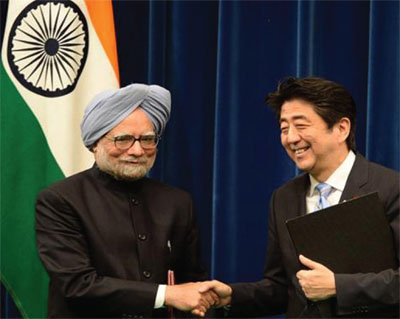
    TOKYO (TIP): Prime Minister Manmohan Singh and his Japanese counterpart Shinzo Abe decided to speed up talks on a civil nuclear deal to allow Japan to export nuclear reactors to India and to bolster maritime security cooperation at a time when China’s postures in the seas of the regional have caused concerns.

    A joint statement issued at the end of the exhaustive talks between Manmohan Singh and Abe said the two Prime Ministers reaffirmed the importance of civil nuclear cooperation between the two countries, while recognising that nuclear safety is a priority for both governments. “In this context, they directed their officials to accelerate the negotiations of an Agreement for Cooperation in the Peaceful Uses of Nuclear Energy towards an early conclusion,” it said.

    India and Japan welcomed the expanding bilateral defence ties and agreed to further cooperate on maritime issues to ensure freedom of navigation and unimpeded commerce. Terming Japan as a partner, Manmohan said at a time of global uncertainties, change and challenges, India and Japan are “natural and indispensable partners for advancing prosperity in our two countries and for a peaceful, stable, cooperative and prosperous future for the Asia-Pacific and Indian Ocean regions”.

    The remarks came amidst flexing of muscles by China in the South China Sea and East China Sea. Both sides expressed their commitment to continue to work to prepare the ground for India to become a full member in the international export control regimes. These included the Nuclear Suppliers Group, the Missile Technology Control Regime, the Australia Group and the Wassenaar Agreement.

    Abe stressed on the importance of bringing into force the CTBT at an early date. Japan wants India to sign both the NPT and the CTBT, which New Delhi terms as discriminatory. On his part, Manmohan reiterated India’s commitment to its unilateral and voluntary moratorium on nuclear explosive testing. The two sides signed the Exchange of Notes for yen loan totalling $ 424 billion. This includes $ 71 billion for the Mumbai Metro Line-lll project as well as the yen loan of the fiscal year 2012 for $ 353.106 billion for eight projects.

    The two sides vowed to further strengthen their strategic ties and deepen economic cooperation. Manmohan said India attaches particular significance to intensifying political dialogue and strategic consultations. He said cooperation in high technology, space, energy security and rare earth minerals will also add rich content to the strategic relationship between the two countries.

    The Prime Minister said there was a meeting of minds in his discussions on global and regional issues. The two leaders welcomed the expanding defence relations between the two countries and decided to conduct naval exercises on a regular basis with increased frequency.

  • COOPERATION WITH JAPAN SPELLS TROUBLE FOR INDIA: CHINESE DAILY

    COOPERATION WITH JAPAN SPELLS TROUBLE FOR INDIA: CHINESE DAILY

    BEIJING (TIP): Strategic cooperation with Japan “can only bring trouble to India”, warned a state-run Chinese daily following Indian Prime Minister Manmohan Singh’s three-day visit to Tokyo. There may be some tacit understanding in strategic cooperation between India and Japan, “given the long-lasting Diaoyu Islands dispute and China-India border confrontation”, said an article in the Global Times on May 30.

    The article “India gets close to Japan at its own peril” said that “India should keep sober over (Japanese Prime Minister Shinzo) Abe administration’s vicious intentions of denying the World Anti- Fascism War as a just war”. “East Asian countries that were the victims of the World War II won’t indulge Japan. Overheated strategic cooperation with the Abe administration can only bring trouble to India and threaten its relationships with the relevant East Asian countries,” it warned.

    Indian Prime Minister Manmohan Singh concluded his visit to Japan Wednesday. The visit came after Chinese Premier Li Keqiang’s recent trip to India. “India’s efforts to develop its relationship with Japan are part of its `Look East’ policy,which has undergone great changes in recent years. In addition to Southeast Asia, the targeted region of the policy has expanded to East Asia and Northeast Asia.

    “It has emphasized more cooperation in the fields of strategy and security in addition to economy,” said the article by Liu Zongyi, a visiting fellow at the Center for Strategic and International Studies and a research fellow at Shanghai Institutes for International Studies. It noted that India has strengthened economic, strategic and security cooperation with countries like Japan, South Korea and Vietnam.

    “It has interfered in the South China Sea disputes in a highprofile manner against the backdrop of the US pivot to Asia…” Pointing out that India and Japan share common ground in developing relations, it said: “Both long for the status of permanent member state of the UN Security Council. Japan and India are theoretically complementary in their economies since India is an emerging economy with a huge potential market but constrained by inadequate capital and backward technology.

    Both countries have territorial disputes with China and are unhappy with China’s rise. It went on to say that India and Japan hold different attitudes to the priorities of the bilateral relationship. “For Japan, strategic and security cooperation are more important than economic cooperation…Abe uses infrastructure construction and the buildup of the Delhi- Mumbai industrial corridor as bait to sell his promotion of `the arc of freedom and prosperity’ and the ‘democratic security diamond’.

    “The Japanese government also encourages enterprises to invest in India with the purpose of reducing Indian dependence on China. However, so far, the results of economic cooperation between India and Japan are not satisfactory,” it added. From New Delhi’s perspective, cooperating with Japan in strategy and security is a long-term goal. In the short term, India’s main task is to guarantee a peaceful environment to boost the domestic economy, it said. “Indians well understand that the current India is incomparable to China in strength.

    The economic ties between China and India are much closer than those between India and Japan. The trade volume between China and India is about four times that of India and Japan.” The article stressed that Indian policymakers are aware of the benefits that being a swing state on the global stage can bring to India.

    “…the core of India’s diplomacy is maintaining a relative balance among big powers,while the China factor is the best excuse for it to win economic and technological support and assistance from the West. As for the India-Japan relationship, currently, India wants more economic, technological and capital help from Japan.”

  • Chinese baby rescued from sewer released to family

    Chinese baby rescued from sewer released to family

    BEIJING (TIP): A Chinese newborn who was rescued from a sewer pipe has been released to his family and his mother is unlikely to face criminal charges because authorities concluded he fell into the toilet after his birth accidentally, local officials and media reports said. The baby was released from a hospital to his maternal grandparents late Wednesday, while his 22-year-old mother remains under medical care, the state-run Jinhua Evening News reported, in an account confirmed Thursday by a local police official who declined to give his name.

    The baby’s stunning, two-hour rescue from a pipe underneath a squat toilet in Zhejiang province’s Pujiang county captivated the world, prompting both horror and an outpouring of charity on his behalf. The mother initially raised the alarm about the baby when he got stuck Saturday in a pipe just below a squat toilet in a public restroom of a residential building, but she had cleaned the room of signs of a fresh birth and did not immediately come forward as the mother, officials have been quoted as saying.

    She admitted she was the mother two days later when confronted by police who found baby toys and bloodstained tissues in her apartment, the reports said. Police later concluded that the incident was an accident and that the woman did not initially come forward because she was frightened, but that she later started telling the truth, the Jinhua Evening News and a Pujiang county propaganda official said.

    The police initially treated the case as a possible attempted homicide, but now are unlikely to file criminal charges, the newspaper and the official said. A man tracked down by police who is believed to be the baby’s father has requested a paternity test and — if the baby is his — is willing to help support the child, said the Pujiang official, who declined to give his name, as is customary among Chinese officials.

    Officials have not publicly released the names of anyone connected with the case, which has raised discussion over China’s lack of proper education about sex, birthing and contraception in many schools. Unwanted pregnancies have been on the rise because of an increasingly lax attitude toward premarital sex. Duan Wanjin, a criminal lawyer based in Xi’an, said local police erred in not prosecuting the mother. He said she could be charged with attempted homicide for not immediately calling for help after the newborn became stuck.

    “The local police may have considered the woman was still young and did not have any malice, and have come to the decision from the human perspective, but it sends a terrible signal to the public,” Duan said. Sociologist Li Yinhe said the only mistake by the woman was not to immediately admit the baby was hers. “I don’t think that’s a big deal. After all, the child is safe, and it has a happy ending,” Li said.

    “The Chinese people still lean heavily on the human considerations. Let it be bygones if there’s no serious crime.” The woman told police she got pregnant after a brief affair with the man, hid her pregnancy from family and neighbors, and secretly delivered the child Saturday in a rental building’s restroom. She said the infant accidentally slipped into the squat toilet and — after cleaning up the scene — raised the alarm. Firefighters who arrived at the rental building found the infant trapped in an L-shaped section of sewage pipe just below the squat toilet in one of the building’s shared restrooms.

    In video footage, officials were shown removing the pipe from a ceiling that apparently was just below the restroom and then, at the hospital, using pliers and saws to gently pull apart the pipe, which was about 10 centimeters (3 inches) in diameter. The baby, who weighed 2.8 kilograms (6 pounds, 3 ounces), had a low heart rate and some minor abrasions on his head and limbs, but was mostly uninjured, according to local reports. The placenta was still attached.

  • U.S. to Send More American Students to India Each Year

    U.S. to Send More American Students to India Each Year

    WASHINGTON, D.C (TIP): The United States is looking to triple the number of Americans going to India for higher studies in the next five years. “That is still far from our goal of 15,000 in five years,” Tara Sonenshine, the Under Secretary of State for Public Diplomacy and Public Affairs, told the visiting Human Resources and Development Minister, Pallam Raju, in a roundtable interaction earlier this month.

    Currently, while more than 100,000 Indian students visit the United States to study every year, the number of American students who studied in India in 2011-2012 was a mere 4300 and far less than those going to China for studies. “We have to look at what are the obstacles to getting American students to go so that we can boost interest and participation,” Sonenshine said.

    Robert Blake, Assistant Secretary of State for South and Central Asia, had earlier said that the American government was working with the Indian government to streamline the education visa processes, which have been repeatedly identified as a key reason for why so few American students go to India. “We recognize that there are indeed challenges and hindrances which have prevented more American students from choosing India as a destination,” Blake told students at Boston University on May 10.

    “Through a grant from our Embassy in New Delhi, the US-India Educational Foundation is working with Indian institutions of higher education to encourage more U.S. students to study there, including by developing better housing and support offices for foreign students,” he said. The Obama administration has launched a “Passport to India” initiative to send more and more American students to India for studies.

    The United States is also working with businesses and foundations to increase opportunities for more Americans to experience India during their college or university years through study abroad, internships, and service learning opportunities. This complements other State Department-sponsored programs for study abroad, including Fulbright, Gilman, and Critical Language scholarships. Passport to India now has ten partnerships with companies as diverse as Honeywell, United Airlines, and Citigroup, which have created hundreds of new opportunities for American students in India.