Tag: China

  • No First Use Nuclear Doctrine with ‘Chinese Characteristics’

    No First Use Nuclear Doctrine with ‘Chinese Characteristics’

    The writing is on the wall as China does not have good track record of strategic comfort and reliability vis-a-vis India. The current incidence of Chinese incursion into Indian territory in Daulat Beg Oldie region in the Ladakh sector should be an eye-opener. While India must focus on its economic, infrastructure and social development and must not waste her meager fiscal resources in a costly nuclear race, she needs to be prepared for all strategic options. Given the aggressive behavior of China in recent years appropriate and credible policies need to be adopted including having a re-look at evolving nuclear posture of China”, says the author.

    Major-General Yao Yunzhu, Director of the Center on China-America Defense Relations of the Chinese Academy of Military Sciences, Beijing in a session on Deterrence, Disarmament and Non-proliferation during the Carnegie International Nuclear Policy Conference, held in Washington, DC on April 8-9th 2013, artfully deflected all the questions on China’s growing number of nuclear arsenals with a cute smile, stating again that the onus for nuclear warhead reduction lies on both US and Russia because China has very limited, small number of nuclear weapons.

    General Yao while doing routine lipservice to the NFU doctrine explicitly admitted that, “A certain amount of opaqueness is an integral part of China’s nofirst- use policy”. She persistently refused to quantify the number of warheads China needed for a credible and effective nuclear deterrence. She officially expressed Chinese Government’s serious concern at the US shifting its ballistic missiles interceptors in the Pacific island of Guam to deal with DPRK nuclear threat, thereby degrading the quality of the Chinese nuclear deterrent.

    She enumerated three essential characteristics for the Chinese nuclear deterrent: it has to be survivable against first strike; it has to be credible enough in numbers and in delivery system, and lastly it has to have an effective and punitive second strike retaliatory capability. She was asked about recent BMD tests by China on January 22nd 2013 and she categorically confirmed that China will, from now on, indeed develop its own BMD system as the US is not willing to commit to cease its BMD system.

    Professor Li Bin from the Department of International Relations, Tsinghua University, Beijing and also a Senior Associate at Carnegie Endowment for International Peace in Washington, DC admits formally in his writings that China’s non-proliferation posture has evolved over a period of time and now is an important and essential part of its nuclear theology.

    However, in private discussions he passionately justified Chinese horizontal proliferation activities outside the scope of the Nuclear Suppliers Group by providing Chashma-3 and Chashma-4 nuclear plants to Pakistan on grounds that China had helped India also with nuclear fuel supplies for the Tarapore Atomic Reactor when India was under the US nuclear embargo. He assertively implied that China will continue to provide nuclear materials and technology to its all-weather friend Pakistan analogous to US-India civil nuclear deal though the latter deal was approved by the NSG.

    Interestingly a younger researcher Zhu Jianyu from the Center for Strategic Studies of the China Academy of Engineering Physics during the Carnegie International Nuclear Policy Conference, held in Washington, DC on April 8-9th 2013 candidly admitted that Chinese press and academicians usually toe the government line because the government controls their funding and hence independent viewpoints are not possible.

    In private discussions with Major General Yao, it became quite clear that China will now vigorously pursue development of its national ballistic missile defense system; something which China had vociferously denounced earlier. She also stated that China will continue to develop its ASAT weapons till a legally binding multi-lateral treaty banning weaponization of the space is signed and ratified.

    Major General Yao attributed to and categorically linked this shift in Chinese strategic thinking to the recent US decision to deploy 14 long-range ballistic missile interceptor batteries in the Pacific Island of Guam ostensibly in response to threats posed by the DPRK thereby potentially degrading the Chinese nuclear deterrent. Changes in the Chinese nuclear posture are also linked to the US development and deployment of advanced precision guided conventional warheads in the Asian theatre capable of destroying Chinese multiple independently targetable reentry vehicles (MIRV) ballistic missile silos thereby degrading the Chinese minimum nuclear deterrent.

    China is focused on modernizing and its strategic survivability and beefing up its effective second strike capability and therefore will continue to develop more nuclear warheads and will keep its nuclear capabilities fully opaque. China’s 2013 Defense White Paper For the first time, the 2013 edition of China’s defense white paper entitled: “Diversified Employment of China’s Armed Forces” conspicuously fails to mention readherence to and re-affirmation of China’s often-stated “No first use pledge”.

    This is significant departure from the 2011 version of China’s Defense White Paper. The absolutely deafening silence in the 2013 version on NFU is deliberate and is very significant for its reverberating eloquence. The new white paper introduces ambiguity as it endorses the use of nuclear weapons in response to a nuclear attack but does not rule out other uses. In the last few years, Chinese analysts and officials have done an excellent job of qualifying the original Chinese “NFU” pledge with myriads of qualitative exceptions so as to render it effectively meaningless.

    This carefully contrived departure is strategically significant for the international community. Following a vigorous international debate on China’s departure from the NFU policy, Major General Yao floated a trial balloon in an op-ed piece in Asia Times Online on April 24th 2013 when she called for a legally binding multi-lateral NFU agreement. She wrote a point by point rejoinder while still defending the reasons as to why China should depart from the often stated NFU policy and acknowledged that domestic discussions happening in China regarding junking the NFU policy.

    She has tried to invoke new exceptions to China’s so-called NFU commitment linking it to a new US law (2013 National Defense Authorization Act) that seeks a report from the Commander of the US Strategic Command by August 15th 2013 to describe the Chinese underground tunnel networks and to review the US capability to neutralize such networks with conventional and nuclear forces. Ostensibly, with a view to creating more confusion and more opaqueness about China’s intentions, she explicitly states: “To alleviate China’s concerns, a constructive approach would be to assure the policy through nuclear policy dialogues, to establish a multilateral NFU agreement among all the nuclear weapon states, and to consider limiting or even prohibiting the use of nuclear weapons in a legally binding international agreement.”

    Li Bin, in bilateral context, has previously suggested that India and China should begin their nuclear engagement with mutual reassurance of NFU and should work together in advocating NFU in global nuclear disarmament and non-proliferation efforts. China very well knows such a legally binding international agreement will not be negotiated for several decades owing to US dogmatic postures. The US is already spending $10 billion to upgrade its nuclear weapons despite Obama’s initial call for a global zero goal.

    This gives a window of opportunity for China to increase its nuclear warheads exponentially while keeping its socalled NFU pledge under suspended animation and even junk it de facto. Interestingly, China refuses to enter into an official government to government nuclear weapons dialogue with India on the grounds that India is non-signatory to the NPT. At the same time, China has shrewdly refused to engage in bilateral dialogue with the US on nuclear arms reductions on grounds of asymmetry of nuclear forces of respective countries.

    China does complain of discrimination and nuclear asymmetry while discussing US-China relations but fails to address genuine Indian concerns on similar grounds. Implications for India Western debate on the perceptible change in Chinese nuclear posture has focused only on its narrow impact on the strategic environment of the US and its allies including Japan.

    India should not behave like an ostrich burying its head in the sand. Perhaps, time has come for India to review her own strategic nuclear doctrine revising the no-first use pledge. Robust evidence has come cumulatively over a period of time from multiple sources reflecting the new nuclear reality in our neighborhood. Totality of the evidence available convinces this analyst that China has indeed changed its nuclear posture from defensive to offensive and is on a largescale nuclear build-up.

    China is indeed willing to consider first strike capability to preserve its core national issues though vehemently denying such intentions at the moment. Predictably, China will continue to obfuscate this change in nuclear posture using ambiguous, turgid and opaque language while simultaneously blaming the US for failing to negotiate a legally binding multi-lateral agreement on NFU.

    Indeed, this gives the dragon a fig-leaf of deniability. Certainly, India should not countenance being the only nuclear weapon state pledging “no first use” while the global nuclear posturing has become indeed hardened. One has to take into factor Pakistan’s accelerated development of tactical nuclear weapons and its stringent refusal to negotiate and sign a multi-lateral Fissile Materials Cut-Off Treaty (FMCT) and continued Chinese help to Pakistan in and outside the NSG.While Pakistan has never subscribed to an NFU commitment and its nuclear arsenal is specifically India-centric; the recent change in China’s nuclear posture is definitely of concern to India.

    The writing is on the wall as China does not have good track record of strategic comfort and reliability vis-a-vis India. The current incidence of Chinese incursion into Indian territory in Daulat Beg Oldie region in the Ladakh sector should be an eye-opener.While India must focus on its economic, infrastructure and social development and must not waste her meager fiscal resources in a costly nuclear race, she needs to be prepared for all strategic options.

    Given the aggressive behavior of China in recent years appropriate and credible policies need to be adopted including having a re-look at evolving nuclear posture of China.

  • India’s economic growth falls to a decade low of 5%

    India’s economic growth falls to a decade low of 5%

    NEW DELHI (TIP): India announced growth figures for its full financial year on Friday showing the once-booming South Asian economy expanded by 5.0% in 2012/13, its slowest pace in a decade. Low business confidence, slumping investment, high inflation and weak export demand from Western countries were blamed for the bleak performance which comes ahead of national elections scheduled for next year. In the fourth quarter to the end of March, gross domestic product grew by 4.8% year-on-year, slightly higher than the previous quarter when it expanded by 4.5%, according to the data from the statistics ministry. Despite government efforts to talk up the economy after a burst of promarket reforms at the end of last year, most independent analysts see continuing slack demand and few quick fixes. “Business activity is still sluggish,” Rupa Rege Nitsure, chief economist with state-run Bank of Baroda said ahead of the release of the data. The economy grew by 6.2 percent in 2011/12.

    Global ratings agency Standard and Poor’s warned earlier this month that India faces at least “a one-in-three” chance of losing its prized sovereign grade rating amid new threats to economic growth and reforms. India’s BBB-minus investment rating is already the lowest among its BRICS peers Brazil, Russia, China and South Africa and cutting it to “junk status” would raise the country’s hefty borrowing costs.

    The Organisation for Economic Cooperation and Development (OECD) this week lowered its projection of India’s GDP to 5.3% in 2013, from 5.9% earlier. “The government needs to go all-out to turn around investment sentiment,” said Yes Bank chief economist Shubhada Rao. The government led by Prime Minister Manmohan Singh and the Congress party has been dogged by corruption scandals during its second term in office and has struggled to push through promised pro-business legislation.

    It is scheduled to face the electorate next year having been unable to sustain the scorching growth rates of the last decade which were frequently near 10%. In a brief reforming period last year, the government opened up the retail and aviation sectors to wider foreign investment and partly freed fuel prices to reduce its burgeoning subsidy bill. But faced with a hostile parliament and a shaky ruling coalition, it has since failed to pass mooted legislation to open up the insurance and pension sectors or a longdelayed law to simplify land acquisition.

    Government pressure has mounted on the central bank to ease borrowing costs after it raised interest rates aggressively in 2010 and 2011 to combat double-digit inflation last year. It has obliged by cutting interest rates three times in 2013, but Reserve Bank of India governor Duvvuri Subbarao has said the bank has “limited space” to ease monetary policy further due to the risk of inflation flaring up again.

    India’s wholesale inflation, its most widely watched measure, cooled last month to a surprise 41-month low of 4.89%. But the consumer price index is at 9.39%, led mainly by high food and beverage prices.

  • India, China vow to end border dispute, sign eight agreements

    India, China vow to end border dispute, sign eight agreements

    NEW DELHI (TIP): Taking stock of “lessons learnt” from the recent stand-off in Ladakh after a Chinese incursion there, India and China decided on further measures for maintaining peace and tranquility along their border. This was disclosed after discussions on “mutual interest and concern” between Prime Minister Manmohan Singh and his Chinese counterpart Li Keqiang, who met here for the second time since Sunday, covering a wide range of issues including boundary dispute, trans-border rivers and trade deficit.

    Addressing a joint press meet, the two leaders acknowledged their talks- first last night and then this morning- had been “candid” and “frank”, a diplomatic aphorism for their forthright discussions. Noting that they “took stock of lessons learnt from the recent incident in the western sector, when existing mechanisms proved their worth”, Singh announced, “We have tasked our special representatives to consider further measures that may be needed to maintain peace and tranquillity along the border.

    “We agreed that our special representatives will meet soon to continue discussions, seeking early agreement on a framework for a fair, reasonable and mutually acceptable boundary settlement.” The talks come nearly a month after the 19-km-deep incursion by the Chinese troops in Depsang valley in Ladakh which was resolved only two weeks ago.

    On his part, Li, while admitting that there were “some problems” between the two countries, said, “Both sides believe that, with regard to the boundary question, one that is leftover by history, the two sides have over time established the principles on this question.

    “In the meantime, we have worked together to maintain tranquility and peace on the border,” the Chinese premier said, adding, “We need to confront various issues with a board mind and conduct dialogue on those issues in a mature and sensible way. “We need to appropriately handle our cooperation by maintaining peace and tranquility in the border areas and on the trans-border river issues.”

    Prime Minister Singh in his statement said that, “starting yesterday evening, Premier Li and I have had wide-ranging and candid discussions covering all matters of mutual interest and concern”. Singh said he was delighted that there are so many areas of convergence between them and on which there is a great deal of meeting of minds. “Most importantly, we agreed that the relationship between our two countries is of growing significance and essential for our peaceful development and sustained economic growth, as well as for stability and prosperity in our region and the world,” he said.

    Noting that India and China are two civilisational neighbours and have lived in peace through the ages, he said, “We have had our differences … , but over the last 25 years, we have steadily built a mutually beneficial relationship”. “The basis for continued growth and expansion of our ties is peace and tranquility on our borders. While seeking an early resolution of the boundary question, Premier Li and I agreed that this must continue to be preserved,” he said. “I also reiterated to Premier Li India’s concerns about the effects on lower riparians of activities in the upper reaches of our shared rivers,” Singh said, in an apparent reference to China building dams on Brahmaputra river.

    Singh said the mandate of the expert-level mechanism should be expanded to include information sharing on upstream development projects on these rivers. He said he was glad that both sides have agreed to expand cooperation on trans-border rivers. It would also be useful for India and China to collaborate on a better understanding of the stresses of the shared Himalayan ecosystem, he said.

  • China doesn’t rule out investing in POK

    China doesn’t rule out investing in POK

    BEIJING (TIP): China on Thursday refused to give any guarantees that its investments in Pakistan Occupied Kashmir would not go up merely out of respect for Indian sensibilities. The signal came from the Chinese foreign ministry in midst of premier Li Keqiang’s visit to Pakistan after spending three days in India. “It’s for India and Pakistan to sort out their differences concerning Kashmir,” the foreign ministry spokesman said in reply to specific questions about why China was making investments in POK, which is claimed by India.

    Premier Li has signed an agreement with Pakistan about building an economic corridor that would pass through POK. “On the issue of Kashmir, China’s position is clear and consistent. We hope India and Pakistan can should the relevant issue through dialogue,” said Hong Lei, the foreign ministry spokesman, in reply to a question about a border management agreement between China and Pakistan.

    China’s border with Pakistan is really the POK region, and the border management programme between the two countries would prove to be a major stumbling block in India’s quest to reacquire the area, sources said. “The two sides should map out a plan for China- Pakistan economic corridor and make steady efforts to promote construction of the corridor so as to promote common development of the two countries,” Hong said.

    Speaking on Li’s India visit, Hong said it resulted in an important agreement under which the two countries “agreed to make consensus the dominant element of their relations”. China and India have agreed to treat each other as partners instead of rivals, he said. Li did not avoid discussing difficult issues like the border, cross-border rivers and trade imbalance but requested India to properly manage differences in the larger interest of the two countries, the spokesman said.

  • No First Use Nuclear Doctrine with ‘Chinese Characteristics’

    No First Use Nuclear Doctrine with ‘Chinese Characteristics’

    The writing is on the wall as China does not have good track record of strategic comfort and reliability vis-a-vis India. The current incidence of Chinese incursion into Indian territory in Daulat Beg Oldie region in the Ladakh sector should be an eye-opener. While India must focus on its economic, infrastructure and social development and must not waste her meager fiscal resources in a costly nuclear race, she needs to be prepared for all strategic options. Given the aggressive behavior of China in recent years appropriate and credible policies need to be adopted including having a re-look at evolving nuclear posture of China”, says the author.

    Like a chameleon, the dragon, very predictably is changing its colors with regards to its often stated nuclear doctrine of “no first use” (NFU). Since 1964 when China conducted its first nuclear weapon test, China has repeatedly and vociferously insisted that it would not be the first nuclear power to use a tactical or strategic nuclear weapon in pursuit of its strategic objectives. This NFU pledge was explicitly and unconditionally included in each of China’s defense white papers from the first in 1998 through the seventh one in 2011.

    Recently, there is some international debate about possible changes in China’s NFU doctrine following publication of China’s biannual 2013 Defense White Paper. However, it appears that China may have moved beyond its socalled NFU doctrine and its duplicitous pledges do not hold any sincere meaning. Strategic deception has been an important part of China’s military DNA since the times of Sun Tzu who wrote in his treatise the Art of War: “All warfare is based on deception. Hence, when we are able to attack, we must seem unable; when using our forces, we must seem inactive; when we are near, we must make the enemy believe we are far away.

    Since achieving a great economic success and flush with $ 3.4 trillion foreign exchange reserves, China has increased its list of core national issues and has adopted a more belligerent strategic posture and hegemonic attitude towards international community in general and its neighbors in particular. Disregarding the Deng’s advice of lying low and bidding your time, the current (5th) generation of China’s leaders are adopting aggressive postures militarily though the transformation into visibly hardened strategic claims started really during the reign of the 4th generation leaders (Hu Jintao, Wen Jiabao and Wu Bangguo).

    The last time a Chinese paramount leader reaffirmed the so-called NFU pledge was on March 27th 2012 in Seoul Nuclear Conference when Hu Jintao mentioned it in his address. However, in December 2012, the new 5th generation Chinese paramount leader Xi Jinping failed to mention about the so-called no first use pledge in a speech given to Second Artillery Force of the PLA which manages China’s land-based nuclear weapons. Apparently, he also stated that nuclear weapons create strategic support for China’s status as a major world power.

    This is a significant departure from the previously stated public positions citing Mao Zedong’s ideas about the use of nuclear weapons as a taboo and labeling the nuclear weapons essentially as “paper tigers”.

    Fundamentals of NFU Commitment
    Out of the nine countries that possess nuclear weapons currently, only two, China and India had explicitly stated “No First Use” as the guiding principle of their strategic nuclear doctrine.

    An absolute and unconditional NFU commitment would have four following components:
    1. Not to use nuclear weapons first against countries that possess nuclear weapons
    2. Not to threaten use nuclear weapons first against countries that possess nuclear weapons
    3. Not to use nuclear weapons first against countries that do not possess nuclear weapons
    4. Not to threaten to use nuclear weapons first against countries that do not possess nuclear weapons
    NFU policy has been a core feature of the Chinese defense policy having been decided apparently by Chairman Mao himself in 1964. Critics of the Chinese NFU commitment claim that it is completely unverifiable and is mere rhetoric. Selfdescribed “China hawks” in the West have derisively dismissed the Chinese NFU pledge as pure propaganda for the last five decades. Chinese strategists have debated the merits of dropping or altering the NFU policy. This debate was reportedly very intense from mid to late 2000s.

    There are assertions from Chinese officials that Chinese NFU commitment is not applicable to perceived claims on territories. China has territorial disputes with multiple neighbors including India. Presumably since China continues to claim that Arunachal Pradesh is its own territory, in a hypothetical scenario, it may use tactical nuclear weapons in a war with India in eastern sector because China will consider this use not against any other country but in its own perceived territory. Similarly, China will not be bound by its

    NFU if the US were to intervene in Taiwan in case of a Sino-Taiwanese war as it considers Taiwan as a renegade province. Chinese NFU is not applicable if it apprehends annihilation of its top leadership by conventional means. Similarly, a conventional attack on strategic target like the Three Gorges Dam would be an exception to the NFU pledge. More recently, Chinese have discussed other possible exceptions from their NFU commitment including a massive precision guided conventional attack on their intercontinental ballistic missile silos or their strategic facilities. As China moves away from minimal credible deterrence to “limited deterrence”, a more sophisticated delivery mechanism and an exponential increase in its nuclear stockpile, it has also moved towards greater flexibility and continued opacity in its nuclear operational doctrine. It is pertinent to say that the socalled Chinese NFU commitment has never been taken seriously by both the US and Russia at any time in their policy matrix.

    Chinese Nuclear Arsenal
    China can be considered the largest nuclear power after the US and Russia. China’s nuclear capability is apparently stronger than those of the next six nuclear states combined. According to Russian estimates, since early 1960s China has generated 40 tons of enriched weapons grade uranium and 10 tons of plutonium which would be enough to produce 3,600 nuclear war-heads. It is probable that half of this fissile material is kept in stocks whereas the rest half has been used up to produce 1500-1800 warheads, half of which may be in storage. This would leave 800-900 warheads that could be available for operational deployment on various types of delivery vehicles. Therefore, the real motives for China’s complete secrecy about its nuclear forces lie not in their “weakness” and “small size” but in much larger strength of China’s actual nuclear arsenal that is much higher than the commonly cited number of 300-400 warheads by the western analysts. There is also a great degree of international uncertainty about the hundreds of tunnels being built in China as their purpose has not yet been officially explained.

    Chinese Nuclear Posture and Track II Interactions

    Personal interactions with various Chinese academicians and officials during policy conferences suggest that China will continue to add to its nuclear arsenal and will not participate in any nuclear disarmament program till it reaches a certain level. This analyst has interacted with Professor Shen Dingli, Associate Dean of the Institute of International Studies from Fudan University, Shanghai over the last four years with very consistent and candid answers regarding Chinese national nuclear posture.

    Professor Shen Dingli claims to have independent (but sometimes more hawkish views) from those of the Chinese Government. In 2009 Carnegie Nuclear Policy Conference in Washington, DC, he expressed absolute ignorance about Chinese proliferation activities and the fact that Chinese weapons designs were turned in by Libya to the International Atomic energy Agency (IAEA) when Libya folded up their clandestine nuclear program.

    He was totally unaware of China’s both vertical and horizontal proliferation activities as late as April 2009. During the 2009 Carnegie International Nonproliferation Conference, Washington, DC, he agreed that Chinese government will continue to increase its number of nuclear war-heads.

    In a more recent Carnegie Endowment meeting on India-China dialogue in Washington DC on January 10th 2013, he again reiterated that China will continue to modernize its nuclear arsenals and the delivery systems till a perceived parity is achieved with the two great powers (US and Russia). China will certainly not agree to cut the number of nuclear arsenals as it wants both the US and Russia to implement further reductions in their respective nuclear arsenals.

    Interactions with another Chinese academician Dr. Shulong Chu, Professor of Political Science and International Relations at the School of Public Policy and Management and the Deputy Director of the Institute of International Strategic and Development Studies at Tsinghua University in Beijing, China in a session on China-US Strategic Stability on 4/6/2009 during the Carnegie International Nonproliferation Conference, Washington DC revealed very interesting Chinese perspectives.

    Chu explicitly stated that since China has accepted US supremacy, analogously both India and Japan should accept Chinese supremacy in the Asiapacific region. China is a bigger country than Japan and India. It has bigger military requirements. Japan, India and other Asian countries should understand that and should be willing to accept China’s ongoing modernization of its military and strategic (read nuclear) assets. Chu further went on saying: “Russia and the US have too many nuclear war-heads. They can afford to have deep cuts. China cannot do that because China has too few. China wants more and its agenda is to have more nuclear weapons”.

  • 12 YEAR INDIAN AMERICAN BOY WINS GEOGRAPHY BEE

    12 YEAR INDIAN AMERICAN BOY WINS GEOGRAPHY BEE

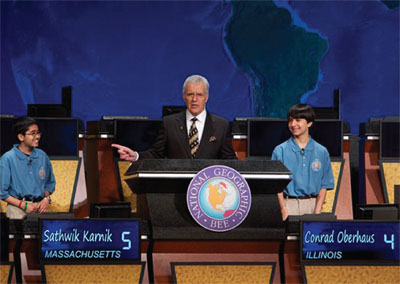
    WASHINGTON (TIP): Passion for geography runs deep in Sathwik Karnik’s family. When he was about 6, his mother began challenging Sathwik and his older brother, Karthik, to her version of hide-and-seek – using an atlas. The boys would comb through the book, trying to be the first to find a city or landmark. The games paid off when Karthik, 15, made the finals of the National Geographic Bee in 2011 and 2012.

    But it was 12-year-old Sathwik, of Plainville, Mass., who finished the job, calmly answering questions about obscure island chains, bodies of water, global trade and culture to win the 25th annual geography bee may 22. The clinching question? “Because Earth bulges at the equator, the point that is farthest from Earth’s center is the summit of a peak in Ecuador. Name this peak.” Sathwik nailed it: Chimborazo.

    Runner-up Conrad Oberhaus, 13, of Lincolnshire, Ill., knew the answer, but Sathwik got all five questions correct in their one-on-one duel. Earlier, Conrad couldn’t name Baotou as the largest city in China’s Inner Mongolian Autonomous Region, home to one of the world’s largest deposits of rare-earth elements. While Conrad didn’t stumble again, Sathwik never relinquished the lead.

    Sathwik and his brother said the victory was a team effort. Ten participants made the finals, culled from a field of 54 state-level winners in Monday’s preliminary round. Sathwik won a $25,000 scholarship, a trip to the Galapagos Islands and a lifetime membership in the National Geographic Society. The finals will be televised Thursday night on the National Geographic Channel and Nat Geo WILD. Conrad, the runner-up, won a $15,000 scholarship. Also represented in the finals were California, Michigan, Colorado, New Hampshire, Oregon and Wisconsin.

  • Tri-service commands for space, cyber warfare

    Tri-service commands for space, cyber warfare

    NEW DELHI (TIP): The armed forces are now finalizing the plan for creation of three new tri-Service commands to handle space, cyber and special forces, which will be “critical” in deploying capabilities for conventional as well asymmetric warfare in a unified manner. Contours of the Cyber, Aerospace and Special Operations Commands (SOC), after “a lot of spadework” over the past several months, are now being fine-tuned to ensure the “formal joint plan” can be presented to the government by end-July, say sources. “The Aerospace Command, for instance, can be based at Hyderabad because of the presence of ISRO, DRDO there.

    Similarly, the SOC can come up at Delhi since the C-130J `Super Hercules’ aircraft, which are customized for special operations, are based at Hindon airbase,” said a source. The chiefs of staff committee — headed by Air Chief Marshal N A K Browne and including General Bikram Singh and Admiral D K Joshi — as well as other forums of the top military brass have been mulling over the plan since last year, as was first reported by TOI. Though the “urgent need” for Army, Navy and IAF to “synergise” their efforts in tackling challenges in the domains of space, cyber and special forces is well-acknowledged, especially with China furiously developing counter-space and cyber weapons, there has been no final decision on who will “mother” which command.

    The experience of India’s only theatre command at Andaman and Nicobar islands (ANC), with its commander-in-chief (a three-star officer like Lt-General, Vice-Admiral or Air Marshal) being rotated among the three Services, has not been successful. “Turf wars ensure the Services are not very keen to part with their assets for ANC,” said the source. At present, each Service gets to head the three unified commands — ANC, Strategic Forces Command (SFC) and Integrated Defence Staff (IDS) — by rotation.

    “But it is felt one particular service should have stake in a specific command that can draw assets and manpower from all three but is steered by that Service,” he said. So, a view that has emerged is that while SFC, IDS and Cyber Command can continue to be “rotated”, ANC should be headed by Navy, Aerospace Command by IAF, and SOC by Army. “This fits in with the domain expertise of each Service. The government will of course have to take the final call on the new commands,” he said. India has floundered for long in setting up effective and unified structures to deal with threats in space and cyberspace as well as in strengthening its clandestine and “unconventional” warfare capabilities.

    The Aerospace Command, for instance, has been demanded by the armed forces in the past also but the government has kept it in cold storage despite China having an expansive military space programme that extends to advanced ASAT (antisatellite) capabilities with “directascent” missiles, hit-to-kill “kinetic” and directed-energy laser weapons. Cyber-warfare, too, is a frontline military priority for China. Cyberweapons can cripple an adversary’s strategic networks and energy grids, banking and communication, and even sabotage a country’s nuclear programme like Iran learnt after the Stuxnet software “worm” destroyed a thousand of its centrifuges a couple of years ago.

  • Sharif for warmer ties with India

    Sharif for warmer ties with India

    Says tackling terror and economic revival top priorities for the PML-N govt
    ISLAMABAD (TIP): Nawaz Sharif, poised for a record third term as Pakistan Prime Minister after his party’s emphatic victory in the landmark General Election, has sought “warmer ties” with India and said his government would devise a national policy to tackle the problem of terrorism. “We will contact every party for the purpose of forming our policy on terrorism,” Sharif said during an interaction with a group of foreign journalists at his farmhouse on the outskirts of Lahore on Monday. Referring to the attack on PML-N leader Sanaullah Zehri in Balochistan, Sharif said it would be wrong to say that terrorism had not affected PML-N. He said the PML-N government would respect the mandate given to parties by the people from the areas where they have won. Claiming that Pakistan will become the Asian tiger under his leadership, Sharif said economic revival was a top priority for the PML-N government.

    Sharif was greeted by world leaders, including the Saudi royal family and the British premier. Sharif expressed resolve to have cordial ties with all neighbors, including Iran, Afghanistan, China and India. Sharif called upon Pakistan Tehreek-e- Insaf to respect the mandate of the people and accept the results of the elections. Sharif said he would be “very happy” to invite Prime Minister Manmohan Singh to Pakistan for his oath-taking ceremony as the new Premier. “We will be very happy to invite him. I got a call from him (Singh) yesterday. We had a long chat on the phone and then he extended an invitation to me and I extended an invitation to him,” said Sharif. He said it would be an honour if Manmohan Singh was present at the swearing-in. He further said he hoped to meet the Indian Prime Minister as soon as possible as he was keen on forging good relations between the two countries.

    The PML-N chief had earlier said he is keen on resuming the India-Pakistan peace process that was interrupted in 1999 by then Army chief Pervez Musharraf, who ousted Sharif’s government in a military coup. Prime Minister Singh had yesterday lost no time in congratulating Sharif on his election victory. Responding to questions on the drone strikes, Sharif said he would discuss the issue with the US leadership. Meanwhile, President Asif Ali Zardari on Monday telephoned Pakistan Muslim League-Nawaz (PML-N) leader Nawaz Sharif and congratulated him on winning the historic polls, according to dawn.com. Zardari expressed hope that Sharif would be able to strengthen the democratic process during his political tenure.

  • Indian-American Scientists Help Pharma Companies Stay Ahead In Export Race

    Indian-American Scientists Help Pharma Companies Stay Ahead In Export Race

    WASHINGTON (TIP): With the U.S. Food and Drug Administration (FDA) adhering to tougher import norms, a group of U.S.-based Indian-American scientists is now helping Indian pharmaceutical companies sharpen their knowledge and maintain competitiveness. These scientists include Dr. Vinod Shah, a veteran of three decades at the U.S. FDA; Dr. Umesh Banakar, President, Banakar Consulting Services; Dr Kailas Thakker, Co-founder and President, Tergus Pharma, and Dr. Vatsala Naageshwaran, Associate Director, Scientific Operations, Absorption Systems.

    This group, along with other top scientists, was here last week to share their knowledge on the latest in dissolution science with over 200 Indian pharma scientists. Dissolution science is about establishing whether a medicine gets dissolved in the body and works after being taken by a patient. Dissolution testing is a crucial part in meeting the stringent guidelines on export of generic and branded drugs to the U.S. and Europe.

    “Indian pharma companies are well advanced (in dissolution science), but we (India) need to be careful. We are leading in product development but China is coming right behind us. It may overtake India. Until now we had the language advantage but that is no more, ” said Dr. Shah, who has become a pharmaceutical consultant after retirement. “We need to be cautious. Some Indian companies are known for cutting corners, after the product gets approved, to make it cheaper.

    That is a problem and the product gets recalled. Through such lectures I am educating Indian companies,” Dr. Shah said. In 1976 only six tablets were mandated by the FDA to pass the dissolution test, but today all pharma products including tablets, capsules, stents, cream and patches need to qualify. “Dissolution testing along with permeability and solubility testing provides a way to obtain biowaivers for generic drugs and bypass expensive and time consuming human bio studies.

    “Absorption Systems is the world leader in biopharmaceuticals classification system (BCS) and our focus is to work with companies in India and other emerging markets to apply the BCS and BCSbased biowaivers to avoid clinical bioequivalence testing through a more ethical and definitive in vitro test system whenever possible,” said Dr. Vatsala Naageshwaran. She said that while there is tremendous institutional knowledge and expertise available in India , an improved awareness and understanding of the in vitro approach can help to bring better quality low cost generic medicines.

    Seventy per cent of medicine produced globally undergoes the dissolution test before being released. Eighty per cent of pharma exports to the U.S. are classified as generic drugs. “Dissolution methods and its applications are kept so confidential by companies that they are not easily available for others. We at the Society for Pharmaceutical Dissolution Science (SPDS) are channelising our efforts towards updating pharma scientists and analytical chemists to improve the quality of pharma products.

    Currently, every fourth tablet consumed in the U.S. and Europe is from India, our target is make it third in some time,” said Dr. Lakshmanan Ramaswami, Managing Director, Sotax India, and General Secretary, SPDS. In the past, some Indian companies were banned by U.S. FDA for exporting drugs which had failed dissolution tests. In 2008, the FDA had banned 30 generic drugs produced by Ranbaxy for gross violation of approved manufacturing norms.

  • Should The Mandarin Speaking National Security Advisor Resign?

    Should The Mandarin Speaking National Security Advisor Resign?

    “We are facing again a situation analogous to both 1999 Kargil fiasco as well as 1962 Chinese war against India in regards to the recent Chinese intrusion in the Daulat Beg Oldi sector in the Ladakh district of J&K. There were ample warnings about multiple Chinese intrusions into Indian territory across the Line of Actual Control during the last few years. All branches of the PLA (army, air-force and navy) have repeatedly intruded into Indian territory during the last few years. In fact the former Chief of Army retired General VK Singh had amply warned the Government of India about lack of military preparedness on our northern border against a very hostile adversary. Our security establishment as well as the government of the day minimized these brazen incidents’, rues the author who is an expert on security strategy.
    There was a Pakistani intrusion into Indian territory in 1999 in Kargil in J&K. It was considered as an intelligence failure of Himalayan proportions. Post- Kargil, an expert committee was appointed by the then Prime Minister Atal Behari Vajpayee under the chairmanship of Late Shri K. Subramanian, former Defense Secretary and a respected strategy and security expert that made a number of recommendations. One of the suggestions was to establish the office of the National Security Advisor who would render overall advice to the Government of India (read PMO) on security matters so as to avoid the kind of intelligence failure we saw during the Kargil fiasco.

    India’s current National Security Advisor, Shiv Shankar Menon is a Mandarin speaking former foreign secretary who has held the office of NSA since 17th January 2010. He has been a former Indian Ambassador to China who has generally a good image as a diplomat having succeeded in getting NSG approval for the US-India Civil Nuclear Energy Deal. He comes from a family of accomplished diplomats; his father Parappil Narayana Menon served as the ambassador to Yugoslavia in his last days.

    His grandfather K. P. S. Menon (senior) was India’s first Foreign Secretary, while his uncle K. P. S. Menon (junior) was the former Indian ambassador to China. From these impeccable credentials it appears that diplomacy runs in his genes. It also seems that being the foreign secretary to the Government of India as well as being the ambassador to China runs in his genes from the paternal side of his family. He has generally taken a very conciliatory stance towards China in his public pronouncements.

    We are facing again a situation analogous to both 1999 Kargil fiasco as well as 1962 Chinese war against India in regards to the recent Chinese intrusion in the Daulat Beg Oldi sector in the Ladakh district of J&K. There were ample warnings about multiple Chinese intrusions into Indian territory across the Line of Actual Control during the last few years. All branches of the PLA (army, air-force and navy) have repeatedly intruded into Indian territory during the last few years. In fact the former Chief of Army retired General VK Singh had amply warned the Government of India about lack of military preparedness on our northern border against a very hostile adversary.

    Our security establishment as well as the government of the day minimized these brazen incidents. False and dastardly malicious rumors were spread about the possibility of an army coup being staged by the retired General VK Singh. Certainly, it appears that the current NSA has failed miserably in properly advising the Government of India about the magnitude of the threat perception from China though he has been in office for more than three years. There has been a serious failure of overall threat assessment as well as of threat perception from China by the office of NSA.

    It would be honorable for the NSA Shiv Shankar Menon to submit his resignation and own up the moral responsibility for the dismal failure of his office. One wonders whether he was reading the Chinese (Mandarin) press at all during the last three years? This brings us to two more pertinent issues regarding management of India’s security establishment. First has to do with the credentials for appointment to the post of National Security Advisor.

    Why it is that only retired IFS officers are deemed worthy and capable enough of leading the office of the NSA? Why does not the Government of the day rely on security and strategic expertise outside the “clubby” community of retired civil servants. Why can we not have a retired defense officer appointed as the National Security Advisor? Second relevant issue is about the non-implementation of the K Subramanian Committee’s recommendation about the appointment of a Chief of Defense Staff (CDS). When will the Government of India consider appointing a CDS? Perhaps after the PLA reaches New Delhi? George Santayana once famously said: “Those who fail to learn from the lessons of history are condemned to repeat it!”

  • US University To Create World Class Pathology Lab In Hyderabad

    US University To Create World Class Pathology Lab In Hyderabad

    WASHINGTON (TIP): An eminent American university has signed an agreement to create a world class clinical pathology laboratory in the south Indian city of Hyderabad, as part of its effort to raise the health care standards in the country to the highest levels. The University of Pittsburgh Medical Center, in a statement yesterday, said it is collaborating with the Citizens Hospital to establish a clinical pathology laboratory on the 10.5-acre campus in Hyderabad, to serve the population of more than seven million people in the metropolis.

    Operating under the name AmPath, the lab initially is serving the Citizens Healthcare Campus, which has opened its first phase in August, including a dedicated oncology facility. When fully operational in 2015, the hospital will include more than 650 patient rooms and offer the entire spectrum of health care services, the university said. UPMC will help the lab expand its capabilities, including the addition of increasingly complex molecular diagnostic testing modalities.

    The facility is expected to become a reference lab serving patients throughout all of India, as well as the Middle East and Southeast Asia, the statement said. “Advisory Services provides our clinical partners with access to a wide-ranging portfolio of UPMC’s expertise, based on its position as one of the nation’s most acclaimed and technologically sophisticated health care networks,” said David Russell, who is leading the new group.

    UPMC’s international footprint already includes operations or services in Italy, Ireland, China, Singapore and Japan.

  • More Than 6,500 Indians Languish In Foreign Jails

    More Than 6,500 Indians Languish In Foreign Jails

    CHENNAI (TIP): More than 6,500 Indians are living an uncertain life in prisons in 80 foreign countries, half of them in three Gulf countries. The Gulf countries have the largest number of Indian prisoners, with 1,691 in Kuwait, 1,161 in Saudi Arabia and 1,012 in the UAE. Among the neighbours, Pakistan holds 253 Indians in its prisons, China has 157 of them and Sri Lanka 63. Languishing in the Nepal prisons are 377 Indians. Italy, a country that recently raised a huge uproar demanding special guest house and home-made food for its two citizens arrested on charges of killing two Indian fishermen off the Kerala coast, has 121 Indian citizens in its prisons. The United Kingdom has 426 Indian inmates in their jails, thanks to a fast growing migration of skilled and unskilled labourers.

    There are 155 Indians in the US prisons. The statistics, obtained through RTI by Kochi-based NGO Human Rights Defense Forum, shows 6,569 Indians are in foreign prisons. On Indian prisoners in 30 countries, the ministry of external affairs said it had ‘nil report.’ The RTI reply also says “this figure keeps changing,” and gives no details about the prisoners or the charges against them. In 2007, it was reported that the number of Indian prisoners abroad had come down from 6,730 in 2005 to around 6,000. The RTI reply given by the ministry last month shows the number has gone up again. T P Sreenivasan, former ambassador of India to the United Nations, said ordinary crimes, drug trafficking and domestic violence land Indians in jails in European countries.

    “But a large number of prisoners in the Gulf countries are arrested for badly formulated contracts, illegal stay and migration,” he said. In Malaysia (187 Indian prisoners) and Singapore (156), most of the Indians have been arrested for immigration violations and a few for criminal cases like drug trafficking. In Pakistan, Bangladesh and Sri Lanka, most of the arrests are made on charges of violation of immigration laws. Sreenivasan said different factors, including delay in ensuring justice, communication between the local government and the Indian offices abroad play a major role in the number and duration of detentions.

  • Town Of North Hempstead Hosts Fourth Annual Asian American Festival

    Town Of North Hempstead Hosts Fourth Annual Asian American Festival

    PORT WASHINGTON, NY (TIP): “Supervisor Jon Kaiman and the North Hempstead Town Board are proud to host the fourth annual Asian American Festival, a celebration of the growing ethnic diversity within the Town of North Hempstead. The festivities will include cultural performances, folk art, and food unique to China, India, Japan, Korea and Pakistan”, a press release says.The beach-front festival will be held on Saturday, May 18 at North Hempstead Beach Park, located on West Shore Road in Port Washington.

    The event will run from noon to 6:00 P. M. “It is important to recognize the growing diversity within our Town,” said Supervisor Kaiman. “The Asian American Festival is a great way of learning about all the different cultures that make North Hempstead one of the best places to live.” Featured performances and activities include K-pop, Bollywood and Chinese puppeteers. The festival will also showcase a traditional Japanese farmer’s market, Korean BBQ, as well as delicious cultural delights from across the Asian-Pacific countries. The event sponsor is WAC Lighting, with media sponsors being the Pakistan Voice and the Chinese World Journal. Other co-sponsors are Kiss, and Shanghai Commercial Bank. For more information on this event, please call 311 or (516) 869-6311 from outside the Town.

  • China Emerging As New Force In Drone Warfare

    China Emerging As New Force In Drone Warfare

    BEIJING (TIP): Determined to kill or capture a murderous Mekong River drug lord, China’s security forces considered a tactic they’d never tried before: calling a drone strike on his remote hideaway deep in the hills of Myanmar. The attack didn’t happen — the man was later captured and brought to China for trial — but the fact that authorities were considering such an option cast new light on China’s unmanned aerial vehicle program, which has been quietly percolating for years and now appears to be moving into overdrive. Chinese aerospace firms have developed dozens of drones, known also as unmanned aerial vehicles, or UAVs. Many have appeared at air shows and military parades, including some that bear an uncanny resemblance to the Predator, Global Hawk and Reaper models used with deadly effect by the US Air Force and CIA.

    Analysts say that although China still trails the US and Israel, the industry leaders, its technology is maturing rapidly and on the cusp of widespread use for surveillance and combat strikes. “My sense is that China is moving into large-scale deployments of UAVs,” said Ian Easton, co-author of a recent report on Chinese drones for the Project 2049 Institute security think tank. China’s move into large-scale drone deployment displays its military’s growing sophistication and could challenge US military dominance in the Asia-Pacific. It also could elevate the threat to neighbors with territorial disputes with Beijing, including Vietnam, Japan, India and the Philippines. China says its drones are capable of carrying bombs and missiles as well as conducting reconnaissance, potentially turning them into offensive weapons in a border conflict. China’s increased use of drones also adds to concerns about the lack of internationally recognized standards for drone attacks.

    The United States has widely employed drones as a means of eliminating terror suspects in Pakistan and the Arabian Peninsula. “China is following the precedent set by the US The thinking is that, ‘If the US can do it, so can we. They’re a big country with security interests and so are we’,” said Siemon Wezeman, a senior fellow at the arms transfers program at the Stockholm International Peace Research Institute in Sweden, or SIPRI. “The justification for an attack would be that Beijing too has a responsibility for the safety of its citizens. There needs to be agreement on what the limits are,” he said. Though China claims its military posture is entirely defensive, its navy and civilian maritime services have engaged in repeated standoffs with ships from other nations in the South China and East China seas. India, meanwhile, says Chinese troops have set up camp almost 20 kilometers (12 miles) into Indian-claimed territory.

    It isn’t yet known exactly what China’s latest drones are capable of, because, like most Chinese equipment, they remain untested in battle. The military and associated aerospace firms have offered little information, although in an interview last month with the official Xinhua News Agency, Yang Baikui, chief designer at plane maker COSIC, said Chinese drones were closing the gap but still needed to progress in half a dozen major areas, from airframe design to digital linkups. Executives at COSIC and drone makers ASN, Avic, and the 611 Institute declined to be interviewed by The Associated Press, citing their military links. The Defense Ministry’s latest report on the status of the military released in mid-April made no mention of drones, and spokesman Yang Yujun made only the barest acknowledgement of their existence in response to a question.

  • Chinese Incursion 19km, But 750 Sq Km At Stake For India

    Chinese Incursion 19km, But 750 Sq Km At Stake For India

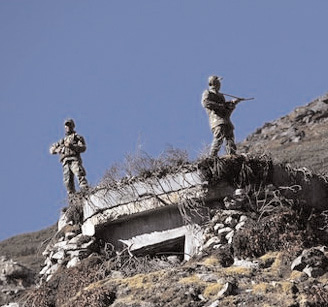
    NEW DELHI (TIP): The “acne” — as foreign minister Salman khurshid described it — could well turn into a deep scar on India’s face, with the Chinese reinforcing their position across the Line of Actual Control and raising the real prospect of India losing access to 750 sq km in strategically crucial northern Ladakh. While China rebuffed India’s plea to withdraw its troops, squatting 19km inside Indian territory at Raki Nala in the Depsang Bulge area, fresh imagery from Indian spy drones has shown that the People’s Liberation Army has already started using trucks to replenish supplies for over 30 soldiers stationed there.

    The pictures, which also show that PLA is trying to convert the track there into a proper road, are transforming what the government had called a “localized problem” into a first-rate diplomatic crisis. The recognition has led to India starting to toughen its response, with Army chief General Bikram Singh on Wednesday briefing the Cabinet Committee on Security (CCS) on the “counter-measures” possible. While a military showdown is not imminent, India may escalate its protest from demarches into a reappraisal of bilateral ties just ahead of the visit of Chinese Premier Li Keqiang on May 20.

    The audacious intrusion into the Depsang Bulge, a table-top plateau, threatens to cut off India’s access to some 750 sq km area in northern Ladakh: an area roughly half the size of Delhi. The face-off site is just about 35km south of the strategic Karakoram Pass, which is at the tri-junction of China- Pakistan-India borders, and overlooks the Siachen Glacier- Saltoro Ridge to the west and the Indian observation post in the Chumar sector to the east.

    Indian Army and ITBP patrols to Daulat Beg Oldi (DBO) and the Karakoram Pass have to trek across the Saser and Depsang passes – both in excess of 16,000 feet — on foot from Sasoma, which is over 80km north of Leh. So, loss of control over the Depsang Bulge would cut off access to the areas north of the passes.Officers who have done stints there say the Depsang Bulge is the only staging area in the region from where Indian forces can group men and machines to launch any action.

    This is because the bulge is the only wide open land in the region which is full of high jagged ridges of the Karakoram range in the north and Ladakh range in the south. Government sources admitted the developments over the past 48 hours, with the third flag meeting also failing to break the deadlock, have radically transformed the nature of the standoff, and the May 9 visit of foreign minister Salman Khurshid – who had initially described the incident as just an “acne” that would not impede the upward trajectory in bilateral ties — to Beijing could be in jeopardy.

    Gen Singh, on his part, gave several options to the CCS, ranging from cutting off supply lines of the Chinese troops at Raki Nala to Indian troops conducting a similar maneuver in some other sector. But the government is sticking to the “no military escalation” policy as of now, even as it works the diplomatic channels. But China is insisting on the demolition of India’s observation post at Chumar as a pre-condition for de-escalation.

    As ties threaten to nosedive, the observation post that can overlook troop movements on the Chinese side has emerged as the main bone of contention. China, which is already miffed with India’s re-activation of advanced landing grounds at Daulat Beg Oldi, Fukche and Nyoma and building of other infrastructure along the LAC over the last four-five years, is uncomfortable with Indian being able to peep at the movement on the highway. The Chinese, in fact, have frequently tried to “immobilize” the surveillance cameras positioned at the Chumar post by cutting wires.

    Last year, Indian troops had intercepted two Chinese personnel on mules across the Chumar post. Though they were subsequently let off, with language being a barrier, China got hugely irritated about the incident. Holding that the two Chinese were from its revenue department, Beijing since then has been pressing hard for the Chumar post to be dismantled.

  • Border row may cast shadow on Premier Li’s India visit: Experts

    Border row may cast shadow on Premier Li’s India visit: Experts

    BEIJING (TIP): While there is no official announcement, officials say Li has has expressed wish to make New Delhi first halt of his maiden foreign tour and it is expected to take place in May. The Sino-Indian border row over Chinese incursion in Ladakh may cast a shadow on the proposed visit of new Chinese Premier Li Keqiang to India, specially his desire to make New Delhi the first stop to send a message of Beijing’s desire to improve relations, analysts here said.Choosing India as the first stop of the premier’s visit shows China’s will to improve bilateral ties, but the current standoff may cast a shadow on the tour, said Han Hua, Director of the Center for Arms Control and Disarmament at the School of International Studies under Peking University.

    While there is no official announcement, officials say Li has has expressed wish to make New Delhi first halt of his maiden foreign tour and it is expected to take place in May. Ahead of that, External Affairs Minister Salman Khurshid would visit Beijing on May 9. “Reports about Chinese troops’ crossborder patrols are not rare in Indian media. However, the latest hyping came at an inappropriate time before the premier’s visit, and it was also inappropriate to summon the ambassador,” Han told staterun Global Times. He spoke about speculation that India may hope to “fish in troubled waters” as China is caught in an island dispute with Japan.

    Zhang Yongpan, a scholar with the Research Center for Chinese Borderland History and Geography at the Chinese Academy of Social Sciences, said the standoff took place in the western section of the border between China and India. Indian army said the Chinese incursion took place at Depsang Valley in Ladakh. “The disputed region in Aksai Chin occupies an area of about 20,000 square kilometers,” he said. According to Zhang, compared with the eastern section of the disputed border, Aksai Chin, which is at high altitude and scarcely populated, is less disputed, because it doesn’t have many natural resources.

    The border dispute is an issue left over from the history of Western colonialism, and both China and India are victims, Dong Manyuan, a researcher at the China Institute of International Studies, told state-run China Daily. As both countries face the task of developing their own economies and keeping their rapid growth, border issues should not get in the way, he said. “But we cannot expect the disputes to be solved overnight. We need to have patience on that,” Dong said. Narrowing differences through peaceful negotiations is the right method, and China’s previous experience with solving border disputes with other countries has proved that, he said. China has denied the incursion saying that its troops have not crossed the Line of Actual Control (LAC).

  • Army, MEA bid can resolve LAC stand-off

    Army, MEA bid can resolve LAC stand-off

    NEW DELH (TIP)I: A third flag meeting to resolve the stand-off created by the April 15th Chinese incursion in Ladakh may be held on Friday, according to sources in the security establishment.

    The third meeting is likely to be held either at the same level of seniority as the earlier two flag meetings, or possibly at a lower level, sources said. At the first two flag meetings on April 18 and 23, the Indian side was represented by a brigadier, and China by a senior colonel.

    Even as the Chinese local commander’s willingness to stay engaged through a possible third flag meeting is welcomed by the Indian border forces, officials in the security establishment don’t sound too hopeful of an immediate resolution of the issue. “The situation may need an intervention at a higher level in the Army or the government to resolve,” a senior intelligence official said, adding that the PLA troops may agree to go back only closer to Chinese Premier Li Keqiang’s visit to India, beginning May 20. The border row will also be taken up by external affairs minister Salman Khurshid during his visit to China, starting May 9. Sources in the security establishment said that China has sought a more concrete arrangement for resolution of border issues on the ground.

    This is being interpreted as a call for a more structured mechanism for flag meetings and procedures for retreat each time an incursion is flagged. With the Chinese troops refusing to budge from the tented post they have set up at Raki Nala, 18km inside of what India perceives as its side of the Line of Actual Control (LAC), a series of flag meetings have been held to persuade them to retreat and restore the status quo.

    However, the Chinese have used these meetings to flag the “heightened Indian activity close to the border in the recent months, including movement of troops, erection of new border outposts and strengthening of infrastructure such as roads and landing grounds”. A platoon of PLA troops transgressed deep into what India claims as its territory on April 15, and refused to retreat despite the Indian border forces flagging the incursion by raising banners as per laid down procedures.

    The Chinese troops have since erected a tented post and are staying there since April 15. Indian border forces, too, have stationed a matching contingent just opposite the Chinese post.

  • Khurshid to visit China on May 9

    Khurshid to visit China on May 9

    NEW DELHI (TIP): A cautious government on April 25 announced that foreign minister Salman Khurshid will indeed be travelling to Beijing on May 9, as India prepares to receive Chinese Premier Li Keqiang on May 20. The visit will happen despite the ongoing stand-off in the Daulet Beg Oldie (DBO) sector in Ladakh where Chinese and Indian soldiers are locked in a face-off with little hope of resolving the issue through local commanders. Government sources said that even if the present impasse continues, it will have no impact on Khurshid’s visit.

    Ever since the incident was first reported, the government has attributed it to differing perceptions of the Line of Actual Control (LAC). Both sides have been in touch on this through the working mechanism for consultation and coordination on India- China border affairs which is headed by joint secretary (East Asia) in the MEA, Gautam Bambawale, and the director general border affairs of the Chinese foreign ministry. Confirming his visit on May 9, Khurshid said on Thursday that the working mechanism was enough to handle the issue. “Let us allow that mechanism to find its solution and repeatedly it has found.

  • The End of Road for Musharraf

    The End of Road for Musharraf

    Whichever way the Hitchcockian drama in Islamabad plays out there is at least one certainty in the grand confusion: that Pervez Musharraf, arguably the most delusional of the four military dictators that have ruled Pakistan for nearly half its existence, has reached the end of the road. His pipedream of landing in his country after five years of exile, like a triumphant Caesar – in the hope of being welcomed by people still nostalgic about what he had done for them in the past and anxious to give him another chance to lead them – has turned out to be a nightmare.

    He can now rue over his folly during his house arrest in his sprawling farmhouse at the edge of the Pakistani capital. As a matter of fact, Islamabad-based foreign correspondents who had gone to Karachi to cover Musharraf’s “momentous arrival” have reported that it should have been clear from that moment that the former president had no future. His candidature in the four constituencies has already been rejected and most of the political leaders he expected to be with him have already joined other mainstream parties.

    He has no role in the ongoing elections or any influence on their outcome. Incidentally, the most delightful and appropriate comment on his present plight has come from Xinhua, the official news agency of China, Pakistan’s “all-weather” friend where at one time Musharraf used to be welcome. There was, says Xinhua, “poetic justice” in Pakistan when the Islamabad Supreme Court issued an arrest warrant against the former president – something he had done “against dozens of judges when he arrested them in 2007”. On the fate that awaits him, opinions differ widely.

    Some hope, rather than think, that the judiciary that he humiliated so disgracefully in 2007 would not be content without hanging him, especially because the three main charges against him are heinous and include the assassination of Benazir Bhutto and the murder in cold blood of the eminent Baloch leader, Sardar Mohammed Akbar Bugti. Some others believe that if the law and the judicial process don’t get Musharraf, the lawless Taliban would. In my view, this possibility should also be ruled out in view of the enormous commando security the Pakistan Army has provided this former commando general. As of now, the most plausible scenario seems to be that Musharraf’s judicial custody up to May 4 will be extended beyond the date of elections that is May 11. Thereafter his trial can begin, if the judiciary and the new government insist on it. But then it can go on and on for years, if only because in this and many other basic practices the underlying unity of the subcontinent endures. However, overall it is a safe bet that Pakistan’s power structure cannot afford to hurt the sentiments of the all-powerful Army by executing or even imprisoning a former army chief.

    According to available information, General Ashfaque Pervez Kayani, though a one-time protégé of Musharraf, did not want him to come home, leave alone take part in the elections. It is said that messages to this effect were sent to him several times. However, when the megalomaniac former military ruler having hallucinations about his popularity with the Pakistani masses did arrive, the Army considered it its bounden duty to see to it that no harm came to his person and that his, and more importantly, the Army’s izzat (an expression dear to both the Indian and Pakistani armies) was not besmirched in any way. This situation will prevail regardless of the dispensation resulting from the May 11 poll. It would be no surprise if some kind of an understanding already exists among the major stakeholders in Pakistan on this subject.

    Come to think of it, even under a caretaker government, whose only duty is to hold free and fair elections, all concerned have treated Musharraf with kid gloves. Remarkably, Xinhua has taken note of “the speculations” that despite the apex court’s clear order to arrest him, “some bigwigs” in the government told the police to “go slow on Musharraf”.

    It would, indeed, be instructive to look back on the events in 1999 when, after his successful coup, Musharraf wanted to “fix well and proper” his bete noir and then Prime Minister, Nawaz Sharif. But then Saudi Arabia intervened and the military dictator agreed to let Sharif go in exile to Saudi Arabia for 10 years. Today, the Saudi stakes in the stability of Pakistan are even higher than before.

    There are two other points that call for comment. The first is the rather intriguing fact that the United States is refusing to comment on Musharraf”s house arrest one way or the other. Does this lend any credence to his calculation while planning his strategy to take part in elections that, given the configuration of forces in the post-poll Pakistan, the Americans would prefer a government led by him?

    After all it was he who, on the morrow of 9/11, had reversed Pakistan’s policy on Afghanistan and lined up his country with the US in the “war on terror”. Moreover, as revealed only recently, in 2003Musharraf unhesitatingly allowed the Americans to use drones to kill as they wished in North Waziristan as long as they left the Lashkar-e-Toiba (LeT), Jaish-e- Mohammmed and other Pakistani terrorist outfits operating against India well alone?

    Today, the US desperately needs Pakistani cooperation for its plan to withdraw its combat troops from Afghanistan by the end of 2014.

    Secondly, the speculation in some quarters in both India and Pakistan that should the civilian government resist the Army’s demand to let Musharraf go, Kayani and the Army would stage a coup should be dismissed.

    Firstly, over the years Gen Kayani has demonstrated repeatedly that he sees no point in directly taking over when the Army can get its way anyhow. Furthermore, gone are the days of the Cold War when the US had a vested interest in embracing and coddling military dictators in Pakistan. Samuel P. Huntington had then written a book to press home the point that in newly independent countries the armed forces were the best instrument for stability.

    Those days are gone. Today, America is the super-salesman of democracy across the world. It can ill-afford a military takeover in Pakistan, never mind the adverse reaction of the world community in general.

  • Prachanda meets Xi, seeks more Chinese aid for Nepal

    Prachanda meets Xi, seeks more Chinese aid for Nepal

    BEIJING (TIP): Nepal’s Maoist leader PushpaKamalDahal alias Prachanda sought more financial and technical aid from China during his first meeting with the country’s new President Xi Jinping. Hailing the “traditional friendship” between the two countries, Prachanda thanked the Chinese side for its selfless assistance to Nepal, state-run Xinhua news agency reported. Known for his pro-China stance in Nepal, Prachanda who heads the Unified Communist Party of Nepal (Maoist) is visiting Beijing for the first time after Xi took over as the leader of the ruling Communist Party of China (CPC) and President. To take the Nepal-China friendship to a higher level, he looks forward to more financial and technical support from Beijing as well as more practical cooperation between the two sides on infrastructure, water conservancy projects and tourism, he said.

    China has scaled up its relations with its Himalayan neighbour in the recent years pumping in a lot of aid and resources. Nepal on its part is cracking down on the Tibetan refugees to prevent the spread of anti-China sentiments. Prachanda said Nepal will continue to firmly adhere to the one-China policy and he believes that the “Chinese dream” of national rejuvenation will be realised under the leadership of the Communist Party with Xi as the general secretary. Xi pledged to boost cooperation saying China attaches great importance to bilateral ties with Nepal. The China-Nepal friendship is not only in the fundamental interests of the two countries and peoples, but also conducive to stability and development in the region, he said. In pursuit of common development, Xi said China will continue to seek peaceful development and win-win cooperation with Nepal and other neighbouring countries. After his returns from Beijing, Prachanda is also likely to visit India.

  • Looking East, Looking West: U.S. Support for India’s Regional Leadership

    Looking East, Looking West: U.S. Support for India’s Regional Leadership

    Today, I’d like to talk about India’s growing influence, felt in the East through its “Look East” policy and in the west, particularly as we move toward the transition in Afghanistan. I’ll highlight how India’s engagement in these areas is crucial to U.S. foreign policy objectives and our pursuit of a stable, secure and prosperous region. India’s leadership has powerful implications that extend beyond its immediate neighborhood – as a beacon of democracy, stability, and growth. India has much to offer all of us, including communities right here in Cambridge. Harvard University’s increased engagement with India, through events like this, through its South Asia Institute, its research center in Mumbai, President Faust’s 2012 visit to India, through over 1,500 Harvard alumni in India, as well as a myriad of research projects, academic collaborations and student and faculty exchanges, testify to India’s growing prominence and our recognition of its increasing importance in the global arena. Massachusetts, likewise, has become a pioneer in forging closer relations with this key partner.

    The State Department strongly champions and supports state-to-state and cityto- city engagement,which is now a vital part of advancing our economic and people-to-people relationships. This year alone, at least eight American Governors are leading trade and other missions to India, not only to develop new markets but to attract job-boosting investments. Massachusetts was an early pioneer: back in 1995,when then-Governor Weld announced plans to forge an alliance with Karnataka, such engagement was a novel concept and a new approach. Governor Weld had the foresight to know that those who didn’t pursue ties with India would miss out on the many rewards this relationship has to offer. His delegation, consisting of 22 U.S. companies, paved the way for numerous U.S. firms to open in and around Bangalore. Today, Massachusetts is one of India’s top 25 trading partners in the world, and last year India received nearly $300 million of this state’s exports. But I hardly need to tell this audience how critical the U.S.-India relationship is.

    Those of you involved in collaborations with India, particularly in academia and research, are fully aware of the benefits. But our bilateral partnership benefits not only our two nations; it is of vital importance to a global vision for a future of shared prosperity. During his visit to India in 2010, President Barack Obama recognized the promise of our shared future and hailed the U.S.-India relationship as “one of the defining partnerships of the 21st century.” We and our Indian friends have taken significant steps to realize that vision. We established a Strategic Dialogue chaired by the Secretary of State and External Affairs Minister to give strategic direction to the wide range of bilateral dialogues between our two governments. We have expanded counterterrorism cooperation, intelligence sharing, and law enforcement exchanges that have helped make both of our countries safer, but clear-eyed about the threats that persist. Bilateral trade has grown by 50% from $66 billion to $93 billion in the last four years and is set to cross $100 billion this year.

    Indian foreign direct investment in the United States increased from $227 million a decade ago to almost $4.9 billion in 2011 – investments that have created and support thousands of U.S. jobs. Another growing component of our bilateral relationship with India is defense trade. Since 2000, sales to India have surpassed $8 billion, representing both an excellent commercial opportunity for U.S. companies but also advancing a vital component of our bilateral security relationship.We will continue to pursue defense trade cooperation with India, including a whole-of-government effort led by Deputy Secretary of Defense Ash Carter to reduce bureaucratic impediments, ease transactions between buyers and sellers, increase cooperative research, and focus on coproduction and co-development opportunities. We have grown our partnership with India on export controls and non-proliferation.We have worked closely with our companies to help them move deeper into India’s nuclear commercial markets, and we hope to announce more tangible commercial progress by the next Strategic Dialogue.

    We have increased our collaboration on clean energy through programs such as the U.S.-India Partnership to Advance Clean Energy (PACE). Since its creation, PACE has mobilized over $1.7 billion in renewable energy financing to India and has driven full-spectrum activity from basic research to development and commercialization in solar technology, advanced biofuels, and building efficiency. India is hosting the Fourth Clean Energy Ministerial (CEM) in New Delhi later this month. The CEM offers a tremendous opportunity for partnership on a range of clean energy technologies, particularly in buildings and appliance efficiency, that are among the world’s most ambitious. And we have witnessed an expansion of our already robust people-to-people ties, particularly in the educational arena,where there is great demand. India has about 600 million people under 25.

    The next generation can only fulfill their roles as economic drivers if equipped with the right training and skills. India aims to increase its higher education enrolment from under 20 percent to 30 percent by the end of the decade. That means it needs 50,000 more colleges and 1 million more faculty. Since the first iteration of the U.S. India Higher Education Dialogue last year,we have focused our efforts on such critical areas as skills training and workforce development by strengthening community college collaboration. We are preparing for another round of Obama Singh 21st Century Knowledge Initiatives awards,which will further partnerships and junior faculty development between U.S. and Indian higher education institutions in priority fields and we have sought to encourage more Americans to study in India and build American expertise about India and by ramping up our Passport to India initiative.

    With its strong democratic institutions, unprecedented demographic growth, economic promise and rising military capabilities, India is poised to play a critical leadership role both regionally and globally.With rising power comes greater global responsibility and in moving beyond its tradition of non-alignment, India has established its credentials as a responsible player in the global arena.We are committed to working together, along with others in the region, toward the evolution of an open, balanced, and inclusive architecture. India has long been an integral member of the Asia-Pacific region, sharing cultural and historical ties that have laid the foundation for its expanded engagement of today.With its “Look East” Policy, initiated in 1991, India began to work more closely with its Asian partners to engage the rest of the world, reflecting the belief that India’s future and economic interests are best served by greater integration with East and Southeast Asia.

    Today, India is forging closer and deeper economic ties with its eastern neighbors by expanding regional markets, and increasing both investments and industrial development from Burma to the Philippines. India is also seeking greater regional security and military cooperation with its neighbors through more intensive engagement with ASEAN and other near neighbors. This week, in fact, India and China held their annual counterterrorism dialogue and focused on pan-Islamic extremism in the backdrop of Afghanistan’s transition. Such interaction evinces Beijing and Delhi’s interest in coordinating to work together for stability in Kabul in 2014 and beyond. Trade, and by extension maritime security, are key components of our bilateral collaboration. The economic dynamism of South, Southeast and East Asia, along with improving relations between India and its neighbors to the East, has spurred the region’s interest in revitalizing and expanding road, air, and sea links between India, Bangladesh, Burma, and the rapidly expanding economies of ASEAN. From 2011 to 2012, trade between India and the countries of Southeast Asia increased by 37%.

    This emerging Indo-Pacific Economic Corridor, as we have come to call it, is a boon for the region and for the United States, providing our own economy with potential new markets. Linkages and infrastructure investments between the rapidly expanding economies of South Asia and those of Southeast Asia are a critical component to integrating regional markets to both accelerate economic development and strengthen regional stability,while helping unlock and expand markets for American goods and services. An India that is well-integrated into the Asia’s economic architecture, that pursues open market policies, and that has diverse and broad-based economic relationships across the East Asia region is not only good for India, but is good for the United States and the Asia- Pacific region as a whole.

    But trade can only prosper when maritime security is assured. Oceans are essential to India’s security and prosperity, as they are to ours. By volume, 90% of the goods India trades are carried by sea. India therefore has a strong interest in guaranteeing unhindered freedom of navigation in international waters, the free flow of commerce, and the peaceful resolution of maritime disputes. But beyond its own economic benefit, India realizes that the economic integration enabled by the improvements of connections across Asia, will lead to prosperity that benefits all nations. India’s growing naval capacity and modernization have enabled its strong presence across the Indian and Pacific Oceans and further bolstered its role as a net security provider in the maritime domain.

    Already in the Western Indian Ocean region, New Delhi is demonstrating its growing maritime capabilities with a robust counter-piracy approach that serves common regional interests and many of their own nationals held hostage in Somalia. As a founding member of the international Contact Group on Piracy off the Coast of Somalia, India has shown great leadership in the efforts to confront and combat piracy stemming from Somalia which threatens trade flows to and from Asia. Our shared vision for economic integration and the promotion of regional stability also extends westward. The United States and India are both strong supporters of a more economically integrated South and Central Asia, with Afghanistan at its heart — what we call the New Silk Road vision.

    At the core of this vision is an Afghanistan at peace and is firmly embedded in the economic life of the region. Such an integrated region will be better able to attract new investment, benefit from its resource potential, and provide increasing economic opportunity and hope for its citizens. Improving connections between South and Central Asia is made all the more urgent as Afghanistan moves through the transition process and puts its economy on a more sustainable private sector-led footing. The countries of the region have embraced a new vision for Afghanistan that places it at the center of a rejuvenated network of commerce, communications and energy transmission, a “land bridge” connecting the Middle East and central Asia to the dynamic markets of China, India and Southeast Asia. Its economic development and ultimate economic integration into the larger network of regional markets is yet another piece of the New Silk Road tapestry. As Afghanistan increasingly takes the lead in its own security, political, and economic situation,we also strongly support the constructive role that India is playing in Afghanistan’s ongoing development.We look to India to play an active part in ensuring that that stability and security endure and that the gains made in Afghanistan over the past 11 years are sustained. Indeed, great challenges lie ahead. But India is committed to our shared vision for a peaceful, stable and secure Afghanistan and has already proven its commitment to assume a greater role in enabling that vision to come to fruition. In 2011, India pledged through the signing of a wide-ranging strategic agreement to train and equip Afghan security forces.

    As the largest regional provider of humanitarian and reconstruction aid to Afghanistan, India has given some $2 billion in aid to the country. Indian public and private companies are building the infrastructure which will carry the nation forward. They have built highways from Kandahar to Kabul and a new parliament building in the capital, put transmission lines between Afghanistan and Uzbekistan and have plans to power Afghan cities through the Salma dam project and to help Afghanistan realize its mineral wealth through development of the Hajigak iron ore mines. On the soft power side, India’s Bureau of Parliamentary Studies and Training invited most senators in Afghanistan’s Upper House, the Meshrano Jirga, for a training session in legislative and budgetary processes in New Delhi, much as the JFK School of Government does for new lawmakers in Washington.

    There’s perhaps no better example of the potentially impact of the New Silk Road vision for Afghanistan and its region than the Turkmenistan-Afghanistan-Pakistan-India pipeline, or TAPI. By connecting abundant energy reserves in Turkmenistan with rapidly rising demand for that energy in South Asia and providing Afghanistan with much-needed transit revenue, TAPI can be transformative for the region. While there’s still much to be done to make this project a reality,we are closer today than anyone would have thought possible just a few years ago, thanks in no small part to Indian leadership. Beyond these infrastructure efforts, India has rallied the international community to encourage further development and to garner the support needed to enable Afghanistan’s successful transition.

    Last year New Delhi hosted a major summit on international investment in Afghanistan’s economy. As Afghanistan shifts the foundation of its economy from aid to trade in the coming years, India’s regional role as a driver of economic prosperity and anchor of democratic stability becomes even more important. Later this month in Almaty, the United States, India, and other countries of the region, will meet to discuss how we can best support a secure and prosperous Afghanistan, integrated into its region. This gathering is part of the Istanbul Process, in which neighbors and nearneighbors support Afghanistan through a range of initiatives that advance security and regional economic cooperation. India has already demonstrated a clear leadership role through its chairing of a working group focused on expanding cross-border commercial and business-to-business relations.

    In conclusion, in Afghanistan as in so many other areas, meeting the challenges of today and seizing the opportunities of tomorrow demand cooperative responses and lasting partnerships.We have found, in India, a strong partner in our shared quest for peace, stability, and prosperity in South Asia, the Asia-Pacific region, and beyond. As India continues to grow economically and extends its engagement outward,we see that our strategic investment in partnership with India is paying dividends that will last for generations.

    An India that is well-integrated into the Asia’s economic architecture, that pursues open market policies, and that has diverse and broad-based economic relationships across the East Asia region is not only good for India, but is good for the United States and the Asia-Pacific region as a whole”, says the author

  • China-Pakistan nuclear axis- India factor behind their game plan

    China-Pakistan nuclear axis- India factor behind their game plan

    Last month Beijing confirmed its plans to sell a new 1,000 megawatt nuclear reactor to Pakistan in a deal signed in February. This pact was secretly concluded between the China National Nuclear Corp (CNNC) and the Pakistan Atomic Energy Commission during the visit of Pakistani nuclear industry officials to Beijing from February 15 to 18. This sale would once again violate China’s commitment to the Nuclear Suppliers Group (NSG) and is in contravention to China’s promise in 2004 while joining the NSG not to sell additional reactors to Pakistan’s Chashma nuclear facility beyond the two reactors that began operation in 2000 and 2011.

    While this issue is likely to come up for discussion at the June meeting of the NSG in Prague, Beijing has already made it clear that nuclear cooperation between China and Pakistan “does not violate relevant principles of the Nuclear Suppliers Group.” This when the CNNC is not merely constructing civilian reactors in Chashma, it is also developing Pakistan’s nuclear fuel reprocessing capabilities and working to modernise Pakistan’s nuclear arsenal. At a time when concerns about Pakistan’s nuclear programme are causing jitters around the world, China has made its intentions clear to go all out in helping Pakistan’s nuclear development. At a time when many in India are contemplating a new bonhomie in Sino-Indian ties under the new Chinese leadership, China is busy trying its best to maintain nuclear parity between India and Pakistan. After all, this is what China has been doing for the last five decades. Based on their convergent interests vis-à-vis India, China and Pakistan reached a strategic understanding in mid-1950s, a bond that has only strengthened ever since.

    Sino- Pakistan ties gained particular momentum in the aftermath of the 1962 Sino-Indian war when the two states signed a boundary agreement recognising Chinese control over portions of the disputed Kashmir territory and since then the ties have been so strong that the Chinese President Hu Jintao has described the relationship as “higher than mountains and deeper than oceans.” Pakistan’s President, Asif Ali Zardari, has suggested that “No relationship between two sovereign states is as unique and durable as that between Pakistan and China.” Maintaining close ties with China has been a priority for Islamabad and Beijing has provided extensive economic, military and technical assistance to Pakistan over the years.

    It was Pakistan that in the early 1970s enabled China to cultivate its ties with the West and the US in particular, becoming the conduit for Henry Kissinger’s landmark secret visit to China in 1971 and has been instrumental in bringing China closer to the larger Muslim world. Over the years China emerged Pakistan’s largest defence supplier. Military cooperation between the two has deepened with joint projects producing armaments ranging from fighter jets to guided missile frigates.

    China is a steady source of military hardware to the resource-deficient Pakistani Army. It has not only given technology assistance to Pakistan but has also helped Pakistan set up mass weapons production factories. But what has been most significant is China’s major role in the development of Pakistan’s nuclear infrastructure, emerging as Pakistan’s benefactor at a time when increasingly stringent export controls in Western countries made it difficult for Pakistan to acquire materials and technology from elsewhere. The Pakistani nuclear weapons programme is essentially an extension of the Chinese one.

    Despite being a member of the NPT, China has supplied Pakistan with nuclear materials and expertise and has provided critical assistance in the construction of Pakistan’s nuclear facilities. Although China has long denied helping any nation attain a nuclear capability, the father of Pakistan’s nuclear weapons programme, Abdul Qadeer Khan, himself has acknowledged the crucial role China has played in his nation’s nuclear weaponisation by gifting 50 kilogrammes of weapon grade enriched uranium, drawing of the nuclear weapons and tonnes of uranium hexafluoride for Pakistan’s centrifuges. This is perhaps the only case where a nuclear weapon state has actually passed on weapons grade fissile material as well as a bomb design to a non-nuclear weapon state.

    India has been the main factor that has influenced China and Pakistan’s policies vis-à-vis each other. Whereas Pakistan wants to gain access to civilian and military resources from China to balance the Indian might in the subcontinent, China, viewing India as potential challenger in the strategic landscape of Asia, views Pakistan as its central instrument to counter Indian power in the region.

    The China-Pakistan partnership serves the interests of both by presenting India with a potential twofront theatre in the event of war with either country. In their own ways, each is using the other to balance India as India’s disputes with Pakistan keep India preoccupied failing to attain its potential as a major regional and global player. China meanwhile guarantees the security of Pakistan when it comes to its conflicts with India, thus preventing India from using its much superior conventional military strength against Pakistan. Not surprisingly, one of the central pillars of Pakistan’s strategic policies for the last more than four decades has been its steady and ever-growing military relationship with China. And preventing India’s dominance of South Asia by strengthening Pakistan has been a strategic priority for China.

    But with India’s ascent in global hierarchy and American attempts to carve out a strong partnership with India, China’s need for Pakistan is only likely to grow. A rising India makes Pakistan all the more important for Chinese strategy for the subcontinent. It’s highly unlikely that China will give up playing the Pakistan card vis-à-vis India anytime soon. Indian policy makers would be well advised to disabuse themselves of the notion of a Sino-Indian convergence in managing Pakistan. China doesn’t do sentimentality in foreign policy, and India should follow suit.
    “But with India’s ascent in global hierarchy and American attempts to carve out a strong partnership with India, China’s need for Pakistan is only likely to grow. A rising India makes Pakistan all the more important for Chinese strategy for the subcontinent. It’s highly unlikely that China will give up playing the Pakistan card vis-à-vis India anytime soon”, says the author.

  • Team Including Indian Develops Tamiflu Rival

    Team Including Indian Develops Tamiflu Rival

    NEW DELHI (TIP): An Indian researcher is part of a team led by a renowned Japanese scientist that has developed a new way of making the only known drug used for treating bird and swine flu. Presently, the drug oseltamivir, known by its brand name Tamiflu, is made solely by the Swiss pharma giant Roche through a costly and secretive process. Kaliyamoorthy Alagiri, the son of a farmer in Nagapattinam district of Tamil Nadu, joined Masakatsu Shibasaki, a renowned organic chemist at the Institute of Microbial Chemistry, Tokyo, last year as a post-doctoral researcher.

    The discovery of the new synthesis for tamiflu would shake up the pharma world and end the Roche patent monopoly. In 2009, Roche reportedly earned nearly $2 billion from tamiflu global sales as governments stockpiled the drug to fight swine flu. Roche is currently making tamiflu by two methods.

    One involves extraction from the fragrant spice star anise, grown primarily in China and the other is biofermentation. Professor Shibasaki’s team used an easily available natural substance called glutamic acid as the starting point and synthesized the flu-drug. “Our process involves simple synthetic methods with inexpensive chemicals and minimum number of costand time-consuming chromatographic purification,” Shibasaki said.

    The real question now is whether the process discovered by Shibasaki and his colleagues can be upscaled and commercialized. Alagiri is confident that it can be. “There is high possibility for industrial scale production of tamiflu using our latest protocol starting from L-glutamic acid. We are now collaborating with a pharmaceutical company,” Alagiri told TOI from his village Karuvazhakkarai where he has come to spend a few days with his parents. Alagiri elected to join the Shibasaki Lab because of the fame of the Japanese master. Professor Shibasaki has authored over 500 papers and several books and he is one of the leading chemists in the world, Alagiri said. “Working in Prof. Shibasaki’s lab is a great learning experience. He gives full freedom and encourages his students to give their inputs towards research,” he said.On his part, Professor Shibasaki is quietly appreciative of Alagiri. “Alagiri was one of the top candidates and I offered him a postdoctoral position supported by my research grant,” he said. There have been many attempts to synthesise tamiflu earlier including one by E.J.Corey, the Nobel winning Harvard chemist, and one by Shibasaki himself.

    Although laboratory level success has been achieved, upscaling to production levels has been difficult. The recent outbreak of a new H7N9 bird flu virus in China has again revived interest in drugs to deal with these mutating viruses.

    A Roche spokesperson claimed the new strain is sensitive to tamiflu “according to preliminary reviews”. Scientists around the world are racing to decipher the mutated H7N9 virus that has caused over 20 deaths in China. So, Roche’s assertion is still wishful thinking. Meanwhile, Alagiri wants to move on to “Europe or US” for more research, and then come back to India to work for a “premier research institute”.

  • Cipla launches first biosimilar for rheumatic disorders

    Cipla launches first biosimilar for rheumatic disorders

    MUMBAI (TIP): Drug maker Cipla has locally rolled out its first biosimilar, Etanercept, used to treat rheumatic disorders. Formed through a partnership alliance, the drug sold under the Etacept brandname will be manufactured by China-based Shanghai CP Guojian Pharmaceutical Co and marketed by Cipla in India, a note from Cipla said.

    Rheumatic disorders
    The introduction of Etacept now signals Cipla’s entry into the biologics segment offering an option to the patients suffering from rheumatic disorders at a lower cost.

    Rheumatic disorders are chronic inflammatory disorders affecting the joints, characterised by pain, redness, swelling and loss of function in several joints. It can lead to joint damage and deformities. If left undiagnosed and untreated, this could lead to permanent disability and at times could lead to mortality. However, rheumatic disorders can be controlled by early diagnosis and treatment, the note explained. Etacept is available as a powder to be given by subcutaneous injection, and is available with stockists across the country at Rs 6,150. Cipla’s Medical Director Dr Jaideep Gogtay said: “The higher cost of biologics has been a major hindrance, limiting its affordability and accessibility to millions of patients. We believe that introducing Etacept at a lower cost (30 per cent lesser compared to the innovator) will enable access of this drug to a greater number of patients in India. This can be enhanced further if we consider the results of a recent study that showed in patients, who were successfully treated with Etanercept for six months, a 50 per cent reduced dose worked just as well as continuing the current dose.”
    Anti-rheumatic drugs
    At present, there are diseasemodifying anti-rheumatic drugs which are considered to be the first line of treatment for rheumatic disorders. However, approximately 40 per cent of the patients are not controlled on these drugs. In such cases, biologics like Etanercept play a significant role in controlling the disease activity and make a positive difference in the lives of these patients, the company said.

    Inflammation, joint damage
    Etacept contains Etanercept, a biologic produced by recombinant DNA technology. Etacept (Etanercept) binds to TNF-a, a cytokine that plays a very important role in inflammation and joint damage in rheumatic disorders. It helps in modifying the course of the disease and prevents further damage to the joints. Etacept (Etanercept) is approved in the management of rheumatic disorders like Rheumatoid Arthritis, Ankylosing Spondylitis, Juvenile Idiopathic Rheumatoid Arthritis and Psoriatic Arthritis, the company said.

    Since its launch in 2006 in China by Shanghai CP Guojian Pharmaceutical Co, over 50,000 patients have been treated with Etanercept. Clinical efficacy and safety of the drug have also been well established in Indian patients, Cipa said.
    What is rheumatic disorder?
    Rheumatic disorders are chronic inflammatory disorders affecting the joints, characterised by pain, redness, swelling and loss of function in several joints.

    It can lead to joint damage and deformities. If left undiagnosed and untreated, this could lead to permanent disability and at times could lead to mortality. However, rheumatic disorders can be controlled by early diagnosis and treatment, the company explained. At present, there are disease modifying anti-rheumatic drugs which are considered to be the first line of treatment for the problem. However, approximately 40 per cent of the patients are not on these drugs. In such cases, biologics like Etanercept play a significant role in controlling the disease and make a positive difference in the lives of these patients.

  • Dev Ratnam-Integrity, Charity, Modesty Propel This Visionary

    Dev Ratnam-Integrity, Charity, Modesty Propel This Visionary

    I am passionate about doing well not only in career but also in my community. I won’t say it’s a passion but I am very keen on being an honorable member in our community. I believe in being a good representative of India. Whatever obligations I have with the government, banks, other financial institutions of US and other countries, I want to deal with them with honor. I never want to escape from that. I never want to fail India, or my state. Life will always force you to deal with breaks, be it good breaks or bad breaks. How you deal with it is your legacy.

    Dev Ratnam began his career as a scientist. But he never wanted to be master at just one trick. He wanted to explore all the opportunities around him before settling into one. He tells us, “In true spirit, I am an entrepreneur, so I try many businesses. Though my education and experience is as a scientist from Penn state in 1977, I still wanted to venture beyond my degrees.” Dev graduated from Indian Institute of Science, Bangalore in Engineering and completed Masters in Engineering from Queens University, Canada and got a Ph.D. in Solid State Science from Penn State University in 1971. Yet, his dream was to always go back to India and set up his own business there. He tried his true best to fulfill that dream. Dev explains, “I was planning to buy a factory from Australia. The agent from Melbourne belonged to a big family.


    img12

    He used to be the Governor of Maharashtra and his son was my partner. We wanted to buy that factory and bring it to Chennai and set it up in India. But somehow the politics played its part after I reached Melbourne. I realized that I would be a minority party. And I had to walk away from my dream of setting up business in India. Of course, I tried to buy a factory from here and take the technology and equipment to India, but that never materialized. But in that search for a factory, I found a company in Long Island called Poly Mag Ink.

    A couple of partners and me bought it, but unforeseen factors didn’t allow it to be a big company. It still exists and it does have big clients like GM, Kodak, etc. Perhaps the location in Long Island was a disadvantage.” While many would give up and try to move on to something else, Dev Ratnam never stopped believing in himself. He defines himself as an eternal optimist and does not think giving up is an option. “I just never wanted to give up. In my years of experience, I have come through all the time. Yes, I did not perhaps see bright successes all over.

    But I have seen spurts of success and it was good with me.” Never to give up, even Dev Ratnam had to let go his dream of establishing business in India. But the blame for that lies on the political system of India. “I don’t want to sound negative, but in 40 years I have never succeeded with one project in India. But in China, South Korea or United States, it is entirely different. That does not make India bad.

    But I cannot recall one fruitful project, be in charity or investment in India.” His passion is what perhaps distinguishes him the most. He is a firm believer in the thought that a successful man is only successful enough if he can give back to his community. Dev explains, “I am passionate about doing not only well in career but also in my community.

    I won’t say it’s a passion but I am very keen on being an honorable member in our community. I believe in being a good representative of India. Whatever obligations I have with the government, banks, other financial institutions of US and other countries, I want to deal with them with honor. I never want to escape from that. I never want to fail India, or my state. Life will always force you to deal with breaks, be it good breaks or bad breaks. How you deal with it, is your legacy.” Dev Ratnam’s dreams and ambitions are just as extraordinary. His dream of helping others has paved the way for success in many people’s lives. He is on the Board of Interfaith Nutrition Network since 1995; had been a voice on the board on behalf of Indian community.

    He charts out a few of his projects. “I just want to do good things in life at this point. I have seen a couple of charitable programs that I want to take up. There is one in particular called Shri Chakra, which is an organization that concentrates on providing electricity through bicycle pedaling. It is on hold for now, due to some real-estate issues, but it’s a temporary hold. I want to provide electricity to rural parts of countries such as India, Afghanistan, Nepal, etc.

    That is my dream for sure. I am working with many major organizations. I am also working on some projects in my village in India too. My daughter is running for the marathon in Rwanda to commemorate the victims of the Rwandan massacre. I am helping her in this project through Rotary Hicksville. So I have a couple of such projects that I am extremely involved in.” Dev Ratnam was born in West Godavari in a small village in Andhra Pradesh and was the eldest son in his family. His father was the biggest influence on his life.


    img13

    Dev explains, “My father’s upbringing had a great impact on me. When he was 14, he had bought a car for marriage. He was a socialist. He too was involved in many ventures. He moved to Chennai with us and I completed my education there. I got a scholarship and went to Canada. From there, I moved here to the US and finished my PhD at Penn State. My father also had a tremendous passion to help people. He never had a formal education.

    Yet he went to Chennai and learnt English and began helping people in many ways. When he came to the US, he hand-drew the map of the US with all the 50 states and began learning about each state. Even before he came here, he knew about Edgar Allan Poe, an American writer and poet most Indians living here now don’t know about.

    But his thinking is what inspired me. Besides being a Socialist, he was able to understand the land of opportunity that United States really is.” Dev Ratnam’s biggest passion after social causes is perhaps traveling. His wife and he share a common interest in visiting and paying homage to the ancient civilizations of the world. “I am a citizen of the world. My wife and I love to travel. We have explored civilizations in Turkey, Greece, Cambodia and other places. We love to go to those places.

    Recently we went to Greece for a vacation. It was astounding to see the civilization there. We stood there and marveled at how the human culture evolved. We paid homage to all these cultures.” Dev admits that his ventures have not been a continual forerunner in their field. He only wishes that he had done his due diligence before beginning the investments. “Do I regret anything I have done? Well, maybe I was not too thorough. My son is 25 and he works for a venture cap holding. And when I see his company work, the immaculate attention to detail, I believe I did not do my due diligence. I guess that is my only regret. But on the other hand, almost all the real estate companies and other companies did just as bad since 2006. So I don’t know if it was just my choices.” He has a lot of praise for our community and believes that there is just as much misconduct in our community as in any other.

    But he commends our community’s foresight and achievements too. “They all belong to different strata. The ones who came in 70s came through education. They got good jobs and earned very well. So they are well adjusted in US. The ones who came in 80s came as immigrants, who basically were brought into the country by mainly extended relatives. They began setting up businesses. Now the people who belong to this group are becoming the core Indian community. They are aggressive, motivated and passionate about their ventures and see them succeeding. I believe they are easily the more successful than any other group of Indian community. So I would say this for our community, that we have an impeccable foresight. We know what can make us prosperous.” Dev Ratnam has an outstanding family too. His wife Prof.

    Runi Mukerji Ratnam is a dynamic leader in academics at SUNY in the entire New York State and a leader in several professional and social organizations. His daughter Romola Ratnam is an NYU graduate and is well known in the sports marketing field in Manhattan. She has also initiated several charity programs much like her father. His son Basudev graduated from Brown University and is an excellent tennis player. Dev Ratnam had ambitions to make his son a national level tennis player but unfortunately Basudev suffered a few injuries that dissuaded him from playing on national levels.

    At present, Basudev is working with a private equity company in Manhattan. Before I take leave, I ask him if he still has plans to move to India and realize his long lost dream. And to that he replies. “No it’s too late now. This is our home now.” From all the readers of The Indian Panorama we wish Mr. Dev Ratnam success in all his professional and social ventures.