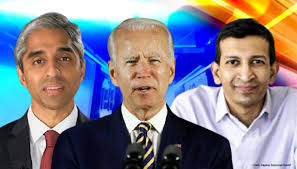
NEW YORK (TIP): Two prominent Indian Americans are among Democratic Presidential nominee Joe Biden’s “core advisors” who have been guiding him on issues ranging from the coronavirus pandemic, economic recovery to foreign policy and climate change, a media report said.
Biden, “plotting an ambitious presidency that would begin amid twin health and economic crises, is leaning on veteran advisers with high-level governmental experience rather than outsiders and ideological rivals to help guide him on subjects including the coronavirus pandemic and the country’s diminished standing in the world,” a report in The New York Times said.
Among those advising him on the pandemic are Dr Vivek Murthy, former US Surgeon General who was appointed by President Barack Obama and Harvard economist Raj Chetty is among those who have briefed Biden on economic issues, the report said.
Murthy and former head of the Food and Drug Administration David Kessler were among those present on a conference call convened by the Biden campaign when it learned that two people who had travelled with Senator Kamala Harris had tested positive for the coronavirus.
“Biden has spoken often of his briefings with experts, and Dr Murthy and Dr Kessler have been two of the most prominent medical figures whose counsel Biden has sought during the public health crisis,” the NYT report said.
The NYT report quoted Kessler as saying that in the early days of the pandemic, he and Murthy would brief Biden “every day, or four times a week.”
“We would send in 80- to 90-page documents, take him through the epidemic from epidemiology, therapeutics, vaccines, testing. Staff would join, originally by phone but they soon shifted to Zoom,” Kessler said, according to the NYT report. “The docs,” as Biden calls Kessler and Murthy, also “pore over research and data on the virus and consult with modelers, vaccinologists and other experts so they can provide Biden with projections about the coming months.”
The report added that Biden has signaled that the government’s top infectious disease expert Anthony Fauci will have a prominent role in a Biden administration.
On economy, Joe Biden has cast a wide net for economic advice, soliciting input from several hundred policy experts, the report said. Among those who have briefed Biden on the economy are Chetty, “who has produced pathbreaking research on economic mobility and its roots in the last several years” and former chair of the Federal Reserve Janet Yellen.
On the issue of foreign policy, the NYT report said Biden would come to “office with more foreign policy experience than any president in memory”.
While some in his inner circle of foreign policy and national security advisers have worked for him through the years, Biden’s aides understand that “assumptions that governed Obama policymaking have changed, including the prospects for cooperation with China and the importance of the Middle East.”
Among the most influential foreign policy adviser for Biden is Antony Blinken, who has previously worked for Biden on the Senate Foreign Relations Committee and served as a deputy national security adviser and deputy secretary of state under Obama.
“Known more for his diplomatic touch than any fixed ideas, he is considered a likely candidate for national security adviser or secretary of state,” the NYT report said.
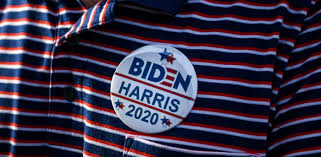
WASHINGTON (TIP): Joe Biden and his running mate Senator Kamala Harris have the best understanding of the Indian-American community, the leaders supporting the two Democratic candidates have said, describing US President Donald Trump as a “foe” who criticizes India on the world stage.
With less than four to go for the November 3 presidential election, Indian Americans on Friday asserted that Biden, first as a US Senator and thereafter as the vice president, has a strong track record of helping the community.
Trump, a Republican, is being challenged by Biden in the US presidential election.
“After four years of the Trump administration, we know our children and grandchildren will not have the same opportunities as we had. We need a leader who understands our community, our values, our pride and appreciates our hard work and gives equal opportunity and say in his administration,” said Ajay Jain Bhutoria, a Silicon Valley-based entrepreneur.
Mr Bhutoria said that Biden and Harris are the leaders who will lead the country out of this mess and restore its soul, revive the middle-class economy and re-establish America’s leadership on the world stage and best relationship with India.
Referring to the final presidential debate between Trump and Biden on Friday, Mr Bhutoria said that the president criticized India on the world stage. “The community understands who the real friend of India is, who the foe. Trump is a foe. Most recently on the debate stage saying- you cannot trust India’s COVID-19 numbers and India is filthy. He has suspended the H1 Visa Programme, put trade deals with India in jeopardy, and has used (Indian Prime Minister Narendra) Modi’s friendship for photo opportunities only,” he alleged.
During the final presidential debate, Trump accused China, India and Russia of not taking care of their “filthy air” as he justified America’s withdrawal from the landmark Paris climate agreement.
“Biden celebrated Diwali with (former) President Obama in the White House and at his residence. The former vice president has a deep connection with Indo-American community and India. Biden understands the values of Indo Americans. In his recent Op-ed he shares how he felt deeply connected to the Indian community and the values of the Indian community,” he said.
Indian-Americans share deep connections with Biden and Kamala Harris, he said. According to a recent survey, 80 per cent of Indian-American community is strongly behind Biden and Harris.
“Indo Americans understand that the way they share their values with Biden and Harris, (they) think that (US President Donald) Trump does not share their values and has failed and is leading America on the wrong path,” Mr Bhutoria said.
California State Assembly member Ash Kalra said that he has known Senator Harris and her sister Maya for over two decades.
“Kamala’s pride of her Indian heritage runs as deep as her love for her late mother, Shyamala Gopalan Harris. Kamala speaks fondly of her trips to India as a child and connects many of the ideals she fights for as an elected leader to the Indian values of her upbringing,” he said.
“With Joe Biden, a leader who during the course of his long career has proven his deep understanding of the needs of the Indian community, Kamala Harris will reaffirm the commitment our future president will have to our needs. The entire Indian community will be well represented with her as our next vice president,” Kalra said.
Aditi Pal with Desi Blue said that the community has always known Biden as a friend of India.
“Seven years ago, as vice president, he told business leaders in Mumbai that the US-India partnership was the defining relationship of the 21st Century. As a Senator, he was instrumental in the passing of India’s Civil Nuclear Deal. And it was during Obama-Biden administration that the two countries saw their best years for the Indo-US relationship. Joe’s choice of Kamala Harris also gave us immigrants from India a sense of pride,” she said.
“Joel’s humility & inclusiveness is evident when he tells immigrants ”thank you for choosing America”,” she added.
According to Ashok Bhatt, businessman and former California Water commissioner, Obama-Biden administration Democrats gave India priority. When Narendra Modi became Prime Minister, Obama-Biden welcomed him and opened up economic areas and visas to students and tourists. H1 visas became so liberal and India benefitted the most from it.
“I believe the Biden-Kamala team will be great for Indo-American relationships and the economy of both countries will be flourishing,” Mr Bhatt said.
Biden is deeply connected to the Indian American community. As vice president, Biden strengthened relations with India and Indian Americans, said Neha Dewan from South Asians for Biden.
“The Obama-Biden administration appointed Indian Americans to serve in high level cabinet and ambassador positions, and as judges. Biden has consistently recognized Indian Americans,” she said.
in Delhi are defining — the defense ties between the two countries have come of age
Sidebar
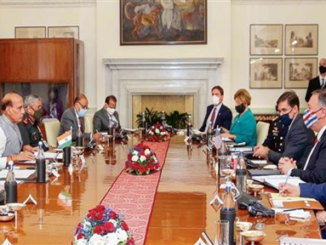
The signing, last week, of the Basic Exchange and Cooperation Agreement (BECA) providing for the sharing of geospatial data is the last of the foundational agreements. The first, General Security Of Military Information Agreement (GSOMIA), relating to security of each other’s military information was signed in 2002. The Congress-led United Progressive Alliance government signed the End Use Monitoring Agreement (EUMA) in 2009. The India-United States defense partnership received a major boost earlier this week with the visit of U.S. Secretary of State Mike Pompeo and U.S. Defense Secretary Mark Esper for the third round of the 2+2 Dialogue with their Indian counterparts, External Affairs Minister S. Jaishankar and Defense Minister Rajnath Singh. The joint statement spells out the highlights but the optics are what define the visit. At a time when most ministerial engagements and even summits are taking place virtually, the significance of two senior U.S. officials travelling to Delhi a week before the U.S. goes to the polls conveys an unambiguous political message — the defense partnership has come of age.
A long road
It has been a long process, with many ups and downs since the first modest steps were taken with the end of the Cold War three decades ago. The 1991 Kicklighter proposals (Lt. Gen. Claude Kicklighter was the Army commander at the U.S. Pacific Command) suggested establishing contacts between the three Services to promote exchanges and explore areas of cooperation. An Agreed Minute on Defense Cooperation was concluded in 1995 instituting a dialogue at the Defense Secretary level together with the setting up of a Technology Group.
The end of the Cold War had helped create this opening but the overhang of the nuclear issue continued to cast a shadow on the talks. There was little appreciation of each other’s threat perceptions and the differences came to a head when India undertook a series of nuclear tests in 1998. The U.S. responded angrily by imposing a whole slew of economic sanctions and leading the international condemnation campaign. An intensive engagement followed with 18 rounds of talks between the then External Affairs Minister, the late Jaswant Singh, and then U.S. Deputy Secretary of State Strobe Talbott spanning two years that helped bring about a shift in perceptions. Sanctions were gradually lifted and in 2005, a 10-year Framework for Defense Relationship established, followed by a Joint Declaration on Defense Cooperation in 2013. The Framework agreement was renewed in 2015 for another decade.
The Framework laid out an institutional mechanism for areas of cooperation including joint exercises, intelligence exchanges, joint training for multinational operations including disaster relief and humanitarian assistance, technology transfer and a sharing of non-proliferation best practices. Initial movement was slow; it gathered momentum once the nuclear hurdle was overcome in 2008 with the India-U.S. civil nuclear deal.
There were other factors at play too. Equally important was the progressive opening up of the Indian economy that was registering an impressive annual growth rate of over 7%. Bilateral trade in goods and services was $20 billion in 2000 and exceeded $140 billion in 2018. The four million-strong Indian diaspora in the U.S. has come of political age and its impact can be seen in the bipartisan composition of the India Caucus (in the House) and the Senate Friends of India group. From less than $400 million of defense acquisitions till 2005, the U.S. has since signed defense contracts of $18 billion.
A bipartisan consensus
A bipartisan consensus supporting the steady growth in India-U.S. ties in both New Delhi and Washington has been a critical supporting factor. The first baby steps in the form of the Kicklighter proposals came in 1991 from the Bush administration (Republican) when P.V. Narasimha Rao led a Congress coalition. Following the nuclear tests, Prime Minister Atal Bihari Vajpayee (Bharatiya Janata Party) welcomed President Bill Clinton (Democrat) to Delhi. The visit, taking place after 22 years — the previous one being U.S. President Jimmy Carter’s visit in 1978 — marked a shift from “estranged democracies” to “natural allies”. A Congress coalition led by Prime Minister Manmohan Singh carried the process forward with a Republican Bush administration. Heavy political lifting was needed to conclude the historic nuclear deal in 2008, removing the biggest legacy obstacle.
The biggest push has come from Prime Minister Narendra Modi overcoming the “hesitations of history” and taking forward the relationship, first with a Democratic Obama administration by announcing a Joint Strategic Vision for the Asia-Pacific and Indian Ocean Region in 2015, followed by elevating the India-U.S. Strategic and Commercial Dialogue (launched in 2009 and the first round held in 2010) into the 2+2 dialogue in 2018 with the (Republican) Trump administration reflecting the ‘Comprehensive Global Strategic Partnership’. Mr Modi is not constrained (at least on the strategic side) unlike Dr. Singh during his second term who faced opposition within his party, had a Defense Minister who preferred to shy away from any decision, and often had to prod a reluctant bureaucracy.
The signing, last week, of the Basic Exchange and Cooperation Agreement (BECA) providing for the sharing of geospatial data is the last of the foundational agreements. The first, General Security Of Military Information Agreement (GSOMIA), relating to security of each other’s military information was signed in 2002. The Congress-led United Progressive Alliance government signed the End Use Monitoring Agreement (EUMA) in 2009 but then dragged its feet on the others on the grounds that it would jeopardize India’s strategic autonomy. However, it was apparent that as military exercises with the U.S. expanded, both in scale and complexity, and U.S. military platforms were inducted, not signing these agreements was perceived as an obstacle to strengthening cooperation. Nearly 60 countries have signed BECA. In 2016, Logistics Exchange Memorandum of Agreement (LEMOA) relating to exchange of logistics support had been concluded, followed by Communications Compatibility and Security Agreement (COMCASA) in 2018 permitting encryption standards of communication systems. More than 100 countries have signed these agreements with the U.S. Equivalent agreements on logistics and mutual security of military communication have also been signed with France but without the political fuss.
Breaking away from ‘labels’
Developing the habit of working together has been a long process of building mutual respect and trust while accepting differences. The U.S. is used to dealing with allies (invariably junior partners in a U.S.-dominated alliance structure) and adversaries. India falls into neither category. Therefore, engaging as equal partners has been a learning experience for both India and the U.S. Recognizing this, the U.S. categorized India as “a Major Defense Partner” in 2016, a position unique to India that was formalized in the National Defense Authorization Act (2017) authorizing the Secretaries of State and Defense to take necessary measures. It has helped that India also joined the export control regimes (Australia Group, Missile Technology Control Regime and Wassenaar Arrangement) and has practices consistent with the Nuclear Suppliers Group where its membership was blocked by China spuriously linking it to Pakistan. In 2018, India was placed in Category I of the Strategic Trade Authorization, easing exports of sensitive technologies.
In every relationship, there is a push factor and a pull factor; an alignment of the two is called the convergence of interests. An idea matures when the timing is right. After all, the Quad (Australia, India, Japan and the U.S.) was first mooted in 2007 but after one meeting, it petered out till its re-emergence now. Alongside the ministerial meeting in Tokyo earlier this month, India was invited for the first time to also attend the Five Eyes (a signals intelligence grouping set up in 1941 consisting of Australia, Canada, New Zealand, the United Kingdom and the U.S.) meeting.
The policy debate in India is often caught up in ‘labels’. When Prime Minister Jawaharlal Nehru described non-alignment as the guiding principle of Indian foreign policy, it was designed to expand India’s diplomatic space. Yet, in 1971, when the Cold War directly impinged on India’s national security, a non-aligned India balanced the threat by signing the Treaty of Peace, Friendship and Cooperation between the Government of India and the Government of the Union of Soviet Socialist Republics. However, during the 1970s and 1980s, it was often hijacked by the Non-aligned Movement tying up policy in ideological knots. Such became the hold of the label that even after the Cold War, India defined strategic autonomy as Non-alignment 2.0! The Indian strategic community needs to appreciate that policies cannot become prisoners of labels. Ultimately, the policy objective has to enhance India’s strategic space and capability. That is the real symbolism of the in-person meeting in Delhi.
(The author is a former diplomat and presently Distinguished Fellow at the Observer Research Foundation)
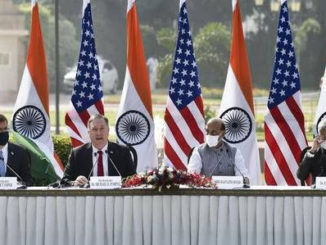
NEW DELHI (TIP): India and the U.S. on October 27 inked a landmark defense agreement that will allow sharing of high-end military technology, classified satellite data, and critical information between the two countries. The signing of the long-negotiated Basic Exchange and Cooperation Agreement (BECA) during the third edition of the ‘2+2’ dialogue between the two strategic partners also signals further boosting of bilateral defense and military ties. External Affairs Minister S. Jaishankar and Defense Minister Rajnath Singh held the talks with U.S. Secretary of State Mike Pompeo and Defense Secretary Mark T. Esper. Both sides were assisted by their top military and security officials. The United States will support the Indian people defend sovereignty and liberty against threats, Secretary of State Michael Pompeo said, following the conclusion of the pact, which comes in the backdrop of India’s tense border standoff with China in eastern Ladakh. Pompeo also attacked the Chinese Communist Party and said it is not a friend of rule of law and democracy.
The inking of the BECA completes the finalization of four key pacts that were identified as crucial to significantly expand the strategic ties between the two countries.
The General Security of Military Information Agreement (GSOMIA) was signed by the two countries in 2002. The GSOMIA provides for specific measures to ensure security standards for safeguarding critical information shared by the U.S. with India.
The Logistics Exchange Memorandum of Agreement (LEMOA), inked in 2016, allows the militaries of the two countries to use each other’s bases for repair and replenishment of supplies and also provide for deeper cooperation. In 2018, India and the U.S. signed another pact called COMCASA (Communications Compatibility and Security Agreement), which provides for interoperability between the two militaries and enables sale of high end technology from the U.S. to India. About BECA, officials said the agreement will give India access to classified geo-spatial data as well as critical information having significant military applications from the U.S.
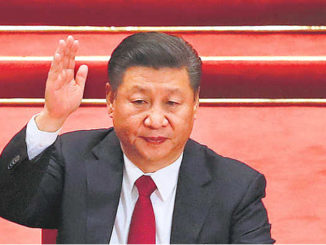
Beijing (TIP): China’s ruling Communist Party on Thursday concluded its key annual conclave during which it approved the 14th Five-Year Plan and Vision 2035, a long-term development plan which observers say hints at the continuation of President Xi Jinping in power for the next 15 years.
The four-day plenary session of the Communist Party of China (CPC) heard and discussed a work report delivered by Xi on behalf of the Politburo of the CPC Central Committee, an official communique said on Thursday.
The session also adopted the CPC proposals for the formulation of the 14th Five-Year Plan (2021-2025) for National Economic and Social Development and the Long-Range Objectives Through the Year 2035.
The session was attended by 198 members of the CPC Central Committee and 166 alternate members of the CPC Central Committee, official media reported.
While the 14th Five-Year plan envisages massive overhaul of the country’s domestic market to boost consumption in order to reduce China’s reliance on shrinking exports markets, the Vision 2035 visualises a long-term plan, reflecting the vision of President Xi.
The Vision 2035 plan prompted speculation that Xi intends to essentially be “president-for-life”.
The aim of Vision 2035, says Benjamin Hillman, a professor at the Australian National University, is to “set goalposts for China’s progress towards achieving high-income status (being a fully developed nation) by 2049”.
Yet the “very idea of a 2035 manifesto has also prompted speculation that Xi intends to lead China through this period, becoming, essentially, president-for-life”, he told the BBC.
Xi, 67, has emerged as the CPC’s most powerful leader after its founder Mao Zedong, holding the posts of CPC General Secretary, head of the military besides the Presidency with prospects of a life-long tenure.
A constitutional amendment in 2018 has removed the two five-year term limit for the President, which would enable Xi to continue in power. His second term as the President is due to end in 2022.
Since he took over power in 2012, Xi firmly established his stamp of authority, doing away with the past system of collective leadership. All CPC meetings, including the plenum, are held in tight secrecy and the proceedings of such meetings other than the official handouts were rarely publicised.
Though the main agenda of the meeting was stated to be the next Five-Year Plan, the plenum was expected to review the political situation as the conclave took place days ahead of the November 3 US presidential election.
China, where the coronavirus emerged in December last year at Wuhan, figured prominently in poll campaigns of both President Donald Trump, a Republican, and his Democratic challenger Joe Biden.
While China’s ties with the US deteriorated to historic low, both Trump and Biden were expected to follow tough hardline policies towards Beijing. China is also battling an adverse image as COVID-19 spread all over the world, killing more than a million people. The country also faced a tough international situation after it passed a controversial National Security Law this year for Hong Kong amidst massive opposition from the local people and the international community, virtually taking over the security of the Special Administration Region for the first time since it was transferred to China by Britain in 1997. The meeting is also being held in the backdrop of the stalemate in the border standoff between India and China in eastern Ladakh, which had affected the relations between the two neighbouring countries. The CPC communique said China would accelerate the modernisation of national defence and the military, which is key to Xi’s vision of China’s emergence as a major global power.
It calls for integrated efforts to build a prosperous country and a strong military.
The country’s national defence capabilities and economic strength should be strengthened at the same time, it said. It said China would nurture a strong domestic market and establish a new development pattern.
The country will ensure smooth domestic circulation and let domestic and international circulations reinforce each other, spurring consumption in an all-round way and expanding investment, the document said.
It said that China would integrate the strategy of expanding domestic demand with deepening supply-side structural reform, and create new demand through innovation and high-quality supply. PTI
Beijing/Lhasa (Tibet) (TIP): China is building the world’s highest-altitude cloud computing data centre in Tibet that will meet the data storage needs of the country and South Asian nations like Nepal, Bangladesh and Pakistan, official media reported On Thursday. The data centre is situated in a high-tech zone of the Tibetan regional capital city of Lhasa and located at an altitude of around 3,656 metres, making it the highest-altitude data centre in the world, state-run Xinhua news agency reported. With a total planned investment of 11.8 billion yuan (over USD 1.80 billion), the project will provide services in areas such as video rendering, autonomous driving, distance-learning data backup, among others, according to its Lhasa-based operator, the Ningsuan Technology Group. It is expected to provide those services to major Chinese provinces and cities, as well as Nepal, Bangladesh, Pakistan and part of Southeast Asia, said the company. The first phase of the project is expected to be put into operation in 2021, said the report. After the completion of phase one, the data centre will have 10,000 machine cabinets and an annual revenue of 1.5 billion yuan (about USD 223.5 million), meeting the data storage needs of key clients in the country and in South Asia. Wang Jun, Ningsuan’s vice president and chief marketing officer, said as Lhasa pushes forward with the construction of a regional bureau for stepping up international communications services, Tibet will become a big-data industrial base. PTI
‘Look at India, it’s filthy,’ the US President said in the Oct 22 presidential debate
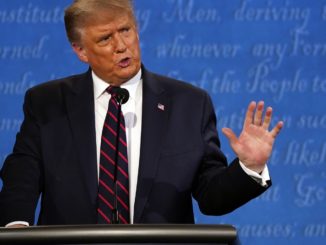
NEW DELHI / NEW YORK (TIP): After not figuring in the first presidential debate between US President Donald Trump and former Vice President Joe Biden, India did crop up in the second edition but not in the manner proponents of a much closer Indo-US strategic relations would have wished for. “Look at China. How filthy it is. Look at Russia. Look at India, it’s filthy. The air is filthy,’’ said Trump in a remark that cut several strategic analysts to the bone. On the other hand, the US has the “lowest number in carbon emissions”, he claimed.
Several questioned on social media the need for Trump to make an unsavory reference to India when they were expecting Indo-US ties to turn the strategic corner during the forthcoming visit of two top American cabinet ministers to India. They also wondered if Trump had this view of India why did he pay a return stadium-visit to Ahmedabad barely six months after being hosted in a Houston stadium by PM Narendra Modi.
Biden did not mention India.
Trump was responding to debate moderator Kristen Welker’s question on how he would simultaneously combat climate change and support job growth.The debate was expected to feature India and the wider neighborhood. During the first debate, the two candidates did not speak much on the American foreign policy, especially in the Asia Pacific, which seems to be the focus of the current administration.
One reason for the cursory references to foreign policy is also because one debate was cancelled after Trump refused to participate in an on-line format.Welker had chosen six topics for in-depth discussions. Three of them were domestic issues while the other three – climate change, leadership and national security – had foreign policy ramifications. Trump, however, was consistent in his observations in blaming the three countries. In the first debate on September 29, he had said, “China sends up real dirt into the air. Russia does, India does — they all do.’’
Beijing (TIP:): China on Friday threatened to stop recognising the UK-issued passports for Hong Kong residents after the country reaffirmed its plan to offer a route to its citizenship to thousands of people living in the former British colony. The British government announced in July that it will open a new special pathway to obtaining British citizenship for eligible Hong Kongers from January 2021 after China imposed a new, sweeping national security law on Hong Kong. The British offer is not for all residents of Hong Kong, but only those holding a British National Overseas (BNO) passport.
China’s Foreign Ministry spokesman Zhao Lijian told a media briefing here that the Chinese government has repeatedly made clear its “strong stance on this issue, but the British side has insisted on interfering with Hong Kong affairs and China’s domestic issues”. “As the British side broke its own promises, the Chinese government will consider not recognising the BNO passport as a valid travel document, and reserve the right to impose further measures,” he said. The new “Hong Kong BN(O) Visa” will allow the holder to enter and remain in Britain for an initial period of 30 months, extendable by a further 30 months, or a single period of five years, according to information on the British government’s website.
“You’ll be able to work and study, but you won’t be able to access public funds such as social welfare benefits,” Hong Kong-based South China Morning quoted the statement as saying.
Holders can apply to settle in Britain once they have lived there for five years.
“After 12 months with this status, you can apply for British citizenship,” the statement said.
More than one million people from Hong Kong could move to Britain in the next five years under the new visa scheme, including 500,000 in the first-year, Hong Kong-based South China Morning.
Around 300,000 people currently hold a BNO passport, while an estimated 2.9 million people are eligible for it, according to the British Consulate General in Hong Kong. Britain handed over Hong Kong, its former colony, to Chinese rule on July 1, 1997, under a “One Country, Two Systems” framework that was supposed to guarantee the city a high degree of autonomy and Western-style civil liberties not seen on mainland China. China imposed the new national security law in Hong Kong after repeated protests there demanding more democracy and less Chinese influence.The new law targets secession, subversion and terrorism with punishments of up to life in prison. PTI
Here is a special article on the occasion of the diamond jubilee of the United Nations. The United Nations officially came into existence on 24th October 1945 when the Charter was ratified by China, France, the Soviet Union, the United Kingdom, the United States of America , and a majority of other signatories.
George Abraham who has had a long association with the United Nations underscores the relevance of the world body in the past, in the present, and in the future. -EDITOR
Today, thousands of Indian citizens are employed by the United Nations around the world. The Asian Headquarters for the World Health Organization is located in New Delhi. UNICEF is highly active in India, helping Children in responding to emergencies and providing them essentials to survive. India’s own contribution to the regular budget assessment is less than half of what the Netherlands pays. Therefore, all the casual talk about getting out of the UN from certain circles are not only ludicrous but a disservice to the people of India.
Peace, dignity and equality on a healthy planet. The San Francisco Conference: Egypt signs the UN Charter. A facsimile copy of the Charter is superimposed on the photo. The Charter of the United Nations was signed on 26 June 1945, in San Francisco, at the conclusion of the United Nations Conference on International Organization, and came into force on 24 October 1945. Preamble to the UN Charter was read out by Sir Lawrence Olivier. Photo / Courtesy UN
“The International Community must ask if the UN is still relevant 75 years after its founding”, said Prime Minister Narendra Modi addressing the General Assembly in a virtual conference in its 75th session. He demanded that a UN reform is the need of the hour and questioned whether the Organization has been effective in tackling Covid-19. Some commentators even went further to say that India should get out of the UN, and it no longer serves any purpose. Sir Brian Urquhart, a former Under-Secretary-General of the United Nations with special responsibility for peacekeeping operations, once quoted as saying, “to be called irrelevant is, I suppose, the most biting insult you can possibly give to anything, a person or an institution, and it’s been used quite a bit about the UN. But it is still here. And for better or worse, I think that its demise is somewhat unlikely, certainly in the near future”.
It again shows the United Nations’ predicament, where it is a challenging job to get everybody to agree on any single issue. If we look back at history, the United Nations was founded in 1945 to save the succeeding generations from the scourge of another war just as the world was emerging out of World war II. It is also important to remember that the UN Charter and the UN’s whole concept was the brainchild of Franklin D. Roosevelt. The assumption then was that the Allies who were on the way to victory then would continue to observe the peace and, if necessary, enforce it.
The World war has led to the cold war between the United States and the Soviet Union, resulting in proxies fighting all over the globe. However, the United Nations may still take consolation because it has succeeded in thwarting a large-scale war between nuclear-armed superpowers. Moreover, in the Cold war era, peacekeeping became a strategic tool in the UN’s hands in containing regional conflicts in places like the Middle East, Kashmir, Cyprus, Congo, Sudan, and so forth.
The critics are often eager to paint a negative view of the UN primarily because of its failures on the political front. However, if one closely examines the structure of the Security Council, the most important organ of the United Nations, it still reflects the status quo in the immediate aftermath of World War II. It is almost as if it was built to fail. All permanent members of the Security Council have one time, or another misused their right to veto in preventing a potential solution to a crisis and often leaving the UN remain largely paralyzed with expanding rifts and mounting tensions. Although the challenge is to shake up the Council’s structure, most governments continue to pay lip service to the need for reform, and the public seems to direct their fire and fury at the Organization.
There is great merit to the argument that Security Council is woefully ill-prepared to deal with the contemporary challenges, and the chamber should accommodate countries like India, Germany, Japan, and Brazil with or without veto powers. However, it is a tall order that would require two-thirds of the votes in the General Assembly and the endorsement of all five permanent members. The growing ideological division among council members in dealing with sanction regimes or protracted regional conflicts may not give any ray of hope that the status-quo may change anytime soon. Nevertheless, it provides an excellent forum for the global community to air their grievances and let off steam.
Apart from the political front, the United Nations and its Specialized Agencies have done a phenomenal job, especially in the Social and Economic arena. Having worked for the Organization on two different continents, I have had the opportunity to view the UN activities from a front-row seat. UN personnel have been directly involved as advisors and technical experts in many projects in many developing countries, especially in Africa. I have witnessed some of those valuable contributions from dedicated civil servants around the world, often under very trying conditions, working with the local officials, whether in the areas of food security, land use planning, deforestation, water, sanitation, or preventive medicine. Of course, these efforts may not make headlines anywhere but have made an incredible difference in the daily lives of those ordinary folks who live in some of the remotest parts of the world.
India played a seminal role in the early history of the United Nations. Although not part of the Security Council, India focused its attention on the General Assembly and worked with the newly independent nations in Asia and Africa on decolonization and socio-economic development. India may have a lot to do with the Organization’s evolution from a security-driven one to a developmental and promotional body.
India was also one of the leaders that led the campaign against Apartheid resulting in the General Assembly adopting a resolution against racial discrimination in South Africa. Sanctions were also imposed on South Africa and Rhodesia (now, Zimbabwe) as part of the continuing opposition to Apartheid, and India played a significant role in that effort. India was also at the forefront in advocating reforms for the global economic order and was instrumental in setting up the UNCTAD to provide developmental assistance to developing countries.
India is a major contributor to the UN’s peacekeeping efforts across the globe. As per the 2019 data, it has provided about 240,000 personnel in 49 of the 71 peacekeeping operations. Currently, Indian Military personnel is participating in 9 out of 14 peacekeeping missions. More than 160 Indian peacekeepers have paid the ultimate price in service to peace, losing lives serving under the UN flag.
UN is also known for its work on behalf of democracy and human rights. With so much pride, India can remember that it has contributed significantly to the Universal Declaration of Human Rights content. Indian leadership – represented by Indian National Congress – articulated its concern for human rights and called upon the world body to learn from the coalescing of ideas and vision learned from India’s freedom struggle and urged for peoples’ self-determination everywhere.
India truly deserves to be in the Security Council, given the demographics and its rising economic might. However, it is worth remembering that India has influenced and changed the UN’s trajectory from a security organ to a developmental body and has been a trailblazer for emerging nations towards a path forward in freedom and self-sufficiency. It was all done without having a seat at the Security Council.
Today, thousands of Indian citizens are employed by the United Nations around the world. The Asian Headquarters for the World Health Organization is located in New Delhi. UNICEF is highly active in India, helping Children in responding to emergencies and providing them essentials to survive. India’s own contribution to the regular budget assessment is less than half of what the Netherlands pays. Therefore, all the casual talk about getting out of the UN from certain circles are not only ludicrous but a disservice to the people of India. “The UN: if it doesn’t exist, we would have to invent it.”
(The author is a former Chief Technology Officer of the United Nations)
Post-Covid, it’s a fit case for the world to demand reparation, as was done after World War I, at the Treaty of Versailles, in 1919. Articles 231 and 232 made Germany sign and pay for the irreparable, willful damage, destruction and death caused to its European neighbors in particular. Germany confessed ‘war guilt’ and agreed ‘compensation will be made for all damage done to civilian population of Allies and their property.’
“The wheel has indeed turned full circle. After 101 years, reparation today is the sine qua non for a free world facing an autocratic, reckless China which is consistently failing to adhere to, or follow, the canons of collective wisdom, so very essential for the existence, nay survival, of the human race. Will China curtail its expansionist ambitions and avoid taking control of weaker landlocked territory through unfair means? The time for reparation is now.”
The Covid-19 pandemic has done more damage to the global economy in mere six months than what the two world wars did in 10 years. The Chinese-origin virus has already claimed over six lakh lives, while more than 1.6 crore cases have been recorded so far. There are debts worth billions, nay trillions, of dollars and over 200 countries are on the road to ruin.
Various sectors are counting the colossal losses, be it banking, transport, shipping, hospitality, core industrial sector or aviation. The key indicators of human welfare — education and health — are in tatters. The future of millions of students across the globe is uncertain. And, the lack of barest human needs — food, housing, clothing and fuel — is plunging millions into poverty.
Such is the havoc wrought on India that the government has extended free ration to an estimated 80 crore till November this year. The entire Europe’s 50-nation population is 58 crore. All of North and South America’s 37 countries constitute 94 crore people. And India alone faces the daunting task of feeding 80 crore people till November. Isn’t it an indication of an unprecedented economic downturn for India? How will the state fund this mega plan? How will the potentially empty state coffers be replenished once the ‘free ration’ scheme ends? Won’t the beneficiaries demand its extension?
Understandably, India is in dire straits today, thanks to the seven-decade-long tradition of misconceived and ill-advised appeasement diplomacy, the Hindi-Chini bhai-bhai (Hindustan-Chinese fraternity) policy, systematically undercutting the economics, polity, commerce, trade, industry and security systems of India.
Thus, if one were to scrutinize the single most important parameter, gross domestic product (GDP), pertaining to the economics of a nation, there’s little doubt that Indian economy is in free fall, along with that of 200-plus countries — the exception being China.
The much-touted ‘world is one’ slogan is a reality today. The world is indeed one, because it is sinking as one, sans the Chinese. Beijing is tom-tomming its success in combating, containing and crushing the disease which has ravaged the planet.
Here, a cursory glance at the 2017 GDP figures of the 15 biggest economies would be relevant: US ($19.48 trillion); Japan ($4.87 trillion); Germany ($3.69 trillion); India ($2.65 trillion); UK ($2.63 trillion); France ($2.58 trillion); Brazil ($2.05 trillion); Italy ($1.94 trillion); Canada ($1.64 trillion); Russia ($1.57 trillion); South Korea ($1.53 trillion); Australia ($1.32 trillion); Spain ($1.31 trillion); Mexico ($1.15 trillion) and Indonesia ($1.01 trillion). All are going downhill.
Yet, the second biggest economy, as per the 2017 GDP, China ($12.23 trillion), as reported by the China Daily Global Weekly (July 24-30) is on the upswing. Chinese President Xi Jinping met corporate leaders on July 21 “to protect market players and stimulate vitality as the Covid-19 pandemic has hit hard the domestic and global economy.”
Global economy isn’t just hit hard, it has tumbled. But the Dragon isn’t hit or hurt, as reported by the same daily: “China has become the world’s first major economy that’s shown robust recovery from the impact of the pandemic, with its GDP expanding 3.2% year-on-year in the second quarter, reversing a 6.8% decline in the first quarter.”
This is a fit case for the world to collectively demand reparation, as was done after World War I, at the Treaty of Versailles in 1919. Two Articles — 231 and 232 — made Germany sign and pay for the irreparable, willful damage, destruction and death it had caused to its European neighbors in particular.
The prefix ‘re’ became the economic slogan of the destroyed economies — reconstruction, recovery, reparations, retrenchment, repayment of war debts, revaluation of currencies and the restoration of gold standard. The 21st century thus far, however, has seen a war without war. Essentially because there’s hardly any power, outside of Asia, with the manpower to fight a physical war owing to the shrinking demography of the West and the impact of the Chinese virus.
It’s, therefore, time to demand reparation from China by the top economic powers of the world in unison. The formula could be arrived at by calculating the loss of the notional GDP figure between 2018-19 and 2020-21. Germany confessed ‘war guilt’ under Article 231 of the Treaty of Versailles and agreed to ‘compensation’ under Article 232: “compensation will be made by Germany for all damage done to the civilian population of the Allies and their property.”
The wheel has indeed turned full circle. After 101 years, reparation today is the sine qua non for a free world facing an autocratic, reckless China which is consistently failing to adhere to, or follow, the canons of collective wisdom, so very essential for the existence, nay survival, of the human race. Will China curtail its expansionist ambitions and avoid taking control of weaker landlocked territory through unfair means? The time for reparation is now.
A binary choice between the U.S. and China is likely to test India’s capacity to maintain strategic and decisional autonomy
By Vijay Gokhale
“Both sides are acutely aware how closely their economies are tied together: from farm to factory, the U.S. is heavily dependent on supply chains in China and the Chinese have been unable to break free of the dollar. If Mr. Trump’s wish is to disentangle China’s supply chains, Mr. Xi is equally determined to escape from the U.S. ‘chokehold’ on technology. To what extent the de-coupling is possible is yet to be determined, but one thing is inevitable, India will become part of the collateral damage.”
A slew of recent announcements on China by U.S. President Donald Trump is a clear indication that the competition between the U.S. and China is likely to sharpen in the post-COVID world. On May 29, the Trump administration said it would revoke Hong Kong’s special trade status under U.S. law. The administration also passed an order limiting the entry of certain Chinese graduate students and researchers who may have ties to the People’s Liberation Army. The U.S. President has also ordered financial regulators to closely examine Chinese firms listed in U.S. stock markets, and warned those that do not comply with U.S. laws could be delisted.
Complicit in China’s rise
Americans have had a strange fascination for China ever since the early 1900s when Protestant missionaries decided that it was God’s work to bring salvation to the Chinese. Books like The Good Earth by Pearl S. Buck and Red Star Over China by Edgar Snow in the 1930s romanticized the country. Even after the Chinese communists seized power, the Americans hoped to cohabit with Mao Zedong in a world under U.S. hegemony. The Chinese allowed them to believe this and extracted their price. U.S. President Richard Nixon gave China the international acceptability it craved in return for being admitted to Mao’s presence in 1972; President Jimmy Carter terminated diplomatic relations with Taiwan in order to normalize relations with China in 1978; President George H.W. Bush washed away the sins of Tiananmen in 1989 for ephemeral geopolitical gain; and Bill Clinton, who as a presidential candidate had criticized Bush for indulging the Chinese, proceeded as President to usher the country into the World Trade Organization at the expense of American business. All American administrations since the 1960s have been complicit in China’s rise in the unrealized hope that it will become a ‘responsible stakeholder’ under Pax Americana.
Disguising its real purpose
The Chinese are hard-nosed and unsentimental about the U.S. They have always pursued America with a selfish purpose, albeit couched in high principle. They have spoken words that the Americans wanted to hear — anti-Soviet rhetoric during the Cold War and market principles thereafter — to disguise their real purpose of thwarting U.S. hegemony. Ever since Cold Warrior John Foster Dulles spoke in 1958 of weaning China and other “satellites” away from the Soviets through regime change, known as “peaceful evolution”, every Chinese leader from Chairman Mao to President Xi Jinping has been clear-eyed that the U.S. represents an existential threat to the continued supremacy of the communist regime. Mao put it best, when he told high-ranking leaders in November 1959, that the “U.S. is attempting to carry out its aggression and expansion with a much more deceptive tactic… In other words, it wants to keep its order and change our system.” (Memoirs, Chinese leader Bo Yibo). The collapse of the Soviet Union only reinforced this view and strengthened China’s resolve to resist by creating its own parallel universe. China is building an alternate trading system (the Belt and Road Initiative); a multilateral banking system under its control (Asian Infrastructure Investment Bank, New Development Bank); its own global positioning system (BeiDou); digital payment platforms (WeChat Pay and Alipay); a world-class digital network (Huawei 5G); cutting-edge technological processes in sunrise industries; and a modern military force. It is doing this under the noses of the Americans and some of it with the financial and technological resources of the West.
Voices of caution have been few and far between, among them political scientist John Mearsheimer, who wrote in 2005 that the rise of China would not be peaceful at all, but the world chose to believe General Secretary of the Communist Party of China Hu Jintao’s assurances about “peaceful rise”. When satellite evidence showed that China was building military installations in the South China Sea, China’s Southeast Asian neighbors and the U.S. preferred to believe assurances to the contrary given by Mr. Xi on the lawns of the White House in 2015.
It is only under Mr. Trump that the Americans are finally acknowledging the uneasy fact that the Chinese are not graven in their image. He has called China out on trade practices. He has called China out on 5G. It was Mr. Trump’s 2017 National Security Strategy document that, perhaps for the first time, clubbed China along with Russia as a challenge to American power, influence and interests. His recent China-specific restrictions on trade and legal migration are, possibly, only the beginning of a serious re-adjustment.
A full-spectrum debate on China is now raging across the U.S. Former White House Chief of Staff Steve Bannon declared that the U.S. is already at war with China. Others like diplomat Richard Haass and former president of the World Bank, Robert Zoellick, warn that a new Cold War will be a mistake. Scholar Julian Gewirtz, in his brilliant essay, ‘The Chinese Reassessment of Interdependence’, talks about a similar process under way in Beijing. Both sides are acutely aware how closely their economies are tied together: from farm to factory, the U.S. is heavily dependent on supply chains in China and the Chinese have been unable to break free of the dollar. If Mr. Trump’s wish is to disentangle China’s supply chains, Mr. Xi is equally determined to escape from the U.S. ‘chokehold’ on technology. To what extent the de-coupling is possible is yet to be determined, but one thing is inevitable, India will become part of the collateral damage.
The Hong Kong question
Will Hong Kong become a game-changer in the post-COVID world? China’s decision to enact the new national security law for Hong Kong has been condemned in unison by the U.S. and its Western allies as an assault on human freedoms. Why is this significant? The points of divergence, even dispute, between them have so far been in the material realm. With Hong Kong, the U.S.-China rivalry may, possibly, be entering the ideological domain. For some time now there are reports about Chinese interference in the internal affairs of democracies. Countries in the West have tackled this individually, always mindful of not jeopardizing their trade with China. Hong Kong may be different. It is not only a bastion for Western capitalism in the East, but more importantly the torchbearer of Western democratic ideals. Think of it as a sort of Statue of Liberty; it holds aloft the torch of freedom and democracy for all those who pass through Hong Kong en route to China. This is an assault on beliefs, so to speak.
This comes on the back of not unreasonable demands that China should come clean on its errors of omission in the early days of COVID-19, when greater transparency and quicker action might have prevented, or at least mitigated, the pandemic. In the months ahead, more information may become public, from sources inside China itself, about the shortcomings of the regime, that will further fuel a debate on the superiority of the Chinese Model as an alternative to democracy. Will this form the ideological underpinning for the birth of a new Cold War? That will depend on who wins in Washington in November; on whether profit will again trump politics in Europe; and on how skillfully the Wolf Warriors of China can manipulate global public opinion. The lines are beginning to be drawn between the Americans on the one side and China on the other. A binary choice is likely to test to the limit India’s capacity to maintain strategic and decisional autonomy.
(The author is a former Foreign Secretary of India and a former Ambassador to China)
The state of our infrastructure and logistics is way behind China’s
By Subir Roy
“It is idle to think that global companies will shift out of China to India just on Donald Trump’s say-so. They will do so only if the state of India’s infrastructure and logistics is better than China’s. Right now, it is way behind”, says the author.
India’s economy has just received not one but several blows. First, in the just ended quarter (Q4 2019-20), GDP grew by a mere 3.1 per cent, the lowest in any quarter since 2004. Consequently, in the whole year, the economy grew by 4.2 per cent, down from 6.1 per cent in the previous year.
The second blow is that this is not a freak quarter. The quarterly growth rate has been falling for over two years now, not having recovered from the twin blows dealt to it by the confusion resulting from demonetization and introduction of GST thereafter.
It is crucial to ask why factories shifting out of China have till now been going to Vietnam, and, in the case of garments, Bangladesh.
The third blow is that things are going to get much worse. The last quarter figures included just one week of lockdown. In the current quarter, at least two of three months have been totally washed out by the lockdown. It is only now being slowly relaxed and there is no knowing when or how fast the economy will pick up. The RBI has predicted that the economy will contract in the current year and Goldman Sachs has put a number on the contraction — 5 per cent.
The only positive indication is that agriculture will hold out and grow by around the trend rate. Perhaps the best news is that the monsoon has hit Kerala right on time and look robust. The only two sectors that held forth in the last quarter were agriculture and government spending, and this is likely to be the pattern in the current year.
Private consumption, which has been severely hit by loss of income because of the lockdown, will recover very slowly. It will be the same story with private investment, which will not be forthcoming unless demand picks up, and that will not happen unless the government spends more and banks lend more.
The government can, and plans to, rev up public investment, which is the right thing to do. The US got its highway network, when in the 1930s, the government spent to get the economy out of the Great Depression. But the government is also in a great mood to disinvest and keen to use private initiative as the enabler of growth. Right now, it will be tough getting private investment into infrastructure, even on a PPP basis.
Additionally, the government is obsessed with maintaining its fiscal deficit at conservative levels. This, when a cross-section of economists has been exhorting the government not just to spend (give quick help to small businesses) but actually give cash to migrant workers trudging across the country, so they do not starve. The high demand for MGNREGS work must be met and quickly paid for.
But let us assume the best. The coronavirus pandemic will die down, with people maintaining social distancing, and hopefully, a vaccine will be ready by the year-end. That will take us back to where we were for the most part of last year.
The key issue before us is how to get back to the high growth phase unleashed by the economic liberalization and briefly interrupted by the financial crisis of 2008. That helped reduce poverty rapidly and brought India into the middle-income group of countries.
One positive development is the reforms that the government promised while delivering the stimulus package. Particularly noteworthy are the reforms for agriculture that have been described as Indian agriculture’s 1991 moment. If all goes well, agricultural efficiencies will go up, better marketing of agricultural produce will reduce the farm gate-to-fork markup and nutrition levels may well go up without people having to spend much more on food.
But good agricultural performance will not be sustainable if water deficiency is not addressed. A fresh set of reforms is needed to change farm practices so that the outdated water and energy guzzling Green Revolution is discarded for a new model of sustainable agriculture.
But there is no scope for being similarly optimistic about manufacturing. ‘Make in India’ is a good slogan but for higher domestic value addition in manufacturing, India has to go up the global competitiveness league table by reducing the cost of doing business and critically improving workers’ skills. It is necessary to ask why factories shifting out of China have till now been going to Vietnam, and, in the case of garments, Bangladesh.
What will not help is upping tariff barriers which a nationalist-minded government has been doing in response to pressure from domestic business lobbies that are part of its constituency. You become competitive by having to survive against cheap and easy imports, not by keeping them out. It is idle to think that global companies will shift out of China to India just on Donald Trump’s say-so. They will do so only if the state of India’s infrastructure and logistics is better than China’s. Right now, it is way behind.
That leaves us with services which account for around half of the value added in India’s GDP. The services sector rides on the rest of the economy and India’s services sector is already efficient. To get services to contribute more on their own, hope must rest on sectors like software doing even better. Plus, healthcare and education can, and should, grow much faster.
It is difficult to see how the economy can get back to high growth even if coronavirus imposes only a one-time cost.
WASHINGTON (TIP): U.S. Secretary of State Mike Pompeo on Thursday accused China of “stealing” U.S. intellectual property and data related to COVID-19 research.
Mr. Pompeo’s allegations came a day after the FBI and the Department of Homeland Security claimed that organizations conducting research into COVID-19 may be targeted by computer hackers linked to the Chinese government.
The U.S. condemns attempts by cyber actors and non-traditional collectors affiliated with People’s Republic of China (PRC) to steal U.S. intellectual property and data related to COVID-19 research, Mr. Pompeo said in a statement.
The United States calls on China to cease this malicious activity, Mr. Pompeo said, adding that the potential theft of this information jeopardizes the delivery of secure, effective, and efficient treatment options.
China on Thursday termed as slanderous the U.S. accusation that hackers backed by Beijing may be attempting to steal COVID-19 related research and vaccine materials and said that “smearing and scapegoating” others will not make the deadly virus go away.
Chinese Foreign Ministry spokesman Zhao Lijian said U.S. officials are shifting the blame on Beijing as they struggled to handle the coronavirus pandemic back home.
The U.S. claims have added fuel to tensions between the two nations, which are engaged in a war of words over the origin of the coronavirus that has killed over 300,000 people globally. Mr. Pompeo alleged that China’s behavior in cyberspace is an extension of its counterproductive actions throughout the COVID-19 pandemic.
Mr. Pompeo in the strongly-worded statement said while the U.S. and its allies and partners are coordinating a collective, transparent response to save lives, “China continues to silence scientists, journalists, and citizens, and to spread disinformation, which has exacerbated the dangers of this health crisis.
The FBI said that it is “investigating the targeting and compromise of U.S. organizations conducting COVID-19-related research by China-affiliated cyber actors and non-traditional collectors.”
“These actors have been observed attempting to identify and illicitly obtain valuable intellectual property (IP) and public health data related to vaccines, treatments, and testing from networks and personnel affiliated with COVID-19-related research,” the FBI said.
The potential theft of this information jeopardizes the delivery of secure, effective, and efficient treatment options, it said.
Meanwhile, President Trump, annoyed with China’s handling of the pandemic, has ruled out renegotiating a trade deal with China.
“The Chinese said somewhere that they would like to renegotiate the (trade) deal. We are not going to renegotiate,” Mr. Trump told Fox Business News on Thursday, May 14.
“Look, I’m not happy about anything having to do with that particular subject (China) right now. Everything I said turned out to be right. You look at other countries they charge us tariffs to do business and we are not allowed to charge them,” he said.
Responding to a question, Mr. Trump said the Chinese have always stolen Intellectual Property (IP) from the U.S. “They were never called (out). Now they are being called out,” he said.
“We can stop them; they are going to try doing it. I mean you could also stop doing business with them, that is one thing. Look, we have lost a fortune dealing with China. We have rebuilt China,” he said.
The President said he does not want to speak to Chinese President Xi Jinping right now. “I have a very good relationship, but I just — right now I don’t want to speak to him,” he said.
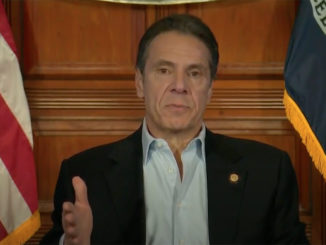
NEW YORK (TIP): In his Coronavirus briefing, Saturday, April 18, New York State Governor Andrew underlined the need for federal funding to the State in order to reopen the State.
Governor Cuomo said there was a little respite from the Coronavirus onslaught which hit the State the most in the last couple of days. It appears the apex has been reached. Giving details, he said, that total coronavirus hospitalizations in New York area was 16,967, the lowest in nearly two weeks; the high point was 18,825. Looking at the past three days, Cuomo said, a case could be made the state has passed the apex. On Friday, there were 1,915 new coronavirus hospitalizations: down from 2,253 Tuesday.
There were 540 state COVID-19 deaths reported Friday, April 17, including 36 from nursing homes. The number is down from 630 on Thursday and hit its lowest total this week. Net intubations have also gone down for a sixth straight day, decreasing by 48 from Thursday’s total.
Cuomo said the state needs coordination and partnership from the federal government, in addition to money. Airlines and small businesses have to be funded, Cuomo said, agreeing with federal officials. He said state governments need funding, too, however.
“When you fund a state government, you’re funding a state government to perform the functions you want us to perform, which is the reopening function,” Cuomo said at a news conference. “I get it. I’ll do it. But I need funding. When you fund a state government, you’re funding small businesses anyway. And you’re funding hospitals anyway. And you’re funding schools anyway. The Republican doctrine used to be limited government and states’ rights. I’m a good distribution mechanism to small businesses, hospitals and schools, because I know what’s going on in the state. But if you want us to reopen, we need funding.”
Cuomo said he wants the state to reopen, but it must be done without the infection rate re-rising.
“Everybody wants to reopen,” he said. “You don’t need to hold up a placard saying, ‘We want to reopen.’ Nobody wants to reopen more than me. Nobody wants to get the economy going more than me. Nobody wants to get on with life more than me and everybody else. We’re all in the same boat. We all the same feelings.”
The infection rate has gone down, with NY PAUSE, social distancing and masks being responsible, Cuomo said. Testing will be key in knowing when and how fast to reopen, he said. Testing will reveal positive cases, which can then be traced to those the person who tested positive came in contact with, according to Cuomo. The people who test positive can then be isolated to prevent the spread. Thousands of people would be needed as “tracing investigators” in New York, Cuomo said.
Over the past month, 500,000 tests were done, but Cuomo said that’s only a fraction of what’s needed. He called for help from the federal government in regard to the testing supply chain, especially when it becomes international.
“The more you test, the more information, the more you can reopen society,” Cuomo said.
On Friday, the federal government sent 1,500,000 cloth masks to the state, Cuomo said, thanking them.
Cuomo dug deeper into what it meant to systematize the testing process in the state. He noted that there are about 30 private companies in the state that manufacture a viable COVID-19 test, all of which are different and require different types of chemical “reagents” to process. These 30 companies are then selling these tests to the 301 labs/hospitals in the state, which can then begin the arduous process of testing everyone in the state. To get an idea of where the state was, Cuomo noted that he had reached out to 50 of the top labs in the state and asked them what it would take to double the testing output. “New York has already tested more people for COVID-19 than any other state or country in the world”, he said.
The labs all said that in order to begin doubling testing, they would need to have better access to the chemical reagents needed to complete the tests—hence the appeal Cuomo made to the federal government yesterday to secure more reagents from China. Since the federal government also regulates the 30 manufacturers of the test kits, that, Cuomo said, would also have to be eased to scale up testing, and it would also need to start funding New York State to ensure that the proper amount of testing was executed.
Cuomo noted, with obvious dig at President Trump, when he said, “The Republican doctrine used to be limited government and states’ rights.”
The push for testing comes at a time when Cuomo has regularly noted a flattening of the curve in the state and has begun to map out the early stages of reopening the economy. This, of course, can’t happen just yet and is wholly contingent on getting the infection rate down further. As Cuomo has noted in the past, society at large won’t be able to return to normalcy until there’s a viable vaccine, which will likely take 12-18 months to produce. The infection rate is currently sitting at 0.9 percent, meaning that every person infected with COVID-19 infects a little less than a single person. The fear is, noted Cuomo, if businesses are reopened and large gatherings are allowed prematurely, that infection rate could skyrocket again.
In answer to a question on people demonstrating for reopening in some States, Cuomo said that the emotion in the country is as high as he can recall, with the pandemic causing frustration, anxiety, fear and anger. There is no time for politics, however, Cuomo said.
“How does this situation get worse and get worse quickly? If you politicize all that emotion. We cannot go there”, he said, in an obvious reference to Trump’s tweet calling upon people to “liberate” their states from the lockdown.
India’s international response to the challenge posed by the Covid-19 pandemic has demonstrated her global leadership as a reliable first responder to humanitarian crises.
India’s international response to Covid-19 exemplifies the continued relevance of Vasudhaiva Kutumbakam, seeing the world as one interdependent family.
The Covid-19 outbreak was termed a “public health emergency of international concern” on 30 January 2020. According to the WHO, the virus originated in the city of Wuhan in China, from where it was transmitted by human travelers to several countries across the world, including India. On 26 February 2020, India supplied 15 tons of medical assistance comprising masks, gloves and other emergency medical equipment on an Indian Air Force special flight to Wuhan as a gesture of solidarity in confronting Covid-19.
The Director General of the WHO declared the global Covid-19 outbreak as a pandemic on 12 March 2020. In a statement in Parliament the External Affairs Minister conveyed that India had taken pro-active action to bring back Indian citizens from the affected countries before restrictions on international air flights to India. These included three special flights to Wuhan in China, evacuating crew and passengers from a cruise ship off Japan, and sending medical teams to assist the repatriation of thousands of Indian nationals stranded in Iran and Italy. As the Minister said, “exceptional situations require an exceptional response”.
On 15 March 2020 Prime Minister Shri Narendra Modi took a major regional initiative to speak with the leaders of all SAARC countries through video conference. During this meeting, India announced five specific measures to prevent such infections from spreading across South Asia.
First, the creation of a Covid-19 Emergency Fund with an initial Indian contribution of $10 million.
Second, placing the services of an Indian Rapid Response Team of doctors and specialists with testing kits and equipment at the disposal of SAARC countries.
Third, training emergency response teams in SAARC countries.
Fourth, giving access to India’s Integrated Disease Surveillance Portal, including training on how to use it.
Fifth, creating a common Research Platform to coordinate research on epidemic diseases in the South Asian region, which would include common SAARC Pandemic Protocols.
The response to the Prime Minister’s initiative from her neighbors was overwhelmingly positive with contributions pledged to the Covid-19 Emergency Fund by Afghanistan, Bangladesh, Bhutan, Maldives, Sri Lanka and Nepal by 23 March 2020.
A follow-up video conference of SAARC Directors General of Health Services on 26 March 2020 emphasized the importance of community engagement and participation to augment the emergency measures undertaken by the governments of South Asia to combat Covid-19.
At the global level, in his role as the incoming Chair of the G-20 in 2021, Prime Minister Shri Narendra Modi had a phone conversation on 17 March 2020 with the G-20’s current Chair, Crown Prince Mohammad bin Salman of Saudi Arabia. The two leaders agreed that Saudi Arabia would convene a video conference of G-20 leaders to coordinate steps to counter Covid-19 and instill confidence in the global populace. 90% of the Covid-19 cases and 88% of the deaths have been in G-20 countries, which comprises 80% of the world’s GDP and 60% of the global population.
On 26 March 2020, the G-20 held a Summit by video conference Summit. Participants agreed to coordinate a global response to fight the pandemic, adopting measures to safeguard the global economy, minimizing trade disruption and enhancing global cooperation.
Before and after the G-20 Summit, the Prime Minister of India engaged in active telephone diplomacy with various world leaders from the five continents to discuss a viable framework for effective international cooperation to counter the spread of Covid-19.
Two special contributions of India to this international effort so far have been the supply of medicines like paracetamol and hydroxychloroquine to help partner countries, including the United States and European Union, to respond to the pandemic, and highlighting yoga exercises and Ayurvedic remedies to mitigate Covid-19 conditions.
India’s international response to Covid-19 exemplifies the continued relevance of Vasudhaiva Kutumbakam, seeing the world as one interdependent family.
(Ambassador Asoke Kumar Mukerj is a former Permanent Representative of India to the United Nations. The article here is originally a commentary Ambassador gave on All India Radio)
NEW YORK (TIP): Alleging that coronavirus was genetically-engineered in a Wuhan lab, an Indian-American survivor of the deadly virus has urged President Donald Trump to seek compensation from China, running into trillions of dollars, for the thousands of deaths and harming the American economy.
“The unleashing of global death and suffering with the coronavirus, a plague upon all of us, is worse than Pearl Harbor, and given its deception, and later, cover-up, lack any semblance of Honor,” Indian-American attorney Ravi Batra said in a letter to the president.
“On the established rules of law, China is at least guilty of negligence in proximately causing a world pandemic, where nearly two million people have suffered its pain and suffering, and nearly 122,000 souls have lost their lives and left their families damaged and fractured,” he said in a letter dated April 14.
China owes us civil compensation – at least for negligence – a fair and reasonable amount, “which I recommend match our standard for 9/11, but no less than $USD1 million dollars for every American who tested positive for Coronavirus, $5 million for every American who died, and $100,000 for every American who has to be ‘locked down’,” he said.
“I recommend, given the cover-up, which exacerbated the injury, pain and suffering globally, as well as avoidable deaths, that China’s ownership of debts in every country – for example the USD1.2T in China’s ownership of our T-Bills – be cancelled,” Batra said.
In his letter, Batra charged China with hiding the actual source of coronavirus.
The Indian Panorama was sent a copy of the open letter addressed to President Donald J. Trump, Speaker Nancy Pelosi and Senate Majority Leader Addison Mitchell McConnell, Jr. with copies to Sen. Chuck Schumer, Leader Kevin McCarthy, Chairman Eliot L. Engel, Ranker McCall, Chair Carolyn B. Maloney, Ranker Jim Jordan, Chairman-Senator Risch, Ranker-Senator Bob Menandez, Secretary Pompeo, Secretary Esper, Gov. Andrew Cuomo, Mayor Bill de Blasio, and A.G. Tish James.
Here is the text of the letter.
“Honorable Messrs Trump, Pelosi, and McConnell:
Let me begin with three obvious facts: first, the Chinese civilization is a great one, with many superlative contribution to humanity, including, empire building, martial arts, gun powder, tea, and perhaps, best of all, Confucius (who famously said: May you live in boring times); second, I am a Blessed survivor of Coronavirus, that at 104.3 fever, when I was on fire for 2-3 days, I was at the surreal edge between live and death, where I could calmly talk to God to allow me to live so I may serve and protect my family and serve the Greater Good. In my personal and intimate experience, I labeled Covid19 as a Trojan Horse, as it obviously has a very friendly “handshake” with every host’s auto immune system to gain entry, before turning to destroy one’s Walls of Troy; and third, today the known global Covid19 cases are 1,945,055, with 121,897 global deaths, total US cases of 584,073 with 23,700 deaths, and New York, our epicenter, nearly 11,000 New Yorker have died. As a disclaimer, I am an American first, a registered Democrat second, and I voted for Donald J. Trump in 2016. I applaud the President for standing up to China’s unfair trade with us, and I am most troubled with her 24/7 global efforts to gain military and economic superiority on land, air, water and space, well beyond OBOR, and her continuing and enhanced misbehavior in South China Sea. Finally, yesterday, I specifically tweeted to dear Amb. Zhang Jun, China’s PR, and to her bilateral Ambassador Cui – as “fairness, respect and personal honor requires me to invite you to respond to my Tweets I’ve made re China, WHO and Covid19.” Unlike, on April 4, 2020, when PR Zhang and I respectfully conversed on Twitter, albeit, about the serious need for China to disclose the “Raw Truth” about Covid19, China’s distinguished diplomats incredulously maintained “radio silence,” when being forthcoming was what was required – both as a duty, and as reciprocal honor.
Recently, on April 9, 2020, House Oversight and Reform’s Ranker Jim Jordon, and his colleagues, sent a gentle letter to Dr. Tedros Adhanom Ghebreyesus, DG, of the WHO. I join in said letter, albeit, I would not have been so gentle to a dishonest fiduciary, whose misconduct proximately caused the world’s public health to lay in ruins and the world’s economies were set adrift from both fiscal and monetary policies.
WHO breached its fiduciary-forensic duties owed to the world, as it dishonestly enjoyed being China’s lap dog and purposefully issued false statements and delayed declaring a pandemic so as to create a confusing record for nations’ leaders, reasonably causing miscalculation. I had in days prior to Rep. Jordan’s letter, called for an amendment to the UN Charter, to do away with the moth-balled Trusteeship Council and to replace it with a new Public Health UNSC, but named “UN Pandemic Council,” with 12 Permanent Members and 9 or 13 Rotating Members, charged with Responsibility to Protect, a sovereignty-piercing power, and have OPCW, as well as a reconstituted WHO, albeit, re-named, and then report to it. I am happy to say, Philippines Foreign Minister, dear Teddy Locsin has publicly – on Twitter – approved my proposal, and other nations’ Permanent Representatives have expressed interest in also supporting such a change to surgically remove the corruption-cancer and establish “clean margins” for honest fiduciary-forensics to protect the global Public Health.
It is a curious fact, that where-ever we have cut back in our contributions at the UN and her “organs,” China for merely giving UN the funding-shortfall we created, has become the “cherry on top” of all such organs. This is wrong, and an insult to our mammoth contributions still being contributed, but, incredulously, taken for granted. The WHO ought to be defrocked and defunded, while its function – only vital if the forensics are done consistent to high fiduciary duties – and then, it too, as reconstituted, report to the new proposed UN Pandemic Council.
The role and function of the United Nations is vital and important as ever, as the UNSC, charged with preventing WWIII has handsomely succeeded, even as the weeds of local and regional wars have mushroomed. UN is celebrating its 75th Anniversary. Perfect time for some “spring-cleaning,” and re-calibration to achieve necessary reforms to better effectuate the high ideals of the UN Charter. It is, after all, a paraphrased amalgam of our Declaration of Independence and our cherished Constitution, to help form a more perfect world.
Wuhan Seafood Market
Coronavirus – as a matter of biochemistry (see, “1st documentary movie on the origins of CCP virus – Tracking Down the Origin of the Wuhan Coronavirus” (The 1st Documentary) http://youtu.be/Gdd7dtDaYmM).
I rely upon this cited evidence, see below, as it credibly shows, and I credit it, that the “story of the Wuhan Seafood Market” is a pretext and an elegant cover-up, which is exposed as such with biochemistry: China denied there was any “human-to-human” transmission. Well, we know that to be a Big Lie, as we are all under a Lockdown to prevent “community spread,” i.e. human-to-human transmission. Jon Cohen wrote in the Journal Science, “Wuhan seafood market may not be the source of novel virus spreading globally.” In a paper entitled, The clinical features of patients with 2019 novel coronavirus in Wuhan, China, published in The Lancet, whose first author Huang Chaolin, Deputy Director of Jin Yin-Tan Hospital, and Dr. Sean Lin, who said:
Symptom onset of the First Patient is on December 1, [2019] had NO relation to the Huanan Seafood market;
No epidemiological link was found between the first patient and later cases;
III. On December 10, [2019], there were 3 more cases, 2 cases of the 3 cases had NO relation to the Huanan Seafood Market;
Since December 15 [2019], a cluster of cases with a history of seafood market exposure have been reported;
NO one sells BATS at the Wuhanan Seafood Market and NO BATS have been found.
Judy A. Mikovits PhD, Molecular Biologist, Former Director of Lab of Antiviral Mechanisms NCI said: There were no bats, and the idea of the spread so fast through the population is highly unlikely and improbable.
There were 99 confirmed cases at Jin Yin-Tan Hospital, of which 50 had NO exposure to Wuhanan Seafood Market.
45 of the 425 confirmed cases before January 22 [2020], had NO contact with the Wuhanan Seafood market, albeit, the secondary source of a virus appears to be mushrooming and over-shadowing (cover-up) the original breach of the original virus.
Daniel Lucey, an epidemiologist at the University of Georgetown said the First case would have been infected by the virus already in November [2019] – if not earlier because there is an incubation time between infection and symptoms surfacing. [Means Wuhanan Seafood Market is a secondary source, not the primary source, and as a result of “community spread,” at best, or a separate virus introduced to cover up the earlier one, at worst].
Gordan Chang, Asian Affairs Expert, and columnist, said: We know that Beijing for six (6) weeks in December [2019] and January [2020] suppressed information, before acknowledging on January 20th, and they then started a campaign of suppression of information, and on January 26th created a panel, and it was very heavy with propaganda officials. Indeed, the vice chairman of the group is the Communist Party’s propaganda czar. The Communist Party Group imposed a false diagnostic criteria, starting with – must have contact with Wuhanan Seafood market, knowing a solid one-third of the cases had ZERO contact with Wuhanan Seafood Market. Thank God, they didn’t impose a Bat-Bite requirement for their investigation. Hence, it was the start of an organized cover-up, and to mislead the world as to what China was really up to.
Gen. Robert Spalding, Senior Fellow Hudson Institute, and former NSC Senior Strategy Director, was in China when SARS happened. Same playbook.
Critical Evidence – The Mysterious Gene Sequence (from the 1st Documentary):
The coronavirus, aka “2019-n-CoV” – has a 100% amino acid similarity in the nsp7 and E proteins with “Bat-SL-CoVZC45″ and “Bat-SL-CoVZXC21, but worst of all, the “2019-n-CoV” – has a reversed-engineered and grafted-on in a lab of the natural-to-bats “receptor-binding” domain structure, the “mushrooms” on the surface, of the “SARS-CoV” – i.e. a transplantation of the Spike Glycoprotein(S), the natural “mushroom” on the surface of “SARS-CoV” is in a lab genetically added/spliced/grafted onto o “2019-n-CoV” – which I have, from personal experience, called a Trojan Horse to have a friendly “handshake,” is in fact accurate biochemically – as the “receptor-binding” unlocks the human cell, and enters the human body much easier! The SARS’ “Bat-SL-CoVZc45″ and “Bat-SL-CoVZXC21″ – with its natural Bat-based “mushrooms” on the surface – did not enter humans.
CDC’s Error: Curiously, the CDC.Gov site publishes the January 29, 2020 article in The Lancet – which gets into the genome characteristics of the subject coronavirus, aka “2019-n-coV” aka “2019-nCov,” at
(https://www.cdc.gov/coronavirus/2019-ncov/downloads/genomic-characterization-of-2019-nCoV-Lancet-1-29-2020.pdf ), which states the predicate findings, as
“The ten genome sequences of 2019-nCoV obtained from the nine patients were extremely similar, exhibiting more than 99·98% sequence identity. Notably, 2019-nCoV was closely related (with 88% identity) to two bat-derived severe acute respiratory syndrome (SARS)-like coronaviruses, bat-SL-CoVZC45 and bat-SL-CoVZXC21, collected in 2018 in Zhoushan, eastern China, but were more distant from SARS-CoV (about 79%) and MERS-CoV (about 50%). Phylogenetic analysis revealed that 2019-nCoV fell within the subgenus Sarbecovirus of the genus Betacoronavirus, with a relatively long branch length to its closest relatives bat-SL-CoVZC45 and bat-SL-CoVZXC21, and was genetically distinct from SARS-CoV. Notably, homology modelling revealed that 2019-nCoV had a similar receptor-binding domain structure to that of SARS-CoV, despite amino acid variation at some key residues.”
Despite finding that 2019-n-CoV had these “receptor-binding,” which is not natural, but was reverse engineered, like the WHO misleading the world, issued an “interpretation” that ignores the non-natural addition of these Spike Glycoprotein to Coronavirus!
Edgar Allan Poe: Purloined Letter
I well recall the famous American mystery writer, Edgar Allan Poe, who in his “Purloined Letter” – has the subject letter hiding in “plain sight” in a letter box on the desk, while everyone is looking for secret compartments. Here, the first case had NO exposure to Wuhanan Seafood Market, and there are NO bats at said market. Hence, Wuhanan is secondary source, after community spread, and can be ignored and discarded as a “cover up.” The actual and original source of the coronavirus is therefore elsewhere. That is an undeniable fact, well capable of meeting even the criminal standard of proof – “beyond a reasonable doubt.” I, therefore charge China with hiding the actual source of coronavirus, and ignore the fraudulent assertion by the Chinese Communist Party Propaganda Czar that Wuhanan Seafood Market, with zero Bats, has any value to getting to the source, or finding the most precious item right now across the world: the most effective vaccine to this plague from China. China, it appears, is following an old playbook it developed in SARS outbreak
The question, then arises: where, oh where, did Coronavirus come from?
The answer, given the reverse-engineered receptor-binding, my “Trojan Horse” element, which makes this virus so contagious, since it took a natural element in the two SARS virus, and spliced it on to Covid19 to unlock human auto-immune system/defense.
Why did China allow its citizens to travel the world after November 2019, when she knew there were coroanvirus (with artificial receptor-binding) cases, which had nothing to do with Wuhanan Seafood Market? Was this negligence? Was this intentional? I cannot prove intent, but negligence, is overwhelming.
China had a duty to tell the WHO, and the world (not, do a “hit & run”):
The International Health Regulations (2005) are internationally binding rules upon member-states, which obligate them in handling public health issues, especially, for highly transmissible diseases. Ironically, they were adopted after the 2003 SARS outbreak in China – and then too, China was criticized for not promptly disclosing – what I have demanded – the “Raw Truth.” These rules are enforced by the WHO, China’s Lap Dog, and thru the ICJ. Among the Rules violated by China include, WHO’s Article 6 (Not notifying WHO of a Public Health Emergency – in November 2019), article 7 (Un-timely information-sharing during an emergency), Article 64 (not providing timely epidemiological reports – the core violation, given China’s active cover-up, and even substituting Wuhanan Seafood Market as a false source), and finally, violating the anti-corruption regulation, Article 37 (seeking to influence the WHO DG Dr. Ghebreysus, and staff – WHO has played well as a lap dog, and hence, China has violated this Article).
Pearl Harbor – FDR: “A Day That Will Live in Infamy” – when Kamikaze Pilots of the Imperial Forces of Japan hit us on December 7, 1941 in a sneak attack, but in broad daylight, their attack started at 7:55 am and lasted till 9:00am, a little over an hour, causing, according to the National Park Service, 1998 Navy personnel, 109 Marines, 233 Army personnel and 48 civilians killed at Pearl Harbor on December 7th, 1941; a total of 2388 Americans killed. Still, the Japanese airmen were enemy combatants, and died in service to their Emperor – until General Douglas MacArthur had him abdicate divinity on the deck of the USS Missouri. Here, however, China used – negligently or heaven forbid, intentionally, her everyday unwitting citizen-tourists and businessmen, contaminated with Coronavirus, to spread the deadly and lab-engineered plague of death and destruction, and then covered it up and went ‘radio silent.” China is criminally guilty at least of a “Hit and Run.” If our Government was to find out that we were Pearl Harbored, even more sneakily than on December 7, 941, then China must lose her UNSC Permanent Seat, and give the world $100 Trillion in reparations, and disband her military.
Rule of Law in our Rules-based world – The Standard of Proof and Permitted Inferences: I honor the established standard of proof, and permitted inference – Civilly, when only compensation is due, the standard is “mere preponderance of the evidence,” and a “negative inference’ is charged, when a party who ought to speak up or produce documents, but doesn’t, such party is presumed to be hiding “inculpatory” evidence of said party’s guilt. My near 10-day Tweets in seeking to honesty crack the Coronavirus case – based upon reliable evidence – and a specific tweet, predicated upon fairness, respect and personal honor, to Ambassadors Zhang and Cui, including, even a tagging of “@China_mfa,” sadly, did not cause a tsunami of facts and documents showing China’s innocence to come my way today.
Instead, China has “closed” and “covered up” tighter than a drum used in parades. This behavior violates a core “duty” to speak up, let alone help find the best Coronvirus vaccine. Accordingly, on the established rules of law, China is at least guilty of negligence in proximately causing a world pandemic, where nearly 2 million people have suffered it’s pain and suffering, and nearly 122,000 souls have lost their lives and left their families damaged and fractured. A simple example: a trucking delivery service has two trucks, one that is a flat-bed, and the other, which is a closed truck-container. The Owner directs the driver to use the flat-bed truck, load it up with boxes, and then strap them down tightly. The driver, on the road, hits a few bumps, does a few hard brakes, and the next thing you know, as he is going around a turn his load becomes loose and shoots across the highway. The cars behind while trying to avoid being “shot at” by the bouncing boxes, crash into each other or the road divider, many suffering injuries, and some even dying. A lawfully negligent driver would stop his truck, get out, and try to help, or at least call 911 for ambulance and police. China didn’t do that. China kept driving, and when asked, told falsehoods to deceive. Hence, under established laws, China is at least guilty of a “Hit & Run,” which is a crime.
Additional facts: China has cancelled approximately 8 million cell phones in the last 3-4 months – each Chinese citizen is authenticated by their government by their cell phone. Unless you are dead, you don’t cancel your cell phone. This suggests that China’s coronavirus death toll far exceeds its official number of a mere 3,300. Since President trump has sought to impose fair trade between us, China’s FDI in the United States has dropped from over $45 Billion to just over $5 Billion. This shrinking footprint suggests evasion of expected sanctions for bad acts.
Recommendations and Conclusions to POTUS and U.S. Congress:
China owes us civil compensation – at least for negligence, which has been proven the legal standard – in a fair and reasonable amount, which I recommend match our standard for 9/11, but no less than $1 million dollars for every American who tested positive for Coronavirus, $5 million for every American who died, and $100,000 for every American who has to be “locked down.” Every other nation can negotiate – using our good offices of Secretary Pompeo – for their fair and reasonable settlement;
China owes criminal “hit & run” sanctions: I recommend, given the cover-up, which exacerbated the injury, pain and suffering globally, as well as avoidable deaths, that China’s ownership of debts in every country – for example the $1.2T in China’s ownership of our T-Bills – be cancelled. As a further example, it means Sri Lanka’s $9 B debt is cancelled, and she gets her largest port back. Furthermore, China must vacate Mischief Reef, and stop all aggression, such as blocking “freedom of navigation,” or just a few days ago, ramming a Vietnamese fishing boat, with eight fishermen fishing in Vietnamese waters. This outlaw behavior coupled with aggressive and active attempts to buy military enhancing capacities must stop.
As I respectfully told China’s distinguished Foreign Minster Wang three years ago in 2017 at the UNGA, China is inviting a Little War now, or a Big War later – and I prefer a Little War now. He responded, “No War; No War.”. The unleashing of global death and suffering with the coronavirus, a plague upon all of us, is worse than Pearl Harbor, and given its deception, and later, cover-up, lack any semblance of Honor.
Respectfully,
/s/
Ravi Batra”
(Ravi Batra is an attorney based in New York. He can be reached at ravi@ravibatralaw.com)
WASHINGTON(TIP): President Donald Trump on Thursday, October 3 called on China to probe former Vice President Joe Biden, further escalating the impeachment fight.
“China should start an investigation into the Bidens,” Trump said in remarks to reporters outside the White House. Trump said he hadn’t directly asked Chinese President Xi Jinping to investigate Biden and his son Hunter but said it’s “certainly something we could start thinking about.”
Trump’s requests for Ukrainian President Volodymyr Zelenskiy to dig up dirt on Biden, as well as Giuliani’s conduct, are at the center of an intelligence community whistleblower complaint that sparked the House Democratic impeachment probe last week.
The president’s reference to China came unprompted in an unrelated question about the July 25 Ukraine call and moments after he was asked about trade negotiations with China to end a year-long trade war that has been a drag on both nation’s economies.
“I have a lot of options on China, but if they don’t do what we want, we have tremendous, tremendous power,” Trump said.
He later alleged without evidence that China had a “sweetheart deal” on trade with the US because of the Bidens.
“You know what they call that,” Trump said. “They call that a payoff.” Trump’s comments came as he publicly acknowledged that his message to Ukrainian President Volodymyr Zelenskiy and other officials was to investigate the 2020 Democratic presidential contender. Trump’s accusations of impropriety are unsupported by evidence.
“It’s a very simple answer,” Trump said of his call with Zelensky. “They should investigate the Bidens.”
Trump has sought to implicate Biden and his son in the kind of corruption that has long plagued Ukraine. Hunter Biden served on the board of a Ukrainian gas company at the same time his father was leading the Obama administration’s diplomatic dealings with Kyiv.
Though the timing raised concerns among anti-corruption advocates, there has been no evidence of wrongdoing by either the former vice president or his son.
Adam Schiff, the Democrat leading the impeachment probe, said there was a “real sense of urgency” to press forward. Trump fought back with language that would once have been inconceivable for a president, including his claim late Tuesday, October 1 on Twitter that this is “not an impeachment, it is a COUP”. Trump insists that he did nothing wrong in a phone call with Ukrainian leader Volodymyr Zelensky and got support from Russia’s President Vladimir Putin, who said he saw “nothing compromising” in the conversation.
“Twitter was initially his mode of communication in domestic politics, during his bitterly fought presidential election campaign against Hillary Clinton. It has now become his favorite instrument to chastise America’s foes and friends alike, ranging from China and Iran to neighbors like Canada and Mexico, apart from allies like the EU and partners like India.”
Governments across the world and most notably the US use instruments of state power like military pressures, diplomatic isolation, travel bans and economic sanctions as instruments of persuasion. President Trump has, however, devised a new instrument of state coercion to express his displeasure and announce his proposed actions. This 21st century diplomatic innovation by Trump is his ‘Twitter handle’.
Twitter was initially his mode of communication in domestic politics, during his bitterly fought presidential election campaign against Hillary Clinton. It has now become his favorite instrument to chastise America’s foes and friends alike, ranging from China and Iran to neighbors like Canada and Mexico, apart from allies like the EU and partners like India. American friends, however, aver that Trump uses this unique method of addressing foreign rulers, primarily to cheer up his domestic base, apart from informing the world of his late-night thoughts!
Trump has excelled himself before, when he took on an exceptional target — his country’s most loyal ally — the UK. He poured scorn on and ridiculed the serving British ambassador in Washington, Kim Darroch, who regards himself as the prima donna of Washington’s diplomatic corps. Trump also hit out at British PM Theresa May, now resigned, for allegedly mishandling the Brexit negotiations to fashion a ‘soft exit’.
His epithets included a description of Darroch as Britain’s ‘wacky ambassador’, a ‘very stupid guy’ and a ‘stupid fool’. May received her share of abuses for her ‘failed Brexit negotiation’. He described her diplomacy as ‘badly handled’ and accused her of going ‘her own foolish way’, while leading her country into a ‘disaster’. True to form, his tweet ended with inevitable boasting about American military and economic might! All this followed leaks of confidential reports Darroch had sent to Whitehall, which were highly uncomplimentary about Trump’s qualities of head and heart.
Only Israel and Saudi Arabia appear to be free from any ‘Trump tirades and tantrums’. Many in Washington aver that this arises from the closeness of the Saudi and Israeli leadership to Jared Kushner, Trump’s son-in-law. Kushner was recently in Bahrain, trying to sell his solution for Middle East peace to Arab leaders. The Kushner ‘solution’ required the Palestinians to renounce all claims to Jerusalem and the West Bank, in return for petrodollars from oil-rich Arab countries. The proposals were received coldly in Bahrain, with even Saudi Arabia making it clear that its approach to the Palestinian issue was distinctly different. Trump’s approach to crucial contemporary issues enjoys little international support. Even NATO allies differ with him on important issues like climate change and sanctions on Iran.
Trump’s desire to target India on trade issues became evident when Indian steel and aluminum products were hit with import duties of 25% and 10%, respectively, in March 2018. India’s exports of steel to the US of $761 million have fallen by 46% since. Trump also abolished the preferential duties that India was getting as a developing country. Trump’s tariff increases substantially hit India’s exports of mechanical and electrical machinery, chemicals, steel and auto parts. India retaliated in a measured manner, just over a month ago, targeting industries and agricultural products produced by Trump’s political/electoral supporters. They included new tariffs on imports ranging from almonds and walnuts to steel products.
The two sides decided to resolve these differences bilaterally, following the Modi-Trump summit in Osaka. Preliminary talks were held recently in New Delhi, with a visiting US delegation. India should, however, bear in mind that it is not the US alone that is unhappy with what it sees as growing Indian protectionist measures. The problems India faces from Trump’s policies pale in comparison to the impact of enhanced US duties on China’s exports. India’s annual exports to US amount to around $54.3 billion while China’s exports to the US amount to $539.67 billion annually. Recent restrictions curb China’s easy access to US high-tech products. The impact is being increasingly felt by China, whose remarkable industrial and technological transformation has been largely facilitated by access to US technology.
Resolving these issues is going to be more difficult than dealing with the protectionist restrictions that India faces now. While India’s exports to China have shown signs of rising, New Delhi has to devise strategies on how it could best utilize Chinese 5G networks and encourage Chinese investments in its industrial sector, at the same time ensuring that its national security is not compromised.
India is going to face other challenges which are the creation of the US Congress. The most important of these are the prospects of sanctions flowing from India’s acquisitions of Russian arms. India has let it be known that it has no intention of buckling under US pressure.
Banking and financial measures to bypass US sanctions were discussed during President Putin’s visit to India. They have since been put in place. While the US has threatened Turkey with sanctions for acquiring S-400 missile systems by ending the proposed supply of F-35 fifth-generation fighters, India has wisely stayed away from attempting to acquire such equipment from the US. The US Indo-Pacific strategy is premised on receiving support from Japan, South Korea, Vietnam, Indonesia and India — a strategy which would have little relevance without the participation of India.
The US uses the dollar in international finance to coerce others by resorting to threats of financial sanctions, without securing international approval. The time has come to counter this coercive use of power by increasing the use of euro and Chinese renminbi for global transactions. The EU is not too happy at being tied up by unilateral US sanctions on Iran, despite Iran abiding by all provisions of an agreement the EU signed, together with Russia, China and the Obama administration.
NEW YORK CITY (TIP): As the Trump administration is repeatedly asking India to open up its market, India should do it for its own benefit, feels noted economist Arvind Panagariya, who served as the first Vice-Chairman of the NITI Aayog from January 2015 to August 2017.
Consulate General of India in New York hosted a Panel Discussion on ‘Economic Priorities for the New Government’ on Monday, June 24, where Arvind Panagariya, Professor of Indian Political Economy, Columbia University delivered the Keynote Address. The panel discussion was organised in partnership with the Deepak and Neera Raj Centre for Indian Economic Policies and the US-India Strategic Partnership Forum (USISPF). The other panellists were – Chip Kaye, Co-CEO, Warburg Pincus, and Krishna Memani, Vice Chairman, Investments Invesco.
Consul General Ambassador Sandeep Chakravorty in his welcome note set the ground for the discussion – what should be the priorities of Narendra Modi after his return to power for the second time with an absolute mandate.
Speaking on that, Dr Panagariya said that taking the advantage of trade war between the US and China, India should do whatever they can to attract multinationals looking for alternative destination. “This is also a great time for India to begin attracting the large multinationals that are now looking for alternative locations. It is an opportune time for India to do whatever it will take to bring these multinationals to Indian shores”.
He also strongly feels that India must slash tariffs on imported motorcycles and automobiles and open up its markets to the US. “It is a good thing for India. I would open it unilaterally, but here is an opportunity to actually negotiate with the US. Give them something and get something in return. Go zero tariffs on Harley Davidson. What is the problem? How long are you going to punish your own customers?” he suggested.
Speaking from the investor’s point of view, Kaye and Memani stressed that substantial set of initiatives should be taken to open the door for more investments.
KOBE, JAPAN (TIP): Prime Minister Narendra Modi on Thursday, June 27 said the ties between India and Japan will become stronger in ‘New India’ as he thanked the Indian diaspora for being part of the world’s largest democratic process, which saw the participation of 61 crore voters.
“When it comes to India’s relationship with the world, Japan has an important place in it. This relationship is dated back to centuries. There is a sense of belonging, goodwill and respect for each other’s culture and civilization,” Modi, who is in Japan to attend the G20 Summit to be held in Osaka from Friday, said while addressing an enthusiastic Indian community at Kobe.
“Almost two decades ago, prime minister Atal Bihari Vajpayee and then Japanese premiere Yoshiro Mori together made our relationship as a global partnership. After becoming Prime Minister in 2014, I got a chance to strengthen our friendship with my dear friend Prime Minister Shinzo Abe.
“This relationship,” Modi said, “will become stronger in ‘New India’”.
He also noted the contribution of Swami Vivekananda, Rabindranath Tagore, Mahatma Gandhi, Netaji Subhas Chandra Bose, Justice Radhabinod Pal and many other Indians in strengthening India’s relationship with Japan.
Modi, who is visiting Japan for the first time after his re-election, said people of India have trusted him once again and have bestowed upon him much more responsibility.
“I’m fortunate to be here once again after 7 months. It’s a coincidence that last time when I was here, election results were out here, and you had shown trust in my dear friend Shinzo Abe. Today, when I’m here, the world’s largest democracy has shown even greater trust in this ‘Pradhan Sevak’,” he said.
Thanking the Indian diaspora for playing a vital role in the recently concluded Lok Sabha elections, in which Modi was voted back to power with a stronger mandate, the prime minister said, “I am aware that many of you have also contributed in this electoral victory.”
While several Indians from Japan came to India and worked on the field, many used social media like Twitter to spread the message of the democratic process, he said.
“For the first time since 1971, the country has given a pro-incumbency mandate to a government. This victory was the victory of truth and democracy,” he said.
He noted that 61 crore voters, 10 lakh polling stations, over 40 lakh EVMs and more than 8,000 candidates took part in the world’s largest democratic process.
The number of voters who participated in the Lok Sabha elections exceeded the population of almost all countries, barring China, he said.
“Government with majority is an advantage in foreign relations…The mandate (given to us) to fulfil the hopes and aspirations of new India will give a fillip to our relations with the world. The mantra of ‘sabka saath, sabka vikas aur sabka vishwaas’ that we are following will help strengthen the world’s trust on India,” Modi said.
During his visit to Kobe, the Prime Minister also witnessed the exchange of Letter of Intent on Ahmedabad-Kobe Sister City Partnership.
UNITED NATIONS (TIP): In an extremely significant diplomatic victory for India, the Asia-Pacific group of the world body, including Pakistan and China, unanimously endorsed India’s candidature for a non-permanent seat at the United Nations Security Council for a two-year term.
“A unanimous step. Asia-Pacific Group UN unanimously endorses India’s candidature for a non-permanent seat of the security council for two-year term in 2021-22. Thanks to all 55 members for their support,” India’s Permanent Representative to the UN Ambassador Syed Akbaruddin tweeted on June 25.
The Council is composed of 15 Members: Five permanent members: China, France, Russian Federation, the United Kingdom, and the United States, and ten non-permanent members elected for two-year terms by the General Assembly. Each year the 193-member UN General Assembly (UNGA) elects five non-permanent members for a two-year term.
Previously, India has been elected as a non-permanent member of the Council for the years 1950–1951, 1967–1968, 1972–1973, 1977–1978, 1984–1985, 1991–1992 and most recently in 2011–2012.
At the meeting of the Governing Council of the NITI Aayog , middle of June, , Prime Minister Narendra Modi announced the target of a $5 trillion economy for India by 2024. It is necessary to think big when seeking to make a difference, for transformation does not come from modest plans. Hopefully, the Prime Minister will also use the drive to growth to place India’s official statistics on a firmer footing, so that we can be sure that economic policymaking is based on reality. However, getting the numbers right will not ideally end the task. What this task is may be illustrated by a question that was asked some years ago when a high-speed expressway connecting the polar extremities of one of our States had been proposed. A wit had asked what we would hope to find once we have reached our destination.
A similar question can be asked of plans for growing the economy. What would we like to see in the proposed $5 trillion economy? Moreover, unlike in the case of an expressway, which can always be built by simply borrowing money and ideas from the global market, a quantum leap in the size of the economy is not so easily achieved. It will require design, funding and governance.
Without investment
The importance of funding, and to an equal extent design, may be seen in the failure of the quite sensible aspiration, ‘Make in India’. Though technically applicable to every sector, it was clearly focused on manufacturing. Articulated very early on in Mr. Modi’s first term (2014-19), and accorded a certain prestige in the pronouncements that followed, it played out as a damn squib. One of the reasons for this was the absence of commensurate investment outlay. To raise the share of manufacturing in the economy from its present 16% to 25%, an ambition declared by both the United Progressive Alliance and National Democratic Alliance governments, requires a scaling up of investment. This did not come about.
Whether this was due to the corporate sector, Mr. Modi’s chosen vehicle, not having the wherewithal or due to it not being convinced of the plan is beside the point. Investment there must be and if the private sector is, for whatever reason, not coming forward to invest, then the government must. This is no more than accounting, but Mr. Modi’s government seems to be unfavorable to this diagnosis, perhaps on ideological grounds. Remember ‘minimum government’?
A small digression should clarify matters. The first attempt to make in India was in the 1940s. Finance Minister Shanmukham Chetty’s first budget speech had identified increasing “internal production” as the economic priority. And this was achieved quite soon. Along with the quickening of the economy as a whole, the share of manufacturing had risen, the mocking epithet ‘Hindu rate of growth’ notwithstanding. This had not emerged as part of the moral victory of an oppressed people. The reason was that it had resulted from a surge in investment, led by the government. That resources could have been mobilized on such a scale in so short a time in an economy devastated by colonial rule is testimony to the availability of the three ingredients — design, resources and governance — necessary when contemplating a move to the next level, which is what aiming at a $5 trillion economy amounts to.
The wish list
While lauding the efforts of leaders of early independent India, however, we would do well to remember their follies. Principal among them was the failure to articulate, possibly even adequately imagine, the contents of the economy that was being raced towards. If this is repeated now, a moment of triumphalism different in character but nevertheless there, it would amount to not having learned the lessons of history. Something missing from “internal production” and ‘Make in India’ is the difference these intentions would make to the lives of Indians. At least in the 1940s, the priority was to get the economy moving in the first place. This is no longer the issue. Today the economy must be evaluated in terms of how much it contributes to the ease of our living. So what would be some of the characteristics of a valuable economy?
First, Indians should feel empowered by the economy. We know that currently they do not feel so. India is placed very low in the United Nations’ World Happiness Report. Happiness, best understood as a sense of well-being, is directly related to empowerment, or being able to undertake the functioning’s we value. This is, in the first instance, related to being educated and experiencing good health. We are in India facing an education sector that is broken down and the majority are battling with almost non-existent public health infrastructure. The private sector has some worthy initiatives in these areas but they await an effective public presence on a gigantic scale. So, the first attribute of the valuable economy would be access to quality health and education for all.
The second attribute of a valuable economy would be equality of opportunity. For over three decades now income inequality has been rising in India. According to some measures, India is today more unequal than China, itself a society widely perceived as highly unequal. Now some part of inequality of opportunity is related to unequal distribution of income but a part of it is not. Gender inequality manifested as women having less opportunity in life is not going to go away with a re-distribution of income along class lines or across social groupings. India is a serious outlier in this regard, and becoming richer as a society may do little to change the status quo. Shockingly, a sex ratio, already unfavorable to women, has shown a secular worsening since 1947. Inequality in India can only be ended by equalizing capabilities across individuals. Concerted public action via education is the means to this outcome. Income transfers, pushed relentlessly by policy entrepreneurs, evade the issue altogether.
Conserving nature
Finally, an economy, whatever its size, cannot be meaningfully evaluated independently of the extent of presence in it of natural capital. Till now, by referring to the imperative for growth, to eradicate poverty, any effort to conserve nature has not just been ignored but treated with derision, by both right and left. This is no longer a credible political stance. Two-thirds of the world’s most polluted cities are in India, when we accept less than a fifth of its population. Air pollution shortens lives and lowers productivity, reducing the capacity to earn a living when alive. The poor are the most affected as they cannot afford to live in gated communities that somehow manage to commandeer scarce natural resources. Some part of environmental depletion in India is due to the pursuit of unbridled growth.
This implies that any improvement in the life of the majority would require a re-alignment of the growth process so that it is less damaging. This would very likely require that we have slower growth but the process can be configured to channel more of it towards poorer groups. We may end up in a situation of less tangible goods in the aggregate than otherwise but one in which more people are happier than in the past. Such an economy is more valuable.
(The author is Professor of Ashoka University, Sonipat and Senior Fellow of the Indian Institute of Management, Kozhikode)
NEW YORK / NEW DELHI / BISHKEK (TIP): Prime Minister Narendra Modi on Thursday, June 13, received assurances of significant trade and investment opportunities in bilateral meetings with Chinese President Xi Jinping and Russian President Vladimir Putin.
Modi and several other world leaders are in Bishkek to participate in a summit meeting of the Shanghai Cooperation Organisation on Friday, June 14.
In a brief discussion on Pakistan with Xi, Prime Minister Modi said India’s position was to peacefully utilize bilateral mechanisms to settle disputes. He had personally invested in the relationship but his efforts had been derailed.
“The PM informed Xi that Pakistan needs to create an atmosphere free of terrorism but India did not see it as happening,’’ said Foreign Secretary Vijay while briefing newspersons.
While Kremlin offered India scope for investment in Russia’s Far East and Arctic regions, China said it had dismantled regulatory procedures that would lead to an “uptick” in Indian exports of non-Basmati rice, sugar and pharmaceuticals.
Xi assured Modi that China was in the process of dismantling even more regulatory barriers. Xi had made a similar promise at the Second Belt and Road summit in April this year.
In the meeting with Putin, PM Modi promised to visit the Russian Far East in September where he will interact at a greater length with the Russian President.
Modi’s visit to Vladivostok will be preceded by tours of the Far East by delegations from Indian states who will scout for business opportunities.
India also accepted Russia’s offer for investing in major oil exploration projects. Modi said skilled Indian manpower could be used to develop the region.
Foreign Secretary Vijay Gokhale said the two leaders did not discuss any specific military equipment nor could regional issues be aired due to paucity of time.
Prime Minister Modi’s meeting with the Chinese President was relatively brief. The discussions mostly revolved around speeding up of border talks and smoothening bilateral trade.
Narendra Modi, who once sold tea at a railway station has become the most influential Indian leader in generations, winning a landslide in election results announced, May 23, 2019. Modi’s own party, BJP won an absolute majority – 302 seats. The BJP combined with its alliance, the NDA, won 351 seats. As votes were tallied early Thursday, May 23 afternoon, Modi’s chief rival, the Indian National Congress, was leading in just 50 races, the second consecutive dismal showing in a national election for what was once India’s most powerful political party.
Modi, 68, was born to a poor family in Gujrat State, where he developed a strong dislike for the ruling Congress Party as a result of hanging around a political office near his father’s tea stall. While still a child, he started attending daily meetings of the RSS (Rashtriya Swayamsevak Sangh), said to be the world’s largest volunteer organization, whose Hindu nationalist ideology envisions the country’s diverse Hindu population as a single nation with a sacred culture that should be given primacy in India.
Hindu nationalists were sidelined by India’s founding Prime Minister, Jawaharlal Nehru, whose vision of India was of a secular nation at ease with its bewildering plurality. Their parties, including Modi’s Bharatiya Janata party (BJP), struggled to win more than 10% of the national vote for decades until the 1990s, when they started to expand on the back of a national campaign to demolish a 16th-century Mughal mosque in Ayodhya, U.P. and replace it with a Hindu temple. That push culminated in the destruction of the mosque by a mob of 150,000 Hindu activists, which triggered rioting across India that killed estimated 2000 people. Still, the BJP’s support was limited to wealthier Hindus in the country’s north and west, with resistance to the party from poor, marginalized Hindus, Muslims, and South Indians thought to be permanent hurdles to Hindu nationalist domination.
Modi’s magnetism, especially his personal branding as a tea boy who climbed to the country’s highest ranks, has changed those calculations, drawing vast support from the country’s emerging middle and lower-middle classes. “He has managed to create this voting bloc—other party’s voters who are voting for the BJP just for Modi,” said Rahul Verma, a fellow at the Delhi-based Center for Policy Research. “The shifts are actually happening among the more aspirational voters, who think Modi can fulfil their economic aspirations…This leader, who has risen from the ranks of a poor family, has become a symbol.” This symbolism was especially potent among young Indians, a vital and growing electorate in a country with a median age younger than 28. “They have grown up seeing the way of life in the West and in places like Singapore and China,” said Vivan Marwana, a journalist who is writing a book on young Indians. “And Modi came on to the scene in 2014 and promised them bullet trains, a million new jobs, the world’s largest statue of Sardar Vallabhbhai Patel, a former Dy. Prime Minister and Minister of Defense. It is all very aspirational.”
Young Indians had grown up being told their country was on the cusp of becoming a superpower. In Modi, they had a leader who spoke as if it already was. Alongside aspiration, the BJP promotes a vision of Hindu cultural supremacy that sidelines the country’s 300 million minority population. As Chief Minister of Gujarat state, Modi was a firebrand Hindutva campaigner. In 2002, anti-Muslim riots in his state killed at least 1,000 people, resulted in the future Prime Minister becoming an international pariah who was banned from entering the U.S. In response, Modi presented himself as an outsider being attacked by elites: a refrain that would become a central part of his political messaging. “He would say he was constantly being targeted by the English-speaking media out of Delhi,” said Nilanjan Mukhopadhyay, author of a biography of the Indian leader. “He made himself the symbol of the underdog, projected himself as somebody who is against the status quo forces. The times came to suit Modi. When the popular disgust at corruption scandals plaguing the previous Congress government boiled over into street protests in 2011, it provided the rightwing populist leader a national springboard.
“Modi was at the forefront of projecting this strong, centralizing leadership,” said Milan Vaishnav, the director of the South Asia program at the Carnegie Endowment for International Peace. “He realized what people are looking for is somebody who gets stuff done.”
HIS MASTERY OF POLITICAL THEATRE, AND FINGER ON THE PULSE OF INDIANS, HAS NOW SECURED HIM THE STRONGEST MANDATE OF ANY LEADER IN DECADES.
But it will do little to create jobs, alleviate financial stress in the country’s vast agriculture sector or grow the economy on the backdrop of a US trade war and a global slowdown.
“Issues of economy will be the focus of his first 100 days,” said Rajat Sethi, a fellow at the influential BJP-aligned India Foundation think-tank. He said Modi could also look to broaden a program of targeted payments to farmers and other struggling groups.
The scale of Thursday’s victory creates room for Modi to ram through reforms, but also the possibility that he may not have to, said Giles Verniers, a political scientist who teaches at Haryana State’s Ashoka University. “It is a peculiar result because there were a multitude of ground realities that were clearly going against the BJP. It won despite jobless growth, rural distress, a tepid economy,” said Verniers. “It’s as if all those adverse factors did not matter at all. “And so the worry is that it could translate into a belief that the BJP can win despite poor performance, and that may not necessarily translate into incentives to address the deeper issues with the economy.”
UNEMPLOYMENT has gone up from 2.2% in 2011 to 6.1% in 2019. It is hoped that Modi will finally build the necessary infrastructure to build large scale factories to manufacture 100 million pieces of varieties of clothing needed by American consumers. The former Reserve Bank of India Governor, Raghuram Rajan, now Professor at the University of Chicago has argued that India needs to create an export-oriented economy. Fortunately, President Trump currently negotiating terms of trade with China is anxious not to depend on China for many of its imports. President Trump will be happy to do business with India provided India has the capacity and capability to deliver the needs of American consumers.
100% TRANSFER OF TECHNOLOGY will allow India to manufacture for several reasons. First, India has a large supply of engineers and professionals. Second, India has a comparative advantage with China and the USA. Third, President Trump must also cope with the skyrocketing prices of drugs manufactured in the U.S.A. Fourth, India has a large supply of biotechnologists, microbiologists, and other health care scientists and professionals. Sixth, making drugs in India will cost a miniscule of what it costs in the USA. The US drug industry can expand its global market share by making drugs in India.
Lockheed Martin, United Technologies, Ratheyon, General Dynamics and other military manufacturers can cut the cost of production if they were to make their products in India. Thus, a confluence of factors such as supply of engineers, scientists and professional managers; comparative advantage in wages and salaries; skyrocketing prices of drugs and military hardware in the US; deterioration of US-China relations in trade; national security and cybersecurity problems; and others look attractive for Prime Minister Modi. He has a huge mandate now and nothing but a Modi economic revolution could solve many problems with one stroke.
Never before, Modi had the good fortune of not facing any major opposition for his initiatives or policies. Modi has almost two thirds majority in the Parliament. Modi must translate the mandate and the extraordinary goodwill from the electors and the global community into Modi economic revolution that will modernize India. The roadmap should call for GDP growth of 10 to 12% for the next decade. Hope Prime Minister Modi comes up with a roadmap for the next 100 days.
(The author, former CEO, First Asian Securities Corporation, NY and Senior Adviser, Imagindia Institute, a New Delhi think tank lives in Scarsdale, NY. He can be reached at vpwaren@gmail.com)
World leaders on Thursday congratulated Prime Minister Narendra Modi for his landslide victory for a second term in office. Congratulatory messages from various parts of the world poured in. While most of them congratulated him over telephone, some leaders took it to social media to extend their greetings.
US President Donald Trump – Congratulations to Prime Minister @NarendraModi and his BJP party on their BIG election victory! Great things are in store for the US-India partnership with the return of PM Modi at the helm. I look forward to continuing our important work together!
Bangladesh PM Sheikh Hasina – The Prime Minister of Bangladesh had initiated the call to Modi to extend her congratulations on the clear mandate given by the people of India to the NDA Government. In doing so, PM Sheikh Hasina became one of the first foreign leaders to congratulate the Prime Minister, thus reflecting the extraordinarily close and cordial ties between India and Bangladesh, and the excellent rapport that the two leaders enjoy.
President of the Russian Federation Vladimir V. Putin – Putin called Modi and congratulated him on his victory in the general elections. President Putin expressed his conviction that the Prime Minister would further strengthen the longstanding friendship between the peoples of both countries and enhance the Special and Privileged Strategic Partnership that bind the two countries together.
French President Emmanuel Macron – President of France congratulated Prime Minister Narendra Modi over telephone, describing him as one of the foremost leaders of the democratic world. President Macron reiterated his invitation to Prime Minister Modi to visit France in August 2019 for a bilateral meeting and also to attend the G7 Summit at Biarritz.
Prime Minister of Nepal, K.P. Sharma Oli – K.P. Sharma Oli called Prime Minister Modi and congratulated him on the electoral victory in the Lok Sabha elections.
Prime Minister of Japan, Shinzo Abe – Shinzo Abe called Narendra Modi and congratulated him for the resounding victory of his party in the 2019 General Elections.
Chinese President Xi Jinping – President of People’s Republic of China, Xi Jinping sent a letter to Prime Minister Modi congratulating him on the electoral victory of National Democratic Alliance under his leadership. In the letter, President Xi noted the great importance he attached to the development of India-China relations and his desire to work with Prime Minister Modi to take the Closer Development Partnership between the two countries to a new height. President Xi also expressed satisfaction at the strong momentum of development in India-China relations in recent years with the joint efforts of both sides.
Israel Prime Minister Benjamin Netanyahu – Benjamin Netanyahu called his Indian counterpart Narendra Modi to personally congratulate him. “Narendra my friend, congratulation, what an enormous victory. I hope, Narendra, that we can see each other soon, as soon as you form a government and as soon as we form a government,” Netanyahu said in a short video clip of the phone call released by the Prime Minister’s Office. “Well, thank you for your congratulations on my victory, but there’s one difference: You don’t need a coalition, I do, and there’s a big difference.”
Signup to our Newsletter!
Don’t miss out on all the happenings around the world