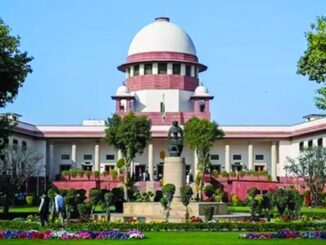
Tag: CJI

  • Supreme Court halts all mandir-masjid cases until 1991 Act verdict

    Supreme Court halts all mandir-masjid cases until 1991 Act verdict

    New Delhi (TIP)- The Supreme Court on Thursday, December 12,  issued a nationwide directive restraining all courts from entertaining fresh suits or passing orders to survey mosques to determine whether temple structures lie beneath them. This interim order serves as a sweeping pause on the growing litigation initiated by Hindu groups seeking to reclaim places of worship, effectively stalling proceedings in trial and high courts, and marking a significant intervention by the judiciary in a matter fraught with religious sensitivities and legal complexities.

    The directive came from a special bench, headed by Chief Justice of India (CJI) Sanjiv Khanna, which clarified that trial courts cannot “overreach” the Supreme Court while it adjudicates on challenges to the Places of Worship (Special Provisions) Act, 1991.

    “As the matter is sub judice before this Court, we deem it appropriate to direct that, though fresh suits may be filed, no suits would be registered and no proceedings shall be undertaken therein till further orders of this Court. Further, in the pending suits, no Court will pass any effective interim orders or final orders, including orders directing surveys, etc., till the next date of hearing/further orders of this Court,” ordered the bench, which also included justices PV Sanjay Kumar and KV Viswanathan. The court has scheduled the next hearing for February 17, 2025”.

    The directive comes amid a surge in litigation initiated by Hindu groups seeking the reclamation of alleged historical temple sites, prompting a host of legal proceedings in district and high courts. These disputes have sparked significant controversy and conflicting orders, amplifying political and communal tensions across the country. From Gyanvapi Masjid in Varanasi to Shahi Eidgah in Mathura, from Shahi Jama Masjid in Sambhal to the Taj Mahal in Agra, from the Dargah Sharif in Ajmer to the Bhojshala in Madhya Pradesh, a host of petitions seeking the redetermination of the character of different structures have sprung up across the country. Despite the significance of the issue, the matter had seen little progress in the Supreme Court over the last two years.

    Justice Khanna took over as CJI from justice Dhananjaya Y Chandrachud on November 11. He then formed a three-judge bench on December 7, paving the way for Thursday’s intervention.

    The Places of Worship Act, enacted in 1991, is central to this issue. The Act, which the court is deliberating on at the instance of the two sides – one challenging it and another seeking its strict enforcement — was enacted to preserve the religious character of all places of worship as they stood on August 15, 1947.

  • CJI turns down plea for urgent listing of Hijab row cases

    Chief Justice of India (CJI) Dhananjaya Y Chandrachud on Friday turned down a plea for an immediate listing of pleas seeking a directive to government institutions in Karnataka to allow students to appear for examinations wearing the hijab. “I will list it immediately after the Holi vacation. I will create a bench,” the CJI told a lawyer, who mentioned the matter. The Supreme Court closes for the Holi break on March 6 and will reopen on March 13.

    The lawyer pointed out that the exams are starting on March 9. “What can I do if you come on the last day?” the CJI asked the lawyer, who responded by saying the requests for a hearing were mentioned twice over the last two months. “I will form a bench. I will list the matter,” the CJI reiterated. But the lawyer asked: “What about the exams?” “I can’t answer your questions,” retorted the CJI. On February 22, the CJI said he would “take a call” soon on setting up a three-judge bench to take up the matter in view of a split verdict of the two judges of the previous bench in October 2022 after a group of students from Karnataka mentioned a similar plea. Another plea for listing the matter was made on January 23.

    The pleas have pointed out that the exams are commencing from March 9 but those wearing hijab would not be allowed inside the examination centres due to the state government’s ban on the headscarves in state-run institutions.

  • ‘No case is too small’: CJI after Rijiju’s ‘frivolous PILs’ remarks

    ‘No case is too small’: CJI after Rijiju’s ‘frivolous PILs’ remarks

    New Delhi (TIP)- Chief Justice of India (CJI) DY Chandrachud on Friday, December 16,  said that no case is too small for the Supreme Court and that the lack of intervention in matters related to personal liberty can lead to “serious miscarriage of justice”. His comments came two days after Union law minister Kiren Rijiju’s statement in the Rajya Sabha where he suggested the top court to avoid hearing bail pleas and “frivolous PILs” to tackle with the large pendency of cases.

    “No case is too small for the Supreme Court and no case is too big because we have to answer the call of conscience and the cry of liberty of our citizens. That is why we are here and these are not one-off cases. If we do not act in matters of personal liberty and grant relief, then what are we doing here?” the CJI observed while heading a bench comprising Justice PS Narasimha which was hearing a case related to a man from Uttar Pradesh, Iqram, sentenced to two years in jail for theft of electricity.

    On Wednesday, Rijiju told the Parliament that the apex court should only hear constitutional matters instead of bail applications to avoid high pendency of cases. He has also been at odds with the top court over the appointment of judges and favoured the National Judicial Appointment Commission, a proposed government body that would have replaced the collegium system of judges’ recruitments. It was struck down by the apex court in 2015 terming it unconstitutional.

    The Union minister also made a remark on court availing long vacations that prove inconvenient to justice-seekers. “There is a feeling among people of India that the long vacation which the courts obtain is not very convenient for justice-seekers,” he said.

    Supreme Court forms vacation benches to hear cases during its summer breaks, however, such benches are not availed during winter breaks.

    Likewise, the CJI announced that the court will not have vacation benches during this year’s winter break between December 19, 2022, and January 2, 2023.

    CJI Chandrachud further said that a case like theft of electricity cannot be elevated to that of murder. The court would be failing in its duty under Article 136 of the Constitution if it doesn’t intervene whenever there is a miscarriage of justice, he added.

    “The intervention by this court to protect the liberty of the citizens is founded on sound constitutional principles embodied in Article 136 of the Constitution. The right to personal liberty is a precious and inalienable right recognised by the Constitution,” he said.

    Article 136 permits the Supreme Court to take up any appeal against judgments passes by any court or tribunal in the country.

    Opposition leaders lashed out at the comment of Union law minister and MP Kiren Rijiju as he said the apex court should not be hearing bail pleas and frivolous PILs at a time when the pendency of cases is so high. Rijiju said this in the Rajya Sabha during a debate on a bill to rename the New Delhi International Arbitration Centre as the India International Arbitration Centre which was passed on Wednesday by the Rajya Sabha.

    Senior advocate Kapil Sibal questioned: “Does he even know the meaning of liberty?”

    Congress leader Salman Khurshid tweeted, “Forget NJAC, Govt wants to micromanage judiciary: cut vacations, no priority to bail, et al. What next?”

    On Thursday, Rijiju said in Parliament the issue of high judicial vacancies will keep coming up until the procedure of the appointment of judges changes.

    Trinamool’s Saket Gokhale said this comment is a direct assault on the independence of the Judiciary. “Law Minister @KirenRijiju is basically saying that vacancies for judges won’t be filled up unless Modi govt is allowed to appoint its own people as judges. Beyond brazen & another attempt to capture institutions,” he said.

    Source: HT
