Tag: Climate Change

  • ‘Champion of Change’ – Indian American Sunita Viswanath honored at White House

    ‘Champion of Change’ – Indian American Sunita Viswanath honored at White House

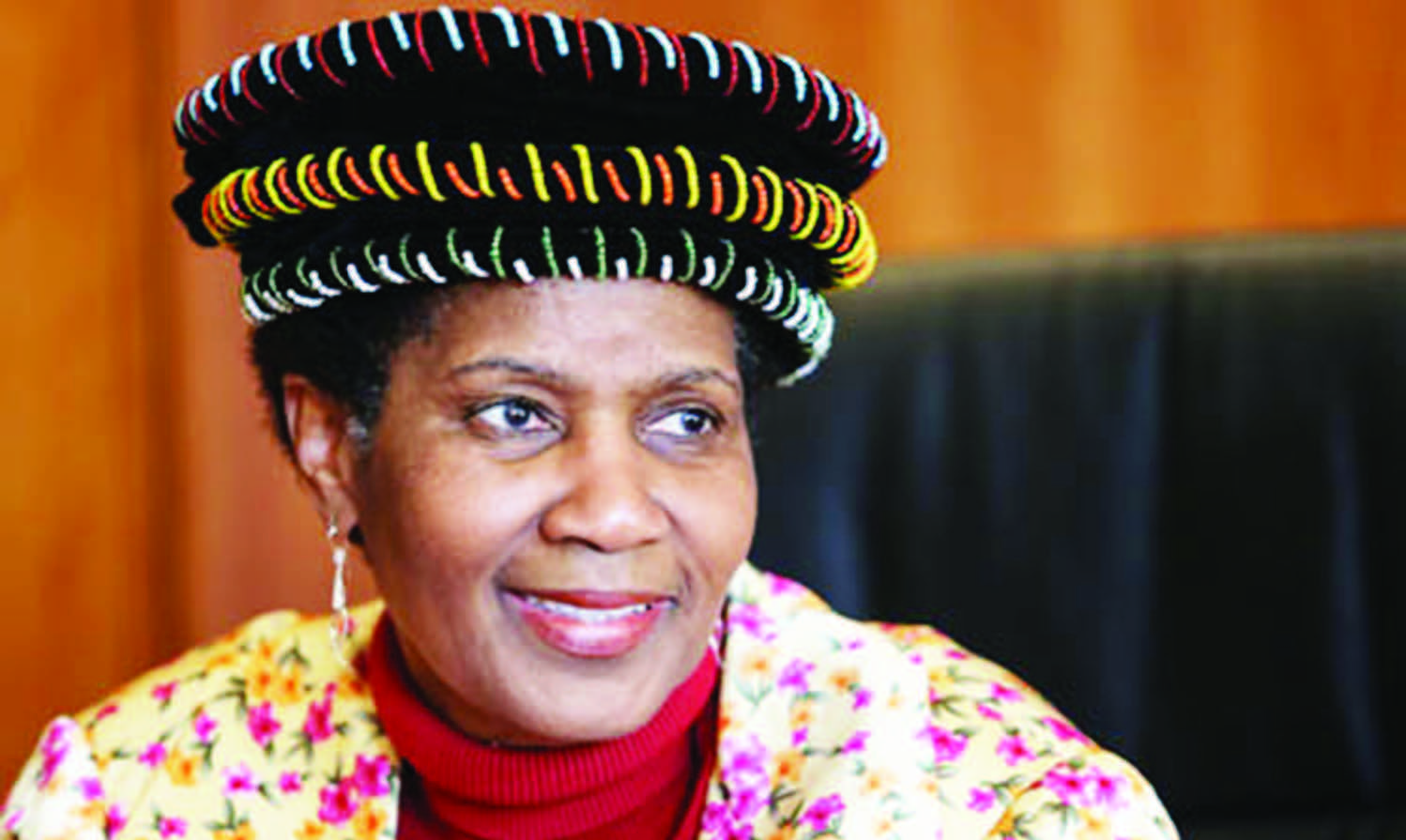
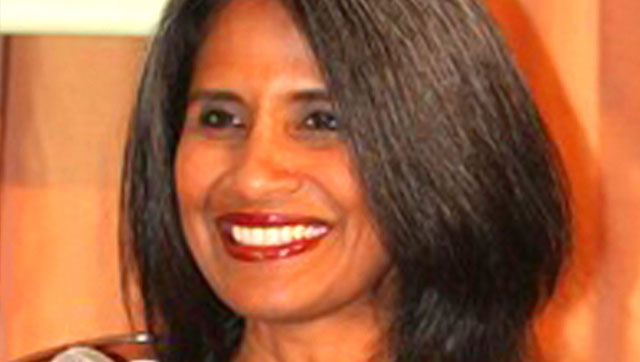
    The White House honoured an Indian-American woman Sunita Viswanath as one of the 12 ‘Champions of Change’ for her effort in protecting environment and communities from the effect of climate change.

    Viswanath was the only Indian American to figure in the list, and was selected for her work in encouraging Hindus to take care of the environment.

    Working with women’s and human rights organisations for almost three decades, Sunita is co-founder and active board member of the 14-year-old front-line women’s human rights organisation, Women for Afghan Women.

    “Sunita is also co-founder and board member of Sadhana: Coalition of Progressive Hindus, living and building a Hinduism that prioritises social justice, and upholding the Hindu principles of ekatva (oneness), ahimsa (non-violence) and sadhana (faith in action),” the White House said.

    “Sunita is being honoured for her work with Sadhana to encourage Hindus to live out these principles by taking care of the environment,” it added.

    Born in Chennai, Viswanath says her childhood was steeped in ritualistic practice of Hinduism.

    “I have always been secure in my identity as a Hindu. Growing up, I thought a lot about faith and religion, but I also had a very strong sense of social justice — what was fair,” Sunita said.

    “I imbibed profound lessons of love and justice from my religious upbringing, from the stories we were told, the prayers we learned, the texts we read. I went on as an adult to devote my life to advancing social justice causes, particularly women’s human rights,” she said.

    “If Hinduism cares deeply about all people and all living beings, then there must be an active, vocal Hindu movement for social justice and human rights today,” she said, adding that a small group of like-minded individuals got together to explore this question and Sadhana was born.

    One Sadhana’s initiatives is Project Prithvi – a grassroots green project, which mobilises Hindus, especially the youth, to live out the principle of ahimsa by taking care of the environment.

    Currently, they are working on a project to clean up specific beaches in Jamaica Bay where Hindus worship and litter the place.

  • HOME MINISTRY BRINGS IN TIGHTER NORMS FOR NGOS TO TRACK FOREIGN FUNDS

    NEW DELHI (TIP): Non-governmental organisations will soon have to start furnishing details of foreign funds received and utilised by them for ‘civil rights advocacy’, a new category created by the home ministry to ascertain whether NGOs are using funds specifically for issues such as human rights, democratic rights, natural resources and religious discrimination.

    In addition to this, every NGO in the country will have to put out details on its website within a week of getting foreign contribution of any value while banks will have to report all such receipts to the government within 48 hours of the transfer from abroad.

    These requirements are part of the proposals under an exercise initiated by the Prime Minister’s Office to tighten monitoring of NGOs. A fortnight after ETfirst reported on June 4 the planned move on PMO’s instructions to amend the Foreign Contribution (Regulation) Rules (FCRR), 2011, the home ministry has put in public domain the proposed changes to these rules following the Intelligence Bureau’s inputs to it to “improve oversight and increase transparency” in the working of the NGO sector in India.

    As per existing norms, NGOs are required to inform the government through their annual returns under 55 heads of ‘purposes’ for which foreign aid has been received and utilised by them. There was a 56th ‘purpose’, ‘of activities other’ than the 55 purposes. The home ministry has created a new category of such ‘purposes’, Civil Rights Advocacy, increasing the total number of purposes to 84.

    Under the new category, NGOs will have to specify whether they received any funds and utilised them for purposes such as “human rights, caste/religious discrimination, tribal/indigenous people’s rights, democratic rights, public accountability, issues regarding natural resources, climate change, cyber security, internet freedom, criminal justice system, communication strategy etc”.

    The ministry has created yet another category, ‘Research’, under which NGOs will have to specify spending of foreign funds on research, seminars, conferences, publications and lectures. “The effort is to ascertain specifically for what a NGO is getting foreign funds and what is it being spent on rather than leaving it uncertain,” a senior home ministry official said.

    The government has a provision to act against an NGO if any false information or concealment of material facts comes to light. The ministry had earlier suspended Greenpeace India’s foreign funding saying the NGO derailed the Mahan coal project and would indulge next in “protest-creation” to target eight other plants, potentially impacting 40,000 mw of power generation.

    hat also reflects in another proposed change in FCCR rules in the form which has to be filled up online for registration or renewal of licence for NGOs. The government has introduced a new declaration that NGOs must make that the foreign aid received by them will not be used for any activities “detrimental to national interest, likely to affect public interest, or likely to prejudicially affect the security, scientific, strategic or economic interest of the state”, leaving it to the discretion of the state to determine a violation.

    NGOs will have to also submit details of any social media account on Facebook or Twitter that it is operating, an apparent effort to keep tabs on social media campaigns.

  • Secrets of the bin Laden ‘treasure-trove’ – 106  documents released

    Secrets of the bin Laden ‘treasure-trove’ – 106 documents released

    In his final years hiding in a compound in Pakistan, Osama bin Laden was a man who at once showed great love and interest in his own family while he coldly drew up quixotic plans for mass casualty attacks on Americans, according to documents seized by Navy SEALs the night he was killed.

    On May 20th  morning, the U.S. Office of the Director of National Intelligence released an unprecedented number of documents from what U.S. officials have described as the treasure-trove picked up by the SEALs at bin Laden’s compound in Abbottabad, Pakistan, on May 2, 2011.

    Totaling 103 documents, they include the largest repository of correspondence ever released between members of bin Laden’s immediate family and significant communications between bin Laden and other leaders of al Qaeda as well as al Qaeda’s communications with terrorist groups around the Muslim world.

    Also released was a list of bin Laden’s massive digital collection of English-language books, think tank reports and U.S. government documents, numbering 266 in total.

    To the end bin Laden remained obsessed with attacking Americans. In an undated letter he told jihadist militants in North Africa that they should stop “insisting on the formation of an Islamic state” and instead attack U.S. embassies in Sierra Leone and Togo and American oil companies. Bin Laden offered similar advice to the al Qaeda affiliate in Yemen, telling it to avoid targeting Yemeni police and military targets and instead prioritize attacks on American targets.

    Much of bin Laden’s advice either didn’t make it to these groups or was simply ignored because al Qaeda affiliates in Yemen and North Africa continued to attack local targets.

    ISIS, of course, didn’t exist at the time bin Laden was writing. The group, which now controls a large swath of territory in the Middle East, grew out of al Qaeda in Iraq and has charted a different path, seeking to create an Islamic state and not prioritizing attacks on the United States and its citizens.

    Taken together, these documents and reading materials paint a complex, nuanced portrait of the world’s most wanted man in the years before he was killed in the raid on his compound.

    In the letters that bin Laden exchanged with his many sons and daughters, he emerges as a much-loved and admired father who doted on his children. And in a letter he sent to one of his wives, he even comes off as a lovelorn swain.

    That’s in sharp contrast to the letters bin Laden sent to al Qaeda leaders that demanded mass casualty attacks against American targets and insisted that al Qaeda affiliates in the Middle East stop wasting their time on attacks against local government targets. “The focus should be on killing and fighting the American people,” bin Laden emphasized.

    What bin Laden was reading

    Bin Laden’s digital library is that of an avid reader whose tastes ran from “Obama’s Wars,” Bob Woodward’s account of how the Obama administration surged U.S. troops in Afghanistan in 2009 and 2010, to Noam Chomsky as well as someone who had a pronounced interest in how Western think tanks and academic institutions were analyzing al Qaeda.

    Bin Laden was a meticulous editor, and some of the memos he wrote were revised as many as 50 times. Of the thousands of versions of documents recovered from computers and digital media that the SEALs retrieved at bin Laden’s compound, the final tally numbers several hundred documents.

    The new documents show how bin Laden reacted to the events of the Arab Spring, which was roiling the Middle East in the months before his death. While bin Laden had nothing to say publicly about the momentous events in the Middle East, privately he wrote lengthy memos analyzing what was happening, pointing to the “new factor” of “the information technology revolution” that had helped spur the revolutions and characterizing them as “the most important events” in the Muslim world “in centuries.”

    Some of the documents paint an organization that understood it was under significant pressure from U.S. counterterrorism operations. One undated document explained that CIA drone attacks “led to the killing of many jihadi cadres, leaders and others,” and noted, “(T)his is something that is concerning us and exhausting us.” Several documents mention the need to be careful with operational security and to encrypt communications and also the necessity of making trips around the Afghan-Pakistan border regions only on “cloudy days” when American drones were less effective.

    Al Qaeda members knew they were short on cash, with one writing to bin Laden, “Also, there is the financial problem.”

    Some of the documents have nothing to do with terrorism. One lengthy memo from bin Laden worried about the baleful effects of climate change on the Muslim world and advocated not depleting precious groundwater stocks. Sounding more like a World Bank official than the leader of a major terrorist organization, bin Laden fretted about “food security.” He also gave elaborate instructions to an aide about the most efficacious manner to store wheat.

    Family concerns

    Many of the documents concern bin Laden’s sprawling family, which included his four wives and 20 children. Bin Laden took a minute interest in the marriage plans of his son Khalid to the daughter of a “martyred” al Qaeda commander, and he exchanged a number of letters with the mother of the bride-to-be. Bin Laden excitedly described the impending nuptials, “which our hearts have been looking forward to.”

    Bin Laden corresponded at length with his son Hamza and also with Hamza’s mother, Khairiah, who had spent around a decade in Iran under a form of house arrest following the Taliban’s fall in neighboring Afghanistan during the winter of 2001.

    Hamza wrote a heartfelt letter to bin Laden in 2009 in which he recalled how he hadn’t seen his father since he was 13, eight years earlier: “My heart is sad from the long separation, yearning to meet with you. … My eyes still remember the last time I saw you when you were under the olive tree and you gave each one of us Muslim prayer beads.”

    In 2010 the Iranians started releasing members of the bin Laden family who had been living in Iran. Bin Laden spent many hours writing letters to them and to his associates in al Qaeda about how best he could reunite with them.

    In a letter to his wife Khairiah, he wrote tenderly, “(H)ow long have I waited for your departure from Iran.”

    Bin Laden was paranoid that the Iranians –who he said were “not to be trusted” — might insert electronic tracking devices into the belongings or even the bodies of his family as they departed Iran. He told Khairiah that if she had recently visited an “official dentist” in Iran for a filling that she would need to have the filling taken out before meeting with him as he worried a tracking device might have been inserted inside.

    U.S. intelligence officials have a theory that bin Laden might have been grooming Hamza eventually to succeed him at the helm of al Qaeda because the son’s relative youth would energize al Qaeda’s base. But Hamza never made it to his father’s hiding place in Abbottabad. When the SEALs raided bin Laden’s compound, they assumed Hamza would likely be one of the adult males living there, but he wasn’t.

    U.S. intelligence officials say they don’t know where Hamza, now in his late 20s, is today.

  • A FORTHRIGHT MODI IN CHINA

    A FORTHRIGHT MODI IN CHINA

    During his China visit, Prime Minister Modi has been unusually forthright in speaking about the problems that hold back the India-China relationship. He probably feels that his desire to strengthen ties with China being so clear, he has earned the confidence of the Chinese leaders enough to be able to pinpoint India’s concerns about some aspects of China’s policies that we find difficult to digest. This is a new approach Modi has fashioned. Our earlier approach has been to soft pedal differences, avoid airing them in public and pretend they are more manageable than they actually are. There has been a tendency also to explain China’s behaviour to ourselves by becoming their spokespersons to our own people, and in the process accept some of the blame for the problems that endure.

    Modi is following a different tack, that of creating consciousness in the Chinese public that China has a responsibility of addressing outstanding issues if it wants the bilateral relationship to move forward and bring about the Asian century that its leadership visualises. This is a more self-confident approach. Whether this more robust attitude will produce the results we want is not certain. China is used to such exhortations by the US, which, unlike our case, are also backed by US power. Yet, China both bends and defies to the degree necessary to manage the relationship with the US, but without changing its fundamental course of building its national power and commensurately raising the level of its strategic challenge to the US. In other words, China does not get cowed down, nor is willing to yield on essentials even when its policies do not make sense always in the light of its own self-interest as seen by external observers.

    Prime Minister Modi interacts with people at the India China business forum  (Photo courtesy: Twitter/PIB)
    Prime Minister Modi interacts with people at the India China business forum (Photo courtesy: Twitter/PIB)

    Whatever the caveats, Modi is moving the Chinese out of their present comfort zone and dealing with China with greater self-assurance which cannot but have some impact on how it treats India in the future. This is a new balance that Modi is establishing between leveraging economically the China connection for India’s development and not losing politically by diffidence in mentioning differences that endure. There are some indications that China believes that of all the partners that India is wooing for investments, it is the one best placed to meet India’s needs, especially in modernising its poor infrastructure. In other words, India’s choices are limited and this gives China a strong hand to play even in the economic field. Modi is implicitly making China reexamine its assumptions

    By choice or consequence, Modi is linking the economic to the political by his double messaging in Beijing. On the one hand, the joint statement issued during the visit explicitly says that outstanding differences, including on the boundary question, should not be allowed to come in the way of continued development of bilateral relations. On the other, Modi stressed in his joint press conference with Chinese premier Li Keqiang that China needed to “reconsider its approach on some of the issues that hold us back from realising the full potential of our partnership” and “take a strategic and long term view of our relations”. This suggested that the long term relationship could be either jeopardised or impeded if China continued with its present approach. It is interesting that in asking China to think long term he summarily debunked the widely accepted myth that China thinks not years but decades ahead in policy making. Standing alongside Li Keqiang, Modi reiterated the “importance of clarification of the Line of Actual Control”, a point he had made in Xi’s presence during the latter’s September visit to India, and “tangible progress on issues relating to visa policy (stapled visa issue, no doubt) and trans-border rivers”. He also alluded to “some our regional concerns” (undoubtedly China’s policies in our neighbourhood, especially in Pakistan). It is clear that Modi raised all these issues in his private conversations with Xi and Li Keqiang, as otherwise publicly mentioning them in the latter’s presence would have seen as a form of political ambush by the Chinese premier. Modi’s intention was obviously to make public his political expectations from China in the years ahead.

    Modi expatiated further on these points in his address at the Tsinghua University. He put more pressure on the Chinese government by stating publicly that if the two countries “have to realise the extraordinary potential of our relationship, we must also address the issues that lead to hesitation and doubts, even distrust, in our relationship”. This is extraordinary plain speaking. He spoke of trying “to settle the boundary question quickly” in a way that does “not cause new disruptions”- an allusion no doubt to China’s unreasonable demands in the eastern sector. This amounts to, again, asking the Chinese publicly to rethink its posture on the package deal on the border. To remove “a shadow of uncertainty” that “hangs over the sensitive areas of the border region” because “neither side knows where the Line of Actual Control is in these areas”, he recalled his proposal to resume the process of clarifying the LAC
    “without prejudice to our position on the boundary question”. This is a via media he is seeking between, on the one hand, stabilising the border and eliminating periodic stand-offs that damage the political relationship and make headway in other areas that much more difficult and, on the other, a permanent solution to the boundary question. It is doubtful whether China would accept this option that was always open. indeed, China was committed to this process but abandoned it favour of the Special Representatives (SR) mechanism. It is unclear, moreover, how the LAC clarification process and the SR mechanism can proceed simultaneously.

    Voicing concerns about China’s increased engagement “in our shared neighbourhood”, Modi, in his Tsinghua address, called for “deeper strategic communication to build mutual trust and confidence” so as to “ensure that our relationships with other countries do not become a source of concern to each other”. In talking of “shared neighbourhood” Modi is talking about South Asia and not the western Pacific, and this is significant. To strengthen our international cooperation, he frontally sought China’s support for India’s permanent membership of the UN Security Council and India’s membership of export control regimes like the Nuclear Suppliers Group. This was unusual as such a public appeal does not normally come from his elevated position. A prime Minister should not seen as a supplicant. Anyhow, by stating all this, Modi has, in a sense, laid out the political agenda of the relationship in the years ahead from his side, which if not achieved in some measure in a reasonable time frame can become a source of criticism and could even make the economic agenda with China even more controversial as a one-sided strategic compromise.

    The joint statement and the Tsinghua speech contain some notable formulations, omissions and iterations, some curious, many positive and a few negative. If the India relationship was for president Obama a defining one for the 21st century, the joint statement notes, as a rhetorical balance, that the “India-China relations are poised to play a defining role in the 21st century in Asia and, indeed, globally”. A China that supposedly rejects an equal status for India accepts in the joint statement that the two countries are “major poles in the global architecture”. On the boundary question, the old, cliched language is repeated and the emphasis remains on improved border management. No mention is made to China’s self-serving One Road One Belt
    (OBOR) initiative to which Xi attaches much importance, and which figured prominently in his recent Pakistan visit. Our neighbours like Sri Lanka and Nepal would have particularly noted this omission. Significantly, the joint statement contains no reference to security in the Asia-Pacific region, unlike in September 2014, which suggests a failure to agree on language on this sensitive issue. Maritime cooperation too does not figure in it, which suggests difficulties in drafting the joint statement.

    We have again thanked China’s Foreign Ministry and the government of “the Tibetan Autonomous Region of the People’s Republic of China” for facilitating the Kailash Manasarovar Yatra. It would have been sufficient to have simply thanked “China” in September 2014 and now, but the Chinese obviously press us to include formulations that recognise TAR as part of the PRC in our joint statements- a practice that was discontinued by the UPA government in the face of China’s increasingly strident claims on Arunachal Pradesh. These offensive claims unfortunately continue and therefore do not justify such politically one-sided gestures by us. Maybe we think this is too sensitive a subject for us to reticent about and to keep the relationship on even keel we feel we can keep giving China comfort over Tibet even when China cynically uses Tibet to make outlandish territorial claims on us. This gesture could also have been a quid pro quo for the stronger formulation on terrorism in the joint statement that could not have pleased Pakistan (though it should be noted that the statement refers not to “cross-border terrorism” which is a formulation India uses to accuse Pakistan, but to “cross border movement of terrorists” which has a different connotation), as well as the separate joint statement on Climate Change that fully reflects India’s position and assumes importance in the context of the Climate Change summit in Paris where the effort would be to isolate India and use the US-China agreement to that end. The question though remains how India will reconcile its commitment to work closely with the US to make the Paris Conference a success with the enunciation of a common position with China which conflicts with the basic US approach.

    The reference in the joint statement to the “commonalities” in the approach of the two countries to global arms control and nonproliferation is puzzling as it conflicts with reality and whitewashes China’s historical and current proliferation activities in Pakistan. To have China in return “note” our aspirations to join the NSG, is an altogether insufficient reason to make this concession and lose a political card against China and Pakistan. Opening ISRO to China through a Space Cooperation Outline (2015-2020) Cooperation may also seem premature to some, given the actual state of India-China relations.

    In his Tsinghua speech, Modi noted pointedly that while both countries seek to connect a fragmented Asia, “there are projects we will pursue individually”, which implies cold shouldering China’s idea of linking our Mausam and Spice Route projects with OBOR. Progress in the BCIM (Bangladesh, China, India, Myanmar) Economic Corridor is mentioned in the joint statement, despite the danger of opening up our inadequately nationally integrated northeast to more economic integration with China. Why Modi mentioned this corridor again in his university speech is unclear, but then, having participated in the joint working group discussions on the project for some time now, it might have been tactically difficult to close the door on it abruptly.

    That Modi himself announced at the last minute at Tsinghua the grant of e-visas to the Chinese after the Foreign Secretary had told the media earlier that no decision had been taken, raises questions about policy making, especially as the stapled visa issue remains unresolved. Of course, enhanced economic engagement requires easier visas and to that extent such a decision can be seen as pragmatic, but we have given up a valuable card touching upon sovereignty issues without sufficient return. No wonder the Chinese Foreign Minister was delighted by this gift from the Prime Minister.

    The driving force behind Modi’s wooing of China being trade and investment, the progress achieved on that front was of principal interest in terms of outcomes. Here, the results have been less than expected. In a sense this was to be expected as too little time had elapsed between Xi’s visit to India and Modi’s visit to China to produce dramatic results. The $20 billion of investment five years promised by Xi would take time to materialise under any circumstances, but more so in the case of China as it has so far invested little in the country, its investors have limited experience of working in India, its leaders are looking for preferential treatment and want a better understanding of the legal conditions. The joint statement largely repeats what was said in September 2014 during Xi’s visit on taking joint measures to alleviate the problem of deficit and cooperate in providing Indian products more market access in China. The language is very noncommittal and it is left to the India-China Joint Economic Group to work on these issues. It was agreed that the next meeting of the Strategic Economic Dialogue, co-chaired by Vice Chairman of NITI Aayog of India and Chairman of NDRC of China, will be held in India during the second half of 2015. On the other hand, China’s economic interests in India are treated more concretely, with satisfaction expressed with the progress achieved in the Railway sector cooperation including the projects on raising the speed on the existing Chennai-Bengaluru-Mysore line, the proposed feasibility studies for the Delhi-Nagpur section of high speed rail link, the station redevelopment planning for Bhubaneswar & Baiyappanahalli, heavy haul transportation training and setting up of a railway university.

    Although 24 agreements were signed during the visit and the number is impressive, in reality the most significant one relates to the opening of our respective consulates in Chengdu and Chennai and space cooperation. There is no economic agreement of note that figures in the list. Surprisingly, the joint statement contains no reference to the two industrial parks that China will be setting up in India, even if it were to merely record some progress in implementing this initiative. Even the figure of $20 billion of Chinese investments in India in the next 5 years- if nothing but for its positive optical effect- is not mentioned this time. No doubt 26 “agreements” were signed during the visit to Shanghai- mostly MOUs involving the private sector that have no binding value- in the areas of renewable energy, power, steel etc. These are sectors in which China is either already strongly present in India or is a global player as in the case of solar power. Its aim would be to capture the Indian market in what would be a highly fecund area for Chinese business given India’s massive plans in developing the solar power sector. A point to consider is whether the unfettered entry of Chinese firms would suffocate Indian enterprise in the renewable industry sector as has happened in the power and telecom sectors. Even financing of private Indian companies by Chinese banks has been put on the positive ledger in projecting the results of Modi’s visit, even though all that is meant is that China will lend money to Indian companies to buy more Chinese products and only add to the burgeoning trade deficit between the two countries. That these MOUs, if and when implemented ( many are in the form of intentions only) are potentially worth $ 22 billion is a PR exercise, which all countries resort to in order to embellish the economic “success” of visits by their leaders abroad, and can therefore be excused as standard diplomatic practice.

    All in all, the China challenge for India has not been reduced by Modi’s visit. On the contrary, Modi has highlighted the political challenges ahead, as China has remained reticent on the points raised by him. Modi is to be commended for largely making the right points during the visit. There were some slippages, but this was perhaps inevitable because China holds the stronger hand. The attempt always is to enlarge the areas of real or potential convergences rather than get bogged down over contentious issues and create a situation where it becomes difficult to issue any meaningful joint statement. The problem in the India-China case is that we are not strategic partners in reality and yet claim that we are. At the end of the day, making the right points and winning them the are two different things.

    As for personal chemistry between Xi and Modi, it would have been better if Xi too had avowed publicly that the two had a “plus one” friendship, otherwise the psychological advantage is with the side that remains silent. Let us also note personal chemistry can have a short shelf life in the face of hard political and strategic realities. Obama and Xi have had a shirtsleeves meeting in Palm Springs in California in 2013, Bush read Putin’s soul in Slovenia in 2001 and Obama had hamburgers with Medvedev in Washington in 2010, but these get-to-know informal meetings intended to create a personal rapport do not help resolve issues beyond a point. It remains though that both Xi and Li Keqiang made unprecedented personal gestures to Modi.

    (The author is a former Foreign Affairs Secretary and Dean, Centre for International Relations and Diplomacy, Vivekananda International Foundation. He can be reached at sibalk@gmail.com)

    (British English)

  • SUPPRESSING DISSENT – Why Greenpeace is first on the Indian government’s chopping block

    Source: World Resources Institute
    Source: World Resources Institute

    As Greenpeace India struggles to stay afloat, the real reason why the government wants to shut down the global environmental NGO hasn’t got much attention: Coal, the single biggest source of primary energy in India, is at the heart of the Narendra Modi government’s ambitious plans to ramp up industrial production in the country.

    Source: PwC
    Source: PwC

    A total of 1,199 new coal-based thermal power plants with a total installed capacity of more than 1.4 million MW proposed worldwide, the lion’s share – 455 plants – are in India, according to data from the World Resources Institute.

    India is overwhelmingly dependent on fossil fuels – coal, oil and gas – which meet more than three fourths of the country’s energy needs, despite Modi’s plans to promote alternative energy sources.

    Of the fossil fuels, oil and gas account for just about 30% of India’s energy needs, the bulk imported (80% in the case of crude oil). India has abundant reserves of coal, the fourth-largest in the world.

    Coal meets 54.5% of India’s energy needs, and 61.5% of the installed power generation capacity, and plays a key role in industries like steel and cement.

    India is set to more than double its coal consumption by 2035 and become the world’s largest coal importer by around 2020, according to the International Energy Agency.

    The cheapest of fossil fuels, coal is also the most polluting in terms of carbon emissions. Coal-burning power plants are the single biggest cause of climate change, way ahead of the burning of petroleum in transportation.

    Greenpeace has been at the forefront of a global campaign against coal mining and burning, and its Indian wing has mounted several high-visibility campaigns against coal-burning thermal power plants and coal mining in forest areas.

    Coal India and Adani in the spotlight

    Greenpeace graph2
    Especially irksome to the government must have been Greenpeace’s targeting of two domestic entities that are also major global players in coal – public-sector company Coal India, India’s 5th most valuable company by market capitalization at $35.9 billion (Rs 2.3 lakh crore) and the Gujarat-based Adani Group, whose promoter Gautam Adani is known to have a close relationship with Modi.

    Coal India is number one, and the Adani Group number three on the list of the top 200 coal companies globally ranked by the potential carbon emissions content of their reported reserves, according to Fossil Free Indexes, a stock market index that promotes ethical investing.

    Greenpeace has campaigned against both companies, exposing their claims on reserves and financial health, and documenting environmental and other violations. Greenpeace’s Australia chapter has opposed Adani’s plans to develop the world’s largest coal deposit, the Carmichael mine in Queensland, which it acquired for 16.5 billion dollars.

    Breakneck industrialization, Chinese style Companies like Coal India and Adani are expected to play a vital role in the Modi government’s grand plan for India to take over from China as the new ‘factory of the world’. With GDP growth dipping to 7% for the first quarter of 2015 (the lowest since 2009), China is clearly slowing down. India seems intent on capitalizing on this slowdown and the newfound limits on growth imposed by environmental and health concerns in China.

    The first signs that the Modi government is pushing for a Chinese-style industrialization project came when it announced a clutch of mega projects under the Make-In-India initiative. Work is underway on the most ambitious of these projects, the Delhi-Mumbai Industrial Corridor, across six states, to be built at an estimated cost of $100 billion.

    For the government, one of the chief obstacles in this path is land acquisition, which is being tackled through amendments to the existing legislation. The other big hurdle is energy, in which coal will continue to play the biggest part-and this is at the core of its grouse with organizations such as Greenpeace.

    Coal and Climate Change – an existential threat

    The burning of fossil fuels – coal, oil and gas, in that order – releases massive amounts of carbon into the atmosphere, and has been proven to be the biggest culprit behind climate change.green peace chart 4

    With carbon-dioxide levels at record highs – as IndiaSpend reported – only a fraction of the known extractable fossil fuel reserves, least of all, coal, can be burned without endangering the world’s future, the reason why campaigners like Greenpeace are dead set against the fuel. But for the Modi government, and India’s elites and middle classes in general, this would amount to the big prize being snatched away from sniffing distance. That’s why the shots fired against Greenpeace may be only the first in the long, bruising battle ahead.

    (This article was originally published on IndiaSpend.com, a data-driven and public-interest journalism non-profit)

  • MODI IN CHINA – A high-octane reception

    MODI IN CHINA – A high-octane reception

    [vc_row][vc_column width=”1/1″][vc_images_carousel images=”35692,35693,35694,35695″ onclick=”link_no” custom_links_target=”_self” mode=”horizontal” speed=”1500″ slides_per_view=”2″ autoplay=”yes” hide_pagination_control=”yes” hide_prev_next_buttons=”yes” partial_view=”” wrap=”yes” title=”LIST OF 24 AGREEMENTS SIGNED BETWEEN INDIA AND CHINA – India and China on Friday signed 24 deals worth over $10 billion during Modi’s visit to the country.” img_size=”full”][/vc_column][/vc_row][vc_row][vc_column][vc_column_text][quote_box_center]Here’s the complete list[/quote_box_center]

    1. Protocols between India and China on the establishment of cousulates-general at Chengdu and Chennai and the extension of the consular district of the consulate general of India in Guanzhou to include Jiangxi province.
    2. MoU between the ministry of skill development and entrepreneurship of India and the ministry of human resources and social security of China on cooperation in the field of vocational education and skill development.
    3. Action plan on cooperation in setting up of the Mahatma Gandhi National Institute for Skill Development and Entrepreneurship in Ahmedabad/Gandhinagar in Gujarat.
    4. MoU between India and China on consultative mechanism for cooperation in TRADE negotiations.
    5. MoU on cooperation between the ministry of external affairs of India and international department of the central committee of the Communist Party of China.
    6. Action plan between the National Railway Administration of China and the ministry of railways of India on enhancing cooperation in the railway sector. (2015-16).
    7. MoU on education exchange programme.
    8. MoU between the ministry of mines of India and the ministry of land and resources of China on the cooperation in the mining and minerals sector.
    9. Space Cooperation Outline (2015-2020).
    10. Protocol on health and safety regulations on importing Indian rapeseed meal between the export inspection council, ministry of commerce and industry of India and the general administration of quality supervision, inspection and quarantine.
    11. MoU between Doordarshan and China Central Television on cooperation in the field of broadcasting.
    12. Agreement between the ministry of tourism of India and the national tourism administration of China on cooperation in the field of tourism.
    13. MoU on establishing India-China think-tanks forum.
    14. MoU between India’s Niti Aayog and the Development Research Centre, State Council of China.
    15. MoU between India’s ministry of earth sciences and the China Earthquake Administration concerning cooperation in the field of earthquake science and earthquake engineering.
    16. MoU between India’s ministry of earth sciences and the State Oceanic Administration of China on cooperation in the field of ocean science, ocean technology, climate change, polar science and cryosphere.
    17. MoU on scientific cooperation between Geological Survey of India, ministry of mines of India and the China Geological Survey, ministry of land and resources of China in geoscience.
    18. MoU between the ministry of external affairs of India and ministry of foreign affairs of China on establishment of states/provincial leaders’ forum.
    19. Agreement on the establishment of sister-state/province relations between state government of Karnataka and provincial government of Sichuan of China.
    20. Agreement on establishment of sister-city relations between Chennai and Chongqing of China.
    21. Agreement on establishment of sister-city relations between Hyderabad and Qingdao of China.
    22. Agreement on establishment of sister-city relations between Aurangabad and Dunhuang of China.
    23. MoU between the Indian Council for Cultural Relations and Fudan University on the establishment of a centre for Gandhian and Indian studies.
    24. MoU between Indian Council for Cultural Relations and Yunnan Minzu University on the establishment of a yoga college.

    [/vc_column_text][/vc_column][/vc_row]

  • UP project runner-up at UK award

    LONDON (TIP): First the good news – a rural project in the heart of Uttar Pradesh that plans to use abundantly and cheaply available agricultural waste as feedstock to co-produce reliable and affordable electricity and clean household cooking gas has become the runner up for the first prize floated by world famous Imperial College for its most innovative female student entrepreneurs in science and technology.

    The bad news however is that two female students from India, who had made it to the top five shortlist failed to make it to the winner’s podium.

    The £10,000 Althea-Imperial prize was won by Charikleia Spathi, a PhD student from the faculty of engineering for her idea of creating ultra-waterproof concrete additive that makes buildings less vulnerable to natural hazards like flooding.

    Spathi draws on the use of paper sludge ash, a waste product to create a super waterproof powder.

    The two Indian students – one who has developed a vaccine delivery system and another who is working on a way of enabling citizen scientists to help find potential new antibiotics failed to win the prize.

    Meanwhile the UP project Oorja is by Clementine Chambon, a PhD student which aims to build and install decentralised, easy to operate plants to power off-grid villages in rural India, where it will be owned and leased by micro-entrepreneurs and women’s self-help groups.

    These ‘mini power-plants’ will coproduce renewable energy and biochar from crop residues. Clean and reliable electricity will help increase the time children can study, facilitate mobile phone charging and use of computers and extend business hours beyond daylight. Provision of cooking gas will reduce the time women spend collecting firewood and reduce health hazards.

    Biochar will also help improve soil fertility by improving its water retention capacity, resulting in higher crop yields and enhanced food security.

    Speaking exclusively to TOI, Chambon said, “We are developing an innovative and sustainable technological solution to address the challenges of energy poverty, soil degradation, food security and greenhouse gas emissions simultaneously. Biochar is a natural and safe soil remediation product which will help restore degraded agricultural soils by improving its water and micro-nutrient retention capacity, thereby significantly increasing crop yields and improving farmer incomes. It will reduce the dependence on fertilizers and store up to 80%of organic carbon by mass permanently and safely in the soil, providing negative carbon emissions.”

    Chambon added, “We will pilot our solution in rural Eastern UP where nearly 80% of villages are un-electrified. They rely on fossil-fuels such as kerosene for household lighting, firewood for cooking and diesel for irrigation and commercial power. All of these are expensive and unreliable alternatives and harmful to health and environment, releasing large amounts of CO2 in the atmosphere. Here, 75% of people are engaged in agriculture for their livelihood and a major driver of poverty is crop failure, due to soil degradation resulting from frequent droughts and floods, exacerbated by the pernicious effects of climate change. Our mission is to develop locally available crop wastes”.

  • Court denies Pachauri permission to travel abroad

    NEW DELHI (TIP): The Delhi High Court on April 23 denied permission to environmentalist RK Pachauri, accused in a sexual harassment case, to travel abroad to attend the Global Water Summit.

    Pachauri had moved the court seeking permission to go to Greece on April 26-29 for the summit.

    Justice SP Garg denied relief to Pachauri after the Delhi Police vehemently opposed his plea and said his presence was not required at the summit and he may abuse the process of law if allowed to go abroad.

    “I don’t think Pachauri’s presence is required there (at the summit),” Justice Garg said after which the plea was withdrawn by Pachauri’s counsel.

    Pachauri was granted anticipatory bail on March 21 but was directed not to leave the country without the court’s permission.

    He was also directed not to visit the premises of The Energy and Resources Institute (TERI). The allegation against Pachauri was made by a woman research analyst.

    Citing several SMS texts, e-mails and WhatsApp messages as evidence, the woman has accused Pachauri of sexually harassing her soon after she joined TERI in September 2013.

    Pachauri stepped down as chairperson of the UN Intergovernmental Panel on Climate Change (IPCC) in February and proceeded on leave from TERI, where he was the director general. But he has denied the allegations of sexual harassment levelled against him.

    During the hearing, Delhi police said the investigation was at a crucial stage and his visit abroad would hamper the probe.

  • The German drum gone silent

    The German drum gone silent

    The death of Günter Grass on Monday, April 13, a giant German writer of the post-World-War-II era, a novelist, playwright, poet, fine draftsman and a sculptor, who was awarded the Nobel Prize in 1999, has eclipsed an enormous creative force of modern-day German world of letters which has been equally venerable as it is universal. Throughout his literary journey, Grass tried to uphold a socio-political and cultural vigor he had fostered amongst the tribe of the writers to act as an ongoing check on the current political affairs. As such, he was often referred to as the moral conscience keeper of his country. He developed an early insight into the fact that writers usually tend to harp on endeavors that serve best their individual interests and motives, encapsulated, at the most, in the niches confined to their personal agendas. Hence, far from taking their rightful place in the socio-political arena, they often end up selling themselves and their voice for a price.

    As a liberal public intellectual with Leftist (though not communist) leanings, Grass had an unabated faith in the multiple realities of life which seems to have had an almost obligatory theme thrust upon his writings – the Third Reich and its legacies. He helped to shape the German postwar history – literary, political and personal – as no one else did, and turned to writing from arts in the hope of a better understanding of “ourselves, our time and our actions” by engaging himself with the meaning of our experiences and deeds, both political as well as personal. The central message of his writings, especially of the Danziger Trilogy: The Tin Drum, Cat and Mouse and Dog Years, as his entire engaged life too prompts one to recall George Santayana’s words: “Those who cannot remember the past are condemned to repeat it.”‘

    Caught between the opposites  

    Born on  October 16, 1927 in the Free City of Danzig, then East-Prussia, and now in Poland, Günter Grass attended the elementary school and later high school there. He later wrote in a poem called Kleckerburg: “And I grew up between / the Holy Spirit and Hitler’s Image”. It was his childhood dream to become an artist. The treasure of books his mother had and her passion for music and theatre supported, in addition, by his teachers gave an impressive kick-off to this vocation, while his father could only play rejection. Decades later Grass wrote: “When I was fifteen, I wanted to murder my father in thoughts, words and works with my Hitler Youth Dagger.”

    The Second World War broke into the life of the young boy with all the vehemence and violence and provided him with experiences, which would determine the largest part of Grass’ later works. Just at15 years of tender age, he fled his family’s tight grip and joined the German Navy as a volunteer, only to be later sent to the Waffen-SS.

    As one of those “who were spared by the capricious war and who became aware of the randomness of their existence,” Grass was now confronted with a future full of question marks, just as his entire generation too was “thrown from 1945 to the wild tracks of life,” as he once called it. Grass refused to lead a middle-class, secured life, which was recommended by his “unloved” father. Instead, he went on to lead “a reality-contemptuous, against all odds penetratingly decided realization of his childhood desire to become an artist,” wrote his biographer, Volker Neuhaus, in Günter Grass – writer, artist, and contemporary.

    After apprenticeship as a stone mason, Grass studied sculpture and graphics from 1948-1956 at the Academy of Arts, Düsseldorf. In 1953, he moved to the University of Fine Arts “in the more complicated Berlin”, where in the mid-1950s Grass debuted as a poet and playwright. After initial attempts as a writer, he became a member of the prestigious “Group47”. From 1957 to 1959 he lived with his first wife Anna in Paris, where his first great novel, The Tin Drum was completed. The pursuit to be a sculptor was abandoned until further notice which he engaged with only in later years, when he was back with the visual arts. However, he designed the covers of his books himself and illustrated many of them.

    Prone to controversies

    As an intellectual, Grass never shied away from controversies, though he never looked for one. They appeared rather as the by-products of his public engagement. For example, though the Swedish Academy, while awarding him the Nobel Prize for Literature in 1999, praised him for his espousal of “the enormous task of reviewing contemporary history by recalling the disavowed and the forgotten: the victims, losers and lies that people wanted to forget because they had once believed in them,” and called The Tin Drum “one of the enduring literary works of the 20th century,” a few years later the author of this masterpiece itself became controversial when he revealed in his autobiography Peeling the Onion, in 2006 that for almost a year or so he had had to join as a young man of 17 a unit of Hitler’s Army called Waffen SS, known for its inhuman acts and horrific crimes, both at home and abroad. Though he insisted that he was only engaged in doing relatively innocent jobs in the Army, but the revelation itself came as a shock and brought him a battery of accusations of hypocrisy. “It was a weight on me,” Grass had later stated. “My silence over all these years is one of the reasons I wrote the book. It had to come out in the end.”

    He was not the only one of his generation to be secretive of his wartime past, but being a pre-eminent public intellectual who had laid open the wounds the German history had both suffered from and inflicted on others, he became the object of mockery beyond the borders of Germany. But there were equal number of voices engaged in his defense as were engaged in his derision. Hardly anyone holds the Nazi seduction of the youngster for a problem, but what is held against him is rather the long silence to come out with it.

    Nevertheless, he seems to have required a whole lifetime to counter and put to death this immature shame he had put on himself at an adolescent age, which, however, he revealed only in the later years of his life. It must have had a cumulative effect on his artistic soul and hence in itself an incitement enough to turn himself into a cleanser of his soul, since he remained the moral voice of his country throughout his life.

    Books-dangerous tools 


    Grass has been vocal about the social misery and maladies of sorts prevalent in all societies. Not only himself, but he had rather wanted every writer to intervene and get involved in the day- to- day decisions made by the regimes. In his Nobel speech in 1999, he highlighted why books and their authors become so dangerous in the eyes of the powerful. He stated that “the evidence provided by literary works often proves that the truth exists only in the plural, just as there does not exist a single reality, but indeed a multitude of realities”. In one of his poems thematizing Grass on Grass, he states:

    “I want to be buried with a bag full of nuts and with the renewed teeth.

    If it then crackles, where I lie, can be assumed: It is him, still very much him.”

    My association with him too was a result of this engagement which began in 1987, when as Vice-President of Berlin Writers Association (NGL) I co-operated with him to get some incarcerated Turkish writers released in that country. This engagement evolved into my becoming active in the Writers-in-Prison Committee of the PEN.

    Later, I followed his call to support the former East-German PEN when the reunification process of both the PEN Clubs ran into difficulties as some West German members objected to the inclusion of some East German Members suspected of espionage for the Stasi, the much-hated State Security agency. Ultimately, his moral instance of not excluding anyone won the upper hand and the German PEN was at last reunited. By this time Grass had donated his historical residence to the German Academy of Arts and Literatures, where the writers of repute were to be given three months’ residencies to complete their ongoing literary works. I was lucky to have been given this residency twice within a span of three years.

    Kolkata connection

    Whatever his urge to intervene came up with was almost always polemical, and hence controversial, often undiplomatic but straightforward, though not always on the basis of facts, but always heard and commented upon by intellectual circles and media.

    In his more than three decades of association with Kolkata, Grass visited the city thrice and was overwhelmed by its cultural richness. At least on two occasions he stayed longer in the town, the longest in 1986 which invoked both his fascination for as well as his aversion to the existing realities there. Whereas the earlier sojourn had produced a chapter in a book called The Flounder, the later sojourn produced a full-length book in 1988 called Show your Tongue. In this book, written impressionistically in the form of a dairy, Grass’ more than thirty-years-old association with Kolkata had multiple shades conspicuous in the depiction of the “omnipresent stench”, city’s culture of hero worship, and  of a philanthropic reach out to its marginalized people like the rag pickers. Both the content as well as the tone of the Show your Tongue invoked criticism from both intellectuals as well as the politicians. But Grass never meant to insult anyone; he only wanted to prompt the authorities to do more than just talk.

    Until shortly before his death, Grass was deeply worried about the future of humanity. “We are heading for the third great war,” the Nobel Laureate said in an interview with the Spanish newspaper El País, which was recorded on March 21 in Lübeck and published for the first time on Tuesday, the day after his death.
    “There is war everywhere. We are in danger of making the same mistakes as before. Without realizing it, as if we were sleepwalkers, we can go to a new world war,” he had warned.

    In addition to the many political conflicts the world is facing today, Grass had complained in the interview against the prevalent “social misery all over the world”, as also against the problems of overpopulation and climate change.” The consequences are completely ignored…, there is one meeting after another between the leaders and experts, but the problem remains: Nothing is done,” he had complained.

    The author of novels such as Dog Years, Cat and Mouse, Local Anaesthetic, The Rat, The Call of the Toad, Too Far A field, Crabwalk and The Box, his latest novel as well as of My Century and Two States – One Nation? can now rest in peace leaving the onus of engagement with moral and political issues on his many successors.

    The writer was Poet-Laureate in Germany between 1997- 2008 and has published 14 anthologies of poetry.

    • The central message of the writings of Gunter Grass, especially of the Danziger Trilogy: The Tin Drum, Cat and Mouse and Dog Years, was to caution the humanity against the political misadventures that kill the conscience of an entire generation.
    • He remained candid about his beliefs to the extent of being blunt and hurtful.
    • Considered to be the voice of conscience of his times, he did not hesitate from writing in his autobiography Peeling the Onion, in 2006 that for almost a year he had had to join as a young man of 17 a unit of Hitler’s Army called Waffen SS, known for its inhuman acts and horrific crimes, both at home and abroad.
    • His book on Kolkata, Show your Tongue invoked criticism from both intellectuals as well as the politicians. He remained engaged in charity work for the street children of Kolkata till his death.
  • SMART MOVES – Modi Government on US & China

    SMART MOVES – Modi Government on US & China

    [vc_row][vc_column][vc_column_text]

    “The Modi government will face the test of managing closer strategic relations with the US, which are in part directed against China, and forging closer ties with China that go against this strategic thrust, besides the reality that China has actually stronger ties with the US than it can ever have with India, though the underlying tensions between the two are of an altogether different order than between India and the US.”


    [/vc_column_text][/vc_column][/vc_row][vc_row][vc_column width=”1/2″][vc_column_text]

    [quote_box_center]China[/quote_box_center] 

    Prime Minister Modi has been quick to court both US and China. His first overtures were to China, prompted no doubt by his several visits there as Chief Minister of Gujarat, Chinese investments in his home state and his general admiration for China’s economic achievements. Beyond this personal element, many in the government and corporate sectors in India believe that our politically contentious issues with China, especially the unresolved border issue, should be held in abeyance and that economic cooperation with that country should be expanded, as India can gain much from China’s phenomenal rise and the expertise it has developed in specific sectors, especially in infrastructure. It is also believed that China, which is now sitting over $4 trillion of foreign exchange reserves, has huge surplus resources to invest and India should actively tap them for its own developmental needs. In this there is continuity in thinking and policy from the previous government, with Modi, as is his wont, giving it a strong personal imprint.

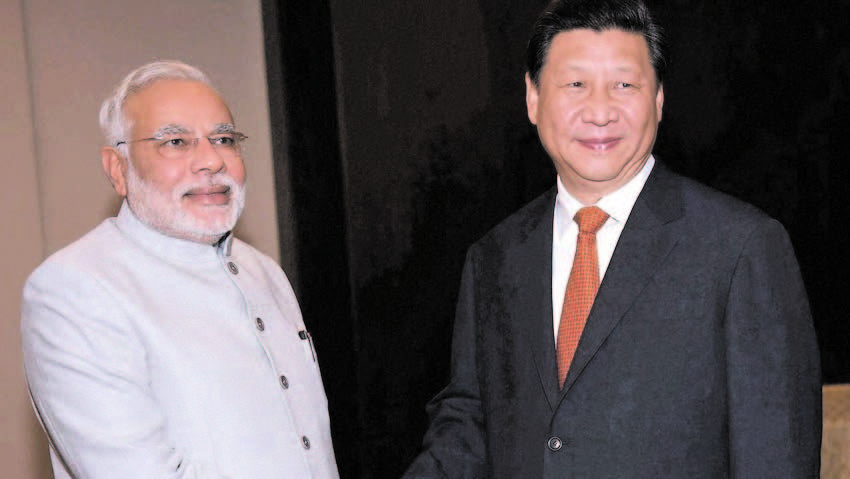
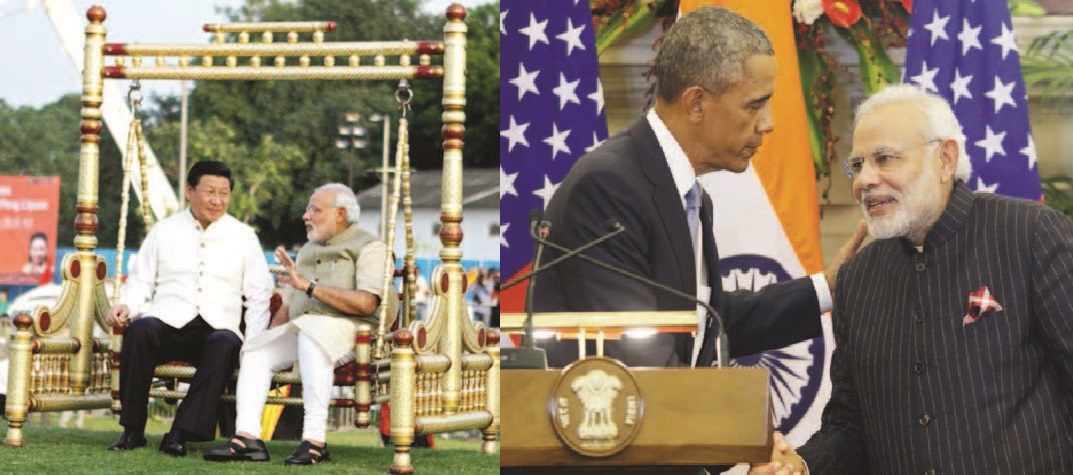
    The first foreign dignitary to be received by Modi after he became Prime Minister was the Chinese Foreign Minister, representing the Chinese President. This was followed by up by his unusually long conversation on the telephone with the Chinese Prime Minister. Our Vice-President was sent to Beijing to celebrate the 60th anniversary of the Panchsheel Agreement even though China has blatantly violated this agreement and India’s high level diplomatic endorsement of it only bolsters Chinese diplomacy, especially in the context of China-created tensions in the South China and East China Seas. Modi had occasion to meet President Xi Jinxing in July at the BRICS summit in July 2014, and this was followed up by the Chinese President’s state visit to India in September 2014, during which the Prime Minister made unprecedented personal gestures to him in an informal setting in Ahmedabad.

    The dramatics of Modi’s outreach to the Chinese aside, his objectives in strengthening economic ties with China, essentially imply a consolidation of the approach followed in the last decade or so, with some course correction here and there. In this period, China made very significant headway in our power and telecom sectors, disregarding obvious security concerns associated with China’s cyber capabilities and the links of Chinese companies to the Chinese military establishment. Many of our top companies have tapped Chinese banks and financial institutions for funds, and this has produced a pro-Chinese corporate lobby in our country. This lobby will obviously highlight the advantages of economic engagement over security concerns. The previous Prime Minister followed the approach of emphasizing shared interests with China rather than highlighting differences. The position his government took on the Depsang incident in May 2013 showed his inclination to temporize rather than confront. Externally, he took the line, which Chinese leaders repeated, that the world is big enough for India and China to grow, suggesting that he did not see potential conflict with China for access to global markets and resources. Under him, India’s participation in the triangular Russia-India-China format (RIC) and the BRICS format continued, with India-originated proposal for a BRICS Development Bank eventually materializing. Indian concerns about the imbalance in trade were voiced, but without any action by China to redress the situation. India sought more access to the Chinese domestic market for our competitive IT and pharmaceutical products, as well as agricultural commodities, without success. Concerns about cheap Chinese products flooding the India market and wiping out parts of our small-scale sector were voiced now and then, but without any notable remedial steps. The Strategic Economic Dialogue set up with China, which focused primarily on the railway sector and potential Chinese investments in India, did not produce tangible results.

    The Manmohan Singh government, despite China’s aggressive claims on Arunachal Pradesh and lack of progress in talks between the Special Representatives on the boundary issue as well as concerns about China’s strategic threats to our security flowing from its policies in our neighborhood, especially towards Pakistan and Sri Lanka, declared a strategic and cooperative partnership with that country. During Manmohan Singh’s visit to China in September 2013, we signed on to some contestable formulations, as, for example, the two sides committing themselves to taking a positive view of and supporting each other’s friendship with other countries, and even more surprisingly, to support each other enhancing friendly relations with their common neighbors for mutual benefit and win-win results. This wipes off on paper our concerns about Chinese policies in our neighborhood. We supported the BCIM (Bangladesh, China, India, Myanmar) Economic Corridor, including people to people exchanges, overlooking Chinese claims on Arunachal Pradesh and the dangers of giving the Chinese access to our northeast at people to people level. The agreement to carry out civil nuclear cooperation with China was surprising, as this makes our objections to China-Pakistan nuclear ties politically illogical. We also agreed to enhance bilateral cooperation on maritime security, which serves to legitimize China’s presence in the Indian Ocean when China’s penetration into this zone poses a strategic threat to us.

    As a mark of continuity under the Modi government, during President Xi Jinxing’s September 2014 visit to India, the two sides agreed to further consolidate their Strategic and Cooperative Partnership, recognized that their developments goals are interlinked and that their respective growth processes are mutually reinforcing. They agreed to make this developmental partnership a core component of their Strategic and Cooperative Partnership. The India-China Strategic Economic Dialogue was tasked to explore industrial investment and infrastructure development.

    To address the issue of the yawning trade imbalance, measures in the field of pharmaceuticals, IT, agro-products were identified and a Five-Year Development Program for economic and Trade Cooperation to deepen and balance bilateral trade engagement was signed. Pursuant to discussions during the tenure of the previous government, the Chinese announced the establishment of two industrial parks in India, one in Gujarat and the other in Maharashtra, and the “Endeavour to realize” an investment of US $ 20 billion in the next five years in various industrial and infrastructure development projects in India, with production and supply chain linkages also in view. In the railway sector, the two sides the two sides agreed to identify the technical inputs required to increase speed on the existing railway line from Chennai to Mysore via Bangalore, with the Chinese side agreeing to provide training in heavy haul for 100 Indian railway officials and cooperating in redevelopment of existing railway stations and establishment of a railway university in India. The Indian side agreed to actively consider cooperating with the Chinese on a High Speed Rail project. In the area of financial cooperation, the Indian side approved in principle the request of the Bank of China to open a branch in Mumbai.

    The Modi government has agreed to continue defense contacts, besides holding the first round of the maritime cooperation dialogue this year, even though by engaging India in this area it disarms our objections to its increasing presence in the Indian Ocean area, besides drawing negative attention away from its policies in the South China Sea as well as projecting itself as a country committed to maritime cooperation with reasonable partners. The joint statement issued during Xi Jinxing’s visit omitted any mention of developments in western Pacific, though it contained an anodyne formulation on Asia-Pacific. This becomes relevant in view of the statements on Asia-pacific and the Indian Ocean region issued during President Obama’s visit to India in January 2015.

    Our support, even if tepid, continues for the BCIM Economic Corridor. On our Security Council permanent membership, China continues its equivocal position, stating that it “understands and supports India’s aspiration to play a greater role in the United Nations including in the Security Council”. It is careful not to pronounce support for India’s “permanent membership”. During Foreign Minister Sushma Swaraj’s visit to China for the RIC Foreign Ministers meeting, China has maintained its equivocation, although the press has wrongly presented the formulation as an advance. China is openly opposed to Japan’s candidature in view of the sharp deterioration of their ties. In India’s case, it avoids creating a political hurdle to improved ties by openly opposing India’s candidature. “A greater role” could well mean a formula of immediately re-electable non-permanent members, of the kind being proposed by a former UN Secretary General and others.

    On counter-terrorism lip service is being paid to cooperation. On Climate Change, the two countries support the principle of “equity, common but differentiated responsibilities and respective capabilities”, although the US-China agreement on emission reduction targets has created a gap in Indian and Chinese positions, with the Modi government deciding to delink itself from China in international discussions to follow.

    In diplomacy, once concessions or mistakes are made, retrieval is very difficult unless a crisis supervenes. The Modi government, for reasons that are not too clear, repeated the intention of the two countries to carry out bilateral cooperation in civil nuclear energy in line with their respective international commitments, which has the unfortunate implication of India circumscribing its own headroom to object to the China-Pakistan nuclear nexus, besides the nuance introduced that China is observing its international commitments in engaging in such cooperation. The calculation that this might make China more amenable to support India’s NSG membership may well prove to be a mistaken one. Surprisingly, stepping back from the Manmohan government’s refusal towards the end to make one-sided statements in support of China’s sovereignty over Tibet when China continues to make claims on Indian territory, the new government yielded to the Chinese ruse in making us thank the “Tibetan Autonomous Region of the People’s Republic of China” as well as the Chinese Ministry of Foreign Affairs – as if both are independent of the Chinese government- for facilitating the Kailash Mansarovar Yatra and opening the new route through Nathu La, even though this is not the  most rational route because it involves a far longer journey, made easier of course by much better infrastructure. On receiving the flood season hydrological date the Chinese have stuck to their minimalist position.

    On the sensitive border issue, the disconnect between the joint statement which repeats the usual cliches and the serious incident in Chumar coinciding with Xi’s visit was obvious. China’s double game of reaching out to India- with greater confidence now as the gap between it and India has greatly widened and it has begun to believe that India now needs China for its growth and development goals- and staging a provocation at the time of a high level visit, continues. This is a way to remind India of its vulnerability and the likely cost of challenging China’s interests, unmindful that its conduct stokes the already high levels of India’s distrust of that country. It went to Modi’s credit that he raised the border issue frontally with XI Jinping at their joint press conference, expressing “our serious concern over repeated incidents along the border” and asking that the understanding to maintain peace and tranquility on the border “should be strictly observed”. He rightly called for resuming the stalled process of clarifying the Line of Actual Control (LAC). While this more confident approach towards China is to be lauded, we are unable to persuade China to be less obdurate on the border issue because we are signaling our willingness to embrace it nonetheless virtually in all other areas.

    That Modi mentioned “India’s concerns relating to China’s visa policy and Trans Border Rivers” while standing alongside Xi Jinping at the joint press conference indicated a refreshing change from the past in terms of a more open expression of India’s concerns. With regard to Bangladesh-China-India-Myanmar Economic Corridor that China is pushing hard, Modi rightly added a caveat by declaring that “our efforts to rebuild physical connectivity in the region would also require a peaceful, stable and cooperative environment”. He also did not back another pet proposal of Xi: the Maritime Silk Road, which is a re-packaged version of the notorious “string of pearls” strategy, as the joint statement omits any mention of it.

    Even as Modi has been making his overall interest in forging stronger ties with China clear, he has not shied away from allusions to Chinese expansionism, not only on Indian soil but also during his visit to Japan. After President Obama’s visit to India and the joint statements on South China Sea and Asia-Pacific issued on the occasion which can be construed as directed at China, Foreign Minister Sushma Swaraj’s recent visit there acquired more than normal interest in watching out for indications of China’s reaction. Her call on Xi Jinping was projected, quite wrongly, as going beyond normal protocol, when in actual fact the Chinese Foreign Minister gets access to the highest levels in India during visits. Swaraj seems to have pushed for an early resolution of the border issue, with out-of-the-box thinking between the two strong leaders that lead their respective countries today. Turning the Chinese formulation on its head, she called for leaving a resolved border issue for future generations.

    That China has no intention to look at any out-of-the-box solution- unless India is willing to make a concession under cover of “original thinking”- has been made clear by the vehemence of its reaction to Modi’s recent visit to Arunachal Pradesh to inaugurate two development projects on the anniversary of the state’s formation in 1987. It has fulminated over the Modi visit over two days, summoning the Indian Ambassador to lodge a protest, inventing Tibetan names for sub-divisions within Arunachal Pradesh to mark the point that this area has been under Tibetan administrative control historically. The Chinese Vice-Foreign Minister arrogantly told our Ambassador that Modi’s visit undermined “China’s territorial sovereignty, right and interests” and “violates the consensus to appropriately handle the border issue.” China is making clear that it considers Arunachal Pradesh not “disputed territory” but China’s sovereign territory. It is also inventing a non-existent “consensus” that Indian leaders will not visit Arunachal Pradesh to respect China’s position. There is a parallel between China’s position on the Senkakus where it accuses the Japanese government to change the status quo and inviting a Chinese reaction, and its latest broadside against India. This intemperate Chinese reaction casts a shadow on Modi’s planned visit to China in May and next round of talks between the Special Representatives (SRs) on the boundary question. If without a strong riposte these planned visits go ahead we would have allowed the Chinese to shift the ground on the outstanding border issue even more in their favor. It would be advisable for our Defense Minister to visit Tawang before Modi’s visit. A very categorical enunciation of our position that goes beyond previous formulations should be made by the Indian side. The Chinese position makes the SR talks pointless, as the terms of reference China is laying down cannot be agreed to by our side.

    [/vc_column_text][/vc_column][vc_column width=”1/2″][vc_column_text]

    [quote_box_center]UNITED STATES[/quote_box_center] 

    Prime Minister Modi, contrary to expectations, moved rapidly and decisively towards the US on assuming office. He confounded political analysts by putting aside his personal pique at having been denied a visa to visit the US for nine years for violating the US law on religious freedoms, the only individual to be sanctioned under this law. The first foreign visit by Modi to be announced was that to the US. Clearly, he believes that strong relations with the US gives India greater strategic space in foreign affairs and that its support is crucial for his developmental plans for India.

    To assess the Modi government’s policies towards the US, the results of his visit to Washington in September 2014 and that of Obama to India in January 2015 need to be analyzed, keeping in mind the approach of the previous government and the element of continuity and change that can be discerned.

    The joint statement issued during his US visit set out the future agenda of the relationship, with some goals clearly unachievable, but the ambitions of the two countries were underscored nonetheless. It was stated that both sides will facilitate actions to increase trade five-fold, implying US-China trade levels, which is not achievable in any realistic time-frame. They pledged to establish an Indo-US Investment Initiative and an Infrastructure Collaboration Platform to develop and finance infrastructure. An agreement on the Investment Initiative was signed in Washington prior to Obama’s visit to India, but bringing about capital reforms in India, which the Initiative aims at, is not something that can be realized quickly. India wants foreign investment in infrastructure and would want to tap into US capabilities in this broad sector, but the US is not in the game of developing industrial corridors like Japan or competitively building highways, ports or airports. Cooperation in the railway sector was identified, but it can only be in some specific technologies because this is the field in which Japan and China are competing for opportunities in India, whether by way of implementing high speed freight corridors or building high speed train networks in the country. India offered to the U.S. industry lead partnership in developing three smart cities, even if the concept of smart cities is not entirely clear. Some preliminary steps seem to have been taken by US companies to implement the concept. The decision to establish an annual high-level Intellectual Property (IP) Working Group with appropriate decision-making and technical-level meetings as part of this Forum was done at US insistence as IPR issues are high on the US agenda in the context of contentious issues that have arisen between the US companies and the Indian government on patent protection, compulsory licensing and local manufacturing content requirements.

    In his joint press briefing with Obama, Modi raised IT related issues, pressing Obama’s support  “for continued openness and ease of access for Indian services companies in the US market”, without obtaining a reaction from  the latter then or later when Obama visited India. On the food subsidy versus trade facilitation stand off in the WTO, Modi maintained his position firmly and compelling the US to accept a compromise. Modi’s firmness on an issue of vital political importance to India showed that he could stand up to US pressure if the country’s interest so demanded. He welcomed “the US defense companies to participate in developing the Indian defense industry”, without singling out any of the several co-development and co-production projects offered by the US as part of the Defense Technology and Trade Initiative (DTTI). Clearly, it was too early to conclude discussions on the US proposals before his September visit.

    The more broad based reference in the joint statement to India and the US intending to expand defense cooperation to bolster national, regional and global security was, on the contrary, rather bold and ambitious, the import of which became clearer during Obama’s January visit. While bolstering such cooperation for national security makes sense, regional security cannot be advanced together by both countries so long as the US continues to give military aid to Pakistan, which it is doing even now by issuing presidential waivers to overcome the provisions of the Kerry-Lugar legislation that requires Pakistan to act verifiably against terrorist groups on its soil before the aid can be released. As regards India-US defense cooperation bolstering global security, securing the sea lanes of communication in the Indian Ocean and the Asia-Pacific region is the obvious context. It was decided to renew for 10 years more the 2005 Framework for US-India Defense Relations, with defense teams of the two countries directed to “develop plans” for more ambitious programs, including enhanced technology partnerships for India’s Navy, including assessing possible areas of technology cooperation.

    The US reiterated its commitment to support India’s membership of the four technology control regimes: the Nuclear Suppliers Group (NSG), the Missile Technology Control Regime (MTCR), the Wassenaar Agreement and the Australia Group, with Obama noting that India met MTCR requirements and is ready for NSG membership, but without setting any time-tables. An actual push by the US in favor of India’s membership has been lacking because of issues of nuclear liability and administrative arrangements have remained unresolved until now and the US has wanted to use their resolution as a leverage. US support for India’s membership of these export control organizations was reiterated during Obama’s January visit, but how quickly the US will move remains unclear even after the political resolution of outstanding nuclear issues.

    The US at one time described India as a lynchpin of its pivot or rebalance towards Asia. The underlying motivation behind the pivot and US interest in drawing India into this strategy is China, though this is not stated publicly in such open terms. India has been cautious about the US pivot towards Asia as its capacity and willingness to “contain” Chinese power has been doubted because of the huge financial and commercial interdependence forged between the two countries. India seeks stable and economically productive relations with China and has wanted to avoid the risk of being used by the US to serve its China strategy that raises uncertainties in the mind of even the US allies in Asia. However, under the Modi government, India has become more affirmative in its statements about the situation in the western Pacific and the commonalities of interests between India and the US and other countries in the Indo-Pacific region. The government has decided to “Act East”, to strengthen strategic ties with Japan and Australia, as well as Vietnam, conduct more military exercises bilaterally with the US armed forces as well as naval exercises trilaterally with Japan. Modi has spoken publicly about greater India-US convergences in the Asia-Pacific region, to the point of calling the US  intrinsic to India’s Act East and Link West policies, a bold formulation in its geopolitical connotations never used before that suggested that India now viewed the US as being almost central to its foreign policy initiatives in both directions.

    On  geopolitical issues, India showed strategic boldness in the formulations that figured in the September joint statement. These laid the ground for more robust demonstration of strategic convergences between the two countries during Obama’s visit later. The reference in September to the great convergence on “peace and stability in the Asia Pacific region” was significant in terms of China’s growing assertiveness there. The joint statement spoke of a commitment to work more closely with other Asia Pacific countries, including through joint exercises, pointing implicitly to Japan and Australia, and even Vietnam. In this context, the decision to explore holding the trilateral India-US-Japan dialogue at Foreign Minister’s level- a proposition that figured also in the India-Japan joint statement during Modi’s visit there- was significant as it suggested an upgrading of the trilateral relationship at the political level, again with China in view.

    On the issue of terrorism and religious extremism, India and the US have rhetorical convergence  and some useful cooperation in specific counter-terrorism issues, but, on the whole, our concerns are  inadequately met because US regional interests are not fully aligned with those of India. The September joint statement called for the dismantling of safe havens for terrorist and criminal networks and disruption of all financial and tactical support for networks such as Al Qaeda, Lashkar-e-Taiba, Jaish-e-Mohammad, the D-company and the Haqqanis, but the Taliban were conspicuously omitted from the list. In any case, such statements against Pakistan-based terrorist groups have been made before but are ignored  by Pakistan in the absence of any real US pressure on it to curb Hafiz Saeed or credibly try Lakhvi despite repeated joint calls for bringing those responsible for the Mumbai terrorist massacre to justice.

    We had a paragraph on Iran in the joint statement in Washington, clearly at US insistence, which the Iranians would have noted with some displeasure. The Modi government is also willing to accommodate the US on Iran within acceptable limits. While the US supports India’s permanent membership of the UN Security Council, the support remains on paper as the US is not politically ready to promote the expansion of the Council.

    At Washington, India and the US agreed on an enhanced strategic partnership on climate change issues, and we committed ourselves to working with the US to make the UN Conference on Climate Change in Paris in December this year a success. This carried the risk of giving a handle to the US to ratchet up pressure to obtain some emission reduction commitments from India, encouraged  diplomatically by the US-China agreement.

    The unusually strong personal element in Modi’s diplomacy towards the US came apparent when during his Washington visit he invited Obama to be the chief guest at our Republic Day on January 26, 2015- a bold and imaginative move characteristic of his style of functioning. That this unprecedented invitation was made was surprising in itself, as was its acceptance by Obama at such short notice. Modi and Obama evidently struck a good personal equation, with the earlier alienation supplanted by empathy. Obama made the unprecedented gesture of accompanying Modi to the Martin Luther King Memorial in Washington, perhaps taking a leaf from the personal gestures made  to Modi in Japan by Prime Minister Abe.

    On the occasion of Obama’s January visit, Modi has moved decisively, if somewhat controversially, on the nuclear front, as this was the critical diplomatic moment to work for a breakthrough to underline India’s commitment to the strategic relationship with the US, which is the way that US commentators have looked at this issue. While in opposition the BJP had opposed the India-US nuclear agreement, introduced liability clauses that became a major hurdle in implementing the commitment to procure US supplied nuclear reactors for producing 10,000 MWs of power, and had even spoken of seeking a revision of the agreement whenever it came to power. During Obama’s  visit, the “breakthrough understandings” on the nuclear liability issue and that of administrative arrangements to track US supplied nuclear material or third party material passing through US supplied reactors, became the highlight of its success, with Modi himself calling nuclear cooperation issues as central to India-US ties. The supplier liability issue seems to have resolved at the level of the two governments by India’s decision to set up an insurance pool to cover supplier liability, as well as a written clarification through a Memorandum of Law on the applicability of Section 46 only to operators and not suppliers. On the national tracking issue the nature of the understanding has left some questions unanswered; it would appear that we have accepted monitoring beyond IAEA safeguards as required under the US law. However, the larger question of the commercial viability of US supplied reactors remains, a point that Modi alluded to in joint press conference. On the whole, whatever the ambiguities and shortfalls, transferring the subject away from government to company level to eliminate  the negative politics surrounding the subject is not an unwelcome development.

    For the US, defense cooperation has been another touchstone for the US to measure India’s willingness to deepen the strategic partnership. While the significant progress expected to be announced under the DTTI during Obama’s visit did not materialize, some advance was made with the announcement of four “pathfinder” projects involving minor technologies, with cooperation in the area of aircraft engines and aircraft carrier technologies to be explored later. The government has already chosen for price reasons the Israeli missile over the Javelin that was part of the several proposals made to India under the DTTI. As expected, the India-US Defense Framework Agreement of 2005 was extended for another 10 years, without disclosing the new text. It is believed  that India is now more open to discussions on the three foundational agreements that the US considers necessary for transfer of high defense technologies to India.

    The US-India Joint Strategic Vision for the Asia-Pacific and Indian Ocean Region signed during the visit is a major document which in the eyes of some reflects India’s move away from the shibboleths of the past associated with nonalignment and the obsession with strategic autonomy. Issuing a separate document was intended to highlight the growing strategic convergences between the two countries, with full awareness of how this might be interpreted by some countries, notably China. It affirms the “importance of safeguarding maritime security and ensuring freedom of navigation and overflight throughout the region , especially in the South China Sea”, while calling also on all parties to avoid the threat or use of force and pursue resolution of territorial and maritime disputes through all peaceful means in accordance with international law, including the Law of the Sea Convention. It speaks, in addition, of India and the US investing in making trilateral countries with third countries in the region, with Japan and Australia clearly in mind. This is a direct message addressed to China, reflecting less inhibition on India’s part both to pronounce on the subject and do it jointly with the US, irrespective of Chinese sensibilities. Some Chinese commentary has criticized this effort by the US to make India part of its containment strategy, without taking cognizance of how India views China’s maritime strategy in the Indian Ocean involving its strategic investments in Sri Lanka, Maldives, Pakistan and other countries. In the joint statement issued during  Obama’s visit, the two sides noted that India’s Act East Policy and the US rebalance to Asia provided opportunities to the two countries to work closely to strengthen regional ties, in what amounted to an indirect endorsement of the US pivot to Asia.

    Obama’s visit also demonstrated the consolidation of the good personal rapport established between him and Shri Modi, with embraces and first name familiarity- possibly overdone on Modi’s part- walk in the park and talk over tea, all of which boosted the prime minister’s personal stature as a man comfortable and confident in his dealings with the world’s most powerful leader on the basis of equality. This personal rapport should assist in greater White House oversight over the Administration’s policies towards India, which experience shows greatly benefits the bilateral relationship.

    Counter-terrorism is always highlighted as an expanding area of India-US cooperation because of shared threats. The joint statement in Delhi spoke dramatically of making the US-India partnership in this area a “defining” relationship for the 21st century. Does this mean that the US will share actionable intelligence on terrorist threats to us emanating from Pakistani soil? This is doubtful. The continued omission of the Afghan Taliban from the list of entities India and the US will work against is disquieting, as it indicates US determination to engage the Taliban, even when it knows that it is Pakistan’s only instrument to exert influence on developments in Afghanistan at India’s cost. The subsequent refusal of the US spokesperson to characterize the Taliban as a terrorist organization and preferring to call it an armed insurgency has only served to confirm this.

    On trade, investment and IPR issues, the two sides will continue their engagement with the impulse given to the overall relationship by the Obama-Modi exchanges. On a high standard Bilateral Investment Treaty the two sides will
    “assess the prospects for moving forward”, which indicates the hard work ahead. On the tantalization agreement the two will “hold a discussion on the elements requires in both countries to pursue” it, a language that is conspicuously non-committal. On IPRs there will be enhanced engagement in 2015 under the High Level Working Group.

    On climate change, we reiterated again the decision to work together this year to achieve a successful agreement at the UN conference in Paris, even when our respective positions are opposed on the core issue of India making specific emission reduction commitments. While stating  that neither the US nor the US-China agreement put any pressure on India, Modi spoke in his joint press conference about pressure on all countries to take steps for the sake of posterity. While  finessing the issue with high-sounding phraseology, he has left the door open for practical compromises with the US.

    As a general point, hyping-up our relations with the US is not wise as it reduces our political space to criticize its actions when we disagree. The previous government made this mistake and the Modi government is not being careful enough in this regard. Obama’s objectionable lecture to us at Siri Fort on religious freedom and his pointed reference to Article 25 of our Constitution, illustrates this. He showed unpardonable ignorance of Indian history and Hindu religious traditions in asking us to “look beyond any differences in religion” because “nowhere in the world is it going to more necessary for that foundational value to be upheld” than in India. To say that “India will succeed so long as it is not splintered around religious lines” was a wilful exaggeration of the import of some recent incidents  and amounted to playing the anti-Hindutva card by a foreign leader prompted by local Christian and “secular” lobbies. Reminding us of three national cinema and sport icons belonging only to minority religions- when their mass adulation is unconnected to their faith- was to actually encourage religiously fissured thinking in our society. On return to Washington Obama pursued his offensive line of exaggerating incidents of religious intolerance in India. On cue, a sanctimonious editorial also appeared in the New York Times. The government could not attack Obama for his insidious parting kick at Siri Fort so as not to dim the halo of a successful visit and therefore pretended that it was not directed at the Modi team. The opposition, instead of deprecating Obama’s remarks, chose to politically exploit them against Modi, as did some Obama-adoring Indians unencumbered by notions of self-respect.

    While giving gratuitous lessons on religious tolerance to the wrong country Obama announced $1 billion civil and military support to Pakistan that splintered from a united India because of religious intolerance in 1947 and has been decimating its minorities since. Obama has also invited the Chinese president to visit the US on a state visit this year, to balance his visit to India and the “strategic convergences” reached there on the Asia-Pacific region. Obama’s claim that the US can be India’s “best partner” remains to be tested as many contradictions in US policy towards India still exist.

    The Modi government will face the test of managing closer strategic relations with the US, which are in part directed against China, and forging closer ties with China that go against this strategic thrust, besides the reality that China has actually stronger ties with the US than it can ever have with India, though the underlying tensions between the two are of an altogether different order than between India and the US.

    [/vc_column_text][/vc_column][/vc_row]

  • India’s emergence as a major player good for world: Ambassador Richard Verma

    India’s emergence as a major player good for world: Ambassador Richard Verma

    NEW DELHI (TIP): Envoys of six leading world powers — US, Japan, China, Britain, Germany and Canada- hailed, March 14,  India’s emergence as a major player at the “global high table” and complimented the new government for its efforts to stimulate economic growth, says a PTI report.

      The Ambassadors and High Commissioners said India’s role was crucial in combating major challenges facing the globe such as terrorism and climate change while noting that the country has huge untapped potential in trade and economic spheres.

      US Ambassador Richard Verma said the strategic partnership between the two countries has moved into a new phase and that the visit here by President Barack Obama had led to breakthroughs on a number of issues.  

    “Our strategic partnership has moved into a new phase, a more mature one that I would characterize as “strategic plus”.

     Our leaders share an understanding that if our democracies work in tandem, we can have a positive impact on global peace, democracy and economic prosperity,” Verma said addressing the India Today conclave.

    He said since Prime Minister Narendra Modi visited the US in September last year, both sides have “convened, signed, and cooperated on no fewer than 30 dialogues, declarations, and agreements.”

    On India-US partnership on clean energy, he said over USD 2.4 billion has been “mobilized” to invest in clean energy projects.

    “We have agreed to make concrete progress this year towards phasing out hudrofluorocarbons under the Montreal Protocol as well as pursuing a strong global climate agreement in Paris this year,” he said adding US has offered its support to Indian cities to combat air pollution.

    He said last week, a team of experts from the US Environmental Protection Agency met with senior officials and experts of the Ministry of Environment and the Central Pollution Control Board.

  • UN lauds India’s improved disaster risk management

    UN lauds India’s improved disaster risk management

    UNITED NATIONS (TIP): Lauding India’s improved disaster risk management and accuracy of its meteorological department, the UN has said timely warnings on cyclones have helped “dramatically” reduce mortality during natural calamities.

    The global assessment report on disaster risk reduction released by the United Nations said that the accuracy of forecasts made by the Indian Meteorological Department has greatly improved over the years.

    It cited the 2013 cyclone Phailin that hit Odisha, saying “in a significant improvement” from previous years, warnings were disseminated four days before the cyclone made landfall.

    “The cyclone made landfall in a pre-electoral period, meaning that both the national and state governments deployed all available resources to ensure that the disaster was well managed and its impacts minimised,” the report said.

    Comparing the casualty figure of 9,843 in the 1999 super-cyclone that had hit Odisha, the report said no more than 47 people died during Phailin.

    “This dramatic reduction in disaster mortality has been attributed to improvements in disaster risk management effected by the Odisha State Government,” it said.

    The report further said that the case of Odisha is indicative of a trend in which improving development conditions and strengthened disaster management lead to dramatically reduced mortality, at least in those events for which warning is possible.

    The report said that success stories from countries like Bangladesh, Chile, India, the Philippines in their disaster preparedness “show that timely and effective warning and communication coupled with risk information and a prepared population significantly reduces mortality.” 

    According to the report, an annual global investment of six billion dollars in disaster risk management strategies would generate total benefits in terms of risk reduction of 360 billion dollars.

    “For many countries, that small additional investment could make a crucial difference in achieving the national and international goals of ending poverty, improving health and education and ensuring sustainable and equitable growth,” the report says.

    While countries are devoting resources to disaster management, the report stresses that more needs to be done to foster a culture of prevention and incorporate disaster risk reduction into the post-2015 development agenda.

    The report also noted that the cost of disasters worldwide has reached an average of USD 250 billion to USD 300 billion every year, urging countries to increase their commitments to strengthen their population’s resilience.

    The report, produced by the UN Office for Disaster Risk Reduction, stresses that the economic losses caused by disasters are also hindering countries’ paths to achieve sustainable development, making risk reduction central to social, economic and environmental progress.

    “If we do not address risk reduction, future losses from disaster will increase and this will impact countries’ capacity to invest money in other areas such as health and education. If we do not take the necessary measures now, it will be difficult to achieve development, let alone sustainable development,” said UN secretary general’s special representative on disaster risk reduction Margareta Wahlstrom.

    “The report is a wake-up call for countries to increase their commitment to invest in smart solutions to strengthen resilience to disasters,” Wahlstrom said, adding that they will have an opportunity to do so at the third conference on disaster risk reduction taking place in less than two weeks in Sendai, Japan.

    At the conference, countries will adopt a framework to success the hyogo framework for action.

    Born in 2005 out of the world conference on disaster reduction, the framework is a 10-year plan, the first to detail the work that is required from all different sectors and actors to reduce disaster losses.

    The report added that in many countries, climate change is magnifying risks and increasing the cost of disasters.

  • WHO WILL BELL THE NUCLEAR CAT? – Perspective on Nuclear India

    WHO WILL BELL THE NUCLEAR CAT? – Perspective on Nuclear India

    The world faces two existential threats: Climate change and nuclear Armageddon – and the bomb can kill us all a lot sooner and faster. The nuclear peace has held thus far as much because of good luck as sound stewardship, with an alarmingly large number of near accidents and false alarms by the nuclear rivals. Having learnt to live with nuclear weapons for 70 years, we have become desensitised to the gravity and immediacy of the threat. The tyranny of complacency could yet exact a fearful price with nuclear Armageddon. It really is long past time to lift the shroud of the mushroom cloud from the international body politic.

    Keeping nuclear nightmare at bay

    India’s propensity to let the best become the enemy of the good notwithstanding (the nuclear liability law is a good recent example), the Nuclear Nonproliferation Treaty (NPT) has kept the nuclear nightmare at bay for over four decades. The number of countries to sign it embraces virtually the entire family of nations. The number of countries with nuclear weapons is still -if only just – in single figures. Yet at the same time, the nuclear arsenals of the five NPT-defined nuclear weapons states expanded enormously under the NPT umbrella. The global total number of nuclear warheads climbed steadily after 1945, peaked in the mid-1980s at more than 70,000, and has fallen since then to a current total of almost 16,400 stockpiled by the world’s nine nuclear-armed states.

    Paradox of deterrence

    The central paradox of nuclear deterrence may be bluntly stated: Nuclear weapons are useful only if the threat to use them is credible but, if deterrence fails, they must never be used for fear of destroying the planet. Second, they are useful for some, but must be stopped from spreading to anyone else. Third, the most substantial progress so far on dismantlement and destruction of nuclear weapons has occurred as a result of bilateral US and Soviet/Russian treaties, agreements and measures, most recently a new Strategic Arms Reduction Treaty (New START). But a nuclear-weapon-free world will have to rest on a legally binding multilateral international instrument such as a nuclear weapons convention.

    Reluctant possessor

    India is the most firmly committed of the nuclear nine to such a goal that would be fully consistent with its policy as the most reluctant nuclear weapons possessor of them all. No other country paused for 24 years between the first test and eventual weaponisation. Successive governments, even since the 1998 tests, have declared with conviction that a nuclear-weapon-free world would enhance India’s national and global security, and also contribute to the attainment of India’s development goals.

    Optimism in 2009 to pessimism in 2015

    Five years ago hopes were high that the world was at last seriously headed towards nuclear disarmament. In April 2009 the (then) exciting new US President Barack Obama gave a stirring and inspiring speech in Prague outlining his dream of a world free of the existence and threat of nuclear weapons. The US and Russia negotiated New START that will cut their deployed strategic nuclear warheads by one-third to 1,550 each. The inaugural Nuclear Security Summit in Washington attracted broad international buy-in to an ambitious new agenda. In contrast to the total and scandalous failure of its 2005 predecessor, the Eighth NPT Review Conference of 2010 was a modest success.

    By the end of 2012, however, as reported in my Centre’s inaugural “Nuclear Weapons: The State of Play” report, much of this sense of optimism had evaporated. By the end of 2014, as our follow-up report “Nuclear Weapons: The State of Play 2015” documents, the fading optimism has given way to pessimism.

    A few silver linings

    To be sure, as always, there are a few silver linings. One has been the modest success of the Washington (2010), Seoul (2012) and The Hague (2014) Nuclear Security Summits in generating some consensus about the need to ensure that nuclear weapons and fissile material do not get into terrorist hands. Even here, however, much remains to be done to implement a fully effective international nuclear security system, setting global standards, including military materials within the nuclear security efforts, and with an accountability mechanism – and Russia has declined to participate further in the summit process.

    Another positive development has been the emergence of the humanitarian consequences movement. Successive conferences in Norway, Mexico and Austria have mobilised governments as well as civil society to focus on the reality that any use of nuclear weapons, the most indiscriminately inhumane ever devised, would have a catastrophic human and environmental impact, beyond the capacity of any one state’s, or all acting together through international organisations, emergency systems to address.

    Even so, levels of public engagement on nuclear weapons issues remain low and the nuclear-armed states are under little pressure to justify the claimed security benefits of nuclear deterrence, or to rigorously defend their vast expenditure on nuclear weapons and modernisation as an effective use of public money.

    The gathering nuclear storm

    Nuclear-armed states pay lip-service to the ultimate elimination of nuclear weapons, but none has committed to any “minimisation objective,” nor to any specific timetable for their major reduction – let alone abolition. On the evidence of the size of their weapons arsenals, fissile material stocks, force modernisation plans, stated doctrine and known deployment practices, all nine foresee indefinite retention of nuclear weapons and a continuing role for them in their security policies.

    North Korea conducted its third nuclear test in 2013 and the Comprehensive Nuclear-Test-Ban Treaty (CTBT) is yet to enter into force. We are no closer to resolving the challenge posed by North Korea and a comprehensive agreement on Iran eluded negotiators by the extended deadline of November 24. The push for NPT-mandated talks on a nuclear-weapon-free zone in the Middle East has stalled and the region remains highly volatile.

    New START was signed and ratified, but the treaty left stockpiles intact and disagreements about missile defence and conventional-arms imbalances unresolved. Nuclear weapons numbers have decreased overall but are increasing in Asia
    (India, Pakistan, China and North Korea); and fissile material production to make still more warheads is not yet banned. Cyber-threats to nuclear weapons systems have intensified, outer space remains at risk of nuclearisation, and the upsurge of geopolitical tensions over the crisis in Ukraine produced flawed conclusions about the folly of giving up nuclear weapons on the one hand, and open reminders about Russia’s substantial nuclear arsenal, on the other.

    The peoples of the world recognise the risks and dangers of nuclear arsenals. Curiously, however, their concerns and fears find little reflection in the media coverage or in governments’ policy priorities. In a recent survey conducted by the US Pew Research Center, nuclear weapons was chosen as the top threat in 10 of the 44 countries polled (including nuclear-armed states Russia and Pakistan), and as the second gravest threat in another 16 (including China). They were rated the top threat by 20 per cent of the people in the Middle East, 19 per cent in Europe, 21per in Asia, 26 per cent in Latin America, 22 per cent in Africa, and 23 per cent in the US.

    Latin America’s anti-nuclear commitment was reinforced by the negotiation of the regional nuclear-weapon-free zone in 1967 under the Treaty of Tlatelolco which consolidates and deepens the NPT prohibitions on getting the bomb. Since then virtually the entire southern hemisphere has embraced additional comparable zones in the South Pacific, Southeast Asia and Africa (plus Central Asia and Mongolia).

    Mitigating & eliminating nuclear risks

    Consequently, looking out at the world from our vantage point, we see no security upsides by way of benefits from nuclear weapons; only risks. Indeed it helps to conceptualise the nuclear weapons challenge in the language of risks. Originally, many countries acquired the bomb in order to help manage national security risks. As the four famous strategic heavyweights of Henry Kissinger, Sam Nunn, William Perry and George Shultz – all card-carrying realists – have argued in a series of five influential articles in The Wall Street Journal between 2007 and 2013, today the risks of nuclear proliferation and terrorism posed by nuclear weapons far outweigh their modest contributions to security.

    Viewed through this lens, the nuclear risks agenda has four components.

    First, risk management. We must ensure that existing weapons stockpiles are not used; that all nuclear weapons and materials are secured against theft and leakage to rogue actors like terrorist groups; and that all nuclear reactors and plants have fail-safe safety measures in place with respect to designs, controls, disposal and accident response systems.

    Second, risk reduction, for example by strengthening the stability-enhancing features of deterrence, such as robust command and control systems and deployment on submarines. Russia and the US could help by taking their 1,800 nuclear warheads off high-alert, ready to launch within minutes of threats being supposedly detected.

    Other countries, including Pakistan, could abandon interest in things like tactical nuclear weapons that have to be deployed on the forward edges of potential battlefields and require some pre-delegation of authority to use to battlefield commanders. Because any use of nuclear weapons could be catastrophic for planet Earth, the decision to do so must be restricted to the highest political and military authorities.

    Third, risk minimisation. There is no national security objectives that Russia and the US could not meet with a total arsenal of under 500 nuclear warheads each deployed across air, land and sea-borne platforms. If all others froze their arsenals at current levels, this would give us a global stockpile of 2,000 bombs or one-eighth the current total.

    Bringing the CTBT into force either by completing the required ratifications or changing the entry formula, concluding a new fissile material cut-off treaty, banning the nuclear weaponisation of outer space, respecting one another’s sensitivities on missile defence programs and conventional military imbalances etc. would all contribute to minimising risks of reversals and setbacks.

    None of these steps would jeopardise the national security of any nuclear-armed state; each would enhance regional and international security modestly; all in combination would greatly strengthen global security.

    Finally, risk elimination. Successive international commissions – the Canberra Commission, Tokyo Forum, Blix Commission, Evans -Kawaguchi Commission – have emphatically reaffirmed three core propositions. As long as any state has nuclear weapons, others will want them. As long as they exist, they will be used again some day, if not by design and intent, then through miscalculation, accident, rogue launch or system malfunction. Any such use anywhere could spell catastrophe for the planet.

    The only guarantee of zero nuclear weapons risk, therefore, is to move to zero nuclear weapons possession by a carefully managed process.

  • INDIA’S RELATIONS WITH THE US MUST NOT BE ONE-SIDED

    INDIA’S RELATIONS WITH THE US MUST NOT BE ONE-SIDED

    ‘It is in the interest of both sides that the visit is seen as being successful. Both sides have invested considerable political capital in it…….This rapid exchange of visits and the decisions taken have to be justified, beyond the symbolism, which is no doubt important in itself. This opportunity to impart a fresh momentum to ties should not be missed………. What we need is a pragmatic approach by both sides. On the side this is assured by Modi. He has shown that he is essentially pragmatic. The only principle he is attached to is India First”, says the author. 


    Prime Minister Narendra Modi’s ready acceptance of United States President Barack Obama’s invitation to visit Washington in September 2014 came as a surprise against the background of the visa denial humiliation heaped on him for nine years.


    Modi’s invitation to Obama to visit India as chief guest at our 2015 Republic day celebrations came as an equal surprise, as did Obama’s acceptance at such short notice.


    The messaging from both sides is clear. Modi wants to give a fresh impetus to the India-US relationship, seen as languishing for some time now. Obama has conveyed that he is ready to respond.


    Now that Obama is coming and the two sides want to reinvigorate the relationship, the outcome of the visit will be watched closely not only in India and the US, but internationally too.


    To look ahead, we should look backwards a little bit so that the potential for the future can be seen through a better understanding of the past.


    There are no instant solutions to the issues in India-US relations. The US demands in many cases require policy, legislative and administrative responses by India, not to mention care by us that a balance in our external relations is maintained.


    Obama had said during his visit to India in 2009 that he saw the India-US relations as potentially a ‘defining partnership of the 21st century.’ It is very hard to define what a defining partnership is, but what he meant presumably is that relations between the oldest and the largest democracy, between the world’s foremost economic power and, in time, the third biggest economy will define the contours of international relations in the decades ahead.


    Our leaders say that India and the US are natural partners. This is not borne out objectively by the history of the relationship, the differences that currently exist on a whole host of issues and the inherently unequal nature of the relationship.


    The US is the world’s only superpower with global interests whose contradictory pulls and pressures they have to manage even in our region, and we are not even a credible regional power yet.


    If the argument is that it is the shared values of democracy, pluralism and respect for human rights make us natural partners, then the US relationship with Pakistan and China — often at our cost — which are not democracies, has to be explained. US interests often take precedence over its declared values.


    Even if rhetoric does not measure up to realities, the fact remains that improvement of India-US ties has been the most important development in India’s external relations in the last decade.


    It is the 2005 nuclear deal that opened the doors to a transformative change in bilateral ties. Reflecting the new intensity of bilateral engagement, about 28 dialogues were set up between the two sides covering the fields of energy, health, education, development, S&T, trade, defence, counter-terrorism, nonproliferation, high technology, innovation etc.


    The US now supports India’s permanent membership of the UN Security Council in principle. It is backing India’s membership of the four international export control organisations — the Nuclear Suppliers Group, the Missile Technology Control Regime, the Wassenaar Arrangement and the Australia Group.


    Trade in goods and services between the two countries has grown to almost $100 billion (about Rs 620,000 crore).


    A big breakthrough has been made in defence. In the last five or six years the US has bagged defence orders worth about $10 billion (about Rs 62,000 crore). These include C-130, C-17 and P-80 I aircraft and heavy lift, attack and VIP helicopters. The US has emerged as the biggest supplier of arms to India in this period.


    The US has proposed joint manufacture of several defence items in India under its Defence Trade and Technology Initiative. While India has overcome its mistrust of the US and fears that at critical moments the US may cut off spares for its equipment as part of its liberally used sanctions instrument, India has been reticent in its response to the DTTI, possibly because it is still not convinced that the US will transfer the technologies that India would want or not tag unacceptable conditions to it.


    The US proposed at one time three ‘foundational’ agreements covering the areas of logistics, interoperability and access to high technology equipment, but India has been cautious, presumably because it was concerned about slipping into the US defence orbit and losing its autonomy.


    To balance this, India and the US have been conducting a large number of military exercises, far more than with any other country. The naval exercises in the Indian Ocean to protect the sea lanes of communication are particularly important because of their geopolitical implications. Trilateral India-US-Japan naval exercises have obvious significance.


    In Obama’s second term, however, the ties lost momentum for various reasons. Economic reforms in India slowed down, its growth rates fell, India was seen as reluctant to deepen the strategic partnership, it was lukewarm to the US pivot towards Asia, US nuclear firms saw their business opportunities in India blocked because of our Nuclear Liability Act, major US corporations began campaigning against India’s trade, investment and intellectual property rights policies in the US Congress and instigated investigations into them by the US International Trade Commission and the US Trade Representative.


    The US began criticising India for being a fence sitter, a free-loader on the international system because of its reluctance to uphold it even at the cost of its interests as other Western powers were supposedly doing. This was the sense of the ‘burden sharing’ demand of the US.


    India had its own complaints against the US regarding the implications of the new US immigration legislation for India’s IT industry, the movement of its professionals, the increase in cost of H1B and L1 visas, the totalisation agreement and outsourcing.


    During his Washington visit, Modi struck an unexpectedly good rapport with Obama who accompanied him personally to the Martin Luther King Jr Memorial and later in Myanmar described him as a ‘man of action.’


    Modi clearly signalled during the visit that he intends to reinvigorate bilateral ties and that he views them as vital for his development agenda at home.


    The joint press conference by the two leaders and their joint statement set an ambitious agenda, with many positives, if all goes according to plan.


    The two leaders agreed to increase the bilateral trade five-fold to $500 billion (about Rs 36 lakh crore).


    Modi asked publicly for more openness and ease of access to the US market for Indian IT companies, even if Obama failed to give any response.


    In order to raise investment by institutional investors and corporate entities, it was agreed to establish an Indo-US Investment Initiative led by India’s finance ministry and the US department of treasury, with special focus on capital market development and financing of infrastructure.


    It was also agreed to establish an Infrastructure Collaboration Platform convened by the ministry of finance and the US department of commerce to enhance participation of US companies in infrastructure projects in India.


    Modi invited the US to send two trade missions to India in 2015 focused on India’s infrastructure needs with US technology and services.


    It was decided to activate the Trade Policy Forum that had not been convened for a long time. An empowered annual working group was approved for addressing IPR issues and it was agreed to set up a contact group for implementing the India-US civil nuclear deal.


    US involvement was sought in the railways sector and in smart city projects (Ajmer, Visakhapatnam and Allahabad).


    It was also agreed that USAID will serve as knowledge partner to support Modi’s 500 Cities National Urban Development Mission and Clean India Campaign.


    Obama offered to reinvigorate the higher education dialogue, which has languished. He welcomed India’s proposal to establish the Global Initiative of Academic Networks under which India would invite and host up to 1,000 American academics each year to teach in centrally-recognised Indian universities, at their convenience.


    The decisions and understandings reflected in the joint statement on the energy front are potentially problematic as they could give the US more handle to put pressure on India on climate change issues.


    Both leaders expressed their commitment to work towards a successful outcome in Paris in 2015 of the conference of the UN Framework Convention on Climate Change, including the creation of a new global agreement on climate change.


    The two leaders, in recognition of the critical importance of reducing greenhouse gas emissions and improving resilience in the face of climate change, agreed to ‘a new and enhanced strategic partnership’ on energy security, clean energy, and climate change, to further which a new US-India Climate Fellowship Programme to build long-term capacity to address climate change-related issues in both countries was launched.


    A MoU was concluded between the Export-Import Bank and the Indian Renewable Energy Development Agency, which would make up to $1 billion (about Rs 6,200 core) in financing available to bolster India’s transition to a low-carbon and climate-resilient energy economy, while boosting US renewable energy exports to India.


    Modi and Obama stated their intention to expand defence cooperation to bolster national, regional, and global security. This broad-based formulation has important geopolitical implications. They agreed to renew for ten more years the 2005 Framework for the US-India Defence Relationship with plans for more ambitious programs and activities.


    They welcomed the first meeting under the framework of the DTTI in September 2014 and its decision to establish a task force to expeditiously evaluate and decide on unique projects and technologies for enhancing India’s defence industry and military capabilities.


    To intensify cooperation in maritime security, the two sides considered enhancing technology partnerships for India’s Navy, besides upgrading their existing bilateral exercise Malabar.


    They committed to pursue provision of US-made mine-resistanta ambush-protected vehicles to India.


    On terrorism, they stressed the need for dismantling of safe havens for terrorist and criminal networks, to disrupt all financial and tactical support for networks such as Al Qaeda, Lashkar-e-Tayiba, Jaish-e-Mohammad, the D-Company, and the Haqqani Network.


    The two countries also expressed the intention to start a new dialogue on space situational awareness.


    Obama affirmed that India met MTCR requirements and was ready for NSG membership. Noting India’s ‘Act East’ policy and the United States’ rebalance to Asia, the leaders committed to work more closely with other Asia Pacific countries through consultations, dialogues, and joint exercises. They underlined the importance of their trilateral dialogue with Japan and decided to explore holding this dialogue among their foreign ministers.


    Modi spoke of great convergence on the issue of peace and stability in Asia-Pacific and more joint exercises with Asia-Pacific countries.


    Very significantly, he stated that the US was intrinsic to India’s Look East and Link West policies, according thus a central role for the US in India’s foreign policy.


    They agreed to continue close consultations and cooperation in support of Afghanistan’s future.


    The principal points agreed during Modi’s visit will serve as a guide to what can be realistically achieved during Obama’s visit. To assess that, we should take into account some limitations and negatives that mark the India-US relationship.


    Already, what was agreed to is mostly not capable of quick implementation or rapid results. These are largely medium term objectives and not always clear in implications. In the course of implementation, many issues will provoke internal political debates, will require detailed processing and negotiations, parliamentary approval and intensive diplomatic effort on the international front by both parties. In some cases real differences have been glossed over by use of diplomatic language.


    On IPR issues it will not be easy to reconcile US demands on IPRs and our position that our IPR policies are in conformity with the World Trade Organisation’s Trade-Related Aspects of Intellectual Property Rights agreement. Legal issues involving our courts are involved.


    The USTR decided to put unilateral pressure on India by investigating India’s IPR policies under Section 301, but this has been halted in November 2014 in view of some forward looking announcements by the Modi government. The USTR’s ‘cautiously optimistic’ statements during his Delhi visit in November suggest that the US will wait and watch what the Modi government actually delivers.


    The US Congress has extended the investigation of India’s investment, trade and IPR policies by the USITC by another year.


    On climate change issues, under cover of its ‘political’ agreement with China, the US seems determined to put pressure on India to agree to some reduction commitments. In actual fact, this is political pressure unrelated to the merits of India’s case. Climate change is a multilateral issue, but the US is making it a bilateral one, with the commercial interests of its companies in mind.


    While the US claims that what it is offering under the DTTI has the green light from all those in the US who control technology exports, it can be doubted whether the US will be as liberal in transfer of technologies as it would have us believe. The US record in this regard with even its allies and partners is not inspiring.


    The US has shown no activism in pushing for India’s membership of NSG or MTCR as a start. It is to be hoped that it is not looking


    for a resolution of the nuclear liability issue and the finalisation of the vexed question of ‘administrative arrangements’ that is needed to complete the India-US nuclear deal before


    it does the heavy lifting again to promote India’s membership of the cartels in question.


    Surprisingly, the list of terror organisations against whom US and India have agreed to work together excludes the Taliban, pointing to a crucial difference between the two countries on the issue of accommodating this extremist force with its close Pakistani links into the power structure in Afghanistan.


    In reaching out to the Taliban the US gives priority to orderly withdrawal of its forces from Afghanistan, treating India’s concerns as secondary. The language on Afghanistan in the Modi-Obama joint statement in Washington was remarkably perfunctory.


    Worse, the US wants to retain complete freedom of action in dealing with Pakistan, irrespective of India’s concerns about its continuing military aid to that country. General Raheel Sharif, the Pakistani army chief, was accorded high level treatment during his recent visit to the US, meeting Secretary John Kerry who indirectly endorsed the role of the Pakistani army in nation building and politics by terming it as a truly binding force.


    It is worth recalling that after accepting the invitation to visit India, Obama felt diplomatically obliged to phone Premier Nawaz Sharif to say he could not visit Pakistan now and would do so later.


    The US involvement in developing our inadequate infrastructure — our ports, airports, railways highways etc — seems unrealistic as its companies are hardly likely stand up to international competition in India.


    As regards our nuclear liability legislation, it appears that the US government may be moving away from its fundamentalist position that supplier liability cannot be accepted and may be open to some practical solution to the issue in terms of limiting the liability in time and costs. The lawyers at Westinghouse and General Electric will, of course, have to be convinced.


    This is a highly charged issue politically and it is doubtful whether the decks can be cleared before Obama’s visit. The larger question of the economic viability of US-supplied nuclear power plants remains, not to mention the fact that GE does not have as yet a certified reactor.


    Work on a bilateral investment treaty will take time It appears that our side wants to be able to announce a couple of projects under the DTTI during Obama’s visit. In this connection anti-tank missiles, naval guns, pilotless aircraft and magnetic catapult for our aircraft carrier are being mentioned as possibilities.


    The US would want at least one project to be announced. Defence Minister Manohar Parrikar has let it be known publicly that US proposals are being seriously examined.


    The announcement of a more ambitious Defence Cooperation Framework Agreement valid for another 10 years is a certainty.


    The government’s decision on the GST, raising the FDI ceiling in insurance, the amendment to the land acquisition law are advance signals of its commitment to reform and attracting FDI, which is a positive from the US point of view.


    The emphasis on Make in India and developing India’s manufacturing sector, coupled with a commitment to ease doing business in India, have begun to change investor sentiment towards India, and this creates a better atmosphere for Obama’s visit.


    It is in the interest of both sides that the US President’s visit is seen as being successful. Both sides have invested considerable political capital in it.


    This rapid exchange of visits between the two leaders, leaving little time to process the decisions taken in Washington in September, has to be justified, beyond the symbolism, which is no doubt important in itself. This opportunity to impart a fresh momentum to ties should not be missed.


    But there is need also to be clear-headed about the relationship that is not easy to manage given US power, expectations, impatience and constant endeavour to do things the way it wants.


    It is a bit disturbing that an atmosphere has been created in which the focus is on what we can do for the US and Obama and not what the US must do to meet our needs and concerns. The agenda has become one-sided.


    The US should not expect India to support all its demands and polices, however questionable. India does not have to prove it is a responsible country by supporting even irresponsible US policies. Of course, India too should not expect the US to always adjust its policies to suit us.


    What we need is a pragmatic approach by both sides. On the side this is assured by Modi. He has shown that he is essentially pragmatic. The only principle he is attached to is India First.


    (By Kanwal Sibal who is a former Foreign Secretary of India)
    (British English)

  • SAARC SUMMIT: ENERGY PACT SEALED, ROAD AND RAIL PACTS ON ANVIL

    SAARC SUMMIT: ENERGY PACT SEALED, ROAD AND RAIL PACTS ON ANVIL

    KATHMANDU (TIP): The 18th SAARC Summit concluded on November 27 in this scenic Nepalese capital with the eight South Asian nations signing a pact on energy cooperation and adoption of the Kathmandu Declaration that called for deeper regional cooperation in core areas of trade, investment, finance, energy, infrastructure and connectivity.

    The two-day South Asian Association for Regional Cooperation summit started on a discordant note on November 26 with Pakistan blocking three proposed agreements. But it ended on a bright and positive note on Thursday with the eight countries signing the Saarc Framework Agreement on Energy Cooperation and promising to sign two other deals — the SAARC Motor Vehicles Agreement for the Regulation of Passenger and Cargo Vehicular Traffic, and the SAARC Regional Agreement on Railways — within three months. The energy agreement will enable greater cooperation in the power sector among South Asian countries.

    It is expected to improve power availability in the entire SAARC region and would facilitate integrated operation of the regional power grid. According to the Kathmandu Declaration adopted at the closing ceremony Thursday, the summit decided to accelerate the process of creating free trade in the region and formulation and implementation of projects, programmes and activities of SAARC in a prioritised, focused and result-oriented manner. Similarly, the summit also agreed to launch regional and sub-regional projects in the agreed areas of cooperation, especially in the area of poverty alleviation, infrastructure building, connectivity and energy.

    Strengthening the SAARC Development Fund, effective implementation of the SAARC Action Plan on Poverty Alleviation with a view to making South Asian free from poverty and hunger and enhancing regional connectivity through building and upgrading roads, railways, waterways infrastructure, energy grids, communications and air links, was also agreed on. The declaration called for combating terrorism in all its forms and manifestations and having effective cooperation among the member states for preventing the trafficking of people, arms and drugs and exploitation of children for forced labour.

    Increasing agricultural productivity and ensuring food and nutritional security is also the part of the Kathmandu Declaration. Providing quality education, eliminating illiteracy, providing vocational education and training, and making South Asia an attractive common tourist destination by promoting public-private partnership, are also mentioned in the declaration. In the opening ceremony on Wednesday, Indian Prime Minister Narendra Modi, who was the cynosure of all eyes, exhorted the eight SAARC member states nations to “walk in step” as he proposed a slew of measures, including ease for business travel, a level playing field in trade, and initiatives in healthcare and tourism.

    He referred to terrorism, especially the 26/11 Mumbai terror attack, in which 10 Pakistani terrorists unleashed mayhem in India’s commercial capital in 2008. “Today, as we remember the horror of the terror attack in Mumbai in 2008, we feel the endless pain of lost lives. Let us work together to fulfill the pledge we have taken to combat terrorism and trans-national crimes,” he said, without naming Pakistan. Urging for seamless connectivity in the region, Modi said “for India, our vision for the region rests on five pillars — trade, investment, assistance, cooperation in every area, and contacts between our people”. “There is a new awakening in South Asia; a new recognition of inter-linked destinies; and a new belief in shared opportunities,” he said. Host of the summit, Nepal Prime Minister Sushil Koirala, said that SAARC would focus on connectivity, security and eradicating extreme poverty.

    While Bangladesh Prime Minister Sheikh Hasina sought implementation of the SAARC free trade agreement (FTA) that was signed nearly a decade ago, Pakistan’s Nawaz Sharif called for a dispute-free South Asia. Afghan President Ashraf Ghani asserted that his country would not endanger regional security. While Maldivian President Abdulla Yameen sought a common SAARC platform on climate change, Bhutan’s Prime Minister Tshering Tobgay called for greater integration among South Asian countries to bolster growth. Sri Lanka President Mahinda Rajapaksa called for a common voice among South Asian nations on international issues and cooperation on eradicating terrorism. The heads of state and government also held bilateral meetings on the sidelines of the summit.

    After having met Nepal Prime Minister Koirala soon after his arrival here on Tuesday, Prime Minister Modi met his Bangladeshi and Bhutanese counterparts Hasina and Tobgay, and later the presidents of Afghanistan, Sri Lanka and Maldives — Ghani, Rajapaksa and Yameen. Though there was no meeting scheduled between the Indian Prime Minister and Pakistan’s Sharif, the two eventually greeted and informally spoke with each other at the retreat organised for the delegates at the Dhulikhel hill resort near Kathmandu on Thursday. Modi and Sharif shaking hands on the podium in the closing ceremony was the lasting image of the summit.

  • Raising ambition for climate action, women lead the way

    Raising ambition for climate action, women lead the way

    Focus will be on women’s participation and partnerships that can catalyze climate justice

    NEW YORK (TIP) : On the eve of the UN Secretary-General’s Climate Summit, more than 130 women leaders will gather in New York to demonstrate their commitment to ambitious and gender-sensitive climate action. As world leaders gather in New York to focus on climate change, the particular needs and responses of women, in terms of climate policy, will be highlighted at an event hosted by UN Women Executive Director Phumzile Mlambo-Ngcuka and Mary Robinson, founder of the Mary Robinson Foundation – Climate Justice, titled “Leaders’ Forum on Women Leading the Way: Raising Ambition for Climate Action”.

    Traveling from 54 nations, and urging concrete action, women leaders representing grass-roots and indigenous, young women and academics will sit down with former Heads of State and Government, policymakers, heads of civil society, international and private sector organizations to discuss robust climate action that is good for people and good for the planet. President of Chile and founding Executive Director of UN Women Michelle Bachelet will deliver the keynote address at the event which will be attended by Her Majesty Queen Rania Al Abdullah, of the Hashemite Kingdom of Jordan; Nadine Heredia de Humala, First Lady of Peru; Graça Machel, member of The Elders; and seven former Heads of State or Government.

  • KERRY EYES US-CHINA partnership despite tensions

    KERRY EYES US-CHINA partnership despite tensions

    HONOLULU(TIP):
    Improving US cooperation with China is critical to maintaining stability and security in the Asia-Pacific as well as combating the effects climate change, US secretary of state John Kerry said. Wrapping up an eight-day, around-theworld diplomatic trip and his sixth visit to Asia as America’s top diplomat, Kerry on Wednesday outlined renewed priorities for much of the Obama administration’s much-touted “pivot to Asia” during its final 2 years, including a focus on strengthening US-Chinese partnership in areas of agreement and bridging gaps in areas of contention.

    “One thing I know will contribute to maintaining regional peace and stability is a constructive relationship between the United States and China,” Kerry said in an address to the East-West Center think tank in Honolulu. “The United States welcomes the rise of a peaceful, prosperous and stable China: one that plays a responsible role in Asia and the world and supports rules and norms on economic and security issues.”

    “We are committed to avoiding the trap of strategic rivalry and intent on forging a relationship in which we broaden our cooperation on common interests and constructively manage our differences and disagreements,” he said. Kerry arrived in Hawaii after stops in Afghanistan, Myanmar, Australia and the Solomon Islands during which tensions between China and its smaller neighbors over competing territorial claims in the South China Sea were a major subject of discussion.

    At a Southeast Asia regional security forum in Myanmar over the weekend, Kerry formally unveiled a US proposal for a voluntary freeze on provocative actions by all claimants, including the Chinese. The US says that it has no position on the competing claims but does regard stability in the South China Sea as a national security issue, given the region’s role as one of the world’s busiest maritime shipping zones. “We do care about how those questions are resolved, we care about behavior,” Kerry said.

    “We firmly oppose the use of intimidation, coercion or force to assert a territorial or maritime claim by anyone. And we firmly oppose any suggestion that freedom of navigation and overflight and other lawful uses of the sea and airspace are privileges granted by big states to small ones. All claimants must work together to solve the claims through peaceful means. These principles bind all nations equally, and all nations have a responsibility to uphold them.” While welcomed in general by the 10 members of the Association of Southeast Asian Nations, China took a dim view of Kerry’s proposal and suggested it would not agree.

    In an apparent nod to such disagreements, Kerry said that building better ties with Beijing will not be easy or inevitable. “Make no mistake: This constructive relationship, this `new model,’ is not going to happen simply by talking about it,” he said. “It’s not going to happen by engaging in slogans or pursuing spheres of influence. It will be defined by more and better cooperation on shared challenges. It will be defined by a mutual embrace of the rules, norms and institutions that have served both our nations and the region so well.”

    Kerry said he was pleased at some areas of current US-China cooperation, including multination talks on Iran’s nuclear program, a shared interest in denuclearizing North Korea and promoting calm in South Sudan. In addition, on climate change, which he regularly describes as the biggest threat facing Earth, Kerry hailed US-Chinese initiatives to reduce greenhouse gas emissions and deforestation as well as working on sustainable, clean energy options.

    At the same time, he noted that the US and China, along with other Asian nations, routinely disagree on human rights. Kerry pointed out backsliding in rights protection and democratic principles in Myanmar and Thailand and repression in North Korea but said the United States would not relent in its drive to improve conditions. “We will continue to promote human rights and democracy in Asia, without arrogance but also without apology,” he said.

  • Kerry Visit: Not Much Expected, Not Much Achieved

    Kerry Visit: Not Much Expected, Not Much Achieved

    Not too much was expected from the justconcluded India-US strategic dialogue and not too much has resulted. Its importance lay in resuming and creating a congenial atmosphere for high level engagement after several US steps roiling India on the diplomatic, economic and trade fronts.

    To signal that the US was ready to engage the Modi government unreservedly, Kerry has tried to woo Shri Modi unselfconsciously by quoting his slogan of “sabke sath sabka vikas” approvingly more than once so as to disarm any personal rancour that they suspect may linger over the visa denial issue. Our external affairs minister has qualified her discussions with Kerry “excellent” though this is not reflected in the announced outcomes.

    She said astutely that the relationship is a truly defining partnership and a strategic one “to the extent” it takes care of our respective regional interests and contributes to security in our neighbourhood. Both sides “stand at a turning point”, she said and referred to the “latent potential” of the relationship -again phrases chosen with care.

    She spoke of scheduling the Ministerial Trade Policy Forum and other dialogue mechanisms to address outstanding trade and economic issues “that arise as a natural result of different perceptions” -again striking a note of realism. She implicitly called US snooping of India as an unfriendly act and “un acceptable”. This needed to be said frankly, as such snooping is a serious diplomatic breach, and had the US been the victim, its reaction would have been severe in reprisals.

    Kerry focused on the US agenda “to boost two-way trade, to support South Asia’s connectivity , to develop cleaner energy , to deepen our security partnership in the Asia Pacific and beyond.” How US can help South Asian connectivity and why the security partnership excludes South Asian security is not clear. He acknowledged realistically that “we all have a lot of homework to do coming out of this meeting”.

    He speaks of specifics that could be put on the table for Shri Modi’s visit to Washington, but which? The US economic interests identified by him are in high-end manufacturing, infrastructure, healthcare and information technology . The first would mean technology transfers and India’s absorption capacities; US companies are hardly likely to build highways, airports, ports, railways etc in India.

    In the IT sector visa issues and movement of professionals remain. Kerry wants removal of obstacles such as “tariffs, or price controls, or preferential treatment for certain products”, issues on which no quick progress can be made. On Climate Change issues, the US is pressing India to accept legally binding commitments to reduce carbon emissions in order to create business opportunities in India for US technologies.

    While supporting Shri Modi’s focus on solar energy , Kerry has said elsewhere that India should become part of global supply chains and not impose local manufacturing, which India seeks in the solar energy sector and for which we have been dragged to the WTO. The joint statement lists the areas of engagement, without breaking any new ground.

    It refers to India joining the export control organisations “in a phased manner”, which implies a delay in the process. On civil nuclear cooperation the joint statement, in deference to US sensitivities, is worded more positively than the situation warrants.

    The reference to India, the United States and Japan working together to build transport and trade connectivity , including by developing economic corridors” to our east is significant geopolitically . On Afghanistan, Iraq and Gaza, a language of the lowest denominator has been found. All in all, the best we could say about the India-US strategic dialogue is: Kerry on.

  • US snooping on BJP unacceptable, SUSHMA TELLS KERRY

    US snooping on BJP unacceptable, SUSHMA TELLS KERRY

    NEW DELHI (TIP):
    Alarmed by the disclosure last month that US authorities spied on BJP when it was not in power, foreign minister Sushma Swaraj raised the issue with visiting secretary of state John Kerry on July 31 saying this was totally unacceptable to India. India had registered a protest with senior US diplomats after the disclosure which was based on documents provided by whistleblower Edward Snowden but officials said Swaraj took up the issue with Kerry to drive home the point that there was anger in the country over alleged snooping by the National Security Agency (NSA). “I told Secretary Kerry that this was completely unacceptable to us as India and US are friendly countries.

    Friends don’t snoop on each other,” Swaraj told reporters after the 5th India-US strategic dialogue and what was also the first high-level engagement between the two countries after the Narendra Modi government took over. In his response, Kerry sought to assuage India’s concerns as he said President Barack Obama had undertaken a unique and unprecedented exercise to review all intelligence activities carried out by US agencies. He also said the US valued its relations with India and also the partnership between the two countries in counter-terror operations. “We don’t discuss intelligence matter publicly.

    But we value sharing of information regularly on counter-terrorism with India. US President Barack Obama clearly articulated that we fully respect and understand feelings expressed by Indian nationals,” Kerry said. The two leaders discussed all issues cutting across trade, energy, climate change, security and counter-terror operations. On the controversy over India’s stand at WTO over trade facilitation, Kerry expressed hope that a compromise deal would be worked out.

    According to documents leaked by Snowden, BJP figured in the list of non-US political parties — along with Lebanon’s Amal which has links with Hezbollah, Egypt’s Muslim Brotherhood and the Pakistan Peoples Party — which were spied on by the NSA after an official authorization by the US government. In fact, Swaraj’s predecessor Salman Khurshid too had mentioned the issue of snooping on the Indian embassy in the US to Kerry last year but later seemed to defend it saying it was actually not snooping and that such information was used by the US to prevent serious terror strikes.

    It was also discovered last year that India was the fifthmost- tracked country by US agencies which used a clandestine “data-mining programe” to monitor worldwide internet data. A joint statement issued later said that faced with a common threat from terrorism, including in South Asia, the two leaders committed to intensify efforts to “combat terrorism, proliferation of WMDs, nuclear terrorism, cross-border crime and address the misuse of the internet for terrorist purposes, in compliance with respective laws.”

    On terrorism, the two leaders reiterated their condemnation of terrorism in all its forms and reaffirmed their commitment to eliminating terrorist safe havens and infrastructure, and disrupting terrorist networks including al-Qaida and the Lashkar-e-Taiba. “The leaders called for Pakistan to work toward bringing the perpetrators of the November 2008 Mumbai attacks to justice,” said the statement. The two leaders welcomed the continuation of the Counter-Terrorism Joint Working Group process, sustained exchanges of senior experts, and the upcoming meeting of the Working Group in 2014.

  • The United States and India: Global Partners in the Global Economy

    The United States and India: Global Partners in the Global Economy

    Remarks made by Nisha Desai Biswal, Assistant Secretary, Bureau of South and Central Asian Affairs, at Tampa Convention Center, Tampa, FL on April 25, 2014

    Thank you, Dr. Singh, for your warm welcome. It is a great honor to participate in the 2014 FICCI-IIFA Global Business Forum. Tampa is an ideal location to talk about the important and growing economic ties between the United States and India. Not only is Tampa the seventh-largest port in the United States by volume, it also handles the highest volume of goods headed to India.

    And FICCI is certainly the right partner for this conversation, as they have been such a key player in advancing our economic relationship. And how thrilling it is for the IIFA Awards to be held in the United States for the first time! Indian culture is increasingly influencing popular culture, not just in America but around the globe. I recall a moment some two decades ago,when I was a Red Cross volunteer in Tbilisi, Georgia, and I went to a local theater where Sholay was playing, dubbed in Russian.

    Imagine listening to some of the most iconic dialogues of Hindi cinema in Russian! And I will never forget the time I was in the small mountain town of Kutaisi and was asked to sing a folk song. I started singing “mera joota hai japani,” and the entire room of 200 Georgians started singing with me. They knew all the words! Indian art, culture, and film have global appeal. Every day, ethnic, linguistic, and cultural lines are blurred, because from Kabul to Kinshasa, from Moscow to Mumbai, from Tampa to Trivandrum,we are all under the thrall of Indian popular culture. But it isn’t just pop culture.

    It is the idea of India itself that holds such special appeal to so many around the world. As for the United States, we want to take what three successive presidents and two prime ministers and most importantly our 1.6 billion citizens have built in 15 years, in this defining partnership of the 21st century, and make it even better. Today, I want to discuss the opportunities that lie ahead as the U.S.-India economic relationship expands and matures, and as our two economies become increasingly intertwined and interdependent.We are living in a truly globalized world, brought closer by technology and trade – and yes, even movies! But despite the lightning speed of technological advances that are transforming so many aspects of our life for the better,we’re also contending with one of the most complex moments in world affairs with very real challenges, including conflict, poverty, and climate change.

    Nowhere is this more apparent than in Asia, which boasts nearly two-thirds of the world’s population, squeezed into only a third of its landmass. It is a region with tremendous promise and potential. As President Obama said in Tokyo yesterday,when he reiterated that we are and always will be a Pacific nation, “America’s security and prosperity is inseparable from the future of this region,” and that’s why we’ve made it a priority to renew American leadership in the Asia Pacific. By 2050, Asia may well comprise half of global GDP. But for the region to realize its potential, it must embrace strong, inclusive, and sustainable economic growth, one where the private sector, not government, leads economic development.

    It must defeat terrorism and counter violent extremism,while at the same time advancing human dignity and human rights. And in an age where citizens have more access to information and are demanding more accountability than ever, governments must promote effective and transparent governance. Despite these challenges,we’ve never been more optimistic about the future of Asia – and the role the United States and India will play in advancing prosperity and stability in the region. One reason is India’s growing economic connectivity – eastward with Bangladesh, Burma, and Southeast Asia; and we see promise in links westward with Pakistan, Afghanistan, and Central Asia. These are vital to the prosperity and stability of Asia.We are committed to supporting economic linkages that will cultivate new markets and knit these countries even closer together – and make them more integrated with the global economy. We’re advancing regional initiatives that do just that.

    First, there’s the historic opportunity to connect South and Southeast Asia into an integrated economic landscape. This Indo-Pacific Economic Corridor is a unique geography teeming with opportunity, but traditional northsouth trade still trumps east-west movement of goods and services by a factor of five. And through our New Silk Road initiative,we have been focused on creating regional energy markets that link Central Asia with South Asia; promoting trade and transportation routes and investing in critical infrastructure; improving customs and border procedures; and linking businesses and people. Today, Afghanistan and its neighbors are increasingly championing and owning that New Silk Road vision, creating new transit and trade routes that complement the very vibrant east-towest connections across Eurasia.

    And the region is making concrete efforts to reduce barriers to trade, invest in each other’s economies, and support development and cross-border projects. At the heart of all of that is India, because prosperity in South Asia hinges on dynamic growth of its economic powerhouse. The United States is committed to working with India to fully unlock the true potential of our economic ties. Today, the United States is one of India’s largest trade and investment partners. Our bilateral trade in goods and services has grown to nearly $100 billion. I think India’s excellent envoy in Washington, Ambassador Jaishankar, said it best recently when he noted that the extraordinary growth in our trade relations has “changed the chemistry of our ties.”

    Tectonic shifts in global economics have helped bring us to where we are today. And it didn’t happen overnight. After the Second World War, the creation of a rules-based trading system increased commerce, connectivity, and prosperity across the globe.While India’s economic transformation is more recent, its progress has been swift. Import tariffs on average are more than 30 times lower than they were in 1991,when then-Finance Minister Manmohan Singh began sweeping reforms. And since 2005 we have seen an increase in goods trade by 250%, in services trade by 350%. But we can do even better.

    As Vice President Biden said last July, there is no reason why our bilateral trade shouldn’t quintuple again if our countries work to grow together and remain candid with each other about the obstacles that exist. I believe $500 billion in total trade is entirely possible. Bilateral investment flows have also grown immensely, with foreign direct investment into India from the United States reaching $28.2 billion last year. Cumulative Indian FDI into the United States has also grown remarkably, from a negligible $96 million in 2000 to $5.2 billion by 2012. Even so,we still lack the investment diversity needed to fuel the growth of new and emerging sectors in our respective economies.

    India needs a transparent, straightforward way of attracting foreign investment, offering private capital a way to share in India’s opportunity. There must be a welcoming business environment that allows every dollar of investment to work efficiently. Currently, the United States and India are negotiating a Bilateral Investment Treaty, or BIT, which will be critical to deepening our economic relationship, improving investor confidence, and supporting economic growth in both countries. A BIT will go a long way toward bringing our economies closer and reducing the friction that’s only natural with two complex free-market systems such as ours. It will help us move past the choppiness that comes from not having an over-arching investment framework. And it will open up even more opportunities for American and Indian firms.

    Beyond our BIT, India’s investment and tax policies need to be designed to attract capital flows from across the world. Regulatory requirements need to be transparent and consistently enforced. Contracts must be upheld and honored across jurisdictions, and perhaps most importantly, intellectual property rights – based on international norms – must be recognized. And the future of India’s economy critically depends on the ability of people and goods to move where they are needed – efficiently and affordably. Soon, some sixty-eight Indian cities will have populations of over one million people each. India’s planned trillion-dollar commitment to infrastructure, with its strong emphasis on public-private partnerships, is both ambitious and admirable.

    No doubt infrastructure improvements will help to relieve the congestion on roads, railways, ports, airports, and in the power supply. American businesses are eager to participate – an effort the U.S. government fully supports. India’s future prosperity will also depend on one of our shared strengths – innovation. Increasingly, our two countries are putting our best minds together, to make growth more sustainable and inclusive and address 21stcentury challenges like climate change and energy security. That’s why we are so excited about the U.S.-India Technology Summit and Expo in November of this year in Delhi. The event will showcase our cooperation on science and technology, helping commercialize technology for economic growth and development, and shaping an ecosystem that incentivizes innovation.

    Policy-makers, industry leaders, educators, and scientists will discuss topics including manufacturing; life sciences and healthcare technologies; clean and renewable energy; IT; and earth science – all areas where U.S.-India collaboration can help us seize the opportunities, and respond to the challenges, of the 21st century. The Tech Summit is the idea place to showcase initiatives like the Millennium Alliance with FICCI,where we support Indian innovators and entrepreneurs who are coming up with new technologies to meet India’s development challenges. In March, I saw first-hand some of the most cutting-edge cooperation in science and technology,when I visited the Indian Space Research Organization, ISRO.NASA’s cooperation with ISRO on India’s Mars Orbiter Mission – India’s first inter-planetary space launch – and ongoing discussions about future joint initiatives, show that even the sky is not the limit when it comes to our partnership. And our energy partnership is changing the way our economies are powered.With 400 million people in India lacking reliable access to energy, the stakes for India’s future growth are enormous.

    We’re collaborating on clean and renewable energy, oil and gas, new technologies, energy efficiency, and civil nuclear energy. But real prosperity is only possible if it is also truly inclusive. That’s why ensuring women and girls are part of the conversation is a critical element to all these areas of partnership. Positive linkages between women’s engagement and a country’s economic status have been definitively proven, and the Obama Administration is determined to elevate the status of women and girls as a critical aspect of our foreign policy.We firmly believe that women’s rights are human rights, and women’s security is national security. While India is a leader in supporting women’s leadership across government, civil society and certainly in business, in many ways the potential of women and girls in India remains untapped and underutilized as a force for growth and development.

    This is why we support efforts like the Girl Rising Project to encourage public dialogue on gender and education issues to encourage community level interventions to help improve girls’ education. So I look forward to the next panel as a way to advance this discussion. In this area and in so many others, our relationship is much broader than our government and business ties. As the late Senator Edward Kennedy noted, our relations are not just government to government, but people to people, citizen to citizen, and friend to friend. Nowhere is that more evident than in the deep and rich ties between the people of the United States and India. Nearly 100,000 Indian students are studying at colleges and universities in the United States. Last year, almost 700,000 Indians visited the United States for business or tourism.

    It is these connections, between our entrepreneurs, scientists, scholars, and artists that make this partnership whole. We find that the relationship is also flourishing at the state and city level. And our cities and states are partnering more extensively than ever before, helping plant even deeper and stronger roots for our partnership. A growing number of states and cities are tailoring their international outreach efforts for India, with delegations from Arizona, Iowa, Indianapolis and San Francisco visiting the subcontinent over the last year. And these trips are yielding real results, opening new doors for business, educational exchanges, and workforce skill development.

    A great example is California and Maharashtra, home to the megacities of Los Angeles and Mumbai, sharing ideas on how to improve fuel quality for India’s fast-growing vehicle fleets. These efforts will not only improve the health of urban inhabitants, but help mitigate climate change. So in conclusion, let me say that I am bullish on this relationship because I believe in the strength and vibrancy of our two countries. I know there is no challenge that we can’t address, no problem that we can’t solve when we bring our two societies together. Thank you again for this opportunity. I would be happy to take a few questions.

  • Rs 5-lakh-crore investments: PM wants solar energy target advanced

    Rs 5-lakh-crore investments: PM wants solar energy target advanced

    NEW DELHI (TIP): Prime Minister Manmohan Singh has instructed advancing the planned commissioning of 100,00 Megawatt (Mw) of solar power generation capacity to 2027, against the originally envisaged target of 2031. The long-term target for the ambitious solar mission will be made public soon.

    The government received bids from 68 companies, including Tata Power, Moser Baer, Welspun, Azure Power, Jakson Power and KSK Energy, for setting up 2,170 Mw capacity projects for the second phase of the mission. This is three times the proposed 750 Mw to be supplied at a fixed tariff of Rs 5.5 per unit. The highest bidders included Azure Power (200 Mw), Welspun (160 Mw) and ILF&S Energy (100 Mw). The PM’s Office has asked the largest power equipment manufacturer, Bharat Heavy Electricals Ltd (BHEL) and the Ministry of New and Renewable Energy (MNRE) to give next week presentations on the blueprint of the strategies to implement the plan that could attract investment in excess of Rs 5-6 lakh crore.

    “PM’s Principal Secretary Pulok Chatterjee is guiding the entire initiative. MNRE had earlier worked out the 2031 plan and the PM has now asked for an aggressive target of 2027. This is now possible as we believe the grid-parity for solar power is expected to be achieved by 2018,” an executive involved in the discussions told Business Standard. As part of the plan, BHEL is setting up integrated facilities to manufacture equipment across the value chain, from polysilicon wafers to photovoltaic cells and modules that capture sunlight light for conversion into electricity. The first 500-Mw capacity factory is under construction and will start producing in 18 months.

    The PSU will also take up the role of a producer by utilising its surplus resources to take up minority equity stakes in the solar power generation projects that will be set up under the initiative. BHEL had a cash balance of Rs 6,221 crore at the end of September quarter. The company is currently building a 4,000-Mw solar power plant 75 km from Jaipur in Rajasthan. Singh had launched the National Solar Mission, as one of the seven schemes under the National Action Plan on Climate Change (NAPCC), in January 2010. The scheme targeted setting up 20,000 Mw of solar power capacity by 2022 in three phases. Since then, over 2,000 Mw of such capacity has been commissioned in the first phase (2010-13).

    The success of the first phase was owed to the mechanism of bundling expensive solar power with electricity from the unallocated quota of the centre’s thermal power stations, which is relatively cheaper. Also, a reverse-bidding mechanism was followed that enabled qualified bidders to benefit from declining global prices for solar components, thereby reducing purchase prices of solar PV equipment. In reverse bidding, developers quote the amount of investment needed to construct a project to qualify for viability gap funding (VGF) rather than quoting the electricity tariff. Prices were pulled down due to a slump in demand for solar components in key economies.

  • 55 airlines accept China’s defence zone amid Biden’s visit

    55 airlines accept China’s defence zone amid Biden’s visit

    BEIJING (TIP): China on December 4 said 55 airlines from 19 countries have accepted its Air Defence Identification Zone (ADIZ) over the East China Sea. Beijing’s announcement aims to demonstrate the success of its ADIZ in the face of resistance from Japan, South Korea and the US, and coincides with US Vice President Joe Biden’s visit to China. These airlines have agreed to submit their flight plans to Chinese authorities before flying into the zone, which includes the disputed Diaoyu Islands being claimed by both China and Japan. China had earlier scrambled its fighter jets after US and Japanese warplanes entered the zone. The announcement came soon after a meeting between Biden and Chinese President Xi Jinping in Beijing. Biden, during a meeting with Japanese Prime Minister Shinzo Abe in Tokyo on Tuesday, had expressed concern over China’s ADIZ.

    Washington had earlier told US-based airlines to abide by China’s requirement that airlines flying into its zone submit flight plans. But it continued to express concern and also advised Beijing to exercise restraint. Japan reacted by establishing a National Security Council that will examine what it regards as a China threat. But Biden didn’t publicly protest against the zone in Beijing on Wednesday suggesting that the US resistance to it had softened further. Biden spoke in generalities at a reception in the Great Hall of the People and said, “Regional issues keep cropping up and there are more pronounced global challenges such as climate change and energy security. The world is not tranquil”. The official English-language China Daily, in a strongly worded editorial, said Biden “should not expect any substantial headway if he comes simply to repeat his government’s previous erroneous and onesided remarks.” “If the US is truly committed to lowering tensions in the region, it must first stop acquiescing to Tokyo’s dangerous brinkmanship. It must stop emboldening belligerent Japanese Prime Minister Shinzo Abe to constantly push the envelope of Japan’s encroachments and provocations,” the editorial said.

  • 55 airlines accept China’s defence zone amid Biden’s visit

    55 airlines accept China’s defence zone amid Biden’s visit

    BEIJING (TIP): China on December 4 said 55 airlines from 19 countries have accepted its Air Defence Identification Zone (ADIZ) over the East China Sea. Beijing’s announcement aims to demonstrate the success of its ADIZ in the face of resistance from Japan, South Korea and the US, and coincides with US Vice President Joe Biden’s visit to China. These airlines have agreed to submit their flight plans to Chinese authorities before flying into the zone, which includes the disputed Diaoyu Islands being claimed by both China and Japan.

    China had earlier scrambled its fighter jets after US and Japanese warplanes entered the zone. The announcement came soon after a meeting between Biden and Chinese President Xi Jinping in Beijing. Biden, during a meeting with Japanese Prime Minister Shinzo Abe in Tokyo on Tuesday, had expressed concern over China’s ADIZ. Washington had earlier told US-based airlines to abide by China’s requirement that airlines flying into its zone submit flight plans. But it continued to express concern and also advised Beijing to exercise restraint. Japan reacted by establishing a National Security Council that will examine what it regards as a China threat.

    But Biden didn’t publicly protest against the zone in Beijing on Wednesday suggesting that the US resistance to it had softened further. Biden spoke in generalities at a reception in the Great Hall of the People and said, “Regional issues keep cropping up and there are more pronounced global challenges such as climate change and energy security. The world is not tranquil”. The official English-language China Daily, in a strongly worded editorial, said Biden “should not expect any substantial headway if he comes simply to repeat his government’s previous erroneous and onesided remarks.”

    “If the US is truly committed to lowering tensions in the region, it must first stop acquiescing to Tokyo’s dangerous brinkmanship. It must stop emboldening belligerent Japanese Prime Minister Shinzo Abe to constantly push the envelope of Japan’s encroachments and provocations,” the editorial said.

  • India-US Partnership

    India-US Partnership

    Defense Trade to be the Driving Engine

    Contrary to the forecasts of doom and gloom and the skepticism surrounding his visit to Washington, the third Manmohan- Obama Summit meeting on September 27 has been quite productive. With hindsight, one can say that media reports about growing impatience of US NSA Susan Rice, impact of the comprehensive immigration law, lobbying in the Capitol Hill by Microsoft, IBM and American drug manufacturing giants against Indian IT and drug manufacturing companies and differences on Afghanistan, Iran, Syria, nuclear liability Act etc were highly exaggerated. An honest and dispassionate assessment of India-US relations in the last decade clearly shows that they have been transformed beyond recognition; India-US strategic partnership is for real and it is in for a long haul in spite of serious differences on some issues in the short run. Nothing demonstrates this better than the exponential expansion of defense trade; US exports of defense and military hardware to India in the last five years have crossed US$ 9bn; with the long shopping lists of the Indian Army, Air Force and Navy this is bound to expand further.

    If the promise of transfer of defense technology, joint research and co-production mentioned in the joint statement is taken to its logical conclusion, this collaboration could become the driving engine of closer Indo-US strategic partnership. In this regard, the US decision to supply offensive weapons to India will be the leitmotif of this burgeoning relationship. Notwithstanding these positive signals, well-known strategic analyst Brahma Chellaney feels that India-US strategic relationship is somewhat “lopsided and unbalanced” on account of structural and strategic limitations of India. A lot is made out of the flattering phrases such as the “defining relationship of the 21st century” (used by Obama and John Kerry) which might transcend into the 22nd century and India being the “lynch pin” of the US policy in Asia (used by Leon Panetta) and optimistic projections made by the heads of think tanks such as Ashley Tellis of Carnegie Endowment. Visiting American dignitaries seldom fail to stress the commonalities between India and the US: democracy, rule of law, human rights, and multi-ethnic, multireligious, multi-lingual, plural societies. These are, no doubt, important factors but must be taken with a pinch of salt.

    In the real world, so long as it serves their national interests, countries don’t mind doing business with other countries where these factors don’t hold water. The US-China relations are an obvious example of this phenomenon. While the US IT companies might continue urging the US government to apply some indirect brakes on the Indian IT companies, the fact is they have been receiving “great service, great quality at low costs” from Indian companies and it has enabled them to operate efficiently and profitably. The misperception created by media reports that the US wishes to “contain” China and hence is trying to warm up to India warrants closer scrutiny. The US-China economic, financial, trade, business and investment ties are so huge and millions of jobs in the US depend on this collaboration that the US will never risk them. As a matter of fact, the US has been quite careful not to hurt China’s sensitivities; it’s decision to call its new approach in Asia now as “Asia Rebalance” instead of “Asia Pivot” is a “course correction” keeping China in mind. On the issues of alleged incursions into Indian territories by the Chinese troops and the India-China spat regarding the ONGC-Vietnam offshore oil drilling collaboration, the US has maintained strict neutrality.

    Conversely, it is also a fact that the US won’t like to see a China-dominated Asia. This, apart from the economic considerations, explains its concerted efforts to come closer to India, ASEAN and beyond to shore up its influence in Asia-Pacific and maintain pressure on China to keep trade routes through the South China Sea open to international trade according to international laws. Some recent developments have eased the alleged “drift”, “wrinkles” and imaginary or real “plateau” in relations. The preliminary contract between the US nuclear companies, Westinghouse and NPCIL for setting up a nuclear plant in Gujarat is a welcome beginning. The establishment of “an American India- US climate change working group” and convening the “India-US Task Force on HFCs” are viewed as positive developments. And the reiteration of US support for a place for India in the reformed UNSC should be music to Indian ears. Besides, a temporary postponement by the US Federal Reserve to end the stimulus package should give countries like India some breathing time to put their finances in order. Though nothing concrete has been promised, some negotiated compromise on the new Immigration laws shouldn’t be ruled out.

    In the field of foreign affairs, the biggest relief has come from Iran. There is thaw in the air in the US-Iran relations thanks to the speech of the newly elected President Rouhani in the UN General Assembly and his wishes on the Jewish New Year on his Twitter which prompted Obama to make the historic Presidential phone call for the first time in 30 years! Unless, this process is cut short by the Iranian supreme leader, US-Iran relations should see some further easing of tension and resolution of the nuclear issue which has led to the imposition of crippling UN sanctions on Iran. This thaw has the potential of lightening India’s oil import bill if more Iranian oil comes on the market. India’s expectations from the US to put further pressure on Pakistan to bring the perpetrators of 26/11 Mumbai attack to book and rein in the terrorist groups like Al-Qaida and LeT and dismantle terror infrastructure and go slow on co-opting the Taliban in the talks on the future of Afghanistan aren’t likely to be met fully because of the US priorities to exit from Afghanistan smoothly. In the meanwhile, India should brace itself for a Taliban-dominated Afghanistan after the withdrawal of the American troops in 2014.

    What role India could play in Afghanistan after the US exit can’t be guaranteed by the US; it will have to work out a strategy with countries like China, Russia, and Iran and, of course, the US. As the economies of India and the US aren’t doing as great as they would have expected, there are domestic pressures in both countries which impact negatively on the bilateral relations. The IT and pharma MNCs in the US and the constituencies in India which didn’t favor FDI in retail and pressed for a more stringent nuclear liability Bill are manifestations of such domestic pressures. As both India and the US have strategic partnership with a number of countries, in crises situations each country will take a decision based on its strategic interests. From this perspective, KS Bajpai, a former Ambassador to the US, injects a reality check: “If ever India finds herself in an open conflict with another country, she will be just by herself; none will come to her help”. That should give us a wake-up call to mend our fences with our neighbors and create an environment of goodwill and warmth without lowering our guards and ignoring defense preparedness.

  • Britain opens its nuclear industry to Chinese investors

    Britain opens its nuclear industry to Chinese investors

    BEIJING (TIP): Britain opened the door to Chinese investors taking majority stakes in future nuclear plants on Thursday as finance minister George Osborne signed a deal aimed at helping find the billions of pounds needed to replace the country’s ageing reactors. On a visit to China, Osborne said the two countries had signed a memorandum of understanding (MOU) on nuclear cooperation that included roles for British companies in China’s nuclear sector, which is the fastest growing in the world. “While any initial Chinese stake in a nuclear power project is likely to be a minority stake, over time stakes in subsequent new power stations could be majority stakes,” a statement from the UK Treasury said. The MOU also covers training in Britain for Chinese technicians, it said.

    Chinese nuclear companies have expressed an interest in building in Britain, but until Thursday’s announcement it was unclear whether the British government would welcome China’s participation. The government said this week it was “extremely close” to a deal with French energy company EDF related to building Britain’s first new nuclear power station since 1995, a project which is likely to involve China General Nuclear Power Group (CGNPG). That deal centres on a 35-year contract guaranteeing EDF and its potential partners an electricity price for the power from the new plant of £92.5 per megawatt hour, roughly double the current wholesale price, Wall Street Journal reported. A spokesman for the UK’s department of energy and climate change said the talks were ongoing. Osborne’s statement did not refer to the EDF project but his announcement was made at the Taishan nuclear power plant in southern China, which is a collaboration between EDF and CGNPG.

    Ageing plants

    Britain aims to renew ageing nuclear power plants that are going out of service but it needs foreign investment to pay the huge upfront costs involved. Britain’s shrinking power capacity could lead to blackouts during the winter of next year, a report prepared for an advisory body to the prime minister warned on Thursday. Energy Secretary Ed Davey said on Sunday he expected nuclear investments from South Korea as well as China, Japan and France. Last year, Japan’s Hitachi bought a new nuclear joint venture company from Germany’s RWE and E.ON , underlining interest from Asian firms in entering Britain’s nuclear industry. Last month, Britain also signed a cooperation agreement with Russian nuclear conglomerate Rosatom. Britain has shortlisted eight sites that can house new nuclear plants, two of which are owned by Hitachi, one by a joint venture between GDF Suez and Iberdrola and the remainder by EDF. The Westinghouse unit of Japan’s Toshiba is in talks to purchase Iberdrola’s stake. Investment from China would similarly involve Chinese companies buying stakes in projects or partnering with the existing owners. “Investment from Chinese companies in the UK electricity market is welcome, providing they can meet our stringent regulatory and safety requirements,” Energy Secretary Ed Davey said in Thursday’s statement. China has 17 nuclear reactors in operation, accounting for about 1 percent of electricity production capacity. Another 28 nuclear plants are under construction. Osborne is in China on a trade mission that this week saw Britain take a step closer to becoming the main offshore hub for trading in China’s currency and bonds by offering less stringent rules for Chinese banks setting up in London