Tag: Climate Change

  • India, US Seal First Commercial Civil Nuclear Power Deal

    India, US Seal First Commercial Civil Nuclear Power Deal

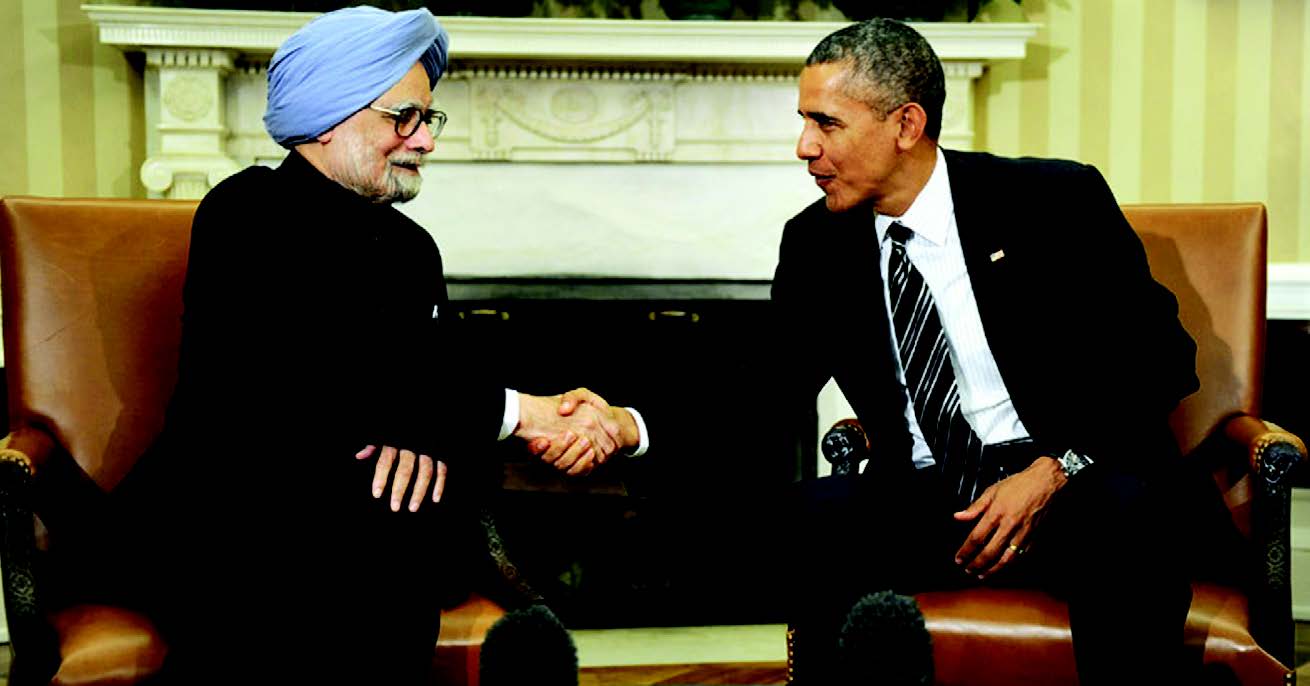
    WASHINGTON (TIP): India and the US have reached the first commercial agreement on civilian nuclear power, five years after a landmark deal between the two countries was clinched. Addressing a joint media interaction after talks with Prime Minister Manmohan Singh, President Barack Obama disclosed that the two countries have sealed the agreement. “We’ve made enormous progress on the issue of civilian nuclear power, and in fact, have been able to achieve just in the last few days an agreement on the first commercial agreement between a US company and India on civilian nuclear power,” Obama said.

    India’s nuclear operator NPCIL (Nuclear Power Corporation of India Limited) and US firm Westinghouse have signed an agreement that will pave the way for setting up an atomic plant in India. However, there was no word on the tough nuclear liability clause in the Indian laws over which the US firms had strong objections. There was a major uproar in India last week over the agreement because of apprehensions that it entailed bypassing the Civil Nuclear Liability Law in place in the country by waiving the operator’s right to recourse with the supplier. Reiterating his commitment for strong ties, Obama said India is not just a regional, but also a global power. Prime Minister Singh reciprocated the feelings, saying US is as an indispensable partner for India. “India, as a significant not just regional power but world power, has worked closely with us on a whole range of issues from climate change to how we can help feed the world, alleviate poverty and deal with disease,” Obama told reporters in his Oval Office following their hourlong meeting. Praising the Prime Minister for his leadership in strengthening India-US ties, Obama said Singh has been a great friend and partner to the United States and to him personally.

    “Across the board, Prime Minister Singh has been an outstanding partner,” Obama said, adding that India continues to grow at an amazing rate, but obviously there are a lot of people in India that are still trapped in poverty. He said US is a strong partner to help India realize that vision because if there is a strong India, that is good for the world and it’s ultimately good for the US. In his remarks, Singh said Obama has imparted a powerful impetus to that process of the two countries being on the same page. “I’ve always believed that India and America are indispensable partners. During the time that I have been Prime Minister, and particularly during the time that President Obama and I have worked together, I think President Obama has made an outstanding contribution to strengthening, widening and deepening of our cooperation in diverse ways,” he said. Singh said India and America are working together to build on the cooperation and widening and deepening it in diverse directions. “We are cooperating in expanding the frontiers of trade investment in technology. Our bilateral trade today is USD 100 billion. Investments in India are USD 80 billion. And they are growing, despite the slowdown in the global economy,” Singh said, referring to the increasing trade between the two sides. “Outside the area of trade technology and investment, we are exploring avenues of cooperation in new areas like energy cooperation, clean coal technology, energy-efficient technology, cooperation in the field of environment, cooperation in the field of defense and securityrelated, cooperation with regard to the intelligence gathering and counterterrorism. In all these areas, India needs the United States to be standing by our side,” Singh said.

  • SLOW AND STEADY RELATIONSHIP

    SLOW AND STEADY RELATIONSHIP

    “The PM’s Washington visit is unlikely to produce any dramatic result, but it will serve its purpose by reminding both sides of the high stakes they have in a progressively improving relationship that is undistorted by impatience or undue expectations on either side”, says the author.
    All eyes will be on the meeting between our Prime Minister and President Obama this week and what it produces. This is natural as our relationship with the US is, in many ways, the most important external relationship we have. The US is our largest trade and investment partner as well as the biggest source of advanced technology, management practices and technical and financial consultancies for our economic sector. The people to people contact with the US is profound, not only because of the large population of Indian origin and the almost 100,000 students we have there, but also because of the influences imbibed by our younger generation. The range of our engagement with the US is larger than with any other country, with over thirty on-going dialogues on various subjects, which implies a regularity of official exchanges on economic, political and security issues.

    Expectations
    Our armed forces have the largest number of military exercises with the US, even though it is not our largest supplier of defense equipment. However, here too the US is making headway, with substantial orders already obtained, even as promises are being made of joint production of advanced weaponry and transfers of technology to rival Russia as our leading defense partner. The political commitment shown by the US leadership to remove the most contentious nuclear issue in our relations has raised expectations on our side that dramatic breakthroughs in relations will continue, even though we cannot define what they could be precisely. At the very least, we expect a trouble free relationship with the US. On the US side, the expectations are more concrete and precise. They would want orders for the US nuclear and defense industries to materialize quickly enough as a quid pro quo for the nuclear deal. They want more access to the Indian market, for which financial and education sector reforms are considered necessary, not to mention improved regulatory frameworks. To the old grievances have been added new ones relating to Indian protectionism as indicated by the decision to give preferential market access to locally established companies in the telecom sector, the retrospective application of our tax laws as in the Vodafone case and inadequate protection to IPRs as decreed by the Supreme Court in the Novartis case. None of these decisions involve US companies, but the US has concerns that India’s example might be followed by other countries affecting ultimately either the global business models of its companies or negatively impacting their future operations in India.

    SHORT-SIGHTED
    The US corporate sector, earlier in the forefront of lobbying for India in the US Congress, is now taking the lead to have Indian trade practices investigated by the Congress. All the indications are that the mood in the US towards India has soured at the political and commercial levels. This is unfortunate because short term considerations of immediate gain are gaining ground over longer term US strategic investment in the India relationship. India’s views about the US have changed fundamentally and the relationship will become more dense with time. US impatience will not necessarily accelerate the process. India and the US have differences on WTO and Climate Change related issues. These differences are in a multilateral context, not a bilateral one, but the US is trying to push for bilateral convergences on these issues. Such pressure should not become counterproductive. India’s nuclear liability law has become a major obstacle in implementing India’s commitment to place orders on Westinghouse and GE for supply of nuclear reactors generating 10,000 MWs of power at two separate sites in India. Secretary Kerry had voiced his expectation that by September India would have found a way to resolve the issue to the satisfaction of US companies, having no doubt Prime Minister’s visit to Washington in view.

    Results
    Reports suggest that India may find a solution by interpreting the rules framed under the Liability Act flexibly enough to meet the demands of not only the US companies but the Russians as well for Kudankulam 3 and 4. This may not be easy in view of Article 17 of the legislation that obliges the operator to take recourse against the supplier for supply of defective equipment, even if the right to recourse is not expressly included in the contract. The challenge is to devise a way to provide insurance cover for such liability through some kind of a pooling arrangement, the cost of which can be adjusted in that of the project. Meanwhile, the decision to sign a “small works agreement” between Westinghouse and NPCIL during Prime Minister’s visit as a token of our intent to implement our commitment might be a diplomatic way out of the current impasse for now, but the larger questions of project cost and tariff competitiveness will remain unaddressed and could block negotiations in the future and cause disappointment. On the Afghanistan question president Obama will not give us satisfaction as he is seeking a dialogue with the Taliban brokered by the Pakistani military. India’s political and security interests in Afghanistan are becoming peripheral to US interest in an orderly withdrawal from there through a pact with the very extremist forces that they had initially dislodged and an understanding with the Pakistani military whose doubledealing they have directly experienced.With the continuing terrorist mayhem in Pakistan and extremist religious forces on the rampage in West Asia and Africa, accommodating the Taliban could prove a folly. The PM’s Washington visit is unlikely to produce any dramatic result, but it will serve its purpose by reminding both sides of the high stakes they have in a progressively improving relationship that is undistorted by impatience or undue expectations on either side

  • US-India ties hit a Plateau

    US-India ties hit a Plateau

    It has now been confirmed that before going to New York to participate in the UN General Assembly deliberations in New York, Prime Minister Manmohan Singh will be visiting Washington in September for his second bilateral engagement with US President Barack Obama. Though New Delhi was very keen on the visit and the US President had extended an invitation to Manmohan Singh earlier this year, it’s not entirely clear what a lame-duck Prime Minister is likely to achieve during this visit.

    That US-India ties have hit a plateau has been evident from the lackluster engagements between the two sides in recent months. It was the turn of US Vice President Joseph – a month after Secretary of State John Kerry’s visit — to India to reassure New Delhi how Washington remains keen on a robust partnership with India. Biden’s four-day visit to India last month, first for a US Vice President in three decades, was aimed at laying the groundwork for the Indian Prime Minister’s visit to the US in September. Though it was clear from the very beginning that Biden’s trip will not result in any ‘deliverables’, it also remains a mystery as to what an Indian Prime Minister at the fag-end of his term and with hardly any political capital left will be able to do to galvanize this very important relationship with a perfunctory visit to the US.

    These are difficult times for the USIndia bilateral relationship which has been flagging for quite some time now and there is little likelihood of it gaining momentum anytime soon. The growing differences between the two today are not limited to one or two areas but are spread across most areas of bilateral concern. These include market access issues, the problems in implementing the US-India civil nuclear accord, the US immigration changes, changing US posture towards Afghanistan, defense cooperation and trade. Biden’s visit was specifically focused on trying to give a push to economic ties, enhancing cooperation on defense issues, pushing India for a greater role in the Asia-Pacific and addressing climate change. That the US is clearly concerned about Indian economic slowdown was reflected in Biden’s comments.

    He exhorted New Delhi to try to take bilateral trade with the US to $500 billion by removing trade barriers and inconsistencies in the tax regime. He recommended more measures like recent relaxation in the FDI rules by underlining “caps in FDI, inconsistent tax system, barriers to market access, civil nuclear cooperation, bilateral investment treaty and policies protecting investment.” Investor confidence in the Indian economy, Asia’s third largest, is at an all-time low with growth slowing down to its lowest level in a decade. Foreign direct investment slid about 21 per cent to $36.9 billion last fiscal year compared with 2011-12. The US is keen to see India remove investment caps in sectors like finance, retail and insurance. The US corporate sector has been up in arms in recent months about India’s trade policies, complaining that American firms are being discriminated against and the US intellectual property rights are being undermined by India.

    Sporadic outbursts of reform measures from New Delhi have not been enough to restore investor confidence in India even as Indian policymakers are now busy trying to secure their votes for the next elections. Policy-making in India remains paralyzed and haphazard with Washington getting increasingly frustrated with the Indian government’s lackadaisical public policy. For his part, Biden went out of his way to assuage the concerns of the Indian corporate sector by suggesting that Washington plans to increase the number of temporary visas and green cards to highly skilled workers from India. The concerns, however, continue to persist because the US Senate has already cleared the much talked-about immigration Bill that will significantly restrict Indian IT companies in the US. If the House of Representatives ends up endorsing it, then the Obama Administration will have to do some heavy lifting to mollify India. Meanwhile, the civil nuclear deal is floundering as the US companies remain wary of Indian laws on compensation claims in the event of a nuclear accident. India’s nuclear liability law is aimed at ensuring that foreign companies operating in Indian nuclear sector assume nearly unlimited liability for accidents, a condition that all but precludes the participation of US firms. After all the political and diplomatic investment that Washington made in making the nuclear deal happen, there is a pervading sense in the US that the returns have not been at all impressive.

    On climate change where the Obama Administration is focusing significantly, Biden pushed India to work with the US to reduce the flow of hydroflurocarbons and provide opportunities to the scientific establishment to work on green technology options. The US is already working with China on a joint effort to curb greenhouse gases. Biden also tried to ease Indian concerns on Afghanistan by underlining that the Taliban would have to give up ties with Al Qaeda and accept the Afghan constitution as part of the reconciliation process. New Delhi remains concerned about the impact of US withdrawal from Afghanistan for Indian security. The recent bombing outside the Indian consulate in Jalalabad merely highlights the challenges India faces in Afghanistan. According to Biden, “there are no obvious places where Indian interests and American interests diverge worldwide, regionally or domestically.” That may well be true but in the absence of a big idea to push the relationship forward strategically, the tactical issues where there are significant differences between Washington and New Delhi continue to shape the trajectory of the US-India bilateral ties. The relationship stands at a serious inflection point.

    The two sides need to start thinking seriously about bringing it back on track. New Delhi, in particular, needs to acknowledge the importance of what Biden suggested when he said that “there is no contradiction between strategic autonomy and strategic partnership.” In the name of ‘strategic autonomy’ New Delhi has become quite adept at scuttling its own rise. At this moment of significant geostrategic flux in the Indo-Pacific, India and the US need each other like no other time in the past. Biden’s visit has underlined India’s importance in US strategic calculus. It is now for India to decide what role it sees for the US in its foreign policy matrix and as a corollary what role it sees for itself in the rapidly changing global order.

  • PM TO MEET OBAMA ON SEPTEMBER 27

    PM TO MEET OBAMA ON SEPTEMBER 27

    NEW DELHI (TIP): US President Barack Obama will meet Prime Minister Manmohan Singh at the White House on September 27 in a meeting aimed at dispelling a common narrative in Washington and New Delhi that the Indo-US relationship has gone adrift. The visit will provide the two leaders an opportunity to chart a course toward enhanced trade, investment, and development cooperation between the US and India, said National Security Council spokeswoman Caitlin Hayden. The announcement coincided with Indian National Security Adviser Shivshankar Menon’s visit to Washington. Menon told reporters on Tuesday evening he was confident that preparations were underway for a “successful working visit”. “You must expect it to be a substantive meeting,” he said.

    Menon met National Security Adviser Susan Rice, Defence Secretary Chuck Hagel, Deputy Secretary of State William Burns, Energy Secretary Ernest Moniz and members of the intelligence community in Washington. Menon dismissed suggestions that the Indo-US relationship had gone adrift saying: “In every area we are doing more together.” Menon said there had been “steady” progress on the Indo-US civilian nuclear deal, but acknowledged that there were some people who would like it to move faster. In his meetings in Washington, Menon discussed the recent deadly incidents along the Line of Control (LoC). Amid the LoC flare-up, India has not taken any decision on whether Manmohan will meet Pakistan Prime Minister Nawaz Sharif when the two leaders attend the UN General Assembly session in New York next month. Menon said he discussed the violence along the LoC with his US interlocutors, but that the Americans did not share their opinion on a possible Manmohan- Sharif meeting.

    The US is “very correct about not getting involved in other people’s business,” he said. Hayden said the Manmohan- Obama meeting would “highlight India’s role in regional security and stability”. Menon and Rice reviewed the Indo-US strategic partnership. “Ambassador Rice reaffirmed US’ commitment to further expanding and strengthening our bilateral relationship, including economic and commercial ties,” Hayden said. “The two exchanged ideas on enhancing our security cooperation, reviewed progress on our civil nuclear and clean energy cooperation and explored greater collaboration on climate change.” The two officials also discussed India’s support for a stable, secure and prosperous Afghanistan. On proposed defence talks, he said: “It (defence ties) could be (path breaking). It is still a work in progress. But it is significant.”

  • BJP Has Sound Plans To Jumpstart The Stalled Indian Economy- Rajnath Singh

    BJP Has Sound Plans To Jumpstart The Stalled Indian Economy- Rajnath Singh

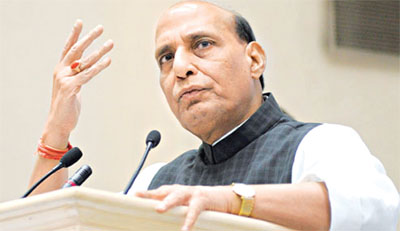
    NEW YORK, NY (TIP): “The BJP-led NDA government created 67 million jobs in less than five years whereas the Congress led UPA created less than 2.7 million jobs between 2004 and 2009. These figures are from the data collected by the federal government controlled agencies and not a figment of imagination”, Rajnath Singh said.

    He was speaking on what BJP will do to jumpstart the stalled Indian economy at a function organized by India-America Chamber of Commerce, July 25. Rajnath Singh who was in Washington for three days said he had discussions with the Congressmen and administration officials on the issue of difficulties faced by candidates in H1B and L1 visa to work legally in the US. The GDP cost burden will go up by 0.3 to 0.4 percent due to increase in fees.

    “We had lodged our protest against the comprehensive immigration reforms bill and they had raised the issue of patents and compulsory drug license issues. There was only one case under these CDL whereas Indonesia had six cases and Canada four cases,” he added. The US would do well to share its latest technology on green energy with nations such as India so that it can benefit the humanity. Once these inventions are ashared, they would help us more in a very rapid manner, he said.

    The BJP government will strengthen the village economy as over 70 percent of the people live in rural areas. We will do our best to stop urbanization and create more jobs in the rural areas as was done in the previous NDA government under the PURA scheme. More than 55 percent of the jobs for youth are in rural areas and there is a need to strengthen this sector. Turning to climate change, the BJP leader said while US that has been preaching, has a carbon emission rate of 20 ton per capita per annum, India has only 1.5 per ton per capita per annum.

    The global average is only 4.5 ton per capita per annum. You now decide who is on the right side and who is not. Addressing the members of the India- America Chamber of Commerce in Manhattan, he said India is now facing a serious financial crisis of grave magnitude despite the fact that no one in the global economy can ignore India. The economy of India is not something that makes us feel comfortable or feel proud of.

    But India was regarded as third largest economy of the world, he said. When the NDA government led by Atal Behari Vajpayee stepped down in 2004, the fiscal deficit was 2.5 percent and current account deficit was surplus. The revenue deficit was less than one percent. The economy witnessed a boom period during 1999 to 2004 when the country was ruled by the NDA and the slide started in 2004. “The boom that we created lasted till 2008 and then we are now witnessing is one of the worse economic downturns,” Singh said.

    “When I mentioned to the Speaker of the House yesterday at Washington that we had a surplus current account when we left power, he was surprised. There was a revenue deficit that went up from 4.5 percent to 6 percent in 2008. The current account of deficit shot to 6 percent. We passed the fiscal responsibility bill in the parliament and hence were able to bring some fiscal discipline.

    Inflation is now hovering around 7.7 percent,” he said. The rupee value has depreciated drastically to the US dollar from Rs 37 a dollar in 2008 to Rs 60 in 2013 almost doubling in five years. We thought this would be offset by increase in exports and that also did not happen; it went up by just one percent. It’s very unfortunate that savings that have been the biggest strength of India as it provided capital is now falling at a very rapid rate.

    The small businesses tend to grow with the increase in savings and in the absence they take a major hit. Savings drop and growth rates drop and what else to drop. The success of Indian story is over. The success story of India is waiting for the BJP to return to power. The UPA has ruined the economic structure of the country. How will the BJP restore investors’ confidence and fix the broken economy once it comes to power? We will do what we did from 1999 to 2004 and we had a unique development model which is not only a model for India to feel proud of but came as a surprise to the world.

    When we handed over the reins of the government to the Congress-led UPA, India’s growth rate was 8 to 9 percent and rate of inflation was around three percent. More than 50 percent of the highways were built during the Vajpayee government and the present Congress dispensation had admitted this in the court. Where had all the developments gone now? The BJP created a success story only to be mauled by the Congress, he added.

    We have proved in the BJP-ruled states how we prioritize economic reforms and Gujarat is a shining example of India. The whole world is now talking about Gujarat and foreign governments are keen to study the success story. Take the case of Madhya Pradesh that was considered a sick state with no economic development before the BJP Government took over. Agricultural growth rate has gone up to 19.1 percent in the state as against 4 percent of the federal government.

    Madhya Pradesh has replaced as country’s largest supplier of food grains to the central pool. In Chhattisgarh, more than 90 percent of the population is covered under the Public Distribution System and people enjoy social security compared to mass suicide by farmers in the Congress-ruled states. Goa is the only state in India where petrol is cheaper than diesel similar to what we see in the US.

    Do we have to prove anything more to assure the people that our first priority will be to fix the problems and take India on a different plane?, he asked. The average GDP of BJP-ruled governments is about 10 percent whereas the nation is only experiencing a growth rate of less than five percent. There are only two models – BJP model for growth and Congress model for destruction, he added. Earlier, Rajiv Khanna, President, India-America Chamber of Commerce welcomed Rajnath Singh and introduced the subject of talk.

    He pointed out that Indian economy has been weakening and this had caused considerable doubts in the minds of investors and wanted Singh to speak on how his party, if it came to power would jumpstart the stalled Indian economy. The talk by Rajnath Singh was followed by an interesting Q & AA session. Singh candidly answered the few questions put to him.

  • UK HEATWAVE KILLS 760 IN 9 DAYS

    UK HEATWAVE KILLS 760 IN 9 DAYS

    LONDON (TIP): A severe and prolonged heatwave is believed to have killed up to 760 people in England in the past nine days. Temperatures in parts of the country reached as high as 32 degree celsius on Thursday, four degrees short of the government announcing a Level 4 alert marking a national emergency.

    Thursday was the sixth consecutive day with a recorded daytime temperature of over 30 degrees celsius marking Britain’s longest heatwave in seven years. Research by the London School of Hygiene & Tropical Medicine has estimated the death toll for the first nine days of the heatwave at between 540 and 760 people in England alone. With high temperatures likely to remain till the end of next week, the number of heatrelated deaths is expected to double.

    A Level 3 heatwave alert means people should be aware of the actions to protect themselves from the possible health effects of hot weather, and social and healthcare services are advised to take specific actions that target highrisk groups. Ambulance services have already seen a 30% increase in past three days. A Level 3 is triggered as soon as the Met Office confirms there is a 90% chance of heatwave conditions, when temperatures are high enough over threshold levels to have a significant effect on health on at least two consecutive days.

    Following this latest Met Office alert, Public Health England (PHE), an executive agency of UK’s department of health, is continuing to remind people to be aware of the health risks of hot weather. “… try to keep out of the sun between 11am and 3pm, avoid physical exertion, wear light, loose fitting cotton clothes, drink plenty of cold drinks, if you have a health problem, keep medicines below 25 °C or in the refrigerator and never leave anyone in a closed, parked vehicle, especially infants , young children or animals ,” it has said.

    Dr Angie Bone, Heatwave Plan lead for PHE, said: “In this continued hot weather, it’s important to remember that high temperatures can be dangerous, especially for yulnerable people like older people , young children and those with serious illnesses.” Professor Dame Sally C Davies , chief medical officer in the department of health, said: “Although it seems we barely saw the sun last summer in England, last year’s Climate Change Risk Assessment clearly indicated that we are increasingly likely to experience summer temperatures that may be harmful to health.

    For example the temperatures reached in 2003 are likely to be a ‘normal’ summer by 2040, and indeed globally, countries are already experiencing record temperatures.” Declaring a Level 4 alert indicates a major incident. The government will decide whether to go to Level 4 if there is a very severe heatwave that will last for a considerable period of time and will also affect transport, food and water, energy supplies and businesses as well as health and social-care services.

    The hottest July temperature in Britain was 36.5°C, recorded in Surrey in 2006. The hottest ever in Britain was 38.5°C in Kent in 2003. July is also expected to become the driest July since records began in 1766 and may beat the record set in 1955 when only one inch (30mm) of rain fell.

  • LADY LIBERTY OPENS AGAIN TO CELEBRATE 4TH OF JULY

    LADY LIBERTY OPENS AGAIN TO CELEBRATE 4TH OF JULY

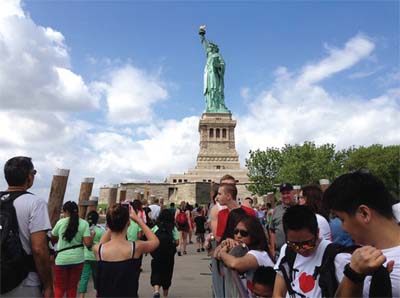
    NEW YORK (TIP): The Statue of Liberty, a beacon of hope for waves of immigrants at the turn of the century – and these days a destination for waves of tourists – reopened to the public Thursday, July 4th, almost nine months after the destruction caused by super storm Sandy. That October storm had left three quarters of Liberty Island underwater and destroyed electrical, phone, water and sewage systems. Sandy struck just a day after the statue had reopened following a yearlong renovation. And before that, there was the Sept. 11, 2001, terrorist attacks, which kept visitors from the inside of the statue for nearly 9 years. Officials said that they hoped that Thursday’s re-opening – the statue’s fourth since 1986 – would be its last for a while. The statue has drawn as many as 4 million visitors a year. And this time, the opening came with predictable patriotic fanfare, including a small marching band clad in Revolutionary War replica uniforms; members of Congress; Secretary of the Interior Sally Jewell; and, of course, New York Mayor Michael Bloomberg, whose pink-collared shirt was soaked through with sweat as he waited on the dais for his turn to speak.

    When he did, Bloomberg said that the statue was “at the heart of what America is really all about.” “Thank God we have people like the French,” Bloomberg added, nodding to the statue’s history, as a gift from France in the 1880s. Bloomberg also took the opportunity to make some pointed comments about climate change, which he said was at the root of increasingly volatile weather conditions across the country and, possibly, major events like Sandy. “Having an argument about climate change … is myopic,” Bloomberg said. “The bottom line is that we have to prepare for the future.” Liberty Island’s recovery, in which crews laid down 42,000 board-feet of new deck, 2,000 feet of hedging, and new electrical, heating, and cooling systems, stands in stark contrast to Ellis Island, which remains closed. Ellis Island was completely submerged after the storm, threatening the island’s archives, which were later removed by the National Park Service Museum Emergency Response Team and taken to a climate-controlled facility in Maryland, said Jonathan B. Jarvis, the director of the Park Service.

    And while work at Ellis Island continues, Jarvis declined to give an estimate, of a re-opening date for the island, saying that the challenges there were far greater. “Ellis is still a process,” he said. That hardly mattered to those on the ground Thursday at Liberty Island. Many visitors were ecstatic, some having come from halfway across the world to photograph and climb the stairs of the world’s most famous monuments.

  • Economic Issues Likely To Dominate Kerry’s Visit To India

    Economic Issues Likely To Dominate Kerry’s Visit To India

    WASHINGTON (TIP): Economic issues like intellectual property protection, local content restrictions and a continued cap on FDI are likely to be on top of his agenda when US Secretary of State John Kerry travels to India next week for the strategic dialogue between two countries. “First and the foremost from our perspective will be economic piece of this (dialogue). There has been lot of concern on part of American business community about what they see as growing obstacles to trade and investment,” Assistant Secretary of State for South and Central Asia, Robert Blake, told an audience here.

    Both Kerry and President Barack Obama have been receiving letters from the US business community, advocacy groups, Senators and Congressmen on the trade policies of India, which they claim is harming American businesses. “Intellectual property protection, local content restrictions, continued restrictions on FDI in different sectors. This is certainly going to be our focus,” Blake said, adding that one of the goals is to reinvigorate the bilateral investment treaty talks and conclude them as soon as possible.

    Likewise, the US wants to reinvigorate the trade policy forum, and will also push for continued progress on the civil nuclear side, he added. Responding to questions, Blake said the US is not looking at any deliverables during the strategic dialogue, except to making sure that they understand each other on these issues. “India has its own concerns on comprehensive immigration reform. Obviously we need to hear from that.

    The purpose of the dialogue is to hear each other out in a very open and friendly manner and then figure out who is going to take charge of fixing these,” he said. As a result of the three rounds of strategic dialogue so far, Blake said there has been significantly quite convergence of strategic growth between the United States and India. Referring to the various bilateral and trilateral dialogues between the two countries, Blake said: “All of these collectively really enabled us to have an extremely good dialogue on issues that were previously very difficult.”

    “Things like Afghanistan, Iran, Burma and Middle East were areas of quite sharp differences. Now we have a remarkable degree of convergence, which has been a very welcome to see. Non-proliferation, food security, scientific and academic co-operation, climate change, defence trade, and regional issues like Afghanistan and Pakistan will also figure prominently during Kerry’s visit, Blake noted. Responding to questions, Blake said India is one of the highest strategic priorities for the US.

  • US House votes to prevent March 27 federal shutdown; Obama reaches out to Senate

    US House votes to prevent March 27 federal shutdown; Obama reaches out to Senate

    WASHINGTON (TIP): Legislation easily passed the US House of Representatives on March 06 to avert another partisan budget battle and a possible government shutdown, and a dinner meeting between President Barack Obama and Senate Republicans offered signs of a thaw in relations. By a vote of 267-151, the House passed a measure to fund government programs until the end of the fiscal year on September 30. The Democratic-controlled Senate is expected to pass a similar bill next week. Without such legislation, federal agencies would run out of money on March 27. The bill to continue funding the government without last-minute drama occurred as Obama took the unusual step of inviting Republican senators to a dinner on Wednesday night at a Washington hotel a few blocks from the White House that lasted about an hour and a half.

    Attendees emerged optimistic about the prospects for the elusive big deal to put the nation’s finances on a more sustainable track in a way that satisfies both Democrats and Republicans. “It was a really good conversation,” Republican Senator John Hoeven said. “It was candid,” he said. “We really talked about how do we get to a big agreement in terms of the debt and deficit.” An administration official told Reuters before the dinner that Obama had been hoping to take advantage of a lull in a series of budget crises to launch a dialogue with Republican lawmakers with the goal of reaching a broad deficit reduction deal.

    While the meal was not intended to be a negotiation, it was an opportunity for Obama to make clear he is willing to consider some difficult spending cuts that are unpopular with his fellow Democrats in Congress, the official said.

    Those could include cuts to programs that include the Social Security pension system and Medicare for the elderly. Obama is due to discuss his other legislative priorities, including immigration reform, gun control and tackling climate change, at meetings with members of both political parties on Capitol Hill next week. The dinner may have been a chance to reverse some of the angry partisan rhetoric that has stood in the way of compromise in recent weeks. “The president greatly enjoyed the dinner and had a good exchange of ideas with the senators,” a senior administration official told reporters. Asked how the soiree had gone, Senator John McCain told journalists outside the hotel, “Just great. Fantastic.” Attendees included Senators Lindsey Graham, Bob Corker, and Kelly Ayotte and nine others.

    Graham drew up the guest list, the White House said. The meetings between the president and lawmakers, whether or not they produce results, depart from what has been an at best a stand-offish relationship between Obama and Republicans in Congress. They suggest that Obama and Republicans are getting the message that public patience with Washington is wearing thin.

    This has become apparent as Americans read of inconveniences they may soon confront at airports and elsewhere as a result of across-theboard cuts to the federal budget that kicked in on Friday after lawmakers and the White House failed to agree on an alternative. “This is the first indication in really a long time that the president is willing to exert leadership and bring people together and that’s exactly what needs to be done,” said Republican Senator Susan Collins of Maine, who has spoken by phone in recent days with Obama. Republican doubters At the heart of the bitter US budget dispute are deep differences over how to rein in growth of the $16.7 trillion federal debt.

    Obama wants to narrow the fiscal gap with spending cuts and tax hikes. Republicans do not want to concede again on taxes after doing so in negotiations over the “fiscal cliff” at the New Year. Despite the scheduled dinners and meetings and the vote on funding the government, few expect those differences to be resolved any time soon. Some Republicans remain skeptical of Obama’s overtures. “This president has been exceptional in his lack of consultation and outreach to Congress,” said John Cornyn of Texas, the second-ranking Senate Republican. Cornyn, like Collins, was not invited to dinner with Obama, but he warned that talk of tax increases would be unwelcome. “I don’t know if the purpose of the meeting is social or if he has an agenda.

    But if it is about raising taxes, we’re done.” While Republicans have taken most of the beating in surveys in connection with the so-called sequestration, a Reuters/Ipsos online poll released on Wednesday showed 43 percent of people approve of Obama’s handling of his job, down 7 percentage points from February 19.

  • John Kerry vows to strengthen ‘critical’ China ties

    John Kerry vows to strengthen ‘critical’ China ties

    WASHINGTON (TIP): Senator John Kerry, on track to be America’s next secretary of state, told US lawmakers on Thursday that he would work to boost ties with China, but warned of a “long slog” ahead. Kerry told his Senate confirmation hearing that he wanted to “grow the rebalance” towards Beijing “because it is critical to us to strengthen our relationship in China.” Washington would continue the so-called pivot — begun during the first term of President Barack Obama — towards Asia and in particular China, Kerry told the Senate Foreign Relations committee, though he added that America was not “turning away from anywhere else.” Kerry said that while the United States and China would remain economic “competitors,” the two nations “shouldn’t be viewed as adversaries in some way that diminishes our ability to cooperate on a number of things.” “China is, you know, the other sort of significant economy in the world and obviously has a voracious appetite for resources around the world, and we need to establish rules of the road that work for everybody,” Kerry said.

    He acknowledged the difficulty of issues such as intellectual property rights, and China’s propping up of its currency, the yuan. But he stressed there were areas where the two economic superpowers could work together. “China is cooperating with us now on Iran.

    I think there might be more we could perhaps do with respect to North Korea,” the veteran senator said. It could be more we could do in other parts of the Far East. And hopefully we can build those relationships that will further that transformation.

    We make progress. It’s incremental… It’s a tough slog.” Another area where the two nations could perhaps come together might be on climate change, Kerry added. Earlier in the hearing he had vowed to be “a passionate advocate” on the subject of working to battle global warming. “China is soon going to have double the emissions of the United States of America.

    So we’ve got to get these folks as part of this unified effort, and I intend to work very, very hard at trying to do that,” Kerry said.

    But he appeared to rule out any move towards increasing again the US military force in the Asia-Pacific region. “I’m not convinced that increased military rampup is critical yet,” Kerry said, adding that if confirmed he wanted to “dig into this a little deeper” and try a thoughtful approach. “We have a lot more bases out there than any other nation in the world, including China today,” he argued, saying the Chinese must be wondering “What’s the United States doing? They trying to circle us? What’s going on?”

  • Obama Vows To Take America Forward

    Obama Vows To Take America Forward

    WASHINGTON (TIP): The second inauguration of Barack Obama as the 44th President of the United States took place in a private swearing-in ceremony on Sunday, January 20, 2013 in the Blue Room of the White House.

    A public ceremony marking the occasion took place the following day, on Monday, January 21, 2013 at the United States Capitol building. The inauguration marked the beginning of the second term of Barack Obama as President and Joe Biden as Vice President. The inauguration theme was “Faith in America’s Future”, a phrase that draws upon the 150th anniversary of President Abraham Lincoln’s Emancipation Proclamation and the completion of the Capitol dome in 1863. The theme also stresses the “perseverance and unity” of the United States, and echoes the “Forward” theme used in the closing months of Obama’s reelection campaign.

    The inaugural events held in Washington, D.C. from January 19 to 21, 2013 included concerts, a national day of community service on Martin Luther King, Jr. Day, the swearing-in ceremony, luncheon and parade, inaugural balls, and the interfaith inaugural prayer service. The presidential oath was administered to Obama during his swearing-in ceremony on January 20 and 21, 2013 by Chief Justice of the United States John G. Roberts.

    While Beyonce sang the National Anthem at the ceremonial swearing-in for President Barack Obama at the U.S. Capitol during the 57th Presidential Inauguration, it was Richard Blanco, the 44-year-old Madrid-born Cuban-American poet who read his poem “One Today” at the swearing-in ceremony for President Obama. Blanco is only the fifth poet – Robert Frost (1961), Maya Angelou (1993), William Miller (1997) and Elizabeth Alexander (2009) were the previous ones – reading at a presidential inauguration. He is also the first Hispanic as well as the first openly gay one. In his 18 minute speech, Obama tied current issues to founding principles.

    He sought to link the past and future, tying the nation’s founding principles to the challenges confronting his second term in a call for Americans to fulfill the responsibility of citizenship.

    Eschewing poetic language for rhetorical power, Obama cited the accomplishments of the past four years while laying out a progressive agenda for the next four that would tackle thorny issues like gun control, climate change and immigration reform. “We have always understood that when times change, so must we; that fidelity to our founding principles requires new responses to new challenges; that preserving our individual freedoms ultimately requires collective action,” he said. “My fellow Americans, we are made for this moment and we will seize it so long as we seize it together,” he added later.

    Analysts called the speech politically astute and an important expression of new forcefulness by the president as he enters his second term following re-election last November. “It’s a real declaration of conscience, about principles, about what he believes in,” said CNN Senior Political Analyst David Gergen. “He basically said, ‘When I came in the first term, we had all these emergencies, we had these wars. We’ve now started to clear the decks.

    Let’s talk about what’s essential.’” The foundation of the address, and Obama’s vision for the future, were the tenets he quoted from the Declaration of Independence — “that all men are created equal, that they are endowed by their Creator with certain unalienable rights, that among these are life, liberty, and the pursuit of happiness.” “Today, we continue a neverending journey, to bridge the meaning of those words with the realities of our time,” Obama said to gathered dignitaries and flag-waving throngs on the National Mall. “For history tells us that while these truths may be self-evident, they have never been self-executing; that while freedom is a gift from God, it must be secured by His people here on Earth.” In particularly pointed references, the president made a forceful call for gay rights that equated the issue with the struggle for women’s rights in the 19th century and civil rights in the 1960s. “We, the people, declare today that the most evident of truths — that all of us are created equal — is the star that guides us still; just as it guided our forebears through Seneca Falls, and Selma, and Stonewall,” Obama said, mentioning landmarks of the women’s, black and gay rights movements. “It is now our generation’s task to carry on what those pioneers began,” he continued, prompting the loudest applause and cheers of his address when he said “our journey is not complete until our wives, our mothers, and daughters can earn a living equal to their efforts.” More cheers came when Obama called for “our gay brothers and sisters” to be treated “like anyone else under the law — for if we are truly created equal, then surely the love we commit to one another must be equal as well.” According to observers, it was the first time a president championed gay marriage in an inaugural address. With further mention of topical issues such as immigration reform and gun control, Obama came to his key point — that adhering to America’s bedrock principles requires taking action on today’s challenges. “Being true to our founding documents does not require us to agree on every contour of life; it does not mean we will all define liberty in exactly the same way, or follow the same precise path to happiness,” he said. “Progress does not compel us to settle centuries-long debates about the role of government for all time — but it does require us to act in our time.” A deep partisan divide in Washington and the country characterized Obama’s first term, with Congress seemingly paralyzed at times and repeated episodes of brinksmanship over debt and spending issues bringing the first-ever downgrade of the U.S. credit rating.

    Acknowledging the political rift, Obama called for leaders and citizens to work for the greater good of the country. “We cannot mistake absolutism for principle, or substitute spectacle for politics, or treat name-calling as reasoned debate,” he said. “We must act, knowing that our work will be imperfect.” At the same time, he made clear he would fight for the central themes of his election campaign. “For we, the people, understand that our country cannot succeed when a shrinking few do very well and a growing many barely make it,” he said.

    While “we must make the hard choices to reduce the cost of health care and the size of our deficit,” he said, “we reject the belief that America must choose between caring for the generation that built this country and investing in the generation that will build its future.” In particular, he defended the need for popular entitlement programs that provide government benefits to senior citizens, the poor and the disabled, saying they were part of the American fabric. “The commitments we make to each other — through Medicare, and Medicaid, and Social Security — these things do not sap our initiative; they strengthen us,” Obama said. “They do not make us a nation of takers; they free us to take the risks that make this country great.” On Monday, Senate Republican leader Mitch McConnell, one of Obama’s harshest critics, called the president’s second term “a fresh start when it comes to dealing with the great challenges of our day; particularly, the transcendent challenge of unsustainable federal spending and debt.” Other issues also appear difficult, if not intractable.

    Obama made a reference to gun control, saying that the nation needed to ensure that “all our children, from the streets of Detroit to the hills of Appalachia to the quiet lanes of Newtown, know that they are cared for, and cherished, and always safe from harm.” However, congressional Republicans and some Democrats, as well as the powerful gun lobby, have rejected proposals Obama recently announced in response to the Connecticut school shootings that killed 20 Newtown first-graders last month.

    In citing climate change as a priority, Obama raised the profile of the issue on the national agenda after a presidential campaign in which it was almost never mentioned. “We will respond to the threat of climate change, knowing that the failure to do so would betray our children and future generations,” he said, warning of a “long and sometimes difficult” path to sustainable energy sources in a nation dominated by its fossil fuel industries such as oil and coal. “America cannot resist this transition; we must lead it,” Obama said. “We cannot cede to other nations the technology that will power new jobs and new industries — we must claim its promise.” Obama infused his speech with references to two assassinated American icons — President Abraham Lincoln and civil rights leader Martin Luther King Jr. In one passage, Obama cited “blood drawn by lash and blood drawn by sword” in mentioning the Civil War and slavery.

    It mimicked Lincoln’s second inaugural address in 1865, when he spoke of the possibility that “every drop of blood drawn with the lash shall be paid by another drawn the sword.” Of King, Obama referred to those who came to Washington almost 50 years ago “to hear a preacher say that we cannot walk alone; to hear a King proclaim that our individual freedom is inextricably bound to the freedom of every soul on Earth.” The inauguration coincided with the national holiday honoring King.

    The president concluded by urging Americans to fulfill their responsibility as citizens by meeting “the obligation to shape the debates of our time — not only with the votes we cast, but with the voices we lift in defense of our most ancient values and enduring ideals.” At a little more than 2,100 words, Obama’s speech was about 300 shorter than his first inaugural address four years earlier.

    In 2009, he was fresh off his historic election as the nation’s first African- American president, facing an economic recession, wars in Iraq and Afghanistan and the ongoing terrorist threat.

    David Maraniss, author of the book “Barack Obama: The Story,” said the difference from four years ago was palpable, adding: “I could feel his heart beating this time.” The inauguration was attended by approximately a million people.

    Obama Inauguration:
    The Inaugural Poem WASHINGTON (TIP): Inaugural poet Richard Blanco read his poem “One Today” at the swearing-in ceremony for President Obama. Blanco, the 44-year-old Madrid-born Cuban-American poet, is only the fifth poet – Robert Frost (1961), Maya Angelou (1993), William Miller (1997) and Elizabeth Alexander (2009) were the previous ones – reading at a presidential inauguration. He is also the first Hispanic as well as the first openly gay one.
    Here is the Poem
    One sun rose on us today, kindled over our shores,
    peeking over the Smokies, greeting the faces
    of the Great Lakes, spreading a simple truth
    across the Great Plains, then charging across the Rockies.
    One light, waking up rooftops, under each one, a story
    told by our silent gestures moving behind windows.

    My face, your face, millions of faces in morning’s mirrors,
    each one yawning to life, crescendoing into our day:
    pencil-yellow school buses, the rhythm of traffic lights,
    fruit stands: apples, limes, and oranges arrayed like rainbows
    begging our praise. Silver trucks heavy with oil or paperbricks
    or milk, teeming over highways alongside us,
    on our way to clean tables, read ledgers, or save livesto
    teach geometry, or ring-up groceries as my mother did
    for twenty years, so I could write this poem.

    All of us as vital as the one light we move through,
    the same light on blackboards with lessons for the day:
    equations to solve, history to question, or atoms imagined,
    the “I have a dream” we keep dreaming,
    or the impossible vocabulary of sorrow that won’t explain
    the empty desks of twenty children marked absent
    today, and forever. Many prayers, but one light
    breathing color into stained glass windows,
    life into the faces of bronze statues, warmth
    onto the steps of our museums and park benches
    as mothers watch children slide into the day.

    One ground. Our ground, rooting us to every stalk
    of corn, every head of wheat sown by sweat
    and hands, hands gleaning coal or planting windmills
    in deserts and hilltops that keep us warm, hands
    digging trenches, routing pipes and cables, hands
    as worn as my father’s cutting sugarcane
    so my brother and I could have books and shoes.

    The dust of farms and deserts, cities and plains
    mingled by one wind-our breath. Breathe. Hear it
    through the day’s gorgeous din of honking cabs,
    buses launching down avenues, the symphony
    of footsteps, guitars, and screeching subways,
    the unexpected song bird on your clothes line.

    Hear: squeaky playground swings, trains whistling,
    or whispers across café tables, Hear: the doors we open
    for each other all day, saying: hello, shalom,
    buon giorno, howdy, namaste, or buenos días
    in the language my mother taught me-in every language
    spoken into one wind carrying our lives
    without prejudice, as these words break from my lips.

    One sky: since the Appalachians and Sierras claimed
    their majesty, and the Mississippi and Colorado worked
    their way to the sea. Thank the work of our hands:
    weaving steel into bridges, finishing one more report
    for the boss on time, stitching another wound
    or uniform, the first brush stroke on a portrait,
    or the last floor on the Freedom Tower
    jutting into a sky that yields to our resilience.

    One sky, toward which we sometimes lift our eyes
    tired from work: some days guessing at the weather
    of our lives, some days giving thanks for a love
    that loves you back, sometimes praising a mother
    who knew how to give, or forgiving a father
    who couldn’t give what you wanted.

    We head home: through the gloss of rain or weight
    of snow, or the plum blush of dusk, but always-home,
    always under one sky, our sky. And always one moon
    like a silent drum tapping on every rooftop
    and every window, of one country-all of usfacing
    the stars
    hope-a new constellation
    waiting for us to map it,
    waiting for us to name it-together.

  • Indian American Honored With Mahatma Gandhi Pravasi Gold Medal

    Indian American Honored With Mahatma Gandhi Pravasi Gold Medal

    HOUSTON (TIP): Utpala Dubey, an Indian American engineer settled in Houston has been honored with the “Mahatma Gandhi Pravasi Samman 2012” medal by the government of India and the Non-Resident Indians (NRI) Welfare Society of India, reports Indo American News. Sandip Verma, Minister of Energy and Climate Change in the UK presented Dubey with the award at a function held at the House of Lords in London. Dubey dedicated the reward to her family and said, “I am extremely honored and humbled to receive such recognition.” She works as a Project Services Manager at BHP Billiton Petroleum. She was recognized for her excellent services, achievements and contributions in the field of project management. Dubey has more than 16 years of experience in Project Management and looks after large scale projects in the energy sector. She has been recognized with numerous awards earlier such as the Sword of Honor, Hind Rattan and Gurudev Rabindranath Tagore Samman.

  • An Indian grammar for International Studies

    An Indian grammar for International Studies

    A little over three years ago I wrote in The Hindu that at a time when interest in India and India’s interest in the world are arguably at their highest, Indian scholarship on global issues is showing few signs of responding to this challenge and that this could well stunt India’s ability to influence the international system.

    As we meet here now, at the first real convention of scholars (and practitioners) of International Studies from throughout India, we can take some comfort. A quick, albeit anecdotal, audit of the study of International Studies would suggest that the last three years have been unusually productive.

    So much so, that we are now, I believe, at a veritable “tipping point” in our emergence as an intellectual power in the discipline. Hoffman, Professor of International Relations (IR) at Harvard, once famously remarked that IR was an American social science.

    The blinding nexus between knowledge and power (particularly stark in the case of IR in the United States) perhaps made him forget that while the first modern IR departments were created in Aberystwyth and in Geneva, thinking on international relations went back, in the case of the Indian, Chinese and other great civilizations, to well before the West even began to think of the world outside their living space. Having absorbed the grammar of Western international relations, and transited to a phase of greater self-confidence, it is now opportune for us to also use the vocabulary of our past as a guide to the future.

    2011 survey
    Recovery of these Indian ideas should not be seen as part of a revivalist project or as an exercise that seeks to reify so-called Indian exceptionalism. Rather, interrogating our rich past with its deeply argumentative tradition is, as Amartya Sen put it, “partly a celebration, partly an invitation to criticality, partly a reason for further exploration, and partly also an incitement to get more people into the argument.”

    In the context of international relations it offers the intellectual promise of going beyond the Manichean opposition between power and principle; and between the world of ideas and norms on the one hand, and that of statecraft and even machtpolitik, on the other. In doing so we are not being particularly subversive.

    A 2011 survey of American IR scholars by Foreign Policy found that 22 per cent adopted a Constructivist approach (with its privileging of ideas and identity in shaping state preferences and international outcomes), 21 per cent adopted a Liberal approach, only 16 per cent a Realist approach, and a tiny two per cent a Marxist approach. When academics were asked to “list their peers who have had the greatest influence on them and the discipline,” the most influential was Alexander Wendt, the Constructivist, and neither the Liberal, Robert Koehane, nor the Realists, Kenneth Waltz or James Mearisheimer.

    Mohandas Gandhi once said that “if all the Upanishads and all the other scriptures happened all of a sudden to be reduced to ashes, and if only the first verse in the Ishopanishad were left in the memory of the Hindus, Hinduism would live forever.” Let me make what may seem like another astounding claim, and which I hope, in the best argumentative tradition, will be heavily contested.

    If all the books on war and peace were to suddenly disappear from the world, and only the Mahabharata remained, it would be good enough to capture almost all the possible debates on order, justice, force and the moral dilemmas associated with choices that are made on these issues within the realm of international politics.

    Uncertainty in the region

    Beyond theory, we are faced with a period of extraordinary uncertainty in the international system and in our region. Multilateralism is in serious crisis. While the U.N. Security Council remains deadlocked on key issues, there is little progress on most other issues of global concern, be it trade, sustainable development or climate change. As academics, we cannot remain unconcerned about these critical failures.

    Our continent is being defined and redefined over time. Regions are, after all, as much shaped by the powerful whose interests they seek to advance as by any objective reality. Whatever nomenclature we adopt, and whatever definition we accept, we are faced with, what Evan Feigenbaum and Robert Manning described as two Asias: the ‘Economic Asia’ whose $19 trillion regional economy drives global growth; the “Security Asia,” a “dysfunctional region of mistrustful powers, prone to nationalism and irredentism, escalating their territorial disputes over tiny rocks and shoals, and arming for conflict.” The Asian Development Bank says that by nearly doubling its share of global GDP to 52 per cent by 2050, Asia could regain the dominant economic position it held 300 years ago.

    Yet, as several academics have pointed out “it is beset by interstate rivalries that resemble 19th century Europe,” as well the new challenges of the 21st century: environmental catastrophes, natural disasters, climate change, terrorism, cyber security and maritime issues. An increasingly assertive China that has abandoned Deng Xiaoping’s 24-character strategy of hiding its light and keeping its head low, adds to the uncertainty of the prevailing strategic environment. India’s military and economic prowess are greater than ever before, yet its ability to influence South Asian countries is less than what it was, say, 30 years ago.

    An unstable Nepal with widespread anti-India sentiment, a triumphalist Sri Lanka where Sinhalese chauvinism shows no signs of accommodating legitimate Tamil aspirations, a chaotic Pakistan unwilling to even reassure New Delhi on future terrorist strikes, are symptomatic of a region being pulled in different directions. Can our thinking from the past help us navigate through this troubled present? Pankaj Mishra, in his brilliant book, From the Ruins of Empire: the Revolt Against the West and the Remaking of Asia, describes how three 19th century thinkers, the Persian Jamal-al Din al-Afghani, Liang Qichao from China and India’s Rabindranath Tagore, navigated through Eastern tradition and the Western onslaught to think of creative ways to strike a balance and find harmony.

    In many ways, these ideas remain relevant today as well. For if Asia merely mimics the West in its quest for economic growth and conspicuous consumption, and thAlittle over three years ago I wrote in The Hindu that at a time when interest in India and India’s interest in the world are arguably at their highest, Indian scholarship on global issues is showing few signs of responding to this challenge and that this could well stunt India’s ability to influence the international system. As we meet here now, at the first real convention of scholars (and practitioners) of International Studies from throughout India, we can take some comfort. A quick, albeit anecdotal, audit of the study of International Studies would suggest that the last three years have been unusually productive. So much so, that we are now, I believe, at a veritable “tipping point” in our emergence as an intellectual power in the discipline. Hoffman, Professor of International Relations (IR) at Harvard, once famously remarked that IR was an American social science. The blinding nexus between knowledge and power (particularly stark in the case of IR in the United States) perhaps made him forget that while the first modern IR departments were created in Aberystwyth and in Geneva, thinking on international relations went back, in the case of the Indian, Chinese and other great civilizations, to well before the West even began to think of the world outside their living space. Having absorbed the grammar of Western international relations, and transited to a phase of greater self-confidence, it is now opportune for us to also use the vocabulary of our past as a guide to the future. 2011 survey Recovery of these Indian ideas should not be seen as part of a revivalist project or as an exercise that seeks to reify so-called Indian exceptionalism.

    Rather, interrogating our rich past with its deeply argumentative tradition is, as Amartya Sen put it, “partly a celebration, partly an invitation to criticality, partly a reason for further exploration, and partly also an incitement to get more people into the argument.” In the context of international relations it offers the intellectual promise of going beyond the Manichean opposition between power and principle; and between the world of ideas and norms on the one hand, and that of statecraft and even machtpolitik, on the other. In doing so we are not being particularly subversive.

    A 2011 survey of American IR scholars by Foreign Policy found that 22 per cent adopted a Constructivist approach (with its privileging of ideas and identity in shaping state preferences and international outcomes), 21 per cent adopted a Liberal approach, only 16 per cent a Realist approach, and a tiny two per cent a Marxist approach. When academics were asked to “list their peers who have had the greatest influence on them and the discipline,” the most influential was Alexander Wendt, the Constructivist, and neither the Liberal, Robert Koehane, nor the Realists, Kenneth Waltz or James Mearisheimer.

    Mohandas Gandhi once said that “if all the Upanishads and all the other scriptures happened all of a sudden to be reduced to ashes, and if only the first verse in the Ishopanishad were left in the memory of the Hindus, Hinduism would live forever.” Let me make what may seem like another astounding claim, and which I hope, in the best argumentative tradition, will be heavily contested. If all the books on war and peace were to suddenly disappear from the world, and only the Mahabharata remained, it would be good enough to capture almost all the possible debates on order, justice, force and the moral dilemmas associated with choices that are made on these issues within the realm of international politics. Uncertainty in the region Beyond theory, we are faced with a period of extraordinary uncertainty in the international system and in our region. Multilateralism is in serious crisis. While the U.N. Security Council remains deadlocked on key issues, there is little progress on most other issues of global concern, be it trade, sustainable development or climate change. As academics, we cannot remain unconcerned about these critical failures. Our continent is being defined and redefined over time. Regions are, after all, as much shaped by the powerful whose interests they seek to advance as by any objective reality.

    Whatever nomenclature we adopt, and whatever definition we accept, we are faced with, what Evan Feigenbaum and Robert Manning described as two Asias: the ‘Economic Asia’ whose $19 trillion regional economy drives global growth; the “Security Asia,” a “dysfunctional region of mistrustful powers, prone to nationalism and irredentism, escalating their territorial disputes over tiny rocks and shoals, and arming for conflict.” The Asian Development Bank says that by nearly doubling its share of global GDP to 52 per cent by 2050, Asia could regain the dominant economic position it held 300 years ago.

    Yet, as several academics have pointed out “it is beset by interstate rivalries that resemble 19th century Europe,” as well the new challenges of the 21st century: environmental catastrophes, natural disasters, climate change, terrorism, cyber security and maritime issues. An increasingly assertive China that has abandoned Deng Xiaoping’s 24-character strategy of hiding its light and keeping its head low, adds to the uncertainty of the prevailing strategic environment.

    India’s military and economic prowess are greater than ever before, yet its ability to influence South Asian countries is less than what it was, say, 30 years ago. An unstable Nepal with widespread anti-India sentiment, a triumphalist Sri Lanka where Sinhalese chauvinism shows no signs of accommodating legitimate Tamil aspirations, a chaotic Pakistan unwilling to even reassure New Delhi on future terrorist strikes, are symptomatic of a region being pulled in different directions.

    Can our thinking from the past help us navigate through this troubled present? Pankaj Mishra, in his brilliant book, From the Ruins of Empire: the Revolt Against the West and the Remaking of Asia, describes how three 19th century thinkers, the Persian Jamal-al Din al-Afghani, Liang Qichao from China and India’s Rabindranath Tagore, navigated through Eastern tradition and the Western onslaught to think of creative ways to strike a balance and find harmony.

    In many ways, these ideas remain relevant today as well. For if Asia merely mimics the West in its quest for economic growth and conspicuous consumption, and the attendant conflict over economic resources and military prowess, the “revenge of the East” in the Asian century and “all its victories” will remain “truly Pyrrhic.”e attendant conflict over economic resources and military prowess, the “revenge of the East” in the Asian century and “all its victories” will remain “truly Pyrrhic.”

  • India Fighting to Salvage Equity in Doha Climate Talks

    India Fighting to Salvage Equity in Doha Climate Talks

    DOHA (TIP): India is fighting an increasingly difficult battle to prevent the principle of equity from being junked from the platform of negotiations at the crucial climate change talks here, as certain powerful blocs seek to erase the baggage of history from the story of global warming. The principle of equity in deciding who does what and how much in dealing with climate change was a founding principle of the UN convention for climate change but over the years there has been unwillingness on the part of rich nations to adopt it into actions.

    Larger developing countries like India and China, who are among today’s major polluters but have minimal historical role in taking the concentration of greenhouse gases in the atmosphere to its present level, are coming under increasing pressure to share the burden of emission reduction. While they have stated clearly that the principles of equity and historic responsibility are non-negotiable for them, it is to be seen how they continue to resist the mounting pressure as stances change and new axes emerge in the polarised world of climate change talks. “When the framework of the UN convention on climate change was developed, equity was established as a principle but unfortunately we see today an unwillingness to accept this principle as a basis for actions,” said Joint Secretary of Environment Affairs and Indian negotiator R.R. Rashmi.

    When an agreement was arrived at last year in Durban that envisaged a post 2020 climate deal, the principle of equity was not mentioned clearly in the ambivalent text, a point that many observers called a big loss for India. “I have heard (from negotiators) that equity is not relevant as it does not figure in the Durban platform, but we have been trying to draw people’s attention to the fact that the Durban platform makes it clear that anything under it automatically comes under the convention,” Rashmi said while stating India’s stance on the issue.

    “We want to see a political acceptance of equity as a principle but we don’t see this happening. The element of equity is not opposed to ambition but is the benchmark to consider the adequacy of actions,” Rashmi said.While G-77 and China have more or less stuck to the principle, cracks have started appearing in the common positions of poor and poorer countries. As the US and the EU push for a regime that brings all major polluters including from the developing countries under obligations for reducing greenhouse gases, the negotiators from the world’s poorer nations too appeared to take this line yesterday in demanding that the debate on equity must not be used to “derail” the climate talks.

    The chair of the group of 48 Least Developed Countries said while equity was an important element, it was equally important to look at the future of things, a position that is closer to that of the EU and the US than the G-77. The US on its part was trying to turn the concept of equity over its head as the EU saw no reason to allow some countries some more years before their emissions peaked, notwithstanding the fact that the global warming the world is looking at is because of past emissions, not the present ones. “We see equity as a matter of fairness and engagement.One aspect of this is that whether or not something is being demanded of a country that it cannot do and this too is inequitable,” said US negotiator Jonathan Pershing calling it “quite a complicated issue’’. The US, which has never been part of the Kyoto Protocol, has never agreed to the regime, while the EU which was party to the first commitment period has been refusing to increase its reduction targets for a second commitment period.

  • U.S. to pursue stable, constructive relationship with China: White House

    U.S. to pursue stable, constructive relationship with China: White House

    WASHINGTON (TIP): The U.S. government will pursue a stable and constructive relationship with China, as part of its strategy of rebalancing to Asia, in order to address diplomatic and economic challenges in today’s world, a senior White House official said on November 15 Speaking at the think tank Center for Strategic and International Studies, Tom Donilon, national security advisor to U.S. President Barack Obama, outlined the reasons and goals of the U.S. Pivot to Asia that the Obama administration began implementing during his first term. Donilon said the rebalancing is a sustained mutli-dimensional strategy, and “a long-term effort to better position ourselves for the opportunities and challenges we’re most likely to face in this century.” Pursuing a stable and constructive relationship is one of the essential elements of the strategy aimed at advancing U.S. national security interests, he said, citing “there are few diplomatic and economic challenges that can be addressed in the world without having China at the table: from North Korea (the DPRK), to Iran, to Syria, to global economic rebalancing and climate change.” “Getting the U.S.-China relationship right is a long-term effort, and we will continue to make this a priority in President Obama’s second term,” he said.

    Noting that there are elements of both cooperation and competition in the U.S.-China ties, Donilon said the U.S. policy has been to seek to balance these two elements in a way that increases both the quantity and quality of its cooperation with China as well as its ability to compete. “At the same time, we seek to manage disagreements and competition in a healthy – and not disruptive – manner,” he added. Donilon said through highlevel consultations with Beijing, such as the Strategic and Economic Dialogue, the U.S. approach toward China has yielded important results that advance U.S. national security interests

    The U.S. has elicited “significant and sustained Chinese cooperation regarding Iran’s and North Korea’s (DPRK) nuclear and missile programs.” On the economic front, the U.S. coordinated with China to jump start the global economic recovery in 2009 and to build the G20 into the leading global economic institution, while the U.S.-China military relations have been gaining momentum, he said. While urging Beijing to assume responsibilities commensurate with its growing global impact and its national capabilities, Donilon said one of U.S. policy goals is “to work with China to strengthen institutions … and enhance the ability of these institutions to address regional and global challenges.” During his speech, Donilon also explained the reasons why Obama chose southeast Asia as the destination of his first foreign trip since winning reelection last week. Obama is set to visit Thailand, Myanmar and Cambodia on Nov. 17-20, during which he will also hold talks with leaders of the Association of Southeast Asian Nations (ASEAN) and attend the East Asia Summit. “His decision to travel to Asia so soon after his re-election speaks to the importance that he places on the region and its centrality to so many of our national security interests and priorities,” he said.

  • Obama becomes 14th US  Prez to win a 2nd Term

    Obama becomes 14th US Prez to win a 2nd Term

    NEW YORK (TIP): President Obama won a second term November 6 night and became the 14th US President to win a second term. He promised his thrilled supporters at the victory celebrations in Chicago that for the United States of America “the best is yet to come.” He congratulated his opponent Mitt Romney and said, “In the weeks ahead I am looking forward to sitting down with Gov. Romney to discuss how we can move this country forward.”

    In a victory speech studded with the soaring rhetoric that first drew voters to him in 2008, Obama reminded the electorate what was still on his agenda — immigration reform, climate change and job creation.
    “Tonight, you voted for action not politics as usual.” he told supporters in Chicago. “You elected us to focus on your job, not ours.”

    Obama told Romney supporters that “I have listened to you… you have made me a better president.” He added, “I return to the White House more determined, more inspired than ever.

    The election is a validation, if not an overwhelming mandate, in support of the president’s policies of the last four years, which included a major overhaul of the healthcare system and a drawdown of troops in Iraq and Afghanistan.
    Top Republican lawmaker John Boehner said on Thursday he would not make it his mission to repeal the Obama administration’s healthcare reform law following the re-election of President Barack Obama.

    “The election changes that,” Boehner, speaker of the U.S. House of Representatives, told ABC news anchor Diane Sawyer when asked if repealing the law was “still your mission.”

    “It’s pretty clear that the president was re-elected,” Boehner added. “Obamacare is the law of the land.”
    Obama built a coalition of young people, minorities, and college educated women and won by turning out supporters with a carefully calibrated ground operation to get out the vote in crucial states like Ohio, Iowa and Wisconsin.
    He thanked those who voted “whether you voted for very first time, or waited in line for a very long time — by the way we have to fix that,” he joked.

    He thanked Vice President Joe Biden, whom he called “America’s best happy warrior” and first lady Michele Obama.
    “Sasha and Malia,” he said addressing his two daughters. “You’re growing up to be two strong, smart, beautiful young women…I’m so proud of you. But I will say for now, one dog is probably enough,” he said riffing on his promise of a puppy four years ago.

    Prior to the president’s speech, Mitt Romney conceded gracefully in Boston.

    “I so wish that I had been able to fulfill your hopes….but the nation chose another leader,” Romney told heart broken supporters at his Boston headquarters.

    “I pray the president will be successful in guiding our nation,” Romney said before running mate Rep. Paul Ryan of Wisconsin and their families joined Romney on the podium.

    Obama’s lease on the White House was renewed with a crucial victory in Ohio.

    Celebrations erupted in Obama’s home town of Chicago, in New York’s Time Square and outside the White House, while Romney’s Boston headquarters went mournfully quiet.

    “We’re all in this together. That’s how we campaigned, and that’s who we are. Thank you,” Obama tweeted even before formally announcing his victory.

    After a campaign for the White House and both houses of Congress that cost more than $6 billion, the make up of all three branches remains very much the same as it was before the election. Obama remains in the White House, Democrats retain control of the Senate and Republicans continue to control the House.

    The participants were themselves history making, the first black president running against the first Mormon presidential nominee to make it the general election. But for the most part the election turned not the politics of identity but of the economy.

    The election took place against the backdrop of a slow economic recovery. From its outset, both campaigns knew the race would come down to the economy, and both tried to tailor their appeals to middle class families struggling with inflation and unemployment.

    Obama routinely reminded voters he had inherited the worst economy since the Great Depression and pointed to policies he led, including the auto bailout, and signs of improvement including a drop in the unemployment rate.

    Obama portrayed Romney as an out of touch millionaire intent on helping the rich at the expense of the middle class when they were hurting the most. That impression seemed to stick with voters who nationally said by 55 to 40 percent that they believed the economic system favors the wealthy rather than being fair to most people, according to exit polls.

    The candidates also tangled over health care, abortion, and taxes, leading to a bevy of negative ads.
    The campaign was the most expensive in history, with each candidate raising nearly $1 billion a piece.

  • as i see it Changed Scenario

    as i see it Changed Scenario

    Fifty years ago, China launched a massive invasion along the border springing a surprise in India, the US and elsewhere in the world. While the golden jubilee of this incident has refreshed painful memories in India as can be seen in news and views expressed in various Indian media, it is not the same scenario in China. Chinese are not celebrating the victory over India. But China has been watching India and its domestic and foreign affairs very closely.

    What all happened about fifty years ago are not dead history. In fact, in international relations 50 years can be considered a very short duration. A brief journey to the past reminds that India-China friendship had begun to develop cracks by mid-1950s. India’s earlier recognition of Chinese suzerainty over Tibet failed to please China in the wake of Tibetan uprising that culminated in Dalai Lama and his tens of thousands of followers seeking asylum in India.

    Fifty years later, one finds that Tibet issue not only remains alive but also now and then hits the global headlines-a development quite irritating for China.

    The US declaration of support to Tibetan ‘self-determination,’ supply of weapons to and training of Tibetan guerrillas by the Central Intelligence Agency had blinded the Chinese to acute political differences between India and the US and rather had convinced the Chinese leadership that India and the US were conspiring against China. Today, Dalai Lama’s presence in India and his acceptability in political circles in Washington are resented by the Chinese government.

    Fifty years ago, the United States followed a declared policy of containment of China. China, on the other hand, supported wars of “national liberation” by communist groups and was virulently anti-imperialist-more than the former Soviet Union that, unlike China, believed in “peaceful co-existence.”

    India adopted a policy of constructive engagement of China for Asian cooperation and to keep the imperialist forces at bay from the Asian continent. The US at this time detested Nehru’s non-alignment and his leadership of the newly independent countries.

    Significantly, even China abhorred India’s leadership of the Third World. The US disliked India’s softness for international communism, including Chinese communists, and China considered India’s non-alignment not-hard-enough against the imperialists. Still worse, China viewed India to be a lackey of US-led western imperialists!

    Strategic partner

    Fifty years later, American suspicion of India and Chinese views on India has not qualitatively changed much. Despite a growing strategic partnership and closer defense ties with India, some Americans view India as an unreliable strategic partner and others view with suspicion Indian concept of “strategic autonomy.”

    Those in Washington who think that India can be a better counterweight to a growing Chinese hegemony feel disappointed to see rising China-India trade and investment ties and diplomatic coordination on international issues, such as climate change and trade negotiations.

    Others who consider ‘strategic autonomy’ mantra as a redefined ‘non-alignment’ oppose closer defense and security ties between the US and India, particularly sharing of defense technology and selling of sophisticated weapons to India.

    However, the mainstream Chinese perception of Indo-US relations in recent years is not very positive. Some believe that India’s economy is a third of Chinese economy and India cannot win a conventional war against China.
    Consequently, India has developed nuclear weapons and is building defense ties with the US. Indo-US defense ties, growing stronger by years, are viewed as aimed at China. Chinese perception of Obama’s ‘pivot to Asia’ strategy, where India finds a place, veers between critical to outright disapproval.

    In addition, around the time, India and China went to war, the world viewed China and India as two competing models of growth for the Third World. In fact, the crushing defeat of India in the war was viewed by many as rejection of Indian model as well. Some argued that one of China’s motivations for going to war was to destroy the Indian model
    Today, once again there is talk of “Beijing consensus” and “Mumbai consensus”. The two countries are large, populous, old civilizations and among the fastest growing economies of the world. There is talk in the international community about the Chinese and the Indian model of growth. Such talks have assumed added significance after the American economic downturn and the Eurozone crisis.

    When Japanese investment in China got affected by the ongoing spar over the Diaoyu/Skenkaku islands, some analysts in China have begun to argue that Japanese investment will now move to other emerging economies, including India. They think that it would be a Japanese strategy (read US-Japan strategy) to slow Chinese economic growth! Before long, growth in Indo-US economic cooperation may be viewed in similar ways.

    What is different after 50 years since the 1962 war is, however, equally significant. Both China and India are nuclear weapon powers. If China has enormously engaged the US in economic field, US-India defense ties have transformed the paradigm of their relations. China can be rest assured that this complex web of triangular ties will force the US to adopt a non-aligned strategy in any future conflict (not necessarily war) between two Asian giants.

    (The author is a Tagore Chair professor at Yunnan University, China)

  • UNGA High-level Debate Recognizes Climate Change Effects on Vulnerable States

    UNGA High-level Debate Recognizes Climate Change Effects on Vulnerable States

    New York (TIP): During the second day of the High-level Debate of the 67th session UN General Assembly (UNGA), several speakers expressed commitments to address climate change. Others expressed concerns about the effects of climate change on vulnerable States and highlighted the potential for climate change to contribute to conflicts.
    Felipe Calderón Hinojosa, President of Mexico, expressed Mexico’s commitment to tackle climate change, and emphasized that countries can simultaneously mitigate climate change impacts and tackle poverty. Viktor Yanukovych, President of Ukraine, recognized climate change as a priority task, noting Ukraine’s voluntary commitments to reduce its greenhouse gas (GHGs) emissions 20% by 2020.

    Henri, Grand Duke of Luxembourg, stated that while progress had been made at the UNFCCC meetings, more commitments were needed to reduce carbon emissions and mobilize financial and technological resources for adaptation among the most vulnerable countries, particularly the least developed countries (LDCs), the Landlocked Developing Countries and the small island developing States (SIDS). Mario Monti, Prime Minister of Italy, also expressed concern for the future of the most vulnerable countries, particularly small island States. He said all countries have a joint responsibility to address climate change, including the sustainable development of oceans and the preservation of their biodiversity, ecosystems and resilience. Cheick Modibo Diarra, President of Mali, noted the effects of climate change on both ecosystems and livelihoods, particularly in vulnerable countries. Anote Tong, President of Kiribati, described climate change as “the greatest moral challenge of our time.” He stressed the need for urgent, intensified action to address climate change and sea level rise, noting the threats it poses to the long-term survival of Kiribati and the world. He also called for development assistance on adaptation.

    King Mswati III of Swaziland called for the adoption of environmentally-friendly technologies to address climate change concerns and welcomed commitments made under the Sustainable Energy for All (SE4ALL) Initiative.
    Some speakers noted connections between climate change and conflict. Mwai Kibaki, President of Kenya, underlined that strengthening global institutions on biodiversity, climate change and environment were critical in avoiding conflicts and disputes. Julia Gillard, Prime Minister of Australia, noted that climate change threatens food security, affecting development. Titus Corlatean, Minister of Foreign Affairs of Romania, said climate change has affected water availability, and urged action to avoid the potential for future conflicts over lack of water resources.

  • Obama accepts Democratic Party’s nomination: Says ‘Our problems can be solved’

    Obama accepts Democratic Party’s nomination: Says ‘Our problems can be solved’

    President Obama assured Americans at the Convention of a better tomorrow. “Our challenges can be met. The path we offer may be harder, but it leads to a better place. And I’m asking you to choose that future.”

    CHARLOTTE, NC (TIP): President Obama took the stage shortly before 10:30 p.m. Thursday, September 6 and accepted his party’s nomination. A week after his Republican challenger, Mitt Romney, accepted his party’s nomination, Obama promised Americans, wary of giving him another term, that “our problems can be solved” if only voters will grant him four more years.

    “Know this, America: Our problems can be solved,” he told thousands of delegates to the Democratic National Convention in Charlotte, N.C. “Our challenges can be met. The path we offer may be harder, but it leads to a better place. And I’m asking you to choose that future.

    ” His appeal aimed to build on a rousing speech from Michelle Obama and former president Bill Clinton. The first lady assured disenchanted voters who backed her husband in 2008 but are wary or wavering today that four years of political knife fights and hard compromises had not stripped her husband of his moral core. And Clinton cast the current president as the heir to the policies that charged the economy of the 1990s and yielded government surpluses. “I won’t pretend the path I’m offering is quick or easy. I never have,” Obama told the cheering crowd in the Time Warner Cable Arena and a television audience expected to number in the tens of millions. “You didn’t elect me to tell you what you wanted to hear. You elected me to tell you the truth. And the truth is, it will take more than a few years for us to solve challenges that have built up over a decade.

    ” Obama’s main vulnerability is the stills puttering economy with a stubbornly high unemployment rate at 8.3 percent nearly four years after he took office vowing to restore it to health. In Charlotte, he ridiculed the Republican approach championed by Mitt Romney. “All they have to offer is the same prescriptions they’ve had for the last thirty years: Have a surplus? Try a tax cut. Deficit too high? Try another. Feel a cold coming on? Take two tax cuts, roll back some regulations, and call us in the morning!” he said, to laughter and cheers from the crowd.

    And it was with ridicule, too, that he portrayed Romney and vice presidential candidate Paul Ryan as heirs to George W. Bush’s foreign policy, and unfit to manage America’s relations with the world. “My opponent and his running mate are new to foreign policy, but from all that we’ve seen and heard, they want to take us back to an era of blustering and blundering that cost America so dearly,” he said. “After all, you don’t call Russia our number one enemy-not al Qaeda, Russia unless you’re still stuck in a Cold War mind warp, he said. “You might not be ready for diplomacy with Beijing if you can’t visit the Olympics without insulting our closest ally. My opponent said it was “tragic” to end the war in Iraq, and he won’t tell us how he’ll end the war in Afghanistan. I have, and I will.” (In fact, Romney has supported an Obama endorsed, NATO-approved timetable to withdraw the alliance’s combat troops by the end of 2014.) The speech reflected Obama’s drive to convince voters to see the election as a choice, and not as a referendum on an embattled incumbent whose job approval ratings are below the 50-percent mark, a traditional danger zone.

    “On every issue, the choice you face won’t be just between two candidates or two parties. It will be a choice between two different paths for America. A choice between two fundamentally different visions for the future,” he said. At the same time, he did not spell out in detail his plans for a second term should he get one–even as he acknowledged that he is not the candidate he was when he pursued his history-making 2008 drive for the White House. “You know, I recognize that times have changed since I first spoke to this convention. Times have changed-and so have I,” he said. “If you turn away now-if you buy into the cynicism that the change we fought for isn’t possible, well, change will not happen.” Obama’s speech came after an evening studded with stars, from Hollywood’s Scarlett Johansson, who pressed young voters to register and cast ballots in November, to James Taylor, who quipped: “I’m an old white guy and I love Barack Obama” in between renditions of his folksy classics. And he was preceded onstage by Vice President Joe Biden, who gave a long-form version of this memorable reelection slogan: “Osama Bin Laden is dead, and General Motors is alive.”

    In addition to the economy, the president highlighted his support for access to abortion, and offered his longest remarks on the fight against climate change in recent memory. “Yes, my plan will continue to reduce the carbon pollution that is heating our planet because climate change is not a hoax. More droughts and floods and wildfires are not a joke. They’re a threat to our children’s future. And in this election, you can do something about it.” Obama had moved his speech from nearby Bank of America Stadium into the Time Warner Cable Arena citing concerns about the weather. Republicans charged he merely feared not being able to fill the 74,000-seat space. Democrats countered that they had more than 65,000 ticket holders.

  • As I SEE IT: Don’t be Limited by NAM Anyhow

    As I SEE IT: Don’t be Limited by NAM Anyhow

    If the US/West, despite their attachment to alliance-based politics, actively explore partnerships with India on issues of shared interest, India, despite its antipathy for military alliances and its “nonaligned” predilections, should have no difficulty in responding positively if it is in our national interest. There should be no tension between our reaching out to the West and the value we carefully place on our NAM links: sovereign equality of states; respect for territorial integrity, a peaceful, equitable and …

    (August 26 to 31) provides an occasion for some general reflections on the movement, its salience today and India’s role in it. For those who have always decried the movement for spurning the camp of democracy and freedoms, dismissing it as a collection of countries that still cling in varying degrees to sterile and outmoded habits of thinking is easy.

    GEOPOLITICS

    For others who believe that nonalignment was the right political and moral choice between two excessively armed blocks intent on self-aggrandizement under the facade of ideology, there is lingering nostalgia for the heydays of the movement. For still others, while the movement’s nomenclature may appear disconnected from post Cold War international realities, its spirit of conserving independence of judgment and freedom of choice for its members remains relevant.

    Indian commentators who sneer at nonalignment because its rationale has disappeared with the end of the East-West polarization do not scoff at NATO’s continued existence even after the Soviet Union’s demise, not to mention its expansion numerically and operationally. NATO is now formally present in our neighborhood in Afghanistan. If India does not discard its nonaligned affiliations completely and, at the same time, supports the continued presence of NATO in our region, by what logic is the first deprecated and the second endorsed?

    The Cold War’s end has not eliminated the fundamental distortion plaguing the post-1945 world- its excessive domination by the West. For developing countries the Soviet collapse brought no relief in terms of strengthening multilateralism, more democratic international decision making, more respect for the principle of sovereignty of countries etc. On the contrary, democracy, human rights and western values in general became tools for further consolidating the West’s grip on global functioning. The immediate result was US unilateralism, sidelining the UN, doctrines of pre-emptive defense, regime change policies, military interventions in Iraq and Afghanistan etc. Despite the huge costs these policies imposed on their protagonists, the open military intervention in Libya under the so-called right to protect and the covert one in Syria show that geopolitical domination remains the central driving force of western policies.

    NAM, never too united because of external political, military and economic inducements, finds its solidarity unglued further because today many developing countries feel less attached to its agenda because of their improved economic condition ascribed to globalization and the self-confidence gained from a perception of a shift of global economic power towards the East The West has also encouraged the Least Developed Countries to differentiate their problems from other developing countries, and by projecting the emerging economies as a separate category, developing-country solidarity has been further impaired.

    MOVEMENT

    The western policy of sanctioning and isolating specific developing countries for their geopolitical defiance has resulted in greater activism by some countries within NAM to resist the West’s “imperiousness”. This has created the perception that NAM has slipped into the hands of anti-western diehards, diminishing thereby its international image. The West is questioning the credibility of a movement chaired today by a country it reviles like Iran.
    NAM has lacked internal cohesion because many member countries are militarily tied to the US in various ways- military aid, regime protection, military bases etc. Egypt has been the largest recipient of US military aid. Saudi Arabia, Qatar, Bahrain and the Philippines are NAM members. The current connivance between Islamic Gulf regimes/Arab League and the West to topple a nationalist, secular Syrian regime, totally ignoring the Israeli dimension, shows how politically confused NAM has become. That NAM in its majority voted against Syria in a recent UNGA resolution underlines this further.

    INDIA

    India’s own experience of NAM in areas of its core national interests has been most unsatisfactory, which is enough reason to shed any undue sentimental or ideological attachment to the movement. India’s NAM leadership did not shield it from US/western technology-related sanctions for decades; in the 1962 conflict with China, NAM did not back India’s position; on Kashmir, India has had to lobby within the movement against attempts at interference; it received no understanding from NAM on its nuclear tests and the sanctions that followed etc. India has therefore no obligation to support any individual NAM country on problems it confronts internationally and should be guided solely by what is best for its own interests.

    While extracting whatever is possible from it, India should treat its NAM membership as merely one component of its international positioning. While being clear sighted about NAM’s limitations, for India it is nonetheless diplomatically useful to mobilize the movement to counter one-sided, inequitable western prescriptions on key issues of trade, development, intellectual property rights, technology, environment, climate change, energy etc, and build pressure for consensus solutions.

    If the US/West, despite their attachment to alliance-based politics, actively explore partnerships with India on issues of shared interest, India, despite its antipathy for military alliances and its “nonaligned” predilections, should have no difficulty in responding positively if it is in our national interest. There should be no tension between our reaching out to the West and the value we carefully place on our NAM links: sovereign equality of states; respect for territorial integrity, a peaceful, equitable and just world order; and the progress of developing countries through socio-economic development.

    As a founding-member of the Non-Aligned Movement, India has consistently striven to ensure that the Movement moves forward on the basis of cooperation and constructive engagement rather than confrontation, and straddles the differences of the traditional North-South divide. India’s broad approach to the NAM Summit in Tehran would be oriented towards channeling the Movement’s energies to focus on issues that unite rather than divide its diverse membership.

    (The author is a former Foreign Secretary of India. He can be reached at sibalkanwal@gmail.com)