NEW YORK CITY, NY (TIP): With an aim to strengthen ties with the local Indian community in Connecticut, a high level delegation led by Ambassador Riva Ganguly Das would be visiting Hartford, Connecticut (CT) on June 3rd, 2016 for an Outreach Program.
The delegation will comprise of representatives from nationalized Indian banks, Air India, IndiaTourism Office, Confederation of Indian Industries (CII), Federation of Indian Chambers of Commerce & Industry (FICCI), United States India Business Council (USIBC), Make my Trip and Cox and Kings Global Services (CKGS).
During the visit, the delegation would be meeting the Honorable Governor of Connecticut Mr. Dannel Malloy, the Honorable Mayor of Hartford, Mr. Luke Bronin, local chambers of commerce, business communities and the Indian-American communities.
The delegation will address the Indian Community at a reception in the evening, starting at 7pm, at the Comfort Inn & Suites. The Consulate and the accompanying delegation members from the chambers of commerce, banks and tourism office will address any queries related to steps taken to improve consular services, passport, visa and banking services, business environment and economic reforms. This platform will provide a great opportunity for the community to interact with the Consulate and its partner stakeholders.
Venue: Comfort Inn & Suites, 900 East Main Street, Meriden, CT 06450
As a home delivery subscriber to The Indian Panorama, you enjoy the convenience and reliability of having the printed newspaper delivered to you first thing in the morning every Saturday.
This incredible offer is available for 2016 at an introductory price of $5 per month (including shipping & handling – US Only). To know more email subscriptions@theindianpanorama.news
Your subscription includes free Digital Access to www.theindianpanorama.news at no additional charge.
Advertise with The Indian Panorama
Place your advertisement or message in The Indian Panorama and let us start delivering your best customers to you.
For advertisers, The Indian Panorama has no rivals. Connect with our Advertising Sales team in order to learn more about who reads TIP and how your brand can connect with our audience.
Our main print coverage is in New York, New Jersey, Connecticut, Dallas / Fort Forth among other major cities of The United States. The Indian Panorama is the 2nd most visited website by NRI’s & Indian Americans for Asian News, Immigration, Diaspora News in the United States much ahead of other newspapers like DesiTalk, NewsIndiaTimes, India Abroad, The Indian Express, South Asian Times etc (Source: Alexa Rankings)
As a home delivery subscriber to The Indian Panorama, you enjoy the convenience and reliability of having the printed newspaper delivered to you first thing in the morning every Saturday.
This incredible offer is available for 2016 at an introductory price of $5 per month (including shipping & handling – US Only). To know more email subscriptions@theindianpanorama.news
Your subscription includes free Digital Access to www.theindianpanorama.news at no additional charge.
Advertise with The Indian Panorama
Place your advertisement or message in The Indian Panorama and let us start delivering your best customers to you.
For advertisers, The Indian Panorama has no rivals. Connect with our Advertising Sales team in order to learn more about who reads TIP and how your brand can connect with our audience.
Our main print coverage is in New York, New Jersey, Connecticut, Dallas / Fort Forth among other major cities of The United States. The Indian Panorama is the 2nd most visited website by NRI’s & Indian Americans for Asian News, Immigration, Diaspora News in the United States much ahead of other newspapers like DesiTalk, NewsIndiaTimes, India Abroad, The Indian Express, South Asian Times etc (Source: Alexa Rankings)
As a home delivery subscriber to The Indian Panorama, you enjoy the convenience and reliability of having the printed newspaper delivered to you first thing in the morning every Saturday.
This incredible offer is available for 2016 at an introductory price of $5 per month (including shipping & handling – US Only). To know more email subscriptions@theindianpanorama.news
Your subscription includes free Digital Access to www.theindianpanorama.news at no additional charge.
Advertise with The Indian Panorama
Place your advertisement or message in The Indian Panorama and let us start delivering your best customers to you.
For advertisers, The Indian Panorama has no rivals. Connect with our Advertising Sales team in order to learn more about who reads TIP and how your brand can connect with our audience.
Our main print coverage is in New York, New Jersey, Connecticut, Dallas / Fort Forth among other major cities of The United States. The Indian Panorama is the 2nd most visited website by NRI’s & Indian Americans for Asian News, Immigration, Diaspora News in the United States much ahead of other newspapers like DesiTalk, NewsIndiaTimes, India Abroad, The Indian Express, South Asian Times etc (Source: Alexa Rankings)
As a home delivery subscriber to The Indian Panorama, you enjoy the convenience and reliability of having the printed newspaper delivered to you first thing in the morning every Saturday.
This incredible offer is available for 2016 at an introductory price of $5 per month (including shipping & handling – US Only). To know more email subscriptions@theindianpanorama.news
Your subscription includes free Digital Access to www.theindianpanorama.news at no additional charge.
Advertise with The Indian Panorama
Place your advertisement or message in The Indian Panorama and let us start delivering your best customers to you.
For advertisers, The Indian Panorama has no rivals. Connect with our Advertising Sales team in order to learn more about who reads TIP and how your brand can connect with our audience.
Our main print coverage is in New York, New Jersey, Connecticut, Dallas / Fort Forth among other major cities of The United States. The Indian Panorama is the 2nd most visited website by NRI’s & Indian Americans for Asian News, Immigration, Diaspora News in the United States much ahead of other newspapers like DesiTalk, NewsIndiaTimes, India Abroad, The Indian Express, South Asian Times etc (Source: Alexa Rankings)
As a home delivery subscriber to The Indian Panorama, you enjoy the convenience and reliability of having the printed newspaper delivered to you first thing in the morning every Saturday.
This incredible offer is available for 2016 at an introductory price of $5 per month (including shipping & handling – US Only). To know more email subscriptions@theindianpanorama.news
Your subscription includes free Digital Access to www.theindianpanorama.news at no additional charge.
Advertise with The Indian Panorama
Place your advertisement or message in The Indian Panorama and let us start delivering your best customers to you.
For advertisers, The Indian Panorama has no rivals. Connect with our Advertising Sales team in order to learn more about who reads TIP and how your brand can connect with our audience.
Our main print coverage is in New York, New Jersey, Connecticut, Dallas / Fort Forth among other major cities of The United States. The Indian Panorama is the 2nd most visited website by NRI’s & Indian Americans for Asian News, Immigration, Diaspora News in the United States much ahead of other newspapers like DesiTalk, NewsIndiaTimes, India Abroad, The Indian Express, South Asian Times etc (Source: Alexa Rankings)
A 13-year-old Indian-American boy has been honoured here in the US for his efforts to improve access to education for underprivileged students in America and around the world through his charity organisation.
Ishaan Patel, founder and CEO of Planting Pencils was recently honoured by the Milan Cultural Organisation during the Republic Day celebration in the Legislative Office building in downtown Hartford, Connecticut, the Bristol Press reported.
Ishan, son of immigrants from India, who attends Kingswood-Oxford School in West Hartford created his charity to improve access to education for underserved children around the world.
Republic Day commemorates the Declaration of Indian Independence by the Indian National Congress to become a democratic government system.
The Milan association is composed of people from India living in America. It is engaged in promoting the traditional art and culture of India in the US.
It organises and participates in cultural events, setting up exhibitions of Indian handicrafts in schools, colleges, educational and cultural institutions, and works with other associations promoting social and civic activities.
“The goals of our organisation are to let the values of our culture and heritage contribute to the strength of America, and for us to all be productive participants in the civic and social issues of the bigger community,” said Suresh Sharma, president of Milan Cultural Organisation.
Mr Sharma and all the directors of the organisation were impressed by this teenager’s efforts to tackle global education problems.
“Ishaan is the embodiment of those goals,” he added. The aim of Planting Pencils is to raise awareness that every child in the world has a right to basic, free, quality education and to give support to underfunded schools in low-income areas in the US and underdeveloped countries where many children have no access or limited access to basic education.
There were the six children, their mother and her boyfriend in Houston, Texas. The nine worshippers in a church in Charleston, South Carolina. The 53-year-old father who tried to stop three men ransacking a metalworker’s minivan in Brooklyn. The 28-year-old mother of two in Indianapolis whose new husband shot her in the face 13 times. The two young reporters shot to death during a live news broadcast in Moneta, Virginia. And the thousands just like them whose deaths did not make the front page.
While many victims’ names may quickly disappear from the public eye, their stories live on in the statistics that help us to understand the scale of gun violence in the United States. Below is a compilation of numbers that added up to a significant year in gun debate in 2015.
According to the Gun Violence Archive (GVA), a nonprofit website that scours more than 1,200 sources to track gun deaths and injuries in the United States, there have been more than 50,000 incidents of gun violence in 2015.
The numbers include everything from homicides and multiple-victim gang assaults to incidents of self-defense and accidental shootings. The organization’s records show that more than 12,000 people have been killed with guns this year, but what its numbers do not record – due to government reporting practices – is a massive hole in the data: the nearly 20,000 Americans who end their lives with a gun each year. Nor does its already high injury tally capture the full extent of the victims who continue life with debilitating wounds and crushing medical bills. When the federal statistics for 2015 are released two years from now, the government’s models will show tens of thousands more gun-related injuries.
Major Incidents / Shootings (order by severity)
San Bernardino
Roseburg, Oregon
Charleston, South Carolina
Chattanooga, Tennessee.
Colorado Springs, Colorado
Garland, Texas
Gun Violence in America: By the Numbers
MORE THAN 4 MILLION: Number of American victims of assaults, robberies, and other crimes involving a gun in the last decade
MORE THAN 30,000: Number of gun deaths in America each year
MORE THAN 20,000: Number of children under 18 killed by firearms over the last decade
MORE THAN 20,000: Number of Americans who commit suicide with a firearm each year
466: Number of law enforcement officers shot and killed by felons over the last decade
As of December 23, a total of 12,942 people had been killed in the United States in 2015 in a gun homicide, unintentional shooting, or murder / suicide.
Terrorism dominates headlines and budget lines while a more lethal scourge persists at home.
In his remarks following the mass shooting at Umpqua Community College on October 1, President Obama said he knew his outrage over the country’s unrelenting gun violence would be interpreted by critics as “politicizing” the issue. Fine, he said, and asked news organizations to check the facts: “Tally up the number of Americans who’ve been killed through terrorist attacks over the last decade and the number of Americans who’ve been killed by gun violence, and post those side-by-side.” Several did, and Obama’s point was made: Amid the government’s massive, justifiable effort to squelch terror threats, comparatively little has been done to address a problem that has claimed exponentially more U.S. lives. According to an October poll, 40 percent of Americans say they know someone who was fatally shot or committed suicide with a gun.
Mass shootings – as measured by four or more people shot, regardless of total fatalities – have taken place in nearly 100 metro areas over the past 12 months.
According to the Mass Shooting Tracker, a crowdsourced database of shootings in which four or more people are injured or killed, all but one major American city has had a mass shooting since 2013, with Austin, Texas as the lone exception. This year alone, nearly 100 metro areas have experienced mass shootings. The Tracker counts domestic homicides in its tally, as well as sprays of gunfire that wound several people at once – but often aren’t counted among the San Bernardinos or Umpquas because the victims survived. Two such incidents year-old Adam Lanza fatally shot 20 children and 6 adult staff members occurred on Father’s Day this year, when 10 people were shot at a block party in West Philadelphia, Pennsylvania, and 12 people were shot at a child’s birthday party in Detroit, Michigan.
“This is not the time to be fearful,” said Detroit Police Chief James Craig. “These are urban terrorists who do nothing positive for our neighborhoods.”
School kids who fell victim to shootings at Sandy HookElementary School in Newton, Connecticut on December 14, 2012 when 20-children & 6 adults were shot
The vast majority of the nation’s gun violence does not look like Umpqua or Charleston or San Bernardino.
Though mass shootings demand nonstop coverage, it’s the shootings taking place in parking lots, bars, schools, bedrooms, and street corners across America that are responsible for most gun injuries and deaths.
Black men are disproportionately affected by gun violence.
A November ProPublica article noted that half of American gun death victims are men of color in “poor, segregated neighborhoods that have little political clout.” Timothy Heaphy, a former U.S. attorney in Virginia, says this is precisely why they don’t capture the public’s attention. “I don’t think we care about African-American lives as much as we care about white lives,” he said.
At a rate of more than twice a day, someone under 18 has been shot and killed.
A remarkable 75 percent of children killed with guns this year have been under the age of 12. Since the mass shooting at Sandy Hook Elementary in Newtown, Connecticut, three years ago, an American child under 12 has died by intentional and accidental gunfire every other day, according to analysis by NBC News. And those children are far more likely to die from guns held by family members and acquaintances than strangers, according to an NBC News analysis of FBI data.
On August 18, 9-year-old Jamyla Bolden was killed by a bullet fired into her Ferguson, Missouri, home as she did her homework on her bed. “Usually when we hear the gunshots, she’s the first one who yells ‘Mom, they’re shooting!’” her mother told KMOV.com, a local news station. “I noticed Jamyla wasn’t saying anything. That’s the main thing I remember: her not moving.”
Unsecured guns have turned dozens of toddlers into killers – and many more into victims.
Kids younger than three have gotten ahold of guns and shot someone at least 59 times this year, a disturbing trend first reported by Christopher Ingraham at the Washington Post in October. Most often, these toddlers injure or kill themselves, but more than a dozen have shot other people, sometimes fatally. Gun violence prevention advocates say that gun storage requirements and the adoption of smart guns that only fire for their owners could reduce these deaths, but the gun lobby vehemently opposes such mandates. In November, after the Post’s report, 20 Democrats in the U.S. Senate asked the Government Accountability Office to issue a report on the safe storage of guns in American homes.
Guns are now ending as many American lives as cars.
The comparative mortality rates – also first flagged by the Post’s Christopher Ingraham – come from CDC figures released earlier this month. They reflect a larger story: While motor vehicles have been getting progressively safer, guns have killed people at a consistent clip over the past 15 years. Unpacking the numbers further reveals that firearm fatalities are holding steady while suicides by firearm have climbed along with the number of guns in circulation. Some theorize that medical advances are saving shooting victims who formerly would have died of their injuries.
A gun in a troubled home continues to raise the risk of death
This enduring statistic from a decade-old California Attorney General report emphasizes just how dangerous it is to introduce firearms into a turbulent relationship. In no state is that more pronounced than in South Carolina, which ranks first in the rate of women killed by men – a rate that is more than twice the national average. After several frustrated starts, South Carolina finally passed legislation this year limiting firearms access for domestic abusers -along with Alabama, Delaware, Maine, Oregon, and Vermont. But 17 states still do not have their own equivalent of a federal law banning criminal domestic misdemeanants from possessing guns, according to the Law Center to Prevent Gun Violence.
In one of those states, Georgia, Vanessa Soyer was gunned down in front of her 13-year-old son in their Lawrenceville apartment on November 16. A mother of four, the Harlem-bred Soyer, 47, authored a book about domestic violence. Her husband of 15 years, from whom she was in the process of separating, was arrested for the murder. “Nobody would’ve ever thought that the words from the pages of her books would become her reality,” her GoFundMe page reads.
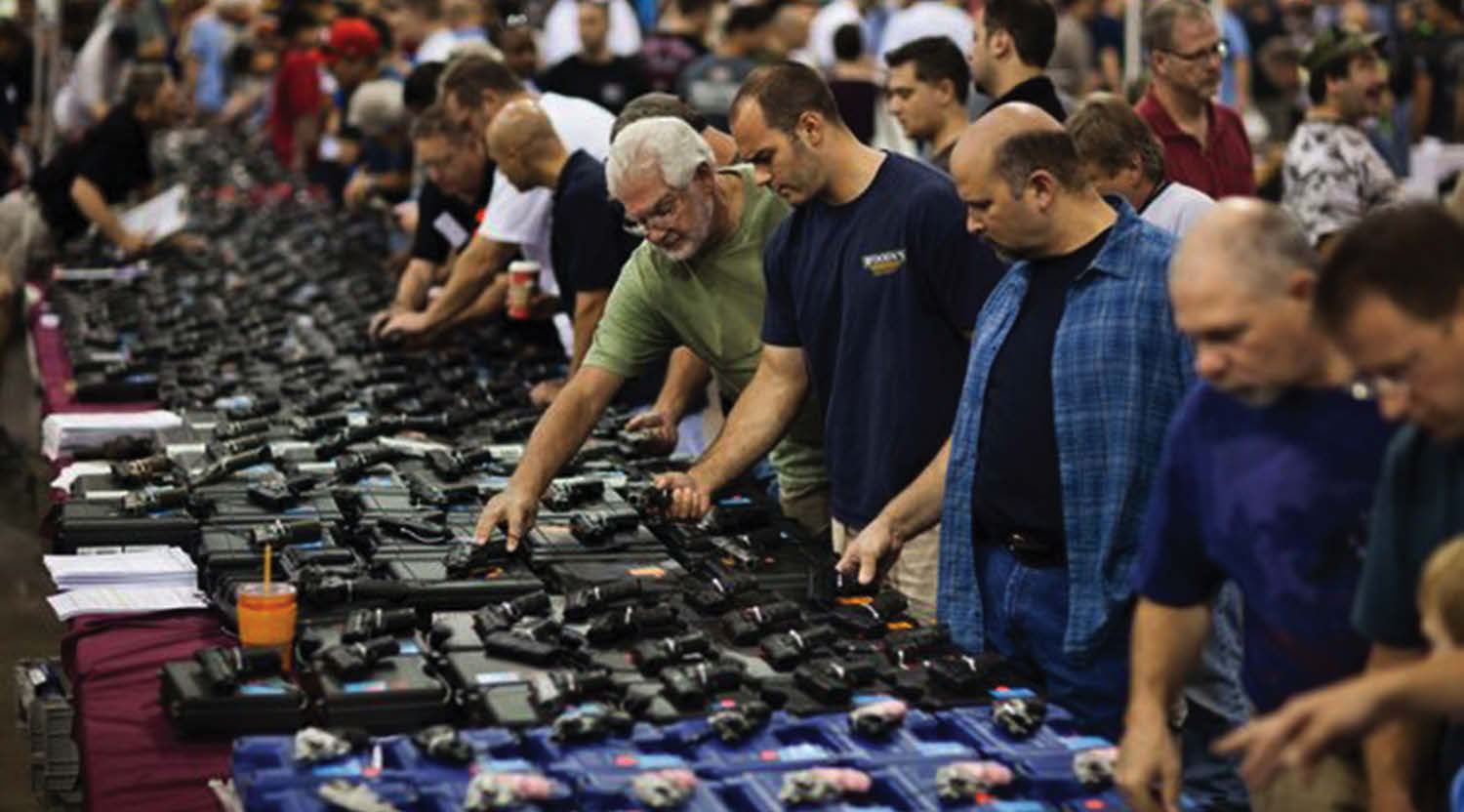
Gun sales in 2015 continued at a blistering pace.
The same day Robert Lewis Dear opened fire at a Planned Parenthood in Colorado Springs, Colorado, killing three and wounding nine, the FBI reported five percent more NICS checks than Black Friday last year, setting an all-time single-day record. If each of those checks resulted in a gun sale, it would means Americans bought enough new firearms to arm every active duty Marine.
8 % of gun owners own a stockpile of 10 or more weapons.
In an online survey of 3,000 people, Harvard’s Injury Control Research Center found that 22 percent of Americans professed to own guns – and 25 percent of those gun owners own five or more guns. The Center’s director, Dr. David Hemenway, told The Trace in October that guns in fewer hands might actually lower rates of gun suicide and accidental shootings. But the fact that these gun owners feel they must compile an arsenal raises another set of questions. “Who are these people and why do they have so, so many guns?” Hemenway asked. “And are they really responsible?”
Tens of thousands more stolen guns entered the illegal market – many a result of theft.
The advisories echoed from sheriffs in Jacksonville, Florida; St. Louis, Missouri; and Lafayette, Louisiana: Lock up your guns. More than 400 firearms were stolen from cars in Duval County, Florida, this year – and 60 percent of those were from unlocked cars. In St. Louis, reports of gun theft were up 70 percent in August, and cars and trucks were targeted far more than homes. A gun stolen out of a car in Lafayette was used to wound a police officer last year, and in Pinellas County, Florida, a gun stolen from an unlocked car was used to kill another officer. Stolen guns, which are increasingly showing up at crime scenes, were called “the engine of violence in Chicago” by police spokesman Anthony Guglielmi in August.
The increase in such thefts has sparked a debate about personal responsibility and gun ownership. The town of Orange, Connecticut, went so far as to charge a resident with misdemeanor reckless endangerment after he reported his loaded .38-caliber revolver stolen from his unlocked truck. Pro-gun advocates argue that stadiums and schools should be removed from gun-free zone designations, so people can carry their guns with them instead of leaving them in their cars. The bottom line, Jacksonville Sheriff Mike Williams said in November, is “be a responsible gun owner, take care of your weapon, lock it up.”
American cities continue to seize illegal guns at an astounding rate.
The Chicago Police Department announced earlier this month that it confiscated 6,521 illegal guns in 2015, which it said works out to one gun every 90 minutes. But Newsweek analyzed the department’s own figures and concluded that it’s been more successful than advertised. “With 335 days so far this year and 6,521 guns removed, that is about 19 guns a day, or about one every 74 minutes,” Polly Mosendz wrote. (In July, Adam Sege conducted a similar audit for The Trace, and determined Chicago Police were removing a gun off the streets every 75 minutes.)
Officers in Little Rock, Arkansas, took 118 guns off the street as of November 2015. Baltimore, Maryland, police estimate that they’ve seized nearly 3,500 illegal guns in the last 12 months.
Tyshawn Lee was the second 9-year-old boy murdered in Chicago in the last 15 months.
The gunshot wounds to his temples had to be sealed with wax. He wore a white tuxedo, red bow tie, white gloves, and red, size 5 gator-skin shoes, and his 25-year-old mother wore a white dress and a red hat to match. Tyshawn Lee was the second 9-year-old boy to be targeted and killed by gangs within the last 15 months in Chicago, and he was lured from a swing set in the Auburn Gresham neighborhood and murdered in an alley because his father allegedly belonged to a gang that may have been involved in the murder of the brother of one of the suspects. Peter Nickeas, the overnight crime reporter at the Chicago Tribune, detailed the days after the boy’s death – during which a battle-hardened city found it still had the capacity for shock.
The 114th Congress is still hesitant to engage with the gun issue.
At a hearing on the third anniversary of the Sandy Hook shooting, California Representative Mike Thompson, chairman of the House Gun Violence Prevention Task Force, noted that Congress has held more than two dozen moments of silence since the massacre – but has not approved any gun safety bills. In March, Thompson, a Democrat, and Representative Peter King of New York, a Republican, introduced a bipartisan bill that would implement background checks on private gun sales. Since then it’s been bouncing from one House subcommittee to another.
This was also the year that saw a backlash against politicians who offer “thought and prayers” after mass shootings but no legislative action. Left-leaning reporters noticed that the same lawmakers who only offered empty platitudes were highly rated by the NRA. On the evening of the San Bernardino shooting, Igor Volsky, a contributing editor at ThinkProgress, began Twitter-shaming them. One by one, he replied to three dozen Republican legislators’ “thoughts and prayers” tweets with the amount they’d been given by the NRA – a total of $12.5 million.
As a home delivery subscriber to The Indian Panorama, you enjoy the convenience and reliability of having the printed newspaper delivered to you first thing in the morning every Saturday.
This incredible offer is available for 2016 at an introductory price of $5 per month (including shipping & handling – US Only). To know more email subscriptions@theindianpanorama.news
Your subscription includes free Digital Access to www.theindianpanorama.news at no additional charge.
Advertise with The Indian Panorama
Place your advertisement or message in The Indian Panorama and let us start delivering your best customers to you.
For advertisers, The Indian Panorama has no rivals. Connect with our Advertising Sales team in order to learn more about who reads TIP and how your brand can connect with our audience.
Our main print coverage is in New York, New Jersey, Connecticut, Dallas / Fort Forth among other major cities of The United States. The Indian Panorama is the 2nd most visited website by NRI’s & Indian Americans for Asian News, Immigration, Diaspora News in the United States much ahead of other newspapers like DesiTalk, NewsIndiaTimes, India Abroad, The Indian Express, South Asian Times etc (Source: Alexa Rankings)
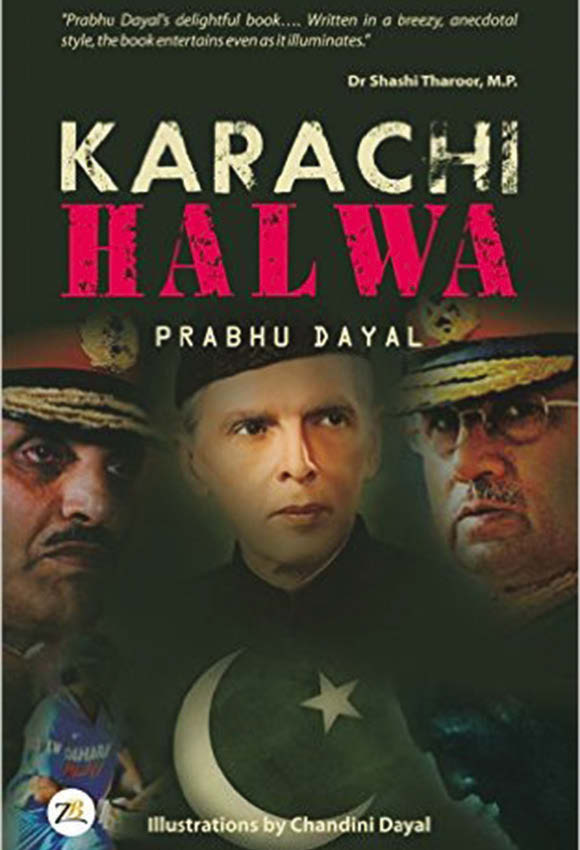
NEW YORK (TIP): Why would Zia want to climb five floors of a hotel? Why did someone think Zia could fix his TV? Was Zia practicing Urine therapy? What did Christopher Lee and Alyque Padamsee have in common?
Ambassador Prabhu Dayal who had a very highly successful diplomatic career as Indian Consul General in New York for five years has penned all his memories of his posting in Pakistan and aptly named the book “Karachi Halwa”.
Karachi Halwa is witty and insightful portrayal of Zia ul Haq’s rule in Pakistan. Ambassador Prabhu Dayal shares his recollections of that period and keeps you laughing throughout his account of the bumpy ride of Pakistan’s domestic politics and its relationship with India. He tells you how a Sahiwal cow was brought into the equation, and where an elephant comes in.
He says, ‘The past, the present and the future are in one continuous motion. Whatever I witnessed in Pakistan during Zia’s rule extends its long shadow not only over the present times but will do so well into the future also’. He poses the ultimate question whether the two South Asian giants can live as friends, offering his own suggestions.’
Ambassador Prabhu Dayal is an illustrious officer of the Indian Foreign Service with a career spanning 37 years. He served in various diplomatic positions in Egypt, Pakistan, Iran and the Permanent Mission to the UN at Geneva before being appointed as Consul General, Dubai in 1994. This was followed by his appointment as Ambassador to Kuwait (1998-2001) and to Morocco
(2004-2008). He also served as Deputy Secretary (Pakistan) and later as Joint Secretary (SAARC).
He was Consul General, New York from 2008 until his retirement in 2013-ranking next in seniority to the Ambassador. From the magnificent heritage building in Manhattan which houses the Consulate General of India, he handled matters relating to 10 US States–New York , New Jersey, Pennsylvania, Ohio, Connecticut, Rhode Island, Massachusetts, Vermont, Maine, New Hampshire. His jurisdiction also included Puerto Rico and the US Virgin Islands.
Having been a student of International Relations at the University of Allahabad, it was perhaps natural for him to opt for the Foreign Service when he stood second in the Order of Merit in the Civil Services Examination. “Nation states have always engaged in warfare and diplomacy” he says, adding “the world needs skillful diplomats more than ever before in history”. He puts his rich experience and intellectual abilities to good use in his first book- ‘Karachi Halwa’. His wife Chandini Dayal has provided illustrations with her deft pen for all the chapters.
‘Karachi Halwa’ is published in India by Zorba Books and kindle books are available online at Amazon. The hard copy version is being sold at a moderate price of Rs.199 on Amazon.in and Flipkart. It is also available on uRead.com, which will deliver worldwide.
In his prologue, Prabhu Dayal says: “My diplomatic career has taken me to several continents, but I must admit that in no country did I feel such an overpowering sense of a common heritage as I did in Pakistan. In both countries, the issues in focus are the ones which divide us. This is of course unfortunate since present day India and Pakistan have existed under similar influences for millennia and have remarkable similarities in a number of areas such as language, literature, art and architecture.
“I found that there was something rather unique about the experience of living amidst my colonial cousins. The warmth and affection which I often received was very moving, and many occasions remain etched in my memory”.
Dayal recalls in his book: “One occasion that I remember fondly was when I wanted to buy a camel-skin lamp and found a shop which had just what I wanted. As I was paying the bill, the elderly shop keeper somehow figured out that I was from India, and asked me as to which city did I hail from. When I told him that I was from Allahabad, he refused to take any money from me as his wife was also from there! Finally, he agreed to let me pay, as long as I would accept two lamps for the price of one”.
“During my stay in Karachi, I met several people who were the very embodiment of sophistication and refinement. Remnants of the legendary ‘Nawabi’ era, they were a charming blend of wealth and culture– poignant reminders of an age that was fast receding into the past, he said.
“Again, there were also many enchanting evenings which I spent at spell-binding concerts of Pakistani maestros or attending mushairas (Urdu poetic symposia) graced by the participation of renowned Pakistani poets. I felt truly enriched by such cultural fiestas.
“Then there were those equally enjoyable evenings which I spent just relaxing in the company of a few close Pakistani friends. These occasions gave me the opportunity to savor the best of Karachi humor, always original though at times, somewhat cynical.
“These and many other memories fill me with sweetness even today. On the other hand, I was often witness to that unabashed lying and duplicity which Pakistani leaders have developed into a fine art. Their pronouncements were often at such variance with ground realities that they were difficult to digest. “Though I embarked on my stint in Karachi with no hint of enthusiasm, the three and a half years which I spent turned out to be unforgettable in several respects and fill me with nostalgia even today after the passage of three decades, he recollects with nostalgia.
Shah Noor, a recent transplant to California from Maryland, was driving through a nearby community one evening with his wife and stopped at a 7-Eleven to get some milk.
A police car pulled up with lights flashing. Officers walked to their car and grilled them for 45 minutes. They were aggressive, he said, and asked what they were doing there, where they work. At one point, he saw the officer put his hand on his gun.
“It was scary,” Noor said. “Pure harassment.”
Police — Noor declined to identify the agency because of an ongoing investigation —cited him for talking on his cell phone while driving. He said the charge is bogus.
“My phone had been dead for over three hours,” said Noor, 32, a lawyer who now runs JS Noor, a jewelry business. And the log on his wife’s cell phone shows no activity during that time.
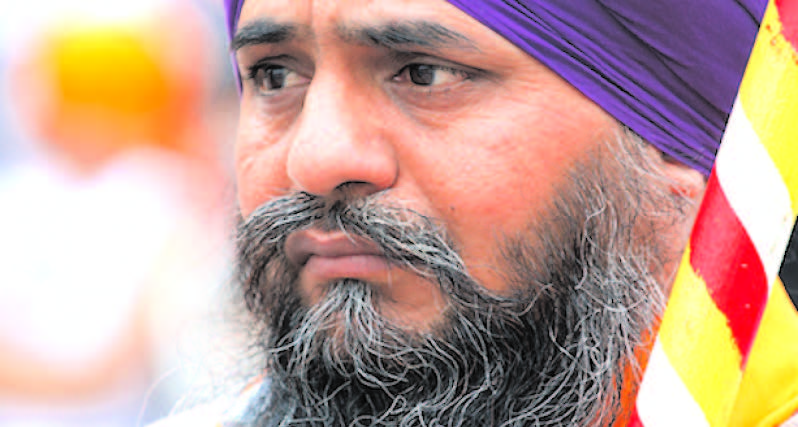
He’s convinced that racial profiling was in play. He wears a turban and has a beard. His wife, Stephanie, is African-American. And all of this happened within days of a mass shooting in San Bernardino carried out by a Muslim couple.
After every attack on U.S. soil committed by Muslims, the backlash seems to increase. But hate crimes don’t target only Muslims.
Noor is originally from India and a Sikh, not an Arab or Muslim.
‘[Sikhism] preaches a message of devotion, remembrance of God at all times, truthful living, equality between all human beings, social justice, while emphatically denouncing superstitions and blind rituals.’ – Sikh Coalition
Since 9/11, Islamophobia has spread and has targeted groups indiscriminately. Sikhs, who wear a turban as an article of faith, have often been mistaken for Muslims in the U.S. They pray at a gurdwara, not a mosque, but a gurdwara in Buena Park, Caifornia, was vandalized days after the San Bernardino shooting. Graffiti sprayed on the façade included the misspelled “Islahm” and an expletive directed at the Islamic State of Iraq and the Levant.
The San Bernardino shooters had apparently been inspired by the group that has been behind horrific violence worldwide, including the Nov. 13 attacks in Paris.
The 20-year-old man arrested for the vandalism issued a public apology to the congregation of Buena Park Gurdwara Singh Sabha, a Sikh house of worship in Orange County.
But other assaults have been more violent. On Sept. 15, 2001, four days after the attacks on the World Trade Center towers, Balbir Singh Sodhi was shot and killed outside of his Mesa, Arizona, gas station by Frank Roque. Roque wanted to “kill a Muslim” in retaliation for the attacks on Sept. 11. Sodhi is considered the first murder victim of post-9/11 backlash. Roque was convicted of first-degree murder and sentenced to life in prison for the hate crime.
The Sikh Coalition was founded by volunteers in 2001 in response to a spate of attacks against Sikh Americans.
“Sikh adults were assaulted, Sikh children were bullied, places of worship were vandalized,” said Arjun Singh, the coalition’s law and policy director. “Terrorist attacks lead to xenophobia and anyone who looks different is targeted, including Sikhs.”
The Sikh Coalition reports a spate of attacks and harassment this month alone.
A Sikh woman traveling to California shortly after the San Bernardino attacks said she had to show her breast pump to airline employees to prove she wasn’t a “terrorist”.
In Grand Rapids, Michigan, a store clerk originally from the state of Punjab in India was shot during an armed robbery. The assailants called the clerk a terrorist.
Five days after the San Bernardino attack, Gian Singh, a 78-year-old grandfather, was walking to pick up his grandson from school in Bakersfield, when a man in a pick-up truck threw an apple at him with such force that the apple split when it hit his head, according to the Sikh Coalition, which is representing him.
‘Sikh adults were assaulted, Sikh children were bullied, places of worship were vandalized. Terrorist attacks lead to xenophobia and anyone who looks different is targeted, including Sikhs.’ – Arjun Singh, law and policy director, Sikh Coalition
There have been Sikhs in the U.S. for more than a century. Many came to build the railroads in the West. There is no accurate data on the number of Sikhs here, and estimates vary widely between 750,000 and 1.6 million, according to the coalition. Almost half of them live in California, the state with the largest Sikh population, but the densest concentration of Sikhs is in the tri-state area of New York, Connecticut and New Jersey.
The Sikh religion is a monotheistic religion that originates in the Punjab region of India. According to the coalition, it “preaches a message of devotion, remembrance of God at all times, truthful living, equality between all human beings, social justice, while emphatically denouncing superstitions and blind rituals.”
“We were shocked after finding out about the graffiti,” said Jaspreet Singh, 40, on the board of the Buena Park gurdwara that was vandalized. “Especially the hate words being used.”
For Sikhs who grew up in the U.S., harassment has been a way of life. For Noor, schoolyard teasing was common but never did he feel so much hatred as after 9/11.
“You feel people don’t like you, like an outsider,” he said. People would call him “Osama” in reference to Osama bin Laden, the founder of Al-Qaeda, the group that claimed responsibility for the 9/11 attacks. They also called him “Taliban,” the armed fundamentalist movement in Afghanistan.
“Sometimes, I would walk up to [the hecklers] and yell back, ‘I’m not a terrorist,’” Noor said.
One time, someone pulled a knife on him in Wheaton, Maryland, a suburb of Washington. Another time, in Amsterdam, people in a car yelled out “bin Laden” at him, he said. When he yelled back, they followed him up an alley. He escaped.
And there was another encounter with police in a Detroit suburb. He had a bracelet in his hand that he was playing with. Police mistook it for a masbaha, Muslim prayer beads. He showed them that it had a cross on it.
“I wear religious symbols of all kinds,” Noor said. “I go to church, to gurdwara, to mosque.”
He has attended service at a Baptist congregation, his wife’s religion.
His cousin, Jaisal Noor, 30, a reporter for The Real News Network, a nonprofit news and documentary service based in Baltimore, wrote about assaults on Sikhs for the 10th anniversary of 9/11.
“The day of 9/11, I was confronted with the reality that things changed,” he said in an interview.
He was in high school when the World Trade Center towers collapsed.
“I remember that day feeling worried for my family, my parents,” he said. His father was a frequent business traveler who encountered a lot of discrimination at airports.
His classmates would rant, “We’re gonna get these A-rabs” but then would turn to him and tell him they had no problem with him because he was Indian.
“But it’s never gone away,” said Jaisal Noor. “Whenever we’re at war, the attacks increase … They see images of turban-wearing men as the enemies.”
Sikhs say their first reaction may be to distance themselves from Muslims and explain to people that they are not Arabs or Muslim. But they stress that no one, Sikh or Muslim or any other religious or ethnic minority, should be targeted.
“Many Sikhs are worried, and rightly so,” said Arjun Singh. “If the bigoted rhetoric continues, hate violence will continue too … Today’s toxic political climate has led to bias, discrimination and hate violence.”
Signup to our Newsletter!
Don’t miss out on all the happenings around the world